Review: The World of Yesterday

Review: The World of Yesterday

The World of YesterdayThe World of Yesterday by Stefan Zweig

My rating: 4 of 5 stars

Memoires often make the best travel books. I began this book in preparation for a short trip to Vienna, and quickly discovered that I had chosen well. Whatever your opinion of Zweig, The World of Yesterday is worth reading simply for the wealth of information it contains. Few history books paint so rich and full a picture of European culture during these transformative years—above all, in Paris, Berlin, and Zweig’s original home of Vienna—from the peaceful span preceding the First World War, to the Indian Summer of the interwar years, to the terrible hardships that led to the second great conflagration.

The last two autobiographies I read were of Benvenuto Cellini (whose beautiful salt-cellar is on display at the Vienna Art History Museum) and Jean-Jacques Rousseau, two very different men alike in their narcissism. Whatever faults Zweig may have had, he was not a narcissist. This is the least personal of autobiographies, almost never mentioning Zweig’s so-called “personal life”—his marriages, private disappointments, and intimate friendships. Instead Zweig focuses his gaze outward, at the world around him, the cultural milieu, the slowly shifting tides of history.

By being so self-effacing, Zweig succeeds in producing a surprisingly insightful look at his world. A delicate, sensitive, and intelligent man, Zweig was extremely well-read, and knew virtually everybody—every famous European, at least—and so was in a uniquely advantageous position to write the history of his times. To give you some idea of his social circle, Zweig knew Sigmund Freud and Salvador Dalí (he even facilitated a meeting between the two when Freud was in London), he met Auguste Rodin, James Joyce, Thomas Mann, H.G. Wells, George Bernard Shaw, and was friends with Richard Strauss, Benedetto Croce, Rainer Marie Rilke, Romain Rolland, and Maxim Gorky, just to name the names that come to mind.

Zweig’s history is largely one of tragic loss, as he repeats again and again. He begins his life in an affluent home, the son of a successful industrialist, in a period of calm stability and cultural efflorescence in Europe. He hones his writing skill, quickly gains success, meets several famous contemporaries, travels and sees the world, and then witnesses the body of European civilization tear itself apart for the flimsiest and most fatuous of reasons during the First World War. The war eventually comes to its bloody end, Austria and then Germany suffer terribly, Zweig meanwhile becomes one of the world’s most famous and most translated authors (although the English never liked him), and then Hitler’s rise begins, forcing Zweig to flee. The book ends just as the Second World War is commencing.

Despite the tragedy that Zweig lived through (and committed suicide during), it is impossible for me not to have life-envy. Here was have a man born into wealth, who had the time and resources to dedicate his whole self to his art, who could travel wherever he pleased whenever he pleased, who achieved instantaneous success seemingly without effort, who was able to meet and befriend all of his contemporary heroes, and who was even wealthy enough to collect manuscripts of his deceased idols—in short, it would be hard to imagine circumstances more favorable to the creation of a writer than those Zweig enjoyed. If you had asked me, before reading this book, to give my prescription for creating a first-class writer, I don’t think the result would be far off.

Yet for all his cultural capital, Zweig does not come across as pretentious or pompous. He is timid, uncharismatic, and even mundane. It is easy to imagine bumping into him on the street. (Though, as Hermann Kesten wrote, the Zweig of reality was far more eccentric than than Zweig of this book.) As a writer, he is skilled, consistent, and accessible. In a word, his prose is fluent: easy to read and digest, even in large doses. He is always interesting and never overpowering, like an excellent dinner guest. The one quality he lacks is humor—a serious deficiency, but not a fatal one. Perhaps the best way to describe Zweig is that he is a sophisticated middle-brow author, which might be why the high-brow world has had trouble accepting him; unlike Milton, Zweig intended to soar a middle flight.

It is hard to criticize Zweig—the champion of European solidarity, whose message is especially important now—who asks so little and never imposes his views. But I must say that he had several blindspots.

First, I think that his narrative of events is deeply colored by his affluence. Zweig—a rich, successful, cosmopolitan intellectual—simply cannot imagine why anyone would do something so insane as to start a war. How is he to travel to Paris or to attend the theater festival in Brussels if men are fighting? His explanation of the conflict—which comes down to thoughtless stupidity—is historically unsatisfactory. And even though I, of course, agree with his anti-war ideals, I couldn’t help thinking that his social status prevented him from understanding why less fortunate people might be dissatisfied with his wonderful world.

More generally, I think that Zweig’s life demonstrates why art should not be made into a religion. Zweig did not only love art, he worshipped it. His intense focus on the objects that artistic geniuses have touched—their manuscripts and notebooks and even their furniture—reminded me of the reliquaries of Catholicism. Every time he introduces one of his famous acquaintances, he writes a mini-hagiography, obsequiously describing even his subject’s face, manners, and expressions, as if artistic skill sanctified one’s mortal frame.

I personally found it all very distasteful—how, for example, Zweig fetishized every item that was in Beethoven’s room when he died. There is nothing intrinsically wrong with this, of course; but it makes it very easy to confuse aesthetic with ethical values. This confusion leads to the kind of political apathy Zweig succumbed to. When the beautiful is all that matters, why worry about tawdry things like social welfare?

Zweig had the attractive, but ultimately vain, notion that he could live aloof from politics. He never mentions anything even remotely political in his fiction; he didn’t even vote. Then he is surprised and dismayed that politics follows him everywhere. Granted, he does have a political stance: he is a pacifist, a humanist, and an internationalist. But this stance is not the product of reasoned consideration; it is the stance that allows him to continue his life as a traveling author unmolested. To steal a phrase from Michael Hoffman’s scorchingly hostile review, he is more a passivist than a pacifist. What Zweig wants from politics, in other words, is what would be necessary for him not to bother with politics.

Now, it is worth asking whether we ought to live in a world where we have no choice but to pay attention to the dreary doings of politicians. Be that as it may, Zweig certainly didn’t have a choice, which led to the irony of this most apolitical of authors structuring his autobiography according to political events.

All these criticisms notwithstanding, I think most people will find here a fundamentally sane, humane, and liberal book. For my part, Zweig supported the right causes, if not always for the right reasons. One thing, however, is left unclear: the relation of this book to Zweig’s suicide. Zweig, along with his wife, ended his own life not long after finishing this book. One might expect this to be his final message to the world; but as the translator notes, it is difficult to read this as a long suicide note. Zweig talks of a future, his future, with more books to write and years to live. The book even ends with a paean to life.

Whatever reason Zweig ended his life, one thing was certain: the Vienna of his youth, the Vienna he so lovingly describes here, is mostly vanished. If I can judge from my short visit, the city is entirely changed: Vienna nowadays is a city of tourism. Instead of the music-loving, critical, and discerning audiences Zweig describes in theaters and concerts, the city is now full of tourists who will pay periwigged salesmen to attend generic Mozart concerts, which run identical programs of greatest-hits that tireless musicians perform nightly. In the streets, English and Chinese are more commonly heard than German. Of course, Vienna is still lovely and full of cultural treasures; but these cultural treasures are of the past now, not the living present.

Did Zweig sense this change coming? Maybe not in so many words, but I think he knew that his world had forever passed into memory. There was no putting Europe back into the same postwar shape after so much destruction and death. That past now exists only in museums, grand old buildings, and books like this.

View all my reviews

Review: Antony and Cleopatra

Review: Antony and Cleopatra

Antony and CleopatraAntony and Cleopatra by William Shakespeare

My rating: 4 of 5 stars

LEPIDUS: What manner o’ thing is your crocodile?

ANTONY: It is shaped, sir, like itself, and is as broad as it hath breadth. It is just so high as it is, and moves with its own organs. It lives by that which nourisheth it, and, the elements once out of it, it transmigrates.

LEPIDUS: What color is it?

ANTONY: Of its own color too.

This is Shakespeare’s most exiting play. The many and rapid changes of scene function like the shaky, shifting camera angles in a Jason Bourne movie: both accelerating the pace, and showing us a variety of perspectives from which to view the action, all the while keeping some angles carefully hidden from view. We see too much and not enough. The play is exhausting to read or watch, a constant torrent of development and action; and yet, by the end, it is terribly difficult to decide what stance to take towards the principle characters.

Antony cuts a poor figure in this play. Unlike the persuasive and savvy politician of Julius Caesar, here he is a bungler past his prime. In this he reminded me most strongly of Macbeth, another ruler who botches everything he tries to do (Antony even botches his own suicide). The two of them are charismatic, independent, and powerful personalities who, nevertheless, are much too susceptible to suggestion. I should say, rather, that they are too apt to ignore good and to follow bad advice. Antony illustrates this even more than Macbeth: all the play long, he is continually waving away his best counselors to follow the unruly impulses of his heart. He has no ability to put aside pleasure for practicality. It is impossible not to sympathize with him—the play would be tedious and dreary if he were totally unsympathetic—but it was, for me, also impossible to root for him.

Octavius is the perfect foil for this passionate hero. I admit that I like Octavius perhaps more than Shakespeare intended. He is so wonderfully efficient and commanding. In every scene he is issuing orders, rapid-fire, and every one of these orders is calculated and shrewd. He takes in all the essential facts of every situation at a glance, and at once his mind hits upon the correct course of action. He is unbending and unrelenting in his pursuit of his goal. Compared with Antony’s agonizing indecision about whether he wants to be a Roman commander or an Egyptian paramour, this is terribly refreshing. There is no question—in my mind at least—that he should and must be the ruler of Rome, since Antony is so manifestly unfit for the role. And yet, for all his single-minded pursuit of his aims, there is an undercurrent of pity and tenderness—his love of his sister and his outrage at her betrayal, and his tears for Antony’s death—that makes him a complete, sympathetic character.

Cleopatra is the most complex character in this play. Like Antony, she is passionate and mercurial; but unlike Antony, there always seems to be a part of herself that is unconquered by her impulses, a more calculating awareness that allows her to cast a spell over everyone in her presence. Like Iago, she is always acting, playing the part of herself, although to what end is not always clear. Unlike Iago, we never see Cleopatra in private, and have no windows into her solitary consciousness. Also unlike Iago, Cleopatra is constantly overwhelmed by her circumstances; the play she is trying to write never goes according to plan, usually thanks to Octavius. Indeed, the only person impervious to her is Octavius, whose cold, stiff demeanor wards off her dramatic performance. That being said, Cleopatra is the only character whom Octavius can neither understand nor conquer. His silver-tongued messengers to her end up getting manipulated, ignored, or conquered themselves (as in the case of Dolabella).

By chance, I watched this play while making my way through Alexandre Kojève’s interpretation of Hegel, much of which focuses on the famous Master-Slave dialectic. Whatever the applicability of Kojève’s thesis to Hegel’s ideas (that’s for another review), it strikes me that this scheme sheds some light on this play. The Master, in Hegel’s famous chapter, is stuck in a paradoxical situation. He craves the recognition of another self-consciousness, and will risk his life for this recognition; and yet his desire leads him to subjugate the Other to the role of Slave, whose recognition cannot satisfy the Master, since the Slave is not supposed to have any perspective whatever.

Now, it seems that Antony and Cleopatra’s erratic and passionate behavior is shaped by this paradox. The two of them are the masters of the world, surrounded by servants and slaves. They command, and are obeyed. But—unlike Octavius, who is comfortable with the role of impersonal master—neither can be satisfied with this obedience. They are bored by it. The two of them do not wish to be recognized simply as “masters,” but as individuals: as Antony and as Cleopatra. Yet this recognition can only come from an equal, from another master: from each other. This is why, in every scene, they always seem to be performing for each other. They are the only suitable audience for each other’s performance, the only audience that can give the satisfaction of individual recognition.

I think this is why critics have disagreed about whether they truly “love” one another. They seem to be using one another, intimately but self-interestedly, to achieve the full feeling of selfhood. They are like two mirrors reflecting each other’s light. This recognition is so vital that they will risk power, fortune, even life itself, only to sustain it one moment longer. Octavius cannot play this role for either of them. He wishes only to be obeyed; his personality, his private feelings and sympathies, are ruthlessly repressed in order to be the ideal master. Likewise, neither Antony nor Cleopatra can give Octavius what he wants: unconditional obedience. Octavius quite literally wants to reduce them to slavery, dragged in chains in a triumphal procession. This would be a fate worse than death for these two actors.

It is only in the final act, after Antony’s death, that Cleopatra seems to discover that she does not need Antony: she can be an audience to herself, she can recognize her own individuality. This is what makes her performance in Act V so overwhelming. She emerges from the circumstances that constantly thwart her plans, she breaks free of the need to be seen to feel complete. At this moment, the only action which will preserve her autonomy and her individuality is her self-destruction, since Octavius will reduce her to the level of a trophy if she allows herself to live. Her death is not wholly tragic, therefore, but has the pathos of self-transcendence.

Then Octavius strides in, and true to form he begins issuing orders for their burial and mourning. (I wonder what percentage of his lines are direct orders.) This is the play’s emotionally ambiguous end. We miss the passionate intensity of Antony and Cleopatra. Octavius may be compelling in his way, but he is certainly not charismatic. And yet we can’t helping feeling—or I can’t, at least—that the self-destructive, wasteful, and egotistical love affair between these two mortal gods had to end, for the world’s sake if not for theirs.

View all my reviews

Review: Introduction to the Reading of Hegel

Review: Introduction to the Reading of Hegel

Introduction to the Reading of Hegel: Lectures on the Phenomenology of SpiritIntroduction to the Reading of Hegel: Lectures on the Phenomenology of Spirit by Alexandre Kojève

My rating: 2 of 5 stars

Generally speaking, there is a tendency to underestimate the difficulties of satisfaction and to overestimate those of omniscience.

Alexandre Kojève is easily one of the most influential thinkers of the last century. This is peculiar, considering that his reputation rests mainly on his interpretation of Hegel, an interpretation which he developed and propounded in a series of lectures in 1933-39. Many who attended these lectures—Maurice Merleau-Ponty and Jacques Lacan, to name just two—went on to be important intellectuals in their own right, reinterpreting Kojève’s ideas for their own purposes.

Kojève’s thinking extended beyond the lecture hall, shaping his whole intellectual milieu—deeply affecting Sartre, who may never have attended the lectures—and even extended to the United States. This was largely thanks to Leo Strauss, who sent his disciples to study under Kojève. One of these disciples was Allan Bloom—of The Closing of the American Mind fame—and, in turn, Bloom taught Francis Fukuyama, who heavily relied on Kojève for his controversial bestseller, The End of History and the Last Man. Once again, Kojève was influential.

It is too bad, then, that I found his most famous book to be of little merit. Frankly, I failed to see anything of serious interest in these pages: either as textual interpretation or as philosophy. Admittedly, the former did not surprise me. By common consent Kojève was a heterodox interpreter of Hegel, mixing Hegel’s ideas with those of Marx, Nietzsche, and Heidegger to create something quite different from what Hegel intended (whatever that was). But I did not expect this book to be so devoid of intellectual interest. Indeed, I am somewhat at a loss as to why or how it became so influential.

For one, Kojève’s writing style will be irksome to any who prize clarity and concision. He is boorishly repetitious, persistently vague, and pompously obscure. Every other word—when it isn’t an unnecessary foreign expression—is capitalized, italicized, wrapped in scare-quotes, or set aside in parentheses, as if simple words and commas were not enough to convey his subtle message. Meanwhile, his meaning, stripped of its pretentious shell, is either a banal truism, nonsense, or obviously wrong. This, by the way, is so often the case with turgid writers that I have grown to be deeply suspicious of all obscurity. In academic circles, dense prose is easily self-serving.

I cannot make these accusations without some demonstration. Here is Kojève on work: “Work is Time, and that is why it necessarily exists in time: it requires time.” Or Kojève on being: “Concrete (revealed) real Being is neither (pure) Identity (which is Being, Sein) nor (pure) Negativity (which is Nothingness, Nichts) but Totality (which is Becoming, Werden).” Another insight on the nature of existence:

One can say, then, that Being is the being of the concept “Being.” And that is why Being which is (in the Present) can be “conceived of” or revealed by the Concept. Or, more exactly, Being is conceived of at “each instant” of its being. Or else, again: Being is not only Being, but also Truth—that is, the adequation of the Concept and Being. This is simple.

Very simple.

As I said above, Kojève’s interpretation of Hegel is distinctly implausible. Kojève sees the Master-Slave dialectic as the key to Hegel’s whole system, whereas it is only one stage in Hegel’s Phenomenology, and Hegel does not frequently refer back to it. This focus on the issue of subjection, alienation, recognition, and work allows Kojève to read Hegel as a quasi-Marxist. Kojève also has lots of things to say about space, time, mortality, and freedom, most of which is derived from Heidegger and which are totally alien from Hegel’s thought. Kojève’s originality is not in any ideas unique to him, but to the conglomeration of these German philosophers that he conveys in these lectures.

I found all this to be academically slipshod. The attempt to make Hegel into a quasi-existentialist, deriving freedom from the cognizance of death, is especially unconvincing: Hegel was anything but an existentialist. Generally speaking there are not nearly enough citations of Hegel, nor is there any discussion whatever of Hegel’s background, development, or intellectual influences. Thus as an introduction to Hegel, the text is basically useless.

Even more intellectually irresponsible is his habit of deferring to Hegel’s text right when any argument is necessary. Statements like these are common: “Once more, I am not concerned with reproducing this deduction here, which is given in the entirety of the first seven chapters of the Phenomenology. But I shall say that it is irrefutable.” He does this quite often, merely asserting something and than insisting that, to prove it, one must read and understand the whole Phenomenology of Spirit. (This habit of deferring to infallible texts, by the way, is a typical move in religious arguments, and has no place in philosophy.) As a result, this book is one bloated series of unfounded assertions—seldom citing the text or providing anything resembling an argument—which makes it worse than useless.

Now, in case you think I am being overly harsh, let me quote one section where he does seem to be making an argument:

Let us consider a real table. This is not a Table ‘in general,’ nor just any table, but always this concrete table right here. Now, when ‘naive’ man or a representative of some science or other speaks of this table, he isolates it from the rest of the universe: he speaks of this table, without speaking of what is not this table. Now, this table does not float in empty space. It is on this floor, in this room, in this house, in this place on Earth, which Earth is at a determined distance from the Sun, which has a determined place within the galaxy, etc., etc. To speak of this table without speaking of the rest, then, is to abstract from this rest, which in fact is just as real and concrete as this table itself. To speak of this table without speaking of the whole of the Universe which implies it, or likewise to speak of this Universe without speaking of this table which is implied in it, is therefore to speak of an abstraction and not of a concrete reality.

This argument is part of Kojève’s general thesis that only holistic knowledge (which he calls “circular”) is true “Knowledge.” Putting aside the dreary, bombastic pointing out of the obvious, this passage, insofar as it makes any point at all, is obviously incorrect. Kojève is saying that it is impossible to refer to concrete reality without having a complete, total knowledge (knowing everything about the table involves knowing everything about everything). This is false. To show this, as well as to demonstrate that philosophy need not always be written so badly, I will quote Bertrand Russell:

The fact is that, in order to use the word ‘John’ correctly, I do not need to know all about John, but only enough to recognize him. No doubt he has relations, near and remote, with everything in the universe, but he can be spoken of truly without taking them into account, except such as are the direct subject-matter of what is being said. He may be the father of Jemima as well as James, but it is not necessary for me to know this in order to know that he is the father of James.

Now, if this book were truly as devoid of value as I am making it out to be, it would lead to the question of how it became to popular and influential. Well, I can only guess. Perhaps Kojève’s dazzling obscurity, along with his sexy combination of the works of Marx and Heidegger—the two most influential thinkers in France at that time—allowed him to touch the Zeitgeist, so to speak. The attempt to reconcile a philosophical understanding of freedom and death (taken from Heidegger) with an understanding of oppression, historical progress, and work (taken from Marx and ultimately Hegel), may have given Kojève’s students an exciting impetus in the hectic days after the Second World War, when Europe was busy rebuilding itself. To any Kojève enthusiasts out there, please do let me know what you see in him. I remain blind.

View all my reviews

Review: A Time of Gifts

Review: A Time of Gifts

A Time of GiftsA Time of Gifts by Patrick Leigh Fermor

My rating: 3 of 5 stars

When I began this book, I fully expected to join the universal chorus of praise. The premise of this book could hardly be more promising: a naïve, bookish nineteen-year-old decides to walk from Holland all the way to Constantinople. We have here all the makings of a literary adventure: an author sensitive enough to language and art to appreciate the finer points of culture, and impetuous enough to get into scraps and misadventures. The only book I can think of that holds comparable promise is Gerald Brenan’s South From Granada, which begins, similarly enough, with the young, bookish Brenan settling down in the south of Spain to read Spinoza.

Well, to get straight to the point, even by the end of the introduction I found myself disappointed. This was surprising. At first I thought I was misinterpreting my own feelings. The book had everything I expected: fine prose, snippets of culture and history, a few youthful misdeeds here and there. Why the persistent feeling of letdown? Is it me? But in the end, true to form, I have decided that my instincts are not misfiring, and that this book is not quite the masterpiece it has been made out to be.

To me, Leigh Fermor is the epitome of superficial learning. No doubt he is well-educated. His vocabulary is vast; he has a solid grasp of art history and a fine appreciation of architecture; he can speak and read several languages; his knowledge of English poetry borders on encyclopedic. And yet all this learning functions, in him, as the feathers in a peacock’s tail: as a bright, beautiful, and at times intimidating display—but a mere display, nonetheless. Leigh Fermor deploys recondite words, the names of painters and poets, and the weighty facts of history, neither to express deep sentiment nor to communicate insights, but as mere ornament.

George Elliot both anticipated and perfectly summed up Leigh Fermor in Middlemarch, in the character of Will Ladislaw—another young Englishman with vague literary and artistic ambitions who travels to the continent to bask in the culture: “rambling in Italy sketching plans for several dramas, trying prose and finding it too jejune, trying verse and finding it too artificial, beginning to copy ‘bits’ from old pictures, leaving off because they were ‘no good,’ and observing that, after all, self-culture was the principal point.” This description fits Leigh Fermor to a T—the total aimlessness, the nebulous hopes of someday writing a book, the amateurish sketching that Leigh Fermor himself is careful to denigrate.

I admit that I am lobbing these accusations at Leigh Fermor with an uneasy conscience, because in so many ways he is leaps and bounds more learned and eloquent than I am. Yet to misuse one’s gifts seems more culpable than not having gifts in the first place. But let me stop being vague. Consider this passage from the beginning, right when the writer is setting out and saying goodbye to his loved ones:

Haste and the weather cut short our farewells and our embraces and I sped down the gangway clutching my rucksack and my stick while the others dashed back to the steps—four sodden trouser-legs and two high heels skipping across the puddles—and up them to the waiting taxi; and half a minute later there they were, high over head on the balustrade of the bridge, craning and waving from the cast-iron quatrefoils.

While I like certain aspects of this sentence—specifically the bit about soggy trouser legs and puddles—the final effect is unpleasant and false. First is the curiously passive construction in the beginning, giving agency to haste rather than people; and the ending focus on cast-iron quatrefoils is emotionally leaden (he isn’t thinking about his family?), and implausible (is this really what the young Leigh Fermor was focusing on in that moment?), and, in sum, strikes me as a purely pedantic inclusion—a word used because he knew it and not because it fit.

This tendency to use words just because he knows them often spoils Leigh Fermor’s prose for me. I grant that his verbal facility is extraordinary. But to what purpose? He is like a virtuoso jazz pianist who shows off his chops in every solo, even on the ballads, without tact or taste. This comes out most clearly in his architectural passages:

The archway at the top of these shallow steps, avoiding the threatened anticlimax of a flattened ogee, deviated in two round-topped lobes on either side with a right-angeled central cleft slashed deep between the cusps. There had been days, I was told, when horsemen on the way to the indoor lists rode in full armour up these steps: lobster-clad riders slipping and clattering as they stooped their ostriche-plumes under a freak doorway, gingerly carrying their lances at the trail to keep their bright paint that spiraled them unchipped. But in King Vladislav’s vast Hall of Homage the ribs of the vaulting had further to travel, higher to soar. Springing close from the floor from reversed and bisected cones, they sailed aloft curving and spreading across the wide arch of the ceiling: parting, crossing, re-joining, and—once again—enclosing those slim subdivided tulips as they climbed.

Aside from illustrating his penchant for refined obscurity, the bit about the horseman with lances in full armor exemplifies another irksome quality of Leigh Fermor: his romanticism. He seems totally uninterested in actually learning about what he sees. Like Byron, he treats the cathedrals, castles, and local history solely as food for his imagination. The closest thing to a real investigation in these pages is his attempt to explain why, in A Winter’s Tale, Shakespeare speaks of Bohemia, a landlocked country, having a “coast.” This line of questioning is somewhat amusing, sure, but also captures Leigh Fermor’s mentality: there he is, in a foreign land, and the question he occupies himself with is how a dead English playwright made a geographical error—a question of scant literary or historical value, a meaningless curiosity.

His tendency to fetishize learning and his romanticism are, I think, both symptoms of a deeper malady: the habit of looking at only the surface of things. Or, to put this another way, the exclusive preference for the specific at the expense of the general.

To be just, Leigh Fermor is marvelous when it comes to surfaces and particularities. He seems to notice every small, fleeting detail of everything he sees: buildings, cities, people, sunsets, landscapes. His love of strange words and foreign phrases fits equally well with this wont—the verbal flavor of an unusual term more important to him than its ability to communicate meaning. Leigh Fermor’s propensity to drown in an ecstasy of aesthetic observation—rendered in gloriously profuse prose—often reminded me of Walter Pater’s similar flights. But even Pater, an extreme aesthete, is not as wholly superficial as Leigh Fermor—who seems entirely incapable of holding abstract ideas in his mind.

Now, I am being rather unduly harsh towards a book that is generally good-natured and light-hearted. Partly this hostility comes from defensiveness: If I am to accuse someone as highly respected as Leigh Fermor of writing badly, I must make a strong case. As the final exhibit in my prosecution, I include this snippet of a description from a bar in Munich:

The vaults of the great chamber faded into infinity through blue strata of smoke. Hobnails grated, mugs clashed and the combined smell of beer and bodies and old clothes and farmyards sprang at the newcomer. I squeezed in at a table full of peasants, and was soon lifting one of those masskrugs to my lips. It was heavier than a brace of iron dumb-bells, but the blond beer inside was cool and marvelous, a brooding, cylindrical litre of Teutonic myth.

To my ears, this is just painfully overwritten. Including infinity and blue strata and iron dumb-bells in a simple bar scene is too much. And the final touch of calling a glass of beer a “brooding, cylindrical litre of Teutonic myth”—besides being a nonsensical image—is yet another example of his adolescent imagination: he can hardly touch anything German without his fantasy flying off into legendary knights and Germanic sagas. There is something to be said for enlivening a regular scene using colorful language; but there is also something to be said for honest description.

Now, despite all this, was I often astounded by Leigh Fermor’s diction and his fluency? Yes I was. Did I enjoy some parts of this travel book? Undeniably I did—particularly the section where he is taken in by the German girls. Do I think Leigh Fermor is insufferable? Often, yes, but he can also be charming and winsomely jejune. But did I learn something about the places he traveled to? I’m honestly not sure I did; and that, more than anything, is why I felt the necessity to write in opposition to the famous travel-writer.

View all my reviews

Review: Saldavor Dali

Review: Saldavor Dali

Salvador Dalí: las obras de su vidaSalvador Dalí: las obras de su vida by Nicolas Palmisano
My rating: 3 of 5 stars

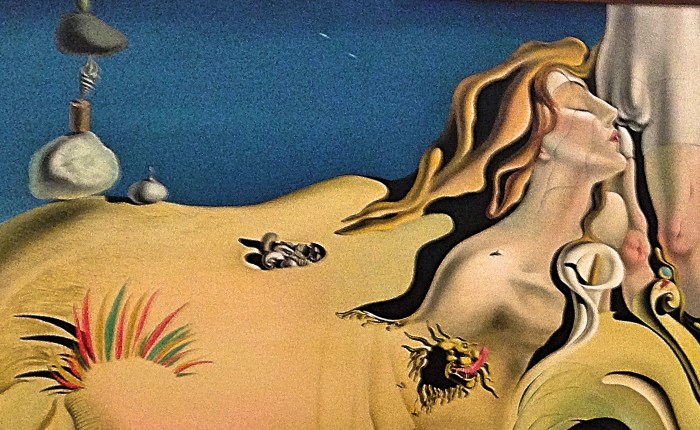
Salvador Dalí is one of the few visual artists of the twentieth century with truly popular appeal. Granted, this probably had as much to do with his moustache and his antics as with his work. But his work is undoubtedly popular. You do not need to be an art history major to appreciate The Great Masturbator, for example; even the title is enough to produce snickers in middle school students. The Dalí Museum in Figueres, Catalonia—which Dalí created himself in an old theater during the last few years of his life—is the second-most visited museum in Spain, after the Prado in Madrid; and this is especially impressive, considering that Figueres is a small town, not very close to Barcelona or any other major city.

This book is one of those omnipresent omnibus collections of artists’ works, cheap enough for tourists to buy on a whim, portable enough for tourists to stuff in their rucksacks. For what it is, it’s done well: full of glossy, high-quality pictures of Dalí’s major works, with some basic biographical information. There’s nothing in this book that you couldn’t find online—the biography on Wikipedia is fuller than the one here—but having a physical copy of an artist’s work, even a cheap one, is undeniably appealing.

As many have noted, the striking thing about Dalí—which is true, although in a different way, of Gaudí—is the combination of radical innovation and extreme conservatism. Dalí was kicked out of his academy; his surrealism was avant-garde; and his lifestyle anything but traditional. Not only that, but he pioneered the role of the zany artist in the 20th century, making media appearances in bizarre getups. And yet, for all this, he was a genuinely religious man, reconciled himself enough with Franco’s reign to move back to Spain, and thought of himself as a Renaissance man in the tradition of Leonardo da Vinci.

It is worth noting that many other great artists and thinkers have exhibited this tension in different ways—Joyce, Stravinsky, even Marx—and, indeed, the desire to place oneself firmly within a tradition, while reserving the artistic right to innovate upon that tradition, strikes me as the defining mark of great geniuses. Only lesser artists see innovation and tradition as antithetical.

Dalí’s tension of traditional and experimental is illustrated in his particular brand of surrealism: the use of careful draughtsmanship to realistically render fantastical scenes. The solidity of Dalí’s paintings, achieved using familiar, traditional technique, is why his work has become so popular, I think. Nobody can accuse Dalí of drawing like a child. Unlike many works in contemporary galleries, his paintings are as visually engaging as any special effects-laden movie. Like the works of Hieronymous Bosch—an obvious precursor—Dalí’s paintings are so full of detail and bizarre images that they always entertain, even if their symbolic meaning escapes the viewer.

One thing this book did allow me to see is the remarkable consistency in Dalí’s work over the years. From his beginnings, before he was even comfortable calling himself a surrealist, to well after he was thrown out of the surrealist group and began interesting himself in Catholicism and quantum physics, the same clear aesthetic sensibility pervades his entire oeuvre. This is the reason for the oft-repeated accusation that he was an artistic one-trick pony. While there is some justice in this, as well as in the accusation that his publicity stunts trivialized his work, I think Dalí is easily one of the greatest painters of the last century. His works seldom have a great emotional impact; indeed, sometimes they produce only slightly amused nods. But he was a visual genius: there is no unseeing a work of Dalí, nor mistaking it for another person’s work. And unforgetability is, I think, the ultimate test of any artist.

View all my reviews

Review: The History of England

Review: The History of England

The History of EnglandThe History of England by Thomas Babington Macaulay
My rating: 4 of 5 stars

A traveler must be freed from all apprehension of being murdered or starved before he can be charmed by the bold outlines and rich tints of the hills.

Sir Thomas James Babington Macaulay, Baron of Rothley—more commonly known as Lord Macaulay—is yet another of those creatures of former ages who could fill volume after volume with excellent prose, seemingly without effort. He wrote reams: this work itself, in the original, runs to five volumes. And everything he wrote—from poems to essays, from speeches to history—was both instantly successful in his day and still remains a model of force and clarity. The power of his style is why Macaulay is most frequently cited nowadays. He is the only English historian (except perhaps David Hume) whose writing can be mentioned in the same breath as Edward Gibbon; indeed the two of them are grouped together as models of elegance, in much the same way as were Demosthenes and Cicero.

Brilliant stylists they both were; but quite different in their brilliance. Gibbon is stately, while Macaulay is luminescent. To borrow a phrase from Tocqueville, Gibbon tried to see history from God’s point of view: as a pure spectator, a neutral observer, emotionally unmoved but intellectually engaged. Macaulay imitated the more dramatic styles of Thucydides and Tacitus, narrating history as an enormous spectacle with heroes and villains. Here he is describing the fate of the Scottish colony of Caledonia during the failed Darien scheme:

The alacrity which is the effect of hope, the strength which is the effect of union, were alike wanting to the little community. From the councilors down to the humblest settlers all was despondency and discontent. The stock of provisions was scanty. The stewards embezzled a great part of it. The rations were small; and soon there was a cry that they were unfairly distributed. Factions were formed. Plots were laid. One ringleader of the malcontents was hanged.

Macaulay’s punchy, declarative sentences have an overwhelming effect when piled atop one another in cumulative description. Indeed, Macaulay never simply describes: he dramatizes. He pays at least as much attention to the emotional effect of his words as their literal accuracy. Granted, Macaulay is seldom as quotable or as graceful as Gibbon; but he is leaps and bounds more exciting to read.

This difference in style, as often happens, mirrors a difference in attitude. Gibbon had his fair share of prejudices, but he was not partisan. Macaulay is partisanship incarnate. He is largely responsible for popularizing what is commonly called Whig History. This is the thesis that sees English history as “the history of physical, of moral, and of intellectual improvement” caused by political reform. This thesis became historical orthodoxy for a time, until, like all orthodoxies, it bred a heresy that became the new orthodoxy.

Nowadays the idea that history is a grand progress from barbarism to civilization will strike many as terribly simplistic, mostly wrong, and nauseatingly complacent. After two world wars and the atom bomb, we are apt to view any suggestions of progress with skepticism. Nevertheless, to condemn Macaulay’s perspective for being old-fashioned would be to forget, what Hugh Trevor-Roper reminds us in the introduction, that the “severest critics themselves are generally unaware of the extent to which they depend on the achievement of their victim.”

The terms ‘Whig’ and ‘Tory’ appear with great frequency both within the book and in discussions of Macaulay; and yet these political positions can be bewildering for a non-British reader. This is in keeping with the general Britishness of this book. Macaulay’s history is a national history; it is a book written for Brits. For any British reader, I suspect this book will excite some strong emotions, positive or negative. For me it appealed mainly to my anthropological curiosity.

In fairness, Macaulay’s conception of Great Britain is wide enough to include Scotland and Ireland. And although this book is full of shocking insults against the Scots and the Irish (as a prophet of progress, Macaulay sees Scotland and Ireland during this time as hopelessly backward), Macaulay’s history was nevertheless important—or so says Hugh Trevor-Roper in the introduction—for treating those two realms as of integral importance to British history.

As Trevor-Roper also points out, Macaulay’s partisanship expresses itself most damagingly in his dealings with individuals. Macaulay is not an acute psychologist. He occasionally breaks off the narrative to engage in a lengthy description of some figure—such as his unforgettable portrait of George Jeffreys—but these descriptions are inevitably either philippics or eulogies. There are no memorable personalities in these pages; only flat heroes and villains. This tendency to choose good guys and bad guys often led Macaulay into errors or even chicanery. He deliberately misrepresents the evidence to blacken William Penn’s name, while going so far as to assert that “extirpate” is commonly understood to mean “disarm” rather than “eliminate” in order to clear William of the Glencoe Massacre.

Purists may have some misgivings about reading this abridgement. For me, I see abridgements like this as an ideal place to begin reading: it gives you a decent overview of the whole work, and allows you to decide if you’d like to commit to five volumes. Trevor-Roper did an excellent job with this edition, giving a satisfying overview of the narrative arc, providing the necessary connections between the missing parts, as well as enlivening the experience with his own cutting commentary. As a writer, Trevor-Roper is fully within the Macaulay school: sharp, direct, and unmerciful. The book is full of footnotes pointing out where Macaulay is erring or being underhanded. The introduction, too, is unsparing: “[Macaulay’s] descriptions of art, architecture, music are of a frigid, conventional pomposity if they are not positively absurd.”

To my surprise, I found this period of time to be relevant to contemporary American politics. James II—a bumbling, petty, egotistical monarch in league with a foreign ruler—couldn’t help but remind me of Trump’s Russia affair. The way that James would fill government posts with cronies, or would try to circumvent long-held traditions by browbeating his subjects in personal interviews, was eerily similar to what James Comey describes in his statement. Macaulay’s sections on the National Debt and the partisan squabbles between Tories and Whigs were also astoundingly applicable. This is curious, if not exactly meaningful.

Hopefully one day I will have the time and inclination to read the unabridged version of this masterpiece. Until then, I can say that Macaulay’s reputation is well deserved: as a stylist, and as a partisan.

View all my reviews

Review: Stoic Pragmatism

Review: Stoic Pragmatism

Stoic PragmatismStoic Pragmatism by John Lachs
My rating: 3 of 5 stars

The questions of philosophy will continue to haunt us so long as we remain finite, baffled animals. The fact that philosophy offers no final answers is not an impediment but a lesson. That first great lesson of philosophy is that we must learn to live with uncertainty.

Since it’s that time of year, I’ve lately been seeing many of my friends—struggling artists, mostly—reposting graduation speeches by famous actors, musicians, entrepreneurs, and other celebrities. So many of these communal pep talks boil down to one message: persist. Every artist worth her salt has a story about how they struggled in the purgatory of unsuccessful oblivion for ten centuries—eating ramen and living in a closet—before finally ascending to the paradise of fame. Jonathan Goldsmith, for example—now famous as the Most Interesting Man Alive for the Dos Equis ads—was an obscure actor for over forty years before his “breakout” role.

But success stories and inspiring graduation speeches all have one obvious, debilitating shortcoming: survivor bias. Of course, every successful person was once unsuccessful and then became successful; so for them hard work paid off. But the vital question is not whether hard work ever pays off, but how often, and for whom? History has been the silent witness of generations of brilliant musicians and talented actors who remained obscure all their lives. The world is simply stuffed with artists of all kinds, many mediocre, but a fair number extremely talented—far more than will ever be able to support themselves in comfort with their craft. The plain fact is that, even if every budding artist in those ceremonies follows the advice to persist, not even half will achieve anything close to the level of success as the person on the podium.

And, indeed, even if there is an appealing wisdom in carrying on in the teeth of disappointment and failure, there is also a wisdom in throwing in the towel. Better to cut your losses and do something else, rather than struggle pointlessly for years on end. The real difficulty, though, is knowing which choice to make. What if you give up right when you’re on the cusp of a breakthrough? Or what if you persist for years and get nowhere? And this isn’t just a question for young artists; it is one of the basic questions of life. I recently encountered it in the philosophy of science: When should a hypothesis be abandoned or pursued? An overly tractable scientist may give up on a truly promising theory with the first hint of difficulty; and an overly stubborn scientist may spend a career working on a bankrupt idea, in the vain hope of making it work.

Seeking an analysis of this dilemma, I picked up John Lachs’s book, Stoic Pragmatism, which explicitly promises to address just this question. Lachs is attempting here to combine the pragmatist doctrine that we must improve the world with the stoic resignation to the inevitable. Unfortunately, he does not get any further than noting what I hope is obvious—that we should improve what we can and resign ourselves to what we can’t change. This is true; but of course we very often have no idea what we can or can’t change, what will or won’t work, whether we’ll be successful or not, which leaves us in the same baffled place we started. Insofar as truly answering this question would require knowing the future, it is unanswerable. Uncertainty about success and the need to commit to potentially doomed actions are inescapable elements of our existential situation. The best we can hope for, I think, are a few good rules of thumb; and these will likely depend on personal preference.

In any case, this book is far more than an analysis of this common dilemma, but an attempt to give a complete picture of Lachs’s philosophical perspective. Lachs promises a new philosophical system, but delivers only a disorganized gallimaufry of opinions that do not cohere. For example, Lachs begins by denigrating the professionalization of philosophy, holding that philosophy is not a discipline that seeks the truth—he asserts that not a single proposition would command assent by the majority of practitioners (though I disagree!)—rather, philosophy is better thought of as intellectual training that helps us to make sense of other activities. But the book includes lengthy analyses of ethics, ontology, and epistemology, so apparently Lachs does see the value in answering the traditional problems of philosophy. To make matters worse, Lachs continually excoriates philosophers who do not practice what they preach; and then he goes on to outline an ethical system wholly compatible with a middle-class, bourgeois lifestyle (our main obligations are to do our jobs and to leave other people alone, it seems).

I am being unfairly satirical. I actually agree with most of what Lachs says; and this of course means I must make fun of him. (According to the “Lotz Theory of Agreement” no intellectual will permit herself to simply agree with another intellectual, but will search out any small point of difference, even a difference in attitude or emphasis, in order to seem superior.) Lachs is an inspiring example of an academic trying to address himself to broader problems using more accessible language. He is an attractive thinker and a skilled writer, a humane intellectual capable of fine prose.

Nevertheless, I must admit that this book makes me despair a little. Here we have a man explicitly and repeatedly repudiating his profession and trying to write for non-specialists; and yet Lachs is so palpably an academic that he simply cannot do it. The book begins with his opinions about the canonical philosophers, frequently breaks off to criticize fellow professors and intellectual movements, and includes academic controversies (such as how to interpret Santayana’s use of the word “matter” in his ontological work) of no interest to a general reader. Lachs tries to come up with an ethical system that he can follow himself as an example of a committed intellectual, and then ends up creating an ethical system with no obligations other than to do one’s job (which, in his case, consists of writing books and advising graduate students). Lachs’s primary example of committed moral action, to which he returns again and again, is signing a petition to remove the president of his university (and he notes that most of his colleagues refused to do even this!).

I am being unduly harsh on Lachs. Really, he is one of the very best examples of what academics can and should do to engage with the world around them. And yet his example demonstrates, to me, the enormous gap that separates academia from the rest of society. Lachs dwells again and again on the pointless abstractions of professional philosophers and the wisdom of everyday people, and then the next moment he launches into an analysis of the concept of the individual in the metaphysics of Josiah Royce—Royce, someone who not even most professional philosophers are interested in, much less the general public—and all this in the context of a book that emphasizes self-consistency over and over again.

This makes me sad, because I think we really do need more intellectuals in the public sphere, intellectuals who are capable of communicating clearly and elegantly to non-specialists about problems of wide interest. And yet our age seems to be conspicuously bereft of anyone resembling a public intellectual. Yes, we have popularizers, but that’s a different thing entirely.

Seeking an answer to this absence, I usually return to the model of specialization in the university.

To get a doctorate, you need to write a dissertation on something, usually a topic of excessive, often ludicrous specificity—the upper-arm tattoos of Taiwanese sailors, the arrangement of furniture inside French colonial homes in North Africa in the 1890s, and so on. This model originated in German research universities, I believe; and indeed it makes perfect sense for many disciplines, particularly the natural sciences. But I do not think this model is at all suited to the humanities, where seeing human things in a wide context is so important. This is not to deny that specialized research can make valuable contributions in the humanities—indeed, I think it is necessary, especially in fields like history—but I do not think it should be the only, or even the dominant, pattern for academics in the humanities.

If I can put forward my own very modest proposal in this review, it would be the creation of another class of academic—let’s call them “scholars”—who would focus, not on specialized research, but on general coverage in several related fields (I’m thinking specifically of philosophy, literature, and history, but this is just one possibility). These scholars would be mainly responsible for teaching courses, not publishing research; and this would give them an incentive to communicate to undergraduates, and by extension the general public, rather than to disappear into arcane regions of the inky night.

These scholars could also be responsible for writing reviews and critiques of research. Their more general knowledge might make them more capable of seeing connections between fields; and by acting as gatekeepers to publication (in the form of a reviewer), they could serve as a check on the groupthink, and also the lack of accountability, that can prevail within a discipline where sometimes research is so obscure that nobody outside the community can adequately judge it (thus proving a shield to shoddy work).

I’m sure my own proposal is impractical, has already been tried, is already widespread, or just plain bad, and so on. (Even if you agree with it, the Lotz Theory of Agreement will apply.) But whatever the solution, I think it is a palpable and growing problem that there is so much intellectual work—especially in the humanities, where there is far less excuse for unintelligibility and sterile specialization—that is totally disconnected with the wider society, and is unreadable and uninteresting to most people, even well-educated people. We simply cannot have a functioning society where intellectuals only talk to each other in their own special language. Lachs, to his credit, is doing his best to break this pattern. But this book, to me, is evidence that the problem is far too serious for well-intentioned individuals to solve on their own.

View all my reviews

Review: Poet in New York

Review: Poet in New York

Poet in New York: A Bilingual EditionPoet in New York: A Bilingual Edition by Federico García Lorca
My rating: 4 of 5 stars

I want to cry because I feel like it
as the boys in the back row cry,
because I am not a man nor a poet nor a leaf
but a wounded pulse that probes the things of the other side.

Poetry is an odd thing. You notice this when you encounter poetry in a second language. This happened to me a few weeks ago, when I went to a poetry reading in Madrid. There were four or five poets there, some of them fairly well-known, with a crowd of hushed listeners hanging on their every word. Meanwhile, with my very imperfect Spanish, I was only able to catch bits of phrases and scattered words that added up to nothing.

“Look, I can be a poet,” I said to a friend after the show: “A cow is a moon, / a moon is a balloon.” That’s really how it sounded to me.

In a way, this isn’t surprising, of course; but it got me thinking how strange a thing is poetry. We string phrases together that, interpreted literally, are either false, absurd, meaningless, or banal; and yet somehow, when the poetry works, these phrases open up subtle emotional reactions in their listeners. Why is it that a certain phrase seems just right, inexhaustibly expressive and unutterably perfect, while a similar phrase may be dead on arrival, impotent, sterile, and maybe even unpleasant? Bad poetry, indeed, can be excruciating and embarrassing to witness, perhaps because it is in bad poetry that the essential strangeness of the act of poetry is most acutely manifest. We feel that this whole thing is silly—trying to make portentous sounding phrases that signify close to nothing. And yet the genuine article, once witnessed, is undeniable.

I usually group poetry along with novels and short stories, as literature; but lately I think that poetry may be closer to another art form: dance. Dance is distinct from every other kind of movement—from walking to golf to sign language—in that it is not oriented towards any external goal. That is, the movement itself is the goal; the point is to move, and to move well. In poetry, too, our words—which normally point us towards the world, if only to an imaginary or a hypothetical world—are stripped as much as possible of their normal denoting function; the point becomes, rather, the pure manipulation of diction and grammar, in much the same way that, in dance, the point becomes the pure movement of limb and trunk.

This is a healthy thing, I think, since in life we can get so preoccupied with the attainment of a goal that we become blind to everything that does not advance our progress towards our object. A coach of a football team, for example, is only concerned with how well his players’ actions increase the likelihood of winning; and likewise, normally when we use language, we are using it to accomplish something specific, from ordering pizza to chiding children. Dance and poetry, by stripping away the intentionality of the act, reveal the subtle beauty in the activity itself, allowing us to slow down, to appreciate the rhythm of a word or the gentle flexion of an arm.

I must hasten to add that this description of poetry and dance does not apply equally to all examples. Alexander Pope’s poetry approaches very nearly to prose in its use of denotation; and T.S. Eliot’s “The Waste Land” is on the other side of the spectrum. A similar spectrum applies in the case of dance, I suppose.

Federico García Lorca’s poetry is much closer to Eliot’s in this regard, perhaps even further along in its tendency towards connotation. This makes his poetry doubly hard for a foreigner like me to appreciate, since the specific emotional flavors of his words are bland in my mouth. As a young man Lorca lived in the famous Residencia de Estudiantes, in Madrid, where he became close friends with Dalí. The two exerted a mutual influence on each other, both moving towards the surrealism that was becoming trendy in the art world.

Lorca wrote this book many years later, during and after his visit to New York City in 1929-30, during which he witnessed the Stock Market Crash. Economic depression or not, however, the inhuman vastness of the city, the crowds and concrete, the money-obsessed workers and the poor and the homeless, the racial discrimination and the absence of nature, seems to have made a deep impression on the rural Andalusian poet. These poems are his anguished response to this experience.

Lorca’s poetry is surreal in the textbook sense that he uses a succession of vivid, concrete images that, taken together, add up to something nebulous and unreal. Much like Dalí, Lorca has a talent for creating bizarre images that nevertheless manage to be emotionally compelling. Opening the collection more or less at random I find:

All is broken in the night,
its legs spread wide over the terraces.
All is broken in the warm pipes
of a terrible, silent fountain.

Admittedly it does take some time to find the odd beauty in the apparently random, unconnected pictures. My first instinct was to read them like metaphors; but if Lorca did indeed have something specific in mind that he was trying to allegorize, the allegories are much too complicated and disjointed to be deciphered. Rather, I think these poems must be read simply for the beauty of the language, the striking collisions of words, the flashes of light and the rumblings of sound. The poems seem to capture nothing more nor less than an emotional mood—different shades of desolation—that presents itself to the conscious mind in a kind of personal mythology, as in a dream. Dalí was deeply influenced by Freud during his stay in the student residence, and I wouldn’t be surprised if Lorca was too.

Even if it is difficult to articulate the structure and meaning of Lorca’s image-world, it is certainly not random. Certain words and images come up again and again, as in a dream sequence, being shuffled and re-shuffled throughout the collection. Some of these words are oil, ant, worm, thigh, moon, void, footprint, hollow, glass, night, wounded, agony, sky, cracked, death, coffin, iron… The ultimate effect of these words, recombined again and again, is cumulative; they create echoes of themselves in the reader’s mind, calling up half-remembered associations from other poems, creating an emotional coherence in the literally incoherent text.

Look at concrete shapes seeking their void.
Mistaken dogs and bitten apples.
Look at the longing, the anguish of a sad fossil world
that cannot find the accent of its first sob.

The emotional resonance of the words themselves is also important, something that is unfortunately lost in translation. For example, the word for “oil,” aceite, has an interesting blend of comforting familiarity and a tint of the exotic. I think this is because the word originally comes from Arabic, and maintains a certain foreign flavor, even as it denotes something absolutely integral to the Spanish culture: olive oil, which is used in everything. The word also brings up the rolling olive fields, stumpy trees on sandy soil, that fill Lorca’s Andalucía; and this again calls to mind the age-old farming tradition, the intimate connection with the land, totally absent in New York City. There is also the double association of oil as integral to cooking and as something potentially toxic and polluting. A native Spaniard will likely disagree with this chain of associations, but I think the word is undeniably resonant.

Ultimately, though, I don’t think I can articulate exactly why the text of these poems is gripping, in the same way that I cannot articulate exactly why I find some dancers compelling and others not. You cannot learn anything about New York City from these poems, and arguably you can’t learn very much about Lorca, either. I’m not even sure that the cliché is correct, that these poems can “teach you about yourself.” Maybe they don’t teach anything except how to feel as Lorca felt. I don’t think that’s a problem, though, since the point of reading is not always to learn about something, just as the point of moving isn’t always to get somewhere. Sometimes we read simply for the pleasure of the text.

View all my reviews

Review: Defending Science—Within Reason

Review: Defending Science—Within Reason

Defending Science - within Reason: Between Scientism And CynicismDefending Science – within Reason: Between Scientism And Cynicism by Susan Haack

My rating: 4 of 5 stars

Is quark theory or kwark theory politically more progressive?—the question makes no sense.

Ever since I can remember I was fascinated by science and its discoveries. Like Carl Sagan and Stephen Jay Gould, I grew up in New York City going routinely to the Museum of Natural History. I wondered at the lions and elephants in the Hall of African Mammals; I gazed in awe at the massive dinosaur fossils, which dwarfed even my dad in height and terror; I spent hours in the Hall of Ocean Life gaping at the dolphins, the sea lions, and the whales. The diorama of a sperm whale fighting a giant squid—two massive, monstrous forms, shrouded in the darkness of the deep sea—held a particular power over my childhood imagination. I must have made half a thousand drawings of that scene, the resolute whale battling the hideous squid in the imponderable depths.

Growing up, I found that not everybody shared my admiration for the process of science and its discoveries. This came as a shock. Even now, no intellectual stance upsets me more than science denial. To me, denying science has always seemed tantamount to denying both the beauty of the world and the power of the human mind. And yet here we are, in a world fundamentally shaped by our scientific knowledge, full of people who, for one reason or another, deny the validity of the scientific enterprise.

The reasons for science denial are manifold. Most obviously there is religious fundamentalism; and not far behind is corporate greed in industries, such as the coal or the cigarette industry, that might be hurt by the discoveries of scientists. These forms of science denial often take the form of anti-intellectualism; but what troubles me more are the various forms of science denial in intellectual circles: sociologists who see scientific discoveries as political myth-making, literary theorists who see science as a rhetoric of power, philosophers who see knowledge as wholly relative. Add to this the more plebeian forms of science denial often encountered on the left—such as skepticism about GMOs and vaccines—and we have a disbelief that extends across the political spectrum, throughout every level of education and socio-economic status.

And all this is not to mention the science-worship that has grown up, partly as a response to this skepticism. So often we see headlines proclaiming “Science Discovers” or “Scientists Have Proved” and so on; and time and again I’ve heard people use “because, science says” as an argument. Scientists are treated as a priestly class, handing out truths from high up above, truths reached by inscrutable methods using arcane theories and occult techniques, which must be trusted on faith. Needless so say, this attitude is wholly alien to the spirit of the scientific enterprise, and ultimately plays into the hands of skeptics who wish to treat modern science as something on par with traditional religion. Also needless to say (I hope), both the supinely adoring and the snobbishly scorning attitudes fail to do justice to what science really is and does.

This is where Susan Haack comes in. In this book, Haack attempts to offer an epistemological account of why the sciences have been effective, as well as a critique of the various responses to the sciences—from skepticism, to cynicism, to paranoia, to worship, to deference—to show how these responses misunderstand or mischaracterize, overestimate or underestimate, what science is really all about. Along the way, Haack also offers her opinions on the relation between the natural and the social sciences, science and the law, science and religion, science and values, and the possible “end of science.”

She begins, as all worthy philosophers must, by criticizing her predecessors. The early philosophers of science made two related errors that prevented them from coming to grips with the enterprise. The first was assuming that there was such a thing as the “scientific method”—a special methodology that sets the sciences apart from other forms of inquiry. The second mistake was assuming that this methodology was a special form of logic—deduction, induction, probability, and so on—used by scientists to achieve their results. In other words, they assumed that they could demarcate science from other forms of inquiry; and that this demarcation was logical in nature.

Haack takes issue with both of these assumptions. She asserts that, contrary to popular belief, there is no such thing as a special “scientific method” used only by scientists and not by any other sort of inquirer. Rather, scientific inquiry is continuous with everyday inquiry, from detective work to historical research to trying to find where you misplaced your keys this morning: it relies on the collection of evidence, coming up with theories to explain a phenomenon, testing different theories against the available evidence and new discoveries, using other inquirers to help check your judgment, and so on.

Because of this, Haack objects to the use of the adjective “scientific” as an honorific, as a term of epistemological praise—such as in “scientifically tested toothpaste”—since “scientific” knowledge is the same sort of knowledge as every other sort of knowledge. The only differences between “scientific” knowledge and everyday knowledge are, most obviously, the subject matter (chemistry and not car insurance rates), and less obviously how scrupulously it has been tested, discussed, and examined. To use her phrase, scientific knowledge is like any other sort of knowledge, only “more so”—the fruit of more dedicated research, and subjected to more exacting standards.

What sets the natural sciences apart, therefore, is not a special form of logic or method, but various helps to inquiry: tools that extend the reach of human sensation; peer-reviewed journals that help both to check the quality of information and to pool research from different times and places; mathematical techniques and computers to help deal with quantitative data; linguistic innovations and metaphors that allow scientists to discuss their work more precisely and to extend the reach of the human imagination; and so on.

Haack’s most original contribution to the philosophy of science is her notion of ‘foundherentism’ (an ugly word), which she explains by the analogy of a crossword puzzle. Scientific theories have connections both with other scientific theories and with the observable world, in much the same way that entries in a crossword puzzle have connections with other entries and with their clues. Thus the strength of any theory will depend on how well it explains the phenomenon in question, whether it is compatible with other theories that explain ‘neighboring’ phenomena, and how well those neighboring theories explain their own phenomena. Scientific theories, in other words, connect with observed reality and with each other at many different points—far more like the intersecting entries of a crossword puzzle than the sequential steps of a mathematical proof—which is why any neat logic cannot do them justice.

It is possible that all this strikes you as either obvious or pointless. But this approach is useful because it allows us to acknowledge the ways that background beliefs affect and constrain our theorizing, without succumbing to pure coherentism, in which the only test of a scientific theory’s validity is how compatible it is with background beliefs. While there is no such thing as a “pure” fact or a “pure” observation untainted by theory, and while it is true that our theories of the world always influence how we perceive the world, all this doesn’t mean that our theories don’t tell us anything about the world. Observation, while never “pure,” still provides a real check and restraint on our theorizing. To give a concrete example, we may choose to interpret a black speck in a photograph as a weather balloon, a bird, a piece of dirt that got on the lens, or a UFO—but we can’t choose not to see the black speck.

Using this subtle picture of scientific knowledge, Haack is able to avoid both the pitfalls of an overly formalistic account of science, such as Popper’s deductivism, and an overly relativistic account of science, such as Kuhn’s theory of scientific revolutions. There may be revolutions when the fundamental assumptions of scientists radically change; but the test of a theory’s worth is not purely in respect to these assumptions but also to the stubborn, observed phenomenon—the black speck. Scientific revolutions might be compared to a team of crossword puzzle-solvers suddenly realizing that the clues make more sense in Spanish than in English. The new background assumption will affect how they read the clues, but not the clues themselves; and the ultimate test of those assumptions—whether the puzzle can be convincingly solved—remains the same.

One of the more frustrating things I’ve heard science skeptics assert is that science requires faith. Granted, to do science you do need to take some things for granted—that there is a real world that exists independently of whether you know it or not, that your senses provide a real, if imperfect, window into this world, that the world is predictable and operates by the same laws in the present as in the past and the future, and so on. But all this is also taken for granted when you ruffle through your bag to find the phone you dropped in there that morning, or when you assume your shoelaces will work the same way today as they did yesterday. Attempts to deny objective truth—very popular in the post-modern world—are always self-defeating, since the denial itself presupposes objective truth (it is only subjectively true that objective truth doesn’t exist?).

We simply cannot operate in the world, or say anything about the world, without presupposing that, yes, the world exists, and that we can know something about it. Maybe this sounds obvious to you, gentle reader, but you would be astounded how much intellectual work in the social sciences and humanities is undermined by this inescapable proposition. Haack does a nice job of explaining this in her chapter on the sociology of science—pointing out all the sociologists, literary theorists, and ethnologists of science who, in treating all scientific knowledge as socially constructed, and therefore dubious, undermine their own conclusions (since those, too, are presumably socially constructed by the inquirers)—but I’m afraid Haack, in trying to push back against attempts like these, is pushing back against what I call the “Lotz Theory of Inquiry.”

(The Lotz Theory of Inquiry states that you cannot be a member of any intellectual discipline without presupposing that your discipline is the most important discipline in academe, and that all other disciplines are failed attempts to be your own discipline. Thus, for a sociologist, all physicists are failed sociologists, and so on.)

Because I am relatively unversed in the philosophy of science, I feel unqualified to say anything beyond the fact that I found Haack’s approach, on the whole, reasonable and convincing.

My main criticism is that she puts far too much weight on the idea of “everyday inquiry” or “common sense”—ideas which are far more culturally and historically variable than she seems to assume. This is exemplified in here criticism of religious inquiry as “discontinuous” with everyday forms of inquiry, since it relies on visions, trances, supernatural intervention, and the authority of sacred texts—normally not explanations or forms of evidence we use when explaining why we got food poisoning (the Mexican restaurant, or an act of God?).

While it is true that, nowadays, most people in the ‘developed’ world do not rely on these religious forms of evidence and explanation in their everyday life, it was not always true historically (think of Luther explaining the creaks in the walls as prowling demons), nor is this true across cultures. One has only to read Evans-Pritchard’s Witchcraft, Oracles, and Magic among the Azande to see a society in which even simple explanations and the most routine decisions rely on supernatural intervention. In cultures around the world, trances and visions, spirits and ghosts, are not seen as discontinuous with the everyday world, but a normal part of sensing and explaining the world around them.

Thus Haack’s continuity test can’t do the trick of demarcating superstitious or theological inquiry from other (more dependable) forms of inquiry into the observable world. It seems that something like Popper’s falsificationism (if not exactly Popper’s formulation) is needed to show why explanations in terms of invisible spirits and the visions caused by snorting peyote don’t provide us with reliable explanations. In other words, I think Haack needs to say much more about why one theory ought to be preferred to another in order to provide a fully adequate defense of science.

This criticism notwithstanding, I think this is an excellent, refreshing, humane book—and a necessary one. It is not complete (she does not cover the relation between science and philosophy, and science and mathematics, for example), nor is it likely to appeal to a wide audience—since Haack, though she writes with personality and charm, is prone to fits of academic prolixity and gets into some syntactical tangles (such as when she begins a sentence “It would be less than candid not to admit that this list does not encourage…” (This, by the way, only supports what I call the “Lotz Theory of Academic Writing”—that the quality of prose varies inversely to the number of years spent in academe—but I digress.) Yet for all its flaws and shortcomings, this book does an excellent job of capturing what is good in science and defending science from unfair attacks, without going into the opposite extreme of deifying science.

As the recent withdrawal from the Paris Climate Agreement shows, science denial is an all-too-real and all-too-potent force in today’s world. Too many people I know—many, smart people—don’t understand what scientists do and misconstrue science as a body of beliefs, with scientists as priests, rather than a form of inquiry that rests on the same presuppositions they rely on every day. Either that, or they see science is just a “matter of opinion” or as a bit of arm-chair theorizing. Really, there must be something terribly wrong with our education system if these opinions have become so pervasive. But perhaps there are some reasons for modest optimism. The United States shamefully backed out of the Paris Climate Agreement, but nearly every other country in the world signed on.

So maybe we naive people who believe we can know something about the world need to take a hint from the sperm whale, with its enormous head, preparing to descend to the black depths of the ocean to battle the multi-tentacled squid: hold our breath, have patience, and buck up for a struggle. We may get a few tentacle scars, but we’ve pulled through before and we can pull through again.

[Cover image by Breakyunit. Taken from the Wikipedia article on the Museum of Natural History; used under the Creative Commons BY-SA 3.0 license.]

View all my reviews

Review: The Stranger

Review: The Stranger

The StrangerThe Stranger by Albert Camus
My rating: 5 of 5 stars


In Search of Lost Time

The Stranger is a perplexing book: on the surface, the story and writing are simple and straightforward; yet what exactly lies underneath this surface is difficult to decipher. We can all agree that it is a philosophical novel; yet many readers, I suspect, are left unsure what the philosophical lesson was. This isn’t one of Aesop’s fables. Yes, Camus hits you over the head with something; but the hard impact makes it difficult to remember quite what.

After a long and embarrassingly difficult reread (I’d decided to struggle through the original French this time), my original guess as to the deeper meaning of this book was confirmed: this is a book about time. It is, I think, an allegorical exploration of how our experience of time shapes who we are, what we think, and how we live.

Time is highlighted in the very first sentence: Meursault isn’t quite sure what day his mother passed. Then, he makes another blunder in requesting two days off for the funeral, instead of one—for he forgot that the weekend was coming. How old was his mother when she died? Meursault isn’t sure. Clearly, time is a problem for this fellow. What sort of a man is this, who doesn’t keep track of the days of the week or his mother’s age? What does he think about, then?

For the first half of the book, Meursault is entirely absorbed in the present moment: sensations, desires, fleeting thoughts. He thinks neither of the past nor of the future, but only of what’s right in front of him. This is the root of his apathy. When you are absolutely absorbed in the present, the only things that can occupy your attention are bodily desires and passing fancies. Genuine care or concern, real interest of any kind, is dependent on a past and a future: in our past, we undergo experiences, develop affections, and emotionally invest; and these investments, in turn, shape our actions—we tailor our behavior to bring us closer to the things we care about. Without ever thinking of the past or the future, therefore, our life is a passing dream, a causeless chaos that dances in front of our eyes.

This is reflected in the language Camus uses. As Sartre noted, “The sentences in The Stranger are islands. We tumble from sentence to sentence, from nothingness to nothingness.” By this, Sartre merely wishes to highlight one aspect of Meursault’s thought-process, as mirrored in Camus’s prose: it avoids all causal connection. One thing happens, another thing happens, and then a third thing. This is why Camus so often sounds like Hemingway in this book: the clipped sentences reflect the discontinuous instants of time that pass like disjointed photographs before the eyes of Meursault. There is no making sense of your environment when you are residing in the immediate, for making sense of anything requires abstraction, and abstraction requires memory (how can you abstract a quality from two separate instances if you cannot hold the two instances in your mind at once?).

Now, the really disturbing thing, for me, is how easily Meursault gets along in this condition. He makes friends, he has a job, he even gets a girlfriend; and for quite a long time, at least, he didn’t get into trouble. Yet the reader is aware that Meursault is, if not a sociopath, at least quite close to being one. So how is he getting along so well? This, I think, is the social critique hidden in this book.

Meursault lives a perfectly conventional life; for a Frenchman living in Algeria during this time, his life could hardly be more ordinary. This is no coincidence; because he’s not interested in or capable of making decisions, Meusault has simply fallen into the path provided for him by his society. In fact, Meursault’s society had pre-fabricated everything a person might need, pre-determining his options to such an extent that he could go through life without ever making a decision. Meursault got along so well without having to make decisions because he was never asked to make one. Every decision was made by convention, every option conscribed by custom. If Meursault had not been locked up, chances are he would have simply married Marie. Why? Because that’s what one does.

So Camus lays out a problem: custom prevents us from thinking by circumscribing our decisions. But Camus does not only offer a diagnoses; he prescribes a solution. For this, we must return to the subject of time. When Meursault gets imprisoned, he is at first unhappy because he is no longer able to satisfy his immediate desires. He has been removed from society and from its resources. This produces a fascinating change in him: instead of being totally absorbed in the present moment, Meursault begins to cultivate a sense of the past. He explores his memories. For the first time, he is able, by pure force of will, to redirect his attention from what is right in front of him to something that is distant and gone. He now has a present and a past; and his psychology develops a concomitant depth. The language gets less jerky towards the end, and more like a proper narrative.

This real breakthrough, however, doesn’t happen until Meursault is forced to contemplate the future; and this, of course, happens when he is sentenced to death. His thoughts are suddenly flung towards some future event—the vanishing of his existence. Thus, the circle opened at the beginning is closed at the end, with a perfect loop: the novel ends with a hope for what will come, just as it began with ignorance and apathy for what has passed. Meursault’s final breakthrough is a complete sense of time—past, present, and future—giving him a fascinating depth and profundity wholly lacking at the beginning of the book.

In order to regain this sense of time, Meursault had to do two things: first, remove himself from the tyranny of custom; second, contemplate his own death. And these two are, you see, related: for custom discourages us from thinking about our mortality. Here we have another opened and closed circle. In the beginning of the book, Meusault goes through the rituals associated with the death of a family member. These rituals are pre-determined and conventional; death is covered with a patina of familiarity—it is made into a routine matter, to be dealt with like paying taxes or organizing a trip to the beach. Meusault has to do nothing except show up. The ceremony he witnesses is more or less the same ceremony given to everyone. (Also note that the ceremony is so scripted that he is later chastised for not properly playing the part.)

At the end of the book, society attempts once again to cover up death—this time, in the form of the chaplain. The chaplain is doing just what the funeral ceremony did: conceal death, this time with a belief about God and repentance and the afterlife. You see, even on death row, society has its conventions for death; death is intentionally obscured with rituals and ceremonies and beliefs.

Meursault’s repentance comes by penetrating this illusion, by throwing off the veil of convention and staring directly at his own end. In this one act, he transcends the tyranny of custom and, for the first time in his life, becomes free. This is the closest I can come to an Aesopian moral: Without directly facing our own mortality, we have no impetus to break out of the hamster-wheel of conventional choices. Our lives are pre-arranged and organized, even before we are born; but when death is understood for what it is—a complete and irreversible end—then it spurs us to reject the idle-talk and comforting beliefs presented to us, and to live freely.

This is what Camus would have all of us do: project our thoughts towards our own inescapable end, free of all illusions, so as to regain our ability to make real choices, rather than to chose from a pre-determined menu. Only this way will we cease to be strangers to ourselves.

(At least, that is the Heideggerian fable I think he was going for.)

View all my reviews