Review: The Egyptian Book of the Dead

Review: The Egyptian Book of the Dead

The Egyptian Book of the Dead by Anonymous

My rating: 3 of 5 stars


Of all the great classic books, The Book of the Dead has been on my list for the longest time. My interest in the book was first ignited by the 1999 cinematic masterpiece, The Mummy, which was released at just the moment to leave a permanent imprint on my growing brain. Unfortunately, I have discovered that The Book of the Dead does not really allow you to summon an army of ninja mummies or to revive my long-lost love, Anck-su-namun. If anything, I appear to have only resuscitated Brendan Fraser’s acting career…

Some books are far more interesting to read about than to actually read, and this is one of them. The Book of the Dead is not really a book in that it was never intended to be read for pleasure or even for edification. And, in any case, The Book of the Dead is not an accurate translation of what the Egyptians called it, which would be something like: The Book of Coming Forth by Day.

This sounds poetic. But perhaps a more descriptive title would be The Ancient Egyptian Manual for Safely Dying. For despite this text being the product of an ancient religion, filled with supernatural beings and too many gods to keep track of, this is above all a practical text. If you use the spells contained herein, you can be sure of making your way through Duat, the hellish underworld populated by monsters and other perils, to safety in the afterlife.

These powerful spells would be written on a long scroll of papyrus and buried along with the mummified body. These various papyri were not always identical, often containing variations of the same spell and a different total numbers of spells. But in total about 190 different incantations have been identified.

The practice of burying bodies with this “book” began about 1500 BCE, during the so-called New Kingdom, but many of the spells have even older origins. The very oldest funerary spells are known as Pyramid Texts, and they were inscribed inside the burial chamber of the Pharaohs in (you guessed it) the pyramids, during the Old Kingdom. Apparently, the afterlife was the sole privilege of the Pharoah in the beginning of Egyptian history. But this changed during the Middle Kingdom, when officials, courtiers, and otherwise very rich individuals began to be buried with Coffin Texts—spells inscribed on the inside of the sarcophagus or on the linen shroud that wrapped the body. When these spells began to be written on papyrus, their use became even more widespread. Life in Ancient Egypt was still thoroughly monarchical, but the afterlife became a touch more democratic.

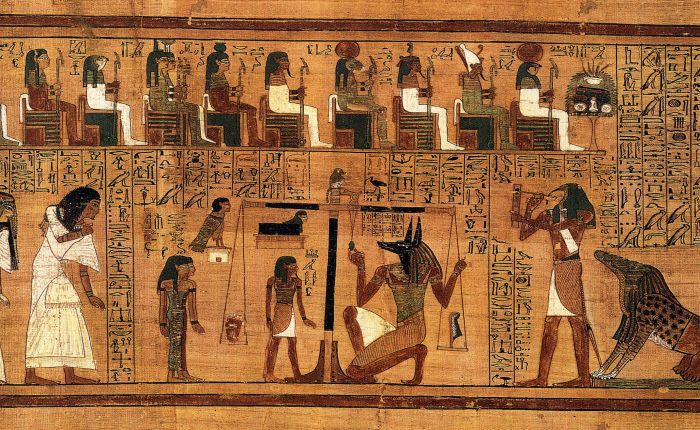
Even (or perhaps especially) if you cannot read hieroglyphs, these papyri were often quite lovely, being richly decorated with vignettes. The most beautiful example of these papyri is the Book of Ani, named after the man whom the book was made for, a Theban scribe. It is worth scrolling through the entire papyrus (the full image is on Wikipedia) and just enjoying the many illustrations, including the famous vignette of Anubis weighing the deceased’s heart against the feather of Maat. This papyrus was actually stolen from the Egyptian police (who had confiscated it from antique dealers) and smuggled to England, where it became a prized item in the British Museum. (The man who stole it, E.A. Wallis Budge, is also, as it happens, the author of the most widely read English translation.)

All of this information is, in my opinion, quite fascinating. Unfortunately, the actual experience of reading the book is considerably less stimulating. As I mentioned above, the spells were not written as literature and make for repetitive, dull, and flat reading. I first attempted to tackle a Spanish version that had been given to me, edited by one Luis Tomás Melgar. But after about 100 pages I simply could not stand it, and decided to try the classic Budge version. The same thing happened: after about 100 pages, I could not bear to read another spell.

Indeed, I am a little embarrassed to admit how unpleasant I found this. Normally I can power through when I don’t much like a book. But it felt as though my brain had been dissolved with acid and was being extracted through my nose. Thus, I decided to have mercy on myself and to mark the book as “read,” while I still had some grey matter intact.

In fairness to the Ancient Egyptian priests and scribes who compiled the book, I ought to include a sample of a spell. Here is one allowing the deceased to transform into a hawk:

Hail, Great God, come now to Tattu! Make thou smooth for me the ways and let me go round to visit my thrones; I have renewed myself, and I have raised myself up. O grant thou that I may be feared, and make thou me to be a terror. Let the gods of the underworld be afraid of me, and may they fight for me in their habitations which are therein. Let not him who would do harm to me draw nigh unto me, or injure me, in the House of Darkness, that is, he that clotheth and covereth the feeble one, and whose name is hidden; and let not the gods act likewise towards me.

If you can make it through 200 pages of this, you are a stronger reader than I am.

Even if The Book of the Dead is not exactly great (or good) literature, it does provide an interesting insight into ancient religion. There is a striking difference displayed here in the attitude towards the Egyptian gods and, say, that displayed towards Yahweh in the Old Testament. In the former, the believer uses spells that grant him predictable control over the gods and other supernatural beings, while the psalms are prayers, supplications, thanksgiving, worship, meditations—attempts to approach and understand the divine, rather than command it.

Another noteworthy aspect is how thoroughly focused on death and the afterlife the Egyptian religion appears to have been. Getting to the afterlife was not seen as the reward of a life well-lived. To the contrary, the spells in this book allow the deceased to reach this eternal reward despite whatever sins they may have committed. The judgment of the gods was not inexorable or unavoidable, but open to magical manipulation. Even if you “defrauded the temples of their oblations” or “purloined the cakes of the gods,” there was still hope of escaping divine retribution.

I know it is highly unfair—and, also simply pointless—for me to judge an ancient religion, especially considering that I did not even manage to finish the sacred book. But I couldn’t help thinking that this religion lacked most of the elements which I normally find compelling in a creed: a substantive moral code, consolation for life’s tragedies, acceptance of the inevitable… There is nothing poetic about death, life’s last major transition (if it can be called that). Instead, the final journey is regarded in such a prosaic, literal-minded way that it evokes no strong feeling. The soul must be defended from physical dangers in order to reach a state of physical well-being, and that is all.

Of course, it is quite possible, and perhaps likely, that The Book of the Dead is not perfectly representative document when it comes to Egyptian religion. After all, the book was not meant to be read by the living, so maybe it is no wonder that I did not find much of value. If I can still access Goodreads from beyond the grave, I will update this review at that (hopefully remote) date.

View all my reviews

Review: The Lotus Sutra

Review: The Lotus Sutra

The Lotus Sutra by Anonymous

My rating: 4 of 5 stars


This book is an excellent example of a text that is interesting as a historical document, but not as literature. To put the matter more bluntly, The Lotus Sutra has much to teach but is not very fun to read.

Having recently finished The Platform Sutra, I was struck by how different these two Buddhist scriptures are. The former is dense with doctrine and often quite deeply philosophical, whereas this text is full of revelations, miracle stories, and parables. And whereas The Platform Sutra accords pretty well with the Western conception of Buddhism as a secular, humanistic philosophy, The Lotus Sutra is frankly and powerfully religious.

This is not a world of quietly meditating monks, but of divine beings, hungry ghosts, endless eons of time, and extravagant promises of salvation. Indeed, the many layers of heaven and hell—the rewards and punishments doled out by Karma—reminded me very much of Dante’s cosmos (though here, neither state is permanent). Believers are promised to enjoy excellent senses of hearing and smell in their next lives, as well as good health and handsome noses; whereas nonbelievers will have crooked noses, bad skin, and halitosis. In short, no New York City atheist could really get behind the message of The Lotus Sutra.

One of the book’s most curious features is its meta-commentary. It is a story of itself—ceaselessly telling us how many sentient beings were saved by hearing its message. And yet, the book does not appear to have much of a message other than to inform us that it is very important. But I do think that The Lotus Sutra contains at least a few important doctrinal innovations.

Quite significant, for example, is the idea of “skillful means.” This is the notion that a Buddhist teacher may use any strategy to enlighten his pupils, even if that involves telling a lie. Closely related to this is the idea of the “one vehicle,” which holds that every strategy—meditating, memorizing sutras, repeating mantras, donating to monasteries, preaching sermons—are all merely aspects of one great effort to enlighten the world. This may sound harmless enough, but the implication is that the previous preachings of the Buddha were merely a half-truth, tailored to the low capacities of his first followers.

For example, the original doctrine held that the Buddha died and achieved enlightenment; that he was the first discoverer of the way; that there is only one Buddha; and that the path to enlightenment is to be attained only by those who diligently follow the path the Buddha laid for them. But The Lotus Sutra informs us that the Buddha never died; that there have been innumerable Buddhas; and that virtually everyone can become enlightened.

In other words, this sutra turns Buddhism into a kind of universalist religion, wherein merely repeating one line of a sutra or thinking one pious thought is enough to guarantee ultimate salvation. It reminds me very much of the transformation of the original Christian message (love your neighbor, abhor wealth, forgive your enemies) into the medieval Catholic church, wherein absolution could be bought and sins confessed away. In this case, Siddhartha Gautama’s demanding eightfold path is turned into an all-embracing highway, wherein anyone can drive straight to Buddhahood with a bit of goodwill.

This new, welcoming doctrine is not exactly so keen on women, however. The perfect future state of universal enlightenment is pictured as a world without women. And the one woman in the text who achieves Buddhahood—the daughter of the dragon king, Longnü—turns into a man the instant she does so. To be fair, Buddhism is hardly the only major religion with a misogynist streak; and I supposed it may have even been “enlightened” at the time to allow the possibility that a woman may transform into a man.

Thus, despite the text being rather repetitive and mystical, I would recommend it to anyone hoping to learn more about Buddhism. If you like it, you may have secured your future Buddhahood—though, I fear I may have attracted some grave karmic consequences with my review. If you meet a snake with very bad breath in the future, you know what happened.


View all my reviews

Review: The Canterbury Tales

Review: The Canterbury Tales

The Canterbury Tales by Geoffrey Chaucer

My rating: 4 of 5 stars


I must begin this review with a kind of repentance. Many years ago, I made my way through The Canterbury Tales in the original Middle English. I figured myself rather clever and linguistically capable enough to handle the language. Indeed, I even felt no pangs about reading the book before bedtime, fighting through the morass of unusual spellings and unfamiliar words while I was at my drowsiest. Needless to say, I did not have an easy time of it. And this difficulty colored rather unfairly my opinion of Chaucer.

This time around, I opted for a modern “translation”—two, in fact: the first, a print version by Nevill Coghill; the second, an audio version by Gerald J. Davis.* Immediately the error of my first impression was apparent. When the obscurity of Chaucer’s English was stripped away, I encountered a thoroughly enjoyable and wholly interesting book.

Admittedly, the circumstances of my reading were also more propitious. I read The Canterbury Tales this time around while I was, myself, on a pilgrimage—spending a few days on the Camino de Santiago, in the north of Spain. Chaucer made for quite an excellent companion—more entertaining, in fact, than the real pilgrims I encountered. (The conceit of the book struck me as especially fanciful by comparison with my experience. Virtually all conversation between the real-life pilgrims consisted of the most predictable small-talk—where are you from, how many kilometers, what’s your job, etc. Certainly I was no better as a conversationalist.)

I was first struck by Chaucer’s obvious debt to Boccaccio. The basic device is the same: a group of people are stuck together, and must tell stories to pass the time. More than that, several of the stories in this book are taken directly from Boccaccio (who is not credited, though I think that was common practice at the time). However, the differences are important as well, and highlight Chaucer’s strengths. Most obvious is that Chaucer was not just a storyteller, but a poet, and his tales are written in brilliant verse. More important, however, are the characters Chaucer employs to tell his stories. While Boccaccio’s storytellers are all genteel aristocrats, Chaucer’s raconteurs come from all levels of society, the poor and the rich, the lowborn and the noble, the profane and the holy.

In these two great gifts—his poetic suppleness and his all-embracing social vision—Chaucer is a direct forerunner of Shakespeare. But the similarity does not stop there. While Chaucer’s characterizations, like Boccaccio’s, are often fairly superficial, at times he achieves depths worthy of the bard himself. This is most obvious in the acknowledged high point of the poem, the Wife of Bath’s Prologue. Here, it is clear that Chaucer realized he had achieved something of a breakthrough, since he allowed the prologue to run longer than any other—longer, even, than the story that follows. And like any of Shakespeare’s great characters involved in a soliloquy, the Wife of Bath comes wholly alive in a way that, as far as I know, was unprecedented for the time.

The content of the stories is varied, but some major themes stand out for comment. The most striking, I think, is that of women and wives. Chaucer presents several disparate views on the matter. One story, for example, advocates that wives be absolutely subservient and obedient to all their husband’s whims, while the Wife of Bath (among others) believes that marriages only work when the wife is in charge. Related is the question of women’s sexuality: Is it something evil or innocent? Is sex to be free and easy within marriage, or is virginity the ideal state? A secondary theme is that of religion. Chaucer, like Boccaccio, makes fun of monks and clergy outrageously, but this does not stop him from being extremely pious in other moments.

This brings me to the low points in the book, the two prose pieces: the Tale of Melibee and the Parson’s Tale. Both of these are not really tales at all, but moralizing essays, full of Bible quotes and references to Aristotle and Cicero. (Indeed, they are wisely omitted from the Coghill version, but I suffered through the audio.) Here, we see that Chaucer could be dreadfully boring in certain moods. These two pieces have no humor at all, and are full of the stuffiest, most pedantic piety imaginable—solemnly concluding, for example, that temperance is the opposite of gluttony, or that good advice is preferable to bad advice. After the ebullience of the Wife of Bath, it is puzzling that Chaucer could have written such tedious pettifoggery. Did he intend these ironically, or was he protected himself from damaging accusations, or did he undergo a religious awakening halfway through writing the tales?

Whatever the case may be, the rest of the book is good enough to forgive him these trespasses. To state the obvious, this book is a classic in every sense of the word. Perhaps I ought to try the original once more? Or should I not press my luck?
___________
*For what it is worth, I liked the Davis version, and noticed no difference in quality from the esteemed Coghill version. However, I find it odd that Davis has translated books from so many different languages: Gilgamesh, Don Quixote, The Divine Comedy, Beowulf… Either he is a linguistic genius or is getting some help.


View all my reviews

Review: Wonderful Life

Review: Wonderful Life

Wonderful Life: The Burgess Shale and the Nature of History by Stephen Jay Gould

My rating: 3 of 5 stars


This book is a headache-inducing mixture of contrary qualities. My emotions swung wildly as I read, from pleasure to exasperation, from wonder to annoyance.

The subject of the book is fascinating. Gould here sets out to tell the story of the Burgess Shale, a site discovered in 1909 by Charles Walcott in the Canadian Rockies. Owing to unusual conditions (an underwater mudslide, 500 million years ago) fossils of thousands of ancient organisms were preserved in excellent condition—not only the typical hard parts that survive fossilization, but their soft tissue as well. This was an unprecedented and highly significant find, as it provided a kind of snapshot of life shortly after the famous Cambrian Explosion (when macroscopic animals suddenly become common in the fossil record).

Amazingly, though the importance of the find was widely understood, most of the specimens collected remained unanalyzed and poorly understood for decades. Their discoverer, Walcott, published a few preliminary studies but nothing of significant depth. It was not until the 1970s that a team of researchers—Harry Blackmore Whittington, Derek Briggs, and Simon Conway Morris—started reinvestigating these samplings and publishing long monographs on their findings. Their research and conclusions form the core of Gould’s book.

It is when Gould is describing the story of the shale’s discovery, and especially when he is describing how the scientists went about their work, that he is at his absolute best. And I think he deserves all the praise in the world for this. Few books for the general public, if any, take the reader so intimately into the process of paleontological research—collecting specimens, dissecting samples, debating taxonomies. What is more, Gould manages to make a book about fossilized worms into absolutely gripping reading. There were times when I felt my heart swell with admiration for these scientists hunched over a microscope, scratching through the exoskeleton of some three-inch creature in order to write a 100-page monograph to be read by a handful of experts. This is no small accomplishment for an author.

Where Gould falters, for me, is in the interpretation he gives to this story. Gould argues that the Burgess fossils completely overturn our notions of evolution and constitute a breakthrough comparable with Darwin’s theory. He bases this grandiose claim on the amount of taxonomic diversity encountered within the samples. Now, when Walcott first analyzed the fossils, he classified the animals as members of modern groups. But when Whittington, Briggs, and Conway Morris re-examined these fossils, they found a great many organisms that did not fit into any modern classification.

From this, Gould draws two conclusions. First, he asserts that this was a particularly fertile time for evolution; and he bases this claim on the large variation present in the fossils. Second, he makes the grander claim that the large number of viable organisms whose descendants did not survive to the present day proves that the history of life is highly contingent.

Now, let me explain why both of these claims are frustrating.

For one, there is a perfectly obvious reason why the Cambrian period could have involved more evolutionary “experimentation” than the present day. This is that, when organisms are first evolving to occupy previously unoccupied niches—as the first macroscopic animals were doing—there would be comparatively less environmental pressure to do so in the most efficient possible way. The first freely swimming animal, for example, did not need to swim faster than any other animal trying to eat it. Gould himself eventually gets around to this explanation, though he seems not entirely satisfied with it.

But the other—and even more obvious—explanation is that these animals are only more varied in a limited sense. As Gould himself admits, modern animals occupy more varied environments and exhibit a far large range of sizes and behaviors. What the Burgess animals possess is taxonomic variety—requiring the creation of new phyla, families, or orders to accommodate them into our filing cabinets. However, what he fails to mention is that this is exactly what one should expect from such ancient fossils. Our taxonomic categories were developed to classify modern animals, so why should they apply neatly to animals living half a billion years ago?

I think this point deserves further elaboration. Our modern categories were purposefully defined using the traits which remain invariable over the largest number of extant species. They would be useless otherwise. It is thus nonsensical when Gould wonders why there should arise so many new phyla in the Cambrian, but not today. This is like wondering why there are so many strange words in Chaucer but not the newspaper. In other words, the huge taxonomic variation Gould discusses is largely an artifact of our own categories and not an actual property of the animals themselves. A foreign language does not have an objectively more complex vocabulary just because there are more unfamiliar words in it.

Ironically, some of the taxonomic weirdness that Gould discusses has since been revised away, as the “radical” interpretations of Whittington, Briggs, and Conway Morris were themselves re-interpreted, placing many animals in more familiar categories. To take just one example, the Burgess animals hallucigenia is here presented as a truly nightmarish creature which walks on spikes and has tentacles sticking out of its back. Most concerning of all, it has a formless blob for a head! This animal was, understandably, at first given its own genus; but it has since been recognized as a lobopodian when a more accurate reconstruction was hit upon. (It turns out that the spikes are on its back and are not its legs; and that its head is, in fact, not a formless blob.)

Of course, Gould can hardly be blamed for basing his book on outdated science. After all, it was published over 30 years ago. But I do think that Gould, of all people, should have known that interpretations of fossil remains are frequently contested and revised, so it seems unwise of him to have based such grandiose conclusions on such a shaky foundation.

Now for Gould’s second claim, that the Burgess fossils prove that the history of based on chance—or, in his words, “decimation by lottery.” He repeatedly states that no modern scientist, if transported back in time, could have selected which lineages would survive to the present day or would end in extinction, since there is no obvious anatomical flaw in the extinct lineages. And he argues that this proves chance, not superiority, determined evolutionary survival.

This strikes me as a completely bizarre argument, since I am not sure who Gould is even arguing against. What scientist believes they could pick out evolutionary winners and losers 500 million years from now? Or even 500 years from now? Virtually every organism is well-adapted to its environment. If you traveled to the previous ice age, could you find an anatomical flaw in the woolly mammoth? I doubt it. But does this prove that extinction is totally random? Hardly.

Indeed, Gould eventually admits that even he himself does not believe that extinction is a truly random process (though this makes his use of the term “lottery” rather puzzling). Instead, he adopts the wholly conventional view that extinction occurs when the environment changes too quickly for a species to adapt, and that the species which do survive environmental shifts are able to do so because of traits they evolved under different circumstances.

In other words, yes, luck is a factor in evolutionary survival. Indeed, considering that evolution is a physical process, one could argue that it is completely a matter of luck which species survive or perish. In a general sense, luck determines whether an asteroid will hit, whether an invasive species will outcompete you, or whether hairless primates will destroy your habitat. But what biologist would deny that? It strikes me that the only people who seriously object to this do so for religious reasons, seeing the evolution of human life as something pre-ordained or divinely guided. Yet Gould acts as if he is arguing against the dominant view in his field.

To sum up, Gould is grandly making a non-controversial point using evidence that does not even prove his point. The burgess fauna were not necessarily more varied than today’s; and even if they were, that would not prove that evolution is random.

I am sorry to be writing such a critical review of this book. It just seemed such a shame that such a great story could be weighed down by so much unnecessary intellectual baggage. If this had simply been an exploration of the Burgess fauna it would have been delightful. Indeed, though perhaps outdated, the many illustrations of ancient creatures are still charming to contemplate. And though I found the book quite frustrating, if read in the right spirit, I still think it is wonderfully educational about the process of science—though, perhaps not in the manner it intended to be.

(Cover photo a reconstruction of hallucigenia by Martin R. Smith and Jean-Bernard Caron. Taken from Wikimedia Commons, CC BY-SA 4.0.)


View all my reviews

Review: Three Zen Sutras

Review: Three Zen Sutras

Three Zen Sutras: The Heart, The Diamond, and The Platform Sutras by Red Pine

My rating: 4 of 5 stars

As a lamp, a cataract, a shooting star
an illusion, a dewdrop, a bubble
a dream, a cloud, a flash of lightning
view all created things like this.


This is a fascinating group of texts. The first in the book is the very brief Heart Sutra. It is short enough to be memorized and recited, like the Lord’s Prayer; and true to its name, it contains the “heart” of much Buddhist teaching, specifically with the famous lines “form is emptiness, emptiness is form.” The sutra is, in essence, a giant negation of conventional reality—all that can be perceived and conceived. The reality of the senses is superficial, transitory, and illusory; and recognizing the emptiness of this reality is fundamental to achieving enlightenment.

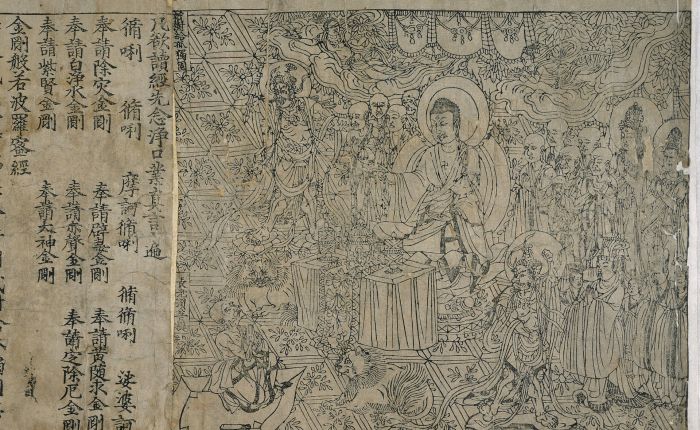
The Diamond Sutra is somewhat longer, though still short enough to be easily read in one sitting. Exactly when it was written down is unclear, though it has the distinction of being the printed book with the earliest known date.

This manuscript (now in the British Library) was printed on May 11, 868, about 600 years before Gutenberg’s bible, at the expense of one Wang Jie. Indeed, this good man even specified that it was “made for free universal distribution,” thus putting it into the public domain. The frontispiece—a line drawing of the Buddha surrounded by his disciples—is a lovely work of art in itself. Even the story of the book’s discovery is interesting. The manuscript, along with many others, had been preserved in a section of the Mogao Caves which had been sealed off since the 11th century—perhaps to protect them from plunderers—only to be opened in the early 1900s.

The text consists of a conversation between the Buddha and his disciple, Subhuti. The upshot of this conversation is very much the same as the message of the Heart Sutra: that everything is fundamentally unreal. Thus, beings are beingless, and the dharma is without dharma. (The word “dharma” can apparently mean a great many things, from “the nature of reality,” to “the right way of acting,” to “phenomena.”) Even the Buddha’s own teachings are unreal. But, paradoxically, though all beings are beingless, for this very reason they should be referred to as “beings.” Apparently, this is an attempt to maintain the practical use of language without attributing reality to what our words refer to. In other words, we must use words to communicate, but we should not mistake our statements about the phenomenal world as having any absolute validity.

The Diamond Sutra is praised and referred to in the last text in this volume, The Platform Sutra of the Sixth Patriarch. Written around 1,000 years ago (it doesn’t seem clear when), it is attributed to the sixth Chan patriarch, Huineng, who preached to and instructed his disciples from a raised platform (thus the name). Unlike the other two works, then, which may have been written in India, this one is certainly Chinese in origin. The book is divided into ten sections and, rather like the Bible, is rather miscellaneous in content, containing stories, poems, parables, preaching, and philosophical discussion.

Despite this variety, I thought that the basic message of the sutra was fairly clear. It expounds a form of Buddhism based on introspection. Well, perhaps “introspection” is the wrong word, since it is a basic tenet of this doctrine that everyone’s fundamental nature is the same, and it is only delusions and confusions that make us lose sight of this. As a kind of substrate of the mind, below our attachments to the external world, we all share the same Buddha-nature. Indeed, in this sutra, Buddha is not so much a man as a state of being, and anyone who attains it is fully the equal of Siddhartha Gautama.

The story of Huineng’s ascension to the patriarchate is deservedly famous. The fifth patriarch decided to have a kind of poetry competition, to see which of his disciples could create the most instructive verse. Shenxiu, the leading disciple, came up with this: “The body is the bodhi tree. / The mind is like a bright mirror’s stand. / At all times we must strive to polish it / and must not let dust collect.” Yet the illiterate “barbarian” from the south, Huineng, upon hearing this verse, came up with a response: “Bodhi originally has no tree. / The mirror has no stand. / The Buddha-nature is always clear and pure. / Where is there room for dust?” (Once again, note the emphasis on negation, the message that reality is insubstantial.) This was enough to secure him the position.

As you can see, it is a curious feature of Buddhism that it requires the paradoxical use of language to express its tenets. For example, as the sutras repeat, enlightenment consists of seeing the world as “empty” of form—that is, of seeing past the superficial differences that separate one thing from another, one person from another. It means seeing beyond dualities such as bad and good, beautiful and ugly, as these are only expressions of our own egotistical desires, and the enlightened one is theoretically free from any selfish desire. It is, in short, a kind of ego-death, the conquering of all attachment to external goods, in which only the purest form of consciousness remains, seeing the world exactly as it is.

Indeed, there is an interesting metaphysical view inherent in these statements, though as far as I know it is not made explicit. It is that the apparent reality of people and things is due to our inability to come to grips with the passage of time. Everything that exists once did not exist previously and will someday cease to exist. Furthermore, all of the matter and energy in the universe swirls in an enormous cycle, generating and destroying all phenomena. In this sense, a mountain, say, is “unreal” since it is only a mountain at this moment, and its existence depends on a host of other factors. Its existence is conditioned and impermanent, and thus superficial.

There is also, arguably, a philosophy of the mind inherent in this doctrine. It is that our conceptualization of reality ultimately warps it to such an extent that we merely delude ourselves. In this sense, Buddhism has something in common with Kant’s system (which Schopenhauer would be the first to point out, of course). Thus, when we call a big pile of rocks a “mountain” we are often attributing certain other qualities to it: natural, big, beautiful, and so on. But what is considered “natural,” or “big,” or “beautiful” are highly subjective qualities, which say more about our own perception than the thing being perceived.

In sum, then, conventional reality is “empty” for two reasons. First, because our minds attribute permanence and self-subsistence to things which are, in actuality, impermanent and conditioned. Second, because our desires and opinions do not allow us to perceive things as they really are.

For this reason, language is a source of delusion, since words create a sense of fixity in the mind—a word picks out an object and treats it as if it were stable. Further, the definitions of words often rely on contrasts (hot and cold, old and young), which are expressions of our subjectivity. However, the Buddhist preacher is forced, by the nature of communication, to say that enlightenment is better than delusion, that meditation is good while attachment is bad, that trying to achieve enlightenment through meditation is correct while doing so by reciting sacred texts is wrong. In short, the doctrine can only be expressed using the very dualities that it purports to move beyond. As a result, the sutras are full of seemingly nonsensical statements, such as that an enlightened one both feels and doesn’t feel pain.

The logically-minded reader thus may be repelled by much of this. After all, the content of a self-contraditory statement is precisely zero. And one could easily make the opposite of the above arguments. For example, just because something is conditioned or impermanent doesn’t make it unreal—indeed, that is arguably the very definition of what is real. The fact that our perception of the world is warped by our subjectivity does not make it unreal—indeed, arguably our subjective reality is the only one we can be sure of. And anybody who has read a scientific text knows that language can be a very useful tool for understanding the world.

But this is all probably beside the point. To begin with, I think a Buddhist would likely object to my attempt to formulate this doctrine as a metaphysical system. To the contrary, such a system would be antithetical to the entire spirit of the enterprise, which is precisely the attempt to move beyond intellectual attempts to understand and rationalize reality. Rather, I think these paradoxes and negations should be read as attempts to inculcate an attitude, or to induce a mental state.

If I have any criticism of this doctrine, it is that it seems—to put it bluntly—rather defeatist. All human striving is vain; all attempts at satisfying our desires are vain; every effort to understand reality is vain. A Buddhist may disagree with this assessment—and, in truth, my understanding of these sutras is undoubtedly superficial—but seeing the world as unreal and freeing myself of all desire seem rather like death than something to pursue. That being said, like most people, I certainly err in the opposite direction: getting too swept up in trivialities, getting upset over things beyond my control, seeing my world from the narrow perspective of my short-term desires. As a corrective to this unhappy state of affairs, I think there is a great deal of value in this school of Buddhism. I look forward to continually failing to apply it to my life.


View all my reviews

Review: The Story of Civilization

Review: The Story of Civilization

The Complete Story of Civilization by Will Durant

My rating: 5 of 5 stars


I have finally done it. Eight years, eleven volumes, nearly 15,000 pages and millions of words. It is certainly the longest thing I have ever read as well as the most educational. I have already left a review of every individual volume. Some are stronger than others—I would rank Volume 1, on Asia, as the worst, and possibly Volume 4, on the Middle Ages, as the best—but in general the quality is consistent and the books have the same strengths and weaknesses.

(Though half of the books are credited to both Will and Ariel Durant, I think it is clear that Will did most of the actual writing, so I will be referring to him. However, I do not mean to diminish the great contributions of Ariel to this project.)

First, I want to emphasize that these books are not a history in the conventional sense, as an attempt to understand the past on its own terms and explain why it developed in the way it did. Judged as such, the books are certainly a failure. And, in any case, Durant did not do any primary research for this work and makes no pretentions to original findings. Yet whatever might be his professions to the contrary, Durant is really writing as a popularizer—specifically, as a popularizer of European capital-C Culture. Enough political, economic, and military history is given to serve the reader as a basic background. But the central figures of the book are artists, writers, poets, musicians, scientists, historians, philosophers, as well as the rulers who directly or indirectly promoted these creators of Culture.

Judged as a popularizer of these figures—from Plato to Voltaire, from Homer to Lord Byron, from Palestrina to Beethoven, from Giotto to Goya, from Pythagoras to Newton—Durant is remarkably successful. And this is due as much to his strong mind as to his fluent prose. His books, though long, are well-organized and well-written. His prose is urbane without ever being taxing to read, and each page has at least one unexpected detail, one memorable anecdote, or one amusing aside. He is, in a word, companionable. While he often veers into abstruse territory his writing is never dense, yet neither does he give the impression—as so many current popularizers do—of writing in a dumbed-down style.

And, somehow, Durant’s writing is also extremely easy to remember. I have gone over sections long after reading them to find that I had retained a great deal of the information. Thus, reading this books gives one the pleasant sensation of downloading information directly into one’s brain.

Durant is also versatile. The number of topics covered in these books is innumerable—architecture, fashion, music, war, the list goes on—but Durant always succeeds in making the subject interesting and transparent. And he is reliably amusing when writing of the eccentricities and personalities of the legions who march through these pages. This, indeed, is what makes the books so readable: it is not a series of processes, epochs, or events, but of individuals actively shaping their own lives. (This is also, of course, what makes the books questionable history, as the wider social, cultural, and economic forces at play are given little consideration.)

Durant begins the series by examining what he regards as the elements of “Civilization.” His list is not surprising (or entirely convincing): writing, morals, government, religion, laws, etc. Yet for most of the series, his main theme—if he can be said to have one—is the conflict of religion and reason. As the thinkers of the series gradually lose their respect for organized religion, Durant continually wonders whether society can function if the populace loses their belief in hell, since the basis of morals will be removed. To me this seems somewhat insulting and, in any case, rather uninteresting. As a general rule, the most secular countries enjoy relatively low levels of crime, so the idea seems to be obviously untrue.

There are some other peculiarities of Durant’s writing. He often discusses “sexual morality,” and takes care to note how frequently this or that person committed adultery. True, the many tales of unfaithfulness to add the only dash of scandal in these otherwise staid pages. Even so, I found Durant’s tendency to judge his subjects based on their love lives to be rather distasteful—and ironic, considering that Durant’s own marriage would certainly not be considered “moral” nowadays. (He married Ariel when she was 15 and he was 28. She had been his student.)

The series has other shortcomings, of course. The most glaring is that it is Eurocentric; and, besides, it is a classic example of a “great man” history (the vast majority of the protagonists are men).

Even so, I do think that, read in the right spirit, The Story of Civilization is a tremendous resource for those, like me, who were not taught any of these things—the history of art, literature, philosophy, among much else—in school. It is a kind of remedial education, and a very good one.

Durant is not the same sort of writer as Gibbon, Burkhardt, or Thucydides—a scholar who shines new, unexpected light on the past. He is, strangely, far more akin to Rick Steves. This may sound slightly insulting, and the writer certainly provides more breadth and depth that the tour guide. But the two of them have the same mission: to allow people (mainly Americans) to appreciate the wealth of Western culture. Indeed, The Story of Civilization was extremely useful to me as I traveled around Europe, just as it helped in my journeys through literature and philosophy. Durant will not make you an expert but he will at least point you in the right direction.

In this way, these books were created in the same spirit as art museums or public classical music radio: to bring Culture to the people. The idea does seem somewhat antiquated now. Collectively, we have lost faith in Culture. And I can see why. Highly cultivated men have committed atrocities, while the most ignorant have led saintly lives. And, in any case, our definition of what counts as Culture has widened so much—has been so thoroughly democratized—that it hardly specifies anything now.

Even so, it is worth remembering that everything we enjoy today is the product of a long and rich tradition. And even if it seems stuffy or snobby to say so, I think it is still very much worth it to acquaint oneself with this heritage. Not to become “better” people, but to fill our lives with beauty.


View all my reviews

Review: Hiroshima

Review: Hiroshima

Hiroshima by John Hersey

My rating: 5 of 5 stars


This is certainly one of the great books of the previous century. It is superlative in many respects. Most obvious is the book’s historical value, which needs no further elaboration. Hiroshima is also a stylistically innovative and influential book, pioneering the dramatic writing techniques that would come to characterize some of the best journalistic writing after the war. And Hersey also deserves praise for his stylistic restraint. Virtually no event could have been more liable to evoke overwrought prose or vain attempts to capture the broad sweep of the tragedy. Hersey’s decision to focus on only six survivors, and to narrate what they saw with simple directness, was an act of great authorial self-control.

But this book is great for more important reasons than these. The power of atomic weapons is such that most of us can barely imagine it, much less picture ourselves their victims. Thus, as with many historical atrocities, the stories of survivors bridge the gap between imagination and experience, and allow us—at least dimly—to grasp the extent of the horror. Merely being faced with the reality of the bomb is enough to make a point. Without any explicit preaching, Hiroshima utterly convinces us that weapons which wreak such indiscriminate violence and widespread destruction have no possible rational use, even in war.

Last, the book is a wonderfully humanistic document. The people in this book were struck with a weapon they did not even suspect existed. They lost their homes, churches, and businesses, and they lost parents, children, spouses, and friends. And yet Hersey shows how these ordinary people often proved capable of extraordinary heroism and resilience, not only in the immediate aftermath, but in the years that followed. I found this especially moving, as I am often ashamed of my own inability to deal calmly with petty frustrations and minor setbacks. Books like this may not make me any wiser, but they at least leave me with a little hope—for myself, and for us all.


View all my reviews

Review: Why We Sleep

Review: Why We Sleep

Why We Sleep: Unlocking the Power of Sleep and Dreams by Matthew Walker

My rating: 5 of 5 stars


I first heard of this book from Michael Pollan’s short work on caffeine. There, he calls Why We Sleep (to paraphrase) one of the most disturbing books he had read in a while. This caught my attention. How could a book on sleep be disturbing?

From the first page of this book, I knew why. The author, Matthew Walker, is essentially diagnosing a major health crisis that is going on in front of our drooping, baggy eyes—namely, the crisis of insufficient sleep. According to Walker, virtually everything we do—how we work, how we relax, how we seek entertainment—is disruptive of sleep. And he has plenty of studies to show that, when you do not sleep enough, there are serious consequences.

In addition to the familiar cognitive impairments of bad sleep (inability to focus, lack of energy, wild mood swings), there are the long-term health risks, such as the increased likelihood to develop cancer, heart disease, or diabetes. More unfortunate still, there does not seem to be any way of getting around the familiar recommendation of eight hours of sleep per night. We cannot get by with less, and we cannot make it up on the weekend.

Indeed, the news gets worse and worse. Even moderate amounts of alcohol and caffeine can gravely affect sleep (and marijuana, too—sorry); and sleeping pills may do more harm than good. Our phones, tablets, and computers—even our indoor lights—wreak additional damage by throwing off our natural diurnal rhythms. So this pretty much eliminates all of my nightly plans.

What it comes down to, says Walker, is a cultural disrespect for sleep. I am certainly guilty of this. I have always taken pride in using the opportunity of a plane, train, or bus ride to read a book rather than to nod off, and felt secretly superior to those dozing around me. More generally, sleeping is often equated with laziness. Waking up after midday is a moral failing; taking a nap on the job is a fireable offense; and going to bed early is socially questionable. Further, many people—especially in the business world—take pride in their ability to get by on few hours of sleep. Wakefulness is productiveness. But this prejudice is, Walker contends, based on ignorance of the real value of sleep.

Sleep is a biologically basic process. All mammals, birds, and reptiles, some fish, and even insects have been observed in a sleep-like state. Lack of sleep can not only be harmful, but fatal. Some gruesome rat experiments have shown this, as does the rare disease, Fatal Familial Insomnia, in which the brain becomes incapable of generating sleep—which is inevitably fatal. Sleep is just as basic a need as food. And as you might expect from such a basic need, it is hard-wired into our evolution. Indeed, two distinct types of sleep have evolved, which accomplish different purposes: REM and (creatively named) non-REM.

As you may know, the REM stands for “rapid eye movement,” which is when we experience vivid dreams; and it alone accomplishes many things. In addition to fostering creativity by forging novel links between memories, REM sleep apparently keeps us sane (people experimentally deprived of REM sleep for long enough experience symptoms of psychosis). Non-REM is, perhaps, the more restful sort, when new memories are moved from temporary storage to a more permanent location. The two sleep types thus work together and come at predictable moments in the night: deep non-REM sleep early on, and REM closer to the time we wake up. (Short sleep thus selectively cuts down our REM sleep time.)

Walker explains the science because he wants to drive home the importance of sleep—not a luxury, or an indulgence, but a survival mechanism designed by natural selection. With this basic point in hand, Walker goes on to make several social criticisms, and at times the book almost becomes a polemic.

Take driving, for example. Everybody knows that driving drunk is dangerous and irresponsible. But Walker cites studies showing that drowsy driving is, if anything, even more dangerous. When you are sleep deprived, your brain can drift off into what are called “micro-sleeps,” which last just a couple seconds. This is quite enough time to get into a serious car crash. And this is common. Over the Christmas break, everybody I mentioned this to had a story about falling asleep behind the wheel. It has happened to me, too—a thoroughly alarming experience, which thankfully did not result in a crash. Considering this, I cannot help but agree with Walker this issue is just as deserving of public awareness campaigns as inebriated driving.

Walker is also highly critical of how the medical community treats sleep. For one, most general physicians have little training when it comes to sleep, and so are apt to prescribe sleeping pills to patients with insomnia. Unfortunately, sleeping pills merely sedate the brain without generating natural sleep, and so do not really solve the problem. Another issue is that of doctors’ timetables. From residency on, doctors are often expected to work inhumanly long shifts, even though evidence shows that sleep-deprived doctors are less effective by every measure. Another issue is patient sleep. Although sleep is highly conducive to healing, hospitals often present hostile sleep conditions (loud noise, bright lights, poorly scheduled tests), especially in the ICU, which actively impedes recuperation.

Last but not least, Walker contends that many (though not all!) children diagnosed with mental disorders, like ADHD, may really be suffering from a sleep problem, as insufficient sleep can cause many of the same symptoms (lack of focus, lack of emotional control, etc.). This neatly dovetails with another issue: schools. According to Walker, every person has a natural sleep-schedule, and teenagers tend to have a later one than adults. When teenagers are expected to get to class by eight o’clock or earlier, therefore, we are making it impossible for them to adequately sleep, in the same way most adults would not be able to adapt to a job that began at six in the morning. As a result, many teenagers are chronically under-slept. No wonder that they are so considerate and polite.

This certainly resonates with my experience. Not only did my high school start early, but most of the musical extra-curriculars took place in the hour before regular classes. This meant that I had to arrive by quarter to eight, while I hardly ever went to bed before midnight (often much later). Unsurprisingly, I was a zombie for most of my morning classes. It is easy for me, then, to concur with Walker in proclaiming these early start times for high schools to be illogical and counterproductive. Thankfully this message seems to be slowly sinking in, and some schools have begun pushing back their schedules.

This review, long as it is, hardly does justice to the content of this book. Not only has Matthew Walker written an excellent work of popular science, but he has written a quietly revolutionary work. After all, our society would really look quite different if we took our need to sleep as seriously as we took our need to eat. The world Walkers imagines is certainly a more relaxed and humane one (though, it must be said, perhaps a bit puritanical in its strictures). Imagine, for example, a world when napping during work was encouraged and when start times were flexible. Imagine getting a deduction on your health insurance for sleeping enough. A boy can dream.

There was only one moment in which I doubted the good Walker. In 2015, a study was released that tracked the sleep of three hunter-gatherer groups, and found that they slept, on average, slightly less than seven hours, rather than the expected eight. This seems to undermine Walker’s contention that the modern world is uniquely inimical to sleep. He counters that the study may only show that these hunter-gatherers are also not sleeping enough. But this seems like rather weak tea after telling us of the evils of coffee, alarm clocks, and LED lights. If those free of modern temptations can’t do it right, what hope do we have? Perhaps we are doomed. Even so, I think all of us could benefit by treating our shuteye with a little more respect. Speaking of which, it is already past my bedtime.
_______________________________________________
A fellow reviewer on Goodreads, Siddhartha, recommended an article written by the blogger Alexey Guzey that examines the first chapter of Matthew Walker’s book in depth, purporting to find many factual errors. I think it is worth going over Guzey’s points.

First, he notes that, while Walkers claims that longer sleep leads to longer life, in reality studies show a kind of U-curve, where both short and long sleep times are associated with higher mortality. Walker addresses this later on, but defends his position by stating that diseases and comorbidities often lead people to sleep more. Guzey counters that some diseases actually make people sleep less. In any case, Walker’s argument does seem fairly week to me in the absence of evidence that these longer sleep times are certainly caused by diseases. (Also it seems like circular reasoning to assert that anyone sleeping significantly longer than 8 hours must have some sort of disease. Were they presumably under-sleeping before, causing an illness that pushed them into over-sleeping?)

Guzey’s next points out that it is untrue that a good night’s sleep is always beneficial, since sleep deprivation is used as a therapy for depression. Now, to me these seems like nit-picking. One can still say it is almost always beneficial. True, Walker does discount the potential benefits of sleep deprivation therapy without much thought, but that is still a minor point since Walker is not a psychologist.

Guzey’s third point is also somewhat unfair. He points out that it is far from certain that the lack of sleep is what kills victims of Fatal Familial Insomnia. Yes, Walker uses Fatal Familial Insomnia to bolster his claim that lack of sleep is fatal, but he does admit (later on) that it is impossible to say that the lack of sleep is what actually kills in the disease, since victims suffer extensive brain damage. But Walker bases his assertion of the mortality of sleep loss on some (rather cruel) rat studies. Admittedly, we are not rats.

Another of Guzey’s criticisms is that, while Walkers is quite insistent on the eight-hour number, the National Sleep Foundation actually recommends anywhere between seven and nine hours. (And though Walkers invokes the WHO, the World Health Organization has not actually issued sleep recommendations.) This is certainly a legimitate critique of the book, since somebody who sleeps seven hours is actually within the normal range, even though they would get the impression from Walker’s book that they are underslept and at risk.

Several other factual errors Guzey point out are quite valid. It does seem true that, contrary to Walker, the WHO has not declared any sleep loss epidemic in industrialized nations. This is a serious error in itself. Guzey also calls into question whether those in the industrialized world really are getting less sleep now than people did 100 years ago. This claim, in my opinions, does deserves far more scrutiny. True, late night work emails and LED screens are recent inventions. But working on a farm or a factory is hardly more forgiving or flexible. And, again, if hunter-gatherers aren’t sleeping more than we are, perhaps the evidence of a recent sleep loss epidemic is not so strong after all.

Not having done any research myself, I can only give my two cents. I did get the strong impression that Walker consistently emphasized the most potentially dire consequences and examples of sleep loss. And, honestly, I really hope that Walker’s prophecies of doom are somewhat exaggerated, since obtaining perfect sleep while going to work, having a decent social life, keeping up with a hobby or two (not to mention the pressures of raising children—not that I have any) seems close to hopeless.

Even after all of this, I do think that this book is an important corrective to our current cultural disregard of sleep. Thank you for your time.


View all my reviews

Review: Johnson’s Dictionary

Review: Johnson’s Dictionary

A Dictionary of the English Language: an Anthology by Samuel Johnson

My rating: 4 of 5 stars

LEXICOGRAPHER: A writer of dictionaries; a harmless drudge, that busies himself in tracing the original, and detailing the signification of words.


A dictionary is a marvelous thing. I discovered this during my first year in college, when I was finally asked to do some challenging reading (and when I finally decided to start doing the assigned readings). It was with some shame that I admitted to myself, after a few weeks, that I often came across a word I did not understand. Indeed, this happened with such frequency that I finally resolved to underline all of the words I could not confidently define, and then look them up. But even this didn’t seem like enough. By the time I encountered the troublesome word again, its definition would be forgotten. Thus the “Word Project” was born.

To forcibly expand my pitiful lexicon, I resolved that I would write out the definition of every unfamiliar word in the back of a marble notebook. Then, to reinforce the definition, I would flip to the front of the notebook and use the word in a sentence. Astoundingly, I actually followed through with this resolution, and carried on the habit for years—filling up two whole marble notebooks in the process, comprising thousands of words, definitions, and sentences. I even filled up the margins with lists of synonyms. (I cannot help feeling that I have gotten much lazier with time. Could I be so disciplined now?)

A few examples from the first page include: inculcate, surfeit, equivocal, corroborate, and depredation. By the time I got to the second notebook, the words were more exotic: jactitation (the restless turning of the body in illness), imago (the unconscious idealized mental image of someone), and ontogenesis (which I’ll let you look up). But I find the lists of synonyms, or near-synonyms, more interesting now. For example: petulant, peevish, tetchy, crotchety, fractious. Or: effrontery, impudence, impertinence, insolence. I could go on—synonyms are wonderful fun, at least for writers—but I shall resist.

The project was a success. My vocabulary improved markedly, to the point when I so rarely came across an unfamiliar word that I stopped bothering to write them down. (It does still happen from time to time, though.) However, my loftier goals were unrealized. You see, I had hoped that, by expanding my vocabulary, I might even make myself noticeably more intelligent. A mind with more words to express itself must, I theorized, think more efficiently. Unfortunately, that theory did not seem to hold water (half the time I don’t think in words, anyway), and my mental acuity remained unchanged. I also thought that such a project might improve my writing. And though I do think I am, at least, more sensitive to language as a result of the project, I normally prefer to use simpler words, anyway.

Even so, in retrospect the “Word Project” was one of the greatest things I ever did for my own education. The definitions of these abstruse words were, for me, a kind of key to the wider world of knowledge and literature. I would never have developed my love of books had I constantly been scratching my head at unfamiliar words. So I have a keen appreciation for any “harmless drudge” who chooses to write a dictionary. Lexicographers do the world a great service.

This volume is, of course, not a book one can use as a standard dictionary. David Crystal has edited the 2,300 pages of dense text into something more manageable, by selecting for those passages that the modern writer might find most curious. Included are words that are now obsolete, words whose meanings have significantly changed, and words with especially pleasurable definitions.

As an example of the latter, fun is defined as “sport, high merriment, frolicksome delight.” And to flatter is “to sooth with praises; to praise with blandishments; to gratify by servile obsequiousness.” As you can see, Johnson has a tendency to pleonasm in his definitions. He is also fond of expressing his opinion of a given word, in a way that no modern dictionary would. “Fun,” for example, is “a low cant word,” and many terms are dismissed as “barbarous.”

Some words have changed in surprising ways. Johnson defines punk as “a whore; a common prostitute; a strumpet,” and punctuation as “the act or method of pointing.” Yet the most delightful entries are perhaps those words which are no longer used. Often one feels that it is a shame it should be so. What is wrong with smellfeast (“one who haunts tables”), fopdoodle (“an insignificant wretch”), and mouth-friend (“one who professes friendship without intending it”)?

If nothing else, it is worth reading this anthology to fully admire Samuel Johnson’s genius and industry. Virtually nobody nowadays would undertake to write a dictionary single-handedly. And such a task would be so massive—running the gamut from scientific jargon to recent slang—that it is difficult to image anyone succeeding. That Johnson did succeed is, more than any other of his accomplishments, the reason he was so widely venerated during his lifetime. (His contemporaries more often referred to him as “Dictionary Johnson” rather than “Dr.”)

And even if his dictionary is hopelessly outdated now, it still can serve as a model of strong writing. Johnson’s definitions are a pleasure to read through—punchy, pugnacious, and punctilious—and each one is accompanied by at least one (often many more) quotation from well-respected authors. This way, the reader’s mind is expanded while her taste is refined. An elegant idea, at least. Yet if I wish to accomplish anything in this review, it is not to praise Johnson’s Dictionary—worthy though it is of praise—but to exhort you to pause, every so often, and ask yourself whether you really know what a word means. A trip to a dictionary can open up new realms of reality.


View all my reviews

2022 in Books

2022 in Books

2022 on Goodreads by Various

My rating: 4 of 5 stars


I have the nagging feeling that I’ve gotten lazy about reading—as if I fail to prioritize it, or that it is rarer for me to get swept up into a book. When I examine the books I did manage to read, however, I see that I have had an altogether decent year in this department. In any case, it is wiser to focus on the positives.

As usual, my reading was divided between certain themes and a random spattering of other books.

One major theme—arguably the dominant theme of the year—was music. The first book I completed was Paul McCartney’s The Lyrics, which coincided with my second viewing of Peter Jackson’s incredible Beatles documentary, Get Back. This reignited my Beatlemania and, more generally, my musical fandom. During the course of the year, I made my way through three books on blues, a history of jazz, a history of music in New York City, a history of modern pop music, biographies of Biggie Smalls and Bob Dylan, and the memoirs of Bob Dylan, Pattie Smith, and Miles Davis. Of these, the absolute best was Miles Davis’s Autobiography, which is so engaging, so full of great stories, so illuminating, that it easily ranks among the best books of the year. And I should also mention Malcolm Gladwell’s audiobook on Paul Simon, a delightful little gem. If nothing else, I am grateful to have reconnected with my love of music this year.

Another, rather vague category could be termed “nature and adventure.” This incorporates Ken Burns’s excellent documentary on America’s National Parks, a book about the Hudson River school of landscape paintings, as well as several accounts of getting lost in the wilderness. Most of these combine danger with discovery: Lewis and Clark’s journals on their voyage across the country, Ernest Shackleton’s account of his failed attempt to cross Antarctica, and Steven Callahan’s record of his struggle to survive in an inflatable life-raft. Best of all was Over the Edge of the World, Laurence Bergreen’s book about Magellan’s journey around the world. This last book was such a winning combination of excitement and historical interest that I would recommend it to nearly anyone.

In the realm of fiction, I made my way through some old classics: Eugénie Grandet, Eugene Onegin, The Charterhouse of Parma, Ivanhoe, As I Lay Dying, The Scarlet Pimpernel, and Their Eyes Were Watching God… My absolute favorite was younger, slimmer, and more stylish than these hoary volumes: Italo Calvino’s If on a winter’s night a travelerThough not profound, it is a delightful work which manages to be utterly post-modern without being annoying (well, it is slightly annoying). I should also mention Camus’s The Fall, which is certainly profound but not quite delightful.

By far the longest book I finished was a history of science in Spain, El país de los sueños perdidos. I feel almost silly for having dedicated so much time to it, since I neither enjoyed it very much nor learned what I hoped to learn. My most popular review of the year was of David Graeber’s posthumously released book, The Dawn of Everything, which somehow managed to be both brilliant and disappointing at once. Meanwhile, the most-represented author on my list is none other than Rick Steves. Somehow, this dorky, goofy tour-guide absolutely won me over. In addition to reading three of his books, I watched all of his travel programs on YouTube—learning a lot about European travel and travel writing in the process.

Two of the most moving books of the year concerned the holocaust: Anne Frank’s diary and Elie Wiesel’s Night. The books are, in a way, complementary, as they are both written from the perspective of a young adolescent swept up in this catastrophe—indeed, Wiesel’s book begins where Frank’s diary ends, at the gates of the concentration camp. These first-hand accounts of human cruelty were supplemented by Paul Preston’s book on atrocities committed during the Spanish Civil War. There seem to be no depths too deep for us to sink to. But since I don’t think a book review—or the year itself, for that matter—should end on such a dark, depressing note, I also would like to mention that I finally read some books on Norse Mythology, which were lovely.

I suppose if next year’s books are just as good as this year’s, I will have no cause to complain. And, as always, the pleasure will be all the greater with the Goodreads community.

To see the rest of my books, click here.


View all my reviews