Review: Silent Spring

Review: Silent Spring

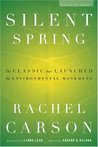
Silent SpringSilent Spring by Rachel Carson

My rating: 4 of 5 stars

Advocacy is tricky. When you’re trying to motivate people to take action, you need to decide whether to appeal to the head, to the heart, to some combination of the two, or perhaps to some more delicate faculty. Upton Sinclair miscalculated when he wrote The Jungle, aiming for the heart but instead hitting the stomach; and as a result, the book was interpreted as an exposé of the meat industry rather than a plea for the working poor. Aldo Leopold, in A Sand County Almanac, eschews appeals to expediency, and instead focuses on the spiritual joys of wild nature; but his book didn’t result in any legislation. Rachel Carson seems to have found the right formula: an urgent and multifaceted appeal to self-interest.

Silent Spring is often grouped along with Jane Jacobs’s The Death and Life of Great American Cities, which came out just the year before, in 1961. The comparison is apt, for both books were written by academic outsiders, by women working independently in male-dominated fields, and both books created a sensation. In subject matter, too, the books are surprisingly close. Jacobs describes how top-down city planning, which doesn’t take into account the needs of city-dwellers or the complex economies of cities, only causes ruination. Carson describes how indiscriminate use of pesticides destroys ecosystems and fails even to permanently kill the pests. Both books, in other words, criticize a practice taken for granted, a practice that attempted to mold the world using brute force while remaining ignorant of the systems it attempted to shape.

Even today, Carson’s book retains its moral urgency and its morbid fascination. Not only is Carson a knowledgeable scientist, but she is quite a gifted author. She knows how to drive home her point using vivid—and often frightening—examples, detailing case after case of poisonings, in animals and humans. And she supplements her examples with scientific explanations, showing us how poisons spread through the environment, are absorbed into the body, and disrupt natural processes. She knew that the chemical industry was going to fight her tooth and nail, so she did not leave any stones unturned in her research. She systematically goes through the effects of pesticides on soil, water, birds, and plants, offering case after case in support of her thesis. Now that we take it for granted that pesticides shouldn’t be applied with such wholesale zeal, this can actually be a little tedious. When advocacy is effective, it renders itself obsolete.

But Carson does not make the mistake of focusing only on the environment. She emphasizes again and again how pesticides can enter foods, can combine in the body, can kill livestock and desolate fish, can enter the skin through commercial lawn products—in other words, she emphasizes that this problem is not abstract and distant, but is one that closely affects the reader. It is this focus that makes the book so effective: she appeals to the stomach, the heart, the head, and also to Aldo Leopold’s spiritual values—but most of all, she appeals to self-interest, the strongest motivator of all.

View all my reviews

Review: 722 Miles, a History of the NYC Subway System

Review: 722 Miles, a History of the NYC Subway System

722 Miles: The Building of the Subways and How They Transformed New York722 Miles: The Building of the Subways and How They Transformed New York by Clifton Hood

My rating: 4 of 5 stars

The seven train slowed to a stop in the Mets-Willets Point station and a distorted voice crackled onto the PA system: “Last stop, last stop everybody, this is the last stop, please exit the train.” Normally the seven goes to Flushing; but today it terminated one stop earlier because of track work. With a chorus of sighs and groans the passengers shuffled out and pushed down the stairs to the buses waiting on the street, a stopgap solution used when the subway is shut down.

The buses were much smaller than the train, of course, so we had to pack ourselves in tight. When the final passenger squeezed in, the doors shut and we started moving, throwing nearly everyone off balance. Most people were silent, but behind me a man began talking: “Honestly, this is unbelievable—unbelievable! Every week, track work, signal problems, delays. Every week another problem. And they keep raising the fare! We pay more money, more money, and the service gets worse and worse. These damn MTA people, they don’t even use the subway. You know who’s on the MTA board? Yoko Ono. Yoko Ono hasn’t taken the subway once in her life!”

Except for the Yoko Ono part (I don’t know where he got that from), the man was right: service on the subways is getting worse, even though the fares keep going up. The quality has gotten so bad lately as to approach a crisis. This summer we have had two derailments, and a track fire that sent several people to the hospital. Less dramatic, but no less important, are the delays: signal problems and overcrowding cause constant tardiness. On some lines, the trains are late more often than on time. Since nearly 6 million people use the subway per day, this is a serious political liability. True to form, the politicians have done what they do best: point fingers at each other. The mayor blames the governor, and vice versa, until finally governor Cuomo declared a state of emergency regarding the subways.

Living in Madrid has given me a new perspective on the NYC subway. Before I moved I had just assumed that, by their very nature, subways were dirty, uncomfortable places. The trains screech and wail on the tracks, and jerk back and forth when they pull into the station. The stations themselves are sweaty, claustrophobic, and full of garbage and rats; and the subway cars are always packed to the breaking point. But in Madrid I discovered that a metro can be clean, sleek, and comfortable—and, most surprisingly, cheap. For comparison, a monthly ticket on the Metro North, the railroad from my town in Westchester to Manhattan, costs almost $300; and a monthly subway pass costs an additional $120. An equivalent ticket in Madrid, including both commuter rail and the metro, costs about 100€—one-fourth the price for a cleaner, safer, and better service.

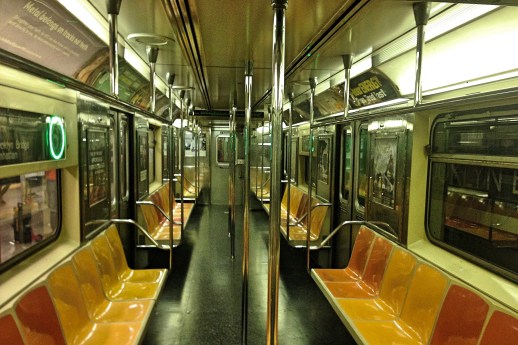
Subway Interior
Modern subway interior

I may sound like I’m disparaging the NYC subway, but really I have a great affection for it. The subway has a gritty, industrial aesthetic that I find strongly appealing. And despite the frustrations, the subway represents what is best about New York: a place where people of every background, doing every activity imaginable, are thrown together in a tight space and manage—just barely—to avoid killing each other. Just the other day, for example, I witnessed a woman violently push herself onto the subway, shoving everyone out of her way to get to a seat. As soon as she reached her prize a man rightly began castigating her, and a loud argument ensued. Luckily, another man began preaching in a loud voice, drowning out the argument and restoring a tense truce as we were given a sermon about the perils of hellfire. I simply don’t witness things like this in Madrid.

For this combination of reasons—a mixture of admiration and despair—I set out to investigate the NYC subway. First I visited the New York Transit Museum, and then I read this book.

The New York Transit Museum has two locations, a small shop in Grand Central Station, and their museum in Brooklyn. The shop in Grand Central has rotating exhibits in half the store. The latest one is about the history of the seven train, which runs from Manhattan to Queens. This line was recently extended to the far West Side, with the opening of the first new station in twenty-five years: Hudson Yards. The museum in Brooklyn, near Borough Hall, is in an old subway station. In addition to the historical photos and the information on display, the museum has examples of all the turnstiles ever used in the subway; and on the old platform there are antique subway cars, going back even to when they were made of wood. (Wooden cars got a bad reputation after the Malbone Street Wreck in 1918, a terrible accident that killed 93 people. The wooden cars splintered apart upon impact.)

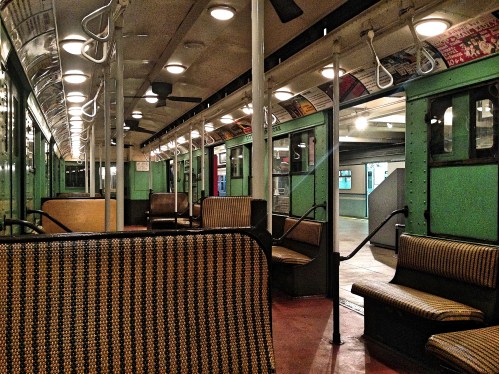
Wooden Subway
Wooden subway cars

If you go visit this museum, I recommend a little stop along the way. The New York City subway was officially opened in 1904. The showpiece of the new system was the City Hall station, located right under the seat of the city government. This station was lavish: decorated with ornate tile-work designed by the Spanish architect Rafael Guastavino, using arches based on medieval Spanish churches. Beautiful as it is, the station had to be abandoned when the subway switched to longer cars. The short length of the platform, and the sharp angle of the turn, rendered the famous station useless. Now it sits, unused and empty, below City Hall. You can still catch a glimpse of this station, however, if you take the six train down to the Brooklyn Bridge station, and then stay on the train when it curves around to go uptown. The subway screeches horribly as it turns, but it is an eerie and fascinating experience to see the old abandoned station.

(I couldn’t get any good pictures myself, but you can find some in the gallery here. The Transit Museum does occasional tours of the City Hall Station, which you can find here.)

This book was the perfect accompaniment to the museum. Written by a professional historian, 722 Miles is, I believe, the most informative book on the market about the subway’s history.* As do many books by academics, this one began its life as a doctoral dissertation. It must have been substantially revised, however, since it is mostly free from academic stuffiness and scholarly squabbles. Hood casts a wide net, focusing on three interrelated aspects of the subway’s history: the political wrangling involved in getting it built, the role it played in the development of NYC, and the engineering methods and challenges of the subway. No engineer himself, the latter aspect is fairly basic; but the politics and the urban history are quite well done.

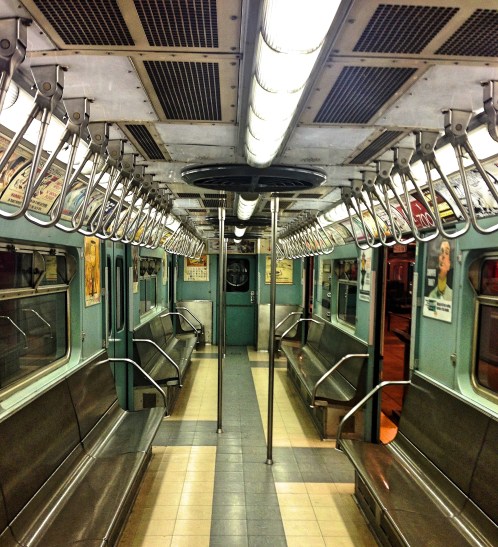
Old Interior
Antique interior design

The reader may be surprised (or maybe not) to learn that the subway has always been plagued with political wrangling and controversy. It was born in an era that saw major government spending and ownership as antithetical to sound business practices. But since private capital has always proven insufficient to infrastructure on this scale, the subway has been a public-private hybrid since its inception, with the state gradually taking on more and more responsibility. One reason the state had to step in was because the five-cent fare became a political stumbling block, something the public regarded as a sacred right; and so the fare remained a nickel even when the cost of a ride to the business was twice that amount.

Old Interior 2
Another old interior design

Originally the subway system was owned and operated by three separate entities: Interborough Rapid Transit (INT), Brooklyn Rapid Transit (BRT), and the Independent Subway System (IND). A relic of this origin is preserved in the subway’s odd numbering and lettering system: the numbered lines were the INT lines, and the lettered lines BRT and IND. These three were consolidated under city ownership by LaGuardia in 1940. From that year onward, there was very little development or even proper maintenance of the subways, in part thanks to the nickel fare. Another contributing factor was Robert Moses—the villain in every New York City story—who commanded most of the federal money available during the New Deal to build highways and bridges, diverting it from subways. Later, in 1968, the subway system was transferred to the newly created Metropolitan Transit Authority (MTA), by governor Nelson Rockefeller. This did little to help its finances, apparently, since by the early 80s the subway was a frightful, rundown, dangerous place. (Photos from that era have a haunting, apocalyptic beauty.)

The original purpose of the subway wasn’t just to serve already built-up areas in the city. Rather, several lines were run into undeveloped areas in the hopes of relieving population density. When the seven line was built in Queens, for example, it was running into almost pristine farmland and wild fields, where many still went to hunt fowl. It didn’t take long for this land to be urbanized. The muckraker Jacob Riis played a role in this development strategy, since it was he who documented the horrors of overcrowded tenements in lower Manhattan, prompting progressives to see the subway as a tool to make the city more livable and clean. This was done under the influence of Ebenezer Howard, the urban planner who originated the idea of the ‘garden city’ (which Jane Jacobs later opposed).

Turnstiles
Chronological turnstiles

Aside from the drier history, there are some fun facts in this book. The first underground train in New York was, I learned, not a proper subway at all, but a pneumatic train built in secret. This was the idea of Alfred E. Beach, who tunneled under Manhattan under the pretense of building a pneumatic parcel delivery system, to avoid the opposition of the corrupt legislature. In 1870 he unveiled his new train, which caused quite a sensation, despite being totally impractical for longer trips (Beach’s train only went a few blocks). I also learned that the tunnel that takes the seven train under the East River, on its journey from Manhattan to Queens, is called the Steinway Tunnel, because it was originally funded and promoted by that scion of the famous piano company. He was interested because he had a factory on the other side of the river.

This book was originally published in 1993, and it shows its age. This was a particularly bad time for the subway, when it was slowly recovering from its low point in the 1980s, and the book ends on a bleak note. Until fairly recently, the subway has been making quite a comeback since then. Just as many people are using the subway nowadays as they did in its so-called “Golden Age,” the 1920s and 30s, which amounts to almost 2 billion per year. The subways are no longer covered in graffiti and plagued by crime. Instead of posters warning passengers about mugging, they discourage ‘manspreading’ and promote basic etiquette. Viral videos also encourage passengers not to eat, clip their toenails, put their bags on seats, or to try to get on the train before other passengers have gotten off—a big improvement. We still have rats, though.

Even more impressive, the subway is building once again. Delayed for nearly 100 years, the Second Avenue line has just begun opening stations, which will relieve the overused Lexington Avenue line. We also have wifi in all the subway stations now.

Nevertheless, there are some serious problems to fix. The most daunting is to replace the subway’s signal system. This system is badly out of date. On some lines, they are still using equipment that dates from the 1930s. Having obsolete analog signals means that there are frequent malfunctions; and even when working properly, trains cannot safely run close to each other, since the old signals are not precise, which leads to overcrowding and more delays. This may seem like an easy fix, but it is estimating that it will take at least until 2045, and probably even later, to refurbish the whole system.

Despite these problems, and despite the expensive fares and the shrieking cars, I am still optimistic about the NYC subway. To me, the subway is a symbol of the entire city: dirty, grimy, overpriced, overcrowded, part worn out and part sleekly modern, where people of all sorts come to strive and struggle and suffer in a narrow space. New York simply wouldn’t be New York if it didn’t include frustration—and garbage—and rats—and loud energy; and the subway has all that in abundance.


*I’m not sure where the number 722 comes from. According to the Transit Museum, there are 656 miles of mainline track and 842 miles total. This number will be rising some more with the completion of the Second Avenue line.

View all my reviews

Review: How the Other Half Lives

Review: How the Other Half Lives

How the Other Half LivesHow the Other Half Lives by Jacob A. Riis

My rating: 3 of 5 stars

Millions of immigrants came to the United States during Jacob Riis’s lifetime, and a great many of them landed on an island: Manhattan. Sadly, thousands of these hopeful souls ended up on another island: Hart Island, New York City’s potter’s field, where the indigent dead are buried.

This island is still in use, by the way. Twice a week, a ferry comes bearing corpses in simple pine coffins, which are buried in mass graves dug out by bulldozers, with prisoners paid fifty cents an hour acting as pall-bearers. It was only in 2015, almost 150 years after the island began being used as a cemetery, that relatives were given permission to visit the island. Before that, the bodies disappeared completely—off limits to the public, isolated by the sea, out of the sight and out of mind. (Click here to see the New York Times’s excellent story about the island.)

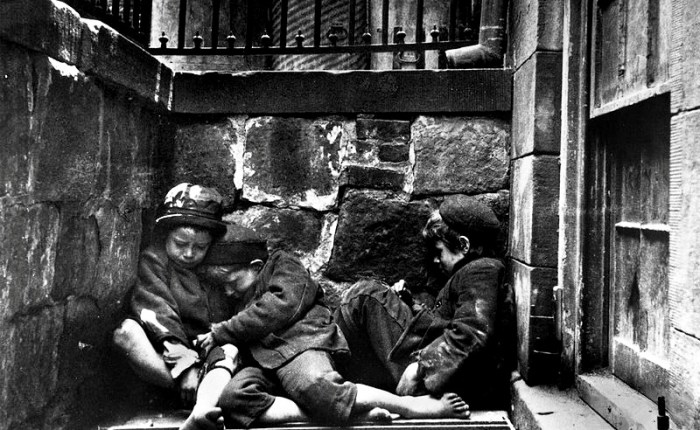
I mention Hart Island, not only because it was already in use back in Jacob Riis’s day (he took a seminal photo of a burial there), but because it is a perfect example of how the city’s poor can be made invisible. In writing this book, Jacob Riis explicitly tried to combat this invisibility. He wanted to bring home to middle-class readers just how bad life in the tenements could be.

Riis was a precursor to the muckraking journalism made famous by Upton Sinclair and his ilk, who came a generation later. In Riis’s case, the term “muckraker” is almost literally accurate, since it was grime he was trying to document. Immigrants from all over the world were pouring into New York City, many of them desperately poor, and housing simply did not keep up with the need. And because there were few building regulations on the books, this resulted in squalid and unsanitary tenements—shabby and dark (many rooms had no windows), and totally packed as families took on lodgers to afford the rent. The overcrowding not only made the buildings fire hazards, but also centers of disease.

Jacob Riis first experienced the plight of the poor when he arrived in New York City fresh from Denmark, aged twenty-one, trying to find work as a carpenter. He struggled for years to get by, occasionally sleeping in police lodging houses alongside beggars and street urchins. When he eventually found his vocation as a journalist, he wound up accompanying the police in nightly patrols of the poorest neighborhoods in the city. He wrote articles about what he saw; and one of them was so successful that he eventually expanded it into How the Other Half Lives.

I must say that this book is not a very compelling read. The prose is fine, but Riis is not a natural story-teller. The writing drifts on in an aimless, impressionistic way, never quite cohering into a cogent overview of the situation. The book itself is somewhat jumbled, with each chapter focusing on one aspect of the poor neighborhoods—stale-beer dives, lodging houses, “street Arabs,” paupers, and so on. You quickly learn that, however indignant Riis may be on behalf of the poor, he is not above racial bigotry. He has an unkind word for nearly every group—Italians, Irish, Jews, Chinese. To his credit, however, he is relatively progressive on the subject of the color line between blacks and whites.

I don’t know if this is true, but I quickly got the impression that Riis never actually spoke with the poor people he took upon himself to document. He mentions a few casual conversations, but no distinct individual emerges. To Riis, the poor seem to be nameless masses, with an ethnicity but not an identity. You occasionally wonder whether Riis is outraged by the injustice of the situation or is simply disgusted by the filth. This complete lack of individual stories contributes to the book’s underwhelming impact. Probably I am judging this book a little harshly, though, since I read this book concurrently with Sinclair’s The Jungle, and the comparison is not flattering for Riis.

There was one area, however, in which Riis excelled: photography. This edition has over one hundred of his photographs, and they are stunning. Riis was able to capture things nobody had before, since he was one of the first field journalists to use flash photography. The early generation of flash cameras used a pistol-like device that was extremely loud and fairly hazardous; twice Riis set fire to the room he was in. Later, he switched to a method that required him to heat the flash powder in a frying pan. The world before smart phones was harsh indeed. Considering these technical limitations, Riis’s photographs are all the more remarkable: candid, dramatic, and sensitive.

It is all too easy to criticize this book from the perspective of the present. Really, Riis is impressive by any measure. He learned English late in life and writes better prose than most of us. He was a brilliant pioneer of photography, and of muckraking journalism. He even had a small hand in the construction of the New Croton Aqueduct, since he documented unsanitary water supplies, as well as the New York Subway, since he was among the reformers who advocated for improved transportation to lessen population density in the slums. Most importantly, despite his flaws, he believed that society had an obligation to its least privileged members, and could not avert its eyes with a clear conscience.

View all my reviews

Review: A Sand County Almanac

Review: A Sand County Almanac

A Sand County Almanac: With Essays on Conservation from Round RiverA Sand County Almanac: With Essays on Conservation from Round River by Aldo Leopold

My rating: 4 of 5 stars

What a dull world if we knew all about geese!

Nature is refreshing. Even a short walk in a park can powerfully clear one’s head. For whatever reason—perhaps because our ancestors lived in trees—surrounding oneself with birches and maples produces in nearly everyone feelings of warmth, comfort, and peace. And for many people, nature is more than refreshing: it is awe-inspiring, even divine. Natural environments are, for some, more uplifting than cathedrals. Emerson might have captured this strain of mystical naturalism best:

In the woods, we return to reason and faith. … Standing on the bare ground,—my head bathed by the blithe air, and uplifted into infinite spaces,—all mean egotism vanishes. I become a transparent eye-ball; I am nothing; I see all; the currents of the Universal Being flow through me; I am part or particle of God.

I myself have had comparable experiences in the woods. Yet both Emerson and I are pure amateurs next to Aldo Leopold.

Leopold was a pioneering conservationist and forester. He was also a superlative writer, and in this brief book he covers a lot of ground. He begins with a month-by-month account of Sand County, a poor farming region in Wisconsin. This was my favorite section, since Leopold’s sensitivity to his environment is nearly superhuman. He has a keen sense of both the history of environments—how they change with the seasons, how they have evolved through time, how they have been warped by human activity—and the close-knit interdependence of ecosystems, how each organism shapes and is shaped by every other organism, forming a perfect whole.

As a stylist, he manages to be lyrical and poetic while sticking scrupulously to what he sees and hears. His sentences are short, his diction simple, and yet he manages to evoke a densely complex ecosystem. This is because, unlike Emerson or I—and more so than Thoreau—Leopold really understood his environment. He can name every species of plant, and tell what soils they prefer and what plants they like as neighbors. He can identify every bird by its call, and knows where it roosts, what it eats, when it migrates, and how it mates. Scratches on a tree tell him a deer is nearby, his antlers fully grown; the footprints in snow tell him a skunk has passed, and how recently.

All this is described with exquisite sensitivity, but no romantic embellishment. To borrow a phrase from E.B. White, Leopold had discovered “the eloquence of facts.” And, like White, Thoreau, and Emerson, his writing has a pleasing, folksy, rambling, ambling quality, wherein each sentence is nailed to the next one at an oblique angle.

In the rest of the book, Leopold puts forward a new philosophy of conservation. This train of thought reminded my very much of another book I read recently, The Death and Life of Great American Cities. In that book, Jane Jacobs explains how top-down approaches to city planning killed neighborhood vitality. Just so, when Leopold was a young man in the forestry service, he participated in the policy of removing predators—bears, wolves, and mountain lions—to protect livestock and to increase the supply of hunting animals, like deer. When hunting became necessary to control population, parks began building more and more roads to make access easier; and meanwhile the exploding deer population prevented new trees from growing. Thus the park was encroached upon by cars, and the ecosystem thrown off balance—in the same way that blindly building highways and public housing can destroy neighborhoods.

Leopold was, I believe, one of the first to popularize the idea that ecosystems act like one giant organism, with a delicate balance of cooperating and competing components. Every healthy ecosystem is a harmony that cannot be disturbed without unpredictable results. To again borrow from Jacobs, an ecosystem—like a city economy or a human brain—is an example of “organized complexity.” Thus ecosystems baffle attempts to understand them by thinking of their components separately, as a collection of individual species, or even statistically, as the average behavior of interchangeable parts. Complexity like this tends to be a product of historical growth, with each distinct component making minute adjustments to each other in a dense network of influence. Leopold doesn’t say this in so many words; but he does something even more impressive: he illustrates this quality using short anecdotes and schoolboy vocabulary.

His most philosophic contribution to the environmental movement is what he called a “land ethic.” Previous arguments for conservation were couched in terms of expediency: how national parks and nature reserves could benefit us economically. Leopold believed that this approach was too narrow; since hunting lodges and mechanized farms are always more profitable in the short term, this would eventually result in the destruction of wild ecosystems and the disappearance of species. We needed to move beyond arguments of expediency and see the land—and everything on it—as valuable for its own sake. Leopold believed that we had an ethical duty to preserve ecosystems and all their species, and that the aesthetic reward of wild nature was more valuable than dollars and cents could measure.

I want to go along with this, but I thought that Leopold was unsatisfyingly vague in this direction. It is simply not enough to say that we have an ethical duty to preserve nature; this is quite a claim, and requires quite a bit of argument. Further, aesthetic value seems like a slender reed to rest on. For every Emerson and Thoreau, there is a Babbitt whose tastes are not so refined. To his credit, Leopold does argue that a great part of conservation must consist in elevating the public taste in nature. Otherwise, conservation will consist of little more than the government using tax dollars to purchase large swaths of land. Individuals must see the value in wilderness and actively participate in preserving it. But molding tastes is no easy thing; and, more importantly, if we are to do so, there must be compelling reasons to do it.

The most compelling reasons for conservation are, I believe, expediency—but expediency in the widest sense. The difference between folly and wisdom is not that the former is preoccupied with expediency and the latter higher things; it is that wisdom considers what is expedient on a grander scale. Leopold comes close to making this same argument. He was, for example, ahead of his time in being deeply concerned about extinction. Every time a species disappears it is an irreplaceable loss; and considering that our medicine partly depends on new discoveries, extinctions may have terrible consequences for us down the line. (I saw a PBS special the other day about scientists trying to discover new antibiotics by shifting through raw soil.) Since Leopold’s day—long before Silent Spring or An Incovenient Truth—we have learned plenty more ways that environmental destruction can be equivalent to self-destruction.

Carping aside, this is a deeply satisfying book: lyrical, descriptive, educational, and innovative. Leopold realized what Orwell also realized: that winning converts requires both argument and propaganda. He does not only argue for the value of nature, but he really captures the beauty of unspoiled environments and serves it up for his readers’ consideration. We are not only convinced, but seduced. This is propaganda in its noblest form—propaganda on behalf of nature.

View all my reviews

Review: The Death and Life of Great American Cities

Review: The Death and Life of Great American Cities

The Death and Life of Great American CitiesThe Death and Life of Great American Cities by Jane Jacobs

My rating: 4 of 5 stars

This is a common assumption: that human beings are charming in small numbers and noxious in large numbers.

I picked up this book immediately after finishing The Power Broker, and I highly recommend this sequence to anyone who has the time. The conflict between Robert Moses, czar-like planner of New York City for almost half a century, and Jane Jacobs, ordinary citizen and activist, has become the source of legend. There is a book about it, Wrestling with Moses, a well-made documentary, Citizen Jane, and an opera, A Marvelous Order, with a libretto written by a Pulitzer Prize winner (I haven’t seen it). The two make an excellent hero and villain. Moses, the autocratic, power-hungry city-planner who eviscerates neighborhoods and bulldozes homes. Jacobs, the underdog autodidact, community organizer, defender of Greenwich Village and Washington Square Park.

The two did not only clash in life—with Jacobs leading protests to stop Moses’s highways—but, more importantly, in thought. More diametrically opposed conceptions of the city could hardly be imagined.

Moses was, at bottom, a follower of Le Corbusier, a modernist who put forward the idea of the Radiant City. The idea was to create a city with all the different functions in separate zones—sections for retail, business, manufacturing, residences—and to create as much green space as possible by putting everything in high-rise buildings, freeing up land for parks. These buildings would be connected, not by ordinary roads, but by giant superhighways. In a way, it is a conception of the city that is anti-city: there would be no streets, no corner shops, no neighborhoods. The impulse was, I believe, originally progressive: to erase differences in class by creating uniform conditions for everyone. But in Moses’s hands this philosophy became deeply reactionary: isolate the poor people of color in projects and build highways for the car-owning middle class.

Jacobs was absolutely opposed to this model. There are innumerable theoretical differences between Jacobs and Moses, but I think the most essential difference is this: Jacobs loved cities. She loved walking around cities, chatting with neighbors, gazing at street-life, making small-talk at local shops, sitting on stoops and leaning out windows. And so her idea of urban planning is not to pack everyone into high-rise buildings to get them off the street, but the reverse: to get as many people on the street as possible. She loves the messiness of cities. A healthy city is not, for her, a work of art, consciously designed. It is more like a biological organism, shaped by natural selection into a well-functioning, complex, interrelated, constantly-changing whole. Healthy cities are not made by planners but by ordinary people.

Since the publication of this book, Jacobs’s ideas have become enormously influential—so influential, in fact, that it is difficult to see anything radical about what she says. One of her basic principles, for example, is that a well-used street is a safe street, because the presence of many bystanders discourages crime. I suspect that this seems obvious to most people. But when you look at the projects that Moses and his ilk built—high-rise buildings surrounded by lawns, with no shops, restaurants, or anything else to attract people to street level—you realize how totally out of touch they were. Indeed, the whole idea of housing projects sounds like a recipe for disaster: pack all the poor into one area, set income limits so anyone successful has to move out, discourage all street activity to eliminate a sense of community. And in practice the projects were disasters—centers of delinquency and despair.

Jacobs’s recipe for creating a healthy neighborhood has four ingredients: (1) mixed uses, so that different kinds of people are drawn to the area at different times of day for different reasons; (2) a mixture of old and new buildings, so that there is low-rent space available for small businesses and low-income residents; (3) small blocks, so that streets are not isolated from one another; (4) and sufficient density of residents, to create the necessary amount of economic and social activity. The goal is to produce a neighborhood like her own Greenwich Village: with lots of street life, with successful residents who choose to stay long-term, with local stores and restaurants and cafes, and with a steady influx of immigrants.

To use a metaphor, Jacobs thinks we should try to create an ecosystem with a lot of biodiversity; and to do this we need a lot of biomass and a lot of separate niches. The essential fact about ecosystems—which also applies to cities—is that they are a delicate balance of different elements, deeply complex, shaped by the action of countless individual players over countless eons. This level of complexity is baffling to the human mind, which is why we so often disrupt ecosystems by trying to “improve” them. Urban planning does the same thing with cities.

The Moses approach (to continue the metaphor) is agricultural rather than natural: sweep away the natural environment and create an artificial monoculture. Monocultures never spring up in healthy ecosystems. Lacking biodiversity, they are inherently vulnerable and difficult to maintain. We expend enormous amounts of money and energy defending our wheat fields from vermin and disease. The same principle applies to the housing projects, which need constant police surveillance to remain remotely viable.

This gives a taste of Jacobs’s guiding idea, perhaps, but I can hardly do justice to the wealth of thought in this book. Jacobs has convincing sociological insights into what makes streets safe or unsafe, what makes city economies thrive or stagnate, why housing projects fail and slums form, why parks are used and unused, why city governments are so often inefficient and ineffective, and even includes her ideas on the history and progress of science. In a way, this book is a constant rebuke to academe. At the time, academic urban planning was entirely stagnant, relying on ideas and principles that hadn’t been modified in thirty years and which were never very good to begin with. It took someone like Jacobs, an autodidact without a college degree, to break up the orthodoxy—and she had to endure a lot of sexism and condescension in the process.

What made her so successful, and what has made this book so enduring, was a rare combination of talents: keen observation, a highly original mind, the ability to think on multiple scales at once, hard-nosed practicality, and a healthy sense of social responsibility. In this book she relies on her wide and somewhat eclectic reading, but even more on her own eyes and ears. She has visited successful and unsuccessful neighborhoods and had talked to their residents. She has led protests and was a frequent visitor of City Hall. When you read this book, it is easy to see why she has become something of a hero for many citizens and academics: she is absolutely unafraid of authority, either intellectual or political, and she had the mental and personal resources to win.

It is, of course, ironic that her ideas, so heterodox, eventually became the new orthodoxy of urban planning. When Jacobs passed away in 2006, there were many who called for an end to her intellectual reign.

The most common criticism, I believe, is that Jacobs did not anticipate gentrification—the gradual takeover of neighborhoods by the affluent. This is the most talked-about problem in New York City today. There’s a popular blog, Vanishing New York, which documents all the small business and local establishments being pushed out by big money. Jacobs’s own former neighborhood, Greenwich Village, is a prime example: now it is nothing like the bustling, bohemian, working-class place it was in her day. I’m not sure if Jacobs can be fairly blamed for this, however. For one, she anticipates how successful neighborhood can become “too successful” and lose their vitality as more money pours in. What’s more, she was very concerned with maintaining housing for low-income tenants within successful neighborhoods, and includes a novel plan to do so in this book.

In any case, this book is not just a recipe for creating neighborhoods. In an oblique way, it presents an entire ideology. Jacobs is a proponent of what you might call progressive decentralism. Normally, decentralism is associated with the right, at least here in the US, but Jacobs make a strong case for leftist decentralism. Large, vertically-oriented government structures simply cannot understand or respond to individual citizens’ needs. The answer is to empower local government so that citizens can shape their own neighborhoods. Government must help the disadvantaged, but must do so by cooperating with local forces and private individuals—exploiting economic and social elements that naturally arise, instead of imposing its own cumbrous structure.

This book can be read even more broadly, as an attack on suburbia and modern isolation. Cities are the future, as Jacobs reminds us—hotbeds of ideas and centers of population growth; and cities are natural products, created by the free choice of individuals, places that organically foster their own sense of identity and community. Suburbia is a rejection of cities: artificial products created through the deliberate policies of planners. Not shaped by free choice, they are not organic communities; and even if they escape being unsafe, like the projects, they foster that constant specter of modern life: isolation. When you hear Jacobs describe her own neighborhood in Greenwich Village, you get a sense of what so many places nowadays lack: neighborliness, friendliness, a group of semi-strangers and sidewalk acquaintances who will go out of their way to help each other, a sense of communal ownership and belonging.

In sum, this book is a true classic: ensconced in an intellectual climate that no longer exists, responding to contemporary problems with eloquence and insight, and championing a perspective that is still vital.

View all my reviews

Review: The Jungle

Review: The Jungle

The JungleThe Jungle by Upton Sinclair

My rating: 4 of 5 stars

Every day in New York they slaughter
four million ducks
five million pigs
and two thousand doves for the pleasure of the dying,
a million cows
a million lambs
and two million roosters,
that leave the sky in splinters.

—Federico García Lorca

I expected to dislike this book, because it is a book aimed at provoking outrage. Outrage is a species of anger, and, like all species of anger, it can feel oddly pleasurable. True, anger always contains dissatisfaction of some kind; but anger can also be an enormously enlivening feeling—the feeling that we are infinitely right and our opponents infinitely wrong. Outrage joins with this moral superiority a certain smugness, since we feel outrage on behalf of others, about things that do not affect us personally, and so we can feel satisfied that we would never do something so egregious. Judging from how ephemeral public outrage tends to be, and how infrequently it leads to action, outrage can be, and often is, engaged in for its own sake—as a periodic reminder to ourselves that we are not villains, since villains couldn’t feel so angry at injustice inflicted on so distant a party.

In a way, the history of this book justifies my suspicion. Upton Sinclair spent seven weeks working in the meatpacking industry in Chicago, and wrote a muckraking novel about the experience. An avowed and proud socialist, his aim was to raise public awareness of the terrible conditions of the working poor—to write the “Uncle Tom’s Cabin of wage slavery,” as Jack London called the book. The book did cause a lot of outrage, but not for the intended reasons. The public interpreted the book as an exposé on the unsanitary conditions in the meat factories; and the legislation that resulted was purely to remedy this problem. As Sinclair himself said, “I aimed at the public’s heart, and by accident I hit it in the stomach.” This is one of those ironies of history that make you want to laugh or cry: a book aimed to publicize the plight of the working poor made an impact solely in the way that working conditions affected the middle class.

About halfway through, I had decided that this was a brilliant piece of journalism and a mediocre novel. But the second half made me revise my opinion: it is a surprisingly decent novel, too. This is impressive, since fiction is not Sinclair’s strength. His characters are, for the most part, one-dimensional and static; in this book they serve as mere loci of pity. Furthermore, they never really come alive, since Sinclair writes almost no dialogue. In the first half, when the protagonists are at work in the yards, the plot is drearily predicable: things go from bad to worse; and, as Shakespeare reminds us, every time you tell yourself “This is the worst,” there is worse yet still to come. But after Jurgis, our hero, finally leaves the meat factories, the novel really comes alive. Things still go from bad to worse, for the most part, but there are some surprising reversals and exciting adventures.

In any case, this book is primarily a work of journalism, and on that level it is absolutely successful. Sinclair is an expert writer. He deploys language with extreme precision; his descriptions are vivid and exact. And what he describes is unforgettable. His portrayal of grinding poverty, and the desperation and despair it drives people to, is almost Dostoyevskyan in its gruesomeness. And unlike that Russian author, Sinclair is very clear that the problem is systematic and social—how decent and hardworking people can fall into an economic trap with no options and no escape. He shows how and why the working poor are free only in theory, how and why the oppressed and exploited are virtually owned by their bosses. And it must be said that his descriptions of factory processes are viscerally disgusting—so disgusting that they do distract a little from Sinclair’s message. The meat factory is the book’s central metaphor: a giant slaughterhouse where hapless animals are herded and butchered. As becomes painfully clear by the end of the book, the working poor are hardly in a better situation than the pigs.

By the end, Sinclair succeeds in producing that rare sensation: reasoned outrage. For there are, of course, situations in which outrage is the only logical response—monstrous injustice and inhuman cruelty—and the working and living conditions in the meatpacking district was one of them. Sinclair succeeds in this by relating facts instead of preaching. (Well, he does some preaching at the end, but it is forgivable.) He does not sentimentalize his characters or exaggerate their nobility; they are ordinary and flawed people. He does not use mawkish or cloying language; his narrative voice is pitiless and cold, like the world he describes. This book is a testament to the positive potential of outrage. The world needs more muckrakers.

View all my reviews

Review: The Power Broker

Review: The Power Broker

The Power Broker: Robert Moses and the Fall of New YorkThe Power Broker: Robert Moses and the Fall of New York by Robert A. Caro

My rating: 5 of 5 stars

Many are concerned about the monuments of the West and the East—to know who built them. For my part, I should like to know who in those days did not build them—who were above such trifling.
—Henry David Thoreau

“Who’s Robert Moses?” I asked my brother, after he bought this book.

Well, who was he?

To drive from my house to the city, you need to take the Saw Mill Parkway, across the Henry Hudson Bridge, onto the Henry Hudson Parkway. Those roads, and that bridge, were built under the direction of Robert Moses. If you have a flight to catch, you take the Hutchinson Parkway across the Whitestone Bridge to the Whitestone Expressway, which takes you the JFK airport; these, too, are Moses constructions. To get from my house to my old university in Long Island, you can take Bronx-River Parkway, which links up with the Cross-Bronx Expressway; then cross over the Throgs Neck Bridge onto the Long Island Expressway or the Northern State Parkway—and that bridge, and every one of those highways, is a Moses project.

Who was Robert Moses? He had formed the world around me. Robert Moses was the most decisive figure in shaping 20th century New York. But what was his job?

In his forty-four years as a “public servant”—from 1924 to 1968—Moses came to hold twelve titles simultaneously. He was the New York City Park Commissioner, with control over the city’s parks and parkways; he was the Long Island State Park Commissioner, with control over all the parks and public beaches on Long Island; he was the chairman of the Triborough Bridge Authority, with near-total autonomy from the city or state government. He was the chairman of the New York Power Authority, the chairman of the State Council of Parks, and the head of Title I, which oversaw all the public housing in New York City—and this is not to mention his membership on the City Planning Commission and the City Youth Board—and his eventual title as the City Construction Coordinator, which gave him control over nearly all public works in the city.

Robert Moses was a master builder. He built hundreds of miles of parkways and expressways; he opened hundreds of parks and playgrounds; he built some of the biggest bridges and tunnels and dams the world had ever seen. In the process, Moses displaced hundreds of thousands of people, condemning and demolishing their homes, and tearing the hearts out of old neighborhoods. How did he build so many things, acquire so many titles, move so many people? How, in other words, did he get and hold onto so much power? This is the central question of Robert Caro’s biography. And I can’t give you an idea of Caro’s biography, or why it is so incredible, without giving you an idea of Robert Moses.

The old adage about power and corruption is repeated so often, in such different contexts, that it can sound stale and meaningless. Moses’s story gives meaning to the adage—and qualification. He began his career as an idealist and a reformer; he was an opponent of nepotism, graft, and privilege. Moses’s first major effort was to institute civil service exams and strict pay scales that would serve as checks on government inefficiency and corruption. This effort failed utterly, defeated by the forces Moses hoped to check, leaving him out of a job.

After that, Moses learned to change his tactics. He stopped being an uncompromising idealist and started working with the forces he had once hoped to subdue with his ideas. And once he began to use the tactics of his erstwhile enemies, his prodigious intelligence and drive allowed him to master every force in his way.

The more power he gained, the more he wanted, and the more adept he became at getting it. One strategy was legislative. He was very crafty at drafting bills, sneaking through obscure clauses that extended his reach. His first master-stroke was to give himself, as the Long Island Park Commissioner, power to condemn virtually any piece of land he chose to for his parkways. Later, he managed to pass a bill that allowed him to simultaneously hold city and state government posts. Later still, he wrote the legislation authorizing the creation of the Triborough Bridge Authority, an entity with so much power and wealth that it was essentially a separate government, unelected by the people and unaccountable to and uncontrollable by the city or state governments.

He used underhanded tactics to build his parks and roads and bridges. To get the approval he needed from government boards, he would give extremely low estimates for the construction projects; and then, when the money ran out when the project was half-complete, no politician could refuse him more money, since that would require leaving a road or a bridge embarrassingly incomplete. He used scare tactics to speed eviction of buildings, telling tenants that demolition was imminent and they needed to vacate immediately, when in reality demolition was months away. To outmaneuver opposition to his projects, he would wait until his opponents were asleep and then bulldoze and jackhammer in the night—destroying dockyards, apartments, old monuments—rendering all acts of defiance pointless.

Moses was a master organizer. He learned to use the selfish interest of the major power-players in the city to accomplish his own ends. The unions and construction companies loved him because he provided work on a massive scale. The banks were eager to invest in the safe and high-yield Triborough bonds; and Moses rewarded the banks by depositing his massive cash reserves into their coffers. Cooperative lawyers received lavish rewards as “payment,” hidden through third-parties and carefully disguised as fees and emoluments. In everything, Moses prized loyalty and doled out money, commissions, and jobs based on how much power was at stake. He also forged a close relationship with the press by throwing lavish parties and befriending many newspaper owners and publishers. His carefully cultivated public image—as a selfless public servant who Got Stuff Done—made him an asset to politicians when they worked with him, and a major liability if they antagonized him.

And the more power he gained, the more uncompromising he became. He surrounded himself with yes-men—he called them his “muchachos,” and others called them Moses Men—who never criticized, or even questioned, what Moses said. He would refuse calls from mayors and governors. He did not go to council meetings and sent delegates to City Hall rather than go himself. Once he had planned the route of a road, he wouldn’t even consider changing it—not for protests or activists or local politicians; he wouldn’t divert his road one mile or even half a mile. If you opposed him once, he would use all his connections and resources—in government, construction, law, and finance—to ruin you. He ruined his own brother’s career this way. He kept files on hand full of compromising information that he would use to threaten anyone who dared oppose him, and during the Red Scare he freely accused his enemies of being closet communists—and if that didn’t work, he would accuse their families.

Summed up like this, Moses seems to be a classic case of a man corrupted by power. He went from a hero, fighting on behalf of the citizens to create public parks, struggling to reform an inefficient and corrupt government, to a villain—bullying, blackmailing, evicting, bulldozing, handing out graft. However, as Caro is careful to note, power did not so much corrupt Moses, turning him from pure-hearted to rotten, as allow certain elements of his personality free play, unhampered by consequences. The most prominent of these elements was his monumental arrogance. There are not many clips of Moses online, but the few there are give some idea of Moses’s egotism. He was uninterested in others’ ideas and perspectives, and could hardly deign to explain his own thinking. He spoke about the removal of thousands of people in a tone of utter boredom, as if the families he was moving were less important than gnats.

Compounding his arrogance, Moses was an elitist and a racist. He built hundreds of playgrounds in New York City, but only one in Harlem. He kept the pools in his parks cold, in the odd belief that this would keep black residents away. He built exclusively for the car-owning middle-class, draining resources away from public transportation, even encouraging subway fare-hikes to finance his projects. He made no provisions for trains or buses on his roads, and refused even to build his highways in such a way that, in the future, they could be easily modified to include a railway. It would, for example, have cost only a few million to do this while the highway to JFK was under construction, keeping a few feet in the center clear for the tracks. But because Moses didn’t do this, the railway to JFK, when it was finally built, had to be elevated high up above the highway; and it cost almost two billion dollars.

Moses was also a workaholic. He worked ten-, twelve-, fifteen-hour days. He worked on vacations and on weekends, and he expected his subordinates to do the same. Politically, Moses was a conservative. Ironically, however, Moses was a key figure in the implementation of the progressive New Deal policies of FDR (who was Moses’s arch enemy, as it happens). Also ironic was Moses’s adoption of progressive, modernist urban-planning principles. His ideal of the city was, in its essentials, no different from that outlined by the Swiss-French architect Le Corbusier, who was certainly no conservative—an orderly city of parks, high-rise apartments, and highways, with no messy downtown areas and no ordinary streets for pedestrians to stroll about. But perhaps the most ironic fact in Moses’s life is that this most fervent believer in the automobile, this builder of highways and bridges, never learned to drive. He spent his life getting chauffeured around in a limousine that he had converted into an office, so he could work and hold meetings on the go.

Now if you’re like me, you may think there is something obviously wrong with a racist and elitist planning housing for poor people of color. There is something wrong with a man who couldn’t drive planning highways for an entire state. There is something wrong with a workaholic who was never home planning homes; something wrong with a lover of the suburbs organizing a city. There is something wrong with a man who was never elected wielding more power than mayors and governors. There is something wrong with a man who was scornful of others, especially the lower-class, being allowed to evict thousands from their homes. There is something wrong with a man who did not care about other perspectives and philosophies, who never changed his mind or altered his opinions, wielding power for over four decades. Really, the whole thing seems like a recipe for disaster, doesn’t it?

And, indeed, many came to see Moses’s policies as disasters. Caro certainly did. Moses thought that his legacy would speak for itself, that his works would guarantee him immortal gratitude. Rather, Moses’s name came to be synonymous with everything wrong with urban planning. Sterile public housing that bred crime and hopelessness; ugly highways that cut through neighborhoods and flooded the city with cars; top-down implementation that didn’t take into consideration the needs and habits of residents; cities that had superhighways but lacked basic, affordable public transportation. Even the harshest critic, however, must admit that Moses did some good. That both the city and the state of New York have such an excellent network of parks is in no small measure due to Moses. And if his highways were hopelessly congested when Caro wrote this book in the 70s, nowadays they work quite well, perhaps because they’ve since been supplemented by better public transportation.

While the value of his legacy is at least debatable, the injustice of his tactics is not. Moses was extremely fond of saying that “You can’t make an omelet without breaking a few eggs.” For him, the ends always justified the means. If a few people—maybe a great many people—would be inconvenienced or hurt by his projects, future generations would thank him. But I think his story is an excellent example of why this type of thinking is dangerous, since it allowed him and his followers to trample over the lives of thousands, destroying houses and neighborhoods, treating those in his way with neither respect or dignity, for the sake of the “common good.” It allowed him, in other words, to be a tyrant in good conscience. And the reason he was able to do this and get away with it was because, as an appointed official, his power did not derive from the public—something intolerable in a democracy.

And yet, as Caro points out, Moses does illustrate a conundrum at the heart of a democratic government. Moses tried to achieve his dreams through the normal channels of government, and failed utterly. It was only when Moses started circumventing the usual rules that he was able to accomplish anything. And I think anyone who has ever tried to make a group decision—whether at work or with friends—can appreciate how enormously inefficient democracies can be. Moses was unjust, but he was efficient. That’s a major reason why no mayor or governor dared fire him; while other officials were mired in red tape and board meetings, waiting for approval, allocating funds, holding public hearings, Moses was plowing through and building his works. As he was fond of saying, he Got Stuff Done. His record of achievement made him, for a time, into a political asset and a public hero.

Here is the democratic conundrum in a nutshell. Quick decisions require unilateral power. This is why the Roman senate appointed dictators in times of trouble. But just decisions require a legal framework, open debate, and the people’s approval—a slow and often painful process. And as the story of Caesar shows, it is a risky matter to grant unilateral power temporarily. Power, once granted, is difficult to take away; and power, once concentrated into one area, tends to keep on concentrating.

But the major lesson about power I learned from this book is that power is particular and personal. This is why this book is so eye-opening and shocking. Before reading this, my operating assumption was that power derived from rules and roles. You were elected to a position with a clearly delineated scope and legally limited options. Each position came with its own responsibilities and jurisdiction, unambiguously defined in black and white by a constitution or a law. Yet Moses’s story illustrates the opposite principle. The scope of a role is defined by who holds it; the power of the position is derived from the ingenuity of the individual. Everything comes down to the personality of the man (usually a man, then as now) in charge, his philosophy, his force of will, his cunning, his intelligence, as well as the personality of the people he has to deal with. Circumstances play a role too. Success or failure depends on the individual’s ability to take advantage of any opportunity that arises. Power is not embodied in an eternal set of rules but rather in an ever-changing set of particular circumstances.

Here’s just one example. Moses thought that his power over the Triborough Authority was inviolable, because he had made contracts with his investors, and contracts are protected by the United States Constitution. But when Nelson Rockefeller, the governor, wanted to merge the Triborough into the Metropolitan Transit Authority—a clear violation of the bond contracts—Moses couldn’t stop him, since the banks were represented by Chase, which was owned by Nelson Rockefeller’s brother—who wouldn’t take the matter to court. In other words, because of the particular circumstances—the family relationship between the governor and the bank—the most sacred rule of all, the Constitution, was broken and Moses was defeated. And the reason this happened was not due to any regulation; it came down to the incompatibility of Moses’s and Nelson Rockefeller’s personalities.

I have written an enormous review, and yet I still think I have not done justice to this enormous book. Caro weaves so much into this story. It is not simply a biography of Robert Moses, but a treatise on power, government, and city-planning, a history of New York City and New York State. Robert Caro is an excellent writer—dramatic, sweeping, and capable of weaving so many disparate threads and layers and levels together into one coherent narrative. The one virtue he lacks is brevity. This book is long; arguably it is unnecessarily long, full of peripheral details and sidenotes and rhetorical passages. But its length is what makes The Power Broker so engrossing. It is more absorbing than a fantasy novel, pulling you completely into its world. For three weeks I lived inside its pages.

I loved this book so much, and learned so much from reading it, that it seems peevish to offer criticisms. I will only say that Caro is clearly hostile to Moses and perhaps is not entirely fair. He is an extraordinary writer, but uses repetition as a rhetorical device a bit too much for my tastes. Also, despite this book’s huge scope and length, there are some curious omissions. Particularly, Jane Jacobs’s conflicts with Moses—which have become somewhat legendary, even the subject of a recent opera—are not covered. Jacobs, who articulated many of the intellectual criticisms of Moses’s approach, isn’t even mentioned.

All these are mere quibbles of a book that totally reconfigured my vision of power and government. I recommend it to anyone. And if you’re from New York, it is obligatory.

View all my reviews

The Old Croton Aqueduct and the New Croton Dam

The Old Croton Aqueduct and the New Croton Dam

The Old Croton Aqueduct trail runs behind my house, and I’ve been walking along its tree-shaded way for well over a decade now. As a kid, I thought “aqueduct” was just a name, until my mom told me that, buried underneath the pebbly ground, there is a tunnel that used to carry water to New York City from Croton, a couple dozen miles north. Even so, it never occurred to me to learn about the aqueduct. This a striking but common phenomenon: we travel to foreign cities and go on tours, but neglect the history in front of our eyes. It wasn’t until I began traveling abroad that I started to realize the scale and significance of the old aqueduct—along with the Brooklyn Bridge and the Eerie Canal, it is one of the major engineering feats of nineteenth-century New York—and so I set myself to investigate it.

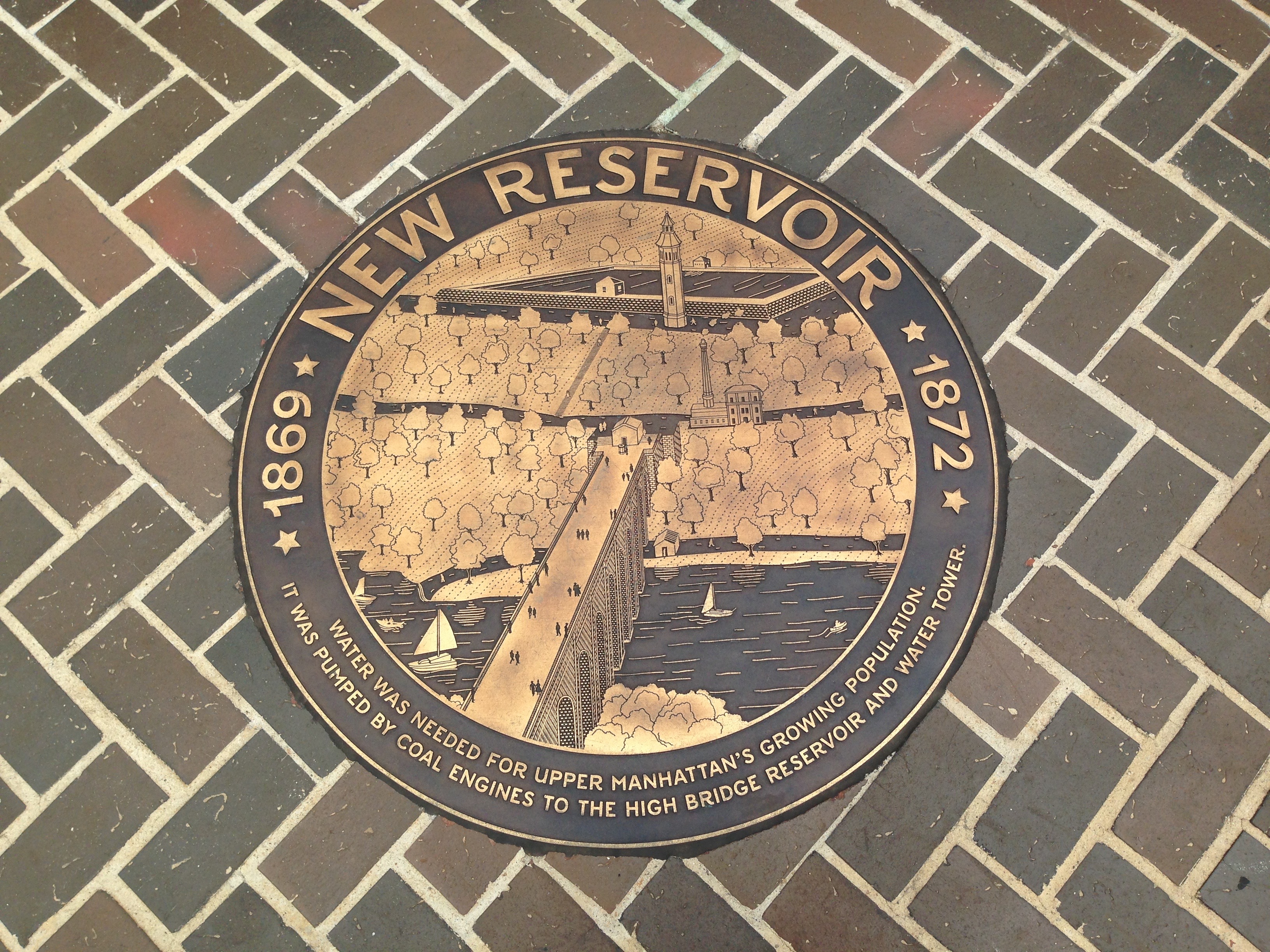
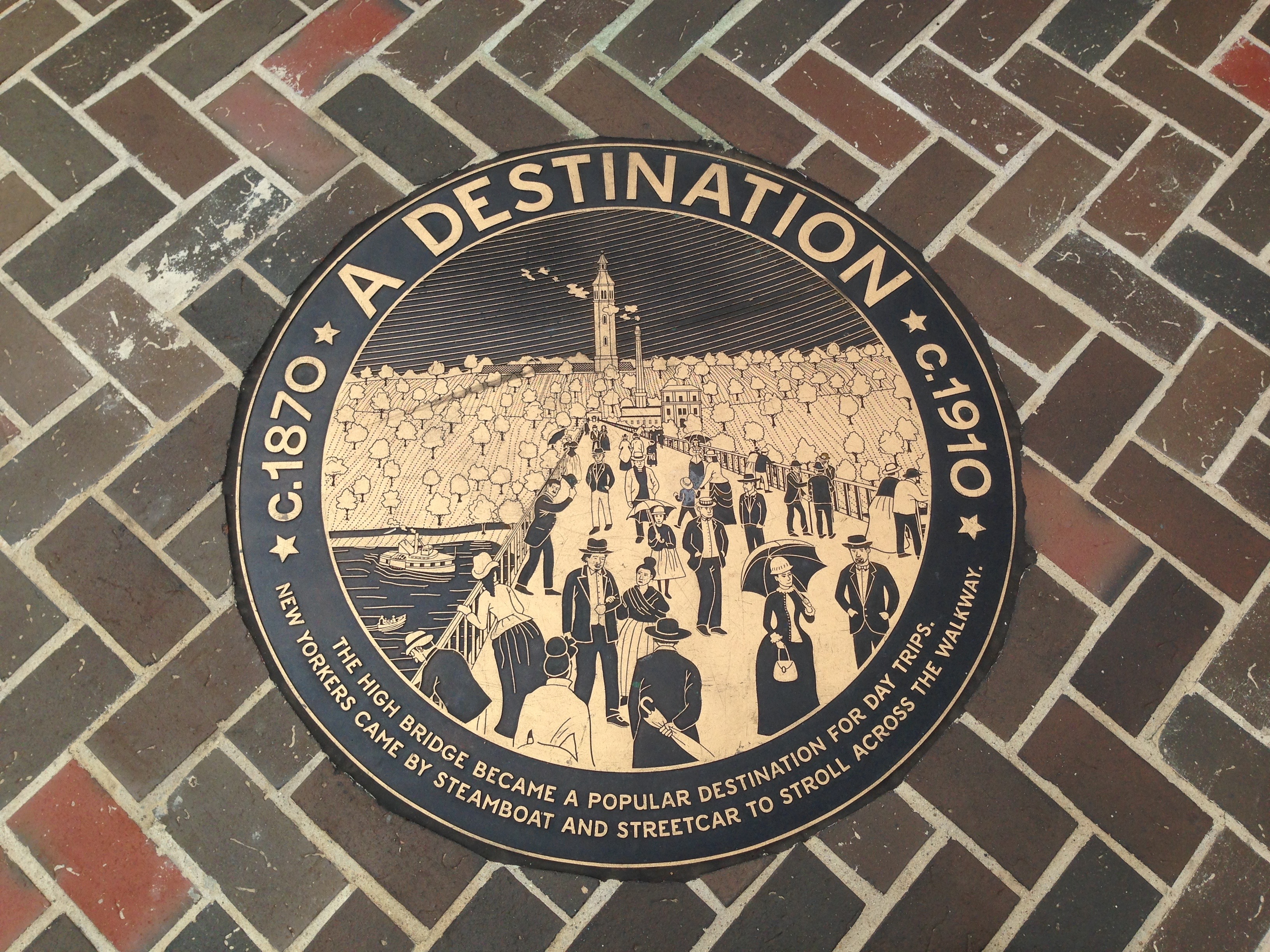
The first step was to walk the whole thing. This is not an easy stroll. The original aqueduct ran about 40 miles from the Croton Reservoir down to Manhattan. The water first reached the Receiving Reservoir, which is now the Great Lawn in Central Park, and then traveled further along to the Distributing Reservoir in Midtown Manhattan on 42nd Street. On this spot now stands the iconic main branch of the New York Public Library, and you can still find remains of the old reservoir’s foundation in the library basement. An imposing structure inspired by Egyptian architecture, this distributing reservoir used to be something of an attraction. People would come to stand atop its walls, for what was then one of the best views of Manhattan.

After the aqueduct was phased out of service in the 1960s, a large chunk of the land—26.2 miles of trail, to be exact—was donated to New York State, to form a historic linear park that stretches from Croton, through Ossining, Scarborough, Tarrytown, Irvington, Dobbs Ferry, all the way down to the Bronx. I didn’t manage to walk the whole way, but I walked most of this distance, first going south to Yonkers and then north to Croton.

For most of the way, the Old Croton Aqueduct is a dirt or grass path, about ten feet wide or narrower, with a well-worn channel in the middle. It goes through some historic areas, taking the walker alongside the Sleepy Hollow Cemetery, through the park of Lyndhurst (former residence of Jay Gould, railroad baron), and near Sunnyside (former residence of Washington Irving), and into the wonderful Rockwood Park (former residence of William Rockefeller). The trail is not always so scenic; sometimes you are basically walking through people’s backyards, and there are a few intervals where you have to exit the trail and walk through a neighborhood to get to the next stretch.

Ventilator
Trail and ventillator

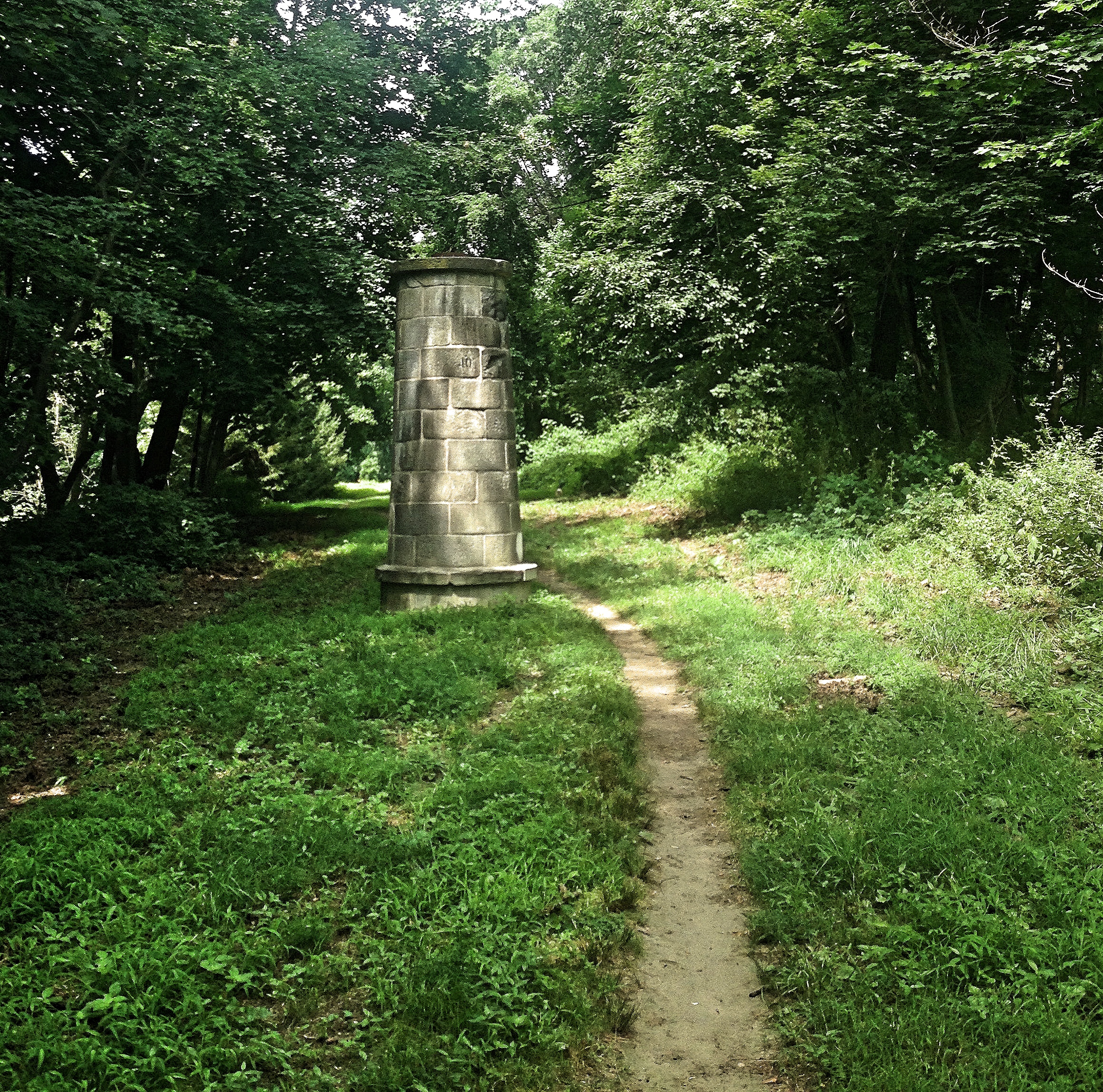
The walker will notice a few structures along the way. The most common are the ventilators, which are hollow stone cylinders with a shaft that allowed fresh air to reach the water below. These were installed to prevent pressure from building up inside the tunnel. Less frequent are the weirs, square stone buildings with metal sluice gates inside that could be dropped like a guillotine to divert the water in case repairs were needed. (And since the growing population of New York put heavy strain on the aqueduct, they frequently were.) These are situated above rivers, into which the water could be redirected. There is one above the Pocantico River in Sleepy Hollow, another in Ossining over the Sing Sing Kill, and another in the Bronx over the Harlem River.

Weir
Sleepy Hollow Weir

In Dobbs Ferry stands one of the old Keeper’s Houses, where the aqueduct’s superintendents used to stay. There used to be six of these along the aqueduct, but the one in Dobbs Ferry is the only one that still stands. It is an inconspicuous white house now, but not long ago it lay completely in ruins; the restoration was just completed in 2016, by the combined efforts of the Friends of the Old Croton Aqueduct, a non-profit volunteer organization dedicated to the aqueduct, and the State of New York. This house is open on weekends and is well worth a visit. It contains many exhibits about the aqueduct, with historical photos, engineering drawings, and maps, and also has several short documentaries you can watch.

Sluice Gate
Sluice gate

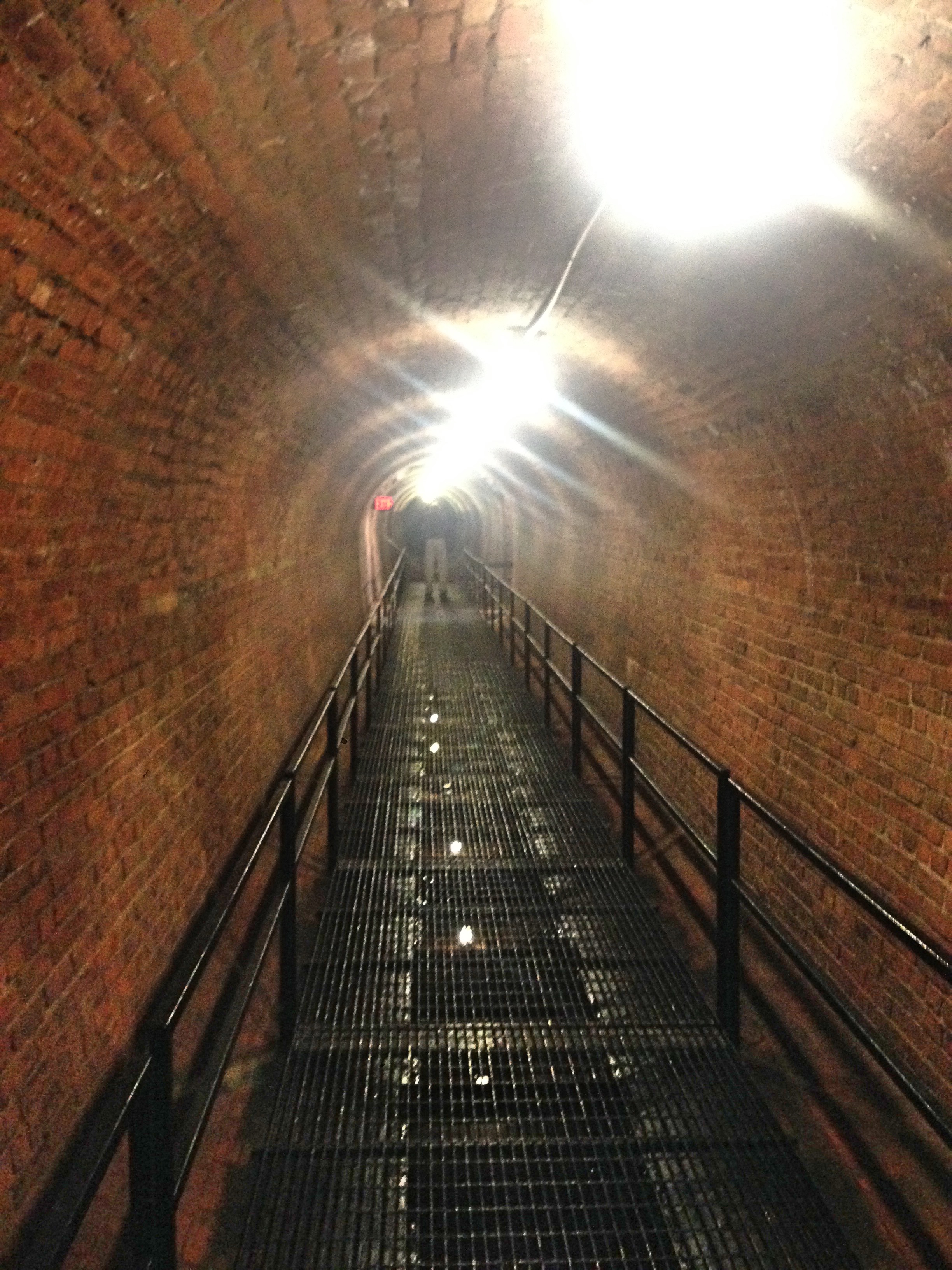
Up north in Ossining there is a stone bridge that carries the aqueduct over the Sing Sing Kill. (“Kill” comes from a Dutch word, meaning “river,” and is used in several place-names in New York.) A few times a year, The Friends of the Old Croton Aqueduct give free guided tours that actually bring you inside this bridge. I recently went on one, and I recommend the experience. A group of about two dozen visitors descended through the weir into the aqueduct. The old sluice gate is a rusty mass of metal now. But the aqueduct tunnel itself, made of brick and waterproof concrete, has held up remarkably well. The only marks of wear are some cracks in the walls from running the aqueduct at full capacity. It made me giddy to think that I could walk through that dark and dank tunnel all the way to New York City.

Tunnel Interior
Inside the Aqueduct

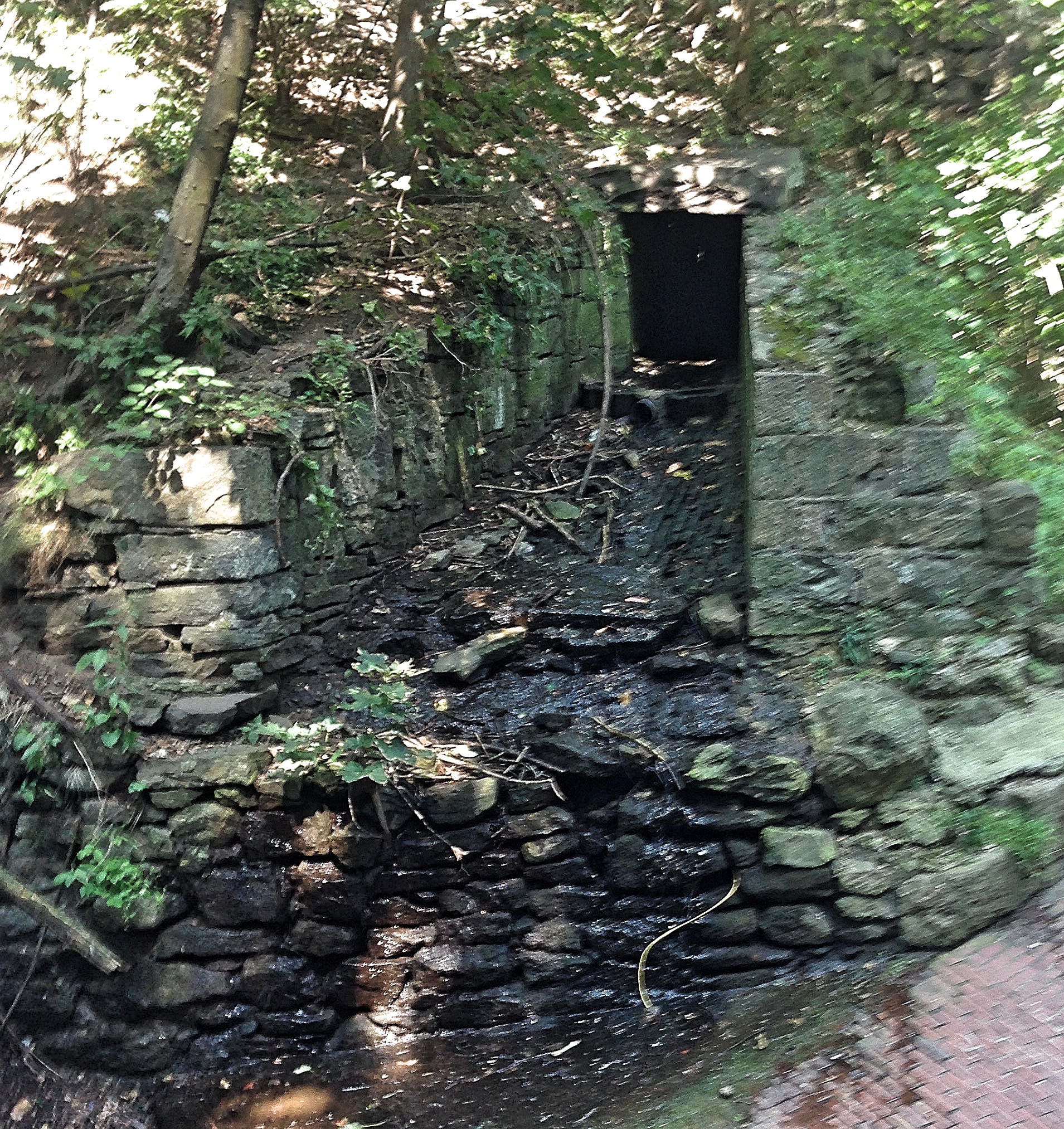
Below this bridge, there is an elevated walkway (a “greenway”) where you can stroll alongside the Sing Sing Kill. This was just opened last year, in 2016, and is astonishingly lovely. From this you can see the spillway, which brought the water from the aqueduct into the river during repairs. As the guide noted, the water would spray out with such force that it scoured the bank on the other side of the river.

Spillway
Sing Sing Kill spillway

From the information available in the Keeper’s House and the Ossining Visitor Center—from permanent exhibitions and documentaries on display—I pieced together the history of this great work. The original aqueduct and dam were commissioned in the 1830s after it became apparent that New York badly needed more water. Outbreaks of yellow fever and cholera killed thousands; and the Great Fire of 1835 destroyed hundreds of buildings, largely because the fire department lacked the water to put it out. Manhattan is an island of marshy ground surrounded by brackish water, and before the Croton Aqueduct was built the only water supplies were local wells which could be easily polluted.

Greenway
Sing Sing Kill greenway

The man primarily responsible for planning and engineering the original aqueduct was John B. Jervis, who must be one of the great engineers of 19th century America. He had political as well as engineering challenges to surmount. The land needed for the tunnel cut through hundreds of properties, mostly farms, each of which required an individual settlement. Meanwhile, the two political parties of the time, the Whigs and the Democrats, were squabbling over funding. Upon completion of the project, Jervis rode in a rowboat through the tunnel all the way from Croton to New York. I don’t know how long it took him, but it takes the water 22 hours to make the journey. This slow speed was intentional, by the way, since it minimized wear on the tunnel.

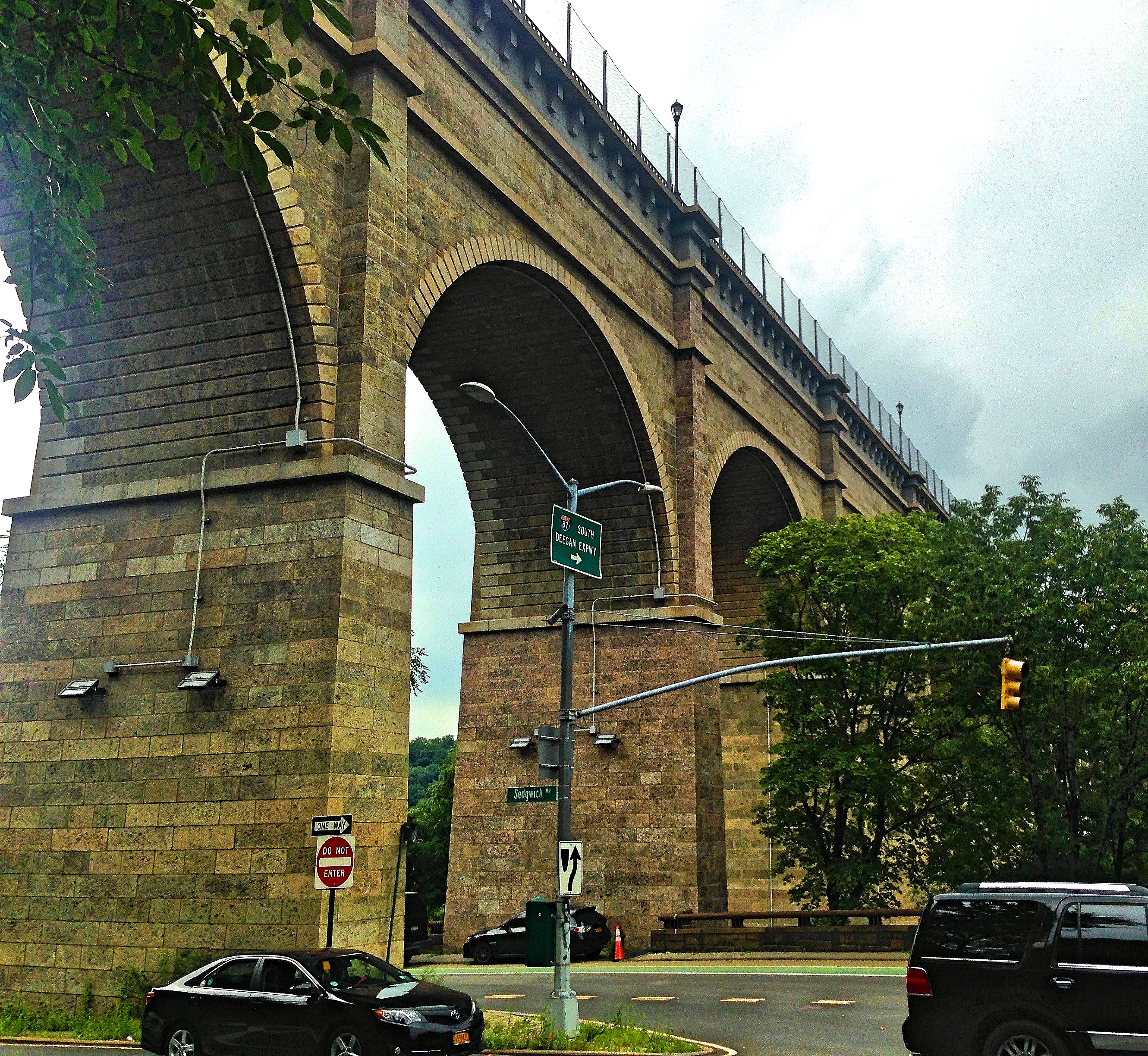
High Bridge Ground View
Original High Bridge arches

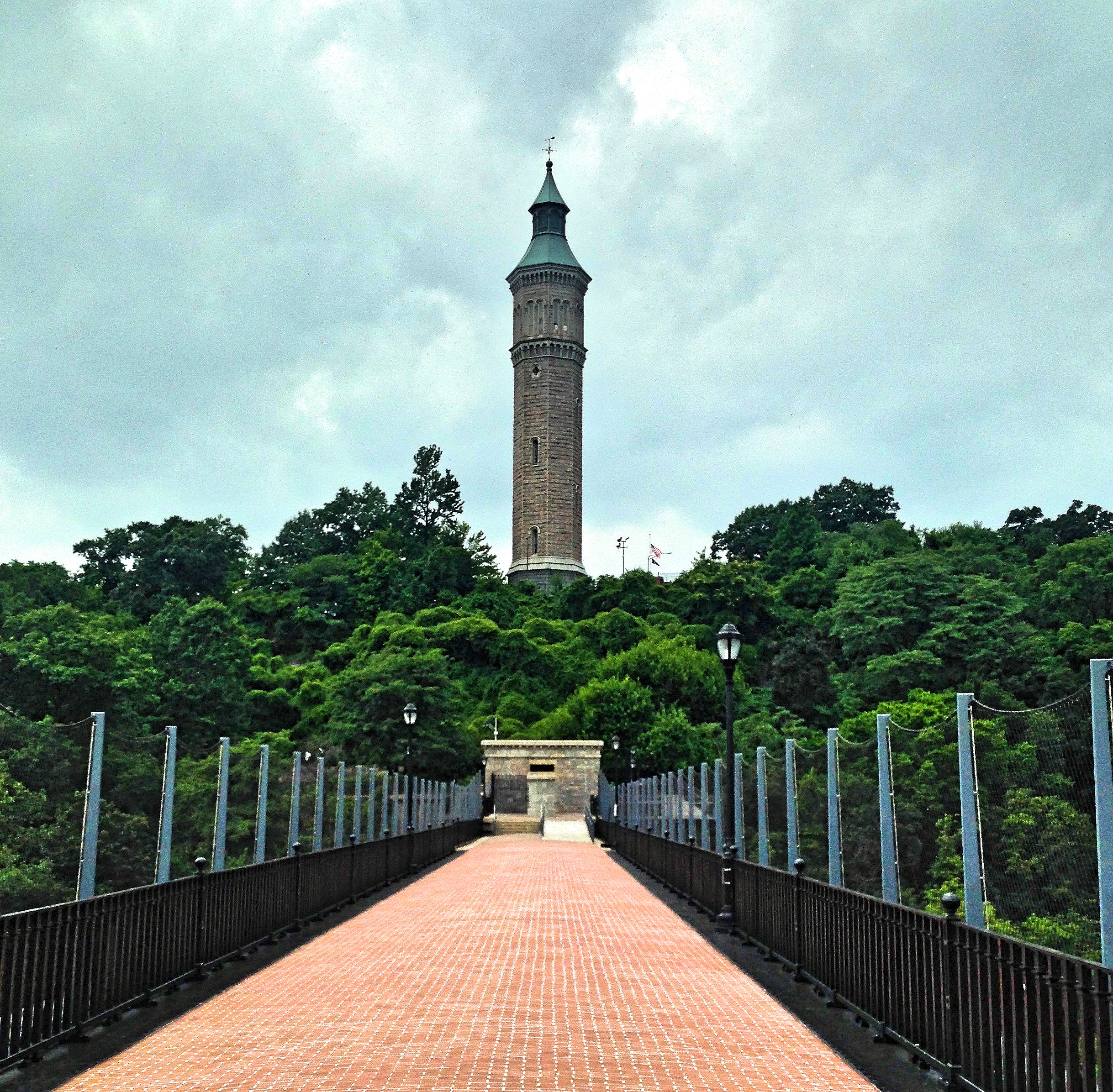
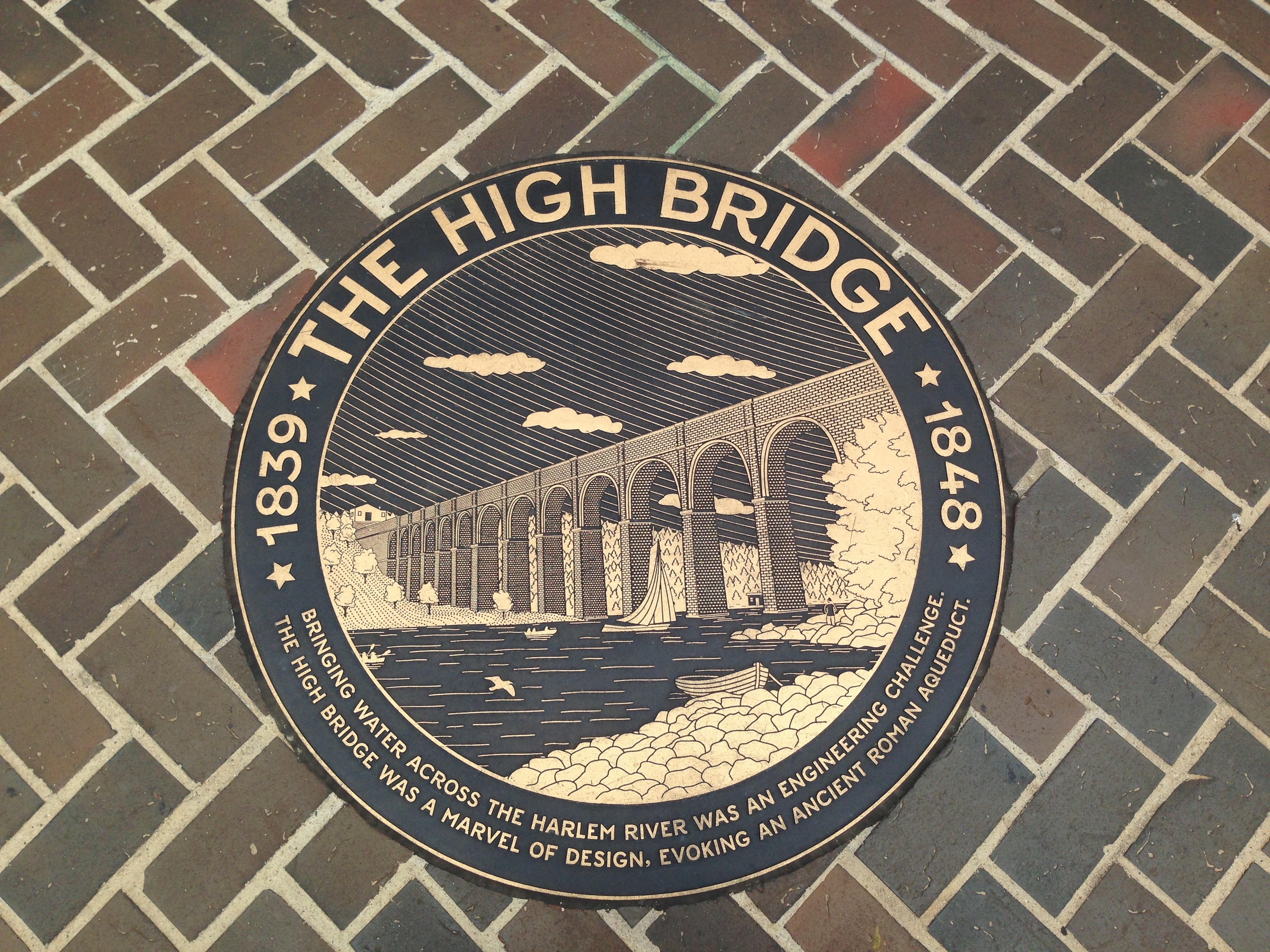
The largest structure of the original aqueduct stands on the southern end. This is the High Bridge. Opened in 1848, this is the oldest bridge still standing in New York City. It originally resembled a Roman aqueduct, with tall stone arches carrying the water high overhead, just like the famous aqueduct in Segovia. Indeed, one remarkable thing about the Croton Aqueduct is that it uses the same principle the Romans used all those centuries ago—namely, gravity—transporting the water on its 40 mile trip with a slight incline, 13 inches per mile. The bridge had to be built so high (140 feet) to maintain this slope. The water tower Jervis designed still stands on the Manhattan side of the High Bridge, looking like the turret of some bygone castle. (This tower was needed to pump water to some areas in the Bronx, which lay above the Aqueduct’s slope.)

Water Tower
Water tower

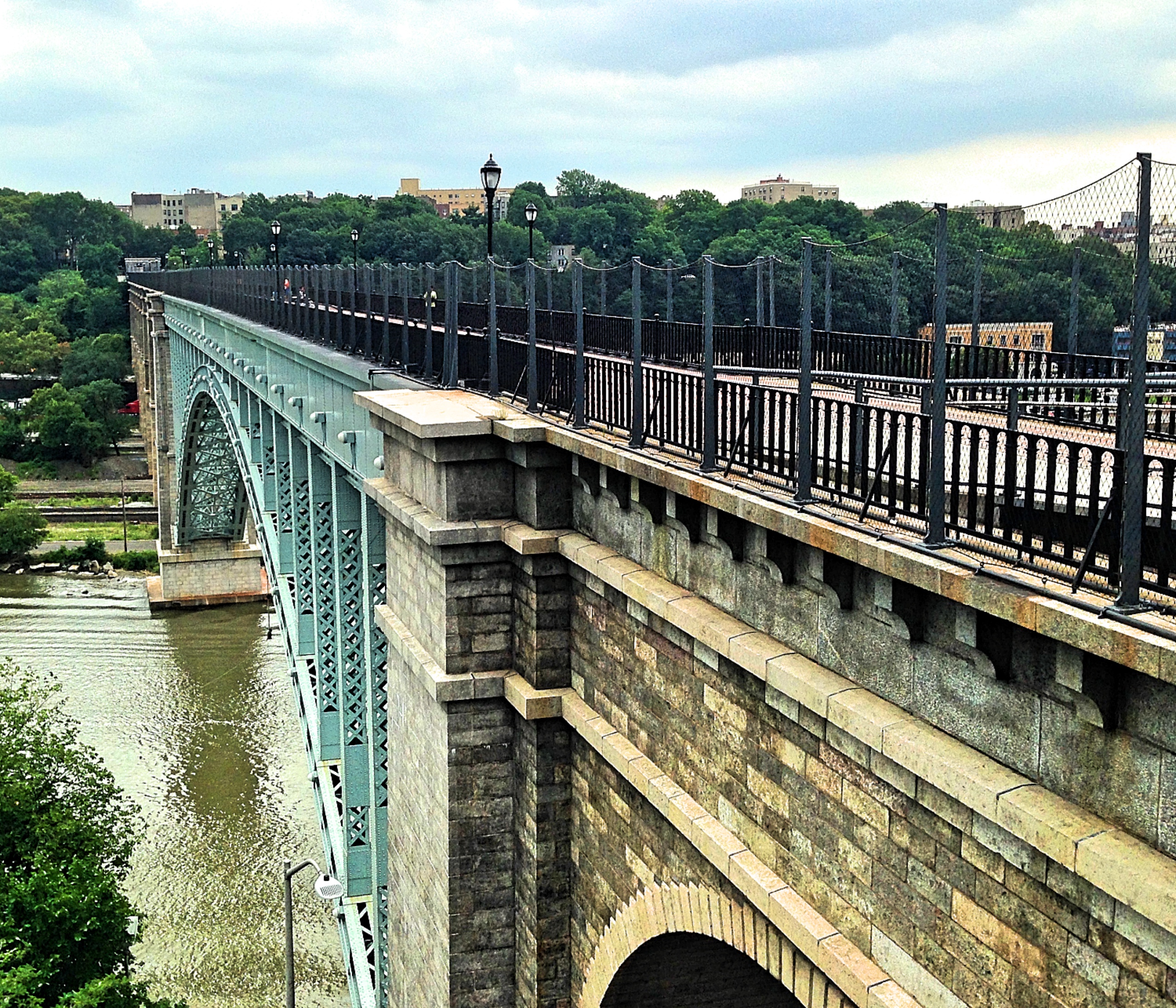
In the 1920s people began to complain that the bridge’s arches were an obstacle to ships traveling through the river, so the middle stone pillars were demolished and replaced with a long steel arch. The bridge was officially closed to the public in 1970, apparently because of vandalism, and wasn’t opened until 2015—an astonishingly long time, if you ask me. (There are some excellent panels on the High Bridge, with illustrations of its history. I have attached the images at the end.)

High Bridge Top
High Bridge

As you can see from the High Bridge, the scale of the Old Croton Aqueduct is undeniably impressive: stretching about four times longer than the Aqua Appia in Rome (although, to be fair, I think the Romans built several aqueducts longer than the Croton Aqueduct), and requiring whole landscapes to be reshaped. The aqueduct was constructed by 4,000 laborers, mostly Irish, who made a dollar or less for ten-hour days. Having thousands of single men, with plenty of drink available (enterprising farmers began converting their barns into bars), predictably caused some ruckus. But it was a good job for the recent immigrants.

The opening of the aqueduct was something of a sensation. At the time, the Croton Aqueduct was one of the biggest engineering projects in the United States, only surpassed by the Eerie Canal. And the effect of the aqueduct on city life was scarcely less important than the canal’s. With a reliable source of clean water, the city began to expand at a remarkable rate. The original aqueduct was built with a maximum capacity of 60 million gallons a day. The engineers thought this would be enough water to supply the city for hundreds of years. But it wasn’t long until the ever-growing population of New York outstripped the capacity of the aqueduct. Indeed, it was largely thanks to the increased supply of fresh water that the city was able to grow so quickly.

Thus the aqueduct, designed to be used for centuries, was supplemented in 1890 by the New Croton Aqueduct, a larger tunnel that runs parallel to the old one. The Old Aqueduct stopped delivering water to the city in the 1950s. The New Croton Aqueduct is still in use—although it, too, has since been supplanted. The Croton watershed now delivers about 10% of NYC water. The majority of the water comes from the Catskill Watershed further north, ferried to the city by the Catskill and the Delaware Aqueducts. This latter tunnel, by the way, is the longest tunnel anywhere on earth, stretching 85 miles. New York is a thirsty city. (The current daily water supply of NYC is 1.3 billion gallons.)

Not only the original aqueduct, but the original Croton Dam was also replaced in the late nineteenth century. Jervis designed the original dam with an innovative S-shaped spillway to reduce damage from floods. But good luck seeing it now. Today, Jervis’s dam is underwater, submerged under the expanded Croton Reservoir, only visible in times of severe drought.

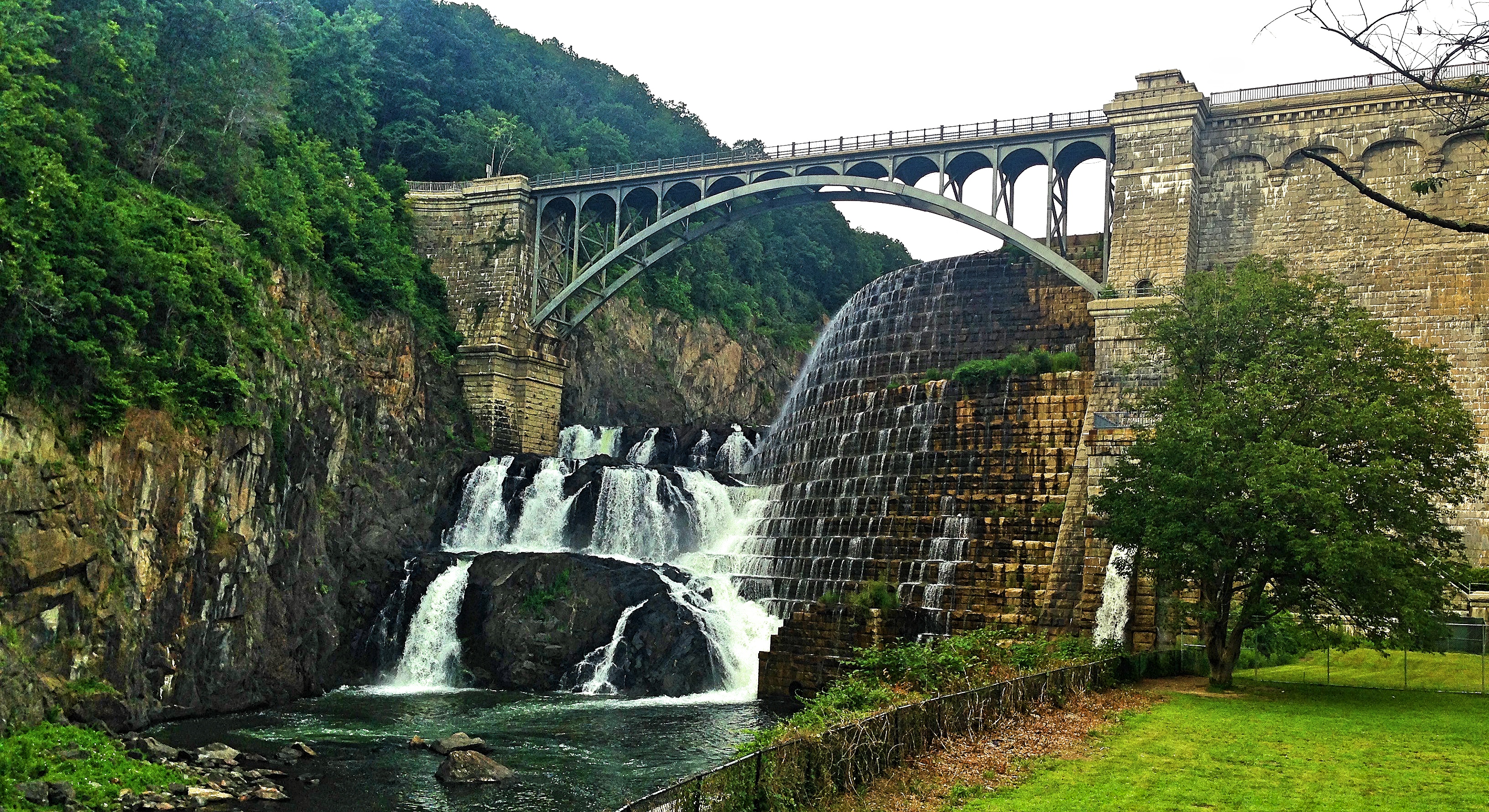
Croton Dam

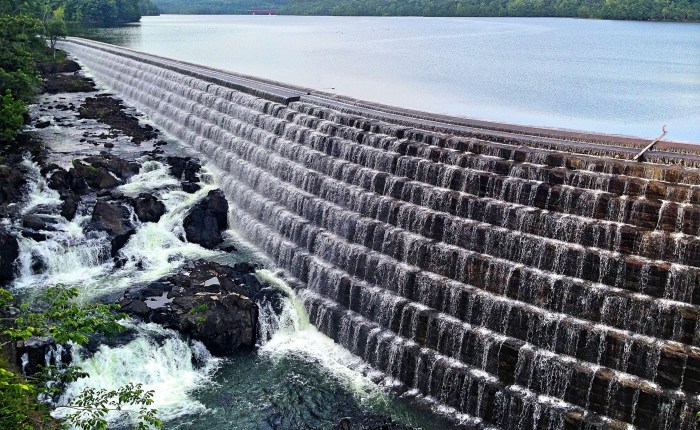
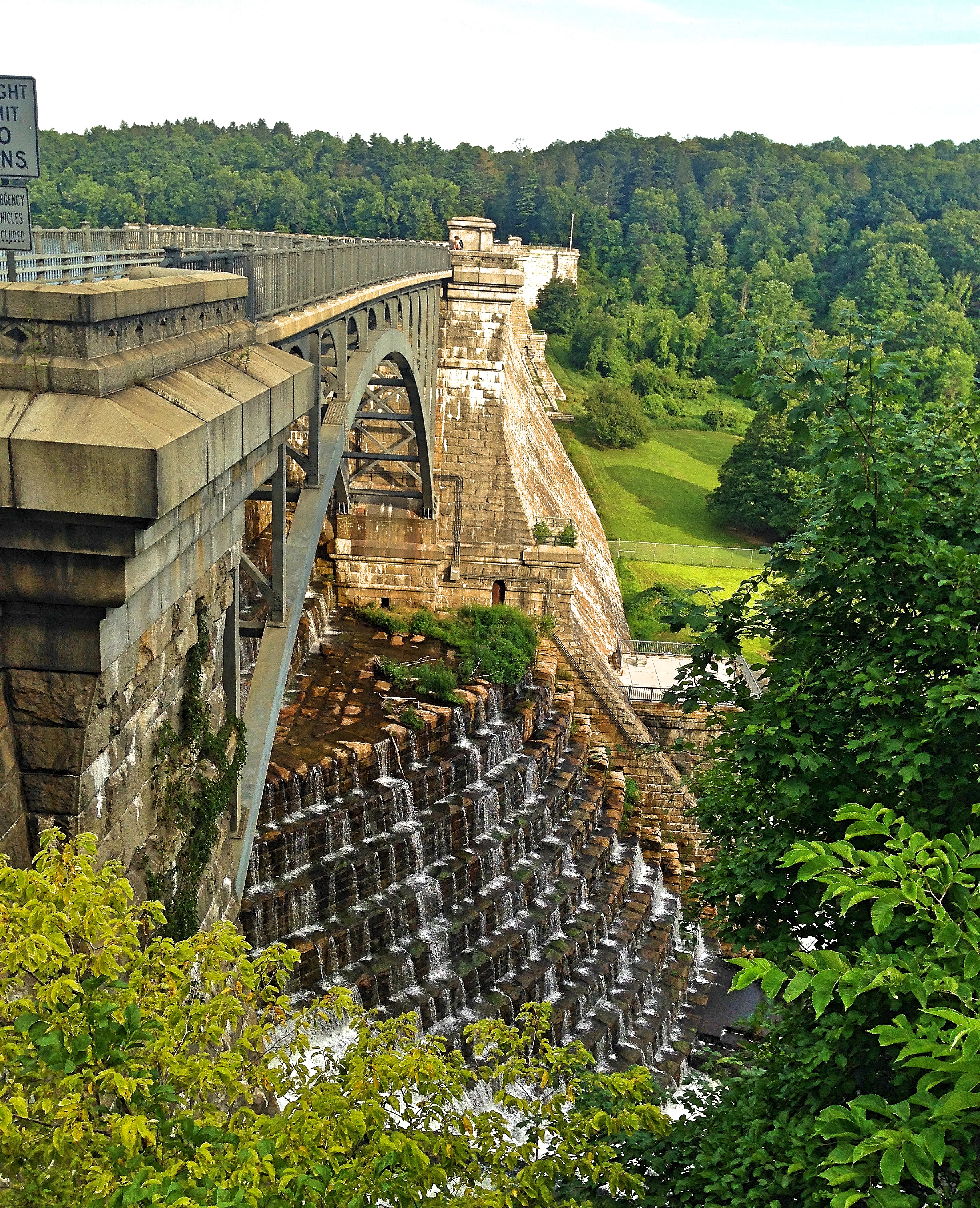
For my part, I don’t regret this loss, since that dam was replaced by the New Croton Dam—a grand monument of the previous century. Made of cyclopean stones, standing at almost 300 feet tall, and stretching to 2,188 feet (almost the exact altitude of Madrid, coincidently) the dam is still immensely impressive. It is also beautiful, with the stair-like spillway allowing water to cascade down to the river below in an artificial waterfall. This dam was begun in 1892 and completed in 1906. Whole communities—cemeteries, churches, and farms—had to be moved to make way for the expanding reservoir. Standing on top of that dam, hearing the rushing water below you, does a better job than any statistic of conveying how much water a major city like New York needs.

Croton Dam Side

As part of my research, I also read the book in the Images of America series about the construction of the New Croton Dam. The story of this construction is told with dozens of old photographs, with commentary by Christopher Tompkins. You don’t exactly get a linear narrative this way; but the images alone are worth the price. It baffles the mind to think of what these men accomplished—redirecting a river, and erecting a structure 300 feet tall with cut stones, flooding an entire valley and displacing many communities—and all this using technology that looks, to my eyes, scarcely more advanced than what the Egyptians used. That’s an exaggeration, of course: the dam workers had steam shovels to excavate and railroads to bring stone from the quarry. But I can’t imagine how difficult it would have been to move those massive stones in a time before modern cranes, using only wooden derricks and pulleys and counterweights.

It is amazing to me that so much history—an engineering feat and a chapter in the history of New York—lay buried right behind my house, and that I’ve been walking along this trail for so many years, oblivious. Don’t wait until you travel to learn about history, to explore and go on tours. Take Thoreau’s advice: “Live at home like a traveler.”


These images are taken from informational panels on the High Bridge.

IMG_0241

IMG_0243

IMG_0242

IMG_0244

IMG_0245

IMG_0249

Processing…
Success! You're on the list.

Review: Walden

Review: Walden

Walden & Civil DisobedienceWalden & Civil Disobedience by Henry David Thoreau

My rating: 4 of 5 stars

How many a man has dated a new era in his life from the reading of a book!

This month, two hundred years ago, Henry David Thoreau made his way into the world. Thus it seemed like a good time to revisit his thorny classic, which filled me with such contradictory feelings the first time around.

This time, I was struck first by how current Thoreau’s book reads. A vegetarian before it was fashionable, or even respectable; a pioneer of nature writing and conservationism; a godfather of activism and protest; an author of lines that, even now, wouldn’t be out of place in any self-help book; and the originator of the “stunt-book”—doing something unusual and then writing about it—anticipating both performance art and reality television in his classic account of his life “in the woods.”

It is very easy to dislike Thoreau, or even to despise him. Thoreau took himself very seriously. He comes across as pretentious and magnificently condescending, while at the same time as naïve as a child. For all his practicality, he was astoundingly impractical. His insistence that everyone in Concord learn enough Latin and Greek to read the classic texts is characteristic of him—a snobbish and pointless piece of advice, delivered with disdain. His authorial personality is so often prickly and misanthropic, rebuking the world at every turn, and this mood is never lightened by an easy humor. There is no Montaigne in this self-chronicler; instead, like Iago, he is nothing if not critical. You wonder if anything but loons and books ever pleased him. He was, in a word, a dour man.

The case against Thoreau is more serious than just his off-putting authorial personality. The most common charge made against him is that of hypocrisy. His book purports to be the record of a bold experiment in living in the woods. He describes how he built his own house, grew his own beans, baked his own bread, and rhapsodizes about the solitude and isolation he created for himself. But in reality he was living just 20 minutes from his ancestral home, squatting on land lent to him by his friend Emerson, and receiving frequent and plentiful visitors. Apparently he went home weekly to get cookies from his mother, who also kindly delivered doughnuts and pies to our hero. It is not reported whether he ate his cookies and doughnuts with milk.

This is a damning fact, considering that Thoreau carefully documents all of his expenses and goes into excruciating detail as to his eating habits—without mentioning a single cookie. He gives the impression that he was a hermit on the very edge of society, living on the produce he created, savoring his lonely retreat from the world. And all this is recorded with the stated intention of showing that self-sufficiency is possible. But if Thoreau himself can bear neither a diet of pure beans nor the stark isolation of true life in the woods, his whole experiment is a sham. It is one thing for an ordinary citizen to be hypocritical; it is another thing for a moralizing philosopher who repeatedly stresses the necessity of living in accordance with one’s tenets.

The case against Thoreau goes ever further than this. For, if his practice didn’t align with his preaching, his preaching didn’t align with his preaching either. Walden is a baffling bundle of contradictions. Did Thoreau like the steam engines or hate them? He excoriates them one moment, and the next he goes into rhapsodies about the locomotive. He praises hunting as a way of bringing oneself closer with nature, and then he condemns all killing and eating of animals. Here he is enjoining us to ignore fantasies and pay close attention to reality: “If men would steadily observe realities only, and not allow themselves to be deluded, life, to compare it with such things as we know, would be like a fairy tale and the Arabian Nights’ Entertainment.” And here he is telling us to do the opposite: “If you have built castles in the air, your work need not be lost; that is where they should be.”

The perplexing thing about this inconsistency is that Thoreau never admits to hesitation or doubt. He rattles off his opinions with the fervor of a zealot. And yet even his zealotry is inconsistent, for it was Thoreau who famously said “If a man does not keep pace with his companions, perhaps it is because he hears a different drummer. Let him step to the music which he hears, however measured and far away.” This famous paean to self-determination is ensconced in a book filled with biting scorn for those who do not agree with Thoreau. In all likelihood, Thoreau himself was the least tolerant man in Concord. Considering both his inconsistency in action and speech, it is difficult to know what exactly Thoreau, who is always urging us, is actually urging us to do.

But I think that a strong case can be made for Thoreau, too—especially now. For Walden has aged remarkably well. If anything, Thoreau’s classic has become even more relevant in our harried age.

Thoreau flees to the woods because of a growing horror with every aspect of his contemporary society—the unjust government, the growing consumerism, the obsession with technology, the increasing specialization of labor, the absorption of all leisure by work, the constant petty conversation, the disregard of wild nature. The sources of this horror are, I think, in part mysterious to even himself, which might be one explanation for his inconsistency. He is like a boxer swinging wildly at an invisible enemy, or a doctor prescribing medicines for an unknown malady. But to be fair, we haven’t gotten much closer to solving the problems that Thoreau tried to tackle with such spirit.

For my part, I think Thoreau’s instincts are right, even when his diagnoses and his cures are wrong. His abhorrence of economic exchange, of interdependence, is an excellent example. Modern society obviously could not exist without exchange; the economy would collapse if we all chose to live like Thoreau advocates, and technological innovation would come to a standstill. Yet Thoreau’s abhorrence of intedependence is neither political nor economic, but moral. He recognized quite clearly, I think, that in a complex economy, we are enmeshed in processes that have moral implications. When we buy a product, for example, we don’t know who made it or how they were treated. When we patronize a shop, we don’t know what the owner does with our money. When we throw something away, we don’t know where it ends up.

Since the morality of any action is partly determined by its effects, and since many of those effects are hidden from view in a complex economy, to a certain extent we can’t even know the morality of our own life. This is why it was so inspiriting for Thoreau to build his own cabin and farm his own food; he could be sure of his “ethical footprint,” so to speak, and so could take full responsibility for his actions. Now, I don’t think Thoreau wanted to do this for the sake of others—he is extremely wary of do-gooderism—but for himself, since we cannot live authentically if we cannot know the effects of our actions.

To borrow an idea from the philosopher John Lachs, this state of ignorance as to the sources and causes of our moral lives is one part of that modern alienation that Marxists have described. When jobs become highly specialized, we might not be completely sure about our own effects within the organization in which we work. I myself have been in that situation, churning out data to be used by unknown people for unknown ends. Everyone in a complex economy, even a commercial farmer, is in this situation. Thoreau’s solution, isolating oneself in the woods, is I think undesirable—since it consists in dissolving society completely (which the misanthropic Thoreau might not have objected to)—but his experiment does at least help us to identify the causes of our “quiet desperation.”

Thoreau is also refreshing on the subject of work and leisure. The glorification of works carries with it the denigration of leisure, which Thoreau realized. When we consider only those activities as worthwhile that can make money for us, we spend our free hours in thoughtless relaxation or idling. And yet working, even if it is remunerative, is too often degrading—largely thanks to excessive specialization, which demands that we do the same thing over and over again, neglecting the full range of our capacities. Work consumes our time and energy and leaves us few moments for reflection and self-improvement. And because we consider leisure only a respite from work—since free time doesn’t pay, it is not for serious exertion—we do not even use what moments we have to achieve perspective and to develop our latent potential.

Again, Thoreau’s prescription for excessive work—to squat on someone else’s land and farm only the bare minimum—is disappointing and (pardon the pun) unworkable. And his advice for how to spend one’s free time—reading ancient books in the original language—is, at the very least, limited. But once again, his thrashing responses at least point the way to the malady that ails us, and his deadly seriousness can remind us to take our free time seriously and not squander it.

Thoreau is perhaps most valuable for his insistence on the time and space to think. Often it seems that the modern world is a conspiracy to prevent thinking. We work until we’re bone tired, and spend our free time in endless, meaningless small talk. Thoreau said: “We are in great haste to construct a magnetic telegraph from Maine to Texas; but Maine and Texas, it may be, have nothing important to communicate.” Imagine if Thoreau could see us now, ceaselessly connected to each other with mobile telegraphs in our pockets, with scarcely anything more to say. The point, of course, is not that the telegraph is inherently bad—nor are smart phones for that matter—but that these things can easily become distractions, distractions in the existential sense, allowing idle chit-chat to intrude into every corner of our lives.

News also comes in for abuse. Too often we read the news, not with a genuine desire to learn about the world or to help us change it, but out of habit, worrying about distant problems that seldom affect us and that, in any case, we seldom try to solve. Sure, it is easy to dismiss Thoreau when he makes such dogmatic pronouncements as “To a philosophers, all news, as it is called, is gossip, and they who edit and read it are old women over their tea.” Yet I know many for whom the news is an addiction, and consuming news is the full extent of their political engagement. (And I don’t think I’m any better in this regard.) Again, the point is not that we shouldn’t read the news, but that we should not let ourselves develop a false sense of urgency that prevents us from examining our own lives.

Thoreau demands space for genuine thought. But what is genuine thought? I think this is what Thoreau had in mind with his famous lines “I went to the woods because I wished to live deliberately, to front only the essential facts of life, and see if I could not learn what it had to teach and not, when I came to die, discover that I had not lived.” Genuine thought, in other words, is thinking about the best way to live—what is deeply and lastingly important to us, and what is only temporarily or superficially important. I personally have found that even a week of relative isolation can be clarifying. It is amazing how fast anxieties and problems melt away when we remove ourselves from our usual environment. We spend so much time worrying about how to get things that we don’t stop to wonder if we really want them. It is easy, too easy, to accept goals and priorities from our environment without scrutiny.

I could go on, but I think you get the idea. Thoreau was reacting against problems of the modern world, problems that have only become more pervasive. His solution, which I find extremely unconvincing, is to reject society completely—and in practice, his solution is only viable for well-connected, single men with no children. Thoreau achieves a kind of purity at the expense of advocating something that is totally non-viable for the vast majority of humanity. But reading his book was, for me, a clarifying and a rejuvenating experience—a reminder to consider the more important questions of life, and also a reminder that these questions can perhaps never be definitely answered.

You may disagree completely with me about the philosophical merit of Thoreau. But his skill as a writer is indisputable. This book is a magnificent monument of prose. Whether he is describing his beloved pond or narrating a battle of ants, his writing is clear, forceful, and direct; and his fingertips occasionally touch the sublime:

If you stand right fronting and face to face with a fact, you will see the sun glimmer on both its surfaces, as if it were a scimitar, and feel its sweet edge dividing you through the heart and marrow, and so you will happily conclude your mortal career. Be it life or death, we crave only reality.

Thoreau’s power as a writer, combined with his undeniable originality—anticipating all the things with which I opened this review, and more—will make this book last until Thoreau’s next centennial, even if sometimes he’s an insufferable teenager.

View all my reviews

Review: Cooking in Spain

Review: Cooking in Spain

Cooking in SpainCooking in Spain by Janet Mendel

My rating: 4 of 5 stars

There are few places a New Yorker can go—especially in Europe—to find truly exotic food. Whether the cuisine is from Italy or Germany, China or Korea, Ecuador or El Salvador, chances are we have tried it—or some Americanized version of it—at least once. But, like many Americans, I was totally taken aback when I moved to Spain. The eating culture struck me as radically different; and the cuisine, if not exotic, was animated by a very divergent approach to cooking.

For a long time, I admit I was not very taken with what I discovered. Like many Americans, I am used to heavy meals with intense flavors, dishes that scorch your tongue and sit in your stomach like an iron weight, and I don’t feel satisfied unless I feel sick and slightly overwhelmed at the end of a meal. Spanish food very seldom produces that sensation. It is generally mild and relatively light. I don’t think I have ever had a dish from a Spanish restaurant I could call properly spicy, and Spanish portions are not usually large enough to produce the semi-comatose post-prandial mood that I was used to.

There are also many things that are simply not to my taste. I am not fond of tuna or hard-boiled eggs, yet nearly every sandwich in the cafeteria in my school has one—or both!—of those ingredients. And in general I cannot stomach as many carbs as the Spanish seem able to do. I am still baffled by bocadillos de tortilla—potatoes on a baguette?—even if I find them delicious; and many times I have been served a heaping plate of rice or potatoes with a side of bread (no meal in Spain is complete without bread), and wondered how Spanish people manage to stay so thin.

I am not the only American to have this reaction. Friends and family have expressed disappointment to me several times regarding the state of Spanish cookery. It is not that Spanish cuisine is bad, of course, only that Americans and Spaniards look for quite different things from food.

One major difference is that Spanish people like to be able to taste the ingredients, to savor the freshness and the quality of the individual elements of the dish, which is why Spanish cooking is often astoundingly simple and mild: both the form and the flavor of the original ingredient are preserved. Americans, on the other hand, like to transform and process ingredients beyond recognition. Another difference is that Spaniards are not so passionately fond of excess, and usually eat until they’re satisfied, not at death’s door. And this is putting aside the difference in Spanish meal times—lunch at two or three p.m., dinner at nine or ten—which I still have trouble adapting to.

Now, I should warn my American readers at this point that Spanish people are extremely proud of their food. Indeed, it seems to be the only thing about their country that Spaniards are unanimously proud of. They will freely denigrate nearly everything else—their government, their universities, their economy—but Spanish cooking is sacrosanct—¡se come bien en España!—and the quickest way to achieve good rapport is to praise the food vigorously. I would also like to mention, in self-defense, that despite some initial misgivings, I have grown to be extremely fond of Spanish cuisine—I swear!

Most cookbooks I’ve looked at—admittedly not many—don’t give an accurate idea of the food you actually encounter in Spain, presenting instead a fusion or haute-cuisine version, but this book is different. Janet Mendel is an American journalist who has been living in the south of Spain for many years now. Her cookbook is the most “authentic” book on Spanish cooking that I have come across. It begins with an overview of the different regions of Spain, moves on to Spanish ingredients, and contains over 400 recipes, as well as a glossary for food terms. The glossary is especially useful, since I’ve found that menus are more difficult to translate than poetry. (In Spanish, food words are particularly variable from country to country, or even region to region, making a Spanish-English dictionary of limited utility when faced with a menu.)

The regional overview is also valuable, for, like everything else in Spain, food can be quite specific to a location. Each major city has its own distinctive dishes; and particular cities—Seville, Logroño, San Sebastian—are famous for their food. The major axis of difference, I’ve found, is between the north and the south. Typically I prefer eating in the north—Cantabria, Asturias, Galicia, and the Basque Country—though there is excellent food to be found all over. In the south, mainly Andalusia, they tend to fry nearly everything, with the exception of the two famous liquid salads, gazpacho and salmorejo, both of which are delicious and refreshing under the brutal southern sun.

The north is far more verdant than the south, and the northern coast is at least equally as good for fishing, which means they generally have fresher ingredients. The Basque Country is the province most famous for its cuisine, and deservedly so, but I am particular to the food of Galicia. If you get a chance, perhaps when hiking the Camino de Santiago, find a pulpería, order some of the Galician octopus—seasoned with the distinctively intense local paprika—and drink the local Ribeiro wine, young and sharp red wine often served in a ceramic bowl. It is an exquisite meal.

Recipes for all these, and more—including all the Spanish classics, like my favorites, cocido, paella, cochinillo, fabadas, croquetas, and tortilla—can be found in this book, in simple and easy-to-follow recipes, along with extensive information on Spanish wines, cheeses, and produce of all kinds. Admittedly, I have not had great luck in my attempts to cook Spanish food, but this was entirely my fault. (My croquettes and my tortilla turned into mush; I am not a good chef.)

My failures notwithstanding, Mendel’s book is excellent, and almost encyclopedic in its coverage of different ingredients and types of dishes, methodically going through every type of meat and fish, including sections on snacks and desserts, with charming little vignettes along the way. She clearly knows Spanish cooking thoroughly, both the typical dishes and the meals for festive holidays, and does not dilute it or change it to cater to foreign palates.

Unfortunately, however authentic the recipe, the dish will not taste exactly right unless you buy the ingredients locally. To pick just one example, pork products play an integral role in Spanish cooking (they say it’s because eating pork differentiated the Catholics from the Jews and Muslims), and you will have a very difficult time finding true Spanish pork in New York. And this is a shame, considering that Spanish jamón is far better than prosciutto, and Spanish chorizo and morcilla (blood sausage) are wonderful flavoring agents for stews. Indeed, for my part I think Spain has the best pork products in the world, not that I would know.

As a parting piece of advice, if you go to Spain try to avoid those omnipresent tourists traps in the city center, with big yellow billboards advertising their paella. I had one of the worst meals of my life at one of these in the Plaza Mayor. You can find many excellent fine-dining establishments in Madrid. But to find more typical food, done well, look for the cheaper, less ritzy places. I can recommend the Café Melo’s—the menu has about six things, and they’re all good—and the Casa Mingo, an Asturian restaurant with famous roast chicken and Spanish cider, that’s right next to the chapel that contains Goya’s remains. And if you’re in Madrid in winter, try La Cruz Blanca de Vallecas for its famous cocido madrileño, a heavy stew of meat and garbanzos.

Well, I’m afraid that’s the best I can offer. I can only add that Spanish food may seem unpromising at first; but once you develop a taste for it and you know what to look for, it is a fascination and a delight.

View all my reviews