Review: Voyage of the Beagle

Review: Voyage of the Beagle
Voyage of the Beagle

Voyage of the Beagle by Charles Darwin

My rating: 4 of 5 stars

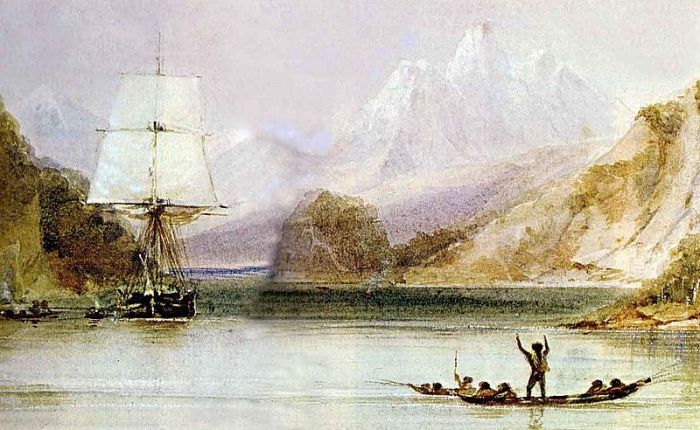
This book is really a rare treasure. Is there anything comparable? Here we have the very man whose ideas have revolutionized completely our understanding of life, writing with charm about the very voyage which sparked and shaped his thinking on the subject. And even if this book was not a window into the mind of one of history’s most influential thinkers, it would still be entertaining on its own merits. Indeed, the public at the time thought so, making Darwin into a bestselling author.

I can hardly imagine how fascinating it would have been for a nineteenth-century Englishman to read about the strange men and beasts in different parts of the world. Today the world is so flat that almost nothing can surprise. But what this book has lost in exotic charm, it makes up for in historical interest; for now it is a fascinating glimpse into the world of 150 years ago. Through Darwin’s narrative, we both look out at the world as it was, and into the mind of a charming man. And Darwin was charming. How strange it is that one of today’s most vicious debates—creationism vs. evolution, religion vs. science—was ignited by somebody as mild-mannered and likable as Mr. Darwin.

His most outstanding characteristic is his curiosity; everything Darwin sees, he wants to learn about: “In England any person fond of natural history enjoys in his walks a great advantage, by always having something to attract his attention; but in these fertile climates, teeming with life, the attractions are so numerous, that he is scarcely able to walk at all.”

As a result, the range of topics touched upon in this volume is extraordinary: botany, entomology, geology, anthropology, paleontology—the list goes on. Darwin collects and dissects every creature he can get his hands on; he examines fish, birds, mammals, insects, spiders. (Admittedly, the descriptions of anatomy and geological strata were often so detailed as to be tedious; Darwin, though brilliant, could be very dry.) In the course of these descriptions, Darwin also indulged in quite a bit of speculation, offering an interesting glimpse into both his thought-process and the state of science at that time. (I wonder if any edition includes follow-ups of these conjectures; it would have been interesting to see how they panned out.)

In retrospect, it is almost unsurprising that Darwin came up with his theory of evolution, since he encounters many things that are perplexing and inexplicable without it. Darwin finds fossils of extinct megafauna, and wonders how animals so large could have perished completely. He famously sees examples of one body-plan being adapted—like a theme and variations—in the finches of the Galapagos Islands. He also notes that the fauna and flora on those islands are related to, though quite different from, that in mainland South America. (If life there was created separately, why wouldn’t it be completely different? And if it was indeed descended from the animals on the mainland, what made it change?)

Darwin also sees abundant examples of convergent evolution—two distinct evolutionary lines producing similar results in similar circumstances—in Australia:

A little time before this I had been lying on a sunny bank, and was reflecting on the strange character of the animals in this country as compared with the rest of the world. An unbeliever in everything but his own reason might exclaim, ‘Two distinct Creators must have been at work; their object, however, has been the same & certainly the end in each case is complete.’

More surprisingly, Darwin finds that animals in isolated, uninhabited islands tend to have no fear of humans. And, strangely enough, an individual animal from these islands cannot even be taught to fear humans. Why, Darwin asks, does an individual bird in Europe fear humans, even though it is never been harmed by one? And why can’t you train an individual bird from an isolated island to fear humans? My favorite anecdote is of Darwin repeatedly throwing a turtle into the water, and having it return to him again and again—because, as Darwin notes, its natural predators are ocean-bound, and it has adapted to see the land as a place of safety. Darwin also manages to walk right up to an unwary fox and kill it with his geological hammer.

You can see how all of these experiences, so odd without a theory of evolution, become clear as day when Darwin’s ideas are embraced. Indeed, many are still textbook examples of the implications of his theories.

This book would have been extraordinary just for the light it sheds on Darwin’s early experiences in biology, but it contains many entertaining anecdotes as well. It is almost a Bildungsroman: we see the young Darwin, a respectable Englishman, astounded and amazed by the wide world. He encounters odd creatures, meets strange men, and travels through bizarre landscapes. And, like all good coming of age stories, he often makes a fool of himself:

The main difficulty in using either a lazo or bolas, is to ride so well, as to be able at full speed, and while suddenly turning about, to whirl them so steadily about the head, as to take aim: on foot any person would soon learn the art. One day, as I was amusing myself by galloping and whirling the balls round my head, by accident the free one struck a bush; and its revolving motion being thus destroyed, it immediately fell to the ground, and like magic caught one hind leg of my horse; the other ball was then jerked out of my hand, and the horse fairly secured. Luckily he was an old practiced animal, and knew what it meant; otherwise he would probably have kicked till he had thrown himself down. The Gauchos roared with laughter; they cried they had seen every sort of animal caught, but had never before seen a man caught by himself.

At this point, I am tempted to get carried away and include all of the many quotes that I liked. Darwin writes movingly about the horrors of slavery, he includes some vivid description of “savages,” and even tells some funny stories. But I will leave these passages to be discovered by the curious reader, who, in his voyage through the pages of this book, will indulge in a voyage far more comfortable than, and perhaps half as fascinating as, Darwin’s own. At the very least, the fortunate reader need not fear exotic diseases (Darwin suffered from ill health the rest of his days) or heed Darwin’s warning to the potential traveler at sea: “If a person suffer much from sea-sickness, let him weigh it heavily in the balance. I speak from experience: it is no trifling evil which may be cured in a week.”

View all my reviews

Review: Letters from a Stoic

Review: Letters from a Stoic

Letters from a Stoic (a selection)Letters from a Stoic by Seneca

My rating: 4 of 5 stars

Philosophy is good advice; and no one can give advice at the top of his lungs.

One of the most persistent criticisms made of modern philosophy is that it isn’t useful. The critics have a point. Modern philosophy largely concerns itself with a variety of theoretical problems. Even though many of these problems do have practical ramifications, many do not; and regardless, the debates can often get so technical, so heated, and so abstract, that it is difficult to see modern philosophy as the path to wisdom it once professed to be. People don’t have time or patience for logic-chopping; they want useful advice.

Those of this persuasion will be happy to find a forerunner and a sage in Seneca. As the opening quote shows, he conceived philosophy to be, above all, the giving of good advice. Seneca thus finds a perfect vehicle for his thought in the form of the letter. Although this book apparently consists of the private correspondence between Seneca and his friend Lucilius, it is obvious from the first page that these were expressly written for publication and posterity. This book should rather be thought of as a collection of moral essays and exhortations.

Even in translation, Seneca is a master stylist. He is by turns intimate, friendly, self-deprecating, nagging, mundane, and profound. He has an enormous talent for epigram; he can squeeze a lifetime into a line, compress a philosophy into a phrase. He is also remarkably modern in his tolerant, cosmopolitan, and informal attitude. Indeed I often found it difficult to believe that the book was written by a real Roman. Montaigne and Emerson obviously learned a great deal from Seneca; you might even say they ripped him off. The only thing that marks Seneca as ancient is his comparative lack of introspection. While Montaigne and Emerson are mercurial, wracked by self-doubt, driven by contrary tides of emotion, Seneca is calm, self-composed, confident.

Perhaps because of his professed aversion to abstract argument, Seneca is not a systematic thinker. Emerson wrote “A foolish consistency is the hobgoblin of little minds,” and Seneca apparently would agree, for there are many inconsistencies to be found in these pages. Sometimes God is conceived of as an impersonal order of the universe, and at other times a personal deity; sometimes Lucilius is advised not to take the opinions of friends and family into account, other times to do so. Seneca’s metaphysical arguments are weak and confused affairs; he is not one for disputation. But for all this, there is a core of good sense contained within these pages, which Seneca himself summarizes:

No man is good by chance. Virtue is something which must be learned. Pleasure is low, petty, to be deemed worthless, shared even by dumb animals—the tiniest and meanest of whom fly towards pleasure. Glory is an empty and fleeting thing, lighter than air. Poverty is an evil to no man unless he kick’s against it. Death is not an evil; why need you ask? Death alone is the equal privilege of mankind.

Like Marcus Aurelius, a prominent statesman in troubled times, Seneca is very concerned with how to be happy in spite of circumstances. There is no satisfaction to be had through external goods, like fame and riches, because these cannot be gotten unless fortune is kind, and fortune is notoriously fickle. Even in good times, this can only lead you into an empty, meaningless competition, valuing yourself for something that isn’t really yours, causing you to ceaselessly measure yourself against others. You must rather become content with yourself, taking pleasure in life whether fortune smiles or frowns: “We have reached the heights if we know what it is that we find joy in and if we have not placed our happiness in externals.”

Of course, this is easier said than done, and Seneca does not have a fully worked-out system for reaching this state. He offers, instead, an unsystematic mass of advice. It is here that Seneca is most charming and helpful, for most other philosophers would not deign to offer such workaday recommendations and observations. Here is Seneca on negative thinking:

The mind at times fashions for itself false shapes of evil when there are no signs that point to evil; it twists into the worst construction some word of doubtful meaning; or it fancies some personal grudge to be more serious than it really is, considering not how angry the enemy is, but to what lengths he may go if he is angry.

It is in these sections, of plain, friendly advice, that I think Seneca is at his best. Certainly not all of his advice is good; every reader will pick and choose what suits them best. But much of Seneca’s advice is timeless, and phrased in deathless prose. Most refreshing is Seneca’s insistence that his advice is for action and not reflection. This is more than slightly ironic, considering that Seneca is often accused of being a hypocrite whose lifestyle was far removed from his doctrines; but, to quote a modern philosopher, “There is no contradiction, or even paradox, in describing someone as bad at practising what he is good at preaching.” So preach on, Seneca.

View all my reviews

Review: A Comedy of Errors

Review: A Comedy of Errors

The Comedy of ErrorsThe Comedy of Errors by William Shakespeare

My rating: 3 of 5 stars

A Comedy of Errors holds a special place in Shakespeare’s oeuvre. It is believed to be his first play; it is one of two Shakespeare plays that observe the “classical unities”; and it is Shakespeare’s shortest play. You can add to this list, Shakespeare’s silliest play, since A Comedy of Errors amply merits this superlative.

To enjoy this work, the viewer must be an expert in suspending disbelief. That there be two sets of twins, bestowed with the same names, who happened to be dressed in the same clothes on the same day—it does not even approach credulity. Added to this is the capstone absurdity that the mother was in the city the whole time, but did not choose to reveal herself to her son for years.

The reward for accepting this improbable premise is hilarity. The humor is low and occasionally crude, but no less brilliant for that. Shakespeare manipulates the simple device of mistaken identity like a virtuoso, squeezing out every bit of drama and every fleeting giggle from this ancient gag. Shakespeare is always witty and amusing, of course, but seldom was he such an expert conjurer of belly-laughs. The scene in which Dromio of Syracuse compares the kitchen-maid to a globe, describing where all the countries can be found on her rotund body, is a pinnacle of comedy.

If this play was, indeed, his first, it certainly augurs Shakespeare’s coming greatness. To make a slapstick farce such as this, the writer need not endow the characters with anything resembling a round personality. But Shakespeare does, and brilliantly. Antipholus of Syracuse is appealing speculative, comparing his search for his long-lost brother to “a drop of water / That in the ocean seeks another drop,” and repeatedly questioning his own identity. His twin brother of Ephesus is decidedly more bourgeois and extroverted; and his wife, Adriana, is touching in her scorned devotion. But of course the real star of the play is Dromio—played by none other than Roger Daltrey in the version I saw—who’s relentless good nature and nonstop wordplay render him irresistibly endearing.

In sum, though certainly not “deep,” this play is both expert and original—a piece of juvenilia that, even by itself, would have secured Shakespeare a modest place in the Western canon, if only as the most perfect example of a staged farce.

View all my reviews

Review: The Spanish Labyrinth

Review: The Spanish Labyrinth

The Spanish Labyrinth: An Account of the Social and Political Background of the Spanish Civil WarThe Spanish Labyrinth: An Account of the Social and Political Background of the Spanish Civil War by Gerald Brenan

My rating: 4 of 5 stars

The Civil War was an appalling calamity in which every class and every party lost.

The longer I live, work, and travel in Spain, the harder it is to believe that, less than a century ago, the entire country was torn apart by a bloody war. What set of circumstances could prompt a nation of ordinary, law-abiding people to explode into conflict and kill each other by the hundreds of thousands? This, of course, is just a specific version of a more general question: Why do people wage wars? I may sound naïve, but I do find this perplexing—since, as Brenan points out, in the destruction wrought by war, especially modern war, there are only losers.

Brenan’s work was one of the first serious analyses of the Civil War to be published (in 1943, just four years after the war’s conclusion), and has remained in print ever since. Nevertheless I was somewhat hesitant to read it. I found Brenan’s famous memoirs, South from Granada, to be underwhelming, so I assumed that this book would be as well. Happily I was mistaken. The Spanish Labyrinth is a comprehensive and penetrating work, easily one of the best books about the Civil War—or indeed about Spain—that I’ve had the pleasure of reading.

This does not mean it is accessible. Brenan chose his title well. The events leading up to the Spanish Civil War are intrinsically complex. So many different parties were involved in the accelerating dance of political turmoil that even the most skilled popular writer would have trouble seamlessly weaving it all together. And Brenan, though a strong writer, was too close to the events described to even approach a popular account. As a result the book itself can feel labyrinthine—with valuable comments and data tucked away into footnotes, with several miniature appendices per chapter and a longer one at the end of the book, and a seemingly endless cast of characters, organizations, and movements. Certainly this book, like any excellent book, will repay careful rereading.

Brenan’s take on the Civil War can be helpfully contrasted with that of George Orwell. Orwell, who was in Spain a matter of months and who never learned Spanish very well, saw the Spanish Civil War in terms of the wider struggle between the Right and the Left. For him, it was a straightforward class conflict between the poor workers and the rich fascists, a struggle that was playing out all over the globe. Brenan, on the other hand, who spoke fluent Spanish and who lived in Spain for a decades, saw the war as a particularly Spanish affair; and his analysis focuses almost exclusively on internal factors. (Both authors, incidentally, did share a distaste for Gaudí’s Sagrada Familia.)

Before the Civil War, political instability plagued Spain for generations. This was, in part, a consequence of economic backwardness; and this backwardness, in turn, had its roots deep in Spanish history—Spain’s commitment to New World gold at the expense of industrialization, and to merino wool at the expense of agriculture. (By the way, Spanish shepherds still hold onto their special privileges, which they demonstrate every year in the Fiesta de Transhumancia, during which sheep are herded straight through the center of Madrid.)

The Church came to identify itself fully with the rich and powerful, alienating itself from the people. As a result, anti-clericalism has played nearly as big a role in Spanish history as the church itself. The army, meanwhile, through a series of pronuciamientos and coups d’etat, came to see itself as the guardian of traditional Spanish values, able and willing to topple any regimes they deemed unsatisfactory—and, as history amply shows, it is always bad news to have a politically active military.

During all this time, Spain was plagued by a long-standing agrarian crisis. In one of Brenan’s most brilliant chapters, he details how different farming traditions sprung up in different regions of the country, partly in response to varying soil and climatic conditions. Unfortunately, many regions of Spain are—either from lack of rain or inferior soil—rather poor for agriculture; and distinct social arrangements (such as small-holding minifundios or large latifundios) are appropriate for these different climatic conditions.

In the hot and dry south, for example, farms are usually quite large; and the work required is seasonal, not year-round. Since a small number of wealthy families controlled these large estates, the vast majority were left to subsist on badly-paid seasonal work, thus leading to inequality and violent political tension. (As I discovered from Gilmore’s The People of the Plain, these agrarian problems persisted until the end of Franco’s reign.)

In addition to the inefficiency and inequality of Spanish agriculture, there was the ever-present problem of Spanish regionalism. Brenan follows Richard Ford and Ortega y Gasset in seeing regionalism as one of the defining features of Spanish political life. (Those watching the Catalan independence movement unfold today will be little disposed to disagree.) Spain is crisscrossed by several mountain ranges and sudden changes in elevation, thus leading to jarring climatic juxtaposition. I have experienced this myself: one moment I will be driving through a windswept mountain range, and the next I will be on the verdant coast. This is one culprit for the famous Spanish regionalism.

Another is Spain’s history. When Fernando and Isabel were married, thus uniting all of Spain for the first time, their separate kingdoms, Castile and Aragon, had distinct political traditions. As the historian J.H. Elliott describes in his excellent book, Imperial Spain, the Castile of Isabel, with its history of centralized rule and its emphasis on military power, was bound to conflict with Catalonia’s history of liberalism and commercial capitalism. The industrial revolution further fueled these regional tensions, as Bilbao and Barcelona became heavily industrialized while the interior and the south remained mainly agricultural.

These divisions in Spain—climatic, historical, and political—translated into splits in leftist movements in the years leading up to the Spanish Civil War. The fundamental split was between the socialists and the anarcho-syndicalists. The socialists tended to be more reformist, while the anarcho-syndicalists were straightforwardly revolutionary. Each party had its associated union, respectively the U.G.T. and the C.N.T., which most often refused to work with one another as they attempted to bring down the capitalist system using general strikes. Brenan’s histories of these movements—their origins, development, and leaders—constitutes the central portion of this book, and is absolutely first-rate.

On the conservative side, in addition to the wealthy landowners and the Church—not to mention the army—there were the Monarchists and the Carlists. The presence of Monarchists, in a country which still had a king living in exile, requires no explanation. The Carlists, on the other hand, were a distinctly Spanish product. The death of Fernando VII, in 1833, set off a series of civil wars (the war in 1936 was hardly the first in Spain) between two contending lines to the throne. Those who supported the pretender Don Carlos became known as Carlists. Theoretically, Monarchists and Carlists were arch-nemeses; but since, by the 1930s, the last living Carlist claimant was old and without an heir, the distinction had worn thin.

Trapped between these arch-conservative and revolutionary-leftist forces were a comparatively small group of liberals, who attempted to create a Republic in 1931. But they were doomed from the start. First, as Brenan notes, liberalism has historically had little appeal in Spain. What is more, the economic downturn—caused by the great depression—severely limited whatever resources the government had to work with. Meanwhile, forces from every side were determined to undermine or dismantle the nascent state. Go too far to appease one side, and they risked severe retaliation from the other. Threading its way between this Scylla and that Charybdis, the ship of state crashed and sank.

From this rather pathetic summary, I hope you can at least get a taste of how complex a story Brenan had to tell. Climatic and cultural regions, revolutionary movements, workers’ unions, political parties, the army, the Church, economical classes—all of these were involved in the conflagration. There do not even appear to be any outstanding individuals towards whom you can orient your gaze. Franco himself was notoriously uncharismatic. The final result is confusion—labyrinthine confusion—and given all this, Brenan did a terrific job in his analysis.

The book is flawed, of course. Like Richard Ford, and like so many foreign writers, Brenan is pre-disposed to find some essential core to the “Spanish personality,” which can be used as a catch-all historical explanation. More often these are crass stereotypes (Spaniards are lazy, excitable, etc.), or otherwise Romantic wishful thinking—for instance Brenan’s insistence on the Spanish abhorrence of the modern world. Another flaw is Brenan’s focus on the Left. Though his histories of socialism and anarcho-syndicalism are masterful, his analysis of the Right leaves a lot to be desired. One certainly does not get any clear picture of Franco’s program from these pages. Finally, by focusing so exclusively on Spain, Brenan ignores the wider international scope of the conflict. The rise of the communists from an obscure party to the most influential organization on the Republic side, for example, cannot be explained without turning one’s eye towards the Soviet Union.

But it won’t do to dwell on these shortcomings. Given that this book was written, not by a professional historian but an amateur, and that it was written so soon after the conflict came to an end, it is a near miraculous achievement. I may not be any closer to understanding war in general; but I do think I’ve come a long way towards understanding this one.

View all my reviews

Review: Storm of Steel

Review: Storm of Steel

The Storm of SteelThe Storm of Steel by Ernst Jünger

My rating: 3 of 5 stars

War means the destruction of the enemy without scruple and by any means. War is the harshest of all trades, and the masters of it can only entertain humane feelings so long as they do no harm.

Ernst Jünger was a born soldier:neither risk-averse nor foolhardy, able to command the loyalty of others and to follow orders without question, able to fight without malice and kill without scruple. These are his captivating memoirs of fighting during the First World War.

The consensus of posterity regarding this war is that it was bloody, tragic, and ultimately inconclusive—the exemplar of a brutal, pointless war. Erich Maria Remarque, who fought on the same side and on the same front as Jünger—albeit far more briefly—writes of his experience with trauma and disgust. Yet Jünger’s memoirs, equally as bloody as All Quiet on the Western Front, are strangely warm and cheery. A born soldier, he felt right at home.

As regards the basic experiences of the war, Jünger’s memoirs cover all the bases: bloody hand-to-hand combat, endless artillery shelling, taking cover in shell-holes and scrambling to put on one’s gas-mask, swarms of flying shrapnel and bullets, and death forever prowling. But out of this basic fabric of experiences Jünger weaves a heroic and even jaunty tale, a battle narrative of gallantry and daring. Each soldier, in Jünger’s archaizing eyes, is a knight locked in a gentlemanly joust with an enemy, motivated by duty and honor. I often wondered whether this quaint way of viewing the war was some kind of subtle psychological defense mechanism, shutting out its horrors with a chivalrous fantasy; but Jünger seems to have carried this perspective with him before the fight even began.

In many ways Jünger reminds me of Patrick Leigh Fermor. Both war heroes, both adrenaline junkies, both of a seemingly inexhaustible vitality—Leigh Fermor lived to 96, Jünger to 104—and both obscenely well-educated, these two authors tend to see life as a legend. Jünger’s prose has little of that cinematographic immediacy as has Remarque’s. By comparison his writing is highly stylized, like a Byzantine mosaic or Homeric verse. Admittedly, this is more true of the first half than the second, which becomes quite thrilling. In any case it takes a special kind of person to compare an artillery bombardment to “a witch’s cauldron,” or to motivate oneself in battle by quoting a verse from Ariosto.

The ending of the book contains, in brief, some of Jünger’s thoughts on the significance of the war. Clausewitz’s famous aphorism, that war is “politics by other means,” seems to have been lost on Jünger. For him the war’s value was not in accomplishing any concrete objective—which was, in any case, foiled for Germany—but in hardening the fighting men. You might say that, for Jünger, the war was valuable for its own sake. The extreme circumstances of war roused in the soldiers an equally extreme dedication to an ideal beyond themselves, the ability to yield themselves completely to their Fatherland; and he thought that future generations would look on the soldiers much as saints:

And so, strange as it may sound, I learned from this very four years of schooling in force and in all the fantastic extravagance of material warfare, that life has no depth of meaning except when it is pledged for an ideal, and that there are ideals in comparison with which the life of an individual and even of a people has no weight.

Personally I find this view disturbing, as I’m sure many do. The nationalistic dreams of Kaisers are nothing in comparison with even one life. In any case I think history has amply proven Jünger mistaken; the very hardening anvil of war he praised led, in just a few years, to another, even more deadly war—under a regime which Jünger himself despised. And whatever we may think of the heroism displayed by individual soldiers, it is outweighed by the sheer horror of it all. I also must say that I am incredulous that someone who lost so many friends and comrades—and who himself narrowly escaped death, getting wounded 14 times—could talk in such fanciful, romantic, and vague terms about the lessons of the war—and again I wonder, was this some kind of defense mechanism?

In sum, this must be one of the oddest war memoirs ever published, equal parts exciting, off-putting, and exacerbating. For those interested in the First World War, certainly it is required reading.

View all my reviews

Review: Rimas y Leyendas

Review: Rimas y Leyendas

Rimas y leyendasRimas y leyendas by Gustavo Adolfo Bécquer

My rating: 4 of 5 stars

I know a hymn, giant and strange, that announces an aurora in the soul’s night; and these pages are from that hymn: cadences which expand in the overshadowed air.

Bécquer is an example of that species of national writers, almost universally known in their own countries, almost universally obscure elsewhere. Here in Spain he is the second most commonly assigned author in schools, only bested by Cervantes himself. But how many readers—even avid readers—outside of Hispanophone countries even know his name?

For an iconic Spaniard, Gustavo Adolfo Bécquer has a curiously Germanic name; change a few letters and you have Gustav Adolf Becker. Indeed, “Bécquer” wasn’t the name he was born with, but one he adopted later in life. (It was his father’s mother’s last name, of Flemish origin.) To me this Germanic tinge is singularly appropriate, since Bécquer was a prophet of Romanticism, an intellectual movement I most strongly associate with German authors.

Notwithstanding this Teutonic whiff, the writer who, in many ways, most closely resembles Bécquer is Edgar Allen Poe: both of them are authors of creepy tales and charming verses. Romantic writers to the bone, they both died relatively young (Bécquer at 34, Poe at 40), although Bécquer perhaps beats Poe by never having achieved widespread fame during his lifetime. This book, Bécquer’s most famous, is a collection of his most popular short stories (“Legends”) and several dozen short poems (“Rhymes”). Poetry was his first and truest love. Yet, as befalls so many of us, penury forced him into prose.

I read the Legends before the Rhymes. These are distinguished, most of all, by their atmosphere. The plot, the dialogue, the characters, the description—everything is subordinate to a certain mood, a mood of mystery and foreboding. The characters wander, wide-eyed and wondering, through haunted glades, enchanted monasteries, and cursed dens. And as is so common in literature written by men, beautiful women are mixed up with these demonic haunts; and Bécquer’s women are always surpassingly beautiful—with pure white skin and pure black hair. Added to this medieval twilight is a strong dose of Spanish Catholicism: beautiful Jewish and Moorish maids are whisked away by their Christian paramours, saved from their heathen fathers.

Some examples might illustrate these tales. In “El Rayo de Luna,” a wandering poet, who walks aimlessly from dawn to dusk in his aesthetic quest, encounters a beautiful woman, chases her until she mysteriously disappears, and then spends the rest of his life comparing everything to “a moonbeam.” In “Tres Fechas,” the Narrator spends most of his time in extended descriptions of old buildings in Toledo, only to be interrupted, three times, by a fleeting vision of a beautiful woman—with ivory-white skin, of course—until finally he encounters her taking the vows of a nun. In “Creed en Dios,” a young atheist kills a priest, gets lost in a forest, is overwhelmed by a cosmic vision, and suddenly awakens to find that generations have gone by—a sort of Catholic Rip Van Winkle. You get the idea.

Although I enjoyed the overwrought atmosphere of these legends, I must say I was surfeited by the end. The Rhymes, on the other hand, are absolutely charming from first to last. The poems seem to have been especially written for Spanish students, since they are surprisingly simple and easy, while maintaining a high quality throughout. In form they are as simple as can be, rhyming couplets or alternating ABAB patterns, sometimes with a refrain. In subject matter they concern themselves with the usual holy trinity of poetry: death, immortality, and love:

“What is poetry?” you ask while
You fix in mine your eyes of azure
What is poetry! And you ask me this?
Poetry… is you

It is light and airy, and appeals to the teenager in all of us—sometimes even to the wistful adult. For any students of Spanish, I cannot recommend this book highly enough.

View all my reviews

Review: All Quiet on the Western Front

Review: All Quiet on the Western Front

All Quiet on the Western FrontAll Quiet on the Western Front by Erich Maria Remarque

My rating: 4 of 5 stars

All Quiet on the Western Front is an extraordinary war novel. It has everything you would expect from a book about World War I: the mixture of boredom and fear; the constant specter of gore; the unrelenting threat of death from every direction; the strong bonds between fellow soldiers and the hatred of superior officers; the reduction of life to its most basic elements; the depersonalization of oneself and one’s enemies; the feeling of apathy and pointlessness; and the difficulty in re-adjusting to civilian life. This, by and large, is the common image of the First World War nowadays, so it is surprising to me that this novel sparked controversy when it was first published. The Nazis eventually burned Remarque’s books, and later decapitated Remarque’s sister.

I have never been in battle, thank heavens, and I hope never to be. Thus the conditions described by Remarque, though doubtless true enough, often struck me as unreal—ghoulish nightmares rather than reality. Indeed, the First World War in general is hard for me to wrap my mind around. That so much carnage could result from such petty causes—it makes my stomach tie itself into a knot the more I think about it. And then there is the, for me, strange collision of the nineteenth and the twentieth centuries: Kaisers and the aristocracy, cavalry charges, bayonets, juxtaposed with gas bombs, land mines, and heavy artillery. Technologically, it seems that defensive weapons far outpaced offensive ones. There were heavy artillery and machine guns, but neither were portable and so of limited use in an attack. Thus the endless trench warfare and the pointless offensives, as both sides could beat each other back but neither could win a decisive victory.

The final effect for the soldier, if he escaped with his body intact, was trauma. This was a world before PTSD; back then it was called “shell shock,” and poorly understood. But as Remarque describes the conditions on the front line, it is no wonder that recruits were traumatized; rather it would be a wonder if they weren’t. The carnage—bodies stabbed, shot, blown to bits, and wounded in every other imaginable way—was ever-present and horrific. Added to that is the constant fear—of artillery, snipers, landmines, electrified barbed wire, or merely getting separated from your fellows and lost in no-man’s land. And then the soldier must endure the loss of his friends—his fellow soldiers, with whom he forms bonds of terrific strength—as the war takes more and more men.

The worst part, perhaps, is that after enduring all this, the soldier cannot easily return to civilian life. In war, life is reduced to its bare essentials: the search for food, warmth, safety. Every moment, even those of rest, is part of a struggle to survive. Thus the soldier is shocked when he returns to his home. Civilian life, though enviably safe and comfortable, also seems terribly artificial, oriented towards goals that, to a soldier accustomed to struggling for bare survival, can seem superficial and even despicable. Remarque portrays this brilliantly, as the returning Narrator finds himself unable to communicate his experiences when he goes home on leave. After reading Proust’s novel set during the First World War, which focuses on the ridiculous pontifications of the socialites far behind the front lines, treating the war as just another topic for gossip, I can see why returning soldiers could feel disgusted.

Just thinking of how young these soldiers were—just eighteen when they began fighting—one realizes that a whole generation of men spent some of their most formative years in the most brutal conditions imaginable. It is no wonder they considered themselves the Lost Generation. And what was it for? Although admittedly the propaganda seems to have been quite effective in whipping up anti-German, -French, or -English sentiment, many soldiers must have felt like Stefan Zweig did—that the conflict was pointless. Remarque captures the absurdity of the situation: powerful men in ornate rooms, signing pieces of paper that result in thousands of young men fighting and killing thousands of other young men, not because any of them have any grievance against one another, but for the sake of the Fatherland.

Remarque conveys all this with a gripping immediacy. The story moves forward at lightning pace; and yet there is nuance and depth, too, in this short novel. Even though this is hardly a story of adventure, you realize that merely to keep on going required a kind of daily heroism—an unglamorous, grueling, thankless heroism—the loyalty to one’s fellows and the determination not to succumb to despair. War brings out both sides of the human character: our enormous capacity for violence and destruction, and our capacity for selfless devotion and extraordinary endurance. This is why war has formed one of the most popular themes of literature, going all the way back to Homer. But between those two extremes we often forget that war is long, boring, and terrifying, and that many people lose everything. It is this daily horror, and the daily heroism required to live through it, that Remarque captures.

View all my reviews

Review: The Analysis of Mind

Review: The Analysis of Mind

The Analysis of MindThe Analysis of Mind by Bertrand Russell

My rating: 3 of 5 stars

When you drop a weight on your toe, and you say what you do say, the habit has been caused by imitation of your undesirable associates, whereas it is brought into play by the dropping of the weight.

It is a puzzle of our modern scientific worldview that we have been extremely successful in explaining things remote from our experience, and yet have made comparatively little headway in explaining our experience itself.

We begin with physics, the king of the sciences. Here we are dealing with things like force, time, mass, charge—abstract qualities which we can define precisely and measure accurately. Using these variables we can, and have, constructed theoretical edifices which continue to astound me and the rest of the world with their surpassing precision and elegance. Yet it is in physics that we have found that our everyday notions are most flawed. Seemingly solid objects like tables and people are, it turns out, mostly empty space. Under certain circumstances, time slows down, objects become foreshortened. Space itself is not wholly distinct from time, but forms a four-dimensional fabric that bends in response to matter. And even our basic logical notions, like that of identity, fail miserably when confronted with the probabilistic world of quantum mechanics.

Things get a bit more orderly when we move up the scale of complexity from physics to chemistry. No longer are we dealing with matter in the abstract, but specific types of matter, with their own specific, recognizable qualities—smell, hardness, color. Here we can at least picture specks of matter, arranged into three-dimensional structures, changing and rearranging like grains of sand on a storm-tossed shore. Our ability to predict and explain the universe on this scale is less precise, and perhaps less elegant, than in physics, but it is nonetheless impressive. Yet as we climb the rungs of complexity from hydrogen to organic chemistry, up through biochemistry, we somewhere reach the frontier that separates life from inanimate matter.

Where we draw the line is, in part, merely a question of semantics; but it is also a scientific question, since we are interested in explaining the origins of life—and we can’t decide when life arose without deciding what life is. Viruses seem to sit right on this troubling boundary; but let’s put them to the side. We arrive, then, at bacteria, organisms too small to sense, but which still form the majority of life on earth, both in mass and variety. These little bitty dots of life float to and fro, performing their limited array of behaviors; and yet, simple as they are, do we have equations that could tell us exactly when a specific bacteria will divide, or exactly what direction it will turn next? And is not our knowledge of what life is even now so limited that we are still surprised, year after year, at the strange and inhospitable places we find bacteria happily residing?

Once we arrive at things like trees, mushrooms, bison, and baboons, all bets are off as far as predictive precision is concerned. It is true, we do have Darwinian evolution, which admirably and elegantly unites all of these phenomena into an orderly framework. Nonetheless, our knowledge here is qualitative, not quantitative; and when dealing with something like, say, animal behavior, biology sometimes approaches what can be called “natural history”—the mere collection of facts. Unlike in physics and in chemistry, where nearly every new particle or element is predicted beforehand—not only its mere existence, but its precise qualities, too—in biology, every new species discovered is a surprise. And even when we have good evolutionary grounds for predicting an ancestral species, the exact qualities of said species cannot be simply deduced from a theory; they must be inferred from remains and analogs.

Finally, we get to our own behavior—and here things get really messy. Because we humans exhibit such behavioral flexibility, we can’t quite decide where genetic influence ends and environmental influence begins. Nor can we even make definitive statements about the limits of our behavioral flexibility, as shown by the Westerners who were continually flabbergasted at the discoveries of cultural anthropologists. Moreover, our dominant theories of human behavior in the social sciences contradict one another. The premises of economics run counter to those of anthropologists; evolutionary psychologists and sociologists make different assumptions and operate within incompatible paradigms. Thus we are left with the ironic result that we can predict the behavior of an electron, which nobody has ever seen, with enormous precision, and yet cannot predict the behavior of our spouses, who we see every day, despite our most valiant efforts.

This isn’t a pretty picture; but the next step in our journey is even uglier. When we arrive at the threshold between body and mind, we are stumped completely. How does consciousness arise from a blob of neural tissue? How do chemical signals and electric jolts, when arranged in a sufficiently complicated network, give rise to awareness? How on earth do we explain choice, will, fear, hope? We reach for science, but here our typical scientific approach encounters an obstacle. Science, which is a method for achieving objective results, is being asked to explain subjectivity; a technique for paring away our biases and partialities, leaving only the truth, is being applied to the very center of our biases and partialities. In short, the only indubitable evidence we have of our awareness is purely personal, and yet such evidence—namely, eyewitness testimony—is inadmissible in the scientific enterprise.

In these paradoxical territories, where we cannot yet achieve satisfactory results using empirical research, philosophy makes its home. And here is where Bertrand Russell enters. Published in 1921, The Analysis of Mind is Russell’s attempts to muster the greatest science and philosophy of his day to explain the human mind. Relying not only on his own techniques of logical analysis, Russell draws on David Hume’s empiricism, William James’s psychology, Freud’s psychoanalysis, and the recently-developed behaviorism, quoting scientific papers more often than other philosophers. It is a valiant effort, and I’m not sure how much better Russell could have done given the knowledge available at the time.

Nevertheless, from the perspective of our own day, this book is quite clearly outdated. The most general flaw is that Russell doesn’t posit nearly enough complexity in the mind to account for the richness of mental activity. Again, this is as much the fault of Russell’s influences as Russell himself. Hume thought the mind was merely a succession of sensations and images; William James mainly relied on habit to explain human behavior; Freud divided the mind into the conscious, the unconscious, and the censor, reducing all motivation to the sex drive; and behaviorism, of course, attempts to circumvent the mind completely, explaining everything through observable actions.

Russell more or less attempts to put these theories together, fiddling with one here, another there, trying to find the right combination to account for the human mind. The result is, I’m sorry to say, supremely unconvincing. For example, a ubiquitous feature of human behavior is language, which certainly cannot be accounted for by mere stimulus-and-response, as Russell attempts to do here. Language is not a mere habit, the way that biting your nails is. This has been evinced by the extraordinary difficulty in constructing translating programs—something which, of course, was far in the future when Russell wrote this. Also flat-footed was Russell’s attempt to built up all the contents of the mind with mere sensations and images (imagined sensations). For example, how could you build up something like happiness from sights, sounds, and tactile sensations? Could you construct despair out of moonlight, a minor chord, and the smell of mould?

Most troubling, though, was Russell’s attempt at monism. Now, to backtrack a little, in philosophy two approaches have been offered to supplant the mind-body problem. The first is materialism, which considers everything supposedly mental to be, at most, the mere byproduct of something physical; and the second is idealism, which takes the opposite approach—namely, considering everything in the universe to be really mental. Spinoza famously tried to steer a middle course, and proposed that matter and mind were two forms of the same thing, a doctrine which has been called “neutral monism.” This idea was much later taken up by William James, and is put forward here by Russell, under James’s influence. The problem, however, is that in positing something intermediary and more fundamental than matter and mind, Russell does violence to both.

Russell’s solutions is essentially to reduce everything to sensations. Physics deals with the behavior of sensations from every possible perspective, whereas psychology deals with the behavior of sensations from only one perspective. Thus, a table in physics is just a table seen from every possible angle, under every possible light, and so on; and a single person’s experience is a successions of sensations—a table, a chair, a pizza—seen from one vantage point. Note the advantage: if mind and matter are just two aspects of the same thing, the mind-body problem is solved. In keeping with this view, Russell suggests that matter is, in his words, a “logical fiction,” which physicists merely posit as the glue to hold the data of sensations together. In his words:

Instead of supposing that there is some unknown cause, the “real” table, behind the different sensations of those who are said to be looking at the table, we may take the whole set of these sensations (together possibly with certain other particulars) as actually being the table. That is to say, the table which is neutral as between different observers (actual and possible) is the set of all those particulars which would naturally be called “aspects” of the table from different point of view.

I have very little sympathy for this view, as perhaps do most other people nowadays. Making sensations fundamental puts humans at the very center of reality. The world was around a long time before life arose, and thus cannot be explained as a collection of sensations. Moreover, our current understanding of physics requires that certain things, far outside of our experience, be treated as fundamental; and even though these entities are merely deduced, never directly observed through our senses, by using them we can formulate predictions of extreme precision and accuracy, which is the goal of science.

Russell might respond that, in the interest of applying Occam’s razor, we should ideally have a science that rests on directly observable data (i.e. sensations), since every microscopic particle we posit is an extra, hypothetical entity. Nevertheless, such a thing doesn’t seem possible—which isn’t surprising, considering that, so far as we know, the way we perceive the universe is accidental, limited, and imprecise, the result of the needs of an ape species living on a small planet orbiting an ordinary star. But Francis Bacon, writing 400 years ago, might have said it best:

But by far the greatest hindrance and aberration of the human understanding proceeds from the dullness, incompetency, and deceptions of the senses; in that things which strike the sense outweigh things which do not immediately strike it, though they be more important. Hence it is that speculation commonly ceases where sight ceases; insomuch that of things invisible there is little or no observation.

In fact, the relationship of what we actually sense to modern physics is fairly tenuous. When we are, for example, running an experiment and using a detecting device, what matters is the information the device displays, not the sensations we experience. For example, the detector might display its readings in neon green lettering, in roman numerals, in Chaucerian English, in Egyptian hieroglyphics—in whatever language you want. These would all be quite different sensations, but would all signify the same thing. In short, it is what we deduce from our experience, rather than our experience itself, which is significant.

This, of course, brings us back to our initial paradox—namely, that we can deduce the origins of the universe from our experience, but we cannot explain how our experience arises from our brains. Well, at least Russell cannot; and if he can’t, what hope do I have?

View all my reviews

Review: Titus Andronicus

Review: Titus Andronicus

Titus AndronicusTitus Andronicus by William Shakespeare

My rating: 3 of 5 stars

This play is famous for being Shakespeare’s dud, not only bad by his lofty standards but by any standard. Even Harold Bloom, who worships Shakespeare this side of idolatry, calls Titus Andronicus “ghastly bad.” The plot is mechanical and clumsy—but admittedly that’s true of many Shakespeare plays. More important, the characters are bland and flat, with the notable exception of Aaron the Moor, who nevertheless is still leagues behind the serviceable villains Iago and Edmund. But the main problem, for audiences and critics, has been the violence. This play is a bloodbath; character are not just killed, they are hacked to bits.

True idolaters of Shakespeare have attempted to defend him from this play. The most obvious defense is that he didn’t write it, or that he collaborated with someone else and only wrote the good bits. Unfortunately the available evidence seems to support the Bard’s authorship. Given the time period, it would hardly be surprising that Shakespeare could write something so violent. Elizabethan audiences were quite fond of bloodshed; and this play was wildly successful in Shakespeare’s lifetime. Harold Bloom takes a subtler approach in Shakespeare’s defense, and asserts that Shakespeare wrote this to free himself from the influence of Christopher Marlowe, by parodying Marlowe’s style to excess. This reading does have its merits. Many passages are nearly impossible to read straight:

Come, brother, take a head,
And in this hand the other will I bear
And, Lavinia, thou shalt be employ’d
Bear thou my hand, sweet wench, between thy teeth.

I agree with Bloom that these lines, the last in particular, cannot be read without a shocked chortle. And Aaron the Moor, devious plotter, is as ridiculous as Dr. Evil in his famous monologue:

Even now I curse the day—and yet, I think, / Few come within the compass of my curse— / Wherein I did not some notorious ill; / As kill a man, or devise his death; / Ravish a maid, or plot a way to do it; / Accuse some innocent, and forswear myself; / Set deadly enmity between two friends; / Make poor men’s cattle break their necks; / Set fire on barns and hay-stacks in the night, / And bid the owners quench them with their tears. / Oft I have digg’d up dead men from their graves, / And set them upright at their friends’ door / Even when their sorrow as almost forgot, / And on their skins, as on the bark of trees, / Have with my knife carved in Roman letters / “Let not your sorrows die, though I am dead.” / Tut, I have done a thousand dreadful things / As willingly as one would kill a fly; / And nothing grieves me more heartily indeed / But that I cannot do ten thousand more.

And yet the play is rarely funny, not even unintentionally funny. Indeed, some lines have a certain gravity and grandeur, though they are often marred by melodrama. Titus’s impassioned sorrow, too, does contain a faint hint of Lear’s magnificently mad grief:

If there were reason for these miseries
Then into limits could I bind my woes
When heaven doth weep, doth not the earth o’erflow?
If the winds rage, doth not the sea wax mad,
Threatening the welkin with his big-swoln face?
And wilt thou have a reason for this coil?

But even the most charitable appraisal must rate Titus Andonicus far behind the other tragedies. Of all Shakespeare’s plays that I know, it is the most marked by its Elizabethan origins, the least able to transcend its epoch. The only indication that this playwright will go on to do bigger and greater things is Aaron the Moor, by far the most “Shakespearean” character in the play, whose tenderness for his newborn son adds an extra dimension to his villainy.

All this being said, I still must say I quite enjoyed Titus Andronicus. This is probably because we are nowadays swinging back around to Elizabethan sensibilities. In a world where Game of Thrones—far more bloody and gruesome than this play—is the most popular show in the world, Titus Andronicus is neither intolerably gory nor overly melodramatic. Indeed, I think if HBO did a production of it, they could make a lot of money.

View all my reviews

Review: Working

Review: Working

WorkingWorking by Studs Terkel

My rating: 4 of 5 stars

They ask me if it’s true that when we bury somebody we dig ‘em out in four, five years and replace ‘em with another one. I tell ‘em no. When these people is buried, he’s buried here for life.

—Elmer Ruiz, Gravedigger

It is not really accurate to call Terkel the “author” of this book. The real authors are the 133 subjects of Terkel’s interviews. Terkel serves as a stenographer and redactor, recording interviews and editing them into readable format. This is no mean feat, of course. The ability to get everyday people to open up and share their private thoughts is an uncommon skill. And considering how messy, faltering, and scatterbrained most ordinary speech is, rare talent is required to edit it into readable form while preserving the subject’s voice. Terkel is the ideal person for this task, able to ask probing but open-ended questions, creating interviews that follow the train of the subject’s thoughts without straying off topic. The result is a panoramic view of people and professions, encompassing nearly every imaginable attitude towards work, representing a wide swath of the public without reducing variation to a single narrative.

Books like this are especially valuable, considering how prone we are to taking work for granted. Work, as an institution, is a fairly recent phenomenon, the child of the Industrial Revolution. Back when the vast majority of the populace were farmers, “work” did not exist. Farmers work very hard, of course, but the rhythm of their work is dictated by the seasons; there are no set hours and no salary. The way we make our living is radically different from how our ancestors did; and yet work, nowadays, seems like the most natural thing in the world, more eternal and more important than marriage. This lack of scrutiny is especially striking, considering that our jobs dictate our social status, consume most of our time, and are usually the number one thing we complain about.

So what are the common themes of these interviews? One is boredom. Adam Smith famously proclaimed the economic benefits of the division of labor, which allows workers to be orders of magnitude more productive by dividing up tasks. But Smith was also wary of the dangers of this division:

The man whose whole life is spent in performing a few simple operations, of which the effects are perhaps always the same, or very nearly the same, has no occasion to exert his understanding or to exercise his invention in finding out expedients for removing difficulties which never occur. He naturally loses, therefore, the habit of such exertion, and generally becomes as stupid and ignorant as it is possible for a human creature to become.

Well, as Terkel shows, this is not quite accurate. Even the workers who have worked their whole lives doing very repetitive work show themselves thoughtful and humane in their interviews. Mike Lefevre, an astonishingly articulate steelworker, says “It isn’t that the average working guy is dumb. He’s tired, that’s all.” The real danger is not stupidity, but profound boredom, which is arguably worse. I know this from experience: though apparently harmless, boredom can be hellish, and can wreak serious harm on your psyche. And it is a ubiquitous malady, either from repetition or simple inactivity. Nora Watson, an editor in an advertising agency, says:

Jobs are not big enough for people. It’s not just the assembly line worker whose job is too small for his spirit, you know? A job like mine, if you really put your spirit into it, you would sabotage immediately. You don’t dare. So you absent your spirit from it. My mind has been so divorced from my job, except as a source of income, it’s really absurd.

Connected to this boredom is a kind of brutish narrowness. Every person, even the most ordinary, is radically unique, with their own perspective, talents, and propensities. Jobs, on the other hand, often require only a very limited set of skills, forcing the worker to neglect a large part of their potential and to put aside their own priorities and preferences. Thus workers in this book often report feeling like “machines” or being “dehumanized,” such as Eric Nesterenko, a hockey player:

I know a lot of pro athletes have a capacity for a wider experience. But they wanted to become champions. They had to focus themselves on their one thing completely. His primary force when he becomes champion is his ego trip, his desire to excel, to be somebody special. To some degree, he must dehumanize himself.

Some workers feel dissatisfied because of the disconnect between their jobs and the rest of their lives. Kay Stepkin, director of bakery cooperative, says: “I see us living in a completely schizophrenic society. We live in one place, work in another place, and play in a third. You have to talk differently depending on who you’re talking to.” Other workers lament the separation of their work and the final product, such as Mike Lefevre: “It’s hard to take pride in a bridge you’re never gonna cross, in a door you’re never gonna open. You’re mass-producing things and you never see the end result of it.” The common theme is social compartmentalization and the feeling of isolation that results, something that the philosopher John Lachs thinks is responsible for modern alienation.

It goes without saying that inequality—economic, social, political—is a major source of concern. Roberto Acuna, a farm worker, has this to say:

I began to see how everything was so wrong. When growers have an intricate watering system to irrigate their crops but they can’t have running water inside the houses of workers. Veterinarians tend to the needs of domestic animals but they can’t have medical care for the workers. They can have land subsidies for the growers but they can’t have adequate unemployment compensation for the workers. They treat him like a farm implement. In fact, they treat their implements better and their domestic animals better. They have heat and insulated barns for the animals but the workers live in beat-up shacks with no heat at all.

Curiously, the bosses and elites on the other end of the differential, though more satisfied with their work, sometimes displayed alarmingly unhealthy or superficial mindsets:

My interest in motorcycles was for the money originally. I saw this was going to be a big field. Later, business becomes a game. Money is the kind of way you keep score. How else you gonna see yourself go up? If you’re successful in business, it means you’re making money. It gets to the point where you’ve done all the things you want to do. There’s nothing else you want to buy any more. You get a thrill out of seeing the business grow. Just building it bigger and bigger…

In America, where our jobs are one of the main determinants of our social standing, it is no surprise that status anxiety plays a big role in worker dissatisfactions. Dave Stribling, who works in an automobile service station, doesn’t like telling people what he does:

What really gets you down is, you’re at some place and you’ll meet a person and strike up a conversation with ’em. Naturally, sometimes during that conversation he’s going to ask about your occupation, what you do for a living. So this guy, he manages this, he manages that, see? When I tell him—and I’ve seen it happen lots of times—there’s a kind of question mark in his head.

And then there is that universal blight of modernity, the lack of meaning. The feeling of being useless, of wasting your talents, of working solely for profit or a paycheck, plagued many of the subjects in this book. This was most heartrending when expressed by the older subjects. Steve Dubi, a steelworkers, says: “What have I done in my forty years of work? I led a useless life. Here I am almost sixty years old and I don’t have anything to show for it.” And here is Eddie Jaffe, a press agent: “I can’t relax. ‘Cause when you ask a guy who’s fifty-eight years old, ‘What does a press agent do?’ you force me to look back and see what a wasted life I’ve had. My hopes, my aspirations—what I did with them. What being a press agent does to you. What have I wound up with? Rooms full of clippings.”

The modern remedy for this feeling of meaninglessnes, to “follow your passion,” also left many feeling lost and confused. Here is Sharon Atkins, a receptionist: “I don’t know what else I’d like to do. That’s what hurts the most. That’s why I can’t quit this job. I really don’t know what talents I have. I’ve been fostered so long by school and didn’t have time to think about it.” And some, like the unforgettable Cathleen Moran, a hospital aide, are just annoyed by the idea: “I don’t know any nurse’s aid who likes it. You say, ‘Boy, isn’t that rewarding that you’re doing something for humanity?’ I say, ‘Don’t give me that, it’s a bunch of baloney. I feel nothin’.’ I like it because I can watch the ball games in the afternoon.”

By the end of this list, it is easy to see what Studs Terkel means with his opening lines: “This book, being about work, is, by its very nature, about violence—to the spirit as well as to the body.” But Working is not totally bleak. There are many workers, often in very ordinary jobs, who report great satisfaction. This seemed to be associated with jobs that require a lot of social interaction. I experienced this myself, when I switched from a desk job to teaching. It is hard to feel isolated and useless when you’re constantly dealing with people. Dolores Dante, a waitress, enjoys the constant waves of new customers: “I have to be a waitress. How else can I learn about people? How else does the world come to me?”

Another obvious source of satisfaction is expertise. One of the most satisfied subjects in this book is Babe Secoli, a supermarket checker. She is satisfied with her work because she does it well. In the days before barcodes and digital cash registers, Babe memorized all the prices in the store: “I’m not ashamed that I wear a uniform and nurse’s shoes and that I got varicose veins. I’m makin’ an honest living. Whoever looks down on me, they’re lower than I am.”

But perhaps the biggest source of satisfaction is the feeling of helping others. This is what Jean Stanley, a cosmetics saleswoman, takes pleasure in, despite not considering her job very important: “You would have liked to do something more exciting and vital, something you felt was making a contribution. On the other hand, when you wait on these lonely old women and they leave with a smile and you feel you’ve lifted their day, even a little, well, it has its compensations.”

This book certainly shows its age. There are many professions which no longer exist, mostly due to automation. But as a portrait of work, as a modern institution, Terkel has given us something timeless.

View all my reviews