Persians: The Age of the Great Kings by Lloyd Llewellyn-Jones
My rating: 3 of 5 stars
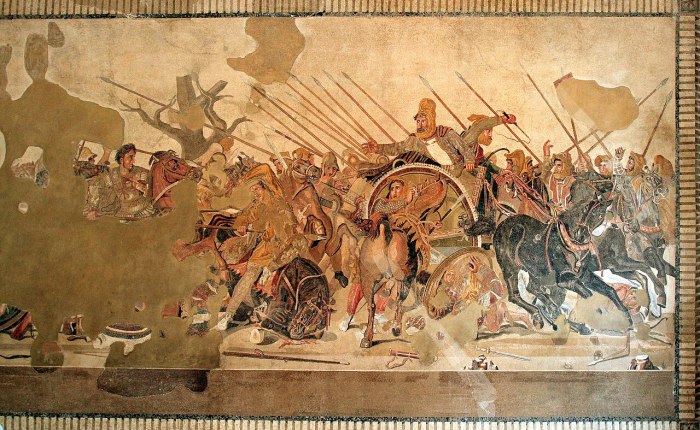
This book begins with a great promise: to correct the distorted view that so many of us have of the Persian Empire. This distortion comes from two quite different directions.
In the West, our view of the Persian Empire has largely been filtered through Greek sources, Herodotus above all. This is nearly unavoidable, as the Greeks wrote long and engaging narrative histories of these times, while the Persians—although literate—did not leave anything remotely comparable. Yet the Greeks were sworn enemies of the Persians, and thus their picture of this empire is hugely distorted. Taking them at their word would be like writing a history of the U.S.S.R. purely from depictions in American news media.
The other source of bias is from within Iran itself. Starting with Ferdowsi, who depicts the Persian kings as a kind of mythological origin of the Persian people, the ruins of this great empire have been used to contrast native Persian culture from the language, religion, and traditions imported by the Muslim conquest. In more recent times, Cyrus the Great has become a symbol of the lost monarchy, a kind of secular saint—a tolerant ruler, who even originated the idea of human rights. This purely fictitious view is, at bottom, a kind of protest against the current oppressive theocracy.
But this book does not live up to its promise. To give the author credit, however, I should note that the middle section of the book—on the culture, bureaucracy, and daily life of the empire—is quite strong. Here, one feels that Llewellyn-Jones is relying on archaeological evidence and is escaping from the old stereotypes. The epilogue is also a worthwhile read, detailing the ways that subsequent generations have used (and abused) the history of this ancient power.
Yet the book falters in the chapters of narrative history. Here, Llewellyn-Jones is forced to rely on the Greek sources, and as a result many sections feel like weak retellings of Herodotus, with a bit of added historical context. Even worse, there are several parts in which I think he is not nearly skeptical enough regarding the stories in these Greek authors. At one point, for example, he retells the story of Xerxes’s passionate love affair with the princess Artaynte—a story taken straight out of Herodotus, and which has all of the hallmarks of a legend. That Llewellyn-Jones decides to treat this story as a fact, and does not even gesture towards its source, is I think an odd display of credulity in a professional historian.
The irony is that the final section of the book—full of scandalous tales taken out of Greek authors, depicting the decadence and depravity of the Persian court—only reinforces the very stereotypes that Llewellyn-Jones sets out to destroy. The really odd thing, in my opinion, is that there are no footnotes or even a section on his sources, so the reader must take him at his word—or not. I suspect this omission is to cover up the embarrassing fact that he relied so heavily on Herodotus.
This is a shame, as the Persian Empire does deserve the kind of reevaluation he proposes. It is fascinating on its own terms, and not just as a foil to the noble Greek freedom-fighters. Still, I think this book is a decent starting point for anyone interested in the subject. One must only read it with a skeptical eye.
View all my reviews
Category: History
Review: The Worst Hard Time
The Worst Hard Time: The Untold Story of Those Who Survived the Great American Dust Bowl by Timothy Egan
My rating: 4 of 5 stars
The Dust Bowl has always been a somewhat vague disaster in my mind. It occurred during the Great Depression, and the images it generated helped to define the misery of the period. But the question has always lingered in my mind: was it simply chance that the two coincided? Or did one cause the other? Like many people, my primary touchstone for the event is The Grapes of Wrath; but that novel is mainly about people escaping the Dust Bowl, not what it was like to be in it. In short, for such an important event, I had only a vague notion of the Dust Bowl.
This book remedied the problem; and for that, Timothy Egan deserves a great deal of credit. The Worst Hard Time traces the disaster from its historical origins to its conclusion, and provides harrowing descriptions of what it was like to live through the dusters—or die trying.
I have never experienced a dust storm. The closest I’ve come was a few years back, when strong winds deposited sand from the Saharan Desert in Madrid, a climatic event called la calima in Spanish. It was unsettling. The air had a rust-colored hue, with visibility at a minimum. Rain drops fell and left dirty stains on your clothes. I was teaching physical education at the time, and we instructed the kids to use the face masks (which they still had, thanks to the pandemic) when we exercised outside. The only other relevant experience I’ve had was a few summers back, when the huge forest fires in Canada sent haze down to my town in New York. I tried to go on a run in the gray air and ended up with a persistent cough.
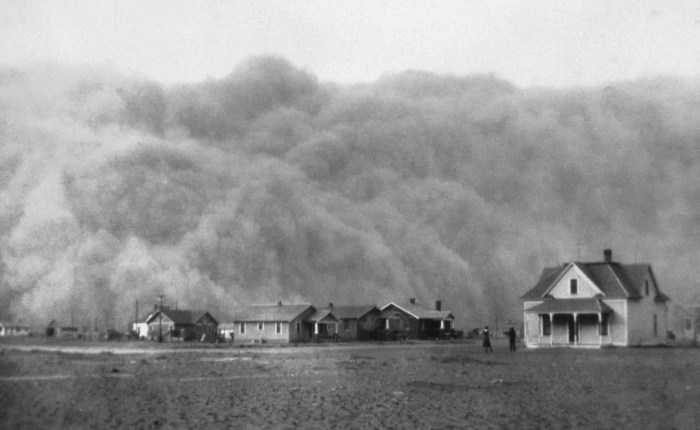
These experiences are mild to the point of triviality compared with the dusters of the 1930s. Visibility would drop to zero, pitch blackness. Dust would block roads and bury equipment. Any vegetation would be drowned or stripped bare. Anyone exposed to the dust would develop a cough that could become a fatal case of “dust pneumonia.” Most surprising of all, the dusters would generate enormous amounts of static electricity which would discharge painfully if an unwary victim touched anything conductive.
As to the question of why this happened, the answer seems to be quite complicated. Regardless of human activity, the Great Plains undergo long periods of rainfall followed by drought; and it just so happened that they were populated when the climate was more benevolent. But the 1930s were a time of extreme drought on the plains. Yet human activity had prepared the way for crisis. First, the peoples of the plain—the Apache and Comanche—were pushed off their land, and the buffalo, upon which they depended, were hunted to oblivion. The federal government encouraged farmers to take up residence by simply giving away land. The combination of the increased demand of the First World War and the Russian Revolution—which took the biggest grain supplier out of commission—prompted farmers to increase yield, plowing up as much topsoil as they could.
Like the Great Depression, then, the Dust Bowl seems to have not been the cause of one simple error, but a kind of perfect storm created by many contributing factors. And like the Great Depression—which was partly provoked by a massive trade imbalance, caused by WWI—the Dust Bowl as a kind of delayed hangover of the Great War.
Once again, Egan deserves a great deal of credit for writing such an informative book about a topic simultaneously so well-known and so poorly understood. That being said, I don’t have warm feelings about The Worst Hard Time. Though it is not an especially long book, it feels bloated and repetitious; and I think this is due to the prose, which was heavy-handed and inflated with a kind of false melodrama. This was frustrating, since the story of Dust Bowl contains more than enough drama to stand on its own.
The first lines give some idea of the tone:
On those days when the wind stops blowing across the face of the southern planes, the land falls into a silence that scares people in the way that a big house can haunt after the lights go out and no one else is there. It scares them because the land is too much, too empty, claustrophobic in its intensity. It scares them because they feel lost, with nothing to cling to, disoriented. Not a tree, anywhere. Not a slice of shade. Not a river dancing away, life in its blood.
I don’t know about you, but I find this ponderous and dull. And it irritates me especially because I don’t think this is Egan’s true voice. It is like he is putting on a persona (a quality of much irritating prose, I find). Mostly, it is extremely redundant—we get it, it’s scary—which is why the book feels so long.
This is just one of the faults of style I thought the book suffered from. However, I don’t want to harp on stylistic shortcomings too much. After all, I didn’t pick up this book to be blown over by the prose, but to learn about the Dust Bowl; and that, I certainly did. Even if it is irritating to read, then, The Worst Hard Time comes close to being the definitive work on the subject.
Review: Master of the Senate
Master of the Senate by Robert A. Caro
My rating: 5 of 5 stars
When I finish a doorstopper like this—a book of enormous scope and ambition, a genuine tour de force—I usually feel that I should reflect this weightiness in my review. After all, I spent months on this thing, bringing it up in conversation after conversation, enjoying the feeling of gradual enlightenment as I made my way from the beginning to the end. And yet, I think Caro has made his point so well, so clearly, and so forcefully that there is very little left to be said on this subject.
Apart from Lyndon Johnson, this book must be one of the best books written about the United States Senate. Indeed, one gets a sense that this was precisely Robert Caro’s goal, since he begins with a kind of book within a book, going through the entire history of the institution. In this respect, Master of the Senate can be rather depressing, since the Senate has always been, if not quite a broken, a malfunctioning body. This is largely the fault of the founders, who had the high-minded idea of creating a legislative house composed of older, wiser statesmen who could modify the rash impulses of the electorate. Instead, they created an anti-democratic institution, unresponsive to the will of the people, and historically on the side of the already rich and powerful.
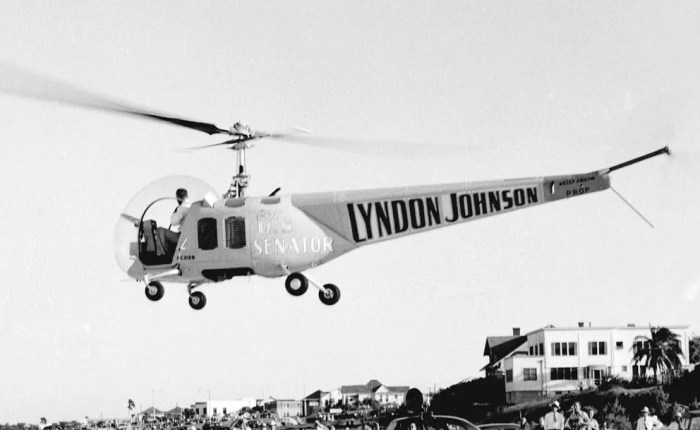
The book’s central theme explores a disturbing irony: it took a bastard of historical proportions to get this legislative body to become, however briefly and modestly, a force for good. For eighty years since Reconstruction, idealistic politicians had tried to get Civil Rights legislation passed through the Senate, and they had all failed. Pure hearts, noble ideals, and moving eloquence had not made a dent in the Senate’s ability to block the legislation. But Lyndon Johnson, who loved power above all, whose personal ambition outweighed every other goal, who stole his election to the Senate, who abused his inferiors, flattered his superiors, and manipulated his equals, who was even cruel to his loving and loyal wife—this man, whom Caro had spent two volumes portraying in the least flattering possible light, had what it took to get a Civil Rights bill through the Senate.
This book thus has a dispiriting message. Put bluntly: maybe we need these Type-A assholes after all. And Johnson is perhaps the perfect representation of this cultural stereotype, all the way down to his heart attack. If you had asked me before starting on this series about this sort of person—selfish, restless, ambitious, domineering—I would have said they all ought to be sent to therapy, for their and our mutual benefit. Indeed, I occasionally fantasized about what would happen if a relatively normal person (me, for example) became president—what would happen if our government were composed of ordinary folks rather than the most power-hungry or ideological among us. The utter foolishness of this thought is demonstrated by this book. If I were suddenly appointed, say, Senate Majority Leader, I would accomplish precisely nothing.
As a final thought, a very clever friend of mine put a question to me some months ago, which at the time I couldn’t answer: Why would a Texas Democrat push so hard for civil rights, when it inevitably meant losing the support of southern whites? This book goes a considerable way in making sense of Johnson’s decision. There were many factors, but the most important in 1957 was that Johnson needed to drop the stigma of being a southern racist if he was ever to have a chance at the presidency—and the presidency was always his ultimate goal. However, this does not explain why Johnson, once president, would continue the fight. The truth seems to be that, when his overwhelming urge for power was satisfied, and other qualities of his personality were allowed to come to the fore, he did genuinely care about helping the disadvantaged. If only every type-A were like that.
View all my reviews
Review: The Hinge of Fate
The Second World War, Volume IV: The Hinge of Fate by Winston S. Churchill
My rating: 5 of 5 stars
I find that I am liking each one of these volumes more than the last. The pleasure of this history is that, through the eyes of Winston Churchill, the war takes the shape of an enormous board game, played over months and years. Far removed from the gore of the front lines, Churchill sees the conflict as symbols on a map, which he needs to arrange in the most advantageous possible way—a game he plays brilliantly. This is not to say that he is frivolous or superficial. But warfare is far more palatable when experienced from the command chair than from the trenches.
Added to purely military decisions is the messier business of courting allies. Indeed, the best parts of this book describe Churchill’s cultivation of his relationships with Roosevelt and Stalin. Dealing with the Americans was relatively easy, as Roosevelt and Churchill seemed to have gotten along very well. Nevertheless, working so closely together required constant coordination of plans, both short-term and long-term; and Churchill sometimes struggled to get the American command to accept his military vision.
With Stalin, relations were far more tense. The Soviet leader is constantly demanding from Churchill fresh supplies and for a second front in France. Churchill, meanwhile, does his best to placate Stalin while firmly refusing to do what he feels is unwise. This culminates in his 1942 visit to Moscow, narrated in the two best chapters of the book. Churchill, sure that he will not be able to invade France in 1942, decides he must deliver this message personally if he is to maintain his working relationship with the Soviets. Stalin, at first, doesn’t take the news well, but by the end they are up all night, drinking vodka. In virtually any other circumstances, the two men would have been sworn enemies, and it is fascinating to see them try to cooperate.
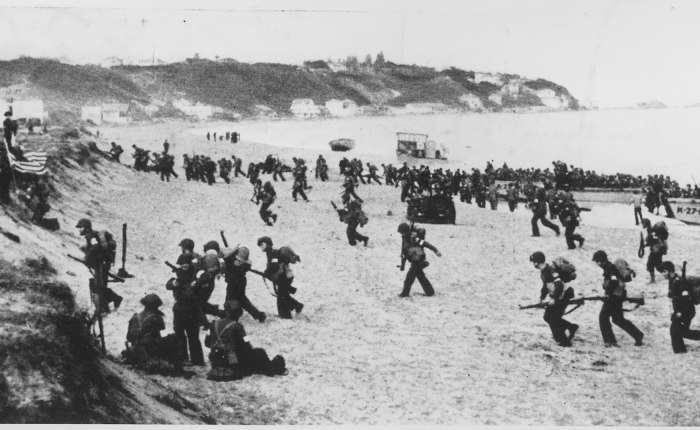
The title of the book is quite apt, as it contains the battles that marked the beginning of the end for both Germany and Japan: Midway, Stalingrad, and Tunisia. These books, it should be remembered, are public memoirs rather than objective history; and so Stalingrad and Midway, being battles Churchill had nothing to do with, get only a cursory treatment. Northern Africa, on the other hand, occupies much of the book, as British and then American forces beat Rommel, invaded the Vichy territories, and finally won a decisive victory in Tunisia.
As a final thought, I am constantly surprised at how much I am learning from these books. Somehow, after a lifetime of World War II media, I knew close to nothing about operation “Torch,” and had no real idea of the significance of the Northern African campaigns. I was also unfamiliar with the Katyn massacres—Russia’s mass executions of Polish prisoners, an issue which Churchill felt he could not raise with the Soviets, for fear of hurting their relationship. Indeed, having been in Dresden just two weeks ago, I’ve had occasion to reflect that it was not only the axis who committed war crimes.
View all my reviews
Review: The Grand Alliance
The Grand Alliance by Winston S. Churchill
My rating: 4 of 5 stars
Churchill’s account of the Second World War continues. I am finding that these volumes have a kind of cumulative power, which far exceeds that of any single volume. As I slowly make my way through the war, month by month, campaign by campaign, theater by theater, the mind-boggling scale of the conflict is beginning to sink in. What would be major operations in other wars are here mere side-shows or diversions. To pick just one example, if the Anglo-Iraq War were to happen today, it would be considered a momentous event that dominated the news. But in the context of World War II, it hardly even registers.
Merely keeping track of all this—the troop strengths, the ships available to the Navy, the number of serviceable aircraft, all distributed literally around the globe—would strain any military organization today. Two silly but revealing examples illustrate just how many different places Churchill had to keep in mind. He insisted that Iceland be written with a (C) after it, so that it could never be confused with Ireland (R). And he also preferred that Iran be called “Persia,” since otherwise somebody might confuse it with Iraq. The very idea that people might mix up what countries to attack or defend I think says more about the scale of the War than any superlative could.
But the military organization is only half of the equation. For Churchill is always acutely aware of the political situation, in ways that strictly military commanders are not.
To pick a simple example, Churchill has occasion to criticize a general for putting a British regiment in a relatively safe zone, while sending colonial forces into battle—for the apparently superficial, but politically real, reason that it reflects poorly on the British government. Indeed, Churchill’s frustrations with General Auchinleck’s hesitations to attack Rommel in North Africa reminded me very much of Lincoln’s own admonishments to George B. McClellan to be more aggressive. In both cases, the political leader realized the value of at least appearing to have the initiative. Appearances are important when you are courting potential allies and public opinion.
Like Manny, I was also impressed by Churchill’s willingness to put politics aside in order to win the war. Few politicians in Britain, I imagine, were less sympathetic to Soviet Communism than Churchill. But as soon as Hitler made his great error and commenced Operation Barbarossa, Churchill did not hesitate to send vital supplies and equipment to his former foe, even though it weakened his own position—correctly predicting that a strong Russian defense would debilitate the German army. The tense and sometimes downright rude correspondence between Stalin and Churchill was especially interesting to read. Even then, at the beginning of their alliance, the Cold War was looming ahead.
View all my reviews
Review: The Assassination of García Lorca
El asesinato de García Lorca by Ian Gibson
My rating: 5 of 5 stars
Sometimes the simple act of remembering is political. History is, unfortunately, replete with crimes that one government or another would prefer to remain hidden. And, certainly, forgetting is probably easier for everyone involved—less traumatic, more convenient—even, perhaps, for the victims. Thus, whenever some busybody like Ian Gibson begins stirring up old trouble, the accusation of “opening up old wounds” is inevitably trotted out (ironically, by the ones who did the wounding in the first place).
And yet, even if it is not entirely logical—even if what is done is done, and nothing can change that—some sense of moral duty, of obligation to victims who are beyond all human help, seems to compel us nevertheless to reach back into the past and seek justice. This book is imbued with that sense—perhaps a quixotic sense—of ethical duty, as Gibson attempts to nudge the moral balance of the universe back in the right direction.
He first establishes that Lorca was anything but the apolitical flower child that he is sometimes portrayed as. It is true that Lorca was perhaps somewhat naïve and, in general, was averse to party politics (he repeatedly refused to join the communist party). But he was politically active and unambiguously allied with the left, as was evident by several public declarations. Indeed, the idea that Lorca was, in his final days, converting to the fascist cause—an openly homosexual poet who dramatized the evils of conservative Catholicism!—was never anything but laughable.
Gibson then does his best to establish the events that lead to Lorca’s death in Granada, using interviews with witnesses (admittedly many years after the fact) to pin down as many details as he can. In the process, he gives the reader a sense of the climate of terror and repression that engulfed Granada in the opening days of the military uprising—jails packed to bursting, mass graves filled by firing squads, a knock on the door at mightnight to go “take a walk.” In the process, he also lays to rest another myth of Lorca’s murder, that he was somehow killed by uncontrollable elements of the falangist party—a random act of violence, in other words. On the contrary, Lorca’s death was the product of an intentional campaign of “purification,” approved of and organized by the authorities.
This book might not have had such an impact on me had I not visited Granada as I was on the final pages. Though I had read many of Lorca’s works before the visit, he was still just a historical personage for me—one of Spain’s many dead poets. But visiting his former houses (there are several, as his family was very wealthy) transformed him into somebody startlingly real and close. I saw the piano that he liked to noodle on, the writing desk on which he wrote his most famous plays, and even hand-drawn theater backdrops to be used in a puppet show for his baby sister.
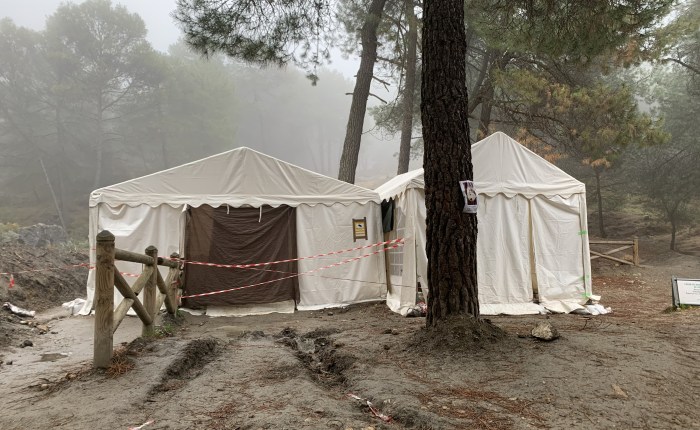
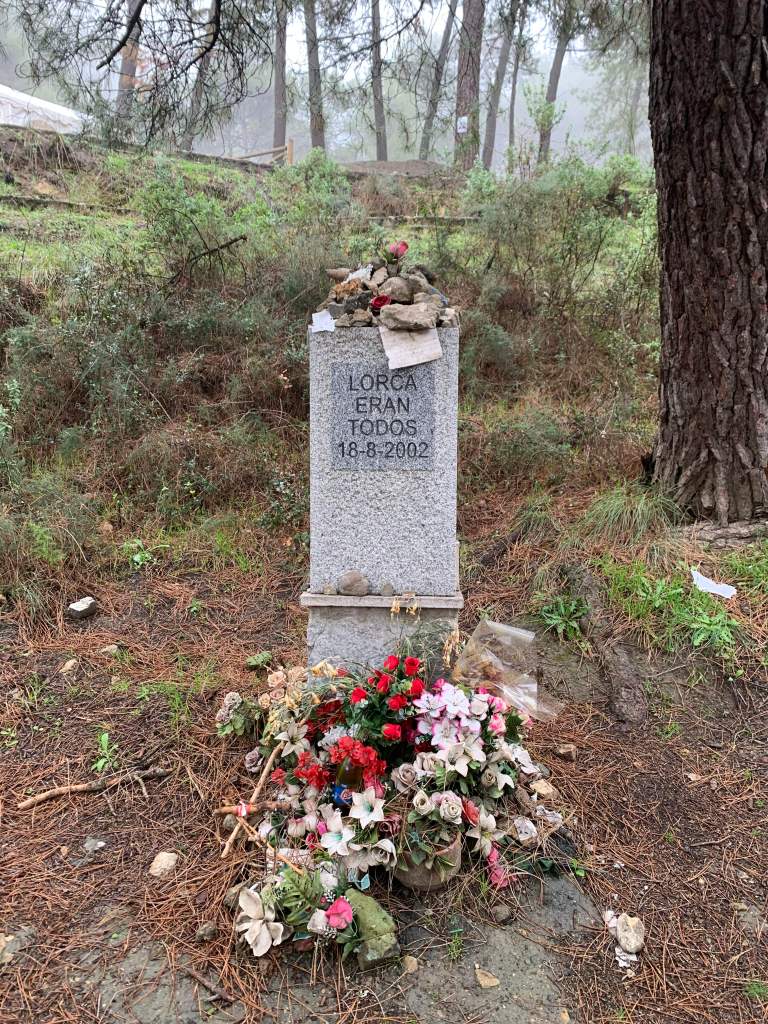
This trip culminated in a visit to the Barranco de Víznar, the place of his execution. We arrived on a foggy Sunday morning and followed the path into the woods. Soon, we came upon several white tents, which covered the excavations sites of mass graves. The trees around the site were covered with laminated posters bearing the names and faces of those executed there—professors, politicians, farmers, pharmacists, music teachers… In the center was a simple memorial covered in flowers, with the inscription “They were all Lorca.”
So far, the remains of dozens of individuals have been recovered there by a team of investigators, though none have yet been identified by DNA tests. That this excavation had to wait nearly 100 years to take place is a measure of the silence—imposed, in an attempt to forget—that followed the Spanish Civil War. But relatives of the victims have kept their memories alive, and now they are perhaps receiving some modicum of justice. Even today, memorializing these victims takes courage. Just last week, a hiker was assaulted at that very place by a man screaming “There aren’t many buried here!” The hiker was hospitalized. But the work continues.
View all my reviews

Review: Battle Cry of Freedom
Battle Cry of Freedom by James M. McPherson
My rating: 5 of 5 stars
It is amazing how ignorant one can be without knowing it. As a product of the American school system, and a veteran of all 11 and a half hours of Ken Burns’s iconic documentary, I thought that I was in for few surprises when I began this book. But because of deficiencies in either my education or my memory—probably a bit of both—I was constantly surprised throughout this telling of the war, and became absolutely riveted.
Though I am certainly not in a position to judge, I would venture to say that this book simply must be the best one-volume account of the war. It is a remarkable performance on every level. Despite the relatively limited amount of space that McPherson can devote to any one subject, the reader never feels that he is offering a superficial or a cursory account. On the contrary, as in the best overviews of historical events, the whole is greater than the sum of its parts, as each element in the story sheds light on every other.
McPherson shows himself to be a skilled and flexible author. Whether he is analyzing the Confederate economy, or examining the Northern political situation, or explaining the advances in naval technology, or narrating battles and troop movements, McPherson’s prose is steady, clear, and engaging. His grasp of the subject is so strong, and his vision so clear, that the chaos of politics and war plays out on the page with the orderliness of a Victorian novel. The simple act of taking such a huge mass of information and rendering it into something comprehensible—while remaining nuanced and enlightening—is, in my opinion, a great literary accomplishment.
As might be expected, the comforting notion that the war was somehow about states’ rights—and not slavery—does not hold up to even a moment of scrutiny. It is true that the Confederate states, in general, did place a high value on the autonomy of individual states. Yet these states’ support of the Fugitive Slave Act before the war—a huge extension of federal power, allowing the national government to overrule individual state laws to return escaped slaves—shows that slavery trumped this concern. In any case, whenever the states’ rights argument is made, it immediately leads to the question: their right to do what, exactly? (Answer: maintain slavery.)
As a final irony, after vociferously denouncing the use of black troops by the Union Army, and refusing to treat captured blacks as soldiers (either summarily executing them or selling them into slavery), in its final months, the Confederacy considered the use of slave soldiers. This idea was so totally contradictory to their stated values that it produced anger, shame, and confusion among the Confederates. Some preferred simply to give up to the North than to resort to this horrible betrayal of their values. Others admitted that, if blacks could make good soldiers, their entire way of life was based on a lie. Politicians wrangled with the implications of slave soldiers: If they were to fight, shouldn’t they be promised their freedom as a reward? In any case, this handwringing came to nothing, as the Confederacy collapsed before they could put this desperate—and hopelessly contradictory—idea into practice.
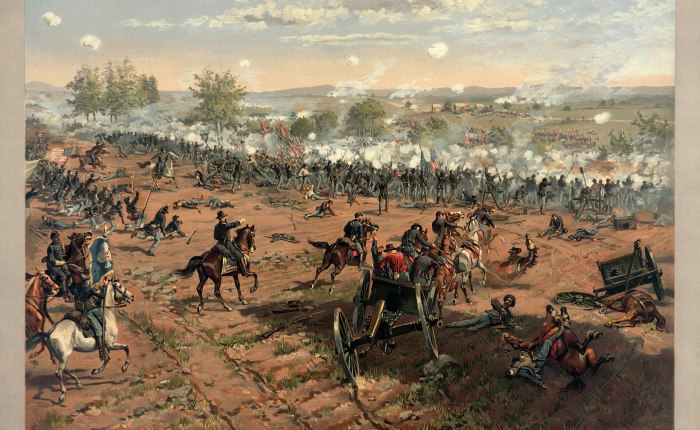
On a purely military level—admittedly, perhaps the most superficial way a war can be judged—the American Civil War is as thrilling and fascinating as any war in history. There were brilliant generals on the Union and Confederate sides whose campaigns are still studied today by would-be commanders. In McPherson’s telling, the main lesson of the war is the wisdom of an aggressive strategy. The first two years of the war, from 1861-63, are marked by defeat after Union defeat under generals (particularly McClellan) who shied away from confrontation, while Southern generals took the initiative. However, when Grant and Sherman—as aggressive as they come—finally took control on the Union side, the carnage of battle went from horrible to simply nauseating, and I began to have some sympathy for McClellan’s reluctance to subject his troops to such slaughter.
In many ways, the American Civil War seems to prefigure the terrible conflicts of the following century. By the end of the war, the basic tactics of the infantry resembled those of the First World War—massed troop attacks against entrenched positions, with predictably horrible casualty rates. The invention of iron-clad ships reminds one of the first tanks, while the Union use of a subterranean mine to break the enemy line in the siege of Petersburg prefigured what became a common strategy in the Great War. On the other hand, the horrible conditions of prisoners of war—particularly in the Confederate camp, Andersonville—are an unsettling forerunner of the German camps in World War II. The photographs of emaciated Union soldiers will look very familiar nowadays. And this is not to mention the millions of enslaved blacks forced to aide in the war effort of their enslavers, another omen of things to come.
And yet, there is a certain horror peculiar to civil wars. I am now, for example, making my way through interviews of civilians and soldiers who lived through the Second World War, and a common thread is how easy it was to hate and fight someone alien—someone who lives far away, speaks a different language, and maybe even looks different. But in a Civil War, neighbors fight neighbors, friends fight friends, and family fight family—not metaphorically, mind you, but literally. It is difficult to understand how a country could devolve to such a point that a boy from Maine is willing to stick a bayonet in the guts of a teenager from North Carolina.
What is even more remarkable, perhaps, is that the country was able to come together after such a vicious conflict. Though the hysterical and uncompromising tone of many of the politicians prior to the war now sound distressingly familiar, I suppose I should derive some hope from the fact that the country survived intact—indeed, became stronger than ever before—after this murderous episode.
Historians are averse to counterfactuals, and perhaps rightfully so. After all, how could you possibly know what might have happened in some imagined parallel timeline? However, I do think it worthwhile to consider these questions, even if precise answers elude us. What would have happened, then, if the South had successfully seceded? In a rapidly industrializing world, in which all of the major powers had abolished slavery or serfdom, how long would the “peculiar institution” have lasted in an independent Confederacy? As valuable as was their cotton, it is difficult for me to resist the idea that they would quickly have ended up an agricultural backwater, increasingly shunned by the rest of the world.
I am getting off track. This is a review of the book, not the war itself. But it is a mark of McPherson’s accomplishment that I cannot stop thinking about this defining conflict. Lately, I have even found myself watching long video tours of the great Civil War battlefields (either a great testament to the book’s value or to my own need to get a life). Of course, in any single-volume work of this kind, there will inevitably be omissions and shortcomings. I would have liked more on the experience of being a common soldier, for example. Yet such criticisms are easy to make, and seem very petty when compared to everything that McPherson has accomplished here. It is a great achievement.
View all my reviews
Review: Means of Ascent
Means of Ascent by Robert A. Caro
My rating: 5 of 5 stars
Robert Caro sets his own standard for political biographies, and if this volume was at all lacking for me it was only in comparison to the masterful first volume in this series. But even this is not exactly a fair comparison, as The Path to Power covered Johnson’s formative years—delving into his family history, his marriage, his schooling, his environment, his first working experience, and finally his rise to the House of Representatives. Its scope, in other words, is quite broad.
Means of Ascent is a very different book, covering only seven years (1941-48). It is significantly shorter (though still hefty enough), and most of these pages are dedicated to Johnson’s 1948 Senate race. This corresponds to what Winston Churchill called his “wilderness years,” in which Johnson was directionless and cut off from the main arteries of power. He spent some of this time in a non-combat role in the military (and spent the rest of his life shamelessly exaggerating his minimal exploits), some of this time using his connections to get rich through a radio station—and finally got back onto the path to power by stealing a Senate election.
As Caro says repeatedly, Johnson is a complex personality with a strange admixture of the despicable and the admirable—and this book contains precious little of the latter. As a result, whereas in the first volume one could sometimes feel sympathetic for the young man from Texas, here he is little more than a power-grasping villain. Caro himself obviously came to feel disgusted with Johnson’s personality, and his feelings seep through in his descriptions of Johnson’s ample transgressions: his blatant mistreatment—indeed, verbal abuse—of anyone he considers inferior (including receptionists, waiters, his own staff, and his poor wife), his absolute amorality regarding even basic ideals (such as democracy itself), and his willingness to stop at nothing to obtain power.
Caro contrasts Johnson’s personality with that of his opponent in the 1948 Senate election, Coke Stevenson—a man Caro portrays as honest and honorable. And here the esteemed biographer got into a little bit of trouble. While Stevenson may indeed have been upstanding in the sense that he was true to his word, did not bow to lobbyists, did not attack political opponents, and did not seek political office in order to satisfy a lust for power—while all this may have been true, Stevenson was also certainly a reactionary and a racist.
These rather unflattering qualities are given only a passing mention in the book, which may leave the reader with a skewed impression of Stevenson. Caro was roundly criticized for this, and in an article in the New York Times, published in 1991, he responded some of these criticisms. Yet his defense—that the subject of race played little role in the election—while valid as far as historical explanation goes, still does not quite excuse the glowing portrait he painted. Upon finishing the book, it is difficult to resist the impression that Caro himself came to admire Stevenson.
Even so, as abhorrent as I find Stevenson’s views to be, I would still prefer such a man to the Johnson of 1948, who seems to have had no political philosophy, no political aspirations beyond his desire to control people, and—worst of all—no respect for the institution of democracy. Throughout all of the legal battles and maneuvers which allowed him to keep his stolen election victory, Johnson never once betrayed the slightest hint that he might have had misgivings about betraying the will of the people. Indeed, as Caro makes clear, he seems to have been proud of it, virtually boasting of the “victory” in later years.
Now, at this point I will do something very brave—or cowardly, perhaps—and venture a slight criticism of Caro. After so many pages, his writing style is beginning to ware on me. This is because, I think, his primary rhetorical technique is that of superlatives. What I mean is that, for Caro, everything is as extreme as possible. Johnson is not just a sleazy politician, but unprecedentedly amoral; Stevenson is not just a popular governor, but a Texan hero; and so on, and so on. Caro relentlessly emphasizes how extreme every event and experience was—so much so that, by the end, you are begging for something totally ordinary and unremarkable to happen (and no, not superlatively ordinary).
That said, the book is eminently readable and highly enjoyable. Here Caro creates such a memorable portrait of an amoral, power-crazed politician that, had this book been written by anyone else, it would by itself be considered an enduring classic of American political writing. It is only when compared to his other books that this one may seem somewhat light.
View all my reviews
Review: Columbus (Laurence Bergreen)
Columbus: The Four Voyages by Laurence Bergreen
My rating: 4 of 5 stars
I remember learning about Columbus when I was in elementary school. The story was simple: he was a daring, visionary man who set out to prove that the earth was round, heroically defeating the nay-sayers who thought that he would sail right over the edge of the earth. To the mind of a child, it is a compelling tale. It is also, of course, complete fantasy (to use a polite word). Since those Edenic days of unproblematic national heroes, Columbus has become a much more divisive figure. So I decided I ought to get the real story, hopefully from somebody without an ideological axe to grind.
As I knew from his books on Marco Polo and Magellan, Bergreen is in the business of writing popular histories of famous explorers. This book is up to his usual standards, though the raw material he had to work with is naturally somewhat messier. Both Polo and Magellan were famous for one iconic voyage, while Columbus travelled to the “New World” on four separate occasions. Instead of one grand adventure, then, we get a series of expeditions, each one drearier than the last. By the fourth voyage, I was quite ready to be done with the Genoese explorer.
But I did learn. For example, Bergreen makes it clear that the competing narratives of Columbus have existed from almost the very beginning. There were rumors and accusations regarding his cruelty and incompetence during his lifetime (which resulted in his imprisonment); and not long after his death the great Spanish anti-colonialist, Bartolomé de las Casas, skewered Columbus for his role in the destruction of the native peoples. In short, he was never a universally beloved hero.
Furthermore, Columbus only became a cornerstone of patriotic ideology centuries later. He started to be celebrated in North America, for example, after the Revolutionary War, as the young nation searched for a founding myth that wasn’t so tied to England. In Spain, October 12th (when Columbus “discovered” the New World) did not become a holiday until 1892, as part of the conservative restoration of the Bourbon monarchy. In the United States, it was not made a holiday until 1937.
So, should Columbus Day be celebrated? Insofar as celebrating Columbus is merely a way of celebrating European colonization of the Americas (which certainly seems to be the case), then I think the answer must be a clear no. I don’t think it is possible to learn about the cataclysm that engulfed the native peoples of the Americas—which resulted in millions dead and the disappearance of so many cultures and languages—and think that worth celebrating. Granted, there is a kind of paradox for European Americans in this, since if there had not been a Columbus we would not exist; and it is difficult to wish oneself out of existence. Even so, celebrating the enslavement and elimination of whole peoples does not seem quite right.
Yet what about celebrating Columbus himself? Well, he does not exactly make a good impression in these pages. Certainly he was a bold and determined man, willing to risk his life for an idea (as well as for gold and glory). And his talent as a navigator is impressive. But these positive qualities seem rather pale when compared with his narrow-mindedness, his incompetence as an administrator, his cruelty to others, and his messiah complex. In the course of these voyages he combats several mutinies (with varying degrees of success), strands his own men (to be used as a bargaining chip), and has untold numbers of people enslaved. And even if you focus exclusively on his role as a “discoverer,” it is difficult to celebrate a man who steadfastly refused to acknowledge the truth of what he, in fact, had stumbled upon.
The truth is that Columbus, contrary to what the legend says, did not have a more accurate notion of the earth than the experts of the time. Precisely the reverse: Columbus’s voyage was based on a profound underestimate of the size of the earth. Indeed, it was pure luck that there was an unsuspected continent in the middle of the ocean. If America did not exist, and there were nothing but open sea between Europe and Asia—as he thought—Columbus would almost certainly have died in the enormous expanse of water. And he never even had the good grace to admit his mistake, insisting to the end that he had found a route to Asia, despite the very clear evidence to the contrary.
Of course, the fact remains that Columbus thought to do something that nobody (to his knowledge) had ever done before, and in the process inaugurated a new period of history. Indeed, given the tremendous importance of his voyage, we ought to do our best to understand both the man and the colonial undertaking he stands for. And I don’t think that is accomplished with myths and unreflecting celebration.
View all my reviews
Review: The Gathering Storm
The Second World War, Volume I: The Gathering Storm by Winston S. Churchill
My rating: 4 of 5 stars
When I first learned, many years ago, that Winston Churchill had written a history of the Second World War, I knew that I would have to read it. After all, I grew up watching documentary after documentary about the conflict (before the History Channel was all about aliens, it was mainly Hitler content). Finally, this summer, I found the complete set, cheap, at the Strand bookstore in New York. Looking at the six fat volumes on my bookshelf, I knew that I was in for a long campaign.
The book is, indeed, long (over 700 pages in this edition), but it is a surprisingly fast read. It was written in haste—if “written” is the right word, for most of the book was either dictated or excerpted from official documents—and reads like a series of dispatches or field reports. This is simultaneously the book’s weakness and its great strength. For Churchill does not attempt to give a universal, impartial overview of the war, but rather recreates what it was like for him to be in the thick of it. And although his perspective does impose serious limitations and distortions on the material, it also makes the narrative far more thrilling. The rush of events is palpable.
Half of this book is devoted to the buildup of the war. Churchill, to his credit, saw the Nazi threat coming from miles away, and tried again and again to rouse his country into action. Unfortunately, his warnings go unheeded, and Germany is allowed time and space to rebuild its military unmolested. It is truly maddening to contemplate all of the lost opportunities. When Germany invaded the Rhineland, for example—clearly violating the Treaty of Versailles—the French and English could have taken decisive action at a time when the German military was miniscule. But nothing can compare with the infamous Munich Agreement, in which a country capable of defending itself was given away to the Germans, which only further strengthened their military for the inevitable war.
One can imagine how such a book could devolve into a series of self-congratulatory told-you-sos. But Churchill, at least in print, is quite generous to his political opponents. In particular, Chamberlain, the architect of appeasement, comes off rather well in Churchill’s telling—portrayed a resolute, peace-loving man who made some very bad decisions. Indeed, I found Churchill’s narrative voice to be rather odd. He has a kind of boyish fascination with war and weapons, and a jingoistic faith in the British people and their empire. Indeed, although he was so very right about Nazi threat, I can easily imagine myself dismissing such a strong believer in king and country as a war-mongering kook.
But he was not a kook, at least not in this regard. Indeed, in his great attention to detail regarding military matters, and his ability to strike a brave, defiant note at a difficult hour, he proved that he was the right man for the moment.
View all my reviews