Review: Collected Poems of Emily Dickinson

Review: Collected Poems of Emily Dickinson

Can you write a book review
Entirely in verse?
Omitting standard sentences
For stanzas taut and terse?

It seems a fitting treatment
For such a book as this;
So humor me, I beg you—
And my limited wit.

Emily Dickinson was a poet,
One of the very best;
A natural gift with language—
At once daft and deft.

Something of a recluse,
Something of a crank;
Living closed up in her room—
Like a fish in a tank.

Undoubtedly a genius,
Ahead of her time;
Unappreciated in her life,
For her erratic rhymes.

But when she finally passed away,
Her cache of poems was found;
Edited to the day’s tastes—
The dashes taken out.

The dash—the perfect punctuation
For her unique style;
Jagged—ragged—sudden—striking
And also—versatile.

Obsessed with life—and death—and bees,
Most of her poems are short;
Some of them only one quatrain,
They end before they start.

And what entrancing rhythm!
Like the beating of a drum—
Her words hammer forward—
Marching—stomping—thumping—done!

The classic case of genius,
At first misunderstood;
Now her poems are classic,
Widely read and widely loved.

So thank you, Ms. Dickinson,
For dedicating yourself—
To art, to words, to poetry—
To posterity’s bookshelf.

Review: Julius Caesar, by Shakespeare

Review: Julius Caesar, by Shakespeare

Julius CaesarJulius Caesar by William Shakespeare
My rating: 5 of 5 stars

Why, man, he doth brestride the narrow world like a Colossus, and we petty men walk under his huge legs and peep about to find ourselves dishonorable graves.

One of Shakespeare’s best, this play is also, I think, one of his most morally ambiguous. The central question of the play—was it right to have killed Caesar?—is left unresolved, principally because of the complexity of the protagonists.

The play opens with Cassius persuading Brutus to act against Caesar. This monologue, though eloquent, is also somewhat confusing, perhaps even incoherent. The reasons Cassius avers for wanting Caesar dead are all petty and somewhat beside the point. Cassius hates Caesar, but why? Because once Caesar faltered while swimming the Tiber? Or because Caesar once had a cold? Of course, these examples are only meant to show that Caesar is a mere man, and thus does not deserve to occupy such a high eminence. And yet, this same argument—namely, that human weakness makes everyone equal—can be used against any form of inequality, be it wealth, power, or prestige; and communism is certainly not what Cassius is preaching.

True enough, word later comes that Mark Antony offered Caesar a crown, which would threaten the very existence of the Republic. But there is nothing in Cassius’s words or deeds that reveal him as someone motivated by political philosophy. Rather, he is a sensitive man, easily insulted, with a delicate ego; and his emotional episode in Brutus’s tent also reveals him to be needy and high-strung. There is nothing evil in him, nor even overtly malicious; but he is not like Brutus, a man of principles, honor, nobility. Thus I cannot help concluding that his plot against Caesar was mainly motivated by petty emotions, even if Cassius told himself otherwise. He felt envious of Caesar’s power, slighted at having a superior, fearful of future humiliations.

All this is more or less apparent in Cassius’s speech to Brutus. From the start, therefore, it should have been apparent to Brutus that he was allying himself with men acting from a suspect motive. But perhaps Brutus is too good-hearted to question the motivations of his friends. Indeed, throughout the play, Brutus is shown to be ethically unimpeachable, a purely noble and righteous person. Even his enemies admit it. And given that he talks the most and dies last, many have argued that the play should be entitled Brutus and not Julius Caesar, since the latter has few lines and dies halfway through.

It is, indeed, tempting to see Brutus as the tragic hero, trying to do what is right, brought down by circumstances. But I have trouble taking his side completely.

For one, it seems foolish to have let himself be persuaded by Cassius. The assassination was rash, and they had no plan whatsoever for restoring order once the deed was done. It also struck me as hypocritical, to say the least, to march through the streets yelling “Liberty! Freedom! Tyranny is dead!” since, at best, the conspirators restored an oligarchy of hereditary privilege. I am not convinced that the life of the common people was any better under the Senators than under Caesar.

Brutus also has a tendency to act imprudently, which is arguably his fatal flaw. First, the assassination plot itself—specifically the plan for restoring order—should have been more carefully considered. Brutus’s oration to the Roman people after the assassination is evidence that his rationales were not given enough thought. He cites “ambition” as the reason Caesar had to be killed, but does not clearly show in which of Caesar’s actions this ambition was manifested. This makes it very easy for Mark Antony to refute the charges. Brutus should have foreseen this, which is why it was the height of folly to have let Mark Antony give that oration. Besides all this, he shows himself to be a poor general.

Brutus’s personal honor code, while earning him respect, also handicaps him. For one, as noted, his tendency to trust others make him a poor judge of character. More troublingly, in attempting to set himself up above petty emotions, he renders himself inhumanly cold. Cassius, though oversensitive, is right in rebuking Brutus for attempting to see the vices and virtues of a friend with an unprejudiced eye, rather than overlooking Cassius’s faults. More significantly, Brutus’s attempt to rise above the grief of his wife’s death lowers him instead, turning him into a mere empty shell motivated by an honor code that brings nobody happiness, not even himself. For these reasons, I feel sad at his loss, but I also feel that he had it coming.

Mark Antony has some of the marks of a villain, who vows revenge even if he drags down all of Rome in the process. He is also not terribly likeable, being arrogant to others and fawning to Caesar. But he has redeeming qualities. His love for Caesar, while at first apparently sycophantic, is later shown genuine. The praises of a living commander are always suspect, but the praises of a departed one are honorable. Mark Antony is also not insensitive to the virtues of Brutus, even praising his memory. He fights for vengeance, true, and vengeance is always ethically suspect; but Hamlet fought for vengeance, and that does not make us like him any less.

In sum, it is difficult to see either Cassius, Brutus, or Mark Antony (or Julius Caesar, for that matter) as unambiguously right or wrong. They are rather three imperfect individuals, with different faults and strengths, who all fight in good faith for what they believe is right.

To acknowledge the faults in these characters, and yet portray them as acting sincerely, is a demonstration of the genius and the nobility of Shakespeare. For the quality Brutus most lacked was the one Shakespeare had in superabundance: empathy. As this play demonstrates, he could acknowledge a person’s faults and limitations while also understanding that, from their point of view, what they were doing was perfectly right. And therein lies both the secret of his art and the moral value of his works.

View all my reviews

In Praise of Brexit

In Praise of Brexit

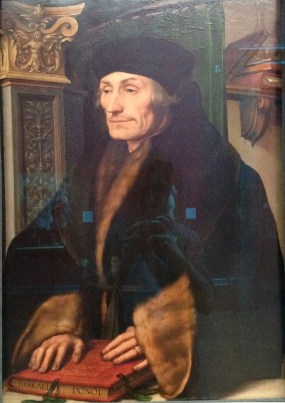
Praise of FollyPraise of Folly by Desiderius Erasmus

My rating: 4 of 5 stars

A Review of The Praise of Folly by Erasmus

Folly speaks:

About five hundred years ago, a man named Erasmus decided to publish a book praising me. Unbelievably, no one had this idea before, and none since. Nobody has the time or the inclination—nobody besides Erasmus, that is—to sing my praises, apparently. All the other gods get their encomiums, but not me.
IMG_3814
Well, perhaps I should take the neglect as a compliment. After all, isn’t it the height of folly not to acknowledge the role that folly plays in human life? So is not the neglect a kind of compliment, albeit backhanded?

Nevertheless, some folks need some reminding, it seems, especially after what happened the other day. Oh, you know what I’m talking about: the United Kingdom’s vote to leave the European Union. All I’m hearing left and right is how stupid, short-sighted, narrow-minded, and above all foolish it was to vote “leave.” Well, I can’t stand my name being dragged around in the dust any longer, so I’m taking this opportunity to peep up and remind you how much you owe me.

First, let’s follow in Erasmus’s footsteps and take a short trip around Europe. As you might already know, Erasmus may justly be called the first true “European,” since he was such a cosmopolitan fellow and traveled everywhere. Even now, the trans-European student-exchange program is named after Erasmus. You might already know that the most popular destination for the Erasmus program is sunny Spain, where lots of young Britons like to go and get a tan. (Guess they won’t be coming anymore!)

Spain’s a lot different now from when Erasmus was alive. Back then, the Inquisition was in full swing and anybody who wanted to hold public office had to prove his “purity of blood,” which meant he didn’t have any Jewish or Muslims ancestors. Nowadays we don’t see that kind of behavior anymore in Spain; the Spaniards decided that it wasn’t such a good idea. But the folks in England apparently disagree: one UKIP candidate, Robert Blay, got suspended after saying his rival “isn’t British enough.” You see, my foolish devotees never disappear, but only migrate!

Yes indeed, Spain is truly different now. Let’s go to the Mediterranean coast to take a closer look. It’s a veritable mini-England! We can find British pubs, British radio broadcasts, British supermarkets selling British products. We can see retired old Brits eating baked beans and drinking tea as they take in the southern sun. And we can meet some Brits who have lived here for over a decade, and who still can’t speak a word of Spanish! Yes, and in between a pint these same Brits can tell you about how terrible is the EU and how there are too many immigrants in England. Oh, my wonderful followers!

As you might recall, it was around the time Erasmus wrote this book that England decided to leave another international organization: the Catholic Church. And the reasons were, I suppose, similar enough: “We don’t want some Italian Pope telling our king which wife he can or can’t behead!” Thomas More, one of Erasmus’s friends, and to whom this book is dedicated, disagreed with this, and he got beheaded along with the wives. Lots of people didn’t like this, but honestly I can’t say it was such a bad move. Executions are decisive, at least. Some people still agree with this strategy, like the guy who killed the politician Jo Cox. It worked for Henry VIII, so it can work for us!

IMG_3304

Let’s fast forward a bit in time, to the glorious British Empire. By Jingo, it was big! It stretched across the whole world! Look at how these colonial officers stroll around Mumbai, Nairobi, Hong Kong, Sydney! You’ve got to admire them. They don’t ask anybody’s permission to go anywhere, they just walk right in with their guns and biscuits. Doesn’t take long to subdue the native population when you’ve got the Royal Navy on your side! Sure, this approach didn’t please everybody. But, hey, it was the high point of British history. Nowadays, they’re a bit more worried about foreign immigrants colonizing them than the reverse.

Now you see what a big role I’ve played throughout history. You see how many decisions and opinions I’ve inspired! Oh, but now I hear some people saying that the world would be better off without me. Sure, Folly is important, they say, but that doesn’t mean Folly is worth praising. Fair enough, I suppose. Yes, maybe I do cause a bit of mayhem in the world. And yes, maybe I take things too far. But consider this: For every bad decision I inspire, I also provide the remedy.

For without Folly, do you think people could overcome the sheer hypocrisy necessary for their decisions? Without me, do you think people could congratulate themselves for shooting their own foot? Without my soothing balm, do you think people could go to bed with a clean conscience after doing harm to the world? Do you think British people could simultaneously praise the heroic strength of their culture while worrying that a few thousand immigrants could totally destroy their way of life?

No! Of course not! And since happiness is the goal of life, and happiness is most easily achieved through folly, I think that, despite whatever decision I inspire, I still deserve a lot of praise.

So long live Erasmus! Long live Folly! And long live Little England!

View all my reviews

Review: The Odyssey

The OdysseyThe Odyssey by Homer
My rating: 5 of 5 stars

To this day, the most interesting research project that I’ve ever done was the very first. It was on the Homeric Question.

I was a sophomore in college—a student with (unfortunate) literary ambitions who had just decided to major in anthropology. By this point, I had at least tacitly decided that I wanted to be a professor. In my future lay the vast and unexplored ocean of academia. What was the safest vessel to travel into that forbidden wine-dark sea? Research.

I signed up for a reading project with an anthropology professor. Although I was too naïve to sense it at the time, he was a man thoroughly sick of his job. Lucky for him, he was on the cusp of retirement. So his world-weariness manifested itself as a total, guilt-free indifference to his teaching duties. Maybe that’s why I liked him so much. I envied a man that could apparently care so little about professional advancement. That’s what I wanted.

In any case, now I had to come up with a research topic. I had just switched into the major, and so had little idea what typical anthropology research projects were like. And because my advisor was so indifferent, I received no guidance from him. The onus lay entirely on me. One night, as I groped half-heartedly through Wikipedia pages, I stumbled on something fascinating, something that I hadn’t even considered before.

Who is Homer? Nobody knew. Nobody could know. The man—if man he was—was lost to the abyss of time. No trace of him existed. We can’t even pin down what century he lived. And yet, we have these glorious poems—poems at the center of our history, the roots of the Western literary canon. Stories of the Greek Gods had fascinated me since my childhood; Zues and Athena were as familiar as Little Red Riding Hood and the Big Bad Wolf. That the person (or persons) responsible could be so totally lost to history baffled me—intrigued me.

But I was not majoring in literature or the humanities. I was in anthropology, and so had to do a proper anthropological project. At the very least, I needed an angle.

Milman Parry and Albert Lord duly provided this angle. The two men were classicists—scholars of ancient Greece. But instead of staying in their musty offices reading dusty manuscripts, they did something no classicist had done before: they attempted to answer the Homeric question with field work.

At the time (and perhaps now?) a vibrant oral tradition existed in Serbo-Croatia. Oral poets (guslars, they’re called there) would tell massive stories at public gatherings, some stories even approaching the length of the Homeric poems. But what was most fascinating was that these stories were apparently improvised.

In our decadent culture, we have a warped idea of improvisation. Many of us believe improvisation to be the spontaneous outflowing of creative energies, manifesting themselves in something totally new. Like God shaping the Earth out of the infinite void, these imaginary improvisers shape their art from nothing whatsoever. Unfortunately, this never happens.

Whether you’re a jazz saxophonist playing on a Coltrane tune, a salesperson dealing with a new client, or an oral bard telling a tale, improvisation is done via a playful recombining of preexisting, formulaic elements. This was Milman and Parry’s great discovery. By carefully transcribing hundreds of these Serbo-Croation poems, they discovered that—although a single poem may vary from person to person, place to place, or performance to performance—the variation took place within predictable boundaries.

The poet’s brains were full of stock-phrases (“when dawn with her rose-red fingers shone once more”), common epithets (“much-enduring Odysseus”), and otherwise formulaic verses that allowed them to quickly put together their poems. Individual scenes, in turn, also followed stereotypical outlines—feasts, banquets, catalogues of forces, battles, athletic contests, etc. Of course, this is not to say that the poet was not original. Rather, it is to say that they are just as original as John Coltrane or Charlie Parker—individuals working within a tradition. These formulas and stereotypical scenes were the raw material with which the poet worked. They allowed him to compose material quickly enough to keep up the performance, and not break his rhythm.

But could poems as long as The Odyssey and The Iliad come wholly from an oral tradition? It seems improbable: it would take multiple days to recite, and the bard would have to pick up where he left off. But Milman and Parry, during their fieldwork, managed to put our fears at rest. They found a singer that could (and did) compose poems equal in length to Homer’s. (I actually read one. It’s called The Wedding of Smailagic Meho, and was recited by a poet named Avdo. It’s no Odyssey, but still entertaining.)

All this is impressive, but one question remained: how could the oral poems get on paper? Did an oral poet—Homer, presumably—learn to write, and copy it down? Not possible, says Alfred Lord, in his book The Singer of Tales. According to him, once a person becomes literate, the frame of mind required to learn the art of oral poetry cannot be achieved. A literate person thinks of language in an entirely different way as a non-literate one, and so the poems couldn’t have been written by a literate poet who had learned from his oral predecessors.

According to Lord, this left only one option: Homer must have been a master oral poet, and his poems must have been transcribed by someone else. (This is how the aforementioned poem by Avdo was taken down by the researchers.) At the time, this struck me as perfectly likely—indeed, almost certain. But the more I think about it, the less I can imagine an oral poet submitting himself to sit with a scribe, writing in the cumbersome Linear B script, for the dozens and dozens of hours it would have taken to transcribe these poems. It’s possible, but seems unlikely.

But according to Ruth Finnegan, Alfred Lord’s insistence that literacy destroys the capacity to improvise poems is mistaken. An anthropologist, Finnegan found many cases in Africa of semi-literate or fully literate people who remained capable of improvising poetry. So it’s at least equally possible that Homer was an oral poet who learned to read, and then decided to commit the poems to paper (or whatever they were writing on back then).

I submit this longwinded overview of the Homeric Question because, despite my usual arrogance, I cannot even imagine writing a ‘review’ for this poem. I feel like that would be equivalent to ‘reviewing’ one’s own father and mother. For me, and everyone alive in the Western world today, The Odyssey is flesh of my flesh, blood of my blood. Marvelously sophisticated, fantastically exciting, it is the alpha and omega of our tradition. From Homer we sprang, and unto Homer shall we return.

[Note: I’d also like to add that this time, my third or forth time through the poem, I decided to go through it via audiobook. Lucky for me, the Fagles translation (a nice one if you’re looking for readability) is available as an audiobook, narrated by the great Sir Ian McKellen. It was a wonderful experience, not only because Sir Ian has such a beautiful voice (he’s Gandalf, after all), but because hearing it read rather than reading it recreated, however dimly, the original experience of the poem: as a performance. I highly recommend it.]

View all my reviews

Review: Anna Karenina

Review: Anna Karenina

Anna KareninaAnna Karenina by Leo Tolstoy
My rating: 5 of 5 stars

Anna Karenina,” my friend told me, “is one of the few books that have influenced how I live my life from day to day.”

This statement touches on a question I often wonder about: Can reading great fiction make you a better person? I don’t mean to ask whether it can improve your mental agility or your knowledge of the world, for it undoubtedly does. But can these books make you kinder, wiser, more moral, more content? The answer to this question is far from self-evident. And maybe we should be doubtful, when we consider how many disagreeable Shakespeare fans have probably existed. Nevertheless, I suspect that most of us are inclined to say yes, these books do improve us. But how?

Here are my answers. First, many great works of fiction tackle the moral question directly: What does it mean to be good? How do you live a good life? What is the point of it all? Dostoyevsky is the exemplary author in this respect, who was intensely, almost morbidly, preoccupied with these questions. Second, great fiction often involves a social critique; many well-known authors have been penetrating guides into the hypocrisies, immoralities, and stupidities of their societies. Dickens, for example, is famous for spreading awareness of the plights of the poor; and Jane Austen performed a similar task in her novels, though much more quietly, by satirizing the narrow, pinched social rules the landed gentry had to abide by.

Finally, we come to great literature’s ability to help us empathize. By imagining the actions, thoughts, feelings, desires, and hopes of another person—a person perhaps from a different time, with different values—we learn to see the world from multiple points of view. This not only helps us to understand others, but also helps us to understand ourselves. And this is important, since a big part of wise living (in my experience at least) involves the ability to see ourselves from a distance, as only one person among many, and to treat ourselves with the same good-natured respect as we treat our good friends. And the master of empathy is undoubtedly Leo Tolstoy.

Leo Tolstoy was a contradictory man. He idolized the peasants and their simple life, and he preached a renunciation of worldly riches; and yet he maintained his aristocratic privileges till the end of his life. He considered marriage to be of enormous importance in living a moral life, and yet his relationship with his wife was bitterly unhappy and he ended up fleeing his house to escape. And as Isaiah Berlin pointed out in his essay on Tolstoy’s view of history, he yearned for unity and yet saw only multiplicity in the world. I can’t help attributing this contradictoriness to his nearly supernatural ability to sympathize with other points of view, which caused him to constantly be pulled in different directions.

This is on full display in Anna Karenina, but I can’t discuss this or anything else about the book without copious spoilers. So if you are among the handful of people who don’t know the plot already, here is your warning.

Like so many authors, Tolstoy here writes about a “fallen” woman who ends up in a bad situation. But unlike anyone else, Tolstoy presents this story without taking any clear moral stance on Anna, her society, her betrayed husband, or her lover. It is, for example, close to impossible to read this simply as a parable of the immoral woman getting her just desserts. What was Anna supposed to do? She would have condemned herself to a life of unhappiness had she stayed with Karenin. And it can hardly be said that she was responsible for her unhappy marriage, since marriages in those days were contracted when women were very young, for reasons of power and wealth, not love. Tolstoy makes this very clear, and as a result this book can be read, in part, as a feminist critique of a society that severely limits the freedom of women and condemns them to live at the mercy of their fathers and husbands.

But this is not the whole story. If it is impossible to read this book as a parable of an immoral wife, it is equally impossible to read it as the heroic struggle of a wronged women against an immoral society. Anna is neither wholly right nor wrong in her decision. For in choosing to abandon her husband, she also chooses to abandon her son. Admittedly, it was only the social rules that forced her to make this choice, but the fact remains that she knowingly chose it. What’s more, unlike in Madame Bovary, where the deceived husband is not a sympathetic character, Tolstoy brings Karenin to life, showing us an imperfect and limited man, but a real man nonetheless, a man who was deeply hurt by Anna’s actions.

A similar ambiguity can be seen in the relationship between Anna and Vronsky. Tolstoy never makes us doubt that they do truly love one another. This is not the story of vanity or lust, but of tender, affectionate love—a love that was denied Anna for her whole life before her affair. For his part, Vronsky is also neither wholly bad nor good. He wrongs Karenin without any moral scruples; but his love for Anna is so deep—at least at first—that he gives up his respectability, his position in the military, and even his good relationship with his family to be with her. I cannot admire Vronsky, but it is impossible for me to condemn him, just like it is impossible for me to condemn Anna or Karenin, for they were all making the choices that seemed best to them.

The final effect of these conflicts is not a critique of society nor a parable of vice, but a portrayal of the tragedy of life, of the unhappiness that inevitably arises when desires are not in harmony with values and when personalities are not in harmony with societies.

The other thread of this book—that of Levin and Kitty—is where Tolstoy tells us how to be happy. For Tolstoy, this involves a return to tradition; specifically, this means a return to rural Russian tradition and a concomitant shunning of urban European influence. Levin and Kitty’s happy life in the countryside is repeatedly contrasted with Vronsky and Anna’s unhappy life in the city. Levin is connected with the earth; he knows the peasants and he works with them, while Vronsky only associates with aristocrats. Levin is earnest, provincial, and clumsy, while Vronsky is urbane, cosmopolitan, and suave. Kitty is simple, unreflecting, and pure-hearted, while Anna is well-read, sophisticated, and passionate.

The most obvious symbol of Europeanization is the fateful railway. Anna and Vronsky meet in a train station; Vronsky confesses his love to Anna in another train station; and it is of course a train that ends Anna’s life. Levin, by contrast, catches sight of Kitty as he sits in the grass in his farm, while Kitty goes by in a horse-drawn carriage. Anna and Vronsky travel to Italy to see the sights, while for Levin even Moscow is painfully confusing and shallow.

This contrast of urban Europe with rural Russia is mirrored in the contrast of atheism with belief. Like Dostoyevsky, Tolstoy attributed the growing disbelief in Christianity to the nefarious influence of the freethinking West. In Tolstoy’s view—and in this respect he’s remarkably close to Dostoyevsky—Russians were mistaken to gleefully import European technologies and modes of thought without paying attention to how appropriate these new arrivals were to Russia. Both Tolstoy and Dostoevsky wanted Russia to develop its own path into the future, a path that relied on an embrace of the Christian ethic, not an attempt to fill the vacuum left by religion with socialism and science.

The final scene of this novel—where Levin renounces his old free-thinking ways and embraces Christianity—is the ultimate triumph of Russia over Europe in Levin’s soul. But this is where the book rings the most hollow for me. For here Tolstoy is attempting to put up one mode of life as ideal, while his prodigious ability to see the world from so many points of view makes us doubt whether there is such a thing as an ideal life or one right way of viewing the world. At least for me, Tolstoy’s magnificent empathy is the real moral lesson I have taken away from this book. His insights into the minds and personalities of different people is staggering, and I can only hope to emulate this, in my own small way, as I fight the lifelong battle with my own ego.

View all my reviews