“History is, indeed, little more than the register of the crimes, follies, and misfortunes of mankind.”
—Edward Gibbon, The Decline and Fall of the Roman Empire
Gibbon does not merely assert this definition of history. In the thousands of pages of his magnificent book, he chronicles every type of vice, wickedness, immorality, imprudence, venality, depravity, villainy, and man-made calamity that has occurred beneath the sun.
For me, reading Gibbon was a thoroughly sobering experience. Nine out of every ten rulers was hopelessly corrupt, incompetent, or malicious. Religious sects spilled each other’s blood over tiny differences of doctrine. Wives poisoned their husbands, fathers executed their sons. Whole cities were destroyed, whole populations slaughtered. Good men were disgraced, bad men elevated to the height of power and respect. Whatever lingering sense of cosmic justice I had before I read that book—the sense that, in the end, most wrongs are righted, most crimes punished—was destroyed. History has no moral compass.
As a writer, Gibbon was at his best when he was portraying decadence. The Roman Empire began as one of the most noble and impressive creations of the human species. Then, slowly but inevitably, the great edifice began to collapse. Sadistic and cowardly emperors took the throne. The love of wealth replaced the love of glory. The desire for gain, comfort, and security destroyed the old Roman ethic of respect, loyalty, and bravery. Institutions slowly crumbled from abuse and neglect. Respect for knowledge was lost, then knowledge itself. Tolerance of differences faded, then the society became pervaded with a sterile uniformity of opinion.
When I first read Gibbon’s book, I thought that his emphasis on moral decline—the decline in values and character—was, at the very least, a superficial explanation for Rome’s decline. Aren’t values and character just adaptations to, and products of, social and economic circumstances?
After witnessing this election, I am inclined to give Gibbon’s view more respect. The degree of incompetence, cowardice, short-sighted ambition—in a word, decadence—displayed by the political class, the media, and the populace, is nothing short of embarrassing.
The debate was rarely, if ever, substantive. We were not seeing two competing philosophies of government, or two rival solutions to the country’s problems. Instead, we saw two outdated candidates who, in different ways, promised nothing but a recapitulation of the past.
Hillary was symbol of the political establishment. She explicitly linked her goals to her husband’s and Obama’s legacies. She would not do anything radically new, but protect (and maybe expand) the work that Obama accomplished against a Republican onslaught. And Trump, with his promise to Make American Great Again, explicitly placed America’s glory days in some idealized past, where white men with little education were able to work good blue-collar jobs and were socially superior to every other demographic group.
(And while I’m at it, it’s worth pointing out that Bernie Sanders was hardly an exception to this. He more or less promised a return to FDR’s New Deal.)
In other words, Clinton promised a return to the 1990s, and Trump to the 1950s.
I can’t help but find both of these campaigns pathetic. Trump’s platform was emptier than a vacuum. His policy suggestions were bad jokes. He is so clearly, so obviously ignorant, and so transparently a con man. But I think it shows that there is something terribly wrong with the political establishment if the best defense they could put forward was Hillary Clinton’s campaign.
As a politician, Clinton has been consistently tone-deaf and uncharismatic. The entire ethos of her campaign was out of step with the country’s mood. The most persuasive reason to vote for her was to prevent Trump from winning. She had no new ideas, but only promised to continue the old ones—and I think it’s obvious by now that lots of people have no love for the old ideas. Many, including myself, were excited to have the first women president. But I think it’s significant that this was the most exciting thing about Clinton.
The media was also consistently pathetic during this campaign. Time after time after time, they predicted Trump would lose. This would be the end of the Republican party, a historic disaster from which they wouldn’t be able to recover. And yet, they gave Trump free air time. They treated his lies like valid opinions. His buffoonery brought them too much revenue, and they focused on profit rather than the truth. The old pundits analyzed, editorialized, and forecasted, and what they said had nothing to do with reality. Over and over, the political, economic, and social elite showed that they had no inkling of what was happening in the country.
In sum, I can’t help but see this election as an unmistakable sign of decadence in the United States. On both sides the campaign was intellectually empty, absent of any new ideas, explicitly focused on preserving or bringing back the past, and fueled by fear rather than hope. And I know from reading Gibbon that when you elevate a narcissistic, demagogic, and incompetent man to the height of power, the results are seldom pretty.
Why are we in the midst of a moral decline? I certainly cannot say. At the very least, we can console ourselves with the knowledge that this era will likely furnish ample material to historians of the future, as they document our crimes, follies, and misfortunes.
History is a nightmare from which I am trying to awake.
—James Joyce, Ulysses
I can’t imagine a more appropriate quote for today, the day I learned that Donald Trump had been elected president.
This morning I fully expected to wake up to news of Clinton’s victory. Even though I wasn’t very happy with Clinton, I was still excited for the first woman president. But I was much more excited to never have to look at, think of, or talk about Donald Trump ever again.
The truth is, I have developed an unhealthy loathing for the man—not just as a politician, but as a person. This hatred is unhealthy because it gives Trump, an egomaniac, exactly what he wants: power over my attention. Unwittingly I got sucked into his reality show world, watching out of spite just to see him lose. Instead, I lost.
This morning I went to work with a pit in my stomach, a feeling of impotent, nebulous anxiety. Seeing the gloomy faces of my coworkers, blanched and speechless, only tightened the knot in my gut.
It wasn’t long before the initial shock wore off, my powers of denial began to fail, and the full enormity of what happened hit me. My reaction was more physical than intellectual. I felt dizzy and lightheaded. I couldn’t think, talk, or do anything remotely productive. I could just sit in sullen silence, trying to hide my feelings from my students.
But James Joyce’s quote reminds me of something. History is nearly always a nightmare. Corruption, bigotry, xenophobia, the lust for power—these have been with us from the beginning, and always will be. The wicked leaders far outweigh the decent ones. Trump is not new, merely a new manifestation of something very old: a demagogue who represents and draws upon the darker impulses of our nature.
If by history we mean the ceaseless tide of human action, propelling us forwards and backwards, raising us to the heights and sinking us into the depths, then it is impossible to awake from history. As long as humans are humans, history will be, in the words of Edward Gibbon, “little more than a register of crimes, follies, and misfortunes of mankind.” History is the constant, heroic, and ultimately doomed attempt to fight against entropy.
But besides the literal meaning, I also like to interpret this quote in another, more psychological, way.
Trump is an archetypical example of a man who places value in external things. For him, this thing is winning. He needs it like a drug, in ever-increasing doses. While it may seem like a strength, this craving to win is really the product of a crippling weakness: the need for constant validation.
When you identify your own value with something external—whether it be money, love, or whatever—you doom yourself to a hamster wheel existence. You spend all your time pursuing it. But when you get it, you immediately want more; and when you don’t get it, you feel worthless.
For me, this is the history from which I am trying to awake. Instead of chasing things, I want to enjoy them. Not that there is anything wrong with pursuing a goal—to the contrary, it is the most admirable thing you can do. But you can pursue goals without wagering your sense of worth and identity in the bargain. You can treat the hustle of life as a necessary, exciting, and vexing game, not the ultimate judgment of your value.
Donald Trump does just the opposite. In his world, if you lose then that makes you worthless, an insect, a nobody, a loser. And if you win, your life has been validated. He identifies totally and completely with the outcome of the game of life. Because of this, no matter how successful he is, he will always feel a gnawing sense of emptiness at the core of his being. No win will ever be enough, and every loss will be devastating.
The reason I am thinking along these lines is that I am now reading Epictetus, the former slave who became a Stoic philosopher. Because Stoicism grew up amid political turmoil and instability, it is a philosophy ideally suited for disastrous times.
Epictetus teaches that external things (like elections) are always ultimately beyond our control. Of course, you do what you can, and you must do so. But you are not obligated to be agitated when it doesn’t go your way—as will frequently happen. Indeed, agitation serves no purpose. Either act, or be tranquil. We cannot always control events, but we can always control how we react to those events.
This Stoic lesson will be increasingly necessary in the coming years, if we are not to wear ourselves out with worrying. It is especially necessary with a man like Trump, who is so addicted to attention. When I talk to friends, watch TV, or look on Facebook, I am constantly surprised by how completely he has captured the attention of the entire world. And this is exactly what he wanted. It’s the only thing he’s good at. Whether you love or hate him, chances are that you can’t stop thinking about him.
But letting Trump totally dominate our thoughts and moods is giving him the ultimate victory. It is giving him exactly what he craves. And ultimately this stress and anxiety will not make us any more effective in countering his proposals or fighting against his influence. To act appropriately, we must remain calm and focused; and to do that, we cannot, must not, let Trump so totally invade our thoughts and destroy our ability for reflection and thoughtful action.
And we certainly cannot let ourselves, like I have done, become obsessed with our hatred and loathing for the man. To act hatefully is to sink to his level. To become obsessed with beating him is to let him win the ultimate battle over your soul.
All power fades, all tyrants die, and everything, good or bad, is swallowed by time. History can indeed by a nightmare; but like a nightmare upon waking it will one day vanish into nothingness.
Change what you can. Accept what you can’t. Enjoy what you have. This is how we can awake from history.
I know of no country where there is generally less independence of thought and real freedom of debate than in America.
—Alexander de Tocqueville
This is quite a pessimistic quote to choose on election day, but I feel it’s appropriate after this grueling election season. For me it has been a thoroughly disheartening affair with little to redeem it.
Trump is a problem—a thoroughly disgusting human being—but only a part of the problem. It is too easy, and too satisfying, to rant about how bad Trump is. No superlative is strong enough to capture his vileness. But vile people have always, and will always, exist. The depressing thing is that this man, so obviously unfit for the presidency, has gotten so close and indeed might win.
It’s very easy to point fingers to the media. And there is some truth to this accusation. The amount of free airtime given to Trump, the double standard that has always been applied to him, the fascination with scandals over substance—all this has characterized this year’s election coverage.
The intellectual level of political discussion has been comparable to the interviews on reality shows. We are voting for personalities, not policies; we hear about controversies, not conflicting ideas. After every debate, the “viral” moment is inevitably something that has nothing to do with the politician’s plans or values. We haven’t even approached a rational discussion. We are voting between two public personas, each with their own package of scandals. Waiting to hear the end result of this election is frighteningly similar to waiting for the finale of a reality show.
But is it completely fair to blame the media? After all, newspapers and cable news need to make money to stay in business; and that has been increasingly difficult lately. Because their existence is now so precarious, they simply cannot afford not to seek as much profit as they can. This provides a serious disincentive to report substantive, serious discussion, since by their nature such discussions are difficult and time-consuming. Simple, dramatic, eye-catching, easily-digestible headlines sell more papers and generate more revenue. And why do such things sell better? That’s not the media’s fault: it’s ours.
In any capitalist system, the supply is always shaped and driven by the demand. Our tastes, our preferences, and our values form the demand for our media content. And these tastes, preferences, and values are apparently, on the whole, so shallow that we cannot even approach a thoughtful discussion.
I am not old enough to really know if it was ever otherwise, or whether such shallowness is a persistent feature of democracies. Yet I can’t help suspecting that this is a bad omen. I don’t want to be pessimistic, but Trump is such a sumptuously, startlingly, indecipherably unsuitable candidate that it is hard to resist the conclusion that something has gone badly wrong.
Of course, every society is vulnerable to duplicitous demagogues. Even Athens succumbed to Alcibiades. What most vexes me about Trump’s rise is that he is not even a skilled demagogue. He is a bald-faced liar, one of the most obvious con mans I have ever seen, a man without strategy or subtlety.
Trump may lose tomorrow. But unless we figure out how to elevate our public discussion, and attain Tocqueville’s independence of thought and freedom of debate, we will continue to be vulnerable to people like Trump.
Who overcomes / By force, hath overcome but half his foe.
—John Milton
Like nearly all good quotes from Paradise Lost, these words are spoken by Satan. He is both commenting on his own expulsion from heaven a well as his plans to disrupt God’s plans through guile and craft rather than force. (He tried using force first, but his army lost.)
This maxim strikes me as true with regard to both physical and intellectual force. If one person is stronger than another, one army better trained and equipped than another, one nation richer and bigger than another, they might be able to have their way through force alone. And doubtless, many have used force successfully. The problem with this strategy, however, is that it is seldom possible to completely defeat an enemy’s strength. Battles are costly, and destruction takes valuable resources. Usually the fallen enemy limps away to fight another day. What’s more, when you use force, you make more enemies than you defeat. There are innumerable examples of this. Through belligerent foreign policy, the United States has often undermined its own security this way, by inspiring hatred in the hearts of many while defeating the arms of a few.
This lesson is equally true in intellectual battles. Let’s say that you and I are having a disagreement. Let’s also say that I am almost certainly wrong, and you almost certainly right. Nevertheless, if you convince me by force, against my will, if you are condescending and contradicting, even if you’re right, you will only inspire resentment and bitterness in me. I will dig in my heels; I will struggle and strain; I will look for every possible argument, however farfetched, to combat you, just because my pride will be on the line. Every intellectual fight is inevitably a fight about something besides the ostensible subject. Every argument becomes a fight of egos, not of minds, and thus a battle in the purest sense. We are never less well disposed to empathize with another person’s point of view if we feel that they are trying to do us harm.
With varying levels of success, I try to apply this lesson whenever I have a disagreement. The trick, I’ve found, is to always try to find some truth in what your partner is saying. (Call them a partner, not an opponent.) Tell them all the ways they’re right before you say any of your own ideas. Then, even if you disagree, don’t frame your comments as contradictions to what they said. Instead, treat your ideas as additions to their ideas, as different bricks in the same structure. This way, you will have an ally instead of an enemy, and they will be much more well disposed towards agreeing with you.
Student: Hey Professor, I could use a hand, I just read a play I didn’t understand.
Professor: And what was this play, pray?
Student: Faust, the one you assigned the other day. I simply can’t wrap my mind around it; I read it carefully, but I am left confounded.
Professor: I have, alas, studied philosophy, Literature, history, and poetry. I have some time that I can set aside; So I will do my best to be your guide.
Student: Gosh, thanks! So where should I start? I suppose at the most conspicuous part: The language, it was strangely various; Both in style and quality, it was multifarious. One moment, it is regal and poetic; Other moments it is hasty and frenetic. Doggerel alternates with highfalutin; At times colossal, at others Lilliputian.
Professor: Perhaps the translation was abysmal?
Student: Actually, I read the German original.
Professor: Ah, I see; please go on.
Student: I hope you won’t think I’m a moron, But I also thought the drama lacking; Even though Faust does all this yacking About his tortured soul, his weary spirit, I found his actions downright incoherent. He alternately scorns the world and yearns— For what? What does he wish to learn? Although supposedly full of all these riddles, I found him a bit superficial. In short, it’s hard to care about his fate, When all he does is whine and prate.
Professor: What about Mephistopheles?
Student: With him, I was somewhat more pleased. He has at least a bit of spice; His naughtiness is rather nice.
Professor: And how did you like the plot?
Student: That actually perplexed me a lot. For one, it’s not a tragedy, Since the play ends happily. And what was with Walpurgis Night? Yes it was fun, but it didn’t seem right To interrupt the action so severely, So pointlessly and cavalierly. Some critics admire that scene, “it’s po-mo,” They say, but I say “Oh, no!” And what was with Valentine? He sticks around for just one scene, And if I am to be concise, He struck me as a plot device. To be honest, from what I gleaned, I can’t tell why this is so esteemed. It was nice and all, but I find it queer, That Goethe is compared with Shakespeare.
Professor: I can understand the plight you’re in, It’s hard to know where to begin. Goethe is a slippery fellow; Reading him is like juggling jello. He was a touch mercurial; Often brilliant, occasionally dull. He was a dabbler through and through There wasn’t anything he wouldn’t do, Or at least try; which is partly why The language goes from low to high.
Student: Certainly he was heterogeneous; But why do you think he was a genius?
Professor: In some ways he was like Faust; He studied all, and all renounced. He was skeptical of all modes of thought; And found faults in everything he sought. His distrust of tidiness Is why the play is such a mess. If reality is in disarray, So shouldn’t be his play?
Student: This strikes me as just an excuse.
Professor: Everyone is entitled to their views. Yet consider Goethe’s sophistication; In him there is no mystification. In renouncing reason, he does not turn, To superstition, but instead learns To spread his mind in all directions; At once seeking, through reflection, To transcend all worldly views, While remaining coarse and worldly, too. His wisdom soars above, and crawls below; It is both cheap and tawdry, and it glows And grows, expanding ever and anon— Here one moment, in another, gone. He was, in short, a universal man; Easy to admire, hard to understand.
Student: So was he Faust or Mephisto?
Professor: He was both, he was both.
(view spoiler)[I highly recommend Kaufmann’s edition. It has the original German, and his fine translation (which I frequently had to turn to for help) on the facing pages. Plus, he includes a finely written, if a bit fawning, introduction. (hide spoiler)]
If you read first Wittgenstein’s Tractatus, and then follow it with his Philosophical Investigations, you will treat yourself to perhaps the most fascinating intellectual development in the history of philosophy. Wittgenstein has the distinct merit of producing, not one, but two enormously influential systems of philosophy—systems, moreover, that are at loggerheads with one another.
In fact, I wouldn’t recommend attempting to tackle this work without first reading the Tractatus, as the Investigations is essentially one long refutation and critique of his earlier, somewhat more conventional, views. But because I wish to give a short summary of some of Wittgenstein’s later views here, I will first give a little précise of the earlier work.
In the Tractatus, Wittgenstein argues that language has one primary function: to state facts. Language is a logical picture of the world. A given proposition mirrors a given state of affairs. This leads Wittgenstein to regard a great many types of utterances as strictly nonsense. For example, since ethics is not any given state of affairs, language couldn’t possible picture it; therefore, all propositions in the form of “action X is morally good” are nonsense.
Wittgenstein honestly believed that this solved all the problems of philosophy. Long-standing problems about causation, truth, the mind, goodness, beauty, etc., were all attempts to use language to picture something which it could not—because beauty, truth, etc., are not states of affairs. Philosophers only need stop the attempt to transcend the limits of language, and the problems would disappear. In his words: “The solution of the problem of life is seen in the vanishing of this problem.”
After publishing this work and taking leave of professional philosophy (as he thought it had been dealt with) Wittgenstein began to have some doubts. Certain everyday uses of language seemed hard to account for if you regarded language as purely a truth-stating tool. These doubts eventually culminated in a return to Cambridge, and to philosophy. His posthumously published Investigations represents the fullest expression of his later views.
So what are these views? Well, first let us compare the styles of the two works. The writing in both the Tractatus and the Investigations is extraordinary. Wittgenstein is one of the very finest writers of philosophy, in a league with Nietzsche and Plato. He uses almost no technical terms, and very simple sentence-structures; yet his phrases can stick in the mind for months, years, after first reading them. Just the other day, I was having a conversation with my German tutor about learning a foreign language. To something I said, she responded, “Die Grenzen meiner Spracher bedeuten die Grenzen meiner Welt.” (“The limits of my language are the limits of my world”—a quote from the Tractatus.)
Although the the writing in both works is equally compelling, the structures are quite different. In the Tractatus, Wittgenstein’s argument is unified, complete; he even numbers his sentences as primary, secondary, and tertiary in terms of their importance to the argument. In that work, we can clearly see the influence of Bertrand Russell’s logicism: language is reduced to logical propositions, and the argument is organized along logical grounds.
The reader of the Investigations will encounter something quite different. Wittgenstein writes in similarly terse aphorisms; he even retains a numbering-system for his points—each individual point getting its own numbered paragraph. The numbering of these paragraphs, however, is cumulative, and does not express anything about their significance to his larger design. It is almost as if Wittgenstein wrote down his thoughts on numbered flash cards, and simply constructed the book by moving the flash cards around. Unlike the Tractatus, which resolves itself into a unified whole, the Investigations is fragmentary.
I begin with style because the contrast in writing is a clue to the differences in thought between the earlier and later works. Unlike the Tractatus, the Investigations is rather a collection of observations and ideas. The spirit of Wittgenstein’s later enterprise is anti-systematic, rather than systematic. Wittgenstein aims not at erecting a whole edifice of thought, but at destroying other edifices. Thus, the text jumps from topic to topic, without any explicit connections or transitions, now attacking one common philosophical idea, now another. The experience can often be exasperating, since Wittgenstein is being intentionally oblique rather than direct. In the words of John Searle, reading the Investigations is “like getting a kit for a model airplane without any explanation for how to put it together.”
Let me attempt to put some of these pieces together—at least the pieces that were especially useful to me.
Wittgenstein replaces his old picture metaphor with a new tool metaphor. Instead of a word being meaningful because it pictures a fact, the meaning of a word is—at least most of the time—synonymous with the social use of that word. For example, the word “pizza” does not mean pizza because it names the food; rather, it means pizza because you can use the word to order the food at a restaurant. So instead of the reference to a type of object being primary, the social use is primary.
This example reveals a general quality of Wittgenstein’s later thought: the replacement of the objective/subjective dichotomy with the notion of public, social behavior.
Philosophers have traditionally posited theories of meaning that are either internal or external. For example, pizza can mean the particular food either because the word points to the food, or because the word points to our idea, or sensation, of the food. Either language is reporting objective states of affairs, or subjective internal experiences.
Wittgenstein destroys the external argument with a very simple observation. Take the word “game.” If the external theory of meaning is correct, the word game must mean what it does because it points to something essential about games. But what is the essential quality that makes games games? Is there any? Some games are not social (think of solitaire), some games are not trivial (think of the Olympic Games), some games are not consequence-free (think of compulsive gambling), and some games are social, trivial, and consequence-free. Is a game something that you play? But you also play records and trombones. So what is the essential, single quality of “game” that our word refers to?
Wittgenstein says there isn’t any. Rather, the word “game” takes on different meanings in different social contexts, or modes of discourse. Wittgenstein calls these different modes of discourse “language-games.” Some examples of language games are that of mimicking, of joking, of mourning, of philosophizing, of religious discourse. Every language game has its own rules; therefore, any proposed all-encompassing theory of language (like Wittgenstein’s own Tractatus) will fail, because it attempts to reduce the irreducible. You cannot reduce chess, soccer, solitaire, black-jack, and tag to one set of rules; the same is true (says Wittgenstein) of language.
Another popular theory of meaning is the internal theory. This theory holds that propositions mean things by referring to thoughts or sensations. When I refer to pain, I am referring to an internal object; when I refer to a bunny, I am referring to a set of visual sensations that I have learned to call ‘bunny’.
Wittgenstein makes short work of this argument too. Let’s start with the argument about sensations. Wittgenstein points out that our ‘sensations’ of an object—say, a bunny—are not something that we experience, as it were, purely. Rather, our interpretations alter the sensations themselves. To illustrate this, Wittgenstein uses perhaps the funiest example in all of philosophy, the duck-rabbit:
As you can see, whether you interpret this conglomeration of shapes, lines, and spaces as a rabbit or a duck depends on your interpretation; and, if you had never seen a duck or a rabbit in your life, the picture would look rather strange. Ernst Gombrich summed up this point quite nicely in his Story of Art: “If we look out of the window we can see the view in a thousand different ways. Which of them is our sense impression?”
The point of all this is that trying to make propositions about sense-impressions is like trying to hit a moving target—since you only see something a certain way because of certain beliefs or experiences you already hold.
The argument about inner feelings is equally weak. For example, when we learned the word pain, did someone somehow point to the feeling and name it? Clearly, that’s impossible. What actually happens is that we (or someone else) exhibited normal behavioral manifestations of pain—crying, moaning, tearing, clutching the afflicted area. The word pain then is used (at least originally) to refer to pain-behavior, and we later use the word ‘pain’ as a replacement for our infantile pain-behavior—instead of moaning and clutching our arm, we tell someone we have a pain, and that it’s in our arm. This shows that the internal referent of the word ‘pain’ is not fundamental to its meaning, but is derivative of its more fundamental, public use.
This may seem trivial, but this line of argument is a powerful attack on the entire Cartesian tradition. Let me give you an example.
René Descartes famously sat in his room, and then tried to doubt the whole world. He then got down to his own ego, and tried to build the work back up from there. This line of thought places the individual at the center of the epistemological question, and makes all other phenomena derivative of the fundamental, subjective experience of certainty.
But let us, as Wittgenstein advises, examine the normal use of the word “to know.” You say, “I know Tom,” or “I know American history.” If someone asked you, “What makes you say you know Tom and American history?” you might say something like “I can pick Tom’s face out of a crowd,” or “I could pass a history test.” Already, you are giving social criteria for what it means to know. In fact, the word “to know” presupposes the ability to verify something with something that is not yourself. You would never verify something you remember by pointing to another thing you remember—that would be absurd, since your memory is the thing being tested. Instead, you indicate an independent criterion for determining whether or not you know something. (The social test of knowledge is also explicit in science, since experiments must be repeatable and communicable; if a scientist said “I know this but I my can’t prove it once more,” that would not be science.)
So because knowing anything apparently requires some kind of social confirmation, the Cartesian project of founding knowledge on subjective experience is doomed from the start. Knowing anything requires at least two people—since you couldn’t know if you were right or wrong without some kind of social confirmation.
Wittgenstein brings this home with his discussion of private language. Let’s say you had a feeling that nobody has told you how to name. As a result, you suspect that this feeling is unique to yourself, and so you create your own name for it. Every time you have the feeling, you apply this made-up name to it. But how do you know if you’re using the name correctly? How do you know that every time you use your private name you are referring to the same feeling? You can’t check it against your memory, since your memory is the very thing being doubted. You can’t ask somebody else, because nobody else knows this name or has this sensation. Therefore, merely thinking you’re using the name consistently and actually using the name consistently would be indistinguishable experiences. You could never really know.
Although Wittgenstein’s views changed dramatically from the early to the late phase of his career, you can see some intriguing similarities. One main current of Wittgenstein’s thought is that all philosophical problems result from the misuse of language. Compare this statement from the Tractatus, “All philosophy is ‘Critique of language’,” with this, from the Investigations: “Philosophy is a battle against the bewitchment of our intelligence by means of language.” In both works, Wittgenstein is convinced that philosophical problems only arise because of the misuses of language; that philosophers either attempt to say the unsayable, or confuse the rules of one language-game with another—producing nonsense.
I cannot say I’ve thought-through Wittgenstein’s points fully enough to say whether I agree or disagree with them. But, whether wrong or right, Wittgenstein already has the ultimate merit of any philosopher—provoking thought about fundamental questions. And even if he was wrong about everything, his books would be worth reading for the writing alone. Reading Wittgenstein can be very much like taking straight shots of vodka—it burns on the way down, it addles your brain, it is forceful and overwhelming; but after all the pain and toil, the end-result is pleasant elation.
It is an absurd understatement to say that Rome has many beautiful churches. You can hardly go two blocks without passing a church which would, in any other city, be a major tourist destination, but which in Rome is just another church.
Rome has so much world-class religious architecture that I need to divide up my posts by building type. This post is for the churches; the basilicas will come next. (The difference between a church and a basilica is largely a matter of size.) I only visited five churches, although they were quite famous ones. Thus this post, like everything written about Rome, will be woefully incomplete.
Santa Maria della Victoria
The first thing I did when I put down my bags was rush to Santa Maria della Victoria, which was luckily right near my Airbnb.
The main reason I wanted to go was because of Bernini’s famous statue: The Ecstasy of Saint Teresa. That was all I knew about the church. So I was astounded, upon entering, to find that every inch of the place was breathtaking. I found myself gasping, transfixed, at everything I saw. The church deservers Bernini’s masterpiece.
The first word that springs to mind, as I attempt to describe the place, is lush. Like a forest in springtime, the church overflowed with sensory pleasure. The floor, the walls, the ceiling, the statues, the altars—every surface, corner, and crevice provided fascination and delight to the eye.
After gaping at everything for a few moments, I went immediately to find Bernini’s statue. And there it was. In my experience, the first time you lay eyes on a famous work of art, one that you have seen many times in photos, there is a second of disappointment. “So, that’s it?” you say to yourself. At first glance, the statue looks like any other.
When you look closer and more deeply, the disappointment soon turns into a feeling of unreality. It’s like you just walked into a television program: you are suddenly inside something which you had been experiencing from without. “Am I really here?” you think.
This feeling, too, goes away soon enough, leaving only you and the artwork. Now that you can look at it, what do you see? To the modern eye, The Ecstasy of Saint Teresa looks inescapably sexual. A smiling angel stands over the supine saint, an arrow raised in his hands. Teresa is crumpled over, obviously overwhelmed, her mouth hanging open (in pain, pleasure, or both?).
To us in the post-Freudian age, the spear, the postures, and the Saint’s expression all seem like an obvious depiction of coitus. This impression is confirmed when you know a bit about St. Teresa’s life, whose greatest religious struggle was her attraction to handsome men. Yet I wonder if this was intended by Bernini. He was certainly not unacquainted with the sexual side of life. But it is also hard for me to think that a sincerely pious man would have intentionally depicted something sexual for a church, and that the church would have accepted something it considered suggestive.
As usual with Bernini, the statue is a work of technical virtuosity. The most outstanding feature is Saint Teresa’s robe. In the Renaissance, as in Rome and Greece, cloaks and robes were depicted as falling naturally over the body, closely fitting the body underneath. But here the robe seems to be alive. Far from succumbing to gravity, it is animated as if by an electric current, rippling and folding and crashing like stormy ocean waves. Instead of revealing the saint’s body underneath, the robe totally obscures her form, absorbing her into a torrent of energy that represents, all too clearly, the ecstasy she is feeling. This also serves to highlight the saint’s face, since the rest of her is absorbed by her garment. And here too we find Bernini to be a master. The saint is angelic, beautiful, and otherworldly.
Across from this masterpiece is a much lesser work, The Dream of Joseph by Domenico Guido, which is nonetheless impressive. The ceiling is covered with a heavenly fresco, and is held up by white, stucco angels. Besides Bernini’s statue, what most stuck in my memory was the marble in the walls and the floor. Several different colored stones were used, all of extraordinary quality. I cannot fathom how much money went into this single church. I find marble to be nearly hypnotic to look at. Light and dark patches of color swirl around each other like puffs of petrified smoke.
Santa Maria del Popolo
I had the bright idea of trying to visit this church on Sunday morning. I walked in to find that, of course, they were celebrating mass, so I did an abrupt about-face and sat down on the steps outside.
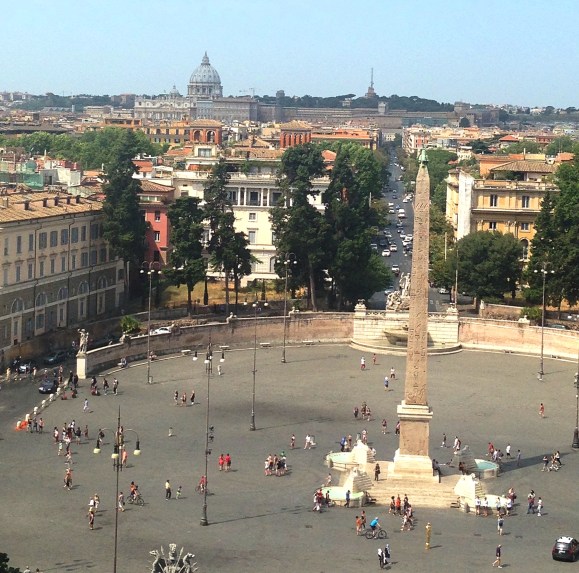
Santa Maria del Popolo is situated in the Piazza del Popolo, one of the pleasantest plazas in the city. In the center is a large Egyptian obelisk, the second oldest obelisk in Rome; and bounding the plaza are two semicircular walls, with a fountain in the middle of each. Although the name literally means “Plaza of the People” in Italian, its name historically comes from the poplar trees that grew there. It was also the site of many public executions.
It was in this plaza that I waited, hungry and frustrated, for the mass to end. The only thing that provided amusement were the many other tourists who made the same mistake. Person after person walked into the door and immediately walked out again, as a beggar by the door futilely said “La messa, la messa!” (“The mass, the mass!”). Obviously nobody could understand the poor guy, or else people habitually ignore the homeless. In any case, the steps were soon full of frustrated tourists who were, like myself, waiting for the mass to end.
It is, by the way, a sardonic comment on religion in the modern world that hundreds of people were annoyed that a church was being used for worship. There are still millions of Catholics in the world, of course; but it seems obvious to me that, in Europe at least, the religion is dying. I don’t know how I feel about this. On the one hand it seems like progress; but on the other it is hard for me to be happy about a religion disappearing when it inspired and helped fund so much beautiful art. But with this new Pope, maybe the future of Catholicism is looking up.
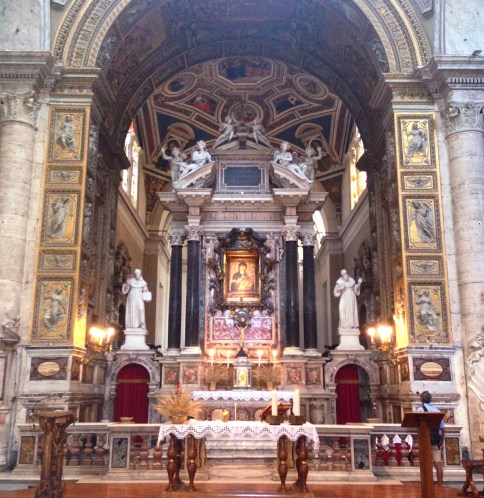
Finally the mass was over, and we all poured inside. Compared with other churches in Rome, the interior of Santa Maria del Popolo is relatively austere. This isn’t saying very much, of course. There were statues, friezes, paintings, and shining golden surfaces in abundance. The church’s dome is lovely, with a pinkish-yellow swirl of clouds painted on the inside, and light pouring in the windows from all directions.
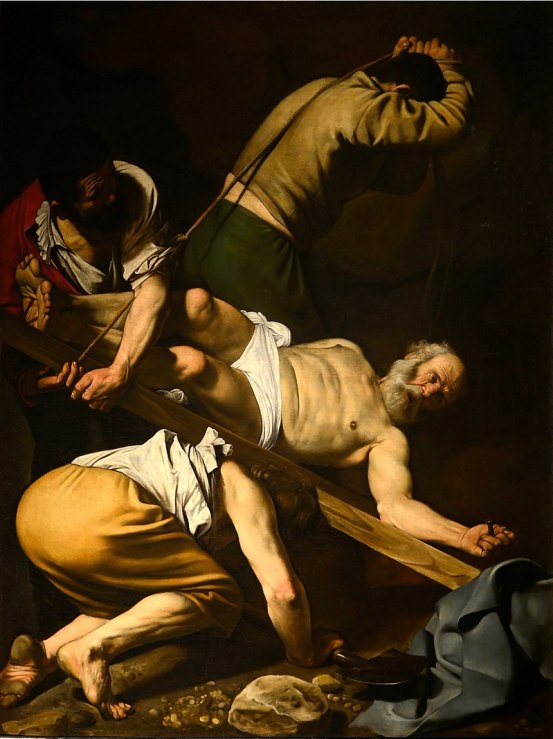
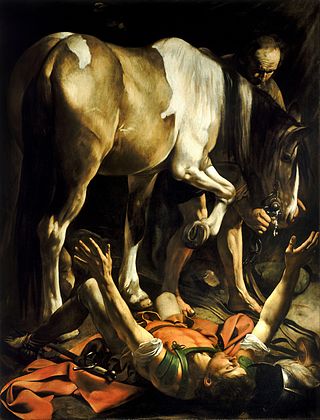
Although Santa Maria del Popolo is home to many important and lovely monuments, it is most known for two paintings by Caravaggio. As soon as we got inside, all of us immediately flocked to the altar where the paintings hang. These two works are the Crucifixion of St. Peter and the Conversion on the Way to Damascus. Unfortunately, the paintings are hung in such a way that they face each other, rather than the viewer, so you have to see them at an odd angle. And if you want to see the paintings properly lighted, you have to put a euro into a little machine nearby (or wait till another visitor does it, like I did).
As usual with Caravaggio, the style is darkly realistic. Accurate anatomy, shadowy backgrounds, grubby details, and an intense focus on dramatic moments are what set Caravaggio apart from his contemporaries.
In Crucifixion of Saint Peter, Caravaggio pictures the saint—old, bearded, and grey—in the moment when he is being hoisted up on the cross (he was crucified upside down). Peter looks with helpless alarm at his hand, nailed to the cross. The workmen are, by contrast, anonymous forms: two of them have their backs turned to the viewer, and the last has his face cloaked in shadow. Caravaggio chose to portray the workers dressed in Renaissance Italian garb, giving the painting an extra feeling of realism.
Conversion on the Way to Damascus depicts the moment when Saul of Tarsus (later, St. Paul) was struck blind by God and converted to Christianity. The saint is laying flat on his back, his eyes closed, his hands reaching up to heaven. A horse and a servant look down at the supine man, confused at what transpired. The bright red and green of Saul’s clothes contrasts with the dull colors of the upper half. To me, there is something particularly touching about this painting. St. Paul is totally helpless, overwhelmed, as fragile as a newborn; and yet the look of rapture on his face tells us that he will soon be reborn.
Sant’Ignazio di Loyola
This church, which stands right in the center of the city, was built in the Baroque period to commemorate St. Ignatius of Loyola, the founder of the Jesuits.
The decoration of this church is lighthearted and joyful. This is exemplified in the fresco painted on the main vault (see above), which abounds in pinks, yellows, and blues, and whose numerous characters, flying through the heavenly skies, are almost cartoonish.
This playfulness is most apparent in the “dome.” Lacking funds to build a proper dome, the Jesuits commissioned a painter to create the illusion of one. It is excellently done: I am sure many visitors do not even notice it is false. When I did notice, I did a double take. “No, that can’t be right,” I thought, and tried to see it from a different angle. But soon the conclusion is inescapable: the dome is a fake.
Also notable are two friezes, one depicting the Annunciation and another St. Aloysius Gonzaga being welcomed into heaven. The swirling spiral columns of dark marble, which flank these friezes, particularly tickle my fancy.
Even more impressive is the monument to Pope Gregory XV. Four angels hold open a curtain, revealing the Pope sitting on a throne. What is most amazing is that the sculptor, Monnot, was able to make marble into a near-perfect semblance of fabric. Technically, at least, it is a masterful.
St. Louis of the French
This is the French national church in Rome. This means that the church originated as a charitable organization that helped French pilgrims in Rome. As a result, all the signs in the church are in French.
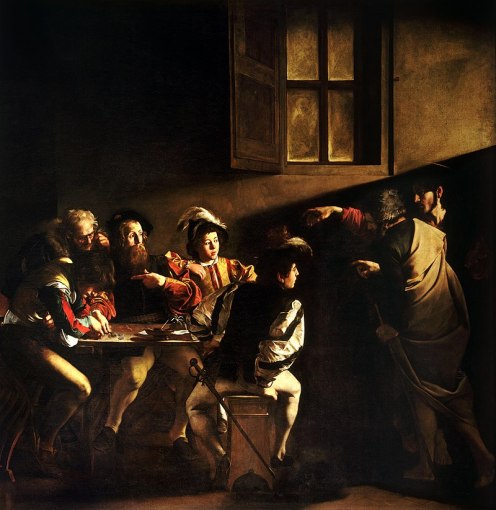
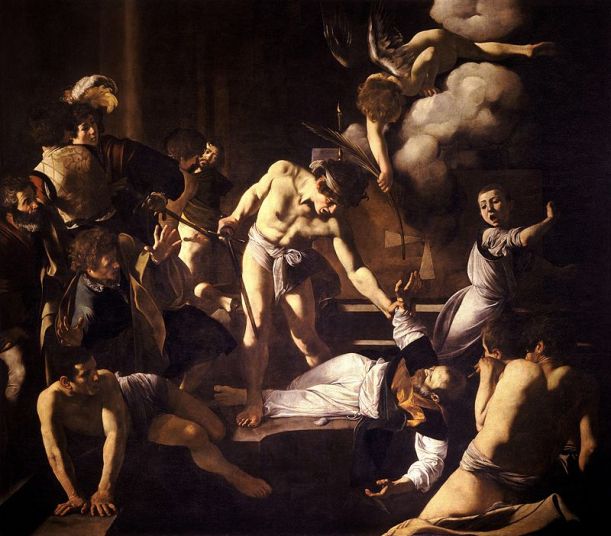
The church of St. Louis of the French is not far from the Piazza Navona. Although a lovely church by itself, it nowadays attracts visitors for its three famous Caravaggio paintings about the life of St. Matthew: The Calling of Saint Matthew, The Inspiration of Saint Matthew, and The Martyrdom of Saint Matthew. All three hang together in the Contarelli Chapel, and all three are masterpieces.
(Unfortunately, as in Santa Maria del Popolo, two of the three paintings are difficult to see, not only because they are a bit far away, because they are positioned at a right angle from the viewer. I can’t help thinking it’s a shame that such great works of art are not more easily visible.)
On the left wall is The Calling of Saint Matthew. Here is a perfect illustration of Caravaggio’s genius and originality. Instead of a heavenly scene, with the divine Jesus calling Matthew to serve God, we are shown a confused rabble in a bar. Jesus is almost invisible, hidden in shadow; most noticeable is his pointing finger. We follow this finger to a shabby, bearded man sitting behind a wooden table. This is Matthew. He thinks Jesus must be confused, looking for someone else; he points helpfully to his companion, who is bent over, counting money on the table. As usual, the costumes and the scenery are all taken from Caravaggio’s contemporary world (note the boy dressed in bright livery). The grimy realism, the dramatic gesture, the innocent surprise on Matthew’s face—all this combine to make the painting one of the most convincing portrayals of this Gospel scene.
In the center, facing the viewer, is The Inspiration of Saint Matthew. This was apparently a difficult commission for Caravaggio, since several earlier versions were rejected by his patron. Unfortunately for us, the most famous of these early versions, Saint Matthew and the Angel, was destroyed during World War II. (As the historian Will Durant notes, art and war are engaged in an eternal struggle.) This earlier painting is almost scandalous in its realism. St. Matthew is portrayed as a illiterate peasant. He is seated uncomfortably on a chair, his eyes squinting, his hand gripped awkwardly around the pen. An angel stands next to him, his hand guiding Matthew’s, acting the role as writing teacher. I love the painting, but I can see why the cardinal did not.
The older version (a colorized photograph) is on the left; the current version is on the right.
The later work is somewhat more conventional, but nonetheless wonderful. Instead of guiding St. Matthew’s hand, the angel hovers above the saint, talking to him (the angel seems to be counting something on his fingers). Matthew looks only slightly more comfortable. He is kneeling on a stool, hunched over his table, bending backward apprehensively to listen to the advising angel. Although less startlingly realistic, this painting makes up for that with its iconic design. The angel, robed in white, comes down from the upper right; while Matthew, robed in red, is positioned in a diagonal from the bottom right. The antithesis of the figures’ colors and postures make this painting instantly memorable.
Last we have The Martyrdom of Saint Matthew. This painting is by far the most dramatic. A nearly naked, intensely muscular soldier stands over St. Matthew, whose has collapsed on the ground. The soldier’s face is pure anger and violence. He is the wrathful embodiment of human strength. Surrounding the two central actors are about a dozen figures, reacting to the scene in different ways, from horror to mild curiosity. The saint seems, at first glance, to be frightened. His arm is raised, as if pleading. But then we notice that he is not looking at or reaching towards the soldier, but is entranced by the angel floating above. The angel is holding down the branch of a tree, which St. Matthew reaches for, as if he is about to be pulled right into heaven.
San Pietro in Vincoli
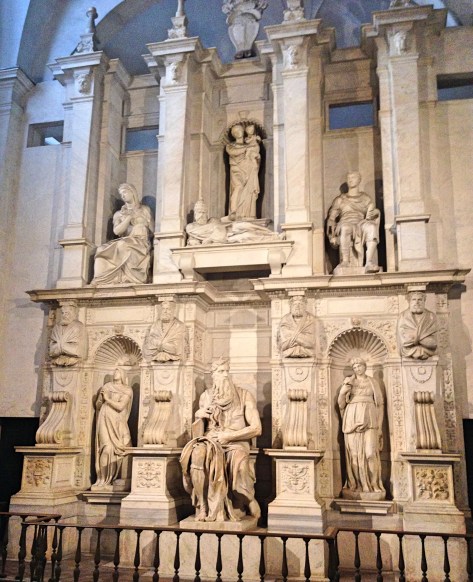
San Pietro in Vincoli is a tremendously old church, first consecrated in the year 439 (although rebuilt after that). Nowadays, it is famous for being the home of Michelangelo’s statue of Moses. The statue is part of a larger funeral monument to Pope Julius II (who was, incidentally, the subject of one of Raphael’s greatest portraits).
The relationship between fame and quality is interesting. To be honest, if I had not known that the statue was done by Michelangelo, I’m not sure I would have paid any special attention to it. This is most likely due to my own ignorance of art, rather than any defect on Michelangelo’s part. Nevertheless, I think the same is true of nearly every person who visits, not only this church, but many other famous works of art: we are impressed as much by the name as by the art itself (if not more).
You might notice that Moses is depicted with horns on his head. This isn’t because Michelangelo thought he was a cuckold, but because of the way St. Jerome, in his Latin Vulgate Bible, translated a Hebrew word. The original Hebrew word, used to describe Moses as he descended from Mt. Sinai, often meant “horned,” but also could mean “shining.” St. Jerome chose the first option; and thus there are many portrayals of Moses with little horns on his head.
Moses is seated. His long, flowing beard hangs down in tangled glory. In body and face he is so splendid that he could be mistaken for Zeus. Under his right arm are the two tablets with God’s commandments. On his face, he wears a dark and judgmental expression. What is he looking at? Perhaps he is casting a disappointed glance at his people, who are lost in idolatry. Freud made this statue the subject of some psychoanalysis, and later scholars have done likewise.
Men are not born equal, they are not born free; they are born a most various multitude enmeshed in an ancient and complex social net.
—The Outline of History, H.G. Wells
This is one of the most powerful quotes in H.G. Wells’s wonderful popular history book. To me it encapsulates an inescapable fact. In any complex society, however egalitarian, resources are not distributed equally. Power, money, influence, and cultural capital are usually distributed hierarchically; and having powerful parents, a rich family, or being the “right” race, sexual orientation, gender, or whatever—these things you are born into.
Karl Marx makes a similar point in this famous passage:
Man makes his own history, but he does not make it out of whole cloth: he does not make it out of conditions chosen by himself, but out of such as he finds close as hand. The tradition of all past generations weighs like an alp upon the brain of the living.
“Equality of opportunity” is a phrase we like very much in the United States. It is an ideal, and like any ideal is something we strive for but can never achieve. Yet what does it mean? People born into wealth are at an obvious advantage to people born into poverty. They have better schools, they can afford to go to elite colleges (and elite colleges often can’t afford to turn them away), and thus they are many times more likely to get high paying jobs (besides being able to inherit money). This is an obvious case of inequality.
But what could we do about it? It’s a difficult problem. Should we prevent people from bequeathing money to their children? Should we make private schools illegal? Should we make laws preventing elite universities from accepting more than a certain percentage of people from wealthy families?
Perhaps it’s better to focus on improving the opportunities of the poor rather than restricting those of the rich? We can improve the schools, legislate affirmative action for disadvantaged groups, and make higher education more affordable (and less dependent on rich donors and students for their survival). These are all good things, for sure, and to a certain extent we are already striving to accomplish them.
A work in progress is all we will ever achieve. Like everything perfect, perfect equality of opportunity is an unrealizable dream. And yet, even if the dream were realized, would we be living in a perfect society? This is a question worth asking.
Even if we managed to equalize the starting point of every child, there would still be the question of how they would be measured. The idea behind having equality of opportunity is that, if some people are more successful than others, we can consider the outcome fair. This is an ideal meritocracy, where everyone gets their just desserts.
In a perfect meritocracy—where opportunity is equal—we advance or fail to advance because we possess certain qualities. But these qualities are arbitrary. In the United States, for example, we tend to value certain types of intelligence, certain personality traits, and certain goals. In other cultures, they have other values.
Every culture arbitrarily chooses some characteristics to value and others to ignore. Yet even when you subtract all the environmental influence, we are still left with our genetic endowment: each of us is born with different abilities, propensities, and weaknesses. Is it really fair that these inborn qualities should determine our success? It seems not—especially when you consider that these native qualities are being measured against an arbitrary standard.
Because of this arbitrariness, I think any fair system needs a kind of social safety net. Even with perfect equality of opportunity—which does not exist—some people will always have more trouble succeeding than others. Providing a basic minimum standard of living is an acknowledgment of this fact.
There is nothing either good or bad but thinking makes it so.
—Shakespeare, Hamlet
This is one of Shakespeare’s most popular quotes, especially among philosophers. And no wonder: it is moral relativism in a nutshell.
“Goodness,” as a concept, is famously difficult to analyze. Plato conceived of the Good as something external to the human mind, more real than the material world. Aristotle, always more prosaic, said that the ultimate good was happiness, since we desire other things for the sake of happiness but never desire happiness for the sake of other things. Recently I read Epicurus, more naturalistic even than Aristotle, who thought goodness was pleasure, pure and simple.
The concept of goodness obviously plays an important role in religions as well as philosophy. Zoroastrians conceived of life as a cosmic battle between the forces of good and evil. In Judaism, goodness is similarly seen as something objective. Hamlet is prophetically damned in the Book of Isaiah (5.20): “Woe unto them that call evil good, and good evil; that put darkness for light, and light for darkness; that put bitter for sweet, and sweet for bitter!” In Christianity, good is often conceived of as God’s will (leading to Plato’s famous Euthyphro dilemma: does God will things because they’re good, or are they good because God willed them?)
The Christian concept of an objective, ideal good—influenced by Plato—held sway in Europe for a long while. Morality was conceived of as absolute and objective. What is good for me is good for you; what was good in ancient days is still good today.
In Shakespeare’s day, however, the idea of moral relativism began to take hold in the European mind. About sixty years after Hamlet’s aphorism, Spinoza had this to say:
As for the terms good and bad, they indicate no positive quality in things regarded in themselves, but are merely modes of thinking, or notions which we form from the comparison of things one with another, thus one and the same thing can be at the same time good, bad, and indifferent. For instance, music is good for him that is melancholy, bad for him that mourns; for him that is deaf, it is neither good nor bad.
If you physically or chemically analyze an object, you will never find goodness or badness in it. Those are judgments, and thus exist in our perception of objects, not in the objects themselves. We have learned this lesson very well in the modern world, which is why we frequently dismiss things as “subjective.”
There does seem to be a limit to moral relativism, however, and a danger in pushing it too far. I discussed this in regards to Milton’s quote about making a hell of heaven and a heaven of hell. Some situations are quite simply unfair, dehumanizing, exploitative, or painful. Those judgments, too, only exist in the mind; but every mind is attached to a body, and every body has certain limits and needs. The mind, too, is not infinitely flexible; some things we simply cannot accommodate. This is why long-term solitary confinement, for example, is unambiguously bad: it deprives the mind of something it needs.
For this reason, I cannot fully agree with Hamlet. Because of the constitution of our brains and bodies, some things are almost always bad, and others good. Nevertheless, for most of us in daily life, I suspect that our judgments of reality cause us more pain than the reality itself. Of course this is not always so; the world has many genuine problems.
The wise course, it seems to me, is to strike a balance between striving to improve the world around us, and striving to make peace with what we cannot change.
Maybe anybody can do what he or she loves, but only the wealthy can avoid going into debt to pay for it.
I first heard of Tokumitsu when an essay of hers was being circulating among some friends on Facebook. I was struck by how well she articulated some half-formed thoughts that had lately been kicking around my head, so I immediately got her book. Then, I immediately put off reading it, until now.
Tokumitsu’s thesis is that the cultural ideal of doing what you love (DYWL) is, in practice, often exploitative and nefarious. She gives many reasons for this. First, DWYL glorifies certain types of work—almost all white collar—and ignores others. Only certain jobs are believably lovable; other types of work are unglamorous, and thus ignored. Steve Jobs gave a famous commencement speech in which he encouraged the young graduates to follow their dreams; but Apple would be impossible without the thousands of people toiling in factories, cafeterias, and warehouses supporting the visionaries.
Another way that DWYL can be exploitative is when it is used to underpay workers. Any musician can tell you that they are often expected to play for free, because they’re doing it out of love and not for money. Unpaid internships have grown in popularity; and academics nowadays often find themselves in underpaid adjunct work, because they’re supposed to be passionate about their subject. These purgatory periods are characterized as paying your dues; and yet studies have shown that, more often than not, unpaid internships and adjunct work don’t lead to full-time positions.
I find the situation in academia especially ironic. As a group, academics are some of the most politically conscious, leftist people out there. And yet in academia the pressure to do underpaid work, to personally identify with your job, and to work long hours can be intense. All this is justified with the notion that academic work is more noble than the grubby capitalism of the non-academic world. In the process, however, academics become ideal capitalist workers, doing enormous amounts of work for little compensation. This is “hope labor” at its purest: badly paid work performed in the hope of breaking through to the next tier.
In many ways, the DWYL ethic is not so different from the Protestant Work Ethic identified by Weber over 100 years ago. The major shift is that the Protestant Ethic viewed work as a duty, while DWYL sees work as love. Duty isn’t trendy anymore, but self expression is, which is what DWYL is all about. In any case, although the virtues we choose to emphasize have changed, the basic logic of an individualistic, competitive system remain. When you’re living in a supposed meritocracy, the poor can be dismissed as deserving their poverty, and the rich congratulated for deserving their wealth. DWYL just puts a different spin on this. One hundred years ago we might have chosen to emphasize Steve Job’s force of will, penuriousness, or his abstemiousness; but now we talk about his passion, vision, and his courage.
Another consequence of DWYL, in Tokumitsu’s opinion, is the culture of overwork. Employers want their employees to be passionate; and the easiest way to demonstrate dedication is to work long hours. This mentality is certainly common in both New York and Madrid; and it is rather strange when you consider that people become generally worse employees when they work longer hours. When you don’t sleep enough, it takes a toll on your health, not to mention makes you sluggish and slow-witted.
One of Tokumitsu’s most valuable observations, in my opinion, is that the DWYL mindset seems to devalue sources of pleasure, pride, and love that are not work-related. Under DWYL, finding love in a non-work activity, like a hobby, a relationship, or just relaxing, is frivolous. If you were serious and passionate, you would be paying your dues and working as an intern. Tokumitsu illustrates this with her discussion of the documentary Finding Vivian Maier, in which the interviewees express astonishment and mild disapproval that Maier, who worked her whole life as a nanny, could have been such a dedicated, talented photographer and have not sought recognition.
The book ends with a call to make free time legitimate. In order to enjoy free time, we need to be paid decently and to work reasonable hours. We shouldn’t be seen as lazy or insufficiently passionate if we want to be fairly compensated for artistic, academic, or even menial work; and we should have the leisure to pursue interests outside work, since for most of us having a wonderful job isn’t realistic. To accomplish this, Tokumitsu envisions labor movements.
These are some of the Tokumitsu’s observations I have found most valuable. For that reason, I think the book is worth reading. But I must admit that, even when I was in agreement, I often found this book exasperating. Without looking at her biography, I could tell Tokumitsu was a recovering academic. The formal writing style, the many quotations and citations, the Marxist bent, and especially the topic of the book—everything belied a recently minted PhD who had felt the pain of the academic job market.
There’s nothing wrong with having a PhD, of course. But there is something wrong with writing a book like this in an academic style. The book’s subject is accessible and relevant, and Tokumitsu’s aim is to spur labor movements. Yet its orientation and tone severely restrict its audience. Her first chapter, for example, is an analysis of two television shows and the way that they portray the DWYL mentality. The analysis was well done, but why on earth would you lead with that?
The prose was also a problem for me. I admit I’m especially sensitive to this sort of thing, since I spent a bad year in a PhD program. And I also admit that Tokumitsu is certainly a better writer than the vast majority of her peers in academe. (I’m talking about the humanities, specifically.) I also think that Tokumitsu has great potential.
Even so, there are many sentences like this one: “Attending the theatrical performance of one’s child faces long odds against the obligations of capitalist production.”
The sentence is irritating in many ways. It is about something intimate, but uses formal language. It is about something concrete, and yet uses abstractions. It turns something personal into something coldly impersonal. Here’s an example of a rewrite: “Making time for your daughter’s school play is hard when your boss can email you at any hour of the day.” I’m not saying my sentence is perfect, but it’s at least an improvement.
The Marxist perspective was also unfortunate, in my opinion, because it will further limit her audience. The DWYL mentality afflicts people of all political persuasions; and I think you can see serious flaws in the mentality without being opposed to capitalism itself. Wanting shorter hours and higher pay is pretty uncontroversial, after all.
I could go on with this complaining, but I’d better stop. Really, the book is a worthy read. Certainly it will be hard for me to forget Tokumitsu’s insights. And even if the style isn’t terribly accessible, the book compensates by being short. So stop doing what you love, and read this book.









 Lotz in Translation