Review: Vanity Fair

Review: Vanity Fair

Vanity FairVanity Fair by William Makepeace Thackeray

My rating: 4 of 5 stars

The world is a looking glass, and gives back to every man the reflection of his own face. Frown at it, and it will in turn look sourly upon you; laugh at it and with it, and it is a jolly kind companion; and so let all young persons take their choice.

There seems to be little to say about Vanity Fair that is worth the time in saying it. This is an open book; its appeal is direct, its themes obvious, its interpretation unambiguous. It is an extended satire of Victorian England—what more is there to add?

I was prepared for the nineteenth-century prose; indeed, Thackeray’s unadorned style has aged uncommonly well. I had readied myself for its protracted length and copious cast of characters. I was even prepared for the strong authorial voice and frequent asides; in this, Thackeray follows Henry Fielding quite closely. But I was not quite ready for such a depressing novel. For the secret of Vanity Fair’s lasting success is not, I think, due merely to Thackeray’s execution—brilliant as it is—but owes itself far more to the novel’s triumphant immoralism.

Like many great novelist, Thackeray opens the book by introducing to us a pair of characters, Becky Sharp and Amelia Sedley, who are to be foils for each other. Amelia is simple and good, while Becky is calculating and wicked. Following the standard conventions, we should expect Amelia to emerge triumphant and Becky to be foiled. And yet Thackeray consistently and persistently flaunts this expectation. Instead, he throws his characters into a world full of cowards, egoists, hypocrites, dullards, drunkards, gluttons, dandies, and every other species of vice—in short, Vanity Fair—and shows us that, in such a world, virtue is a luxury few can afford.

Indeed, the frightening thing about this novel is that Thackeray gradually pulls us into sympathy with Becky Sharp. The daughter of a painter and a dancing master, she hoists herself up from the lowest to the highest ranks of society using only her wit. In the process, it becomes clear that she is a sociopath in the proper sense of the word—seeing others as mere instruments, unable to care for anyone but herself. And yet we feel—we are made to feel—that she is not morally lower than those around her (who also only care for money and status), only cleverer and more determined.

In a word, Thackeray’s thesis is that, in our depraved world—where people care only for vanities, and where unjust accidents such as birth determine the distribution of these goods—the only logical course of action is to be ruthless. Thackeray completes this impression by showing how commonly virtue leads to misery. Amelia’s virtue, though genuine, is consistently made to look foolish. Her dedication to her husband is rendered ridiculous by her husband’s unfaithfulness, her dedication to her son rendered absurd by her son’s unconcern with leaving the house, and so on. For my part I found it very difficult to like her, and more often found myself rooting for Becky.

William Dobbin is the only character who is allowed to appear really admirable. Yet his virtue, too, is for most of the story ignored and unrewarded. And when he finally obtains his goal—by which time he has grown bitter with waiting—this is arguably caused, not by his action, but by Becky Sharp, the only effectively active character in the book.

The final result of this has been to leave me with a feeling of emptiness. Thackeray’s portrayal of Vanity Fair is convincing enough to leave the reader with a numbing sense of cynicism, scarcely pierced by the novel’s few tender moments. Despite this, I must recommend the book highly. Thackeray has, in many ways, aged better than his chief rival, Dickens. His prose is leaner and sharper, his characters more realistic, and his ethos free of Dickens’ dripping sentimentality. This is satire raised to a sweeping view of human life—which does not make it any funnier.

View all my reviews

Review: The Merchant of Venice

Review: The Merchant of Venice

The Merchant of VeniceThe Merchant of Venice by William Shakespeare

My rating: 3 of 5 stars

I can easier teach twenty what were good to be done, than be one of the twenty to follow mine own teaching.

In my first review of this play I agonized over whether it was truly anti-Semitic or not. Now I am not unsure: this play is undoubtedly anti-Semitic. The plot is simply incoherent if Shylock is to be regarded as anything but a villain. Sympathetic as we may be to a man so mistreated, we cannot sympathize with someone so single-mindedly bent on material gain and bloody vengeance. No playgoer can conscientiously hope, in the trial scene, that Shylock is successful in fulfilling his bond. And Shakespeare does not allow us to suspect that Shylock is bluffing: he is prepared to cut out a man’s flesh and weigh it on a scale (a traditional anti-Semitic image) simply because “it is my humour.” If Shakespeare was trying to be slyly subversive, he did a very poor job.

What provokes audiences into sympathy with Shylock is the end of the trial, in which, aside from being denied his money, he is forcibly converted to Christianity, on pain of death. To us this seems such an obvious mockery of justice, such an undeniable outrage, that we assume Shakespeare must have felt the same way, and to have written the scene to undermine all the Christian talk of mercy. Yet I do not think Shylock’s fate would have provoked anything like this reaction in Shakespeare’s England, where anti-Semitism was taken for granted. To the contrary, that such a greedy and bloodthirsty Jew should be spared some of his fortune and accepted into Christianity might have been seen as wholly just, even merciful.

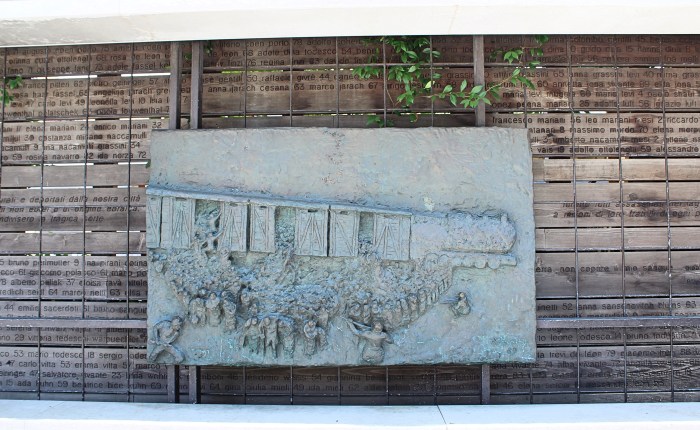
The final result of this—Shylock’s villainy and the play’s anti-Semitism—made the trial scene literally sickening for me. One man, mistreated and spiteful, is trying to legally kill another man for defaulting on a debt, and he is in turn stripped of his property, his identity, and his honor—humiliated, kicked, and spat upon. And all this is delivered as the denouement of a romantic farce, complete with cross-dressing ladies and a playful love story. I admit that I was in no mood to overlook or excuse the anti-Semitism, having recently stood in the Ghetto Vecchio in Venice, and seen the monuments to the deported Jews there. Even so, I think anyone must admit that the play’s dramatic coherence is seriously compromised, even destroyed, by the decline of anti-Semitism.

It speaks to the power of Shakespeare’s art that, even in such an obviously anti-Semitic play, which uses so shamelessly anti-Jewish stereotypes, and which so joyfully persecutes the play’s Jewish villain—even despite all this, we still read and stage this play. As often happens in life, charisma can deaden our moral senses; and Shylock is nothing if not charismatic. He is one of dozens of Shakespeare’s characters whose dialogue reveals a complete personality, a shifting mind whose depths we can only guess at, whose roving interior life extends into parts unknown. Somehow Shakespeare has conjured a character that embodies all of the negative Jewish stereotypes, yet who nevertheless is a believable and fully individual human. This is dramatically admirable and, in retrospect, morally reprehensible. For, as Harold Bloom said, Shylock’s very plausibility is why the play has been such a potent inspiration for anti-Semites.

I am not sure what conclusion to draw from all this. The play is without doubt one of Shakespeare’s stronger efforts. And yet, by the end, I felt little more then distress.

View all my reviews

Review: Stones of Venice

Review: Stones of Venice

The Stones of VeniceThe Stones of Venice by John Ruskin

My rating: 4 of 5 stars

Many people, capable of quickly sympathizing with any excellence, when once pointed out to them, easily deceive themselves into the supposition that they are judges of art.

I recently went on a short trip to Venice, for which I chose an abridged version of this work to accompany me. Ruskin is an eccentric guide, to say the least. To call him ‘opinionated’ is to risk absurd understatement. For Ruskin uses his survey of Venetian architecture, not merely to instruct, but as evidence for his grand theses of art and society. Few writers could turn descriptions of vaults, capitals, and statues into impassioned social criticism; but Ruskin was no ordinary man.

Ruskin’s primary contention is that gothic art was in every way superior to that of the Renaissance, and this was so because gothic art embodied positive social virtues. The workmen had considerable creative freedom, and did not simply execute the instructions of the master architect; not just nobles and popes, but ordinary citizens and guilds contributed to building projects; and the religious architecture was not done in a special style, but was an elaboration of the normal civic architecture of the town. In short, gothic art was communal, while the art and architecture of the Renaissance and later was individualistic, and suffered accordingly.

It is difficult to even critically engage with this thesis, since it rests on Ruskin’s unconvincing conviction that aesthetic and ethical virtues spring from the same root. Like Tolstoy and Orwell, Ruskin was a man possessed of both keen artistic sensitivity and a burning moral conscience; and like those two Ruskin struggled to reconcile these proclivities. To an extent this issue is troubling for us all. We are disturbed to find that our favorite singer beat his wife, or that our favorite writer is a white supremacist. Can we enjoy the art of such disreputable people? Many opt to boycott the works of artists they deem unacceptable. But Ruskin went further, and asserted that truly immoral people cannot make fine art. In this, Ruskin becomes a proper Platonist, equating beauty and goodness—and throwing truth into the bargain as well—thus cutting the uncomfortable gordian knot.

This position has the intellectual convenience of uniting all the goods on one side. This is very appealing for the social reformer. But this comes with the inconvenience of having to argue palpable absurdities. Ruskin is forced, for example, to make statements such as: “It is very possible that the reader may at first like fig. 14 best. I shall endeavor, in the next chapter, to show why he should not”—vainly trying to argue somebody out of an aesthetic preference. Contrariwise, when great art is made by figures whom history has shown to be immoral, Ruskin must commit the opposite absurdity—opposing his own aesthetic sense to documented fact:

I do not believe, of the majority of the leading Venetians of this period whose portraits have come down to us, that they were deliberately and everlastingly hypocrites. I see no hypocrisy in their countenances. Much capacity of it, much subtlety, much natural and acquired reserve; but no meanness. On the contrary, infinite grandeur, repose, courage, and the peculiar unity and tranquility of expression which come of sinciety or wholeness of heart, and which it would take much demonstration to believe could be any possibility be seen on the countenance of an insincere man.

Few people will be converted to this way of thinking, which submits reality to the whims of Ruskin’s moral and artistic senses. It is, however, refreshing to see a man so passionately convinced of the social importance of art. Ruskin scours to the city of Venice—sketchbook and notepad in one hand, step ladder under the other arm—making detailed studies of statues, capitals, friezes, cornices, and whatever other stone monuments he could find. The original edition of this book includes descriptions of eighty churches. Even in my heavily abridged edition, Ruskin goes through every capital of the Ducal Palace, comparing the representations of the virtues to Giotto’s and to Spenser’s—a tedious yet extraordinary feat. Idle fancy could hardly spur such devotion. He operated with the zeal of a reformer and the conviction of a crusader—ready to show all the world that these stones held the key to social welfare.

Personally I wish there were more people like Ruskin in the world, even if they can be insufferable at times. He wanted to live in a beautiful world, and he wanted that beauty to both reflect and encourage the health of its society. We may be inclined to laugh at Ruskin’s arguments; yet we are willing to pay thousands of dollars to go to these beautiful places and see them for ourselves—which, like Venice, consequently become hollowed out shells of their former selves from the influx of tourism—without stopping to wonder why we don’t spare ourselves the trouble and make our own cities beautiful. While I suspect the rise of urban ugliness is far more complex than Ruskin is apt to think, I agree with him in seeing a moral and social dimension to this aesthetic problem.

In any case, it is a pleasure to read Ruskin if only for his rococo prose, whose sentences twist, curl, and spiral into little infinities. One can see why Proust was a fan (and, indeed, his Narrator’s visit to Venice owes much to the Victorian critic). Ruskin was true to his principles, and strove to unite literary elegance, moral fervor, and insightful argument into every one of his paragraphs—and most of the time he achieves at least two out of three, which is not bad at all. Even if you disagree with Ruskin from first to last, it is scarcely possible to dive in his book and come out the other side without a few of his cobwebs sticking to your coat.

View all my reviews

Touching Tuscany: Pisa

Touching Tuscany: Pisa

I arrived in Pisa a little before noon. I was already hungry, so I sat down on a bench outside the airport, took out my exquisitely prepared salami sandwich, and dug in. This time I had remembered the mustard, which was a considerable improvement. It was a sunny February day and my feet had just touched Tuscan soil for the first time.

I had excellent luck with my Airbnb: I could check in early, I had a big room with a big comfortable bed, coffee was included, and best of all the place was a ten minute walk from the airport. This meant no fuss with airport shuttles or trams, no worrying about transfers or ticket machines, just a peaceful walk through the suburbs of Pisa. As I was quickly learning, Tuscany is a land of comfort.

My bags deposited, the mustard wiped from my chin, I was ready to explore Pisa.

Pisa is a fair sized city of around 90,000 souls, gathered around the river Arno, the same river that passes through Florence. The city is home to far more than an angled tower. In the Middle Ages Pisa was, like Venice, a wealthy maritime republic; and examples of her former riches and glory abound. Even a brief walk along the riverside or a view from the bridge—with churches, historic apartments, old castle walls—is enough to convince the visitor that Pisa has a great deal to offer.

My first stop was Knights’ Square (Piazza dei Cavalieri), one of the old city’s most important and most attractive squares. Its name derives from the Knights of Saint Stephen, a religious military order who had their headquarters in this piazza. Nowadays it is home to a branch of the University of Pisa, a historic university that was founded back in 1343, and which is still within the top 10 universities in Italy. I walked into one of the university buildings (it was open), to see if I could find anything worthy of admiration. And I did. On the ground, walking in a little line, was a group of tiny ants. I found this rather exciting since it was February and the insects normally do not appear until May in Madrid.

Pisa_plaza

Pisa_church

There is also the attractive church Santo Stefano dei Cavalieri, with a pretty facade designed by Giorgio Vasari, the famous art historian, who also contributed a painting for the interior. It was Vasari, too, who designed the attractive Palazzo della Carovana, which originally housed the Knights of Saint Stephen, but which now is the central building of the Scuola Normale Superiore di Pisa (a part of the university). In the center of the piazza, standing before the Palazzo della Caravona, is a statue of Cosimo I de’ Medici (1519 1574), the first Grand Duke of Tuscany.

I did not stay very long to admire this fine square, however, since I was eager to see the iconic tower. A few minutes of walking, a few twists and turns, and the inclined cylinder came into view. It is always strange seeing something in reality that we have seen a thousand times in pictures. It produces the oddest mixture of excitement and boredom—the first because it is so iconic, the second because it does not look like anything new. It was, however, novel to see the tower from the city, at the end of a row of apartment buildings, as I did. The drooping building is almost always photographed from the grassy cathedral square. Seen like this, the tower looked charmingly out of place.

Pisa_tower

Soon I entered the cathedral square, formally called the Piazza dei Miracoli (Square of Miracles), and formerly the Piazza del Duomo (Square of the Dome). This is where all of the major monuments of Pisa are concentrated, including the infamously misaligned edifice. To enter any of these monuments one must buy a ticket at the ticket office. There are various ticket options, each of which includes different places that can be visited. As usual, I bought the most basic one. It did not seem worth it to pay an extra 20 euros (if memory serves) to ascend steep spiral staircase of the notorious shaft.

Pisa_tower2

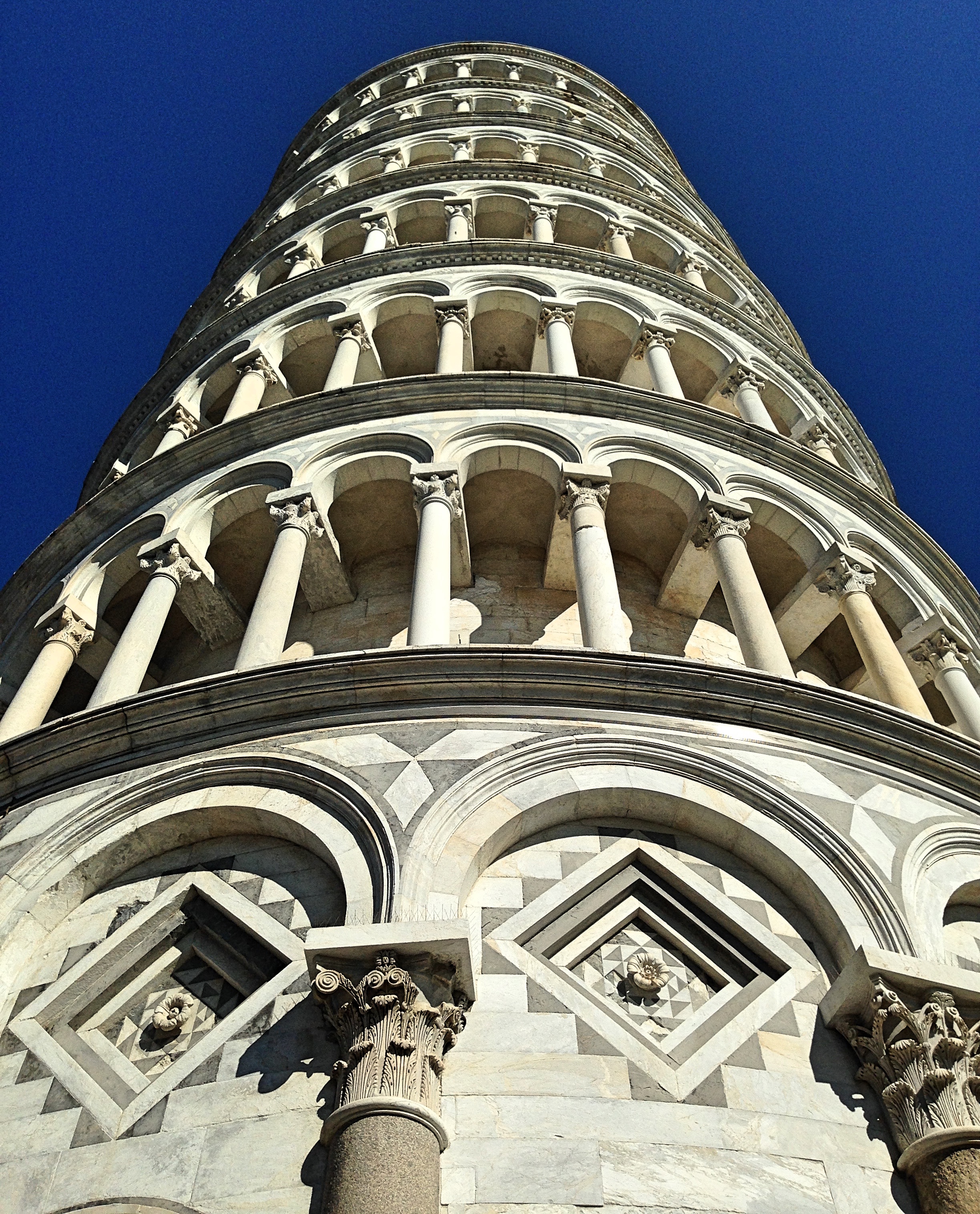
But I did take a moment to admire the Leaning Tower from the outside. The myths are true: the tower does leave the ground at an angle other than 90 degrees. To be precise, the tower is now 3.9 degrees off—which may not sound like a lot but which, as you will gather, is quite noticeable. And this is an improvement from the tower’s maximum inclination, which was 5.5 degrees. An international team of scientists worked between 1990 to 2001 to reduce the tilt—which had been gradually growing over the centuries—in order to prevent instability. (By the by, Pisa’s tower is not the most uneven edifice in Europe. The prize goes to the crooked church tower of Suurhusen, in Germany.)

The crooked protuberance of Pisa was not, of course, originally designed to be a tourist attraction. It is the campanile—an unattached belltower—of the cathedral. Even were it perfectly straight, the tower would be worth admiring for its elegant rows of columns and arches. Indeed, I think we are apt to overlook how pretty is its Romanesque form. I have seen few belltowers comparable in loveliness. As we are told, the tower’s gradient is the result of uneven firmness of ground, causing one side of the structure to sink. Fixing this was clearly beyond the technologies of the time; to the architects had little recourse but to cross their fingers and keep going.

As expected, the square was full of people taking pictures of themselves with the tower. A visit to Pisa is certainly not complete without the generic photo of oneself holding the tower up. As venerable as this pastime is, I confess that I found the dozens of people holding out their hands likes mimes, with exaggerated expressions on their faces, to be a ridiculous sight.

I cannot finish my description of Pisa’s most famous building without making mention of Pisa’s most famous son. Everybody knows the tale of Galileo dropping differently sized cannonballs from the tower, in order to prove that objects of different mass fall at the same velocity. (This went against the Aristotelian physics of the times.) This story is, unfortunately, poorly corroborated and thus—like Newton and his apple—likely a myth made up after his death. Rarely does reality live up to our romantic notions.

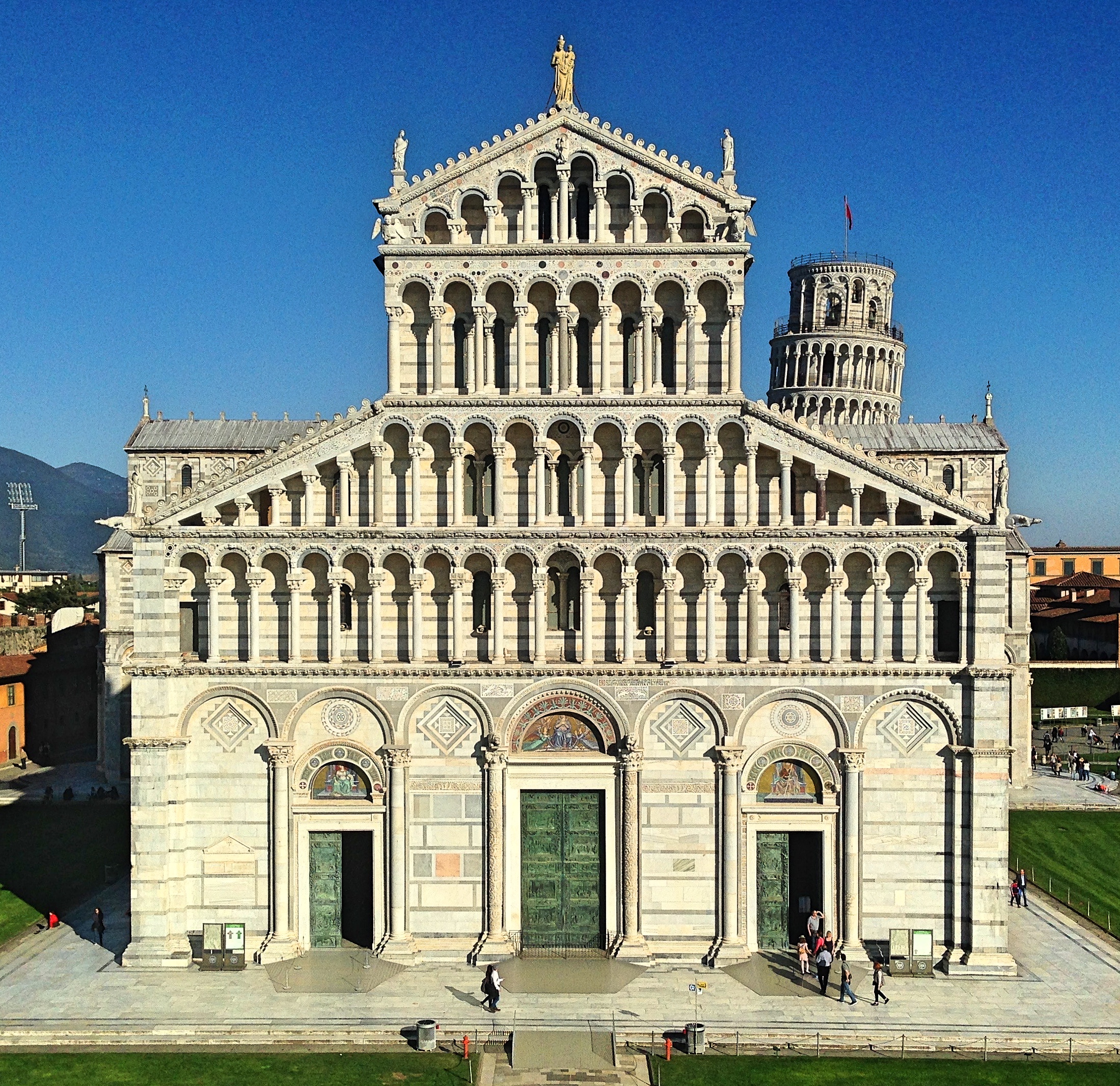
The 12th century tower is only the third-oldest building in the square. The oldest is Pisa Cathedral. Like the campanile, this is a truly splendid building in the Pisa Romanesque style. Just as in the Leaning Tower, the facade of the cathedral is covered in false columns, which give it a dignified air. The white marble of the building is also agreeably reminiscent of a Greek temple, adding to the cathedral’s impressive demeanor; and darker shades of marble have been used to add faint patterns on the walls. Closer inspection reveals that the exterior is covered in decorative friezes and mosaics. I particularly admired the monumental bronze doors, covered in scenes from the New Testament.

Pisa_cathedral

The inside of the cathedral appeared in less than its full splendor. Due to conservation work being done, two large sections were obscured by colossals tarps. Nevertheless, I was still able to admire the beautiful wooden coffered ceiling, covered in gold leaf, as well as the mosaic of Christ surrounded by Mary and Saint John, the only unambiguously attributable work of Cimabue. One can see that this artist (who Vasari believed taught Giotto) was still working very much in the Greek tradition of stylized figures against a gold background. The walls reveal that taste for lush decoration, so characteristic of Italian churches.

Pisa_pulpit

Unfortunately much of the cathedral’s finest works were lost in a fire in 1595. As the period of Pisa’s greatest splendor occured long before this, it follows that what we see now in the cathedral is but a faint afterglow left by the embers. Luckily one masterpiece did survive the flames: the pulpit by Giovanni Pisano. It is an incredible work. Every inch of the piece bursts with figures; and each has a symbolic significance. We have personifications of the cardinal virtues, and of the subjects of the trivium (grammar, logic, rhetoric) and the quadrivium (arithmetic, geometry, music, astronomy); we also find angels, prophets, and sybils. Figures support the pulpit as caryatids; they adorn the bases, corbels, and the capitals. On the curving walls of the pulpit are extraordinary scenes from the life of Christ. And all of this is carefully arranged to create an intelligible whole, a summary in stone of the medieval worldview. All in all, this pulpit very well may be, as the sign says, “the most organised illustration of the Christian doctrine of salvation and redemption ever provided by sculpture.”

Pisa_baptistry
Notice the baptistry also has a slight tilt

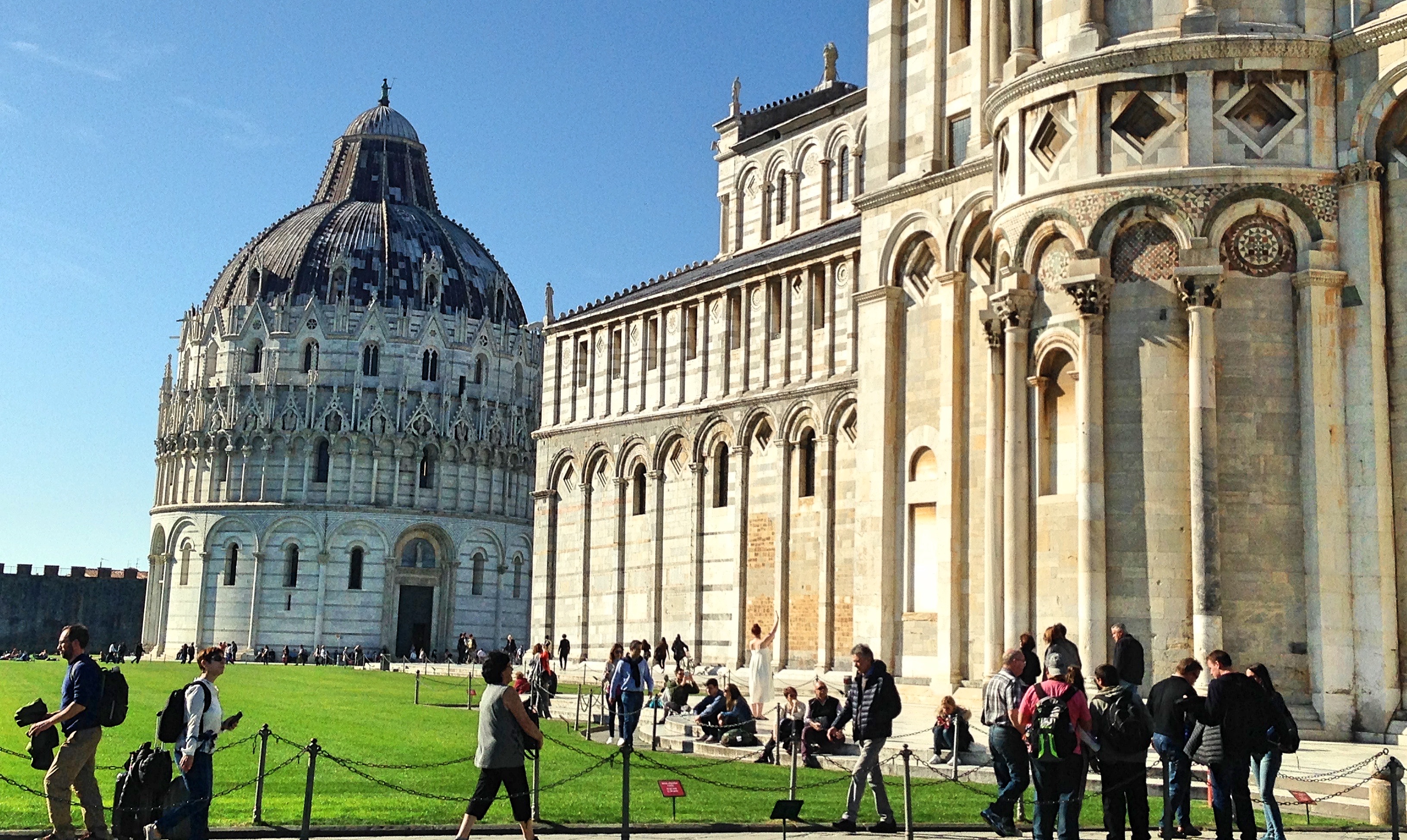
Standing face to face with the cathedral is Pisa’s baptistry. This is the largest baptistry in all of Italy, a colossal dome that shows a transitional style between the Romanesque and the Gothic. (The lower half has rounded arches, the upper half pointed ones.) The inside is cavernous and mostly empty. One wonders why so much space was needed to dunk newborns into water. The most famous babe who was ever initiated into the Christian faith in this building was Galileo Galilei, who made his way into the world in 1564 and was dipped soon thereafter. It is amusing to think of our intellectual heroes as little squirming babes. Little did the priest known that the child he was anointing with water, while he spoke the holy words, would one day help to undermine the faith of half of Europe. Even the biggest baptistry in Italy was not enough to contain Galileo.

My last stop in the square was the Campo Santo (“holy field”). According to legend, it was built around soil brought back from Golgotha (where Christ was crucified) during the Third Crusade, thus making it undeniably sacred ground. On this holy soil the Pisanos built a monumental cemetery for their notables. From the outside it does not look like much—just a grey wall with blind arches carved into it, though there is a nice gothic shrine above the doorway. From the inside, however, it is lovely: an exquisite cloister, with finely sculpted window traceries, and a dome crowning one end. Populating this rectangular arena are sculpted tombs and sarcophagi, some of them dating back to the Romans and Etruscans.

Pisa_camposanto

More attractive than any of the statues or sarcophagi are the frescoes. Many of these were, unfortunately, damaged or destroyed during the Second World War when an allied bomb ignited the roof. What survives is tantalizing, and makes one regret that bombs were ever invented. I was particularly entranced by a glorious rendering of the Last Judgment, whose image of Satan and Hell is wonderfully gruesome.

Pisa_frieze

Now I had seen all the sites on my ticket. I thought of going back to my Airbnb, but the excellent weather tempted me beyond resistance. It was a cloudless day, remarkably warm for winter; so I sat down on the grass to breathe and take in the scene. It was nearing evening but the temperature was still mild enough so that I could take off my jacket in the shade and be perfectly comfortable. I shudder to think what the city is like in the summer.

This half hour of lounging on the grass was the capstone of my day. Pisa had already impressed me beyond all my hopes. Whereas I had expected little more than the off-center campanile, I had found a city full of beautiful monuments and a lovely historic center. Now I had a moment to stop—something I too seldom do when I travel alone—and to reflect. I was in a city that I had heard of since I was a kid; up until the year before, I had assumed that I would never see Pisa; and here I was, and it was better than I expected. The air was delicious, the breeze gentle, the sun mild, the sky everywhere.

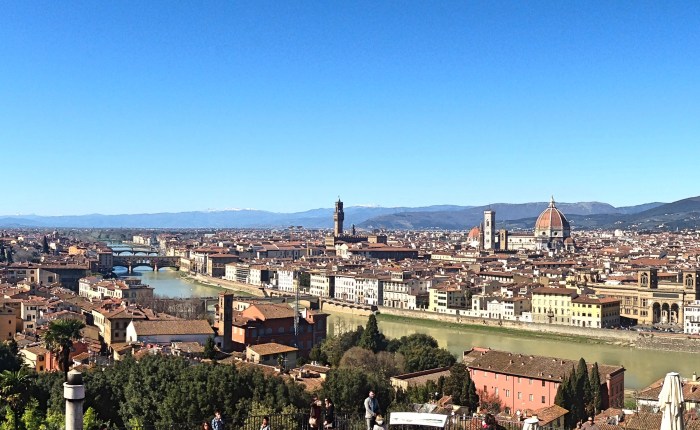
Finally I decided to go. I walked back slowly, still savoring the evening, taking a detour to stroll along the riverside and admire the many historic buildings—forts, churches, apartments—arrayed there. The water was still and clear as glass. I crossed a bridge, and in the distance I could see the brown hills of Tuscany. No wonder the Renaissance started here. The atmosphere is so clear, the sun so bright, that every color is magnified and every form defined. The painters merely had to copy what they saw.

Though I am normally too shy to do this when I travel alone, this day I decided to sit down at a nice restaurant by myself. I chose the Ristorante alle Bandierine, and did not regret it. The pasta was magnificent and the wine went down very easily. I left stuffed and happy—my belly, my mind, my soul all satisfied. Italy is a charmed place, and Tuscany perhaps most of all.

Pisa_river

Review: Lives of the Artists

Review: Lives of the Artists

Lives of the ArtistsLives of the Artists by Giorgio Vasari

My rating: 4 of 5 stars

An artist lives and acquires fame through his works; but with the passing of time, which consumes everything, these works—the first, then the second, and the third—fade away.

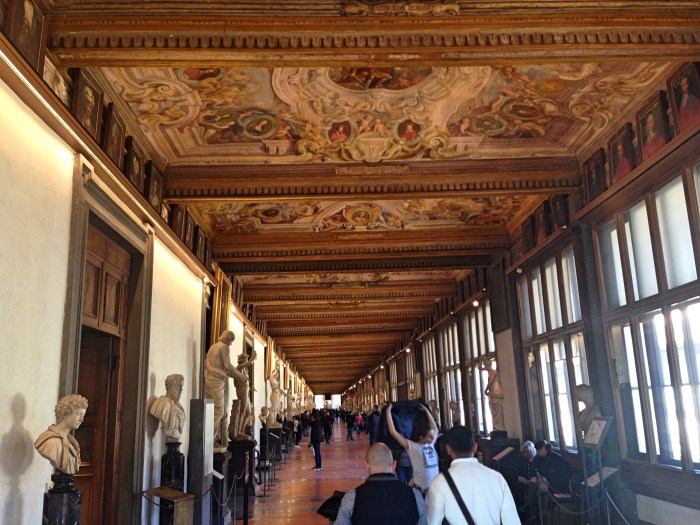
After Plutarch’s Lives, Vasari’s Lives of the Artists is likely the most iconic collection of biographies of famous men. He published two editions of the book, the first in 1550, the second in 1568; and both found success in Vasari’s lifetime and have continued to sell well ever since. In life Vasari was a typical Renaissance man, achieving fame for his paintings (he decorated the Palazzo Vecchio) and his architecture (he was responsible for the loggia of the Uffizi), in addition to his work as a biographer. Granted, his paintings are not highly regarded nowadays (though many are pleasing enough to my eyes); but this posthumous verdict did not prevent him from making a fine living. And when you write the first book of art history in the history of art, the rest hardly matters.

The edition I own is highly abridged, as are nearly all popular versions, since the original contains dozens upon dozens of painters, sculptors, and architects—most of whom the casual reader does not know of or care for. This explains why most of the Lives are so short. Indeed, fans of any particular Renaissance artist are liable to be disappointed by Vasari’s treatment. He runs through Sandro Botticelli in all of ten pages, for example, barely pausing to mention the Birth of Venus. Indeed, many of these biographies are hardly biographies at all, just extended catalogues of works. This is certainly useful for the art historian (though Vasari made many mistakes) but it does not make for electrifying reading.

The modern psychoanalyzing mode of artistic biographies was, of course, entirely alien to Vasari, and he seems to regard the artist’s personality as a source of gossip but not of insight. This does not prevent him from including many good stories. Like Plutarch himself, Vasari is rich in anecdote—and, as in Plutarch, half of them are probably false. Fact or fiction, a good story is preferable to a dry fact, and this is when Vasari’s Lives really come alive. We hear of Cimabue agreeing to take on Giotto as a pupil, after seeing the young boy scratching on a stone; or of Paolo Uccello staying up long nights to work on problems of perspective. Whether these stories help us to understand the paintings is doubtful; but they do help to bring alive this amazing time in history.

Vasari begins the book with a sketch of the history of art as he understood it. His opinion is not a masterpiece of subtlety. In essence, the Greeks and Romans understood that art begins by copying nature, and so produced excellent works; then art fell into barbarism (Vasari coined the term “gothic” to describe medieval art) in which the ancient knowledge was lost and artists had no knowledge of proper technique; finally the painter Giotto came and revived the arts, inaugurating a process that culminated in the works of Michelangelo. I must say that this view, though little more than naked prejudice, is at least refreshing in Vasari’s conviction that art was ascending and culminating in his own epoch. (Most of us are disposed to think it is declining.) It is striking that Michelangelo’s historic importance was understood even during his own lifetime. This was not an age of poor Van Goghs working in lonely shacks. The great artists were recognized and rewarded when they lived; and younger artists were seen to have surpassed their masters—novel concepts in our romantic age.

The Life of Michelangelo, whom Vasari knew and worshipped, is by far the longest and forms the core of this collection. Indeed, all the other lives can be seen as mere leadup to the great Florentine, who fulfils all the promise of former ages. Vasari here turns from chronicler to hagiographer, praising Michelangelo with every breath. You might even say that Vasari turns into quite the Boswell, including various bits of Michelangelo’s conversation, and also several letters written to him by the great artist, as if to prove that Michelangelo really was his friend. All this makes for good reading, even if the worshipful tone is grating. The second longest Life in my collection is that of another Florentine (Vasari was a fierce patriot of his home city), Filippo Brunelleschi. This life is perhaps even better than that of Michelangelo, as Vasari charts the squabbles and drama behind the scenes of Brunelleschi’s dome.

Vasari’s style is easygoing and almost conversational, and the pages go by quickly. He strikes me as a man full of shallow opinions but of a generous mind and a steady judgment. This book—full of errors, lacking any historical context, and greatly out of step with modern opinion—could hardly be read as a standalone volume on Renaissance painting. But every book on the subject borrows, knowingly or unknowingly, from Vasari, who has given bread to scholars and delight to readers for generations with this charming book.

I have endeavored not only to record what the artists have done but to distinguish between the good, the better, and the best, and to note with some care the methods, manners, styles, behavior, and ideas of the painters and sculptors; I have tried as well as I know how to help people who cannot find out for themselves to understand the sources and origins of various styles, and the reasons for the improvement or decline of the arts at various times and among different people.

View all my reviews

Review: Plutarch’s Lives

Review: Plutarch’s Lives

Parallel LivesParallel Lives by Plutarch

My rating: 3 of 5 stars

Ease, and speed of execution, seldom produces work of any permanent value or delicacy. It is the time which is spent in laborious production for which we are repaid by the durable character of the result.

In the course of his grand theory of history, Oswald Spengler distinguishes what he sees as the fundamental difference between the ancient Greco-Roman and the contemporary Western cultures: the Greek’s ideal concept was of bounded, perfect forms, while the Western soul craves the boundless, the formless, and the infinite. It is a somewhat vague statement, I know, but I kept coming back to Spengler’s idea as I read Plutarch’s Lives.

Specifically, I kept thinking of Spengler’s idea as I mentally compared Plutarch’s conception of personality with Montaigne’s. I could not help making this comparison, you see, since it was Montaigne who led me to Plutarch. The Frenchman idolized the Greek; and the Essays are full of quotes of and references to Plutarch. Indeed, Montaigne specifically praises Plutarch for his insight into human nature:

The historians are my right ball, for they are pleasant and easy, and where man, in general, the knowledge of whom I hunt after, appears more vividly and entire than anywhere else… the variety and truth of his internal qualities, in gross and piecemeal, the diversity of means by which he is united and knit, and the accidents that threaten him. Now those that write lives, by reason they insist more upon counsels than events, more upon what sallies from within, than upon what happens from without, are the most proper for my reading; and, therefore, above all others, Plutarch is the man for me.

For my part this quote better describes Montaigne than Plutarch. Since it is exactly in this—the representation of personality—that I think Spengler’s idea most aptly applies in these two writers.

Compare the representation of a person in a classical Greek statue and in a portrait by Rembrandt, and I think you will catch my meaning. The first is all surface—shapely limbs, a well-proportioned body, a harmonious face, whose eyes nevertheless stare out serenely into vacancy, suggesting nothing internal. In Rembrandt it is exactly the reverse: the face may be ugly, the body largely hidden in shadows, yet all the energy is focused on the expression—an expression of endless suggestion, which brings to us a definite human personality.

I feel the same contrast between Plutarch and Montaigne. Plutarch’s method of characterization is statuesque. He enumerates his heroes’ virtues and qualities as if they were set in stone; and he derives all of their actions from these static characteristics. Montaigne is completely the reverse: he contradicts himself a thousand times in his book, and in the process reveals the qualities of his mind far more exquisitely than any straightforward description could accomplish. Plutarch’s heroes never change: their character is their destiny; whereas Montaigne is nothing but change. Indeed, for me it is hard to say that Plutarch’s heroes have “personality,” in the sense that I can imagine meeting them. They are no more relatable than a Greek statue.

They were certainly relatable to Plutarch himself, however, as he writes in a famous passage:

It was for the sake of others that I first undertook to write biographies, but I soon began to dwell upon and delight in them for myself, endeavoring to the best of my ability to regulate my own life, and to make it like that of those who were reflected in their history as it were in a mirror before me. By the study of their biographies, we receive each man as a guest into our minds, and we seem to understand their character as the result of personal acquaintance, because we have obtained from their acts the best and most important means of forming an opinion about them.

This quote also illustrates Plutarch’s moral purpose. For a book written by a Greek living under Roman domination, comparing the lives of Greeks and Romans, he seems to have been quite bereft of political purpose. He is, rather, a moralist. Through his biographies he hopes to determine which actions are noble, which nobler, and which noblest, an analysis he performs through his comparisons at the end of the paired lives. He writes biographies in the conviction that we naturally imitate which we see and admire; we are drawn in by the attraction we feel for noble characters, and become ennobled ourselves in the process. This is why Plutarch eschews writing strict history:

I am writing biography, not history; and often a man’s most brilliant actions prove nothing as to his true character, while some trifling incident, some casual remark or jest, will throw more light upon what manner of man he was than the bloodiest battle, the greatest array of armies, or the most important siege. Therefore, just as portrait painters pay most attention to those peculiarities of the face and eyes, in which the likeness consists, and care but little for the rest of the figure, so it is my duty to dwell especially upon those actions which reveal the workings of my heroes’ minds, and from these to construct the portraits of their respective lives, leaving their battles and their great deeds to be recorded by others.

This sounds promising enough: teaching moral lessons through depicting great personalities. My problem—aside from not being able to relate to the heroes—was that I questioned the very greatness of their actions. Of course there are many virtuous actions recorded here, worthy of praise and emulation. However, nearly all of Plutarch’s heroes are military commanders; and these pages are spattered with blood. The cutthroat world of ancient political squabbles, territorial conquests, internal strife, did not strike me as promising ground to teach virtue. Voltaire was perhaps thinking of Plutarch when he made this remark:

Not long since the trite and frivolous question was was debated in a very polite and learned company, viz., Who was the greatest man, Caesar, Alexander, Tamerlane, Cromwell, etc.? Somebody answered that Sir Isaac Newton excelled them all. The gentleman’s assertion was very just; … those politicians and conquerors (and all ages produce some) were generally so many illustrious wicked men. That man claims respect who commands over the minds of the rest of the world by force of truth, not those who enslave their fellow-creatures: he who is acquainted with the universe, not they who deface it.

Plutarch, to his credit, does give a remarkable portrait of the Newton of his time: Archimedes. But this is tucked away in his life of the Roman general, Marcellus.

For these reasons I had a great deal of difficulty in finishing this book. After every couple Lives I had to take a break; so it took me three years of on-again, off-again reading to finally get to the end. My ignorance did not help, either. Plutarch, being an ancient author, sometimes presumed a great deal more knowledge that I possessed about the relevant political history; and so I found myself frequently lost. And his style, though eloquent, is also monotonous (at least in translation), which was another challenge to my attention.

But I am glad I read Plutarch. This book is an extraordinary historical document, an invaluable (but not infallible) source of information about these ancient figures. Plutarch loved a good story and these pages are rich in anecdote—some of them so famous that it is likely you know one even if you have not read Plutarch. And though I struggled through many of the less famous figures, I was entranced by Plutarch’s biographies of the heroes I was acquainted with: Pompey, Alexander, Cicero, Brutus, and Antony. (Shakespeare followed the latter two Lives very closely in his Roman plays.) If Plutarch was good enough for Montaigne then, by Jove, he is good enough for me.

View all my reviews

Central Europe: Plzeň

Central Europe: Plzeň

After seeing everything I wanted to see in Prague, I still had a day to spare before moving on to Nuremberg. Luckily there are some excellent day trips from the Czech capital. There is Karlovy Vary, an attractive town near Prague with famous hot springs, which several people had recommended to me. There is also the Sedlec Ostuary—a world heritage site—a chapel decorated with thousands of human bones in a church in the town of Kutná Hora. But after looking over these and more options, the beer lover in me won out: I had to go to Plzeň.

With a population of about 170,000, Plzeň is the fourth-largest city in the Czech Republic. For much of its history Plzeň was significant as a trade post near the German border. But in the 19th century the city’s importance considerably grew. First, in 1842 the city’s iconic export was invented: Pilsner beer. Shortly later, the city underwent rapid industrialization, turning Plzeň from a rural outpost into a city of factories and breweries.

Getting to Plzeň from Prague is straightforward. I boarded a commuter train from the central train station, Praha hnlavní nádraží, which took me to Plzeň in around an hour. I did not give myself enough time to buy my ticket, however (there are no machines, so you need to wait in line to buy from a person), so I had to rush to catch the train. The only way up from the station to the platforms was on a slow-moving automatic walkway, which was so full of infuriatingly relaxed and immobile people that I had to wait, biting my lip, as the walkway took me forward at around 2 mph, while the train was on the verge of leaving. When I finally reached the end I bolted up the stairs to the platform, running and jumping onto the train just as the doors were closing. Indeed, I had gotten on so fast that I was not even sure it was the right train. But I was in luck.

Unfortunately for me, however, by the time I pulled my stunt all the seats in the train were taken. I had no choice but to stand. So I made my way to the dining car, ordered a coffee, and got out my Kindle to read. I was trying to get through Rousseau’s Emile, but the Romantic philosopher was quickly getting on my nerves and I had trouble paying attention. Time passed this way until, feeling peckish and needing a distraction, I decided I would try the train’s goulash. This is a type of strew, originally from Hungary but now popular throughout Central Europe, made with meat, veggies, and flavored with paprika. It was my first goulash experience; and—contrary to what you might expect from a dining car—it was actually quite good.

Pilzen_entrance

Once arrived, I wasted no time in going to Plzeň’s biggest attraction: the Urquell brewery. The word “Urquell” can be roughly translated as “the source,” and it is appropriate: for it is this company that invented the iconic pale lager, or pilsner beer, which has proven immensely influential. It is said that two-thirds of the beer produced in the world is an adaptation of this Czech invention. And, indeed, every country seems to have its own version of a pale lager: China’s Tsingtao, Japan’s Sapporo, Kenya’s Tusker, Mexico’s Pacífico, America’s Budweiser, Spain’s Mahou. The world cannot seem to get enough of this sour beverage.

Pilzen_glasses

To enter the brewery one must pass through the festive main gate, designed to look like a triumphal arch. In the ticket office there is a large display of antique brewing methods, complete with life-sized sets and dummies. I queued up and bought a ticket for the next English tour—for which, luckily, there was still a spot remaining. Soon I was in a tour group, ready to explore the birthplace of pale lager.

Our tour commenced with some elaborate ceremonial glasses, made on the occasions of visits by European monarchs to the brewery. Then, after explaining something of the history of the place, our guide took us to see some antique carts, train cars, and trucks used to transport Urquell beer back in yonder days. A bus then picked us up and drove us to the bottling plant.

Pilzen_oldtruck

I am always impressed by industrial processes like this. I think of Adam Smith and his pin factory, and marvel how such marvelously complex solutions can arise for such simple challenges. In this case the challenge is to put beer into a bottle or a can. The solution is a massive facility—noisy with mechanical racket, steamy with sweat and spillage, buzzing with electricity and life. We watched the action from an elevated platform. People in waterproof suits marches around the factory floor, while giant conveyor belts swept hundreds of bottles into metal apparatuses—rinsers, inspectors, vacuums, palletizer, depalletizers, feeders, inspectors, packets, dispatchers—each of which performs one specialized function at lightning-fast speed. To put this into numbers, the bottling line can church out 120,000 bottles per hour, and the canning line 37,000 cans per hour. We have come a long way.

Pilzen_bottlingplant

From here we were transported back on the bus, herded into a large elevator—the largest in the Czech Republic, they said—and then shown a film about Pilsner Urquell’s origins, which was projected on a semicircular screen while we sat on a rotating platform. In this film we were informed that the inventor of pilsner beer, Josef Gross (a German), created the beer in response to growing dissatisfaction among the populace with the top-fermented beer. (The yeast rises to the top during fermentation, which occurs at a relatively high temperature.) In response to this, Gross developed a bottom-fermenting beer, which uses a different sort of yeast that requires a lower temperature. And so, pilsner beer was born.

Pilzen_hops

Then we were shown an exhibit about the four ingredients of beer: malt, water, hops, and yeast—with examples of each. I did not know that malt is not a specific type of grain, but is instead any cereal grain (usually barley) which has been made to germinate by soaking in water, and then dried. I tried chewing on a piece of malt; it’s rather hard. But I particularly enjoyed the chance to sniff and taste the hops. As you may know, beer hops are made from crushing up the flowers of the hop plant. The final product looks an awful lot like marijuana, but smells delightful—the floral, bitter, and richly complex flavor that is most notable in strong indian pale ales, though less apparent in pale lagers.

Then we were led into the old factory, no longer in use. The brewing process, however, remains the same; and so the guide (with the help of a video) took us through the steps to make pilsner beer. First, after being mashed, the malt is put into these big copper kettles filled with water; the resultant mixture is called a ‘wort.’ The wort is gradually heated, which converts the malt’s starch into sugar. Then, to kill off unwanted bacteria, the wort is boiled through a process of siphoning off thirds, heating the portion, and then reintroducing it into the main kettle for it to be repeated.

Then this wort is siphoned off into stainless-steel drums—to filter out the solid bits of barley, I believe—and then on to the hopping kettles. Hops are put in and removed three times in 90 minutes, while the liquid is boiling. After that the liquid goes on to a fermentation tank, which is stored outside, where the yeast is finally added. (This is that “bottom-fermenting” yeast I mentioned earlier.) To achieve the right flavor, the temperature of this container must be kept within fairly strict boundaries. And controlling the temperature during fermentation is tricky, since fermentation itself generates heat. The fermentation process takes some few days, if memory serves, and the final product contains both alcohol and carbonation.

This isn’t the end of the process, however, since then yeast must be filtered out, the beer left to age in barrels, and then the final product is pasteurized to ensure longevity. All this was explained to us as we explored the old and then the current factories, both of which are impressive places. I especially liked the futuristic look of the new factory, with shiny copper kettles in a tiled room. But this wasn’t the end of the tour.

Pilzen_brewery

Finally we were led down into the cellars. Underneath the complex, you see, is a massive network of tunnels carved into the ground—miles and miles of them. These were used to keep the beer at a controlled temperature as it aged in barrels. Apparently a rather cool temperature is needed, so ice would be dumped into a massive room at the end of the hall, whose proximity would cool the rest of the network. It must have been chilly indeed, since even without the ice the tunnels were many degrees cooler than outside. (Nowadays the beer is aged in another way, and the tunnels are unused.)

Pilzen_barrels

This is where our tour ended. But not without a tasting, of course. Two bearded gentlemen poured each of us (there were around 30 on the tour) a glass of pilsner beer. It was unfiltered, meaning that the yeast was still in the beer, which gives it a cloudy look. Now, here I have to admit that I am not particularly fond of lagers, and I especially dislike pilsner beer. To me its defining flavor is sourness—lacking the sweetness of wheat beer, the bitterness of ales, and the smoothness of dark beers. But I will drink a pilsner and enjoy it, of course, since any beer is better than none.

The tour was over, having taken about 2 hours. I highly recommend it to anyone with even a slight interest in beer and brewing.

Pilzen_tunnel

I had some time before my return train to Prague. First I ate lunch at a place called the PUB Plzeň, which has great hamburgers. Then I went to see Plzeň’s cathedral, St. Bartholomew. The church has only had cathedral status since 1993, and underwent major renovations and expansions at around that time. As it stands now, the cathedral is an attractive building, both inside and out. But the best part of the visit was ascending the hundreds of steps up to its bell-tower. One must pay a special price to do this, of course, and undergo some claustrophobia, vertigo, and exhaustion on the twisting and narrow stairs. But the view of the surrounding city and countryside is worth it. I particularly admired Plzeň’s main square, which is extremely pretty, full of brightly painted old apartment buildings and futuristic fountains.

Now it was time for me to go. Unfortunately I did not have time to see Plzeň’s Great Synagogue, the second-largest in Europe (though nowadays only about 70 Jews live in Plzeň). But at least this time I got a seat on the train, from which I could appreciate the rolling grassy countryside of the Czech Republic. It is a beautiful country.

Pilzen_city

Central Europe: Prague

Central Europe: Prague

When I arrived in Prague I wasn’t feeling too good. Flights from Madrid to Prague are normally expensive; but I had gotten lucky and had found one for quite cheap. The only problem was that it left Madrid at an inhumane hour in the morning; and since I have trouble sleeping either before or during flights, I was not exactly at my best. Sleep-deprivation, besides making me delirious, also makes me more prone to stress. I feel as though I cannot calm down; every little obstacle provokes a feeling of panic. Keep in mind that, when you buy cheap plane tickets, you pay for the flight in other ways.

Admittedly I did have two additional things to worry about this trip. The first was money. The Czech Republic does not use the euro, but the koruna (or “crown”). This alone produced in my exhausted mind a feeling of disorientation, since now I had to perform a conversion to understand how expensive something was, and my mind was in no condition for arithmetic. More stressing was my new camera. Just days before I had impulsively ordered a Canon 1300D (Rebel T6 in America) and I had hardly any idea how to use it, care for it, or store it. Fresh from the financial sting of purchasing the device, I was terrified of losing, breaking, or having it stolen. This was my state as I entered one of the most beautiful cities in Europe.

There are many options for getting from the airport to the center of Prague. I took a local bus and transferred to the metro, which took me to Prague’s central train station, Praha hnlavní nádraží, where I deposited my things in a luggage locker. Prague’s metro system is conspicuously attractive and efficient. There are only three metro lines (A, B, and C); but they have been planned so well and go so quickly that I felt that I could zip around the city. Many stations also feature appealing, even futuristic designs. It made a good first impression. Though the city of Prague has only around 1.3 million inhabitants, the metro carries 1.6 million riders a day, which gives you an idea of the level of tourism in the city.

As I emerged into the daylight from the train station—confused, panicked, disoriented—I was at a loss for where to go first. After some aimless wandering I emerged on the Václavské Náměstí (Wenceslas Square), which is more of a long open avenue than a plaza. Its name comes from St. Wenceslas, patron saint of Bohemia; and a monumental equestrian statue of the saint stands at the top of the square. Behind the statue, bookending the space, is the palatial building of the National Museum—which houses a large collection of both natural and cultural history, but which nevertheless is not a popular attraction (I didn’t go).

powder_tower

From there I made my way to the Old Town. (The aforementioned Wenceslas Square is in the New Town, an expansion of the city planned under Charles IV in the 14th century—very new indeed.) This led me through one of the old city gates, the Powder Tower, an attractive gothic edifice built of smoky grey stone and covered with decorative work.

Soon I found myself in the center of the city: Old Town Square. It is a very pretty place, lined with square apartment buildings painted in bright colors. Beyond them is the Church of Our Lady before Týn, whose tall, jagged gothic spires provide one of Prague’s most distinguishing sights. Tycho Brahe, the astronomer who taught Johannes Kepler, is buried here. In the center of the square is a statue of Jan Hus, an important religious reformer and predecessor of the Protestant Reformation, who believed that mass should be given in the vulgar tongue and the Bible translated into Czech—for which he was very reasonably burned as a heretic. This kicked off the Hussite Wars, in which an armed and mobilized Czech population repelled crusade after crusade sent by the Pope to squelch the heresy, an important event in Czech nationalism.

On the other side of the square is St. Nicholas Church, decorated in a pretty Baroque. Yet the most famous landmark is the extraordinary astronomical clock, or Prague orloj, affixed to the Old Town Hall. Unfortunately for me, however, the clock was under restoration when I visited, and was hidden underneath a tarp.

Prague_Oldtownsquare

Standing in that expansive square, I was already beginning to see why Norman Davies, who wrote a history of Europe, named Prague the continent’s most beautiful city. But why is one of Europe’s most attractive places and most popular tourist destinations located in the Czech Republic, a country about which most Americans (myself included) know close to nothing?

It goes back to Prague’s previous title as the capital of the Kingdom of Bohemia—at first an independent kingdom, and then a central part of the Holy Roman Empire. The kings of Bohemia ruled over a vast land that extended far beyond the borders of the current Czech Republic; and some were even elected to become the Holy Roman Emperor (that is, until the Habsburgs had their way). Indeed, during the high points of the Austrian power Prague played a role nearly as important as Vienna in central Europe. So the city’s great beauty is no coincidence. And luckily the city was not bombed nearly as heavily as other Nazi-controlled cities during the Second World War, so its beauty has survived intact.

My next stop was the city’s Jewish Quarter, located in a corner of the Old Town. My original plan was just to visit one synagogue; but to visit any of the landmarks of this neighborhood one must buy a combination ticket, which is certainly worth it. My first stop was the famous Spanish Synagogue. This is the newest synagogue in the Jewish Quarter; it was completed in 1868, built over what was the oldest synagogue in Prague, which had become too small for the congregation. The synagogue is called “Spanish” because of its Neo-Mudéjar interior decoration, built in imitation of the Moorish-influenced style developed by the Sephardic Jews of Spain. It is beautiful to behold. Every inch of the space is covered in geometric designs painted in a shimmering gold.

Spanishsynagogue

Outside the synagogue is a monument to one of Prague’s most famous sons: Franz Kafka. Born to a Jewish family (though not exactly religious himself), Kafka spent most of his unhappy life in Prague. The statue, by Jaroslav Róna, shows the sharp-featured, diminutive writer pointing his finger (at what?) while riding on the back of a faceless and armless man—a fittingly absurd image for the great poet of the absurd. Apparently it is considered good luck to rub Kafka’s feet; but I kept my distance, since luck and Kafka do not go together. There is a Kafka Museum elsewhere in the city, which I have heard is not very impressive. But in front there is a fountain worth seeing, featuring two men urinating into a little pool of water as sections of their bodies spin around. I don’t know if the image is particularly Kafkaesque, but it is memorable.

The next synagogue on my combined ticket was the Pinkas Synagogue. This synagogue is not nearly as visually striking as the Spanish Synagogue; its interest lies, rather, in the memorials within. On the lower level of the synagogue, the name, birthdate, and date of death of every Jewish victim of the Holocaust in the Czech Republic are inscribed on the walls. On the upper floor is an even more moving tribute: drawings made by the children sent to the concentration camp of Theresienstadt. These survived because the children’s drawing teacher, Friedl Dicker-Brandeis, hid them in Theresienstadt before her deportation to Auschwitz, where she was killed. Most of the children suffered the same fate. The drawings are an extraordinary testimony of the humanity, individuality, and creativity of the children caught up in the catastrophe.

Right next to the Pinkas Synagogue is the Old Jewish Cemetery. Since Jewish custom forbids removing graves or markers once they are laid down, and since new land was difficult to acquire, the community was forced to put several graves on top of each other. As a result the cemetery is a forest of tombstones, many of them pushed to odd angles or otherwise falling down; and the ground level is higher than the surrounding streets. The graves span from the 14th to the 18th centuries, at which time Josef II (of Austria) decreed that no more burials were to take place within city walls, in order to reduce disease. Most of the markers are tombstones, though some of the more important personages have tumbas, or sarcophagi (though the body is not inside these). In some of these tumbas I observed little pieces of paper, folded up and tucked inside the nooks of the stone; and in front of one tumba—perhaps of rabbi Judah Loew ben Bezalel—I observed some people praying.

Jewish_cemetery

There were still more sites included on my ticket. One was the Ceremonial Hall of the Jewish Burial Society. A burial society (chevra kadisha in Hebrew) is a voluntary organization that helps to prepare the body of a deceased member of the community and prevent desecration. Nowadays the building is an exhibition space, with panels of information about the role of burial societies (of which I was entirely ignorant) as well as some ritual items on display. Nextdoor is the Old-New Synagogue, a gothic building that is the oldest active synagogue in Europe (it became the oldest when the older synagogue was knocked down to make the Spanish Synagogue). A legend tells that a golem—created by none other than the above-mentioned Judah Loew ben Bezalel, to protect the Jews of Prague from antisemites—inhabits the attic of this building. Nowadays the synagogue is filled with symbolic objects on display and explanations of Jewish customs. The last stop on this ticket was the Maisel Synagogue, an attractive neo-gothic building that houses an exposition on the history of the Jews in Prague. All of these spaces are administered by the Jewish Museum.

As all of these monuments demonstrate, Prague has long had a sizable Jewish community, which would seem to indicate that the city was relatively tolerant compared to other major European capitals. This may be true. However, even here the Jews faced serious persecution. In 1389, for example, following an accusation that Jews had desecrated the host—a common anti-semitic accusation during the Middle Ages—the city’s population was incited to fury and massacred almost every Jew in the city.  In the previous century, aside from the infamous Nazi persecutions, the Jewish religion was repressed under the communists. It is, therefore, very heartening to see that a sizable community still exists in the city.

Now it was time to visit one of Prague’s most iconic monuments: the Charles Bridge. This medieval bridge is named for Charles IV (1316 – 1376), perhaps the most influential ruler in Czech history. Originally king of Bohemia, he was elected to become Holy Roman Emperor; and during his reign he oversaw several important expansions of the city, such as the aforementioned Wenceslas Square. Charles IV was also responsible for the so-called Golden Bull of 1356, which he proclaimed from the castle in Nuremberg, and which established clear procedures for electing the Holy Roman Emperor. This was important, since it helped to prevent controversies of legitimacy and succession, which threatened the continuance of the empire.

Praguecastle_bridge
Prague Castle from the Charles Bridge

The bridge spans the river Vltava (sometimes called by its German name, the Moldau), the iconic waterway of the Czech Republic. From its opening in 1402 until 1841, the Charles Bridge was the river’s only crossing, connecting the Old City with Prague Castle. In design the bridge is not very different from Roman bridges I have seen: a relatively flat span (2,000 ft. in length) lying close to the water, suspended on a series of stone arches resting on stone foundations. Towers guard both sides of the bridge—an important defensive feature back in those days—which are not only intimidating but pleasing to the eye. The bridge is covered with statues, 30 of them, in a Baroque style depicting religious subjects.

Yet it is difficult to appreciate the statues, the bridge, the water, or the views with the huge crush of people inevitably walking across. Prague is hardly behind Venice as a European tourist destination; and so major attractions, like the bridge, attract suffocating crowds. And where tourists go, so does the rubbish—street performers, sketch artists, souvenir vendors, and all the rest. It is the bane of traveling.

Having squeezed across the bridge, it was time to ascend to Prague Castle. This is a whole building complex rather than a specific edifice. The castle sits atop a hill far above the level of the river, so getting there can be slightly exhausting if you are, like myself, not athletically inclined. The exertion is compensated, however, by lovely views of the river and the city beyond. To get inside the complex one must wait in a line and pass through security. Then one must buy a ticket at the office. There are multiple types of tickets, with different numbers of sites which can be visited, depending on the price. (True to form, I bought the cheapest one.)

Prague castle has been a seat of governance since the 9th century, making it far older than most other European capital buildings. And due to its very long tenure as a seat of power, the castle has an abundance of architectural styles on display. Having served Bohemian Kings and Holy Roman Emperors, the place retains its function as a seat of power, being the official residence of the President of the Czech Republic. Even the crown jewels are still kept here (though, unlike in Vienna, they cannot be visited). It is, in short, an important spot.

Yet the most famous building inside the castle complex is neither a palace nor a castle, but Prague’s cathedral: St. Vitus. This is one of the finest gothic cathedrals in the world, a blend of typical French gothic and special innovations particular to this church. The original head architect of the cathedral was Matthias of Arras, a Frenchman who designed a building in the prevalent French gothic. But after his death he was succeeded by Peter Parler, one of the great craftsmen of the Middle Ages. A sculptor rather than an architect, a German rather than a Frenchman, Parler introduced several idiosyncratic elements into the design of the cathedral, such as his characteristic net-vaulting, which both improve strength and create an attractive criss-crossing design on the ceiling.

Prague_cathedralfacade

I admit that, when I visited, I was mostly unable to appreciate any of these technical subtleties. Nevertheless I found the building hypnotic. From both without and within, the cathedral is pleasing to the eye—harmonious in its proportions, tasteful in its ornament, and unmistakable for any other cathedral. (It is worth noting, by the way, that Peter Parler was appointed by the unavoidable Charles VI; and it was this same architect who designed the Charles Bridge. In the history of Prague these two are unavoidable.)

Prague_cathedralinside
Note the vaulting

The cathedral presents a striking view from every angle—inside or outside, back or front, from up close or far away, and so on. Its beauty consists in the design of the building itself rather (as in Toledo) in the artwork contained within. However, there is one chapel that stands out for special mention: the one dedicated to St. Wenceslas (which you may remember as the patron saint of the Czechs). The visitor cannot enter the room, but must be content with peering in through the doorway. The lower walls are dedicated with semi-precious stones and gothic painting depicting the passion, while the upper portion shows Renaissance-era frescos showing the life of the titular saint.

Wenceslaschapel

After I was finished admiring this glorious piece of religious architecture, I visited the Old Royal Palace, which was built in the 12th century. It is most notable for its Vladislav Hall, a massive ceremonial hall with an intricately vaulted ceiling that undulates like an ocean wave. It was also in this palace that the infamous Second Defenestration of Prague took place in 1618, when Czech protestants threw the catholic representatives of the Holy Roman Empire out a window, an event which helped to trigger the horrific Thirty Years’ War. (Somehow the catholics survived the 70-foot drop, which they naturally attributed to angels, and which the protestants attributed to a dunghill underneath them.) Since this event was the only thing I remembered about Prague from my AP European History class, I was elated to find this legendary window.

Prague_hall

My next stop in the cathedral complex was the Basilica of St. George, a church with a cheerful Baroque façade that conceals a somber Romanesque interior. It was founded all the way back in 920 and preserves that ancient atmosphere even now. Then I made my way to the Golden Lane, a row of colorfully painted houses, pretty and quaint, that were originally built to house guards, and which later served as a home for goldsmiths (hence its name). Nowadays it is a row of overpriced souvenir shops. And it must be said that this progression, from guards to gold to gimmicks, encapsulates European history quite well.

Observationtower

Right next to Prague Castle is the Petřín Hill, an elevation covered with parks, which rises above the Vltava River. This is one of the loveliest green spaces in Prague and is a welcome respite from the crowded streets. Walking up the hill is not terribly strenuous; for the enemies of inclination, however, there is a funicular available. On top of the hill is the Petřín Lookout Tower, which was made in imitation of the Eiffel Tower. Indeed, it looks as though the top bit of the Parisian edifice had been lopped off and transported here. With the height of the hill (130 meters) added to the height of the tower (64 meters), it still falls short of the Eiffel Tower’s height (300 meters). Even so, it is the highest point for miles around. (I did not go up, since I was not in the mood for climbing stairs.) Also to be seen is the Hunger Wall, a defensive structure built during the reign of (guess who) Charles IV. Its name comes from the myth that the wall’s primary purpose was simply to provide work and food for the poor.

Nearby is the Strahov Monastery. Founded in the 12th century, it is an abbey of the Premonstratensians (the Order of the Prémontré), which means that it is inhabited, not by monks, but by Canons Regular who fulfil priestly duties. The building complex is impressive and lovely, especially the basilica (which, unfortunately, was closed to visitors when I arrived). Most famous are the monastery’s libraries. Visitors cannot enter inside, but must be content with peering in through the doorways. In the hall outside is an old cabinet of curiosities, featuring shimmering seashells, a stuffed alligator, and ancient Persian (?) armor—the sort of exotic mishmash one would expect from a curious European mind of centuries past. The two library rooms are magnificent. The Philosophical Hall is a grandiose neoclassical room filled with wooden shelves. The Theological Hall is perhaps even more impressive, featuring an elaborate stucco ceiling whose designs incorporate religious paintings. I love seeing such care lavished on libraries. Our books deserve it.

Theological Hall_JorgeRyan
The Theological Hall. Photo by Jorge Royan; licensed under CC BY-SA 3.0; taken from Wikimedia Commons

I descended from the monastery to the riverside, and found myself in Malá Strana. Literally this name means “Lesser District”—though, as my Airbnb host said, “There’s nothing ‘lesser’ about it.” This is one of the oldest parts of the city, dating back to the Middle Ages; but wars and fires largely destroyed the original town. What stands now mainly owes its origin to the Baroque era. As a result the buildings have a more uniform look, all around the same height with the same orange tiled roofs; and the streets are wider and straighter than in the Old City It is a pleasant place to walk around, if only because it is far less crowded than Prague’s center. There are some notable buildings to be seen, such as the Wallenstein Palace, an extensive mansion originally built for a general, and which now houses the Czech Senate. And there is the monumental St. Nicholas Church, an excellent example of Baroque architecture.

After a stroll through Malá Strana I squeezed over the Charles Bridge back into the Old City. This is what Prague is famous for. I have heard this part of the city described as “Disneyland for adults,” which is not far from the truth. For the Old City is swarming with people and full of restaurants and shops catering to foreign visitors. There is everything on sale between cheap junk and expensive trinkets, everything to eat from take-away pizza to pricey sit-down establishments. All this is crammed into the narrow, winding streets of the medieval city. It would be a beautiful place to walk around in if everyone else didn’t think so, too.

Feeling peckish myself, I ducked into a kebab place, hopeful that it would offer the highest ratio of foot-to-money. But I found, after calculating the conversion (which I unwisely did post-meal), that the kebab was three times more expensive than it would have been in Madrid—and didn’t taste any better. I had a much more positive experience at Naše maso, a butcher and delicatessen with great meat dishes at low prices. I had a meatloaf sandwich that was fantastic.

Next I walked down the river. (Just to be clear, I am putting multiple days together to streamline the narrative. This would be too much for one day.) The area beside the river is picturesque on either side. On the Malá Strana side I found a dock with a series of yellow penguins walking atop it. Nearby are three giant statues of faceless babies by the Czech sculptor David Černý, who was also responsible for the urination fountain outside the Kafka museum. Similar baby statues by Černý can be found crawling up and down Prague’s massive broadcasting tower, the Zikov TV Tower. Incidentally, there is a famous work of Černý’s that I missed on my visit to Vienna: a statue of Freud hanging from a roof. No Michelangelo, perhaps; but his work is memorable.

Prague_penguins

On the Old City side of the river the walk is just as lovely, taking me on a gentle curving road with the river on my right and a row of pretty, colorful building on my left. Walking along this way, I came upon the famous Dancing House of Prague. This is a modernistic (“deconstructivist,” as the designers call it) building designed by Frank Gehry and Vlado Milunić. The name is well-chosen, since the building does give the unmistakable impression of two figures in a waltz. A tower of glass swirls up next to the concrete body of the building, whose form is equally unstable. Irregular concrete panels and pop-out windows give the edifice a funhouse effect, as if it had been squished in a trick mirror. It makes for quite a sight next to the staid forms of the baroque apartments next door. For my part, I think the apartment provides a welcome moment of contrast with the rest of the city.

dancinghouse

Nearby is the Ss. Cyril and Methodius Cathedral, which is the principal Orthodox church in the Czech Republic. The church itself is an attractive place; but its fame does not rest on its architecture, but its history. Now, as you may know, Czechoslovakia, despite possessing formidable defenses, did not get a chance to defend itself from Nazi aggression during the Second World War. This is because Neville Chamberlain, as part of his appeasement strategy, ceded Czechoslovakia (without input from the Czechs) to Hitler in the hopes of satisfying the dictator’s expansionist threats. Thus the country was simply annexed without a fight. After the war broke out the Czechs set up a government-in-exile in England; and to establish its legitimacy and contribute towards the war effort, this government (in participation with England) planned and carried out Operation Anthropoid.

The idea was to kill Reinhard Heydrich, one of the most powerful men in Nazi Germany. A ruthless and vicious man—commander of internal security forces (such as the Gestapo), head of the Final Solution, and administrator of Nazi-controlled Bohemia—Heydrich soon earned the universal hatred he deserved. To be rid of him, seven Czech soldiers were parachuted into the country under cover of darkness on British planes. Two of these soldiers attacked Heydrich’s relatively unprotected car on his commute from his house to his office in Prague Castle. After a submachine gun jammed, the assassins threw a tank grenade which inflicted fatal wounds on the Nazi official. The assassins then made their escape and joined the rest of their team.

After the assassination, the Czech soldiers retreated to the church, a hideout for the resistance. But the betrayal of a Czech resistance fighter, Karel Čurda, led to their discovery. A huge team of SS soldiers descended on the church, determined to take the assassins alive. The soldiers defended themselves with pistols until three were killed, and the rest driven to the church’s basement, where they eventually committed suicide to avoid capture. This was not the end of the grizzly tale. On the very day of the assassination, Hitler ordered reprisals. Over 13,000 Czechs were arrested and sent to concentration camps, where 5,000 of them died. And this isn’t all. Based on false intelligence that the assassins had a connection to the small village of Lice, the Germans sent soldiers to commit a complete massacre. All the men were shot; the women and children were sent to the concentration camps, where most of them were killed. (After the war, Čurda the betrayer was hanged.)

Prague_bust

In the basement of this church is now a permanent exposition and memorial to these soldiers. In a large circular room there are artifacts, such as weapons and parachute gear, on display; and panels of information tell the story of Operation Anthropoid. In the crypt—appropriately gloomy and grey—are busts of each of the seven soldiers, with plaques telling of their lives. Operation Anthropoid is a fascinating episode from the Second World War, equal parts uplifting and depressing; and standing before the graves of these young men who shook the world is a moving experience.

My last stop was further south along the river: Vyšehrad. The name literally means “upper castle,” and refers to the hill’s previous use as a fortress. Like Petřín Hill, Vyšehrad is an elevated green space that provides excellent views of the city. Crowning the hill is the Basilica of St. Peter and St. Paul, an imposing neo-gothic structure. I wanted to go inside but, unfortunately, they were having mass. (Isn’t it irritating when people pray in churches?) It was late in the day when I arrived, so the attractive Vyšehrad cemetery was also closed—which is a shame, since Antonín Dvořák, the most famous of Czech composers, is buried here.

The sun was setting. Without anything to do, I walked to the front of the hillside and looked out at Prague—the shimmering blue river, crossed by iron and stone bridges; the orange rooftops and pink façades of the apartments; and in the distance Prague Castle, with the grey towers of its cathedral silhouetted against a rosy sky. I can see why people like this place.

Admittedly, I am not sure if I can concur with Norman Davies in calling Prague the most beautiful city in Europe—though it is certainly in the running. For my part there is too much tourism for it to be entirely comfortable; and it must be said that the city suffers from the lack of a really top-notch museum. Even so, nobody can deny that Prague is one of the jewels of this continent. There is something for everyone here—for the history buffs, for the art-lovers, and, yes, for the aficionados of knick-knacks and beer.

Prague_riverview

Review: The Logic of Scientific Discovery

Review: The Logic of Scientific Discovery
The Logic of Scientific Discovery

The Logic of Scientific Discovery by Karl R. Popper

My rating: 4 of 5 stars

We do not know: we can only guess.

Karl Popper originally wrote Logik der Forchung (The Logic of Research) in 1934. This original version—published in haste to secure an academic position and escape the threat of Nazism (Popper was of Jewish descent)—was heavily condensed at the publisher’s request; and because of this, and because it remained untranslated from the German, the book did not receive the attention it deserved. This had to wait until 1959, when Popper finally released a revised and expanded English translation. Yet this condensation and subsequent expansion have left their mark on the book. Popper makes his most famous point within the first few dozen pages; and much of the rest of the book is given over to dead controversies, criticisms and rejoinders, technical appendices, and extended footnotes. It does not make for the most graceful reading experience.

This hardly matters, however, since it is here that Popper put forward what has arguably become the most famous concept in the philosophy of science: falsification.

This term is widely used; but its original justification is not, I believe, widely understood. Popper’s doctrine must be understood as a response to inductivism. Now, in 1620 Francis Bacon released his brilliant Novum Organum. Its title alludes to Aristotle’s Organon, a collection of logical treatises, mainly focusing on how to make accurate deductions. This Aristotelian method—characterized by syllogisms: deriving conclusions from given premises—dominated the study of nature for millennia, with precious little to show for it. Francis Bacon hoped to change all that with his new doctrine of induction. Instead of beginning with premises (‘All men are mortal’), and reasoning to conclusions (‘Socrates is mortal’), the investigator must begin with experiences (‘Socrates died,’ ‘Plato died,’ etc.) and then generalize a conclusion (‘All men are mortal’). This was how science was to proceed: from the specific to the general.

This seemed all fine and dandy until, in 1738, David Hume published his Treatise of Human Nature, in which he explained his infamous ‘problem of induction.’ Here is the idea. If you see one, two, three… a dozen… a thousand… a million white swans, and not a single black one, it is still illogical to conclude “All swans are white.” Even if you investigated every swan in the world but one, and they all proved white, you still could not conclude with certainty that the last one would be white. Aside from modus tollens (concluding from a negative specific to a negative general), there is no logically justifiable way to proceed from the specific to the general. To this argument, many are tempted to respond: “But we know from experience that induction works. We generalize all the time.” Yet this is to use induction to prove that induction works, which is paradoxical. Hume’s problem of induction has proven to be a stumbling block for philosophers ever since.

In the early parts of the 20th century, the doctrine of logical positivism arose in the philosophical world, particularly in the ‘Vienna Circle’. This had many proponents and many forms, but the basic idea, as explained by A.J. Ayer, is the following. The meaning of a sentence is equivalent to its verification; and verification is performed through experience. Thus the sentence “The cat is on the mat” can be verified by looking at the mat; it is a meaningful utterance. But the sentence “The world is composed of mind” cannot be verified by any experience; it is meaningless. Using this doctrine the positivists hoped to eliminate all metaphysics. Unfortunately, however, the doctrine also eliminates human knowledge, since, as Hume showed, generalizations can never be verified. No experience corresponds, for example, to the statement: “Gravitation is proportional to the product of mass and the inverse square of distance,” since this is an unlimitedly general statement, and experiences are always particular.

Karl Popper’s falsificationism is meant to solve this problem. First, it is important to note that Popper is not, like the positivists, proposing a criterion of ‘meaning’. That is to say that, for Popper, unfalsifiable statements can still be meaningful; they just do not tell us anything about the world. Indeed, he continually notes how metaphysical ideas (such as Kepler’s idea that circles are more ‘perfect’ than other shapes) have inspired and guided scientists. This is itself an important distinction because it prevents him from falling into the same paradox as the positivists. For if only the statements with empirical content have meaning, then the statement “only the statements with empirical content have meaning” is itself meaningless. Popper, for his part, regarded himself as the enemy of linguistic philosophy and considered the problem of epistemology quite distinct from language analysis.
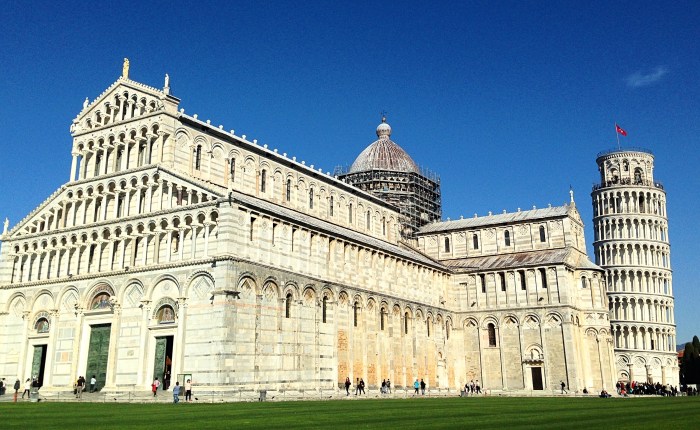
To return to falsification, Popper’s fundamental insight is that verification and falsification are not symmetrical. While no general statement can be proved using a specific instance, a general statement can indeed be disproved with a specific instance. A thousand white swans does not prove all swans are white; but one black swan disproves it. (This is the aforementioned modus tollens.) All this may seem trivial; but as Popper realized, this changes the nature of scientific knowledge as we know it. For science, then, is far from what Bacon imagined it to be—a carefully sifted catalogue of experiences, a collection of well-founded generalizations—and is rather a collection of theories which spring up, as it were, from the imagination of the scientist in the hopes of uniting several observed phenomena under one hypothesis. Or to put it more bluntly: a good scientific theory is a guess that does not prove wrong.

With his central doctrine established, Popper goes on to the technicalities. He discusses what composes the ‘range’ or ‘scope’ of a theory, and how some theories can be said to encompass others. He provides an admirable justification for Occam’s Razor—the preference for simpler over more complex explanations—since theories with fewer parameters are more easily falsified and thus, in his view, more informative. The biggest section is given over to probability. I admit that I had some difficulty following his argument at times, but the gist of his point is that probability must be interpreted ‘objectively,’ as frequency distributions, rather than ‘subjectively,’ as degrees of certainty, in order to be falsifiable; and also that the statistical results of experiments must be reproducible in order to avoid the possibility of statistical flukes.

All this leads up to a strangely combative section on quantum mechanics. Popper apparently was in the same camp as Einstein, and was put off by Heisenberg’s uncertainty principle. Like Einstein, Popper was a realist and did not like the idea that a particle’s properties could be actually undetermined; he wanted to see the uncertainty of quantum mechanics as a byproduct of measurement or of ‘hidden variables’—not as representing something real about the universe. And like Einstein (though less famously) Popper proposed an experiment to decide the issue. The original experiment, as described in this book, was soon shown to be flawed; but a revised experiment was finally conducted in 1999, after Popper’s death. Though the experiment agreed with Popper’s prediction (showing that measuring an entangled photon does not affect its pair), it had no bearing on Heisenberg’s uncertainty principle, which restricts arbitrarily precise measurements on a single particle, not a pair of particles.

Incidentally, it is difficult to see why Popper is so uncomfortable with the uncertainty principle. Given his own dogma of falsifiability, the belief that nature is inherently deterministic (and that probabilistic theories are simply the result of a lack of our own knowledge) should be discarded as metaphysical. This is just one example of how Popper’s personality was out of harmony with his own doctrines. An advocate of the open society, he was famously authoritarian in his private life, which led to his own alienation. This is neither here nor there, but it is an interesting comment on the human animal.

Popper’s doctrine, like all great ideas, has proven both influential and controversial. For my part I think falsification a huge advance over Bacon’s induction or the positivists’ verification. And despite the complications, I think that falsifiability is a crucial test to distinguish, not only science from pseudo-science, but all dependable knowledge from myth. For both pseudo-science and myth generally distinguish themselves by admirably fitting the data set, but resisting falsification. Freud’s theories, for example, can accommodate themselves to any set of facts we throw at them; likewise for intelligent design, belief in supernatural beings, or conspiracy theories. All of these seem to explain everything—and in a way they do, since they fit the observable data—but really explain nothing, since they can accommodate any new observation.

There are some difficulties with falsification, of course. The first is observation. For what we observe, or even what we count as an ‘observation’, is colored by our background beliefs. Whether to regard a dot in the sky as a plane, a UFO, or an angel is shaped by the beliefs we already hold; thus it is possible to disregard observations that run counter to our theories, rather than falsifying the theories. What is more, theories never exist in isolation, but in an entire context of beliefs; so if one prediction is definitively falsified, it can still be unclear what we must change in our interconnected edifice of theories. Further, it is rare for experimental predictions to agree exactly with results; usually they are approximately correct. But where do we draw the line between falsification and approximate correctness? And last, if we formulate a theory which withstands test after test, predicting their results with extreme accuracy time and again, must we still regard the theory as a provisional guess?

To give Popper credit, he responds to all of these points in this work, though perhaps not with enough discussion. But all these criticisms belie the fact that so much of the philosophy of science written after Popper has taken his work as a starting point, either attempting to amplify, modify, or (dare I say it?) falsify his claims. For my part, though I was often bored by the dry style and baffled by the technical explanations, I found myself admiring Popper’s careful methodology: responding to criticisms, making fine distinctions, building up his system piece by piece. Here is a philosopher deeply committed to the ideal of rational argument and deeply engaged with understanding the world. I am excited to read more.

View all my reviews

Central Europe: Vienna

Central Europe: Vienna

The train from Munich crawled through the city’s surroundings towards the central train station. We were entering Vienna. I gazed eagerly through the window, but could discern nothing save for the usual nondescript buildings, the industrial wreckage, and the bleak tracks and power cables that surrounds every modern city like a cage. Nevertheless I was excited. I had just finished Stefan Zweig’s absorbing autobiography, The World of Yesterday, which portrays the Vienna of the pre-War years (before World War I, that is), in loving detail. But I hardly needed Zweig’s description to know that I was entering one of Europe’s cultural capitals, where great artists, writers, and especially musicians lived and worked.

Thus I felt a little disoriented when I stepped off the train and found myself on a city street. I don’t know what I was expecting—a giant opera house or a city-sized museum—but certainly not an ordinary street, full of ordinary people, doing ordinary things. Indeed, the scene that confronted me was rather ugly, full of glass office buildings surrounded by yellow cranes (no doubt busy erecting more glass office buildings). Yet the disillusion quickly passed, since, after storing my bags in a luggage locker, I went straight to the Belvedere Palace Museum, a quick ten-minute walk away. Thus before I could even glimpse the city I was plunged into its art.

Belvedere_Palace

The Belvedere Palace consists of two buildings, an upper and a lower, both built during the Baroque period. They are separated by a lovely orangerie, a French-style garden full of neoclassical statues, carefully pruned ferns, decorous fountains, and artificial ponds. From the Upper Belvedere (where the museum’s most famous art is located), the visitor can see Vienna’s center looming beyond, with its cathedral’s dark spire splitting the skyline. It is a lovely place, worth visiting even if it were not full of famous works of art; and its design, by Johann Lukas von Hildebrant, proved stylistically influential. But I am no connoisseur of palaces or their deadening pomp. So after a quick walk around the gardens, I queued up and passed through the ornate lobby into the museum.

Belvedere_Collage
Above: the Belvedere gardens. Below: a painting of the gardens by Canaletto

The Upper Belvedere’s collection focuses on art from the nineteenth and early twentieth century. The highlight of its collection, and the reason why so many tourists bother visiting, is its extensive collection of Klimt’s work. For my part I knew close to nothing about Gustav Klimt before my visit; thus I felt somewhat out of place in such a horde of gaping spectators. Klimt is much more famous than I had suspected. There was a frenetic energy in the Klimt rooms, much like the atmosphere in the Louvre around the Mona Lisa and the Venus de Milo, with tour groups jostling for photos (which are inevitably ruined by other jostling tourists). What was all the fuss about?

The first works I encountered were of plants, trees, and other natural scenes. Klimt’s style immediately struck me for its resemblance to wallpaper. An eye for pattern and design transforms everything into an ornament: the colors decorate rather than delineate, and any sense of depth is flattened into the scheme. As I gazed into the swarming mass of greens, pinks, reds, blues, and yellows, I felt a tingling sense of pleasure, like that of drinking cool soda water on a hot day. Every element of the paintings was subservient to a sense of texture, an almost tactile use of color. I would not call them beautiful, but they are very pretty.

But Klimt’s most famous works are not of nature, but of women. These combine his taste for the ornate with a surprisingly frank sensuality; and the combination has proven popular.

Kilmt_Judith

Judith and the Head of Holofernes illustrates this perfectly. Klimt takes the original story from the Book of Judith—about a widow visiting an enemy force and decapitating its general, Holofernes, traditionally interpreted as an act of pious devotion—and turns it into one of the most iconic images of the femme fatale. The disrobed Judith looks at the viewer with an extraordinary expression, a perfect mixture of scorn and invitation, of seduction and triumph. Her carefully realistic skin contrasts sharply with the abstract two-dimensional background, made from gold-leaf, which makes her seem to pop out from a graphic design. Though the painting celebrates the triumph of woman over man, to me it represents the double poles of fear and desire of the male gaze—the sex drive tinged with castration anxiety, to use a Freudian expression (as we must, in his home city).

Even more famous than this painting is The Kiss. Indeed, it is so famous it can hardly be properly seen, which is the irony of so many famous painting. The crowds they attract make it impossible for the visitor to observe closely, to ponder, to become completely absorbed in the work. To give the museum credit, they have set up a printed copy of the work in an adjoining room, marked “Kiss Selfie Point,” in the hopes that selfie-seekers would go there and leave the original unmolested. But it did not work. Dozens of people were gathered around, all busy taking pictures of each other and of themselves, and seemingly none actually looking at the painting.

Kiss_Painting

All this notwithstanding, I can see why the painting has become so iconic. The woman kneels on a flowery meadow, her lover bending down to kiss her cheek. The poses are exaggerated and unnatural, reminding me of Mannerism; the man’s neck in particular seems painfully bent. Yet all the attention is focused on the woman’s face, which wears a look of rapturous joy. They are both wrapped in golden clokes, the man’s with a stiff vertical design, the woman’s with swirling spirals, which serve to obscure their bodies into one amorphous whole. The composition of the figures, situated at the top of the canvass, makes it seem as if all nature—the earth, the flowers, the stars—are swelling and concentrating themselves on this one blissful moment.

Having said all this in Klimt’s praise, I must admit that I am not particularly fond of his work. At best the strike me as excellent graphic designs, absorbing and attractive, but failing to touch any strong emotional or intellectual keys in me.

The Upper Belvedere has more to offer besides the world’s best collection of Klimt. One painting which stands out in my memory is a pentaptych (consisting of five separate panels) by Hans Makart, portraying the five senses in allegorical form, as female nudes engaged in symbolic poses—looking at a mirror, cupping an ear, smelling a flower, reaching for an apple, or resting a hand on a cloth. The painting is saved from its potentially trite theme and shallow symbolism by excellent technique and tasteful execution; the result is an ode to sensuality, which artfully represents Makart’s own views on ‘Total Art’ (art that appeals to all the senses). As you may know this idea is mostly associated with Wagner, and indeed the two of them were friends in life. The sensuality of Makart’s work was, perhaps unsurprisingly, a notable influence on Klimt, who is said to have worshipped him.

Makart_Fuenf_Sinne

Another famous painting on display is Jacques-Louis David’s Napoleon Crossing the Alps. This is one of five surviving versions by the painter, the others scattered around Europe. The original painting, which hangs in Malmaison, was commissioned by Napoleon to send to Charles IV of Spain after the two countries’ rapprochement following the strife of the Revolution. (Charles sent Napoleon a portrait of himself by Goya.) The painting is executed in David’s characteristic neoclassical style, turning Napoleon into a second Alexander the Great. Though the heroic ethos of David’s paintings is ethically questionable at best—the worship of warriors and conquerors is something I have trouble understanding—his works are undeniably visually striking and impressive, and this one is no exception.

Napoleon_at_the_Great_St._Bernard_-_Jacques-Louis_David_-_Google_Cultural_Institute

The only other work I will mention (though there are many more deserving of note, ranging stylistically from neoclassicism to romanticism to impressionism) is the collection of busts by Franz Xaver Messerschmidt. These are hard to miss: they cover an entire wall in the museum and, besides, are unlike any other busts in the world. Rather than sculpt images of calm dignity, Messerschmidt made a collection of extreme expressions and distorted features. Apparently he achieved this by pinching himself and observing his reactions in the mirror. They must have been awfully painful pinches, since many of the busts portray horrendous grimaces. But pain is not all he captured; some are smiling maniacally, some have their lips pursed like an old lecher, some are engaged in a terrific yawn, and so on, covering everything from delirium to disgust. It strikes one as a little silly at first; but given how often we tense up our faces—from pain, from pleasure, from a curious odor—we may rank Messerschmidt as a more accurate chronicler of the human soul than many more famous sculptors.
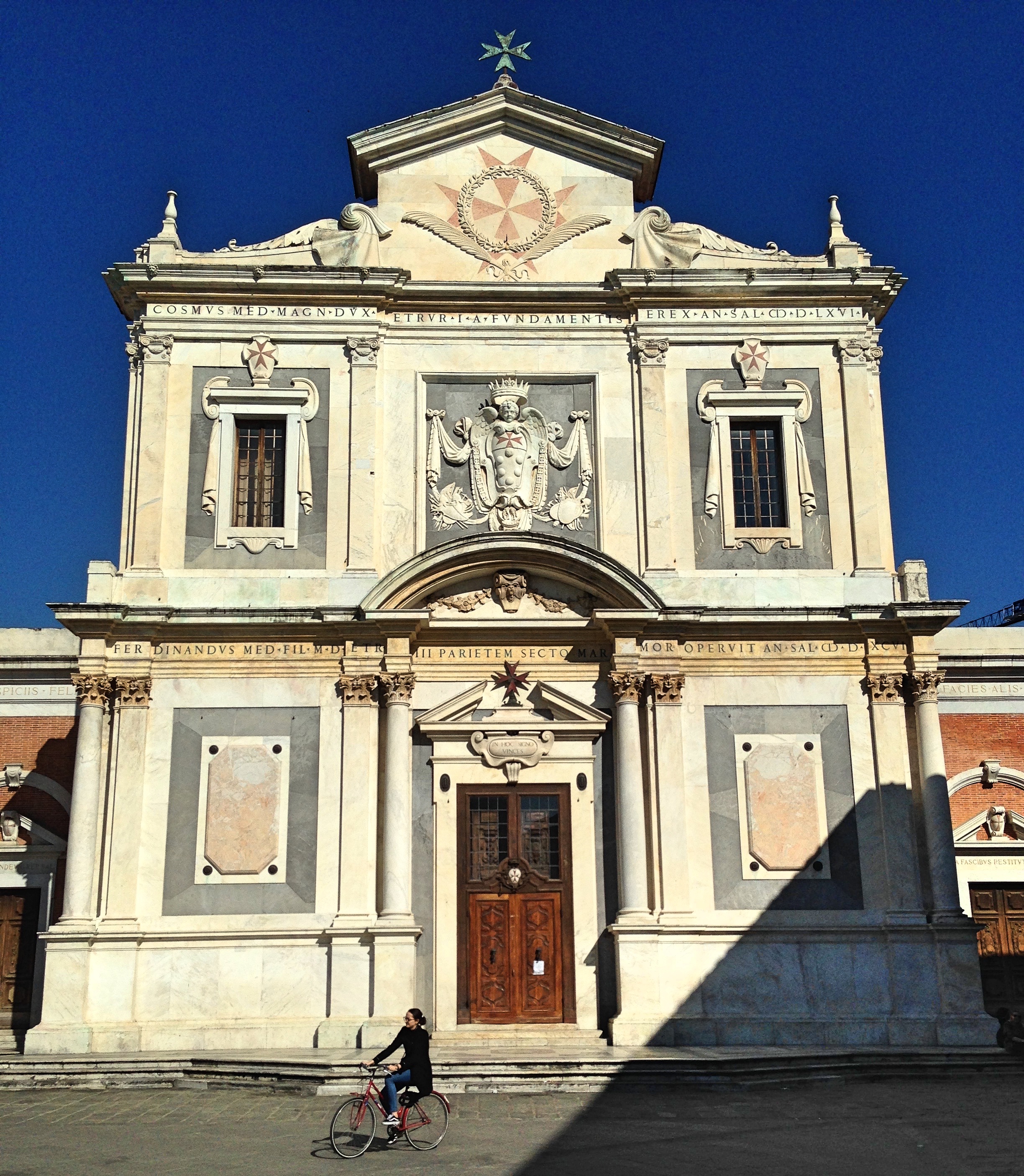
Belvedere_Bust

After taking in my fill of art, I returned to the train station, picked up my bags, and went off to check in to my Airbnb. The gap between my arrival in a city and the check-in time of my accomodations, by the way, is something that had been troubling me. For how can I take advantage of arriving early if I have to drag my bags around until the afternoon? The luggage lockers in train stations have proven to be the best way to solve this problem; and I recommend their use to any similarly beset travelers.

Now it was time to see the old city center. The first thing I noticed is that Vienna is very flat. Everything seemed situated on a level plain, which somehow made distances seem longer. Little deviations in angle help to make one feel progression; without that, one feels as though one is on a treadmill. The wide and long avenues also contributed to this impression: I felt small in the openness of the city’s streets, trying to traverse a space too expansive for my puny legs. But what most struck me about Vienna was the city’s unified aesthetic. Everything is built in a grand, stately style, in a noble marble-white. Walking around the center, you do indeed get the impression that you are wandering around a massive palace or museum or opera house, or rather some combination of all of the above. And this is not very far from the truth.

Vienna_city

Vienna is sometimes called the “City of Music,” and the city will not let you forget it. Concerts are everywhere. Salesmen sporting white wigs and dressed in fluffy satin suits walk the streets selling tickets to see performances of Mozart and Beethoven. It is no wonder that the city is known for music, considering that not only Mozart and Beethoven, but also Haydn, Brahms, Mahler, and Schoenberg have worked here. Nevertheless I find it somewhat depressing that the genuine cultural vibrancy that made the city so famous—the universal love of art that Zweig lovingly describes in his autobiography, in which the theater and the opera were universal obsessions—have been turned into a kind of parody of what it was, a tourist industry, in which cookie-cutter performances of canonical works are sold to tourists, the majority of whom have only a very limited interested in classical music. I suppose this is only to be expected, considering that the profit motive of the vendors harmonizes with the desire of the tourist for iconic experiences.

Vienna_Opera
The Staatsoper

All this being said, it is no doubt true that Vienna still has a thriving performance scene. This is evidenced by the city’s several opera houses, the most famous of which being the Staatsoper, or State Opera House. This is a monumental and dignified building, built in the nineteenth century, in which Gustav Mahler worked as a conductor. Though I unfortunately did not take this opportunity (since I didn’t know at the time), it is possible to buy cheap standing-room tickets 80 minutes before a show. Another notable venue in Vienna is the Burgtheater, a elegantly decorated circular building near the Town Hall. I did not venture within, but from the outside I observed busts of Goethe, Schiller, and Lessing hovering above me, the gods of German theater. This theater, still popular, has historically been important in the German-speaking world for its trend-setting style.

Vienna_Theater
The Burgtheater

From there I walked to Vienna’s lovely neo-gothic city hall, situated at the end of a large plaza. Opened in 1883, the building bears a strong resemblance to Munich’s neo-gothic town hall (built around the same time). I suppose this resemblance is due to both structures owing much to Brussels’ authentically gothic city hall. On the day I visited there was an outdoor fair set up, and the square was full of trailers and tents selling appetizing food. Though I was tempted by Indian curry and Turkish kebab, I decided that, since I was in Vienna, I had better have a sausage. It was spicy, filled with cheese, and came with warm potato salad. The Austrians, like the Germans, certainly know how to accompany a beer.

Vienna_Cityhall

Near the City Hall (or Rathaus, in the teutonic speech) is Universität Wien’s central building. It does not look especially interesting from the street; but after wandering inside I found myself in a lovely courtyard, whose shaded walk enclosed busts of the notable Austrian intellectuals that have been associated with the university. There I found Freud’s scowling face, whose enormous forehead and glowering eyes reveal a man who sought dark secrets. Much more cheerful is Karl Popper, who looks eminently professorial and harmless, even avuncular—though I think the real Popper was not so mild. Erwin Schrödinger looks completely abstracted, as if lost in an uncomfortable dream (presumably featuring a cat); his bust has his famous equation—used to calculate quantum effects—written beneath his name. Vienna is certainly not short on intellectuals.

Klimt was famously commissioned to decorate the Great Hall of this university in 1894. When he finally revealed his designs for Philosophy, Medicine, and Jurisprudence, the university reacted with shock and alarm, declaiming the works as pornographic and refusing to install them. The originals no longer survive, since the Nazis reportedly destroyed them during their retreat, though this is not confirmed. Judging from the surviving photographs, the works are quite impressive allegorical designs—both deeply original and visually striking. That being said, the profusion of nude women is hardly in keeping with the sober dignity of an old university. But when they commissioned Klimt, what did they expect?

Next to the university is the Sigmund Freud Park, where I observed college students in their native habitat—bent over cheap takeout noodles, their heads buried in books. This park is presided over by the Votivkirche, an excellent example of neo-gothic architecture, comparable even to St. Patrick’s in New York City. Its name (“Votive Church”) alludes to its construction: it was built to give thanks to God after a failed assassination attempt on Emperor Franz Joseph in 1853, for saving the emperor’s life. God may have not been so pleased, seeing as Franz Joseph lived to see the death of his brother, his wife, and his son (Archduke Franz Ferdinand), and to witness the beginning of the Great War which would end his empire for good. Lovely as the church is, I could not properly appreciate its form, since it was being restored when I visited; and so its façade was covered with scaffolding, which in turn was covered with a giant advertisement. Nowadays even churches are billboards.

Vienna’s most famous church may be the Peterskirche. This was remodeled by Johann Lukas von Hildebrandt, who you may remember as the same man who designed the Belvedere Palace. Though the outside of the church is, in my opinion, unremarkable, its inside is quite impressive, decorated from top to bottom in a florid yet tasteful Baroque. Outside the church’s front entrance is the Pestsäule, or Plague Column, a memorial to the Great Plague epidemic of 1679. The column is bursting with forms and figures, using a complex iconography to represent the victory of faith over the threatening disease (in those days thought to be caused by sin). Though full of angels, the bulbous form of the column manages to be quite grotesque, which I think is appropriate given what it commemorates.

One more church deserves mention. On one of my walks back to my Airbnb I stumbled upon the Karlskirche, which unfortunately was closed when I found it. Yet, even from the outside, the church leaves an impression for its monumental size and for the spiral columns (inspired by Trajan’s column) that flank its entrance. The Karlskirche is only a five-minute walk from another of Vienna’s treasures: the Naschmarkt. This is a street market that has existed since the sixteenth century. Now, I am no foodie, nor do I enjoy shopping for exotic products. Nevertheless I was impressed by the vast display of fresh fruits and vegetables, of spices and herbs, of candies and baked goods, all of which seem to go on forever—indeed, it was almost unbearable to witness, since I visited on an empty stomach (but didn’t leave that way).

Naschmarkt_collage
Stalls at the Naschmarkt (above); and a painting of the same market, with Karlskirche in the background (below)

Yet dwarfing even the finest of these churches in size and splendor is Vienna’s Cathedral, the Stephansdom. Its profile is unmistakable. The front entrance of the cathedral (to the west) is flanked by two Romanesque towers, rising up in grandiose dignity. To the back is the cathedral’s famous southern bell tower, a massive gothic spire that can be seen from many corners of the city, a feature as characteristic of Vienna’s skyline as is the Duomo in Florence. Yet the Cathedral’s most striking feature is not its towers nor its profile, but its colorful roof. The Stephansdom’s slanted roof is decorated with glazed tiles; on the southern side these are arranged into a bright diagonal pattern; and on the north the tiles create Vienna’s and Austria’s coats of arms. The inside of the cathedral is decorated in a high gothic style and contains the tomb of Emperor Frederick III, who was responsible for obtaining cathedral-status for the church from Pope Paul II.

Cathedral_Collage
A painting from the Belvedere (left) and my photo (right)

I feel that I am rambling on about Vienna, and yet failing to capture the flavor of the city—a city which for so long was one of the great cultural and political centers of the continent. “Center” is the operative word here, since the city leaves no doubt that it was the seat of power and the ultimate arbiter of artistic taste. Yet I am cataloguing buildings as if they were a random assemblage, while Vienna seldom feels haphazard or fortuitous; rather the city feels planned down the last centimeter, like one giant palatial complex. Indeed, you might say that the city seems to grow out of the labyrinthine Hofburg Palace in the city center. This palace served as the winter residence of the omnipotent Habsburgs for generations; and it is still occupied by the President of Austria.

The most iconic view of the palace is from the Heldenplatz, or Heroes’ Square, a crushingly vast, open space that features two heroic equestrian statues: of Archduke Charles of Austria, and of Prince Eugene of Savoy, two of Austria’s greatest generals. Facing this plaza are the arching wings of the Neue Burg, the newer section of the palace (built in the 1800s), whose arms sweep out like a giant embrace. This is only a fraction of the palace, however, which expands chaotically through the area. Built over a span of centuries, the Hofburg lacks the unified grandeur of, say, Versailles or the Schönbrunn. Indeed, when I visited I could not tell where it begun or ended.

Hofburg

Nowadays the gargantuan complex, in addition to being the official residence of Austria’s leader, is the home of several institutions. One wonders how any emperor, however egotistical and vain, could ever have used so much space. The aforementioned Neue Burg, for example, is home to an ethnology museum, a museum of arms and armor, and a museum of musical instruments. Elsewhere in the complex is Vienna’s famous Spanish Riding School, which puts on horse shows that are a popular attraction. (I didn’t go.) The Imperial Treasure is also on display—with its bejewelled crowns and scepters and other ornaments of power—though no doubt well guarded. What attracted me most was the Court Library (now part of the Austrian National Library), famous for its gorgeously decorated Punksaal (“State Hall”). And this is only a taste of the behemoth.

Right next door to the Neue Burg of the Hofburg is the Maria-Theresien-Platz, an attractive square named for the statue of Empress Maria Theresa in its center. Two of Vienna’s most famous museums face each other from across the square: the Kunsthistorisches Museum (the Museum of the History of Art) and the Naturhistorisches Museum (the Museum of Natural History). These are housed in matching grand, palatial buildings, topped with a dome, which creates a satisfying symmetry across the square. The two buildings were built under the reign of the unhappy Franz Joseph in order to make the imperial art and science collections public—for which we may heartily thank him. Though both museums are popular attractions, the art museum is indisputably the more so. Being in all things a follower, I visited this one.

The museum building itself is attractive. A mock-palace decorated in a neoclassical style, each room is well-tailored to the art it displays: providing a charming but not distracting background. The exception to this is the central stairwell, which is adorned with statues of heroes and lions, and whose ceiling and walls are covered in paintings. Klimt is responsible for a few of these paintings, such as a nude Cleopatra that occupies a nook. Not only is the building itself impressive, but the exhibitions are expertly arranged and displayed. It is an excellent institution.

Gemma_augustus

Despite the Kunsthistorisches Museum’s name, the museum is not an attempt to portray the whole history of art. The collection is, rather, the result of the tastes of Emperors and the periods of their glory. Thus we begin with antiquities—Egyptian and Greco-Roman—for the Empire funded and commissioned many excavations in the years when it was easier to simply take artifacts from their native lands. I admit that it was difficult for me to pay proper attention to these collections, since I was in Austria to learn about Austria, not Egypt or Greece. This is a shame, however, as the collections are undeniably impressive, well-organized and displayed, and featuring thousands of items—many of them beautiful and all of them instructive. Of particular note is the Cult Chamber of Ka-ni-nisut (a section of an Old Egyptian Temple) and marvelous Gemma Augusta, a delicately carved inscribed gem from a Roman workman.

From these relics of ancient peoples the collection jumps to the high point of Habsburg in the Kunstkammer rooms. A Kunstkammer or Wunderkammer (normally translated as “chamber of curiosities”) originated during the Renaissance as a kind of private a museum, a collection of strange and rare objects to stimulate the mind (and sometimes thought to have occult properties). The other examples I have seen contained fossils (not understood at the time), stuffed exotic animals, and foreign artifacts. But the Kunstkammer in the Kunsthistorisches Museum is full to the brim of luxury items, the most striking of which are delicate creations in gold. Far from the product of intellectual curiosity, this collection seems more to be a display of wealth.

The most notable item in this section is the salt cellar by Benvenuto Cellini. I was especially keen to see this, since I had read and loved Cellini’s roguish autobiography—possibly my favorite example of the genre—in which he repeatedly boasts that he is the best goldsmith in the world, even of all time. So I was curious to see whether his boasting was justified. It was. I find it depressing to think that this man, who wrote one of the great books of the Italian Renaissance, was also an extremely accomplished artist. Some people can do everything. The cellar contains two reclining figures: a man representing the sea, and a woman representing the earth. Each is seated next to decorous boxes, one to contain salt, the other pepper. The craftsmanship is exquisite in every detail: the bodies lithe and expressive, the ornamentation sumptuous. Imagine having something like that at your dinner table.

Cellini_salt

Though the Cellini Salt Cellar is without doubt the highlight of the Kunstkammer rooms for its artistry, it is only a small part of the extraordinary display of craftsmanship and wealth. A succession of Habsburgs used their combination of resources and connections to assemble a vast collection of scientific instruments, statuettes, models, clocks, lamps, and decorative plates, trays, and cutlery, all of it made with the finest craftsmanship out of the most expensive materials. And yet, aside from Cellini’s cellar, the display produced in me little more than an admiration for the fine skill required, and a mixture of awe and disgust at the flaunting of riches.

After exploring the Egyptian, Greco-Roman, and Habsburg rooms, I thought there could be little more to see in the museum. But I was blissfully wrong. The second floor of the museum is a world-class painting gallery, comparable to Amsterdam’s Rijksmuseum or even Madrid’s Prado. The collection mainly contains works by Germanic, Dutch, and Flemish artists, though there are some notable exceptions. One of these is Raphael’s Madonna in the Meadow, with the rosy-faced Virgin Mary watching over the infant John the Baptist and Jesus, playing in a field. The painting exhibits the Renaissance master’s smooth forms, agreeable colors, and harmonious compositions. Also notable are the several works by Velazquez on display, which were originally given as a gift by the Spanish to the Austrian Habsburgs.

kunstmuseum_gallery

Jan_Vermeer_The_Art_of_Painting

Other paintings call out for attention: several excellent portraits by Jan Van Eyck, self-portraits by Peter Paul Rubens (looking resplendent) and Rembrandt (looking rather shabby), and one of Vermeer’s masterpieces, The Art of Painting, which portrays a painter (himself, presumably) engaged in painting a woman dressed in blue (possibly his daughter). As is usual with Vermeer, an expert composition is matched with exquisite realism, blending the iconic and the intimate. On the one hand, the painting looks like a snapshot of an ordinary day; you can almost guess the time of day from the shadowing on the crickled map on the far wall. And yet, once examined, the painting reveals itself to be anything but casual, but even more carefully composed than the painting which is being painted in the painting.

All of these wonderful works notwithstanding, the highlight of the gallery is indisputably its collection of Pieter Bruegel the Elder. The acknowledged master of the Flemish Renaissance, Bruegel began his career as an engraver of prints, and only took up the brush comparatively late in his short life (he died at around the age of 40). Even so, he left us with a treasury of paintings, which combine the engraver’s eye for detail with an earthy humor and an ironic sensibility, making him one of Europe’s great artists.

Perhaps I enjoyed Bruegel’s work so much because there were influenced by another of my favorite artists, Hieronymus Bosch. This is most apparent in Bruegel’s Fight Between Carnival and Lent, which tackles the typical Boschian theme of the combat between sin and piety in the typical Boschian manner of a vast panorama. In the lower-left of the large town square the people boisterously celebrate Carnival, with all the hilarity, mirth, and drunkenness expected; and in the upper right, robed figures and well-behaved children carry out the abstemious rituals of Lent. The riot of detail is too much for the eye to take in at a glance, or even several; and no central narrative emerges from the busy activity of the town. The closest thing to a central action is the joust between the figure of Carnival, a fat man seated on a barrel, being pushed by drunkards, wielding a skewer, and Lent, a skinny, miserably figure in religious vestments, being pulled by a monk and a nun. Both of these figures are pure Bosch in their exaggerated ghastliness, down to the odd objects sitting on their heads.

Pieter_Bruegel_d._Ä._066

Another remarkable panorama by Bruegel is his painting, Children’s Games, which shows hundreds of kids engaged in dozens of sorts of play—with masks, with dolls, in groups, by themselves, climbing, rolling, play acting, and so on—creating a veritable anthology of childhood. But Bruegel’s artistry is not confined to these social summaries. He was also deeply sensitive to the beauties of nature, as is shown in his winter landscape, Hunters in the Snow. I do not think that I am the only one to feel a peaceful sense of sublimity in this work. Somehow Bruegel has captured the feeling of the hours after snowfall, when the world is frozen still and silent, and the works of human hands are humbled in the anonymous white of winter. When I visited there was a guest artist busy making a copy of the work, which I admire, for there is much to learn in this work.

800px-Pieter_Bruegel_the_Elder_-_Hunters_in_the_Snow_(Winter)_-_Google_Art_Project

Yet my favorite work in the Bruegel collection is his Tower of Babel, the most convincing representation of that mythical tower I know of. I admit I am predisposed to like the painting because the story is among my favorits of the Bible. It shows how much we humans, individually weak, can accomplish if we unite together—a power so great as to even make God in heaven tremble, since He decided that He had better scatter us and confuse our speech if He was to defend his astral territory. The story seems so prescient, too, considering that we have succeeded in leaving earth and entered the heavens, and with the help of two universal languages: English and mathematics, the international languages of science. Though the story has traditionally been interpreted as an allegory for humanity’s presumption, I tend to see it as an allegory for the potential of cooperation. Thus I feel a strange pathos when I look at Bruegel’s image of the unfinished—never to be finished—tower, dominating the landscape and brushing away the clouds.

Pieter_Bruegel_the_Elder_-_The_Tower_of_Babel_(Vienna)_-_Google_Art_Project_-_edited

This does it for my tour of the Kunsthistorisches Museum. But one museum remains: the Sigmund Freud Museum.

This is located in the apartment were the psychoanalyst lived and worked for over 40 years, on Berggasse 19. I believe the rest of the apartments in the building are still residencial. To enter I had to queue up on the stairwell, since only a limited number of visitors can be admitted at any one time, due to the limited space. I admit that I was somewhat disappointed by the museum. You see, when Freud fled the Nazis and moved to London, he was able to take all of his furniture (such as the famous couch) with him; so the museum in Vienna is largely bereft of its original furnishings. (There is a Freud Museum in London in which you can see what his house and office looked like.) Instead, the exhibition mainly consists of information and photographs, with a few antique items on display.

Even though I did not learn very much about Freud—since I already knew a fair amount about the psychoanalyst before my visit—it was still special to know that I was standing in the apartment of somebody whose thoughts had changed the world. For even if Freud’s ideas are bunk as science and questionable as therapy, he undoubtedly contributed to our concept of the human condition, helping to erode the old Platonic idea in rational beings, and instead accustoming us to the now-common notion of unconscious, unreasonable, and ugly motivations. Since Freud, we have not been able to trust so blithely in the logic of our thoughts or the purity of our actions; and I think this is ultimately a good thing: since blindness to the animal within makes us unable to restrain it.
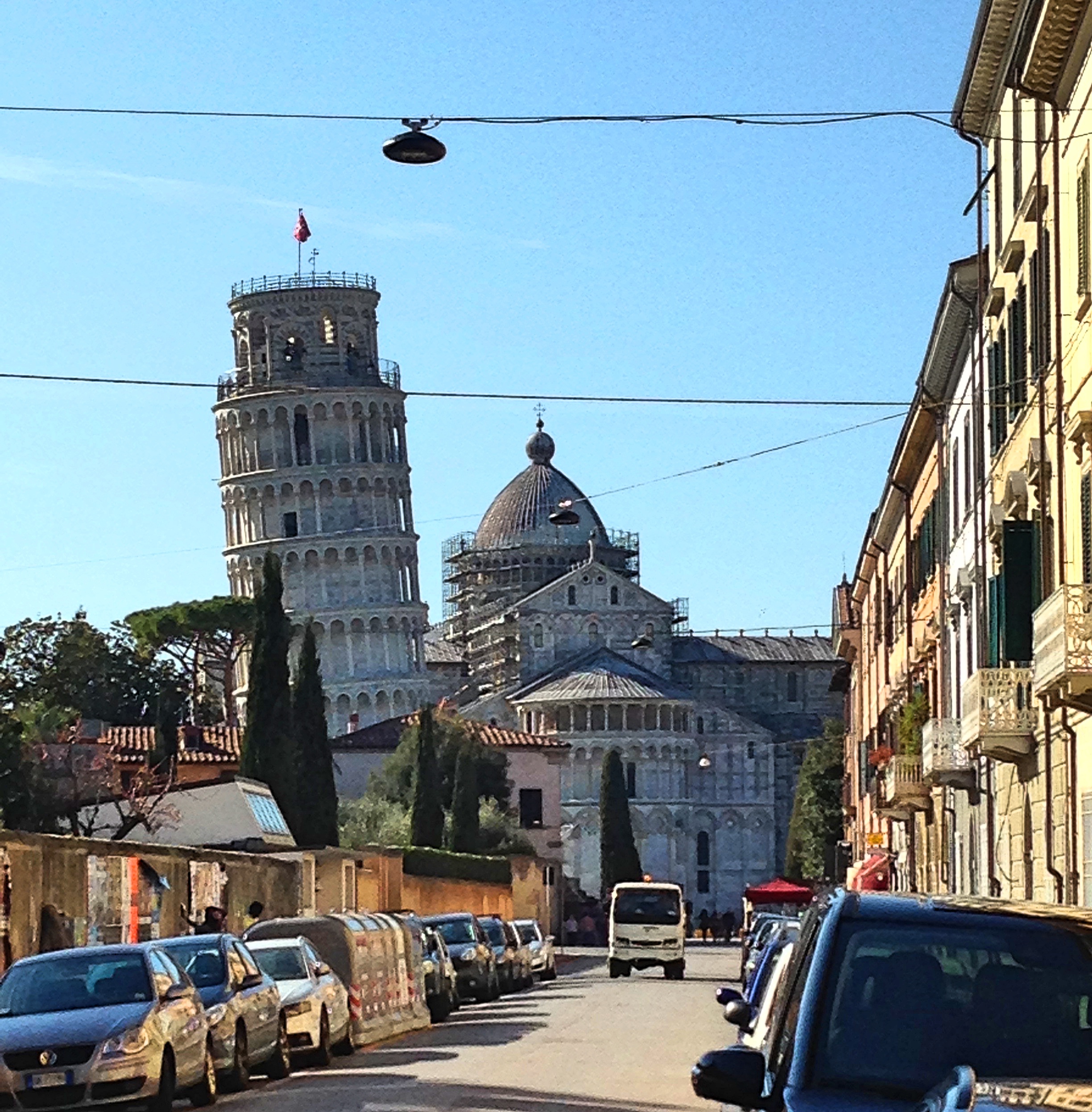
§

Evening was falling now, and I was going to leave the next day. I was tired and sore from having walked all day for days on end; but there was one more place to visit: the Schönbrunn Palace.

Sometimes called the “Versailles of Vienna” (which is somewhat Francocentric, I think), the Schönbrunn (literally, “Beautiful Fountain”) is the marvelous palace that, for hundreds of years, was used by the Habsburgs as a summer residence. As such, it stands in the center of Austrian history. Franz Joseph, Austria’s aforementioned last emperor, was born, lived, and died within these walls. Located about an hour’s walk from the center, the palace is accessible by metro, tram, and bus for the foot-weary, and is easily worth the detour.

Schonbrunn_collage
The palace from the gardens (above); and a painting of the palace from the road (below).

As it stands today, the Schönbrunn mainly owes its monumental, neoclassical form to that remarkable empress, Maria Theresa. It is painted a cheerful yellow color, which helps to humanize the inhuman proportions of the building. The visitor entering from the street passes two imperial eagles, elevated on columns, which lead into a stone courtyard. By the time I arrived the palace was closed (which did not much bother me, since I prefer gardens anyhow). So I walked around the monumental pile to the other side, which opens up into the palace’s orangerie.
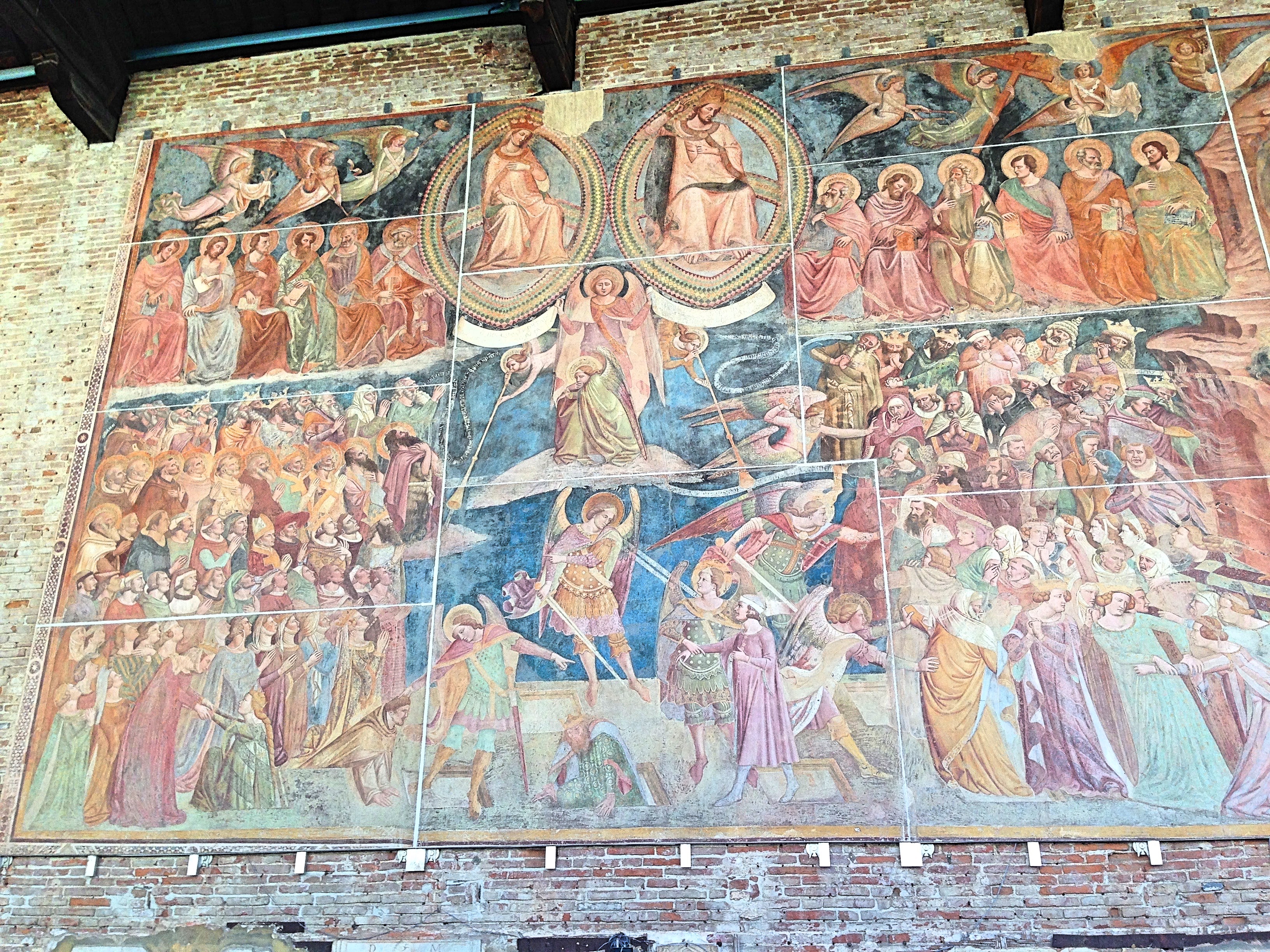
Schonbrunn_gloriette

The gardens are arranged in the orderly French style, with rows of ferns adorned with classicalizing statues of heroes and gods. These lead up a gentle hill to the famous Gloriette, a kind of ceremonial structure, vaguely reminiscent of a triumphal arch, built to celebrate Habsburg power. I slowly ascended the slope until I reached its modest peak. The grass swells like an ocean wave on its way down the hill; and at the bottom, flower patches lead up to the palace, which does not look so presumptuously big from up here, and whose yellow façade grows agreeably in the sunset light. Vienna is stretched out in the distance, almost completely flat, save for the dark spire of a church silhouetted against the pink sky. I wrote in my diary: “The clouds look painted. I can almost see the brushstrokes.”

Schonbrunn_view

I made my way back down through a side path, which took me through a more wooded area and passed near the palace’s zoo. Some large animal—a lion, a bear, or even an elephant—was growling powerfully in its enclosure. The deep and throaty roar made my hair stand on end; the sound was so deep it even seemed to shake the leaves on the trees. A panic momentarily came over me; and this instinctual fear quickened my senses and snapped me out of my fatigue. I was here, I was in Vienna, listening to an elephant in the palace gardens.

Finally I reached the bottom of the hill and passed by the palace on my way back to my apartment. As I passed, strains of music caught my ears. A concert of chamber music was being held in the palace; and by standing nearby, I could hear the players quite well. It was Mozart, whose composition accompanied my final moments of wonder in the City of Music.

The next day, as I waited for my train to take me to the airport, I wrote these concluding thoughts in my diary:

Every day I ingest Culture, sometimes so much I can hardly swallow it all without feeling ill. What effect does all the art-viewing and book-reading have on me? Does the sophisticated, elegant, finely crafted decorations of, say, an Egyptian sarcophagus create any reflected, echoed, imprinted form in my mind? Do I gain something from visually processing the forms of brilliant men and women? My mind has its limits, which I feel all the more keenly when I measure myself against these artists.