… a sign proclaiming in three words that a Roman emperor’s orgy is now a democratic institution. It says: ‘Topless Pizza Lunch.’
(As in my reviews of Kenneth Clarke’s Civilisation and Jacob Bronowski’s The Ascent of Man, this review focuses on the documentary, not the tie-in book.)
This documentary is a window into another time, when the public intellectual was a far more respected institution. Nowadays it is hard to imagine a popular program that contained long stretches of a man simply talking into a camera; nor it is easy to think of a contemporary program so fully dominated by the personality of one person. As the subtitle of this program indicates, this is “A Personal View,” not an attempt at impartiality or objectivity. Cooke is giving us America as he sees it, through the eyes of a highly-educated, well-traveled English immigrant.
The 13 episodes of the series follow a chronological scheme, beginning with the French and Spanish colonists and ending with the (then) present day. The exception to this is the first episode, the best in the series, in which Cooke tells his own story—coming to America as a young man during the Great Depression, and taking a road trip out west. As for the other episodes, there are few surprises in Cooke’s choice of subject: the English dissenters, the Revolutionary War, the drafting of the Constitution, the Louisiana Purchase, and so on, all the way up to the Cold War. We see Ellis Island and the Oregon Trail, New England foliage and the Hoover Dam, Hippie communes and Black Baptist churches—a panorama of American scenes.
In many ways this series falls short of the other two major BBC documentaries of the time, Clarke’s Civilisation and Bronowski’s The Ascent of Man. Cooke’s America has none of the gorgeous cinematography of the former nor the innovative editing of the latter. Indeed, the shooting style of the documentary is remarkably basic—which is not necessarily a bad thing, of course, but in this case it imbued sections of the documentary with a soporific effect. Another difference in quality was due to the level of insight that the programs offer. Cooke, though no chump when it comes to American history, seems an amateur when his expertise is compared to Clarke’s grasp of art and Bronowski’s understanding of science. I was consistently interested, but I cannot say I came away from the program with any deep sense of insight into my vast homeland.
All this being said, there are some delightful sections in the program. Cooke has a great knack for finding fascinating props. He holds up a vial containing tea preserved from the Boston Tea Party, or he holds the manuscript of Dickens’s A Christmas Carol in the Morgan Library, or he itemizes the typical equipment and supplies taken by families on the Oregon Trail. And if the information he presents is not exactly striking, his easy eloquence and gentle wit give his facts a pleasing ring. Cooke’s voice—with his faultless Transatlantic accent—was made for broadcasting, and transmits a sense of confident sophistication that is entirely rare today. Most valuable for us is Cooke’s convincing sense of being above partisan politics—an intelligent observer unbound by any tribe. Again, could any similar program exist today?
Just as royalty and nobles have played a crucial role in Europe’s art, providing money and stability to artists, in American history very rich patrons have played an equally important role in the establishment of cultural institutions. From Carnegie, to Frick, to the Rockefellers, great business tycoons have used their enormous wealth to bring culture to the masses; and in this respect J.P. Morgan is no exception.
Unlike the above-mentioned robber barons, Morgan was not an industrialist; his specialty was money itself. A son and eventually a father of a banker, finance was in Morgan’s blood. He had dealings with every major player in business and government of the age, and was instrumental in the creation of the era’s major conglomerates: General Electric (which hailed from Thomas Edison), United States Steel (from Carnegie, Schwab, and Frick), and AT & T (from Alexander Graham Bell)—to name just a prominent few. A large man with a deformed nose, he struck the unflappable John D. Rockefeller as moody and impulsive. But this iconic money-changer and pharaonic materialist was not bereft of an appreciation of higher things.
The Morgan Library & Museum sits right in midtown Manhattan, on Madison Avenue and 36th street. The main building looks quite similar to the Frick: a severe, grey, neoclassical structure. Adjoining this is an attractive brownstone building; and the complex is completed with a sleekly modern—and rather discordant and tasteless—box of an entryway, built in 2006 to help organize the space. This is where the contemporary visitor enters and pays.
No photos are allowed inside the complex, so I am forced to rely on my paltry memory.
John Pierpont Morgan
As one would expect, the house is richly furnished. The original entrance hall is gorgeously decorated, with Renaissance-style wall frescos and Pompeian motifs; even the floor is attractively patterned. Anyone visiting the banker would know immediately that this was financial royalty. Morgan’s study, where he made decisions that shaped the economy, is a deep shade of scarlet—the rug, the wall paper, the furniture. Morgan himself, with his handlebar mustache sitting under his bulbous nose, presides over the fireplace in the form of a portrait. Few rooms give such an indelible impression of power.
The next room accessible from the entrance hall was, I believe, previously the librarian’s office; now it contains a fine sampling of Morgan’s impressive collection of Babylonian cylinder seals. These are small circular objects made of hard stone, about an inch long, inscribed with delicately carved reliefs. They were used as a sort of signature or official seal, by rolling the seal over soft clay to create a horizontal image. Dozens of these seals were on display in the room. Since the seals themselves do not look like much, they were shown alongside an impression made with the seals, wherein the images can be clearly seen. These typically involve scenes of gods and royalty, and are quite beautiful works of art. Certainly it is a much more elegant way of indicating ownership and approval than illegibly scribbling our names.
This image is from the Louvre. It is in the public domain, taken from Wikimedia Commons
From here I went to the central attraction of the museum: the library itself. Even if it had no books at all, it would be a beautiful space—the ceiling as richly decorated with allegorical friezes as El Escorial’s royal library. Three floors of oaken bookcases line every wall up to the ceiling, each one filled with venerable volumes covered by a protective screen. On the ground level there are display cases that showcase some of the library’s treasures. And these are beyond anything I had expected.
A page from the University of Texas copy of the Gutenberg Bible (public domain)
Here is the finest collection of manuscripts and rare books that I had ever hoped to see. To begin with, there are three Gutenberg Bibles, the first book published with moveable type in Europe, one of the most iconic books in history. While the invention of printing was, no doubt, a great advance in the history of our species, it must be admitted that the Gutenberg Bibles look rather plain next to the older, handmade ones nearby. The most famous example of these is the Morgan Bible, or Crusader Bible, a brilliantly illuminated Bible showing scenes from the Old Testament, but depicted as if it had occurred in medieval France. (Thus it is easy to mistake the images for depictions of the crusades.) The images are chaotic and violent, but no less compelling for being so; and seeing it such vivid illustrations between the cover of a book does make one a little nostalgic for the days when books were handmade.
The most ornate book in the collection—and the first in the Morgan Library catalogue, MS M.1—is a book of the gospels from the 9th century, around the reign of Charlemagne. (I admit that I cannot remember if I actually saw this book in person, but I did see it in a documentary that mentioned the library.) The cover is a mass of ornately decorated gold, encrusted with precious jewels. The amount of material wealth devoted to this single volume beggars belief—though it does seem a little ironical to decorate a book about Jesus of Nazareth, arch-enemy of the money-changers, so resplendently. While I am on the topic of ironies, I must also add a point made by the journalist Alistair Cooke, that while these super rich tycoons—Carnegie, Frick, Morgan—were buying up the treasures of Europe, they were benefiting from waves of European immigrants willing to work long hours for low wages. And so these robber barons exploited the huddled masses of Europe to buy up its treasures.
But it is difficult to be indignant for very long when you are looking at such beautiful books. The Morgan Beatus, for example, is a brilliantly illuminated copy of the Commentary on the Apocalypse by Beatus of Liébana, with bright yellows and reds and oranges, showing us a world redeemed and a world aflame. Then there is the Hours of Catherine of Cleves, a wonderful example of gothic illumination. As with so many other illuminated manuscripts, the mind boggles at the amount of time it would have taken to paint a single one of these ornate pages, much less a whole book of them. An example of this is the Farnese Hours, illuminated by Giulio Clovio over a period of nine years. Clovio was a friend of the young El Greco, during his early years in Italy, and the Greek painter created a portrait of the old Italian master, pointing to this masterpiece of Renaissance illumination. The book was completed in 1546, 100 years after the Gutenberg Bible was printed, already the waning years of the art of illumination.
Still more exciting than these beautiful books, for me, were the original manuscripts on display. These are the notebooks and pieces of paper where authors and composers first wrote down their masterpieces. Among these is Dickens’s A Christmas Carol, with his edits still preserved, as well as nine novels by Sir Walter Scott, including Ivanhoe. Honoré de Balzac, Émile Zola, Lord Byron, and William Makepeace Thackeray also are in attendance; and in music there are handwritten examples from Beethoven, Brahms, Mozart, and even Bob Dylan (the latter obviously not acquired during Morgan’s lifetime). It is thrilling to see the preserved handwriting of these men (and yes, they are mostly men), since they can appear so unreal behind the printed page. The artists become living, working, fallible souls when you can see them scribbling and scratching out. Even the most iconic works of art were the process of trial and error.
I must say that I was stupefied by the end of my visit. The collection had exceeded my every expectation. Few places are as inspiring as a beautiful library. The museum is a magnificent tribute to the ways that we have preserved and transmitted our culture—in all its manifold facets. From the Babylonian cylinder seals to Bob Dylan’s “Blowin’ in the Wind,” humans continue to scribble, print, draw, paint, and inscribe our art and ideas for the benefit of people in distant times and faraway places.
But there was still one more thing to see. The Morgan has a temporary exhibition space, and when I visited this was dedicated to an exhibit on Henry David Thoreau. This was a stroke of luck, since I had recently finished rereading Walden.
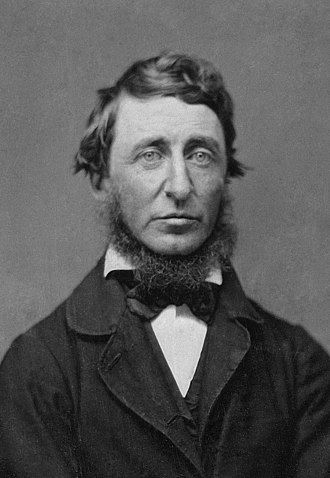
Considering the scanty possessions that Thoreau left behind, the exposition was astonishingly complete. There was Thoreau’s writing desk, over a dozen volumes of Thoreau’s diaries, and Thoreau’s walking stick (notched so that he could measure things on his walks). Also present was every original photograph (there are only two, admittedly) taken of the man. The exhibit was filled with information about his life and extracts of his journals. Seeing his humble collections gathered all in a heap—his scribbled and illegible handwriting, his beat up desk, his pocket-sized images—spoke more eloquently of his life’s project than all the fanciful phrases he ever assembled. And just as with the original manuscripts, seeing his original possessions helped to turn Thoreau from a distant voice into a living, breathing person.
As a child in Manhattan, growing up on the Upper West Side, I visited the Museum of Natural History nearly every week. It is a little boy’s paradise: dinosaur bones, stuffed lions and elephants, and my favorite—the whales. Later, in high school and college, I developed a taste for the Metropolitan Museum of Art. I was first drawn to the Arms and Armor room—swords and guns, another boy’s paradise—and then progressed to the Egyptian and Greek antiquities. It takes little sophistication to enjoy cursed mummies and violent gods.
But it was not until I moved to Europe, and began visiting art museum’s here, that I developed an appreciation for sculpture and painting. Thus it was only during one of my summer trips back home to New York that I finally visited one of the finest art museum’s in the city: the Frick.
The Frick Collection is housed in the former mansion of Henry Clay Frick, who was one of the great robber barons that dominated the Gilded Age of America. He made his fortune by selling coke (the carbon fuel, not the drug), and achieved industrial dominance by partnering and eventually merging with Carnegie’s steel company. Despite his success and wealth, he is a difficult man to admire. Like many tycoons, he was adamantly opposed to organized labor, and played a key role in repressing the Homestead strike—a violent confrontation in which 9 strikers and 3 pinkerton detectives were killed, and which caused a major setback to the labor movement. He was so hated by laborers, in fact, that the anarchist Alexander Berkman tried to assassinate him. The attempt failed (Frick would die in 1919, at the age of 69, of a heart attack) and Berkman spent 14 years in jail as a consequence, where he wrote a famous memoir of his experience.
Henry Clay Frick
But whatever Frick’s defects in the realm of social justice, no one can accuse the man of bad taste. He accumulated superlative works of art during his lifetime; and, fortunately for us, he donated his house and his collection to the public upon his death, to be used as a museum. Along with Rockefeller and Carnegie, Frick is yet another example of a robber baron who managed to be both cutthroat and civic minded.
The museum sits across from Central Park, on 5th avenue and 70th street, about a 10 minute walk south from the Metropolitan. From the outside the mansion is not especially impressive: a squat neoclassical building, the color of granite. It has none of the conspicuous stateliness of Andrew Carnegie’s old mansion, located just up the road (it is a part of Cooper Union now). But the inside is not nearly so restrained: each room is richly decorated, with the finest furniture, chandeliers, mirrors, and wallpaper that money could buy. I have walked through my share of palaces in Europe, so I am used to seeing affluent interiors; but I still found myself gaping as I walked through the house. In the giddy years before income taxes, the robber barons could accumulate more wealth than Old World despots.
But of course the absorbing interest of the museum is not the interior decoration, however sumptuous, but the paintings on display. Though relatively small, the Frick has one of the finest collections of old masters in the city—perhaps in the country. Relatively few works by Velazquez are available outside of Spain. New Yorkers are fortunate: the Metropolitan has a handful, the Hispanic Society has three, and the Frick has one—a portrait of Felipe IV. Typical of Velazquez, it is a masterful work: we feel we are standing right in front of the king. The Spanish monarch’s magnificently regal outfit—painted with such delicacy that it is almost tactile—contrasts sharply with the awkward and gangly figure who wears it, with his monumental Hapsburg chin sticking out below his curled mustache. Most impressive of all, Velazquez manages to imbue this unpromising figure with a certain kingly dignity—his eyes calm, thoughtful, careworn, but in control.
The other two members of the Spanish triumvirate are also in attendance: Goya and El Greco. I especially like the former’s contribution to the collection: The Forge. It is an excellent example of Goya’s ability to convey strenuous action while preserving the harmony of the composition. The stocky figures, contorted with effort, nevertheless combine to form a solid triangle in the center of the painting. I also enjoy the gloomy, almost liquid blackness that engulfs the figures, emphasizing their solitary grandeur.
The Dutch masters are also here in force. Frick managed to get his hands on three Vermeers. My favorite of these, Officer and Laughing Girl, shows all the hallmarks of his style: an interior room lit from a side window, with a homely girl in the center and a detailed map in the background. In this case the girl is chatting with a soldier, seated with his back to us. Is she being courted, or is there something more scandalous afoot? From a purely technical perspective, the most extraordinary feature of the painting is the map, which is so beautifully and accurately rendered as to beggar belief. Rembrandt is here, too, with two works. One of these is a self-portrait, showcasing himself as a florid gentleman with a sword strapped to his hip. The other paintings is rather more mysterious: The Polish Rider. It shows us an armed man in slightly exotic garb, mounted on horseback. Scholars cannot decide who this person is supposed to be; he is called “Polish” because of the style of his hat and dress; but beyond that there is little but guesses.
We can also see a work by the greatest of English painters, J.W. Turner. The Harbor of Dieppe is entirely typical of his style: a bright yellow morning, a shimmering sea, and a large perspective with dozens of figures and boats. Nothing about the painting’s content is profound or especially moving. Its appeal is mainly to the eye—it is a joy to behold, since Turner captures so perfectly the warmth and the brilliance of a summer sunrise. Standing in front of the painting, you can almost feel the sun on your skin. How can paint be made to glow so intensely? In this glorious landscape of light—Turner paints the sun twice, in the sky and reflected in the sea—we can also sense the magic of all ports of travel: a place where different corners of the earth mingle, a gateway to the wide world, beckoning us towards the beyond.
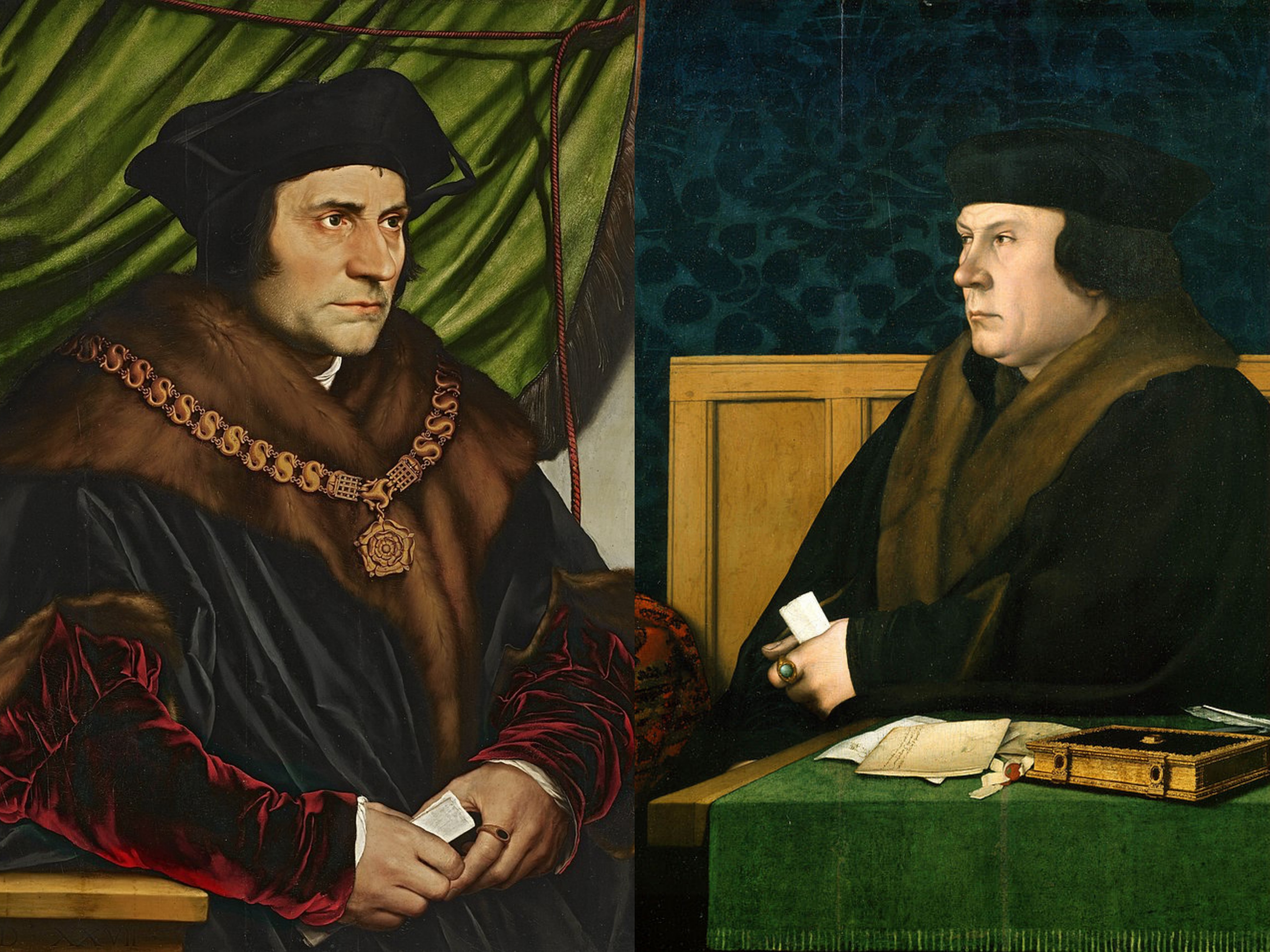
In the interest of brevity, I will skip over many other worthwhile paintings to get to the two great masterpieces of the collection, both by Hans Holbein. They hang on either side of the great fireplace in the center of the mansion. To the right is a portrait of the English politician Thomas Cromwell, and to the left is the Renaissance humanist Thomas More (famous for inventing the word “utopia”). The two were adversaries in life. Cromwell aided Henry VIII in his quest to annul his marriage to Catherine of Aragon in order to marry Anne Boleyn, which resulted in England’s break with the Catholic Church; meanwhile, More remained loyal to the Pope and opposed the new marriage. Despite this opposition, the two men shared the same fate: beheaded by the order of the king. More was beheaded for opposing the establishment of the Church of England, and Cromwell because he helped arrange the king’s next marriage (after Boleyn was duly decapitated) to the German princess Anne of Cleves (who did not please the king, but who escaped execution). These were dangerous times for love.
The two portraits are masterful. Each detail is so sharply defined that you can lean in very close without noticing the brushstrokes. Both men sit in sumptuous rooms, and Holbein obviously delighted in painting the fabrics of their gowns, the tablecloth, the cushions. And, as in any great portrait, the personalities of the sitters shine through. Cromwell appears suspicious, scheming, intelligent, and alert; he is a man grasping for power and influence, and wary of all impediments. More’s portrait is a study in contrast. He is dignified and focused. Unlike Cromwell, who gazes sideways with narrowed eyes, More stares straight ahead. His eyes are soft and sensitive, almost like a poet’s, and yet the expression is far from naive; it is, rather, experienced and far-sighted. It is easy to picture such a man dying for his principles, just as it is easy to picture Cromwell plotting to bolster his influence with the king. The two portraits are complemented by Holbein’s portrait of Henry VIII himself, which I have seen many times in the Thyssen in Madrid. As you stare past the corpulent face into his black beady eyes, you can tell that this was not a man to be trifled with.
I left the museum deeply impressed. By any standard the Frick has a marvelous collection of paintings, all the more remarkable for being here in America and for being showcased in a historical mansion. Whether you are a tourist or a New Yorker, I urge you to visit.
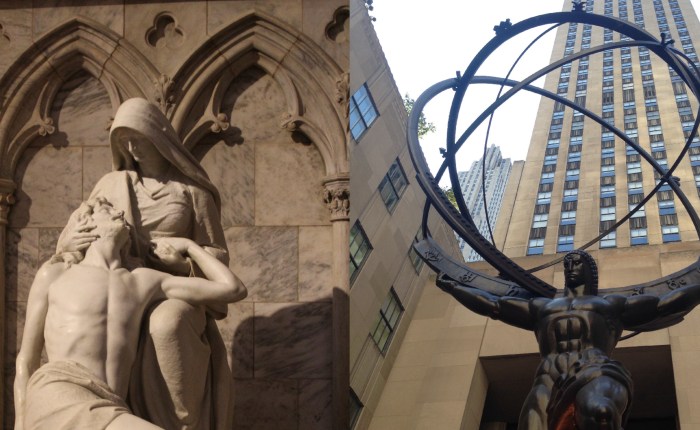
New York is a city bent on the future. Every new generation overtops the next, in the relentless march skyward. This is especially apparent when we compare two of the cities landmarks which are right across the street from one another: St. Patrick’s Cathedral and Rockefeller Center.
St. Patrick’s Cathedral
St. Patrick’s is not the first Catholic cathedral in the city of New York. It replaced a building that is now called St. Patrick’s Old Cathedral (nowadays merely a church), which is still standing, further down town. It is easy to see why the authorities wanted the old structure replaced: it has none of the grandness and grandiosity that the cathedrals of great cities are supposed to have. Construction began on the current cathedral (the land had long been owned by the church) in 1858, and was completed twenty years later. When it was finished the towering spires must have dominated the landscape from miles around—since what is currently midtown Manhattan is far north of the former population center. Nowadays, of course, the gothic spires look almost dainty compared to the highrises nextdoor.
The cathedral presents an impressive face to passersby on the sidewalk below. Designed in a resplendent neo-Gothic style, where pointed arches hold everything up, its orientation is entirely vertical. This is the classic aim of gothic architecture: to draw the looker’s gaze towards heaven. But now, ironically, the cathedral has the opposite effect: it provides relief from the relentlessly vertical structures of midtown Manhattan. The city block on which the cathedral stands is a breath of air in an otherwise claustrophobic space, a note of contrast in an otherwise monotonous wall of buildings. And besides what it gains from its surroundings, the cathedral’s façade is lovely in itself—dense with decoration and design, so very different from the walls of concrete and glass that normally encase the sidewalk.
Visiting the cathedral is free. To enter, you must only let the people in front check your bags. The interior is no less impressive and harmonious as the exterior. Indeed, it is almost too harmonious. Much of the loveliness of European cathedrals consists, for me, in the fact that they were built over a long period of time. The buildings were shaped by several generations of workers and artisans, using different materials, in different styles, with different techniques. As a result the visitor can really feel the time that has gone by in the cathedral, can sense how the building played an integral part in the community’s life for hundreds of years.
The visitor to St. Patrick does not get this sensation, since the whole aesthetic is unified. The same materials, the same styles, and the same techniques were used throughout the space. The decoration on the chapels, the walls, the choir, the altar, and the stained glass is all of a piece—very well done, but somehow sterile when added together. Another element that adds to this sensation is that the builders of St. Patrick had modern tools and technology to work with; and as a result, much of the artwork has a kind of manufactured perfection that is simply not seen in old cathedrals. Of course this is the trouble with any revivalist art: in seeking to replicate the artwork of the past, without going through the trouble needed in those days to make it, the revivalists produce only a sort of empty copy: superficially perfect and yet lacking in emotional power.
If I am being harsh on St. Patrick’s, it is only because I am comparing it with some of the great cathedrals I have had the pleasure of seeing: Toledo, Prague, Chartres. But this is an unreasonable comparison, since St. Patrick’s was not made in analogous circumstances. And even the harshest critic must admit that, all told, it is a lovely building—pure, bright, balanced. I feel refreshed every time I visit, and grateful every time I walk by on the street.
Rockefeller Center
Across from St. Patrick’s Cathedral is another New York landmark: Rockefeller Center. This building complex—19 distinct buildings in all—is centered around a plaza, made famous by the massive Christmas tree placed there every year. Thousands of workers commute here every day—to clean, to sell, to sit behind a desk—and thousands more tourists come to experience one of the best views of New York, on top of 30 Rockefeller Plaza, the tallest building in the center.
Though I have lived in or near New York City my whole life, I had not visited the Top of the Rock until this very year. This is a common occurrence: residents neglect the great monuments and attractions of their own cities, only to seek them abroad. It is a little strange, since seeing the sights of one’s own city is cheaper and easier than going elsewhere; what’s more, it provides an opportunity to learn about local history, which enriches the experience of living in a place. Yet there are good reasons that residents stay away. Tourist attractions are crowded and expensive. The Top of the Rock is a case in point: it costs $36 for a visit that will likely last under an hour; and the visitor will likely be elbowing crowds half the time. A certain mindset is necessary to justify the expense with the experience, a mindset that is common enough while traveling but rare during workaday life.
But my time spent living abroad has turned New York City into a quasi-foreign town, which I can enjoy like any other tourist. So even though I was put off by the price, I decided to visit.
I bought my ticket online, which comes with an entrance time. At the designated hour I walked through the doors, went up the stairs, passed through a metal detector, and got in the line for the elevators. On the walls were images and panels of information, explaining some of the history of Rockefeller center. The line moved too quickly to really delve into the story, but I happened to know some of the from reading Ron Chernow’s biography of the Rockefeller paterfamilias. Rockefeller was not a project of the Oil magnate, however, but of his son, John D. Rockefeller, Junior. A man deeply involved in charity, with the world’s largest fortune at his disposal, Junior wished to help the Metropolitan Opera relocate. Thus he bought this plot of land from Columbia University in 1928.
Unfortunately for everyone involved, the stock market crashed a year later and the Great Depression ensued. The Metropolitan Opera could not relocate, so Junior was stuck with a massive development in a sinking economy. To avoid going bankrupt himself, Junior had to compromise on his principles. A hater of modern art, a lifelong teetotaler, and certainly a prude, Junior nevertheless approved designs for an Art Deco building complex complete with Radio City Music Hall, where patrons could enjoy alcohol while they contemplated dancing girls. Thus there are some notable artistic works on display, such as the Atlas statue across from St. Patricks and the Prometheus statue in the Plaza’s fountain. Despite this and other adornment, however, the buildings themselves are quite plain and brown.
After I passed these information displays I was herded to the elevator. The employees did a good job in keeping the crowds moving and organized, but even the best crowd control is not a pleasant experience. Admittedly, they tried to alleviate the discomfort: the woman who operated the elevator drummed on the walls and told jokes. The elevator itself was also memorable. It shot up to the top floor sixty-fifth floor in under a minute; and as we were elevated, images were projected onto the clear glass ceiling, while sound effects played. It was an audiovisual experience.
Once at the top, I found myself in an enclosed space with balconies. By following the signs I ascended up to the outdoor observation decks. And there it was—New York City, for miles all around. It was a typical summer day in the city: hot, muggy, overcast. The humidity in the air diminished the visibility somewhat, making things in the distance appear vague and grey. Still, the view was astonishing.
432 Park Avenue
If I looked north I could see Central Park, with the Great Lawn, the Reservoir, and the Metropolitan Museum. On the left flowed the Hudson, with the George Washington Bridge in the far distance; and on the right I could see the Harlem and the East rivers. This view must have been more impressive in the past, since lately a spate of skyscrapers have been constructed in the space between Rockefeller Center and Central Park. The tallest of these, at 432 Park Avenue, is a residential apartment building that is even taller than the Empire State Building. Indeed, if you discount the antenna on top of the One World Trade Center, it is the tallest building in New York. Its huge height (1,398 feet, 550 feet taller than 30 Rock) is accentuated by its thinness, which looks almost unsafe. Two similarly tall and skinny buildings are going up directly north of 30 Rock, which will not improve the view.
The view south is even more impressive. Front and center is the Empire State Building, towering over its surroundings. The ability to see this iconic structure from a level height is why 30 Rock, and not the Empire State Building itself, is the best view of New York. (30 Rock is not nearly so pretty from the Empire State observatory.) Beyond, down near Wall Street, the One World Trade Center stands like a ceramic blade; and if I squinted I could just make out the Statue of Liberty in the harbor. On a clear summer day, or better yet on a clear summer night, the view would be perfect. (But sunset tickets costs extra.) The views to the east and west are not quite so interesting: On one side is Queens and Brooklyn, and on the other is New Jersey.
One thing that becomes immediately apparent from up high are the centers of real estate development. The tall buildings of New York are concentrated mainly at the southern tip of Manhattan and in midtown, from about 36th street upwards, with a notable gap in between these two areas that stretches from the Village to the Empire State Building. The newest concentrations of skyscrapers are, as I said before, between Rockefeller Center and Central Park, and also in the new Hudson Yards developments on the west side. Proceeding further north, the building size abruptly drops off in the area next to, and north of, Central Park.
I stayed on the roof for about an hour, enjoying the new perspectives. Pedestrians were nearly invisible on the sidewalks below, and the cars looked smaller than toys. Even St. Patrick’s Cathedral, directly underneath, looked dainty and delicate. The steady hums of air conditioners on the tops of neighboring buildings was clearly audible, as they fought against the summer heat. Helicopters flew by, traveling up and down the rivers, almost at eye level. I could not regret spending almost $40 to get up here. It is refreshing to see familiar things from a new perspective. Suddenly an imposing and monolithic place was turned into an oversized jungle gym.
Benito Peréz Galdós is yet another of those Spanish authors whose wide fame in their own language is equalled by their wide obscurity elsewhere. In Spain his reputation as a novelist is second only to Cervantes; and yet the English translation of this book, one of his most famous, is out of print. This is a shame, since Galdós was a writer of rare gifts, a fountain of stories written in beautiful prose. In many ways he is reminiscent of Lope de Vega: both a critical and popular success, whose celebrity did not get in the way of his output. For like the golden age playwright, Galdós was extremely prolific. Apart from his few dozen—and often lengthy—social-realist novels, he wrote five series of historical novels, forty-six novels in all, covering the 19th century in Spain. Dickens was a slug by comparison.
This book is about Marianela, called La Nela, an orphaned, “deformed” adolescent who lives in the mining country in Cantabria. She is described as having spotty skin, thin hair, a malproportioned face, and most notably an underdeveloped body for her age. She is the “lazarillo,” or guide, to Pablo, a blind young man from a rich family. The two fall in love, and share many passionate sentiments on their walks together. But then the brilliant doctor, Teodoro Celepín, comes to visit Pablo, examines him, cures his blindness, and, well, Marianela’s life gets considerably worse. It is a simple story with a tragic arc.
For me the outstanding quality of Galdós’s writing is his prose. It is elegant but readable, balanced but energetic. Though there were many words scattered about that I did not understand, I never felt lost; to the contrary, I read quickly, avidly, completely sucked into the story in a way that is rare for me with Spanish books. As with many novelists, there are two main registers of Galdós’s writing on display: scene-setting description and dialogue. Galdós excels at both. The conversations between La Nela and Pablo, though sentimental in a way that only enamored teenagers can be, was totally convincing. And his description of the desolate, charred, and barren landscape of the mines is an excellent example of how a scene can contribute to the narrative of a book:
El vapor principió a zumbar en las calderas del gran automóvil, que hacía funcionar a un tiempo los aparatos de los talleres y el aparato de lavado. El agua, que tan principal papel desempeñaba en esta operación, comenzó a correr por las altas cañerías, de donde debía saltar sobre los cilindros. Risotadas de mujeres y ladridos de hombres que venían de tomar la mañana [beber aguardiente] precedieron a la faena; y al fin empezaron a girar las cribas cilíndricas con infernal chillido; el agua corría de una en otra, pulverizándose, y la tierra sucia se atormentaba con vertiginoso voltear, todando y cayendo de rueda en rueda hasta convertirse en fino polvo achocolatado.
And in English:
The steam began to hiss in the boilers of the big car, which operated the workshop equipment and the cleaning machines at the same time. The water, which played such a principal role in this operation, began to run through the high pipes, where it had to jump over the cylinders. The guffaws of women and the barks of men who came to take the morning [drink aguardiente] preceded the task; and at last they begun to turn the cylindrical sieves with a hellish shriek; the water ran from one to the other, spraying and splashing, and the dirty earth was tormented with dizzy turning, rolling and falling from wheel to wheel until it became a fine chocolate powder.
Few authors could provide such a gripping description of an industrial process and also present us with a character as memorable as La Nela. She is self-contained but selfless, self-willed but self-abnegating, intelligent but ignorant, a person who was given nothing and so expects nothing, but whose isolation caused her to form a novel perspective. Her notion of the world is pagan; she sees things in mythical, poetic categories that lead everyone around her to chastise her for being unchristian. Her tragedy, like so many, is the plight of undeveloped potential; in other circumstances, she may have done remarkable things; but being born poor, orphaned, and “ugly” has confined her to being a guide.
I have said all this in praise of Galdós prose, his scene-setting, his characterization, but of course there is more to this story. Thematically, this book is also quite rich—the relation between inner and outer sense, between inner and outer worth, the relation between knowledge and love—but I will not get into that. This book was too enjoyable to belabor it with heady analysis. To conclude, this novel has convinced me that Galdós is a master of the craft. I am eager to devour more of his books.
This is one of those books whose great merit was in undermining itself. When it was first published, in 1970, it must have been a shock to the Americans who grew up reading and watching movies about the heroic coy boys, settlers, and soldiers who settled the West. It was—and to an extent, remains—a key part of our national myth. But like so many national myths, it left unnoticed the people who were repressed, marginalized, or exterminated on the road to the country’s greatness. Books like this one, a people’s history, told from the perspective of the vanquished, are a necessary corrective to this, and perform an important moral function in our society: shining a light on the misdeed perpetrated by our national heroes.
The greatest testament to the success of a book of this type is to render itself obsolete, and I think this is what has happened in this case—at least, to an extent. For by the time I went to school it was the Dee Brown version of the West, not the Buffalo Bill version, that was taught to us. (Admittedly this must vary a lot depending on where you go to school; I come from quite a liberal area.) Thus the story told in these pages was, however depressing, entirely familiar: broken promises, cultural misunderstandings, blatant dishonesty, and wholesale slaughter. As a result I admit I did not enjoy this book as much as I expected, for everything that Brown narrated was fully expected. Of course, there were moments that pierced through even my dullness, such as the description of the Sand Creek Massacre, which was as horrible as anything I have read about the Holocaust.
Brown is a strong writer, and evokes people and scenes with the power of a good novelist. But I was disappointed at how much of this book is given over to descriptions of battles and skirmishes. The pattern was always the same: the Indians are promised land, the whites decide they want the land after all, tension escalates, and then conflict ensues—with the American military usually coming out the victor. I think it was important that Brown narrate this fighting from the other perspective, since it formed such a cherished part of our myth, but apart from sheer drama I did get much out of it. I would much have preferred that Brown dedicate space to the customs of the groups he is describing—the Navajo, the Sioux, the Cheyenne, the Arapaho, and many more. Without this, we get a sense of brave cultures being swept away, but not a sense of what was actually lost.
A few more criticisms come to mind. Though this book is well-researched and well-sourced, it is clear even at a superficial reading that Brown has imaginatively embellished quite a bit in order to get the novelistic style he was after. More importantly, now that we are (hopefully) moving past this Spaghetti-Western version of American history, I believe a different kind of book is needed. Any book that tells the story exclusively from one side, either victor or vanquished, will leave important parts of the story out. Apart from more ethnographic description of the American Indians in question, I would also have liked a much deeper analysis of the government and settlers. This would have given more insight into why these interactions played out the way they did.
But these criticisms are somewhat unfair, since they are predicated on the book’s success. Without a doubt this was a necessary book, and Brown did us a service in writing it—and in writing it so well.
The Earth sings MI, FA, MI so that you may infer even from the syllables that in this our domicile MIsery and FAmine obtain.
Thomas Kuhn switched from studying physics to the history of science when, after teaching a course on outdated scientific models, he discovered that his notion of scientific progress was completely mistaken. As I plow through these old classics in my lackadaisical fashion, I am coming to the same conclusion. For I have discovered that the much-maligned Ptolemy produced a monument of observation and mathematical analysis, and that Copernicus’s revolutionary work relied heavily on this older model and was arguably less convincing. Now I discover that Johannes Kepler, one of the heroes of modern science, was also something of a crackpot.
The mythical image of the ideal scientist, patiently observing, cataloguing, calculating—a person solely concerned with the empirical facts—could not be further removed from Kepler. Few people in history had such a fecund and overactive imagination. Every new observation suggested a dozen theories to his feverish mind, not all of them testable. When Galileo published his Siderius Nuncius, for example, announcing the presence of moons orbiting Jupiter, Kepler immediately concluded that there must be life on Jupiter—and, why not, on all the other planets. Kepler even has a claim of being the first science-fiction writer, with his book Somnium, describing how the earth would appear to inhabitants of the moon (though Lucian of Samothrace, writing in the 2nd Century AD, seems to have priority with his fantastical novella, A True Story). This imaginative book, by the way, may have contributed to the accusations that Kepler’s mother was a witch.
In reading Kepler, I was constantly reminded of a remark by Bertrand Russell: “The first effect of emancipation from the Church was not to make men think rationally, but to open their minds to every sort of antique nonsense.” Similarly, the decline in Aristotle’s metaphysics did not prompt Kepler to reject metaphysical thinking altogether, but rather to speculate with wild abandon. But Kepler’s speculations differed from the ancients’ in two important respects: First, even when his theories are not testable, they are mathematical in nature. Gone are the verbal categories of Aristotle; and in comes the modern notion that nature is the manifestation of numerical harmonies. Second, whenever Kepler’s theories are testable, he tested them, and thoroughly. And he had ample data with which to test his speculations, since he was bequeathed the voluminous observations of his former mentor, Tycho Brahe.
At its worst, Kepler’s method resulted in meaningless numerical coincidences that explained nothing. As many a statistician has learned, if you crunch enough numbers and enough variables, you will eventually stumble upon a serendipitous correlation. This aptly describes Kepler’s use of the five Platonic solids to explain planetary orbits; by trying many combinations, Kepler found that he could create an arrangement of these regular solids, nested within one another, that mostly corresponded with the size of the planets’ orbits. But what does this explain? And how does this help calculation? The answer to both of these questions is negative; the solution merely appeals to Kepler’s sense of mathematical elegance, and reinforced his religious conviction that God must have arranged the world harmoniously.
Another famous example of this is Kepler’s notion of the “harmonies of the world.” By playing with the numbers of the perihelion, aphelion, orbital lengths, and so forth, Kepler assigns a melodic range to each of the planets. Mercury, having the most elongated orbit, has the biggest range; while Venus’s orbit, which most approximates a perfect circle, only produces a single note. Jupiter and Saturn are the basses, of course, while Mars is the tenor, Earth and Venus the altos, and Mercury the soprano. He then suggests (though vaguely) that there are beings on the sun, capable of sensing this heavenly music. (The composer Laurie Spiegel created a piece in which she recreates this music; it is not exactly Bach.) Once more, we naturally ask: What would all this speculation on music and harmonies explain? And once more, the answer is nothing.
Kepler’s writing is full of this sort of thing—torturous explorations of ratios, data, figures, which strike the modern mind as ravings rather than reasoning. But the fact remains that Kepler was one of the great scientific geniuses of history. He was writing in a sort of interim period between the fall of Aristotelian science and the rise of Newtonian physics, a time when the mind of Europe was completely untethered to any recognizable paradigm, free to luxuriate in speculation. Most people in such circumstances would produce nothing but nonsense; but Kepler managed to invent astrophysics.
What gives Kepler a claim to this title was his conception of a scientific law (though he did not put it as such). Astronomers from Ptolemy to Copernicus used schemes to predict planetary movements; but there was no one underlying principle which could explain everything. Kepler’s relentless search for numerical coincidences led him to statements that unified observations of all the planets. These are now known as Kepler’s Laws.
The first of these was the seemingly simple but revolutionary insight that planets orbit in ellipses, with the sun at one of the foci. It is commonly said that previous astronomers preferred circles for petty metaphysical reasons, seeing them as perfect. But there were other reasons, too. Most obviously, the mathematics of shapes inscribed in circles was well-understood; this was the basis of trigonometry.
Yet the use of circles to track orbits that, in reality, are not circular, created some problems. Thus in the Ptolemaic system the astronomer used one circle (the eccentric) for the distance, and another, overlapping circle (the equant) for the speed. When these were combined with the epicycles (used to explain retrogression) the resultant orbits, though composed of perfect circles, were anything but circular. Kepler’s use of ellipses obviated the need for all these circles, reducing a complicated machinery into a single shape. It was this innovation that made the Copernican system so much more efficient than the Ptolemaic one. As Owen Gingerich, a Copernican scholar, has said: “What passes today as the ‘Copernican System’ is in detail the Keplerian system.”
Yet the use of ellipses, by itself, would not have been so useful were it not for Kepler’s Second Law: that planets sweep out equal areas in equal times of their orbits. For when a planet is closest to the sun (at perihelion) it is moving its fastest; and when it is furthest (at aphelion) it is slowest; and this creates a constant ratio (which is the result of the conserved angular momentum of each planet). Ironically, of the two, Ptolemy was closer than Copernicus to this insight, since Ptolemy’s much-maligned equant (the imaginary point around which a planet travels at a constant speed) is a close approximation of the Second Law. Even so, I think that Kepler moved far beyond all previous astronomy with these insights, jumping from observed and analyzed regularities to general principles.
Kepler’s Third Law seemed to have excited the astronomer the most, since he even includes the exact date at which he made the realization: “… on the 8th of March in this year One Thousand Six Hundred and Eighteen but unfelicitously submitted to calculation and rejected as false, finally, summoned back on the 15th of May, with a fresh assault undertaken, outfought the darkness of my mind.” This law states that, for every planet, the ratio of the orbital period squared to the orbital size cubed, is constant. (For the orbital size Kepler used half the major axis of the ellipse.)
While it is no doubt striking that this ratio is almost the same for every planet (this is because the planet’s mass is negligible compared with the sun’s), it is difficult to completely sympathize with Kepler’s excitement, since the resultant law is not useful for predicting orbits, and its significance was only explained much later by Newton as a derivable conclusion from his equations. Kepler, being the man he was, used this mathematical constant to fuel his metaphysical speculations.
However much, then, that Kepler’s theories may strike us nowadays as baseless, crackpot theorizing, he must be given a commanding place in the history of science. The reason I cannot rate this collection any higher is that Kepler is extremely tiresome to read. In his more lucid moments, his imaginative energy is charming. But much of the book consists of whole paragraphs of ratio after ratio, shape after shape, number after number, and so it is easy to get lost or bored. Since I have a decent grasp of music theory, I thought I might be able to get something out of his Harmonies of the World, but I found even that section mostly opaque, swirling in obscure and impenetrable reasoning.
The great irony, then, is that Kepler’s writings can strike the modern-day reader as far less “scientific” than Ptolemy’s; but perhaps we should expect such ironies from a man who helped to inaugurate modern science, but who made his living casting horoscopes.
When can I go into the supermarket and buy what I need with my good looks?
On my recent trip to San Francisco I was obliged to buy a copy of this book from the City Lights bookstore. Well, that isn’t the whole story. I visited the book store without knowing anything of its history, left with a copy of Galileo’s Sidereus Nuncius, and then shamefacedly returned to pick up this book when my mother informed me, five minutes later, that it is famous for the “Howl” trial. I had heard recordings of Ginsberg reciting “Howl” many times, but I had never actually owned a copy of this poem. Now, thanks to the timely intervention of my mom, I am bona fide hip.
Like so many obscene books of bygone ages, “Howl” seems remarkably tame nowadays, and it is hard to believe any institution would go through the bother of banning and confiscating it. As in so many other cases of censorship, the attempt to suppress the work backfired, helping to turn poem and poet into icons. In our present, enlightened age, we have realized that, when anything can be published, nothing can be shocking or subversive; so oversaturation accomplishes in a stroke what censorship failed to accomplish in generations. But I am getting rather off the track of this book review.
It is difficult to evaluate “Howl,” since everything innovative about it has been thoroughly absorbed into the culture: obscenity, drugs, jazz, eastern mantras, free-form poems that follow the breath, and so on. Ginsberg’s voice is still with us; and you can hear it for yourself if you go to the right college campus—to pick just one example, New Paltz, in upstate New York, has many psychedelic, socially conscious, very enlightened free-form poets. This is not to say that this poem is no longer enjoyable, only that its appeal is more as a fossil than as a revelation now.
But it is a delightful fossil. For with Ginsberg’s “Howl” I hear the first grumblings of a new phenomenon in society: a group of disaffected youths becoming self-aware as a loose movement—as a counter-culture. Now, there have always been disaffected people who have turned to alcohol, drugs, sex, foreign faiths, and in general that peculiar mix of mysticism and hedonism that gives solace to those who feel they do not have a place in their own society. Yet it was not until the Beats, I believe, that this now quintessential experience was turned into art that defined a whole generation. The irony, of course, is that as soon as a counter-culture becomes faddish, its harmless aspects are absorbed into society, and its radical aspects swept to the side, until the revolt loses its teeth.
In both Ginsberg’s “Howl” and Kerouac’s On the Road I see young men, profoundly disenchanted and disconnected with their world, deeply disgusted with the values of their society, but without much to offer in the way of replacement. Instead they wander “starving hysterical naked” across the country, in search of some sort of epiphany that will clarify their predicament—an elusive truth, to be pursued on highways, in bedrooms, and in the altered states of the mind. Yet until they reach this truth, all they have to offer in opposition to “Moloch” is hedonism—which is exactly the same dilemma unsuccessfully faced by Babbitt.
Needless to say I do not find either alternative convincing, but that does not mean I cannot enjoy Ginsberg’s poems. Now, I do think the book format does not do Ginsberg justice, since the lines are organized by his breath and demand to be read, preferably by him. I will always remember laying awake in my bed in high school, listening to Ginsberg reciting “Howl” and “America,” and feeling strange stirrings of literary rebellion that I could not hope to articulate. A literary triumph, perhaps not, but an essential landmark on the country’s and my own maturity.
… on a day when two young men were walking on the moon, a very old woman on Long Island would tell reporters that the public excitement over the feat was not so much compared to what she had seen “on the day they opened the Brooklyn Bridge.”
On the inside cover of my copy of this book its previous owner has inserted a little love note. The brief message is written in a very neat script, in red ink, apparently on the eve of a long separation. Now, you may think that a book about the Brooklyn Bridge is a rather odd gift for a lover—and, considering that the book ended up in a used book shop, this may be what the recipient thought, too—but, now that I have read McCullough’s chronicle of the Brooklyn Bridge, I can see why it might inspire such sentimental attachment. For it is a thoroughly lovable book.
This is my first McCullough work, and I am pleased. He is a fine writer. His prose is stylish yet unobtrusive, striking that delicate balance between being intelligible but not simplified. He has a keen eye for the exciting details of a seemingly dry story; and effectively brings together many different threads—the personalities, the politics, the technology—in such a way that the past looms up effortlessly in the imagination. The only parts which I think could have been improved were his explanations of the engineering, since he used too many unfamiliar terms without explaining them, perhaps thinking that such explanations might swell the book to unseemly proportions. In any case, he is a writer, not an engineer, and he shines most when discussing the human experience of the Bridge.
The bridge’s designer was John A. Roebling, who deserves a book unto himself. An eccentric polymath, who among other things studied philosophy under Hegel, he came to America to found a Utopian village and ended up the foremost expert on suspension bridges. The Brooklyn Bridge was his project; but tragically he died during the first year of the project, after his foot was crushed, his toes amputated, and he contracted tetanus. His son, Washington, immediately took over—in many ways just as remarkable a man. A Civil War hero with a tenacious memory, the bridge ruined his health, too, through a combination of stress and the bends.
In those days the bends were known as “caisson sickness,” named for the compartment sunk underwater in order to excavate for the bridge’s foundations. These were filled with pressurized air in order to prevent water from seeping in. Unfortunately, in those days the dangers of rapidly depressurizing were not understood, so many people fell ill during the construction—including Roebling himself, who spent the final years of the bridge’s construction as an invalid, observing the work through a telescope from his apartment. Luckily for him, his wife, Emily, was a remarkable woman—diplomatic and brilliant—and helped to carry the project to completion.
These personalities come alive in McCullough’s narration, turning what could have been a dry chronicle into an enthralling book. And this is not to mention the political corruption, the manufacturing fraud, the deadly accidents, and the glorious celebrations that took place during the fourteen years of the bridge’s construction.
Yesterday I revisited the Brooklyn Bridge, which is beautiful even if you know nothing about it. As a friend and I strolled across in the intense summer heat, elbowing our way through crowds of tourists, I blathered on about all the fun facts I had learned from this book—which I am sure my friend very much appreciated. Sensing his discomfort, I made sure to emphasize that a fraudulent wire manufacturer had tricked the engineers into using sub-par cables, and that a panic broke out a week after the bridge’s opening, which resulted in twelve people being trampled. You see this book has already helped my social life. Maybe next I can write my own love note inside.
“I know who I am,” replied don Quijote, “and I know who I can be…”
I bought this book under the sway of a caprice which, if it were not too hackneyed to say so, I would call quixotic. This was two years ago. I was in the royal palace in La Granja de San Ildefonso, near Segovia. I had just toured the palace—one of the finest in Spain—and was about to explore the French gardens, modeled after those in Versailles, when I encountered the gift shop. Normally I do not buy anything in gift shops, since half of it is rubbish and all of it is overpriced. But this book, this particular volume, called out to me and I obeyed.
It was a foolish purchase—not only because I paid gift-shop prices, but because my Spanish was not anywhere near the level I needed to read it. And at the time, I had no idea I would be staying in Spain for so long. There was a very good chance, in other words, that I would never be able to tackle this overpriced brick with Bible-thin pages. At least I left myself some hope. For this is not the original El ingenioso caballero don Quijote de la Mancha—written in Spanish contemporaneous with Shakespeare’s English—but a bastardization: its style diligently modernized by the writer Andrés Trapiello. Even with this crutch, and even with an additional two years of living in Spain, this book was a serious challenge.
Before charging headlong into the thickets of criticism, I want to say a word in praise of Trapiello’s edition. Cervantes’s Spanish is not as difficult as Shakespeare’s English, but it still foreign enough to prove an obstacle even to native speakers. I know many Spaniards, even well-read ones, who have never successfully made it through El Quijote for this very reason (or so they allege). Trapiello has done the Spanish-speaking world a great service, then, since he has successfully made El Quijote as accessible as it would have been to its first readers, while preserving the instantly recognizable Cervantine style. And while I can see why purists would object to this defacement of hallowed beauty, I would counter that, if ever there were a book to painlessly enjoy, it is El Quijote.
To get a taste of the change, here is Trapiello’s opening lines:
En un lugar de la Mancha, de cuyo nombre no quiero acordarme, vivía no hace mucho un hidalgo de los de lanza ya olvidada, escudo antiguo, rocín flaco y galgo corredor. Consumían tres partes de su hacienda una olla con algo más de vaca que carnero, ropa vieja casi todas las noches, huevos con torreznos los sábados, lentejas los viernes y algún palomino de añadidura los domingos.
And here is the original:
En un lugar de la Mancha, du cuyo nombre no quiero acordarme, no ha mucho tiempo que vivía un hidalgo de los de lanza en astillero, adarga antigua, rocín flaco y galgo corredor. Una olla de algo más vaca que carnero, salpicón las más noches, duelos y quebrantos los sábados, lentejas los viernes, algún palomino de añadidura los domingos, consumían tres partes de su hacienda.
Now, undeniably something is lost in the transition. Cervantes’s “duelos y quebrantos” (lit. “aches and pains”), for example, is undeniably more evocative than Trapiello’s “huevos con torreznos” (eggs with bacon); but without Trapiello I would have no idea what Cervantes meant. It is also worth noting how similar the two are; Trapiello has taken care to change only what he must.
Onward to the book itself. But I hesitate. The more I contemplate this book, the more I think that a critic must be as daft as the don and as simple as his squire to think he can get to the bottom of it. Cervantes was either extremely muddle-headed or fantastically subtle, since this book resists any definite conclusions you may try to wring from its pages. Perhaps, like many great books, it simply got out of the author’s control. Just as Tolstoy set out to write the parable of a fallen woman and gave us Anna Karenina, and as Mark Twain set out to write a boys’ book and invented American literature, it seems Cervantes set out to write a satire of chivalric romances and produced one of the great works of universal art. It is as if a New Yorker cartoonist accidentally doodled Guernica.
The key to the book’s enduring beauty, I think, is Cervantes’s special brand of irony. He is the only author I know who can produce scorn and admiration in the same sentence. He is able to ruthlessly make fun of everything under the sun, while in the same moment praising them to the heavens. The book itself embodies this paradox: for it is at once the greatest rejection of chivalric romance and its greatest embodiment—an adventure tale that laughs at adventure tales. There is no question that Cervantes finds the old don ridiculous, and he makes us agree with him; yet by the end, Quijote is more heroic than Sir Galahad himself.
The central question the books asks is whether idealism is noble or silly. There is no question that the Knight of the Sorrowful Countenance is a hilarious figure. But do we laugh at his expense, or at our own? Is his idealism pathetic, or is it our realism? The book resists both horns of this dilemma, until finally we must conclude that we are all—dreamers and realists alike—equally ridiculous. For we all reside in a social world whose rules only exist in our beliefs and in our actions, a world which we create but do not design. It is only Quijote who seems to realize (however unconsciously) that, by changing the script, we can recreate the world. And he does. By the time we get to Part Two, everyone is playing along with Quijote.
Even so, I am not able to go so far as Miguel de Unamuno, and consider Quijote a sort of messiah. I do not think Cervantes’s irony permits this. For Quijote truly is out of touch, and frequently gets pummeled for it. And even when his fantasy inspires others to play along, and to help him create his new world, they never do so for disinterested reasons. Some, including Sancho, play along for gain; others do so to control or to help Quijote; and most do it just to have some fun at his expense. This is the dilemma faced by all revolutionaries: they have the vision to see a better world, the courage to usher it in with their actions, and the charisma to inspire others to follow them; but most worldlings chose to play along for ulterior motives, not for ideals; and so the new world becomes as corrupt as the old one. To put this another way, Quijote’s problem is not that he is out of touch with the social order, but that he is out of touch with the human heart.
Much of the greatness of this book lays in the relationship between the don and his squire. Few friendships in literature are so heartwarming. Sancho, in his simplicity, is the only one who can even partially meet Quijote in his new world—as a genuine participant in Quijote’s make-believe. Of course, Sancho is not free from ulterior motives, either. There is the island he is to rule over. But the longer the story goes on, the more Sancho believes in his master, and the less he pursues material gain. We are relieved to see that, when finally offered his island, the squire comes running back to the don in a matter of days. As the only two inhabitants of their new world, as the only two actors in their play, they are homeless without one another.
It is useful to compare Shakespeare’s and Cervantes’s method of characterization. As Harold Bloom points out, Shakespeare’s characters are most truly themselves when they are alone, soliloquizing. When together, on the other hand, even close friends and lovers never seem to communicate perfectly, but talk past each other, or talk for their own benefit, or simply show off. But don Quijote and Sancho Panza are most truly themselves when they are with each other; they draw one another out and spur one another on; they ceaselessly bicker while remaining absolutely loyal; they quibble and squabble while understanding one another perfectly. When they are separated during Sancho’s sojourn on the island, the reader feels that each has lost more than half of himself. For my part, though I am not sure it is more “realistic,” I find Cervantes’s friendship more heartening than the bard’s. Though they begin as polar opposites, the squire and the knight influence one another as the story progresses, eventually coming to resemble one another. This beats Romeo and Juliet by a league.
What strikes most contemporary readers of this ur-novel is its modernity. Formally, Cervantes is far more daring than his Victorian successors. This is admittedly more apparent in Part Two, when Cervantes has his characters travel around a world where Part One has already been published and read widely, and where the spurious Part Two by Alonso Fernández de Avellaneda (a pseudonym) has just been released. This leads to self-referential tricks worthy of the coolest postmodernist: the duo encountering readers of the prequels and commenting on their own portrayal. Another daring touch was Cervantes’s use of the Arabic historian Cide Hamete Berengeli—whose Arabic book, found on the streets of Toledo, he is merely transcribing into Castilian—which allows him to comment on the text he is writing: praising the historian’s scrupulous attention to detail and skipping over boring sections in the “original.”
All this is done, not merely to be clever, but to reinforce the sense of infinite irony that pervades the text. The gap opened up by these tricks is what gives Cervantes room to be so delightfully ambiguous. As the authorship is called into question, and as the characters—who are imaginative actors to begin with—become aware of themselves as characters, the sense of a guiding intelligence crafting the story becomes ever more tenuous. The final irony, then, is that this self-referential irony does not undermine the reality of the story, but only reinforces it. In Part Two, especially, the characters leap from the book into reality, becoming both readers and writers of themselves—so real, indeed, that we risk repeating the don’s error of mistaking the book with reality.
Having said all this in praise of El Quijote, I should mention some of the book’s flaws. These are mostly confined to Part One, wherein Cervantes inserts several short novelas that have, for the most part, aged poorly. At the time there was, apparently, a craze for pastoral love stories involving shepherds and shepherdesses, which nowadays is soppy sentimental trash. One must also admit that Cervantes’s was a very mediocre poet, so the verse scattered throughout these pages can safely be skipped. On the whole, though the book’s most iconic moments are in Part One, Part Two is much superior and more innovative.
Part Two is also far sadder. And this is the last ambiguity: the reader can never fully decide whether to laugh or cry. Tragedy and comedy are blended so deeply together that no emotional response seems adequate. I still have not decided with any certainty how I feel or what I think about this book. All I know is that I wish it could go on forever—that I could read another chapter of don Quijote’s and Sancho Panza’s adventures for the rest of my life. To reach the end is unbearable. Don Quijote should live eternal life. And he will.


 Alistair Cooke’s America by Alistair Cooke









 Lotz in Translation