Historic Hudson Homes: Kykuit

Historic Hudson Homes: Kykuit

This is part of a series on Historic Hudson Homes. For the other posts, see below:


By common consent, the richest man in modern history was John D. Rockefeller. At his peak he was worth at least three times more than the world’s current richest man, Jeff Bezos—over $300 billion to Bezos’s $112 billion. In a world before income taxes or antitrust laws, it was possible to amass fortunes which (one hopes) would be impossible today. Strangely, however, this living embodiment of Mammon did not have extravagant tastes. To the contrary, for a man of such unlimited resources Rockefeller was known for his simple, even puritanical, ways. According to Ron Chernow, a recent biographer, Rockefeller had a habit of buying homes and keeping the original decoration, even if it was absurdly out of keeping with his own taste, just to avoid an unnecessary expense.

Thus when John decided to buy a property near his brother William’s estate (Rockwood), near the Hudson River, he simply stayed in the pre-existing houses. (William’s Rockwood mansion has since been torn down, but the property has been transformed into a wonderful park.) The spot Rockefeller chose occupies the highest point in the Pocantico Hills overlooking the Hudson; it is named Kykuit from the Dutch word kijkuit, which means “lookout.” Likely enough Rockefeller would have been satisfied indefinitely with a fairly modest dwelling, had not his loyal son, John D. Rockefeller, Jr., decided to take charge of a manor house to be built for his father.

Junior and his wife, Abby Aldrich, set to work on an ambitious, architecturally eclectic design. They worried about every detail, as they knew how exacting and finicky the paterfamilias could be; the planning and construction took six painstaking years; the couple even took the precaution of sleeping in every room in the house, just to be sure that it was perfect. Nevertheless, John the father was unsatisfied; and he could not conceal his dissatisfaction. He was disturbed, for example, that the servants’ door was right underneath his bedroom window, so he could hear it clapping all day. Eventually (and doubtless to his son’s dismay) Rockefeller concluded that the house needed to be completely remodeled; and thus the current, Classical Revival form of the house came into being.

(An amateur landscape designer, Rockefeller was also dissatisfied with the work of Frederick Law Olmsted, whom you may remember as the designer of Central Park. Senior decided to do the landscaping himself.)

As in Sunnyside, tours are given by the Historic Hudson Valley. But you cannot go directly to the Kykuit property. To visit, you must buy a ticket in the gift shop of Philipsburg Manor, another historic site (a 17th century farm) in Sleepy Hollow, right across from the Cemetery. After you sign up for a tour, you board a small bus, which transports you on the 10 minute ride to the property. A cheesy informational audio clip plays during the trip, giving some brief background information about the family and the property. This sets the scene for the tour guide. I have, incidentally, heard that the content of the tour can vary significantly depending on the guide’s interests.

As the bus rolls in, through the gates and beyond the walls—passing by a “play house” still used by the Rockefeller family (many of whom still live somewhere on the massive estate)—one gets a sense of the private, exclusive, and isolated world inhabited by the world’s richest man. Widely known and, for a time, almost universally hated, Rockefeller needed to create his own refuge. My favorite detail was the tunnel underneath the mansion that was used to make deliveries without disturbing Rockefeller’s rest.Kykuit_facade

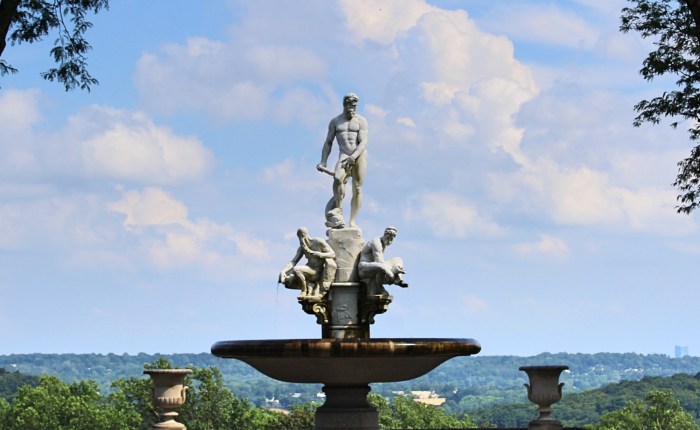
The bus deposited us in front of the house, near an impressive Oceanus fountain, copied from a fountain in Florence. Ivy crawls up the stone facade, all the way up to the neoclassical tympanum. An eagle crowns the top, displaying the family crest. From there the guide led us up onto the porch, where two strikingly modern statues stand flank the doorway. This is a constant feature in Kykuit: the juxtaposition between classic and contemporary tastes. John D. Rockefeller himself had very little taste in art, conservative or otherwise; his son, Junior, was enamored of the past—Greek, Medieval, even classical Chinese. Meanwhile, Junior’s wife, Abby, and his son, Nelson, were important patrons of modern art. Thus the house is an, at times, uneasy incorporation of these divergent tastes.kykuit_side

As a case in point, there are beautiful examples of Chinese porcelain on display throughout the house, protected by plexiglass cases. (The guide explained the glass was installed to protect them from playing children.) In a room used by Nelson Rockefeller there is also the vice-presidential flag, commemorating his term under Gerald Ford. Nelson wanted to be president himself, and he had the experience to do it—he was the governor of New york from 1959-72—but according to Ron Chernow, his divorce made him an unpalatable candidate. (How times have changed!) There were also portraits of the Rockefellers, and a phenomenal bust of the bald, decrepit, and yet mesmerizing John D. Rockefeller Senior—whom I was excited to meet, since I had just read a book about him.
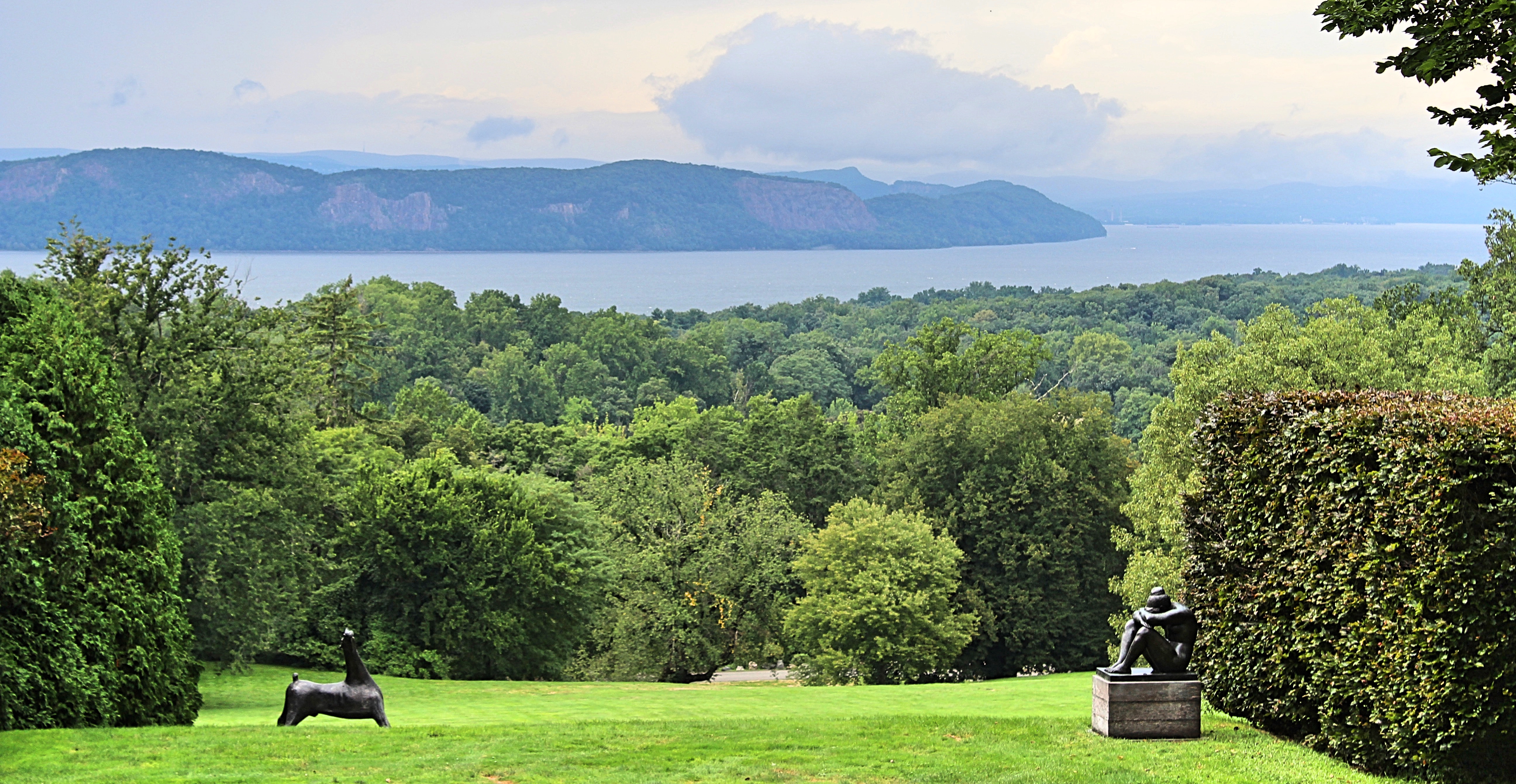
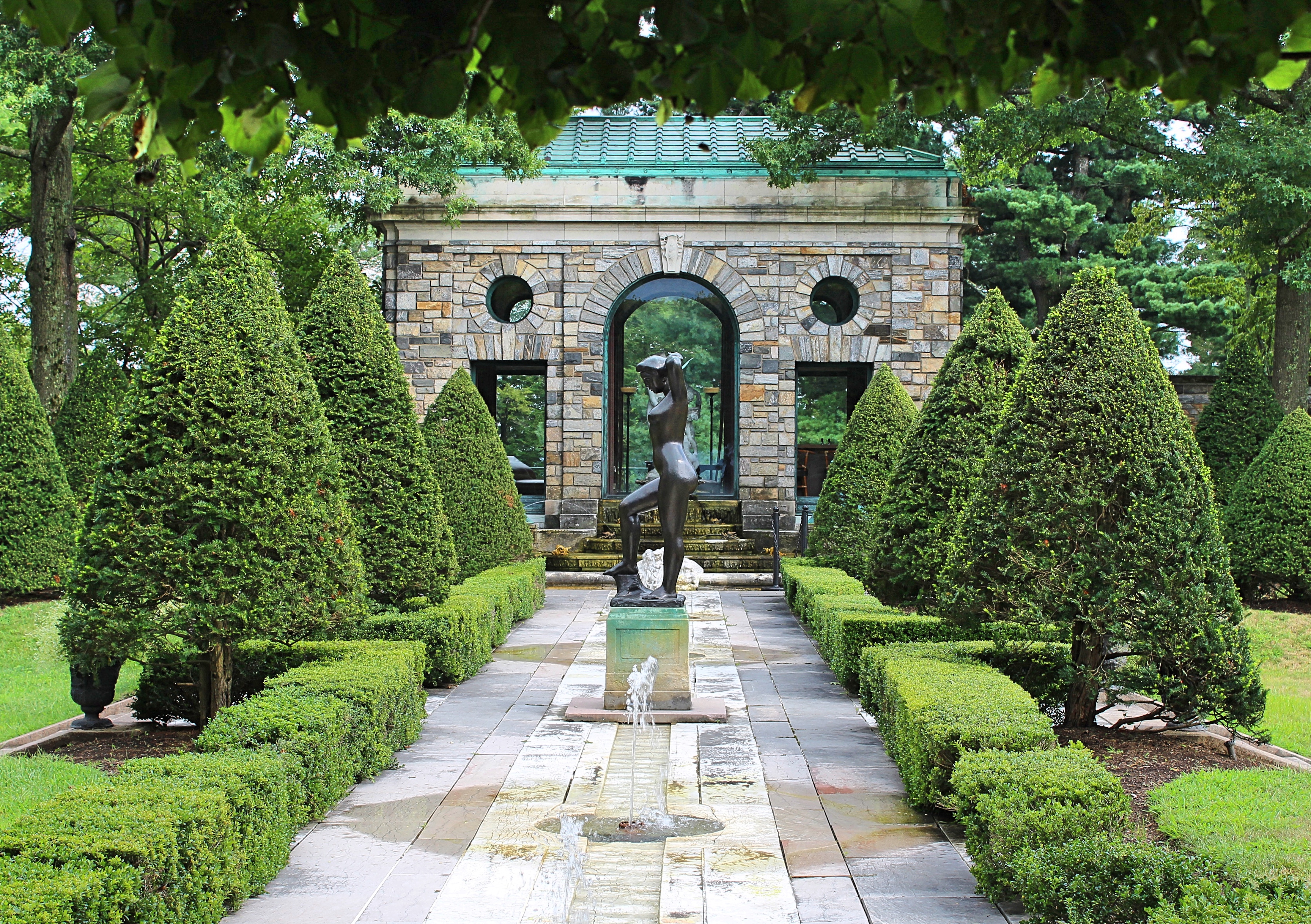
After this, our guide led us into the gardens. The most notable feature of these are the modernist statues scattered about—gruesome metal bodies amid neat hedgerows. Unsurprising for such a commanding spot, the view is excellent. On a tolerably clear day you can see all the way to Manhattan from the back porch. I imagined lounging on an easy chair, sipping some very posh drink—for some reason a mint julep comes to mind—and contemplating the Hudson. But of course the Rockefellers were Baptist stock, and teetotallers all, so the drink is pure fantasy. Beyond view (and beyond the scope of the tour) was the reversible nine-hole golf course that Rockefeller used with Baptist scrupulousness; after God and Mammon, golf was his top priority. Likely Rockefeller Senior would have been shocked and appalled by the massive modernist statue (resembling an alien squid) that was airdropped by helicopter into place on the property during his grandson’s tenure.
Then we made our way inside to visit the art gallery in the basement. This includes original works by many modern artist, the most famous being Andy Warhol; but the best works on display are undoubtedly the Picasso tapestries. These were commissioned by Nelson Rockefeller, to be made by Madame de la Baume Dürrbach, for the purpose of making his works easier to display. The biggest of these tapestries was a copy of Guernica, now on display at the United Nations building. Of the ones in this private gallery, my favorite is of Picasso’s Three Musicians (the original hangs in the MoMA). Even when I toured Kykuit as a child, tired, hungry, and very bored with all this old-people nonsense, I was impressed that a person could have Picassos in his basement; and my opinion has not changed.

To speed through the tour somewhat, we eventually boarded the bus again to go back to Philipsburg Manor. However, we did stop at the stables on the way back, which was filled with antique horse carriages and old luxury automobiles. In addition to being an avid golfer, you see, Rockefeller Senior also loved to go riding in his carriage and, in later life, to take fast drives in his fancy cars. (A strange detail from the biography is that, in later life, the upright and conservative Rockefeller would grope women during these rides. He was a man of many contradictions.)

This fairly well sums up my visit to Kykuit. It is an impressive place—six floors, forty rooms, and twenty bedrooms. Even so, considering Rockefeller’s vast fortune, and considering the kinds of monstrous mansions that other rich families—most notoriously the Vanderbilts—built for themselves, it is a restrained edifice. One can see the old Baptist tastes coming through, even amid all this wealth and splendor. Even so, I cannot imagine living in such a private world, so far removed from pesky neighbors and city noise. But the Rockefellers apparently had no trouble with the house. Nelson Rockefeller lived in it up until his death in 1979, when it was donated for use as a museum.

Before ending this post, I should also mention two nearby Rockefeller monuments.
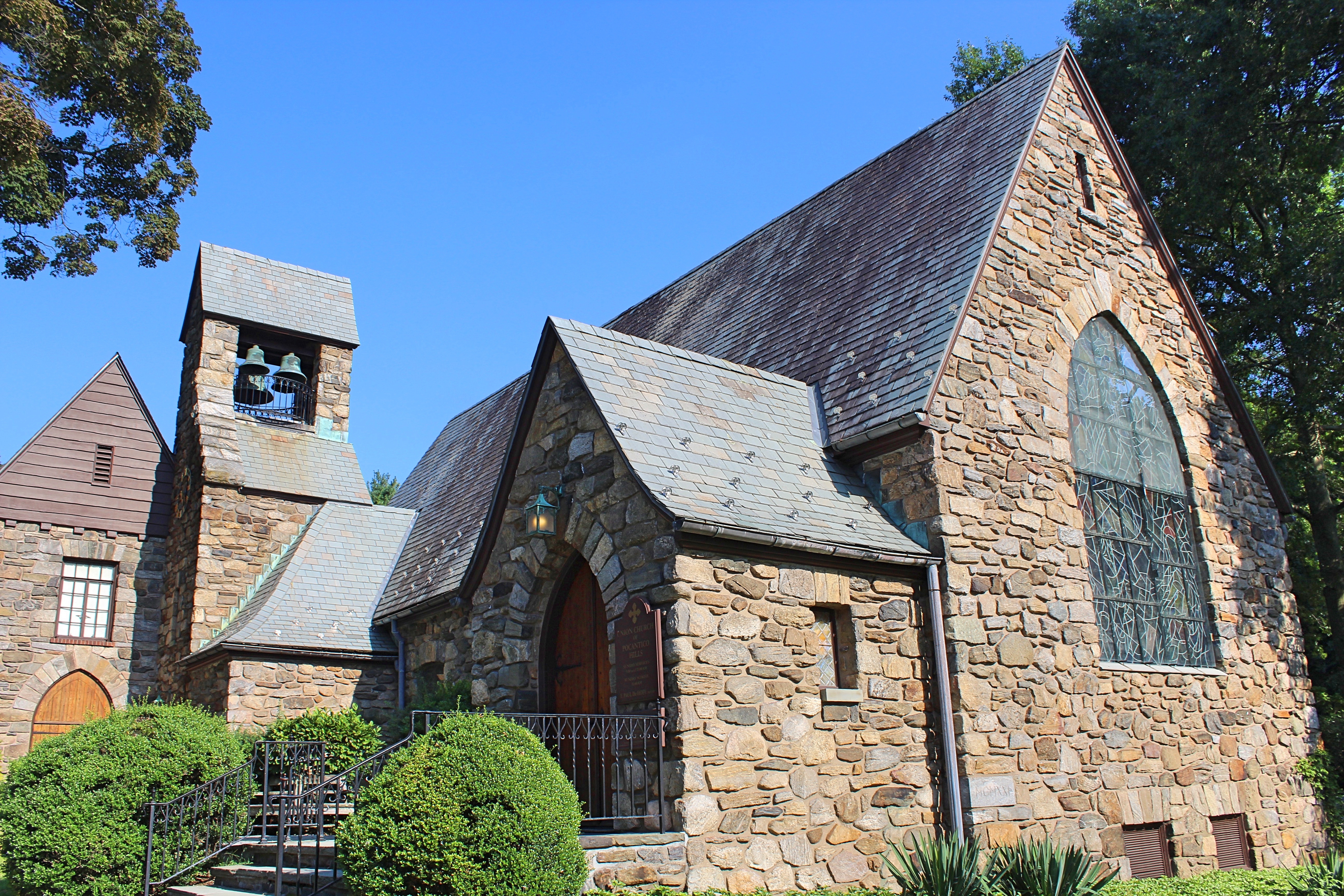
The first is the Union Church. This is one of two non-denominational churches (the other being Riverside Church in Manhattan) commissioned by John D. Rockefeller, Jr. It is an attractive and modest building, made of cut stone with a steeply slanting roof. Though the church does have an active congregation, most of the time its main use is as a tourist attraction, also administered by Historic Hudson Valley. The church is notable for its stained glass. The rose window was designed by the modernist pioneer Henri Matisse; according to the guide (I was the only one on the “tour”), it was the last work the artist ever completed. It is a simple, abstract pattern, yet subtly interesting to look at. More memorable, however, is the series of stained-glass windows completed by Marc Chagall, using Biblical scenes to commemorate deceased members of the Rockefeller family. Though I am normally not greatly fond of Chagall’s work, I must say that the strong, simple colors of Chagall’s windows created a pleasant—if not exactly religious—atmosphere.

Stone Barns

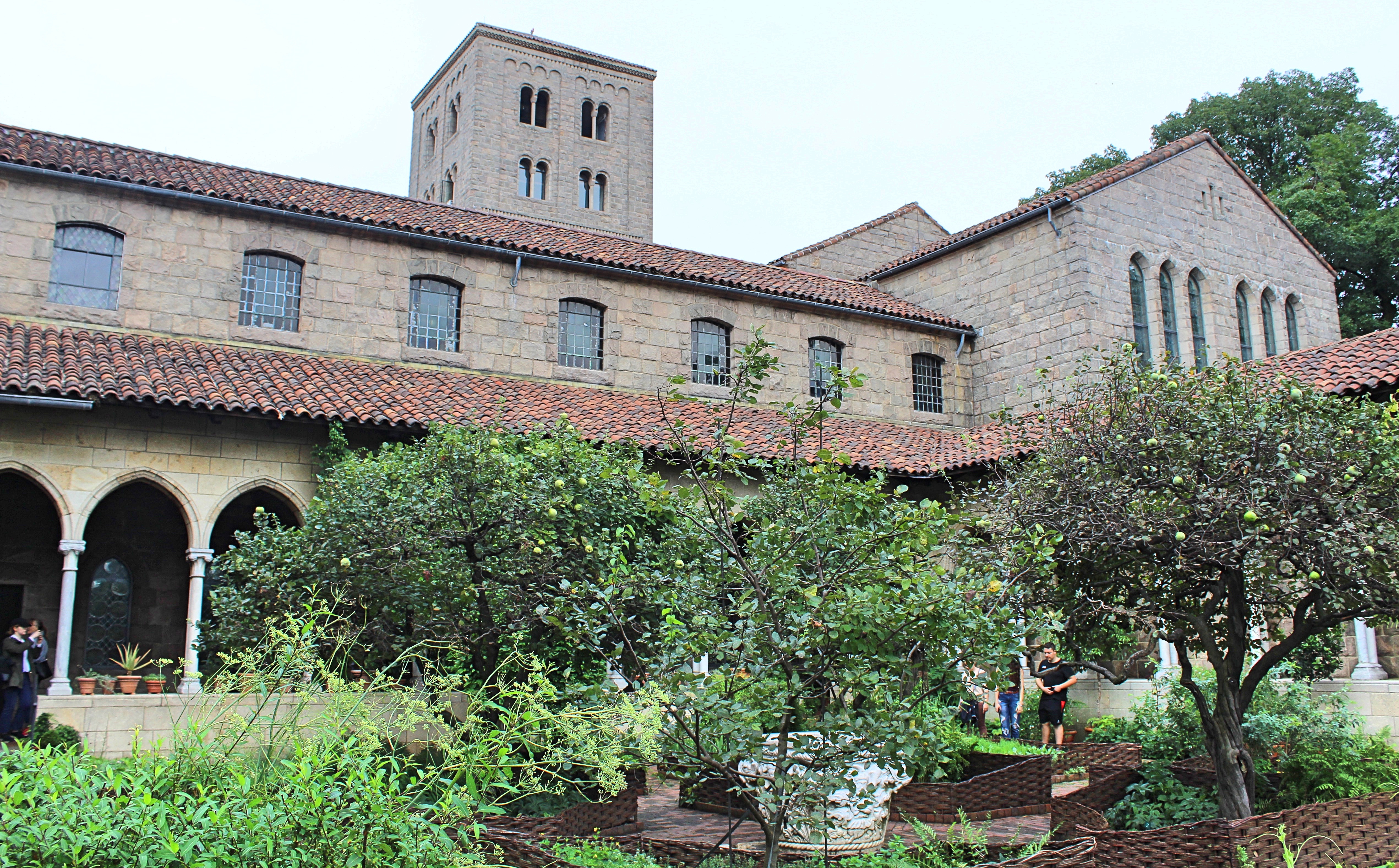
The second Rockefeller institution is Stone Barns, a center for sustainable agriculture established by David Rockefeller (Junior’s youngest son). (Sharing the Rockefeller talent for long life, David passed away just last year, at the age of 101.) The center lies on the edge of the Rockefeller State Park, alongside Bedford Road, surrounded on all sides by rolling farmland. It is a very pleasant place for a stroll. The buildings of the complex are completed in a style reminiscent of Union Church, as well as of the Cloisters museum in Manhattan: deep-grey cut stone. The farm is dedicated to growing high-quality produce and livestock without using anything “artificial.” Some of its products are served in the famous Blue Hill restaurant on the property—a place so absurdly fancy and expensive that, judging by the way things are going, I doubt I will ever get an opportunity to try. The menu, which costs $258 per person, consists of many different courses of artisanal dishes using esoteric ingredients. I have bought cheaper transatlantic plane tickets.
Processing…
Success! You're on the list.

Historic Hudson Homes: Sunnyside

Historic Hudson Homes: Sunnyside

This is part of a series on Historic Hudson Homes. For the other posts, see below:


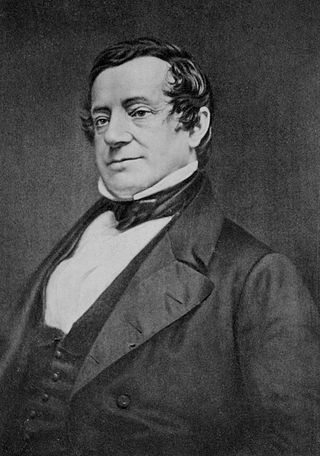
Washington Irving haunts my corner of Westchester like a beneficent ghoul. As a quintessential New Yorker, and the first American writer to gain international prominence, he left monuments to his memory scattered about everywhere. In my native town of Sleepy Hollow, he is inescapable: our municipal statue, our high school football team, and our most famous landmark, the cemetery—not to mention postcards, ghost tours, haunted hayrides, and all our other identifying symbols. Irving was clearly a generous person, as he donated his own name to the town next door, Irvington, where his house still remains as a tourist attraction.

320px-Irving-Washington-LOC
Washington Irving

In the grand scheme of the universe, Sunnyside is quite close to my own domicile. Yet when, like me, you lack a car; and also, like myself, you enjoy walking places, the journey can take a long while. Luckily the walk there is very pleasant, since Sunnyside is right next to the Aqueduct trail that extends from NYC all the way to Croton. The path took me through the heart of Tarrytown, across Route 9, and then past Lyndhurst mansion—another historic Hudson home, an extravagant neo-gothic castle once owned by Jay Gould. After that I passed by a large property owned by the Belvedere Family Community (otherwise known as Unificationists), who have chosen this picturesque spot to bring about world peace.  

By the time I reached Sunnyside I was tired and very sweaty. But paying customers, even smelly ones, are seldom turned away. Sunnyside is run by the Historic Hudson Valley, an organization which administers several other sites along the river (such as the subject of my next post, Kykuit). To visit you must sign up for a guided tour, which you do in the gift shop (as you are conveniently surrounded by overpriced books and paraphernalia); the price is a little more then $20. As I waited for the tour to start, I was tempted to buy a copy of Irving’s History of New York, his breakthrough piece of social satire; but I remembered I already have a copy on my Kindle. For all its social ills, technology does occasionally save us from gift-shop prices.

Sunnyside_Tarrytown_Currier_and_Ives_crop_closeup
An artist’s rendering

In minutes, the tour commenced. Our pleasant guide, who was dressed in period costume, took us to our first stop: a ripe old sycamore tree, planted in the heart of the property. It has been growing there since 1776—respectably middle-aged for a tree but not exactly venerable. Our guide then directed our attention to the property itself. Apparently Irving was an amateur gardener and landscape designer, and helped to mold his property according to his romantic tastes. Here there are no French gardens, with neat hedgerows and grid-like walking paths, but something more akin to the English Gardens in Munich: a blend of planning and nature.

Of course, the property was originally much nicer, since it extended all the way to the Hudson River. But when the Hudson Line railroad was completed in 1849, it cut off his property from the water; and I cannot imagine the country-loving writer had much affection for the noisy, screeching, fuming locomotives chugging before his windows. Even today, the whooshing of the Metro-North disturbs the peace of this hitherto isolated spot. In fairness, the Metro-North has compensated by naming a few of their train cars after the famous writer and his creations—Headless Horseman, Knickerbocker, Ichabod Crane, Rip Van Winkle, and so on. I should also note that the observant rider on the Hudson Line can catch a glimpse of Sunnyside between the Irvington and Tarrytown stations, somewhat south of the Tappan Zee Bridge.

Sunnyside_west_facade_and_piazza
The West Façade. Photo by Beyond My Ken; licensed under CC BY-SA 4.0; taken from Wikimedia Commons

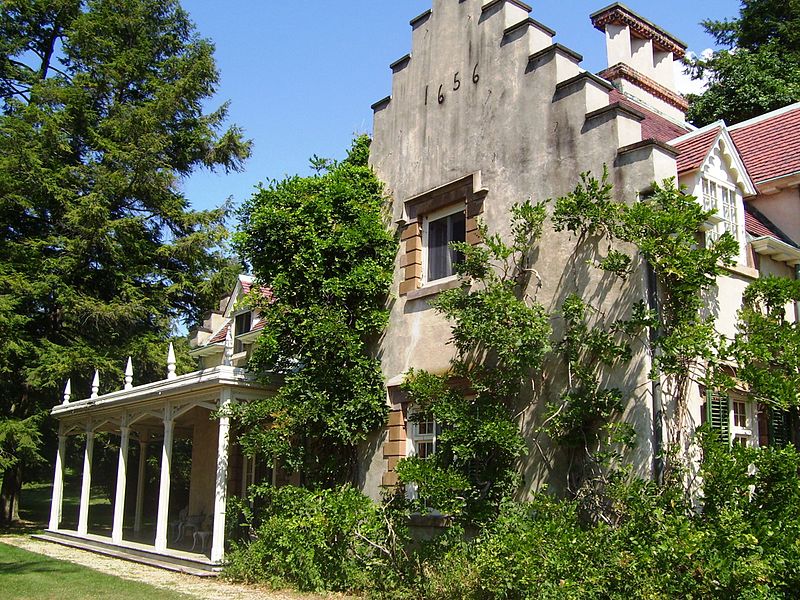
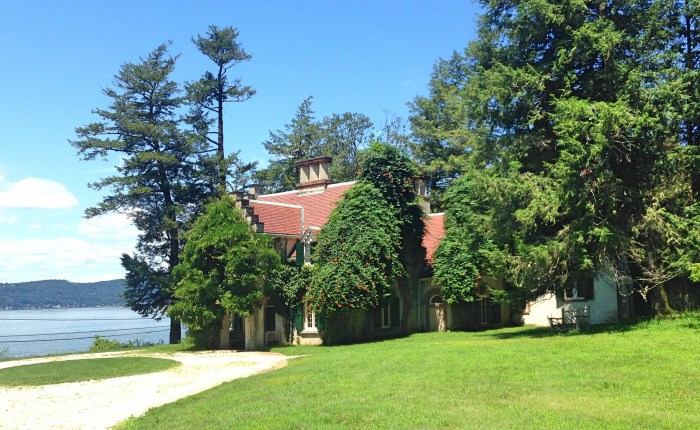
The building of Sunnyside itself is arrestingly modest—indeed, hardly bigger than my own suburban home. Its exterior bears the whimsical and fanciful humor of its maker. Most obvious is the Dutch stepped-gable, which shows how fascinated Irving was with the original Dutch inhabitants of this region. (His most famous characters, and even his own pseudonym, Knickerbocker, bear testimony to this interest.) On the river-facing side of the house he put the date 1656—a date which only roughly corresponds to the first cottages build on this land by Dutch settlers (in the 1690s), and which shows Irving’s love for mixing fact and fiction heedlessly together (as he did in his history of New York and his biography of Columbus). And last we come to the so-called Spanish tower, whose sharply swooping roof is modeled after Spanish golden age architecture (such as the El Escorial). Irving, you see, spent a good many years in Spain as the American ambassador (I cannot even escape him here!), so he was naturally interested in Iberian architectural styles.

Sunnyside_Spanish_Tower
The Spanish Tower. Photo by Beyond My Ken; licensed under CC BY-SA 4.0; taken from Wikimedia Commons

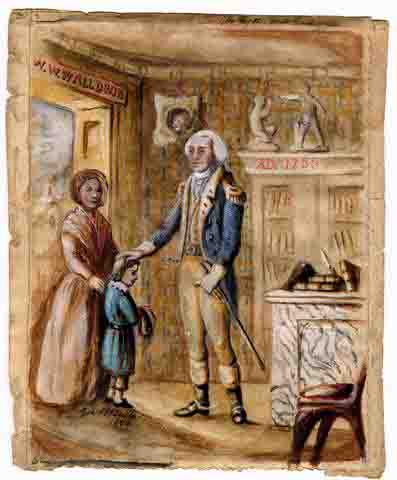
My memory of the interior is necessarily more vague, since you cannot take pictures. In any case, there are few surprises—a study filled with books, a living room with a piano for social events, a bedroom (where Irving happened to die), and so on. My favorite object on display was a little watercolor, apparently by Irving himself, depicting his legendary meeting, as a boy, with his namesake George Washington. (According to our guide, it cannot be determined whether this meeting actually took place.)

Irving had little more than twenty years to enjoy his cottage, from its construction in 1835 to his own demise (he died of a heart attack in the bedroom upstairs) in 1859; and this was interrupted by his long stay in Spain. Though he chose the spot for its picturesque isolation, considering it a kind of writerly escape from the noise of Manhattan, he seldom had peace: besides the railroads, he had to contend with many visitors, both invited and uninvited. If we had to look for a modern parallel to the fame Irving enjoyed, we would have to choose a figure such as Stephen King or George R.R. Martin. Both he and his house were a sort of American monument, gracing the covers of magazines and attracting tourists. Besides this public attention, the bachelor Irving shared his house with his brother Peter, and Peter’s daughters, whom had fallen on hard times. Irving’s very presence transformed this country escape into a center of American culture.

Washington_Irving's_Encounter_with_George_Washington
Washington Irving meeting George Washington

There is little more to add. After Irving’s death the family lived on in the house for several generations, only finally parting with it in 1945. For its preservation we must thank a man who is quickly becoming one of the heroes of this blog: John D. Rockefeller, Jr., who bought up the house and turned it into a museum. For any lovers of literature or history in the Hudson Valley, it is well worth a visit.

NY Museums: The Cloisters

NY Museums: The Cloisters

This is part of a series on New York City museums. For the other posts, see below:


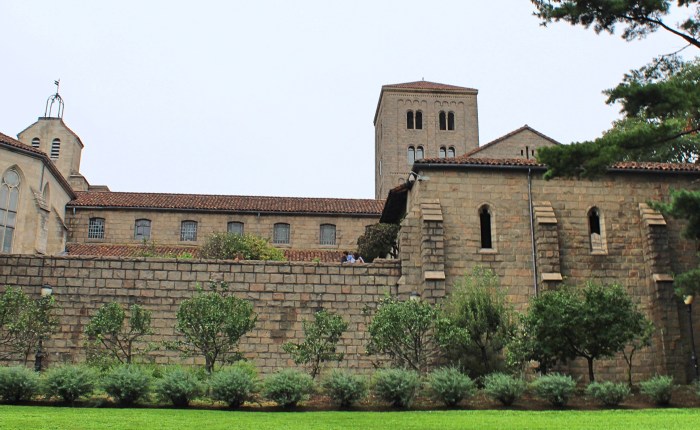
Sitting atop one of the highest points on the island of Manhattan, overlooking the palisades of the Hudson Valley stretching northwards, is the most convincing slice of Europe in New York—perhaps in the country. This is the Cloisters, a branch of the Metropolitan Museum, specializing in medieval art and architecture.

Like any great museum, the story of the Cloisters begins with a person and his vision. In this case we have George Grey Barnard, a European-trained sculptor and collector, who managed to acquire a large collection of medieval sculptures, pillars, and and tombs during his time in France. He did this by focusing on stones that had been the victims of pillage and war—often repurposed by local populations for mundane needs. This was an especially amazing feat, considering that Barnard—an exuberant and impulsive man—was not wealthy to begin with, and had terrible spending habits which often landed himself on the verge of financial ruin.

Junior
John D. Rockefeller, Jr.

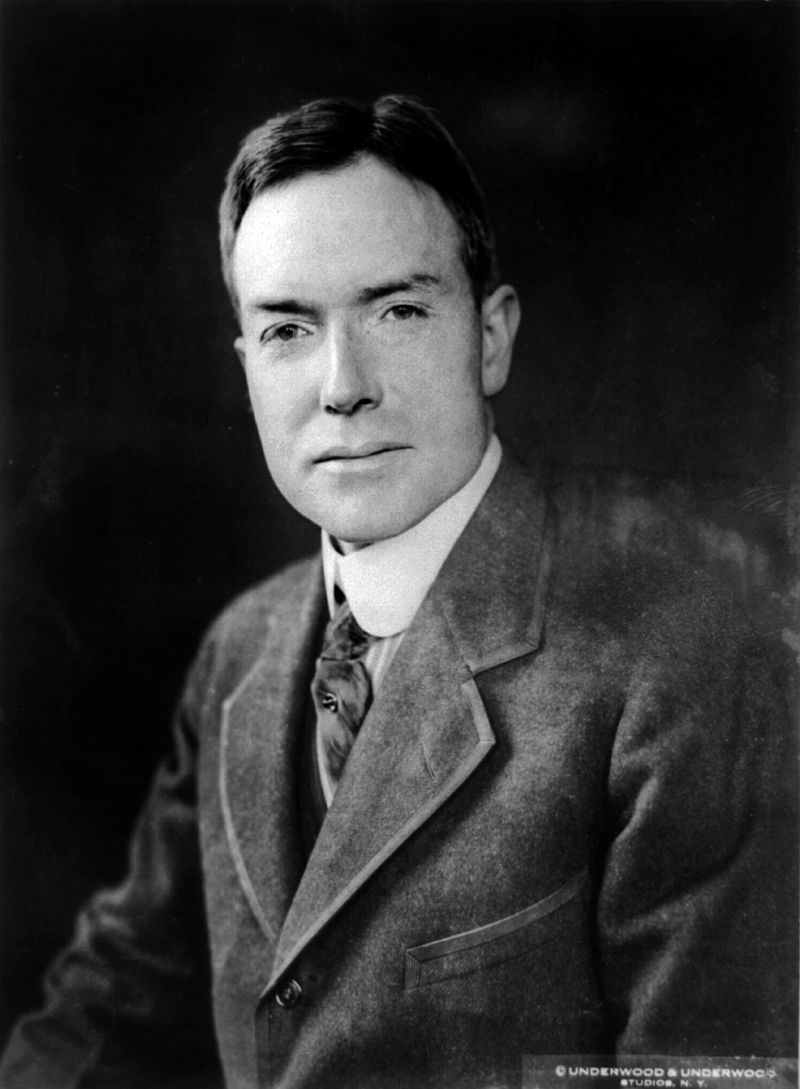
It was during one of his periodic pecuniary crises that he was forced to sell his collection to John D. Rockefeller, Jr., a man who could hardly have been more different—puritanical, reserved, prudent. But the two men shared a love for medieval art; and Barnard’s collection was the first step towards Junior’s dream of opening a museum in this romantic niche of Manhattan.

Things moved rather swiftly with the world’s wealthiest man financing the project. After the acquisition of Barnard’s collection in 1925, Junior had Fort Tyron Park built around the chosen site (designed by the descendants of the designer of Central Park); then, he had substantial sections from abbeys in Catalonia and France shipped to New York, where they were incorporated into a single structure. The museum was then donated to the Metropolitan Museum, and the park to the city. The result is an oasis of medieval Europe in uptown Manhattan.

It is interesting to compare this museum to the one founded by Junior’s wife, Abby Aldrich: the MoMA. They are a study in contrast. The MoMA sits right in the center of the city, surrounded by activity and noise; its design is sleek and modern, with a vertical orientation and sterile white walls. The Cloisters is situated far from the city center; indeed it is somewhat inconvenient to visit the museum, since it is so out of the way. The surrounding park is quiet and bucolic, a haven from the noise and stress of city life. The museum building itself is an attempt to recreate the past: using traditional materials and techniques to mimic a bygone age. If the MoMA tries to break with tradition, the Cloisters tries to break with modernity. It is a wonder that Junior and Abby got along so well, since they had such diametrically opposed attitudes to art.

cloister_cloisters

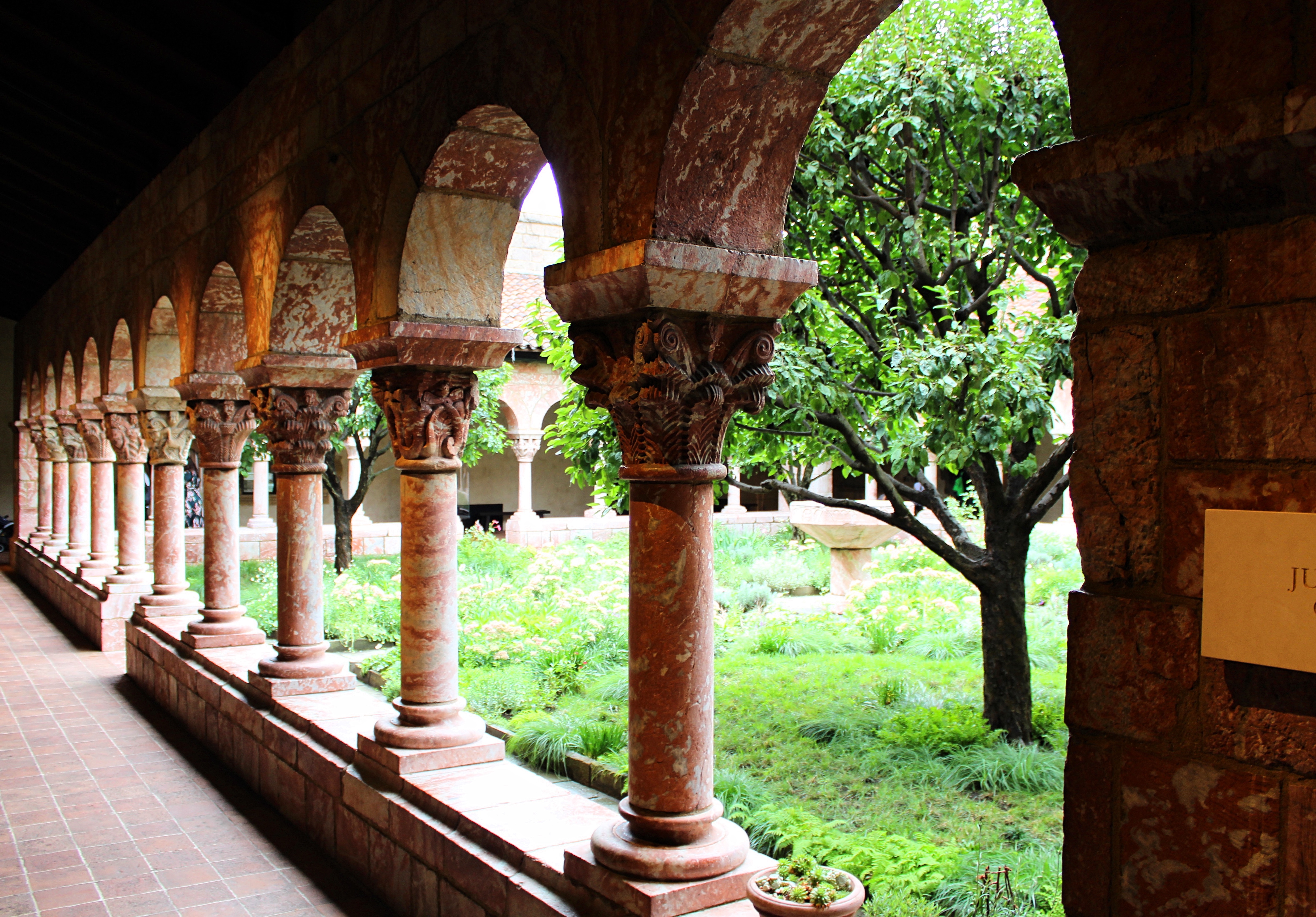
The Cloisters is exceptional in that the building itself is one of the main attractions. Whenever possible, the original materials have been integrated into the structure, creating a faux-monastery, complete with quasi-churches and pseudo-cloisters, where imaginary monks perform invisible rituals. There are several ornamented doorways, with sculptures climbing up the sides and crowning the top. Some walls display decorative friezes—Biblical scenes and medieval bestiaries—and the windows shine with colorful stained glass. The cloisters have authentic columns, complete with Romanesque capitals; and there are three gardens where rare plant species pertinent to the medieval mind are grown. (Apparently, the madonna lily is associated with love and fertility.)

garden_cloisters

As for the museum’s collection, on display are fine examples of every type of medieval plastic art: paintings, altars, carvings, sculptures, reliquaries, sarcophagi, illuminated manuscripts, stained glass, and tapestries. For the most part these are not organized by medium or style, but by their architectural setting: they are placed to create a harmonious and authentic experience. Thus walking around the Cloisters is akin to exploring a great cathedral, whose every chapel contains distinct works of art, organized by religious themes rather than academic categories. The final effect is not an emphasis on any one piece in the collection, but on the collection as a gestalt: an integrated, aesthetically captivating space.

interior_cloisters

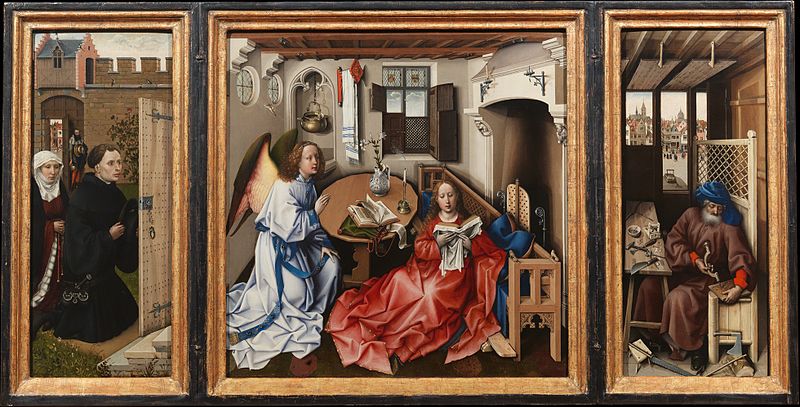
Nevertheless some pieces to stand out for special comment. One is the Mérode Altarpiece, whose central panel depicts the annunciation. It is a wonderful example of Dutch realism, showing a celestial scene taking place in a modest Dutch living room. I particularly like the Virgin’s round, plump face, and her carefree expression as she idly reads a book, not even bothering to look up at the angel bearing news of universal significance. In general the interior is convincingly painted—filled with fine detail, especially the book lying open on the table—but the perspective is a little uneven, as you can clearly see when comparing the table to the room. The kneeling figures of the donors are on the left-hand panel, looking appropriately wan and penitent. On the right, Joseph (looking considerably older than his wife) is busy at work as a carpenter; and behind him, through the window, we can see what is obviously a lovely Netherlandish town. (Biblical scholarship was not highly advanced in those days.)

Annunciation_Triptych_(Merode_Altarpiece)_MET_DP273206

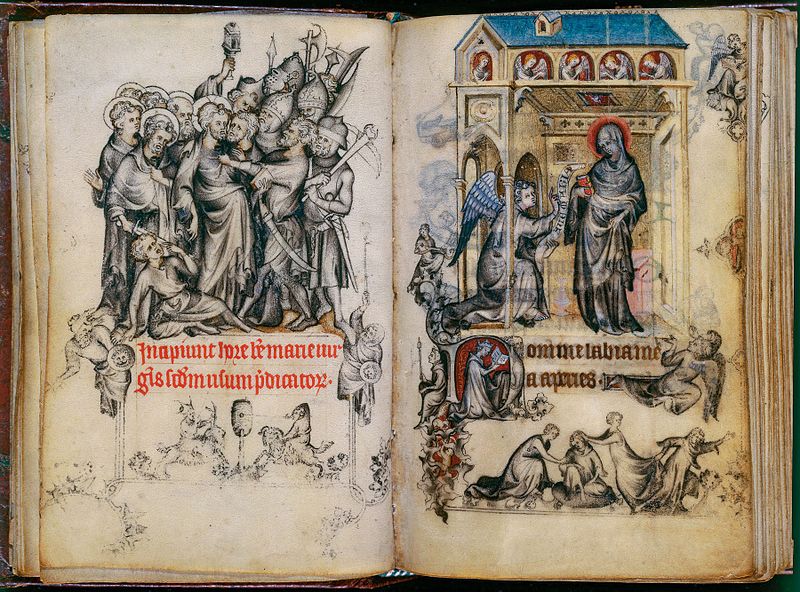
Besides Rockefeller Junior, an important early donor to the museum was J.P. Morgan, who contributed a few items from his incomparable collection of rare manuscripts (most of which, however, he kept for his own museum downtown). Among these are the Cloisters Apocalypse, the Psalter of Bonne de Luxembourg, and the Hours of Jeanne d’Evreux. This last is particularly impressive. A “book of hours” is a prayer book, usually made for wealthy patrons, containing prayers appropriate for different times of the day. In this case, Jeanne d’Evreux was the third wife of king Charles IV of France (reigned 1325-28); and the book was executed by the Parisian artist Jean Pucelle, who was a witty inventor of drolleries (the little designs that frame the text in an illuminated manuscripts). In any case, the book is a terrific example of gothic illumination.

800px-4_Jean_Pucelle._Hours_of_Jeanne_d'Evreux._1325-28,_Metropolitan_Museum,_New-York

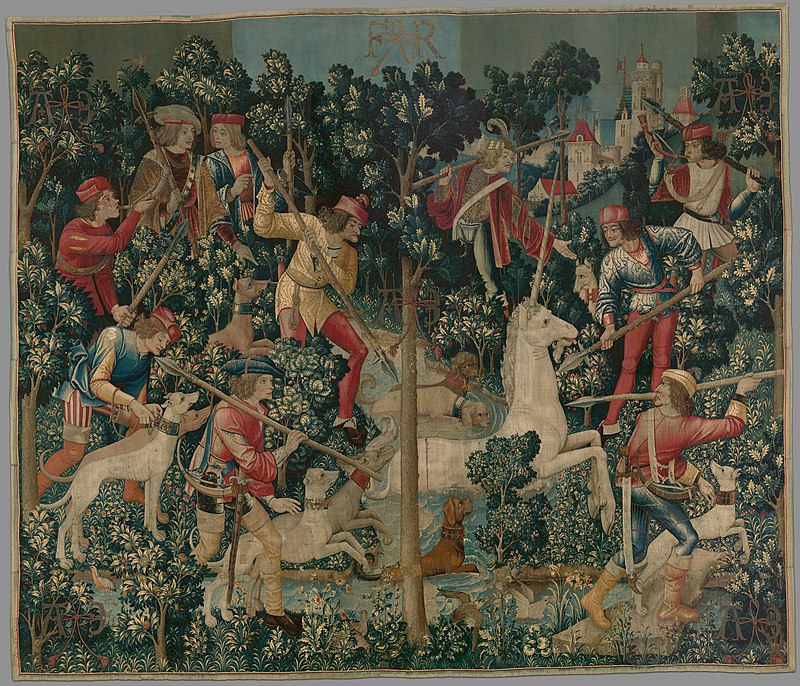
Yet my favorite work—and I suspect the favorite of many others—is the famed Unicorn Tapestries. This is a series of seven tapestries, depicting the hunt, capture, and (possible) rebirth of a unicorn. Its provenance is mysterious: First recorded in the possession of La Rochefoucauld family many years after their creation, then looted during the French Revolution (reputedly used to cover potatoes), the tapestries were ultimately acquired by Rockefeller Junior, who adored them and could scarcely bear donating them to the museum. But eventually his charity prevailed over his aesthetic greed, and now the tapestries hang in the museum for all to see.

800px-The_Unicorn_is_Attacked_MET1

What is immediately striking is the quality of their workmanship and preservation. I have seen a fair number of tapestries by now, and most are not nearly as detailed nor as vibrant. Scholars debate nearly everything about the works—their meaning, their relationship to paganism and Christianity, and even the order in which they should be seen. Nevertheless some basic narrative is obvious. A group of hunters sets out in the forest; they encounter the unicorn by a well, surrounded by other beasts; they attack; the unicorn defends itself, killing a dog with its horn and kicking a man; but the unicorn is surrounded, killed, and brought back to the castle (apparently with its horn missing). But there is one tapestry that is difficult to account for, showing a unicorn standing inside a fenced enclosure, alive and with horn intact. Where does this image fit in? Should it go first or last? Does the unicorn come back to life?

This last interpretation makes some sense, considering that the unicorn was used as a symbol for Christ during the Middle Ages. Still, the metaphor of hunting a unicorn seems odd for symbolizing the path to Christian salvation. Are the hunters supposed to be those seeking Christ’s wisdom, or is this rather a metaphor for the passion and death of Christ? I can hardly give a coherent answer; but the ambiguity only adds to the tapestry’s magnetic power. Yet even as images alone, the series is compelling: the lush forest, the atmosphere of fantasy, the dynamic encounters with the unicorn.

I am spilling words on these exceptional works, yet I feel I am failing to do justice to this museum—whose effect is never dependent on the excellence of a single piece. Indeed you might say that the building itself is the greatest work on display. Despite being a melange of elements—incorporating churches and monasteries from different eras and different regions—the Cloisters convincingly brings the visitor into the Medieval mindset: of chivalry, romance, nobility, and, most importantly, Christianity. Indeed, arguably the architectural eclecticism of the museum accurately captures the feel of medieval religious structures, which were often built over hundreds of years and incorporated several different mediums and styles.

cloisters_collage

So if you have any interest at all in the Middle Ages, I highly recommend taking the A train uptown (190th street station) to visit this shrine to a bygone age.

NY Museums: MoMA

NY Museums: MoMA

This is part of a series on New York City museums. For the other posts, see below:


I have always been prone to conservative tastes in music, literature, and art. I remember having long discussions in high school about the emptiness of contemporary music and the inanity of modern art (at the time, I knew close to nothing about visual art, ancient or modern). Every painting I encountered from the 20th century only confirmed my prejudices—using a minimum of technical skill to create images that were either incomprehensible or simply dull. At the ripe age of eighteen I mourned the decline in standards and the decadence of our culture.

Luckily, my tastes have broadened somewhat since then (though not as much as could be desired), and I have come to cherish the Museum of Modern Art as one of the great museums in New York—indeed, of the world.

Like many New York landmarks, the MoMA is a product of the Rockefeller family. Specifically, it was conceived and funded by Abby Aldrich Rockefeller, along with two of her friends.

Abby was the wife of John D. Rockefeller, Jr., who himself had a great love of art. However, he and his wife had diametrically opposed tastes. Junior was fond of Chinese porcelain and medieval art (which led him to develop the Cloisters Museum, uptown), while his wife was enamored with modern art. This occasioned not a few marital squabbles, since the straight-laced and puritanical Junior considered modern art to be degenerate and scandalously uninhibited. To add insult to injury, Abby wanted to demolish their old home to make way for the museum. Nevertheless, Junior offered the requisite financial support for his wife’s project, and so the MoMA was born. It opened in 1929, just a few days after the financial crash (while Junior was busy dealing with Rockefeller Center); and this opening marks a watershed in the institutional acceptance of modern art.

Upon entering the MoMA, the visitor should go all the way to the top, the fifth floor (American style), and then work her way down. Nearly all of the museum’s most famous paintings are to be found in this gallery, so it is best to go with fresh eyes.

starry_night

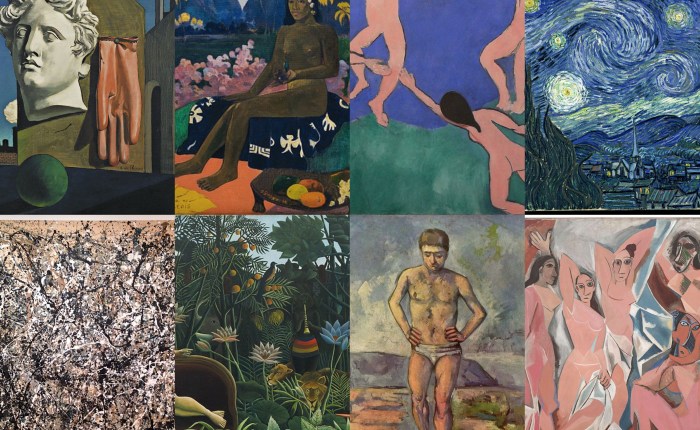
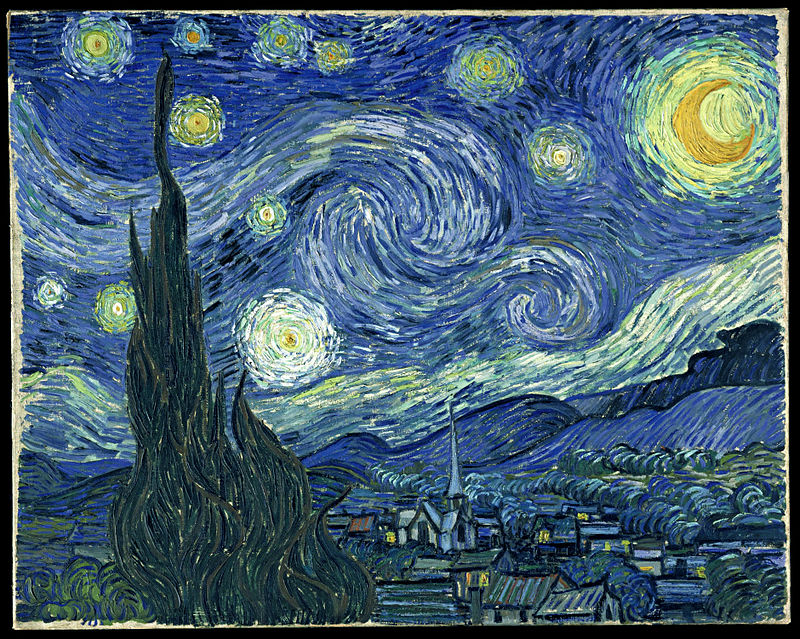
Almost immediately you will find the most famous painting in the collection: Starry Night. Like La Gioconda in Paris or The Birth of Venus in Florence, Starry Night is always surrounded by a swarm of buzzing tourists. Predictably, this detracts from the viewing experience. Much of the pleasure of a great painting consists in minute observation; and this is doubly true of Van Gogh’s works, which are so thick with paint that they are nearly tactile. In any case, I need hardly say that Starry Night is one of the great images of Western Art, as instantly recognizable as Guernica or the Sistine Chapel ceiling. The swirls in the night sky have been as overanalyzed as Mona Lisa’s famous smile: as turbulent manifestations of the artist’s epileptic visions, or as a profound insight into the physics of nebular star formation, or as an allegorical representation of Christ.

While I think Starry Night is undeniably among Van Gogh’s best, I admit that overexposure has diminished my enjoyment of the painting. It is like hearing a song played one hundred times on the radio: even if it is a great song, it will lose interest eventually. In any case, the painting is exceptional in many respects. Unlike the majority of Van Gogh’s mature work (characterized by the artist’s strong commitment to observation), it contains several imaginative elements. For one, the village in the distance is an invention: it was not visible from his window at the monastery in which he was staying. More striking, the swirls in the sky seem to be a purely imaginative detail—not only invented, but fantastical. Are they clouds, wind, or a spiral galaxy? Nothing quite seems to fit, which is strange in a painter so obsessed with working from nature.

Starry_Night_Over_the_Rhone
Starry Night Over the Rhône

The final result is a painting whose effect is somewhat different from Van Gogh’s other mature work. The Starry Night Over the Rhône, for example, is typical of the artist in that, despite not being “realistic,” it evokes the sensation of an actual starry night. The Starry Night in the MoMA, however, evokes a quite different feeling: that of a cryptic, quasi-mystical utterance.

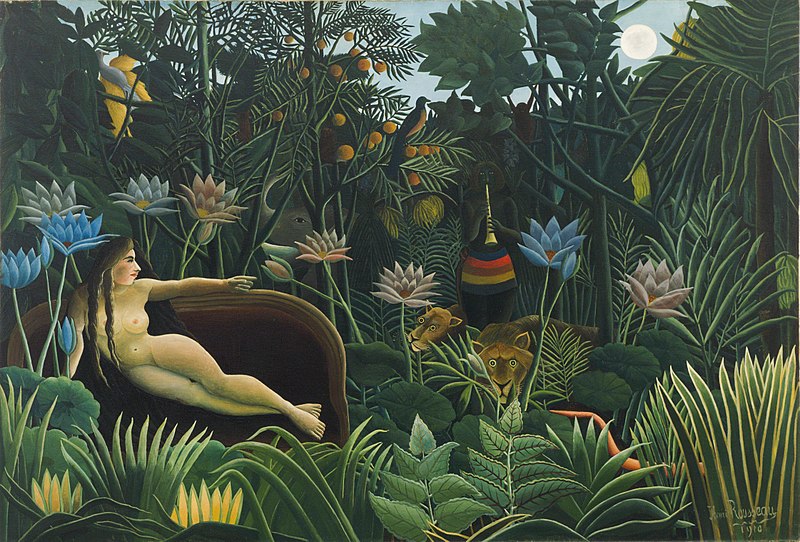
Another famous painting in this gallery is Henri Rousseau’s The Dream. It features a nude European woman reclining on a couch, in a reclining pose reminiscent of many European female nudes, such as Titian’s Venus of Urbino or Goya’s The Naked Maja. But she is not in a living room, but deep in the jungle, surrounded by exotic birds, tropical plants, two lions, and an African person playing the flute. The style is exaggerated and cartoonish, not exactly dreamlike but heavily stylized. The woman’s portrayal, for example, is almost Egyptian in its perspective: her body facing forward but her head entirely in profile, with both of her braids somehow in front of her chest. My favorite aspect of the painting are the large, hypnotic eyes of the lions, which serve to make the animals seem terrified rather than terrifying.

800px-Henri_Rousseau_005

However, I must admit that, on the whole, I do not find the painting terribly captivating to look at. I do appreciate it as a kind of satire of bourgeois dreams of the exotic: the gentile French woman, dozing in her salon, lost in daydreams of the lush forests of the Africa. And perhaps the snake tail sticking out from the bushes, and the fruit hanging on the tree above, tell us that this imaginary Eden is liable to implode when faced with actual knowledge.

Les_Demoiselles_d'Avignon

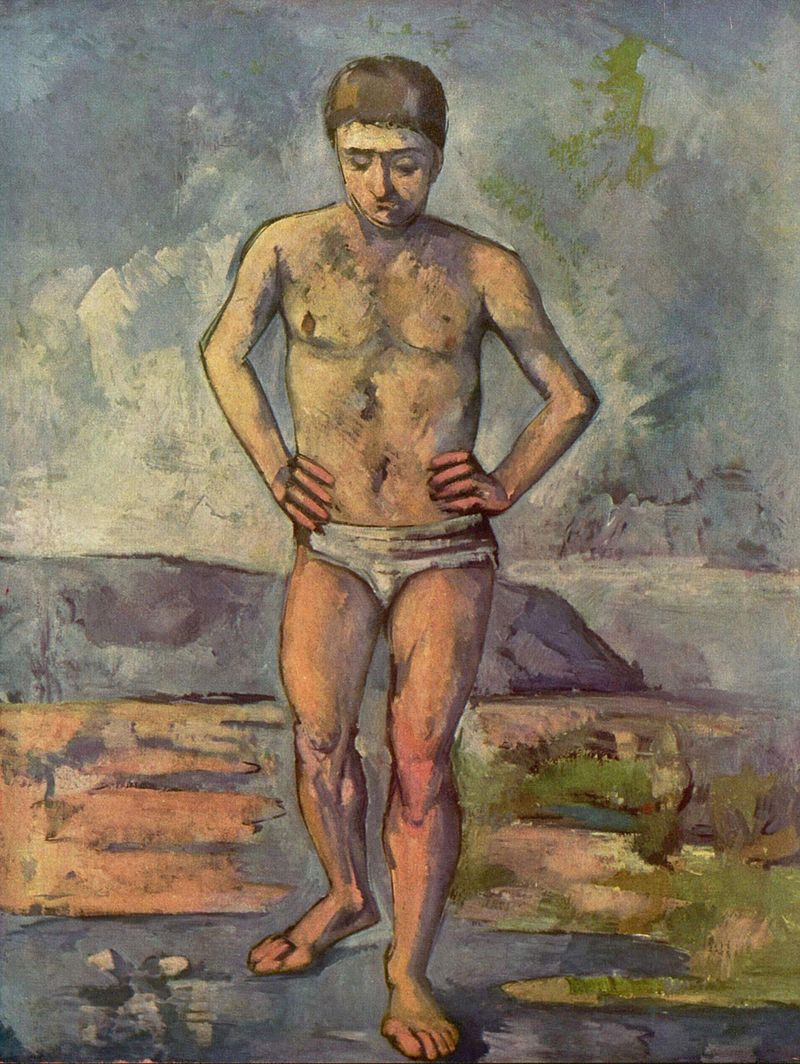
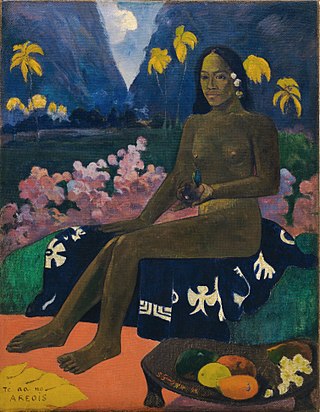
In the next room there are several works by Picasso, including what I consider to be, after Guernica, his greatest: Les Demoiselles d’Avignon. (In this case, Avignon refers to a street in Barcelona where prostitutes would congregate, not to the city in France.) It is a brutal, disturbing work. Picasso painted it in 1907, when he was still relatively obscure and was embroiled in a rivalry with the older Henri Matisse. At the time there was widespread interest in so-called “primitive” art, such as that of sub-Saharan Africa, Oceania, and pre-Roman Iberian sculpture. The painter Gauguin (who died in 1903) also contributed to this interest, since he had spent the last ten years of his life on the island of Tahiti, and had cultivated a “primitive” style in his late works. (This can be seen in Gauguin’s The Seed of Areoi, also at the MoMA.) Picasso combined this interest in the exotic with his admiration of Cézanne, whose daring landscapes pioneered the geometrical simplification that would become the basis of Picasso’s mature style. (The MoMA features several excellent works by Cézanne, including The Bather.)

The result is a painting utterly unlike any other in Western art. Five nude prostitutes gaze at the viewer, who is supposed to be a potential customer in their brothel. But there is not a hint of sensuality about these ladies of the night. Indeed, the extreme distortions of their bodies, and the mask-like form of their faces, transforms them into threatening monsters—particularly the two women on the right, whose faces bear the obvious influence of African art. The women have been literally objectified: reduced to distorted, two-dimensional placards. But the objectification turns them into objects of fear rather than desire; their curves are sharpened into knife-blades, their frontal gazes—traditionally a sign of invitation—are instead frightening blanks, devoid of any discernible emotion.

Compare this work with Matisse’s Le bonheur de vivre (The Joy of Life), completed just the year before; it shows us a colorful landscape full of voluptuous nudes, luxuriating in sensual pleasure. This is the ever-beguiling fantasy of sex. Picasso shows us the reality beneath the fantasy, the ugliness that we push into the shadows. For the relationship between the viewer as client, and the prostitutes gazing back, is dehumanizing for both parties. The women are visibly dehumanized—turned into thin masks, which perform their sexual function without pleasure or pain, without lust or hatred, but only a blank apathy. For his part, the client’s desire for sex becomes yet another financial transaction, performed mechanically—without enthusiasm and even without real desire—to fulfill mundane biological urges.

Perhaps I am reading too far into the painting, but for me the image represents the consequences of a repressive sexual morality: wherein a single man’s only opportunity for sex is the brothel, which in turn fuels a market that preys upon vulnerable women, pulling them into a cycle of poverty and abuse. Yet this is only one of an endless list of interpretations, as the helpless critic struggles to make sense of this pitiless image.

It was not a long way from these distorted forms to Picasso’s major breakthrough: cubism. Several cubist works of his hang nearby, as well as those of his partner in cubism, Georges Braque. I must admit that these works of “high” cubism always leave me cold: they are monochromatic and chaotic images, with at most the purely intellectual interest of a crossword puzzle. But there is no denying that cubism was the most influential movement of the period; through the painters’ experiments with perspective and abstraction, a new idiom was developed, a pictorial language that Picasso (among others) would later use to great effect.

Not far from here is a room mostly dedicated to works by Marcel Duchamp. Now, Duchamp is one of the most influential figures in 20th century art; in his program, The Shock of the New, Robert Hughes dedicates ample time to his work, and most of what he says is quite positive. For my part, I have been unable to penetrate this artist’s work, in part because he seems to represent what I generally dislike about modern art: namely, its abandonment of aesthetic qualities for intellectual games or self-involved irony.

duchamp_moma

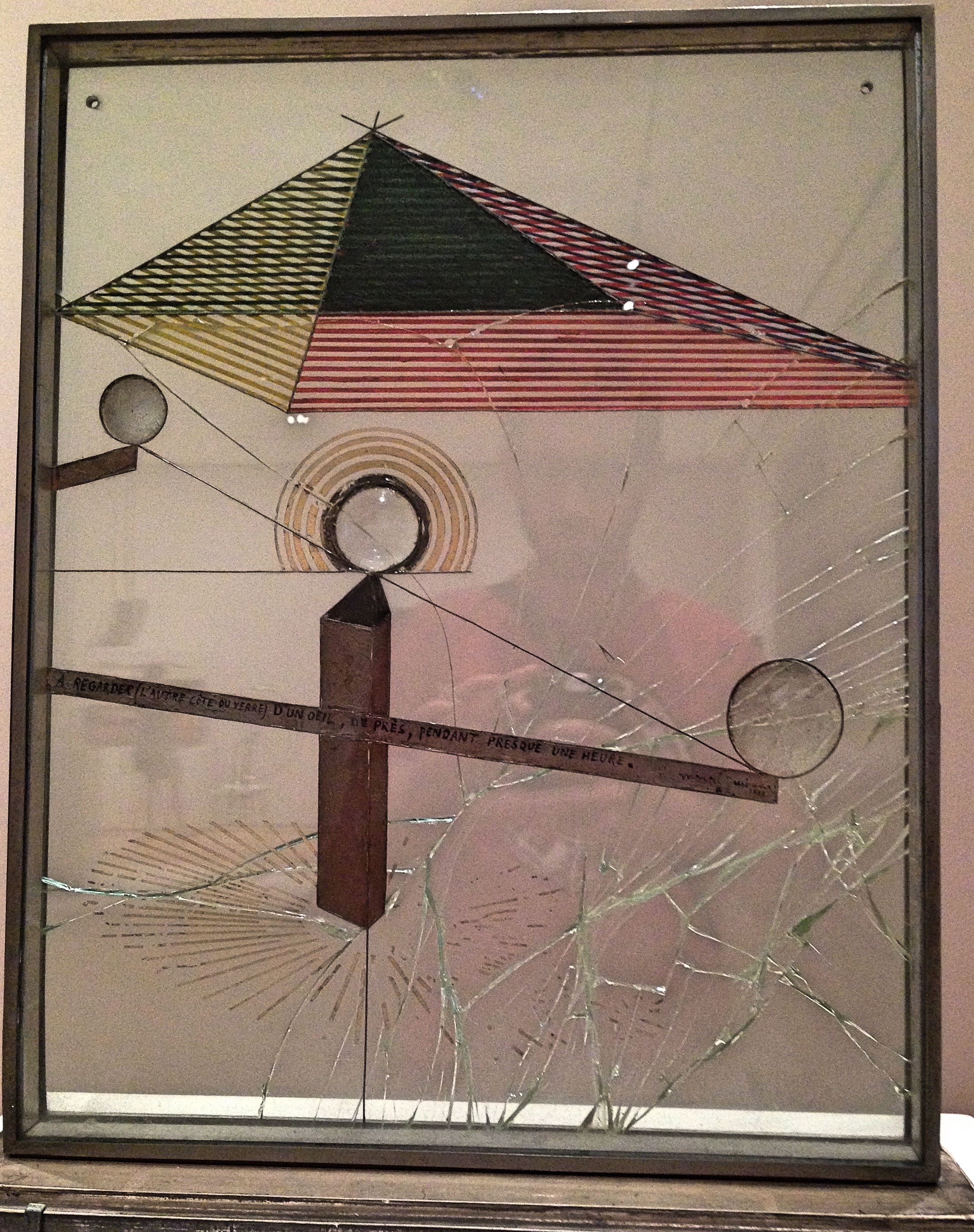
An example of this is his piece To Be Looked at (From the Other Side of the Glass) with One Eye, Close to, for Almost an Hour. It consists of two panes of glass with a magnifying lens mounted in the middle. On the glass is a geometrical design of a three-dimensional pyramid. The glass was unintentionally cracked during transport, which greatly appealed to Duchamp’s sense of random creation. I can see that the piece is a sort of ironic comment on science and perspective; the design and the lens suggest the meticulous representation of space, and yet it is a mere parody—the image through the lens is distorted and fuzzy. It is also a sort of ironic comment on the act of seeing in a gallery, since the viewer must dedicate a frankly unrealistic amount of time to experience the visual distortions induced by the lens. In other words, the whole point of this work, which uses symbols of seeing scientifically, is to see badly. Yet is it interesting to look at?

Another example of Duchamp’s work is Three Standard Stoppages. He made this by dropping a meter-long thread onto sheets of glass, so they it fell in haphazard shapes, and then gluing the threads to the glass. Afterwards, he made wooden “rulers” (whose length is less than a meter, since the thread is curved) using these shapes. The idea (or so the MoMA audioguide explains) is to show the arbitrariness and the boringness of the standard meter, as opposed to the spontaneous naturalness of these shapes. This is a fine idea; but again I do not see the point of creating a work of art which only serves as the prop for an argument. I remain old-fashioned enough to think that it should be beautiful in itself; this is one of my many intellectual shortcomings.

De_Chirico's_Love_Song

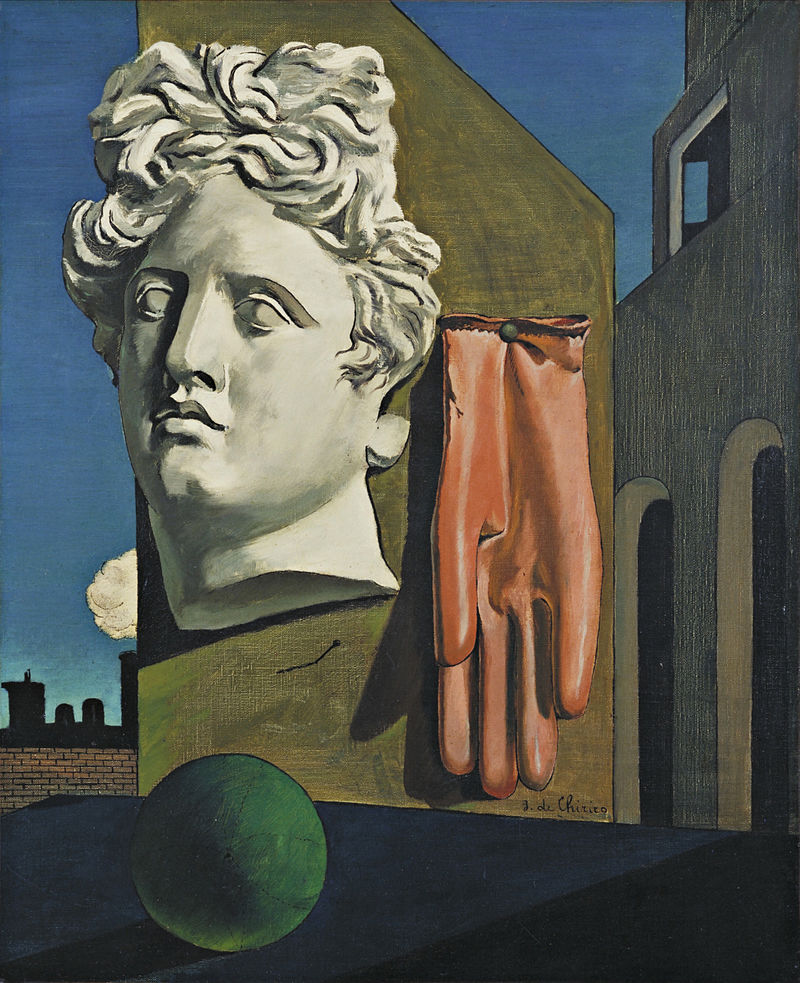
A room nearby is dedicated to the work of Giorgio de Chirico. Indeed, the MoMA has perhaps the world’s greatest collection of this elusive artist’s work, including his most famous painting: The Song of Love. Like so many of Chirico’s paintings, it is a baffling image: a rubber glove hangs from a wall, next to a beautiful antique bust (of Apollo?), with a green ball on the ground in front—all of this in a cartoonish urban landscape. Like many, I can only hazard a guess of what this all means. I suppose that the powerful juxtaposition of the bust and the rubber glove is suggestive of different interpretations of the human body—one a unique idealized image, another a prefabricated utilitarian object—indicative of the many cultural manifestations of the same underlying reality. But, really, whatever interpretation we choose to impose, the image persists; and it is memorable.

La_danse_(I)_by_Matisse

Another memorable image is Dance (1) by Henri Matisse. The work in the possession of the MoMA is a preliminary work for a decorative panel in the Heritage Museum, Saint Petersburg. If you keep in mind that this naive image was created in 1909, you can get an idea of how revolutionary it must have been. For there is not a hint of realism in the work; not only do the figures lack detail, but their postures are impossible—anatomically and perspectively. The landscape consists of two blobs of color, slashed across the canvass. And yet it is an utterly convincing image of joyous celebration. The freedom from realism is transformed into a freedom of all restraint, a kind of basic delight in movement and release. The painting is also a convincing demonstration that childlike can produce lasting art.

800px-Kazimir_Malevich_-_'Suprematist_Composition-_White_on_White',_oil_on_canvas,_1918,_Museum_of_Modern_Art

I have a much more negative opinion of another so-called childish piece in the collection, White on White, by Kazimir Malevich. Malevich was the creator of the Suprematist movement, which emphasized the use of basic geometrical shapes—squares, circles, lines, and so on—with a black-and-white color scheme. White on White consists of an off-white square positioned diagonally in a white canvass. Neither this painting nor any other of the Suprematist works on display produce even the slightest iota of emotion in me; they are not visually interesting or intellectually stimulating.

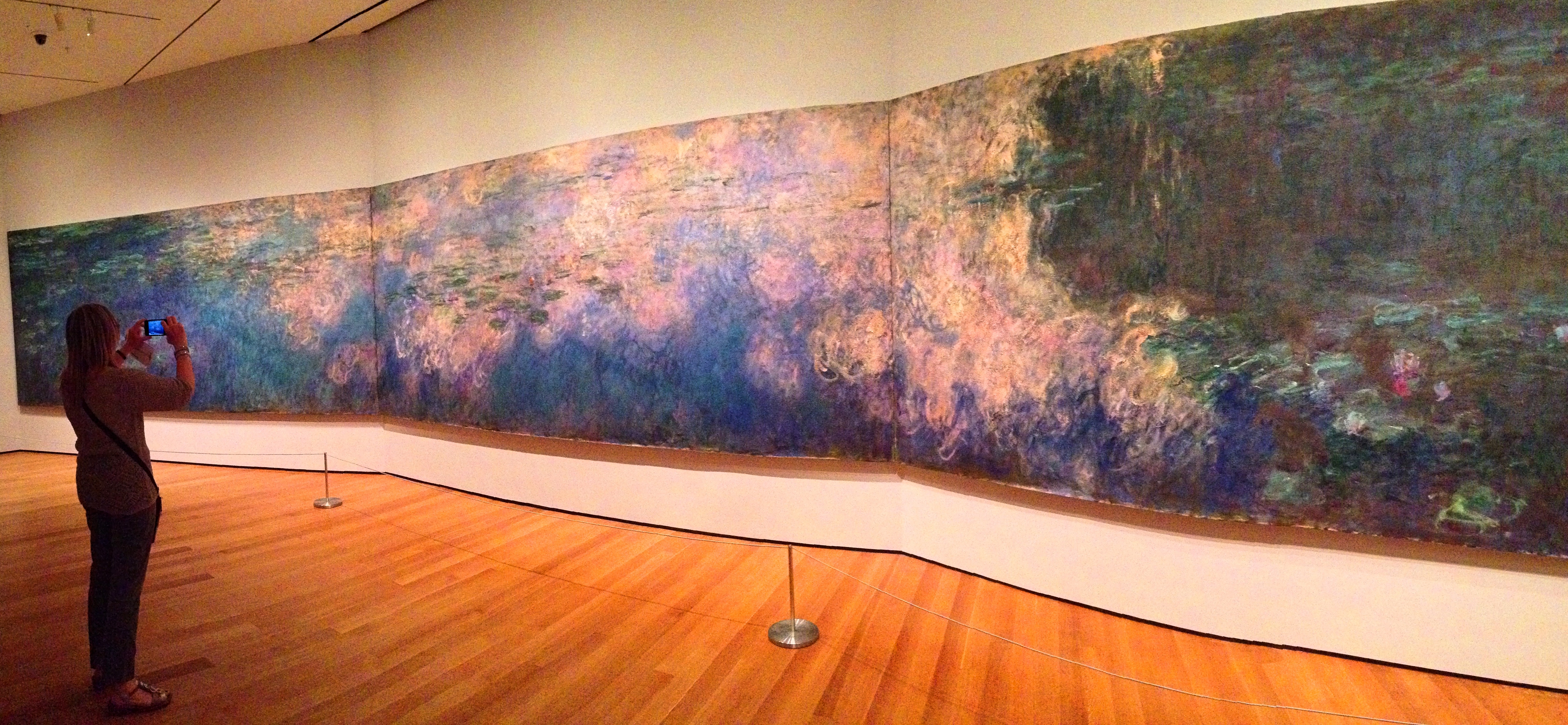
But I should not pause to cast aspersion, but should dwell on the paintings that I do like. Among these is, naturally, Claude Monet’s wonderful painting of water lilies, stretched out on an enormous canvass (well, actually three canvasses). In the later part of his life, Monet retreated into his own estate; here following Voltaire’s advice, he cultivated his own garden. This became his artistic haven, where he would sit for hours, working. The most famous and stunning results of this aesthetic quest are these enormous representations of the surface of his lily pond. (Monet made several of these; most are collected in the Musée de l’Orangerie in Paris.) The work is unmoderated aesthetic bliss: the swirling colors are so inherently peaceful and pleasant that they induce a sort of meditation, an artistic absorption in color and light.

waterlilies_monet_moma

I see that I am rattling on and on, as I tend to do, so I will restrict myself to two more paintings. But be advised that this list is only representative of my tastes, and does not adequately reflect the wealth of beauty on display.

As a somewhat begrudging fan of Dalí, I was delighted to finally see his Persistence of Memory. This image is so famous that it requires no description. Nevertheless, I think it is worth pausing to savor this painting’s brilliance. For no painting I know is such a convincing depiction of time. Contrast this work with another whose subject is time: The Ages and Death, by Hans Baldung. This painting, which hands in the Prado, represents time by showing its effect on the female body. It is an exceptional painting, well executed and well conceived; but it has none of the haunting power of Dalí’s work. For here time itself ages—it melts and droops pathetically. In Baldung time is universal, inescapable, and adamantine; but for Dalí time itself takes place in a larger environment—that suggested by the rocky landscape—and is itself subject to change. This leads us to ask: what is ultimate, after all?

pollock_moma

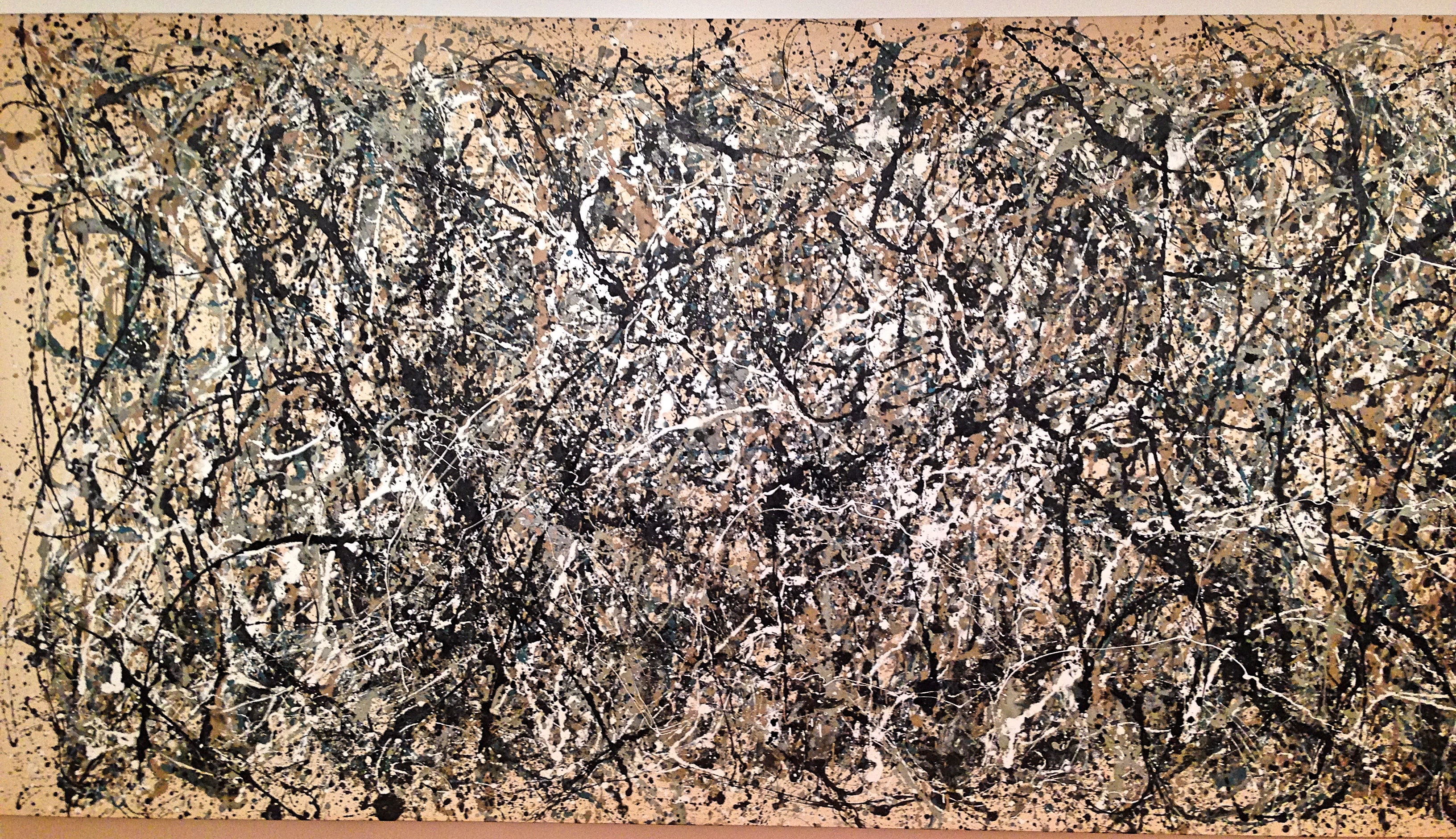
The last painting I will mention is Jackson Pollock’s One: Number 31, 1950. Admittedly, giving the name of a certain Pollock seems silly, since I at least would be at a complete loss to pick one out of a slideshow. Nevertheless I do want to single out this painting, and Pollock’s work generally, for its extraordinary energy. Though superficially random, any amount of inspection will reveal that, in fact, Pollock exerted an extreme level of control over his paint drippings. The result is a sort of explosion of human movement, an exploration of gesture, a kind of visual dance, where the overlapping colors create a rhythmic sensation, and the blobs of paint sticking out of the canvass make it nearly tactile.

If she is at all like me, the visitor will be quite exhausted by the end of this gallery. Yet this floor, although it contains the majority of the MoMA’s most famous works, is only a small fraction of its total exhibitions. On the next floor down are the more contemporary works, from 1940 to 1980. I will pass over this gallery in silence since, for me, visual art after the Second World War is hit or miss—and usually the latter. Below this, on the third floor, is a rotating special exhibition on architecture. When I went last year it was a fascinating exposition dedicated to Frank Lloyd Wright; this year it is dedicated to communist Yugoslavian architecture. On the second floor (European first floor) the collection continues from 1980 up to the present. Finally, on the ground floor is the Abby Aldrich Rockefeller sculpture garden, a peaceful place full of bizarre statues, plants, and benches, which is perfect for having a short rest.

This does it for my virtual tour of the MoMA. It is well worth a visit, not only because of its wonderful collection, but because it is one of the most significant institutions that governed artistic taste in the 20th century. Next, I will examine a museum founded by Abby Aldrich’s conservative husband: the Cloisters.

Review: 1491

Review: 1491

1491: New Revelations of the Americas Before Columbus1491: New Revelations of the Americas Before Columbus by Charles C. Mann

My rating: 3 of 5 stars

I should begin by saying that this book is not what I expected, which necessarily entails some disappointment. I was hoping for a more in-depth look at the major pre-Columbian societies and cultures. What this book instead offers is a sort of overview of trends in research in this area, highlighting how these trends contradict the popular image of the Americas before European colonization. This is, of course, also a valuable and worthwhile topic—and, considering the book’s popularity, many have found it to be so—but I nevertheless must admit that, after putting down the book, I still have only a hazy notion of the actual cultures in question.

Mann sets himself to undermine the popular notion of scattered groups of savages in a pristine, ahistorical paradise, living lightly off the land in a perfect harmony with nature. He sets out to show that, first, there were orders of magnitude more people in the Americas than was originally suspected; second, that humans arrived in the Americas far earlier than previously thought; and third, that pre-Colombian societies radically altered their environment. The picture that emerges is of a continent teeming with complex civilizations, each one manipulating the world around them in unique ways.

Due to the limited and often indirect evidence available to researchers, and the comparatively nascent state of the field, Mann is unable to give a textbook-like overview of pre-Colombian societies. Our knowledge is simply too fragmentary; there are too many scholarly disagreements. He instead chooses to focus on individual scholars and their lines of research, showing how these converge to suggest the aforementioned new conclusions. The advantage to this method is that his narrative is enlivened with the stories of real research; and it also allows Mann to give a more realistic impression of the state of our knowledge. But the disadvantage is that this book often reads like an extended Nat Geo article—the report of a journalist tagging along on research expeditions—rather than the bird’s-eye view I was hoping for.

Another major drawback is that, by focusing on pioneering research, Mann is unable to give answers that are wholly satisfying, since the field itself has not yet reached a stable consensus. The research he relies on for his section on pre-Colombian population, for example, uses a combination of indirect evidence and simple speculation. Granted, I was convinced even before opening this book that European diseases caused significant depopulation after first contact. But whether the fatality rate was as high as 90%, as he suggests, is difficult to accept without more decisive evidence. Personally I find it hard to believe that one-fifth of the global population (to use his figure) could die off without leaving a far less ambiguous archeological trace.

That the research is in this state is not, of course, Mann’s fault; yet he is not merely reporting the results of different experts in the field, but choosing those whose research most strongly supports this book’s thesis. This put me naturally on guard, since I know from my brief time studying archaeology how varied scholarly opinion can be in a field where evidence is necessarily scanty, incomplete, and suggestive. This being said, I do want to emphasize that I was convinced of Mann’s major points; it was only the details that put me in a dubious state of mind.

Mann’s habit of focusing on the research that most forcefully bolsters his conclusions is part of a more general tendency to overstate his case. For example, I find it difficult to accept Mann’s assertion that the first generation of European colonists did not have a decisive military advantage over their American counterparts (which supports the thesis that disease was the decisive factor in the conquest). Steel blades, guns, and mounted cavalry were all landmarks in military technology in Eurasia, so I do not see why they would not lend an advantage in this context. I also could not swallow Mann’s argument that American Indian cultures played such a decisive role in the emergence of Western liberalism and individualism. Now, I have little doubt that the example of egalitarian, non-coercive societies did play a role in this development; but Mann makes it seem as if Locke, Montesquieu, and Voltaire were reliant on this example.

But I should stop nitpicking a book which is thoughtful, well-written, well-researched, and which dispels many obsolete myths. And, really, it is my fault for choosing a book on new revelations, when I really wanted to learn more about the religion, art, architecture, and science of these vanished civilizations.

(I should note one error I caught. Mann says that the Spanish missionary Gaspar de Carvajal was born “in the Spanish town of Extremadura.” But Extremadura is region, or an autonomous community, not a town; Carvajal was born in Trujillo, which is indeed in Extremadura.)

View all my reviews

Review: A Midsummer Night’s Dream

Review: A Midsummer Night’s Dream

A Midsummer Night's DreamA Midsummer Night’s Dream by William Shakespeare

My rating: 3 of 5 stars

The forms of things unknown, the poet’s pen,
Turns them to shapes and gives to airy nothing
A local habitation and a name.

Both times that I have encountered this play, it has failed to make much of an impression on me. I fear that I am insensitive to the atmosphere of enamorment and enchantment that so pervades this work. A Midsummer Night’s Dream is one of the few of the bard’s plays whose plot he himself wrote. The result shows that, while brilliant in nearly every other dramatical ability, plot was not one of Shakespeare’s gifts. The play is a whimsical tapestry, a historically absurd mélange, a jury-rigged skeleton on which to hang his romantic poetry.

As is typical of Shakespeare, his lovers are mostly devoid of intrinsic interest. There is not much that allows the reader to distinguish Helena from Hermia, Lysander from Demetrius; their love-sick pinning all blends together into an impassioned monotony. This, of course, is wholly intentional; the farcical scheme of the love potion reveals that the lovers’ choice is wholly arbitrary—even random—and that the passions are due entirely to the lover and not the beloved. This is standard Shakespeare fare, even if it is spiced up with the device of the fairies.

The standout character is, as so often happens, not a lover at all, but a jester: Bottom. He is the liveliest and most loveable character in the play, a thoroughly upright and decent man. His most striking feature is his imperturbability. Being transformed into a monster hardly phases him; and meeting the fairies of the enchanted world strikes him as no special cause for alarm. Also notable is his apparent indifference to the amorous advances of the fairy queen. Being so lauded and desired does not augment his ego one bit, nor does it prompt him to

View all my reviews

Review: Two New Sciences

Review: Two New Sciences

Two New Sciences/A History of Free FallTwo New Sciences/A History of Free Fall by Galileo Galilei

My rating: 4 of 5 stars

But in what seas are we inadvertently engulfing ourselves, bit by bit? Among voids, infinities, indivisibles, and instantaneous movements, shall we ever be able to reach harbor even after a thousand discussions?

When most people think about the Copernican revolution, the name that comes most readily to mind—more even than that of Copernicus himself—is that of Galileo Galilei. It was he, after all, who fought most valiantly for the acceptance of the theory, and it was he who suffered the most for it—narrowly escaping the tortures of the Inquisition. It was also Galileo who wrote the most famous book to come out of the revolution: Dialogue Concerning the Two Chief World Systems, whose publication most directly resulted in Galileo’s punishment.

Some years ago I read and admired that eloquent work. But lately, after slogging my way through Ptolemy, Copernicus, and Kepler, I have come to look upon Galileo’s famous dialogue with more suspicion. For it was only through the work of Kepler that the Copernican system became unquestionably more efficient than the Ptolemaic as a method of calculating celestial movements; and though Kepler was a contemporary and a correspondent of Galileo, the Italian scientist was not aware of the German’s groundbreaking innovations. Thus the version of heliocentrism that Galileo defends is Copernicus’s original system, preserving much of the cumbrous aspects of Ptolemy—epicycles, perfect circles, and separate tables for longitude and latitude, etc.

Added to this, the most decisive advantages in favor of Copernicus’s system over Ptolemy’s—explaining why the planets’ orbits seem related to the sun’s—are given little prominence, if they are even mentioned. Clearly, a rigorous defense of Copernicanism would require a demonstration that it made calculating heavenly positions easier and more accurate; but there is nothing of the kind in Galileo’s dialogue. As a result, Galileo comes across as a propagandist rather than a scientist. But of course, even if his famous dialogue was pure publicity, Galileo would have a secure place in the annals of astronomy from his observations through his improved telescope: of the lunar surface, of the moons of Jupiter, of the rings of Saturn, of sunspots, and of the phases of Venus. But I doubt this would be enough to earn him his reputation as a cornerstone of the scientific revolution.

This book provides the answer. Here is Galileo’s real scientific masterpiece—one of the most important treatises on mechanics in history. Rather inconveniently, its title is easy to confuse with Galileo’s more famous dialogue; but in content Two New Sciences is an infinitely more serious work than Two Chief World Systems. It is also a far less impassioned work, since Galileo wrote it when he was an old man under house arrest, not a younger man in battle with the Catholic authorities. This inevitably makes the book rather more boring to read; yet even here, Galileo’s lucid style is orders of magnitude more pleasant than, say, Kepler’s or Ptolemy’s.

As in Two Chief World Systems, the format is a dialogue between Simplicio, Sagredo, and Salviati (though Galileo cheats by having Salviati read from his manuscript). Unlike the earlier dialogue, however, Simplicio is not engaged in providing counter-arguments or in defending Aristotle; he mostly just asks clarifying questions. Thus the dialogue format only serves to enliven a straightforward exposition of Galileo’s views, not to simulate a debate.

The book begins by asking why structures cannot be scaled up or down without changing their properties. Why, for example, will a small boat hold together if slid down a ramp, but a larger boat fall to pieces? Why does a horse break its leg it falls down, but a cat can fall from the same distance entirely uninjured? Why are the bones of an elephant proportionately so much squatter and fatter than the bones of a mouse? In biology this is known as the science of allometry, and personally I find it fascinating. The key is that, when increasing size, the ratio of volume to area also increases; thus an elephant’s bones must support far more weight, proportionally, than a mouse’s. As a result, inventors and engineers cannot just scale up contraptions without providing additional support—quite a counter-intuitive idea at the time.

Galileo next delves into infinities. This leads him into what is called “Galileo’s paradox,” but is actually one of the defining properties of infinite sets. This states that the parts of an infinite set can be equal to the whole set; or in other words, they can both be infinite. For example, though the number of integers with a perfect square root (4, 9, 16…) will be fewer than the total number of integers in any finite set (say, from 1-100), in the set of all integers there is an infinite number of integers with a perfect square roots; thus the part is equal to the whole. Galileo also takes a crack at Aristotle’s wheel paradox. This is rather dull to explain; but suffice to say it involves the simultaneous rotation of rigid, concentric circles. Galileo attempts to solve it by postulating an infinite number if infinitesimal voids in the smaller circle, and in fact uses this as evidence for his theory of infinitesimals.

As a solution to the paradox, this metaphysical assertion fails to do justice to its mathematical nature. However, the concept of infinitely small instants does help to escape from of the Zeno-like paradoxes of motion, to which Greek mathematics was prone. For example, if you imagine an decelerating object spending any finite amount of time at any definite speed, you will see that it never comes to a full stop: the first second it will travel one meter, the next second only half a meter, the next second a quarter of a meter, and so on ad infinitum. The notion of deceleration taking places continuously over an infinite number of infinitely small instants helped to escape this dilemma (though it is still unexplained how a thing can be said to “move” during an instant).

Galileo had need of such concepts, since he was writing long before Newton’s calculus and too early to be influenced by Descartes’s analytical geometry. Thus the mathematical apparatus of this book is Greek in form. Galileo’s calculations consist exclusively of ratios between lines rather than equations; and he establishes these ratios using Euclid’s familiar proofs. Consequently, his mechanics is relational or relativistic—able to give proportions but not exact quantities.

This did not stop Galileo from anticipating much of Newton’s system. He establishes the pendulum as an exemplar of continually accelerated motion, and shows that pendulums of the same length of rope swing at the same rate, regardless of the height from which they fall. He asserts that an object, once started in motion, would continue in motion indefinitely were it not for friction and air resistance. He recounts experiments of dropping objects of different masses from the same distance, and seeing them land at the same moment, thus disproving the Aristotelian assertion that objects fall with a speed proportional to their mass. (Unfortunately, there is scant evidence for the story that Galileo performed this experiment from the Leaning Tower of Pisa.) Galileo also makes the daring asserting that, in a vacuum, all objects would fall at the same rate.

There are still more riches to be excavated. Galileo asserts that pitches are caused by vibrating air, that faster vibrations causes higher pitch, and that consonant harmonies are caused by vibrations in regular ratios. He exhaustively calculates how the time and speed of a descending object would differ based on its angle of descent—straight down or on an inclined plane. He also shows that objects shot into the air, as in a catapult, descend back to earth in a parabolic arc; and he shows that objects travel the furthest when shot at 45 degrees. In an appendix, Galileo uses an iterative approach to find the center of gravity of curved solids; and in an added dialogue he discusses the force of percussion.

As you can see, this book is too rich and, in parts, too technical for me to appraise it in detail. I will say, however, that of all the scientific classics I have read this year, the modern spirit of science shines through most clearly in these pages. For like any contemporary scientist, Galileo assumes that the behavior of nature is law-like, and is fundamentally mathematical; and with Galileo we also see a thinker completely willing to submit his speculations to experiment, but completely unwilling to submit them to authority. Far more than in the metaphysical Kepler—who speculated with wild abandon, though he was a scientist of comparable importance—in Galileo we find a true skeptic: who believed only what he could observe, calculate, and prove. The reader instantly feels, in Galileo, the force of an exceptionally clear mind and of an uncompromising dedication to the search for truth.

View all my reviews

Review: ¿Qué es filosofía?

Review: ¿Qué es filosofía?

¿Qué es filosofía?¿Qué es filosofía? by José Ortega y Gasset

My rating: 3 of 5 stars

I have always believed that clarity is the courtesy of philosophy…

When I picture Ortega to myself, I imagine a man seated in the middle of a room full of books—the atmosphere smoky from frequent cigarettes—banging furiously away at a typewriter, going at it from morning till evening, rapidly accumulating piles of written pages by his side. Ortega was so prolific, and wrote about so many different things, that he could have filled an entire journal by himself—and nearly did. I have read only a fraction of his collected works, but this has included: an analysis of love, a political reckoning of Spain, a diagnosis of the social ills of Europe, and essays on literature and modern art. Now added to this list is an introduction to philosophy.

What I most admire in Ortega is this flexibility and his fluency: his omnivorous interest in the world and his ability to write smooth prose about complex issues. What I most deprecate is his tendency to rush headlong into a problem, sweep away controversy with grand gestures, and then to drop it at once. In other words, he is profligate with ideas but stingy with systems. His theories are always germinal; he leaves to others the difficult work of rigorous arguments and concrete applications. This is not damaging in cases such as aesthetic criticism, where rigor is hardly possible anyway; but it is ruinous in the case of philosophy, where logical consistency is so crucial.

The result of his approach is this series of lectures, which does not give a coherent view of philosophy’s history or its method. Instead, Ortega offers an essayistic series of opinions about the shortcomings of previous incarnations of philosophy and where he thinks philosophy should go next. I say “opinions” because, crucially, Ortega does not offer anything resembling a formal argument. This makes it difficult to accept his conclusions and, worse, makes it difficult to understand his opinions in the first place, since without the supporting skeleton of an argument his views remain formless.

Nevertheless, a short summary is still possible. Ortega derides science for being concerned with merely “secondary” problems, and mysticism for being irrational. Materialists metastasize existence into something inhuman and discrete, while idealists (such as Descartes) divorce the subject from his surroundings. Ortega’s solution is his phrase, “I am myself and my surroundings,” considering human experience—composed of the interpenetration of subject and surrounding circumstances—the basic fact of philosophy. In this, as in his emphasize on human freedom, he fits in well with existentialists like Heidegger and Sartre. But he differs from then, first, in writing legibly; and second in his strong emphasis on reason.

I think there are the germs of some worthy ideas contained here; but in order to really understand the ontological and epistemological ramifications of his positions, he would have to argue for them in a way entirely absent from this book.

View all my reviews

Review: Kenneth Clarke’s Civilisation

Review: Kenneth Clarke’s Civilisation

Civilisation:  A Personal ViewCivilisation: A Personal View by Kenneth Clark

My rating: 5 of 5 stars

I wonder if a single thought that has helped forward the human spirit has ever been conceived or written down in an enormous room

I must admit immediately that I have never read nor even laid eyes on this book. I’m sure it’s lovely. This review is, rather, about the television series, which I’d wager is twice as lovely.

Civilisation is the best documentary I’ve ever seen. Kenneth Clark takes his viewer from the Dark Ages, through romanesque, gothic, the Renaissance, the Reformation, baroque, rococo, neoclassicism, impressionism, through the industrial revolution and the two World Wars, all the way up to when the program was made in the late 1960s. This is a remarkable amount of ground to cover for a show with 13 episodes, each 50 minutes long.

Not only chronologically, but in subject matter, this documentary casts a wide net. Although the show’s primary emphasis is on architecture and art, Clark also dips into literature, poetry, music, engineering, politics, and wider social problems like inequality, poverty, oppression, and war. Of course, for lack of time Clark cannot delve too deeply into any one of these subjects; but because the presentation is so skillful and economical, and the selection of material so tasteful, the viewer is nevertheless satisfied at the end of every episode.

The documentary generally shifts between shots of Clark facing the camera, talking to the viewer, and extended, panoramic shots of churches, monuments, paintings, drawings, sculptures, and mountains, while beautiful music plays in the background. Clark himself chose the musical accompaniments to these visuals, and they are uniformly splendid (and this is one reason why I recommend the documentary over the book). More than perhaps anything I’ve seen on a screen, this series is rich, lavish, sumptuous. As the camera pans over the altarpiece of a church, while Bach’s St. Matthew’s Passion plays in the background, it’s so lush and gorgeous that it almost gives you a stomach ache.

Aside from these visuals and music, the main attraction of the series is Clark himself. He comes across as refined, cosmopolitan—almost a freak of erudition. But for all that, he is charming and witty, if ultimately a bit cold. One of the strongest impressions I got was that Clark was a man from another time. He looks out of place as he walks through the modern streets, crowded with cars and buzzing with urban life. He has many misgivings about the modern world: he is anti-Marxist, anti-modern art, and certainly didn’t understand the student protests and hippie culture flourishing at the time. In his own words, he was a “stick in the mud,” and I think felt alienated from his time because of his intense appreciation, even worship, of Western art.

This brings me to some of this program’s shortcomings. Most of these are due to the time in which it was made. This is most apparent in the first episode, “The Skin of Our Teeth,” wherein he argues that civilization almost disappeared during the Dark Ages, and comes close to crediting Charlemagne as the savior of all subsequent culture. This requires that he completely discredit both Byzantine and Muslim culture (not to mention Chinese), both of which were doing just fine. He repeats the tired stereotype about Byzantium being a fossilized culture and treats the Muslims as simple destroyers. Later on in the series, he has some uncharitable things to say about the Germans, which I think was a product of growing up during the World War.

A more serious flaw might be that the series bites off more than it can chew. The questions Clark poses to answer are vast. What is civilization? What makes it thrive? What makes it fall apart? Deep questions, but his answers are by comparison shallow. Civilization requires confidence in the future; they cannot be built on fear. Civilization requires rebirth, the constant search for new styles and ideas; but it also requires continuity and tradition, a respect for the past. Civilization is pushed forward by men of genius (and in this series, they’re all men), who enlarge our faculties with their godlike creative powers; men like Michelangelo, Dante, Beethoven, men who are timeless and yet who forever alter the face of culture.

These are interesting answers, but they seem rather superficial to me. They describe, rather than explain, civilization. But of course, this is a documentary, not a monograph. And although Clark asks and tries to answer many questions, I think his primary goal was simply to inspire a sense of the worth, the preciousness, the grandeur of the accomplishments of European civilization. He wants to remind his viewers that our culture is fragile, and that we owe to it not only beautiful paintings and poetry, but also our very ability to see and appreciate the beauty in certain ways, to think about ideas in a certain light, to live not only a happy but a full and rich life.

Maybe this seems pinched and old-fashioned nowadays. Still, I can’t help thinking of all the times that a friend, a fellow student, or even a teacher has made a blanket statement about “Western culture,” “Enlightenment ideas,” “scientific materialism,” or some such thing, while seeming to understand none of it. (I’ve probably done this myself, too.) I’ve been in classes—serious, graduate-level classes—where, amid condemnations of “Western” ideas and gratuitous namedropping of Western philosophers, I realized that I was the only person there, professor included, who actually read some of these authors. I’m not making this up.

I suppose this is just a callow intellectual fashion, and it will eventually pass away. And I also suppose that this might be slightly preferable to the idiotic self-glorification of “European man” that prevailed in earlier times. At present, however, this program is a wonderful corrective to our bad habits of thought. It’s an education, a social critique, and a joy. I hope you get a chance to watch it.

View all my reviews

Review: Alistair Cooke’s America

Review: Alistair Cooke’s America

Alistair Cooke's AmericaAlistair Cooke’s America by Alistair Cooke

My rating: 4 of 5 stars

… a sign proclaiming in three words that a Roman emperor’s orgy is now a democratic institution. It says: ‘Topless Pizza Lunch.’

(As in my reviews of Kenneth Clarke’s Civilisation and Jacob Bronowski’s The Ascent of Man, this review focuses on the documentary, not the tie-in book.)

This documentary is a window into another time, when the public intellectual was a far more respected institution. Nowadays it is hard to imagine a popular program that contained long stretches of a man simply talking into a camera; nor it is easy to think of a contemporary program so fully dominated by the personality of one person. As the subtitle of this program indicates, this is “A Personal View,” not an attempt at impartiality or objectivity. Cooke is giving us America as he sees it, through the eyes of a highly-educated, well-traveled English immigrant.

The 13 episodes of the series follow a chronological scheme, beginning with the French and Spanish colonists and ending with the (then) present day. The exception to this is the first episode, the best in the series, in which Cooke tells his own story—coming to America as a young man during the Great Depression, and taking a road trip out west. As for the other episodes, there are few surprises in Cooke’s choice of subject: the English dissenters, the Revolutionary War, the drafting of the Constitution, the Louisiana Purchase, and so on, all the way up to the Cold War. We see Ellis Island and the Oregon Trail, New England foliage and the Hoover Dam, Hippie communes and Black Baptist churches—a panorama of American scenes.

In many ways this series falls short of the other two major BBC documentaries of the time, Clarke’s Civilisation and Bronowski’s The Ascent of Man. Cooke’s America has none of the gorgeous cinematography of the former nor the innovative editing of the latter. Indeed, the shooting style of the documentary is remarkably basic—which is not necessarily a bad thing, of course, but in this case it imbued sections of the documentary with a soporific effect. Another difference in quality was due to the level of insight that the programs offer. Cooke, though no chump when it comes to American history, seems an amateur when his expertise is compared to Clarke’s grasp of art and Bronowski’s understanding of science. I was consistently interested, but I cannot say I came away from the program with any deep sense of insight into my vast homeland.

All this being said, there are some delightful sections in the program. Cooke has a great knack for finding fascinating props. He holds up a vial containing tea preserved from the Boston Tea Party, or he holds the manuscript of Dickens’s A Christmas Carol in the Morgan Library, or he itemizes the typical equipment and supplies taken by families on the Oregon Trail. And if the information he presents is not exactly striking, his easy eloquence and gentle wit give his facts a pleasing ring. Cooke’s voice—with his faultless Transatlantic accent—was made for broadcasting, and transmits a sense of confident sophistication that is entirely rare today. Most valuable for us is Cooke’s convincing sense of being above partisan politics—an intelligent observer unbound by any tribe. Again, could any similar program exist today?

View all my reviews