Washington D.C. and Arlington National Cemetery

Washington D.C. and Arlington National Cemetery

Some capitals are far older than the countries to which they belong. This includes Lisbon, Paris, London, and Rome—all ancient settlements which survived the rise and fall of many states. We have very little idea how these cities were founded, who exactly founded them, or when exactly they first came into being. None of this is true in regards to America’s capital city. Washington D.C. is younger than its country (by one year), and we know nearly everything about its creation.

When George Washington was inaugurated as the first president of the United States, in 1789, it was not, of course, in the city that now bears his name, but in New York City. Many in his cabinet—including, most notably, Alexander Hamilton—would have been quite happy to have left the capital right there, in the nation’s largest and most cosmopolitan city. But a powerful contingent from the south feared that this would give the northern moneyed interest too much sway over the nascent country. Therefore, Thomas Jefferson and James Madison pushed to have the nation’s capital established in the south.

Although Hamilton did not get along with the two Virginians, they somehow managed to come to an agreement, in what we now dub the Compromise of 1790. (The details of the negotiation are impossible to pin down, since it took place at a private dinner.) In return for allowing the federal government to assume the states’ war debts—thus helping to establish the new country’s credit—Hamilton agreed to have the capital established along the banks of the Potomac. Thus, even before the ground was surveyed, Washington D.C. was marked by backroom political haggling. 

Though most everyone is aware that the city is named for our first president, there are fewer, perhaps, who know that “Columbia” was a kind of highfalutin name for America. The city was built on land donated from Maryland and Virginia—though in the tensions leading up to the Civil War, Virginia cordially decided to take its land back. The city owes much of its shape to a foreigner, the Frenchman Pierre Charles L’Enfant, a Revolutionary War veteran who came up with the basic grid layout. His original plan for a presidential mansion five times the size of the White House was, however, mercifully not put into action.

The original L’Enfant Plan

Washington D.C. has grown into a medium-sized city, with about 700,000 residents. But when its entire metropolitan area is included, the population rises to 6 million, making Washington D.C. the sixth-biggest urban center in the country. Yet the city still retains the artificial character of its origin. A friend of mine once described D.C. as having “all the hospitality of the north, and all the efficiency of the south.” Though perhaps a bit too hard on the capital, this description does capture the strange lack of personality that struck me as I first stepped foot D.C. It is a place of many monuments and little life.

But I do like a good monument.


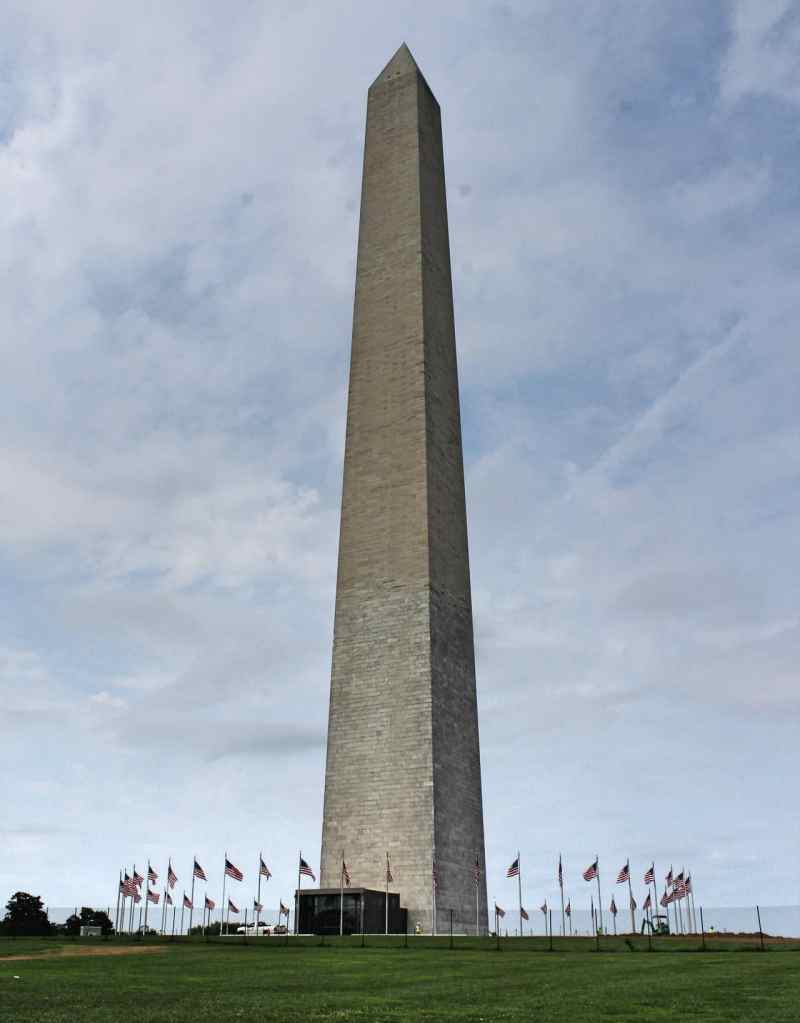
The taxi left us—my dad and my brother, plus me—at the National Mall. It was a muggy day in early September, and the blue sky was heavy with clouds. The only structure breaking the sky was the familiar form of the Washington Monument.

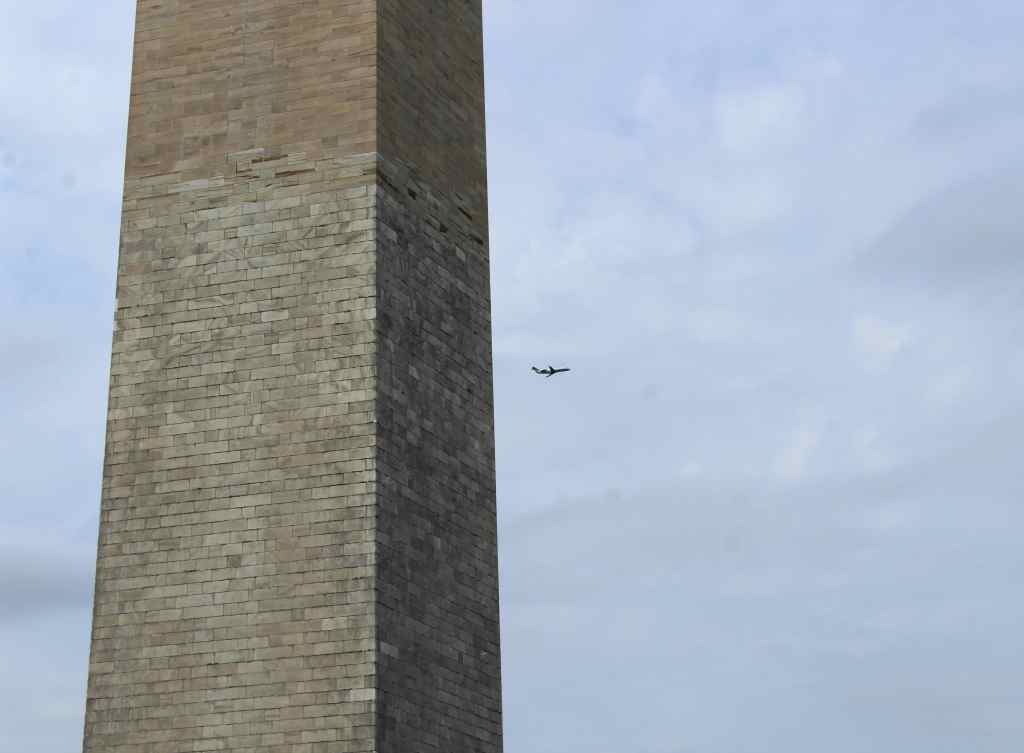
This was the first time I had seen the famous tower since I was in middle school, and I was surprised by its height. Indeed, the Washington Monument is fairly massive: standing over 500 ft. (150 m), it is simultaneously the tallest obelisk, the tallest structure made of stone, and, for five glorious years, it was the tallest structure in the entire world. (The Eiffel Tower put an end to its brief reign in 1889.) It is also curiously discolored, as a result of using marble from two different sources during its construction—which in turn was a result of a long hiatus in construction, caused by a lack of funds and the American Civil War. As the ancient Egyptians could have told us, building obelisks is not as simple as it seems.

You can clearly see where the stone type changes.

Our first stop was the National Museum of African American History and Culture, which is one of the many Smithsonian museums along the National Mall. Housed in a decidedly futuristic building—like a step pyramid that had been turned over—the main collection is displayed underground. This museum was only opened in 2016, a shocking fact, considering that the Holocaust museum opened almost two decades earlier. It is always easier to deal with the crimes of others, I suppose. Considering how important it is for the country to come to terms with African American history, it pains me to criticize this museum. However, I must admit that I was disappointed by the visit, partly because there was a great deal of text to read in the poorly lit, underground rooms, and also because I found the history presented to be almost the identical story that was taught to me in high school, and thus already familiar. Such a museum should not feel like a textbook but a reckoning.

We emerged, blinking, back into the hazy D.C. summer day. To our right was the grand obelisk, and all around us were grass and trees. This was the famous National Mall, a green area stretching from the Lincoln Memorial, to the east, to the Capitol building, to the west. (While it does seem appropriate that the center of American power is a mall, the name derives from an older version of the word, meaning a sheltered promenade.) The entire area from the Washington Monument to the Capitol is dotted with enormous museums, all administered by the Smithsonian Institute.

Strangely enough, the name of this august body comes from a man named James Smithson, an Englishman and a bastard in the technical sense, who spent much of his life running around Europe performing scientific research. A bachelor, he left his estate to his nephew, with the stipulation that, were his nephew to also die without an heir, the money be used to set up an “establishment for the increase and diffusion of knowledge among men” in Washington D.C. The nephew did duly die childless, and so the Smithsonian was born. It is rather strange that Smithson chose Washington for this bequest, since he never visited the United States. And so our most prestigious center of knowledge bears the name of an aloof English bastard. 

The statue is of Joseph Henry, first secretery of the Smithsonian

The Smithsonian, as it exists today, is beyond the bounds of even the most eccentric English scientist. All told, the Smithsonian administers 50 institutions—including museums, research centers, libraries, and even a zoo—and its collection is numbered in the tens of millions of items. Much of the money used to fund this vast edifice of knowledge comes from the humble tax-payer, who is rewarded by being allowed free entry into any and all of the Smithsonian museums. The headquarters is quite conspicuous among the enormous buildings of the National Mall. Nicknamed “The Castle,” it is built in a kind of flamboyant medieval revival style out of red sandstone. This eye-catching design, by the way, was the work of James Renwick, Jr., who is also responsible for the even more resplendent St. Patrick’s Cathedral in NYC.
We had many museums to choose from. Besides the previously mentioned, there was the Museum of American History, the National Gallery of Art, the Museum of Natural History, the Museum of the American Indian, the Hirshorn, the Renwick Gallery, the Museum of African Art… All wonderful museums, I am sure, and all within close walking distance. But, for my part, if you are in Washington D.C. and hoping to rekindle your patriotism and American pride, the best place to go is the Air and Space Museum.

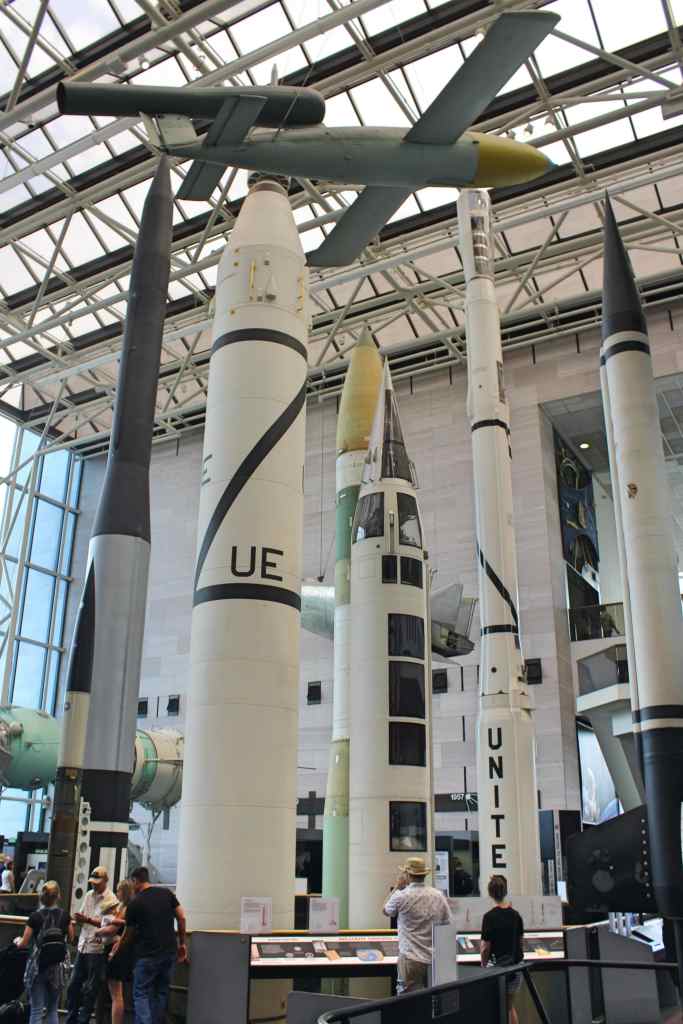
If you retain even one iota of the childhood wonder of human flight, then the Air and Space Museum will be a delight. It is exactly what you would expect: room upon room full of fighter jets, propeller planes, gliders, rockets, missiles, satellites, space shuttles, and landing craft. So many of these vehicles are connected with American firsts—the first airplane, the first transatlantic flight, the first man on the moon—that a visiting citizen cannot help but feel a mixture of pride and also nostalgia, since these great achievements now seem so very distant. Indeed, the Cold War still hangs over this museum like a stubborn ghost, as it was this conflict which spurred us to the furthest reaches of the atmosphere and beyond.

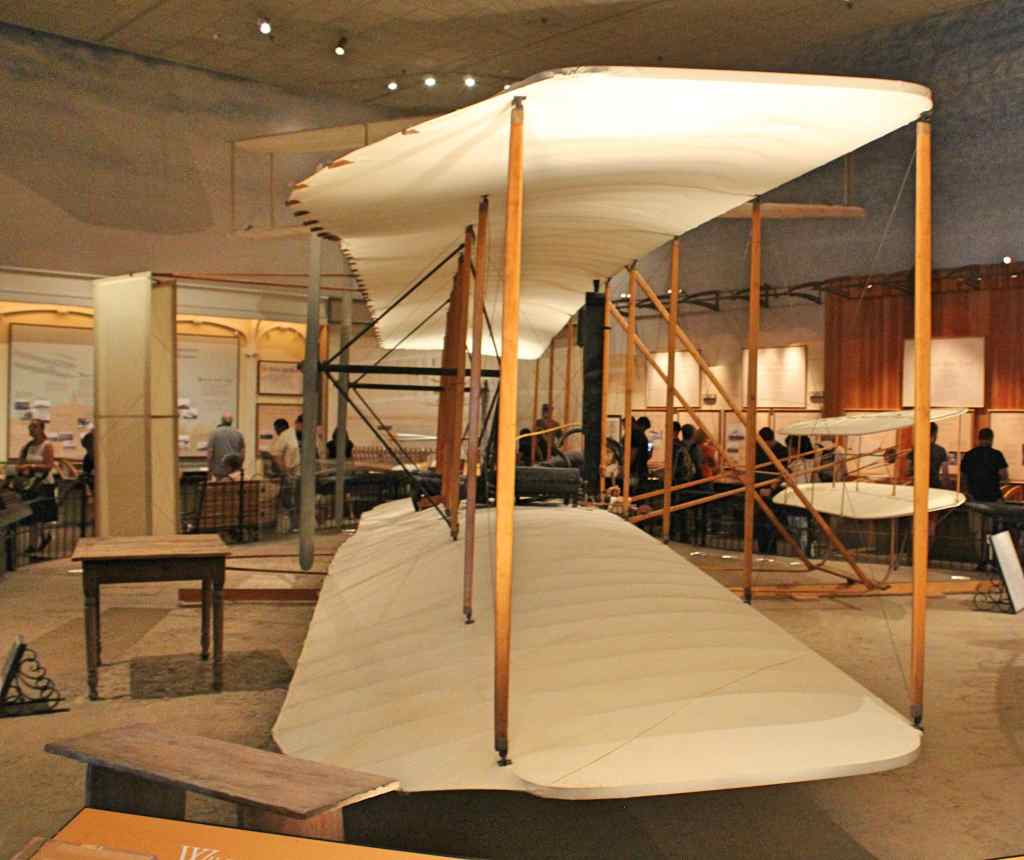
My favorite part of the museum was the exhibit on the Wright Brothers, which has the original Wright Flyer on display. The exhibit was conspicuously well-written; indeed, its tone was so highly reminiscent of the historian David McCullough, that it made me wonder if he had written the plaques himself. After this exhibit, I was so impressed by the Wrights that I decided to pick up McCullough’s book on the inventors, which I highly recommend. The brothers were far more than idle tinkerers, as I had assumed; they were brilliant mechanics and dogged problem-solvers, who accomplished something many people thought impossible. Seldom has a single invention so entirely changed modern life as the airplane; and its inventors were bike mechanics.

The 1903 Wright Flyer
My brother and I in Armstrong’s helmet

After taking in our fill of space suits, cockpits, engines, wings, slats, spoilers, and flaps, we went back out into the mall for a bite to eat. There were plenty of food trucks around, so this was quite easily accomplished. A few dollars bills exchanged, a few chunks of greasy meat swallowed, and we were ready for the next museum: the National Gallery of Art.

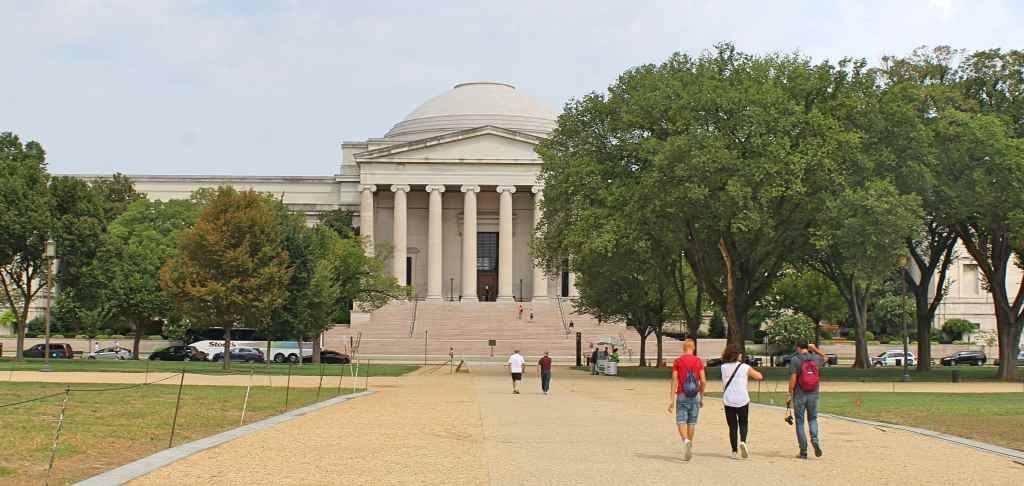
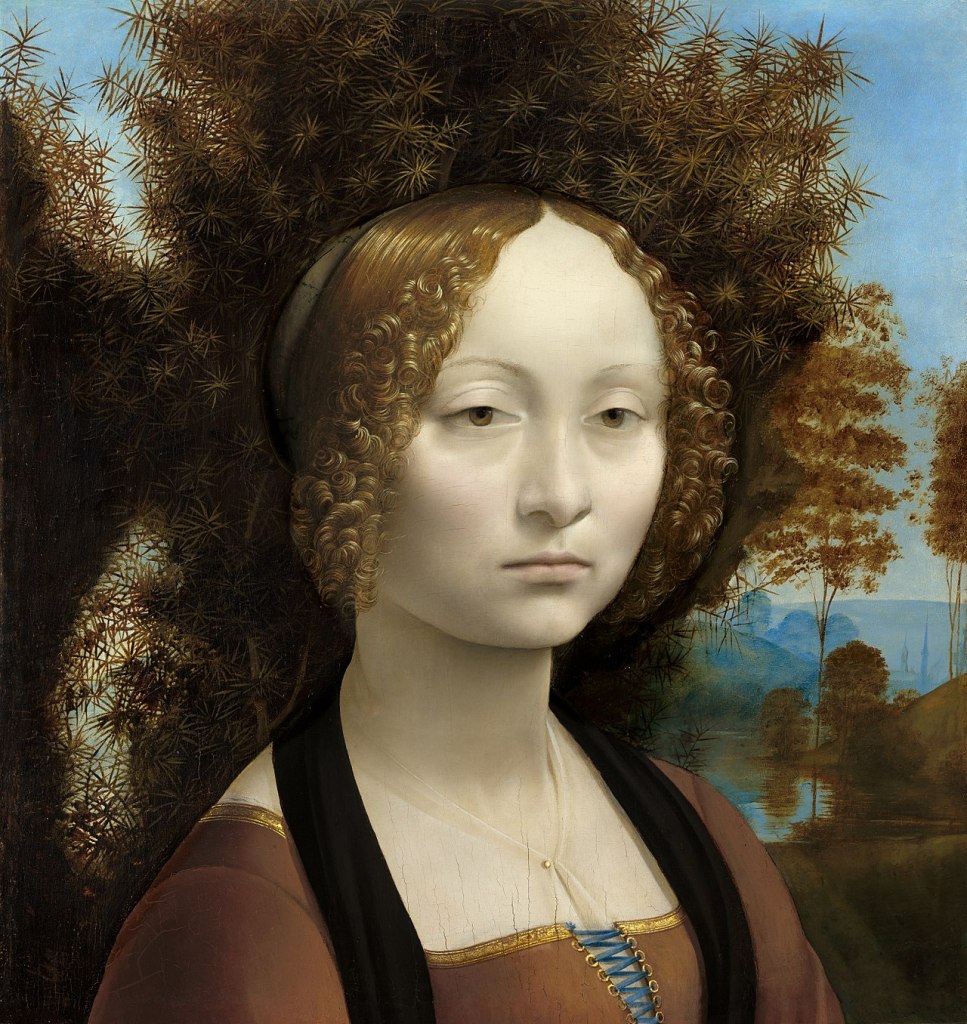
This is the Smithsonian’s enormous homage to Western culture. The central building has a façade and dome made in imitation of the Pantheon in Rome; and its spacious wings are full to the brim with paintings from Spain, France, Italy, England, and the Netherlands (not to mention the United States). Stretching from the middle-ages to the twentieth century, the collection is remarkably high-quality. There are self-portraits by Rembrandt and Van Gogh, studies of light by Monet, atmospheric symphonies by Turner, dancers by Degas, landscapes by Cezanne, and portraits of all the founding fathers. El Greco’s magnificent Laocoön is to be found here, as well as a breath-taking full-length portrait of Napoleon by Jacques-Louis David. Most spectacularly of all, the National Gallery has the only work of Leonardo da Vinci to be found in the country: Ginevra de’ Benci. In sum, I think the American National Gallery is fully the rival of its counterpart in London, which is high praise indeed.

While we were about halfway through the visit, my brother slipped off to meet a friend of his in the area. The two of them visited the National Portrait Gallery, where, among other works, there hangs the iconic presidential portrait of Barack Obama, by Kehinde Wiley. I wish I had gone to see it, too.

Now, at this point my visit to D.C. became somewhat jumbled—what with going out to eat, rendezvous with family, returning to the hotel, meeting local friends, and so forth—and so I will forego any pretext of narrating my own visit in order to round out this portrait of the National Mall.

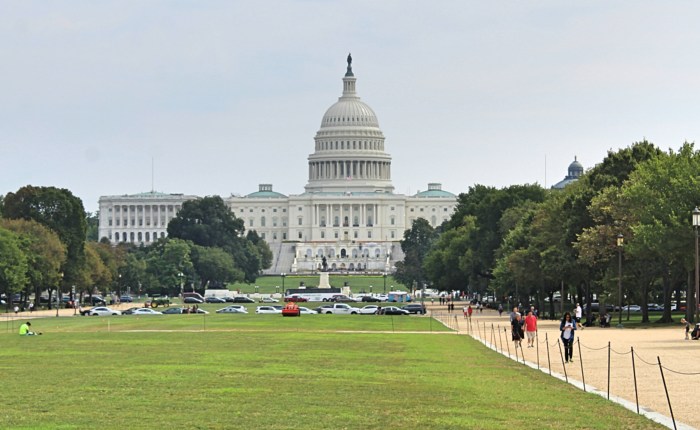
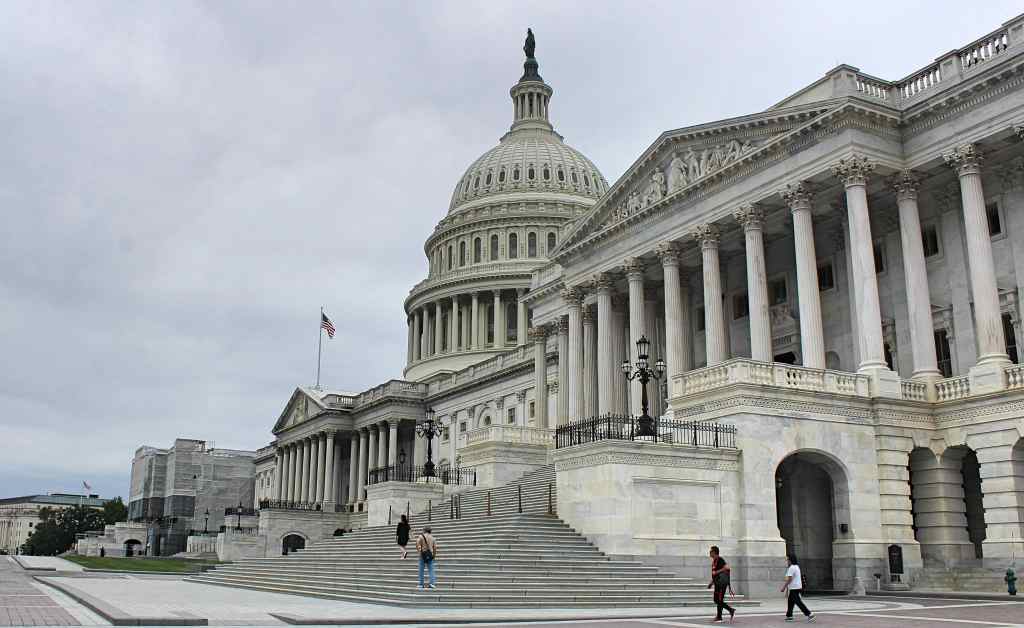
At the eastern end of the Mall stands the most impressive structure in the entire city: the Capitol Building. Its majestic form is so iconic that, I have found, many foreigners actually confuse the Capitol Building for the White House. But with 13 times the floor area, and 4 times the height, the Capitol Building is far grander. It is also far more approachable. The curious visitor can walk right inside to the visitor’s center of our legislative palace, without the worry that a secret service sniper will open fire. The name “Capitol,” by the way, apparently derives via Jefferson from the Capitoline Hill, in Rome—though the connection between American democracy and Jupiter Optimus Maximus remains obscure to me. Jefferson did, however, manage to give everyone a headache when it came time to spell capital and capitol.

The original Capitol Building, in 1800

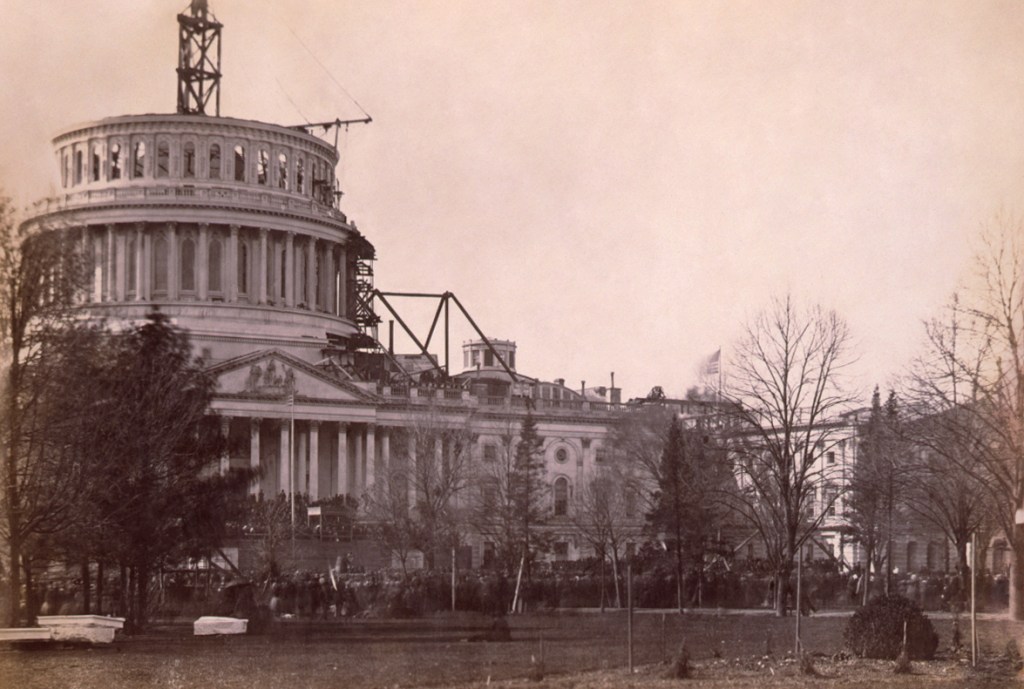
The Capitol was not always such a grandiose structure. The original building, completed in the year 1800, was a fairly modest affair, roughly the size of the present White House. But as the country grew in wealth, population, and number of states, so did the building have to be enlarged and expanded. The current dome—88 meters high, and 96 in diameter—was built between 1855 and 1866 (Lincoln insisted that construction continue right through the Civil War), and is actually made of iron painted to blend in with the white stone of the main structure. The two legislative chambers are now housed in the expansive wings to the north (Senate) and south (House of Representatives).

The Capitol Dome under construction, during Lincoln’s Inauguration

As one approaches from the west—passing the monument to Ulysses S. Grant, which marks the end of the National Mall—the Capitol presents a grandiose but inviting appearance, with two winding staircases leading up to the entrance. If one approaches from the east, however, one can see the faux-Greek temple façades, complete with sculpted pediments, such as the Apotheosis of Democracy above the entrance to the House of Representatives. The Capitol Building is also, naturally, decorated with plentiful patriotic art in its interior. Beneath the dome is the painting, The Apotheosis of Washington—a kind of heavenly scene, common in European palaces, that I always find rather silly—and below that, the Frieze of American History, a trompe-l’œil (as in, a painting that pretends to be a frieze), whose colonial imagery did not age particularly well. Both of these are the work of the Italian-American painter Constantino Brumidi, who famously fell off the scaffold and had to hold on for dear life for 15 whole minutes, until someone noticed the poor hanging artist.

The Capitol from the north-east.

But most of the people who worked on this resplendent structure were not eccentric European immigrant artists. In large part, the manual labor was performed by slaves, and the same is true of the White House. Racism runs very deep, indeed, in our democracy. 

 Right across the street from this most democratic branch of our government is the least: the judiciary. The current Palace of Justice is not as old as one might expect, having been completed as recently 1935. Before that, the Supreme Court had no residence to call its own, but instead had to find space within the Capitol Building. What is now called the Old Supreme Court Chamber served as the seat of constitutional law from 1810 to 1860, and the court moved to the Old Senate Chamber (itself replaced when the Capitol was expanded) until the construction of the current building. Finally, under the impetus of William Howard Taft (the only person to serve as both president and chief justice), a separate structure was built for the court.

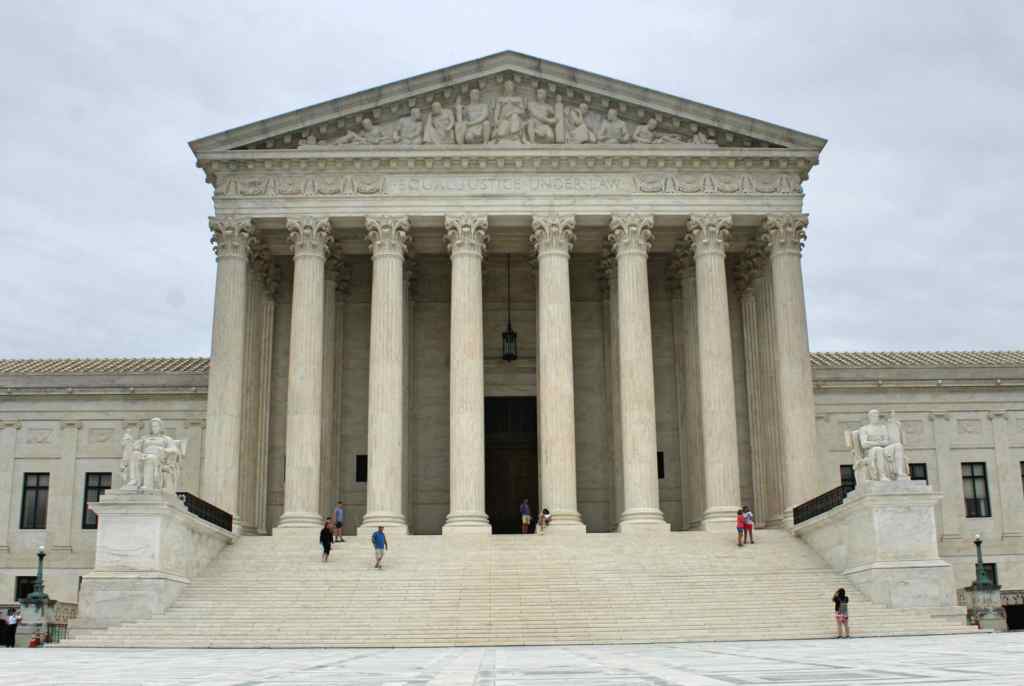
Designed by Cass Gilbert, a friend of Taft, the Supreme Court Building is a testament to the American pretension for fancying ourselves heirs of Greco-Roman culture. The building takes the form of a Greek temple, with columns, pediment, and walls made of white marble. Two brooding statues, the Authority of Law (masculine) and the Contemplation of Justice (feminine), flank the staircase leading up to the main entrance. Above, in the pediment, is a frieze with the great theme: “EQUAL JUSTICE UNDER LAW” (they spell it out in case you miss it).

The humble visitor does not ascend these great steps to enter the court, however, but walks in through a little door at ground level, with the obligatory metal detectors. Inside the visitor center, one is presented with a monumental sculpture of John Marshall, who is often considered the greatest Supreme Court Justice ever. There are also plentiful little plaques and exhibits, and of course busts of many other justices, past and present, and a very beautiful marble spiral staircase. The visitor is permitted to ascent to the first floor, and peek into the courtroom. (The only way to actually enter, when court is not in session, is to sign up for a lecture.) Then, the visit is capped off by exiting out of the enormous, bronze doors.

We could peak into the courtroom, where a lecture was being given.

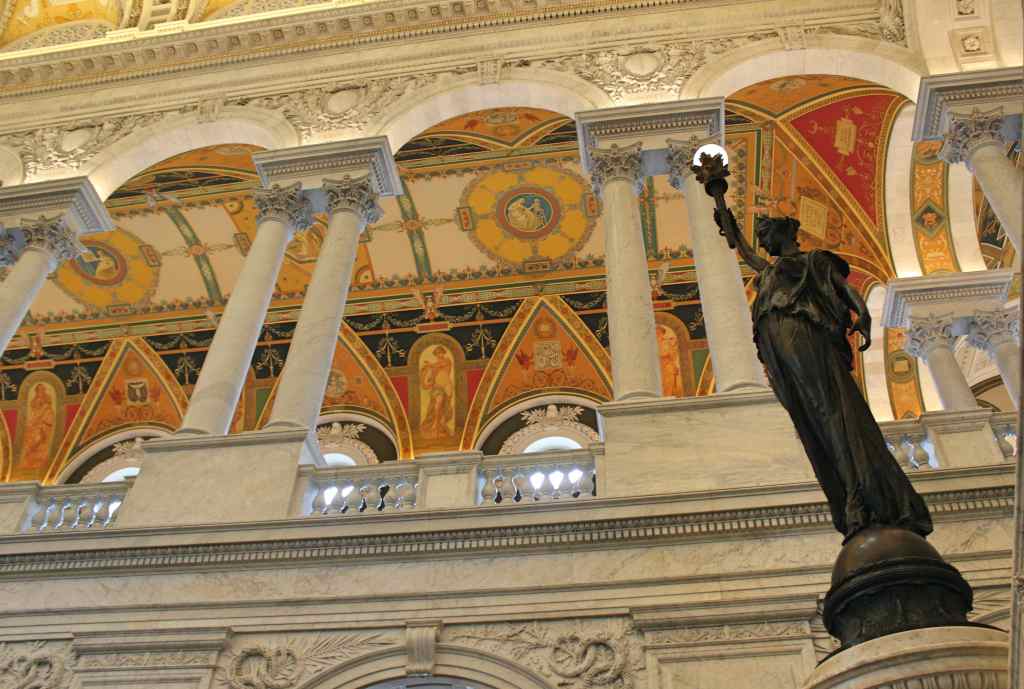
As impressive as all this was, the cold dictates of justice did not touch me so nearly as the warm thrill of literature from right next door: the Thomas Jefferson Building of the Library of Congress. This is but one of three library buildings in the capital, the other two being the John Adams and the James Madison memorial buildings (to deal with the overflowing collection). As an institution, the Library of Congress is impressive. With a collection of over 170 million items, in 470 different languages, the Library of Congress plausibly claims to be the largest in the world. Like any famous library worth the name, it has an ample collection of rare books and manuscripts, including one of the three perfect versions of the Gutenberg Bible still in existence. Thomas Jefferson amply deserves to be the namesake of this library, as he personally sold his collection of 6,487 books to the federal government after the invading British burned the previous collection during the War of 1812. (A subsequent fire unfortunately destroyed many of Jefferson’s books as well.)

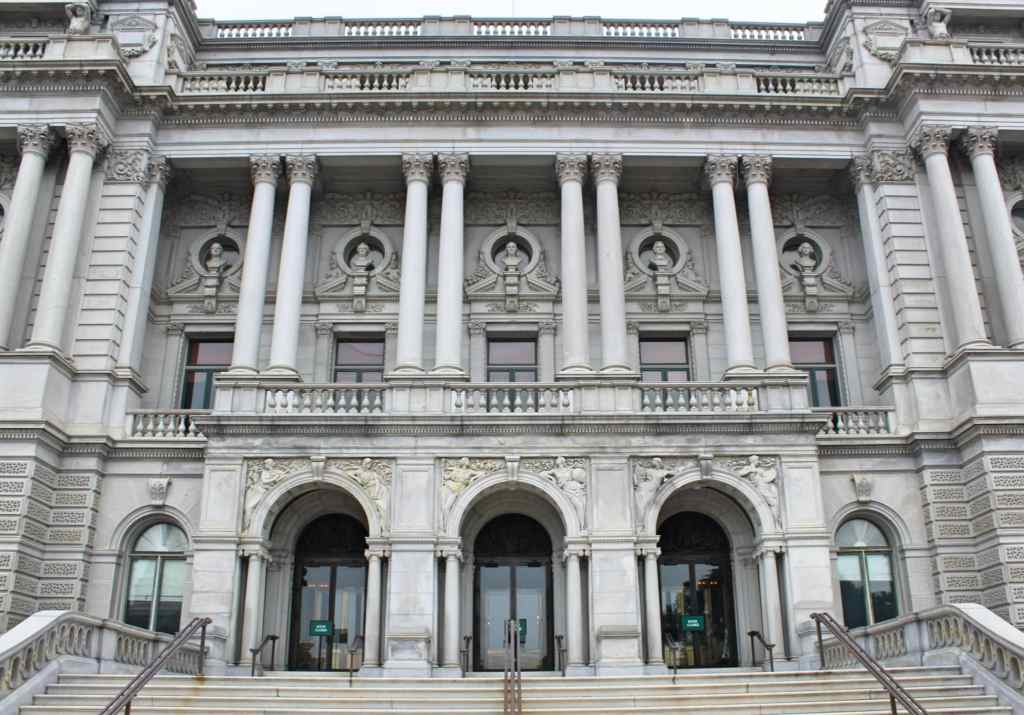
I am a sucker for books, of course, and rather fond of ornate architecture as well. So I was absolutely delighted with the Thomas Jefferson Building. The visitor is first confronted with the busts of literary giants, from left to right: Demosthenes, Emerson, Irving, Goethe, Franklin, Macaulay, Hawthorne, Scott, and Dante. Some of these choices do seem questionable to me, however. Why a Greek orator, an Italian poet, a German dramatist, a Scottish novelist, and an English historian? And why, in this great diverse nation, no women or minorities? I propose, then, that we replace old Demosthenes with Emily Dickinson, Goethe with Louisa May Alcott, Macaulay with Frederick Douglass, Scott with Herman Melville (a white man, yes, but for my money the greatest American novelist), and Dante with Walt Whitman (another white man, though at the very least sexually adventurous). I think we have quite enough native talent here to occupy all of the busts on our own national library, thank you very much!

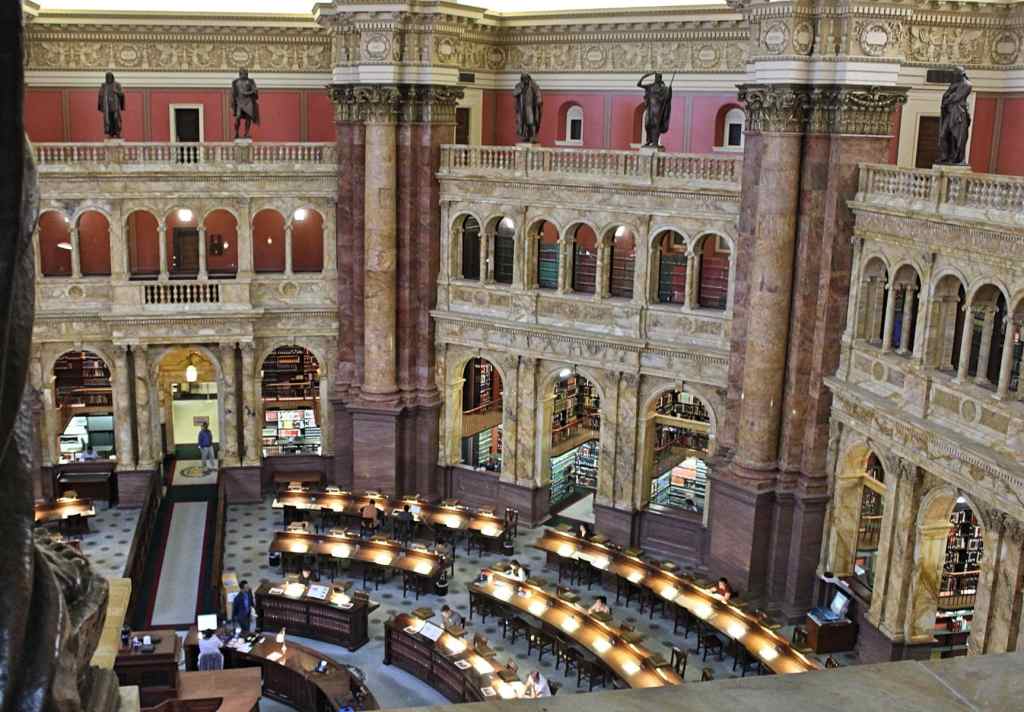
The interior of the building is even more richly decorated than its façade. The Great Hall is covered in an elaborate program of murals, friezes, and sculptures, created by an enormous team of artists. It is a kind of secular cathedral, with personifications of the arts, sciences, and civic life. Little cherubins adorn the grand staircases leading up to the upper deck, while heroic figures in flowing robes masquerade as abstract concepts. The names of great writers—Cervantes, Shakespeare, Milton—with accompanying quotes are worked into the decorative program, preserving something of the taste of Ainsworth Rand Spodoff, who was the Librarian of Congress at the time. All of the decoration, abstract and figurative, is lovely. The room has a light and buzzing energy, not at all oppressive in its finery. The rare books on display complete the impression of a temple of knowledge. 

From the upper level of the Great Hall the visitor can peak down into the equally vast Reading Room. I must confess that, at this point, the first thing that came to mind was the second National Treasure movie. I must further confess that I was feeling slightly annoyed, as I had mixed up the Library of Congress with the National Archive, and assumed that the Declaration of Independence was displayed here. In any case, the Reading Room is quite gorgeous—filled with concentric circles of reading desks, all beneath a towering dome. Here, too, allegorical women and Great Men stand guard, including statues of Beethoven, Homer, Plato, and Newton to keep the busy scholars company. (The statue of Columbus may be somewhat less welcome nowadays, however.) Even if I were looking up the number of hairs on the underside of a flea, I think I would feel quite wise and important while doing so in such a room.

As much as I love the idea of a national library serving as an enormous intellectual resource for the nation’s lawmakers, I wonder how often members of congress nowadays make use of this temple of knowledge. One suspects it is a lot less than ideal.

I want to mention here an institution in the neighborhood that I regret not visiting: the Folger Shakespeare Library. This is an independent research organization, dedicated to the bard. Its name may be familiar from the high-quality editions of Shakespeare’s works published by the library. For any Shakespeare fans, this is the nearest thing to a mecca in the United States, as the library has the largest collection of the bard’s printed plays, as well as a theater where his immortal works are performed. Admittedly, it does seem a little strange that an institute dedicated to an Elizabethan playwright is located in the heart of our nation’s capital; but I suppose we have never been able to shake off a bit of our ancestral anglophilia.

Well, we have visited two of the branches of the federal government, so it is high time we make our way over to the third: the executive. To get to the White House from the Capitol Building by foot means walking along the most famous stretches of road in the country, a section of Pennsylvania Avenue called “America’s Main Street.” The walk takes about half an hour, and leads past a few notable monuments. One is the National Archive—which, again, I regret not visiting—and another is the monumental Old Post Office building, designed in a castle-like Romanesque Revival style. I must say, however, that Washington D.C. is not a pleasant city to stroll about, even on its most famous avenue.

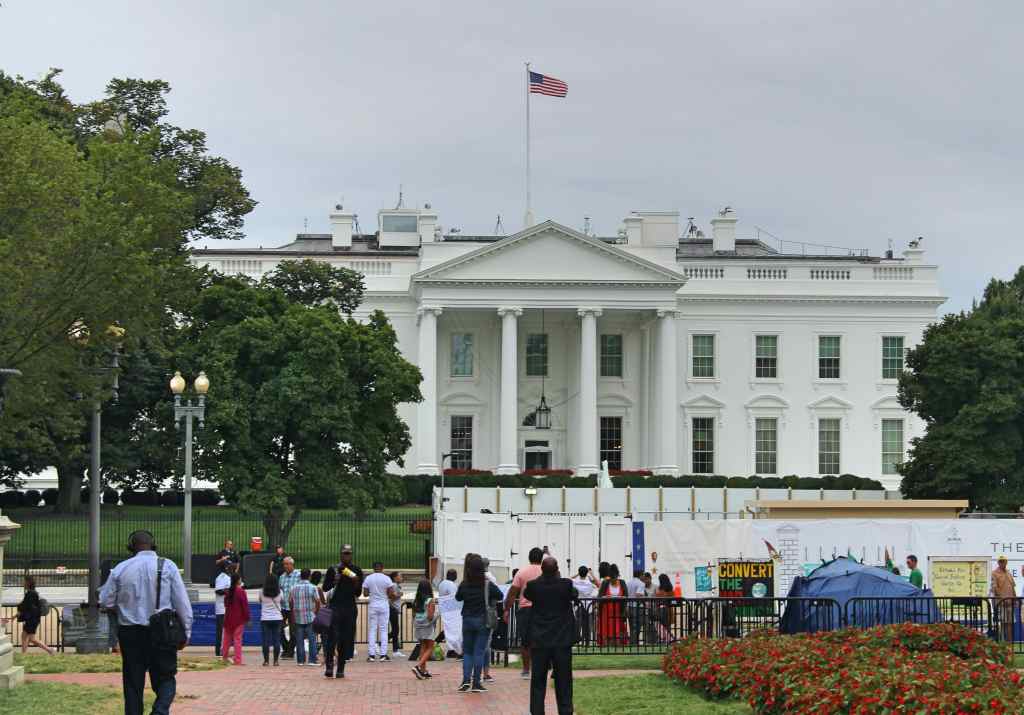
Unless you contact your Member of Congress to request an official tour, chances are you will be seeing the White House from the outside, as I did. Your choice, then, is to see the presidential residence from the north or the south. The southern route takes you to The Ellipse, a large clearing in President’s Park; and from the north the spectator must gaze from Lafayette Square. This last park is the scene of much recent controversy. Presiding over the green space is an equestrian statue of Andrew Jackson, a populist and a racist, which Black Lives Matter protesters attempted to remove during the 2020 protests. The police not only thwarted the demolition, but forcibly removed all of the protesters from the area with chemical irritants, in order to give the president photo opportunity with the nearby St. John’s Church. I will let Christians decide on the righteousness of this course of action.

The White House was completed in 1800, which means that John Adams, not George Washington, was the first president to occupy this iconic seat of American power. The building owes its design to the Irish Architect James Hoban, who himself was deeply influenced by the Italian Renaissance architect Andres Palladio, who himself was deeply influenced by the Roman architectural writer Vitruvius. In consequence, the style of the White House is thoroughly neoclassical. As with the Capitol Building, the White House has two distinct façades. The northern one, facing Lafayette Square, features four columns and a triangular pediment, while the southern façade consists of six columns on a semicircular bow. It is worth pointing out that, compared with either the Capitol or the Supreme Court buildings, the White House is conspicuously unadorned. There are no statues or allegorical friezes, which I think gives the building a certain gravitas.

As presidential power gradually expanded, and the president’s entourage grew, so did the White House. The West Wing was added during the presidency of Teddy Roosevelt, in order to deal with this influx of personnel, to which William Howard Taft later added the now iconic Oval Office. The East Wing was added a few decades later, thus giving us the symmetrical structure we have today. Having toured many palaces in Europe, I must say that the White House is, at least, refreshingly small by comparison. Charles L’Enfant envisioned a palace more along the lines of Versailles; but I agree with Jefferson in thinking that such a monstrous residence would be out of keeping with a democracy. The White House is not meant to be the domain of some distant, all-powerful ruler, but our house—the seat of the people’s power.

As late as 1901, Frederick Owen proposed turning the White House into this monstrosity.

But let us leave this fraught symbol of national power and return, once again, to the National Mall. Whereas the eastern half of the mall is dominated by museums, the western half is given over to memorials. The grandest of these is, without a doubt, the Lincoln Memorial. The memorial takes the form of a Greek temple, situated at the end of a long reflecting pool. A staircase leads the visitor past two rows of columns and into this presidential shrine, where, instead of finding an enormous Athena, we are greeted with the equally august Abraham Lincoln. He sits, regal and somewhat world weary, on a kind of throne; and the text of two of his speeches—the Gettysburg Address, and his second inaugural address—adorn the walls on either side of this national hero. Though I cannot help a little irreverence in my description, in truth I found the memorial—and especially the statue of Lincoln, designed by Daniel Chester French—to be both beautiful and inspiring. It is rare that a monumental sculpture of a politician is so compellingly human.

Standing at the other end of the reflecting pool is the World War II Memorial, which was opened as recently as 2004. Perhaps the least famous of the mall memorials, it consists of a series of granite slabs in two opposed semicircles, one per each state and U.S. territory (56 in all). The Korean War Memorial, to the south of the pool, is rather more striking in design. 19 stainless steel soldiers, in full gear, bedecked in ponchos, make their way through what is doubtless muddy ground. For my part, the sculptures strike a difficult balance between portraying the horrors of war and capturing the determination of the soldiers.

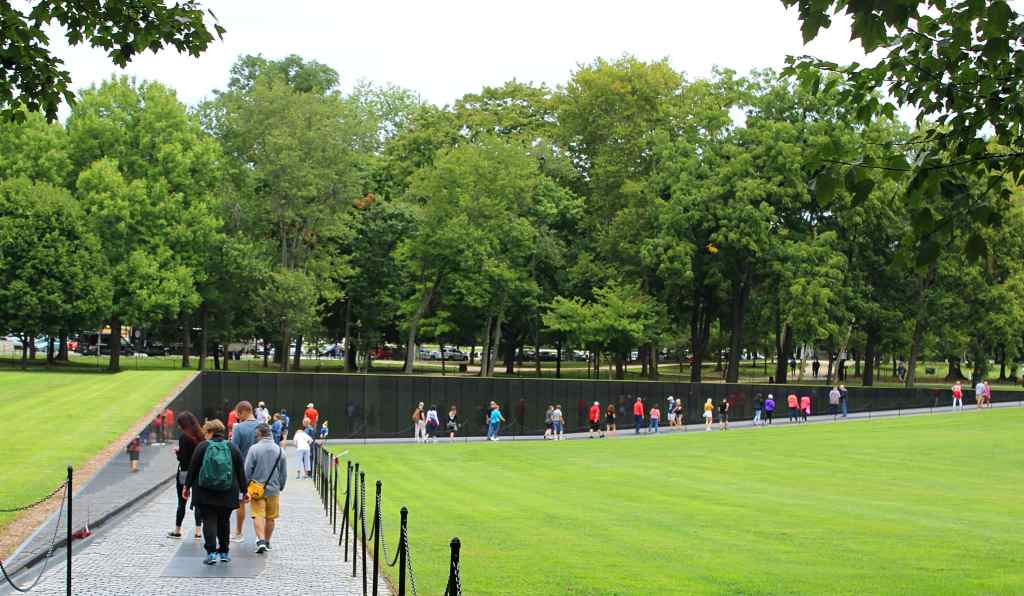
The most iconic memorial, however, is that devoted to the Vietnam War, which stands north of the pool. In design, it could hardly be simpler: a black wall that cuts a triangle into the earth, inscribed with the names of all the servicemen (and, later, some women) who died in the conflict. At the time, this design was controversial, both for its simplicity and also because its designer was an Asian woman, Maya Lin. As a compromise, a more traditional sculpture, The Three Soldiers, was placed nearby. But history has vindicated Lin’s design. Even the casual visitor cannot help but sense the trauma left by the war. Indeed, the sculpture itself was conceived as a kind of wound in the earth, which opens and then closes as the visitor makes their way from end to end. Friends and family and old comrades still leave flowers and photos besides the names of their loved ones.

Before we leave the mall, I have to mention some memorials that I did not have the opportunity to visit. They are located around the Tidal Basin, the reservoir between the National Mall and the Potomac River. One is that dedicated to Martin Luther King, Jr., which was completed in 2011. It is centered around a monumental sculpture of the civil rights leader, called The Stone of Hope (a line from King’s most famous speech), in which he emerges from a partially carved block of granite. (I should also mention that the spot from which King gave his “I Have a Dream” speech is also marked, on the steps to the Lincoln Memorial.) Further on is the Franklin Delano Roosevelt memorial, which features an open, spread out design, commemorating the 32nd president with a series of scenes from his eventful tenure. But the memorial to Thomas Jefferson undoubtedly occupies the pride of place. Like that of Lincoln, Jefferson’s shrine is a pseudo-Greek temple, with a statue of Jefferson at the center, surrounded by some notable quotes of his. Though I think the building itself is impressive, I must say that I do not care for the bronze statue of Jefferson at the center.

Well, at this point I wish I could say, “Enough with dead presidents and old wars!” But our next destination has plenty more of both: the Arlington National Cemetery. To get there, the visitor will have to leave D.C. entirely, traveling across state lines to Virginia, via the Arlington Memorial Bridge. (The bridge had been proposed since at least Andrew Jackson’s presidency, but it was not built until 100 years later. It was conceived as a kind of symbolic reunification of North and South.) Though I cannot say the walk is especially scenic, at least you get a good view of the Potomac. 

Arlington National Cemetery is a graveyard with an odd history. After the Revolutionary War, the land was bought by an adopted son of George Washington, whose daughter eventually married Robert E. Lee—a man who was, himself, the leading general of the secessionists during the Civil War. In a decision that was equal parts whimsical and spiteful, the land was then confiscated to be used as a resting place for the Union soldiers who died fighting against Lee’s forces. The Supreme Court eventually decided that this confiscation was not legal, and awarded Lee’s son a very large chunk of money for the land. It does seem ironic for the government to pay someone who wanted to secede from the country for use of their land, but I suppose even rebels deserve due process. 

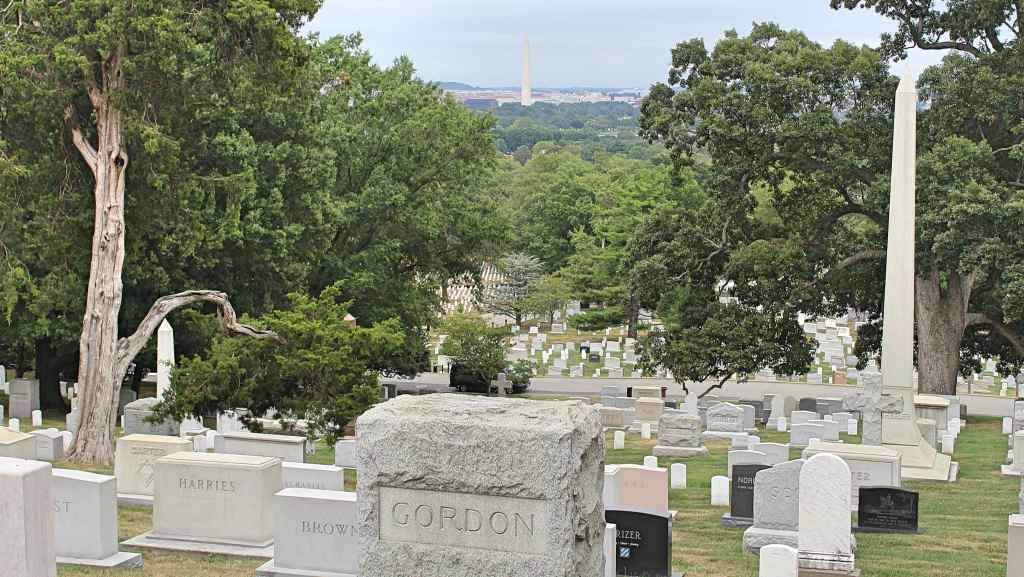
Arlington is a military cemetery. There are very strict rules for being interred on the grounds, most of which involve having served in the military (or being the family of someone who has). With 400,000 already buried, space is naturally limited. But one can immediately see why Arlington is such a coveted spot to inter one’s earthly remains.  Even if this land had not been the residence of a rebellious general, it would still be ideally suited for the task. Consisting of rolling hills that rise up above the Potomac, the cemetery provides a commanding view of the surrounding area, including the Pentagon (which sits just to the south). In fact, Lee’s old house still stands on the property, an enormous neoclassical building that was, unfortunately, closed during my visit.

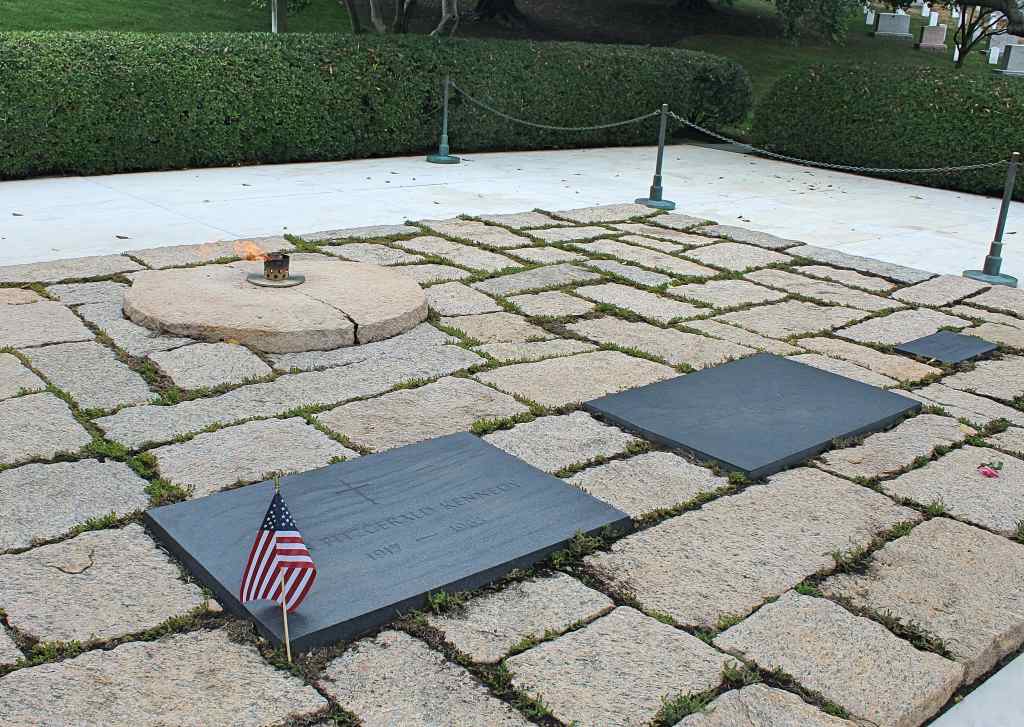
The most famous person buried in Arlington National Cemetery is John Fitzgerald Kennedy. His tomb is marked by a simple black slab, which stands before an endlessly burning torch, the “eternal flame.” Nearby are buried John’s two brothers, Edward and Robert, who lay under simple crosses. Another often-visited tomb is that of Audie L. Murphy, one of America’s most decorated soldiers from the Second World War, who went on to be a movie star in later life. But most of the landmarks in this cemetery are dedicated to groups of people—mostly men—who died in tragic circumstances.

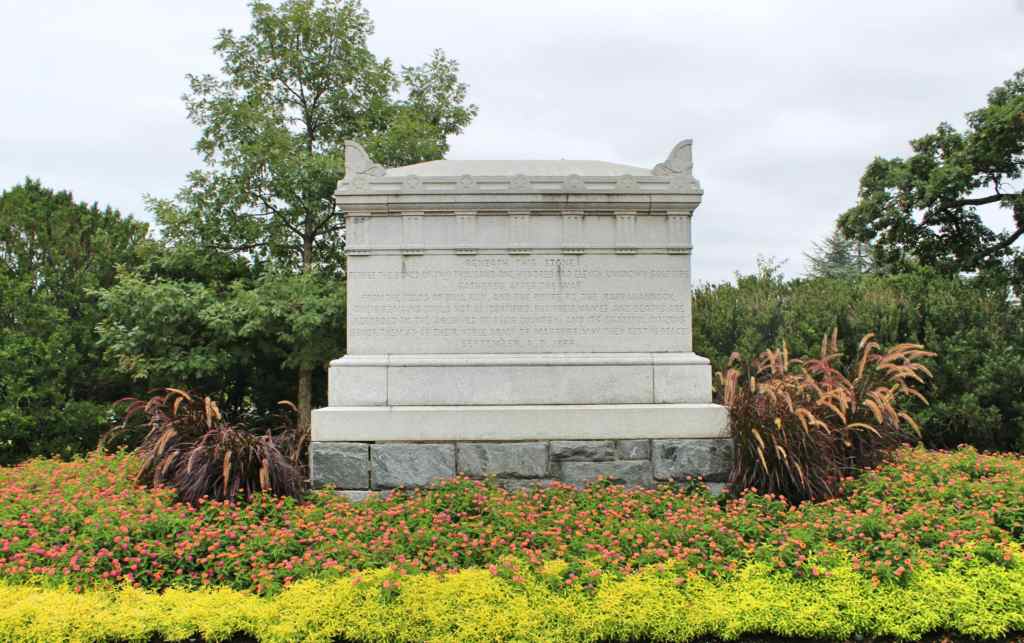
There is, for example, the tomb to the unknown soldiers of the Civil War, which stands near Lee’s old mansion. Also notable is the tombstone dedicated to the crew of the space shuttle Challenger—a moving monument, unfortunately marred by quite ugly portraits of the crewmembers on the tombstone. Most monumental of the monuments is that devoted to those who died aboard the USS Maine, which exploded off the coast of Havana, sparking the Spanish-American War. (Most likely the Spanish had nothing to do with it, but the explosion was used as a pretext for hostilities.) The monument incorporates the main mast of the ship, likely making it the tallest structure in the cemetery.
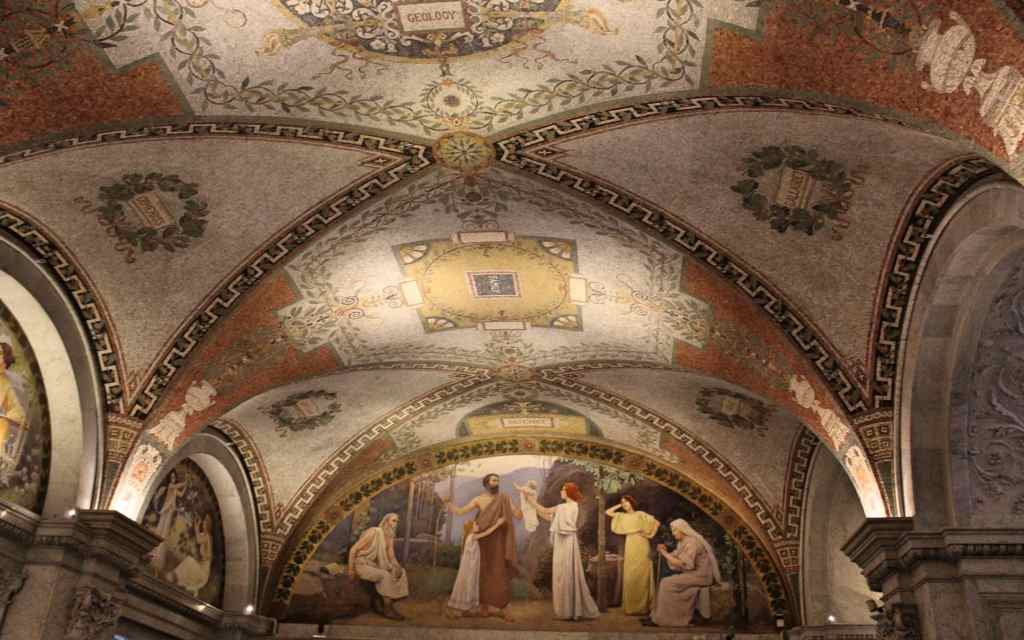
The unknown soldiers of the Civil War.

More famous, perhaps, than even the tomb of John F. Kennedy, is the tomb of the Unknown Soldier. This is a large marble vault in the courtyard of the cemetery’s amphitheater, where the unidentified remains from four American wars are interred—World War I, World War II, the Korean War, and the Vietnam War. Well, since 1998 that number has been 3, since the remains of the Vietnam soldier were identified via mitochondrial DNA and disinterred.

In any case, the bodies inside the actual tomb are meant more as symbols of the many thousands of soldiers whose remains have been lost in the fog of war. As such, they are symbolically guarded by soldiers in the United States Army, around the clock, since the year 1937. These soldiers perform an elaborate ritual of pacing back and forth, snapping their rifle from soldier to soldier, in a series of actions so precisely timed and coordinated that it seems scarcely human. It is hypnotic to watch; one wonders at the amount of training that must have been necessary. Every hour or half-hour (depends on the month), the guard is relieved of duty in an equally elaborate ritual, known as the Changing of the Guards, in which the rifle is presented to the next guard on duty. 

Now, here I am, at the end of a long post about the capital of the United States of America. And I am afraid that it has all been rather stuffy and dreary. Virtually all that makes Washington D.C. notable has to do with politics or war (which is, of course, just politics by other means). In other words, it is a city given over to monuments, memorials, and museums—beautiful, grandiose, and dead. Apart from these attrctions, the city center is mostly comprised of governmental offices, filled to the brim with bureaucrats, lawyers, administrators, clerks, officials, aides, and of course politicians (aside from all the tourists). This gives the city a curiously alien feel, as if it exists for nobody in particular—like an office full of disaffected workers. Even the shops and restaurants reinforce this impression, as the vast majority are chains and franchises, equally devoid of character.

So, to end this post, I would like to focus on a bastion of life in our nation’s great capital, a little takeout place called the Greek Deli, located right in the center of D.C. Its owner, Kostas Fostieris, has been working in this cramped little shop for over 30 years, beginning his workday at 3 in the morning. He was still going strong when we visited, September of last year. The deli serves an assortment of typical Greek staples: gyros, soups, hummus, salads, feta cheese, and so on. What makes the place so special—aside from the food being so very delicious—is that it is absolutely unpretentious. There is nothing trendy about the place; there is little outdoor seating, and there is no way to order via an app. Indeed, the deli is not even open on the weekends. Instead, the visitor must queue up, order from Fostieris himself, and then hope there is a spot to eat in one of the tables outside.
Explained in such a way, perhaps the deli does not sound so appealing. But in a city like D.C., it is a godsend. This was the one time during my whole visit that I felt like I was in a real place, filled with living people, people who were laboring, loving, and growing old in this chosen spot. This is the feeling one gets from any genuine community—and it is a feeling horribly lacking from the capital, or at least the city’s center. And, let me add, the story of a Greek immigrant struggling night and day to make his little shop a miniature institution is just as American as the Lincoln Monument. For my part, Kostas Fostieris is an American hero. At the very least, he has likely brought more joy into the world than many who have served inside the Capitol Building.
I am sure that is a lot more to D.C. than what I saw during my short visit. My only hope that there are enough pockets of life like the Greek Deli to help compensate for the sterile deserts of jingoistic vainglory that so dominate Washington. During my visit, I felt that the entire city epitomized the emotional distance between the ordinary citizen and those at the country’s helm—as if our politicians were the equivalent of the guard of the Tomb of the Unknown Soldier, enacting a stiffly ritual preservation of the illustrious dead. But, as Jefferson noted, “The earth belong always to the living generation.” This is why politics, at its best, shares the same goal as any great human endeavor: to touch people. And I cannot think of any better way of doing that than a delicious lamb gyro.

Processing…
Success! You're on the list.

I’m on the Radio, again!

I’m on the Radio, again!

Back in June, I was interviewed for the radio station Santa María de Toledo. The host, Teresa Martín Tadeo, apparently enjoyed the interview enough to ask me to do another one. This time we talked about Thanksgiving traditions (the holiday isn’t celebrated here, so Spaniards are always curious), as well as the recent elections. I hope you enjoy!

https://www.ivoox.com/roy-lotz-accion-gracias-otras-audios-mp3_rf_61031884_1.html?fbclid=IwAR3QsEFigvRXZIt0sYFyTLEItMXHBTkQ7KUhmqpQf1HNO6Cz9wzPZhYd5H0

Review: Stoner

Review: Stoner

Stoner by John Williams

My rating: 4 of 5 stars

This book is among the class I call ‘Goodreads Books,’ because so many of my friends here have read the book, whereas nobody I know in the real world has even heard of it, much less read it. Among a certain niche of readers, this book is quite highly regarded; some have even gone so far as to dub it the ‘perfect novel.’ I would hate to be the dissenting voice in this chorus of praise; so I am happy to report that I liked the book, even if I did not find it ‘perfect.’

The novel follows the life, from birth to death, of William Stoner, a farm boy turned man of letters. It tracks the few successes and many disappointments in his long and fairly undistinguished earthly career. What makes the novel special is not the character of Stoner—a rather bland and colorless fellow—nor anything that happens to him. Rather, it is the tone with which Williams narrates Stoner’s life—a sort of tender melancholy, searching for the beauty and sadness in ordinary things.

For me, the strongest parts of this book were the beginning and the end (which are very good parts for a book to be strong). We first see Stoner emerging from his drudging life of farm work into the halls of academe, and witness his discovery of literature. Any devoted reader will naturally appreciate this. The book ends with a striking narration of Stoner’s confrontation with his own mortality, and his acceptance of his deeply flawed life.

The middle parts of the book were dominated by a series of interpersonal conflicts, and I enjoyed these somewhat less. The dominant relationship of this novel is that between Stoner and his wife, Edith. Shortly after the marriage, it becomes clear that Edith has been emotionally (and perhaps physically?) abused, and is traumatized from this abuse, which turns her into an abuser. This makes the marriage hellish for Stoner; and the dynamics of a dysfunctional relationship are described quite expertly. However, I was frustrated by Williams’s portrayal of Edith, which is almost entirely without sympathy. As a character, she has no interiority, no real perspective, but is merely a kind of wounded automaton that goes on wounding. As a result, I found her actions incomprehensible and even unbelievable.

I would lodge a similar complaint about the novel’s other villain, Hollis Lomax. Stoner’s academic rival and eventual boss, he is possessed by a kind of vindictiveness that is never fully explained, or even investigated. The third major relationship in the book—the affair between Stoner and Katherine Driscoll—is far more sympathetic. Still, I was baffled by its eventual end. (Spoilers here.) Lomax threatens to have Driscoll fired, so Driscoll quits? Stoner ends the relationship to preserve his non-existent family life? This did not square.

It is fair to say that the only character granted interiority is Stoner himself. Judging from the reviews, many readers seem to have found in Stoner a certain nobility—seen him as a fundamentally decent man borne down by circumstances—and thus interpret this book as a tragedy of a good man in a bad world. And while I agree that Stoner is decent enough, I read this book as a case study of the pathetic man. To say this in a slightly more cultivated way, I interpreted Stoner as a prime example of what the existentialists call ‘bad faith.’

By that I mean that Stoner never seems to consciously choose what he wants from life. Even in the book’s beginning, when Stoner switches from studying agriculture to literature, this is narrated not as a conscious choice but as a kind of instinctual impulse. The same goes for his marriage, and for virtually everything else. Very often, Stoner seems hardly aware of what is happening, and most often he decides to simply go along with the current. The only time he really goes against the prevailing wind was in his attempt to prevent a bad student from obtaining a Ph.D., and even then he frames this decision as an attempt to defend the university from the world ‘out there.’ Indeed, Stoner’s whole attitude towards the university is that of a diver’s towards a shark cage. It is a shield from life.

My point is that Stoner is largely responsible for the way his life turned out. He could have divorced his wife, or have tried far more vigorously to have protected his daughter from his wife’s abuse. After Lomax decided to torture him, Stoner could have simply left the university and gone to another one. He could have eloped with Katherine Driscoll—why not? In each of these instances, Stoner simply did nothing, staying in a bad marriage, relinquishing his daughter to his wife’s power, bowing to Lomax’s schemes, and cutting it off with the only person he ever loved.

The best example of Stoner’s decision making may have been his refusal to enlist to fight in World War I. When it finally dawns on him that he would have to decide, for himself, whether to fight, he seems absolutely dumbstruck. He asks the people in his life to tell him what to do. And then, he does nothing, merely continuing on with his routine—not because he is against war, and not even because he is afraid of dying on the battlefield, but simply because it is the null choice. This, to me, is bad faith.

Now, all this is not to say that I did not like the book, or that I did not find any value in reading it. To the contrary, I think there is a great deal of value in exploring such a character. But I do not blame the world for Stoner’s problems.

Stylistically, I could not make up my mind whether I liked or disliked Williams’s writing. There were times when the prose swelled into beautiful lyricism, but mostly the narration is deadpan, often dreary, and occasionally even dirge-like—a kind of funeral procession for Stoner’s life. As for the story, I wish Williams had focused far more on Stoner’s relationship with literature, rather than simply narrating it from a distance. We never experience Stoner, say, savoring a poem; most of his energy is expended in rather dry academic work—though this, again, accords with his use of literature as an existential shield rather than a way of enhancing his life.

Regardless of one’s take on Stoner, or William’s prose, or the untapped veins in the story, it is evident that this book evokes strong reactions from its readers, some negative and mostly positive. And that, if anything, is a mark of a good book.


View all my reviews

Review: The World as Will and Representation

Review: The World as Will and Representation

The World as Will and Representation, Vol. 1 by Arthur Schopenhauer

My rating: 3 of 5 stars

To truth only a brief celebration of victory is allowed between the two long periods during which it is condemned as paradoxical, or disparaged as trivial.

Arthur Schopenhauer is possibly the Western philosopher most admired by non-philosophers. Revered by figures as diverse as Richard Wagner, Albert Einstein, and Jorge Luis Borges, Schopenhauer’s influence within philosophy has been comparatively muted. True, Nietzsche absorbed and then repudiated Schopenhauer, while Wittgenstein and Ryle took kernels of thought and elements of style from him. Compared with Hegel, however—whom Schopenhauer detested—his influence has been somewhat limited.

For my part, I came to Schopenhauer fully prepared to fall under his spell. He has much to recommend him. A cosmopolitan polyglot, a lover of art, and a writer of clear prose (at a time when obscurity was the norm), Schopenhauer certainly cuts a more dashing and likable figure than the lifeless, professorial, and opaque Hegel. But I must admit, from the very start, that I was fairly disappointed in this book. Before I criticize it, however, I should offer a little summary.

Schopenhauer published The World as Will and Representation when he was only thirty, and held fast to the views expressed in this book for the rest of his life. Indeed, when he finally published a second edition, in 1844, he decided to leave the original just as it was, only writing another, supplementary volume. He was not a man of tentative conclusions.

He was also not a man of humility. One quickly gets a taste for his flamboyant arrogance, as Schopenhauer demands that his reader read his book twice (I declined), as well as to read several other essays of his (I took a rain check), in order to fully understand his system. He also, for good measure, berates Euclid for being a bad mathematician, Newton for being a bad physicist, Winckelmann for being a bad art critic, and has nothing but contempt for Fichte, Schlegel, and Hegel. Kant, his intellectual hero, is more abused than praised. But Schopenhauer would not be a true philosopher if he did not believe that all of his predecessors were wrong, and himself wholly right—about everything.

The quickest way into Schopenhauer’s system is through Kant, which means a detour through Hume.

David Hume threw a monkey wrench into the gears of the knowledge process with his problems of causation and induction. In a nutshell, Hume demonstrated that it was illogical either to assert that A caused B, or to conclude that B always accompanies A. As you might imagine, this makes science rather difficult. Kant’s response to this problem was rather complex, but it depended upon his dividing the world into noumena and phenomena. Everything we see, hear, touch, taste, and smell is phenomena—the world as we know it. This world, Kant said, is fundamentally shaped by our perception of it. And—crucially—our perception imposes upon this observed world causal relationships.

This way, Hume’s problems are overcome. We are, indeed, justified in deducing that A caused B, or that B always accompanies A, since that is how our perception shapes our phenomenal world. But he pays a steep price for this victory over Hume. For the world of the noumena—the world in-itself, as it exists unperceived and unperceivable—is, indeed, a world where causal thinking does not apply. In fact, none of our concepts apply, not even space and time. The fundamental reality is, in a word, unknowable. By the very fact of perceiving the world, we distort it so completely that we can never achieve true knowledge.

Schopenhauer begins right at this point, with the division of the world into phenomena and noumena. Kant’s phenomena become Schopenhauer’s representation, with only minimal modifications. Kant’s noumena undergo a more notable transformation, and become Schopenhauer’s will. Schopenhauer points out that, if space and time do not exist for the noumena, then plurality must also not exist. In other words, fundamental reality must be single and indivisible. And though Schopenhauer agrees that observation can never reveal anything of significance about this fundamental reality, he believes that our own private experience can. And when we look inside, what we find is will: the urge to move, to act, and to live.

Reality, then, is fundamentally will—a kind of vital urge that springs up out of nothingness. The reality we perceive, the world of space, time, taste, and touch, is merely a kind of collective hallucination, with nothing to tell us about the truly real.

Whereas another philosopher could have turned this ontology into a kind of joyous vitalism, celebrating the primitive urge that animates us all, Schopenhauer arrives at the exact opposite conclusion. The will, for him, is not something to be celebrated, but defeated; for willing leads to desiring, and desiring leads to suffering. All joy, he argues, is merely the absence of suffering. We always want something, and our desires are painful to us. But satisfying desires provides only a momentary relief. After that instant of satiety, desire creeps back in a thousand different forms, to torture us. And even if we do, somehow, manage to satisfy all of our many desires, boredom sets in, and we are no happier.

Schopenhauer’s ethics and aesthetics spring from this predicament. The only escape is to stop desiring, and art is valuable insofar as it allows us to do this. Beauty operates, therefore, by preventing us from seeing the world in terms of our desires, and encouraging us to see it as a detached observer. When we see a real mountain, for example, we may bemoan the fact that we have to climb it; but when we see a painting of a craggy peak, we can simply admire it for what it is. Art, then, has a deep importance in Schopenhauer’s system, since it helps us towards the wisdom and enlightenment. Similarly, ethics consists in denying the will-to-live—in a nutshell, asceticism. The more one overcomes one’s desires, the happier one will be.

So much for the summary; on to evaluation.

To most modern readers, I suspect, Schopenhauer’s metaphysics will be the toughest pill to swallow. Granted, his argument that Kant should not have spoken of ‘noumena’ in the plural, but rather of a single unknowable reality, is reasonable; and if we are to equate that deeper reality with something, then I suppose ‘will’ will do. But this is all just a refinement of Kant’s basic metaphysical premises, which I personally do not accept.

Now, it is valid to note that our experience of reality is shaped and molded by our modes of perception and thought. It is also true that our subjective representation of reality is, in essence, fundamentally different from the reality that is being represented. But it strikes me as unwarranted to thus conclude that reality is therefore unknowable. Consider a digital camera that sprung to life. The camera reasons: “The image I see is a two-dimensional representation of a world of light, shape, and color. But this is just a consequence of my lens and software. Therefore, fundamental reality thus must not have any of those qualities—it has no dimensions, no light, no shape, and no color! And if I were to stop perceiving this visible world, the world would simply cease to exist, since it is only a representation.”

I hope you can see that this line of reasoning is not sound. While it is true that a camera only detects certain portions of reality, and that a photo of a mountain is a fundamentally different sort of thing than a real mountain, it is also true that cameras use real data from the outside world to create representations—useful, pleasing, and accurate—of that world. If this were not true, we would not buy cameras. And if our senses were not doing something similar, they would not help us to navigate the world. In other words, we can acknowledge that the subjective world of our experience is a kind of interpretive representation of the world-in-itself, without concluding that the world-in-itself has no qualities in common with the world of our representation. Besides, it does seem a violence done to language to insist that the world of our senses is somehow ‘unreal’ while some unknowable shadow realm is ‘really real.’ What is ‘reality’ if not what we can know and experience?

I also think that there are grave problems with Schopenhauer’s ethics, at least as he presents it here. Schopenhauer prizes the ascetics who try to conquer their own will-to-live. Such a person, he thinks, would necessarily be kind to others, since goodness consists in making less distinction between oneself and others. Thus, Schopenhauer’s virtue results from a kind of ego death. However, if all reality, including us, is fundamentally the will to live, what can be gained from fighting it? Some respite from misery, one supposes. But in that case, why not simply commit suicide? Schopenhauer argues that suicide does not overcome the will, but capitulates to it, since its an action that springs from the desire to be free from misery. Be that as it may, if there is no afterlife, and if life is only suffering punctuated by moments of relief, there does not seem to be a strong case against suicide. There is not even a strong case against murder, since a mass-murderer is arguably riding the world of more suffering than any sage ever could.

In short, it is difficult to have an ethics if one believes that life is necessarily miserable. But I would also like to criticize Schopenhauer’s argument about desires. It is true that some desires are experienced as painful, and their satisfaction is only a kind of relief. Reading the news is like that for me—mounting terror punctuated by sighs of relief. But this is certainly not true for all desires. Consider my desire for ice cream. There is absolutely nothing painful in it; indeed, I actually take pleasure in looking forward to eating the ice cream. The ice cream itself is not merely a relief but a positive joy, and afterwards I have feelings of delighted satisfaction. This is a silly example, but I think plenty of desires work this way—from seeing a loved one, to watching a good movie, to taking a trip. Indeed, I often find that I have just as much fun anticipating things as actually doing them.

The strongest part of Schopenhauer’s system, in my opinion, is his aesthetics. For I do think he captures something essential about art when he notes that art allows us to see the world as it is, as a detached observer, rather than through the windows of our desires. And I wholeheartedly agree with him when he notes that, when properly seen, anything can be beautiful. But, of course, I cannot agree with him that art merely provides moments of relief from an otherwise torturous life. I think it can be a positive joy.

As you can see, I found very little to agree with in these pages. But, of course, that is not all that unusual when reading a philosopher. Disagreement comes with the discipline. Still, I did think I was going to enjoy the book more. Schopenhauer has a reputation for being a strong writer, and indeed he is, especially compared to Kant or (have mercy!) Hegel. But his authorial personality—the defining spirit of his prose—is so misanthropic and narcissistic, so haughty and bitter, that it can be very difficult to enjoy. And even though Schopenhauer is not an obscure writer, I do think his writing has a kind of droning, disorganized quality that can make him hard to follow. His thoughts do not trail one another in a neat order, building arguments by series of logical steps, but flow in long paragraphs that bite off bits of the subject to chew on.

Despite all of my misgivings, however, I can pronounce Schopenhauer a bold and original thinker, who certainly made me think. For this reason, at least, I am happy to have read him.


View all my reviews

Review: We Were Eight Years in Power

Review: We Were Eight Years in Power

We Were Eight Years in Power: An American Tragedy by Ta-Nehisi Coates

My rating: 4 of 5 stars

Racism was not a singular one-dimensional vector but a pandemic, afflicting black communities at every level, regardless of what rung they occupied.

Ta-Nehisi Coates has turned what could have been a routine re-publication of old essays into a genuine work of art.

The bulk of this book consists of eight essays, all published in The Atlantic, one per year of the Obama presidency. But Coates frames each one with a kind of autobiographical sketch of his life leading up to its writing. The result is, among other things, a surprisingly writerly book—and by that I mean a book written about writing—a kind of Bildungsroman of his literary life. Even on that narrow basis, alone, this book is absorbing, as it shows the struggles of a young writer to hone his craft and find his voice. And that voice is remarkable.

But this book is far more than that. Though the essays tackle diverse topics—Bill Cosby, the Civil War, Michelle Obama, mass incarceration—they successfully build upon one another into a single argument. The kernel of this argument is expressed in the finest and most famous essay in this collection, “The Case for Reparations”: namely, that America must reckon with its racist past honestly and directly if we are ever to overcome white supremacy. Much of the other essays are dedicated to criticizing two principal rivals to this strategy: Respectability Politics, and Class-Based Politics.

First, Respectability Politics. This is the notion—popular at least since the time of Booker T. Washington—that if African Americans work hard, strive for an education, and adhere to middle-class norms, then racism will disappear. Though sympathetic to the notion of black self-reliance, Coates is basically critical of this strategy—first, because he believes it has not and will never work; and second, because it is deeply unjust to ask a disenfranchised people to earn their own enfranchisement.

His portraits of the Obamas—both Barack and Michelle—are fascinating for Coates’s ambivalence towards their use of respectability politics. Coates seems nearly in awe of the Obamas’ ability to be simultaneously black and American, and especially of Barack Obama’s power to communicate with equal confidence to the black and white communities. And he is very sympathetic to the plight of a black president, since, as Coates argues, Obama’s ability to take a strong stance regarding race was heavily constrained by white backlash. Coates is, however, consistently critical of Obama’s rhetorical emphasis on hard work and personal responsibility (such as his many lectures about black fatherhood), rather than the historical crimes perpetrated against the black community.

Coates’s other target is the left-wing strategy of substituting class for race—that we ought to help the poor and the working class generally, and in so doing we will disproportionately benefit African Americans. The selling point of this strategy is that, by focusing on shared economic hardships, the left will be able to build a broader coalition without inflaming racial tensions. But Coates is critical of this approach as well. For one, he thinks that racial tension runs far more deeply than class tension, so that this strategy is unlikely to work. What is more, for Coates, this is a kind of evasion—an attempt to sidestep the fundamental problem—and therefore cannot rectify the crime of racism.

The picture that emerges from Coates’s book is rather bleak. If the situation cannot be improved through black advancement or through general economic aid, then what can be done? The only policy recommendation Coates puts forward is Reparations—money distributed to the black community, as a way of compensating for the many ways it has been exploited and disenfranchised. But if I understand Coates correctly, it is not that he believes this money itself would totally solve the problem; it is that such a program would force us to confront the problem of racism head-on, and to collectively own up to the truth of the matter. Virtually nobody—Coates included—thinks that such a program, or such a reckoning, will happen anytime soon, which leaves us in an uncomfortably hopeless situation.

The easy criticism to make of Coates is that his worldview is simplistic, as he insists on reducing all of America’s sins to anti-black racism. But I do not think that this is quite fair. Coates does not deny that, say, economic inequality or sexism are problems; indeed, he notes that these sorts of problems all feed into one another. Furthermore, Coates reminds us that racism is rarely as simple as a rude remark or an insult; rather, it is as complex, diffuse, and widespread as an endemic disease. Coates’s essential point, then, is that racism runs far more deeply and strongly in American life than we are ready to acknowledge—mainly, because persistent racism undermines most of our comfortable narratives or even our policy ideas, not to mention our self-image.

For a brief moment, after Obama’s election, we dreamed of a post-racial America. But, as Coates shows, in the end, Obama’s presidency illustrated our limitations as much as our progress. This was apparent in the sharp drop in Obama’s approval ratings after he criticized a police officer for arresting a black college professor outside of his own house. This was shown, more dramatically, in the persistent rumors that Obama was a Muslim, and of course in Trump’s bigoted birtherism campaign. And this was shown, most starkly, by the fact that Barack Obama—a black man entirely free of scandals, of sterling qualifications, fierce intelligence, and remarkable rhetorical gifts —was followed by Donald Trump—a white man with no experience, thoughtless speech, infinite scandals, and who is quite palpably racist.

As so many people have noted, it is impossible to imagine a black man with Trump’s resumé of scandals, lack of experience, or blunt speaking style approaching the presidency. Even if we focus on one of Trump’s most minor scandals, such as his posing with Goya products after the CEO praised Trump’s leadership, we can see the difference. Imagine the endless fury that Obama would have faced—and not only from the Republican Party—had he endorsed a supporter’s product from the Resolute Desk of the Oval Office! Indeed, as Coates notes, Trump’s ascension is the ultimate rebuke to Respectability Politics: “Barack Obama delivered to black people the hoary message that in working twice as hard as white people, anything is possible. But Trump’s counter is persuasive—work half as hard as black people and even more is possible.”

Whether Obama’s optimism or Coates’s pessimism will be borne out by the country’s future, I do think that Coates makes an essential point: that racism is deeply rooted in the country, and will not simply disappear as African Americans become less impoverished or more ‘respectable.’ Communities across America remain starkly segregated; incarceration rates are high and disproportional; the income, unemployment, and wealth gaps are deep and persistent; and we can see the evidence of all of these structural inequalities in the elevated mortality suffered by the black community during this pandemic. The intractability of this problem is bleak to contemplate, but an important one to grapple with. And it helps that this message is delivered in some of the finest prose by any contemporary writer.


View all my reviews

Review: Capital in the Twenty-First Century

Review: Capital in the Twenty-First Century

Capital in the Twenty-First Century by Thomas Piketty

My rating: 4 of 5 stars

In any case, truly democratic debate cannot proceed without reliable statistics.

For such a hefty book, so full of charts and case studies, the contents of Capital in the Twenty-First Century can be summarized with surprising brevity. Here it goes:

For as long as we have reliable records, market economies have produced huge disparities in income and wealth. The simple reason for this is that private wealth has consistently grown several times faster than the economy; furthermore, the bigger your fortune, the faster it grows. As a result, in the 18th and 19th centuries, inequality was high and consistently grew: most of the population owned nothing or close to nothing, and a small propertied class accumulated vast generational wealth. This trend was only reversed by the cataclysms of the 20th century—the World Wars and Great Depression—as well as the resultant government policies, such as social security and progressive taxes. But all signs indicate that the general pattern is re-emerging, and we are reverting to levels of inequality not seen since the Belle Epoque.

This is a relatively simple story, but Piketty goes to great lengths to prove it. Indeed, the value of this book consists in its wealth of data rather than any seismic theoretical insights. Piketty is an artist on graph paper; and with a few simple dots and lines he cuts to the heart of the matter. The large time scales help us to see things invisible in the present moment. For example, while some economists have thought that the ratio of income going to labor and capital was quite stable, Piketty shows that it fluctuates through time and space. Seen in this way, the economy ceases to be a static entity following fixed rules, but something all too human—responding to government policy, cultural developments, and historical accidents.

Given the title of this book, comparisons to Marx are inevitable. Piketty himself begins with a short historical overview of the thinkers he considers his predecessors, with Marx given due credit. Piketty even concurs with the basic Marxian logic—that capitalism inevitably leads to a crisis of accumulation, with the capitalists siphoning off more and more resources until none are left for the rest of the population (with revolution inevitable). If we have avoided such a crisis, says Piketty, it is because Marx based his analysis on a static economy, not a growing one. The twentieth century was exceptional, not only because of its many calamities, but also because it saw enormous rates of economic growth, which also helped to offset the basic logic of capitalist accumulation. Growth rates have significantly slowed in this century.

In summarizing Piketty this way, I fear that I am not doing justice to his appeal. This book is at its most enjoyable when Piketty is at his most empirical—when he is taking the reader through historical trends and case studies. This is extremely refreshing in an economist. I often complain that economics, as a discipline, is needlessly theoretical, getting lost in abstruse debates about how certain variables affect one another, rather than focusing on observable data. Piketty explicitly rejects this style of economics, and puts forward his own method of historical research. This has many advantages. For one, it makes the book far easier to understand, since Piketty’s point is always grounded in a set of facts. What is more, this way of doing economics can be integrated with other disciplines, like history or sociology, rather than existing apart in its own theoretical realm. For example, Piketty often has occasion to bring up the novels of Jane Austen and Honoré de Balzac to illustrate his points.

Well, if Piketty is even approximately correct, then we are left in a rather uncomfortable situation. As Piketty repeatedly notes, vast inequality leads to political instability and the undermining of democratic government, as the super-wealthy are able to accumulate ever-larger influence. So what should we do about it? Here, the difference in temperament between Marx and Piketty is especially apparent. Instead of advocating for any kind of revolution, Piketty puts forward the decidedly wonkish solution of a global tax on wealth. The proposed tax would be progressive (only significantly taxing large fortunes) and would extend throughout the world, so that the rich could not simply hide their money in tax havens. Yet as Piketty himself notes, this solution is nearly as utopian as the Proletariat Revolution, so I am not sure where that leaves us.

As much as I enjoyed and appreciated this book, nowadays it is somewhat difficult to see why it became so wildly popular and influential. This had more to do with the historical moment in which it was published than the book itself, I suspect. The world was still reeling from the shock of the 2008 crash, and the public was just coming to grips with the scale and ramifications of inequality. Specifically, while most people tend to think of inequality in terms of income—partly, because most people do not have much wealth to speak of—Piketty’s emphasis on wealth, specifically generational wealth, added another dimension to the debate. Piketty evidently succeeded in getting his message across, since I did not find anything in this book shocking. Now we all know about inequality.

While I am no economist, it does seem clear to me that Piketty’s argument has several weak points. For one, his narrow focus on income and wealth distributions lead him to ignore other important factors—most notably, for me, unemployment rates. Further, the major inequality that Piketty identifies—that wealth grows faster than the economy, or r > g—could have used more theoretical elaboration. I wonder: How can private wealth grow so much faster than the economy, if it is a major component of the economy? At one point, Piketty argues that the super rich can afford to hire the best investors and financial consultants; but from what I understand, professional investors do not, on the whole, outperform index funds (which grow along with the economy). Clearly, there is much for professional economists to argue about here.

Whatever its flaws, Capital in the Twenty-First Century is an ambitious and compelling book that made a lasting and valuable contribution to political debate. Piketty may be no Marx; but for a man who loves charts and graphs, he is oddly compelling.


View all my reviews

On Pandemic Fatigue

On Pandemic Fatigue

If there is a common thread to this pandemic, it is loss. Many have lost jobs, businesses, or homes. Others have lost members of their family, and still others have lost their lives. Even the luckiest among us have lost something, if only time. But this essay seeks to focus on another kind of loss: the loss of patience. Specifically, I want to put into words for myself this strange and unsettling feeling that, of late, comes over me at least once a day, the feeling we call pandemic fatigue. 


The first time the coronavirus entered my consciousness as anything more than a blip was around Chinese New Year, in late January. I was going to see the celebratory parade in Usera, Madrid’s Chinese barrio, and I asked a friend of mine if he wanted to come. “Doesn’t seem like a good idea,” he said. “Lots of people coming from Wuhan.” Wuhan? I did not understand. “You know, that new coronavirus.”

I was stunned that someone in my life—and someone I considered sensible—was willing to change their behavior because of this virus on the news. Long before that, I had written off the periodic media frenzies about foreign diseases. Every other year there seemed to be some new virus ready to destroy the world—avian flu, swine flu, zika, SARS, Ebola—and every year it amounted to very little, at least in my life. Besides, I figured the media had such a strong financial incentive to frighten people that they would play up any potential danger, however remote.

So I went to the Chinese New Year Parade, and I didn’t get sick (though my camera was stolen), and I pushed coronavirus back to the peripheries of my awareness. It did not stay there for long. The news coming out of China seemed increasingly dire. The city of Wuhan was shut down completely. A whistleblower doctor died. Travel from China was banned. And still, stories of coronavirus infections started popping up all over the place.

I went on vacation in late February with my brother—to Poland—and, for the most part, life was still completely normal. But our flight back to Madrid took us through Milan, just for a short layover. By that time Italy was in bad shape, and parts of the country were already on lockdown. Milan was one of the worst hit areas. Even so, we did not even consider changing our flight. I was still quite sure that this virus business would blow over. All this was just our instinctual fear of the unknown. 

By the first of March, most people were still in denial. By that I mean that we were thinking of this virus like some other kind of natural disaster, a flood or a fire—one that is localized in space and time. Maybe Italy was bad, and maybe China was bad, but we didn’t live in Italy or China. The virus would go away and we would move on. Yet two weeks after I got back to Madrid, the schools were closed. Two days later, restaurants had to shut down; and the next day we were shut up in our houses. It was the lockdown.

I really believed that it would just be for two weeks. A month, tops. I encouraged my mom to buy tickets for a trip to Ireland in June. No way this would still be going on in June, I thought. No chance. But now that I had so much extra time, I decided to read a little about pandemics. I read books by experts in public health and infectious disease, by historians and novelists, and by investigative journalists. And slowly, the truth dawned on me—the hard truth that this emergency was going to last a long time.


This was the first time that I was living through a world-historical crisis as an adult. The closest thing I could remember were the attacks of September the 11th, but I was just a kid then, and I did not really understand what was going on. This time, I was painfully aware, and yet equally powerless to do anything about it.

I had heard stories of the solidarity that arises during times of crisis, but this was the first time I experienced it. Admittedly, it was difficult to show solidarity in any normal way, since we could not be physically close to one another. This was one of the most depressing aspects of the situation. But people figured out ways to lift each other’s spirits. There were the balcony concerts, the children’s drawings taped to windows, and the nightly rounds of applause for the healthcare workers.

The other aspect that helped us to get through this lockdown was fear. During these months we were still coming to grips with this new infection. How deadly was it, exactly? How did it spread? Could it stay in the air? Who was more vulnerable? What were all the symptoms? The uncertainty made the virus all the more frightening. Even so, it was clear that the virus was dangerous: overwhelmed emergency rooms, bodies stored in hockey rinks, and improvised field hospitals. With such a predator lurking the streets, it was less tempting to go outside.

The twin supports of fear and solidarity made the lockdown bearable. That, and a certain amount of creativity.


In Spain we were only allowed out to go shopping for food. We could not take walks or exercise outside. This really limited the options when it came to maintaining mental health—especially in my case, since I love a long walk or a good run.

But I adapted. I created a workout routine I could do in my tiny room, and made sure to do it every day. To get some sun, I snuck out onto my roommate’s balcony. Missing the local parks, I bought a bunch of plants. I made YouTube videos for my students learning English at home. Since we could not go to restaurants, my brother and I started cooking ever-more elaborate dishes—braised oxtail stew, Brazilian feijoada, French cassoulet, and even homemade kebab.

Still, the monotony could be numbing, the social isolation irritating. I can hardly imagine what it would have been like for someone living alone.

Eventually, after what seemed to be half an eternity, we were let out to exercise. In mid-May, I took my first run in over two months. I emerged onto the street almost shivering with excitement.

And yet the run was somehow less enjoyable than I thought it would be. Partly this was due to circumstances. For whatever reason, the Spanish government decided to let us out only at certain prescribed times; so when I set out the streets were absolutely packed. But I was more disappointed at my own physical shape. Though I had been regularly exercising in my little room, running even a fairly short distance felt difficult, heavy, painful. Breathing was so uncomfortable that I even wondered if I had gotten the virus. And, of course, I was much slower than before.


By the beginning of summer, some flicker of light began to appear at the end of the tunnel. We were coming down from the virus’s curve, and hopefully hitting a flat bottom. The state of alarm lifted on June 21 and we were free to do whatever we wanted. Except for the masks, life began to look pretty normal again.

But even at this relatively calm time, the virus could not be forgotten. This was brought home to me when I tried to get my papers in order to visit New York for the summer. I do this every year, and I was even more eager than usual to go home, since it is always nice to take refuge in times of trouble. Even after getting the requisite documents together, however, I was faced with uncertainty.

Here was my predicament: though I could legally travel there and back with my documents, there was no guarantee that the airlines would know that. Visa regulations are enforced very imperfectly by airlines, who tend to err on the side of caution since they face penalties if they transport someone who cannot legally enter a country. Aside from that, flights could simply get cancelled from lack of demand, or the rules could change while I was in the United States, leaving me unable to return to my job in Spain. I hoped that someone in authority could give me some clarity. But the Spanish consulate could only tell me that the situation was evolving, and advised me not to risk it. So, in the end, I had to forego a visit to my homeland.

I focus on this situation because it captures an essential part of pandemic fatigue: the sense of total uncertainty about the future. It is the feeling of being in limbo, of your life being totally up in the air, of being unable to plan even in the short-term. The most one could do was to wait, while the normal pleasures of life passed silently by.


During the summer, I slowly tried to regain the running facility I had lost. It was far more difficult than I anticipated. My body was slow and sluggish, and even rather delicate. On one run I pulled a muscle in my core and had to spend several days recuperating. Nearly every run was in some way a disappointment. But I did discover a new place to run: a park near my apartment, affectionately called siete tetas (seven boobs), a name the park owes to its seven prominent hills that stand above the surrounding city. Running there obviously meant a lot of running uphill, and I figured that this challenge might be enough to get me back into shape.

Practicing this way, I quickly discovered the key to uphill running: look down. It is simply too painful to focus on how much of the hill remains. When you look forward, you become hyper-aware of your labored breathing, and the urge to give up becomes irresistible. But if you look down, focus on your feet, you notice that each individual step is not that much harder than running on level ground, and so you can continue. And it quickly struck me that the pandemic requires just this same mentality: look down, focus on each step, and forget about how much of the hill is left to climb.

Perhaps a Buddhist would describe this state of mind as enlightened, since it is just this absorption in the present moment that meditation tries to cultivate. And, indeed, it is a powerful strategy when times are tough. But few runners, I suspect, would enjoy running the whole time with their head down. Part of the pleasure of a good run is the scenery—at least for me. Likewise, a big part of the motivation of running comes from setting goals and trying to accomplish them: an attitude inherently oriented towards the future. The pandemic, just like this hill, made all this impossible, and it was all we could do to just keep our heads down and keep pushing forward.


Time became a problem during the pandemic—empty time.

At first, I admit, it was exciting to have so much time to fill. Indeed, mixed in with all the alarm and frustration of the early days of the lockdown, there was a distinct note of relief—the opportunity to slow down, to maybe work on some hobbies, or simply to relax and introspect.

But very soon people began to hit a wall, or at least I did. Humans are simply not meant to spend so much time inactive, cut off, and without a fixed schedule. We need a bit of structure and variety, or else time turns into an mushy purée, thin and bland. With no reason to get up early or late, to do something in the morning or the evening, today or tomorrow, this week or next, it somehow became all the more difficult to focus on anything productive. Focus, after all, is as much an act of exclusion—expelling extraneous distractions—as it is of inclusion; and there was nothing to exclude (or, perhaps, there was everything at once?).

One consequence of this lack of any fixed temporal landmarks was an increase in my consumption of alcohol. Simply put, there was not much else to do, and none of the usual reasons not to drink. Not that I was deliberately drowning my sorrows, you see (at least not most of the time); rather, my background consumption of alcohol grew steadily, until I was drinking almost every day. This only exacerbated the physical toll of prolonged inactivity, contributing to the general sense of malaise and torpor that became my natural element. I would wake up groggy and late, and hang around the house most of the day, even when we were finally allowed outside.

The cumulative effect of all this has been pandemic fatigue: a listlessness mixed with an undercurrent of anxiety. Without a routine, unable to see my family, I passed the time the best I could—taking a few trips, teaching a few online classes, and trying to carry on with my usual hobbies. It was not an altogether unpleasant way to live, I suppose.

Yet the feeling was rather like sunbathing on an active volcano. The whole world had a delicate, fragile quality, as if the situation might suddenly and drastically change once again. This made it difficult to fully relax or to fully commit to future plans. Even the approach of the new school year seemed distant and unreal. Would the schools really re-open? And if so, how long would they remain so?


The reason I have become so aware of pandemic fatigue is that, for the moment, it is partially lifting. School has started for in-person classes, and I am once again in front of a classroom, writing on a white board, trying to memorize students’ names (much more difficult with the masks!). In short, I not only have a routine once more, but also a social purpose. It feels surprisingly good. Aristotle was correct when he noted that we are social animals. 

Now, after all this time, I have to be presentable in front of other people. This means no more gym shorts and sweatpants. The pandemic beard—quite impressively long, if I may say so—was shaven off, and my long hair trimmed. I even decided to do a dry month, Sober October, in order to reduce my drinking to pre-pandemic levels. 

Best of all, my running ability has started to reach pre-lockdown levels once again. All that running uphill paid off, and I can finally run without my body dragging behind my intentions. Better still, I can run while looking forward instead of with my head down, staring at my feet.

But this pandemic is not over yet, and neither is the fatigue. We are in the midst of the long-predicted second wave of infections. The Spanish government is scrambling, amid bitter partisan bickering, to put together a coherent response for this new challenge, and without much success. The main consequence has been a slew of new rules, changing unpredictably from week to week, the majority more annoying than effective. Even as I write this, I am not sure what I will be allowed to do by next week.

The worst part of the current situation is that we will have to endure the next round of restrictions and rules without the psychological supports from the early days. The buoyant solidarity has vanished into the usual humdrum concerns and routine bickerings of life. Lately, most of us (especially the politicians) are more concerned with finger-pointing than with lending a helping hand.

Also, the fear of the virus has lessened considerably. While this is, perhaps, partly justified, since we are more familiar with its symptoms and have better treatments, this is mostly a result of familiarity. Coronavirus is beginning to shift into the background threats in our environments, like car crashes or lung cancer—one of many dangers that we mostly ignore.

After the solidarity and the fear have mostly gone, the only thing left is the feeling of fatigue. In the end, this fatigue is a failure to live with coronavirus, to really face up to it. Most of us badly want to forget about this emergency and move on, and yet we are constantly reminded of its nagging presence. Without the support of the community or even the fear of a new threat, the virus becomes merely a burden, an extra chore, an added whisper of anxiety. Somehow, a problem affecting nearly everyone on the globe has become a dull ache that we all must deal with privately and alone.

I am afraid that there is still a lot of uphill running in our future. The only thing to do is to put our heads down, and push on. 

Processing…
Success! You're on the list.

Review: How to Draw

Review: How to Draw

Drawing was one of my first obsessions. Not that I was ever any good at it. I had very little interest or ability in the visual arts; rather, I used drawing as a way to channel my other young obsessions. These ranged from whales, to dinosaurs, to guns, to cars, to phantasy battles—all of which I drew in a kind of careful, painstaking schematic style, wholly two-dimensional, like a crude blue-print. Eventually, my interest shifted to music and reading, and drawing was left behind.

My interest in this childhood preoccupation was reignited by reading Leonardo da Vinci and Santiago Ramón y Cajal. Both of these men used the pencil as a way of examining the world, of almost literally pulling it apart (both of them performed dissections, too), and of thinking about structure and form in ways no one had before. In short, for both the Renaissance painter and the Spanish neuroscientist, drawing was a philosophy and a science in addition to being an art, and this piqued my curiosity. Besides, I had always wondered if I could finally learn to draw in three-dimensions.

This set of lectures by David Brody was an excellent resource in this goal. Brody covers all of the basic techniques of drawing—line, composition, value, color, perspective, and the human form—including exercises, analysis, and history along with his demonstrations. To really work through all of these lectures would take a great deal of time. I spent over a year, on and off (mostly off), with these lectures, and even so I think far more time would be required to achieve results comparable to his (intimidatingly amazing) students.

On the whole, I would rate these lectures very highly. Brody takes an academic approach, trying to get his students to think analytically and to apply general-purpose techniques to a wide range of problems. That is, rather than focusing on specific tricks—such as how to draw convincing eyes or a tree—Brody tries to boil down drawing into fundamental techniques and approaches. Granted, I do think Brody took this approach too far, as a few lectures consist almost entirely of abstract discussions of visual space, hierarchy, color, and so forth. I think the series would have been improved with more draw-along types of activities.

Brody himself comes across as intelligent and surprisingly erudite. He uses many historical examples in his lectures—including many from Asia, which was a nice touch. (Brody is also, as it happens, a talented musician who published a popular fake book for the fiddle.) But he is, unfortunately, a rather dry and uncharismatic lecturer, which is one reason why it took me so long to get through this series.

Yet I cannot really complain, since Brody finally helped me to understand perspective, and to finally draw images in three dimensions. (I still need to work on bodies and faces.) And though I entertain few illusions about my own talent as an artist, I do think I developed a better artistic eye. And this is a reward in itself.

Below I have added some photos of the exercises, not because I am proud of them, but because it gives some idea of what one does in this course:

Conquering Normandy

Conquering Normandy

The way that this year is going, 2019 is beginning to look like a long lost paradise. This was especially true for me—partly because, last year, one of my oldest friends, Greg, was living and working in Europe. Fluent in French, willing to travel, he was the perfect partner in my goal to finally see Normandy.

The plan was simple: I would fly to Nantes (on the west coast of France), where I would pick up a rental car, and then drive about three and a half hours to Caen. Meanwhile, Greg would take a train up from Paris and meet me there. Alright, perhaps the plan was not exactly simple, but we did save money this way (both the flight to Nantes and the rental car were bargains).

I arrived in Nantes on an early May morning, in a sorry state. Flying always makes me nervous—the security, the long lines, the altitude—and the prospect of driving does not exactly calm me, either. As a consequence of using my license only occasionally, I have managed to remain an inexperienced driver for many years. And this time I would have to drive in an entirely new country, all by myself.

But when I walked into the rental car agency, anxiety was rebuffed by incompetence: They did not have my car. In fact, they did not have any car with automatic transition in the lot. I would have to wait until the truck came with new cars. (As a side note, I still do not understand why nearly all Europeans drive manuals, while Americans have switched to automatics.) 

Thus, I found myself sitting in an airport café, sipping on a café au lait, for about two hours until a suitable car arrived. And no, I was not offered a discount. But the mistakes and misdeeds of rental car agencies are too sordid to dwell upon.

The drive was blessedly easy. The French, as it turns out, obey the same traffic laws as do other drivers around the world. Soon I felt confident enough to listen to an audiobook: Livy’s History of Rome. This quickly proved to be a bad idea, however, as the narrator’s deep and sonorous voice, combined with the fairly monotonous rhythm of his delivery, had a powerful soporific effect. At one point, my eyes even started to close, and my car drifted into the next lane. Luckily, I jerked awake before any calamity could occur. The historical audiobook was then replaced by upbeat music.

I arrived in Caen just in time to pick Greg up at the train station. Then, we headed to our Airbnb, which was a bedroom in a little house on the outskirts of the city. Our host was a young Frenchman with a broken leg. Nearby there were formidable concrete walls, which I romantically imagined to be connected to the Second World War. In truth, it was the Centre pénitentiare de Caen, a prison for people serving long sentences. 

By the time we were ready to head out, the hour was already late, and daylight was waning. We got into the car and drove into the center of Caen; and though I have a bad history with underground parking garages, it was the only place to leave the car. The sky was overcast and the city’s stone streets equally grey. It was too late to visit anything, so we strolled around until we found a place to eat, sampling some of the local cuisine (hamburgers). After a satisfying meal, we wandered through the historical center, where Greg—who was dressed in a colorful shirt, a long red trench coat, and an equally scarlet wide-brimmed hat—had his dazzling cranial accoutrement snatched by a mischievous drunk, who danced around asking for money with the stolen article. Eventually the hat was returned, the drunk unrewarded.

Soon we passed by the Abbey of Saint-Étienne, a beautiful romanesque monastery that was, unfortunately, closed by the time we arrived. (It was founded by none other than William the Conqueror, who is buried there.) Nearby was a wine and liquor shop, where Greg bought some hard cider, a specialty of the region. Then, we headed to the Château de Caen, an impressive castle situated on a hill overlooking the city. (This, too, was built by William the Conqueror.) The front gate was still open, so we strolled right in and climbed up to the walls, where Greg opened the cider in celebration. And, truly, it felt surreal and awfully pleasant to leave my Madrid apartment in the morning and to end up, that night, sipping cider with an old friend on a Norman castle.

Darkness fell and the day was over. Time to go to sleep. But we had quite a bit of trouble finding the car. I could not remember where the parking garage was, or how to get down into it. Eventually we had to ask a local in a hotel, who told us, with mock solemnity, that we had forfeited our rights to the car and that it was his now. (Normans are more jolly than Parisians, it seems.) That was one day’s adventure. We still had two more to go.


Our first full day in Normandy had only one objective: to visit Mont-Saint-Michel.

I had first seen the island in a photo, some years ago, and had assumed that it was from some fantasy movie like Lord of the Rings. Upon learning that it was real, I could hardly believe it. Now I was finally going to see it, and I could hardly believe that, either. I had mentally filed Mont-Saint-Michel away in a folder of places that I would often see in photographs, but never travel to, like the Taj Mahal or Machu Picchu. Apparently I had underestimated life.

During the hour’s long journey there, we listened to a podcast that Greg recommended, 99% Invisible, which focuses on architecture and design. The subject of that podcast was Isamu Noguchi, a Japanese-American artist who, among other things, designed an iconic coffee table, as well as innovative playground ideas. His culminating work was a large landscape called Play Mountain, which looks to me like an overgrown South American pyramid.

Feeling properly edified, we arrived. Formerly, visitors were able to drive on an elevated causeway up to the walls of the commune and park on the island; but the authorities rightly decided that the parking lot was an eyesore. Now, one must park in a large area on the mainland, and then choose either to walk or take a shuttle bus to the island. We took one look at the long bus line, and quickly decided that walking would be better. And it was. This way, we were able to relish the slow approach.

Mont-Saint-Michel is a tidal island, situated in the middle of a silty bay. The island was formed as the tough granite at its base resisted the abrasion of the sea, while the softer land around it was gradually worn away. At high tide, water pours in from the ocean, filling in the space between the island and the mainland. But at low tide, enough water drifts out that a pilgrim can walk directly to the island without any sort of walkway (though with very muddy shoes). Apart from giving Mont-Saint-Michele its air of mysterious beauty, this situation has also given the island military importance. Neither a naval nor a land attack is safe, since the changing tides can either leave boats stranded or wash soldiers away. This has allowed quite small garrisons on the island to hold out against far larger forces.

But Mont-Saint-Michel has never been primarily a military site. It began, in the early Middle Ages, as a small hermitage, much like San Juan de Gaztelugatxe remains today. This hermitage eventually grew in size and importance (bolstered, of course, by the obligatory legend of a heavenly figure appearing to inspire someone to build a church there), and became a site of pilgrimage within France. As such, it was integrated into a much wider network of European pilgrimage, ultimately connected to Santiago de Compostela in Spain. (In the Abbey’s gift shop there was a lovely map of these routes.) Thus, as both a holy site and a bulwark against invading English forces, the small hermitage grew into an architectural wonder.

Once we passed through the main gate, we found ourselves in an environment built of greyish brown stone (the locally-sourced granite). The plan of Mont-Saint-Michel follows a kind of zig-zagging spiral up to the top. We wasted little time in ascending up from the streets to the commune’s walls, which allowed us to avoid the crowd and enjoy the view at once. Besides, there is not much in the way of street life or local culture in Mont-Saint-Michel. The island has seldom supported populations above 200 (though it rose over 1,000 during the 19th century), and lately has dwindled to about thirty lonely souls. So it is safe to say that every business on the island exists exclusively for tourists.

We followed the walls ever upward, revealing a progressively more expansive view of the bay. Eventually we reached the very top, occupied by the Abbey, which sits on the island like a crown. Amazingly, at the entrance to the Abbey, Greg and I almost balked at the price of admission. This would have been a remarkably stupid decision.

The view of the bay from Mont Saint-Michel

As soon as we entered the church, we were blown away by a beauty that, cliché as it is, must be described as “heavenly.” It is hard to capture in words, since everything hit us at once. There was the environment. The church epitomizes the Norman style—austere and unadorned, with strong vertical lines. Bright sunlight flowed in from the long windows, almost blinding us at first. There was also the sound. A group of nuns and monks in white robes were chanting in harmony, and their voices echoed spectrally—even, yes, celestially—in the cavernous space. The result was a mixture of light and sound that almost knocked us off our feet. We went from animated conversation to hushed, reverential silence, and left the abbey in a kind of daze. Both of us spontaneously admitted that we had almost converted to Catholicism on the spot. It really was that powerful.

We wandered through the rest of the Abbey complex, chattering happily about the nuns. The Abbey had what one might expect from a monastic space: a cloister for meditation, a refectory for shared meals, and a hall to receive pilgrims. The most striking feature was a treadwheel crane, which was used to haul up supplies from the lower levels. In order to operate it, people actually had to climb inside and walk forward, like hamsters. This feature was installed in the later history of the abbey, when its religious function was stripped away during the fiercely anti-clerical French Revolution, and it was turned into a prison (mostly for priests!). Unsurprisingly, it was the prisoners who had to operate this winch. Mont Saint-Michel served this ghastly function for over half a century, until campaigners—most notably Victor Hugo—convinced the government to restore the Abbey to its former glory.

After the visit, we found ourselves back on the twisting streets of the commune. It was rather jarring to see the overpriced restaurants and junky gift shops stuffed into the exquisite medieval streets. In such tourist hotspots, I normally opt for the cheapest, fastest food available, since there is little hope of having a genuinely good meal. So we ordered some ham and cheese sandwiches in a place so cramped that the kitchen was actually on the floor below (all of the orders had to be sent down a little elevator, and the food brought up the same way). Having dined with our wallets intact, we left through the front gate and walked out into the bay in order to see the other side of the island. 

The ground was sticky—covered in thick pasty silt—and smelled of the ocean. Every so often we would come across a decomposing fish, left behind by the receding tide. In the distance we could make out Tombelaine, a small island further out in the bay. We put some distance between ourselves and the city, and looked back to see a less-famous aspect of Mont-Saint-Michel. Whereas from the land you can see the walls, the town, and the lower structures of the Abbey, the northward facing side is covered in a thick mass of trees. The only notable feature is the Chapelle Saint-Aubert, a small stone structure that is about as simple as a chapel can be. The chapel is named in honor of Aubert of Avranches, who had the legendary vision that led to the creation of the abbey.

This was all for Mont-Saint-Michel. We circled back around the island, walked back to the mainland, and, after some confusion finding the car in the parking lot, we were off in search of something else to do. Luckily, Greg knew a Norman who gave him a few suggestions. One of these was the nearby town of Granville, where we headed to next.

Granville is a lovely coastal commune on the English Channel. The town immediately reminded me of some of the more picturesque pueblos from the north of Spain—a jagged peninsula jutting out into the rough waters of the North Atlantic. There are also several sandy beaches in Granville, which helped to make it a popular resort for landlocked Parisians. On the day we arrived, however, the town seemed to be rather sleepy, the only notable street life being a group of older men playing pétanque (a very simple game in which you try to throw balls as close as possible to a given target).

We parked the car and admired the town’s principal church, Notre Dame du Cap Lihou, an attractive stone building that stands at the commune’s highest point. Then we walked out to the end of the peninsula, the Pointe du Roc, which is a kind of park. There, a stumpy little lighthouse overlooked cliffs of pale schist, while a few boats blew about in the water. In the distance we could see the Chausey Islands, a sparsely-inhabited archipelago out in the English channel. If we had binoculars we could, perhaps, have made out Jersey—which, I was surprised to learn, is technically not part of either France or the United Kingdom, but a self-governing state. (Europe is filled with all sorts of absurd historical artifacts like this.) 

After taking in our fill of the view and the cold ocean breeze, we retreated to the center of town for a snack. For this, Greg ordered rillettes. He told me it was a kind of meat, so I was surprised to be confronted with something that looked more like butter. In fact, rillettes is meat cooked in its own fat at low temperatures for a long time, and then served as a spread at room temperature. It was quite delicious. 

marBy now, the day was mostly spent, and we still had to make the drive back to Caen. Back in the Airbnb, we decided to cook instead of going out for dinner; and for a meal decided to recreate the exact menu we had the last time we were together, in Marseille: merguez sausages, ratatouille, and couscous. And even though my ratatouille wasn’t as good as my friend Lily’s, and even though Greg made far too much couscous, the meal was a success. We went to bed with full stomachs, dreaming of the morrow.


I have only taken one art history class in my life, an introductory course in college with a fairly apathetic teacher. And yet, this one basic class has had quite a lasting impact on my travels. Whenever I realize that I have the opportunity to see something from my old textbook, I make it a priority on my trips. This time, that piece of art was the Bayeux Tapestry. 

As you will probably not be surprised to learn, this famous tapestry is located in the city of Bayeux, which was our first destination for the day. This small city is only a short drive from Caen (though the drive was still slightly stressful due to my making a fool of myself at a gas station because I didn’t know which side of the car the fuel cap was on, and also my general incompetence when it comes to parking). We headed straight for the museum where the tapestry is held; but instead of walking inside, we got involved with a group of Erasmus students standing out front, who needed the two of us to get the group discount rate. We participated and saved a few euros. This is communism in action.

The museum issued us audio guides and then directed us to the tapestry. This tapestry is about 70 meters (230 feet) long, and is displayed in a long case that wraps from the entrance to the exit. No photos are allowed, and the hallway is kept quite dark. The audio guide was programmed to play automatically as we proceeded through the space, which made the experience almost like watching a documentary. I was impressed.

But I ought to describe the tapestry itself. The Bayeux Tapestry is one of the jewels of Romanesque art. It is a kind of woven comic book, telling the story of the conquest of England by the invading Normans (1064-1066), led by William the Conqueror. For centuries it hung in the Bayeux Cathedral, exposed to the smoke of incense and candles, and yet it has survived in quite excellent condition. The story reads like an epic poem: It begins with a dispute over succession after the death of Edward the Confessor, king of England, and culminates in the huge, bloody Battle of Hastings. In the course of the story we can see Mont Saint-Michel, Hailey’s Comet, and many historical figures like William and his enemy Harold Godwinson, as well as more humble historical details like boat building, roasting a meal, or the construction of a fortification.

A public domain detail of the tapestry

By the time you reach the end (which takes about half an hour), you really do feel as though you have seen an engrossing film. But I wish I had had more time to stop and pause over the details of the tapestry (we had to keep moving through the hallway), since it is a wonderful work of visual art, in addition to a compelling narrative. Though it can seem crudely made at first glance, the stylized aesthetic effectively brings you into a different world—a world with different values and different concepts of beauty. This makes the tapestry one of those rare portals to the past. And it just so happens that the event depicted was quite genuinely epic, since it marked the end of Anglo-Saxon rule and the beginning of Norman domination in England. If it were not for this event, and the resultant use of French, the English language would be very different (not to mention the rest of England).

Another public domain detail

The rest of the museum was interesting but, I admit, not especially memorable. I do remember seeing a facsimile of the famous Domesday book. This was compiled by William the Conqueror in order to take account of his newly acquired realm. Thus the book is part census and part Internal Revenue Service. Indeed, the name of the book (Middle English for “Doomsday Book”) seems to indicate that even back then, taxes were seen as inevitable—quite as inevitable as the apocalypse.

We exited the museum and found ourselves in a bright and brisk day. We strolled around Bayeux a bit, which has an attractive medieval center, and stopped to wolf down some sandwiches from a little corner shop. Then, we ducked inside the gothic Bayeux Cathedral, which is surprisingly beautiful given its relative lack of fame. But we did not have time to pause over spires and arches. This was our last day, and we had to go and see American Cemetery at Omaha Beach.

When Normandy is mentioned, the first thing that comes to mind for most Americans (if anything comes to mind at all) is D-Day. The bloody scenes of combat, so often dramatized in films, took place here in northern France, signaling a new phase of the European war that put Nazi Germany on the defensive. It was an enormous operation, likely the largest invasion by sea in human history, which nevertheless had to be kept top secret. And it was a success: the Nazis were caught off guard, as they had expected the invasion to occur elsewhere; and Allied casualties were actually much lower than expected. And yet, as we can see from the Bayeux Tapestry, even though the invasion was carried out with battleships and bombers, it was not all that different from the many naval invasions that have taken place here. Normandy has long been a site of contact and conflict between the British Isles and the Continent. 

We parked the car and walked into the cemetery. The American flag was flying overhead, signalling that we were crossing a border. (The land is a concession from France to the United States, though it technically still belongs to the French.) For the third time in this trip—after Mont Saint-Michel and the Bayeux Tapestry—I was filled with that strange, reverent feeling, the sensation of witnessing something iconic and significant. For the third time, I was going to see something which, just a few months ago, I assumed that I was never going to see. It seems trite to describe the sensation like that of walking onto a movie set, though the comparison always comes to mind. Perhaps it would be better to say that it is like walking into history.

The cemetery is so famous that it hardly needs describing. Rows upon rows of white marble tombstones extend in every direction—over 9,000 in all. Most of these are crucifixes, for Catholics and Protestants, though 151 are stars of David for Jewish service members. (These were the only officially recognized religions at the time.) In fact, the entire complex is arranged as a crucifix, which lays parallel to the shore. In the center of the cross is a simple chapel, and a semi-circular memorial sits at the far end, listing the names of the missing. The most recent burial in the cemetery occurred just two years ago, in 2018, when a veteran was laid to rest next to his twin brother—one of 45 pairs of brothers in the cemetery. Not every casualty of the landings are buried here, of course; the soldiers’ families had the option to repatriate the remains.

We wandered around the cemetery, trying to wrap our minds around this epochal battle. It was unlike any cemetery I had ever visited, in that the vast majority of those interred did not die of natural causes. These people were deliberately killed. Such carnage is simultaneously a noble sacrifice and a tragic waste—a loss endured by those fighting to end a war that they did not start. It is humbling to think what sorts of lives these men and women could have led, had not a group of crazed nationalists decided to seize their “birthright.”

After walking through this somber monument, we decided that we had to set foot on Omaha beach itself. There is a little path that leads down towards the ocean, which takes you past a small memorial and a ruined German bunker. The beach itself is both wide and long—stretching 5 miles (8 km), with several hundred feet from the water’s edge to the other side. One can see both the advantages and disadvantages of such a spot: plenty of space for landing crafts, but no cover whatsoever or the advancing troops. It must have been terrifying.

After taking our fill of the chill ocean air, we climbed back up towards the car, to visit another monument to this war: the artillery battery at Longues-sur-Mer. This consists of four guns in concrete bunkers. The guns are huge: firing 15 cm bullets, with a range of 20 km, originally designed for use aboard destroyers. A good hit could easily have taken down a warship.

The guns were fired in action during the Allied landings, though quite ineffectually since most of the Allied ships were out of range. The concrete fortification did hold up against aerial and naval bombardments, however, and the guns remain in a good state of preservation. Like the tombs in the American Cemetery, these old rusted barrels brought home for us the intensity of the fighting on these beaches. The guns are also, in a way, a reminder that war can touch any earthly spot, however apparently tranquil. The area surrounding Longues-sur-Mer is nowadays lovely and bucolic, with fields of wildflowers overlooking the sandy coastline. It almost boggles the imagination that people were willing to fight and die over this bit of land. 

Having had enough of war for the day, we got in the car to see some of the local life. Greg’s friend had recommended a small village to us, Beuvron-en-Auge. Personally I did not think this village would be very special, if only because every village we passed through looked so similar. That is not to say they were boring. On the contrary, as we drove through the countryside, I was in an almost continual state of delight. The country roads took us by farmland with grazing cows, through wooded areas and fields of flowers, and passed dozens of the distinctive stone barns in the local style. But the charm reached almost absurd heights when we reached Beuvron-en-Auge.

This town is legitimately special. Rather than the typical grey stone, most of the village’s buildings are made of wood, all of them painted in bright colors with criss-crossing patterns on their façades. There also seemed to be flowers everywhere: on the street, hanging from walls, and in the shops. Really, I do not think I can do justice to the sensation we had from seeing this town by mere description. The emotional effect was like stepping into a fairy tale. We stopped into a café, and were served tea in appropriately adorable kettles. Then, we made a lap around the town. This was not hard to do, considering that only about 200 people live in it.

“Look, that’s the town hall,” Greg said.

“Really?” I said, examining the little house. “Who do you think the mayor is, an elf?”

The town is, admittedly, a bit touristy, as evidenced by the many shops selling typical local products. These include lots of sweets, cheeses, jars of honey, and of course calvados, the regional apple brandy. There were even locally brewed beers and honey mead. We bought a few drinks for later, and returned to the car.

Our last stop for the day was, like Granville, another beach resort town: Cabourg. The town itself is frankly not particularly memorable, except for the appropriately named Grand Hotel. But the reason for this town’s fame becomes clear as soon as one catches a glimpse of the shore. Just as in Omaha Beach, a wide expanse of sand—seemingly endless—stretches out on either side. This is what made Cabourg a popular resort town for Parisians hoping to escape the summer in the city.

Most famous among those Parisians was none other than Marcel Proust, who immortalized Cabourg as the fictional Balbec in his interminable novel, In Search of Lost Time. Here is a taste of his writing:

Among the rooms which I most often evoked in my sleepless nights, none resembled the rooms at Combray, sprinkled with a grainy, pollinated, edible, and devout atmosphere, less than that of the Grand Hotel, at Balbec, whose lacquered walls contained, like the polished walls of a swimming pool where the water turns blue, a pure, azure, and saline air.

(And, yes, all 3,000 pages are written like that.)

After taking in our fill of the beach, we had to find a place to have dinner. Privately, I was a little concerned, since I doubted we would be able to find anything decent and affordable in such a ritzy town. But my phone told me that there was an inexpensive restaurant nearby. Well, “nearby” turned out to be an overstatement, since my phone took us into the residential part of town, over a bridge, and across a major road, into what looked like a strip mall. Worse still, according to the restaurant sign, the place would only be open for another half-hour before closing; and we had to wait for a table. These sorts of situations provoke an unreasonable amount of anxiety in me, so I spent all the time waiting for a table in a quiet panic.

But there was nothing to fear. We were seated and enjoyed a delicious meal. The restaurant was the Creperie Suzette et Sarzin, and specialized in galettes. This is a kind of savory crepe from Brittany (entirely new to me) made with buckwheat flour and served with the filling of your choice. I ordered one with chicken, potatoes, and mushrooms in a cream sauce, and it was scrumptious.

The rest of our plan was simple: return to the Airbnb, drink the alcohol we purchased in the little village, and watch a documentary. This was, after all, our last night. But fate had something else in store for us. When we arrived, our Airbnb host was drinking a beer and was all dressed up and ready to go out. He told us he expected to leave shortly to see his friends, and made some light conversation with us in the meantime. However, it soon became clear that his friends were either very disorganized or blowing him off. Half an hour stretched into sixty minutes, one hour into two, and then three. Throughout all this time, he kept up an almost continuous string of broken English, which became louder, more slurred, and nonsensical as he continued to drink. The night ended, memorably, with him explaining his antipathy to cream.

“Imagine!” he cried. “I am Norman, and I can’t eat cream! It makes me do like this.”

Then he proceeded to stick his finger in his mouth while he imitated a retching noise.

“Blegh, blegh, blegh. You see? Cream makes me blegh!”

Greg lost all patience at around the one hour mark, so by this time he was angrily responding in monosyllables. But our host was far past the point of being able to pick up on social cues. 

Finally, at around midnight, he mercifully left the house. But by then, we were thoroughly tired and soon went to bed. So ended our last day in Normandy.


On our final morning together, we walked into the center of Caen to get something to eat. It was a Sunday, and we found ourselves smack in the middle of the weekly market.

It was this humble event that, of everything I saw on the trip, contrasted most powerfully with Spain. Not that Spanish people are averse to markets; quite the contrary. However, in a typical Spanish outdoor market you can find fruit, jewelry, clothes, or cheap consumer items like kitchen knives or extension cords. But you will usually not find a stand selling street food. Spanish people have preserved their dislike for eating while standing, walking, or even on a bench. (They do make an exception for churros.)

What is more, Spaniards are not overly fond of “ethnic” cuisines (they are convinced their food is the best); and in any case there are not nearly so many immigrants in Spain. But this Norman market was a paradise of international street food. The selection on offer was amazingly diverse. There seemed to be food from all over the globe being sold in this smallish, northerly Norman city.

The reason I am bothering to write all this is to convey how unexpected and delightful it was for me. Suddenly I found myself surrounded by all types of scrumptious cuisines, most of which I would have trouble finding in Madrid. The choice was indeed overwhelming, as we walked passed stand after stand, each one looking better than the last. Finally we settled on a woman selling food from the Caribbean (I think it was Trinidad?)—savory meat stews served over rice. We sat down and devoured our meal.

And that was that. Greg had to catch his train back down to Paris, and I had to get to Nantes for my flight back to Madrid. It is always bittersweet—if not altogether bitter—to leave a place that has put you under its spell. It is also quite unpleasant to say goodbye to friends. But after all we had seen and done, we were in good enough moods to last us a long time.


The only thing that remains is to tell of my own return journey. I drove the rental car back to Nantes, fighting traffic and my own bladder along the way. (I was greatly relieved when I figured out that Aire in French was used to indicate rest stops.) The car was returned without a dent or a scratch; and even though I am sure I ran at least one red light as I drove through the medieval city centers, I never received an additional bill.

I stayed the night in an Airbnb with a somewhat eccentric host. He was an older man, retired, with surprisingly good English, who had a great passion for films. His apartment was covered with movie posters and filled with books about cinema. He even offered to walk me into town, since he himself was on his way to see a screening of a David Lynch movie.

As I arrived towards evening, I did not see much of Nantes. But what I saw, I liked. The town is situated along the Loira River, a fact that has made it a major commercial port. Indeed, two centuries ago Nantes was an important hub in the Atlantic Slave Trade, a sad fact now memorialized in a kind of mini-museum along the river. (My host even informed me that the homes of slave-traders were distinguished by including little sculptures of faces in the façades.) I was quite impressed by the city’s castle, the Château des Ducs de Bretagne, as well as the local cathedral. Even putting aside the monuments, the historical center itself is attractive and filled with character.

Naturally, I had dinner in a kebab restaurant. Then, I bid adieu to France and went to sleep. It was a wonderful adventure. 

Processing…
Success! You're on the list.

Review: Rage

Review: Rage

Rage by Bob Woodward

My rating: 4 of 5 stars

We were speaking past each other, almost from different universes.

Under normal circumstances, I would not subject myself to a single book about Donald Trump, much less two. But I happened to finish A Very Stable Genius—written by two of Woodward’s fellow reporters at the Washington Post—during one of the most bizarre weeks in Trump’s very bizarre presidency.

The week began ordinarily enough, with the revelation in the New York Times that Trump was using his business failures to avoid taxes. Big surprise. This scandal was quickly eclipsed by Trump’s unhinged performance in the first presidential debate, which even some keen supporters found unpalatable. And then Trump managed to top his own performance, by announcing his coronavirus diagnosis. Somehow, even this potentially solemn event quickly devolved into a carnival of lies, as various reports on the president’s health conflicted. The farce was capped off by Trump’s tweeting “Don’t be afraid of COVID” after leaving the hospital.

I mention all this only to show that, even after four years and four thousand scandals, Trump has retained his ability to completely absorb my attention and, yes, to shock me. Hoping for some more insight or clarity, I reached for this book—yet another in the long list of Trump exposés. And I did find that Rage complemented the story told in A Very Stable Genius quite nicely, covering much of what is left out in that earlier book. Whether I am any the wiser for having read these books is another question.

The basic story is simple: Trump relentlessly wore down his advisors and officials through unreasonable and often contradictory demands, until they either resigned in frustration or were fired (often via a Tweet). As the authors of A Very Stable Genius put it, Trump ground through his human guard rails. This way, advisors willing to oppose or moderate the president were gradually replaced by sycophants who did little to curb his more destructive whims. Thus, when a real crisis hit the country, one requiring a complex and coordinated response, the White House was completely unprepared.

However, it is also apparent that this was not originally the story that Woodward set out to tell. The first half of the book focuses quite steadily on foreign policy, and is clearly the fruit of much careful research. There are the usual stories of Trump snubbing allies and pining after Putin. But the real surprise comes when Woodward reveals that he somehow obtained the letters exchanged between Trump and Kim Jong-un. Though containing little of substance, these letters are quite surprising in their affectionate and even flowery tone. Even so, this is one section of the book where Trump does not come off so badly. Nothing was gained from the meetings and the letters, but nothing was lost, either; and arguably it was worth a try to extend an olive branch.

Like so much of life, the book gets severely derailed in its second half by the arrival of the coronavirus. It was around this time, too, that Woodward gained access to Trump himself. From January to shortly before the book’s publication, Woodward interviewed the president eighteen times, for a total of over nine hours. This meant that Woodward had a direct line to Trump during the greatest test of his presidency. The book thus becomes a kind of character study in a time of crisis, with Woodward pushing and probing, trying to understand why Trump is handling the pandemic so badly.

The closer a look one gets of Trump, the stranger he appears. To use Woodward’s phrase, he is a “living paradox”—or at least bafflingly inconsistent. One obvious example of this is Trump’s decision to do these interviews in the first place. After all, Woodward had already written a book highly critical of Trump, and is an associate editor at the Washington Post, a paper Trump routinely derides as liberal media spouting fake news. Was it simply bad judgment? More likely, in my opinion, Trump thought that by personally speaking with Woodward, he could convince the journalist to change his tone. (Trump hoped to do the same with Mueller, Putin, and Kim Jong-un, after all.) Either that, or he simply found the publicity and prestige offered by a Woodward book irresistible.

Another tension in Trump’s personality is that between authoritarianism and negligence. Trump’s admiration for strong-men around the world has often been noted, as has his demand for loyalty and praise from his subordinates. And his response to the Black Lives Matter protests—threatening to send the military, and using federal troops to illegally detain protesters—is broadly authoritarian. On the other hand, Trump’s response to the coronavirus crisis reveals a man quite averse to real responsibility, as he often left it up to the governors to deal with the problem. An aspiring autocrat could easily have used the emergency to appropriate more power for himself, but Trump did no such thing.

But this apparent paradox is resolved when one realizes that Trump’s conception of authority is very superficial. Being praised by subordinates, being the center of attention, being declared the best, being seen as a tough guy—this is the extent of what Trump demands from the world.

This superficiality is pervasive in Trump’s makeup, and has much to do with his (almost non-existent) relationship with the truth. It is common to call Trump a “liar”—and, of course, the major revelation of this book is that Trump apparently knew how dangerous the coronavirus was in February, and did not take action or warn the public. Yet for me this term is misleading, as it implies that Trump is fully aware of the truth and is carefully concealing it. I am sure he does that sometimes, of course. But more often it is as if he is speaking as a person might when totally overcome with emotion—in extreme rage or ecstatic joy—without even considering the truth.

The reason I say this—and I hope that I am not getting carried away here—is that, when Trump speaks, the words do not seem to come from some deep place inside himself, as happens during a thoughtful conversation. Rather, the words seem to pop out of thin air, determined only be the immediate needs of the present. To put it slightly differently, Trump never seems to be searching inside himself as he speaks—turning an issue over mentally or finding the appropriate phrase—but instead his mouth goes off by itself, like a machine gun, in its predictably staccato rhythm. The following excerpt captures this quite well:

“I’ve talked to lots of your predecessors,” [Woodward] said. “I never talked to Nixon, but I talked to many, many of them. They get philosophical when I ask the question, what have you learned about yourself? And that’s the question on you: What have you learned about yourself?”

Trump sighed audibly. “I can handle more than other people can handle. Because, and I’ll tell you what, whether I learned about it myself—more people come up to me and say—and I mean very strong people, people that are successful, even. A lot of people. They say, I swear to you, I don’t know how it’s possible for you to handle what you handle. How you’ve done this, with the kind of opposition, the kind of shenanigans, the kind of illegal witch hunts.”

I find this response so telling, because we can safely ignore the truth or falsity of Trump’s words. Indeed, I am inclined to think that questions of this kind usually elicit bullshit. But if I were asked this, I know that I would have to pause and search within myself for something that at least appeared to be self-knowledge. I would have to at least simulate speaking from the heart. And it takes a certain amount of self-awareness to do this. Trump’s answer, meanwhile (which essentially amounts to “I am better than other people”), pivots almost immediately from self-knowledge to what anonymous “very strong people” are telling him. In other words, it does not even betray the modicum of self-knowledge necessary to plausibly bullshit.

I am writing this to fully express these thoughts for myself, even though I am painfully aware that I am falling into the tar-pit of Trump’s personality. But enough. Let us move on from Trump to the secondary question of whether Woodward is guilty of journalistic malpractice for sitting on the information about the coronavirus. And I think he is. Woodward has given multiple reasons why he did not go public with the Trump tape, such as that he needed to give the story more context, or that he thought Trump was just talking about China. Neither of these make much sense to me. And I do think it could have made a difference if the recording of Trump had been released in, say, March.

Be that as it may, this book is still a valuable and alarming look into Trump’s White House and character. After such a steady inspection, it is difficult to disagree with Woodward’ conclusion: “Trump is the wrong man for the job.”

View all my reviews