Düsseldorf
Düsseldorf is not on many travel agendas. Indeed, it doesn’t even merit a mention in the copy of Rick Steves’s Germany travel guide that I had brought with me. For my part, I knew close to nothing about the place. And yet this was my destination.
As it happened, a friend of mine from Spain, Sai, had moved here (for work), and offered me a place to sleep on his sofa. Another coincidence: my German conversational partner, Karen—whom I had met in Scotland—lived quite closeby, and offered to show me around. So Düsseldorf it was.
Düsseldorf is named after the river Düssel, a tributary of the nearby Rhine, which flows through the city. (“Dorf” means town or village.) While the Rhine Valley is famous for its dramatic hills and castles, at this point the land is extremely flat and highly urbanized. Not for nothing does Steves call it the “unromantic Rhine.” With over 600,000 inhabitants, Düsseldorf is a medium-sized city, somewhat smaller than nearby Cologne (with which it has a fierce rivalry). Despite this, it is Düsseldorf, not Cologne, which is the capital of the region.
Sai was busy at work, so it was Karen who showed me around the city. First, she took me to Königsalle, the widest boulevard in the country. It is so wide because a large landscaped canal runs through the center of it, with bridges covered in ornamental statues crossing the water. But Kö (as the locals call it) is mainly famous for its upscale shopping, with luxury store after luxury store. Each of these locales, as Karen pointed out, has a kind of bouncer out front, controlling access to the expensive goods within. It was a slightly sickening sight.

After that, Karen took me to the marina of the city, where a few dozen smaller, private boats are docked. There, we sat on a park bench and admired the Neuer Zollhof. These are a group of three buildings designed by Frank Gehry, which feature the characteristic twisting architecture familiar to anyone who has seen, say, the Dancing House in Prague or the Guggenheim Museum in Bilbao. Each one is made out of a different material—brick, plaster, and reflective stainless steel—but when I visited, the plaster was in poor shape.
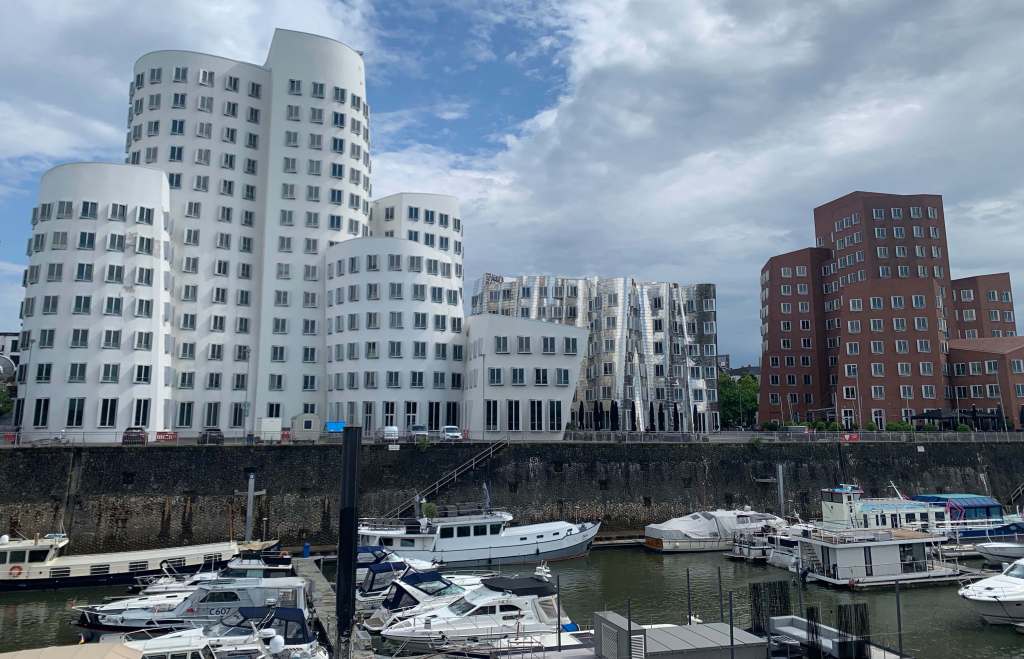
This pretty much concluded my first tour of the main sights of Düsseldorf. From there, we walked along the river Rhine. It was a hot day, and I wondered why nobody was swimming in the water. But I quickly gathered that that would be a bad idea. For one, the current is surprisingly fast and strong, easily able to sweep you downstream. I also doubt that the water is particularly clean, considering the constant traffic of barges passing up and downstream. Even now, the Rhine is a major artery of commerce. I enjoyed watching them go by, wondering at their cargo. The captains and crew must live a good chunk of their lives on these ships, which sometimes had the appearance of mobile homes—with their cars parked on the back and, in some cases, their kids playing on a swing set as the boat drifted downstream.

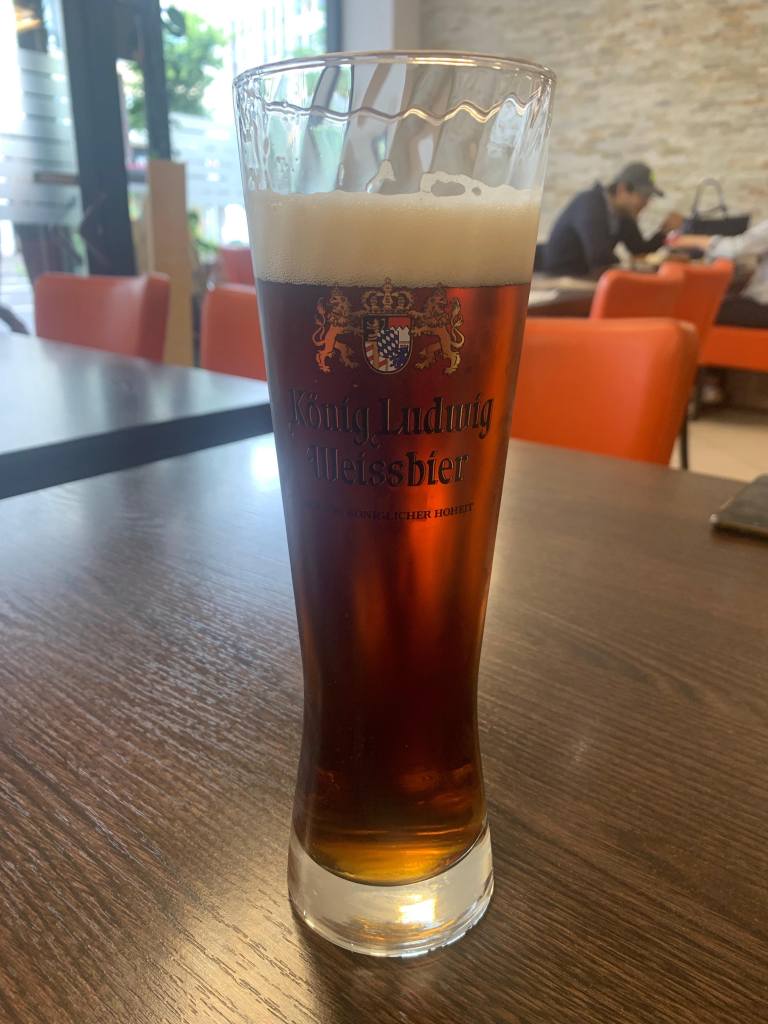
In Germany, drinking in public is perfectly legal (a wonderful state of affairs!). Thus, we bought beers at a stand and sat down on some beach chairs facing the river. This was my first taste of Altbier, the local beer of Düsseldorf. It is sort of rust colored and has a strong, hoppy taste. (It is called “old beer” because it is fermented with yeast that floats on top, which is older than the bottom-fermenting yeast used to make lagers.) Despite being brewed like ales, however, its taste is quite distinct, and significantly lighter. As I discovered later, Altbier—like Kölsch, its rival from Cologne—is typically served in small glasses, which are circulated by the waiter on a tray. When you take a glass, the server puts a mark on your coaster, thus keeping a tally of your drinks.
We finished up the day by going to dinner in a Japanese restaurant. It was excellent. Düsseldorf, you see, has one of the largest Japanese populations in Europe. Indeed, Düsseldorf is a highly diverse city in general, with a substantial Chinese population and a great many immigrants from within Europe. Shortly after I arrived, for example, Sai took me to one of the Asian supermarkets near his apartment, and I was astounded at the selection of available foods and ingredients. A few days later, Sai invited me to a picnic in the park with some friends of his, most of whom were of Chinese extraction. We had a veritable feast of non-German foods.
Sai has a demanding job, but he found the time to show me around the city a bit. We took a walk towards the Kö-Bogen, a large and flashy complex of office buildings near the Königsalle. Nearby is the Hofgarten, Düsseldorf’s central park. It was a beautiful day and the park was full of strolling families and youngsters lounging on park benches. Soon, we came upon an impressive neoclassical statue, consisting of a perfectly muscular young man who is dying on his bed, accompanied by a sympathetic lion. This is a war memorial, but not one dedicated to either World War. Instead, this commemorates the dead of the German wars of independence as well as the Franco-Prussian War of 1870. Since that time, war memorials have become less beautiful and more anguished.

As it happened, the day of the picnic with Sai was also some kind of museum day. This meant that many of the city’s museums were free to visit and open late. Many of these institutions are probably well worth a visit, but I had other plans. I wanted to go out to the city’s Altstadt (Old Town) to enjoy some of the famous nightlife.
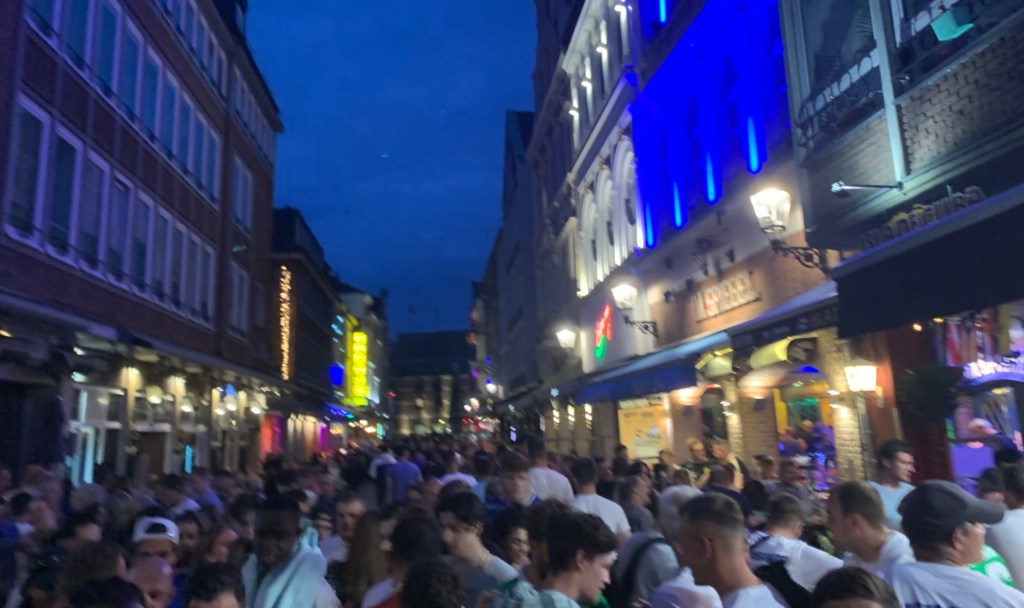
This proved to be a mistake. Sai and I arrived shortly after dinner, and the entire neighborhood was completely overrun. There were bachelor and bachelorette parties, and groups of university students on the prowl. Every single one of the seemingly innumerable bars was packed. I was astounded that such a seemingly sleepy town could turn into what struck me as a giant frat party. During the day, Düsseldorf seemed so perfectly bourgeois; but at night, it was overtaken by a kind of adolescent, macho drunkenness. Sai and I had a few of the Altbiers at a bar, but quickly retreated from the noise and chaos. Instead, we got some beers at a corner store and walked along the Rhine. Even here, it was scarcely quieter. For me, being stuck in the middle of so many drunk young people made me distinctly uncomfortable, and it was a relief when we called it a night early.
Such was my experience of Düsseldorf, a city that perhaps deserved more of my time and attention. My brief impression was rather confused. With its high-end shopping, large immigrant community, and raucous night-life, the city seemed to have a split personality. Next, it was time to visit its rival.
Köln
Cologne is in every way a bigger city than Düsseldorf. With over a million inhabitants, it feels properly urban. Whereas the Düsseldorf train station makes very little impression, for example, Köln’s enormous Hauptbahnhof immediately conveys to you its size and importance.
I visited on a tight schedule. This was several days after my visit to Düsseldorf. That morning, I had left my Airbnb in Koblenz (in the Rhine valley, to be related in a future post) in order to return to Düsseldorf for my evening flight back to Madrid. Cologne was one of the major stops on the commuter train from Koblenz, so it was easy to get off and see this famous German city as a final sightseeing stop.
Indeed, Cologne seems custom-made for day trippers. The train station is full of automated luggage storage lockers, which bring your baggage to the basement via an elevator. It was easy to use, cheap, and worked perfectly.
Right next to the station is Cologne’s principal tourist attraction: the Kölner Dom, the city’s magnificent gothic cathedral. Like many European churches, it took several eras to complete. It was begun in the 1200s, in a pure gothic style; but construction was stopped in the 16th century, the Renaissance, with still half of the church unbuilt. For centuries, the half-built cathedral stood in the city, with the medieval wooden crane still mounted atop one of the towers. Finally, in the 1800s, when a romantic passion for the medieval past was sweeping over Europe, it was decided to finish the building according to its original plans. Its completion in 1880—632 years after it was begun—became a national celebration for the relatively new nation of Germany (unified on January 1, 1871).
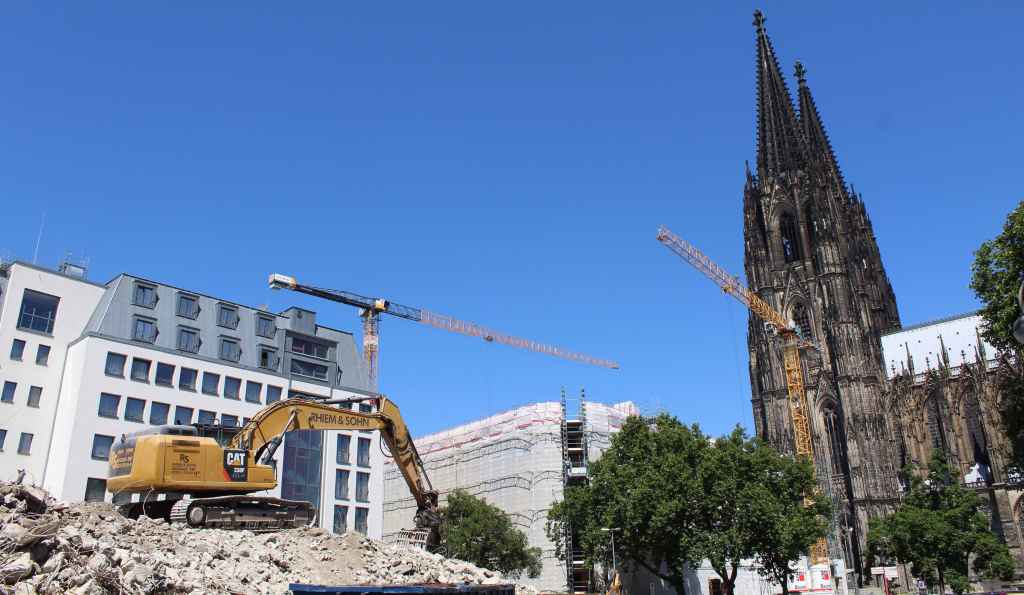
Since I had recently visited Italy, it was natural to compare the Kölner Dom to that other massive gothic church which took 600 years to finish: the Duomo of Milan. For my part, the German church is the clear winner. Whereas the Duomo is a confused mess of spikes and statues, the Cologne Cathedral has a unified and coherent aesthetic. Its first and last impression is of overwhelming verticality, as if the church is a kind of spiritual rocket about to take off towards heaven. Indeed, even today Cologne Cathedral is among the tallest church buildings in the world, stretching up 157 meters (or over 500 feet). Even its bell is big. The enormous Petersglocke (affectionately called “Fat Peter”) is the second-largest swinging bell in the world, weighing one ton more than the massive Pummerin in Vienna.
Like so many churches and monuments in Europe, the Cologne Cathedral was badly damaged during the Second World War. On a wall near the cathedral, you can see photos of the destruction. The entire city of Cologne was turned into rubble from Allied bombing raids, but the towers of the cathedral remained standing. In the final battle for the city, a German Panzer tank fought a rearguard battle against advancing Allied armor, disabling two Sherman tanks in the process. It was finally destroyed by one of the new American Pershing tanks—an event captured on video by an attached American cameraman.

Right across from the cathedral is (or was, it seems to have been moved) the Roman-Germanic Museum. Cologne, you see, was originally a provincial outpost of the Roman Empire. Indeed, the name of the city comes from the Latin colonia. As a result, the area is abounding in Roman ruins, many of which are collected in this museum. Right nearby is the Ludwig Museum, the city’s premier institution of modern art.
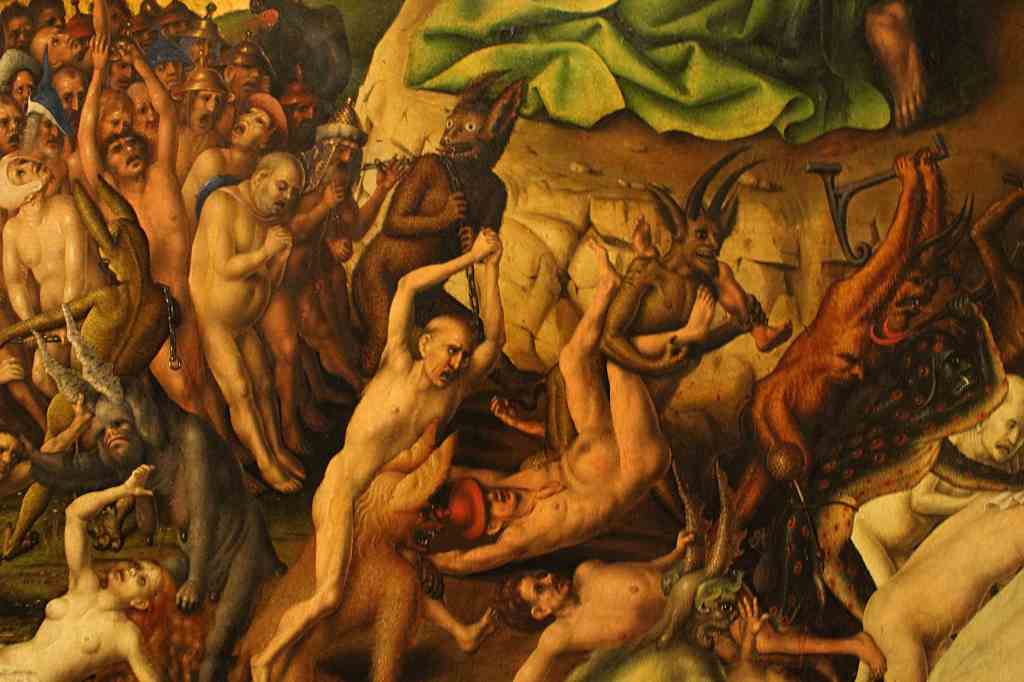
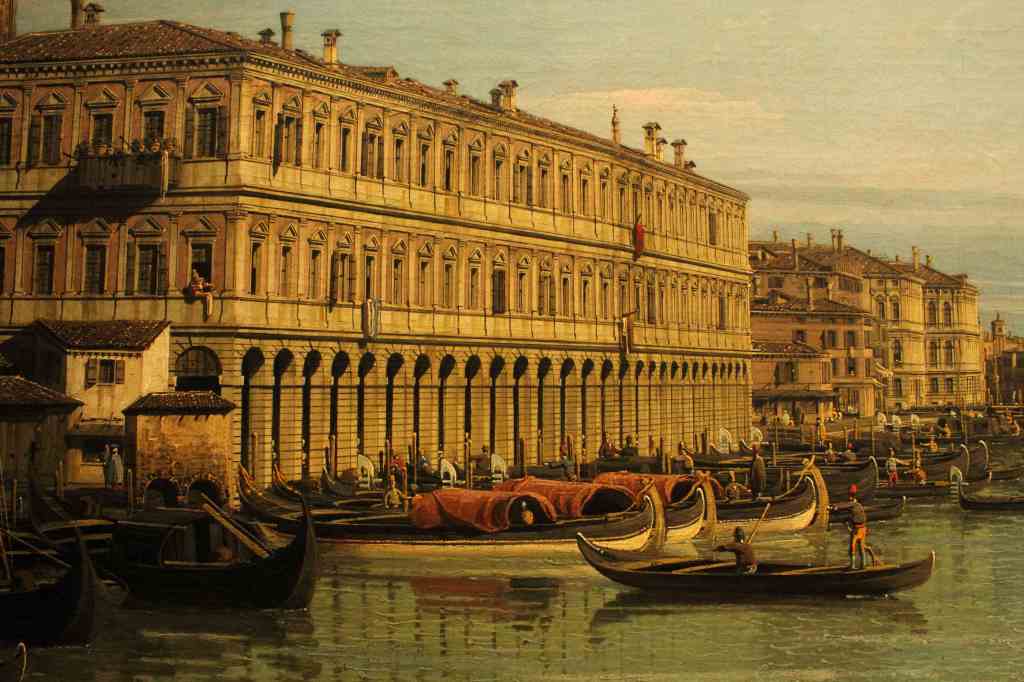
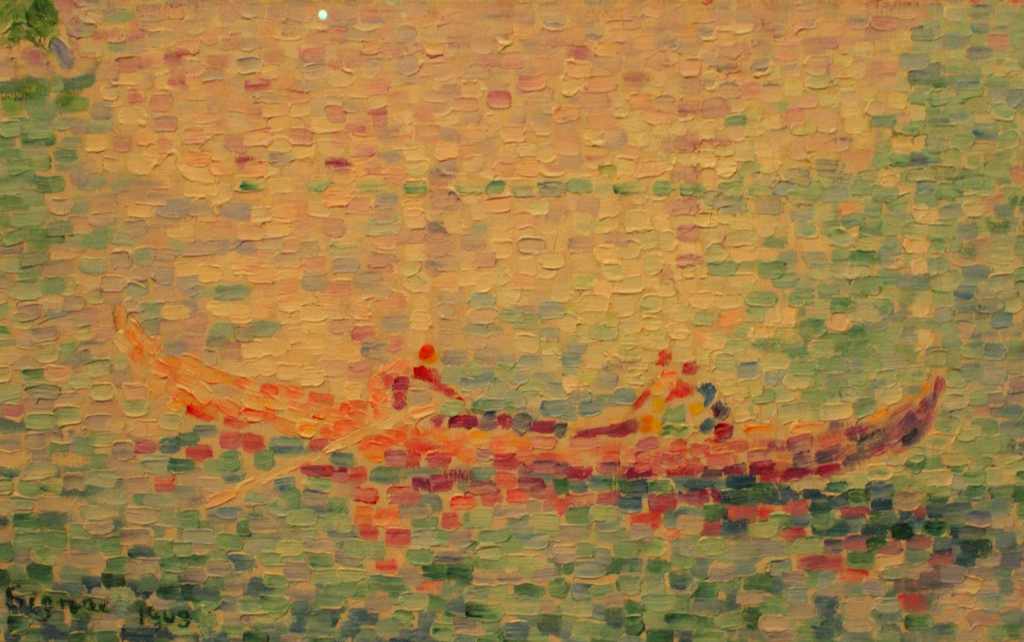
But with my limited time, I decided to go slightly further off and visited the Wallrat-Richartz Museum. Its clunky name notwithstanding, this is a fantastic painting gallery, with a collection that spans from the gothic to the early 20th century. The medieval section is likely the strongest, as the museum has many excellent examples of gothic paintings, some of the best I have ever seen. But with Rembrandt, Monet, and Van Gogh in attendance, there is no lack of quality in the other departments.
Right across the street is the Farina Fragrance Museum. It was here that the Italian Giovanni Maria Farina (whose name is often Germanized to Johann) produced his famous eau de cologne (“water of Cologne”); and they are still in business to this day. (Curiously, although in English cologne is normally marketed for men, in Spanish “colonia” does not have such gendered connotations.)
From there, I went back in the direction of the cathedral. From there, I walked across the Heinrich-Böll Platz, where I noticed a strange sign in French. Apparently, the city’s concert hall was constructed under this square. But it was not well-conceived, for the sounds of people walking could be clearly heard in the Philharmonie. Thus, every time there is a performance, the plaza must be closed to foot traffic. Lucky for me, there was no symphony going on, and I could cross without issue.
I climbed up some stairs, onto the Hohenzollern Bridge. This is the busiest train bridge in Germany, constantly rumbling with traffic. It is also a landmark for lovebirds, who leave locks on the bridge’s railing. The bridge is named after Germany’s erstwhile royal family, and statues of the old kings guard the four corners of the bridge.
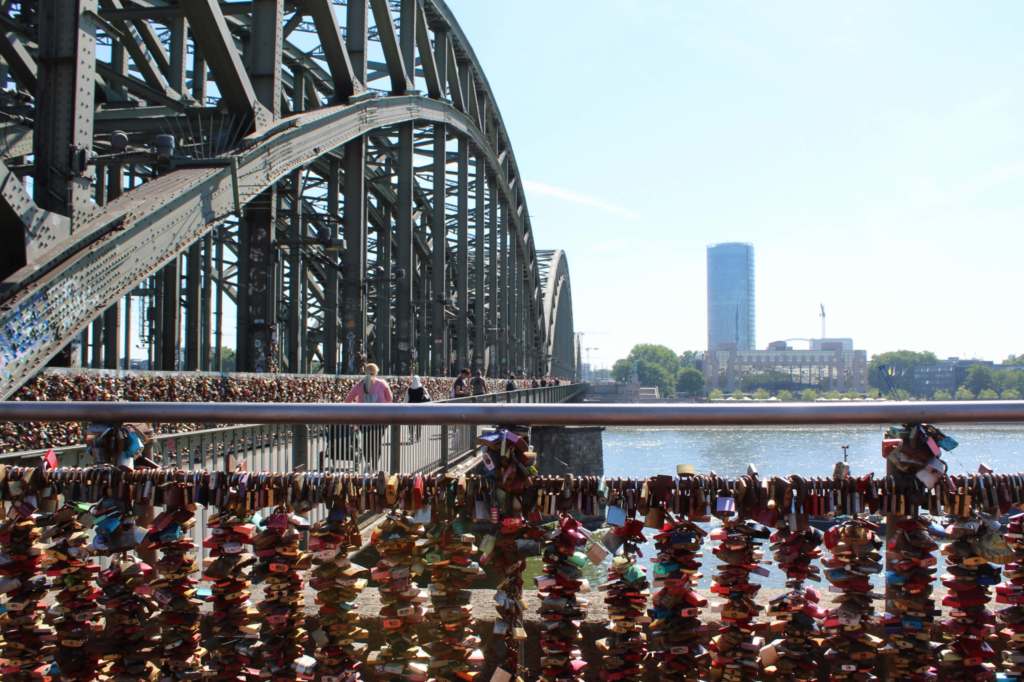

Across the bridge is one of the tallest buildings in the city (though still considerably shorter than the cathedral’s towers), the Kölntriangle. Situated on a little hill, this building is known for its viewing platform on the top floor. I paid and took the elevator to the top, where there is a 360-degree view of the city. Frankly, Cologne is not the most beautiful city to see from the air, but you do get a classic photo of the cathedral next to the bridge.

Finally, it was time to have lunch. My roommate at the time had a German boyfriend who was from Cologne, and he kindly sent me a long list of things to see and do. Unfortunately, I hardly had time to scratch the surface, but I did follow his advice as to where to have a good German meal. Früh am Dom is a traditional beer hall right near the Cathedral. Outside the place was bustling with activity and I was afraid I wouldn’t be seated; but as soon as I walked in, I saw that the beautifully furnished space was half empty.
To eat, I ordered Himmel und Ääd (the Rhinish dialect for “heaven and earth”), a formidable dish consisting of blood sausages over mashed potato and apple sauce. It was delicious—especially, when washed down with the city’s typical beer, Kölsch. Compared to Düsseldorf’s Altbier, Kölsch is much lighter in color and flavor. Though mild, I found it to be delicious and extremely refreshing. As in Altbier, the Kölsch was served in little glasses, and the drinks marked on your coaster. I believe I had three before the end of my meal.
Stuffed, I now had just a bit of time to kill before my train to the airport. To enjoy Germany’s lax laws, I got a Kölsch from a corner store, walked to the park along the Rhine, and drank it slowly in the sunlight. It had been a wonderful trip to Germany.
Epilogue: Travel Troubles
But my voyage was not to have such a tranquil end. For one, the train was absolutely packed. I quickly gave up on finding a seat and resigned myself to standing with my heavy backpack near the doors, as the crowd surged in and out. We passed stop after stop, with the train only growing more and more crowded. After a little more than an hour, the train was full almost to bursting, and I was very eager to get off.
Yet that was not to be. On the tracks between Düsseldorf and its airport, the train came to a halt. Then, a crackling and muffled voice came over the loudspeakers, and made a brief announcement. My German was good enough to get the basic message. My heart sank: the train was not going to stop at the airport, but would bypass the stop and go to the next town over, Duisburg. Full of anxiety now, I got off and looked for the next train back to the airport. It was supposed to arrive in just 10 minutes. But after more than a week in Germany, I knew that this was unlikely. (The trains in Germany are famously unreliable.)
As predicted, the train was delayed. Indeed, it was so late that it had not arrived by the time the next train to the airport was supposed to come. That one was delayed, too. Then this happened again with the next train, so I was waiting on three. I began to grow very panicked, since now I couldn’t tell which train would arrive first or what track it would be on. I was so frantic that I jumped on the first train appearing to head in the right direction, without even being quite sure what train it was.
I had chosen well, and after a delay of about 40 minutes I was at the airport. But my travel stress was not at an end. As I walked into the main lobby, I noticed two enormous lines stretching through the airport. After some reconnaissance, it dawned on me that these were the lines for security. I had given myself a large margin to arrive for my flight, so even with the previous delay I still had almost two hours. But as the line edged forward, I realized that I might be cutting it close.
An hour passed, and we were finally in view of the metal detectors and luggage scanners. Then, behind me, a frazzled woman started making her way through the line, explaining to each person that she was going to miss her flight if they didn’t let her through. Finally, she made it to me, and I let her pass me by (I still had about 45 minutes). But the main in front of me adamantly refused.
“Please, sir, I’m going to miss my flight,” she said, holding her hands in a gesture of supplication.
“That’s not my problem!” he shouted back.
“Please, it doesn’t affect you.”
“You think you’re the only one who’s going to miss their flight?” he snapped. “I’m going to miss my flight, too!”
The argument went on for about ten minutes, with the woman pleading and the man growing more enraged, until finally, exasperated, he let her pass by. (Later, I heard him talking to a colleague on the phone, reporting that he did indeed miss his flight. I don’t know if the woman made it.)
I made it to my gate with just twenty minutes to spare, feeling immensely relieved. I’d had a wonderful time in Germany. But I must say, the country’s reputation for efficiency is rather unmerited.


“Düsselford” is a cute typo.
LikeLiked by 1 person
Oh, whoops! Fixed it.
LikeLiked by 1 person