It was the summer of 2022 and Europe was in the midst of an energy crisis. As a response to the rise in fuel prices, many governments attempted to make public transportation cheaper. Spain, for example, reduced the price of monthly metro cards by half and offered free train passes for commuters. Germany, meanwhile, offered a nine euro monthly pass that was valid for the bus, metro, and commuter trains for the entire country. It was an incredible deal, and I had arrived in Germany right in time to take advantage of it.
Now, this may come as a surprise if you believe in the German stereotype of efficiency and timeliness, but the trains in Germany are a mess, with constant cancellations and delays. (This is partly because, unlike in Spain or France, the high speed trains in Germany use the same tracks as the local trains.) The new 9-euro pass had only added to the chaos, since the added passengers put additional pressure on the already overburdened system.
So the train ride was not exactly quick. But I was in a good mood, nevertheless. You see, Aachen had been on my list for years, ever since I watched Kenneth Clark’s magnificent documentary Civilisation. The first episode of that series begins with the so-called Dark Ages, and culminates in the rise of Charlemagne—an event which, for Clark, signifies the rebirth of European civilization from the brink of destruction. Though many historians would, I think, dispute this dramatic conclusion, it cannot be denied that Charlemagne is a figure of paramount importance in the history of Europe. And if you want to learn about Charlemagne, Aachen is the place to be.
But my arrival was something of an anticlimax. As it happened, my train pulled into the Aachen Hauptbahnhof at almost the same moment that several appointments were made available on the Spanish government website. As I was in desperate need of an appointment (in order to get a document that would allow me to travel back to the United States while my visa was being renewed), I spent a panicked 15 minutes navigating the poorly designed and unreliable website in order to secure myself a spot. After so many years in Spain, I still feel acute and almost crippling anxiety when I have to do anything regarding my visa. My hands literally shook as I confirmed the appointment. When I realized I had been successful, relief washed over me.
Now, I could explore the town with no distractions. My route took me to one of the two surviving medieval gates of the city, the Marschiertor. (On the other side of town is the even more impressive Ponttor.) Nowadays, this huge gate stands alone, as Aachen is happily safe from foreign invaders—for the foreseeable future, at least.
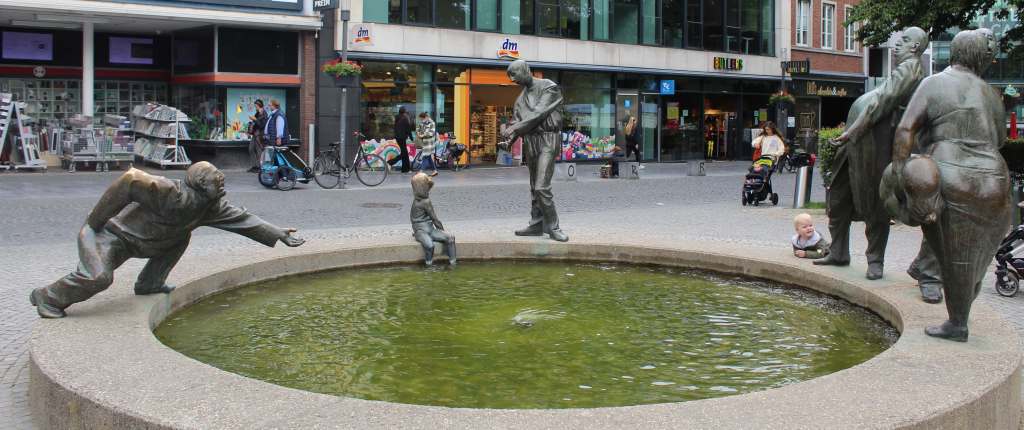
Speaking of invasions, Aachen has been under the control of France on at least two occasions. First, it was ceded to France for about 15 years after Napoleon defeated the Holy Roman Empire. Then, after World War I, it was controlled by the allies until 1930. Germany lost control of the city at least once more after that, to American troops, who virtually leveled the place in the process. It was the first German city to fall to the Allies during the Second World War.
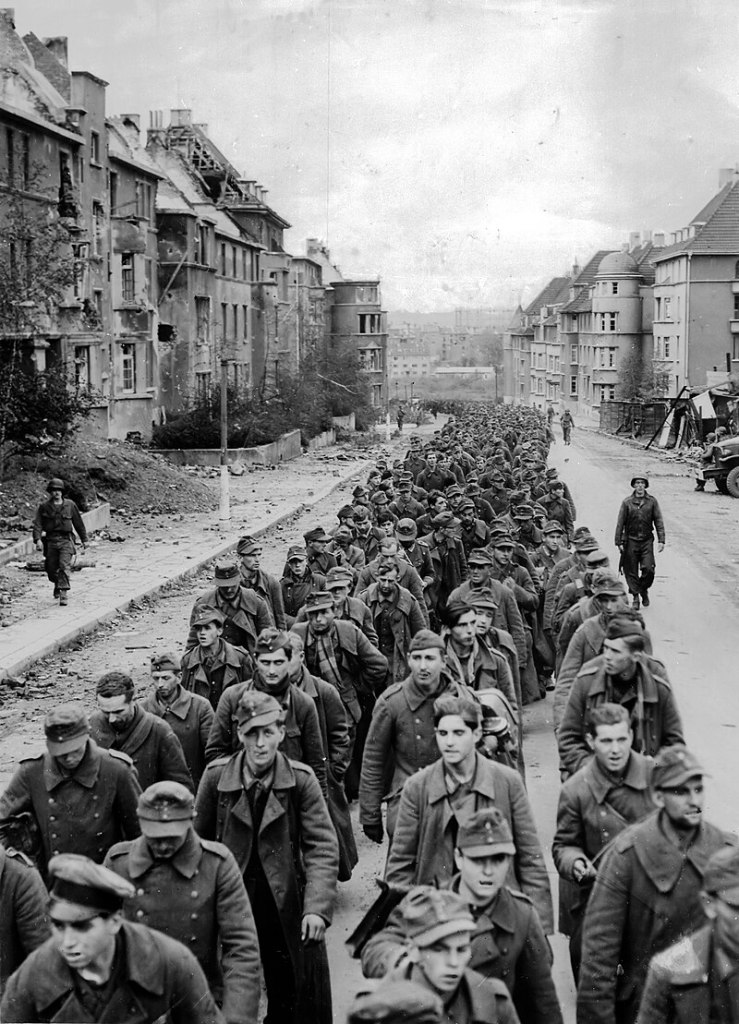
As you can see from these snapshots of its long and somewhat turbulent history, Aachen is not the sleepy town that is status as a spa city would have you believe (its hot springs have been appreciated since Roman times). Partially this is due to its history as a capital of the Holy Roman Empire (of that, more below). But this is also because Aachen is near the borders of Belgium and the Netherlands, making it simultaneously the door to Germany (in the Second World War) and, via Belgium, the door to France (in the First).
All this has resulted in a multitude of names for this place. In German it is, of course, Aachen, while in French it is Aix-la-Chapelle. Meanwhile, in Italian, Portuguese, and Spanish, the city is called some variation of Aquisgrán. This is an awful lot of historical and linguistic weight for one town of a quarter of a million souls to bear. But, on that sunny summer day, none of the residents seemed to notice or mind.

My first stop was the Aachen Town Hall. This is a venerable old building that, like Aachen itself, has suffered many reversals of fortune—burned down, left to crumble, burned down again, and then finally bombed. As it stands today, it is an imposing neo-gothic structure that looks more like the abode of a nefarious count than a civic-minded mayor. But the flocks of school children on field trips, and the wedding party out front, showed that—appearances to the contrary—this is indeed a beloved part of the town. For a modest price, you can even visit the interior of the Rathaus. If for nothing else, this is worth it to see the extremely well-made replicas of the Imperial Regalia of the Holy Roman Empire. (The originals are now in Vienna.) This includes the famous Imperial Crown, which is so encrusted with jewels that it looks decidedly uncomfortable.


My next destination was the Aachen Cathedral. This is by far the most famous sight in the city—the church built by Charlemagne himself, where 31 kings and 12 queens were crowned, one of the first places to be listed as a UNESCO World Heritage site. I walked in and was immediately awe-struck. But my amazement turned to confusion when I failed to find the legendary Throne of Charlemagne. I asked one of the tired-looking guards, in the best German I could muster, “Wo ist der Thron des Karl der Grosse?” He responded quickly, repeating the word “Führing” several times, which my dictionary told me meant “guided tour.”
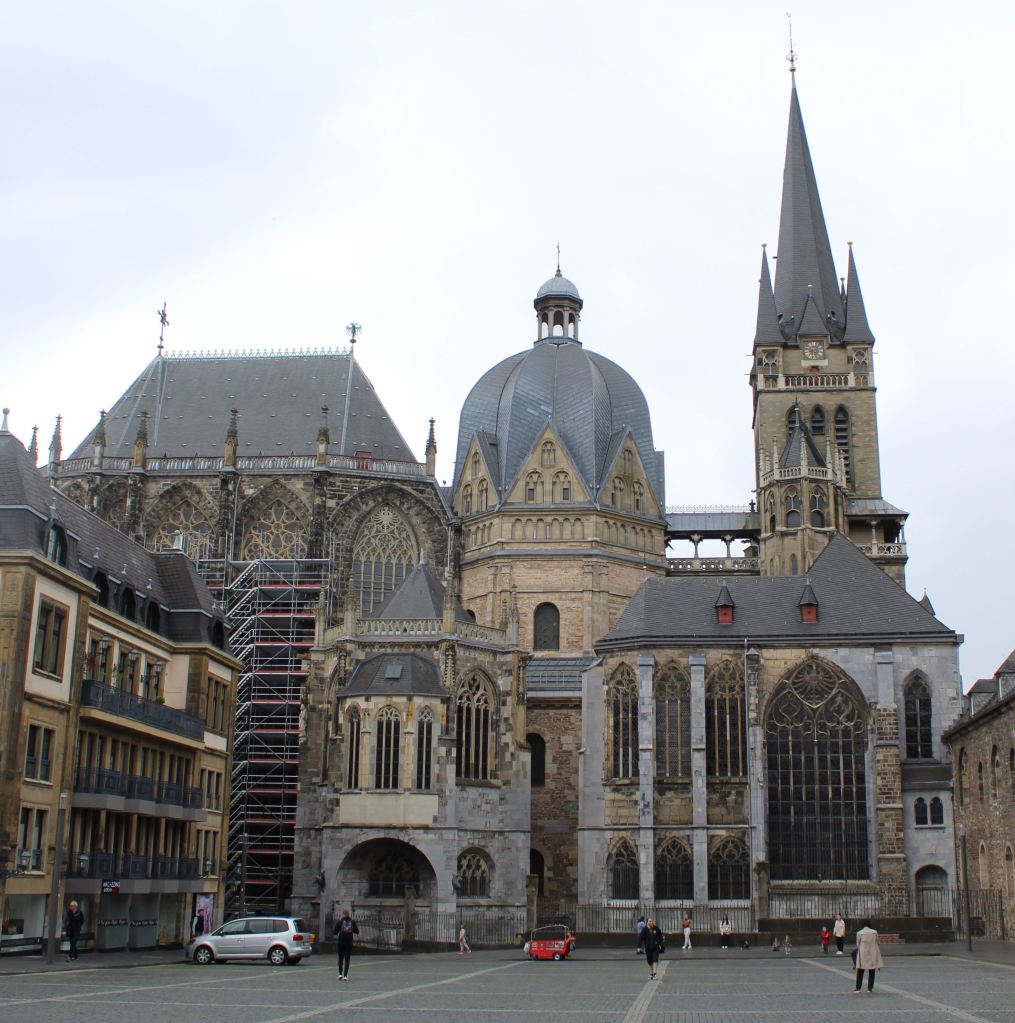
With this new information, I left the cathedral and found the neighboring office, where tickets can be bought for the guided tour. Once there, I noticed an option to buy a combination ticket for the tour and the cathedral treasury—which worked out quite well for me, as it gave me something to do while I waited for the tour to begin.
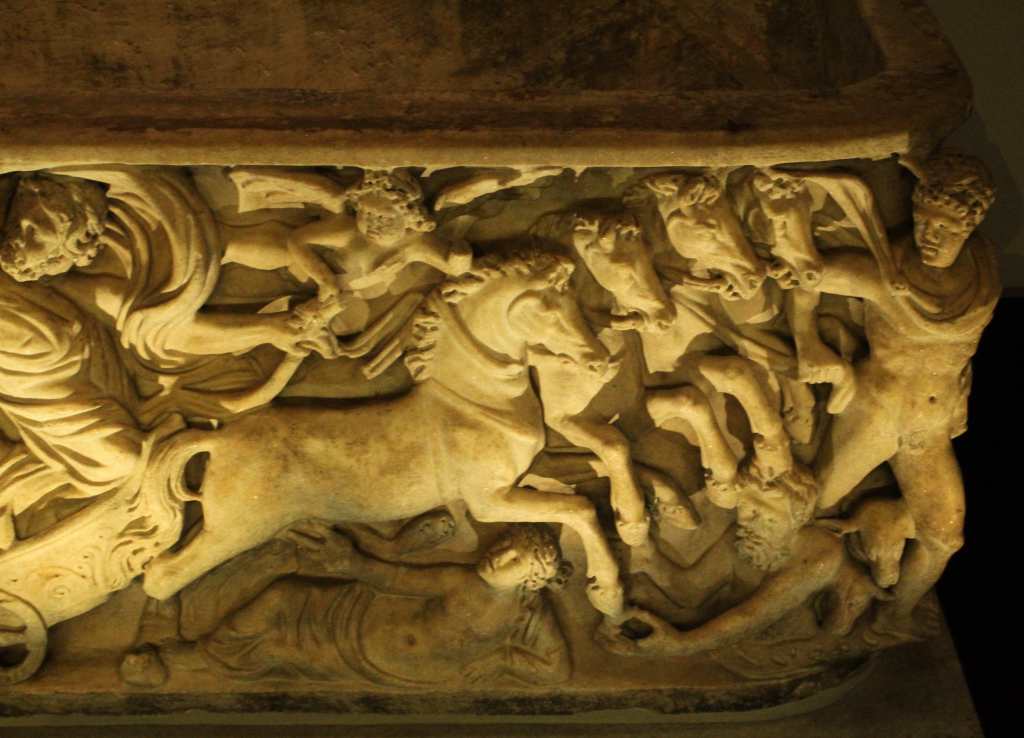
Now, I have been in many cathedral treasuries by now, and most of the time I find them rather uninspiring—usually consisting of gold and silver reliquaries of various shapes and designs. But the artwork on display here was exquisite and unique. There is, for example, the Proserpina sarcophagus. Made of marble and carved in ancient Rome, it was brought here as a symbol of imperial rule by Charlemagne, who was quite possibly buried in it. Also (potentially) belonging to Charlemagne is a hunting horn and knife. But two works of the goldsmith stood out to me as the jewels of the collection.
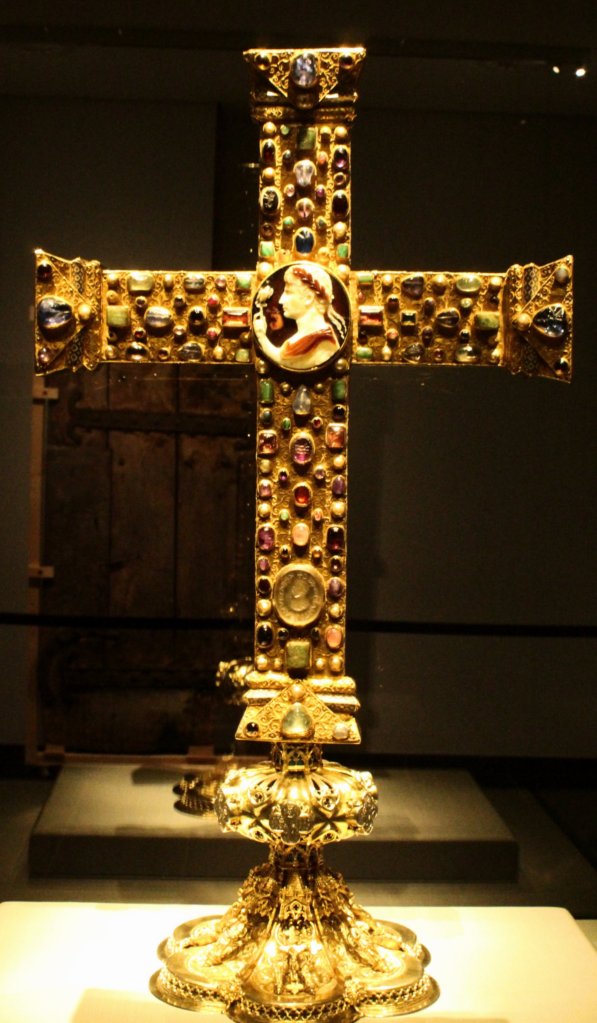
One is the Cross of Lothair, made around the year 1000. On one side the gold cross is completely covered in jewels (much like the imperial crown). Strangely, in the very center of the cross is a cameo of Augustus Caesar. Now, it is possible that this pagan emperor was included to symbolize the connection between the ancient empire and the medieval so-called Holy Roman Empire. But it is just as possible that they simply did not know who it represented and thought it was a holy figure. In any case, the reverse side is certainly pious. Delicately engraved into the gold is a portrayal of the crucifixion. To modern eyes, it appears rather standard in design, if well-executed. But in 1000 the image of Christ suffering on the cross still wasn’t paramount in Christian decoration (notice the many depictions of Christ of the Last Judgments in medieval churches). This crucifix, then, is not only beautiful but artistically daring.

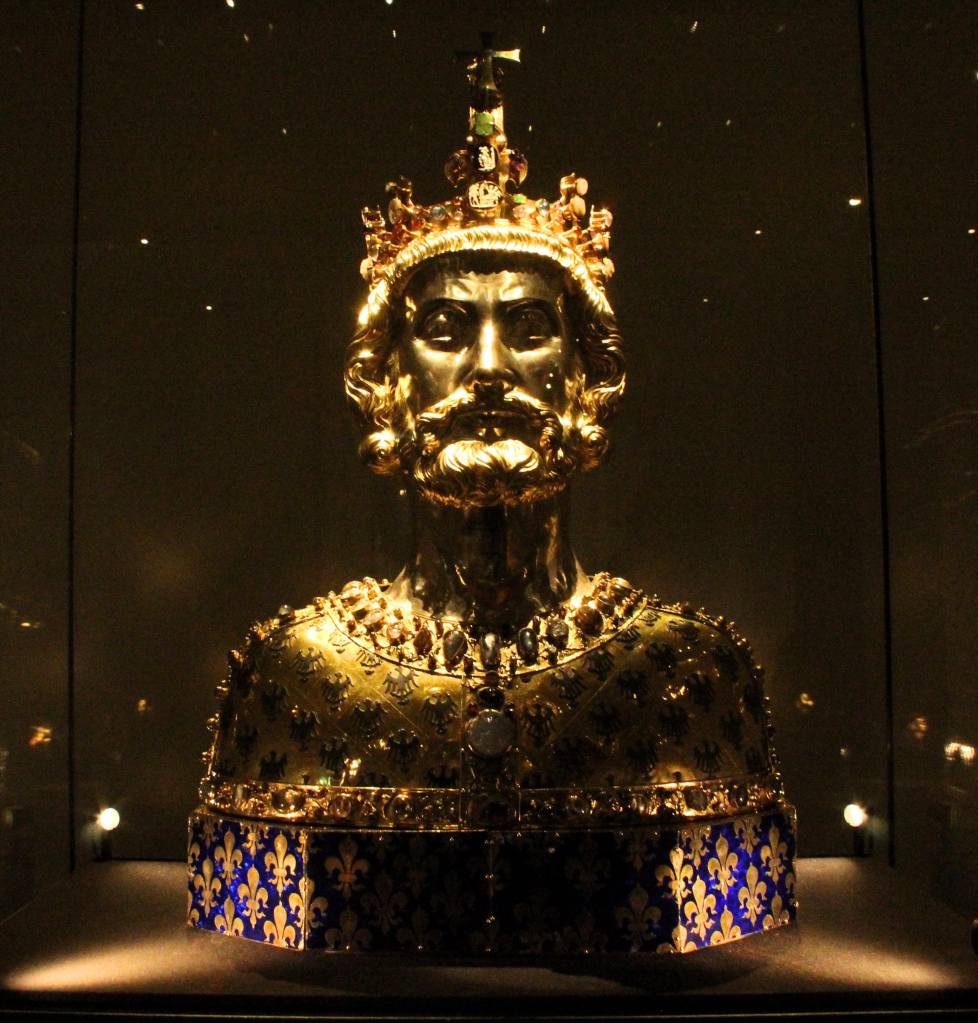
The other is the bust of Charlemagne, a reliquary containing a part of the king’s skull. Roughly life-sized, the bust was made hundreds of years after Charlemagne’s death, and so probably bears little resemblance to the actual king. But this portrait, however idealized, is shockingly lifelike nevertheless. The anonymous craftsmen who made it were obviously masters of their arts. The bust works on three levels, as a work of art, a religious object, and a symbol of imperial power. For example, the king’s tunic is covered with the imperial eagle and he wears a crown covered with jewels and, again, ancient Roman cameos (signifying the inheritance of the Roman Empire). It is a marvelous statue—delicate and beautiful, while authentically royal and imposing.
Now it was time to visit the cathedral. The visit began with the traditional entrance to the church, the Wolfstür. This is the subject of a legend, which (if memory serves) goes like this: The townspeople, lacking the time and resources to complete the church, made a deal with Satan. If he completed the church, he would be able to keep the soul of the first creature that entered its doors. But when it came time to honor the bargain, the townspeople craftily sent a wolf to enter the church doors, which is obviously not what Lucifer had in mind. The enraged devil tried to leave the church to punish the townspeople, but got his thumb caught in the closing door.
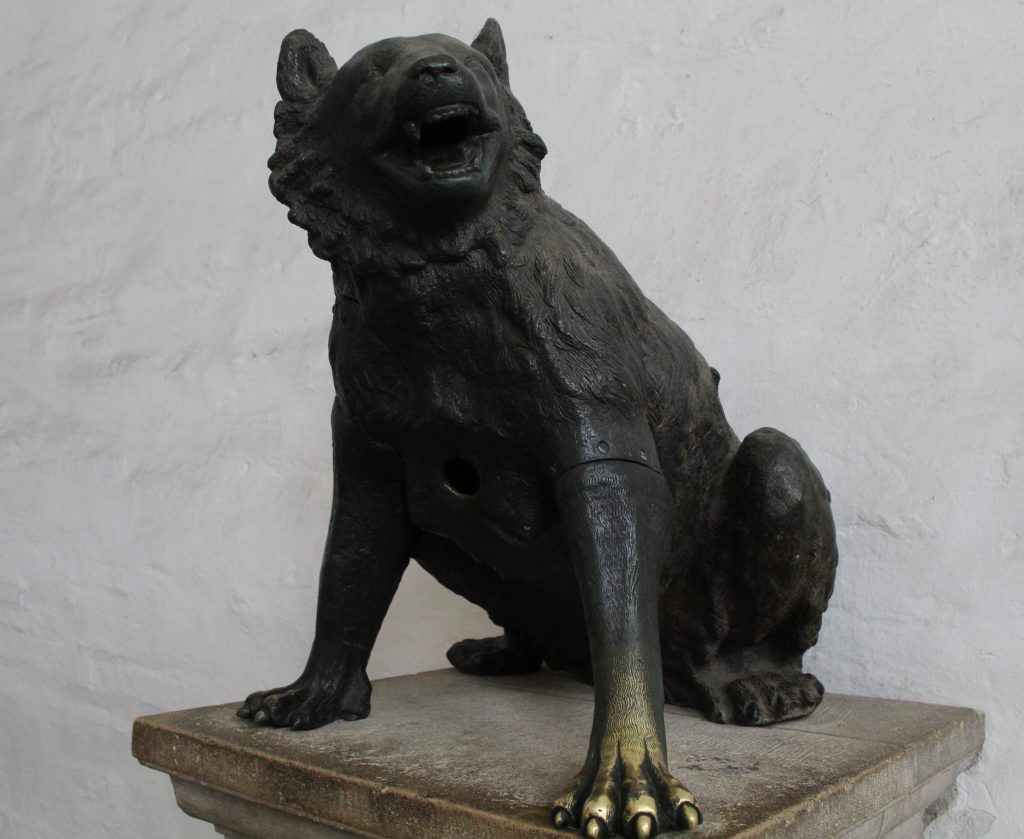
This story (repeated, in various forms, all over Europe and perhaps the world) has some physical manifestations. In the bronze door knocker, for example, there is a bump inside the lion’s mouth, which legend says is the satanic thumb. Once inside, there is a statue of the unfortunate wolf, and opposite that is (for whatever reason) a pine cone.
Finally we entered the church itself. The core of the structure—the so-called Palatine Chapel—goes back all the way to the year 800, though it has been so finely refurbished that you would hardly guess its age from its polished and immaculate appearance. In structure it is hardly like the typical European church, with its three names culminating in a main altar. Instead, the church is octagonal, with no natural front and back. It takes this design from the Byzantines, as the core of the church is closely modeled after Basilica San Vitale in Ravenna. Indeed, the structure even incorporates ancient marble columns taken from Rome. Clearly, Charlemagne was quite consciously forging a connection between his new kingdom and the splendor of the ancient world.
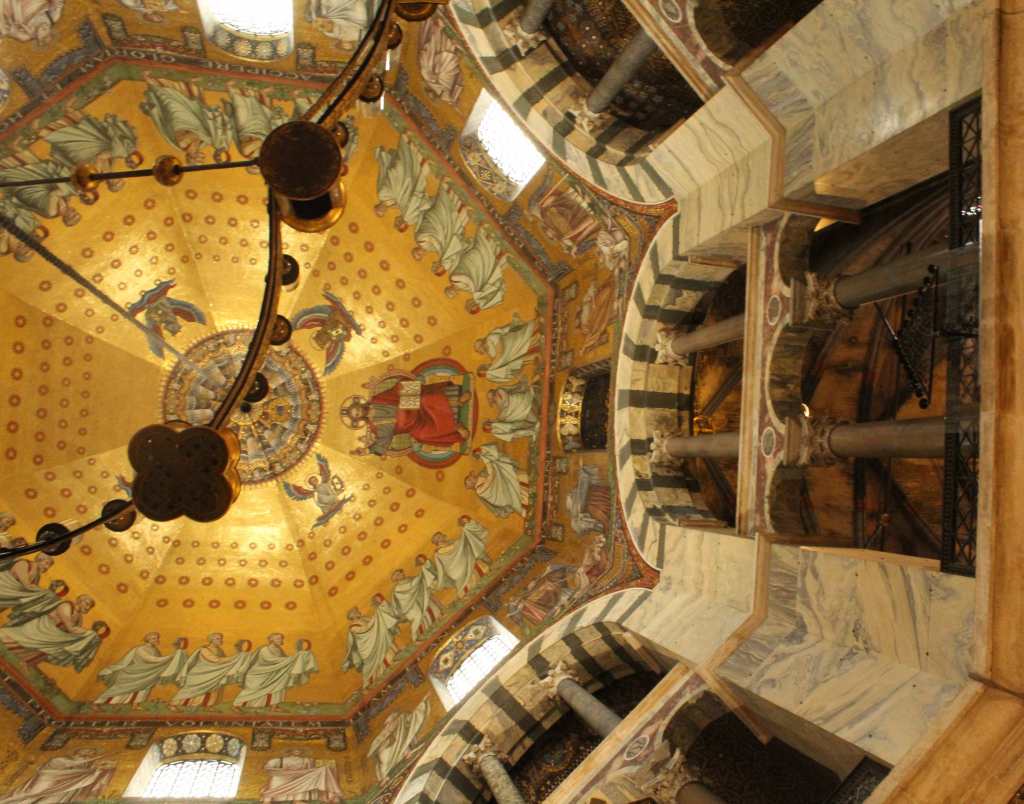
Hanging in the center of this splendid octagon is the so-called Barbarossa Chandelier, named for the Holy Roman Emperor Frederick I (who had a red beard). Looking like a giant crown, its symmetrical shape complements the octagonal space, creating a sort of tunnel view up to the mosaic on top of the cathedral.
Then, our guide took out a large key and opened the grated metal door leading up to the stairs. This was the moment I had been waiting for, as I knew that Charlemagne’s Throne was on the up there. After pausing to admire the railings, ceiling mosaics, and marble columns, we arrived at the legendary seat.
It is, at first glance, almost comically unimpressive. Far from being the gold and bejeweled seat one might expect, it is made of plain stone slabs, sitting on a platform of what appear to be cinder blocks. Apparently, however, the slabs which make up the throne are relics of some kind (there are different theories, but they all connect the stones to Jerusalem and the life of Jesus). This contrives to make the throne itself into a kind of relic. And, indeed, visiting pilgrims would crawl underneath the throne as an act of devotion.

Considering this religious nature, “throne” may not even be the best word to describe this esteemed seat—at least, as it was originally conceived. Charlemagne, for example, was not crowned here, but in Rome. And, certainly, it is strange to imagine that ruler issuing his decrees from the second floor of a cathedral. But it became a throne, if it was not one to begin with. As I mentioned, dozens of monarchs were crowned on this very spot. Napoleon, in a rare moment of humility, climbed the steps but refrained from sitting down himself. According to our guide, such scruples did not stop Heinrich Himmler.
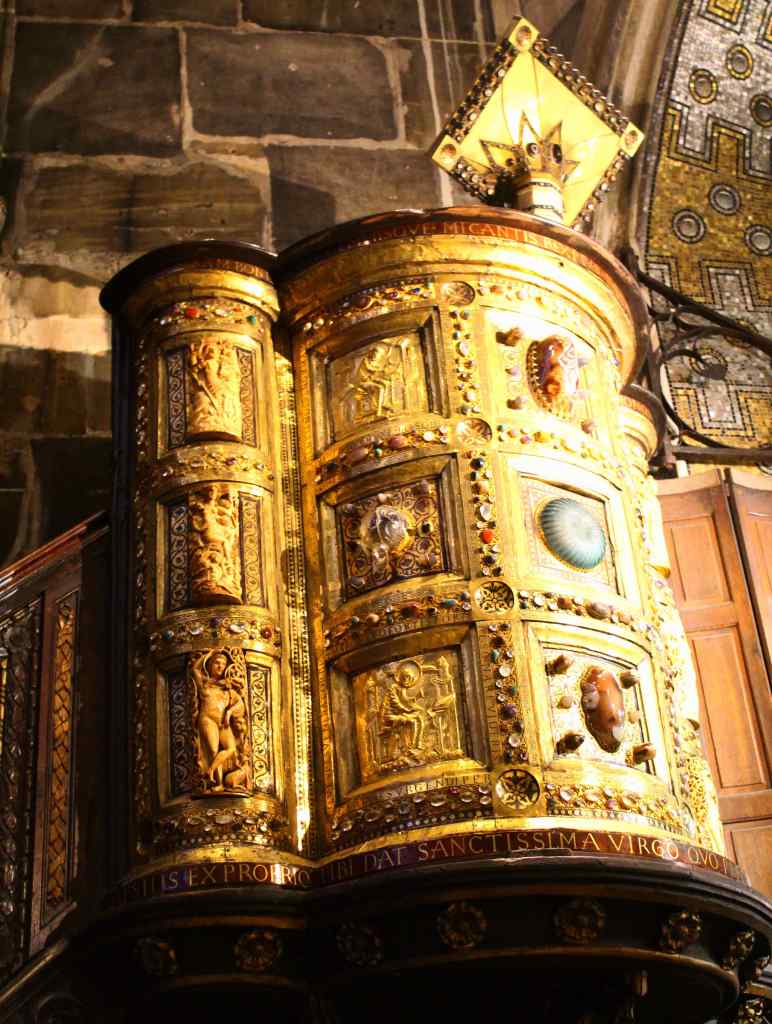
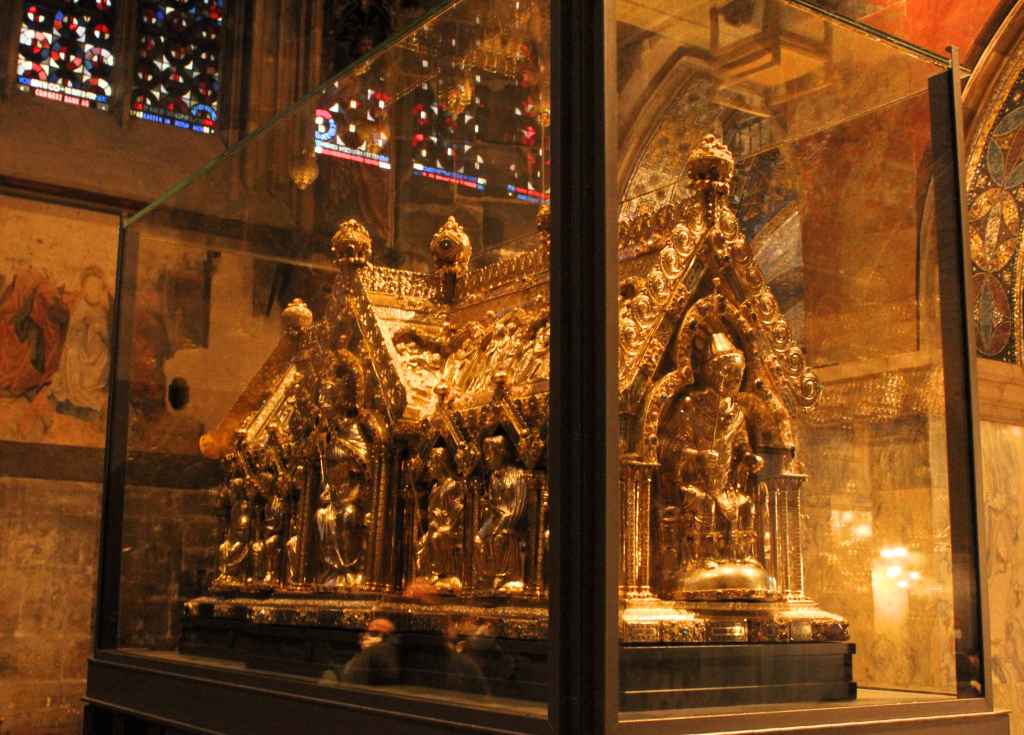
Now it was time to enter the gothic church. The original Palatine Chapel has, you see, been supplemented with a gothic choir, of a much more conventional—not to say unattractive—design. This part of the church also has its share of famous objects. There is, for example, Henry’s Pulpit (also called an “ambon”), which is yet another example of the golden and encrusted style typical of the Carolingian period. It is covered with exquisite ivory carvings and, as typical of the Holy Roman Empire, it incorporates elements of pagan art pillaged from Italy and the Holy Land. Nearby are the Karlsschrein and the Marienschrein, two enormous gold reliquaries. The first contains the bones of Charlemagne himself (moved from the Roman sarcophagus, apparently), while the second is supposed to contain Jesus’ swaddling clothes and a dress belonging to the Virgin Mary. What is indisputable, however, is that these two are remarkable examples of medieval metalworking.
This is where the tour ended. Dazzled, I wandered back into the streets of Aachen. It had warmed up by now and my jacket was unnecessary. Extremely hungry, I was gratified to find a German sausage restaurant right around the corner. There, I tried to order the most “German” thing I could, and decided that would be a mug of beer and a plate of blood sausages, accompanied with mashed potatoes and applesauce. A bit over the top, but I enjoyed it.
Stuffed to bursting, I wandered back to the train to return to Düsseldorf, where I was going to stay. But that is a story for another post.

 Lotz in Translation
Love this, Roy. You’ve got me interested in Charlemagne.
LikeLiked by 1 person