Basking in the Basque Country: San Sebastián

Basking in the Basque Country: San Sebastián

(This post is part of my series on the Basque Country. Click here for Bilbao, here for San Juan de Gaztelugatxe, and here for the Vizcaya Bridge.)

San Sebastián is a city much unlike Bilbao. For one, it is noticeably smaller, with a population of less than 200,000. But more conspicuously, it is not at all a city of industry, commerce, or manufacturing. Rather, it is a place of tourism. The streets are full of foreigners, squeezed into the narrow streets, filling up the parks, covering the beaches with their bodies. The city is also remarkably pretty. As I strolled along the beaches I was reminded of Cádiz; and as I wandered through the streets, Oviedo came to mind. But the strongest and most persistent impression was surprise at the number of tourists. They were all over the place; every restaurant was full, every shop was crowded. The shoreline was an unbroken wall of hotels. I had no idea San Sebastián was so popular.

Some of this probably had to do with the city being (along with Wroclaw in Poland) one of the European Cultural Capitals of 2016. (Each year, a city or two in the European Union gets designated a European Cultural Capital, which means it will host several Europe-oriented events during the year.) This may have attracted even more tourists than usual. Even so, it is clear that San Sebastián is a major tourist destination, because its whole economy is oriented around visitors. This is fitting, for the city is undeniably charming. Its location is a good one, too, being only 12 miles from the French border, and northerly enough so that the temperature is nearly perfect in summer.

We were hungry when we arrived, so our first order of business was food. Our Airbnb host recommended a restaurant in the center. The restaurant was the Bar Aitona, and it was excellent. We ordered the steak and the octopus. Both were served on a huge bed of fries, both were amply portioned, both were well seasoned, and both were scrumptious. Added to that, the prices were very reasonable. We left very full, and very satisfied. I recommend it with great enthusiasm.

IMG_3778

When we were back on the street, we decided to start exploring the city. This inevitably led us to Monte Urgull, the most conspicuous landmark in San Sebastián. Urgull is a hill that overlooks the bay. Nowadays, it is covered in trees, and is basically a park; but in the past it formed as a military fortification, since its high elevation at the bay’s edge made it well suited for defense. And these fortifications were not just for show; they were used in several important battles. Probably the most significant of these was the Siege of San Sebastián, in which the British forces, led by Wellington, ousted Napoleon’s troops in the Peninsular Wars. Of course, I didn’t know any of this at the time, but was instead attracted by the gigantic statue of Jesus—12 meters, or almost 40 feet tall—that looms over the hill.

IMG_3773

We began walking up, and quickly found that it is a delightful place. Old walls, broken battlements, obsolete canons, and other aging fortifications still stand, some in ruins, some overgrown; and for me there is something remarkably romantic about the sight of weeds and trees reclaiming the abandoned dwellings of past times. The hill is divided into several levels, and as you ascend you get a progressively better view of the city. From the top, the whole shore is spread before you, with its azure water, crowded beaches, and the rolling green hills in the distance. We got to the top, where we could stare up at the towering figure of Jesus, and then descended on the other side of the hill.
IMG_3781

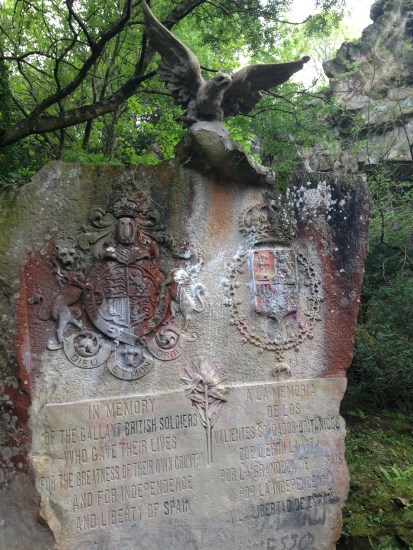
This part of was a wooded area. But as we climbed down a rocky path, something caught our eye. Right below a cliff, surrounded by roots and trees, was the old memorial erected by the British army after the conquest of San Sebastián. A broken and discolored plaque, bearing the royal insignias of England and Spain, bore a message in both English and Spanish honoring the fallen soldiers. Further on, we noticed another plaque, this one on the side of a rock face, honoring the unknown soldiers lost in the campaign. I know these must be well known, but at the time, with only the two of us, it felt like coming upon an archaeological treasure. This illusion was quickly dispelled, since at the bottom of the hill we encountered a map showing where all the different war memorials, graves, and mausoleums could be found on the hill. In any case, it’s a lovely area, both for its history and its views.
IMG_3788

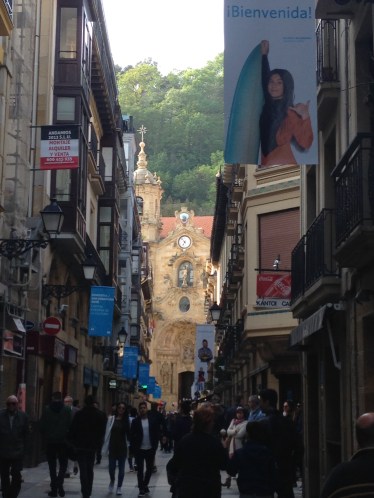
The rest of our day was rather uneventful. We strolled around San Sebastián, enjoying the ocean, the river, the crowded city center. But we did not really visit anything in particular, since we couldn’t find anything to visit. It seems that San Sebastián is a lovely place if you want to eat and go to the beach, but it does not have much in the way of cultural tourism, which is mostly what I’m after. In any case, it was late. We had arrived at around noon, and by now the sun was setting. So we walked along the river to our apartment, and the next morning we said farewell to the Basque Country. But I hope to return, the sooner the better.

IMG_3795

Review: A Comedy of Errors

Review: A Comedy of Errors

The Comedy of ErrorsThe Comedy of Errors by William Shakespeare

My rating: 3 of 5 stars

A Comedy of Errors holds a special place in Shakespeare’s oeuvre. It is believed to be his first play; it is one of two Shakespeare plays that observe the “classical unities”; and it is Shakespeare’s shortest play. You can add to this list, Shakespeare’s silliest play, since A Comedy of Errors amply merits this superlative.

To enjoy this work, the viewer must be an expert in suspending disbelief. That there be two sets of twins, bestowed with the same names, who happened to be dressed in the same clothes on the same day—it does not even approach credulity. Added to this is the capstone absurdity that the mother was in the city the whole time, but did not choose to reveal herself to her son for years.

The reward for accepting this improbable premise is hilarity. The humor is low and occasionally crude, but no less brilliant for that. Shakespeare manipulates the simple device of mistaken identity like a virtuoso, squeezing out every bit of drama and every fleeting giggle from this ancient gag. Shakespeare is always witty and amusing, of course, but seldom was he such an expert conjurer of belly-laughs. The scene in which Dromio of Syracuse compares the kitchen-maid to a globe, describing where all the countries can be found on her rotund body, is a pinnacle of comedy.

If this play was, indeed, his first, it certainly augurs Shakespeare’s coming greatness. To make a slapstick farce such as this, the writer need not endow the characters with anything resembling a round personality. But Shakespeare does, and brilliantly. Antipholus of Syracuse is appealing speculative, comparing his search for his long-lost brother to “a drop of water / That in the ocean seeks another drop,” and repeatedly questioning his own identity. His twin brother of Ephesus is decidedly more bourgeois and extroverted; and his wife, Adriana, is touching in her scorned devotion. But of course the real star of the play is Dromio—played by none other than Roger Daltrey in the version I saw—who’s relentless good nature and nonstop wordplay render him irresistibly endearing.

In sum, though certainly not “deep,” this play is both expert and original—a piece of juvenilia that, even by itself, would have secured Shakespeare a modest place in the Western canon, if only as the most perfect example of a staged farce.

View all my reviews

Basking in the Basque Country: the Vizcaya Bridge

Basking in the Basque Country: the Vizcaya Bridge

(This post is part of my series on the Basque Country. Click here for Bilbao, here for San Juan de Gaztelugatxe, and here for San Sebastián.)

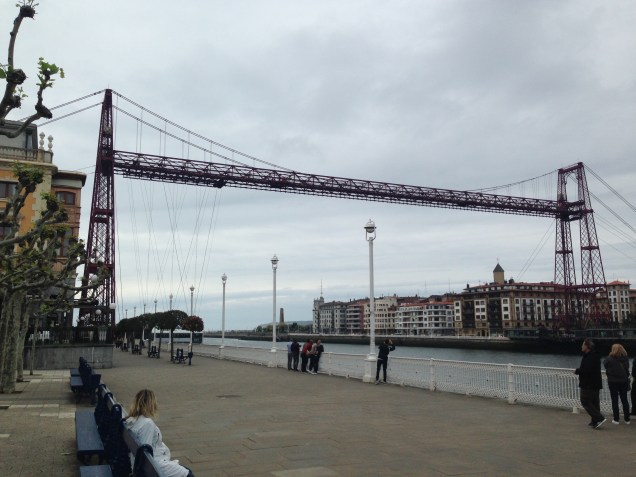
The train pulled up to Portugalete station, the doors opened, and we got off. Portugalete is one of the towns, ranged along the Bilbao river, that make up the Bilbao metropolitan area. (The name’s resemblance with “Portugal” is apparently only a coincidence.) With a population of about 50,000, and a land area of only 3.21 square kilometers, it is actually the fifth most densely populated area in Spain.

To me, the place struck me as a pleasant, moderately urbanized, more or less tranquil town. Along the riverside there were some large, attractive restaurants, their tables crowding into the streets—though at this hour, too early for dinner in Spain, the chairs were mostly empty. But the surroundings didn’t attract my attention for long, since I could already see my goal: the Vizcaya Bridge.

IMG_3745

In Spanish it is called the Puente Colgante, or “Hanging Bridge.” The name is appropriate. It is a perplexing sight at first. The bridge has the familiar form of a suspension bridge; but the middle section seems to be misplaced: it hangs ludicrously high in the air, with no ramps to get up or down. The more I looked, the more confused I became, for there didn’t seem to be any way you could use the bridge.

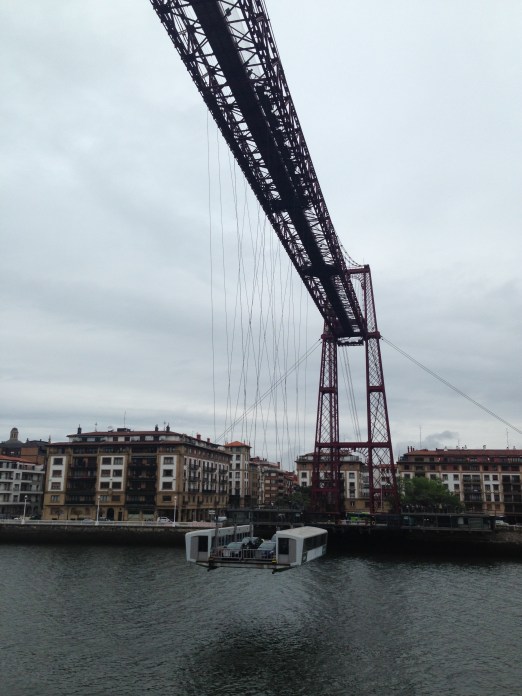
As I got nearer, I noticed something strange on the water. It wasn’t quite on the water, actually, but hovering above it. I looked up, and saw that the thing was hanging from the bridge. So that’s how it worked! The reason the bridge looked so odd was that it transported a shuttle that hung underneath, almost like a puppet on strings. That’s why the bridge was so high up and there weren’t any ramps to get on.

IMG_3749

But it looked dangerous to me. The shuttle was fairly large; it transported about six cars and one hundred people. Could that skeletal iron structure above support so much weight? Dreadful fantasies immediately started rushing to my mind. I saw the bridge snapping in the middle, sending iron raining down into the river below, crushing the shuttle and sending everyone inside to a watery grave. Unfortunately, awful visions like this plague me rather frequently. I wonder if it’s the product of a morbid imagination, or just watching too many action movies.

We went into the office and bought our tickets, though I wasn’t sure what the tickets were for. The man explained that there was an elevator to take you up to the top, where you could walk to the other end. He also gave us a little information pamphlet about the bridge. From this, I learned that the bridge is actually a UNESCO World Heritage site, the only monument in the Industrial Heritage category in Spain.

I also learned more about the construction and history of the bridge. The Vizcaya Bridge is a transporter bridge, the first of its kind in the world. If you haven’t heard of a transporter bridge before, that is perfectly normal, since this type of bridge is uncommon; according to Wiki, less than two dozen were built, and only 12 still stand today.

The Vizcaya Bridge, finished in 1893, was designed by one of Gustave Eiffel’s disciples, Alberto Palacio; and Eiffel’s influence shows. The bridge is built in the same manner as the Eiffel Tower, with narrow iron beams riveted together to form a triangular grid; and like the Eiffel Tower, the Vizcaya Bridge is austere and elegant. Palacio originated the idea in response to a common engineering problem: how do you create a bridge that allows people and cars to cross the river, while leaving the river open for shipping vessels? The Vizcaya bridge, then, in both purpose and execution, is a symbol of the Basque Country’s embrace of industry, commerce, and the future—not to mention art.

(I do wonder, though, whether Palacio’s solution was all that efficient. After all, there must be a reason why the design didn’t catch on. The primary problem, it seems to me, is that the amount of cars and people that can cross at any one time is limited by the size of the shuttle and the frequency of its trips. Perhaps the famous Tower Bridge in London—completed almost the same year—solved the problem more satisfactorily, by putting a drawbridge on the lower level and a pedestrian walkway on the upper. But Palacio’s design is beautiful, original, and elegant, so efficiency can go to the devil.)

Finally it was our turn for the elevator. It was an ancient thing, crawling up the bridge at a snail’s pace. Eventually the lift creaked to a halt, and we got out. A narrow wooden walkway, surrounded by the iron structure, extended from one end of the bridge to the other. It’s really amazing how much of the Vizcaya Bridge is just air. You can see right through the thing, and yet it is strong enough to support the weight of a large shuttle carrying six cars.

IMG_3750

I experienced this when one of the shuttles came rolling by, right underneath our feet. I could feel the entire bridge shaking, rattling, and shivering, as the electrical buzzing of the engine roared past. Once again, terrible fantasies started flickering through my mind, this time with me myself plunging to a ghastly death. But soon the shuttle came to a halt, and I realized that the bridge was solid as stone. What an impressive achievement: The bridge seems to float high up in the air, supported by the slenderest structure; and yet it is sturdy enough to remain operational after more than one hundred years of daily use.

IMG_3751

We took some time to admire the view. On one side we could see the bay, and then the ocean beyond. In the dockyard in the distance, I could see dozens of giant cranes standing silently, like petrified dinosaurs, waiting to come back to life. On the other side, we could see the river gradually making its way towards Bilbao; and in the distance, a factory loomed. Really, wherever you turned you could not fail to notice the signs of industry, filling up the entire estuary with their jagged, colossal, metallic forms. Below us, we could see the towns of Portugalete on one side and Getxo on the other, their streets now full. We might have stayed more time up there, but the wind was quite strong and chilly, so we took the elevator down on the other side. Not long after that, we took the shuttle from Getxo across the river, back to Portugalete; and I am happy to report that the ride was quick and smooth.

There is only one thing more I have to report. Before we left, GF had asked some of her students in Madrid where you can buy good pizza, and they told her to go to Telepizza (a popular chain here, comparable to Dominoes). That sounded awful to me, but GF wanted to try it; so, once we got to Portugalete, we decided to go to the nearest Telepizza for dinner. It brings me no joy to tell you that, as I expected, the pizza was horrible, some of the worst pizza I’ve ever had; and GF was of the same opinion. Is this what Spanish people think pizza is supposed to taste like?

Basking in the Basque Country: San Juan de Gaztelugatxe

Basking in the Basque Country: San Juan de Gaztelugatxe

(This post is part of my series on the Basque Country. Click here for Bilbao, here for the Vizcaya bridge, and here for San Sebastián.)

I always find public transportation a bit nerve-racking—especially in a new city, not to mention a foreign country. Every time I hop on a bus, I feel like I’m taking a leap of faith. I imagine taking the wrong bus and getting stranded in the middle of nowhere, or taking the right bus and getting off on the wrong stop—and these fears aren’t totally unfounded, as I’ve done both of these things. Thus I was filled with apprehension as we searched for the bus to Bakio, the A3518.

Probably you have never heard of Bakio, because there isn’t much to be heard about it. Bakio is a small town, with a population of about 2,500, situated about 30 kilometers from Bilbao. There is admittedly a beach there, although the damp, chilly, overcast weather of the region didn’t exactly put me in the mood for surfing. Rather, we were going to Bakio because it was the closest we could to get by bus to San Juan de Gaztelugatxe.

IMG_3711
The town of Bakio

The bus ride to Bakio was quite pleasant, taking us through the green countryside, filled with little huts and farmhouses tucked away into the rolling hills. After 40 minutes we arrived, ate some breakfast, and then set on our way. I had found a little report online (found here), written by somebody who had walked from Bakio to Gaztelugatxe. And attached in that report is a little map, with the walking route conveniently highlighted. But for whatever reason I forgot about this map as we started walking. Instead I chose to rely on my phone’s GPS to guide me there. Please, don’t make this mistake: just follow the walking route.

GF and I soon found ourselves walking along a busy road, with no sidewalks.

“Are you sure this is the right way?” she said.

“Yeah, I’m just following my phone.”

“Okay…”

We walked further, and after a while came to a sharp curve in the road. Because there wasn’t any sidewalk, and the road was hemmed in by a rockface on one side and some trees on another, we found ourselves in the predicament that, no matter which side we chose, we would risk making ourselves invisible to an incoming car. Thankfully, the cars only came periodically, with big gaps in-between; and we hoped we’d be able hear them a ways off. Still, it was nerve-racking as we rushed around the corner, trying to minimize our time on the curve.

“I hope there aren’t any more curves like that,” GF said as we got to the other side.

“Me too,” I said.

But five minutes later, we came to another curve. And then another, and another. The entire road, it seemed, wrapped around the hills like a snake, constantly turning left and right. Meanwhile, the amount of cars on the road seemed to be steadily increasing.

“I don’t like this,” GF said. “Is there any way off this road?”

“Umm,” I said, “maybe up ahead.” (I had no idea.)

During the stretches of straight roads, I did my best to enjoy the scenery. It was a nice place, with pine trees and farmhouses all around, and the occasional view of the countryside beyond. But the whoosh of a passing cars destroyed any peace to be had; and the sight of every sharp turn ahead increased my anxiety.

There was over an hour of this, the two of us walking on through the brush and bushes by the side of the road, our feet searching for stability amid the roots and rocks, changing sides whenever it seemed more safe, pressing ourselves against the trees whenever a car went past, rushing around curves with our adrenalin racing, GF nervously complaining while I tried to keep my own fears to myself. And then, finally, just as I was at my wit’s end, the hermitage came into view.

“Yes!” GF said, filled with relief.

§

San Juan de Gatztelugatxe (recently made famous in Game of Thrones, as the location of Dragonstone) is an island off the coast of Biscay, connected to the maindland by a man-made bridge. Since at least the 10th century, a little religious building has been perched up at the top of it, though it has burnt down and been rebuilt many times, most recently in 1980.

To get there from the road we had to climb down towards the shore. The path was steep, twisting, and rocky. Even though you’re going down hill, it is exhausting because you need to be constantly on guard against falling. At last we got near the bottom, where there was a lookout point from which we could get a good view of the island.

IMG_3719

It must be one of the most astonishing sights in Spain. The island is a mound of jagged grey rock, covered in slight patches of green. Its splayed form stretches out into the sea, wherein it is battered day and night, on all sides, by the winds and the waves. In the middle of this island, criss-crossing its way up from the bottom to the top, is a staircase—usually filled with the miniscule forms of people going up and down. And crowning the island is the hermitage, a small shack with a dull red roof.

Perhaps this image is so appealing to me because I find in it a symbol of the relationship of humanity to nature. We have carved a staircase into the rock, and erected a place of worship on the summit of the island; and in this way we can be said to have dominated the place. And yet, how feeble our dominance of nature seems when viewed from a distance—just a pile of boards, liable to be blown away by the first strong gust. This is the age-old contest of craft, cleverness, and perseverance against capricious, indifferent power. And I cannot help thinking that, however successful we are now, there will come a day when the hermitage blows down, and there won’t be anyone to build it back up again.

IMG_3725

But these gloomy thoughts were soon gone as I huffed and puffed my way up the staircase to the top of the island. By now we had been walking over an hour next to that road, our hearts in our throats all the while; so we were understandably a bit worn out. It felt all the better, then, when we finally reached the top, and could look back towards the land.

In the distance, to our right, we could see the beach of Bakio; and to the left, nothing but steep, grey cliffs and green forests. Gigantic rocks stuck out of the ocean, the biggest one almost as big as the island itself. To one side, far off, I could see what looked like an oil drill. Apart from that, no boats, no freighters, no planes broke the endless blue of the sea beyond or the grey of the sky above. It felt like standing at the edge of the world.

IMG_3733

We couldn’t go inside the hermitage, nor even peek through a window. This didn’t bother me, however, since judging by the looks of the plain exterior, the interior would be similarly nondescript. What we could do was ring the bell. A string hung from the bell on the roof to the ground below, and all the visitors were taking turns having a pull (one kid got a bit too enthusiastic, and his parents had to keep him away). I gripped the chord and lightly tugged, and the satisfying clang of a church bell sounded overhead.

Since neither of us had any intention of repeating that dreadful walk by the road, this time I looked up the walking path on my phone. We found the path without any trouble, which made me feel like such an idiot for not using it the first time. It was such a relief! Instead of the twisting, turning road we had a straight path, free of cars, taking us through quiet countryside. We passed through a copse of trees, and then through some fields where cows were grazing, making our way over gently rolling hills, the seaside on our right, until we were finally back in Bakio. The bus soon arrived, and then we were on our way to Bilbao, where we still had one more thing to see.