Concord and Walden Pond

Concord and Walden Pond

Through some combination of chance and circumstance, some little places become fulcrums of history. This is certainly true of Concord, Massachusetts.

Boasting a population a little south of twenty thousand, and of no obvious geographical significance, this town nevertheless became the setting of our War of Independence. A detachment of British troops was sent to Concord to confiscate or destroy weapons that they believed were being stockpiled here. But they were met by the nascent American militia. After a brief shootout, the redcoats retreated, demonstrating that the British army was not invincible. This was the battle of Lexington and Concord (there was an earlier skirmish in the nearby town of Lexington), and it took place at the Old North Bridge, which spans the Concord River.

Being the site of the “Shot heard round the world”—as it was later dubbed, somewhat self-importantly—would satisfy most towns the size of Concord. But in the 19th century, this modest municipality once again attracted outsized importance by becoming the center of one of the most important movements in American literature and philosophy: Transcendentalism. This was largely due to the presence of Ralph Waldo Emerson, who moved into town in 1835.
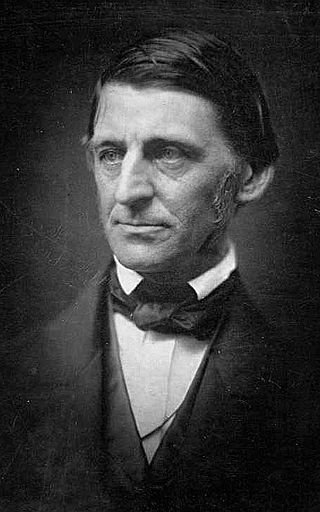
Ralph Waldo Emerson

The son and grandson of ministers, Emerson was very much a preacher himself, though of a new religion. Transcendentalism was perhaps the original back-to-nature movement, a celebration of self-reliance and the simple life. The time was ripe for such ideas, and Emerson was its most articulate voice. He attracted a circle of friends and admirers, among whom was Amos Bronson Alcott, a fellow philosopher who sadly lacked Emerson’s gift for expression. Alcott’s most notable venture was an experiment in Utopian living, called the Fruitlands, a kind of agricultural commune whose members adhered to a vegan diet. It soon imploded, and Alcott returned to Concord to live in the now-famous Orchard House with his wife and four daughters. One of those daughters was Louisa May Alcott, who fictionalized her girlhood to create the classic, Little Women. Her literary ability kept the family financially afloat.

Louisa May Alcott

The Fruitlands was not the only Transcendentalist experiment in communal living. Another was Brook Farm, also in Massachusetts, and also an attempt to live off the land in perfect equality. The novelist Nathaniel Hawthorne took part in this venture, though he did not stay for long (and Brook Farm did not survive for very long, either) before he, too, moved to Concord. Indeed, he moved into the Emerson family home, the Old Manse, which stands near the famed Old North Bridge. Emerson, meanwhile, moved into a larger house, now an eponymous museum, where he continued to serve as the center of the town’s intellectual life.

Nathaniel Hawthorne

A frequent guest was a young and very earnest man named Henry David Thoreau. Thoreau must have seemed to be an eccentric and marginal character compared to the likes of Emerson. But it was Thoreau who came to epitomize Transcendentalism better than anyone, and Thoreau who immortalized Concord more completely than any writer (with the possible exception of Louisa May Alcott). His fame largely rests upon a single book, Walden, named after a small lake in Concord. In 1845, the young Thoreau decided on an entirely novel experiment: to attempt to live independently in the woods beside Walden Pond. The land was owned by Emerson, who let the young vagrant use it. In Thoreau’s own words:

“I went to the woods because I wished to live deliberately, to front only the essential facts of life, and see if I could not learn what it had to teach, and not, when I came to die, discover that I had not lived.”
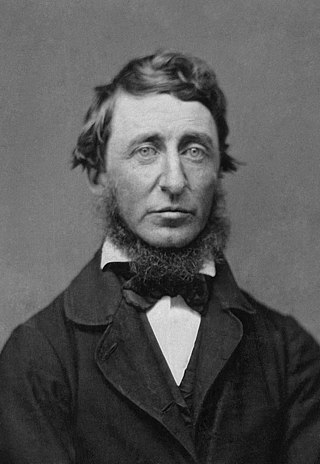
Henry David Thoreau

So Thoreau used some recycled materials to build a little cabin with some furniture and commenced an experiment that would last two years, two months, and two days. Later, when he wrote up the experience, he compressed this into an imaginative year, weaving memories into reflections to make an original work of literature. Walden is an odd book by any standard—meandering, prickly, pompous, but also thoroughly original and beautifully written—and it did not find a large audience in Thoreau’s lifetime. In the years since his death in 1862, however, Walden has become one of the most beloved American classics, and Walden Pond has become a site of pilgrimage.

It was certainly in the spirit of a pilgrim that I visited Walden Pond, once in summer, once in winter, both times passing through the town of Concord on my way to someplace else. On my first visit I was filled with anticipation, as though I was about to step into the Sistine Chapel or walk along the Great Wall of China, though in retrospect it is hard to say what I was expecting. Walden Pond is just that—a pond: a body of water, surrounded on all sides by trees. In fact, it is not even treated very reverently by the locals. Now a state park, when I visited in summer there were many locals lounging on the sand, and a few in the water. It is a place for recreation as much as reverence.

Admittedly, the geology of Walden Pond is interesting. A kettle hole lake, it was formed by retreating glaciers during the end of the last ice age, when a hunk of ice broke off the glacier and got lodged underground. As a result, the lake is surprisingly deep: over 100 feet, or 30 meters. But ninety-nine out of a hundred visitors (if not more) would likely not find anything memorable or special about Walden Pond had it not been made famous by Thoreau. And, I realized, this is precisely the message of Thoreau’s book: that anyplace can be made special through focus, attention, and work. With the right eyes, a mundane pool could be just as inspiring as a gothic cathedral.

On my first visit, I walked around the lake to the spot where Thoreau had built his little cabin. It does not stand today, though the spot is marked by concrete pillars. Nearby is a large cairn, where visitors have been pilling pebbles for decades. Before it stands a sign on which Thoreau’s famous battlecry is painted (see above). Once again, rather than any grand monuments, we are confronted only with the woods, the water, and Thoreau’s words.

An old photo of the site of Thoreau’s cabin

Not long before my first visit to Walden Pond, I visited the Morgan Library in Manhattan, where I was lucky enough to find a special exhibit on Thoreau. It was extraordinary: the museum had Thoreau’s walking stick, surveying gear, and writing desk. They even had the many volumes of Thoreau’s journals—and he was a prolific diarist, recording both his philosophical thoughts and his observations of the natural world—which served as the basis for his published books. I believe that the bulk of these items were on loan from the Concord Museum, where they normally reside.

During my second stop in Concord, we also stopped by the Sleepy Hollow Cemetery. The reader may recognize this name from the legend of Sleepy Hollow, which of course takes place in a cemetery—though not the one in Concord, Massachusetts. The burying ground of Washington Irving’s story is in Westchester, New York: my home town. It seemed very strange to me that two famous cemeteries would bear the same name; and I assumed that the Concordians had copied the Westchesterites. But apparently this is not the case. The Westchester cemetery was formerly called the Tarrytown Cemetery, and only changed its name to honor a posthumous wish of Washington Irving, who died in 1859. The Concord cemetery was established in 1855, and the place had been called Sleepy Hollow before anybody even thought of burying the dead here. So the names are a complete coincidence.

The cemeteries in Westchester and Concord do not only share a name; they were established at almost the same historical moment, and were shaped by the same intellectual currents. Washington Irving was a notable proponent of romantic gardening, wherein the landscape is modified to appear as if it were just a product of nature—albeit a particularly pleasing product. Ralph Waldo Emerson, too, believed that nature should be emulated, not suppressed; and as the designers of Concord cemetery were followers of his, the cemetery incorporates the natural topography—and some original vegetation—into its design. Both places can thus be classed as “garden cemeteries,” far more open and green than what came before.

Emerson’s tomb, in the center

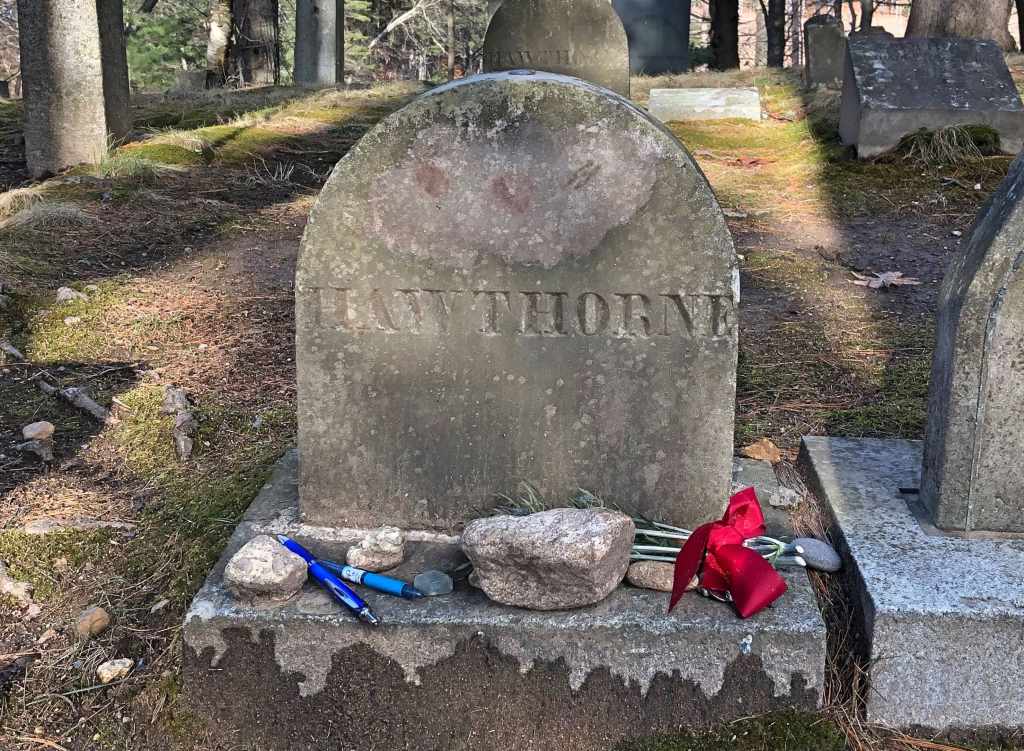
Luckily for the visitor, most of the famous graves in Sleepy Hollow Cemetery are concentrated in one spot: Author’s Ridge. Here you will find Ralph Waldo Emerson, Nathaniel Hawthorne, Louisa May Alcott, and Henry David Thoreau. Emerson’s grave is by far the most conspicuous: an enormous marble boulder to which a plaque has been fastened. I suppose it symbolizes Emerson’s love of nature to have an unhewn tombstone. Hawthorne’s grave is far simpler: a standard headstone, about a foot high. Thoreau’s and Alcott’s are even humbler; but theirs inspired the most devotion. Alcott’s was covered in old pens and pencils—presumably to honor Jo, Alcott’s writer heroine—while Thoreau’s was adorned with feathers, pine cones, and a bird’s nest. The two of them are still beacons for young minds. 

Before we go, another resident of the Sleepy Hollow Cemetery must be mentioned: Ephraim Wales Bull. Not a writer, nor even a Transcendentalist, Bull was responsible for developing the Concord grape, now a ubiquitous varietal. This cultivar was special because, unlike other grape species, it could survive the brutally cold winters of Massachusetts. It was also robust and sweet, making it perfect to eat by itself or to turn into juice and jelly (though not great for wine). Unfortunately for Bull, his grapes were stolen and sold, meaning that he did not profit from his hard word. This is why his tombstone says: “He sowed, others reaped.”

Bull’s tomb is on the right.

I have gone on and on about the historical importance of Concord, but I must end by noting that it is simply an attractive place. In my all-too-brief time in the town, I was enchanted by the antique houses and churches, so quaint and picturesque. Even if you have little interest in the Revolutionary War or Transcendentalism, and just want to visit a thoroughly charming place, then I propose a visit to Concord and Walden Pond.

Review: Walden

Review: Walden

Walden & Civil DisobedienceWalden & Civil Disobedience by Henry David Thoreau

My rating: 4 of 5 stars

How many a man has dated a new era in his life from the reading of a book!

This month, two hundred years ago, Henry David Thoreau made his way into the world. Thus it seemed like a good time to revisit his thorny classic, which filled me with such contradictory feelings the first time around.

This time, I was struck first by how current Thoreau’s book reads. A vegetarian before it was fashionable, or even respectable; a pioneer of nature writing and conservationism; a godfather of activism and protest; an author of lines that, even now, wouldn’t be out of place in any self-help book; and the originator of the “stunt-book”—doing something unusual and then writing about it—anticipating both performance art and reality television in his classic account of his life “in the woods.”

It is very easy to dislike Thoreau, or even to despise him. Thoreau took himself very seriously. He comes across as pretentious and magnificently condescending, while at the same time as naïve as a child. For all his practicality, he was astoundingly impractical. His insistence that everyone in Concord learn enough Latin and Greek to read the classic texts is characteristic of him—a snobbish and pointless piece of advice, delivered with disdain. His authorial personality is so often prickly and misanthropic, rebuking the world at every turn, and this mood is never lightened by an easy humor. There is no Montaigne in this self-chronicler; instead, like Iago, he is nothing if not critical. You wonder if anything but loons and books ever pleased him. He was, in a word, a dour man.

The case against Thoreau is more serious than just his off-putting authorial personality. The most common charge made against him is that of hypocrisy. His book purports to be the record of a bold experiment in living in the woods. He describes how he built his own house, grew his own beans, baked his own bread, and rhapsodizes about the solitude and isolation he created for himself. But in reality he was living just 20 minutes from his ancestral home, squatting on land lent to him by his friend Emerson, and receiving frequent and plentiful visitors. Apparently he went home weekly to get cookies from his mother, who also kindly delivered doughnuts and pies to our hero. It is not reported whether he ate his cookies and doughnuts with milk.

This is a damning fact, considering that Thoreau carefully documents all of his expenses and goes into excruciating detail as to his eating habits—without mentioning a single cookie. He gives the impression that he was a hermit on the very edge of society, living on the produce he created, savoring his lonely retreat from the world. And all this is recorded with the stated intention of showing that self-sufficiency is possible. But if Thoreau himself can bear neither a diet of pure beans nor the stark isolation of true life in the woods, his whole experiment is a sham. It is one thing for an ordinary citizen to be hypocritical; it is another thing for a moralizing philosopher who repeatedly stresses the necessity of living in accordance with one’s tenets.

The case against Thoreau goes ever further than this. For, if his practice didn’t align with his preaching, his preaching didn’t align with his preaching either. Walden is a baffling bundle of contradictions. Did Thoreau like the steam engines or hate them? He excoriates them one moment, and the next he goes into rhapsodies about the locomotive. He praises hunting as a way of bringing oneself closer with nature, and then he condemns all killing and eating of animals. Here he is enjoining us to ignore fantasies and pay close attention to reality: “If men would steadily observe realities only, and not allow themselves to be deluded, life, to compare it with such things as we know, would be like a fairy tale and the Arabian Nights’ Entertainment.” And here he is telling us to do the opposite: “If you have built castles in the air, your work need not be lost; that is where they should be.”

The perplexing thing about this inconsistency is that Thoreau never admits to hesitation or doubt. He rattles off his opinions with the fervor of a zealot. And yet even his zealotry is inconsistent, for it was Thoreau who famously said “If a man does not keep pace with his companions, perhaps it is because he hears a different drummer. Let him step to the music which he hears, however measured and far away.” This famous paean to self-determination is ensconced in a book filled with biting scorn for those who do not agree with Thoreau. In all likelihood, Thoreau himself was the least tolerant man in Concord. Considering both his inconsistency in action and speech, it is difficult to know what exactly Thoreau, who is always urging us, is actually urging us to do.

But I think that a strong case can be made for Thoreau, too—especially now. For Walden has aged remarkably well. If anything, Thoreau’s classic has become even more relevant in our harried age.

Thoreau flees to the woods because of a growing horror with every aspect of his contemporary society—the unjust government, the growing consumerism, the obsession with technology, the increasing specialization of labor, the absorption of all leisure by work, the constant petty conversation, the disregard of wild nature. The sources of this horror are, I think, in part mysterious to even himself, which might be one explanation for his inconsistency. He is like a boxer swinging wildly at an invisible enemy, or a doctor prescribing medicines for an unknown malady. But to be fair, we haven’t gotten much closer to solving the problems that Thoreau tried to tackle with such spirit.

For my part, I think Thoreau’s instincts are right, even when his diagnoses and his cures are wrong. His abhorrence of economic exchange, of interdependence, is an excellent example. Modern society obviously could not exist without exchange; the economy would collapse if we all chose to live like Thoreau advocates, and technological innovation would come to a standstill. Yet Thoreau’s abhorrence of intedependence is neither political nor economic, but moral. He recognized quite clearly, I think, that in a complex economy, we are enmeshed in processes that have moral implications. When we buy a product, for example, we don’t know who made it or how they were treated. When we patronize a shop, we don’t know what the owner does with our money. When we throw something away, we don’t know where it ends up.

Since the morality of any action is partly determined by its effects, and since many of those effects are hidden from view in a complex economy, to a certain extent we can’t even know the morality of our own life. This is why it was so inspiriting for Thoreau to build his own cabin and farm his own food; he could be sure of his “ethical footprint,” so to speak, and so could take full responsibility for his actions. Now, I don’t think Thoreau wanted to do this for the sake of others—he is extremely wary of do-gooderism—but for himself, since we cannot live authentically if we cannot know the effects of our actions.

To borrow an idea from the philosopher John Lachs, this state of ignorance as to the sources and causes of our moral lives is one part of that modern alienation that Marxists have described. When jobs become highly specialized, we might not be completely sure about our own effects within the organization in which we work. I myself have been in that situation, churning out data to be used by unknown people for unknown ends. Everyone in a complex economy, even a commercial farmer, is in this situation. Thoreau’s solution, isolating oneself in the woods, is I think undesirable—since it consists in dissolving society completely (which the misanthropic Thoreau might not have objected to)—but his experiment does at least help us to identify the causes of our “quiet desperation.”

Thoreau is also refreshing on the subject of work and leisure. The glorification of works carries with it the denigration of leisure, which Thoreau realized. When we consider only those activities as worthwhile that can make money for us, we spend our free hours in thoughtless relaxation or idling. And yet working, even if it is remunerative, is too often degrading—largely thanks to excessive specialization, which demands that we do the same thing over and over again, neglecting the full range of our capacities. Work consumes our time and energy and leaves us few moments for reflection and self-improvement. And because we consider leisure only a respite from work—since free time doesn’t pay, it is not for serious exertion—we do not even use what moments we have to achieve perspective and to develop our latent potential.

Again, Thoreau’s prescription for excessive work—to squat on someone else’s land and farm only the bare minimum—is disappointing and (pardon the pun) unworkable. And his advice for how to spend one’s free time—reading ancient books in the original language—is, at the very least, limited. But once again, his thrashing responses at least point the way to the malady that ails us, and his deadly seriousness can remind us to take our free time seriously and not squander it.

Thoreau is perhaps most valuable for his insistence on the time and space to think. Often it seems that the modern world is a conspiracy to prevent thinking. We work until we’re bone tired, and spend our free time in endless, meaningless small talk. Thoreau said: “We are in great haste to construct a magnetic telegraph from Maine to Texas; but Maine and Texas, it may be, have nothing important to communicate.” Imagine if Thoreau could see us now, ceaselessly connected to each other with mobile telegraphs in our pockets, with scarcely anything more to say. The point, of course, is not that the telegraph is inherently bad—nor are smart phones for that matter—but that these things can easily become distractions, distractions in the existential sense, allowing idle chit-chat to intrude into every corner of our lives.

News also comes in for abuse. Too often we read the news, not with a genuine desire to learn about the world or to help us change it, but out of habit, worrying about distant problems that seldom affect us and that, in any case, we seldom try to solve. Sure, it is easy to dismiss Thoreau when he makes such dogmatic pronouncements as “To a philosophers, all news, as it is called, is gossip, and they who edit and read it are old women over their tea.” Yet I know many for whom the news is an addiction, and consuming news is the full extent of their political engagement. (And I don’t think I’m any better in this regard.) Again, the point is not that we shouldn’t read the news, but that we should not let ourselves develop a false sense of urgency that prevents us from examining our own lives.

Thoreau demands space for genuine thought. But what is genuine thought? I think this is what Thoreau had in mind with his famous lines “I went to the woods because I wished to live deliberately, to front only the essential facts of life, and see if I could not learn what it had to teach and not, when I came to die, discover that I had not lived.” Genuine thought, in other words, is thinking about the best way to live—what is deeply and lastingly important to us, and what is only temporarily or superficially important. I personally have found that even a week of relative isolation can be clarifying. It is amazing how fast anxieties and problems melt away when we remove ourselves from our usual environment. We spend so much time worrying about how to get things that we don’t stop to wonder if we really want them. It is easy, too easy, to accept goals and priorities from our environment without scrutiny.

I could go on, but I think you get the idea. Thoreau was reacting against problems of the modern world, problems that have only become more pervasive. His solution, which I find extremely unconvincing, is to reject society completely—and in practice, his solution is only viable for well-connected, single men with no children. Thoreau achieves a kind of purity at the expense of advocating something that is totally non-viable for the vast majority of humanity. But reading his book was, for me, a clarifying and a rejuvenating experience—a reminder to consider the more important questions of life, and also a reminder that these questions can perhaps never be definitely answered.

You may disagree completely with me about the philosophical merit of Thoreau. But his skill as a writer is indisputable. This book is a magnificent monument of prose. Whether he is describing his beloved pond or narrating a battle of ants, his writing is clear, forceful, and direct; and his fingertips occasionally touch the sublime:

If you stand right fronting and face to face with a fact, you will see the sun glimmer on both its surfaces, as if it were a scimitar, and feel its sweet edge dividing you through the heart and marrow, and so you will happily conclude your mortal career. Be it life or death, we crave only reality.

Thoreau’s power as a writer, combined with his undeniable originality—anticipating all the things with which I opened this review, and more—will make this book last until Thoreau’s next centennial, even if sometimes he’s an insufferable teenager.

View all my reviews