
The Great Influenza: The Story of the Deadliest Pandemic in History by John M. Barry
My rating: 4 of 5 stars
People write about war. They write about the Holocaust. They write about the horrors that people inflict on people. Apparently they forget the horrors that nature inflicts on people, the horrors that make humans least significant.
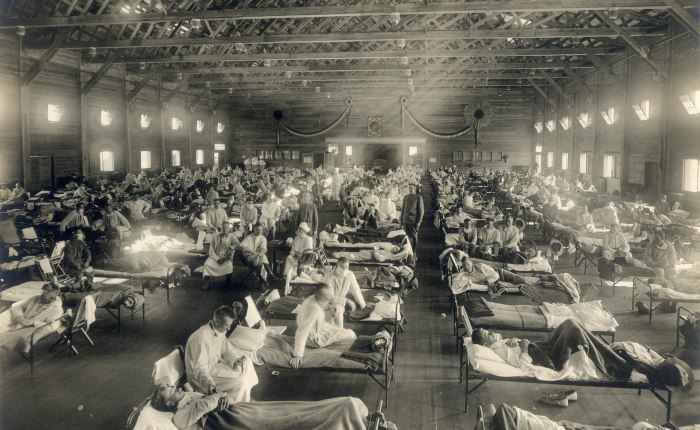
Like so many people nowadays, I have been scrambling to wrap my mind around the current pandemic. This led me, naturally, to the last major worldwide outbreak: the 1918 influenza. I have a distant connection to this disease. My great-grandfather (after whom I was named) was drafted out of Cornell’s veterinary school to work as a nurse in a temporary hospital set up for flu victims. I read the letters he sent to his mother, describing the experience.
John Barry’s account of this virulent flu is sobering to say the least. In a matter of months, the flu spread across the world and caused between 50 and 100 million deaths. More American soldiers died from this flu than from the entire Vietnam War. In most places the mortality rate hovered around two percent, but it struck much more fiercely elsewhere. In the Fiji Islands, 14 percent of its population succumbed; in Western Samoa, twenty-two percent; and in Labrador, a third of the population died. And because the disease mainly struck young people—people in their twenties and thirties—thousands were left orphans.
Barry’s book is not, however, simply a record of deaths. He sets the historical scene by giving a brief overview of contemporary medicine. In the early 1900s, modern medicine was just coming into its own. After centuries in which it was thought that bad air (“miasma”) caused illness, and in which bleeding was the most popular “cure,” researchers were beginning to discover viruses and bacteria, and were beginning to understand how the immune system combats these germs. Major public health initiatives were just getting underway. The John Hopkins School of Public Health had been founded, and the Rockefeller Institute was making new types of research possible. It was not the Dark Ages.
The other major piece of historical context is, of course, the First World War. Undoubtedly this played a major role in the epidemic. Not only did troop movements help to spread the disease, but press censorship virtually guaranteed that communities were unprepared. Barry notes how newspapers all across the country consistently downplayed the danger, which ironically only further increased panic. (The pandemic is sometimes called the “Spanish flu,” because the press in neutral Spain was uncensored, and so reported freely on the disease.) The war effort overrode all of the warnings of disease experts; and by the time the disease struck many communities, most of the available doctors and nurses had been sent to the military.
Barry’s narration mainly focuses on the United States. Partly this is because this is where he believes the disease originated (there are several competing theories), partly this is because the disease’s impact in Europe was overshadowed by the war, and partly this is simply because of the amount of easily available sources. I did wish he had spent more time on other countries—especially on India, which suffered horribly. The sections on science—both on the history of science, and summarizing what we know now about flu viruses—were in general quite strong. What was lacking, for me, were sections on the cultural impact of the disease.
But perhaps there are not so many. As Barry notes, no major novelist of the time—Hemingway, Fitzgerald, Lawrence—mentioned the pandemic in their works. I have noticed the same thing myself. I cannot recall a single mention of this flue in biographies and autobiographies of people who lived through the pandemic, such as John Maynard Keynes or even John D. Rockefeller (who personally funded research on the disease). This is perhaps understandable in Europe, where the deaths from the pandemic were swallowed up in news of the war; but it seems odd elsewhere. What is more, the pandemic did not seem to exacerbate existing racial or class tensions. In many ways the virus seems to have swept through communities and then disappeared from memory.
(Barry does have one fairly controversial claim in the book: that Woodrow Wilson contracted the flu while negotiating the treaty of Versailles, and that it caused him to capitulate to Clemenceau’s demands. If this is true, it would be a major historical consequence.)
It is illuminating to compare the 1918 pandemic to the current crisis. There are many similarities. Both are caused by easily transmissible viruses, and both spread around the world. The H1N1 flu virus and the SARS-CoV-2 virus both infect the respiratory system, causing fever, coughing, and in severe cases pneumonia and ARDS (acute respiratory distress syndrome). In both cases, no vaccine is available and no known treatment is effective. As in 1918, doctors are turning desperately to other therapies and medicines—those developed for other, unrelated diseases like malaria—and as in 1918, researchers are publishing at a frantic pace, with no time for peer review. Police are again wearing masks, hospitals are again overrun, and officials are struggling to catch up with the progress of the virus.
But of course, there are many important differences, too. One is the disease itself. The 1918 flu was almost certainly worse than the novel coronavirus. It was more deadly in general, and it killed younger people in far greater numbers—which resulted in a much bigger dip in life expectancy. (Young people died because their immune systems overreacted in what is called a “cytokine storm.”) The H1N1 flu also had a far shorter incubation period. This meant that the gap between infection and the first symptoms was short—often within 24 hours—and patients deteriorated far more quickly. Barry describes people being struck down within mere hours of showing their first symptoms. The challenge of the SARS-CoV-2 virus, however, is the very long incubation period—potentially up to two weeks—in which people may be infectious and yet not show symptoms. This makes it very difficult to keep track of who has it.
The explanation for this difference lies in the nature of the virus. A virus is basically a free-floating piece of genetic code incased in a protein shell. It needs to highjack animal cells in order to reproduce; and it infiltrates cells using proteins that link up with structures on the cells’ surface. Once inside, the virus begins to replicate until the cell literally bursts, spilling virus into adjacent cells, which in turn get infected, and which in turn burst. Each burst can release thousands of copies. The rate at which the virus replicates within the cells determine the incubation period (between first infection and first symptoms), and coronaviruses replicate significantly more slowly in animal cells, thus explaining the slower onset of symptoms. Their greater speed also means that flu viruses change faster, undergoing antigenic drift and antigenic shift, meaning that new strains of the virus are inevitable. The novel coronavirus is (likely) more stable.
Another potential difference is seasonality. Flu viruses come in seasonal waves. The 1918 virus struck first in spring, receded in summer, and then returned in autumn and one last time in the winter of 1919. Every wave hit very quickly—and then left just as quickly. Most cities experienced a sharp drop-off in cases after about six weeks of the first patients. The seasonality of the 1918 flu was partly a result of the genetic drift just mentioned, as the different waves of this flu were all at least subtly different strains of the virus. Atmospheric conditions—humidity and temperature—also presumably make some difference in the flu virus’s spread. COVID-19 may exhibit a very different pattern. It may, perhaps, be less affected by atmospheric conditions; and if it mutates and reproduces more slowly, it may linger around for one long wave rather than several short ones. This is just my speculation.
Well, so much for the virus. How about us? The world has changed a lot since 1918. However, not all of those changes have made us better prepared. Fast and cheap air travel allowed the virus to spread more quickly. And economic globalization did not help, either, as both medicines and medical equipment are often produced overseas and then imported, thus rendering countries more vulnerable to supply-chain disruption than in the past. As we witness countries and states compete for supplies, this vulnerability is very apparent.
But of course we have many advantages, too. Many of the deaths caused by the flu and the coronavirus are not from the virus infection itself, but because the virus renders us vulnerable to secondary infections by bacteria, causing pneumonia. Antibiotics (which did not exist in 1918) can save many lives. Another advantage is medical care. The most severe patients of both epidemics were struck with ARDS, a condition with an almost 100% mortality rate for those who do not receive intensive medical care (using a ventilator machine). In 1918 they were able to administer oxygen, but far less effectively than we can. Even so, even with the best intensive care, the survival rate of ARDS is between 40-60%. And our ability to administer intensive care is quite limited. The ventilator shortage has become a global emergency in itself, as hospitals are overrun.
Medical science has also advanced considerably. Now we can isolate the virus (which they could not do in 1918), test individuals for it, and work on a vaccine. However, testing has so far been unable to keep up with the virus. And the most optimistic estimate of an available vaccine is in a year. Arguably a much bigger advantage is information technology. The press is not censored—so citizens have a much better idea of the risks involved—and experts can communicate with each other in real time. We can coordinate large-scale societal responses to the pandemic, and can potentially even use technology to track individual cases. As we come to better understand the virus, we will be able to use more sophisticated statistical methods to understand its progress. None of this was possible in 1918.
One thing that we will have to contend with—something that is hardly even mentioned in Barry’s book—is the economic toll that this virus will take. Even in the ugliest days of the 1918 pandemic, governments did not require businesses or restaurants to close. War preparations went on unabated. (In 1918, after years of slaughter and at the height of the war, life was simply cheaper than it is now.) Our societal response will likely mitigate the health crisis but will create a secondary economic crisis that may ultimately be more difficult to solve. The solutions to this crisis could be our most lasting legacies. Already Spain’s government is talking of adopting universal basic income. Though of course it is far too early to predict anything with confidence.
Comparisons with 1918 are partly depressing, and partly uplifting. Depressing, because we knew this was possible and did not prepare. Depressing, because so many governments have gone through the same cycle of early denial and disorganized response as they did back then. Uplifting, because we do know much more than we did. Uplifting, because—after our early fumbles—we are finally coordinating as a global community to deal with the crisis. Perhaps most uplifting of all, despite some ugly stories here and there, the crisis has revealed a basic sense of solidarity in the face of a universal threat. Hopefully, unlike 1918, we will not do our best to forget about this one.
View all my reviews

 Lotz in Translation