From Madrid to the Skies: the Planetarium and the Royal Observatory

From Madrid to the Skies: the Planetarium and the Royal Observatory

“¡De Madrid al cielo!” is something people here like to say—meaning, I suppose, that Madrid is so marvelous that it can only be surpassed by a visit to heaven itself. And Madrid certainly is marvelous, not least for its big open skies, so often completely cloudless. Indeed, there are two institutions in the city dedicated to exploring the air and space above: the Planetarium and the Royal Observatory.

The Planetario de Madrid is a futuristic-looking building located in the south of the city, in the Tierno Galván park. Climbers scale the large concrete wall nearby, and electronic music festivals are often held in the park’s center. Constructed in 1986, the Planetarium gives the impression that it is how the designers imagined houses might look on Mars, in the distant year 2025. 
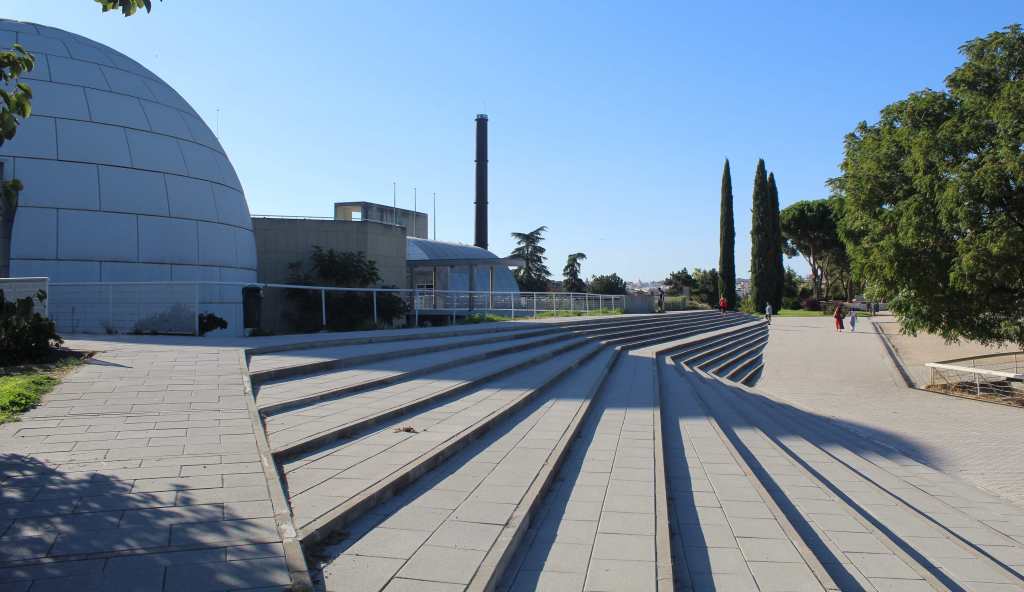
Underneath the bulbous dome of the planetarium is a semi-circular screen, where educational programs are projected—cartoons for kids, documentaries for adults, and educational sessions for school groups. Through an oversight, I once sat through a film about velociraptors who constructed a space ship and traveled throughout the universe, only to return to earth and find the bones of their ancestors in museums.
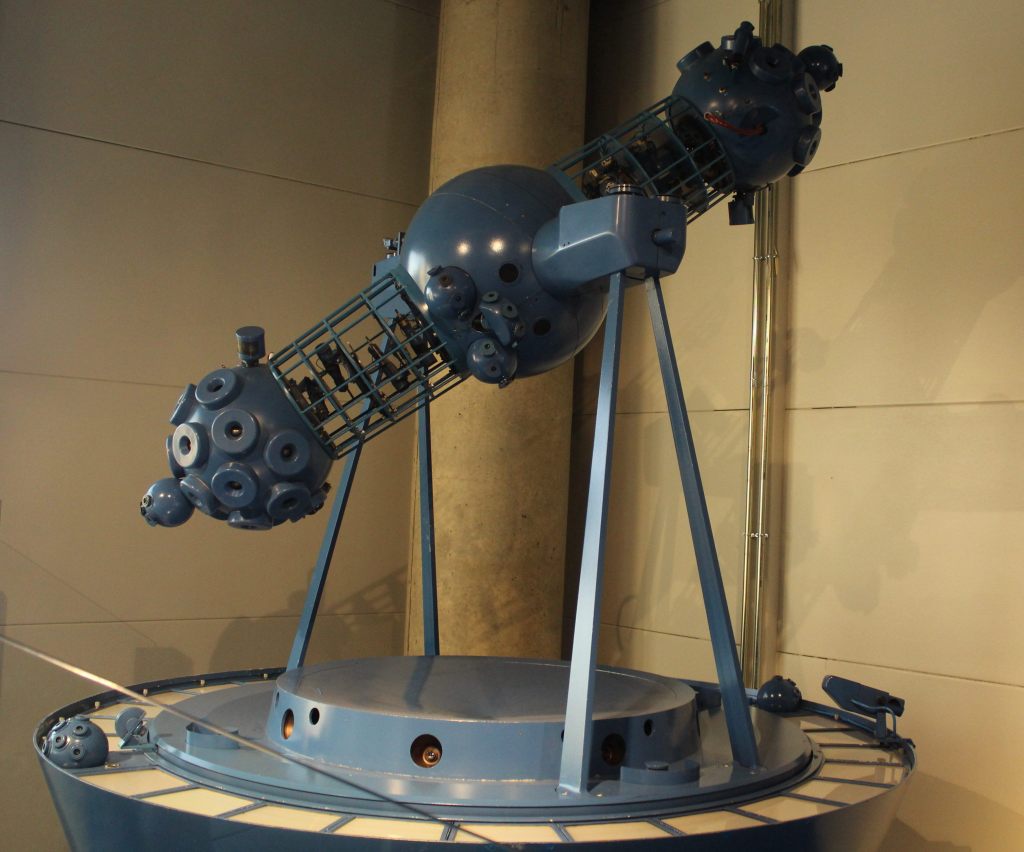
The rotating projector used in the semi-spherical dome

Apart from these films, the Planetarium has a small exhibition space, where the visitor can see short educational films on the solar system, gravity, and the history of the universe. There are replicas of Mars rovers and space suits, as well as displays on the Milky Way and the moons of Jupiter. Most beautiful, I think, are the photos of distant galaxies and nebulae, taken by the Hubble Telescope and gently illuminated. The universe is a frighteningly beautiful place. All this being said, I think the exhibit space is rather light, and in general the Planetarium is geared towards younger audiences. Still, it is always worthwhile to contemplate the stars.

The Real Observatorio is certainly not a visit for kids. This royal institution was founded in 1790 by Carlos III, and it bears all the hallmarks of its Enlightenment origins. The Observatory is a kind of temple of science—housed, as it is, in a cathedral-like building designed by the great architect Juan de Villanueva. To visit, you need to reserve a spot on a guided tour, which are only available on weekends (and I believe are only available in Spanish). But if you have any interest in the history of science, the visit is certainly worth the trouble.
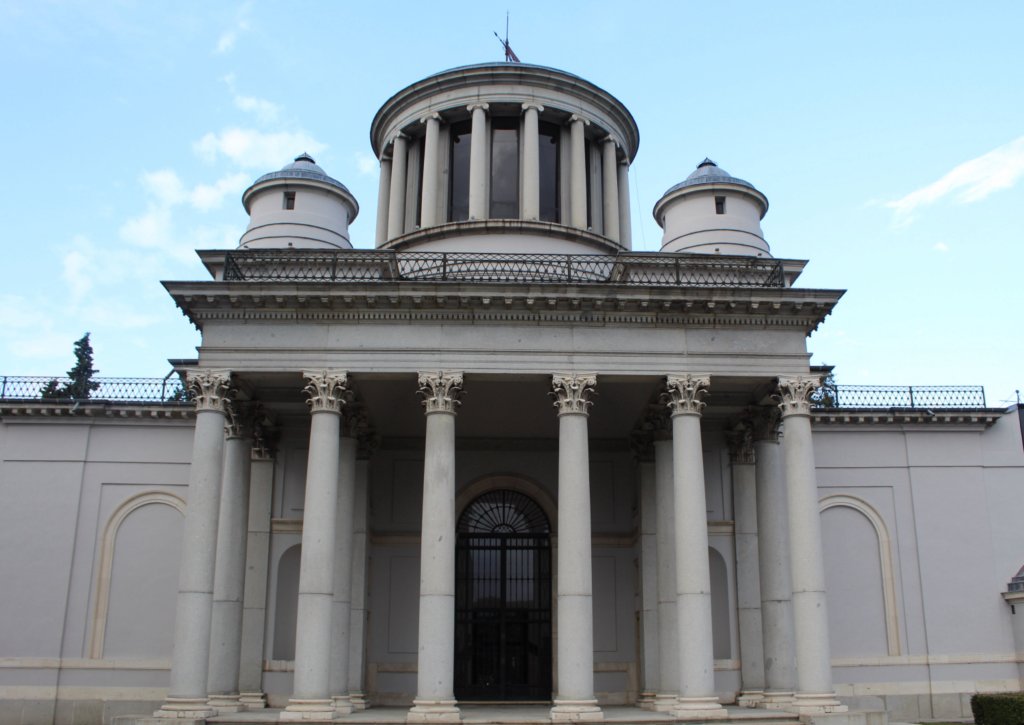
The tour begins in the great edifice of Villanueva, which preserves so much confident optimism of the Age of Reason. In the great hall, a Foucault pendulum hangs from the ceiling, making its slow gyrations. This device—the original of which hangs in the Panthéon of Paris—is a demonstration of the rotation of the earth, as the planet’s movement under the pendulum makes it appear to spontaneously change direction.
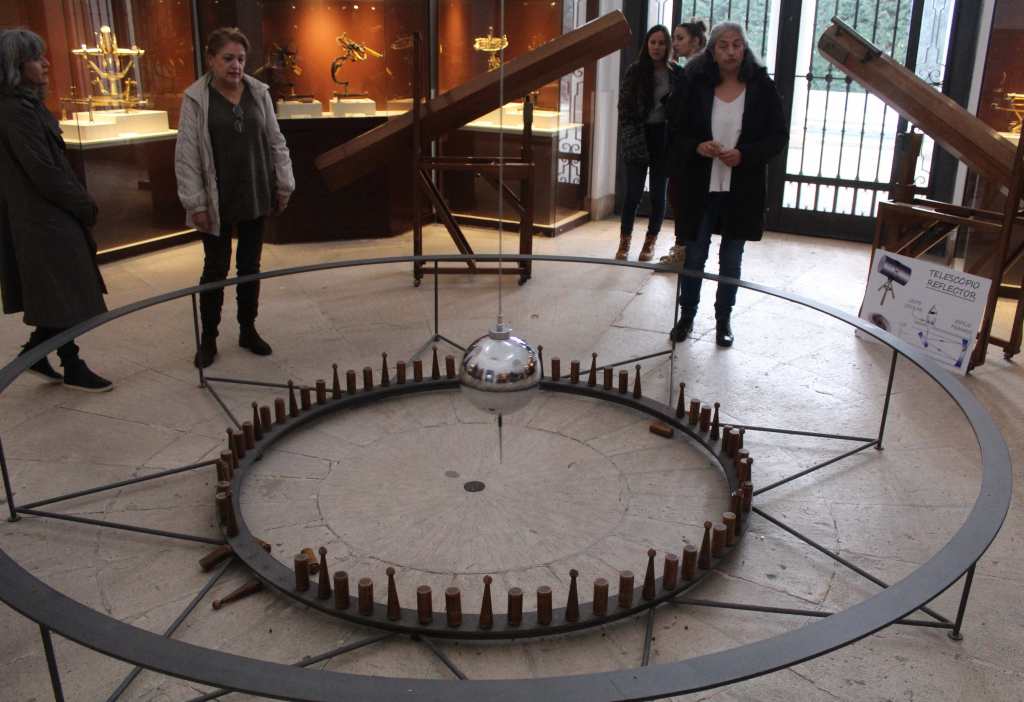
Distributed around the space were any number of beautiful antique telescopes and other scientific devices—crafted by hand out of polished brass and carved wood. Antique clocks hung on the walls in abundance, as if the scientists of that era had to double- and triple-check the time for their observations. In the main chamber, a large telescope occupied the center of the space. There, mounted like a canon, a metal rod is pointed at the slotted ceiling. Below it, a plush chair with a folding back allowed the scientist to look through it from either side.

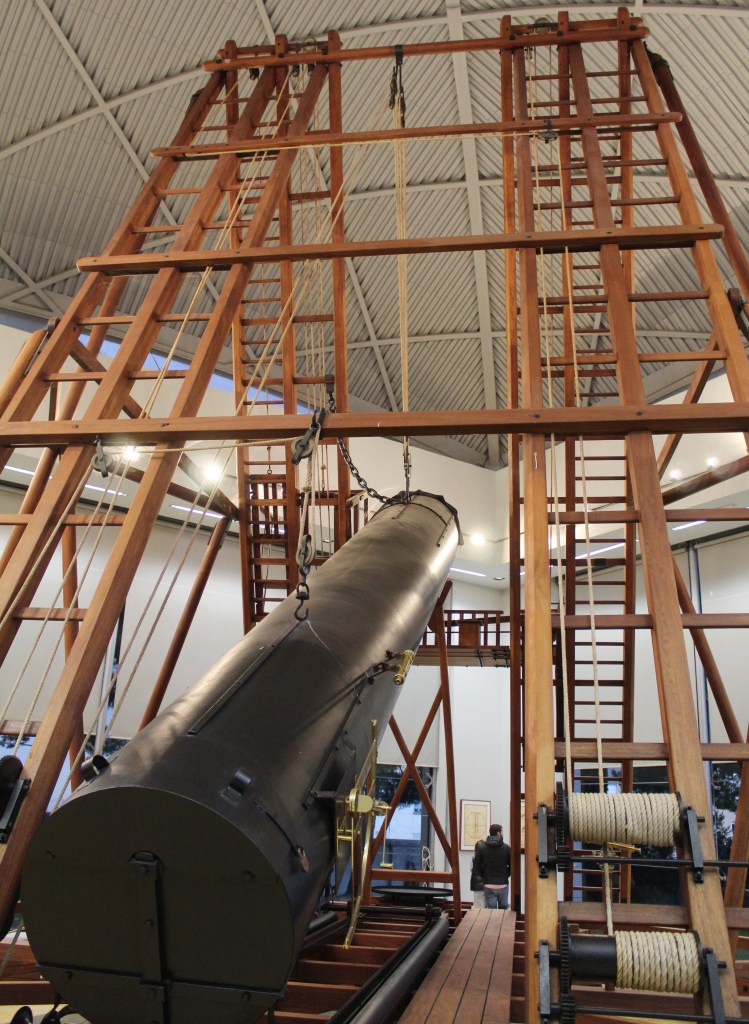
But the star attraction of the Observatory is held in a different building, a short walk from the Villanueva edifice. This is the great telescope of William Herschel, the English-German astronomer. This huge contraption was built in an English shipyard in 1802 for the new Royal Observatory. It was to be the center of the whole scientific enterprise. Unfortunately, fate soon intervened in the form of Napoleon, whose troops occupied the Royal Observatory (it has a strategic vantage point on a hill) just a few years later. These soldiers melted down the metal parts of the telescope for munitions and used the wood to keep warm. Thus, the current telescope is a careful reproduction, completed in 2004.
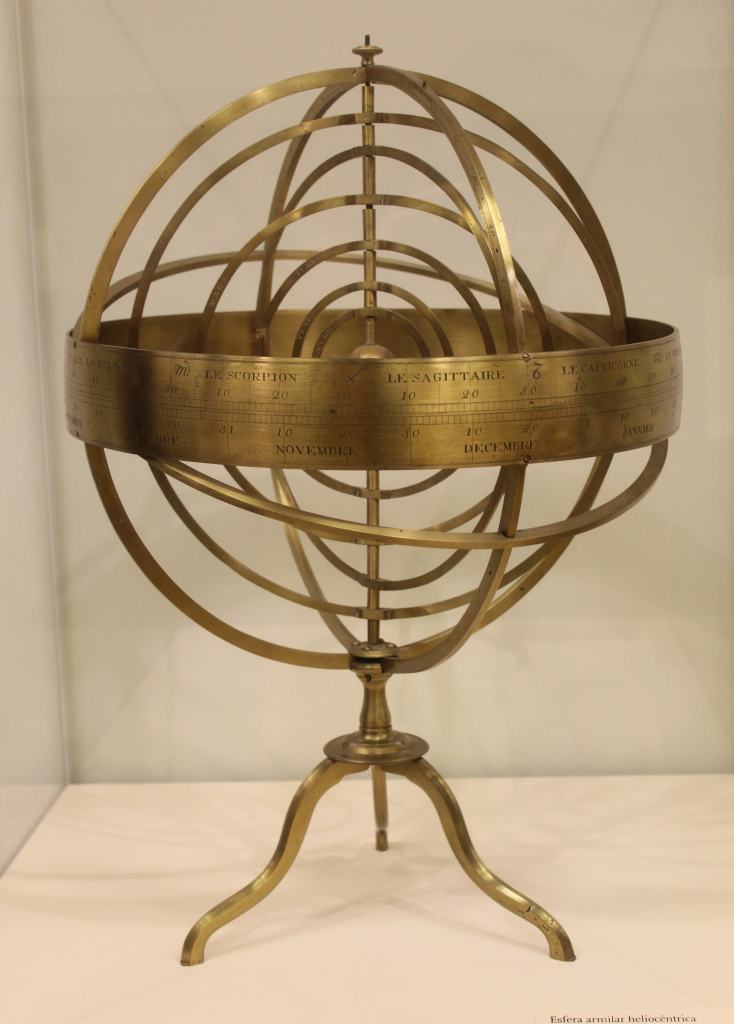
The tour ends in the Hall of Earth and Space sciences, a kind of miniature museum that is run by Spain’s Instituto Geográfico Nacional. The exhibit is divided into four sections: astronomy, geodesy, cartography, and geophysics. Each display is full of yet more scientific instruments, both old and new. There are armillary spheres (for determining the position of the planets in the sky), theodolites (for surveying land), and samples of volcanic eruptions from the Canary Islands. My favorite was a lithographic plate used in the printing of the National Topographic Map—the official, hyper-detailed, super-accurate map of the country.
The Royal Observatory is still an active scientific enterprise, monitoring both the skies above and the earth below—though the amount of light pollution in the city makes even Herschel’s great telescope largely useless. Instead, they receive data from far away telescopes, such as the Gran Telescopio Canarias, located high up in the mountains of La Palma, above the clouds and far from major city centers.

Yet even if Madrid’s skies no longer serve the purposes of science, they still inspire locals and visitors alike. As I write this, I am peering up at the blazing ethereal blue of a mid-September day, with the laser-like sun casting sharp shadows on the street below. It is, indeed, just one step short of heaven.

Review: Two Brecht Plays

Review: Two Brecht Plays

Mother Courage and Her Children by Bertolt Brecht

My rating: 4 of 5 stars

The poor need courage. Why? They’re lost. That they even get up in the morning is something.

It is surprising to read, from such a famously doctrinaire thinker, a work of art that is so rich in moral ambiguity. The titular character is enormously compelling, despite being neither hero nor villain. Mother Courage has moments of courage, of course, but also of capitulation, moments wherein she is admirable and when she is despicable. She is, on the one hand, a war profiteer, a kind of jackal gnawing at the scraps of human carnage. But can a person living on the edge of poverty, with hardly any other viable option to make a living, be condemned?

The world that Brecht presents is as hopeless and absurd as in any work from the previous century. It is a world where both morality and immorality are rewarded with cruelty. Two of Mother Courage’s children are killed as a direct consequence of their attempts to do the right thing, whereas her oldest son is killed for his crimes (the same crimes, ironically, that were praised in wartime). Mother Courage herself, who at least survives, is moral within the bounds of practicality. Even when life and death are on the line, she is always a business woman first and foremost, unwilling to make any sacrifice that will jeopardize her ability to make a living.

Considering Brecth’s Marxism, I am tempted to view Mother Courage as a kind of embodiment of the evils of capitalism—or, at least, as a portrait of how capitalism degrades us. And certainly she is far from ennobled by her ceaseless dealings and negotiations. In perhaps the pivotal scene in the play, she convinces a soldier that protests against the powers that be are useless. Her worldview, in other words, is materialistic and cynical.

And yet it is the war, not the economy, that is the defining element of the setting. And it is a war of religion. Is Brecht showing us, then, how capitalists lack the moral ability to oppose war? Certainly Mother Courage’s attempts to profit from the conflict ultimately destroys her family; but there doesn’t seem to be any other option open to her besides starvation.

Rather than a condemnation of capitalism or even of war, then, my final impression was of a cry of despair for the entire human race, written at one of the darkest moments of the previous century. Not cunning, nor cruelty, nor selfishness, nor martyrdom, nor religion, nor anything else can save the characters of this play from ruin. It is a portrait of an entire world gone mad.


Galileo by Bertolt Brecht

My rating: 4 of 5 stars

The evidence of your eyes is a very seductive thing. Sooner or later everybody must succumb to it.

This play succeeds as a drama while failing as history, at least as a history of science. Galileo here is presented as a kind of anti-religious working-class hero—who wants to liberate the toiling masses through knowledge. However, the idea that his philosophy of the heaven’s would naturally lead to atheism and, thus, political disquiet—an argument put against him at various points in the play—would have seemed very foreign to the seventeenth century. To my knowledge, those who censured Galileo were far more afraid of the Protestant Reformation than the Proletariat Revolution.

And as Eric Bentley’s astute introduction points out, the terms of the debate are also not fairly portrayed. True, when Galileo was looking through his telescope and merely reporting what he saw, this was a case of raw observation overturning established doctrine. But in the more important case—Galileo’s advocacy of the Copernican system—it is simply not true that the heliocentric astronomy was manifestly superior to the geocentric.

On the contrary, arguments for its adoption were in the realm of abstract mathematics, far removed from the realm of simple observation. Ironically, then, Galileo was indeed not simply asking the doctrinaire philosophers to accept the evidence of their senses. He was, in a real sense, asking them to disregard it—since, as we all know, what we experience every day is the sun rising and setting, not the earth in motion.

Also, the argument that the Copernican astronomy is a blow to human vanity is also rather anachronistic. Readers of Dante’s Divine Comedy will recall that, although Earth is regarded as the center, it is hardly a privileged place in the cosmos. On the contrary, each of the heavenly spheres is the more divine the further it is from earth, with God himself furthest of all. Thus, for Galileo to place earth among the heavenly spheres was rather flattering to humanity’s stature.

Yet this is a play, not history, and must be judged as such. Written at nearly the same moment as Mother Courage and Her Children, this play—though apparently quite different—shares the central feature of a morally ambiguous hero in compromising circumstances. At various points, particularly at the end, Brecht seems to want to condemn the famous scientist, just as Brecht judges Mother Courage rather harshly. And yet, in both plays, the cowardly behavior of the protagonists is their only real option, the alternatives being a pointless martyrdom.

The ambiguous nature of Galileo—hero and coward, genius and bungler (scientifically astute and yet politically inept)—is what gives him his authentic humanity as a character, as somebody we can readily identify with. That is not to deny his greatness. For Brecht here has portrayed a truly great figure, even an authentically tragic figure, whose flaws form an integral part of his virtues. The play succeeds, then, in spite of its historical inaccuracies, through a compelling portrayal—all too rare in drama—of an intellectual struggling against his surroundings.


View all my reviews

Review: Maxwell’s Treatise on Electricity and Magnetism

Review: Maxwell’s Treatise on Electricity and Magnetism

Maxwell’s Treatise on Electricity and Magnetism: The Central Argument by Howard J. Fisher

My rating: 4 of 5 stars


Most good books lend themselves to be read on many levels. One can read them superficially, merely for momentary pleasure, or study them deeply, working your way slowly through their contents. For the most part, I try to chart a middle path through these two extremes, doing my best to understand what I’m reading—at least on a basic level—without getting bogged down in academic study.

However, some books simply do not lend themselves to that approach, and this is one of them. One can skim over the mathematical proofs in, say, Newton’s Principia and still get a fairly good idea of what the book is about. But in Maxwell’s magnum opus, the math is what does the talking. Indeed, by the midway point I was so desperate—feeling guilty, lazy, and stupid for understanding so little of what I was reading—that I decided to turn to an old ally, Kahn Academy. There, I went through all of the videos on electricity and magnetism, and learned a great deal. (The last time I had any formal instruction on the subject was in my sophomore year of high school, and I doubt I understand much back then.)

But I found, when I picked up the book again, that even this Hail Mary would not save me from the perdition of Maxwell’s writing. Indeed, as I had already bought the heavily annotated student’s edition (with copious notes by Howard J. Fisher), it seemed that I had used up all of my lifelines, and simply had to content myself with only the most superficial reading of this important book.

What follows, then, is probably as valuable as a review of Hamlet by somebody with an elementary level of English. Here I goes.

Now, as I mentioned, the version I picked up is meant for students. Thus, it is heavily abridged and, often, so full of explanatory footnotes that the original text is crowded out.

For what it’s worth, even if you do have the mathematical and scientific chops to handle Maxwell’s tome, I would recommend either this version or something similar. The original is famous for being rather unfocused and overlong. After all, this book was not meant to be Maxwell’s Origin of Species—a text devoted to propounding a radical new theory. Maxwell had already set forth his most revolutionary insights—most notably in the paper “A Dynamical Theory of the Electromagnetic Field,” in 1865—several years before this book was published. Instead, this was meant as a kind of definitive textbook on the subject, to be studied by university students, telegram technicians, and other specialists. Thus, there are long sections in which he rehashed old theories which would be of limited interest to any modern reader.

This edition attempts to pare down the original, leaving only what Fisher considers to be the “central argument”—that is, the material leading directly to Maxwell’s signature breakthroughs. These would be, first, his four famous eponymous equations and, second, the electromagnetic theory of light.

Regarding the former, as you may know, Maxwell did not actually formulate his equations in the form which modern students encounter them. It was one of Maxwell’s followers, Oliver Heaviside, who put the equations into their definitive form. Instead, Maxwell puts forward twelve equations, which use the now-defunct quaternion notation rather than vector calculus. This makes Maxwell’s presentation seem rather foreign, even to those less ignorant than myself. What is more, Maxwell has a liking for using Gothic letters as symbols in his equations, which gives them a doubly strange appearance.

More generally, I think even a mathematically literate reader will have some trouble following significant portions of this book, if only because Maxwell’s mathematical language seems clunky and dated. In my version, for example, Fisher is continually translating Maxwell’s operations into more familiar forms (which, admittedly, I still did not follow).

As I had recently made my way through an (abridged) version of Faraday’s epochal Experimental Researches in Electricity, I was most interested in the sections in which Maxwell reflects on his predecessor’s work. He is extremely laudatory of the English physicist and is quite generous in giving credit for developing this new way of examining electricity.

And, indeed, if I have any way of understanding Maxwell, it is only through the lens of Faraday. At first glance, the devoted experimentalist with no mathematical schooling seems to have little in common with the visionary theorist who prefers numbers to words. And yet, as I’m sure Maxwell would agree, they were bound together by a new vision of the cosmos. In a nutshell, and said very imprecisely, I think their insight was to see energy rather than matter as fundamental.

In the Newtonian view that preceded Maxwell, the world was composed of matter—indeed, even light was supposed to be made up of little corpuscles. This matter traveled in straight lines and attracted other matter in straight lines. This Newtonian view was embodied in, say, Ampère’s earlier theory of electromagnetism.

And yet this view always sat uncomfortably with Faraday, who instead saw the curving lines of the magnetic field as the fundamental reality, rather than one piece of matter attracting another via “action at a distance.” Indeed, Faraday’s brilliant experiment involving the shifting of light via a magnet got him tantalizingly close to the central insight of Maxwell’s life: the unification of light with electromagnetic radiation.

Faraday is one fount of Maxwell’s inspiration. Yet if Maxwell has a mathematical predecessor, it is Joseph-Louis Lagrange, whose work comprises a culminating chapter in this book. Lagrange arguably developed the math that Faraday had been striving toward from another direction. For in Lagrangian mechanics, rather than thinking of forces being exerted by physical objects, one thinks of the energies in the system—the object in question merely following the path of least resistance through the fields of energy around it.

It was Maxwell’s great insight to see how the work of Faraday and Lagrange—among many, many other brilliant scientists—fit together to form one complete account of electricity and magnetism. It is a theory in which fields of energy take precedence over particles, indeed in which the world around us is filled with vibrations in luminiferous ether. And while some parts of Maxwell’s theory (notably the ether) have not survived to the present day, his basic insight was so sound and so significant that, as Richard Feynman said, his discovery constitutes one of the major turning points in human history. You certainly wouldn’t be reading this review without it. Thus, Maxwell’s name stands beside Newton’s and Einstein’s as one of the greatest physicists of all time—even if his book is completely opaque to people like me.


View all my reviews