

This is Part Two of a six-part series on Rome, following this plan:
- Introduction
- Churches
- Basilicas
- Museums
- Ruins
- The Vatican
It is an absurd understatement to say that Rome has many beautiful churches. You can hardly go two blocks without passing a church which would, in any other city, be a major tourist destination, but which in Rome is just another church.
Rome has so much world-class religious architecture that I need to divide up my posts by building type. This post is for the churches; the basilicas will come next. (The difference between a church and a basilica is largely a matter of size.) I only visited five churches, although they were quite famous ones. Thus this post, like everything written about Rome, will be woefully incomplete.
Santa Maria della Victoria
The first thing I did when I put down my bags was rush to Santa Maria della Victoria, which was luckily right near my Airbnb.
The main reason I wanted to go was because of Bernini’s famous statue: The Ecstasy of Saint Teresa. That was all I knew about the church. So I was astounded, upon entering, to find that every inch of the place was breathtaking. I found myself gasping, transfixed, at everything I saw. The church deservers Bernini’s masterpiece.
The first word that springs to mind, as I attempt to describe the place, is lush. Like a forest in springtime, the church overflowed with sensory pleasure. The floor, the walls, the ceiling, the statues, the altars—every surface, corner, and crevice provided fascination and delight to the eye.
After gaping at everything for a few moments, I went immediately to find Bernini’s statue. And there it was. In my experience, the first time you lay eyes on a famous work of art, one that you have seen many times in photos, there is a second of disappointment. “So, that’s it?” you say to yourself. At first glance, the statue looks like any other.
When you look closer and more deeply, the disappointment soon turns into a feeling of unreality. It’s like you just walked into a television program: you are suddenly inside something which you had been experiencing from without. “Am I really here?” you think.
This feeling, too, goes away soon enough, leaving only you and the artwork. Now that you can look at it, what do you see? To the modern eye, The Ecstasy of Saint Teresa looks inescapably sexual. A smiling angel stands over the supine saint, an arrow raised in his hands. Teresa is crumpled over, obviously overwhelmed, her mouth hanging open (in pain, pleasure, or both?).

To us in the post-Freudian age, the spear, the postures, and the Saint’s expression all seem like an obvious depiction of coitus. This impression is confirmed when you know a bit about St. Teresa’s life, whose greatest religious struggle was her attraction to handsome men. Yet I wonder if this was intended by Bernini. He was certainly not unacquainted with the sexual side of life. But it is also hard for me to think that a sincerely pious man would have intentionally depicted something sexual for a church, and that the church would have accepted something it considered suggestive.
As usual with Bernini, the statue is a work of technical virtuosity. The most outstanding feature is Saint Teresa’s robe. In the Renaissance, as in Rome and Greece, cloaks and robes were depicted as falling naturally over the body, closely fitting the body underneath. But here the robe seems to be alive. Far from succumbing to gravity, it is animated as if by an electric current, rippling and folding and crashing like stormy ocean waves. Instead of revealing the saint’s body underneath, the robe totally obscures her form, absorbing her into a torrent of energy that represents, all too clearly, the ecstasy she is feeling. This also serves to highlight the saint’s face, since the rest of her is absorbed by her garment. And here too we find Bernini to be a master. The saint is angelic, beautiful, and otherworldly.
Across from this masterpiece is a much lesser work, The Dream of Joseph by Domenico Guido, which is nonetheless impressive. The ceiling is covered with a heavenly fresco, and is held up by white, stucco angels. Besides Bernini’s statue, what most stuck in my memory was the marble in the walls and the floor. Several different colored stones were used, all of extraordinary quality. I cannot fathom how much money went into this single church. I find marble to be nearly hypnotic to look at. Light and dark patches of color swirl around each other like puffs of petrified smoke.

Santa Maria del Popolo
I had the bright idea of trying to visit this church on Sunday morning. I walked in to find that, of course, they were celebrating mass, so I did an abrupt about-face and sat down on the steps outside.
Santa Maria del Popolo is situated in the Piazza del Popolo, one of the pleasantest plazas in the city. In the center is a large Egyptian obelisk, the second oldest obelisk in Rome; and bounding the plaza are two semicircular walls, with a fountain in the middle of each. Although the name literally means “Plaza of the People” in Italian, its name historically comes from the poplar trees that grew there. It was also the site of many public executions.
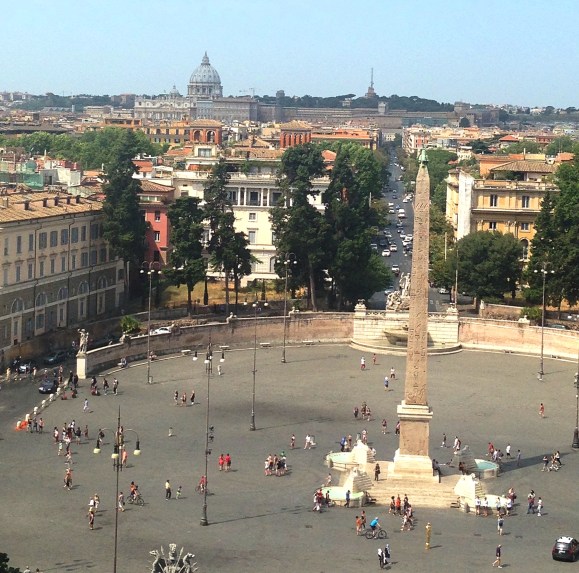
It was in this plaza that I waited, hungry and frustrated, for the mass to end. The only thing that provided amusement were the many other tourists who made the same mistake. Person after person walked into the door and immediately walked out again, as a beggar by the door futilely said “La messa, la messa!” (“The mass, the mass!”). Obviously nobody could understand the poor guy, or else people habitually ignore the homeless. In any case, the steps were soon full of frustrated tourists who were, like myself, waiting for the mass to end.
It is, by the way, a sardonic comment on religion in the modern world that hundreds of people were annoyed that a church was being used for worship. There are still millions of Catholics in the world, of course; but it seems obvious to me that, in Europe at least, the religion is dying. I don’t know how I feel about this. On the one hand it seems like progress; but on the other it is hard for me to be happy about a religion disappearing when it inspired and helped fund so much beautiful art. But with this new Pope, maybe the future of Catholicism is looking up.
Finally the mass was over, and we all poured inside. Compared with other churches in Rome, the interior of Santa Maria del Popolo is relatively austere. This isn’t saying very much, of course. There were statues, friezes, paintings, and shining golden surfaces in abundance. The church’s dome is lovely, with a pinkish-yellow swirl of clouds painted on the inside, and light pouring in the windows from all directions.
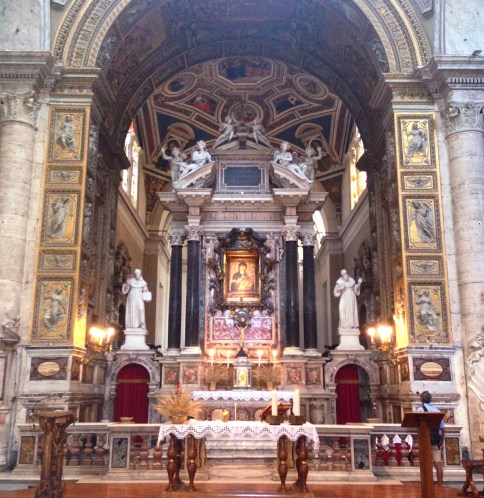
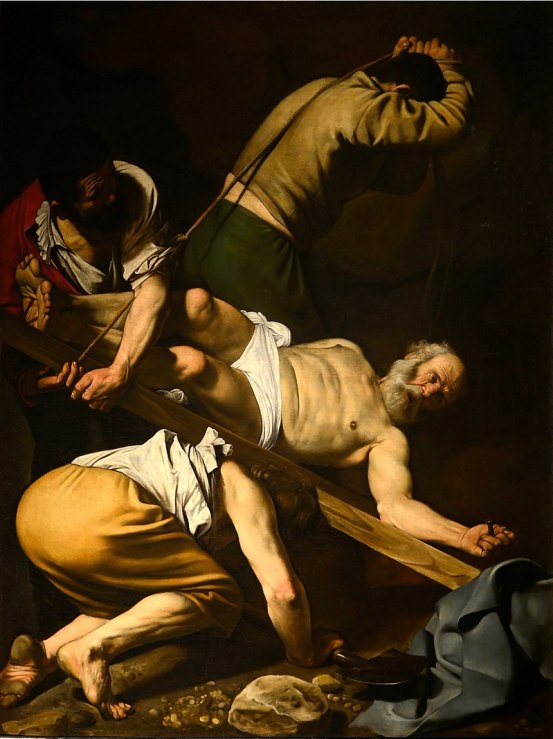
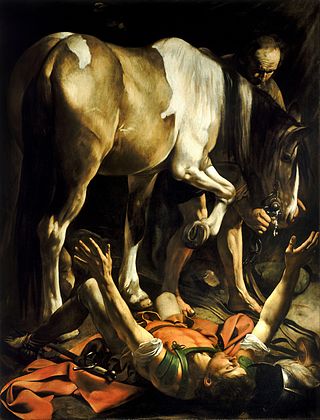
Although Santa Maria del Popolo is home to many important and lovely monuments, it is most known for two paintings by Caravaggio. As soon as we got inside, all of us immediately flocked to the altar where the paintings hang. These two works are the Crucifixion of St. Peter and the Conversion on the Way to Damascus. Unfortunately, the paintings are hung in such a way that they face each other, rather than the viewer, so you have to see them at an odd angle. And if you want to see the paintings properly lighted, you have to put a euro into a little machine nearby (or wait till another visitor does it, like I did).
As usual with Caravaggio, the style is darkly realistic. Accurate anatomy, shadowy backgrounds, grubby details, and an intense focus on dramatic moments are what set Caravaggio apart from his contemporaries.
In Crucifixion of Saint Peter, Caravaggio pictures the saint—old, bearded, and grey—in the moment when he is being hoisted up on the cross (he was crucified upside down). Peter looks with helpless alarm at his hand, nailed to the cross. The workmen are, by contrast, anonymous forms: two of them have their backs turned to the viewer, and the last has his face cloaked in shadow. Caravaggio chose to portray the workers dressed in Renaissance Italian garb, giving the painting an extra feeling of realism.
Conversion on the Way to Damascus depicts the moment when Saul of Tarsus (later, St. Paul) was struck blind by God and converted to Christianity. The saint is laying flat on his back, his eyes closed, his hands reaching up to heaven. A horse and a servant look down at the supine man, confused at what transpired. The bright red and green of Saul’s clothes contrasts with the dull colors of the upper half. To me, there is something particularly touching about this painting. St. Paul is totally helpless, overwhelmed, as fragile as a newborn; and yet the look of rapture on his face tells us that he will soon be reborn.
Sant’Ignazio di Loyola
This church, which stands right in the center of the city, was built in the Baroque period to commemorate St. Ignatius of Loyola, the founder of the Jesuits.
The decoration of this church is lighthearted and joyful. This is exemplified in the fresco painted on the main vault (see above), which abounds in pinks, yellows, and blues, and whose numerous characters, flying through the heavenly skies, are almost cartoonish.
This playfulness is most apparent in the “dome.” Lacking funds to build a proper dome, the Jesuits commissioned a painter to create the illusion of one. It is excellently done: I am sure many visitors do not even notice it is false. When I did notice, I did a double take. “No, that can’t be right,” I thought, and tried to see it from a different angle. But soon the conclusion is inescapable: the dome is a fake.

Also notable are two friezes, one depicting the Annunciation and another St. Aloysius Gonzaga being welcomed into heaven. The swirling spiral columns of dark marble, which flank these friezes, particularly tickle my fancy.
Even more impressive is the monument to Pope Gregory XV. Four angels hold open a curtain, revealing the Pope sitting on a throne. What is most amazing is that the sculptor, Monnot, was able to make marble into a near-perfect semblance of fabric. Technically, at least, it is a masterful.

St. Louis of the French
This is the French national church in Rome. This means that the church originated as a charitable organization that helped French pilgrims in Rome. As a result, all the signs in the church are in French.
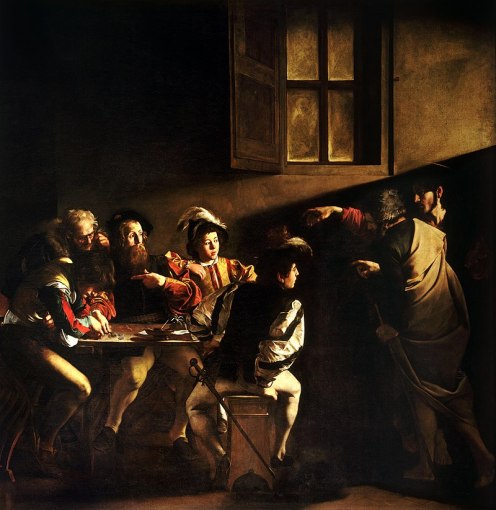
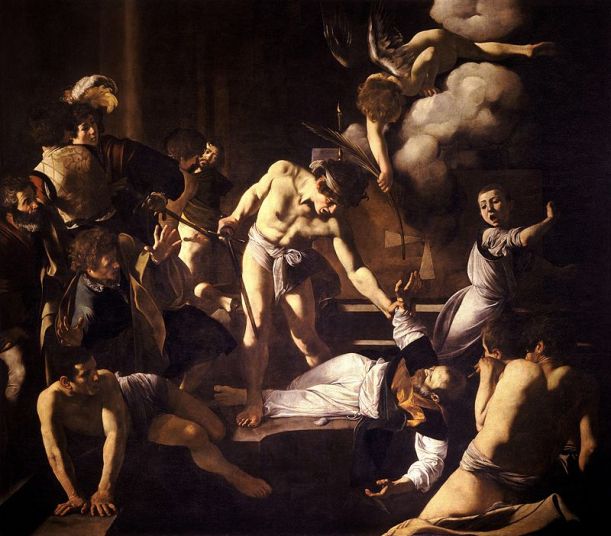
The church of St. Louis of the French is not far from the Piazza Navona. Although a lovely church by itself, it nowadays attracts visitors for its three famous Caravaggio paintings about the life of St. Matthew: The Calling of Saint Matthew, The Inspiration of Saint Matthew, and The Martyrdom of Saint Matthew. All three hang together in the Contarelli Chapel, and all three are masterpieces.
(Unfortunately, as in Santa Maria del Popolo, two of the three paintings are difficult to see, not only because they are a bit far away, because they are positioned at a right angle from the viewer. I can’t help thinking it’s a shame that such great works of art are not more easily visible.)

On the left wall is The Calling of Saint Matthew. Here is a perfect illustration of Caravaggio’s genius and originality. Instead of a heavenly scene, with the divine Jesus calling Matthew to serve God, we are shown a confused rabble in a bar. Jesus is almost invisible, hidden in shadow; most noticeable is his pointing finger. We follow this finger to a shabby, bearded man sitting behind a wooden table. This is Matthew. He thinks Jesus must be confused, looking for someone else; he points helpfully to his companion, who is bent over, counting money on the table. As usual, the costumes and the scenery are all taken from Caravaggio’s contemporary world (note the boy dressed in bright livery). The grimy realism, the dramatic gesture, the innocent surprise on Matthew’s face—all this combine to make the painting one of the most convincing portrayals of this Gospel scene.
In the center, facing the viewer, is The Inspiration of Saint Matthew. This was apparently a difficult commission for Caravaggio, since several earlier versions were rejected by his patron. Unfortunately for us, the most famous of these early versions, Saint Matthew and the Angel, was destroyed during World War II. (As the historian Will Durant notes, art and war are engaged in an eternal struggle.) This earlier painting is almost scandalous in its realism. St. Matthew is portrayed as a illiterate peasant. He is seated uncomfortably on a chair, his eyes squinting, his hand gripped awkwardly around the pen. An angel stands next to him, his hand guiding Matthew’s, acting the role as writing teacher. I love the painting, but I can see why the cardinal did not.

The later work is somewhat more conventional, but nonetheless wonderful. Instead of guiding St. Matthew’s hand, the angel hovers above the saint, talking to him (the angel seems to be counting something on his fingers). Matthew looks only slightly more comfortable. He is kneeling on a stool, hunched over his table, bending backward apprehensively to listen to the advising angel. Although less startlingly realistic, this painting makes up for that with its iconic design. The angel, robed in white, comes down from the upper right; while Matthew, robed in red, is positioned in a diagonal from the bottom right. The antithesis of the figures’ colors and postures make this painting instantly memorable.
Last we have The Martyrdom of Saint Matthew. This painting is by far the most dramatic. A nearly naked, intensely muscular soldier stands over St. Matthew, whose has collapsed on the ground. The soldier’s face is pure anger and violence. He is the wrathful embodiment of human strength. Surrounding the two central actors are about a dozen figures, reacting to the scene in different ways, from horror to mild curiosity. The saint seems, at first glance, to be frightened. His arm is raised, as if pleading. But then we notice that he is not looking at or reaching towards the soldier, but is entranced by the angel floating above. The angel is holding down the branch of a tree, which St. Matthew reaches for, as if he is about to be pulled right into heaven.
San Pietro in Vincoli
San Pietro in Vincoli is a tremendously old church, first consecrated in the year 439 (although rebuilt after that). Nowadays, it is famous for being the home of Michelangelo’s statue of Moses. The statue is part of a larger funeral monument to Pope Julius II (who was, incidentally, the subject of one of Raphael’s greatest portraits).
The relationship between fame and quality is interesting. To be honest, if I had not known that the statue was done by Michelangelo, I’m not sure I would have paid any special attention to it. This is most likely due to my own ignorance of art, rather than any defect on Michelangelo’s part. Nevertheless, I think the same is true of nearly every person who visits, not only this church, but many other famous works of art: we are impressed as much by the name as by the art itself (if not more).
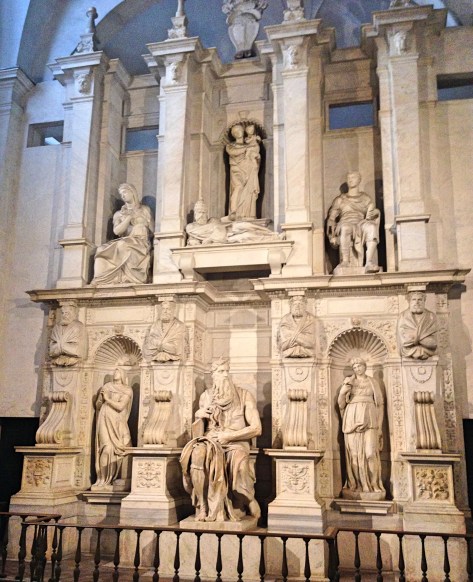
You might notice that Moses is depicted with horns on his head. This isn’t because Michelangelo thought he was a cuckold, but because of the way St. Jerome, in his Latin Vulgate Bible, translated a Hebrew word. The original Hebrew word, used to describe Moses as he descended from Mt. Sinai, often meant “horned,” but also could mean “shining.” St. Jerome chose the first option; and thus there are many portrayals of Moses with little horns on his head.
Moses is seated. His long, flowing beard hangs down in tangled glory. In body and face he is so splendid that he could be mistaken for Zeus. Under his right arm are the two tablets with God’s commandments. On his face, he wears a dark and judgmental expression. What is he looking at? Perhaps he is casting a disappointed glance at his people, who are lost in idolatry. Freud made this statue the subject of some psychoanalysis, and later scholars have done likewise.
 Lotz in Translation