Review: Miró—Painter of the Stars

Review: Miró—Painter of the Stars

Miró: El pintor de las estrellasMiró: El pintor de las estrellas by Joan Miró

My rating: 4 of 5 stars

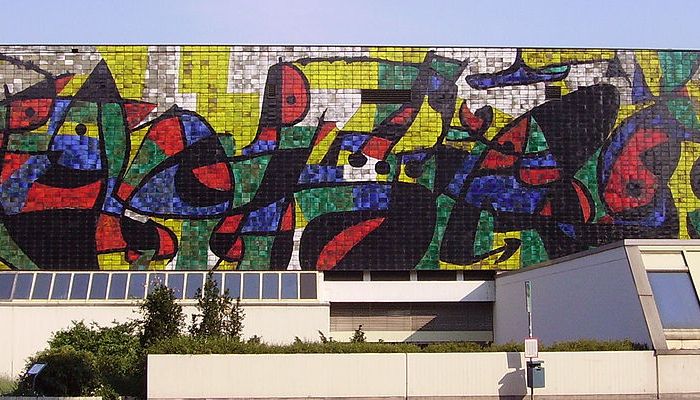
Although Joan Miró’s name is hardly less known than that of Dalí’s or even Picasso’s, his art seems strikingly less popular. I have been told by several people that they cannot appreciate it. And, indeed, I was often left cold by the works I had seen in the Reina Sofia—some of which seems to confirm every negative stereotype about modern art. But I wanted to give Miró another chance; so I visited the Fundació Miró in Barcelona, and read this book.

One of the most difficult tasks before any young artist is to develop her voice. By “voice” I mean many things: style, philosophy, identity, themes, and so on, which taken together make an artists work immediately recognizable as hers. In a word, this requires originality. One might be inclined to think that originality is the easiest thing to achieve—being the natural product of everyone’s differences. But to produce a deeply original work—one that could not have been produced by anybody else—is anything but easy. Artistic voice emerges in a dialectical process with one’s influences, as they are first mastered and then synthesized, until gradually something appears which cannot be traced to any influence.

This process is most easily seen among painters. And it is wonderfully illustrated in Miró, whose work incorporated fauvism, surrealism, and cubism. But it wasn’t only artistic trends that shaped the young painter. He was deeply inspired by natural sights—particularly the countryside near Montroig (near the city of Tarragona, in his ancestral Catalonia). The voice that Miró developed through his formative experiences and influences is unmistakable—displaying a sensibility for forms and color that no other artist could replicate. And consequently one feels, upon entering the Fundació Miró, the same way one feels upon entering the Dalí Museum in Figueres—that one is entering a new visual universe that obeys different laws.

In short, I have come to enjoy Miró’s work far more than I had. I find in it a sense of playfulness, and sometimes a sense of peacefulness, that is deeply appealing; and I enjoy watching his manipulation of forms shift throughout his work, while remaining recognizably Miró, like a theme and variations. But I still must admit that it does not affect me very deeply. My appreciation, in other words, is more intellectual than emotional. And I think that would have suited Miró just fine.

This little book is full of glossy pictures and does an excellent job in covering the different phases of Miró’s career.

View all my reviews

Review: What’s Up with Catalonia?

Review: What’s Up with Catalonia?

What's Up with Catalonia?What’s Up with Catalonia? by Liz Castro

My rating: 3 of 5 stars

Do not invite an American to speak about Europe; he will usually display great presumption and a rather ridiculous arrogance.

—Alexis de Toqueville

Perhaps the most politically controversial topic here in Madrid is the Catalonian independence movement. Almost everyone I speak to is vigorously against it, for one reason or another. I’ve heard people say that it is just a bluff for political negotiations; that it is based on calculated lies; that it is illegal and unconstitutional; that the Catalans are just crazy people; and so on. Indeed, it is my understanding that disagreement over the Catalonia Question is one of the major causes of the current political deadlock in Spain.

People talk about it a lot. But even after dozens of conversations, I still felt that I didn’t understand the situation; I was only hearing one side of the story. So for my first trip to Barcelona, I decided to open this book, a collection of essays by several pro-independence authors. It is a quick read: I read half of the book on the flight to Barcelona, and the other half on the flight back to Madrid. And now that I think of it, that is probably the best place to read this book, suspended in midair between the two cities.

It is this stance, an attempt at impartiality, that I am trying to maintain. But this is difficult for me. As one of the essays in this collection explains, many Americans are predisposed against independence movements because it reminds us of our Civil War. Of course, Catalonia is a completely different issue, so my association is illogical and unfair; and besides, my whole country originated in a war for independence. Yet I find it difficult to contemplate the option of secession without feeling queasy. That’s my bias.

This collections offers a variety of arguments for and perspectives on independence. The reasons offered for secession range from economic, to sentimental, to nationalistic, to linguistic, to historical, to political, often in combination. But, to quote Warwick, the result is less than the sum of its parts. The authors have different priorities and their arguments often contradict one another, which creates a sense of incoherence. One author argues that the Catalan language cannot be used as the primary marker of their identity, since a significant portion of the region’s inhabitants don’t speak it fluently; but another author comes out strongly for Catalan. Lots of authors talk about taxation and fiscal spending—all of them quoting the same statistics, which got rather tiresome by the end—but others said that they would want independence even if these financial troubles were cleared up. The tone of the essays ranged from dry analysis to impassioned pleas. It’s a hodgepodge.

One thing seriously lacking from the discussions of taxation and fiscal spending was how the Catalonia situation compared with that of other countries. In a nutshell, the complaint is that the Spanish government takes more money from Catalonia than they spend on it. But it is my understanding that this is a common occurrence when one region of a country is richer than another: money is diverted to where it is needed most. New York and California help to fund other states; and from what I’m told, Berlin is on the receiving end of a lot of financial support. If one of the authors had framed the fiscal situation in an international context, it would be easier to see whether it was fair.

These criticisms notwithstanding, I think this is an extremely valuable collection. Yes, there are much better overviews of the independence movement in Tremlett’s Ghosts of Spain and Hooper’s The New Spaniards; but those are two foreigners trying to summarize a complicated situation. This collection lets the Catalans speak for themselves, leading to a much more nuanced view of the independence movement. It shouldn’t be read in isolation; this is only one half of the debate. But it is an important half.

Personally I can’t decide how I feel about the whole thing. I am hostile to nationalism in general; and it strikes me that both the pro- and anti-independence positions are tinged with nationalism, for Catalonia or for Spain. I can certainly understand why, after Franco’s repressive policies, there is a considerable amount of bad blood built up in Catalonia; and I appreciate that it would make many Catalans very happy to have a country of their own. On the other hand, I think one mark of a country’s greatness is the amount of diversity it can incorporate, so I’d prefer it if the opposing sides could figure out how to live together without stepping on each other’s toes. Secession strikes my American mind as an overly drastic solution to the problem. But at this point I will take heed from Toqueville’s warning and say no more.

View all my reviews

Review: Why Buddhism is True

Review: Why Buddhism is True

Why Buddhism is True: The Science and Philosophy of Meditation and EnlightenmentWhy Buddhism is True: The Science and Philosophy of Meditation and Enlightenment by Robert Wright

My rating: 3 of 5 stars

A far more accurate title for this book would be Why Mindfulness Meditation is Good. For as Wright—who does not consider himself a Buddhist—admits, he is not really here to talk about any form of traditional Buddhism. He does not even present a strictly “orthodox” view of any secular, Western variety of Buddhism. Instead, this is a rather selective interpretation of some Buddhist doctrines in the light of evolutionary psychology.

Wright’s essential message is that the evolutionary process that shaped the human brain did not adequately program us for life in the modern world; and that mindfulness meditation can help to correct this bad programming.

The first of these claims is fairly uncontroversial. To give an obvious example, our love of salt, beneficial when sodium was hard to come by in natural products, has become maladaptive in the modern world where salt is cheap and plentiful. Our emotions, too, can misfire nowadays. Caring deeply that people have a high opinion of you makes sense when you are, say, living in a small village full of people you know and interact with daily; but it makes little sense when you are surrounded by strangers on a bus.

This mismatch between our emotional setup and the newly complex social world is one reason for rampant stress and anxiety. Something like a job interview—trying to impress a perfect stranger to earn a livelihood—simply didn’t exist for our ancestors. This can also explain of tribalism, which Wright sees as the most pressing danger of the modern world. It makes evolutionary sense to care deeply for oneself and one’s kin, with some close friends thrown in; and those who fall outside of this circle should, following evolutionary logic, be treated with suspicion—which explains why humans are so prone to dividing themselves into mutually antagonistic groups.

But how can mindfulness meditation help? Most obviously, it is a practice designed to give us some distance from our emotions. This is done by separating the feeling from its narrative. In daily life, for example, anger is never experienced “purely”; we always get angry about something; and the thought of this event is a huge component of its experience. But the meditator does her best to focus on the feeling itself, to examine its manifestation in her body and brain, while letting go of the corresponding narrative. Stripped of the provoking incident, the feeling itself ceases to be provocative; and the anger may even disappear completely.

Explained in this way, mindfulness meditation is the mirror image of Cognitive-Behavioral Therapy (CBT). In CBT the anger is attacked from the opposite side: by focusing on the narrative and subjecting it to logical criticism. In my experience, at least, the things one tells oneself while angry rarely stand up to cool analysis. And when one ceases to believe in the thought, the feeling disappears. The efficacy of both mindfulness meditation and CBT, then, is based on the interdependence of feeling and thought. If separated—either by focusing on the feeling during meditation, or the thought through analysis—the emotion disappears.

This, in a nutshell, is how mindfulness meditation can be therapeutic. But Wright wants to make a far more grandiose claim: that mindfulness meditation can reveal truths about the nature of mind, the world, and morality.

One of the central ideas of Buddhism is that of “emptiness”: that the enlightened meditator sees the world as empty of essential form. The first time I encountered this idea in a Buddhist text it made no sense to me; but Wright gives it an intriguing interpretation. Our brain, designed to survive, naturally assigns value to things in our environment based on how useful or harmful they are to us. These evaluations are, according to Wright’s theory, experienced as emotional reactions. I have quite warm and fuzzy feelings about my laptop, for example; and even the communal computers where I work evoke in me a comforting sense of familiarity and utility.

These emotions, which are sometimes very tiny indeed, are what give experiential reality a sense of essence. The emotions, in other words, help us to quickly identify and use objects: I don’t have to think too much about the computers, for example, since the micro-emotion brings its instrumental qualities quickly to my attention. The advantages of this are obvious to anyone in a hurry. Likewise, this emotional registering is equally advantageous in avoiding danger, since taking time to ponder a rattlesnake isn’t advisable.

But the downside is that we can look at the world quite narrowly, ignoring the sensuous qualities of objects in favor of an instrumental view. Visual art actively works against this tendency, I think, by creating images that thwart our normal registering system, thus prompting us into a sensuous examination of the work. Good paintings make us into children again, exploring the world without worrying about making use of things. Mindfulness meditation is supposed to engender this same attitude, not just with regards to a painting, but to everything. Stripped of these identifying emotional reactions, the world might indeed seem “empty”—empty of distinctions, though full of rich sensation.

With objects, it is hard to see why this state of emptiness would be very desirable. (Also it should be said that this idea of micro-emotions serving as registers of essential distinctions is Wright’s interpretation of the psychological data, and is rather speculative.) But with regards to humans, this mindset might have its advantages. Instead of attributing essential qualities of good and bad to somebody we might see that their behavior can vary quite a bit depending on circumstances, and this can make us less judgmental and more forgiving.

Wright also has a go at the traditional Buddhist idea that the self is a delusion. According to what we know about the brain, he says, there is no executive seat of consciousness. He cites the famous split-brain experiments, and others like it, to argue that consciousness is not the powerful decision-maker we once assumed, but is more like a publicity agent: making our actions seem more cogent to others.

This is necessary because, underneath the apparent unity of conscious experience, there are several domain-specific “modules”—such as for sexual jealousy, romantic wooing, and so on—that fight amongst themselves in the brain for power and attention. Each module governs our behavior in different ways; and environmental stimuli determine which module is in control. Our consciousness gives a sense of continuity and coherence to this shifting control, which makes us look better in the eyes of our peers—or that’s how the theory goes, which Wright says is well-supported.

In any case, the upshot of this theory still would not be that the self doesn’t exist; only that the self is more fragmented and less executive than we once supposed. Unfortunately, the book steeply declines in quality in the last few chapters—where Wright tackles the most mystical propositions of Buddhism—when the final stage of the no-self argument is given. This leads him into the following speculations:

If our thoughts are generated by a variety of modules, which use emotion to get our attention; and if we can learn to dissociate ourselves from these emotions and see the world as “empty”; if, in short, we can reach a certain level of detachment from our thoughts and emotions: then, perhaps, we can see sensations arising in our body as equivalent to sensations arising from without. And maybe, too, this state of detachment will allow us to experience other people’s emotions as equivalent to our own, like how we feel pain from seeing a loved one in pain. In this case, can we not be said to have seen the true oneness of reality and the corresponding unreality of personal identity?

These lofty considerations aside, when I am struck by a car they better not take the driver to the emergency room; and when Robert Wright gets a book deal he would be upset if they gave me the money. My point is that this experience of oneness in no way undermines the reality of distinct personal identity, without which we could hardly go a day. And this state of perfect detachment is arguably, contra Wright, a far less realistic way of seeing things, since being genuinely unconcerned as to whom a pain belonged, for example, would make us unable to help. (Also in this way, contra Wight, it would make us obviously less moral.)

More generally, I think Wright is wrong in insisting that meditation can help us to experience reality more “truly.” Admittedly, I know from experience that meditation can be a great aid to introspection and can allow us to deal with our emotions more effectively. But the notion that a meditative experience can allow us to see a metaphysical truth—the unreality of self or the oneness of the cosmos—I reject completely. An essentially private experience cannot confirm or deny anything, as Wright himself says earlier on.

I also reject Wright’s claim that meditation can help us to see moral reality more clearly. By this he means that the detachment engendered by meditation can allow us to see every person as equally valuable rather than selfishly considering one’s own desires more important.

Now, I do not doubt that meditation can make people calmer and even nicer. But detachment does not lead logically to any moral clarity. Detachment is just that—detachment, which means unconcern; and morality is impossible without concern. Indeed, it seems to me that an enlightened person would be even less likely to improve the world, since they can accept any situation with perfect equanimity. Granted, if everyone were perfectly enlightened there would be no reason to improve anything—but I believe the expression about hell freezing over applies here.

Aside from the intellectual weakness of these later chapters, full as they are of vague hand-waving, the book has other flaws. I often got the sense that Wright was presenting the psychological evidence very selectively, emphasizing the studies and theories that accorded with his interpretations of Buddhism, without taking nearly enough time to give the contrasting views. On the other hand, he interprets the Buddhist doctrines quite freely—so in the end, when he says that modern science is confirming Buddhism, I wonder what is confirming what, exactly. The writing, while quite clear, was too hokey and jokey for me.

Last, I found his framing of meditation as a way to save humanity from destructive tribalism as both naïve and misguided. In brief, I think that we ought to try to create a society in which the selfish interests of the greatest number of people are aligned. Selfish attachment, while potentially narrow, need not be if these selves are in enmeshed in mutually beneficial relationships; and some amount of attachment, with its concomitant dissatisfactions, seems necessary for people to exert great effort in improving their station and thus changing our world.

Encouraging people to become selflessly detached, on the other hand, besides being unrealistic, also strikes me as generally undesirable. For all the suffering caused by attachment—of which I am well aware—I am not convinced that life is better without it. As Orwell said: “Many people genuinely do not wish to be saints, and it is probable that some who achieve or aspire to sainthood have never felt much temptation to be human beings.”

View all my reviews

Review: The Dehumanization of Art

Review: The Dehumanization of Art

La deshumanización del arte y otros ensayos de estéticaLa deshumanización del arte y otros ensayos de estética by José Ortega y Gasset

My rating: 4 of 5 stars

In my judgment, the characteristic feature of new art “from the sociological point of view” is that it divides the public into two categories: those that understand it, and those that don’t.

The more I read of José Ortega y Gasset, the more I discover that he was one of the most complete intellectuals of the previous century. During his prolific career he made contributions to political theory, to philosophy, to literary criticism, and now I see to art criticism.

In the title essay of this collection, Ortega sets out to explain and defend the “new art.” He was writing at the high point of modernism, when the artists of the Generation of ’27 in Spain—a cadre that included Dalí, Buñuel, and Lorca—were embarking on new stylistic experiments. Somewhat older and rather conservative by temper, Ortega shows a surprising (to me) affinity for the new art. He sees cubism and surrealism as inevitable products of art history, and thinks it imperative to attempt to understand the young artists.

One reason why Ortega is attracted to this art is precisely because of its inaccessibility. An elitist to the bone, he firmly believed that humankind could be neatly divided into two sorts, the masses and the innovatives, and had nothing but scorn for the former. Thus new art’s intentional difficulty is, for Ortega, a way of pushing back against the artistic tyranny of the vulgar crowd. This shift was made, says Ortega, as a reaction against the trend of the preceding century, when art became more and more accessible.

The titular “dehumanization” consists of the new art’s content becoming increasingly remote from human life. The art of the nineteenth century was, on the whole, confessional and sympathetic, relying on its audience’s ability to identify with characters or the artist himself. But the new art is not based on fellow-feeling. It is an art for artists, and appeals only to our pure aesthetic sense.

As usual, Ortega is bursting with intriguing ideas that are not fully developed. He notes the new art’s use of irony, oneiric symbolism, its rejection of transcendence, its insistence on artistic purity, and its heavy use of metaphor. But he does not delve deeply into any of these topics, and he does not carefully investigate any particular work or movement. Ortega’s mind is like a simmering ember that sheds sparks but never properly ignites. He has a seemingly limitless store of pithy observations and intriguing theories, but never builds these into a complete system. He is like a child on a beach, picking up rocks, examining them, and then moving on. He wasn’t one for sand castles.

One reason for this is that he normally wrote in a short format—essays, articles, and speeches—and only later wove these into books. It is a journalistic philosophy, assembled on the fly. Personally I find this manner of philosophizing intriguing and valuable. His books are short, punchy, and rich; and even if I am seldom convinced by his views, I also never put down one of his books without a store of ideas to ponder. He is even worth reading just for his style; like Bertrand Russell in English, Ortega manages to combine clarity, sophistication, and personality. I look forward to the next book.

View all my reviews

Review: Ghosts of Spain

Review: Ghosts of Spain

Ghosts of Spain: Travels Through Spain and Its Silent PastGhosts of Spain: Travels Through Spain and Its Silent Past by Giles Tremlett

My rating: 4 of 5 stars

It is still a mystery to me how so many Spaniards can function on so little sleep.

Late one night in Madrid, as my friend and I finished eating our dinner on Spanish time—which means we get home around midnight—we were walking back to our apartment when it suddenly began to rain. First, it sprinkled; then, it drizzled; and soon it was pouring. Without an umbrella (here amusingly named paraguas, “for water”) we were forced to take cover in a bar.

As we stood there, looking out at the rain washing down the tiled streets, I heard somebody behind me say, in accented English, “It’s finally raining in Madrid.” I turned around and saw that it was the Spanish waitress, looking pensively out at the rain. Beside her was a bald patron, with the same thoughtful look on his face. “Oh, Madri’,” he said, in a thick Scottish accent. “It’s a beau’i’ful ci’y. Jus’ beau’i’ful.”

To me, this moment summarized my reaction to this city so far. It’s lovely here in Madrid. I had never planned on moving to Spain; I wasn’t even particularly interested in visiting Spain on vacation. It was a mixture of chance and opportunity that prompted me to pick up and fly over here; and consequently, I had no idea what to expect. The most pleasant surprise, for me, is how easy it has been for a New Yorker to feel at home here. Madrid has many of the positive qualities one finds in New York City: bustle, inclusiveness, diversity, variety, nightlife. Added to this, Madrid is safer, cleaner, cheaper, and, most conspicuously, much more relaxed.

The besuited man (or woman) walking quickly down the street holding a disposable cup of coffee is an omnipresent figure on the streets of NYC. Meals are quick there; people swallow their food and keep moving, often simply eating on the go. The $1 pizza, which you can get by throwing a dollar at the cashier, who then throws you the slice in return so you can eat it without breaking your stride, is perhaps the quintessential New York meal. You can do anything in NYC—anything except slow down.

In this respect, Madrid is quite the opposite. Rarely do you see people running for the trains, for the busses, elbowing their way through crowds. Virtually nobody eats while walking; and disposable coffee cups are a rarity, as coffee is normally drunk sitting down. When Madrileños eat, they like to take their time. They sit and chat, for perhaps hours, sipping their drinks and occasionally snacking on tapas and raciones. Here, the waiters don’t bother you; they serve you your food and disappear. Often, I have to chase them inside in order to get the check; but this is probably because I am an impatient American.

As a consequence of this generally relaxed attitude, I’ve found adapting to life here to be extremely pleasant (despite my ignorance of the language, which is a constant impediment). And I’m glad that, to help me through my own transición, I have Giles Tremlett as a guide, a British journalist who has been living in Madrid for decades.

This book is about the historical imagination in modern Spain. Through thirteen chapters, Tremlett examines some of the political fault-lines that run through the country. He begins with an examination of Franco’s regime and its aftermath. There is, apparently, no safe way to talk about the past in Spain—not even something which, to me, should be as uncontroversial as Franco’s fascism. But different political parties propose competing interpretations of the past, which of course reflect their different interpretations of the present. Hard as it is to believe, but the horrible bombings of commuter trains on March 11, 2004, were also the occasion of political squabbling, as the right-wingers insisted that ETA (the Basque terrorist group) had something to do with it.

To tell the story of modern Spain, Tremlett takes the reader across the country: from Madrid, to Bilbao, to Barcelona, to Galicia, and even to Spanish jails and slums. He examines flamenco, Basque and Catalan separatism, Spanish art and cinema, political corruption, gender relations, prostitution, tourism, and much more, as he attempts to pin down the quickly changing country. Perhaps unsurprisingly, given his background, his method is journalistic. He focuses on the sorts of things that would make the news; and his writing-style bears the hallmarks of his profession—impersonal rather than personal, intended to convey information rather than emotion or analysis.

Like every book, this one isn’t perfect. Although Tremlett packs an impressive amount of information into the book, his analyses are often superficial, or just nonexistent. He has the journalistic habit of letting others do his thinking for him, merely reporting their opinions. Thus, while informative, I didn’t find Tremlett to be a penetrating guide. What’s more, though I generally found his writing quite strong, I sometimes felt that his style, which he obviously honed while writing shorter pieces for newspapers and magazines, did not have enough forward impetus to carry me through a whole chapter. In a longer format such as a book, more organization, more interconnection, more integration is needed than Tremlett is accustomed to; and thus his chapters sometimes seem scatterbrained, disconnected—too much like a list of facts and quotes.

(I’d also like to note, in passing, that Tremlett’s comma-use is the exact opposite of mine, which I found continually irksome. He typically omits commas where I would include them, and includes commas where I would omit them. For example, he writes “He or, normally, she is joined…” whereas I would write “He, or normally she, is joined…” Admittedly, this is surpassingly trivial.)

These are fairly minor complaints, however. Really, all things considered, it is hard for this anglosajón to imagine a better book to read as an introduction to this fantastic country. I still have a great deal to learn—not least Castellano—but at least now I have had a grand tour of the place. And perhaps one of these days, as I wander back from another late dinner, I’ll bump into Tremlett himself, and gratefully shake his hand.

View all my reviews

Review: The Ornament of the World

Review: The Ornament of the World

The Ornament of the World: How Muslims, Jews, and Christians Created a Culture of Tolerance in Medieval SpainThe Ornament of the World: How Muslims, Jews, and Christians Created a Culture of Tolerance in Medieval Spain by María Rosa Menocal

My rating: 3 of 5 stars

Idealism—what we call quixotic idealism, so vividly is it depicted by Cervantes—is an act of the imagination, and perhaps a doomed one, and the question on the table becomes whether this is a good thing or a bad thing.

This is a book about nostalgia, and nostalgia is a dangerous thing. It’s one of the tricks of our memory to filter the past through a sentimental lens, forgetting all the bad and magnifying the good. And when thinking about a time before we lived, we run the risk not only of twisting the truth but of inventing it.

Ostensibly the book is about Al-Andalus, Muslim Spain—from 711 to 1492—and specifically about the culture of tolerance that flourished during this period. Menocal takes her title from a remark of Hroswitha, the German canoness, who called Córdoba the “Ornament of the World” after meeting with an ambassador. Menocal does not, however, write a conventional, chronological history, but instead a series of vignettes from the time-period. Indeed, her approach is much closer to that of a journalist than a historian, picking out the most captivating personalities and focusing exclusively on them. And even though these vignettes often contain lots of interesting information, their primary aim is not to inform, but to evoke.

Menocal writes in a dreamy, wistful tone, a style that is often seductive enough to deactivate the reader’s critical facility. The land and the people she describes sound so fantastic that you want to believe her. And this, as well as the lack of almost any scholarly apparatus, makes me very suspicious.

It is hard to believe the book was written by a professor at Yale, for it is quite explicitly propagandistic, trying to counter the conventional view of the Middle Ages as backward and intolerant with a vivid portrait of an advanced, integrated civilization. Personally, I agree with both her ideals of tolerance and her desire to acknowledge the accomplishments of Muslim Spain; but this does not excuse a professor from the commitment to scholarship. All the repression and barbarism that existed during the time period is waved away by Menocal’s insistence that it was the work of foreigners, either Berbers from the south or Christians from the north; and everything positive is credited to Andalusian culture. It would be hard to be more partisan.

In short, I have many reservations about recommending this book, because I believe it wasn’t written in good faith, with scrupulous attention to facts, but rather in the effort to influence the public’s perception of Al-Andalus through storytelling. True, all scholarship is somewhat biased; but to paraphrase Stephen Jay Gould, using this fact to excuse extreme bias is like saying that, since a perfectly antiseptic operating room is impossible, we should just perform surgeries in the sewer.

Keeping the bias in mind, however, this book can be profitably read. There is a lot of fascinating information in these pages. Indeed, I recently revisited Toledo to see some of the things Menocal mentioned, such as Santa Maria la Blanca, a beautiful synagogue built in a Moorish style. And I do think that the story of syncretism, tolerance, and collaboration in Muslim Spain should be told, especially during this era of Islamophobia. It is too easy to forget how crucial the history of Islam is to the history of the “West,” if the two histories can indeed be separated at all. Menocal’s emphasis on the architecture, the poetry, and especially the translations of the Greek philosophers by Muslim and Jewish scholars, counters the common stereotypes of the Muslims as intolerant destroyers. What’s more, I fully understand how Menocal could be swept away in nostalgic awe after seeing the Mezquita in Córdoba or the Alhambra in Granada; that the people who made those amazing structures could disappear is hard to fathom.

Still, even though I agree with Menocal’s goals, I don’t agree with her means. The bright, rosy structure is built on too flimsy a foundation. Propaganda is a bad long-term strategy, because when people realize they are being manipulated they grow resentful. Much better would have been a balanced, sourced, and footnoted book, acknowledging both the good and the bad. The society Menocal so effusively praised was undeniably great; the best way to praise is simply to describe it. The worst aspect of Menocal’s approach is that it didn’t allow her to say anything insightful about how tolerance arose. And this is important to know, since creating a tolerant society is one of the omnipresent challenges of the modern world.

View all my reviews

Review: The Life of Reason

Review: The Life of Reason

The Life of ReasonThe Life of Reason by George Santayana

My rating: 5 of 5 stars

George Santayana, in both his life and mind, was the embodiment of several contradictions. He was a European raised in America; a Spaniard who wrote in English; a philosopher who despised professional philosophy. He was an atheist who loved religion, a materialist who loved ideals. His writings seem somehow both strangely ancient and strikingly modern; he cannot be comfortably assimilated into either the analytic or continental traditions, nor dismissed as irrelevant. He stands alone, an intellectual hermit—like an embarrassing orphaned child that history can’t decide what to do with.

What is, at first, most conspicuous about Santayana is his writing style. His prose is elegance and balance itself. His style is, in fact, so supremely balanced that it seems to stand stock-still; the reader, instead of being drawn from sentence to sentence by the usual push and pull of connectives, must guide her own eye down the page, just as one might guide one’s eye across a painting. Will Durant summed this up quite nicely when he called Santayana’s writing “statuesque”; I can think of no better word it. Yet if his prose be a statue, it is a beautiful one; like a Greek nude, Santayana’s writing seems to both represent something real, as well as to capture the ideal essence hidden within—and this, you will see, is a feature of his mind as well as pen.

A dream is always simmering beneath the conventional surface of speech and reflection. Even in the highest reaches and serenest meditations of science it sometimes breaks through. Even there we are seldom constant enough to conceive a truly natural world; somewhere passionate, fanciful, or magic elements will slip into the scheme and baffle rational ambition.

This book, his most influential, is about the Life of Reason. It is a simple idea. We all know from experience that every desire we possess cannot and will not be satisfied. Even the richest and most powerful are saddled with unrealizable dreams. And these dreams and desires, Santayana notes, are not in themselves rational; in fact, there is no such thing as a rational or irrational desire. All desires, taken on their own terms, are simply givens.

Rationality comes in when we must decide what to do with our various wishes and wants. The Life of Reason consists in selecting a subset of our desires, and pruning off all the rest; more specifically, it consists in selecting the subset of our desires that consists in the greatest number that do not thwart one another. No single desire is itself rational, but a combination of desires may be:

In itself, a desire to see a child grow and prosper is just as irrational as any other absolute desire; but since the child also desires his own happiness, the child’s will sanctions and supports the father’s. Thus two irrationalities, when they conspire, make one rational life.

This is what we all already do—at least, to a certain extent. The key is to think of everything we desire, and to select those desires which go harmoniously together, neglecting all discordant impulses; and this harmony is our ideal towards which we strive. There is, indeed, a certain tragedy in this, for the Life of Reason requires that we choke off all incompatible desires, and thus eliminate a part of ourselves; yet this tragedy is unavoidable. All life, even exceedingly happy life, has some tragedy; our lives are too short and the universe too indifferent to satisfy our every whim:

Injustice in this world is not something comparative; the wrong is deep, clear, and absolute in each private fate.

All this seems very commonsensical, and it is. But note that this commits you to a certain type of moral relativism: relativism of the individual. Santayana is in agreement with Aristotle in thinking that happiness is the aim of life: “Happiness is the only sanction of life; where happiness fails, existence remains a mad and lamentable experiment.”

And since happiness is achieved by satisfying certain desires—somatic, sensual, or spiritual—and since desires spring from irrational impulses that we cannot control, every person’s happiness will, or at least might, be different. What would be the ideal Life of Reason for one man is a living nightmare for another. We can only prune and harmonize the desires we are given; we cannot manufacture desires and change our natures. We are given a set of propensities and potentialities, and it is the task of a reasonable life to realize them as best we can.

This, I think, is the core of this book; yet it is far from being the only attraction. Santayana’s mind is curious and roving, and in this volume he covers a huge territory. Just as Santayana’s style transforms imperfect bodies into perfect statues, so his mind is concerned with finding the ideal form in all things human. He commences a survey of governments, and concludes that a timocracy (or meritocracy) is the best form. Santayana would have total equality of opportunity, not in order to establish a perfect communism, but to select those whose natures are the best fitted to advance. Thus, he advocates a kind of natural aristocracy. (Not being a very practical man by nature, Santayana doesn’t speculate how such a perfect state could be realized.)

Santayana explores the history of morals and the morals of history; he discusses science and its purported rivals. He is an ardent naturalist, and espouses a rather pragmatic view of truth: “Science is a bridge touching experience at both ends, over which practical thought may travel from act to act, from perception to perception.” Yet I think Santayana is most refreshing when he discusses religion.

When Santayana wrote this book, he was living in a time that was, in one respect at least, very similar to our own: there was a bitter clash between science and religion. Like now, there were several thorny atheists ridiculing and dismissing religion as nonsense; and, like now, there were dogmatists who took their myths literally. Santayana is at home in neither camp; he thinks both views miss the point entirely.

Religious rituals and myths should be treated like poetry; they do not represent literal truths, but moral ones. To mistake the story in the Book of Genesis for a scientific hypothesis would be as egregious as mistaking Paradise Lost for a phonebook. The myths and stories of religions are products of culture, which express, in symbolic guise, deep truths about one’s history, society, and self. Thus, both the bilious atheists and the doctrinaire devotees were overlooking what was beautiful in religion:

Mythical thinking has its roots in reality, but, like a plant, touches the ground only at one end. It stands unmoved and flowers wantonly into the air, transmuting into unexpected and richer forms the substances it sucks from the soil.

This brings me to my original point: that Santayana was the embodiment of several contradictions. He holds no supernatural beliefs, yet admires religions for their deep artistic power. He is a materialist, yet thinks that life must be organized around an ideal. He is a naturalist in thinking that science is the key to truth; but he holds that science is a mere efficacious representation of reality, not reality itself. He seems antiquated in his love of aristocracy, yet modern in his relativism. He seems, from a modern point of view, analytic in his pragmatic attitude to truth and his emphasis on reason; yet he is, unlike analytic philosophers, greatly preoccupied with aesthetics, ethics, and history.

Certainly, Santayana is not without his shortcomings. Although his prose is beautiful, his concern for beauty often leads him to select a phrase for being tuneful rather than clear; the reader often expresses the half-wish that Santayana would write with less prettiness and more directness. His concern for beauty affects the content as well; he very seldom puts forward careful arguments for his positions, but more often resorts to putting them forth as attractively as possible. But I cannot help forgiving him for his faults.

For me, reading this book was a sort of thoughtful meditation; one must read it slowly and with great attention, carefully unwrapping the germinal thoughts from the flower petals in which Santayana enfolds them, so that they may bloom in your mind’s soil. Santayana may indeed be a hermit of history; yet because of his solitude, reading him is an escape from the bustle and noise of the world, a reprieve from the normal tired controversies and paradoxes, a diversion as refreshing and revitalizing as cool water.

View all my reviews

Review: Draft No. 4

Review: Draft No. 4

Draft No. 4: On the Writing ProcessDraft No. 4: On the Writing Process by John McPhee

My rating: 4 of 5 stars

I include what interests me and exclude what doesn’t interest me. That may be a crude tool but it’s the only one I have.

I came to this book from an odd angle. Neither a reader of The New Yorker (where McPhee has published the lion’s share of his work), nor a reader of John McPhee’s books, nor even aware of his existence until a few months ago, I was nonetheless gifted this book for Christmas. It was an intelligent choice. McPhee is a kindred spirit, a nonfiction writer who loves nature, science, and the written word; whose rapacious curiosity for apparently prosaic subjects—oranges, rocks, the merchant marine—is only matched by his rapacious attention to the craft of writing.

Among a certain crowd of readers and writers McPhee is worshipped this side of idolatry. In this way he strongly resembles another writer for The New Yorker, E.B. White, whose style has become synonymous with good taste. The two men, very unlike in many ways, share something more: an odd mixture of down-home folksiness and slick sophistication. Their tone is frank and unpretentious, their subjects far removed from the shibboleths of high culture, and yet their writing is polished, refined, and consummate.

This book is presented as the written version of McPhee’s famous class on creative nonfiction at Princeton, which he has been teaching for over 40 years. This class is a part of the McPhee legend, since so many of its students went on to become highly regarded writers themselves. (There does seem to be a problem of cause-and-effect in attributing this success to the class, however, since to join the class you need to submit a writing sample, and only the best 16 are admitted.) As such, I opened this book expecting to find something like a style manual or a writing guide.

But Draft No. 4 is only peripherally concerned with giving advice. It is primarily a series of essays on his experience writing, researching, editing, fact-checking, and publishing. I admit that I was disappointed with this at first, since I was hoping for a focused series of tips and exercises, something along the lines of William Zinsser’s On Writing Well; but McPhee writes so charmingly that these misgivings were soon forgotten. Indeed, I had trouble putting the book down, and in short order finished it.

The most memorable chapter of the book is “Structure,” in which he illustrates some of the organizational schemes he has employed. McPhee, you see, is deeply concerned with the structure of his writing, in ways that I didn’t even imagine possible. In writing I tend to think of structure linearly, as an unbroken arc of meaning; but McPhee has the mind of a modern architect, and his arrangements are far more intricate. He illustrates these arrangements with idiosyncratic diagrams—incomprehensible to all but him. The diagram for Encounters with the Archdruid, for example, consists of the letters A, B, and C over a line, with D underneath. What does this mean?

In the rest of the book we are given several snapshots of his career. We see him interviewing Woody Allen (“a latent heterosexual”), learning to use Kedit (an arcane software program that he uses to organize his material), inventing bad puns as a young writer for Time, working with (and sometimes against) The New Yorker’s famously assiduous fact-checking department, negotiating the perils of editors, house-styles, and publishing deals, and other adventures in the life of a nonfiction writer.

The writing advice interspersed between these anecdotes, collected together, would likely not amount to a page and a half. And I must say the advice did not grab me. After long enough, all council on the craft of writing begins to sound the same: omit, condense, search for the right word, start with a strong lead, etc., etc. John McPhee’s emotional guidance is also in line with a noble tradition: writing is herculean, writers are masochists, writer’s block is the seventh layer of hell, and so on. Parenthetically, I think writers ought to stop complaining about writing or wallowing in its struggles. To me it always comes across as shamelessly melodramatic.

All carping aside, I thoroughly enjoyed this book. McPhee has clearly earned his reputation as a master of the craft. Each line of every essay exhibits intelligence, taste, and care. He is full of stories and knows how to tell them; and, true to form, he knows how to weave these stories into a satisfying whole. I look forward to reading more of McPhee, particularly Annals of the Former World, and in the meantime will hope that some of his obsessive care for the art of writing has rubbed off.

View all my reviews

Review: Scepticism and Animal Faith

Review: Scepticism and Animal Faith

Scepticism and Animal FaithScepticism and Animal Faith by George Santayana

My rating: 5 of 5 stars


Who was Santayana?

Santayana has long attracted my curiosity. He just has so many things going for him.

For one, his background is interesting: a Spanish citizen who grew up in Boston, and whose professional career was spent at Harvard during its golden age, alongside William James and Josiah Royce. Like Nabokov, he learned English as a second language; also like Nabokov, he was a fantastic writer of English prose. His philosophy is as unique as his background: a personal statement far removed from the technical problems of his discipline. And in addition to authoring several influential philosophical works, he was also a man of letters, penning a best-selling novel and autobiography. He belonged to no country and no philosophical school. He was an individual.

Seeking an entry point into the writings of this half-forgotten sage, I picked up this book: Scepticism and Animal Faith. This is meant to be a critical introduction to a longer work that Santayana later wrote on metaphysics, The Realms of Being. But nowadays this book is more often read than its hefty sequel. It is a rich text. Santayana manages to compress an epistemological argument into just over 300 pages.

The first thing the reader will notice is Santayana’s writing style, which is elegant, humane, and often poetic:

Here is one more system of philosophy. If the reader is tempted to smile, I can assure him that I smile with him… My endeavor is to think straight in such terms as are offered to me, to clear my mind of cant and free it from the cramp of artificial traditions; but I do not ask any one to think in my terms if he prefers others. Let him clean better, if he can, the windows of his soul, that the variety and beauty of the prospect may spread more brightly before him.

He also has a knack for aphorisms. “Scepticism is the chastity of the intellect, and it is shameful to surrender it too soon or to the first comer.”

But lurking underneath this melodious stream of words is quite a sophisticated philosophical argument. Ironically, Santayana’s eloquence actually makes him harder to understand than other, less literary, writers. He takes pains to clothe his thoughts in fine words, when more cumbersome and less artful language would actually make his point easier to grasp. By the time that I got halfway through this book, I felt uncertain that I was following his argument.

Seeking guidance, I picked up John Lachs’s On Santayana, which is a marvelous little book that I recommend to anybody struggling. For what it’s worth, I put my own attempted summary in this review.

Santayana in a Nutshell

Santayana was a realist, a materialist, a naturalist, and an epiphenomenalist. By realist I mean that he believed that reality existed independently of it being perceived. He is a materialist in that he thinks that matter, not mind, is the fundamental stuff of nature. He is a naturalist in that he thinks scientific investigation is the only valid explanation for the universe; that natural laws, not supernatural principles, are what govern reality.

Epiphenomenalism is just a fancy word indicating the view that mind is distinct from matter, but fully and totally dependent on matter. Someone who holds this view believes that mental events cannot possibly influence or affect material events. For example, you see a bear; the sight of the bear triggers a flight-or-flight mechanism in your limbic system; you run away. Subjectively you have the experience of seeing, of feeling fear, and of deciding to run away. But your body performs this action because of things happening in your brain, which fully determine the things that happen in your mind; not the reverse.

Think of foam on the top of an ocean wave. The foam only appears if the wave is tall and fast enough. The presence of this foam has no effect on the height or speed of the wave; it is a byproduct of certain conditions. This is what an epiphenomenalist thinks of the body (the wave) and the mind (the foam).

These are his general conclusions; so how does he arrive at them?

Santayana’s Epistemology

Like Descartes, Santayana starts the book by doubting everything that can be doubted. But Santayana finds—to his and our astonishment—that he can doubt himself out of existence. He doesnt get himself down to just a transcendental ego, like Descartes or Husserl; instead, at the end of Santayana’s doubting, all that remains is pure appearance.

Perhaps ‘doubt’ isn’t quite the right word for this kind of radical skepticism, since the word is too active; a better term would be ‘letting go.’ Santayana’s ultimate skeptic is completely and totally engrossed by pure appearance. Like a sage having a mystical vision, the experience absorbs him entirely—so entirely that the idea of him somehow being a distinct entity, or somehow possessing a quality called ‘existence’, couldn’t even be thought.

There’s no logical or philosophical way to return from this kind of skepticism. There is no argument that can be made; no kind of being that can be posited. The ultimate skeptic exists in a timeless, egoless ecstasy of images.

The thrust of this argument is that the Cartesian method of arguing outward from a condition of doubt can’t work; it’s an insoluble puzzle.

But clearly most people—including most philosophers—don’t doubt themselves senseless. They eat, drink, go to the bathroom, and fall in love. Idealists (who think all is mental) still enjoy eating spaghetti; anti-realists (who don’t think anything exists independently of perception) still run out of the way of oncoming traffic. Underneath all of the varied customs in history and around the world, in spite of all the different philosophies concerning the nature of reality, certain fundamental assumptions are constant to human behavior. And these assumptions, taken together, Santayana calls animal faith.

For example, one influential idea in the history of philosophy is phenomenalism. This is the view of knowledge which holds that, since we can never experience something that isn’t a perception, it is illogical to posit something that is ‘behind’ or ‘responsible for’ the perception, which in itself cannot be perceived. No such unperceivable object is necessary, they argue; the perception is self-sufficient. Imagine an apple. Now remove the color; now remove the texture; now remove the shape; now remove the taste; now remove the smell. What’s left? Nothing. Therefore (argue phenomenalists) an apple is merely a collection of sensations; nothing more.

Santayana responds by saying, of course we can never perceive something that isn’t perceivable; that much is obvious. And of course we can’t have evidence for something we didn’t observe; that would be a contradiction. But nobody acts on the phenomenalist assumption; nobody acts as though sensations constitute all reality; we all assume that substance exists. Now, Santayana uses the word ‘substance’ to indicate the thing that exists independently of it being perceived. He doesn’t mean that substance is metaphysical, distinct from physical objects; to the contrary, Santayana thinks that substance is a name for the fundamental constituents of matter—whatever they might be.

It is a tenet of animal faith that things are more than mere sensations. Nobody thinks that, if they were standing in front of an oncoming trolley, closing their eyes and plugging their ears would make it disappear. And we all consider children to be the same individuals as the adults they eventually become—a gratuitous assumption, in the phenomenalist view, since the sensations associated with the person have changed entirely. If you left your house to go to work, and returned to find that a large tree had fallen and crushed it, I bet you wouldn’t conclude that the house was a certain set of sensations when you left, and is now a different set of sensations. Rather, we all assume that the tree which fell in the forest did make a sound (or at least made vibrations travel through the air) and did destroy your house—even though you weren’t around to hear and see it.

Santayana’s point is that we believe in substance not for logical reasons, nor for experiential reasons; in fact, as far as logic and experience go, the phenomenalist argument is quite compelling. But we can’t help believing in substance. It is an assumptions that is inescapable. All attempts to doubt substance presuppose it. And any philosophical criticisms of substance are bound to be hypocritical, since the philosopher who offers the criticism also operates via animal faith.

So the task of epistemology, Santayana argues, is merely to describe these fundamental beliefs that make up animal faith. We all already assume and act as if knowledge is possible; that experience can be trusted; that reality is more than sensation or ideas. So all epistemological inquiries into the possibility of knowledge are bloodless, academic exercises—the wild play of the imagination when sophistry is embraced. These arguments are as far removed from reality as the wildest myths.

Santayana’s realization that he must believe certain things in order to function, regardless of their logical cogency, leads him to his materialism, his naturalism, and his realism.

This more or less sums up Santayana’s epistemological argument. What is his metaphysical argument? I confess that I found this aspect of his thinking both harder to understand and to accept. But I’ll do my best to explain it.

Santayana’s Metaphysics

Santayana thinks that there is not one simple type of being, but four distinct types of being: matter, essence, truth, and spirit. His conceptualizations of truth, matter, and spirit are hardly touched upon in this volume. Santayana spends most of his time explaining his notion of essence. His definition of essence, however, I find puzzling.

Before I muddle things up, here are some of the ways Santayana defines essence:

The realm of essence is not peopled by choice forms or magic powers. It is simply the unwritten catalogue, prosaic and infinite, of all the characters possessed by such things as happen to exist, together with the characters which all different things would possess if they existed. It is the sum of mentionable objects, of terms about which, or in which, something might be said.

Later, he says “distinction, infinitely minute and indelible distinction from everything else, is what essence means.” I don’t know about you, but I’m still confused. Is an essence a potential object of experience? Is essence an adjective that isn’t necessarily attached to a noun? A disembodied quality? But Santayana thinks that essences exist independently of both mind and matter; they are eternal and infinite. But how could a quality exist independently of a perceiving mind to take note of it?

This quote made it more clear to me: “Substance is the speaker and substance is the theme; intuition is only the act of speaking or hearing, and the given essence is the audible word.” Let us recall Santayana’s view of the mind. Santayana thinks consciousness is an inner myth; that our experiences are quite literally fiction. But it is fiction that allows us to operate in the world.

When we see the color red, for example, we see a completely arbitrary mental representation of a certain wavelength of electromagnetic radiation. This representation is neither true nor false; it is a sort of visual symbol that indicates to you that something is in your environment. It is confirmed in experience when you point to a stop sign and say “that’s red,” and your friends agree with you. Similarly, the smell of spaghetti and meatball is an arbitrary mental representation of the atoms and molecules that are buzzing through the air and hitting your nostrils. Whether this is the ‘true’ smell of the spaghetti is besides the point; what matters is that this smell reliably indicates the presence of delicious food that makes your belly feel full and doesn’t poison your body. In summary, sensations are signposts that tell you what to do and where to go; they aren’t the things themselves.

Words are also arbitrary signs. The word ‘red’ is normally not printed in red ink; and the words ‘spaghetti and meatballs’ don’t smell like spaghetti and meatballs.

Now imagine there’s somebody near you speaking a foreign language. At least you think it’s a foreign language. For all you know, it could be meaningless gibberish. The only thing you know for sure is that it’s speech. You listen to the speech; but instead of listening as you usually do—interpreting the audible sounds into various meanings—you listen to the pure sound of it. In other words, instead of paying attention to the significance of the sign, you pay attention to the qualities of the sign itself.

The pure qualities of sensations are, I think, what Santayana is getting at with his term ‘essence’. The pure experience of red; the pure smell of spaghetti and meatballs. By ‘pure’ I mean the qualities of the sensation as a sensation—not purporting to signify something beyond the sensation. They are the qualities that differentiate one sensation from another. The visual qualities that make the letter A what it is are its essence. Every shade of red has its own essence. Every possible object of experience has its own essence—often multiple.

Parting Thought

In case you haven’t already guessed from this laborious summary, I found this book extremely engrossing. I must wait until I read his Realms of Being to pronounce on his metaphysics. But as an epistemological notion, I find “animal faith” extremely useful—and worth revisiting.

One of the things I most like about Santayana is his constant concern with the lived ramifications of philosophy:

My criticism is not a learned pursuit, though habit may sometimes make my language scholastic; it is not a choice between artificial theories; it is the discipline of my daily thoughts and the account I actually give to myself from moment to moment of my own being and of the world around me.

But to this humane and classical conception of philosophy, Santayana adds a considerable amount of dialectical sophistication. Thus in the same breath his system is convincing and vital.

View all my reviews

Review: The Beautiful Brain

Review: The Beautiful Brain
Beautiful Brain: The Drawings of Santiago Ramon y Cajal

Beautiful Brain: The Drawings of Santiago Ramon y Cajal by Larry W. Swanson

My rating: 4 of 5 stars

Like the entomologist in pursuit of brightly colored butterflies, my attention hunted, in the flower garden of the gray matter, cells with delicate and elegant forms, the mysterious butterflies of the soul, the beating of whose wings may someday—who knows?—clarify the secret of mental life.

I love walking around cathedrals because they are sublime examples of vital art. I say “vital” because the art is not just seen, but lived through. Every inch of a cathedral has at least two levels of significance: aesthetic and theological. Beauty, in other words, walks hand in hand with a certain view of the world. Indeed, beauty is an essential part of this view of the world, and thus facts and feelings are blended together into one seamlessly intelligible whole: a philosophy made manifest in stone.

The situation that pertains today is quite different. It is not that our present view of the world is inherently less beautiful; but that the vital link between the visual arts and our view of the world has been severed. Apropos of this, I often think of one of Richard Feynman’s anecdotes. He once gave a tour of a factory to a group of artists, trying to explain modern technology to them. The artists, in turn, were supposed to incorporate what they learned into a piece for an exhibition. But, as Feynman notes, almost none of the pieces really had anything to do with the technology. Art and science had tried to make contact, and failed.

This is why I am so intrigued by the anatomical drawings of Santiago Ramón y Cajal. For here we see a successful unification, revealing the same duality of significance as in a cathedral: his drawings instruct and enchant at once.

Though relatively obscure in the anglophone world, Cajal is certainly one of the most important scientists of history. He is justly considered to be the father of neuroscience. Cajal’s research into the fine structures of the brain laid the foundation for the discipline. At a time when neurons were only a hypothesis, Cajal not only convinced the scientific world of their existence (as against the reticular theory), but documented several different types of neurons, describing their fine structure—nucleus, axon, and dendrites—and the flow of information within and between nerve cells.

As we can see in his Advice to a Young Investigator, Cajal in his adulthood became a passionate advocate for scientific research. But he did not always wish to be a scientist. As a child he was far more interested in painting; it was only the pressure of his father, a doctor, which turned him in the direction of research. And as this book shows, he never really gave up his artistic ambition; he only channelled it into another direction.

Research in Cajal’s day was far simpler. Instead of a team of scientists working with a high-powered MRI, we have the lonely investigator hunched over a microscope. The task was no easier for being simpler, however. Besides patience, ingenuity, and a logical mind—the traits of any good scientist—a microanatomist back then needed a prodigious visual acumen. The task was to see properly: to extract a sensible figure from the blurry and chaotic images under the microscope. To meet this challenge Cajal not only had to create new methods—staining the neurons to make them more visible—but to train his eye. And in both he proved a master.

He would often spend hours at the microscope, looking and looking without taking any notes. His analytic mind was not only at work during these periods, making guesses about cell functions and deductions about information flow, but also his visual imagination: he had to hold the cell’s form within his mind, see the cells in context and in isolation, since the fine details of their structure were highly suggestive of their behavior and purpose. His drawings were the final expression of his visual process: “A graphic representation of the object observed guarantees the exactness of the observation itself.” For Cajal, as for Leonardo da Vinci, drawing was a form of thinking.

Though by now long outdated by subsequent research, Cajal’s drawings have maintained their appeal, both as diagrams and as works of art. With the aid of a short caption—ably provided by Eric Newman in this volume—the drawings spring to life as records of scientific research. They summarize complex processes, structures, and relations with brilliant clarity, making the essential point graspable in an instant.

Purely as drawings they are no less brilliant. The twisting and sprawling forms of neurons; the chaotic lattices of interconnected cells; the elegant architecture of our sensory organs—all this possesses an otherworldly beauty. The brain, such an intimate part of ourselves, is revealed to be intensely alien. One is naturally reminded of the surrealists by these dreamlike landscapes; and indeed Lorca and Dalí were both aware of Cajal’s work. Yet Cajal’s drawings are perhaps more fantastic than anything the surrealists ever produced, all the more bizarre for being true.

Even the names of these drawings wouldn’t be out of place in a modern gallery: “Cuneate nucleus of a kitten,” “Neurons in the midbrain of a sixteen-day-old trout,” “Axons in the Purkinje neurons in the cerebellum of a drowned man.” Science can be arrestingly poetic.

One of the functions of art is to help us to understand ourselves. The science of the brain, in a much different way, aims to do the same thing. It seems wholly right, then, that these two enterprises should unite in Cajal, the artistic investigator of our nervous system. And this volume is an ideal place to witness his accomplishment. The large, glossy images are beautiful. The commentary frames and explains, but does not distract. The essays on Cajal’s life and art are concise and incisive, and are supplemented by an essay on modern brain imaging that brings the book up to date. It is a cathedral of a book.

View all my reviews