In the Footsteps of García Lorca

In the Footsteps of García Lorca

Federico García Lorca is the most famous playwright and poet that Spain produced in the previous century. This is largely owing to undeniable brilliance, as any readers of Bodas de Sangre or Yerma can attest to. Yet his fame is also due, in part, to the tragic story of his death—executed by Nationalist forces during the first few months of the Spanish Civil War. Among the hundreds of thousands dead from that conflict, Lorca remains its most famous victim. And in death, he has become a kind of secular saint to artistic freedom.

The precise details of Lorca’s murder were, for a long while, rather obscure; and it is largely thanks to the Irish writer, Ian Gibson, that it was finally uncovered. Prior to our trip to Granada, Rebe had read Gibson’s book, El asesinato de García Lorca, and so we had a full Lorca itinerary planned.

Our first stop was the Huerta de San Vicente. This was the summer house of the García Lorca family for the last ten years of the poet’s life. It is a kind of rustic villa, typical of Andalusia, with large windows and whitewashed walls—ideal for keeping cool. We joined a tour and were shown around the house, which has a piano that Lorca would play on (he was a gifted musician, and friends with Manuel de Falla), as well as a desk at which he wrote.
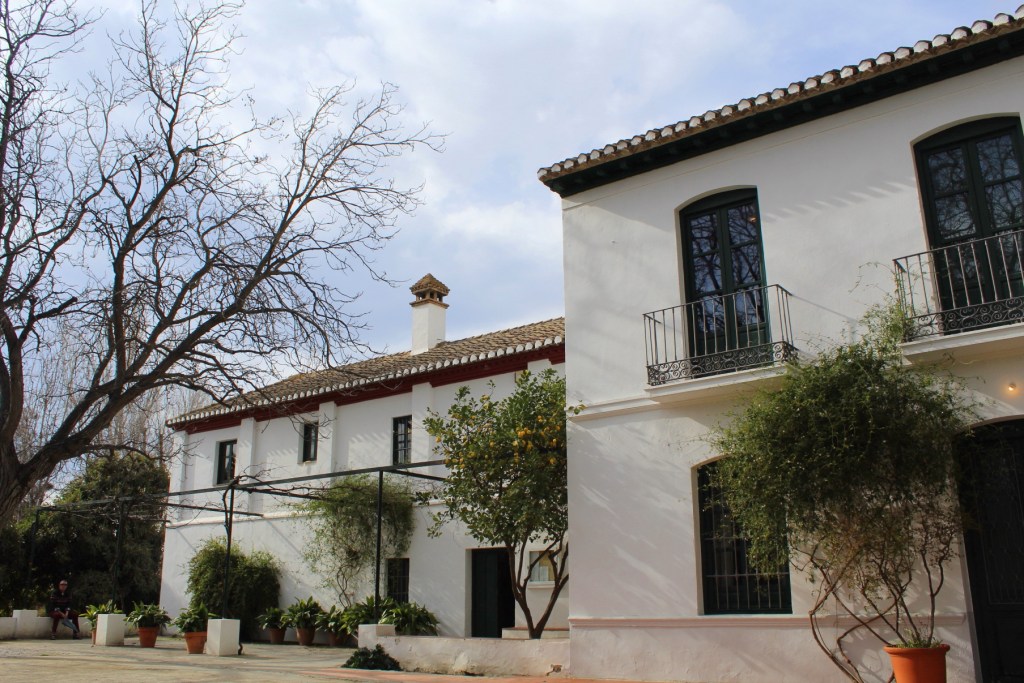
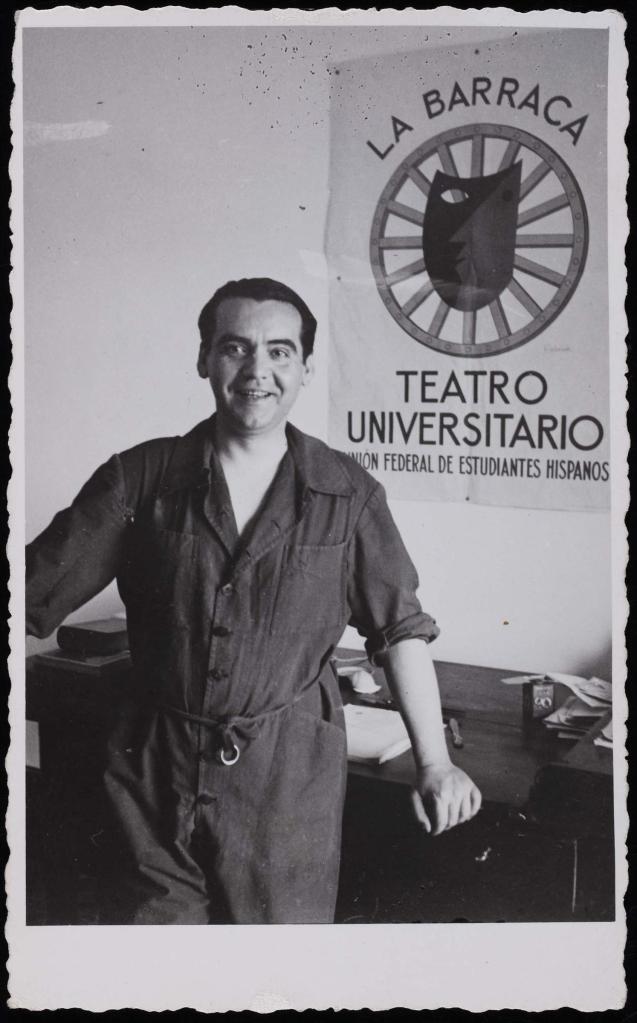
The hour-long visit gave a satisfying overview of the many facets of his short life. Lorca came across as a man wholly devoted to the arts—to music, to poetry, and above all to theater. One of my favorite items on display was a poster for La Barraca, a popular theater group that he helped to direct. They would travel around the countryside and perform for the benefit of the public, putting on avante-garde shows for the masses. It reminds me somewhat of the Federal Theater Project of the American New Deal, and demonstrates that Lorca, while not overtly political, did not shy away from social causes.
Our next stop was the small town of Fuente Vaqueros, which is a short drive from Granada. There, we visited the house where Lorca was born and spent his earliest years. It is a large house with thick walls, ideal for keeping out the heat. We were given a tour—just the two of us—by a local whose grandfather had gone to the same primary school as Lorca himself! He explained that the Lorca family was quite wealthy, having made their fortune in the tobacco business. Indeed, their house was one of the first to receive electricity in the area.

The upstairs of the house was made into a small exhibition space. Among other things, there is the only extant video clip of the poet, as he emerges from a truck used to haul theater supplies. The video has no sound and it lasts for only a few moments. Yet it is a tantalizing glimpse into the past. Also on display are puppets that Lorca made, in order to put on shows for his baby sister.

A short drive from Fuente Vaqueros is the town of Valderrubio, previously known as “Asquerosa” (“Disgusting”). Apparently, this name is a linguistic coincidence, having come from the Latin Aqua Rosae (“Pink Water”), but it led to the unfortunate toponym “asquerosos” for the denizens of this perfectly inoffensive town. Here is yet another house museum of the playwright, this one larger and grander than the one in Fuente Vaqueros. Unfortunately, however, we arrived too late for the tour of this house, and had to content ourselves with a quick walk-through.
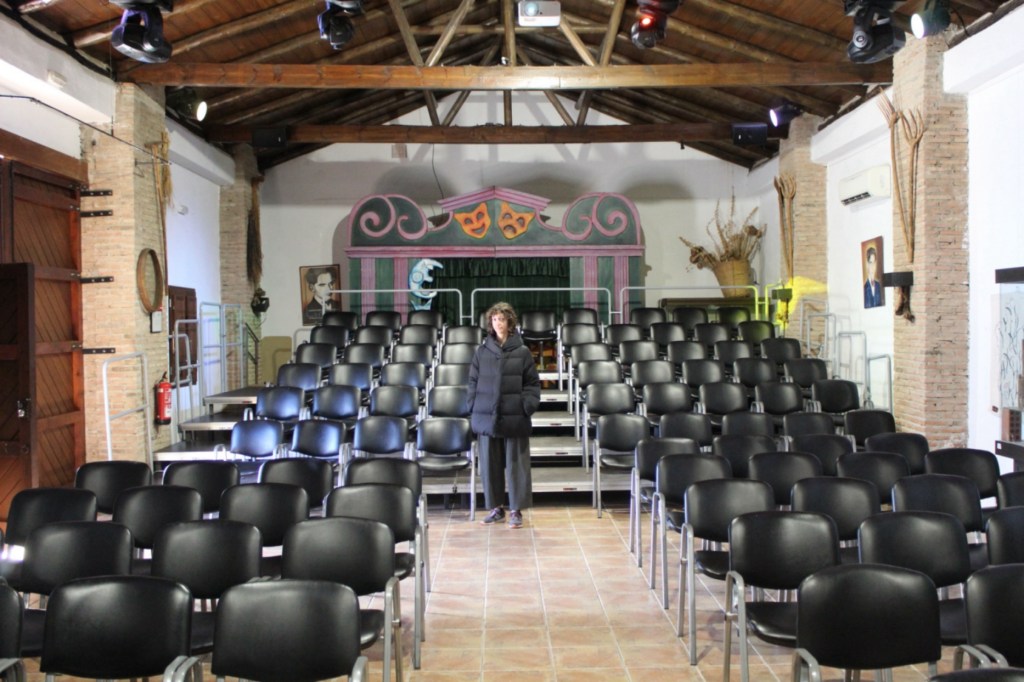
Rebe in the theater attached to the house museum.

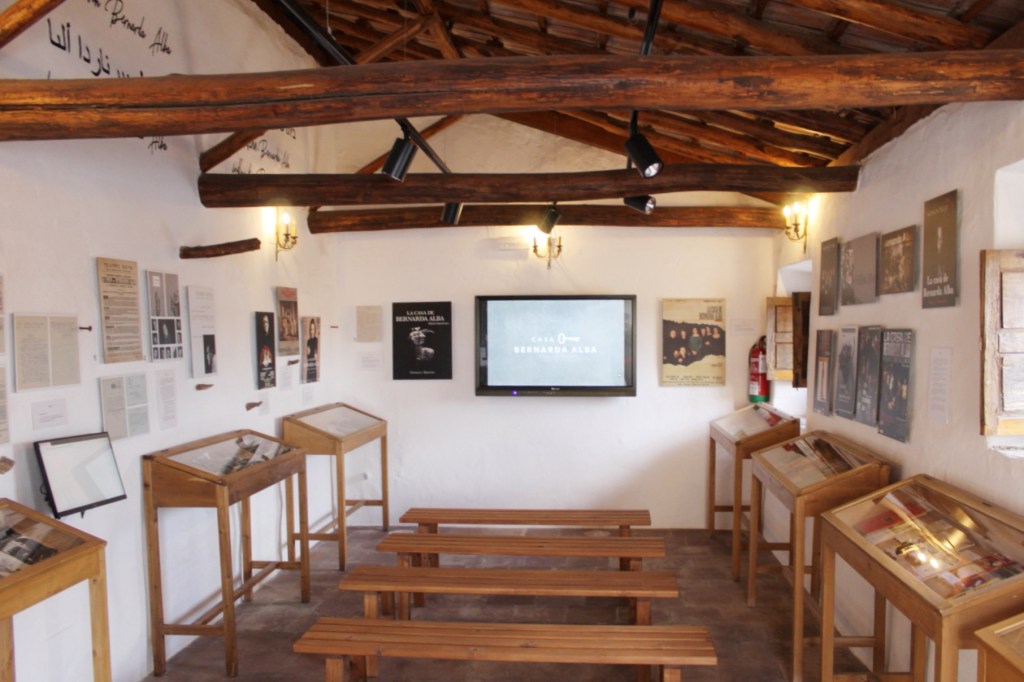
But we were on time for the tour of the House of Bernarda Alba. This is an attractive villa next to the Lorca property, where a widow lived with her daughters. Federico used this family as the basis for one of his best plays, La casa de Bernarda Alba, which is about a tyrannical widow who imposes a decade’s long period of mourning on herself and her daughters after the death of her husband. Apparently, the actual family—who I presume weren’t nearly as monstrous as Lorca portrayed them—were understandably quite offended by this, and cut off contact with the Lorcas. And now, to add insult to injury, their home stands as a museum to the poet’s honor!
Our last stop was rather more somber. On the 19th of August, 1936, Lorca was arrested, taken outside the city, and shot. Against the advice of his friends, on the eve of the Civil War he had traveled to his native city. But as war broke out and violence spread, he realized that he was unsafe and so hid himself in the home of family friends, who were members of the right-wing Falangist party. The political connection didn’t help. Along with three other men, he was taken to a spot on the highway between Vïznar and Alfacar and shot.

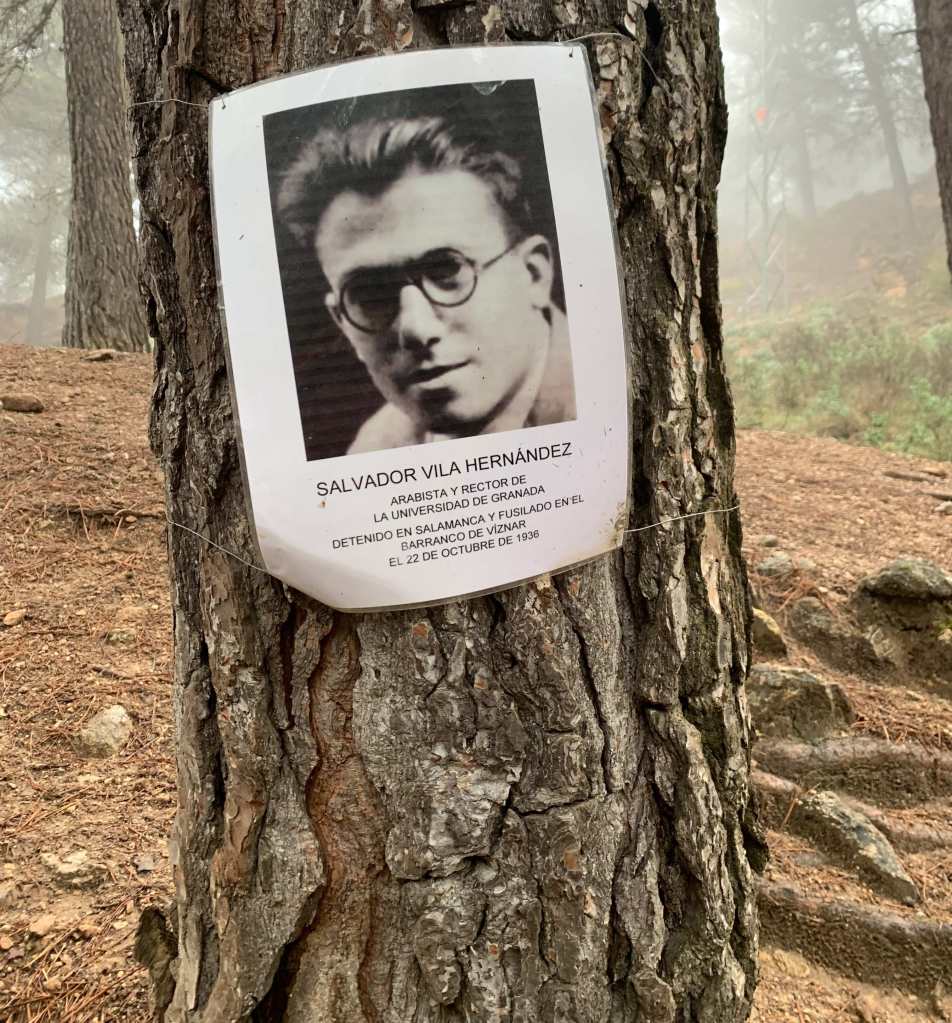
The place where Lorca was executed is hardly recognizable today. At the time it was a barren hillside, completely devoid of vegetation. Today, however, it is a grove of tall pine trees that cover the ground with shade. We parked the car and walked up a hill, not sure what we were looking for. Then we noticed papers tacked onto trees, like ‘Lost Cat’ posters on telephone polls. They were photos of the people believed to be executed here. There were dozens of these photos, each one with a name, profession, and believed date of death.
Even more unsettling were the white tents, standing empty and silent. They were covering excavation pits, where investigators are finally unearthing the remains of the hundreds of victims executed here, nearly a century after the Civil War. The investigators are also collecting DNA samples from surviving family members, so as to be able to identify any remains they uncover. Lorca’s body is believed to be here somewhere, though it hasn’t been identified yet. (You can learn more about the effort by following the groups’s Instagram.)
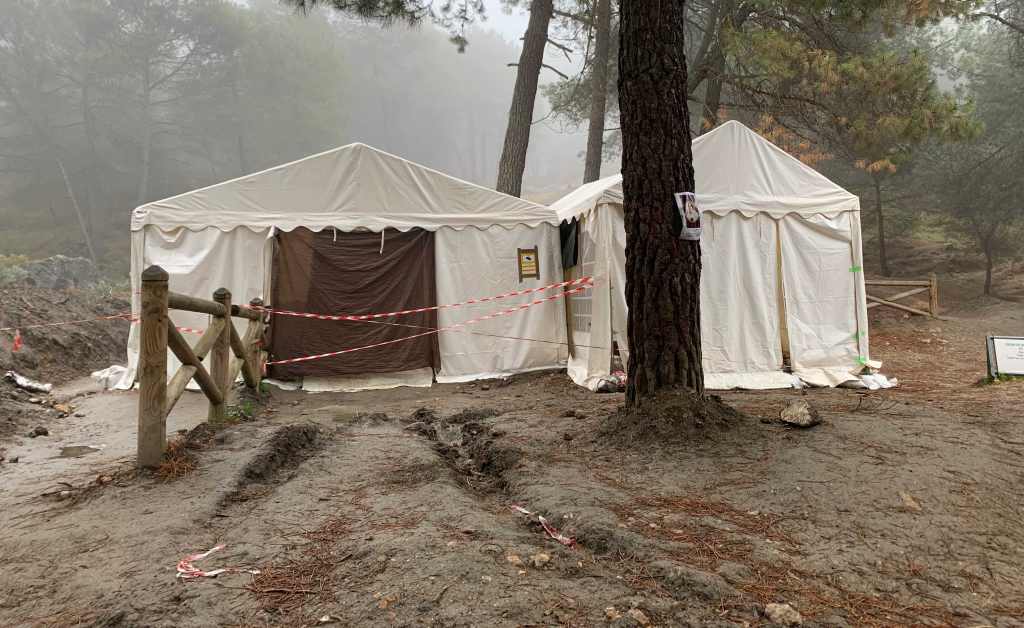
To state the obvious, it is chilling to think that such a harmless man—a gift to the world and an ornament to his country—could be deemed so threatening that he had to be executed this way. His last moments must have been terrifying. His work, however, has outlived Franco and his regime, and perhaps it will outlive the current constitution.

Now, for the very serious Lorca fan, there are also some sites to visit in Madrid. There is a lovely statue of the poet in the plaza de Santa Ana, and on Calle de Alcalá 96 there is a plaque which marks the apartment where Lorca lived for the last three years of his life. Another worthwhile visit is the Residencia de Estudiantes, where Lorca lived as a student along with his Dalí. The two were very close as young men, though many have criticized Dalí’s later reconciliation with the Francoist regime as a betrayal to the memory of his friend. 
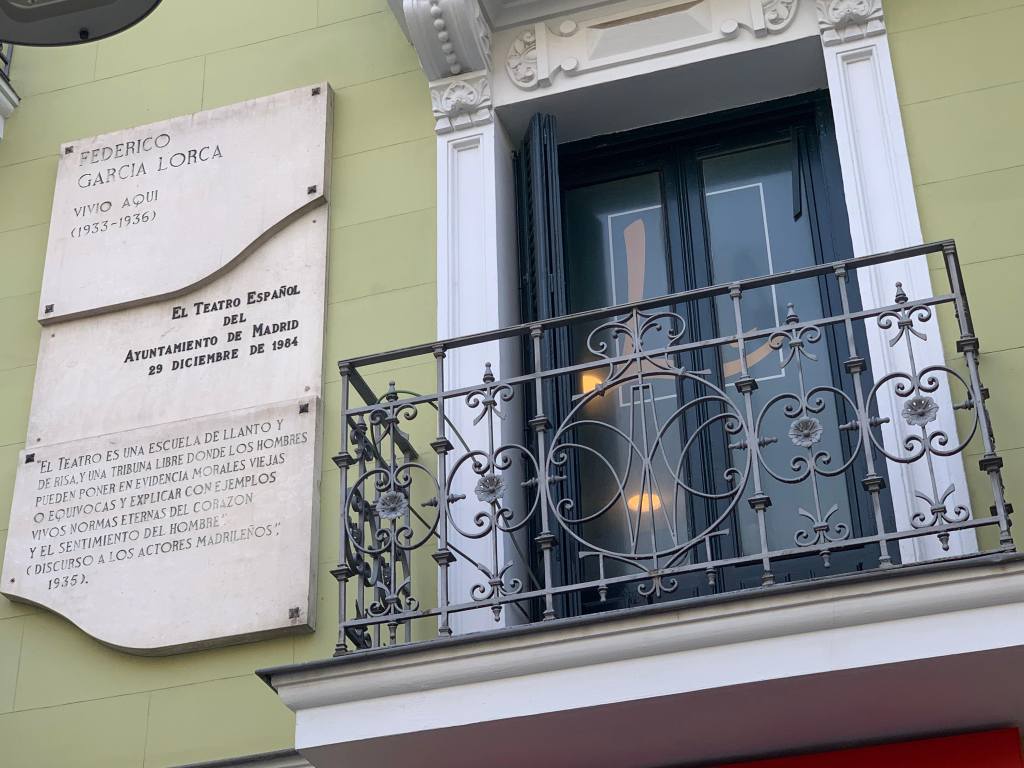
But, of course, the most important thing is not to follow in his footsteps, but to keep reading and performing his works. This way, he will remain forever alive. 
Review: The Canterbury Tales

Review: The Canterbury Tales

The Canterbury Tales by Geoffrey Chaucer

My rating: 4 of 5 stars


I must begin this review with a kind of repentance. Many years ago, I made my way through The Canterbury Tales in the original Middle English. I figured myself rather clever and linguistically capable enough to handle the language. Indeed, I even felt no pangs about reading the book before bedtime, fighting through the morass of unusual spellings and unfamiliar words while I was at my drowsiest. Needless to say, I did not have an easy time of it. And this difficulty colored rather unfairly my opinion of Chaucer.

This time around, I opted for a modern “translation”—two, in fact: the first, a print version by Nevill Coghill; the second, an audio version by Gerald J. Davis.* Immediately the error of my first impression was apparent. When the obscurity of Chaucer’s English was stripped away, I encountered a thoroughly enjoyable and wholly interesting book.

Admittedly, the circumstances of my reading were also more propitious. I read The Canterbury Tales this time around while I was, myself, on a pilgrimage—spending a few days on the Camino de Santiago, in the north of Spain. Chaucer made for quite an excellent companion—more entertaining, in fact, than the real pilgrims I encountered. (The conceit of the book struck me as especially fanciful by comparison with my experience. Virtually all conversation between the real-life pilgrims consisted of the most predictable small-talk—where are you from, how many kilometers, what’s your job, etc. Certainly I was no better as a conversationalist.)

I was first struck by Chaucer’s obvious debt to Boccaccio. The basic device is the same: a group of people are stuck together, and must tell stories to pass the time. More than that, several of the stories in this book are taken directly from Boccaccio (who is not credited, though I think that was common practice at the time). However, the differences are important as well, and highlight Chaucer’s strengths. Most obvious is that Chaucer was not just a storyteller, but a poet, and his tales are written in brilliant verse. More important, however, are the characters Chaucer employs to tell his stories. While Boccaccio’s storytellers are all genteel aristocrats, Chaucer’s raconteurs come from all levels of society, the poor and the rich, the lowborn and the noble, the profane and the holy.

In these two great gifts—his poetic suppleness and his all-embracing social vision—Chaucer is a direct forerunner of Shakespeare. But the similarity does not stop there. While Chaucer’s characterizations, like Boccaccio’s, are often fairly superficial, at times he achieves depths worthy of the bard himself. This is most obvious in the acknowledged high point of the poem, the Wife of Bath’s Prologue. Here, it is clear that Chaucer realized he had achieved something of a breakthrough, since he allowed the prologue to run longer than any other—longer, even, than the story that follows. And like any of Shakespeare’s great characters involved in a soliloquy, the Wife of Bath comes wholly alive in a way that, as far as I know, was unprecedented for the time.

The content of the stories is varied, but some major themes stand out for comment. The most striking, I think, is that of women and wives. Chaucer presents several disparate views on the matter. One story, for example, advocates that wives be absolutely subservient and obedient to all their husband’s whims, while the Wife of Bath (among others) believes that marriages only work when the wife is in charge. Related is the question of women’s sexuality: Is it something evil or innocent? Is sex to be free and easy within marriage, or is virginity the ideal state? A secondary theme is that of religion. Chaucer, like Boccaccio, makes fun of monks and clergy outrageously, but this does not stop him from being extremely pious in other moments.

This brings me to the low points in the book, the two prose pieces: the Tale of Melibee and the Parson’s Tale. Both of these are not really tales at all, but moralizing essays, full of Bible quotes and references to Aristotle and Cicero. (Indeed, they are wisely omitted from the Coghill version, but I suffered through the audio.) Here, we see that Chaucer could be dreadfully boring in certain moods. These two pieces have no humor at all, and are full of the stuffiest, most pedantic piety imaginable—solemnly concluding, for example, that temperance is the opposite of gluttony, or that good advice is preferable to bad advice. After the ebullience of the Wife of Bath, it is puzzling that Chaucer could have written such tedious pettifoggery. Did he intend these ironically, or was he protected himself from damaging accusations, or did he undergo a religious awakening halfway through writing the tales?

Whatever the case may be, the rest of the book is good enough to forgive him these trespasses. To state the obvious, this book is a classic in every sense of the word. Perhaps I ought to try the original once more? Or should I not press my luck?
___________
*For what it is worth, I liked the Davis version, and noticed no difference in quality from the esteemed Coghill version. However, I find it odd that Davis has translated books from so many different languages: Gilgamesh, Don Quixote, The Divine Comedy, Beowulf… Either he is a linguistic genius or is getting some help.


View all my reviews

Review: Don Juan

Review: Don Juan

Don Juan by Lord Byron

My rating: 4 of 5 stars

Let us have wine and woman, mirth and laughter,
Sermons and soda water the day after.

The legend of Don Juan appears to be one of the most productive stories in all of literature. After its first setting by Tirso de Molina—still a classic of the Spanish stage—it has been adapted innumerable times. Molière’s powerful version may be the most famous for the theater, and Mozart’s opera is considered to be among the greatest works of music even sounded. After speaking in French verse and singing in mellifluous Italian, the infamous seducer of Seville lived on—though much altered—to speak iambic pentameter in Lord Byron’s comedic epic.

Nonetheless, Lord Byron’s use of the legend is free to the point that it may as well have been discarded entirely. The protagonist is, indeed, an attractive young man from Seville with a formidable sexual appetite. Byron’s Juan, however, is usually the seducee rather than the seducer. He does not lie to get his way, he does not have a wisecracking servant, he does not kill the fathers of his victims, and he does not meet his end at the hands of a living statue. There is none of that here. Instead, Don Juan is an attractive young boy with a good heart who runs into a lot of trouble, mainly because every woman who sees him wants him. It is a pleasant twist on an old tale.

Though a member of the Romantic age, Byron does not strike me as a Romantic poet. His poetry is witty, snappy, sharp, irreverent, and lean. There is nothing sentimental, meditative, or wistful in this long poem. Indeed, the verse is so prose-like that it is hardly even poetical. His most obvious literary forebear is not Milton or Donne, but Pope—another witty versifier. It seems strange, then, that of all the great English Romantic poets, it was Byron who was arguably the most famous and influential. Perhaps tastes did not change as much as we are prone to believe.

This epic poem has a loose and baggy structure. That is to say that it is full of holes and an awful lot of wind blows through it. Byron appears to have begun with a fairly concrete idea in mind, and the first three or four cantos are brilliant fun. Soon thereafter the poem falls apart, however—dissolving into an endlessly long aside, in which the main action is lost. The poem ceases to be the comic epic of Don Juan and instead becomes a vehicle for Byron’s own endless editorializing. This is still mostly worth reading, for Byron’s wit if not for his logic, but it is not exactly a work of high art.

Poor Don Juan is left in the lurch, and never does get to meet his final end—whatever that may have been. Byron met his own end before he could give one to Don Juan. If not for that, this poem may have gone on for twenty cantos more. But at the rate the story was progressing in the final cantos, twenty more may not even have been enough to bring this sprawling story to a satisfying conclusion. So let us be thankful for what we have. The parts that are weak are readable, and the parts that are strong are delightful.


View all my reviews

Review: The Poetry of John Keats

Review: The Poetry of John Keats

Keats: Poems by John Keats

My rating: 4 of 5 stars

A thing of beauty is a joy for ever

As a dedicated book reviewer, it is my job to say why I like certain books and dislike others. When it comes to nonfiction, this is reasonably straightforward: if the exposition is clear, if the arguments are logical, if the ideas are reasonable—then it is a worthy book. Nonfiction aims for truth, and truth can at least be tested. With literature, however, the task is somewhat more fraught. Beauty is an unfalsifiable hypothesis. We can break down a novel’s strengths and weaknesses by category—good prose, bad pacing, fine dialogue, shallow characterization—but ultimately these evaluations, however much we justify them, rest upon gut reactions.

Why does one sequence of musical notes create a pleasing melody, another a forgettable ditty, and a third a nonsensical jangle? Why do certain combinations of words strike the ear as just right, and others as discordant? Formal analysis can clarify and categorize the sorts of sounds and structures that people tend to enjoy. But it can never explain why we enjoy them in the first place, nor why different people enjoy them to different extents. If literary criticism is to be a worthwhile exercise it requires, then, that the gut reactions of the audience members are at least roughly alike—that we are similarly constituted as regards to beauty.

Shared education contributes towards this similarity; as does, presumably, the basic resemblance of our natures. But does this bedrock of shared taste constitute something durable and permanent enough so that we may say a great artist hits upon the “truth” of art—appealed to something permanent in ourselves—in the same way that a scientist may hit upon a “truth” of nature? Many have thought so. And it strikes me that something like this must be the case if we wish to call any form of art “universal”—namely, that it is a true expression of what we share.

I mention this because the relationship of beauty to truth is one of the great themes of Keats’ poetry. At the end of his “Ode on a Grecian Urn” he tells us that “Beauty is truth, truth beauty”—a line that has been endlessly analyzed. Certainly the widespread and steady popularity of his poems may argue that, indeed, Keats hit upon some basic truth of art. But what could that mean?

The issue of translation may bear on the question. It is often said that poetry is untranslatable; and the bilingual edition I read ironically proved the point. The Spanish consistently failed to evoke the sublimity of the original. Here, for example, are two famous lines from Keats’ “On First Looking into Chapman’s Homer”:

Then felt I like some watcher of the skies
When a new planet swims into his ken

And here is the Spanish translation:

Entonces me sentí como un astrónomo
cuando ve frente a sí un Nuevo planeta

Translated back into English this reads something like: “Then I felt like an astronomer when he sees a new planet in front of him.” Despite preserving the literal meaning, this obviously loses all of the magic of the line. “Watcher of the skies” is infinitely more romantic than “astronomer,” and “sees in front of him” has none of the mystery of “swims into his ken.” In short, the rich beauty of the language does not survive; and the poem becomes a rather bland statement about enjoying a new edition of Homer, rather than an evocation of the grandeur of nature and art.

(I do not think it was the translator’s fault. Spanish is very different to versify than English; and the literal Spanish translation would preserve meaning at the expense of rhythm.)

Yet if Keats’ poetry is truly untranslatable, then how could it contain truth? After all, one could translate Newton’s work into Spanish, French, German, or Japanese, and it would contain just as much truth (or untruth) as in the original. Science is not linguistically bound. Admittedly, the boundary of translation is not equivalent for all forms of poetry. Homer’s works are still riveting in English; and Dante’s vision survives (at least partially) its journey from Medieval Florentine. Lyrical poetry seems to fare the most poorly.

The obvious difference between Homer and Keats is that Homer’s appeal lies in the story, while Keats’ relies on his linguistic brilliance. And, for my part, it is easier to see how a story can contain a semblance of “truth,” rather than a beautiful string of words. Assuming that some experiences in life are universal, that some emotional crises are recurring, that some existential state is inescapable, then a great story may be able to capture something common and durable about the human condition. A beautiful poetic line, on the other hand, has a purely formal appeal—charming not in what it says, but in how it says it—and this perfection of expression, being untranslatable, must fall short of universal art.

Nevertheless, to describe Keats as merely a brilliant wordsmith would be an absurd underestimation. As his letters prove, he was thoroughly educated and keenly intelligent. His poems abound with perplexing classical references. And, in any case, words are never mere sounds; they are laden with meaning; and even the briefest of lyrical poems are pregnant with thought. Contemplation permeates Keats’ work. In his poems we find the focused musings of a highly original man as he meditates on entirely common occurrences: Autumn, Melancholy, Nature, Art—the list goes on.

Here is where Keats’ art may be said to be “universal”—and, in some sense, “true” to the human condition. For many of us have stood, amazed, before a work of art, or felt thrilled upon opening a book, or listened yearningly to a bird singing outside a window—or any number of comparable experiences. Yet only Keats and his ken have taken these fleeting twinges of emotion, reflected deeply upon them, and captured them in words so felicitous that they are impossible to forget once heard. Like the revelers on the Grecian Urn, Keats has frozen time.

It may be that this lyrical form of art, being so bound up in brilliance of expression, is less universal and less durable than works of narrative. But for those who are, by chance, linguistically equipped to enter Keats’ world, then his poems contain just as much artistic “truth” as the oldest tales and the finest melodies.

View all my reviews

Quotes & Commentary #58: Santayana

Quotes & Commentary #58: Santayana

Indeed, the enlightenment common to young wits and worm-eaten old satirists, who plume themselves on detecting the scientific ineptitude of religion—something which the blindest half see—is not nearly enlightened enough: it points to notorious facts incompatible with religious tenets literally taken, but it leaves unexplored the habits of thought from which those tenets sprang, their original meaning, and their true function.

—George Santayana

This little passage contains multitudes. Santayana’s attitude towards religion is refreshingly balanced. An atheist himself, he nevertheless finds much to value in religion. He has the admirable ability—so rare, apparently—to balance an awareness of religion’s irrationality with its nobler impulses.

I am tempted to agree with Santayana in dismissing those who “plume themselves on detecting the scientific ineptitude of religion,” ridiculing their dogmas and disproving their tenets, such as the so-called New Atheists do. For one, it is very easy. Every shred of evidence and convincing argument is on the side of the naturalistic, scientific worldview. Indeed, no thinking person could fail to note the huge part played by hopeful emotion, unchecked by the cold light of reason, in religious belief. As Santayana goes on to say:

The only truth of religion comes from its interpretation of life, from its symbolic rendering of that aspiration which it springs out of and which it seeks to elucidate. Its falsehood comes from the insidious misunderstanding which clings to it, to the effect that these poetic conceptions are not merely poetical, but are literal information about experience or reality elsewhere—an experience and reality which, strangely enough, supply just the defects betrayed by reality and experience here.

The last remark of this passage is key to my skepticism of all religious belief. For it always seems that the promises of belief—blessings, good fortune, an afterlife—all coincidentally compensate precisely for the defects we find in our lives here and now. In other words, it is almost naked wishful thinking, thinly disguised as a supernatural promise.

In any case, the lack of logical cogency of supernatural beliefs, combined with the obvious emotional motivation of such beliefs, would seem to render it superfluous to argue with or disprove them. They fail every test of reasonable belief, and thus do not merit reasonable rejoinder. Nevertheless, the huge prevalence of such supernatural beliefs—present in the majority of our species, their absurdity apparently not “something which the blindest half can see”—and their concomitant influence on human behavior, would seem to make it necessary to lay out the case against religious belief.

Of course, such a rejoinder need not be done with vituperation and bitterness—qualities guaranteed to make any listeners unreceptive. And, in any case, explaining why religious belief is unreasonable leaves untouched the far more mysterious question: If it is manifestly unreasonable, why do so many people believe?

Theories abound. James Frazer thought that superstition and religious belief were just proto-science. Sigmund Freud thought religion an illusion motivated by psychological drives, and Emile Durkheim thought religion a tool of social cohesion. Daniel Dennett put forward the idea that religion was a kind of mental virus. Jonathan Haidt largely agrees with Durkheim, though he puts his own Darwinian twist on the idea. And this is only a small sampling.

All of these theories may have their grain of truth. But I think any explanation will be incomplete if it does not take into account what Santayana was so acutely aware of: religion’s poetry. Indeed, for Santayana religion was itself a kind of poetry:

Thus religion has the same original relation to life that poetry has . . . The poetic value of religion would initially be greater than that of poetry itself, because religion deals with higher and more vital themes, with sides of life which are in greater need of some imaginative touch and ideal interpretation than are those pleasant or pompous things which ordinary poetry dwells upon. But this initial advance is neutralised in party by the abuse to which religion is subject, whenever its symbolic rightness is taken for scientific truth.

Poetry allows us to dwell on the too often overlooked beauty of life, to savor the ironies and tragedies of the day, to pinpoint and express fleeting emotions. Religion does this, too, but on an altogether grander scale. Rather than imbuing life with a personal aesthetic sensibility, the aesthetics of a religion are impersonal, belonging to a whole community. Not only that, but the subjects that religions concern themselves with—birth, marriage, suffering, death—belong to nobody and everybody, being the most universal and critical of the human condition.

The beneficent social role that such communal poetry can play should not be underestimated. Religions allow us to see the meaning of times of crisis, prompts us to feel the significance of life’s transitions, and gives us a common emotional language that binds us together. Like any sublime poetry, religion can raise our eyes above humdrum concerns, and point our gaze to things of lasting importance.

From this description I hope you can see that I am not wholly insensitive to the value of religion. Believe me, the trivial pursuits of modern life, with all its squalid materialism and narrow selfishness, make me all the more acutely aware of the role that religion can play in a society. The prosaic world of today is in desperate need of poetry.

The problem, as Santayana points out, is that religions insist that their poetry be taken literally. And in the process, the poetry is destroyed. Religion then ceases to be a sublime poetry and becomes a vulgar superstition. And the more that these traditional beliefs clash with our scientific understanding of the world, the more it drives a wedge into the fabric of society, forcing people to choose between faith and reason. Indeed, in such circumstances religions can lose their moral superiority completely, becoming just as worldly as the rest of the world.

Is it possible to maintain the benefits of religious belief—its ability to guide us through times of crisis, its source of common values and a common language, its ability to remove us from vulgar materialism—with the benefits of rationalism? Can we have a communal poetry that we acknowledge to be poetry—not truth? Looking around the world, the answer seems to be no.

Review: Blake’s Poetry

Review: Blake’s Poetry

Blake: Poems (Everyman's Library Pocket Poets)Blake: Poems by William Blake

My rating: 4 of 5 stars

The Angel that presided o’er my birth
Said, ‘Little creature, form’d of Joy & Mirth,
Go love, without the help of any Thing on Earth.’

As I’ve said before, I feel a bit uncomfortable reviewing poetry. I don’t have the proper tools; I lack the vocabulary. Critiquing poetry, to me, is like critiquing a human body. I don’t know why one face pleases me, and another pleases me not; I simply couldn’t say why I find one shape shapely, and another shape misshapen. When I see a pleasing face or an attractive form, I respond automatically; and the same might be said for my reactions to poetry.

William Blake makes this job even more difficult, as he was, in the truest sense of the word, an individual. How does one evaluate a totally idiosyncratic artist? It seems impossible; all evaluations, either explicitly or implicitly, involve comparison. But when somebody is so aloof and peculiar as was Blake, comparisons seem somehow inappropriate. Well, I’ll stop caviling, and on with it.

There is a childlike innocence to many of Blake’s poems. Some of them have the gentle sing-song rhythm of a lullaby; the words seem to rock you back and forth, lulling you into a dreamy peace. Blake’s early poems, in particular, are totally free of cynicism and disenchantment; rather, they are direct, honest, wide-eyed.

To see the World in a Grain of Sand
And a Heaven in a Wild Flower,
Hold Infinity in the palm of your hand
And Eternity in an hour.

Married to this total innocence, however, is an intense spirituality. Blake is a textbook mystic. Perhaps the closest poet to Blake that I’ve read is Whitman. Like Whitman, Blake is scornful of organized, traditional, Puritanical religion. Rather, he sees God in every blade of grass, and considers the body a source of delight, rather than of sin.

All Bibles or sacred codes have been the causes of the following Errors.
1. That Man has two real existing principles, Viz: a Body & a Soul.
2. That Energy, call’d Evil, is alone from the Body, & that Reason, call’d Good, is alone from the Soul.
3. That God will torment Man in Eternity for following his energies.

In terms of pure poetic skill, Blake is no match for a Milton, a Donne, or a Whitman. Indeed, that sort of thing seems not to interest him. He has not a great talent for aphorism; he is not eminently quotable. The poems are not meant to be unraveled or chewed; you will not be left puzzled or bewildered. Verbal ingenuity is not, in short, Blake’s strength; and if Blake is read with that purpose in mind, you are sure to be disappointed. His aim is instead to disarm you, to make you let down your guard; his poetry is, in fact, almost conversational. Blake knew he was something of an oddball; but he was too wise to think himself any the worse for it. His poetry, then, is a kind of invitation into his personal world.

My mother groan’d! my father wept,
Into the dangerous world I leapt,
Helpless, naked, piping loud,
Like a fiend hid in a cloud.

And indeed, this world gets more odd and fanciful the longer you stay with him. Blake’s later poetry is considerably more obscure than his earlier work. He seems, in fact, to have invented his own mythology; and the poems from this period are little more than tales and visions of his personal gods and heroes and demons. It is certainly odd; but it is oddly alluring.

If the doors of perception were cleansed, every thing would appear to man as it is, infinite.

For man has closed himself up, till he sees all things thro’ narrow chinks of his cavern.

Part of the reason books are so fascinating is because people are so fascinating. Right before reading this collection, I read a collection of Donne’s poetry. The juxtaposition is telling. Both men are mystics, both men are sensualists, both men are aloof individuals. Yet Donne is intellectual, anguished, and strained; Blake is direct, joyful, effortless. At least, this is my impression. It is odd trying to get to know somebody purely through their poetry; it is rather like trying to get to know somebody by rummaging through their trash. We are forced to guess at what’s locked inside by shifting through what’s shed.

View all my reviews

Review: Poet in New York

Review: Poet in New York

Poet in New York: A Bilingual EditionPoet in New York: A Bilingual Edition by Federico García Lorca
My rating: 4 of 5 stars

I want to cry because I feel like it
as the boys in the back row cry,
because I am not a man nor a poet nor a leaf
but a wounded pulse that probes the things of the other side.

Poetry is an odd thing. You notice this when you encounter poetry in a second language. This happened to me a few weeks ago, when I went to a poetry reading in Madrid. There were four or five poets there, some of them fairly well-known, with a crowd of hushed listeners hanging on their every word. Meanwhile, with my very imperfect Spanish, I was only able to catch bits of phrases and scattered words that added up to nothing.

“Look, I can be a poet,” I said to a friend after the show: “A cow is a moon, / a moon is a balloon.” That’s really how it sounded to me.

In a way, this isn’t surprising, of course; but it got me thinking how strange a thing is poetry. We string phrases together that, interpreted literally, are either false, absurd, meaningless, or banal; and yet somehow, when the poetry works, these phrases open up subtle emotional reactions in their listeners. Why is it that a certain phrase seems just right, inexhaustibly expressive and unutterably perfect, while a similar phrase may be dead on arrival, impotent, sterile, and maybe even unpleasant? Bad poetry, indeed, can be excruciating and embarrassing to witness, perhaps because it is in bad poetry that the essential strangeness of the act of poetry is most acutely manifest. We feel that this whole thing is silly—trying to make portentous sounding phrases that signify close to nothing. And yet the genuine article, once witnessed, is undeniable.

I usually group poetry along with novels and short stories, as literature; but lately I think that poetry may be closer to another art form: dance. Dance is distinct from every other kind of movement—from walking to golf to sign language—in that it is not oriented towards any external goal. That is, the movement itself is the goal; the point is to move, and to move well. In poetry, too, our words—which normally point us towards the world, if only to an imaginary or a hypothetical world—are stripped as much as possible of their normal denoting function; the point becomes, rather, the pure manipulation of diction and grammar, in much the same way that, in dance, the point becomes the pure movement of limb and trunk.

This is a healthy thing, I think, since in life we can get so preoccupied with the attainment of a goal that we become blind to everything that does not advance our progress towards our object. A coach of a football team, for example, is only concerned with how well his players’ actions increase the likelihood of winning; and likewise, normally when we use language, we are using it to accomplish something specific, from ordering pizza to chiding children. Dance and poetry, by stripping away the intentionality of the act, reveal the subtle beauty in the activity itself, allowing us to slow down, to appreciate the rhythm of a word or the gentle flexion of an arm.

I must hasten to add that this description of poetry and dance does not apply equally to all examples. Alexander Pope’s poetry approaches very nearly to prose in its use of denotation; and T.S. Eliot’s “The Waste Land” is on the other side of the spectrum. A similar spectrum applies in the case of dance, I suppose.

Federico García Lorca’s poetry is much closer to Eliot’s in this regard, perhaps even further along in its tendency towards connotation. This makes his poetry doubly hard for a foreigner like me to appreciate, since the specific emotional flavors of his words are bland in my mouth. As a young man Lorca lived in the famous Residencia de Estudiantes, in Madrid, where he became close friends with Dalí. The two exerted a mutual influence on each other, both moving towards the surrealism that was becoming trendy in the art world.

Lorca wrote this book many years later, during and after his visit to New York City in 1929-30, during which he witnessed the Stock Market Crash. Economic depression or not, however, the inhuman vastness of the city, the crowds and concrete, the money-obsessed workers and the poor and the homeless, the racial discrimination and the absence of nature, seems to have made a deep impression on the rural Andalusian poet. These poems are his anguished response to this experience.

Lorca’s poetry is surreal in the textbook sense that he uses a succession of vivid, concrete images that, taken together, add up to something nebulous and unreal. Much like Dalí, Lorca has a talent for creating bizarre images that nevertheless manage to be emotionally compelling. Opening the collection more or less at random I find:

All is broken in the night,
its legs spread wide over the terraces.
All is broken in the warm pipes
of a terrible, silent fountain.

Admittedly it does take some time to find the odd beauty in the apparently random, unconnected pictures. My first instinct was to read them like metaphors; but if Lorca did indeed have something specific in mind that he was trying to allegorize, the allegories are much too complicated and disjointed to be deciphered. Rather, I think these poems must be read simply for the beauty of the language, the striking collisions of words, the flashes of light and the rumblings of sound. The poems seem to capture nothing more nor less than an emotional mood—different shades of desolation—that presents itself to the conscious mind in a kind of personal mythology, as in a dream. Dalí was deeply influenced by Freud during his stay in the student residence, and I wouldn’t be surprised if Lorca was too.

Even if it is difficult to articulate the structure and meaning of Lorca’s image-world, it is certainly not random. Certain words and images come up again and again, as in a dream sequence, being shuffled and re-shuffled throughout the collection. Some of these words are oil, ant, worm, thigh, moon, void, footprint, hollow, glass, night, wounded, agony, sky, cracked, death, coffin, iron… The ultimate effect of these words, recombined again and again, is cumulative; they create echoes of themselves in the reader’s mind, calling up half-remembered associations from other poems, creating an emotional coherence in the literally incoherent text.

Look at concrete shapes seeking their void.
Mistaken dogs and bitten apples.
Look at the longing, the anguish of a sad fossil world
that cannot find the accent of its first sob.

The emotional resonance of the words themselves is also important, something that is unfortunately lost in translation. For example, the word for “oil,” aceite, has an interesting blend of comforting familiarity and a tint of the exotic. I think this is because the word originally comes from Arabic, and maintains a certain foreign flavor, even as it denotes something absolutely integral to the Spanish culture: olive oil, which is used in everything. The word also brings up the rolling olive fields, stumpy trees on sandy soil, that fill Lorca’s Andalucía; and this again calls to mind the age-old farming tradition, the intimate connection with the land, totally absent in New York City. There is also the double association of oil as integral to cooking and as something potentially toxic and polluting. A native Spaniard will likely disagree with this chain of associations, but I think the word is undeniably resonant.

Ultimately, though, I don’t think I can articulate exactly why the text of these poems is gripping, in the same way that I cannot articulate exactly why I find some dancers compelling and others not. You cannot learn anything about New York City from these poems, and arguably you can’t learn very much about Lorca, either. I’m not even sure that the cliché is correct, that these poems can “teach you about yourself.” Maybe they don’t teach anything except how to feel as Lorca felt. I don’t think that’s a problem, though, since the point of reading is not always to learn about something, just as the point of moving isn’t always to get somewhere. Sometimes we read simply for the pleasure of the text.

View all my reviews