The Old Croton Aqueduct trail runs behind my house, and I’ve been walking along its tree-shaded way for well over a decade now. As a kid, I thought “aqueduct” was just a name, until my mom told me that, buried underneath the pebbly ground, there is a tunnel that used to carry water to New York City from Croton, a couple dozen miles north. Even so, it never occurred to me to learn about the aqueduct. This a striking but common phenomenon: we travel to foreign cities and go on tours, but neglect the history in front of our eyes. It wasn’t until I began traveling abroad that I started to realize the scale and significance of the old aqueduct—along with the Brooklyn Bridge and the Eerie Canal, it is one of the major engineering feats of nineteenth-century New York—and so I set myself to investigate it.
The first step was to walk the whole thing. This is not an easy stroll. The original aqueduct ran about 40 miles from the Croton Reservoir down to Manhattan. The water first reached the Receiving Reservoir, which is now the Great Lawn in Central Park, and then traveled further along to the Distributing Reservoir in Midtown Manhattan on 42nd Street. On this spot now stands the iconic main branch of the New York Public Library, and you can still find remains of the old reservoir’s foundation in the library basement. An imposing structure inspired by Egyptian architecture, this distributing reservoir used to be something of an attraction. People would come to stand atop its walls, for what was then one of the best views of Manhattan.
After the aqueduct was phased out of service in the 1960s, a large chunk of the land—26.2 miles of trail, to be exact—was donated to New York State, to form a historic linear park that stretches from Croton, through Ossining, Scarborough, Tarrytown, Irvington, Dobbs Ferry, all the way down to the Bronx. I didn’t manage to walk the whole way, but I walked most of this distance, first going south to Yonkers and then north to Croton.
For most of the way, the Old Croton Aqueduct is a dirt or grass path, about ten feet wide or narrower, with a well-worn channel in the middle. It goes through some historic areas, taking the walker alongside the Sleepy Hollow Cemetery, through the park of Lyndhurst (former residence of Jay Gould, railroad baron), and near Sunnyside (former residence of Washington Irving), and into the wonderful Rockwood Park (former residence of William Rockefeller). The trail is not always so scenic; sometimes you are basically walking through people’s backyards, and there are a few intervals where you have to exit the trail and walk through a neighborhood to get to the next stretch.
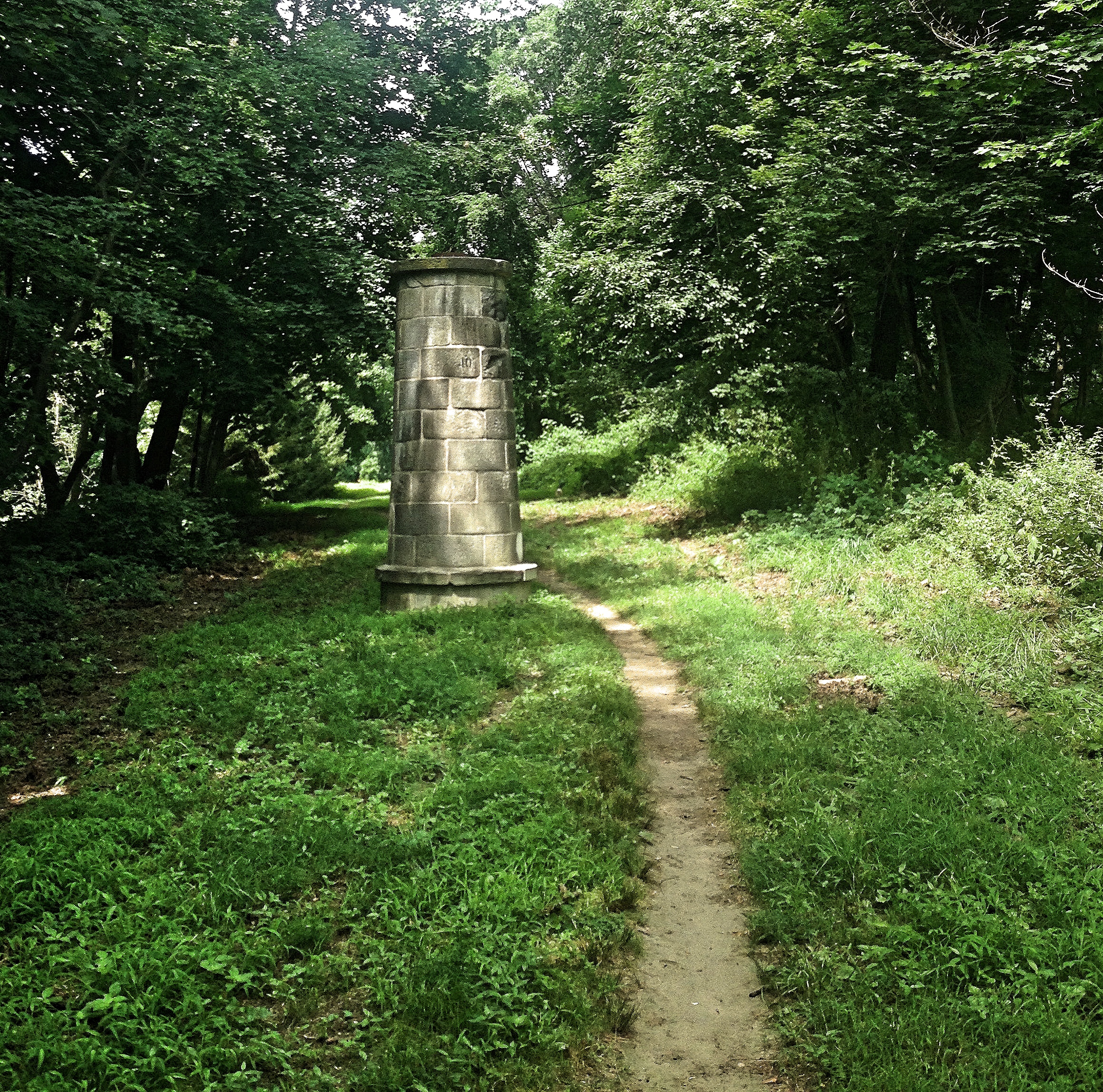
Trail and ventillator
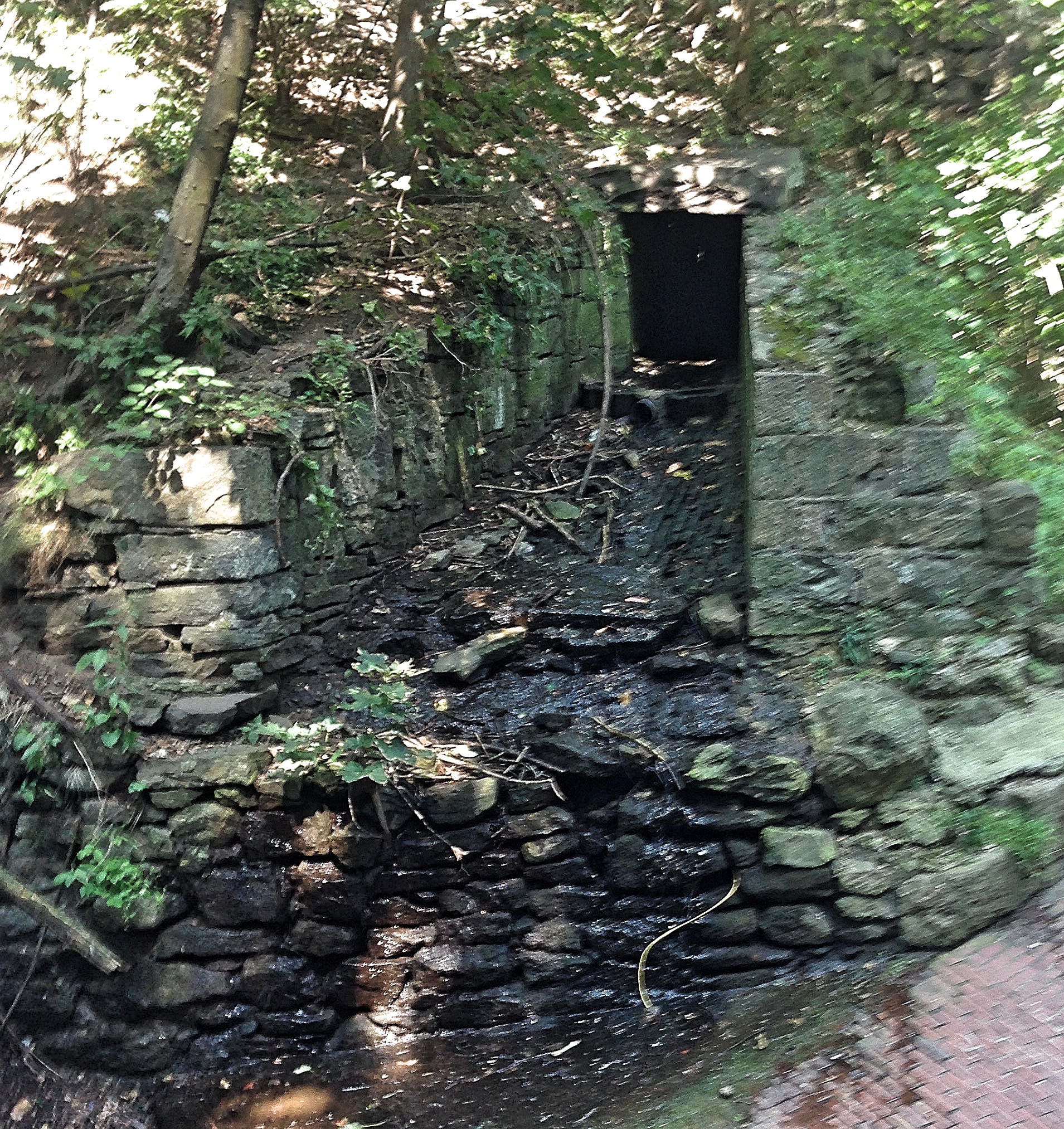
The walker will notice a few structures along the way. The most common are the ventilators, which are hollow stone cylinders with a shaft that allowed fresh air to reach the water below. These were installed to prevent pressure from building up inside the tunnel. Less frequent are the weirs, square stone buildings with metal sluice gates inside that could be dropped like a guillotine to divert the water in case repairs were needed. (And since the growing population of New York put heavy strain on the aqueduct, they frequently were.) These are situated above rivers, into which the water could be redirected. There is one above the Pocantico River in Sleepy Hollow, another in Ossining over the Sing Sing Kill, and another in the Bronx over the Harlem River.
Sleepy Hollow Weir
In Dobbs Ferry stands one of the old Keeper’s Houses, where the aqueduct’s superintendents used to stay. There used to be six of these along the aqueduct, but the one in Dobbs Ferry is the only one that still stands. It is an inconspicuous white house now, but not long ago it lay completely in ruins; the restoration was just completed in 2016, by the combined efforts of the Friends of the Old Croton Aqueduct, a non-profit volunteer organization dedicated to the aqueduct, and the State of New York. This house is open on weekends and is well worth a visit. It contains many exhibits about the aqueduct, with historical photos, engineering drawings, and maps, and also has several short documentaries you can watch.
Sluice gate
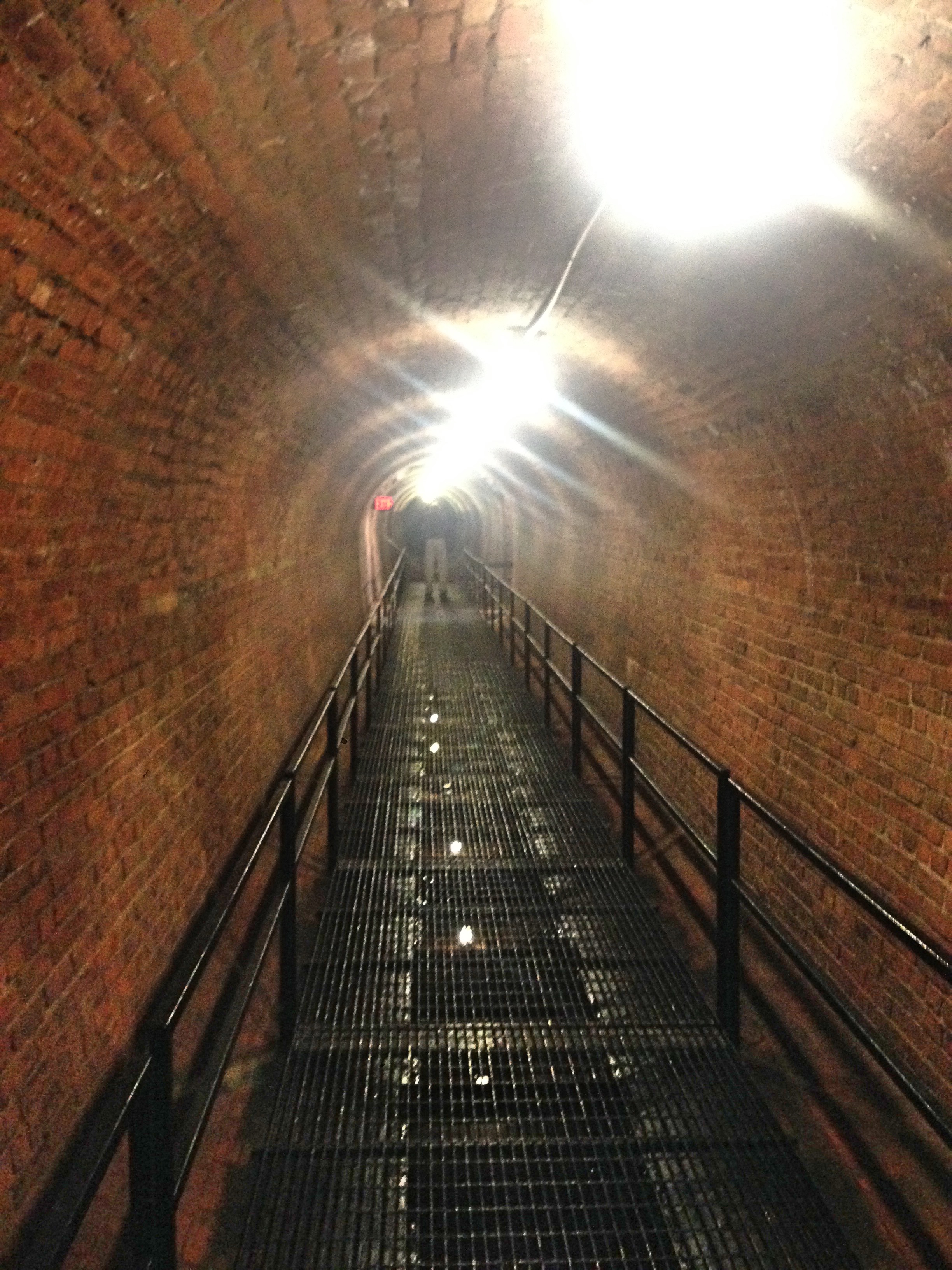
Up north in Ossining there is a stone bridge that carries the aqueduct over the Sing Sing Kill. (“Kill” comes from a Dutch word, meaning “river,” and is used in several place-names in New York.) A few times a year, The Friends of the Old Croton Aqueduct give free guided tours that actually bring you inside this bridge. I recently went on one, and I recommend the experience. A group of about two dozen visitors descended through the weir into the aqueduct. The old sluice gate is a rusty mass of metal now. But the aqueduct tunnel itself, made of brick and waterproof concrete, has held up remarkably well. The only marks of wear are some cracks in the walls from running the aqueduct at full capacity. It made me giddy to think that I could walk through that dark and dank tunnel all the way to New York City.
Inside the Aqueduct
Below this bridge, there is an elevated walkway (a “greenway”) where you can stroll alongside the Sing Sing Kill. This was just opened last year, in 2016, and is astonishingly lovely. From this you can see the spillway, which brought the water from the aqueduct into the river during repairs. As the guide noted, the water would spray out with such force that it scoured the bank on the other side of the river.
Sing Sing Kill spillway
From the information available in the Keeper’s House and the Ossining Visitor Center—from permanent exhibitions and documentaries on display—I pieced together the history of this great work. The original aqueduct and dam were commissioned in the 1830s after it became apparent that New York badly needed more water. Outbreaks of yellow fever and cholera killed thousands; and the Great Fire of 1835 destroyed hundreds of buildings, largely because the fire department lacked the water to put it out. Manhattan is an island of marshy ground surrounded by brackish water, and before the Croton Aqueduct was built the only water supplies were local wells which could be easily polluted.
Sing Sing Kill greenway
The man primarily responsible for planning and engineering the original aqueduct was John B. Jervis, who must be one of the great engineers of 19th century America. He had political as well as engineering challenges to surmount. The land needed for the tunnel cut through hundreds of properties, mostly farms, each of which required an individual settlement. Meanwhile, the two political parties of the time, the Whigs and the Democrats, were squabbling over funding. Upon completion of the project, Jervis rode in a rowboat through the tunnel all the way from Croton to New York. I don’t know how long it took him, but it takes the water 22 hours to make the journey. This slow speed was intentional, by the way, since it minimized wear on the tunnel.
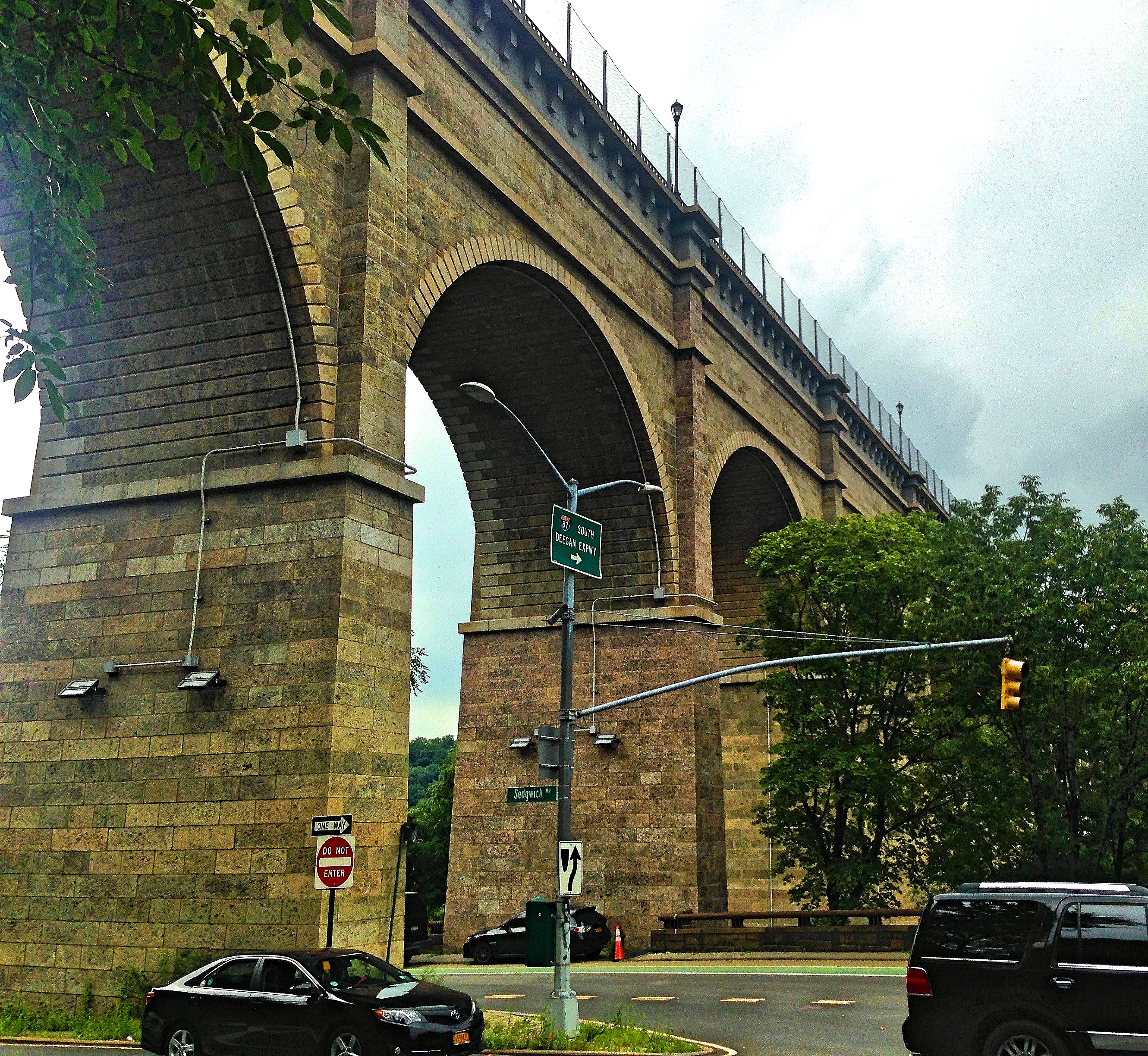
Original High Bridge arches
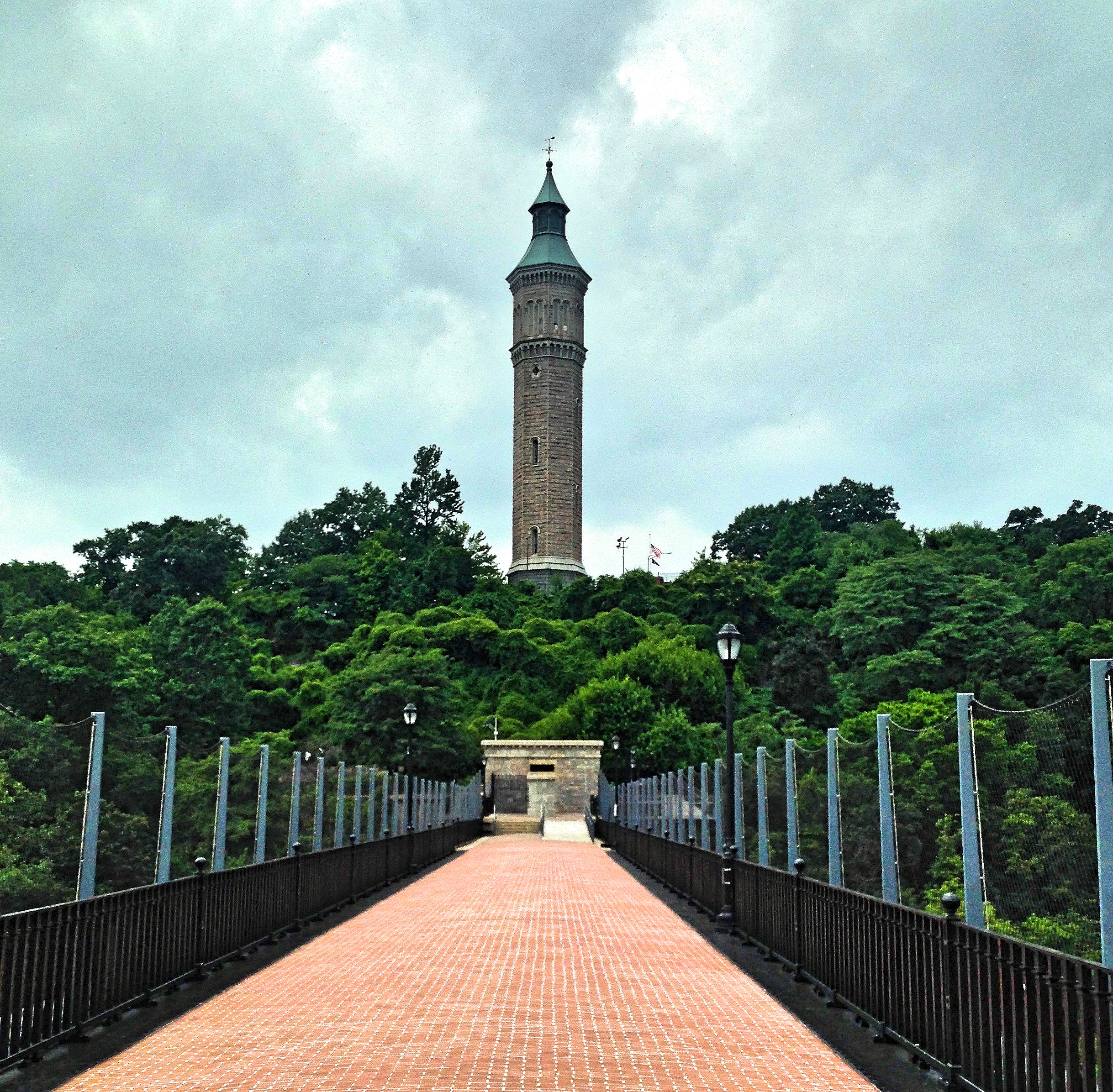
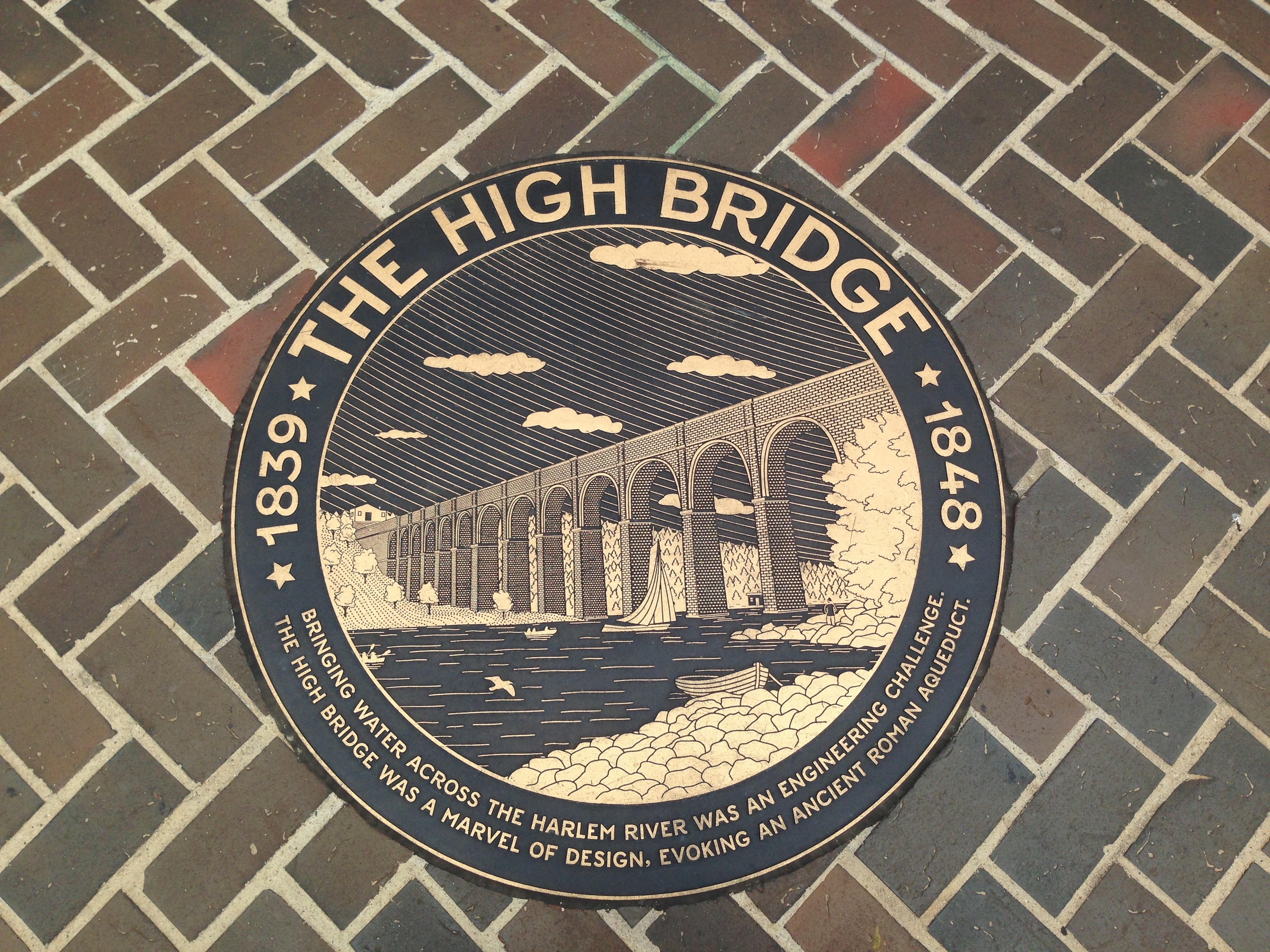
The largest structure of the original aqueduct stands on the southern end. This is the High Bridge. Opened in 1848, this is the oldest bridge still standing in New York City. It originally resembled a Roman aqueduct, with tall stone arches carrying the water high overhead, just like the famous aqueduct in Segovia. Indeed, one remarkable thing about the Croton Aqueduct is that it uses the same principle the Romans used all those centuries ago—namely, gravity—transporting the water on its 40 mile trip with a slight incline, 13 inches per mile. The bridge had to be built so high (140 feet) to maintain this slope. The water tower Jervis designed still stands on the Manhattan side of the High Bridge, looking like the turret of some bygone castle. (This tower was needed to pump water to some areas in the Bronx, which lay above the Aqueduct’s slope.)
Water tower
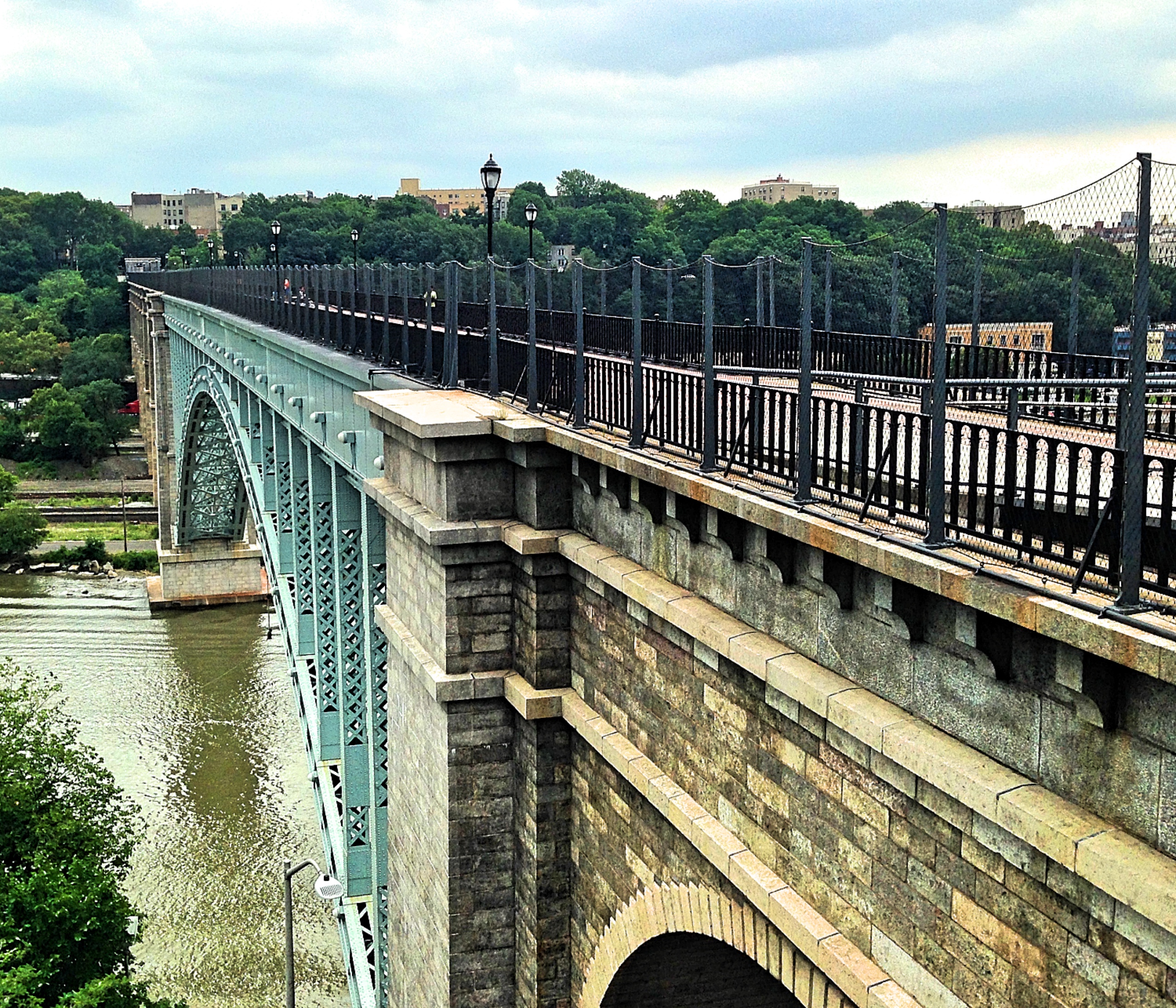
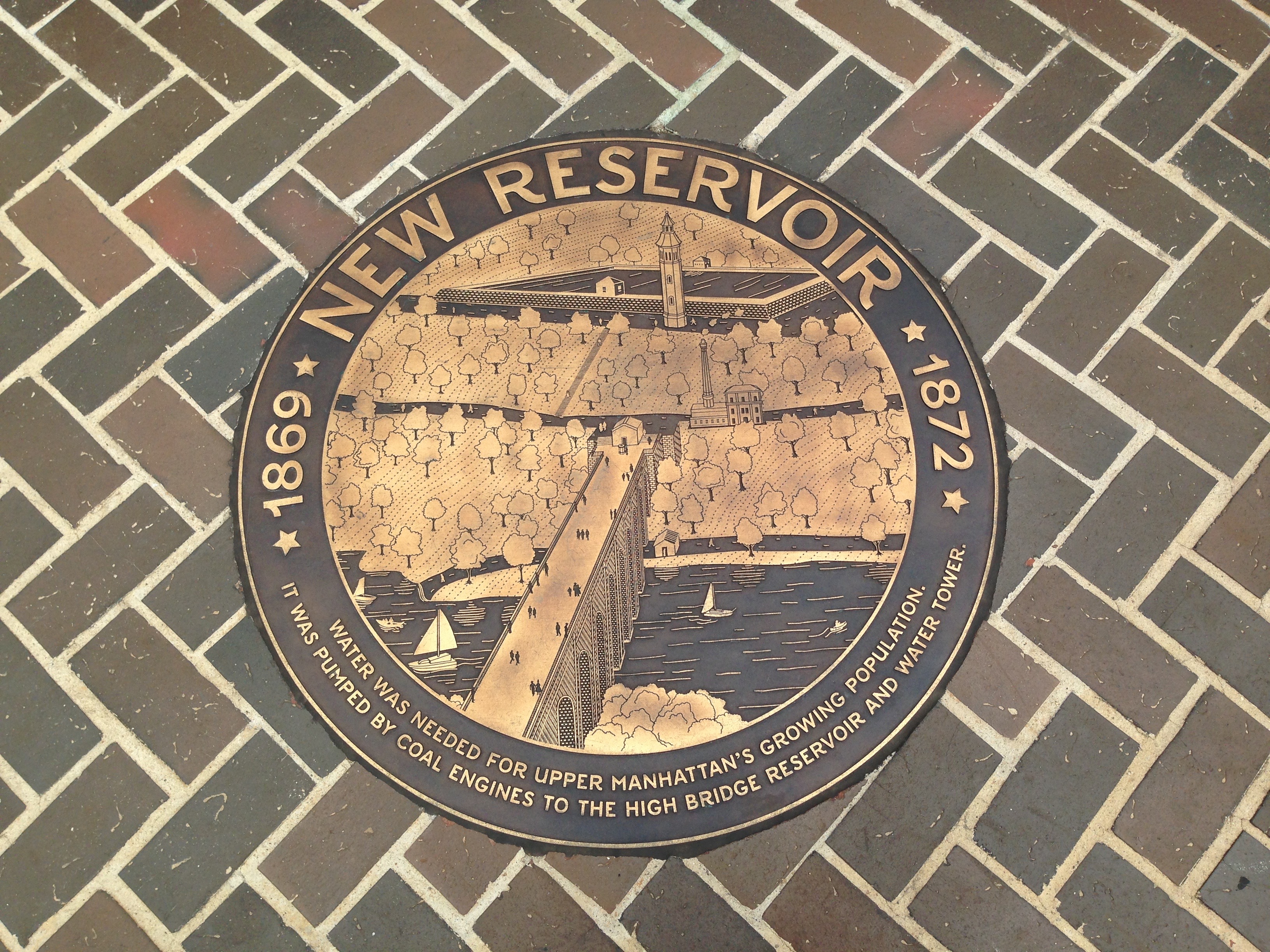
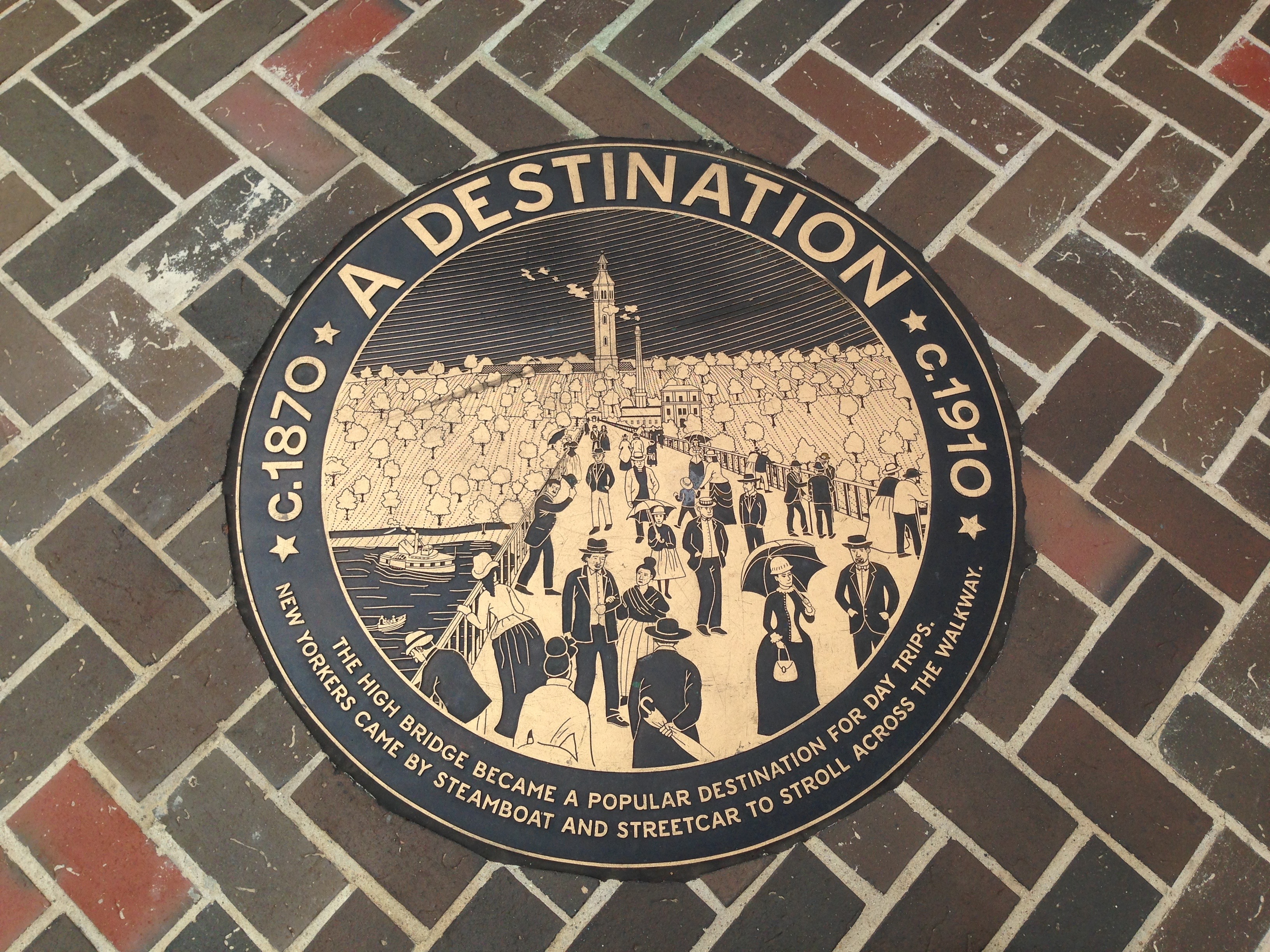
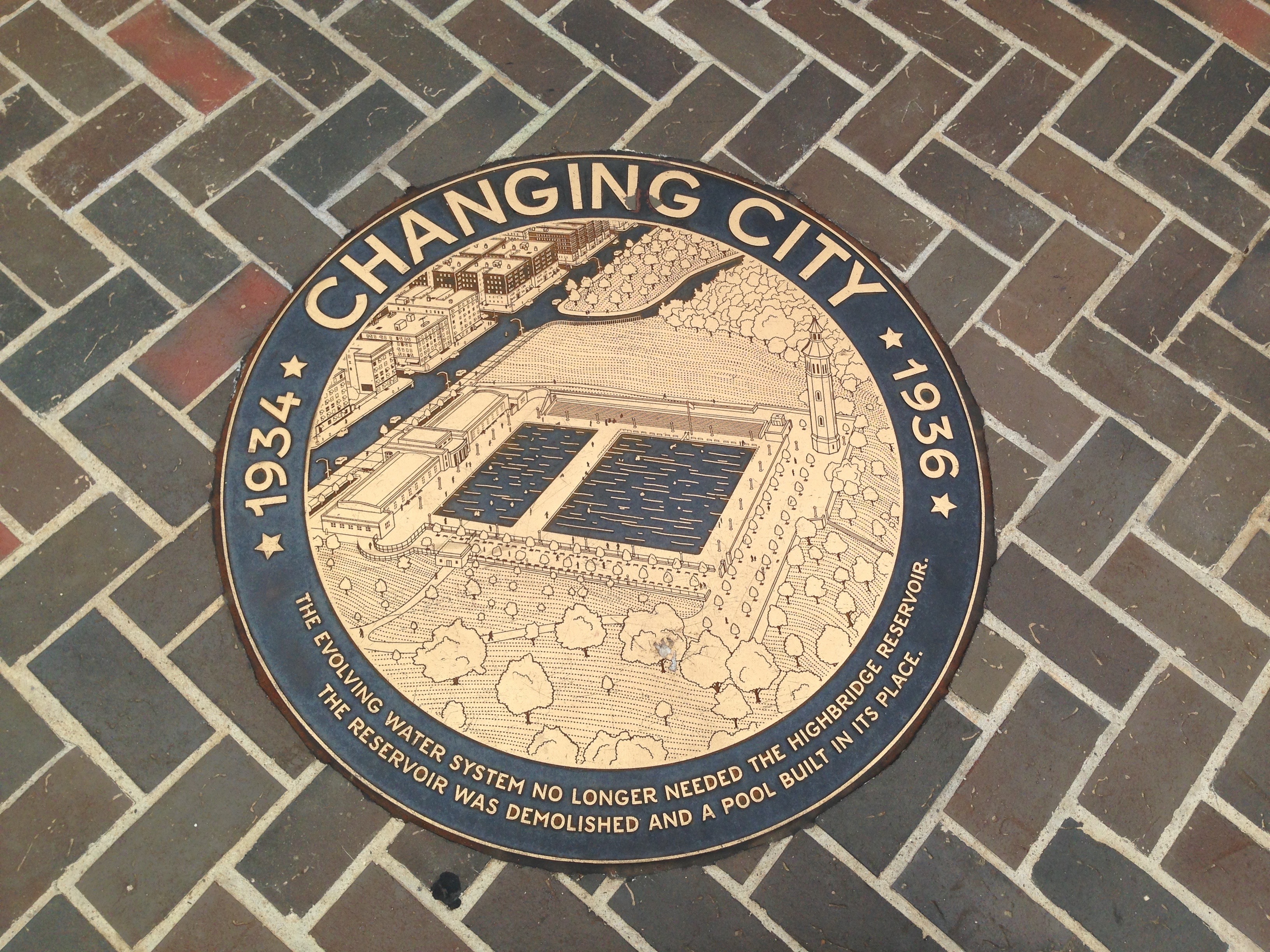
In the 1920s people began to complain that the bridge’s arches were an obstacle to ships traveling through the river, so the middle stone pillars were demolished and replaced with a long steel arch. The bridge was officially closed to the public in 1970, apparently because of vandalism, and wasn’t opened until 2015—an astonishingly long time, if you ask me. (There are some excellent panels on the High Bridge, with illustrations of its history. I have attached the images at the end.)
High Bridge
As you can see from the High Bridge, the scale of the Old Croton Aqueduct is undeniably impressive: stretching about four times longer than the Aqua Appia in Rome (although, to be fair, I think the Romans built several aqueducts longer than the Croton Aqueduct), and requiring whole landscapes to be reshaped. The aqueduct was constructed by 4,000 laborers, mostly Irish, who made a dollar or less for ten-hour days. Having thousands of single men, with plenty of drink available (enterprising farmers began converting their barns into bars), predictably caused some ruckus. But it was a good job for the recent immigrants.
The opening of the aqueduct was something of a sensation. At the time, the Croton Aqueduct was one of the biggest engineering projects in the United States, only surpassed by the Eerie Canal. And the effect of the aqueduct on city life was scarcely less important than the canal’s. With a reliable source of clean water, the city began to expand at a remarkable rate. The original aqueduct was built with a maximum capacity of 60 million gallons a day. The engineers thought this would be enough water to supply the city for hundreds of years. But it wasn’t long until the ever-growing population of New York outstripped the capacity of the aqueduct. Indeed, it was largely thanks to the increased supply of fresh water that the city was able to grow so quickly.
Thus the aqueduct, designed to be used for centuries, was supplemented in 1890 by the New Croton Aqueduct, a larger tunnel that runs parallel to the old one. The Old Aqueduct stopped delivering water to the city in the 1950s. The New Croton Aqueduct is still in use—although it, too, has since been supplanted. The Croton watershed now delivers about 10% of NYC water. The majority of the water comes from the Catskill Watershed further north, ferried to the city by the Catskill and the Delaware Aqueducts. This latter tunnel, by the way, is the longest tunnel anywhere on earth, stretching 85 miles. New York is a thirsty city. (The current daily water supply of NYC is 1.3 billion gallons.)
Not only the original aqueduct, but the original Croton Dam was also replaced in the late nineteenth century. Jervis designed the original dam with an innovative S-shaped spillway to reduce damage from floods. But good luck seeing it now. Today, Jervis’s dam is underwater, submerged under the expanded Croton Reservoir, only visible in times of severe drought.
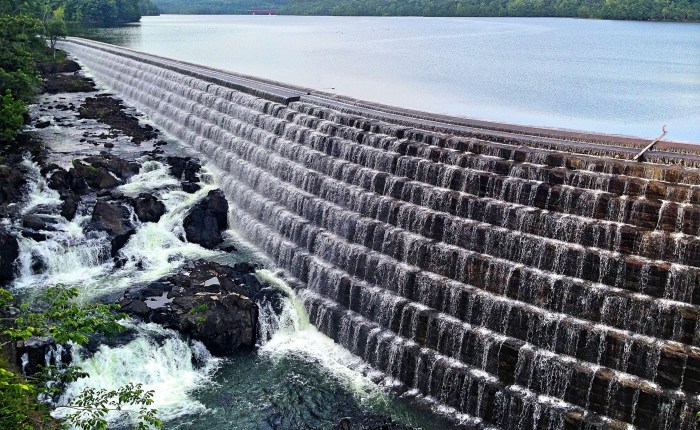
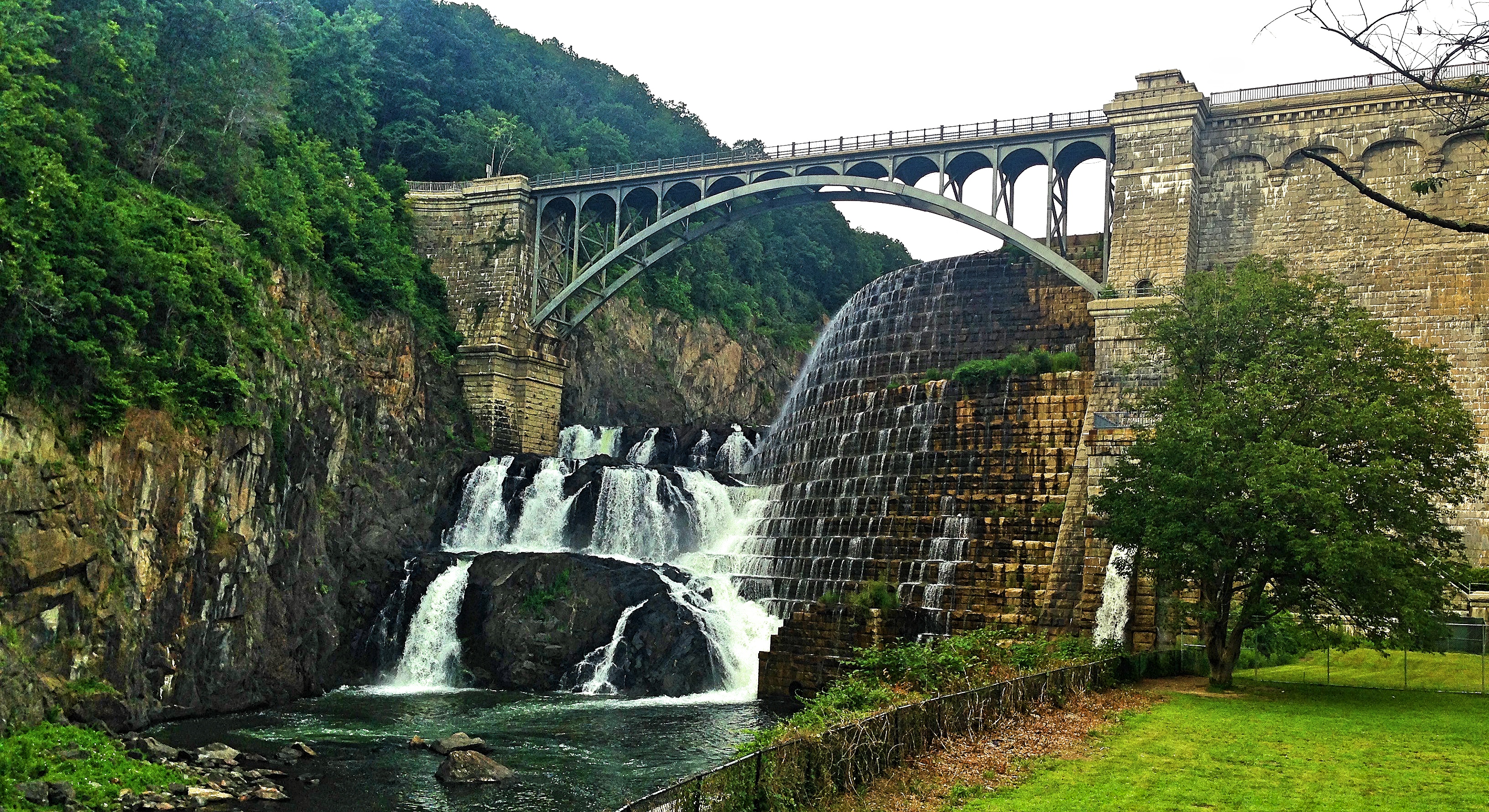
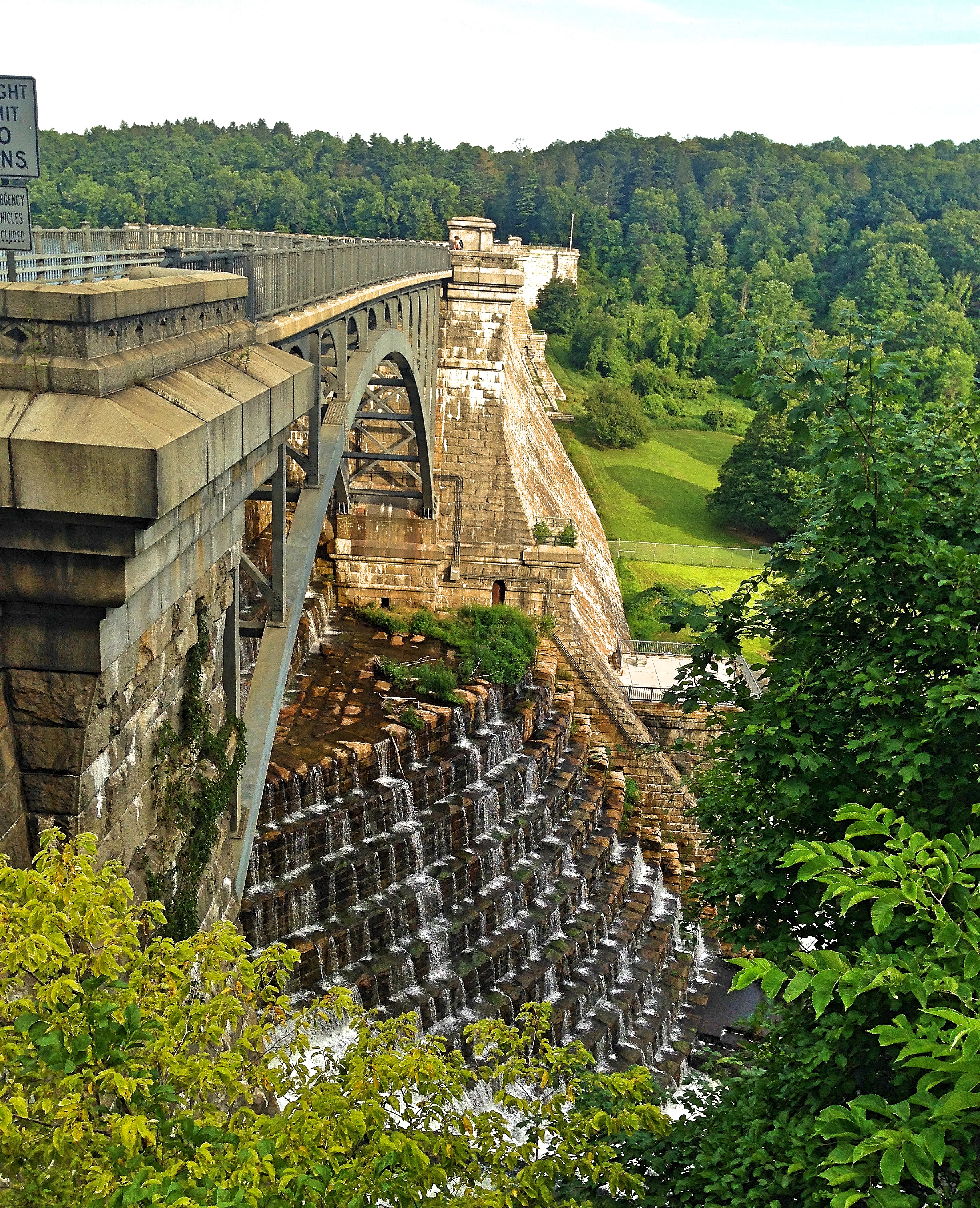
For my part, I don’t regret this loss, since that dam was replaced by the New Croton Dam—a grand monument of the previous century. Made of cyclopean stones, standing at almost 300 feet tall, and stretching to 2,188 feet (almost the exact altitude of Madrid, coincidently) the dam is still immensely impressive. It is also beautiful, with the stair-like spillway allowing water to cascade down to the river below in an artificial waterfall. This dam was begun in 1892 and completed in 1906. Whole communities—cemeteries, churches, and farms—had to be moved to make way for the expanding reservoir. Standing on top of that dam, hearing the rushing water below you, does a better job than any statistic of conveying how much water a major city like New York needs.
As part of my research, I also read the book in the Images of America series about the construction of the New Croton Dam. The story of this construction is told with dozens of old photographs, with commentary by Christopher Tompkins. You don’t exactly get a linear narrative this way; but the images alone are worth the price. It baffles the mind to think of what these men accomplished—redirecting a river, and erecting a structure 300 feet tall with cut stones, flooding an entire valley and displacing many communities—and all this using technology that looks, to my eyes, scarcely more advanced than what the Egyptians used. That’s an exaggeration, of course: the dam workers had steam shovels to excavate and railroads to bring stone from the quarry. But I can’t imagine how difficult it would have been to move those massive stones in a time before modern cranes, using only wooden derricks and pulleys and counterweights.
It is amazing to me that so much history—an engineering feat and a chapter in the history of New York—lay buried right behind my house, and that I’ve been walking along this trail for so many years, oblivious. Don’t wait until you travel to learn about history, to explore and go on tours. Take Thoreau’s advice: “Live at home like a traveler.”
These images are taken from informational panels on the High Bridge.
Processing…
Success! You're on the list.
Whoops! There was an error and we couldn't process your subscription. Please reload the page and try again.
I want to cry because I feel like it as the boys in the back row cry, because I am not a man nor a poet nor a leaf but a wounded pulse that probes the things of the other side.
Poetry is an odd thing. You notice this when you encounter poetry in a second language. This happened to me a few weeks ago, when I went to a poetry reading in Madrid. There were four or five poets there, some of them fairly well-known, with a crowd of hushed listeners hanging on their every word. Meanwhile, with my very imperfect Spanish, I was only able to catch bits of phrases and scattered words that added up to nothing.
“Look, I can be a poet,” I said to a friend after the show: “A cow is a moon, / a moon is a balloon.” That’s really how it sounded to me.
In a way, this isn’t surprising, of course; but it got me thinking how strange a thing is poetry. We string phrases together that, interpreted literally, are either false, absurd, meaningless, or banal; and yet somehow, when the poetry works, these phrases open up subtle emotional reactions in their listeners. Why is it that a certain phrase seems just right, inexhaustibly expressive and unutterably perfect, while a similar phrase may be dead on arrival, impotent, sterile, and maybe even unpleasant? Bad poetry, indeed, can be excruciating and embarrassing to witness, perhaps because it is in bad poetry that the essential strangeness of the act of poetry is most acutely manifest. We feel that this whole thing is silly—trying to make portentous sounding phrases that signify close to nothing. And yet the genuine article, once witnessed, is undeniable.
I usually group poetry along with novels and short stories, as literature; but lately I think that poetry may be closer to another art form: dance. Dance is distinct from every other kind of movement—from walking to golf to sign language—in that it is not oriented towards any external goal. That is, the movement itself is the goal; the point is to move, and to move well. In poetry, too, our words—which normally point us towards the world, if only to an imaginary or a hypothetical world—are stripped as much as possible of their normal denoting function; the point becomes, rather, the pure manipulation of diction and grammar, in much the same way that, in dance, the point becomes the pure movement of limb and trunk.
This is a healthy thing, I think, since in life we can get so preoccupied with the attainment of a goal that we become blind to everything that does not advance our progress towards our object. A coach of a football team, for example, is only concerned with how well his players’ actions increase the likelihood of winning; and likewise, normally when we use language, we are using it to accomplish something specific, from ordering pizza to chiding children. Dance and poetry, by stripping away the intentionality of the act, reveal the subtle beauty in the activity itself, allowing us to slow down, to appreciate the rhythm of a word or the gentle flexion of an arm.
I must hasten to add that this description of poetry and dance does not apply equally to all examples. Alexander Pope’s poetry approaches very nearly to prose in its use of denotation; and T.S. Eliot’s “The Waste Land” is on the other side of the spectrum. A similar spectrum applies in the case of dance, I suppose.
Federico García Lorca’s poetry is much closer to Eliot’s in this regard, perhaps even further along in its tendency towards connotation. This makes his poetry doubly hard for a foreigner like me to appreciate, since the specific emotional flavors of his words are bland in my mouth. As a young man Lorca lived in the famous Residencia de Estudiantes, in Madrid, where he became close friends with Dalí. The two exerted a mutual influence on each other, both moving towards the surrealism that was becoming trendy in the art world.
Lorca wrote this book many years later, during and after his visit to New York City in 1929-30, during which he witnessed the Stock Market Crash. Economic depression or not, however, the inhuman vastness of the city, the crowds and concrete, the money-obsessed workers and the poor and the homeless, the racial discrimination and the absence of nature, seems to have made a deep impression on the rural Andalusian poet. These poems are his anguished response to this experience.
Lorca’s poetry is surreal in the textbook sense that he uses a succession of vivid, concrete images that, taken together, add up to something nebulous and unreal. Much like Dalí, Lorca has a talent for creating bizarre images that nevertheless manage to be emotionally compelling. Opening the collection more or less at random I find:
All is broken in the night, its legs spread wide over the terraces. All is broken in the warm pipes of a terrible, silent fountain.
Admittedly it does take some time to find the odd beauty in the apparently random, unconnected pictures. My first instinct was to read them like metaphors; but if Lorca did indeed have something specific in mind that he was trying to allegorize, the allegories are much too complicated and disjointed to be deciphered. Rather, I think these poems must be read simply for the beauty of the language, the striking collisions of words, the flashes of light and the rumblings of sound. The poems seem to capture nothing more nor less than an emotional mood—different shades of desolation—that presents itself to the conscious mind in a kind of personal mythology, as in a dream. Dalí was deeply influenced by Freud during his stay in the student residence, and I wouldn’t be surprised if Lorca was too.
Even if it is difficult to articulate the structure and meaning of Lorca’s image-world, it is certainly not random. Certain words and images come up again and again, as in a dream sequence, being shuffled and re-shuffled throughout the collection. Some of these words are oil, ant, worm, thigh, moon, void, footprint, hollow, glass, night, wounded, agony, sky, cracked, death, coffin, iron… The ultimate effect of these words, recombined again and again, is cumulative; they create echoes of themselves in the reader’s mind, calling up half-remembered associations from other poems, creating an emotional coherence in the literally incoherent text.
Look at concrete shapes seeking their void. Mistaken dogs and bitten apples. Look at the longing, the anguish of a sad fossil world that cannot find the accent of its first sob.
The emotional resonance of the words themselves is also important, something that is unfortunately lost in translation. For example, the word for “oil,” aceite, has an interesting blend of comforting familiarity and a tint of the exotic. I think this is because the word originally comes from Arabic, and maintains a certain foreign flavor, even as it denotes something absolutely integral to the Spanish culture: olive oil, which is used in everything. The word also brings up the rolling olive fields, stumpy trees on sandy soil, that fill Lorca’s Andalucía; and this again calls to mind the age-old farming tradition, the intimate connection with the land, totally absent in New York City. There is also the double association of oil as integral to cooking and as something potentially toxic and polluting. A native Spaniard will likely disagree with this chain of associations, but I think the word is undeniably resonant.
Ultimately, though, I don’t think I can articulate exactly why the text of these poems is gripping, in the same way that I cannot articulate exactly why I find some dancers compelling and others not. You cannot learn anything about New York City from these poems, and arguably you can’t learn very much about Lorca, either. I’m not even sure that the cliché is correct, that these poems can “teach you about yourself.” Maybe they don’t teach anything except how to feel as Lorca felt. I don’t think that’s a problem, though, since the point of reading is not always to learn about something, just as the point of moving isn’t always to get somewhere. Sometimes we read simply for the pleasure of the text.
I’ve fallen far behind in my travel posts, and now I find myself in the embarrassing position of writing about a trip I took over a year ago. It also seems that, no matter how hard I try to be brief, I end up writing more and more. Well, enough prefatory remarks; on to business.
Introduction
For an American, there is something religious about visiting London for the first time. We have been hearing about the place all our lives. Dry humor, pints of beer, red phone booths, black taxis, fish and chips, bad teeth, good tea, bad weather, good tikka masala, the British Invasion, the British Parliament, the British Empire, Queen Elizabeth, Queen Victoria, Shakespeare, Dickens, the Beatles, Monty Python, Dr. Who, Harry Potter—London is the focal point of all our stereotypes, good and bad, of England and the English.
This is important for us Americans, since England is the only other country whose media we regularly consume. English media is so important for us because of our shared language. Unlike in Spain—where English-language songs often play on the radio (and people sing these songs without understanding the lyrics), and where American shows, overdubbed in Spanish, are extremely popular—in the United States we don’t listen to music in a foreign language if we can help it, and we only watch television that was originally made in English (overdubbing looks silly). This provincial preference for English media limits our options of foreign media mainly to England and Australia, and England has been the clear favorite.
A consequence of this popularity of English media is that Americans have internalized a highly partial picture of the English character. We associate the English with sophistication, elegance, wit, good manner, royalty, and the historical past.
This is almost the polar opposite of the English reputation in Spain. You see, Spain is an excellent travel destination for English holidaymakers—cheap, close, and sunny—and as a result, lots of English tourists come to Spain looking for a good time. A “good time” entails drinking, of course, and thus there are lots of drunken English people stumbling around city centers on any given night. As a result, Spaniards think of the English, not as genteel aristocrats, but as tipplers.
(Parenthetically, the English also have very different alcohol consumption habits than the Spanish. On a Friday or Saturday night, people in Spain begin drinking in earnest after dinner—which means 11 pm at the earliest. They often don’t even leave their apartment to go to bars and clubs until 2 in the morning, and don’t return home until dawn the next day. In London, on the other hand, drinking begins as soon as people leave work, at 5 pm. This is due, in part, to an old law in London that required pubs to close down at 11. So the English stop drinking when the Spanish barely start.
(This difference in schedule is supplemented by a difference in speed and volume. Spaniards are rarely visibly drunk. I have seen very few Spanish people stumbling from alcohol; instead, they focus on maintaining a level of comfortable tipsiness for a long period of time. Compared with Brits, Spaniards sip their drinks, and eat a lot while they drink. English people, by contrast, get properly drunk, and fast, much like many Americans do. As a consequence, Brits can be very loud drinkers—in my experience, at least. This is an especially interesting contrast, I think, since in every other circumstance Brits tend to be mucher more quiet than Spaniards.)
Of course, both the American and the Spanish stereotype is an over-generalization; they are based on very partial exposures to the English character. Partial and false as they may be, however, these stereotypes did succeed in endowing England with a certain contradictory mystique—a place full of witty drunkards, elegant and boisterous, cultured and slovenly? I needed to go see London for myself, to catch a glimpse of the reality behind the reputation.
My problem was that, at the time, I was particularly low on funds. And however distorted all the other stereotypes may be about London, this one is true: London is expensive. Well, it’s expensive if you enjoy eating, sleeping indoors, using transportation, and doing any activity besides walking and sitting outside. This was a few months before the Brexit referendum, and the pound was still strong.
As a result, my short trip to London—barely 48 hours—became a frantic exercise in traveling cheaply. I didn’t buy an oyster card, and I didn’t use the Tube or the buses. I ate “meal deals”—pre-packed sandwiches at Tesco supermarkets, not terribly delicious—instead of paying for dinner in a restaurant. And I focused on visiting museums, which are free in London, instead of other popular sites.
Arrival & First Impressions
As usual, I traveled with Ryanair. My plane arrived in Stansted, the smallest of London’s airports, where I had to fill out a form and wait in a long queue to enter the country. The English, it seems, are almost as paranoid about their borders as we are in the United States. From Stansted, I took the so-called Stansted Express to London’s central Liverpool Station. The ride took about an hour, and was not cheap. This is a typical Ryanair experience: the flight is inexpensive, but uncomfortable; and you land in an unpopular airport far outside the city. I am a loyal customer.
I sat in the train—dazed from lack of sleep, filled with nervous energy, physically miserable but mentally awake—and stared out the window in disbelief. Was I really here? Was this England, the land of dry humor and wet weather? I gazed out at fleeting patches of green countryside as the train sped by, and savored the delightful names of the train stations between Stansted and London. (Of course I can’t remember any of the names now; but as I look on Google maps, I find such gems as Matching Tye, Hartfield Heath, Hastingwood, Theydon Bois.)
English novels—from Austen, to Dickens, to Rowling—have powerfully shaped the American imagination of the past; and thus, by association, English place-names strike many Americans as irresistibly charming. Each name seems to be the title of another great novel, filled with irony and romance, and written with quaint wit. Likewise, the English countryside—a neatly trimmed park, whose rolling hills are covered in a grey mist—is featured in so many films that even the snatches of green I saw out the train window filled me with delight.
These feelings of romance and fantasy are, I suspect, nearly universal for Americans visiting England, and specifically London, for the first time. England is the only foreign country we regularly see in television and movies. This gives the experience of visiting England the effect of stepping into a movie set—everything is familiar, and yet unreal. The same thing happens, I believe, to many who visit New York for the first time. Many people have independently told me that it felt like they were in a movie, since so many landmarks and features were familiar to them from films.
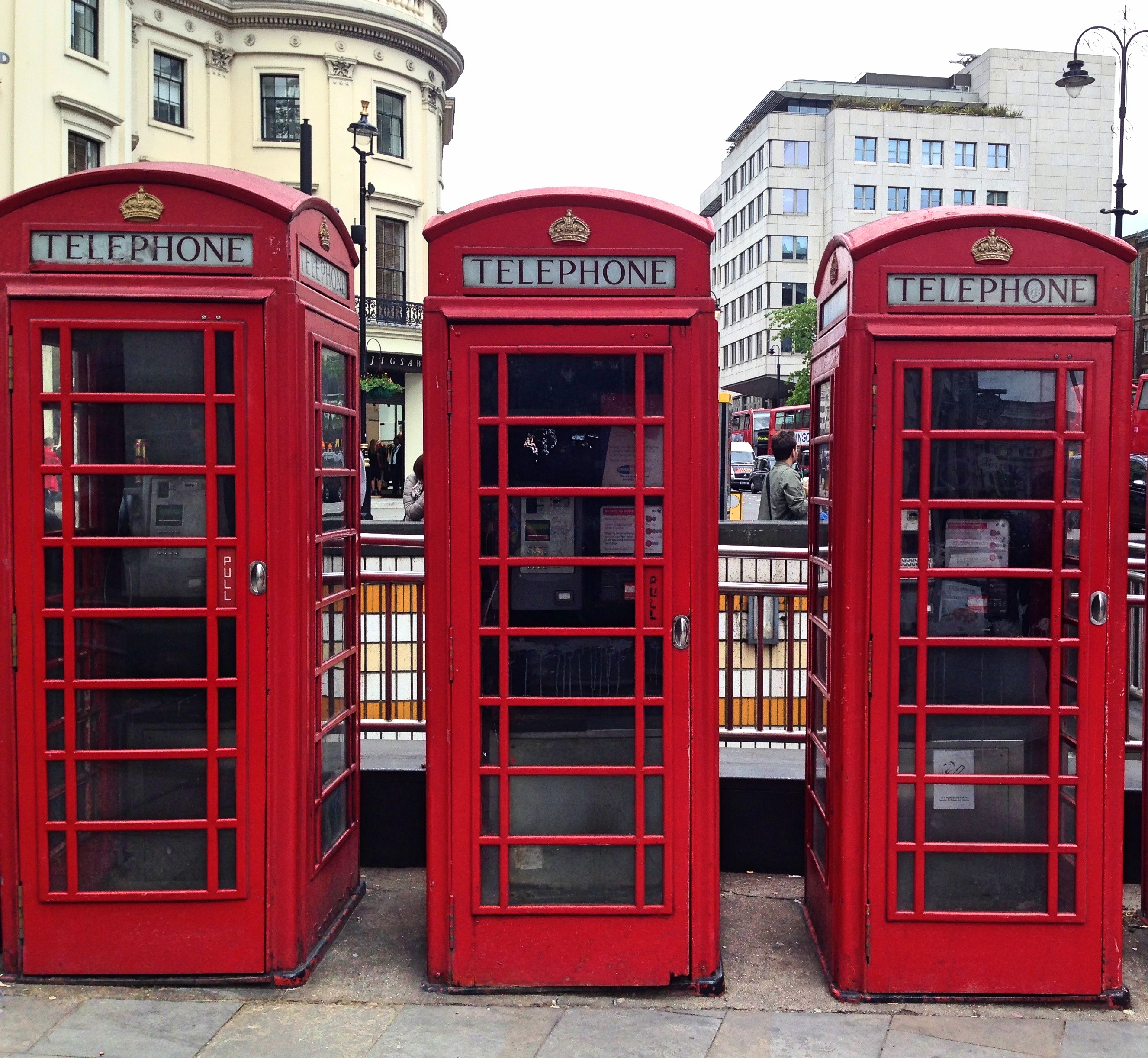
The train arrived, and I got out to go find my Airbnb. I was on edge. The combination of sleep deprivation (the flight was terribly early) with the usual stress of navigating a foreign city (my phone didn’t have service), plus the feeling of unreality that comes from actually being in a place which I’d been hearing about all my life—all this combined to make me edgy and oversensitive. The double-decker red buses, the black taxis, the cars driving on the wrong side of the road, the eccentric road signs (including the delightfully existential “Change Priorities Ahead”), pubs with absurd names (“Ye Old Cheshire Cheese,” on Fleet Street), the red phone booths scattered seemingly at random (apparently, the city had once sold all these phone booths, only to regret the decision and then repurchase as many as they could)—my first impressions of London did contain many of ye quaint olde stereotypes that I expected.
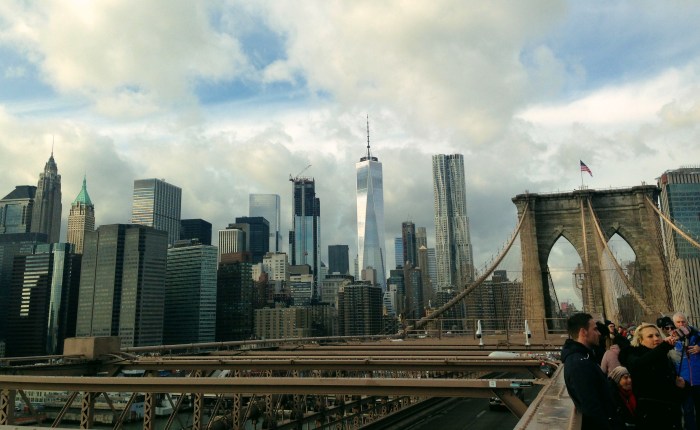
But one thing that, as a New Yorker, always surprises me when I visit a new city is the lack of skyscrapers. Madrid has only four buildings which can reasonably be called skyscrapers, and they’re located in the north of the city, far outside the center. London has its own share of skyscrapers, to be sure. But walking around in London has nothing of that vertiginous feeling that New York produces, the feeling of being crushed by steel and glass, the feeling of constantly craning one’s neck. I had always thought of London as being a huge and imposing place, so this lack of skyscrapers did disconcert me somewhat.
In many other respects, however, London can be easily compared with New York: the bustling streets, the flashy billboards and ever-present advertisements, the endless shopping, the infinite variety of chain restaurants, the ethnic diversity, the smell and the grime. London even has the same phony Buddhist monks trying to scam tourists into giving them money. (You can find a great story about them here; and in case you’re wondering, if someone is aggressively asking you for money, you can safely assume that they’re not a Buddhist monk.)
As I discovered when I got to my Airbnb, one way that London is incompatibly different from both my country and Spain is the style of its outlets. I had to buy a power-adaptor there; and like everything in London, it wasn’t cheap. Be wise and buy one ahead of time.
These were my first impressions, hazy and distorted, as I walked from the station to my Airbnb. Already I was running short of time. It was midday Friday, and my flight home would leave early on Sunday. So I set out to the first place on my list, the National Gallery.
A Note on Cuisine and Language
I should preface my trip to the National Gallery with a mention of a small restaurant, the Breadline, which can be found nearby. I decided to eat there because it had fish and chips—I know it’s silly, but I couldn’t leave London without eating that iconic meal—and because its prices were eminently reasonable. The food was plain and basic, but nonetheless, for me, extremely satisfying. I even returned the next day to try an English breakfast, which I quite liked.
English food has a poor reputation, and I understand why; it is hardly a cuisine designed to have universal appeal. Nevertheless, if those two meals can be trusted to give a fair representation (an open question), I can say that I am a fan. There is something about greasy fried potatoes and fried fish, covered in white vinegar, that just feels right to me. And sausage and beans for breakfast is brilliant.
While I was eating, a young British man came in and said “A small white coffee to take away.” This is an excellent example of the differences between British and American English. This sentence, uttered in New York, would produce only bafflement. You would have to translate it to “A small coffee with milk to go,” if you wanted to be understood. I run into these differences constantly as I teach English. Before coming to Spain, I thought the differences between British and American English were minor and negligible, besides the accent; but I was wrong. Working with British textbooks and materials can be extremely frustrating, since often I don’t know what certain expressions or words mean—which is embarrassing when my students ask. Not only that, but there are a few subtle grammatical differences between the dialects, such as in the use of the perfect tense. But this is a digression of a digression; now to the museum.
The National Gallery
It is immensely satisfying to simply walk into a museum, without fees or lines, like it’s your own home. The experience is even better when the museum is one of the best in the world. The National Gallery is only behind the Louvre, the British Museum, and the Metropolitan in visitors per year; and this is especially impressive considering the museum’s collection is comparatively small, easily viewable in three hours or so. But for those with any sensitivity to art, these three hours will be among the most rewarding of your aesthetic life; for the National Gallery’s collection is remarkable both for its breadth and its excellence. The only museums I’ve visited that compare in the average quality of the paintings on display are the Prado in Madrid and the Musée d’Orsay in Paris. Every room in the gallery contains a masterpiece, often many.
Indeed, there are so many wonderful paintings—paintings I had seen and loved in art history books—that I cannot even hope to mention all of them in this post, much less describe the impression each one made on me. Nevertheless, I can’t resist the temptation to dwell on some of these exquisite works of the human imagination.
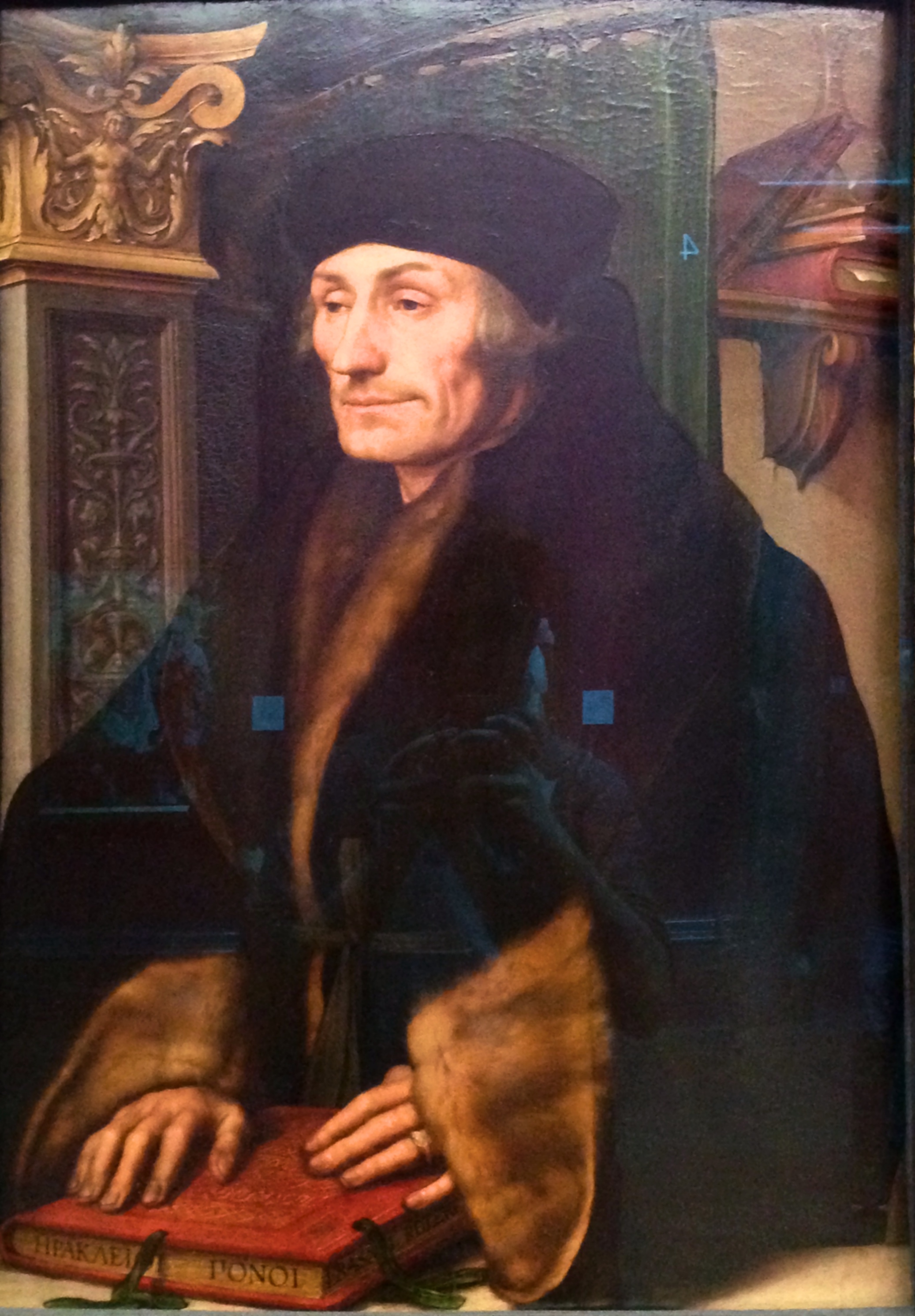
The first painting which attracted my attention was the portrait of Erasmus by Hans Holbein the Younger. This is an extraordinary demonstration of the portraitist’s art; instead of a photographic image, capturing the physical surface of the famous writer, we get a glimpse of the writer’s mind. As in any excellent portrait, the inner is made manifest in the outer without compromising the realism of the portrait. His sharply angular face bespeaks cleverness; his gaunt features reveals a life dedicated to the mind and not the body; his half-closed eyes and serene expression show calm intelligence and a wisdom that sees beyond earthly troubles. We also catch a hint of Erasmus’s self-complacent vanity: he looks a little too comfortable in his fine fur robe, and his hands rest a little too easily upon a volume of his own writings. Is there a more convincing portrait of the scholar?
Erasmus
Holbein has an even more famous work on display at the museum: The Ambassadors. This is a portrait of two aristocratic ambassadors (their identity was long debated), in a room which includes an exquisitely-rendered still-life of several objects—a lute, several globes, a psalm-book, and various instruments of navigation. But the most memorable, and bizarre, feature of this painting is the giant anamorphic skull in the center. Anamorphic means that it is purposefully distorted when viewed head-on, and must be seen from a specific perspective to be seen properly. When viewed from the front, the skull is just a strange grey diagonal shape; but when you walk to the painting’s left, the skull comes into focus. I can only imagine the technical virtuosity required of a painter to pull off this trick with such consummate perfection; when seen properly, the skull is finely detailed, beautifully shaded, and anatomically accurate. Holbein painted this tour de force in 1533.
The Ambassadors
The National Gallery also possesses what is probably the most famous papal portrait in history: Raphael’s portrait of Pope Julius II. Julius was the most important of the high renaissance popes; he is responsible for the beginning of the Vatican museum, Michelangelo’s commission to paint the Sistine Chapel, and Raphael’s commission to paint the Vatican Library. Not only that, Julius originated the idea of tearing down the original St. Peter’s and building a new one. Such a man must have had enormous energy and a deep sensitivity to art. And yet in Raphael’s portrait we see him weary, worn-out, and melancholic. He is gently gripping a handkerchief in one hand and his chair in the other; his eyes are hollow, and the wrinkled skin of his face droops loosely from his skull. He seems to be just feebly holding on to the last chords of life, staring at his own end with resignation. Such terrible realism was entirely new in papal portraiture.
Julius II
Before going to the National Gallery, I didn’t look up any of the famous pictures that could be found there; so I was surprised and delighted when I found myself face to face with one of my favorite pictures, Jan van Eyck’s Arnolfini Portrait. I remember first seeing this portrait in Ernst Gombrich’s Story of Art, and being stunned. In the context of its time, 1434, the portrait is startling for its realism and its domestic subject: a marriage contract taking place in a bedroom. To a modern eye, perhaps the portrait no longer seems terribly realistic; the husband, with his pale expressionless face and his oversized clothes, always looks like he belongs in a Tim Burton film to me; but this only adds to its charm. The little toy-sized dog in the foreground—as adorable as ever—and the mirror in the background—showing us the whole scene from reverse in a distorted perspective—add to the painting’s undeniable power.
Arnolfini Portrait
There are dozens more paintings—of equal importance and beauty—that I could devote an unworthy paragraph to describing; but this would only swell this post to unartistic dimensions. Yet I cannot move on without mentioning the National Gallery’s collection of Italian Renaissance art. This includes Piero del Pollaiolo’s masterpiece, The Martyrdom of Saint Sebastian, a landmark in the realistic use of perspective, with the saint enricled by crossbowmen.
The Martyrdom of Saint Sebastian
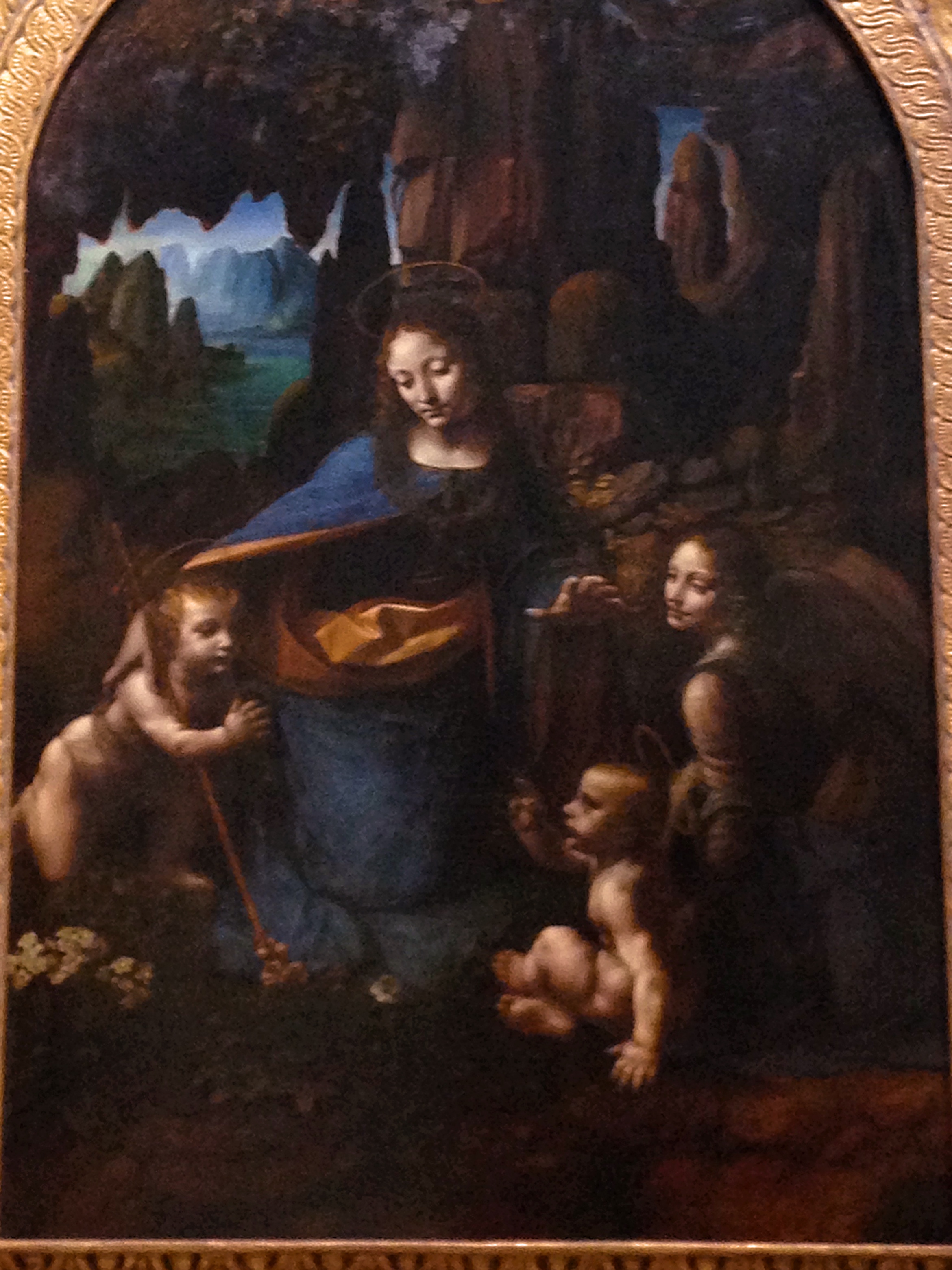
Even more important is one of the two versions of Leonardo da Vinci’s Virgin of the Rocks. The other one is in the Louvre, and is usually considered the original; but I think the Gallery’s version, with its deeper shades and more dramatic chiaroscuro, is lovelier. Apart from its beauty, this painting is notable for its setting. Leonardo, as is typical of him, creates a carefully naturalistic background for this traditional Biblical scene. In previous eras, the background of paintings was almost entirely neglected; monochrome gold foil set off the human figures. But in Leonardo’s masterpiece, the background—a cave, which was an unprecedented choice—swallows up its subject. Such careful attention to rendering nature was something new in history.
I also cannot move on without mention of Rembrandt. The National Gallery has several of Rembrandt’s most highly regarded works, including two of his self-portraits. Looking into the eyes of a famous artist, as he stares back at you from a self-portrait, is an unnerving experience; suddenly the gap in space and time that separates your lives vanishes; the artist has transcended death, and even transcended life; his focused gaze, dry pigment on a canvas, will outlast even your own living flesh. On a less dramatic note, the Gallery also has one of Velazquez’s most famous works: The Rockeby Venus, famous for being one of the few female nudes in Spanish art (one other being Goya’s La Maja Desnuda).
I will muster my self-control and mention only two more works.
By common consent, the greatest painter in English history is Joseph Mallord William Turner; and several of his finest works can be seen at the Gallery. Of these, my favorite is Rain, Steam, and Speed—The Great Western Railway. A locomotive emerges from a tempest, a black tube bursting through grey fog. Every line and color is blurred as if seen from an out-of-focus camera. All we can see in the background are hints of blue sky, a bridge, and a lake where some people are rowing in a little boat.
In this paintings, Turner seems to have both anticipated and surpassed the impressionists in rendering momentary flashes of life. The swirl of indistinct color is absolutely hypnotic; yet the painting is not merely pretty, as are many impressionistic paintings, but a convincing symbol of the relationship between human technology and natural power. The train punches through the mist, in a confident gesture of industrial might; and yet the stormy clouds that swirl all around menace the lonely black locomotive. Both the train and its surrounding are impressive, even sublime, but also inhumanly vast and cold; and the two slight figures in the rowboat below reveal our true vulnerability in the face of these forces.
The last painting I’ll mention before forcing myself away—even remembering the Gallery is a pleasure—is Bathers at Asnières, by Georges Seurat. This painting was completed in 1884; but it was not until many years after Seurat’s death that it was recognized as a masterpiece. It depicts several middle-class Parisians relaxing by the Seine on a hot summer day. The technique Seurat used is almost pointillistic in its precise use of strokes and colors, relying mainly on bright horizontal daubs. The combination of statuesque modeling and poses—the bathers’ heavy bodies and horizontal orientation remind me of an Egyptian frieze—with Seurat’s delicate treatment of brushstrokes, makes the painting look crystal-clear from a afar and blurred from up close. The treatment really captures the feeling of heat: how everything can seem perfectly clear in the summer sun, and yet distant objects are blurred.
Complementing this tension between form and vagueness, is an emotional tension between fun and desolation. At first glance the bathers are having a wonderful day. They are at leisure, enjoying the sunshine, the smooth grass, and the cool water. But then you notice how isolated is each one of the figures. They are all in their own world; many seem lost in thought. Their expressions are emotionless; their hunching posture bespeaks weariness. The factory spewing smoke in the background adds another hint of gloom.
To me, the painting is a devastating portrait of the isolation and meaninglessness of contemporary life. We imagine the figures working 9 to 5 jobs in offices during the week, performing mechanical tasks that mean nothing to them. Then they go to their usual restaurant for a bite to eat and then to their apartment to sleep. When with their friends, they drink and talk of trivialities. On a holiday, they come here, and stare into space, unable to articulate to themselves or anyone else the strange sense of emptiness that engulfs them whenever they have a free moment. It is a comfortable world that conceives of nothing beyond wealth and luxury; and its members, when released from their usual routine, can think of nothing to do. Convention dictates that they come here to ‘relax’. The painting is the perfect complement and illustration of Albert Camus’s The Stranger: it is a painting of a world of strangers, to one another and to themselves.
The next day, I headed to one of the other great museums in London: the British Museum. Originally I planned to include my account of that great institution in this post; but I ended up writing so much that I decided that the British Museum deserved its own separate essay, which you can find here.
Brief Snatches of London Life
When I wasn’t visiting museums, I had a few spare hours to wander around the city. This allowed me to glimpse, all too briefly, most of the major sights in London—the places that must be given a mention and a respectful nod in any post about that old city.
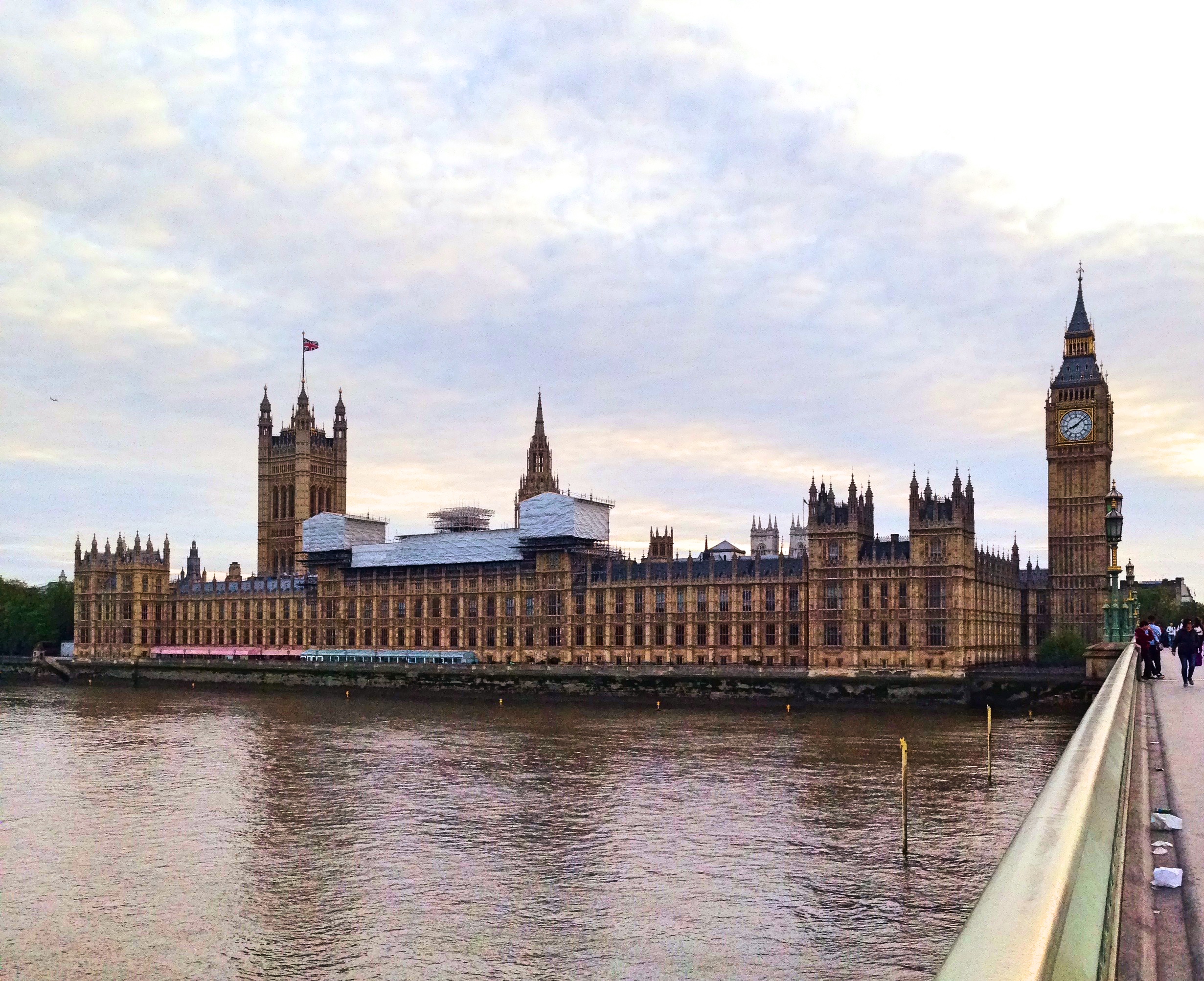
The first landmark I insisted on seeing was Big Ben. A trip to London without seeing that venerable clocktower would be like a trip to Pisa without its leaning campanile. I was so ignorant when I visited London (and remain, despite strenuous efforts) that I didn’t even know that Big Ben was attached to the British parliament building, the Palace of Westminster. It was a delightful surprise to find these two landmarks joined together.
Although it looks gothic, the palace is of fairly recent construction. The old Westminster palace burned down in 1834 (Turner witnesses the fire, and painted several pictures of it). The new building was designed by Charles Barry, who used a Gothic revival style in his plan. I doubt there is any parliament buildings in the world so elegant, so imposing, and so charming. Few experiences in London, if any, can do a better job of creating that Hollywood sensation of being in a movie than standing on the Westminster bridge, seeing that palace and the clocktower, and hearing the ringing bells of Big Ben chime out the hour.
From there I walked away from the bridge, pausing to examine the statue of Winston Churchill (covered in pigeon droppings) in the nearby plaza, and went to Westminster Abbey. In my very limited experience, this is easily the most beautiful church building in London. I can’t say much about it, because I didn’t go inside—it was closed by the time I arrived, and in any case I didn’t want to pay the steep entry fee—but I can say that its façade is exquisite, especially the north entrance. Funnily enough, Westminster Abbey is not an abbey—at least, not anymore. Originally it was an abbey of the Benedictine monks, but after the Protestant Reformation, and after a brief stint as a cathedral, the abbey was designated a church. For the last 1,000 years it has been the site of coronations and royal weddings.
The walk from Westminster Abbey to Buckingham Palace is about 15 minutes—slightly longer if, like me, you walk through St. James’s Park. I highly recommend this, since the park is absolutely lovely.
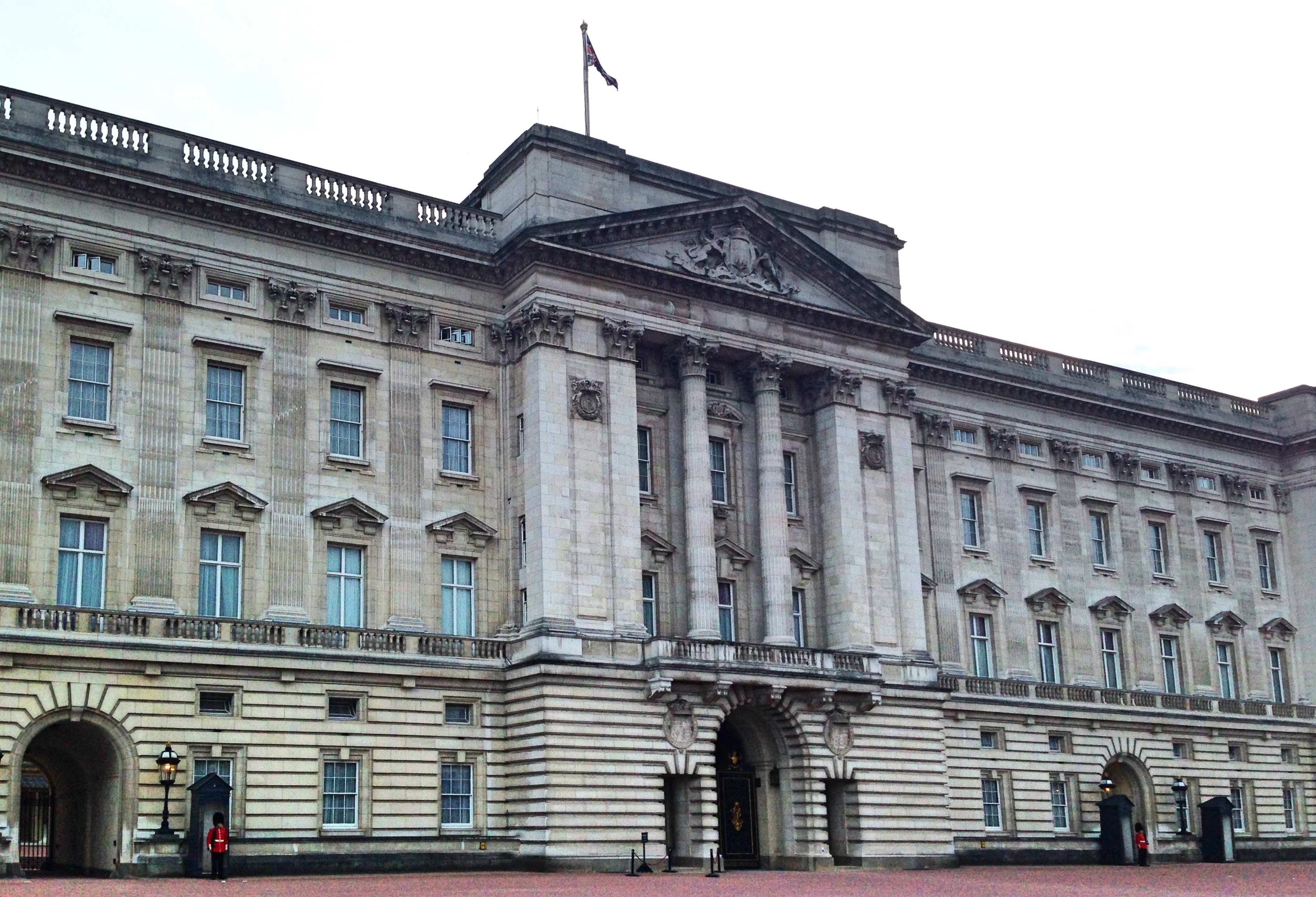
Architecturally, Buckingham Palace isn’t much to look at; it presents itself as a cheerless, square, grey block. The building was not originally designed as a royal residence; it only became the seat of the monarchy in 1837, during the reign of Queen Victoria. The palace takes its name from the Duke of Buckingham, who originally had it built. It sits at the end of the Mall—a major road often used for processions—in a roundabout in which stands the golden Victoria Memorial, which commemorates that famous queen.
Even so, neither the monument nor the palace would attract a great deal of attention, I suspect, were it not for the Queen’s Guard. Equipping guards with antique weapons and dressing them in bright red outfits with fluffy tall hats seems to be one of those conspicuously impractical things that wealthy and powerful people do to showcase their wealth and power. Your average rich entrepreneur or politician could not afford to keep a corps of totally inefficient guards performing ceremonial movements all day (which are, naturally, supplemented by other guards using modern weapons, keeping careful watch, and wearing less conspicuous clothes). Here is an incident that demonstrates the guards’ mainly ceremonial role: in 1982 a man managed to evade the palace guard and make his way to the Queen’s bedroom, where he was apprehended by the city police.
I spent some time watching the guards march back and forth, their limbs as stiff as a wooden nutcracker. Purely as athletic performers, the soldiers are undeniably impressive: the timing, the coordination, the posture, the endurance—it must require excellent physical condition and serious training to keep up the routine, especially considering that they wear those clothes even in hot weather. The guards now mainly function as a tourist attraction and an amusing symbol of British culture; but to be fair, the Queen’s Guard aren’t the only soldiers to wear funny clothes (think of the Swiss Guard in the Vatican) or to engage in elaborate ceremony purely for show (think of the tomb of the unknown soldier in Washington D.C.).
By the time I left the British Museum the next day, I only had about 6 hours left before I’d have to go to sleep and say goodbye to London. The best way to get the most out of this time, I figured, was a free walking tour. The guide was excellent, and the tour just what I wanted. Unfortunately I don’t remember the name of the company or of our guide; he introduced himself as the only American tour guide in London—so he shouldn’t be too hard to find. (But apparently this isn’t true; a Google search reveals an American woman named Amber who also gives tours.)
The tour focused on the City of London. You may not know—I certainly didn’t—that the “City of London” refers to the original part of the metropolis, founded by the Romans way back when. This original City of London is now only a tiny fraction of the greater metropolitan area; indeed, it is quite a small place, having an area of only one square mile. This city is far older than England; it has enjoyed special privileges (or, to use the phrase of the Magna Carta, “ancient liberties”) since the Norman Conquest; and even now it retains the privilege to create many of its own regulations, independent of the greater metropolitan area or of England herself. The city has laxer building codes, which explains why so many of London’s skyscrapers are found there, and also looser financial regulations, which explains why it remains the center of London’s economic life. The City of London is home to the Bank of London, the London Stock Exchange, and Lloyd’s of London (the insurance market).
The tour began at Temple Station. Our guide took us along the river and then down Fleet Street, giving us bits of details about London’s past and present. We walked by Ye Olde Cheshire Cheese, one of the oldest and best known pubs in London, famous both for its silly name and its dark, windowless interior; and this prompted our guide to embark on a long, impassioned explanation of London pub culture. Though an American, he was clearly a convert to the pub way of life; he had strong opinions about what made a pub good or bad; and he had pub recommendations for nearly any area of the city. (I was so inspired that, after the tour, I went into a pub to get a drink; but the beer was so expensive and so mediocre that my disappointment was even more bitter than the beer.)
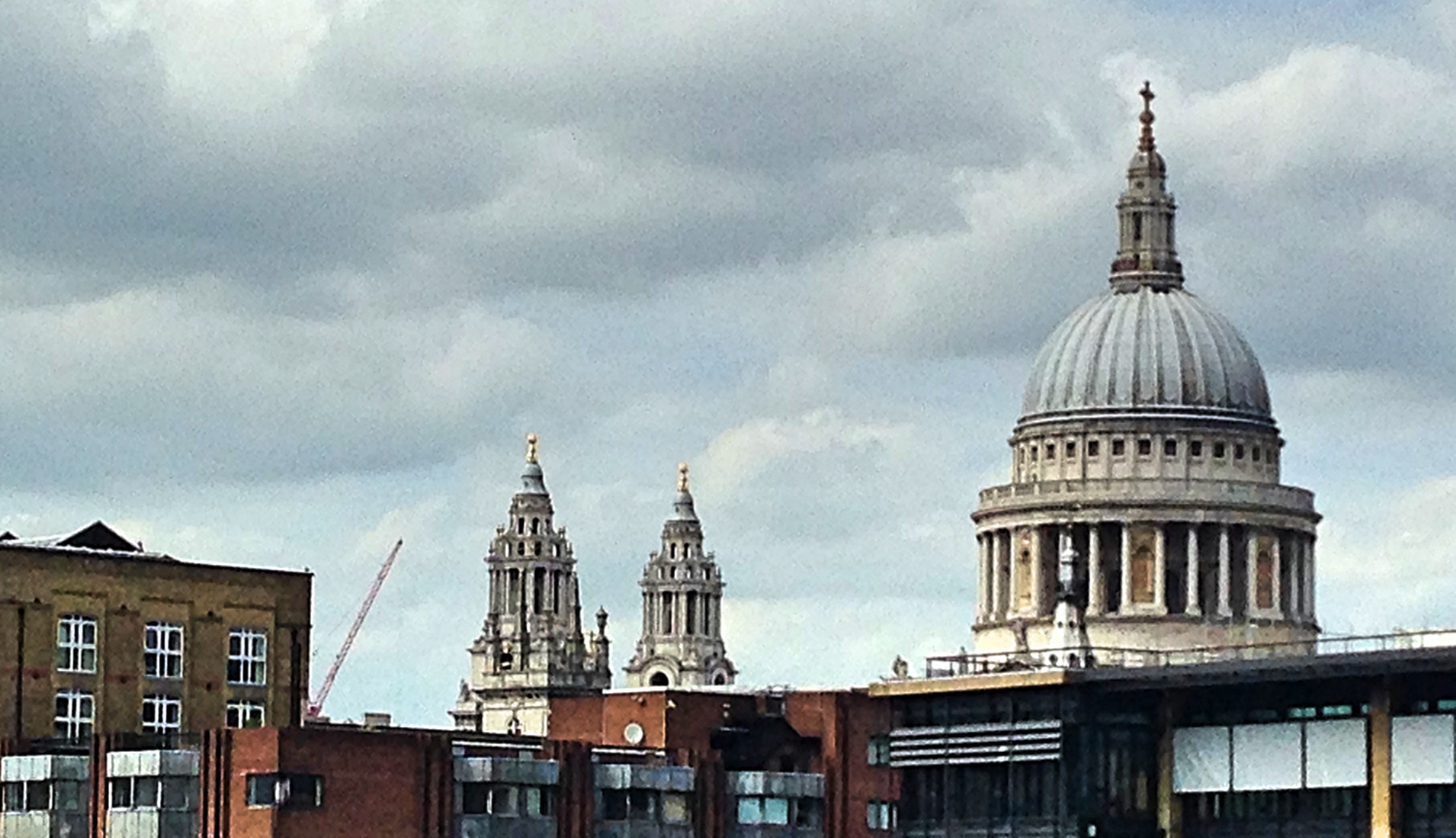
Soon we reached St. Paul’s Cathedral. The tour didn’t pause for us to go inside; and, in any case, the entrance fee is formidable enough to discourage penurious travelers like me. Among other things, St. Paul’s is famous for having one of the tallest domes in the world. But the present St. Paul’s replaced an older, even taller cathedral (well, it was taller before its spire was destroyed by lightning), which was badly damaged in the Great Fire of London in 1666. The present building was designed by Sir Christopher Wren, and completed in his lifetime. Wren was, if not the greatest, at least the most prolific architect in England’s history. He designed and oversaw the construction of no less than 52 churches after the Great Fire. The architect himself is buried in the crypt of the cathedral, in a modest grave that says “Reader, if you seek his monument—look around you.”
From there we moved on to the Monument to the Great Fire, also designed by, you guessed it, Sir Christopher Wren. As our guide pointed out, the monument—a tall doric column that originally rose far above its surroundings—is now hemmed in by neighboring buildings and dwarfed by modern architecture. The guide used this as an example of the tendency of Londoners to be more interested in the future than the past.
To emphasize this point, he directed our attention to the skyscraper at 20 Fenchurch Street, a bizarre, top-heavy construction, completed in 2014, whose shape quickly earned it the nickname ‘The Walkie Talkie’. This building won—and earned—an award for ugliness. (It was also discovered that the building’s concave shape focused the sun’s rays strongly enough to damage cars, ignite doormats, and fry eggs; a screen has since been installed to prevent this from happening.) But the Walkie Talkie is only one of the many skyscrapers that have sprung up in the City of London in recent memory, despite concerns that these tall monstrosities will dwarf and obstruct historic buildings.
Walkie Talkie
From the cathedral, we went down towards the river and ended up under London Bridge. Many people, including me, assume from the nursery rhyme that London Bridge is a tourist attraction; indeed, the justly famous Tower Bridge, which spans the Thames nearby (see below), is often mistakenly called the London Bridge. Sad to say, the current London Bridge is a brutalist piece of concrete and steel, a minimalistic slab of stone that stretches across the Thames, without charm, beauty, or really any distinguishing quality.
The nursery rhyme dates from a time when a different London Bridge spanned the Thames. The ‘Old’ London Bridge, built in 1209 and demolished in 1831, rested on stone arches and was covered in wooden buildings (which proved to be a fire hazard). It was famous for being the site where the severed heads of those executed for treason, dipped in tar and impaled on pikes, were displayed for passersby to take heed. William Wallace’s head was the first to play this role.
In 1831, the ‘New’ London Bridge was built to replace the crumbling medieval construction; this bridge also rested on arches, but it was taller and so allowed bigger ships to pass underneath. In the 1960s it was discovered that London Bridge was falling down (sinking into the riverbed) and had to be replaced. In true English entrepreneurial spirit, the bridge was sold; an American oil tycoon, Robert McCulloch, bought the bridge, disassembled it, shipped it to the United States, and then reassembled it in Lake Havasu City, Arizona—a little piece of English history in the American south. The current behemoth was finished in 1972.
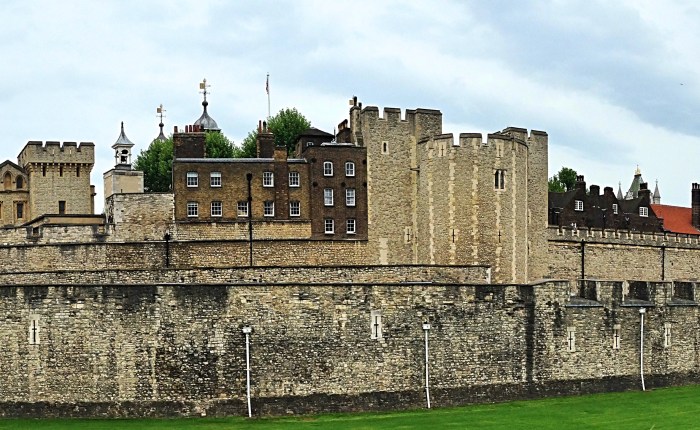
The tour came to an end front of the Tower of London. Once again, I didn’t go inside that old castle—I am really exposing myself as a pathetic traveler, I know—but contented myself with walking around the perimeter. From the outside, the Tower of London doesn’t seem to merit the name “tower”; the White Tower, the central citadel which sits at the center of the castle complex, is less than 100 feet tall—almost invisible in the context of London. The castle is quite venerable; it was first constructed by the Normans in the 11th century, and was expanded in the preceding two centuries. At present the Tower of London is a large complex with two concentric layers of stone walls surrounding the central keep, and some additional buildings such as a chapel and a barracks. The outer wall is surrounded by a moat, now left dry. Besides the castle itself, visitors can see several historical objects on display, such as Henry VIII’s armor and—most notably—the Crown Jewels of England.
The Tower of London has played an important and often a nefarious role in English history. For a long time it served as the British version of the Bastille, as a prison for traitors and other political pests. Anne Boleyn, unfortunate wife of Henry VIII, is the most famous prisoner ever to be held and executed in the tower; legend has it that her ghost still travels through the old castle, her severed head under her arm. But as I stood there looking at that stone pile, I thought only of Thomas More, the British intellectual who dreamed of a utopia with freedom of religion, and who was imprisoned in the tower and then executed for being true to his Catholic faith (also by Henry VIII). More’s head was eventually covered in tar and displayed on a pike on the old London Bridge.
The tour guide ended with a short speech, which I will try to reproduce here:
“In this tour, we’ve seen many different types of power. We have the political and military power of the Tower of London, the religious power of St. Paul’s cathedral and the Church of England, and the economic power of the London Stock Exchange. And this, ultimately, is what the City of London has always been about: the use of power to control its own destiny. It’s a place oriented towards the future, constantly striving to master whatever is the next form of social power in order to maintain its dominance in the world’s affairs.”
And this strikes me as perfectly true.
From the Tower of London I made a quick walk to the nearby Tower Bridge. This is the iconic bridge often mistakenly called the London Bridge. It’s a pretty sight, with two neo-Gothic towers supporting two platforms, one higher and one lower. Built in the 1890s, its design, by Sir Joseph Bazalgette, was innovative: a combined suspension bridge and drawbridge. The idea (according to the tour guide) was to allow pedestrians to keep using the bridge even when the drawbridge was drawn up to allow ships to pass.
Pedestrians soon learned, however, that walking up the stairs in one of the towers, crossing the upper platform, and then walking down the stairs in the other platform, took even more time than just waiting for the drawbridge to close again. Accordingly, pedestrians hardly ever used the upper platform, which came to be frequented mainly by criminals and prostitutes; it was closed in 1910. Nowadays, you need to pay an entrance fee to go up to the upper walkway. This is just another example of a brilliant idea that doesn’t take into account basic human realities: an innovative plan for a bridge that ignores the time and effort needed to climb several flights of stairs. It is certainly pretty, though.
As my last stop I made my way to Shoreditch, a neighborhood which had been recommended to me by a Londoner in my Spanish class. Shoreditch is London’s Williamsburg: a previously working class neighborhood that has been gentrified, and is now home to trendy restaurants and technology companies. The area even looks like Williamsburg, with narrower streets and older, shorter buildings, full of colorful shops and cafes. The population, too, is almost indistinguishable from its New York counterpart: men with large mustaches, plaid shirts, and suspenders; women with half their heads shaven, nose rings, and small, tasteful tattoos—in a word, hipsters. I felt right at home. The gentrification is so extreme as to be beyond parody; there is, for example, a cafe, the Cereal Killer Cafe, that serves only breakfast cereal.
To illustrate my own complicity in the world of hipsterdom, I went to a cafe famous for its rainbow-colored bagels, the Brick Lane Beigel Bake. This little cafe is open 24 hours a day, it is cheap, and it is excellent. I didn’t order a rainbow bagel, but instead a ‘hot salt beef’ on a roll. The beef comes with pickles and strong, superb mustard. I had two (for a very reasonable price) and I was stuffed. Another positive mark for English cuisine.
My time was up. My flight was leaving at seven the following morning, which meant I had to wake up at four to give myself enough time to walk to the train station and take the train to the airport.
All told, I spent less than 48 hours in London. I was constantly tired, hungry, and physically exhausted. I ate little, I slept less, and I walked almost constantly—more than 10 hours each day. I spent as little money as I could, and still the trip was expensive. I learned as much as I could, but left the vast majority of the city unseen and unknown. The trip was a physical ordeal and a financial hardship. But in return for all this trouble, I encountered, however briefly, one of the great cities of the world.
This short exclamation is one of my favorite quotes of Dostoyevsky, and I find myself saying it under my breath all the time. The quote is arresting because it condemns as bad something we normally think of as good: human adaptability.
This adaptability—and adaptability is closely tied with intelligence—is what has allowed us conquer nearly every corner of the world. We can fashion clothes for cold climates, accustom ourselves to new technologies, and retain a childlike ability to learn new things throughout our lives.
Like anything, however, adaptability has a darker side. I know this from my own experience. When you live in New York—or Madrid, for that matter—you quickly grow used to passing homeless people on the street. At first, something inside of you rebels against this state of affairs. It is unconscionable that we can live such a heartless society, where the poor are simply left behind.
But then your outrage turns into selfishness when you are accosted for money; and your heart hardens when you pass them day after day. Soon the homeless have been completely dehumanized in your eyes, and the situation is regarded as normal.
I’m not proud of admitting that this happens to me, but it does. I simply get used to it. I can’t maintain outrage or compassion forever. The feelings dissipate, and numbness comes creeping in.
This is just an illustration. People have gotten used to more horrible things than homelessness. One need only read about some of the darker periods of history to see how far this process can go. Injustice and cruelty, if practiced regularly, become expected, customary, unremarkable. Humans aren’t always scoundrels, but too often are.














 Lotz in Translation