
Collision 2025: The Joy of Losing

Collision 2025: The Joy of Losing

I got off the bus into a bright August day, climbed the stairs to the Meadowlands Exposition Center, and then gave my ID to a young man at the door. He handed me a lanyard that read: “COMPETITOR.” For the first time since high school, I was going to compete in a video game tournament. And it was a big one: Collision 2025.

The space was huge, gray, and bare. On both sides of the cavernous room, rows and rows of monitors and consoles were set up, ready to be played. In the back was the main stage, where the final matches would be projected onto a big screen. By the time I arrived, early on the first day, relatively few people were about. The main events wouldn’t begin until the following day.

I walked around and tried to get my bearings. Nothing much was happening. A few dozen people were playing so-called “friendly” matches (not competitively), while others were simply milling about. Yet there was a quiet intensity to the space. Though the event was dedicated to video games in which cartoon characters beat each other up, it was clear that the attendees were not here to have fun. They were here to play, and to win.
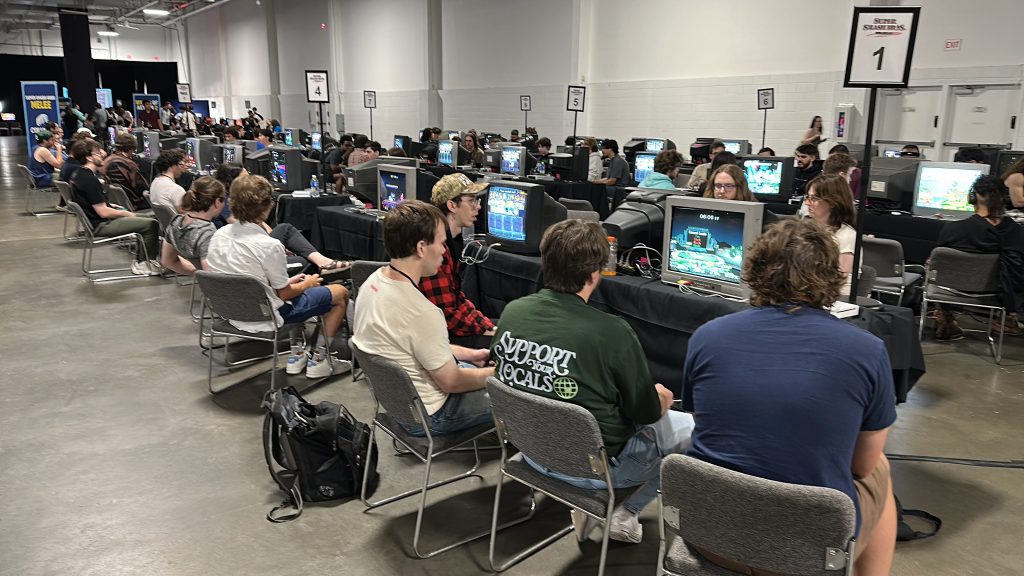
Suddenly, a strange panic began to take hold. It was a feeling that I hadn’t had since I was a teenager: the paralyzing fear of being badly beaten at a video game. From the first moment, I could tell that I was simply not at the same level as even the average players here; and I felt sure that, if they saw me play, I would be laughed at. I felt ridiculous: a man at the age of 34, having lived in a foreign country, published several books, and worked for years as a teacher—paralyzed with fear at the thought of losing a video game. But the anxiety was real.

Indeed, it was so real that I had to leave the venue. Breathing heavily, I sat at a bus stop and even contemplated leaving, despite having paid a significant amount to sign up. But that would be cowardly, I decided. So I walked to a nearby diner, sat down, and ate an omelette. Then, still rattled, I walked to the Mill Creek Marsh Trail, a park that consists of a path through restored wetland. There, I took a deep breath, put on my headphones, and focused: “It’s just a freaking video game,” I told myself: “I can do this.”


I should give you some background. Super Smash Bro. Melee, released in 2001 for the GameCube, is the second iteration of one of Nintendo’s most popular games. Despite its age, the game is still played avidly: its fast and complex mechanics make it the most competitive version of the franchise.

As I’ve written about elsewhere, this game was a big part of my teenage years. I played it with friends and neighbors, and even brought it to school to play during breaks. And after one of my college suite mates brought his old GameCube to our dorm, I once again went through a heavy phase of Melee. But I hadn’t touched a controller since 2013, when I graduated college.
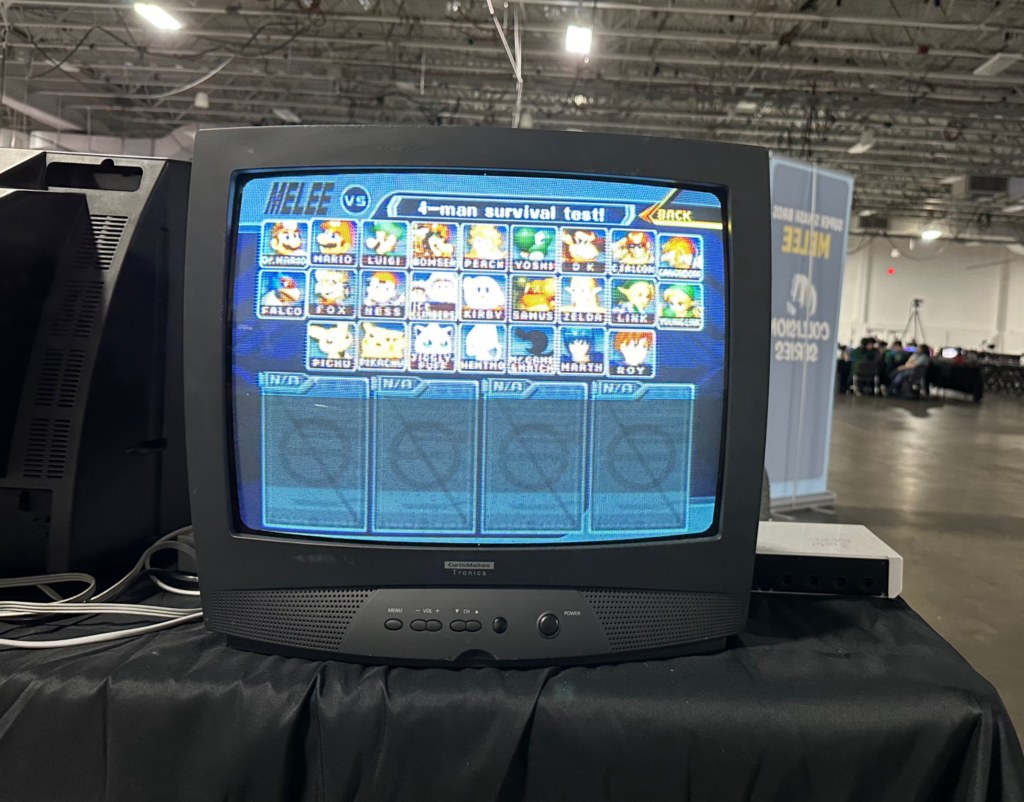
Despite this, I maintained an active interest in the game. Though I’ve never been a sports fan, I somehow became a fan of competitive Melee. Every so often, I would lose myself down a YouTube black hole, watching game after game after game. And this, despite fancying myself too enlightened and cultured for video games. For a long time, it was a secret vice. And despite my shame, I dreamed of someday playing it again.

Then, during my Christmas break, 2024, something fateful happened: my brother discovered our old GameCube in the basement of my mom’s house. Inside was Super Smash Bro. Melee. It even had our old memory card. For the first time in over a decade, I could play my favorite game. It was heaven: surrounded by all of my old friends, playing the exact game we used to play, rediscovering the pure joy of being kids. I enjoyed it so much, in fact, that I decided to take the GameCube with me back to Spain.

Eight months of practice later—most of it on my own, against the computer—I decided that it was time that I take my first real step into the world of Melee. My brother sent me the link to Collision 2025, a large tournament set to take place in New Jersey (indeed, so many important players would attend that it was classed a “supermajor”), and I decided that I had to sign up, even though I had no chance of even making it past the first round.


So here I was. I was still so nervous that I decided that I couldn’t allow myself to hesitate again. Thus, I walked back into the expo center, plugged in my controller into a free console, and started to warm up against a computer. After just a minute, however, somebody sat down next to me. “Wanna play?” he asked. 

Thus began my own friendlies. As I expected, I was far worse than virtually everyone in attendance, and our matches mainly consisted of me being tossed around like a rag doll. Still, it was a fascinating experience—to finally see for myself how I measured against serious players. It was like playing against a professional tennis player after practicing in the park with friends: we were hardly playing the same game.

Yet much to my relief, everyone I spoke to was welcoming and kind, even as they whooped me. And I learned much about the game which I would never have learned by simply following it online.

For example, I discovered that controllers are an entire world unto themselves. Throughout the venue, there were several stands selling tricked-out controllers—for hundreds of dollars—or offering customization services, swapping out buttons and joysticks. And here I was, with an original, unmodified GameCube controller from 2001.

One player I played, JKJ (everyone goes by a “gamer tag” at these events; mine is Royboy), gave me a close-up look at his controller: it had fabric wrapped around the handles, and extra notches around the joystick. These notches are a controversial topic, as it makes it easier for players to angle their joysticks more precisely. JKJ explained that he thought notching was unsportsmanlike, but he started doing it because the practice is so widespread.

Another player I met—whose gamer tag I can’t recall, but whose real name was John—played with a different kind of controller entirely. It was a kind of black rectangle, the size of a traditional keyboard, but with much larger buttons. This is the B0XX Controller, which was developed by the smasher Hax$ (who died under tragic circumstances) for those suffering from joint and wrist problems.

“Are you squeamish?” he asked, after I inquired about the controller. I said “No,” and he showed me a video taken by his surgeon: his wrist was sliced open, and a gloved hand was manipulating his arm to show the tendons, muscles, and nerves. John explained that he was practicing on a traditional controller (“frame-perfect ledgedashes,” if you want to know the technique) when he felt something pop in his wrist. Apparently, a tendon had snapped out of its sheath, causing severe pain.

Now, after surgery, he has a scar and uses this ergonomic controller. Just because it is a video game doesn’t mean that you won’t get an injury.

I spent several hours playing and socializing before deciding to call it a day. The next day, Saturday, was when the real tournament began. At least I was warmed up.


For me, Melee is pure nostalgia. But the next day brought even more nostalgia, in the form of Jackie Li. Jackie grew up with me and my brother. He was over at our house so often that he might as well have been a third sibling. We would spend hours each day together. My mom would give him rides to school in the morning. He knew everyone in my family—even coming up to see my grandparents in the Catskills.

Like many kids, our main activity together was video games. We played them obsessively as kids. And Jackie was always the best. Nowhere was this more true than with Melee. Although I took the game very seriously, spending hours honing my technical skills, and although I could beat everyone else, often quite easily, I could never beat Jackie. He would win nine out of ten games, and no amount of practice ever seemed to bridge that gap.
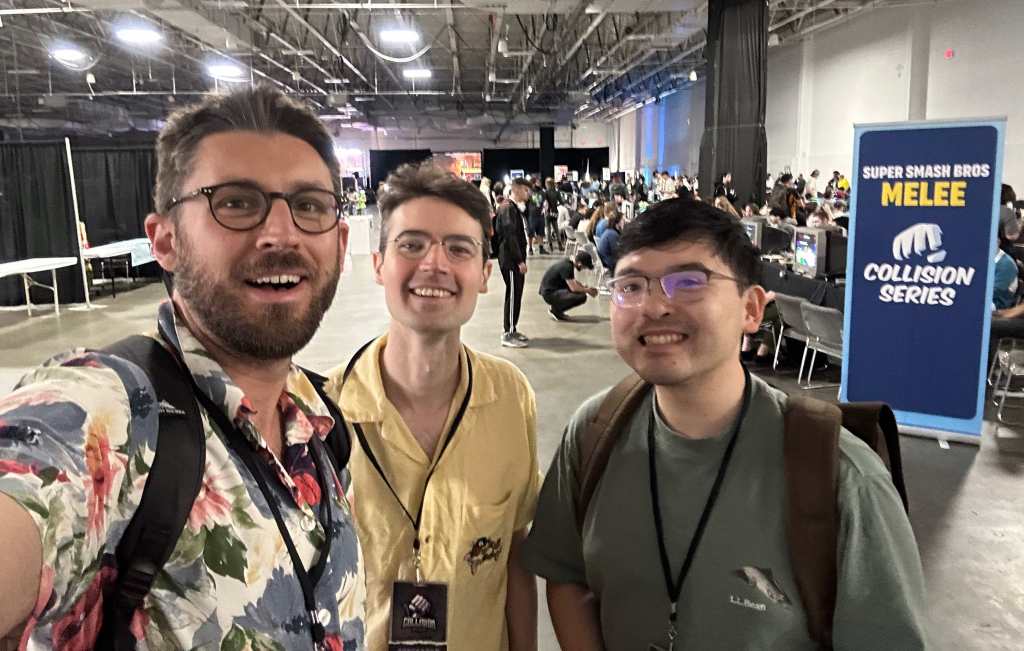
From left to right: me, my brother, and Jackie

My failure to beat him even followed me to college, as we both attended Stony Brook University. My suite mate got a GameCube, and I commenced to beat everyone who sat down to play me. But when Jackie came over, I still couldn’t win.

But all of us drifted apart after college. Partly it’s because I stopped playing video games, and partly it was simple neglect, and partly it was my move to Spain. But the impending tournament jogged my memory, and I decided that I had to reach out to Jackie. More than a decade had gone by, and I didn’t even have his phone number. So I sent him a message through LinkedIn. He agreed, and on Saturday morning he met me and my brother in Port Authority, looking just as he looked the last time I’d seen him.

Seeing somebody from your past after so long is almost trippy. It is a disorienting mixture of familiarity and strangeness. You know one another intimately, and yet hardly know one another at all. But it did make one thing clear to me: Our memories are stored in other people.

As I spoke to Jackie, huge swaths of my childhood came flooding back—nothing terribly important, but lots of little things, things that I hadn’t thought about in a long time.

So much of what we think of as “maturing” involves forgetting—leaving behind old identities that no longer serve us. There is definitely a power in this, the power of reinvention. But there is also a kind of spiritual danger, I think, since we can forget important aspects of ourselves.

Becoming an adult, I’ve found, eventually means integrating some of the identities we left behind, at least to some degree. And though it’s silly, I think my own changing attitude towards video games illustrates this process. When I was younger, video games were pure fun—absolutely engrossing, an escape from life, a competitive thrill. But at a certain point I forswore them: I decided that they were for losers, a huge waste of time, and brought out the ugly competitive side of players.

This was useful to me, since it allowed me to focus on socializing, on music, on school, and so on. But this left a huge part of my childhood as a black hole, a write-off. Now that I’m older, I’ve come to see video games as a qualified good. They are, after all, just a type of game; and our love of playing and creating games is one of our species’s most distinguishing qualities. Of course, their nature makes them more addictive than, say, Parcheesi. But nobody who has witnessed football culture in Europe, or even the steel-willed dedication of an avid chess player, can argue that video games are uniquely bad in this respect.

Indeed, crazy as it sounds, I am now inclined to say that Super Smash Bros. Melee must be one of the greatest games ever made. And now I was ready to compete.


The three of us entered the venue and sat down to play. Jackie was going to help me warm up before the tournament. This was like being in a dream. Here I was, over a decade later, ready to play my arch-rival—the one who I learned with, the one who always beat me. All these years later, what would the result be?

Strangely, anticlimatically, the result was nearly the same as it had always been: He still had a serious edge on me, beating me in about 90% of our matches. (It turns out that he was also practicing occasionally over the years.) And this brings me to another fascinating aspect of this game, and of games in general: the reality of skill.

Now, if you don’t know much about Melee, the game could seem to involve a great deal of luck. After all, players are making split-second decisions in situations that, chances are, they had never seen before—at least not in that precise configuration. The same is true of many games and sports: to the untrained eye, they seem to be up to chance as much as skill. But the reality is that skill is something as real and tangible as a controller: it is measurable and tends to be fairly consistent through time.

The results of the tournament speak for themselves: the first, second, and third place finishers (Zain, Hungrybox, and Joshman, respectively) were the first, second, and third place seeds. In other words, the results were exactly what was anticipated based on the player’s rankings.

This is not to say that there weren’t “upsets.” The 4th-place finished, lloD (a practicing doctor, as it happens), was seeded 13th; and the 7th-place finisher, Zamu, was seeded 23rd. Clearly, a player’s official rank isn’t a perfect reflection of their skill at a given moment (and we should be grateful for that, as the game would be boring to watch otherwise). But what strikes me as more notable is that even these “upsets” weren’t radical miscalculations. It is not as if a player came out of nowhere to finish in the top 8.

Another striking feature of skill is how it can appear to follow an exponential scale. I will illustrate this point with my own tournament experience. My first-round opponent was a player who went by “notsmoke.” He beat me handily, winning every game by a significant margin. The set was over in less than 10 minutes. But as soon as I congratulated my opponent, his second-round pick sat down for the match. This was Agent, a ranked player, who proceeded to beat notsmoke nearly as badly as I’d just been beaten. Agent was, in turn, knocked out handily by Zuppy, who in turn was eliminated without much ado by Moky. And on and on.
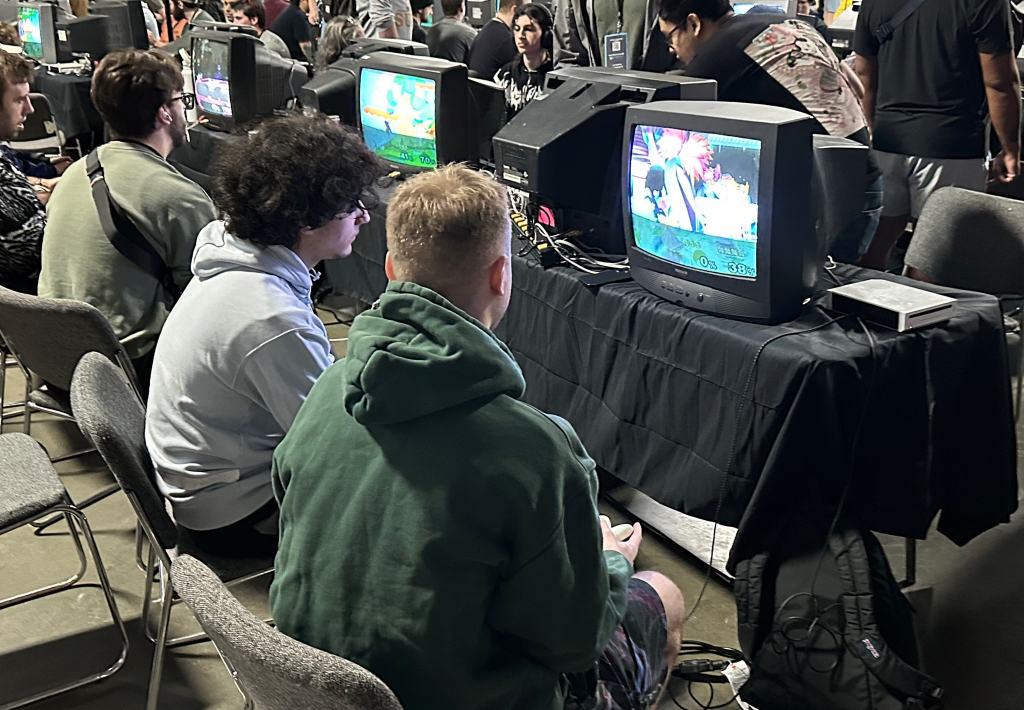
The striking thing about all this is that, to me, the skill levels of (say) Agent, Zuppy, and Moky appear to be nearly indistinguishable, and yet there are significant chasms between each of them. And the gap between Moky and Zain (the winner of the tournament) is just as significant still.

To round out my own tournament experience, I had one more match to play before I was knocked out entirely. My new opponent was ENFP, who beat me even more dramatically than notsmoke (though rather politely, I should add). And that was it for my stint as a competitive gamer.


The rest of our time at the Meadowlands Exposition Center was just spent watching. And here I want to add a note on the demographics. As you might imagine, the large majority of the attendees were male (stereotypes do sometimes hold true). But I was surprised, and charmed, by the significant number of trans people. When I was a kid, video game culture was quite misogynistic and homophobic (and perhaps corners of it still are); but now, players are introduced along with their pronouns. Most everyone was in their 20s and 30s, though some were considerably younger. For example, one up-and-coming player, OG Kid, is (as his name suggests) still a teenager—meaning that he is younger than the game itself.

One jarring aspect of the tournament was seeing so many famous players. Virtually all of the major competitors were in attendance, with the notable absence of Wizzrobe (who dropped out last minute), Cody Schwab (the current #1 player), and Mang0 (often considered the greatest player of all time, who had just been banned due to his drunken misbehavior at another event). Everywhere I looked, there were faces I recognized: Axe, Salt, Junebug, Aura, Nicki, Aklo, Jmook, Trif… I was starstruck, but then realized that none of these people is, in truth, really famous. They were legends only in the context of a fighting game that is over two decades old.

Floating among the crowd, his hair died blond, was Zain—the current #2 player and the heavy favorite to win. He was surrounded by people who knew exactly who he was, who admired and envied him; and yet he seemed to be separate from the crowd, just drifting from place to place. At one point, he stood next to me as I observed a match—the tournament’s eventual winner next to its last-place finisher. And it occurred to me that I had never stood so close to somebody so good at anything.

Zain stood there—alone in a mass of people dedicated to this game, people who had collectively devoted hundreds of thousands of hours to honing their own skills—secure in the knowledge that he could beat any one of them. And it made me reflect on why people devote themselves to such seemingly pointless activities.

Aside from fun (and the game is very fun), the most obvious answer is escapism: to focus your attention on something unrelated to your daily life, where there are no consequences. But that is not the whole story. For some, it is the community—being a part of like-minded people, the chance to make friends and share interests. And the game also offers an opportunity to forge a new identity— nerdiness transmogrified into coolness.

But for Zain, and those like him, I realized that they were here for something else: the pure pursuit of a skill—skill for the sake of itself, being the best they could be at this one specific task. There is something almost inhuman about it—requiring, as it does, such single-mindedness of purpose that everything else in life becomes secondary. And yet, in a way, this pursuit of skill for its own sake might be the most human quality of all—the quality that drives us to the highest reaches of excellence.

But there is a high price to pay. The irony is that, thanks to my reunion with Jackie, I probably enjoyed the tournament quite a bit more than its champion. And to enjoy things you’re bad at—to enjoy them, especially, with old friends—is also a very human quality.
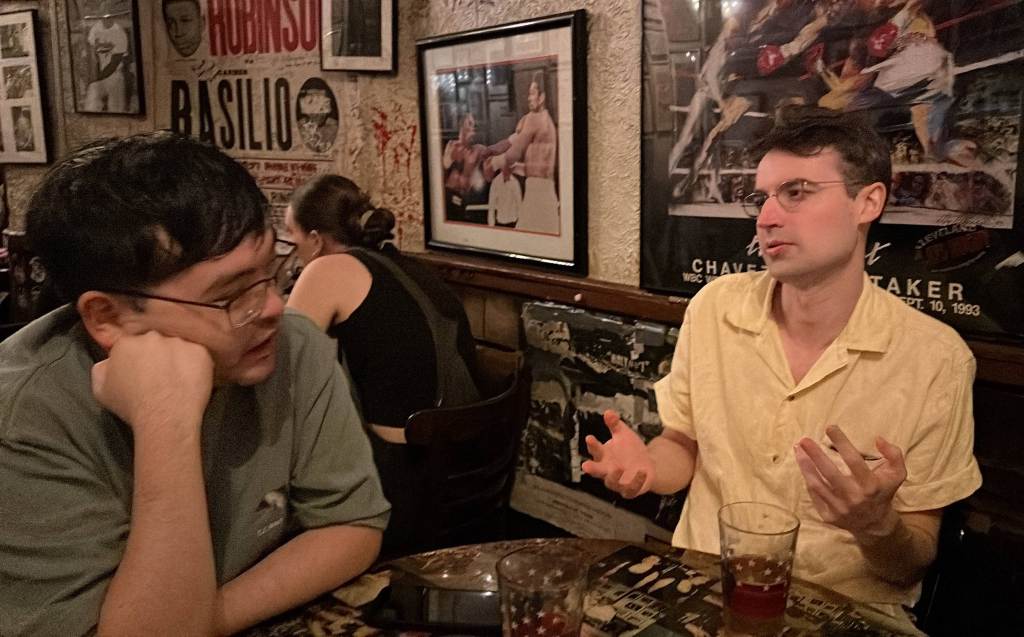
After the tournament, we went to an iconic bar in Times Square, Jimmy’s Corner

DBZ & SSBM: An Adolescence in Two Acronyms

DBZ & SSBM: An Adolescence in Two Acronyms

After I got home from long and boring day of school, I would sit on the couch, turn on the television, and lazily do my homework during the commercial breaks.

This procedure—which I followed for years—guaranteed that homework would be torture. Even simple tasks could take ages, from starting, stopping, forgetting, and starting again. And since I did not devote even half my attention to the work, I did it badly without learning anything. Yet by the time I got home from school I was so burnt out that I had to distract myself from the work as much as possible, just to stay sane. It did not help that this homework was inevitably the most pointless drudgery—“busywork,” as my mom called it—requiring time but no thought, some attention but no creativity. Television at least took the edge off.

In the late afternoon, when I got home, there usually wasn’t anything very good on. As the day waned the quality would improve, until, finally, it was time for Toonami. Toonami was a programming block on Cartoon Network, specializing in Japanese anime dubbed into English. The programs were presented by TOM, an animated robot man—surprisingly pudgy for an android—who was a kind of space-pirate broadcaster, transmitting the shows from his spaceship all across the galaxy. You can imagine that the teenage me was entranced.

The first anime to win me over, and the one that was to remain my favorite, was a show called Dragon Ball Z. On the surface it was like any superhero cartoon; the characters had powers and fought bad guys; and since I had long been a fan of Superman and Batman, this drew me in. Indeed, the protagonist, Goku, had a backstory almost identical to Superman’s. One of the last survivors of his destroyed planet, Goku arrived on Earth as an infant and was brought up as a human. Yet his alien fisique soon proved much stronger than a normal human’s, and so on, etc.

All this was standard stuff. But there were some odd discrepancies between DBZ and American superhero cartoons. DBZ had a surprising amount of ethical ambiguity—at least, surprising for a young teenager. Bad guys sometimes became good guys, or at least semi-good guys; and the good guys were often foolish, cowardly, or just silly. This did not happen with Superman and Batman, who were always good, brave, and wise, and whose enemies were always arrogant, cowardly, and bad. Another fundamental difference was the concept of training. The characters in DBZ did not simply have powers, but had to continually train to develop their abilities, which grow as the series progresses.

But the most striking difference were the fights. Whereas Batman threw batarangs and gave karate chops, and Superman mainly stuck to a few good jabs and hooks, the characters of DBZ would disappear into a blur of punches and kicks, shoot energy rapid-fire until whole landscapes were engulfed in flame, make the entire earth shake as they charged their attacks. The fight choreography was light years beyond the most daring American cartoons. And the fights lasted longer—much longer. Two characters could be embroiled in a fight for whole episodes, sometimes even multiple episodes: hours and hours of anime action. After DBZ, the Justice League seemed tame.

The show was unashamedly centered on fights in a way that I found irresistible. The plot became ever-more perfunctory, merely serving to set up meetings between powerful characters so they could proceed to beat each other to pulp or blow each other to bits. If you think that the plot of a usual superhero movie is thin, try watching DBZ. Everything—the characters, the pacing, the story—is dictated by the demands of epic battle. Characters have epiphanies just so they can reach another power level; characters fall in love just so they can have kids, who will have their own battles; characters make irrational decisions just so that battles will be prolonged.

DBZ is most infamous for its long power-ups, wherein a character will scream his head off while his body emits light and heat in a fantastic buildup of energy. I almost admire how shamelessly this device is used by the writers to fill episodes and build tension. This is the only explanation for the power-ups, since they make no sense within the story: the fighter is perfectly vulnerable during the ordeal, just standing there and screaming like a wild monkey. And yet time after time their opponents let it happen, despite the possibility that a successful power-up spells defeat. Even wicked world-destroying villains are above interrupting this sacred process, it seems. While this yodelling lightshow takes place, all the other characters retreat to gape and repeatedly exclaim how amazed they are. Certain phrases become obligatory: “I can’t believe how powerful he’s become!” “What? Impossible!” “This energy! Can it really be from one person?” Even by the end of the series, when they have all seen a hundred power-ups, the spectacle never fails to fill them with awe and dread.

Sometimes these power-ups led to transformations, which is another hallmark of DBZ. The young Goku found that, like a sort of King Kong werewolf, he transformed into a giant dog-monkey during a full moon—until cutting off his tail solved that problem. His rival Vegeta, another Saiyan, used this transformation against Goku until, being similarly dismembered, he was deprived of this power. And this is not the end of the Saiyans’ ability to transform. The most iconic of these is the Super Saiyan, in which the hair turns golden and stands straight up. But this turned out to be just the tip of the iceberg; Super Saiyan 2 and 3 followed, and in other media even the ape-like Super Saiyan 4.

And the Saiyans aren’t the only ones who transform. The show’s most famous villains—Frieza, Cell, and Majin Buu—are all distinguished by their many metamorphoses; and these are not just changes in hairstyle, but involve a complete modification of their bodies. I suppose we associate these bodily mutations with insects, which is why it seems like a villainous thing to do. Indeed, Cell has beetle wings, and Majin Buu emerges from a cocoon like a butterfly. Even more nefarious, these two villains unlock their new forms by absorbing other people, like giant mosquitoes. And yet it is interesting to note that, for all three of these villains, their most powerful form is their most humanoid. The combination of human and animal traits is, after all, the essence of monstrosity.

§

A few years after I started watching DBZ, I began to delve into Super Smash Brothers Melee. In case you are not familiar with this game, SSBM is a fighting game originally released on the Nintendo GameCube in 2001. It is the sequel to the original Super Smash Brothers game on Nintendo 64, which I had been playing with my friends since elementary school. Some of my happiest memories from childhood are of sitting in my best friend’s basement playing Smash. And Melee was just as good, if not better. Both Smash and its sequel Melee are ideal party games—there is no backstory, the objective is clear, they require little skill to enjoy, and up to four people can play at once. Just choose a character and try to knock the other guy off.

My brother and I bought SSBM almost as soon as it came out, and for a while we played it the way it was designed to be played: as a lighthearted, meaningless diversion among friends, much like Mario Kart. But then, in high school, we began to take games more seriously. This began when we started playing online computer games, both greatly widening the pool of our competition and introducing us to gaming culture—a culture of competition adequately summarized and parodied in the online series Pure Pwnage (which we also watched). The goal was not just to have fun, but to be the best, to crush and humiliate your opponents: in short, to pwn noobs.

It was during this period that our neighbor visited us one day, and said he wanted to play SSBM. This was somewhat odd, since we believed that SSBM was just for button-mashing fun, not for serious high-level play. “But look,” our neighbor said. “I found out about advanced techniques.” And he searched a video of the wavedash.

The wavedash is the most iconic advanced technique of SSBM. It is hard to explain what it is without giving some idea of the game. Normally, you can run, jump, or roll to move around. These are all standard controller inputs, a straightforward combination of a button and the joystick. But a wavedash is executed by pressing the jump button, and then immediately air-dodging (by pressing another button while angling the joystick) diagonally towards the ground, thus interrupting the jump: two inputs, one after the other. The result is that the character slides across the stage, sometimes very quickly. This method of locomotion was likely not intended by the game’s architects. But it works wonderfully.

The wavedash alone significantly added to gameplay, giving players speed and maneuverability that weren’t available before. But this was only the beginning. There were lots of these so-called advanced techniques: short-hop, dashdance, L-cancel, crouch cancelling, directional influence, wall-teching, and on and on. We had played the game for years and had never even suspected the existence of higher-level play. Out of the package, the game seemed as simple and obvious as Parcheesi; that was its appeal. But these techniques opened up an entirely new level of gameplay, turning a lighthearted diversion into a lightning-fast contest of reflexes.

Seeing these techniques in action was incredible. Top players made combo-videos, showing how they could string together attacks in inescapable sequences, juggling their opponents across the fighting stage and then sending them flying. Even more impressive were the videos of professional players. This was around 2007, right before SSBM was discontinued from its three-year run on the Major League Gaming circuit (a company that organizes gaming tournaments with big prizes and high publicity). This meant that YouTube was already full of videos of high-level players competing in formal competitions. PC Chris, KorenDJ, Azen, Chudat, Isai, and Ken—we watched their matches and marvelled at their prowess. Soon enough my neighbor and I were practicing these advanced techniques and sharpening our skills against one another.

Here I should pause to explain a bit about how SSBM works. Unlike in other fighting games, where you have a certain amount of health or stamina that is depleted by your opponent’s attacks, in SSBM you have percentage. This determines how far you are sent if an attack hits you. A player with 0% will hardly move from an attack, while a player with 150% will take off like a cannonball. If you fly too far off stage, in any direction, you lose a “stock,” or life. Another big difference is that there are no predetermined combos in SSBM. (As in, no series of controller inputs automatically results in a combo.) Combos have to be discovered or invented by the player, and rely on a mixture of luck and timing to pull off. The result is a far freer fighting game, with death may come at any time (or postponed indefinitely), and where each sequence of moves is improvised in the moment.

Another attraction of the game is its wealth of characters. There are twenty-six to choose from, each with a different set of moves, a different height and weight, a different walking and falling speed, and consequently requiring techniques and styles of play. And though some characters are generally far stronger than others (competitive players arrange them on a tier-list from best to worst), the game’s architects did an excellent job in giving each one unique strengths and weaknesses, making each two-way matchup unique. I mostly played Captain Falcon, a mid- to high-tier character with strong moves and fast movement, but who suffers from predictable recovery and being easily comboed. My neighbor mostly played Marth, one of the best characters in the game, who nevertheless suffers from a difficulty in finishing off opponents.

After a few months of practice, my neighbor and I were good enough that we could beat any normal player without much trouble. And yet even though I improved greatly, I was constantly frustrated at my inability to best my neighbor. No matter how good I became, he was always at least slightly better—sometimes more than slightly—and no amount of practice could bridge the gap. This made me furious. Even for my adolescent age, my maturity level was not high. I had a low tolerance for frustration and had difficulty controlling my anger. So sometimes, when being badly beaten, or when victory was snatched away from me at the last moment—as it always seemed to be—I would explode and slam my controller on the ground, or throw it across the room, sometimes damaging or even breaking it. Fully indoctrinated to the gaming ethos, I wanted only to win, to be the best, to crush my opponents; so when I was myself beaten, I felt worthless, empty, powerless.

This experience playing videos games, incidentally, is one reason why I generally avoid competitive situations. While competition seems to bring out the best in some people, I think it brings out the worst in me. I become petty and spiteful: arrogant towards those I beat and resentful towards those who beat me. So focused on winning, I cannot relax and enjoy what I’m doing, which ironically makes me less likely to win. The pressure I put on myself makes me nervous; I think about how good it would feel to win, how awful to lose, and my palms begin to sweat and my mind races; I panic, my playing suffers, and I lose—and then the rage comes, and I mentally chastise myself until I feel like a little worm squirming in the mud. This is more or less what would happen to me as I became ever more engrossed in competitive gaming, which is why I have developed a reluctance to compete in adulthood. Since so much of life in a capitalistic world is based on competition, at times this puts me out of harmony with my surroundings—but that’s another story.

The closest I ever came to the professional player scene was my one trip to a local tournament. I went with my neighbor. My mom drove us. The tournament was held in a video game shop next to an old toy store I used to go to. Strange to say, my memory of this tournament is very vague. I remember being in a cramped room full of chairs and TV screens, and feeling intimidated by all the older people around me (at around 15, we were probably the youngest there); I didn’t say a word to anybody except my neighbor. I remember sitting down to play my first match with sweaty palms, and I remember being beaten, but putting up a respectable fight. And that was it for me.

So my very promising career as a professional gamer was quickly snuffed out. Discouraged by the huge skill-gap that remained between myself and even moderately ranked players, I lost heart. Not that it mattered much, since the following year my interests abruptly switched from video games to playing guitar—but, again, that’s another story.  

§

The reason that I am writing about these two adolescent obsessions of mine is because, strange to say, they never entirely left me. After many years of scarcely thinking about Goku or Captain Falcon, I now find myself regularly watching clips from DBZ and SSBM matches, and really loving them. And this, in a man who normally looks down his nose at all lowbrow pleasures. Why the resurgence in interest?

Partly my renewed interest has been sparked by an actual resurgence in these media. After a long hiatus, the Dragon Ball Z saga was continued in the new series, Dragon Ball Super. And after a period of decline following the release of SSBM’s sequel, Super Smash Brothers Brawl for the Nintendo Wii (a game far less amenable to quick, competitive play), the Melee community has rebounded and grown, with regular tournaments all over the world, and even a full-length documentary devoted to the game’s early years.

I began watching Dragon Ball Super out of boredom and a sense of nostalgia, but I was quickly hooked into to the series. In every way it is an improvement from DBZ. The story has far less filler—notably, the power-ups only take a few minutes. The already perfunctory plot-lines about monsters trying to blow up the world have been scrapped for simple tournaments, giving the characters a chance to pummel each other without further ado. The villains are, for the most part, no longer shapeshifting monsters but other martial artists. And the animation is much sharper and impressive. Yet the basic elements remain the same. The humble Goku trains to unlock new transformations (Super Saiyan God, Super Saiyan Blue, Ultra Instinct) in order to beat the enemy, who is, as usual, arrogant and overconfident.

I started to watch the Smash Brothers Documentary out of a sense of curious irony, amused that somebody would make a documentary about such a silly subject. But I soon found myself genuinely impressed. Indeed, for a fan-made documentary uploaded directly to YouTube, it is almost absurdly well-made—informative, entertaining, and attractive. Directed by Travis ‘Samox’ Beauchamp, the documentary contains nine episodes, each of which is dedicated to a notable player from SSBM’s “Golden Age” (the years following its release): Ken, Isai, Azen, PC Chris, Korean DJ, Mew2King, Mango, with many other players making an appearance. Having followed these players in high school, I was fascinated to hear their own story in their own words. And the commentary, far from the usual callow gamer smacktalk, was consistently thoughtful and humane—especially that of the player Wife. In short, the documentary really captures the magic of the game and the community which has formed around it.

But even if DBZ and SSBM are still going strong, it does not explain my continued interest. Again, I have a tendency to be extremely pretentious when it comes to the media I consume. I seldom resist the opportunity to denigrate popular music, films, and books as simplistic, formulaic, childish, etc. (Here you see my nasty competitive side expressed in a different way.) And yet here I am, still watching a cartoon about men flying and fighting, still watching people manipulate characters on a screen, still enjoying the adolescent obsessions that I thought I had left off long ago. Clearly, these two media have a consistent appeal to me. But why?

They are similar in several conspicuous ways. Both SSBM and DBZ focus on fast-paced fights, with characters dashing, jumping, and flying through the air—shooting projectiles, exchanging blows, sending each other flying. In both, the fight itself is more compelling than the outcome. Though DBZ has good guys and bad guys, we do not watch to see who wins (it’s always Goku), but to see the fight itself—the sheer spectacle of it. And even the story-mode of SSBM does not have anything resembling a plot. The whole substance of SSBM and DBZ is made of rapid punches, flying kicks, and energy beams. And since the fight is the main focus, both media include training as a major focus. Goku is not simply strong, like Superman is; his strength is the product of work. Top SSBM players, too, must put in endless hours of practice to compete on their level.

Another striking similarity is that both SSBM and DBZ are male-oriented. Though Dragon Ball Super finally incorporated some female fighters, DBZ’s fighters were exclusively male; and though I do not have the statistics, I believe the show’s audience was similarly male-dominated. One look at an SSBM tournament will reveal how completely boy-centered is the game. Every top player I know of is male; the commentators, too, are all men; and the audience is inevitably a chorus of husky voices. Perhaps this should be expected. True to the cultural stereotype, both DBZ and SSBM are bereft of romance and sentiment, and instead focus on violence—a traditionally male vice.

It should be noted, however, that both the show and the game are pretty tame. Indeed, I would argue that both DBZ and SSBM are distinguished by a kind of vanilla violence, where characters are punched but do not break their bones, where they lose a game or are sent to the afterlife but never really die (the important characters in DBZ are inevitably revived with the titular dragon balls)—where the stakes are, in short, never very high. (The resemblance only increased in Dragon Ball Super, where the characters are eliminated from the tournament by being knocked off the stage, just as in SSBM.) It is a violence without bloodshed and without consequence, for the pure sport and spectacle of it. And this, perhaps, explains why the two attracts similar demographics, namely “dorky” men: they are male but not manly, competitive but not cutthroat, violent but not vicious. It is purely imaginative fighting.

§

DBZ and SSBM are similar, then. But again I must ask: Why do they hold such a consistent appeal to me? The most obvious answer is nostalgia. I am a boy who grew up right when they were coming out, and they remind me of my childhood. This, however, leads to another question: Why did they appeal to me in the first place?

This is, perhaps, also no mystery. I fit their demographics pretty well. I was a dorky boy who has never been popular or good at sports. Like other video games, SSBM gave me a chance to excel at something competitive. I could not beat anyone in any physical activity, but I could run circles around my opponents on the screen. And Goku was the perfect hero for a boy in my situation: whose strength was the product of determination, and whose persistent efforts could defeat his more naturally talented foes—muscly monsters whose overconfidence always led them to neglect their own training. In short, the imaginative identification with the heroes of DBZ and the characters of SSBM could transform a slow, weak, pudgy kid into a lightning-fast, super-strong fighter.

SSBM and DBZ were a form of escape in more ways than one. Not only did they provide me with an escape from my nerdy, unathletic self, they also provided a much-needed relief from the omnipresent boredom of school. My memories of middle and high school are, with some notable exceptions, sitting in a claustrophobic room, feeling tired and bored out of my mind, seldom paying attention to what was being said or read. Despite this, I was actually a good student—at least as far as grades were concerned. But the endless amounts of busywork, the dry lectures, and the repetitive routine had me constantly on the verge of burning out completely.

When I got home my first priority was to unplug, to forget everything from the day and to put school as far as possible from my mind. Shows like DBZ and games like SSBM were perfect. They require no thought to understand and enjoy. Indeed, then and now their primary function for me is to switch off my intellect, leaving only a kind of dim, dog-like awareness of movement. When I indulge in these media I am in a trance, as incapable of critical thought as is a goldfish.

Many times in later life I have found myself feeling the same way I felt in high school: bored to tears by my daily life—an endless parade of meaningless obligations and unrewarding tasks—and looking for some way to forget it all. Intellectual pleasures are arguably not the best way to do this, since they sharpen rather than blunt the attention. But SSBM and DBZ are perfect: cartoon fights without meaning, appealing to my primitive brain and leaving the frontal lobe blissfully empty. Indeed, I have found that when I am particularly keen to watch SSBM fights on YouTube, it is usually a sign that I need to liven up my routine.

In saying these things I hope I have not insulted or offended anyone connected with these media. I have only the warmest feelings towards DBZ and SSBM; and if I wore a hat I would take it off to the makers of the first and the players of the second, who have provided me with so many happy hours. For the world—at least how it is now—necessarily involves drudgery. As long as we have routines we will have boredom. And some light escapism is, I think, a healthy and natural way of coping with the limitations of our own identities and the plodding monotony of the day-to-day.

[Cover photos taken from Dragon Ball Wiki; its use falls under Fair Use.]