Review: Mozart’s Letters

Review: Mozart’s Letters

Mozart’s Letters, Mozart’s Life by Wolfgang Amadeus Mozart

My rating: 5 of 5 stars


The best time of year for reading is, for me, the time between Christmas and New Year’s. The weather is cold, school is out, and I feel relaxed and fully able to focus. I find myself devouring books with great relish, and that is precisely the case with this wonderful collection of Mozart’s letters.

First, a note on the translation. Mozart’s writing is highly idiosyncratic—full of misspellings (at least when he was younger), multiple languages, puns and wordplay. Spaethling’s translation is thus a kind of virtuosic performance in itself, as he brings as much of this exuberance seamlessly into English. As an example, I will quote the first letter in this collection, written when Mozart was just thirteen:

My dearest mama,

My hear is filled with alott of joy because I feel so jolly on this trip, because it’s so cozy in our carriage, and because our coatchmann is such a fine fellow who drives as fast as he can when the road lets him.

Spaething’s careful rendering of Mozart’s peculiar style allows that composer to fully come to life in this book. The result is undoubtedly one of the most fascinating books in the history of music. Though the letters all have the feeling of being dashed off in a great hurry—much like some of his music—they brim with energy and intelligence, and create a remarkably revealing look at the composer. To get an idea for the Mozartian style, it is worth quoting one of his later letters. This one is to his father, merely describing a pleasant outing in a city park:

I just can’t make up my mind to go back to the city so early—the weather is just so beautiful—and it’s so pleasant to be in the Prater today.—We had a little something to eat in the park, and now we’ll stay until 8 or nine o’clock in the evening.—The only company I have is my pregnant little wife—and her only company—consists of her little husband, who isn’t pregnant but is fat and happy…

The man revealed by these letters is full of contradictions. On the one hand, Mozart is capable of being headstrong, defying his father and even the musical establishment, seeking out his own artistic path. And yet, he is also weak-willed—easily swayed by flattery, improvident with money, and short-sighted regarding his career. One gets the impression that his father had inadvertently been overprotective—shielding the child genius from practical concerns so that he could only focus on music—and when Wolfgang had to make his own way outside of the stern, practical, and worldly guidance of his father, he quickly sank into dysfunction.

This is illustrated most painfully in the last section of this volume, which is filled with repeated and increasingly desperate pleas to his friend for money. His letters to his father are also quite revealing of this dynamic, though perhaps inadvertently so. It is amazing to think that one of the greatest composers of history could have been, in many respects, a frustrating disappointment to his father, but this seems to have been the case. In his letters to his father, he seems always to be pleading for Leopold’s approval, even as the imprudent Wolfgang continually flouts his father’s advice.

And yet, revealing as they are, the best letters in this volume are not those to his father, but to his cousin “Bäsle” (Maria Anna). Mozart seems to have found a kind of ideal playmate for his brand of practical jokes and bathroom humor in his cousin, and his letters to her are full of the most extraordinary playfulness—not to mention, a kind of fixation on excrement which sometimes goes beyond the bounds of humor into obsession. Here is an excerpt of perhaps the best of these letters:

Dearest cozz buzz!

I have received your highly esteemed writing biting, and I have noted doted that my uncle garfuncle, my aunt slant, and you too, are all well mell. We, too, thank god, are in good fettle kettle. Today I got the letter setter from my Papa Haha safely into my paws claws. I hope you too have gotten rotten my note quote that I wrote you from Mannheim…

In these letters, perhaps most clearly, you can see the kind of childlike charm of Mozart. And this immaturity is arguably the source of both his particular genius and his constant financial troubles. Both Mozart’s letters and his music brim with a wonderful sense of play—as if his mind were constantly prancing from one idea to another—picking up one form, giving it a twirl, and setting it down into a new pattern.

Yet it would be wrong to accuse Mozart of superficiality. For underneath this childlike playfulness is a deadly serious commitment to his art. This is readily apparent in this volume, as the constant references to music in these letters belie a kind of workaholic productivity as well as a dedication to reaching the highest possible standards at all times. He was anything but an unconscious composer, as he often shows a keen awareness of how his music should affect his listeners.

It is interesting, I think, to compare these letters with those of another wonderful correspondent, Vincent Van Gogh. At first glance, the two artists could not be any more dissimilar: Van Gogh started late and never achieved fame during his lifetime, whereas Mozart was famous since his childhood. The painter was the furthest thing from a technical master, whereas Mozart dominated both instrumental and compositional technique in multiple domains.

And yet, these two men—both of whom died much too young—share one dominating characteristic: an overwhelming, uncompromising commitment to their art. Arguably, this monomaniacal devotion led both of them astray, as they both died isolated and penniless. But who can honestly wish that either man had been even a whit more “practical.” Indeed, I think the world would be a better place if we had more people to dedicate themselves with reckless abandon to the creation of beauty. And such a man is ultimately what these letters reveal.

View all my reviews

Review: Letters of the Younger Pliny

Review: Letters of the Younger Pliny

The Letters of the Younger Pliny by Pliny the Younger

My rating: 4 of 5 stars

… the work of getting anybody to cheerfully undertake the monotony and drudgery of education must be effected not by pay merely, but by a skillfully worked-up appeal to the emotions as well.

I read this book in preparation for a recent visit to Pompeii; and it was an excellent choice. The ancient letters and the ruined city make for an ideal pairing, as both offer a remarkable look into daily life in ancient Rome. Pliny had a long and eventful career: an orator, magistrate, lawyer, and writer. His correspondence includes mundane details, tender love letters, poetic reflections, philosophical musings, and much else. Whatever the subject, his personality shines through: intelligent, urbane, loyal, if a bit ostentatious and pompous. He is, above all, eloquent; and his letters are without exception written in superb prose.

Though each epistle is a valuable historical document, some are conspicuously noteworthy. Most interesting for me was his description of the eruption of Vesuvius, which resulted in the death of his illustrious uncle, Pliny the Elder. He recounts his uncle’s and his own experience in two letters to his friend the historian Cornelius Tacitus. Here, with an eye to posterity, perhaps, Pliny reaches the height of his literary skill as he relates his escape from the eruption:

We had scarcely sat down when night came upon us, not such as we have seen when the sky is cloudy, or when there is no moon, but that of a room when it is shut up, and all the lights put out. You might hear the shrieks of women, the screams of children, and the shouts of men; some calling for their children, others for their parents, others for their husbands, and seeking to recognize each other by the voices that replied; one lamenting his own fate, another that of his family; some wishing to die, from the very fear of dying; some lifting their hands to the gods; but the greater part convinced that there were now no gods at all, and that the final endless night of which we have heard had come upon the world.

The collection is also invaluable for the correspondence between Pliny and Trajan. In these letters Pliny’s style is more restrained and formal; he takes the part of a supplicant and an apprentice. For the most part he is asking the Emperor for a favor or for advice. Much of it is concerned with the proper way to interpret the law and to distribute punishments, or else asking for permission to erect aqueducts, temples, and the like. Most extraordinary are two letters concerning the practice, spread, and prosecution of Christianity. Even at this early date, it was clear that the religion could grow rapidly: “In fact, this contagious superstition is not confined to the cities only, but has spread its infection among the neighboring villages and country.”

In sum, I recommend this book to anyone and everyone interested in ancient Rome. The letters are at once a model of style and a window into the past. Few books offer so much insight and pleasure for such little drudgery.

View all my reviews

Review: The Letters of Vincent van Gogh

Review: The Letters of Vincent van Gogh

The Letters of Vincent van GoghThe Letters of Vincent van Gogh by Vincent van Gogh

My rating: 5 of 5 stars

For great things do not just happen by impulse but are a succession of small things linked together.

The main problem when encountering Van Gogh is that his life has become the quintessential artistic myth of our age. The obscure genius ahead of his time, toiling in solitude, tortured by personal demons, driven by a creativity that sometimes spilled over into madness—and so on. You’ve heard it all before. You have also seen it before. His paintings suffer from the same overexposure as does his life story. Starry Night hangs, in poster form, in dorm rooms and offices; it is used in commercials and as desktop backgrounds. The challenge, then, as with all iconic art, is to unsee it before it can be properly seen.

The best way to pop this swollen bubble of this myth is, I think, to read these letters. Here an entirely different Van Gogh is revealed. Instead of the mad genius we find the cultured gentleman. Van Gogh could read and write English, French, and German fluently, in addition to his native Dutch. He peppers his letters with references to Dickens, Elliot, Dostoyevsky, Tolstoy, Balzac, Zola. His prose is fluent, cogent, and clear—sometimes even lyrical. His knowledge of art history is equally impressive, as he, for example, compares Shakespeare’s and Rembrandt’s understanding of human nature. Not only this, but he was far from insulated from the artistic currents of his day. To the contrary, he was friends with many of the major artists in Paris—Seurat, Signac, Gauguin—and aware of the work of other prominent painters, such as Monet and Cézanne.

But, of course, Van Gogh’s myth, like many, has some basis in truth. During his lifetime he did not receive even a fraction of the recognition his work deserved (though if he had lived a little longer it likely would have). He was often unhappy and he did suffer from a mental illness of some sort, which did indeed lead him to sever a portion of his own ear. What is less clear is the role that his unhappiness and his mental illness played in his work. In our modern world, still full of Romanticism, we are apt to see these factors as integral to his artistic vision, the source of his inspiration and style. Van Gogh himself had, however, quite a different opinion, seeing his suffering and illness as a distraction or an obstacle, something to be endured but not sought.

The letters in this volume span from 1872 to 1890, the year of his death. Most of them are addressed to his brother, Theo, who worked as an art dealer in Paris and who supported Vincent financially. There are also a few letters to his sister, Wil, and to his artist friends. From the beginning we see Van Gogh as an enthusiastic and earnest man, very liable to be swept up into passions. His first passion was the church. Following in his father’s footsteps, Van Gogh went to England to work as a preacher. His letters from this period are full to bursting with pious sentiments; in one letter he even includes a sermon, which he composed in English. He quickly grew disenchanted with conventional religion, however, and soon he is pining after his cousin, Kee, who rejects him and refuses to see him. Not long after that he takes in a woman named Sien, a former prostitute, and his letters are filled with his dreams of family life.

But in all of these letters, even before he decided to take up art—which he did comparatively late, at the age of 27—Van Gogh shows a keen visual awareness and appreciation. He includes long, detailed, and sometimes rapturous descriptions of towns and landscapes. He is also, from the start, independent to the point of stubbornness. He persists in trying too woe his cousin even in the face of his whole family (including Kee herself) discouraging him. He insists on taking in Sien despite the disapproval of nearly everybody, including his brother and his mentor, Mauve. When it came to art he was absolutely uncompromising, refusing to paint anything just for money, and getting into passionate disagreements with some of his artist friends (Gauguin, most notoriously).

Van Gogh’s intractability often landed him in trouble. He had a bad relationship with his parents and often quarrelled with his brother, Theo, who was his closest confidant. But it is also, I think, the quality that is ultimately most admirable in him. His personal standards drove him to work hard. He was no savant. His letters are filled with exercises and studies. He was tough on his own work and constantly strove to improve it. And though he sometimes got discouraged, there is never any hint of quitting or compromising. This is the classic story, often told. But it is easy to lose sight of how dreary and dispiriting this life could be, day to day. In films the struggling artist is enmeshed in a moving drama, and the audience always knows it will come right in the end. But for Van Gogh this was a plodding daily reality of struggle and failure, with no audience and no guarantee of ultimate success.

That we admire Van Gogh for persisting is, in large part, because his art was truly great. But what would we think if he was mediocre? This, you might say, is the paradox of persistence: We admire those who persist in the face of struggle when they have genuine talent; but when they do not, the spectacle becomes almost pathetic. What would we think of a man financially supported by his brother, constantly quarrelling with and alienating his parents, toiling away in isolation, who produced nothing beautiful? We might be inclined to call such a person naïve, foolish, or even selfish. Whether we admire or scorn stubbornness, in other words, depends on whether it eventually pays off. But in the meantime nobody can know if it will, least of all the stubbornly persistent person. It is, in short, a great risk.

Yet it cannot be said that Van Gogh wagered everything on his talent, since there is not even a hint of calculation or self-interest in his continuing persistence. He is so manifestly, uncompromisingly, absolutely obsessed and absorbed by art that there is no other option for him. Even when institutionalized and hospitalized he thinks of nothing but when, how, where, and what he can paint next. And though he at times expresses regret for the sacrifices this entails—he is especially vexed by the toll it takes on his love-life—he never discusses art with even a touch of bitterness. He is willing to live in a hovel and survive on crumbs if it means he can afford paint. To see such unqualified devotion, not in a novel or on a stage, but in the real, intimate context of his daily life is (to use a hackneyed word) inspiring.

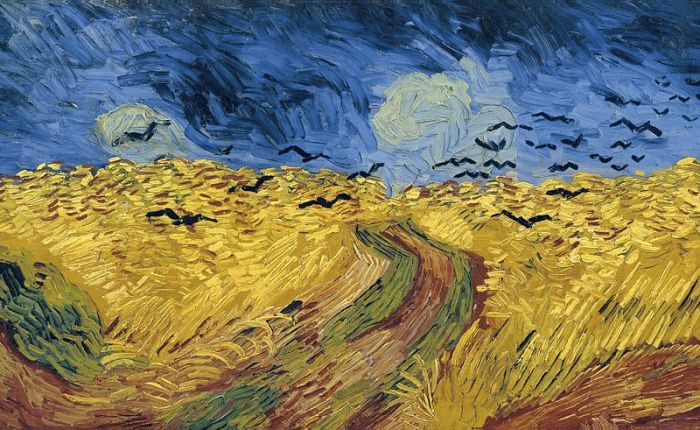
Vincent’s story had a tragic ending. On a summer day in July he walked into a wheat field where he was painting and shot himself in the chest. He survived two more days, finally passing away in his brother’s arms on July 29. The circumstances surrounding this death are rather remarkable, and I don’t wonder that two biographers, Naifeh and Smith, have raised questions about it. The tone of his final letters, while troubled, are far from despairing. He even includes an order of paints in his final dispatch to Theo. And it is also extraordinary to think that a man who had shot himself in the chest could walk a mile back to the inn, or that a man locally known for his mental instability could get a gun. The recent film, Loving Vincent (which I haven’t seen), is focused on this question.

Theo did not long survive his brother: he succumbed to syphilis within just six months. Theo had married his wife, Jo, less than two years earlier, which proved an extremely fortunate circumstance—for art’s sake, at least—since it was Jo who championed Vincent’s legacy and who published his correspondence. Theo and Jo’s only son, named after his uncle Vincent, was responsible for founding the Van Gogh Museum in Amsterdam, which I recently visited. To any who get the chance, I highly recommend this paired experience, for the letters and the paintings are mutually enriching. Few people in history seemed to have lived so entirely for the sake of posterity: churning out paintings which few people saw, writing letter after letter few people read, creating a story and an oeuvre that now have the power to tear you in two.

View all my reviews