Review: The Copernican Revolution

Review: The Copernican Revolution
The Copernican Revolution: Planetary Astronomy in the Development of Western Thought

The Copernican Revolution: Planetary Astronomy in the Development of Western Thought by Thomas S. Kuhn

My rating: 5 of 5 stars

There are few phrases more annoying or more effective than “I told you so.”

This is my second encounter with Thomas Kuhn, and again I emerge deeply impressed. To do justice to an event so multifaceted as the Copernican Revolution a scholar must have a flexible mind; and Kuhn is fully equal to the task. He moves seamlessly from scientific data, to philosophical analysis, to historical context, and then back again. The result is a book that serves as an admirable introduction to the basics of astronomy and a thorough overview of the Copernican Revolution, while raising intriguing questions about the nature of scientific progress.

Kuhn first makes an essential point: that the conceptual schemes of science serve both a logical and a psychological function. Their logical function is to economically organize the data (in this case, the position and movement of heavenly objects); their psychological function is to make people feel at home in the universe. Belief is only necessary for this second function. A scientist can use a conceptual scheme perfectly well without believing that it represents how the universe ‘truly is’; but people have an obvious and, apparently, near-universal need to understand their place in, and relation to, the cosmos. Thus, scientists throughout history have insisted on the truth of their systems, despite the history of science being littered with the refuse of abandoned theories (to use Kuhn’s expression). Even if this belief cannot be justified philosophically, however, it does provide a powerful emotional impetus to scientific activity.

Another question Kuhn raises is when and why scientists decide that an old paradigm is unsustainable and a new one is required. For centuries astronomers in the Muslim and Western worlds worked within the basic approach laid down by Ptolemy, hoping that small adjustments could finally remove the slight errors inherent in the system. During this time, the flexibility of the Ptolemaic approach—allowing for fine-tuning in deferents, equants, and epicycles—was seen as one of its strengths. Besides, the Ptolemaic astronomy was fully integrated within the wider Aristotelian science of the age; and this science blended perfectly with common everyday notions. The fact that the Ptolemaic science broke down is attributable as much, or more, to factors external to the science as to those internal to it. Specifically, with the Renaissance came the rediscovery of Neoplatonism, with its emphasis on mathematical harmonies—something absent from Aristotelianism—as well as its strain of sun-worship.

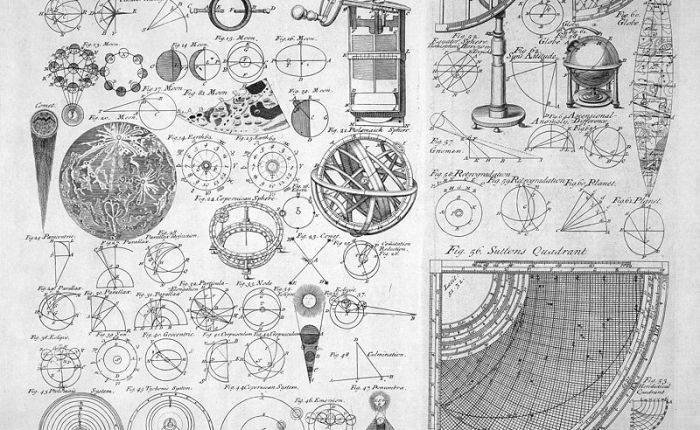
Copernicus was one of those affected by the new current of Neoplatonism; and it is this, Kuhn argues, that ultimately made him dissatisfied with the Ptolemaic system and apt to place the sun at the center of his system. We often hear of science progressing as a result of new experiments and empirical discoveries; but no such novel observation played a role in Copernicus’s innovation. Rather, the source of Copernicus’s rejection of an earth-centered universe was its inability to explain why the planets’ orbits are related to the sun’s. His system answered that question. But this was only an aesthetic improvement. It did not lead to more accurate predictions—the essential task of astronomy—and, indeed, it did not even lead to more efficient calculations. The oft-reproduced image of the Copernican universe, consisting of seven concentric circles, is a simplification; his actual system used dozens of circles and was cumbersome and difficult to use.

But the most puzzling feature of Copernicus’s innovation is that it achieves qualitative simplification at the expense of rendering it completely incompatible with the wider worldview. Aristotelian physics cannot explain why a person would not fly off of a moving earth. And, indeed, the entire cosmological picture, such as that painted so convincingly by Dante, ceases to make sense in a Copernican universe. For centuries people had understood the earth as a midpoint between the fires of hell and the perfect heavens above. Now, hell was only metaphorically “below” and heaven only metaphorically “above.” Besides that, the universe had to be expanded to mystifying proportions; the earth became only a small and unimportant speck in an unimaginably vast space. Strangely, however, Copernicus seemed blind to most of these consequences of his innovation. A specialist concerned only with creating a harmonious system, his attempt to render it physically plausible or theologically palatable is, at best, half-hearted.

This leads to the irony that one of the greatest intellectual revolutions in history started with a man concerned with technical minutiae inaccessible to the vast majority of the public, who had access to no fundamentally new data, whose system was neither more accurate nor more efficient than its predecessor, and whose main concern was qualitative harmoniousness. Copernicus was no radical and had no notion of upsetting the established authority; he himself would likely have been appalled at the Newtonian universe that was the end result of this process.

Yet this simple innovation, once proposed, had ripple effects. Though the earth’s motion was near universally rejected as a fact, its use in a serious astronomical work kept it alive as an option. And this new option could not be laughed away when, in the next generation under Tycho Brahe, better observations and novel phenomena upset the Ptolemaic world order. The heavens could no longer be seen as perfect and unchanging when Brahe proved that supernovae and comets do not exhibit a parallax (as in, they do not to change location when the observer moves), and thus could not be atmospheric phenomena. Further, Brahe’s unprecedentedly accurate observations of the planets were incompatible with any Ptolemaic system.

This seems to be one of many cases in the history of science when novel observations followed, rather than preceded, a theoretical innovation. us
Granted, this incongruence led Brahe to propose his own earth-centered system, the Tychonic, rather than adopt a sun-centered universe. But this new system used Copernican mathematics, and embodied the Copernican harmonies. In any case it is hard to see how the Tychonic system could ever have been anything but a stopgap, since the jump from Ptolemy to Brahe was scarcely easier than the jump from Ptolemy to Copernicus. Besides, it struck many as dynamically implausible that everything in the universe would orbit the sun except the earth and the moon.

Kepler and Galileo were among those unconvinced by the Tychonic system. The two very different men were both of an independent turn of mind, and their work finally made the Copernican universe unequivocally superior. Kepler particularly made the decisive step with his three laws: that planets orbit in ellipses with the sun at a focus, that they sweep out equal areas in equal times, and that they orbit the sun in a ratio of the 3/2 power (the orbital axis to the orbital time). But in Kepler we find further ironies. Far from the dispassionate lover of truth, Kepler was a Neoplatonic mystic, bursting with occult hypotheses. Many parts of his work strike the modern reader as scarcely more rational than the ravings of a conspiracy theorist. Yet the hard core of Kepler’s astronomical work lifted Copernicanism into a league of its own for accuracy of prediction and efficiency of calculation. If the orbits of the planets were related to the sun in such simple, elegant ways, it was difficult to see how earth could be at the center of it all.

This is my best attempt at summarizing the most salient points of the book. But of course there is far more in here, most of it worthwhile. I particularly enjoyed Kuhn’s chapter on the oft-ignored medieval research into physics, such as the impetus theory in the work of Nicole Oresme. The only weak point of the book was the rather brief epilogue to Copernicus. In particular, I would have appreciated an entire chapter devoted to Newton, since it was his Principia that was, in Kuhn’s phrase, the “capstone” of the revolution. But on the whole I think this is a superlative book, serious yet accessible, informative while brief. Kuhn captures the reality of scientific progress, which is far less neat that we may like to believe. Most striking is how a revolution which was guided by many extra-logical considerations—the Neoplatonic belief in celestial harmonies, the desire for mathematical elegance, the weakening of the religious worldview, the need to feel at home in the universe—fueled a process which, taken as a whole, resulted in a science definitively better than the Ptolemaic system it replaced.

Kuhn makes no mistake about this. Here is what the reputed relativist has to say:

The last two and one-half centuries have proved that the conception of the universe which emerged from the Revolution was a far more powerful intellectual tool than the universe of Aristotle and Ptolemy. The scientific cosmology evolved by seventeenth-century scientists and the concepts of space, force, and matter that underlay it, accounted for both celestial and terrestrial motions with a precision undreamed of in antiquity. In addition, they guided many novel and immensely fruitful research programs, disclosing a host of previously unsuspected natural phenomena and revealing order in fields of experience that had been intractable to men governed by the ancient world view.

View all my reviews

Review: Epitome of Copernican Astronomy & Harmonies of the World

Review: Epitome of Copernican Astronomy & Harmonies of the World

Epitome of Copernican Astronomy and Harmonies of the WorldEpitome of Copernican Astronomy and Harmonies of the World by Johannes Kepler

My rating: 3 of 5 stars

The Earth sings MI, FA, MI so that you may infer even from the syllables that in this our domicile MIsery and FAmine obtain.

Thomas Kuhn switched from studying physics to the history of science when, after teaching a course on outdated scientific models, he discovered that his notion of scientific progress was completely mistaken. As I plow through these old classics in my lackadaisical fashion, I am coming to the same conclusion. For I have discovered that the much-maligned Ptolemy produced a monument of observation and mathematical analysis, and that Copernicus’s revolutionary work relied heavily on this older model and was arguably less convincing. Now I discover that Johannes Kepler, one of the heroes of modern science, was also something of a crackpot.

The mythical image of the ideal scientist, patiently observing, cataloguing, calculating—a person solely concerned with the empirical facts—could not be further removed from Kepler. Few people in history had such a fecund and overactive imagination. Every new observation suggested a dozen theories to his feverish mind, not all of them testable. When Galileo published his Siderius Nuncius, for example, announcing the presence of moons orbiting Jupiter, Kepler immediately concluded that there must be life on Jupiter—and, why not, on all the other planets. Kepler even has a claim of being the first science-fiction writer, with his book Somnium, describing how the earth would appear to inhabitants of the moon (though Lucian of Samothrace, writing in the 2nd Century AD, seems to have priority with his fantastical novella, A True Story). This imaginative book, by the way, may have contributed to the accusations that Kepler’s mother was a witch.

In reading Kepler, I was constantly reminded of a remark by Bertrand Russell: “The first effect of emancipation from the Church was not to make men think rationally, but to open their minds to every sort of antique nonsense.” Similarly, the decline in Aristotle’s metaphysics did not prompt Kepler to reject metaphysical thinking altogether, but rather to speculate with wild abandon. But Kepler’s speculations differed from the ancients’ in two important respects: First, even when his theories are not testable, they are mathematical in nature. Gone are the verbal categories of Aristotle; and in comes the modern notion that nature is the manifestation of numerical harmonies. Second, whenever Kepler’s theories are testable, he tested them, and thoroughly. And he had ample data with which to test his speculations, since he was bequeathed the voluminous observations of his former mentor, Tycho Brahe.

At its worst, Kepler’s method resulted in meaningless numerical coincidences that explained nothing. As many a statistician has learned, if you crunch enough numbers and enough variables, you will eventually stumble upon a serendipitous correlation. This aptly describes Kepler’s use of the five Platonic solids to explain planetary orbits; by trying many combinations, Kepler found that he could create an arrangement of these regular solids, nested within one another, that mostly corresponded with the size of the planets’ orbits. But what does this explain? And how does this help calculation? The answer to both of these questions is negative; the solution merely appeals to Kepler’s sense of mathematical elegance, and reinforced his religious conviction that God must have arranged the world harmoniously.

Another famous example of this is Kepler’s notion of the “harmonies of the world.” By playing with the numbers of the perihelion, aphelion, orbital lengths, and so forth, Kepler assigns a melodic range to each of the planets. Mercury, having the most elongated orbit, has the biggest range; while Venus’s orbit, which most approximates a perfect circle, only produces a single note. Jupiter and Saturn are the basses, of course, while Mars is the tenor, Earth and Venus the altos, and Mercury the soprano. He then suggests (though vaguely) that there are beings on the sun, capable of sensing this heavenly music. (The composer Laurie Spiegel created a piece in which she recreates this music; it is not exactly Bach.) Once more, we naturally ask: What would all this speculation on music and harmonies explain? And once more, the answer is nothing.

Kepler’s writing is full of this sort of thing—torturous explorations of ratios, data, figures, which strike the modern mind as ravings rather than reasoning. But the fact remains that Kepler was one of the great scientific geniuses of history. He was writing in a sort of interim period between the fall of Aristotelian science and the rise of Newtonian physics, a time when the mind of Europe was completely untethered to any recognizable paradigm, free to luxuriate in speculation. Most people in such circumstances would produce nothing but nonsense; but Kepler managed to invent astrophysics.

What gives Kepler a claim to this title was his conception of a scientific law (though he did not put it as such). Astronomers from Ptolemy to Copernicus used schemes to predict planetary movements; but there was no one underlying principle which could explain everything. Kepler’s relentless search for numerical coincidences led him to statements that unified observations of all the planets. These are now known as Kepler’s Laws.

The first of these was the seemingly simple but revolutionary insight that planets orbit in ellipses, with the sun at one of the foci. It is commonly said that previous astronomers preferred circles for petty metaphysical reasons, seeing them as perfect. But there were other reasons, too. Most obviously, the mathematics of shapes inscribed in circles was well-understood; this was the basis of trigonometry.

Yet the use of circles to track orbits that, in reality, are not circular, created some problems. Thus in the Ptolemaic system the astronomer used one circle (the eccentric) for the distance, and another, overlapping circle (the equant) for the speed. When these were combined with the epicycles (used to explain retrogression) the resultant orbits, though composed of perfect circles, were anything but circular. Kepler’s use of ellipses obviated the need for all these circles, reducing a complicated machinery into a single shape. It was this innovation that made the Copernican system so much more efficient than the Ptolemaic one. As Owen Gingerich, a Copernican scholar, has said: “What passes today as the ‘Copernican System’ is in detail the Keplerian system.”

Yet the use of ellipses, by itself, would not have been so useful were it not for Kepler’s Second Law: that planets sweep out equal areas in equal times of their orbits. For when a planet is closest to the sun (at perihelion) it is moving its fastest; and when it is furthest (at aphelion) it is slowest; and this creates a constant ratio (which is the result of the conserved angular momentum of each planet). Ironically, of the two, Ptolemy was closer than Copernicus to this insight, since Ptolemy’s much-maligned equant (the imaginary point around which a planet travels at a constant speed) is a close approximation of the Second Law. Even so, I think that Kepler moved far beyond all previous astronomy with these insights, jumping from observed and analyzed regularities to general principles.

Kepler’s Third Law seemed to have excited the astronomer the most, since he even includes the exact date at which he made the realization: “… on the 8th of March in this year One Thousand Six Hundred and Eighteen but unfelicitously submitted to calculation and rejected as false, finally, summoned back on the 15th of May, with a fresh assault undertaken, outfought the darkness of my mind.” This law states that, for every planet, the ratio of the orbital period squared to the orbital size cubed, is constant. (For the orbital size Kepler used half the major axis of the ellipse.)

While it is no doubt striking that this ratio is almost the same for every planet (this is because the planet’s mass is negligible compared with the sun’s), it is difficult to completely sympathize with Kepler’s excitement, since the resultant law is not useful for predicting orbits, and its significance was only explained much later by Newton as a derivable conclusion from his equations. Kepler, being the man he was, used this mathematical constant to fuel his metaphysical speculations.

However much, then, that Kepler’s theories may strike us nowadays as baseless, crackpot theorizing, he must be given a commanding place in the history of science. The reason I cannot rate this collection any higher is that Kepler is extremely tiresome to read. In his more lucid moments, his imaginative energy is charming. But much of the book consists of whole paragraphs of ratio after ratio, shape after shape, number after number, and so it is easy to get lost or bored. Since I have a decent grasp of music theory, I thought I might be able to get something out of his Harmonies of the World, but I found even that section mostly opaque, swirling in obscure and impenetrable reasoning.

The great irony, then, is that Kepler’s writings can strike the modern-day reader as far less “scientific” than Ptolemy’s; but perhaps we should expect such ironies from a man who helped to inaugurate modern science, but who made his living casting horoscopes.

View all my reviews