Summertime in Andalucía: Jerez and Cádiz

Summertime in Andalucía: Jerez and Cádiz

Jerez de la Frontera

After our stays in Granada and Málaga, our next base of operations was Jerez de la Frontera.

If you know some Spanish, you may recognize that this name translates literally into “Sherry of the Border.” But this has an explanation. For one, sherry wine is named after Jerez, not vice versa; the original name “Jerez” goes all the way back to Phoenician times. And the place is referred to as occupying a “border” because, during the middle ages, this town was on the border between Christian- and Muslim-controled areas.

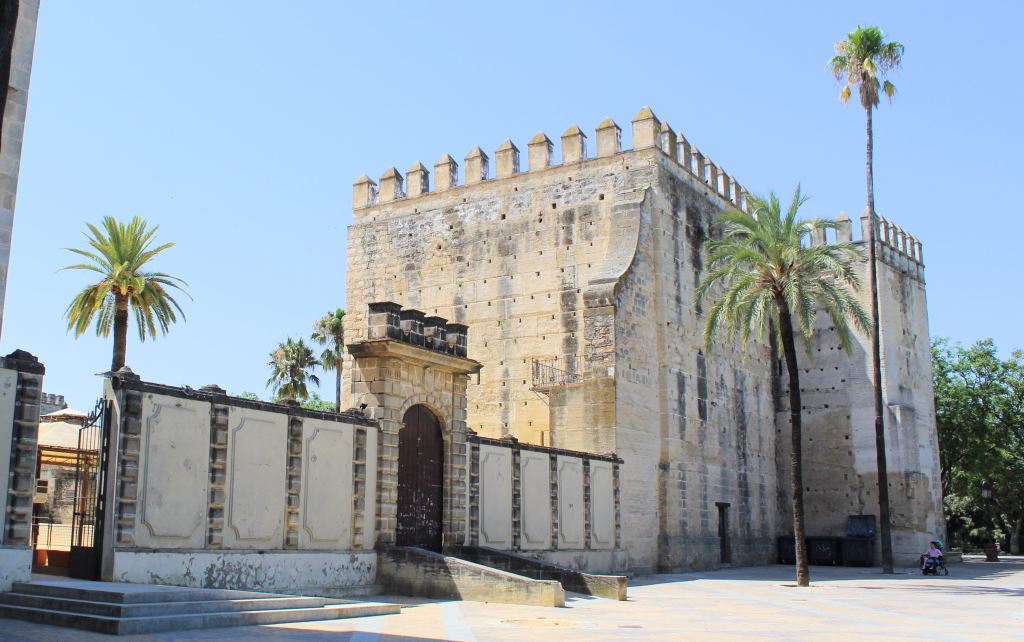
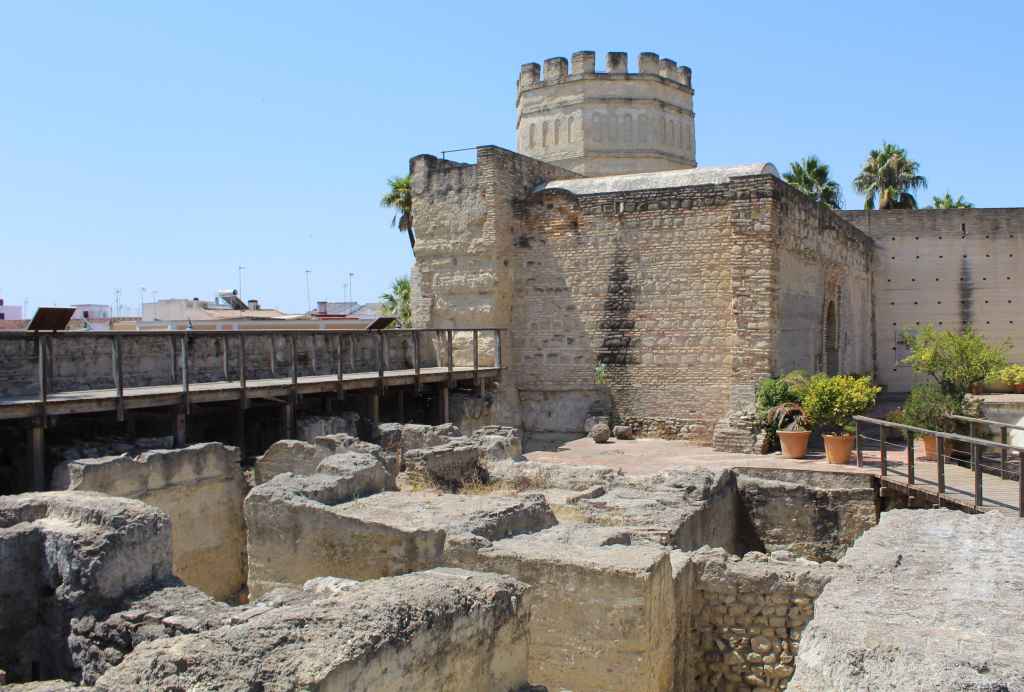
After dropping off our things, the first thing we did was to visit the city’s Alcázar. Now, there are “alcázars” all over the country. The name—like most Spanish words beginning with “al”—comes from Arabic, in this case from al-Qasr, meaning a castle or a fortress. This one was built in the 11th century, when Jerez was part of a small Muslim kingdom. The conquering Christians added to the fortress. Even so, the fortress—with its horseshoe arches and baths with star-shaped vents—is an excellent example of Moorish architecture. And the walls provide an excellent view over the city.
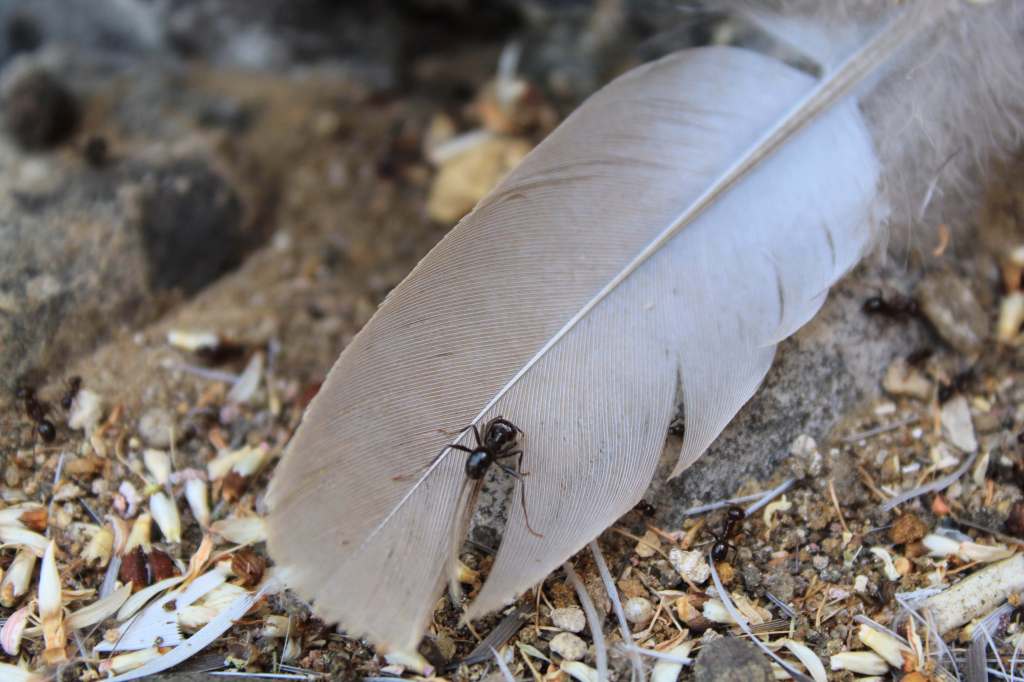
An ant in the alcázar

Next we visited the city’s cathedral. This is quite a grand building. But if you are used to the scale of European cathedrals, it may strike you as on the smaller side. This is because it was not originally built as a cathedral, but as a collegiate church which was later “promoted” to the status of cathedral in 1980. In any case, it is a lovely building with gothic flying buttresses and baroque decorations on its façade. Even lovelier might be the Church of San Miguel. If memory serves, the opening hours of this church are rather limited (and they aren’t posted online). But if you manage to get in, you will be rewarded with striking gothic vaults and richly-carved altarpieces.
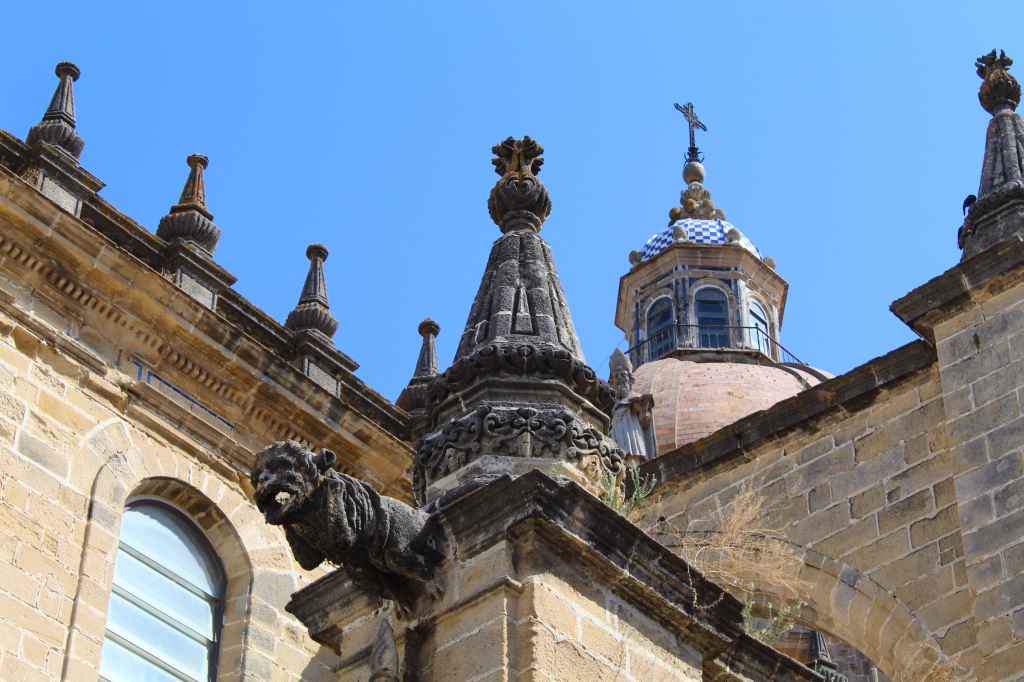
A detail of the cathedral.
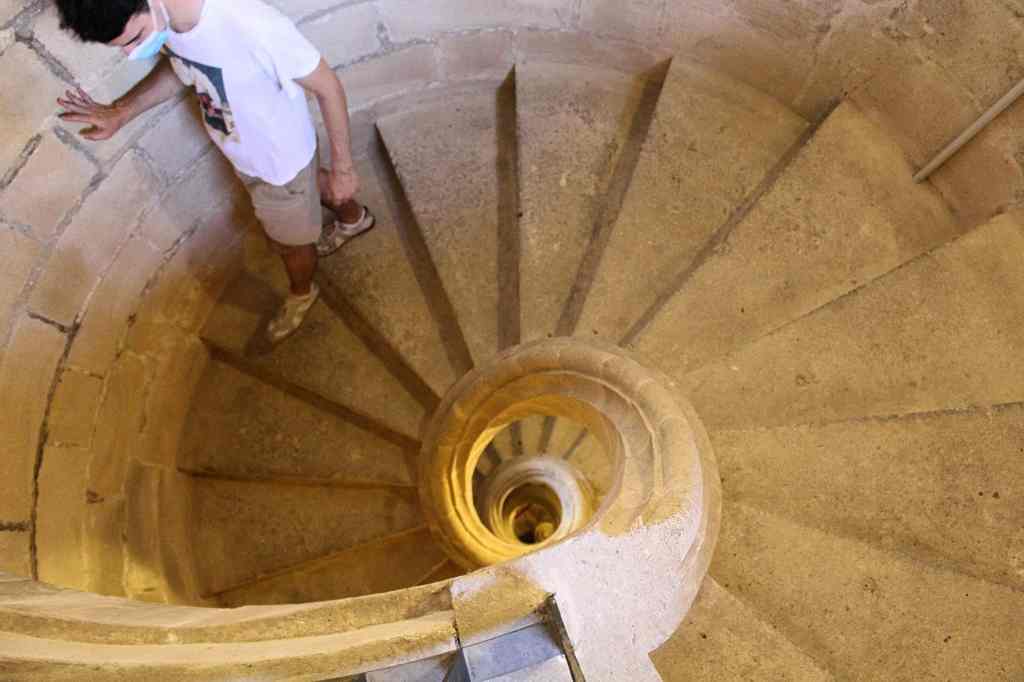
Jay navigating a staircast in the cathedral.
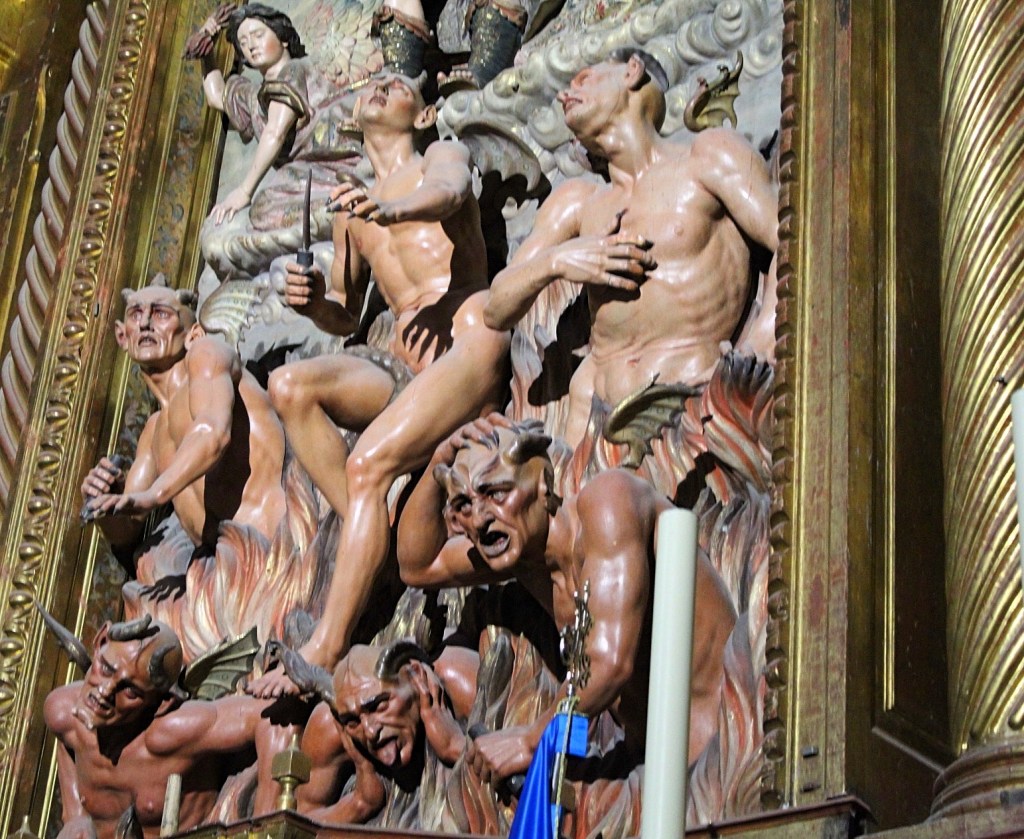
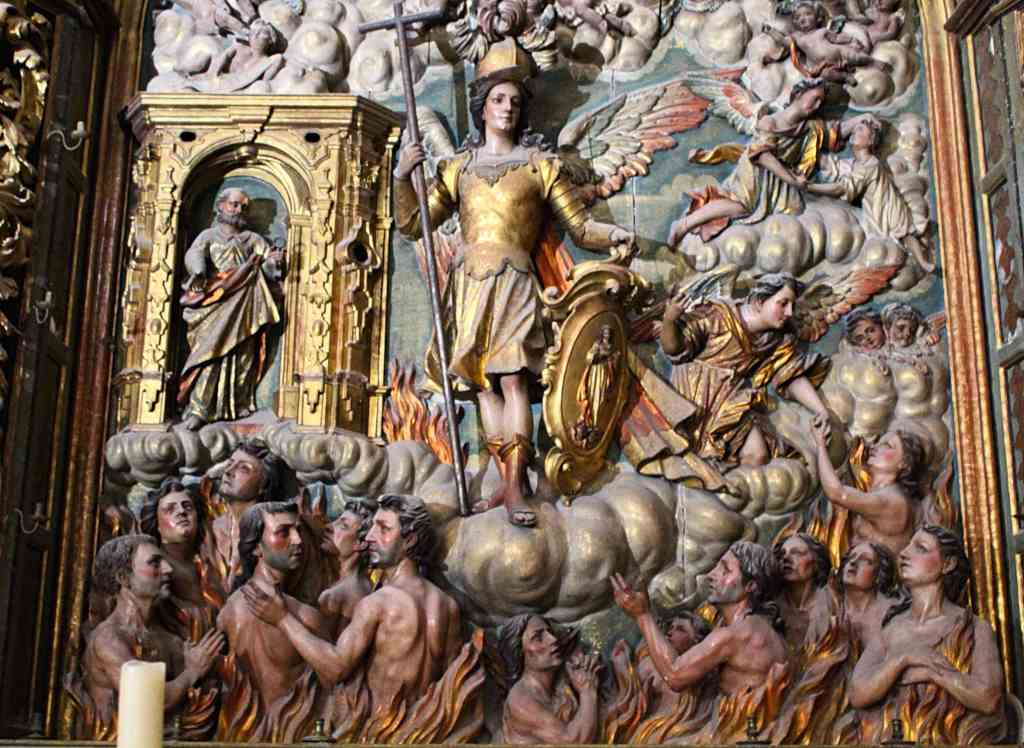
A detail from an altarpiece in the Church of San Miguel.
Another detail.

But the highlight of Jerez is not, in my opinion, any monument. Rather, it is the wine. We happened to arrive on a Sunday and most of the major wineries were closed. But after calling several in a row (getting through to a janitor in one of them), I finally reached a man who seemed rather surprised on the phone. He said he had a totally flexible schedule and that we could come any time we liked. Like an ignorant American, I suggested five o’clock, but he quickly told me that it would be too hot then, and that seven would be far better.

We arrived punctually at Bodegas Faustino González. An older man with white hair was waiting for us. He introduced himself as Jaime, and led us inside. It quickly became apparent that this tour was just for the two of us. And it was also quickly apparent that we had inadvertently chosen a beautiful bodega. (In Spain, a “bodega” is a winery, not a corner store.) In a simple white warehouse there were long rows of barrels, stacked three barrels high. Jaime explained that this is the standard way of aging sherry. The bottom barrel is known as the “solera,” from the word for floor (“suelo”). This is the basis for the wine, as the solera is never entirely emptied. Thus, it preserves the distinct character of any particular winery. Then the sherry is moved up to the next barrel, a “criadera” (literally a “breeding ground”), and finally to the last one. This process takes at least two years, often far longer. 
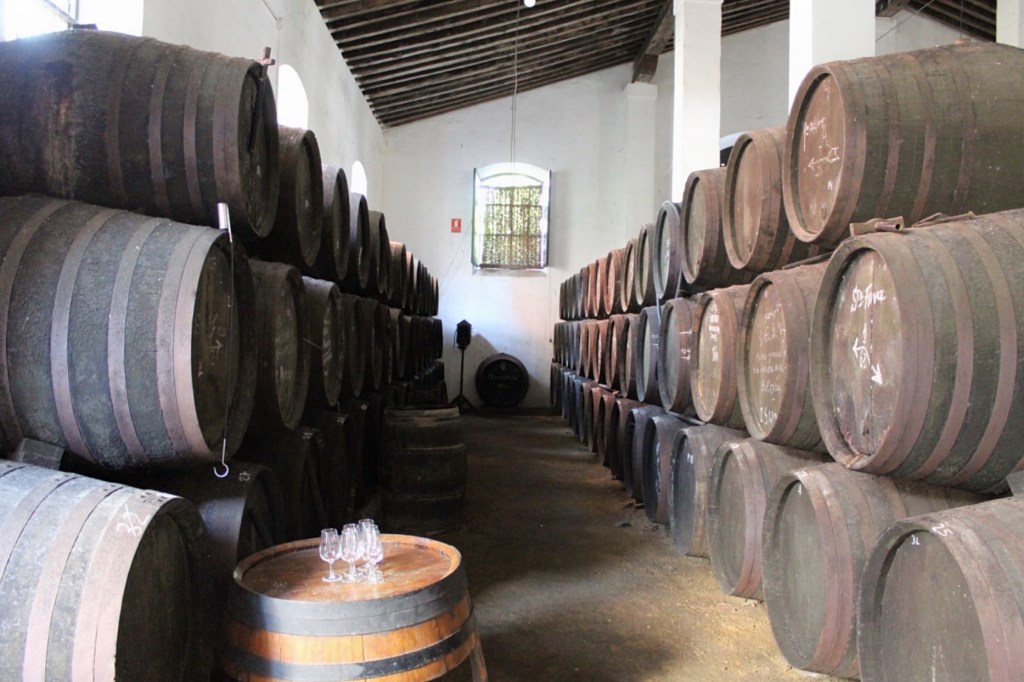
(The barrels, by the way, are made of American oak. Once they are too old for sherry, they can be sold to Scottish Whiskey makers, where they continue to age fine spirits.)

Jaime took a device known as a “venencia”(basically, a cup on the end of a stick), stuck it into a barrel, and let us taste the fresh wine. It was fresh and quite tart. He explained that dry sherry is normally made with palomino grapes, which are white. There are several varieties of the wine, which can be divided into two main groups: manzanilla and fino (white, clear, plain), and amontillado, palo cortado, and oloroso. These latter three kinds are oxidized during the aging process, giving them a dark, rusty color and a far more aromatic flavor. (For my money, oloroso is consistently the best.)

The venencia in action.

Many exported sherries are basically sold as cooking wine, and taste like finos with added sugar. But if you really want to taste a sweet sherry, you’ve got to try Pedro Ximenez. This wine is made from the grapes of the same name, which are left to dry into raisins before they are turned into wine. This makes the final product almost black in color and incredibly sweet. The flavor is intense—almost too intense to drink, like maple syrup. In fact, I used the bottle I bought from the winery to pour over vanilla ice cream, and found it to be extravagantly delicious.

As you can probably tell, my brother and I were delighted by the visit. We emerged, about two hours later, very satisfied and quite drunk (we had been given about six glasses of sherry), and wandered off to find something for dinner. I have subsequently bought sherry from Jaime and can attest to its excellent quality. 

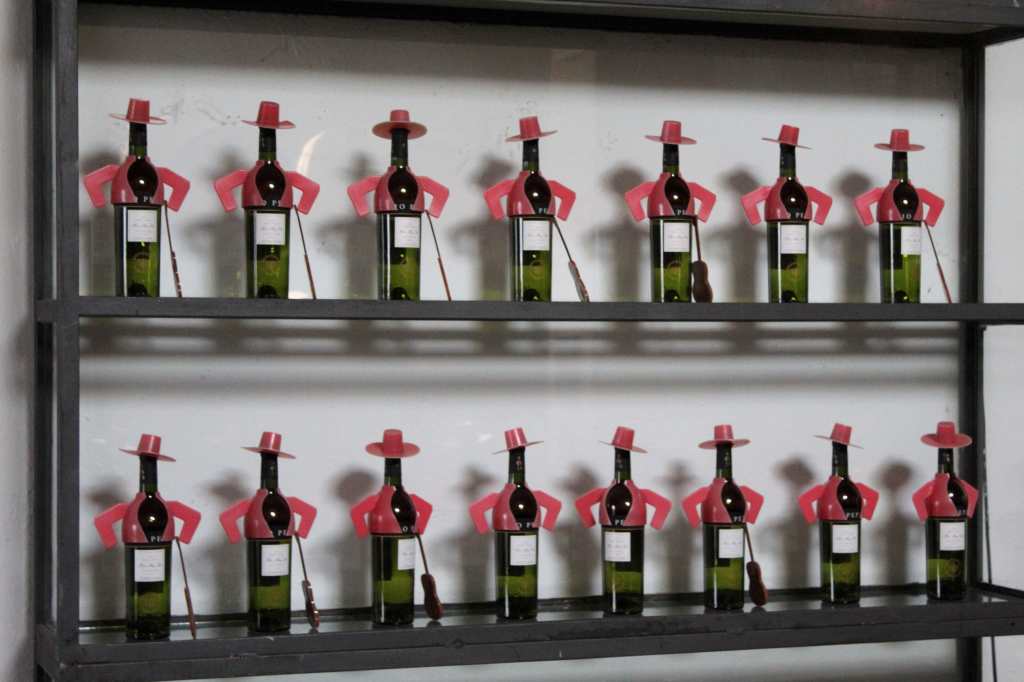
During our time in Jerez, we managed to visit another winery: González Byass. Its name comes from its founder, Manuel María González, and his English agent, Robert Blake Byass. (There is a charming statue of Manuel near the cathedral.) This is possibly the biggest and certainly the most famous producer of sherry. The iconic Tío Pepe fino sherry—whose mascot is a  bottle dressed in a red sombrero and jacket, holding a guitar—is from this company. Any visitor to the Puerta del Sol, in Madrid, will recognize it: an advertisement which has been elevated to a symbol of Spain. (An even more famous symbol of Spain, the Osborne Bull, also originated as an advertisement—for sherry brandy.)
The tour lasted about an hour and was with a group of about twenty people. I imagine that it is more difficult to secure a spot on a tour during normal times. Right after the lockdown, we were given a spot on the very next group. Compared to Faustino González—an artisanal producer, with a single warehouse—this winery was enormous. It is also, obviously, famous. There were bottles dedicated to heads of state and signed by celebrities (notably, Orson Wells). Indeed, according to our guide, the most attractive of the warehouses, La Concha, was designed by none other than Gustave Eiffel, on the occasion of a queen’s visit. (It appears, after looking it up, that this is not really true. Though commonly attributed to Eiffel, “La Concha” was designed by an English firm.)

La Concha

Finally we were ushered into a posh bar for a tasting. Though I can hardly be called an expert in this ancient art, the difference between the handcrafted sherry of the previous visit and this industrially-produced wine was immediately apparent. The sherry from González Byass tasted simple and even bland by comparison. In fairness, the GB products are significantly cheaper and easier to find. And I certainly would not turn down a glass of their oloroso.

The dark one on the right is Pedro Ximénez. The rust-colored one further down is Oloroso. One of the two clear ones is a dry fino, and the other is a sweet one.

Cádiz

Jerez de la Frontera is a delightful city by itself. But one of its best qualities is its close proximity with Cádiz. Indeed, aside from Venice, I would rank Cádiz as the prettiest city in Europe. And unlike that Italian icon, Cádiz is a place where people actually live.

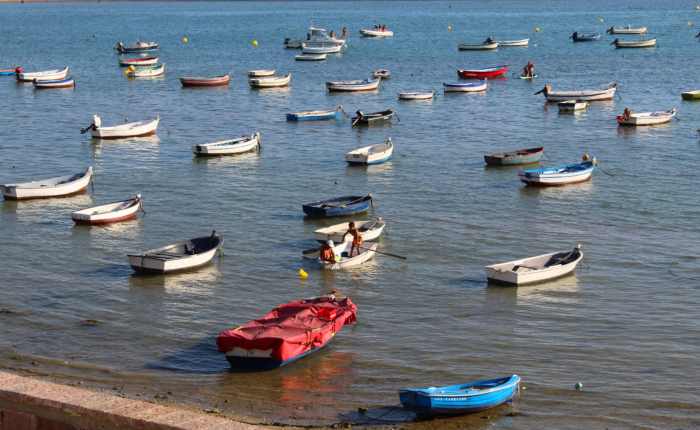
Cádiz is located on a small peninsula that juts out into the Atlantic ocean. It is an extremely old place, inhabited since at least the 7th century BC. Arriving from Jerez is a breeze: the local train takes you right there in about 45 minutes—treating you to some arresting views of the landscape and the ocean along the way.

The first thing any visitor to Cádiz ought to do is to simply walk around. The buildings form a coherent color palette: made of tan stone or painted pastel colors. The inner streets are narrow and winding, like those of any city with a long pedigree. But go too far in any direction and you emerge onto the open sea. Even on a hot day, the breeze makes it tolerably cool, and if it is sunny the ocean shines a kind of delirious turquoise. (You can probably gather that I am fond of Cádiz.)

One of the most attractive parts of the city are the Gardens of Alameda Apodaca, which is located alongside the water on the Northern side of the peninsula. It is a kind of garden walkway, with flowers hanging from trellises. At the end of this garden you reach two strange and enormous trees. These are Australian Banyans, which have special supporting structures known as “buttress roots,” which spread over the ground to support the enormous canopy. An equally lovely park is the Parque Genovés, which is full to the brim with exotic plants, such as a Drago tree (from the Canary Islands), a Metrosideros (from New Zealand), and a Norfolk Island Pine (from Australia).
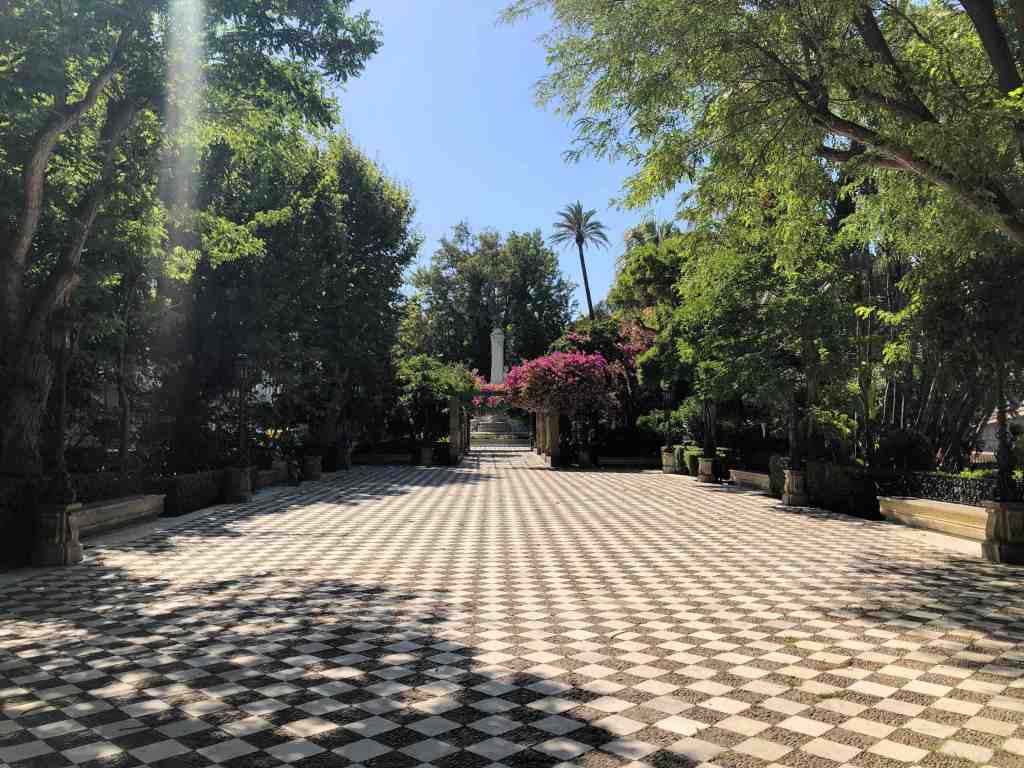
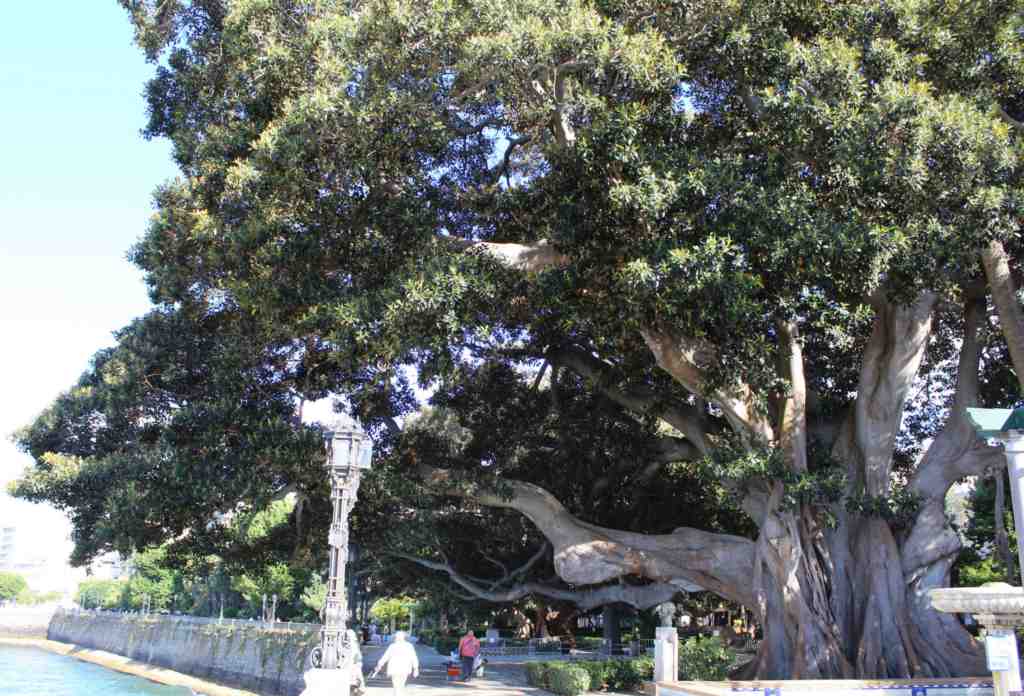
As you can perhaps tell from these exotic trees, Cádiz is (or was) well connected with foreign lands. Indeed, the city owes its wealth to being the primary port of trade between Spain and her American colonies for several centuries. Of course, this source of revenue abruptly ended when Spain lost her empire in the 19th century, which is one reason the city is still so quaintly beautiful. If that had not happened, then doubtless Cádiz would be full of modern glassy skyscrapers.

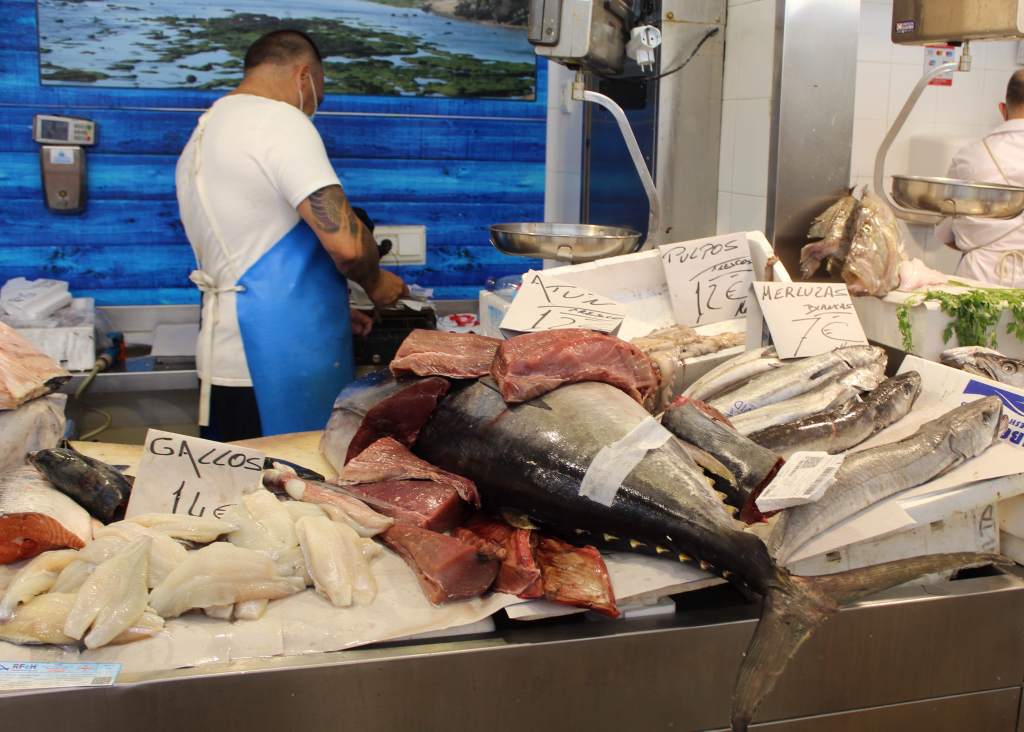
After a stroll around, my brother and I were in the mood for lunch. For the hungry or the morbidly curious, the Mercado Central is worth a visit. On the inside you can see an enormous collection of freshly-caught seafood, still covered in ocean brine. There are piles of squids and shrimp, and tuna as heavy as a person. If this whets your appetite, you can get something to eat in any of the dozens of food stalls running along the outside. I would certainly recommend sampling the seafood. Local specialties include tortillitas de camarones (shrimp fritters) and cazón en adobo (marinated dogfish)—both quite tasty, in my opinion.
After our meal, we visited the Cádiz Museum. Normally, this institution has exhibits which range from prehistory to the 20th century. But when we visited, it was under renovation, and the upper floors were closed. This was fine with me, however, as the section on ancient history was still open, and this is what I especially wanted to see.

As I mentioned before, Cádiz has a very long history, and the museum has artifacts dating from well before the era of Socrates and Confucius. But the two most famous artifacts are two Phoenician sarcophagi, carved in the form of a man and a woman, made some time around the year 400 BC. The male sarcophagus was discovered all the way back in 1887, with a well-preserved skeleton still inside. The corresponding female was found almost an entire century later—coincidentally just outside the former home of a museum director—during a routine construction job. The two tombs are quite lovely works of art, showing possible Greek influences but still unlike any Greek statue I have ever seen.

Perhaps the best way to get a tour of Cádiz is to visit the Torre Tavira. This is a former lookout tower, now the second-tallest structure in the city (after the cathedral). The views from the top are worth the fee to go up. But your visit also includes a kind of remote tour using a camera obscura, reflecting light from outside onto a large dish, while a guide points out all of the major landmarks in the city. It is certainly a touristy experience, but one I do not hesitate to recommend.
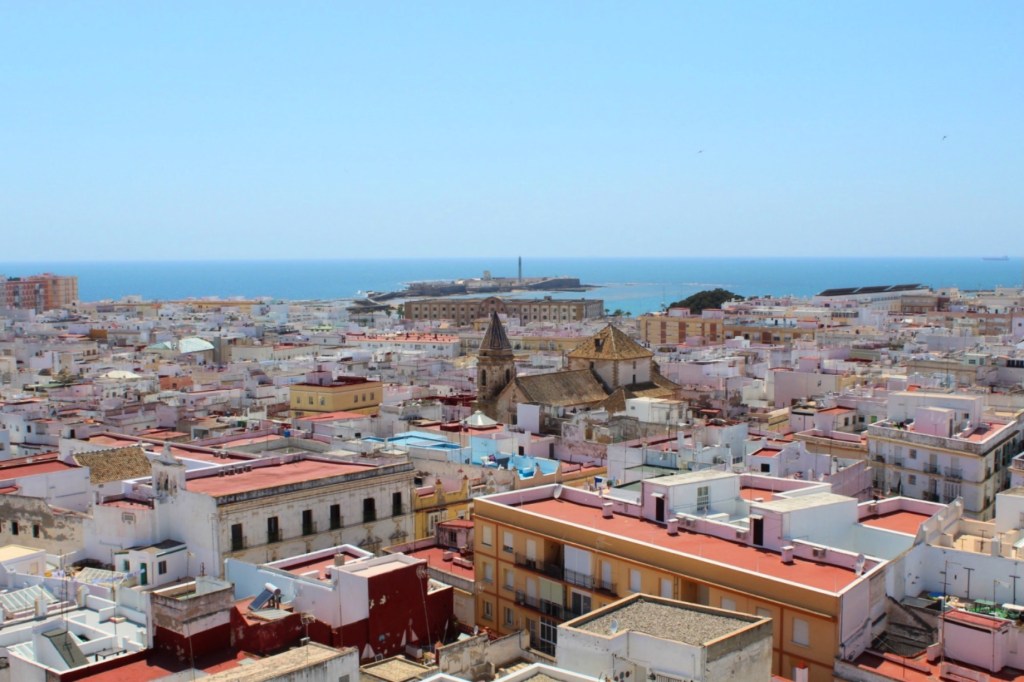
(The cathedral, I should mention, is also certainly worth a visit. Unfortunately, it had yet to reopen after the lockdown when my brother and I visited.)

The next site I want to mention did not figure on our itinerary. But as I visited two years later, with Rebe, I think it worth including here for the sake of information. This is the Gadir Archaeological Site. Gadir is the original, Phoenician name for the city, and this site takes you directly into the ancient past. As fate would have it, the site is located under a puppet theater. Visits are conducted by guided tour only, which means you must reserve at least a little bit in advance. During my visit, the tour was conducted by one of the archaeologists who actually did work on the site, which made for an especially interesting experience. The ruins are not visually impressive (consisting of the outlines of buildings and streets), but the information revealed about ancient lifeways was fascinating.

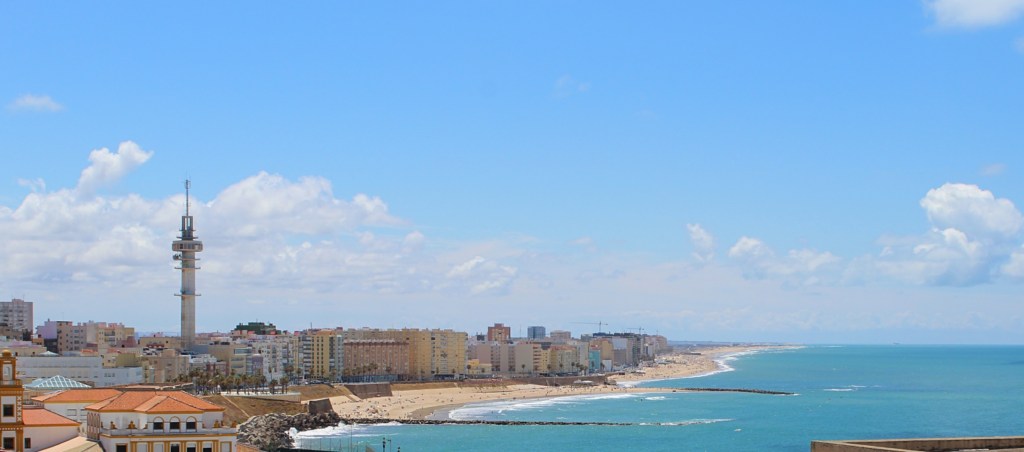
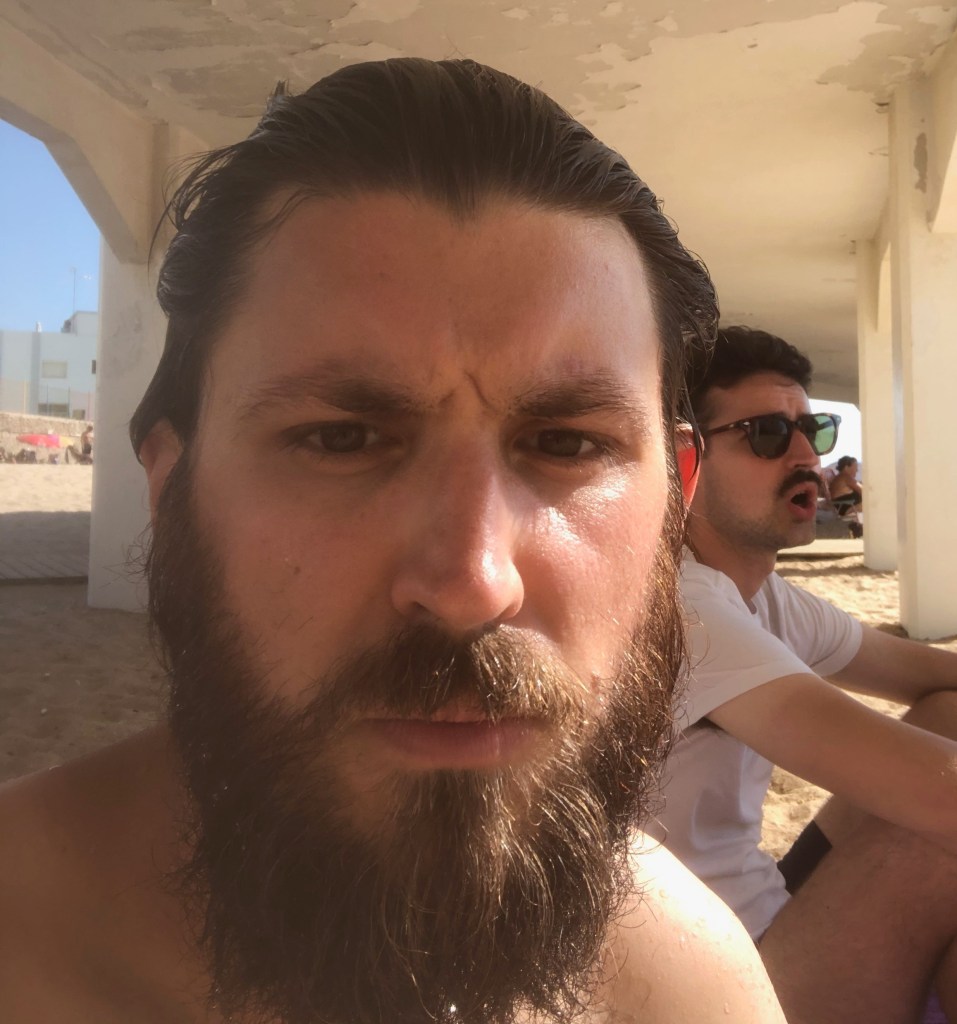
But of course, I cannot end a post about Cádiz without mentioning the beach. There is an extremely long beach—Playa de la Cortadura—running along the road that connects Cádiz with the mainland. Far more beautiful and iconic, however, is La Caleta, which is at the very end of the peninsula. My brother and I spent two evenings lounging under the shade of an old spa and taking dips in the ocean, from which I can conclude that it is a thoroughly lovely spot. (This spa building, by the way, is itself an icon of Cádiz. It was built in 1926 with long, sweeping arms suspended over the sand. The spa went out of business, however, and nowadays it is the headquarters of the Underwater Archaeology Center.)

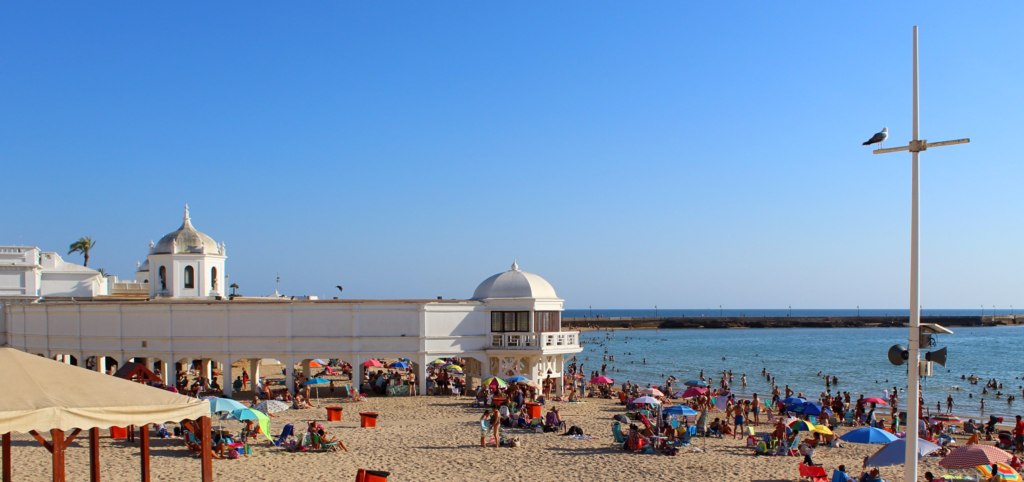
The white structure is the former Balneario de Nuestra Señora de la Palma y del Real (a spa).
Under the spa, looking a little ragged.

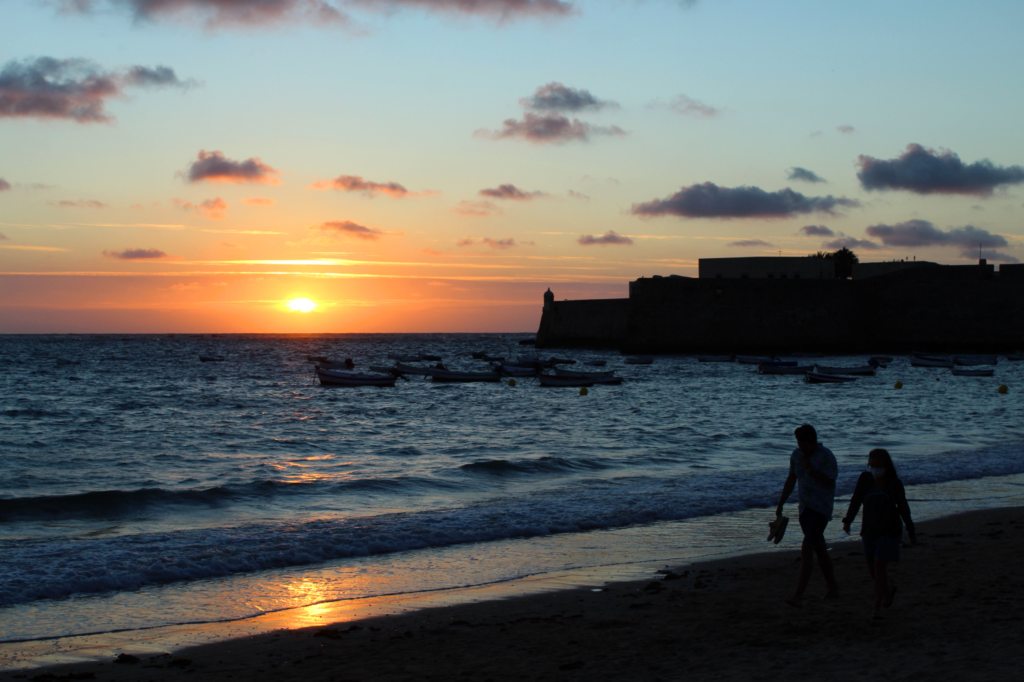
La Caleta is made especially picturesque by being flanked by two castles. On the right is the Castle of Santa Catalina, built around the year 1600. There is a small exhibition center inside and a good view of the beach. (I also think there is a hotel somewhere in the castle.) On the left side is the Castle of San Sebastián, which is located on a small island off shore, and connected by a thin walkway to the beach. It is possible that a Greek temple occupied this spot millennia ago, but the castle was built around the year 1700. The last two times I visited Cádiz the castle was closed, though the very first time I went I could go inside (and there was not much to see). In any case, the walkway is attractive enough to merit a visit.

That does it for our trip to Jerez and Cádiz. As great as were Granada, Málaga, and the little towns we visited, these two cities were easily the highlights of the trip. There is little that can compete with a cold glass of exquisite sherry followed by a swim.
Christmastime in Andalusia: Jerez de la Frontera

Christmastime in Andalusia: Jerez de la Frontera

(Continued in my posts about Cádiz, Nerja, Ronda, and Málaga.)

The Voyage

On December 24, Christmas Eve—or Noche Buena (“Good Night”) as the Spanish call it—in the year 2015, at an egregious hour in the morning, we met up with a couple of guys that we had contacted through Blablacar to make the drive down to Jerez de la Frontera.

They were both extremely nice, agreeable fellows; but I’m afraid they had Andalusian accents and I could hardly understand them.

The people of Andalusia, you see, have something of a reputation. Their accent is distinctive and difficult for outsiders to understand. They speak in a rapid staccato, spitting out the words like a machine gun. Unlike in most of Spain, Andalusians do not pronounce c’s or z’s like “th” (often mocked, incorrectly, as the “Spanish lisp”); and instead pronounce all soft c’s and z’s like an “s,” as they do in Latin America. For most people this would not be a problem; but since I’m only used to Castillian Spanish this confuses me.

What is more, Andalusians drop the terminal “s” wherever it appears: tres becomes tregracias becomes gracia, and so on. To top it off, the consonants separating two ending vowels are also dropped, and the vowels are blended together into a dipthong: complicado becomes complicao. With all these factors taken together, the final result is, for me, an indistinct slur of sound that never resolves itself into separate words.

In sum, I could not understand them. So I slept; and GF slept; and we woke up and then fell asleep again.

The countryside of Andalucía, normally so flat and treeless that you can see for miles, was shrouded in a mysterious and impenetrable wall of fog. Apparently, mornings in the south of Spain are typically foggy, which I find odd considering how absolutely sunny and cloudless are the days.

But I had traveled this road before, when I went to Seville. So even though I couldn’t see much, memories flew by the window instead.

There are castles, I recalled: mostly run-down and in ruins, dotting the countryside; we must have passed five or six. Then there are the great, big, black silhouettes of bulls, which stood here and there, sometimes next to the highway and sometimes on a hillside beyond. These are the Osborne Bulls: signs that were originally set up as advertisements for Osborne brand sherry. Despite this prosaic commercial origin, they have since become something of a symbol for Spain, and you can find them on everything from T-shirts to book jackets to postcards.

Osborne_bull

I also remembered the livestock. The Spanish countryside has a rugged, rural, pastoral charm that I did not expect to find in an industrialized country. In what look like wild fields along the highways you can see cows grazing, sheep huddling in herds, and horses bathing their shiny coats in the sun. No human can be seen watching over them; not a fence is in sight—except perhaps and old, derelict stone barrier that looks short enough to hop over.

Then I thought of the wind turbines—those gigantic white towers, their blades meditatively spinning in the breeze—and the solar panels, glistening like the future itself in the sun. These new technologies served to break the spell of the castles and the wandering livestock, snapping you back to the twenty-first century. But they also showed a wonderful continuity; people still made their living here, and were still doing their best to achieve harmony with their environment.

But the castles and the bulls and the horses and the turbines were nowhere to be seen this morning; just the grey fog, the clouds overhead, and the few feet of road in front of us. I was having trouble staying awake, and still more trouble staying asleep. So I drifted in that unpleasant, cramped, confusing, groggy twilight between consciousness and unconsciousness, my neck hurting, my knees in pain, my eyelids feeling as though a gigantic weight had been placed upon them.

But then we arrived. Our driver, very kindly, drove us right up to the door of our Airbnb, and soon we found ourselves in Jerez de la Frontera, blinking in the familiar bright of the Andalusian sun, our bags sitting on the sidewalk, both of us tired and dazed, pressing the buzzer to get in.


Jerez de la Frontera

Our hosts were just as kind and friendly and welcoming as our driver had been. One of them, the husband, was a professor of Spanish and French from Switzerland; and his wife was a wonderful woman from Peru. They were hospitality incarnate; they gave us a tour of the neighborhood, told us about the bus schedule, provided us information about all the things to do and see in Jerez, and in general answered every question we had. Not only this, but they had the patience of saints with our halting, slow, mistake-ridden Spanish.

Soon we were on the bus, heading towards town. We arrived at 3:30 in Jerez de la Frontera, on Christmas Eve. The restaurants were jam-packed, the streets filled with so many people eating, drinking, and talking that there weren’t nearly enough chairs, so most people had to stand—not that anybody seemed to care. On Christmas Eve, apparently, the entire town celebrates by having an after-lunch drink.

With more hope than foresight, we thought we could visit some of the main sights of Jerez. First, we tried the Alcázar, a Moorish castle in the center of town. It was closed. Then we tried the cathedral. Closed. After that, we walked to a bodega (winery), to taste some famous sherry. (Jerez de la Frontera is the birthplace of sherry wine.) They were all closed, too. It was Christmastime in Andalusia, and the only places open were the restaurants.

So we walked around, somewhat aimlessly, feeling lost and out of place. What were we doing here? This was the holidays, a time for family, and here we were, just the two of us, alone in a strange city with nothing to do. After two hours of wandering, we decided we might as well eat, and sat down at the first restaurant we could find.

Two tables over an entire extended family was gathered together. They were playing flamenco. Three boys were strumming on guitars, others were stomping and clapping, and they were singing in unison, the women an octave higher than the men. It wasn’t professional by any means, but it was fun and exciting. As we sat outside in temperate sun, listening to this family play flamenco—not because they were being paid, but to celebrate the holiday—the day suddenly became ineffably romantic.

We sat at that restaurant as long as we could before they kicked us out—which was at about 5 o’clock. Then we walked back to the Airbnb.

It did not feel like Christmas Eve. We spoke with our families through Skype, but this only served to remind us of what we were missing. The loneliness was easy to forget during the day, when surrounded by crowds, overhearing small-talk, exchanging pleasantries with waiters. But as the sun went down and the shops began to close and the people retreated indoors to be with their brothers and sisters, sons and daughters, fathers and mothers, we could not forget that we were not at home; that on another side of the globe, our own families were celebrating without us; and that instead of being surrounded by familiar faces, we were surrounded by faces entirely new, and even strange.

And with these thoughts, we went to sleep.

§

Christmas morning.

We got out of bed and went downstairs. Sadly, there weren’t any presents waiting for us, not even a tree; but there was breakfast. It was simple and delicious: bread, yogurt, fresh fruit, and Spanish ham. Even though our goodly hosts had eaten several hours before, they had sat at the table with us just to talk. As I sat there, I realized how odd it was to be staying at the house of a stranger—or, at least, someone we’d just met—during Christmas. It felt somehow intrusive and indecent. But then I remembered that our hosts were immigrants, too, and all their family was elsewhere as well. This made me feel a bit more at home.

We were off to town again, though we hardly knew what for. Just like yesterday, everything was closed; and today, not even the restaurants were busy. This time we didn’t even try to see anything. We sat down at a restaurant, ordered some food, and relaxed. I must admit, though, that I was getting a bit cranky by this point. Not only had I missed Christmas, but for what?

I calmed down a bit after I pulled out my book to read. I read and read, looking up now and again to observe people strolling by, kids playing, grandparents chiding, young couples chitchatting—and the day passed like this. I began to feel calm and happy. There is something strangely intoxicating about Andalusia. I don’t know quite what it is. A big part is just the weather. The sun is so bright that it’s hypnotic. The intense light is just so constantly present; it transforms everything, making colors brighter, laughter louder, people friendlier.

Then again, the people really are friendlier in Andalusia. Here the social instinct of the Spanish is expressed most fully. In New York, there are crowds, of course; but the crowds are always crowds of individuals thrown together more or less by accident, by force of circumstance. But the Andalusians, as I witnessed on Christmas Eve, congregate purposefully and joyfully—taking pleasure in the feeling of togetherness and camaraderie and excitement that good crowds generate.

The day wore on, and nothing much happened. I looked around the square; there wasn’t much to see. A cone-shaped, plastic Christmas light sat in the center. Beside that was a civic statue of someone riding a horse, surrounded by fountains and flowers. Palm trees were lightly swaying in the breeze. At another table, an elderly British woman was yelling at her dog every time it barked; but the dog didn’t seem to care, and kept on barking at every passerby.

Behind me some kids were riding around on a toy car ride that played cheesy music as it went by. Later, another group of kids were amusing themselves by exploding firecrackers in the middle of the plaza. These firecrackers were astoundingly loud, sounding like gunshots. I nearly jumped out of my seat the first time one went off. I’m still surprised that the kids’ parents, who were sitting nearby, didn’t mind their six and seven-year-olds playing with such powerful explosives. American parents would sooner let their kids eat gluten and get vaccinated.

We sat there four solid hours, until the sun began to set behind the restaurant, casting the square in shadow. Without the sun, I began to feel colder and more lonely. So we left. The walk back took us through several strip malls, all completely vacant. Although the sun was still out we could see the moon. It was full and seemed much bigger and closer than usual. Behind us the sun was setting, turning the sky a bright storybook pink and orange. By the time we reached the Airbnb, all was dark.

Everything was closed, even the supermarkets. What would we eat? Our hosts came to the rescue. In their freezer, they had cooked, seasoned pork chops ready to heat up, along with rice, potatoes, and salad. It was fantastic. We sat around the table, talking some more—the kind of supremely pleasant small-talk that is both interesting and easygoing, the kind that engages the mind enough to keep your attention but not so much to get you flustered.

We ate; we slept. Tomorrow we were leaving, so we only had the first part of the day to explore. Thus, even though I spent three days in Jerez, the time lost to Christmas closures resulted in only a half-day to visit the sites.

§

Jerez de la Frontera, translated literally into English, means “Sherry of the Border.” Indeed the English word “sherry” is an anglicization of “Xeres,” the antique name for this town. For it is here that the famous fortified wine originated. Situated just 7 miles (12 km) inland from the Atlantic Ocean, Jerez enjoys a mixture of humidity and heat that has proven ideal for its trademark wine. This sprawling city has overtaken Cádiz, the regional capital, as the region’s most populous city; and apart from its wine it is know for being the home of the Grand Prix motorcycle race.

Tiopepe
A statue of Manuel Críspulo González y Soto, founder of Tío Pepe sherry, with the cathedral in the background

Our first stop was the Alcázar of Jerez. The word “alcázar” comes from the Arabic word for “fortress,” and many cities in Spain have one: Córdoba, Segovia, Toledo.

This alcázar is located right in the center of town, surrounded on all sides by pretty plazas filled with orange trees. Today this area was also filled with people. The locals were holding a market around the old fortress—a flea market, more precisely. Tables and tables were filled with all sorts of delightful rubbish, old plastic toys, dusty books with broken spines, varieties of colorful knickknacks, tiny statuettes for nativity scenes, and much else. We wandered through the crowd as we looked for the entrance, passing around the entire building before we finally found it.

The Alcázar of Jerez is a compound surrounded on all sides by a high wall. It was originally built when Jerez was a small Taifa kingdom during the Moorish period. Many of the internal structures—likely built of wood and therefore perishable—have disappeared, and a garden now occupies the center of the fortress.

alcazar_jerez

An old Mosque, the only one that wasn’t destroyed by the conquering Christians, still stands (though I couldn’t identify it); and you can walk inside an old Moorish bath with its roof pierced with star-shaped holes. Also standing is the oven and the machinery that the Christian used to make their pottery. Yet the best part of the visit was just the opportunity to stand on the walls and see the whole city spread out before us.

After this we went across the plaza to see the city’s cathedral. The Jerez Cathedral is comparatively small. Indeed it wasn’t originally built as a cathedral, but as a church, and was only elevated to that status in 1980. Stylistically speaking, the building is eclectic: gothic flying buttresses were fixed to neoclassical columns. We walked in the door, excited to explore the interior, but stopped in our tracks. They were having a service.

The whole place was packed, every pew totally filled. At the altar, several white-robed priests were gathered. One of them was speaking through a microphone, his old, tired voice projected throughout the cavernous space. He sighed rather than preached, seeming to exhale the words with minimal emphasis. Meanwhile, his proclamations were punctuated by the cadences of an organ, going from the dominant to the tonic minor chord. This might have been the first time in my life that I’ve heard an organ in a cathedral. The sound was duly impressive. But more interesting were the musical interludes provided by a group of flamenco singers and guitar players. Yes, here in Jerez they even have flamenco in their church services. It sounded absolutely great in that old building, and provided a welcome contrast to the old gentleman’s fatiguing voice.

“You gonna put that in your blog?” GF asked as we walked out.

“Of course,” I said. “I put everything in my blog.”

This was the end of our time in Jerez. We had to eat lunch, pick up our luggage, and catch a train to our next stop. I still regret that we didn’t get to visit one of the town’s famous sherry wineries. I suppose I’ll just have to come back.