
Every Man for Himself and God Against All: A Memoir by Werner Herzog
My rating: 5 of 5 stars
I saw my first Werner Herzog film in my final year at college. I found out at the last minute that, to graduate on time, I needed to take some kind of history class. For some reason that I don’t remember (maybe cultural aspirations), I chose an introduction to Art History. It was taught by an unenthusiastic and disgruntled graduate student (by the end of that semester he would quit his program to become a chiropractor), yet it somehow left a deep impression on me. I had very limited knowledge of ancient and medieval art, and I can still vividly remember first seeing photos of the Book of Kells and the Boudreaux Tapestry.
But probably my most intense experience of art came early in the semester, when we were learning about prehistoric art. In the middle of class, the professor mentioned, offhand, that there was a recent documentary by Werner Herzog about the caves of Lascaux. I had never heard of Herzog, but I decided to look for the film anyway. It was not at all what I expected. Rather than a standard overview of what we know about cave paintings (which is not much, anyway), the film is an attempt to come to terms with the painters as artists. I felt cheated at first—thinking the film unscientific and wishy-washy—but, by the end, I was convinced that Herzog had indeed taken the right approach. For he does the most important thing, which is to try to recreate with his camera the actual experience of being in the caves.
Later on, I saw Aguirre, the Wrath of God and Fitzcarraldo—probably his two most famous films, both with the unstable actor Klaus Kinski—though I have to admit that neither of them left a particularly deep impression on me. It was only this past summer that I fell completely under Herzog’s spell, when my friends invited me to watch Grizzly Man. I was completely transfixed by it, and (as is typical with me, when I find something I really like) I found myself bringing it up in conversation months afterwards. And so I fell down the rabbit hole—or, to put it in more Herzogian terms, I plunged headfirst into the abyss.
One reason that I became so enamored of his films is because Herzog captures images on film that I’ve only dreamed about: What is it like to swim under the ice, or to get lost in the desert, or to walk inside a volcano, or indeed to be in a cave full of prehistoric paintings? The human experiences that Herzog likes to explore also attract my morbid imagination: living on death row, being attacked by a bear, surviving in the jungle after falling from the air (both Dieter Dengler and Julianes Sturz). And I find Herzog’s manner of approaching these images and experiences to be wonderfully human—perhaps, because he is such a pedestrian filmmaker. I mean that literally, in that his films always convey a kind of physical closeness, as if you are there walking beside him. His most characteristic touch as a filmmaker, I’d argue, are his shots in which the footsteps of the cameraman are palpable.
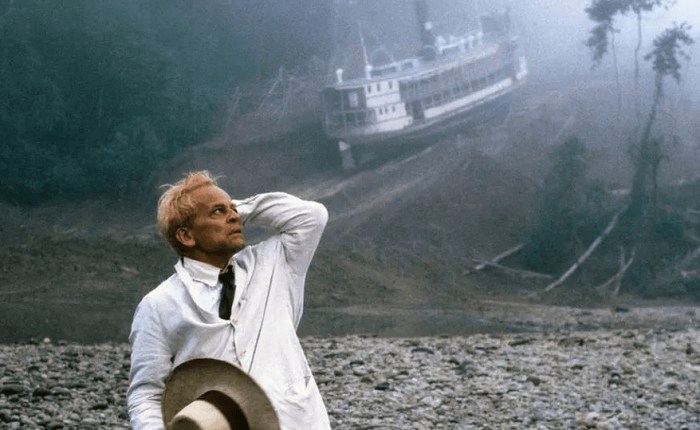
But above all, I appreciate his films and documentaries because they are not about the interpersonal struggles that characterize so much of Hollywood—between children and parents, or between friends, or above all between couples. Granted, this means that his work generally has little value as social commentary, in the way that, say, a classic Victorian novel has. Yet it makes up for it by being about what is, for me, the ultimate theme: the doomed struggle between humanity and the universe. This is summed up in what is arguably the central image in his entire oeuvre, the challenge of Fitzcarraldo: lifting a boat over a mountain in the middle of the jungle. Indeed, the making of the film itself became such an impossible task that it is doubly metaphoric.
Well, I have gone on about Herzog’s work as a filmmaker, but this is a book review, after all. Yet it is apropos, my reaction to this book only makes sense if you know that I am in the midst of a Herzog obsession. And I would only recommend the book to people in a similar predicament. That is, it is difficult for me to imagine someone with only a casual interest in Herzog, or perhaps just wishing to read a good book of memoires, really enjoying the book. Yet if you are a fan, this is wonderful reading.
Or listening. It was an easy decision to experience the book in audio format, narrated in Herzog’s iconic voice. It is certainly good practice for my Herzog impersonation (though it’s still mediocre). Also, it was constantly amusing whenever Herzog pronounced any sort of foreign word—be it German, Spanish, or Nahuatl—as his voice became inundatingly phlegmy.
While Herzog is an extremely thoughtful person—indeed, he seems to be one of the last living examples of the twentieth-century European intellectual, full of strange opinions and oracular pronouncements—while that is true, as I was saying, he is not particularly introspective. To the contrary, he declares himself the enemy of psychoanalysis, and says that there are parts of the human psyche which should remain shrouded in darkness. It is this aversion to delving emotional depths, I think, which makes him spurn human relationships as the focus of his work—and, it seems, as the focus of his life, for he does not seem to be principally motivated by his family or friends.
What motivates him artistically and personally are, rather, what you might call miniature obsessions. The geneses of his films seem to take the following form: He hears a piece of music (such as the madrigals of Carlo Gesualdo) or a story (such as about the simultaneously-speaking twins, Freda and Greta Chaplin) or sees an image (such as man in a protective suit battling an oil fire) and then decides he must make a film about it.
This tendency to get completely lost in a temporary fixation is another quality I share with Herzog. But the big difference between him and sorry devils such as myself is that Herzog is not content to read a book or watch a movie about his latest mania. He actually travels to the ends of the earth to explore it himself.
His absolute determination to see his projects through, regardless of the hardships or the risks, is perhaps his most admirable (and frightening) quality, and the one I identify with the least. I am a soft person who likes comfort, while this book is full of hardship after hardship and injury after injury. It is sometimes difficult to escape the conclusion that the man is a masochist. But I think it is more accurate to say that he has a philosophic attitude to pain. It is woven into his worldview, as something he simply expects to receive from the universe.
Now, I do have to confess at the end of this review that, now and then, I do get a faint whiff of charlatanism. Herzog seems to like telling stories about himself, and he also seems to have a flexible attitude towards the truth (as explained in his theory of “ecstatic truth”). There are precious few flashes of, say, self-deprecating humor to puncture the popular caricature of himself. But even if Herzog the man does not quite live up to Herzog the character, the artistic persona is so compelling that I think we would have to invent him ourselves if he did not really exist.
View all my reviews
Review: Every Man for Himself and God Against All
 Lotz in Translation