Letters from Spain #3: Halloween and History

Letters from Spain #3: Halloween and History

Here is episode three of my podcast on life in Spain:

https://podcasts.apple.com/us/podcast/letters-from-spain-3-halloween-and-history/id1469809686?i=1000455436075

For the transcript, see below:


It has been quite an eventful past week.

Most obviously, and least importantly, Halloween is coming up. Though the origins of Halloween are properly European—hailing from the Celtic ‘Samhain,’ or summer’s end, and related to the Catholic All Saints’ Day—the holiday nowadays is quite justly considered to be an American invention. Geniuses of marketing that we Americans are, we have turned Halloween into a commercial extravaganza. And when money is to be made, people quickly follow suit.

Thus the so-called “Chinese” shops fill up with Halloween paraphernalia: costumes, masks, plastic weapons, and grisly makeup. (These shops, by the way, are somewhat similar to American dollar stores, and are often owned by Chinese immigrants—thus the name.) Pumpkins and witches can be spotted in the windows of bakeries and cafés, and the supermarket is selling giant tubs of gummies in the shapes of spiders and skeletons.

In a way, Halloween is a more sensible holiday in Spain than in the United States, since the following day, November 1st or All Saints’ Day, is always a holiday. (Most of the holidays in Spain are still Catholic.) But for most Spaniards, Halloween is totally unremarkable. College students don’t go to costume parties, adults don’t watch scary movies, and few people buy candy for trick or treaters. Indeed, Halloween’s main importance is in primary schools, where the holiday is embraced as a way of teaching American culture, not to mention giving teachers and students a fun event. 

I dutifully went myself to the shop this past weekend and bought a costume for school, as I prepared myself for the rush of Halloween activities that this week will bring.

But, to repeat, Halloween is probably the least important event in Spain during these past weeks. In fact, I was amused the other day to see a sign in my local supermarket saying that “Christmas is finally here.” In America, we have Halloween, Thanksgiving, and Black Friday to slow down the approach of Christmas season; but in Spain, Christmas is already in the air in late October. Much to my delight, they are already selling the typical Spanish Christmas sweets. I love turrón with chocolate. 

The most important event from this last week has to do with Spain’s past. The government made history this last Thursday by exhuming the remains of dictator Francisco Franco from his burial place in the Valley of the Fallen. As you may recall, after winning the Spanich Civil War in 1939, Francisco Franco ruled Spain for 36 years until his death in 1975—a dictator of a repressive, reactionary regime. The Valley of the Fallen is a tourist destination for many foreigners, but for Spaniards it remains deeply controversial. The place is undeniably impressive. Situated in the pine-covered mountains north of Madrid, it is a basilica built into the base of a granite outcropping, topped with a 150 m (or nearly 500 ft) tall cross. 

The Valley of the Fallen was ostensibly built as a place of reconciliation after the Civil War. But it is difficult to accept it as a truly neutral monument. For one, part of the labor that went into building it was performed by prisoners of war. Moreover, a great many of the over 33,000 fallen soldiers buried in the crypt of the basilica were moved there without the families’ permission. They lie entombed in an enormous vault, unmarked and inaccessible to visitors. The only two marked graves in the Valley belong to José Antonio Primo de Rivera, a leader of the proto-fascist Falangist party whose murder helped to trigger the Civil War, and Francisco Franco himself.

The exhumation was the fruit of a long and bitter legal struggle between the socialist government and Franco’s family. When the courts finally decided in the government’s favor, the exhumation was quickly scheduled to proceed. The authorities were wisely afraid of sparking a violent protest—Spain has had enough of that in recent weeks, with the riots in Barcelona—and so took pains to make the event as quiet as possible. The body, housed in a coffin draped with a cloth and crowned with a wreath, was born by his relatives to a hearse waiting at the foot of the stairs. A priest sprinkled holy water on the remains, before the car drove a short distance to a helicopter waiting nearby. This mode of transport was thought convenient, so as to avoid and disturbances along the way. It flew the dictator’s bones to a cemetery north of Madrid, where Franco was re-interred next to his wife in a private ceremony. 

All things considered, the event was surprisingly calm. About 500 Franco supporters appeared outside of the gates of the basilica, but there was no violence. The Civil War is still quite a touchy subject in Spain. It is very much an open wound in the country’s psyche, since naturally people are divided on the topic. Virtually every Spaniard alive has relatives who fought and died on one side or another, and the conclusion that Franco was an evil man is far from universally accepted. 

As an American, I can sympathize with this situation. Our own Civil War, almost one hundred years older than Spain’s, is still the cause of political tension in our country. And the removal of Franco’s body from the basilica is very much akin to our own removal of Confederate flags and statues of Southern generals from our public spaces. Now, it is easy to be jaded about this. After all, such symbolic victories are good publicity for politicians—cheap, easy, and ultimately involving no real change for living people. Franco’s bones were not hurting anyone. That being said, I do think that the heroes a country chooses to honor constitute a tacit statement of values. If we publically honor men who fought for slavery, or men who trampled democracy underfoot, we condone these actions.

A sophist might respond that Jefferson owned slaves, and that king Philip II of Spain was also against democracy. So where do we draw the line? First, it is worth noting that the answer to that question is always: somewhere. The necessity of making a decision is not an argument against decisions. Where we collectively choose to draw this line will inevitably be a matter of debate for every generation to come. But I hope that we can agree not to publicly honor men who deliberately fought against their own country with the aim of limiting human freedom. That statement applies just as readily to General Custer as it does to the Generalisimo Franco.

Thanks to its Civil War, and the deep code of silence which followed, Spain remains (after Cambodia) the country with the most mass graves in the world. The Valley of the Fallen is the largest mass grave of them all. The country has a long way to go in dealing with this legacy, and this basilica is at the epicenter of this question. My own vote is to deconsecrate the place and to preserve it as a museum. But if that ever happens, it is many years off. For now, the exhumation is a historical step in the right direction, painful as it may have been.
Processing…
Success! You're on the list.

Review: Washington Irving’s Sketchbook

Review: Washington Irving’s Sketchbook

The Legend of Sleepy Hollow and Other Stories: Or, The Sketch Book of Geoffrey Crayon, Gent.The Legend of Sleepy Hollow and Other Stories: Or, The Sketch Book of Geoffrey Crayon, Gent. by Washington Irving

My rating: 4 of 5 stars

Prose writers are voluminous and unwieldy; their pages crowded with commonplaces, and their thoughts expanded into tediousness.

I am a child of Sleepy Hollow, New York, and I have lived in Irving’s shadow almost as long as I can remember.

Every Halloween, this town is inundated with tourists, who come to wander around the lovely old cemetery where the legend is set, and where Irving himself is buried. Behind my house is where they put on the “haunted hayride.” I went every year as a kid. A pickup truck drags groups of twenty in a trailer through a stretch of forest, where volunteers dressed in masks jumped out and scared the kids half to death. And of course no hayride was complete without the headless horseman himself, riding out of the shadows on a black horse with a jack-o’-lantern on his knee.

The town nextdoor is called ‘Irvington’ in Washington Irving’s honor, and it is there that his old house, Sunnyside, is situated. The house is a delightful little dwelling, a small jumble of architectural styles—gothic, Dutch, Spanish—overlooking the Hudson River. Irving was an amateur architect and landscaper, very much of the Romantic school, and re-made the old farm he bought into a charming park, with a little pond, a babbling brook, and paths that wind through the forest nearby. On the property is a sycamore tree that has been growing since 1776, seven years before Irving himself was born.

When Irving bought the property, he had unimpeded access to the river; but that changed when, ten years later, the Hudson Line railroad was built at the river’s edge. Nowadays, trains rattle by every ten minutes or so. All the old train cars have names printed on their sides; and as I sat there on a recent visit, I saw that one of the cars on the passing Amtrak was named “Washington Irving.” He is simply everywhere. There is a statue of Rip Van Winkle outside the Irvington Town Hall Theater. On the walk back to my house I passed by the Washington Irving Middle School, which I attended, the Tarrytown High School, where our football team is the Horsemen, and the Christ Episcopal Church, where Irving himself worshiped, and where his pew is still preserved.*

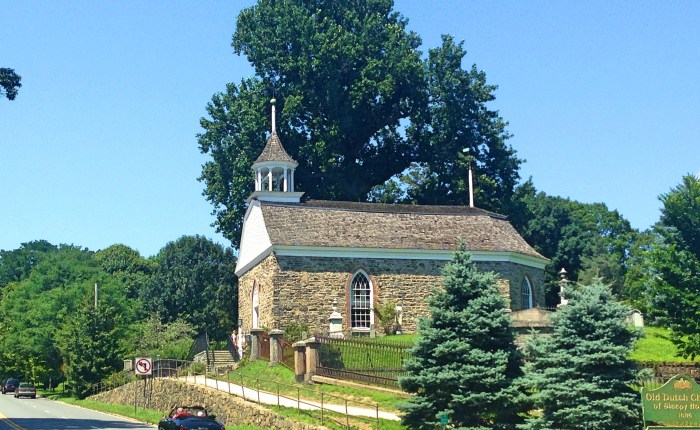
Right outside Philipsburg Manor—an old colonial farm that now serves as a historical site—is an ugly metal sculpture of the Headless Horseman. Right next to it is where the old bridge stood where Ichabod Crane met his fate. There is not much to see now, just a modern concrete construction. But if you keep walking into the Sleepy Hollow Cemetery you can see the Old Dutch Church, and, a little farther on, you will come across the man’s tombstone. Like his house, his grave is neither ostentatious nor grandiose, just a simple stone that lays in a family plot.

The man’s influence is inescapable. It was Washington Irving who originated the nickname ‘Knickerbockers’ (after an imaginary Dutch historian he used as a nom de plume) for the denizens of New York. The New York Knicks owe their name to Irving, and the word ‘knickers’ also derives, through devious channels, to this writer. It was Irving who popularized the myth that Christopher Columbus thought the earth was flat, which he included in a biography of Columbus that Irving wrote while living in Spain. It was Irving, too, who originated the nickname ‘Gotham’ for New York City.

We even owe our holiday celebrations to Irving, since it was he, along with Charles Dickens, who helped to make Christmas into the secular holiday of gift-giving and merry-making that it is today. Irving played a hand in the creation of Santa Claus, too, with a story about St. Nicholas in his first book. With his love of ghost stories, Irving is also one of the architects of Halloween—and thousands still make the pilgrimage to visit his tombstone in that ghoulish time of the year. I cannot even escape his influence in Spain, since it was Irving who helped to spread the exotic, enchanted image of Andalusia, and who thus helped make Spain a tourist destination; and it was also thanks to his book of stories about the Alhambra that people began taking an interest in restoring that old ruin.

Washington Irving was named after George Washington, and was born just a few weeks before the Revolutionary War was officially concluded. He was a new man for a new land. An often-told story—difficult to verify—has it that he was taken by his maid to visit George Washington when he was just six years old; there’s a watercolor drawing, still hanging in Irving’s hold house, of the old general patting the young boy on the head. Whether it happened or not, the story seems symbolic of the role that Irving would play in American literature—exactly analogous to George Washington in politics—as a pioneering leader. For it was Washington Irving who was the first American writer to be respected by his English peers. He showed that these unruly savages overseas could aspire to eloquence too.

This book is often marketed as The Legend of Sleepy Hollow and Other Stories; but its original title is The Sketchbook of Geoffrey Crayon, Gent., and was published under that pseudonym rather than Irving’s own name. The book, often merely called The Sketchbook, is a sort of parody of the sketchbooks that other wealthy American travelers made on their visits to Europe. It is framed as a travel book, and contains many vignettes about places Irving visited. But Irving does not stick to this theme very diligently. The book also contains some short pieces about Native Americans; and the two most famous stories, “The Legend of Sleepy Hollow” and “Rip Van Winkle,” are both set in New York, and purport to be found among the old papers of Diedrich Knickerbocker, another of Irving’s pseudonyms.

Although the collection is miscellaneous, Irving was not a writer of great breadth, and his distinctive style is consistent throughout. Thematically, Irving was a purebred Romantic. He has a taste for quaint customs, forgotten ruins, exotic places, and old yarns—in short, everything antique, out-of-the-way, and foreign, everything that allows his imagination to run wild with conjecture. These preoccupations lead him to investigate old English Christmas customs in the country, and to rail against their disappearance. It also leads him to treat the Native Americans as noble savages, the pure emblems of a disappearing culture, as well as to focus his eye on the old Dutch lore lingering about his native New York.

In truth there is not much substance to his writing. The closest he ever gets to philosophy is the Romantic, Ozymandian sentiment that all things yield to time. Rather, Irving is a stylist. His prose is fluent and easygoing—indeed, remarkably easy to read considering its age—so effortless that the prose practically reads itself. The subject-matter is usually a description of some kind—of what someone is wearing, of a farm or a tavern, of a funeral or a wedding—and he steers clear of all argument and dialogue, maintaining the fluid rhythm of his pen as it flies forward. When he is not describing a gothic ruin, an old curiosity, or a picturesque landscape, he is involved in some ghost story or traveler’s anecdote. Some of these, indeed many, involve love affairs between gallant soldiers and young women who possess “that mysterious but impassive charm of virgin purity in whose hallowed sphere no guilty thought can live”—it’s quite revolting.

But if Irving nowadays strikes one as lightweight and Romantic to the point of silliness, one should remember that he was a pioneer and an innovator—the first American man of letters, and one of the champions of Romanticism when that movement had hardly reached this country. And if he seems more style than substance, one should also remember that Irving wrote to amuse, not to instruct; and it is by that goal that he should be measured. Even now, Irving is a champion amuser; and even if he has some unfashionable tastes, he it still fresh and good-natured after all these years:

If, however, I can by any lucky chance, in these days of evil, rub out one wrinkle from the brow of care or beguile the heavy heart of one moment of sorrow; if I can now and then penetrate through the gathering film of misanthropy, prompt a benevolent view of human nature, and make my reader more in good-humor with his fellow-beings and himself—surely, surely, I shall not then have written entirely in vain.

Surely, surely, he has not.


*I recently went to visit this church. As luck would have it, I was about to knock on the door just as the rector, Susan, was on her way out of the building. When I asked about Irving’s pew, she very kindly gave me a quick tour. The old pew sits in a corner now, set aside to preserve it. The church also has Irving’s bible and prayer book—tattered old things in a glass case—as well as a copy of the 1859 issue of Harper’s Magazine that carried a front-page story about Irving’s funeral. “So many people came in, they were worried the floorboards would break,” Susan said.


View all my reviews