Review: The Age of Napoleon

Review: The Age of Napoleon
The Age of Napoleon (The Story of Civilization, #11)

The Age of Napoleon by Will Durant

My rating: 4 of 5 stars

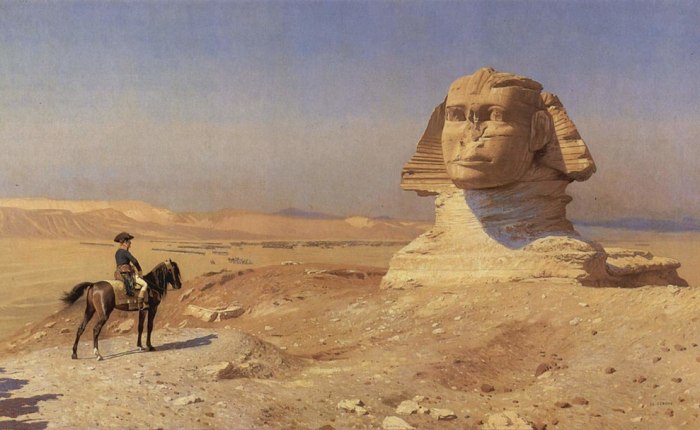
Finally I have come to the last book in this series. It was four long years ago when I first read The Life of Greece; and these have been the four most educational years of my life, in part thanks to The Story of Civilization. Though I have had some occasions to criticize Durant over the years, the fact that I have dragged myself through ten lengthy volumes of his writing is compliment enough. Now all I need to do is to read the first volume of the series, Our Oriental Heritage, in order to bring my voyage to its end. (I originally skipped it because it struck me as absurd to squeeze all of Asia into one volume and then cover Europe in ten; but for the sake of completion I suppose I will have to read it.)

Durant did not plan to write this volume. His previous book, Rousseau and Revolution, ends with a final bow. But Durant lived longer than he anticipated (he died at 96), so he decided to devote his final years to a bonus book on Napoleon. It is extraordinarily impressive that he and his wife, Ariel, could have maintained the same high standard of writing for so many decades; there is no notable decline in quality in this volume, which makes me think that Durant should have written a book on healthy living, too.

The Age of Napoleon displays all of Durant’s typical merits and faults. The book begins with a bust: Durant rushes through the French Revolution, seeming bored by the whole affair, seeing the grand drama only as a disruptive prelude to Napoleon. This showcases Durant’s inability to write engagingly about processes and events; when there is no central actor on which to focus his attention, the writing becomes colorless and vague. Further, it also shows that Durant, while a strong writer, was a weak historian: he provides very little analysis or commentary on what is one of the most important and influential events in European history.

When Napoleon enters the scene, the book becomes appreciably more lively. For reasons that largely escape me, Durant was an unabashed admirer of the diminutive general, and sees in Napoleon an example of the farthest limits of human ability. Though normally uninterested in the details of battles and campaigns, Durant reveals a heretofore hidden talent for military narration as he covers Napoleon’s military triumphs and defeats. Some parts of the book, particularly near the end, are genuinely thrilling—an adjective that rarely comes to mind with Durant’s staid and steady style. Granted, he had an extraordinary story to tell; Napoleon’s rise, fall, rise again, and fall again are as epic as anything in Plutarch.

But as usual Durant shines most brightly in his sections on artists, poets, and philosophers. The greatest section of this book is that on the Romantic poets: Wordsworth, Coleridge, Shelley, and Byron. (For some reason, Durant sees fit to exclude Keats, even though the scope of Keats’ life falls entirely within that of Napoleon.) Less engaging, though still worthwhile, was Durant’s section on the German idealist philosophers; and his miniature biography of Beethoven was a stirring tribute. Many writers who properly belong in this volume were, however, paid their respects in the previous, most notably Goya and Goethe, since Durant thought that this volume would never appear.

Though I am happy to reach the end, I am saddened that I cannot continue the story of Europe’s history any further forward with Durant. He is an inspiring guide to the continent’s cultural treasures.


View all my reviews

Review: Kenneth Clarke’s Civilisation

Review: Kenneth Clarke’s Civilisation

Civilisation:  A Personal ViewCivilisation: A Personal View by Kenneth Clark

My rating: 5 of 5 stars

I wonder if a single thought that has helped forward the human spirit has ever been conceived or written down in an enormous room

I must admit immediately that I have never read nor even laid eyes on this book. I’m sure it’s lovely. This review is, rather, about the television series, which I’d wager is twice as lovely.

Civilisation is the best documentary I’ve ever seen. Kenneth Clark takes his viewer from the Dark Ages, through romanesque, gothic, the Renaissance, the Reformation, baroque, rococo, neoclassicism, impressionism, through the industrial revolution and the two World Wars, all the way up to when the program was made in the late 1960s. This is a remarkable amount of ground to cover for a show with 13 episodes, each 50 minutes long.

Not only chronologically, but in subject matter, this documentary casts a wide net. Although the show’s primary emphasis is on architecture and art, Clark also dips into literature, poetry, music, engineering, politics, and wider social problems like inequality, poverty, oppression, and war. Of course, for lack of time Clark cannot delve too deeply into any one of these subjects; but because the presentation is so skillful and economical, and the selection of material so tasteful, the viewer is nevertheless satisfied at the end of every episode.

The documentary generally shifts between shots of Clark facing the camera, talking to the viewer, and extended, panoramic shots of churches, monuments, paintings, drawings, sculptures, and mountains, while beautiful music plays in the background. Clark himself chose the musical accompaniments to these visuals, and they are uniformly splendid (and this is one reason why I recommend the documentary over the book). More than perhaps anything I’ve seen on a screen, this series is rich, lavish, sumptuous. As the camera pans over the altarpiece of a church, while Bach’s St. Matthew’s Passion plays in the background, it’s so lush and gorgeous that it almost gives you a stomach ache.

Aside from these visuals and music, the main attraction of the series is Clark himself. He comes across as refined, cosmopolitan—almost a freak of erudition. But for all that, he is charming and witty, if ultimately a bit cold. One of the strongest impressions I got was that Clark was a man from another time. He looks out of place as he walks through the modern streets, crowded with cars and buzzing with urban life. He has many misgivings about the modern world: he is anti-Marxist, anti-modern art, and certainly didn’t understand the student protests and hippie culture flourishing at the time. In his own words, he was a “stick in the mud,” and I think felt alienated from his time because of his intense appreciation, even worship, of Western art.

This brings me to some of this program’s shortcomings. Most of these are due to the time in which it was made. This is most apparent in the first episode, “The Skin of Our Teeth,” wherein he argues that civilization almost disappeared during the Dark Ages, and comes close to crediting Charlemagne as the savior of all subsequent culture. This requires that he completely discredit both Byzantine and Muslim culture (not to mention Chinese), both of which were doing just fine. He repeats the tired stereotype about Byzantium being a fossilized culture and treats the Muslims as simple destroyers. Later on in the series, he has some uncharitable things to say about the Germans, which I think was a product of growing up during the World War.

A more serious flaw might be that the series bites off more than it can chew. The questions Clark poses to answer are vast. What is civilization? What makes it thrive? What makes it fall apart? Deep questions, but his answers are by comparison shallow. Civilization requires confidence in the future; they cannot be built on fear. Civilization requires rebirth, the constant search for new styles and ideas; but it also requires continuity and tradition, a respect for the past. Civilization is pushed forward by men of genius (and in this series, they’re all men), who enlarge our faculties with their godlike creative powers; men like Michelangelo, Dante, Beethoven, men who are timeless and yet who forever alter the face of culture.

These are interesting answers, but they seem rather superficial to me. They describe, rather than explain, civilization. But of course, this is a documentary, not a monograph. And although Clark asks and tries to answer many questions, I think his primary goal was simply to inspire a sense of the worth, the preciousness, the grandeur of the accomplishments of European civilization. He wants to remind his viewers that our culture is fragile, and that we owe to it not only beautiful paintings and poetry, but also our very ability to see and appreciate the beauty in certain ways, to think about ideas in a certain light, to live not only a happy but a full and rich life.

Maybe this seems pinched and old-fashioned nowadays. Still, I can’t help thinking of all the times that a friend, a fellow student, or even a teacher has made a blanket statement about “Western culture,” “Enlightenment ideas,” “scientific materialism,” or some such thing, while seeming to understand none of it. (I’ve probably done this myself, too.) I’ve been in classes—serious, graduate-level classes—where, amid condemnations of “Western” ideas and gratuitous namedropping of Western philosophers, I realized that I was the only person there, professor included, who actually read some of these authors. I’m not making this up.

I suppose this is just a callow intellectual fashion, and it will eventually pass away. And I also suppose that this might be slightly preferable to the idiotic self-glorification of “European man” that prevailed in earlier times. At present, however, this program is a wonderful corrective to our bad habits of thought. It’s an education, a social critique, and a joy. I hope you get a chance to watch it.

View all my reviews

Central Europe: Prague

Central Europe: Prague

When I arrived in Prague I wasn’t feeling too good. Flights from Madrid to Prague are normally expensive; but I had gotten lucky and had found one for quite cheap. The only problem was that it left Madrid at an inhumane hour in the morning; and since I have trouble sleeping either before or during flights, I was not exactly at my best. Sleep-deprivation, besides making me delirious, also makes me more prone to stress. I feel as though I cannot calm down; every little obstacle provokes a feeling of panic. Keep in mind that, when you buy cheap plane tickets, you pay for the flight in other ways.

Admittedly I did have two additional things to worry about this trip. The first was money. The Czech Republic does not use the euro, but the koruna (or “crown”). This alone produced in my exhausted mind a feeling of disorientation, since now I had to perform a conversion to understand how expensive something was, and my mind was in no condition for arithmetic. More stressing was my new camera. Just days before I had impulsively ordered a Canon 1300D (Rebel T6 in America) and I had hardly any idea how to use it, care for it, or store it. Fresh from the financial sting of purchasing the device, I was terrified of losing, breaking, or having it stolen. This was my state as I entered one of the most beautiful cities in Europe.

There are many options for getting from the airport to the center of Prague. I took a local bus and transferred to the metro, which took me to Prague’s central train station, Praha hnlavní nádraží, where I deposited my things in a luggage locker. Prague’s metro system is conspicuously attractive and efficient. There are only three metro lines (A, B, and C); but they have been planned so well and go so quickly that I felt that I could zip around the city. Many stations also feature appealing, even futuristic designs. It made a good first impression. Though the city of Prague has only around 1.3 million inhabitants, the metro carries 1.6 million riders a day, which gives you an idea of the level of tourism in the city.

As I emerged into the daylight from the train station—confused, panicked, disoriented—I was at a loss for where to go first. After some aimless wandering I emerged on the Václavské Náměstí (Wenceslas Square), which is more of a long open avenue than a plaza. Its name comes from St. Wenceslas, patron saint of Bohemia; and a monumental equestrian statue of the saint stands at the top of the square. Behind the statue, bookending the space, is the palatial building of the National Museum—which houses a large collection of both natural and cultural history, but which nevertheless is not a popular attraction (I didn’t go).

powder_tower

From there I made my way to the Old Town. (The aforementioned Wenceslas Square is in the New Town, an expansion of the city planned under Charles IV in the 14th century—very new indeed.) This led me through one of the old city gates, the Powder Tower, an attractive gothic edifice built of smoky grey stone and covered with decorative work.

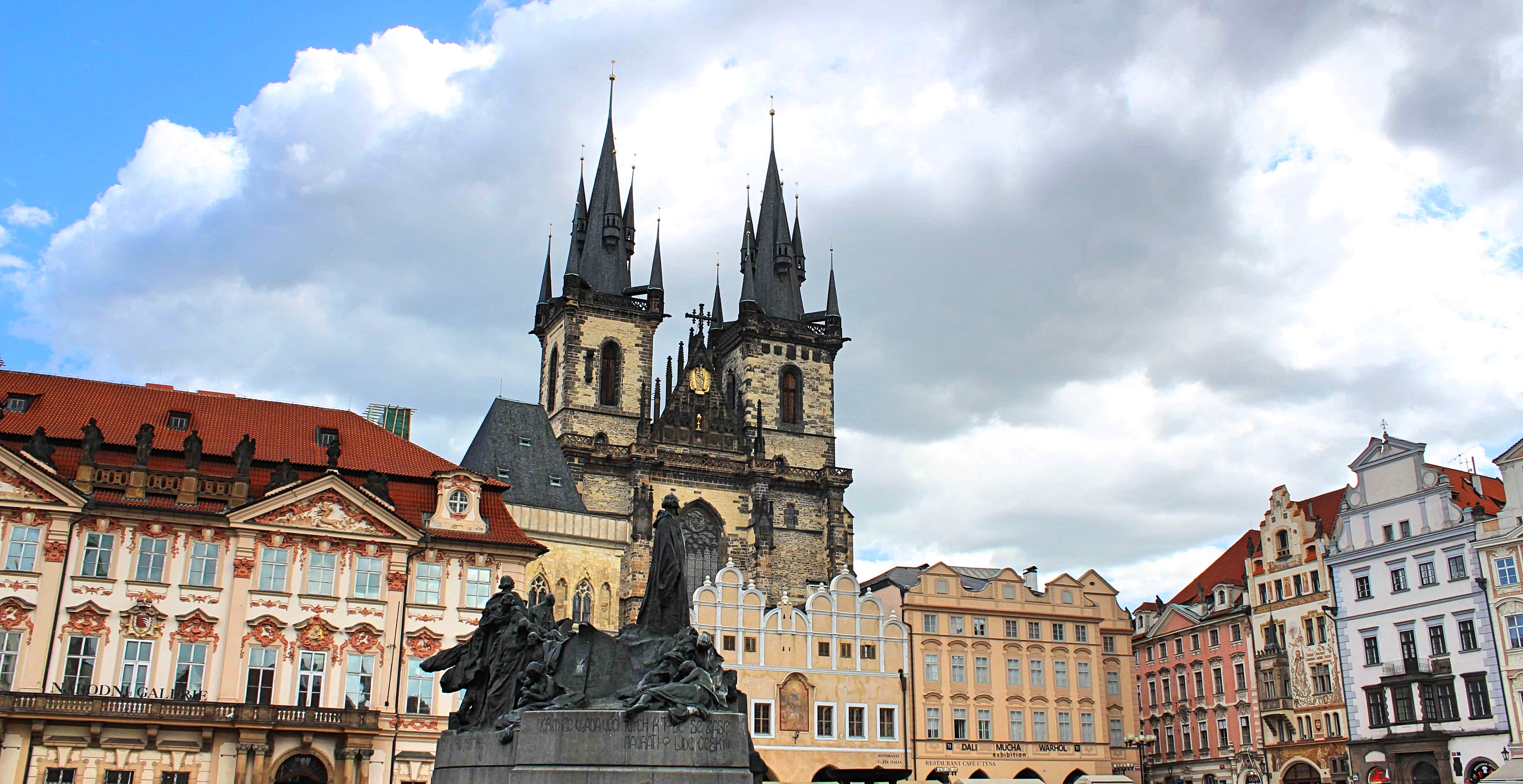
Soon I found myself in the center of the city: Old Town Square. It is a very pretty place, lined with square apartment buildings painted in bright colors. Beyond them is the Church of Our Lady before Týn, whose tall, jagged gothic spires provide one of Prague’s most distinguishing sights. Tycho Brahe, the astronomer who taught Johannes Kepler, is buried here. In the center of the square is a statue of Jan Hus, an important religious reformer and predecessor of the Protestant Reformation, who believed that mass should be given in the vulgar tongue and the Bible translated into Czech—for which he was very reasonably burned as a heretic. This kicked off the Hussite Wars, in which an armed and mobilized Czech population repelled crusade after crusade sent by the Pope to squelch the heresy, an important event in Czech nationalism.

On the other side of the square is St. Nicholas Church, decorated in a pretty Baroque. Yet the most famous landmark is the extraordinary astronomical clock, or Prague orloj, affixed to the Old Town Hall. Unfortunately for me, however, the clock was under restoration when I visited, and was hidden underneath a tarp.

Prague_Oldtownsquare

Standing in that expansive square, I was already beginning to see why Norman Davies, who wrote a history of Europe, named Prague the continent’s most beautiful city. But why is one of Europe’s most attractive places and most popular tourist destinations located in the Czech Republic, a country about which most Americans (myself included) know close to nothing?

It goes back to Prague’s previous title as the capital of the Kingdom of Bohemia—at first an independent kingdom, and then a central part of the Holy Roman Empire. The kings of Bohemia ruled over a vast land that extended far beyond the borders of the current Czech Republic; and some were even elected to become the Holy Roman Emperor (that is, until the Habsburgs had their way). Indeed, during the high points of the Austrian power Prague played a role nearly as important as Vienna in central Europe. So the city’s great beauty is no coincidence. And luckily the city was not bombed nearly as heavily as other Nazi-controlled cities during the Second World War, so its beauty has survived intact.

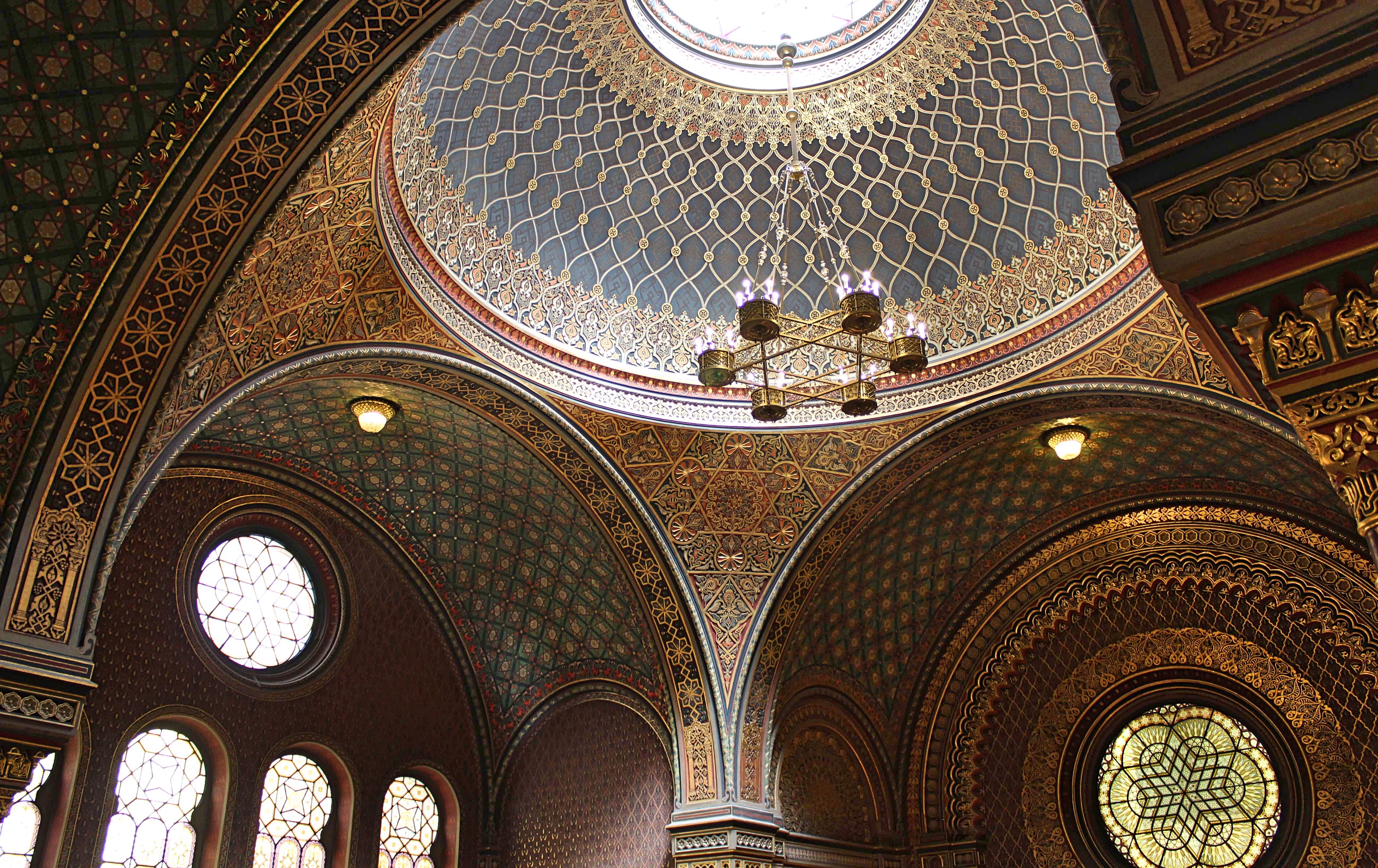
My next stop was the city’s Jewish Quarter, located in a corner of the Old Town. My original plan was just to visit one synagogue; but to visit any of the landmarks of this neighborhood one must buy a combination ticket, which is certainly worth it. My first stop was the famous Spanish Synagogue. This is the newest synagogue in the Jewish Quarter; it was completed in 1868, built over what was the oldest synagogue in Prague, which had become too small for the congregation. The synagogue is called “Spanish” because of its Neo-Mudéjar interior decoration, built in imitation of the Moorish-influenced style developed by the Sephardic Jews of Spain. It is beautiful to behold. Every inch of the space is covered in geometric designs painted in a shimmering gold.

Spanishsynagogue

Outside the synagogue is a monument to one of Prague’s most famous sons: Franz Kafka. Born to a Jewish family (though not exactly religious himself), Kafka spent most of his unhappy life in Prague. The statue, by Jaroslav Róna, shows the sharp-featured, diminutive writer pointing his finger (at what?) while riding on the back of a faceless and armless man—a fittingly absurd image for the great poet of the absurd. Apparently it is considered good luck to rub Kafka’s feet; but I kept my distance, since luck and Kafka do not go together. There is a Kafka Museum elsewhere in the city, which I have heard is not very impressive. But in front there is a fountain worth seeing, featuring two men urinating into a little pool of water as sections of their bodies spin around. I don’t know if the image is particularly Kafkaesque, but it is memorable.

The next synagogue on my combined ticket was the Pinkas Synagogue. This synagogue is not nearly as visually striking as the Spanish Synagogue; its interest lies, rather, in the memorials within. On the lower level of the synagogue, the name, birthdate, and date of death of every Jewish victim of the Holocaust in the Czech Republic are inscribed on the walls. On the upper floor is an even more moving tribute: drawings made by the children sent to the concentration camp of Theresienstadt. These survived because the children’s drawing teacher, Friedl Dicker-Brandeis, hid them in Theresienstadt before her deportation to Auschwitz, where she was killed. Most of the children suffered the same fate. The drawings are an extraordinary testimony of the humanity, individuality, and creativity of the children caught up in the catastrophe.

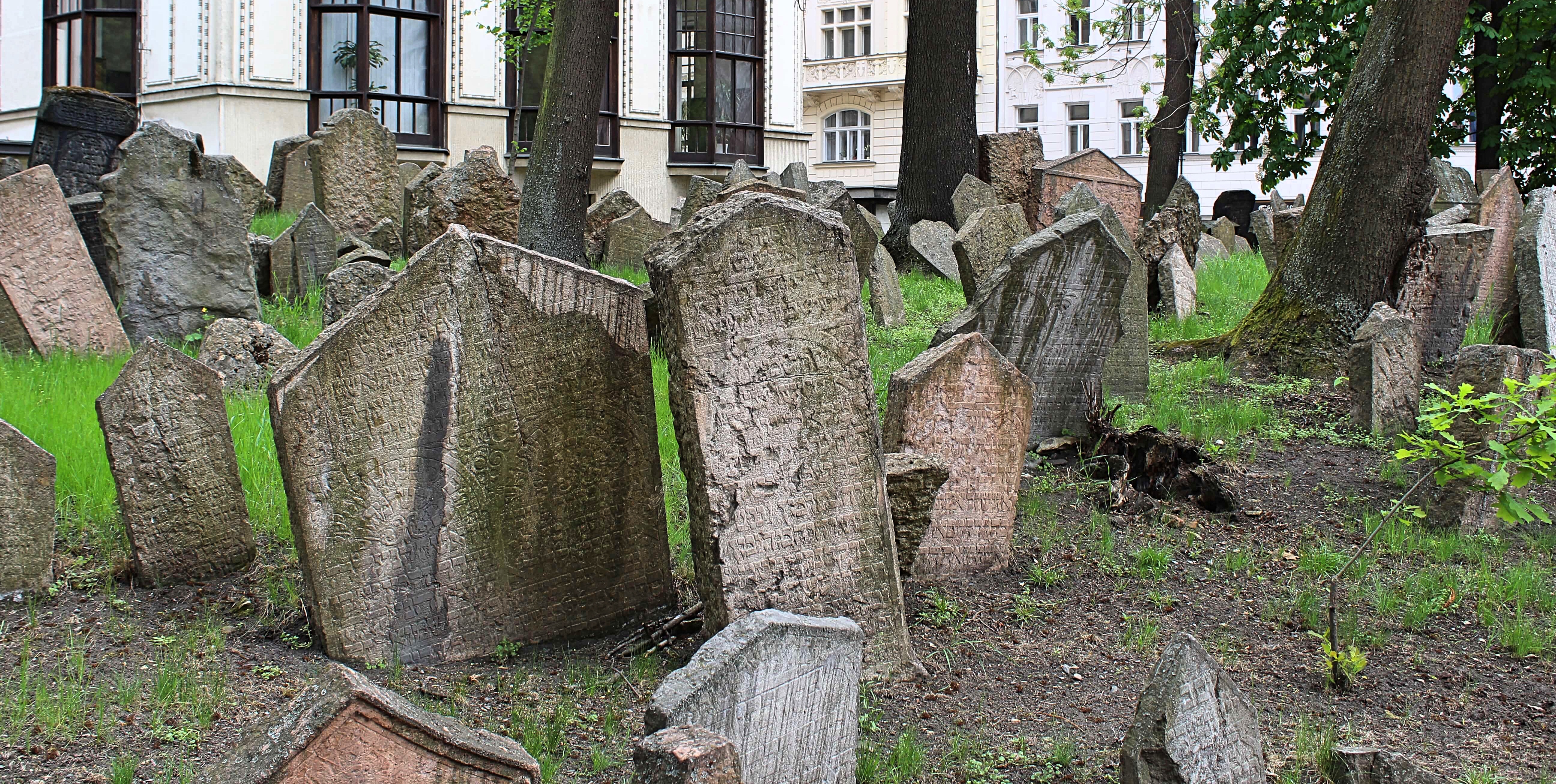
Right next to the Pinkas Synagogue is the Old Jewish Cemetery. Since Jewish custom forbids removing graves or markers once they are laid down, and since new land was difficult to acquire, the community was forced to put several graves on top of each other. As a result the cemetery is a forest of tombstones, many of them pushed to odd angles or otherwise falling down; and the ground level is higher than the surrounding streets. The graves span from the 14th to the 18th centuries, at which time Josef II (of Austria) decreed that no more burials were to take place within city walls, in order to reduce disease. Most of the markers are tombstones, though some of the more important personages have tumbas, or sarcophagi (though the body is not inside these). In some of these tumbas I observed little pieces of paper, folded up and tucked inside the nooks of the stone; and in front of one tumba—perhaps of rabbi Judah Loew ben Bezalel—I observed some people praying.

Jewish_cemetery

There were still more sites included on my ticket. One was the Ceremonial Hall of the Jewish Burial Society. A burial society (chevra kadisha in Hebrew) is a voluntary organization that helps to prepare the body of a deceased member of the community and prevent desecration. Nowadays the building is an exhibition space, with panels of information about the role of burial societies (of which I was entirely ignorant) as well as some ritual items on display. Nextdoor is the Old-New Synagogue, a gothic building that is the oldest active synagogue in Europe (it became the oldest when the older synagogue was knocked down to make the Spanish Synagogue). A legend tells that a golem—created by none other than the above-mentioned Judah Loew ben Bezalel, to protect the Jews of Prague from antisemites—inhabits the attic of this building. Nowadays the synagogue is filled with symbolic objects on display and explanations of Jewish customs. The last stop on this ticket was the Maisel Synagogue, an attractive neo-gothic building that houses an exposition on the history of the Jews in Prague. All of these spaces are administered by the Jewish Museum.

As all of these monuments demonstrate, Prague has long had a sizable Jewish community, which would seem to indicate that the city was relatively tolerant compared to other major European capitals. This may be true. However, even here the Jews faced serious persecution. In 1389, for example, following an accusation that Jews had desecrated the host—a common anti-semitic accusation during the Middle Ages—the city’s population was incited to fury and massacred almost every Jew in the city.  In the previous century, aside from the infamous Nazi persecutions, the Jewish religion was repressed under the communists. It is, therefore, very heartening to see that a sizable community still exists in the city.

Now it was time to visit one of Prague’s most iconic monuments: the Charles Bridge. This medieval bridge is named for Charles IV (1316 – 1376), perhaps the most influential ruler in Czech history. Originally king of Bohemia, he was elected to become Holy Roman Emperor; and during his reign he oversaw several important expansions of the city, such as the aforementioned Wenceslas Square. Charles IV was also responsible for the so-called Golden Bull of 1356, which he proclaimed from the castle in Nuremberg, and which established clear procedures for electing the Holy Roman Emperor. This was important, since it helped to prevent controversies of legitimacy and succession, which threatened the continuance of the empire.

Praguecastle_bridge
Prague Castle from the Charles Bridge

The bridge spans the river Vltava (sometimes called by its German name, the Moldau), the iconic waterway of the Czech Republic. From its opening in 1402 until 1841, the Charles Bridge was the river’s only crossing, connecting the Old City with Prague Castle. In design the bridge is not very different from Roman bridges I have seen: a relatively flat span (2,000 ft. in length) lying close to the water, suspended on a series of stone arches resting on stone foundations. Towers guard both sides of the bridge—an important defensive feature back in those days—which are not only intimidating but pleasing to the eye. The bridge is covered with statues, 30 of them, in a Baroque style depicting religious subjects.

Yet it is difficult to appreciate the statues, the bridge, the water, or the views with the huge crush of people inevitably walking across. Prague is hardly behind Venice as a European tourist destination; and so major attractions, like the bridge, attract suffocating crowds. And where tourists go, so does the rubbish—street performers, sketch artists, souvenir vendors, and all the rest. It is the bane of traveling.

Having squeezed across the bridge, it was time to ascend to Prague Castle. This is a whole building complex rather than a specific edifice. The castle sits atop a hill far above the level of the river, so getting there can be slightly exhausting if you are, like myself, not athletically inclined. The exertion is compensated, however, by lovely views of the river and the city beyond. To get inside the complex one must wait in a line and pass through security. Then one must buy a ticket at the office. There are multiple types of tickets, with different numbers of sites which can be visited, depending on the price. (True to form, I bought the cheapest one.)

Prague castle has been a seat of governance since the 9th century, making it far older than most other European capital buildings. And due to its very long tenure as a seat of power, the castle has an abundance of architectural styles on display. Having served Bohemian Kings and Holy Roman Emperors, the place retains its function as a seat of power, being the official residence of the President of the Czech Republic. Even the crown jewels are still kept here (though, unlike in Vienna, they cannot be visited). It is, in short, an important spot.

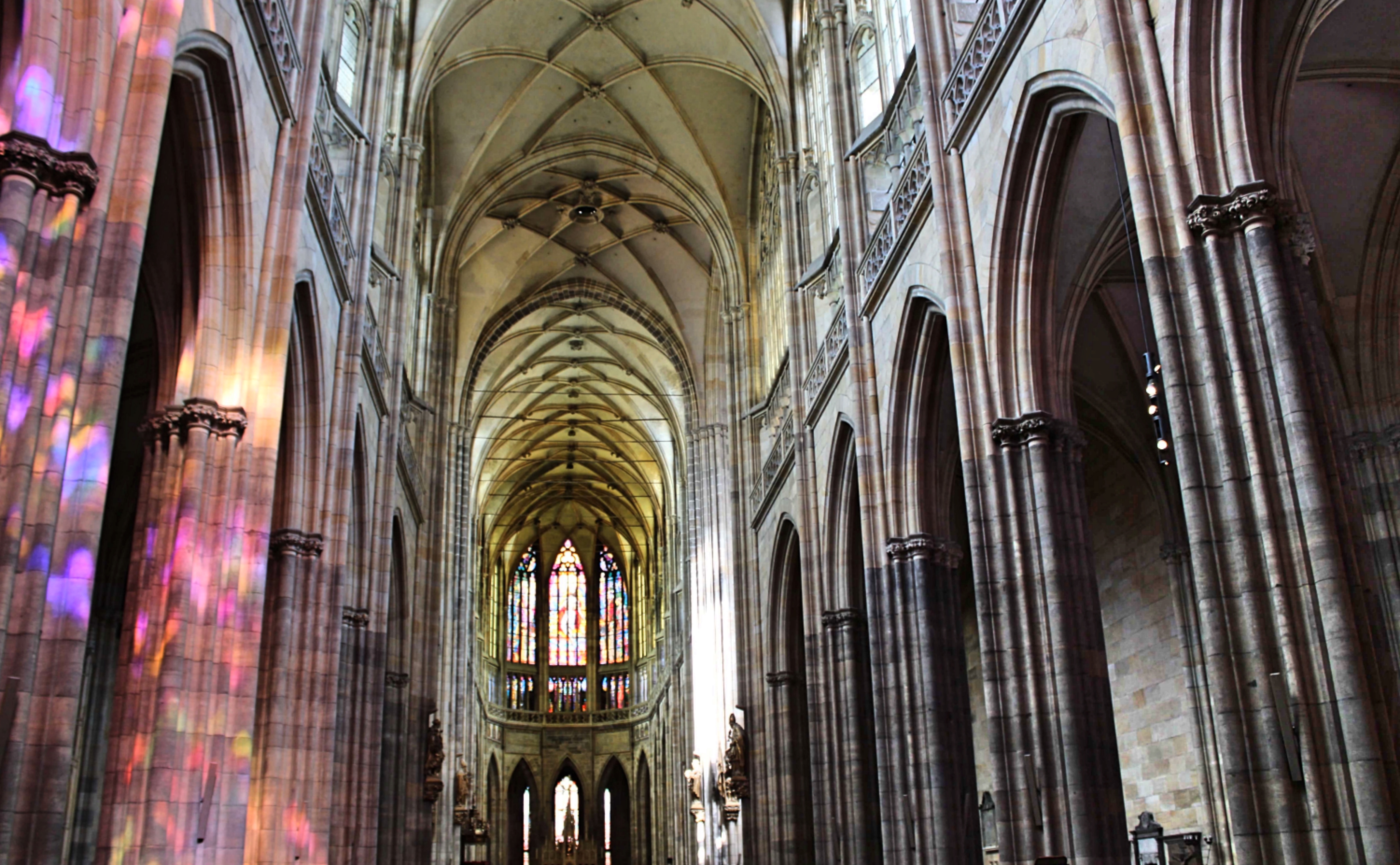
Yet the most famous building inside the castle complex is neither a palace nor a castle, but Prague’s cathedral: St. Vitus. This is one of the finest gothic cathedrals in the world, a blend of typical French gothic and special innovations particular to this church. The original head architect of the cathedral was Matthias of Arras, a Frenchman who designed a building in the prevalent French gothic. But after his death he was succeeded by Peter Parler, one of the great craftsmen of the Middle Ages. A sculptor rather than an architect, a German rather than a Frenchman, Parler introduced several idiosyncratic elements into the design of the cathedral, such as his characteristic net-vaulting, which both improve strength and create an attractive criss-crossing design on the ceiling.

Prague_cathedralfacade

I admit that, when I visited, I was mostly unable to appreciate any of these technical subtleties. Nevertheless I found the building hypnotic. From both without and within, the cathedral is pleasing to the eye—harmonious in its proportions, tasteful in its ornament, and unmistakable for any other cathedral. (It is worth noting, by the way, that Peter Parler was appointed by the unavoidable Charles VI; and it was this same architect who designed the Charles Bridge. In the history of Prague these two are unavoidable.)

Prague_cathedralinside
Note the vaulting

The cathedral presents a striking view from every angle—inside or outside, back or front, from up close or far away, and so on. Its beauty consists in the design of the building itself rather (as in Toledo) in the artwork contained within. However, there is one chapel that stands out for special mention: the one dedicated to St. Wenceslas (which you may remember as the patron saint of the Czechs). The visitor cannot enter the room, but must be content with peering in through the doorway. The lower walls are dedicated with semi-precious stones and gothic painting depicting the passion, while the upper portion shows Renaissance-era frescos showing the life of the titular saint.

Wenceslaschapel

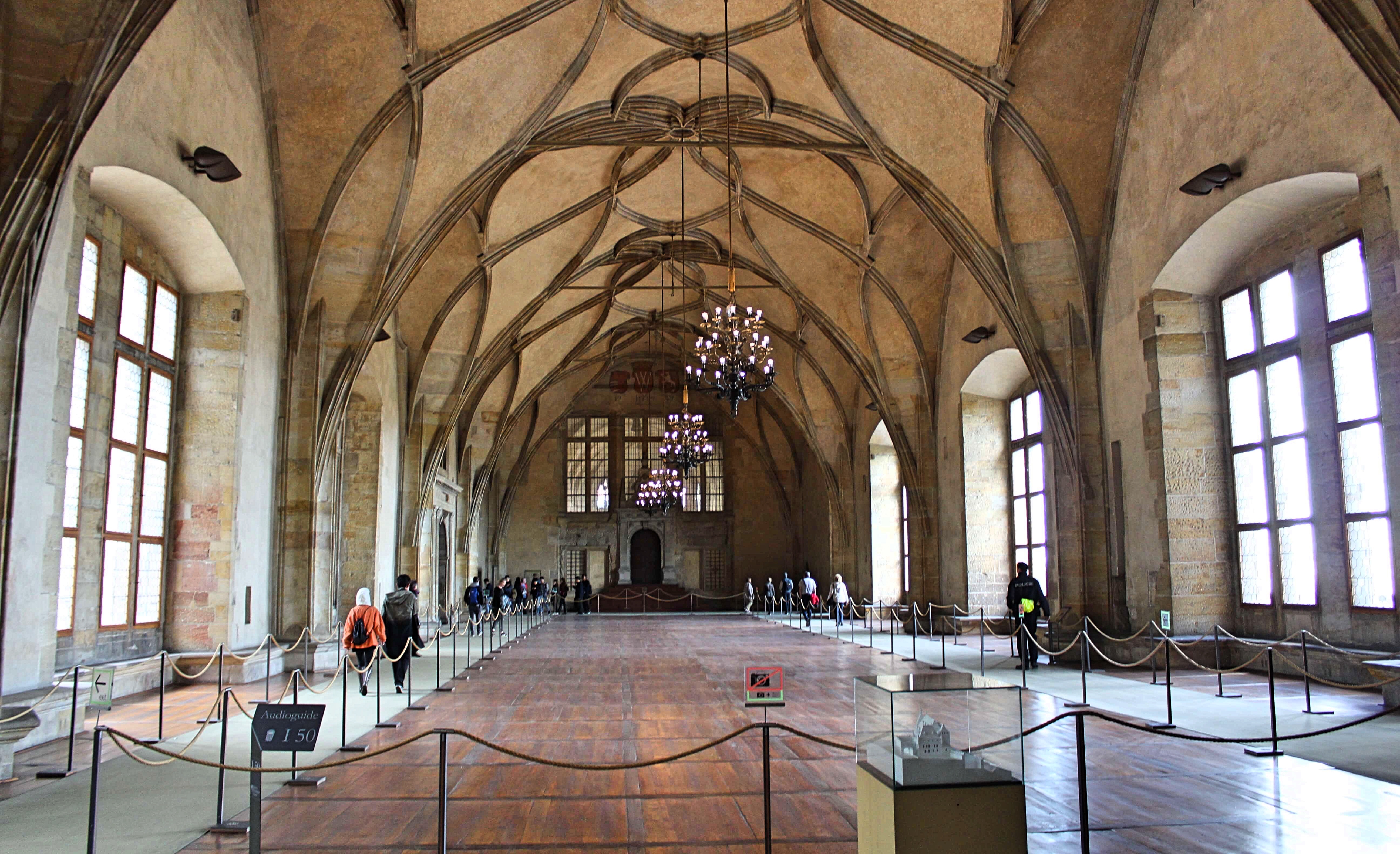
After I was finished admiring this glorious piece of religious architecture, I visited the Old Royal Palace, which was built in the 12th century. It is most notable for its Vladislav Hall, a massive ceremonial hall with an intricately vaulted ceiling that undulates like an ocean wave. It was also in this palace that the infamous Second Defenestration of Prague took place in 1618, when Czech protestants threw the catholic representatives of the Holy Roman Empire out a window, an event which helped to trigger the horrific Thirty Years’ War. (Somehow the catholics survived the 70-foot drop, which they naturally attributed to angels, and which the protestants attributed to a dunghill underneath them.) Since this event was the only thing I remembered about Prague from my AP European History class, I was elated to find this legendary window.

Prague_hall

My next stop in the cathedral complex was the Basilica of St. George, a church with a cheerful Baroque façade that conceals a somber Romanesque interior. It was founded all the way back in 920 and preserves that ancient atmosphere even now. Then I made my way to the Golden Lane, a row of colorfully painted houses, pretty and quaint, that were originally built to house guards, and which later served as a home for goldsmiths (hence its name). Nowadays it is a row of overpriced souvenir shops. And it must be said that this progression, from guards to gold to gimmicks, encapsulates European history quite well.

Observationtower

Right next to Prague Castle is the Petřín Hill, an elevation covered with parks, which rises above the Vltava River. This is one of the loveliest green spaces in Prague and is a welcome respite from the crowded streets. Walking up the hill is not terribly strenuous; for the enemies of inclination, however, there is a funicular available. On top of the hill is the Petřín Lookout Tower, which was made in imitation of the Eiffel Tower. Indeed, it looks as though the top bit of the Parisian edifice had been lopped off and transported here. With the height of the hill (130 meters) added to the height of the tower (64 meters), it still falls short of the Eiffel Tower’s height (300 meters). Even so, it is the highest point for miles around. (I did not go up, since I was not in the mood for climbing stairs.) Also to be seen is the Hunger Wall, a defensive structure built during the reign of (guess who) Charles IV. Its name comes from the myth that the wall’s primary purpose was simply to provide work and food for the poor.

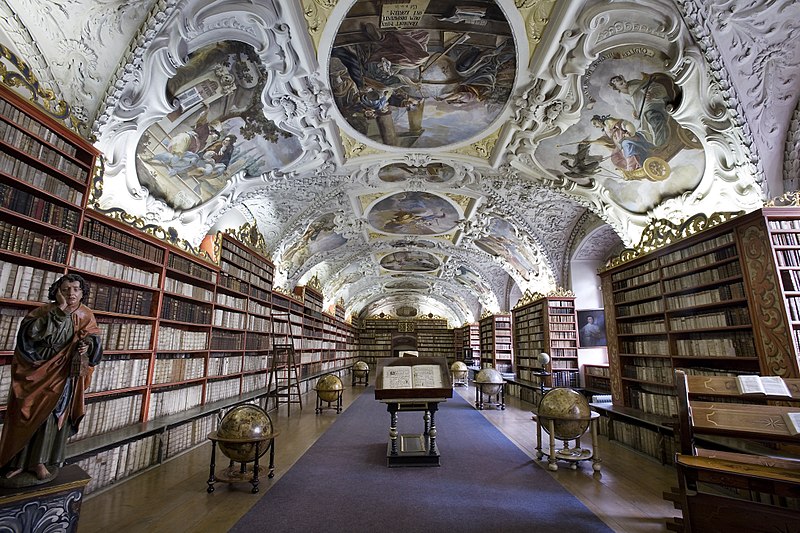
Nearby is the Strahov Monastery. Founded in the 12th century, it is an abbey of the Premonstratensians (the Order of the Prémontré), which means that it is inhabited, not by monks, but by Canons Regular who fulfil priestly duties. The building complex is impressive and lovely, especially the basilica (which, unfortunately, was closed to visitors when I arrived). Most famous are the monastery’s libraries. Visitors cannot enter inside, but must be content with peering in through the doorways. In the hall outside is an old cabinet of curiosities, featuring shimmering seashells, a stuffed alligator, and ancient Persian (?) armor—the sort of exotic mishmash one would expect from a curious European mind of centuries past. The two library rooms are magnificent. The Philosophical Hall is a grandiose neoclassical room filled with wooden shelves. The Theological Hall is perhaps even more impressive, featuring an elaborate stucco ceiling whose designs incorporate religious paintings. I love seeing such care lavished on libraries. Our books deserve it.

Theological Hall_JorgeRyan
The Theological Hall. Photo by Jorge Royan; licensed under CC BY-SA 3.0; taken from Wikimedia Commons

I descended from the monastery to the riverside, and found myself in Malá Strana. Literally this name means “Lesser District”—though, as my Airbnb host said, “There’s nothing ‘lesser’ about it.” This is one of the oldest parts of the city, dating back to the Middle Ages; but wars and fires largely destroyed the original town. What stands now mainly owes its origin to the Baroque era. As a result the buildings have a more uniform look, all around the same height with the same orange tiled roofs; and the streets are wider and straighter than in the Old City It is a pleasant place to walk around, if only because it is far less crowded than Prague’s center. There are some notable buildings to be seen, such as the Wallenstein Palace, an extensive mansion originally built for a general, and which now houses the Czech Senate. And there is the monumental St. Nicholas Church, an excellent example of Baroque architecture.

After a stroll through Malá Strana I squeezed over the Charles Bridge back into the Old City. This is what Prague is famous for. I have heard this part of the city described as “Disneyland for adults,” which is not far from the truth. For the Old City is swarming with people and full of restaurants and shops catering to foreign visitors. There is everything on sale between cheap junk and expensive trinkets, everything to eat from take-away pizza to pricey sit-down establishments. All this is crammed into the narrow, winding streets of the medieval city. It would be a beautiful place to walk around in if everyone else didn’t think so, too.

Feeling peckish myself, I ducked into a kebab place, hopeful that it would offer the highest ratio of foot-to-money. But I found, after calculating the conversion (which I unwisely did post-meal), that the kebab was three times more expensive than it would have been in Madrid—and didn’t taste any better. I had a much more positive experience at Naše maso, a butcher and delicatessen with great meat dishes at low prices. I had a meatloaf sandwich that was fantastic.

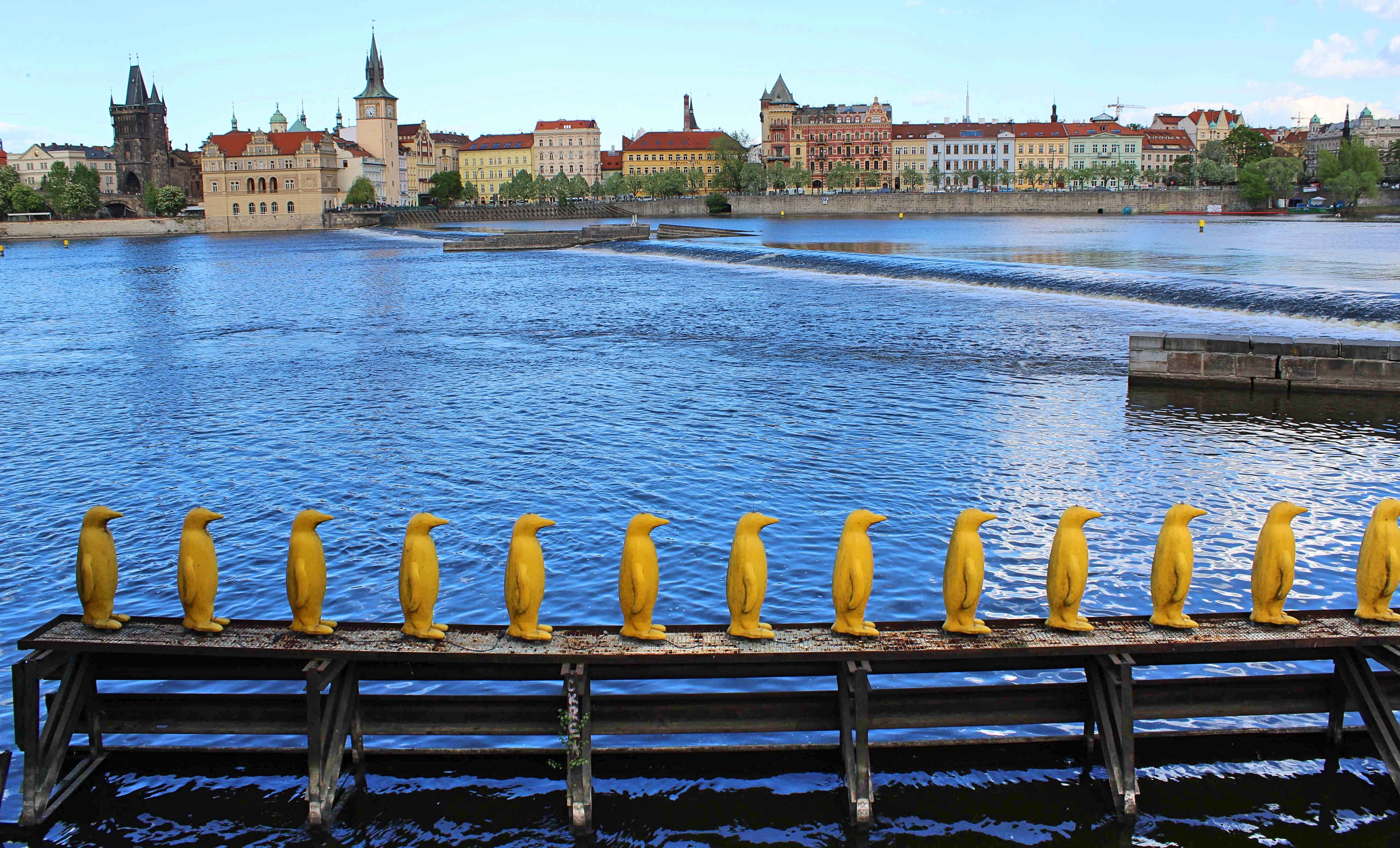
Next I walked down the river. (Just to be clear, I am putting multiple days together to streamline the narrative. This would be too much for one day.) The area beside the river is picturesque on either side. On the Malá Strana side I found a dock with a series of yellow penguins walking atop it. Nearby are three giant statues of faceless babies by the Czech sculptor David Černý, who was also responsible for the urination fountain outside the Kafka museum. Similar baby statues by Černý can be found crawling up and down Prague’s massive broadcasting tower, the Zikov TV Tower. Incidentally, there is a famous work of Černý’s that I missed on my visit to Vienna: a statue of Freud hanging from a roof. No Michelangelo, perhaps; but his work is memorable.

Prague_penguins

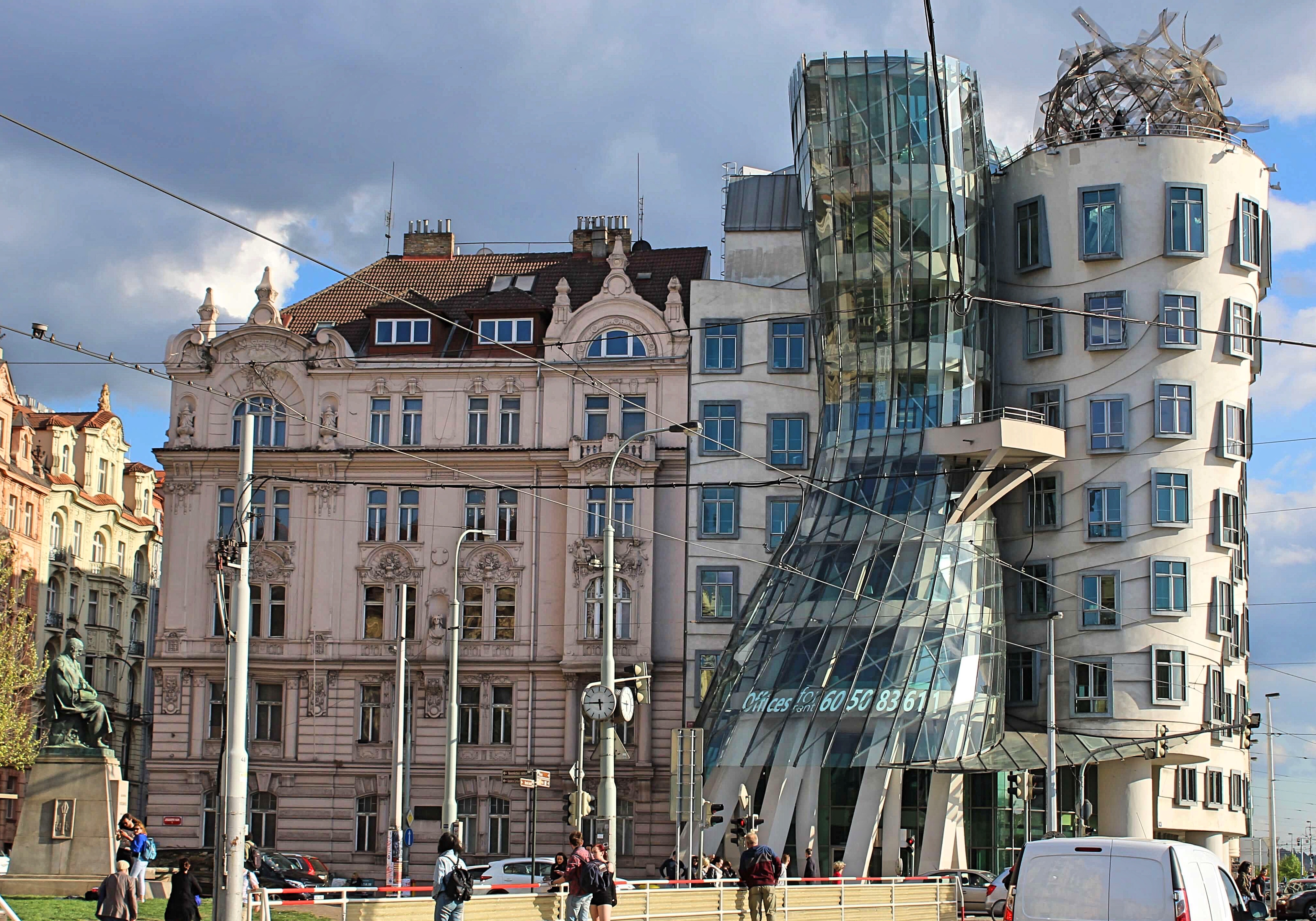
On the Old City side of the river the walk is just as lovely, taking me on a gentle curving road with the river on my right and a row of pretty, colorful building on my left. Walking along this way, I came upon the famous Dancing House of Prague. This is a modernistic (“deconstructivist,” as the designers call it) building designed by Frank Gehry and Vlado Milunić. The name is well-chosen, since the building does give the unmistakable impression of two figures in a waltz. A tower of glass swirls up next to the concrete body of the building, whose form is equally unstable. Irregular concrete panels and pop-out windows give the edifice a funhouse effect, as if it had been squished in a trick mirror. It makes for quite a sight next to the staid forms of the baroque apartments next door. For my part, I think the apartment provides a welcome moment of contrast with the rest of the city.

dancinghouse

Nearby is the Ss. Cyril and Methodius Cathedral, which is the principal Orthodox church in the Czech Republic. The church itself is an attractive place; but its fame does not rest on its architecture, but its history. Now, as you may know, Czechoslovakia, despite possessing formidable defenses, did not get a chance to defend itself from Nazi aggression during the Second World War. This is because Neville Chamberlain, as part of his appeasement strategy, ceded Czechoslovakia (without input from the Czechs) to Hitler in the hopes of satisfying the dictator’s expansionist threats. Thus the country was simply annexed without a fight. After the war broke out the Czechs set up a government-in-exile in England; and to establish its legitimacy and contribute towards the war effort, this government (in participation with England) planned and carried out Operation Anthropoid.

The idea was to kill Reinhard Heydrich, one of the most powerful men in Nazi Germany. A ruthless and vicious man—commander of internal security forces (such as the Gestapo), head of the Final Solution, and administrator of Nazi-controlled Bohemia—Heydrich soon earned the universal hatred he deserved. To be rid of him, seven Czech soldiers were parachuted into the country under cover of darkness on British planes. Two of these soldiers attacked Heydrich’s relatively unprotected car on his commute from his house to his office in Prague Castle. After a submachine gun jammed, the assassins threw a tank grenade which inflicted fatal wounds on the Nazi official. The assassins then made their escape and joined the rest of their team.

After the assassination, the Czech soldiers retreated to the church, a hideout for the resistance. But the betrayal of a Czech resistance fighter, Karel Čurda, led to their discovery. A huge team of SS soldiers descended on the church, determined to take the assassins alive. The soldiers defended themselves with pistols until three were killed, and the rest driven to the church’s basement, where they eventually committed suicide to avoid capture. This was not the end of the grizzly tale. On the very day of the assassination, Hitler ordered reprisals. Over 13,000 Czechs were arrested and sent to concentration camps, where 5,000 of them died. And this isn’t all. Based on false intelligence that the assassins had a connection to the small village of Lice, the Germans sent soldiers to commit a complete massacre. All the men were shot; the women and children were sent to the concentration camps, where most of them were killed. (After the war, Čurda the betrayer was hanged.)

Prague_bust

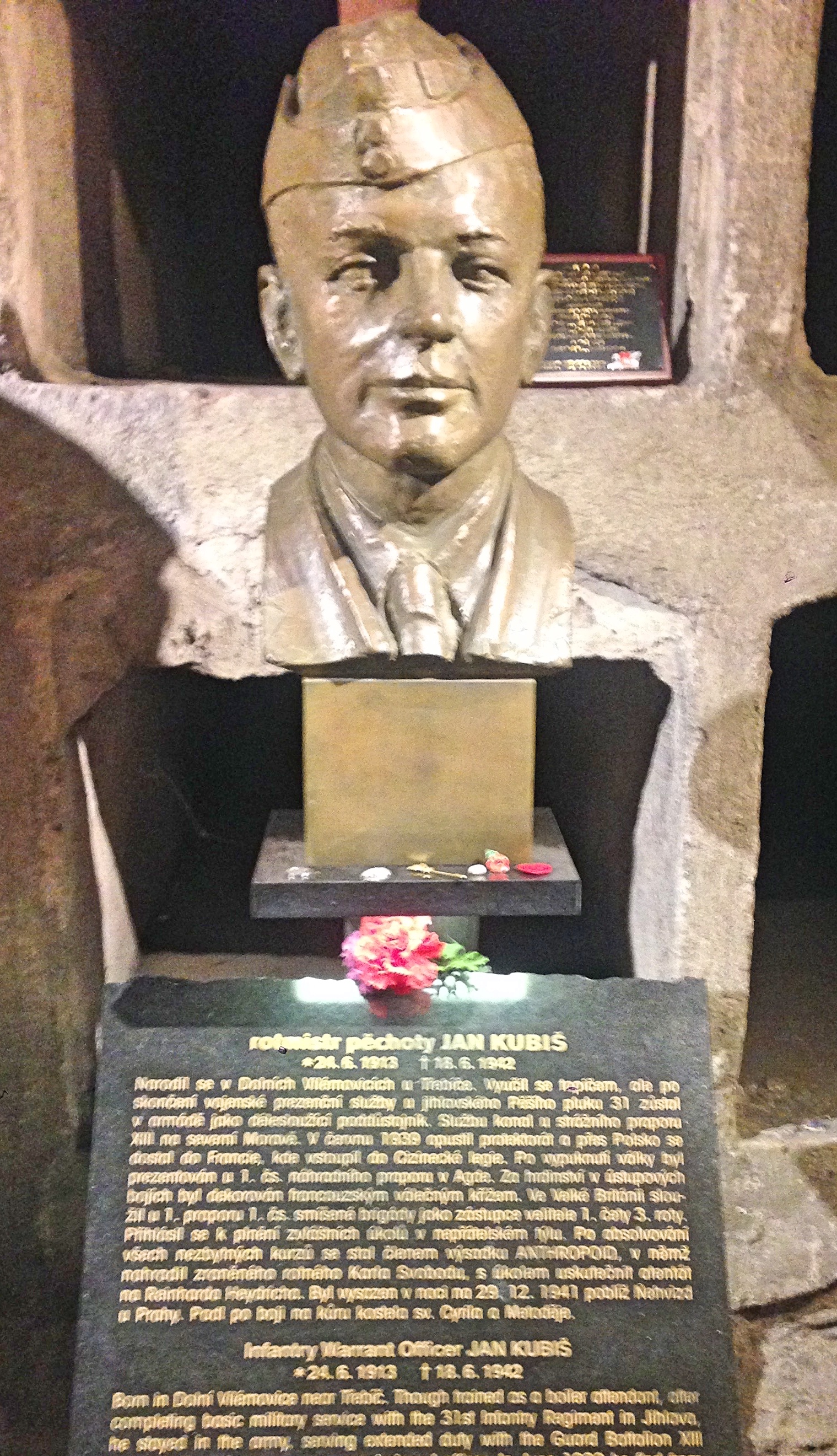
In the basement of this church is now a permanent exposition and memorial to these soldiers. In a large circular room there are artifacts, such as weapons and parachute gear, on display; and panels of information tell the story of Operation Anthropoid. In the crypt—appropriately gloomy and grey—are busts of each of the seven soldiers, with plaques telling of their lives. Operation Anthropoid is a fascinating episode from the Second World War, equal parts uplifting and depressing; and standing before the graves of these young men who shook the world is a moving experience.

My last stop was further south along the river: Vyšehrad. The name literally means “upper castle,” and refers to the hill’s previous use as a fortress. Like Petřín Hill, Vyšehrad is an elevated green space that provides excellent views of the city. Crowning the hill is the Basilica of St. Peter and St. Paul, an imposing neo-gothic structure. I wanted to go inside but, unfortunately, they were having mass. (Isn’t it irritating when people pray in churches?) It was late in the day when I arrived, so the attractive Vyšehrad cemetery was also closed—which is a shame, since Antonín Dvořák, the most famous of Czech composers, is buried here.

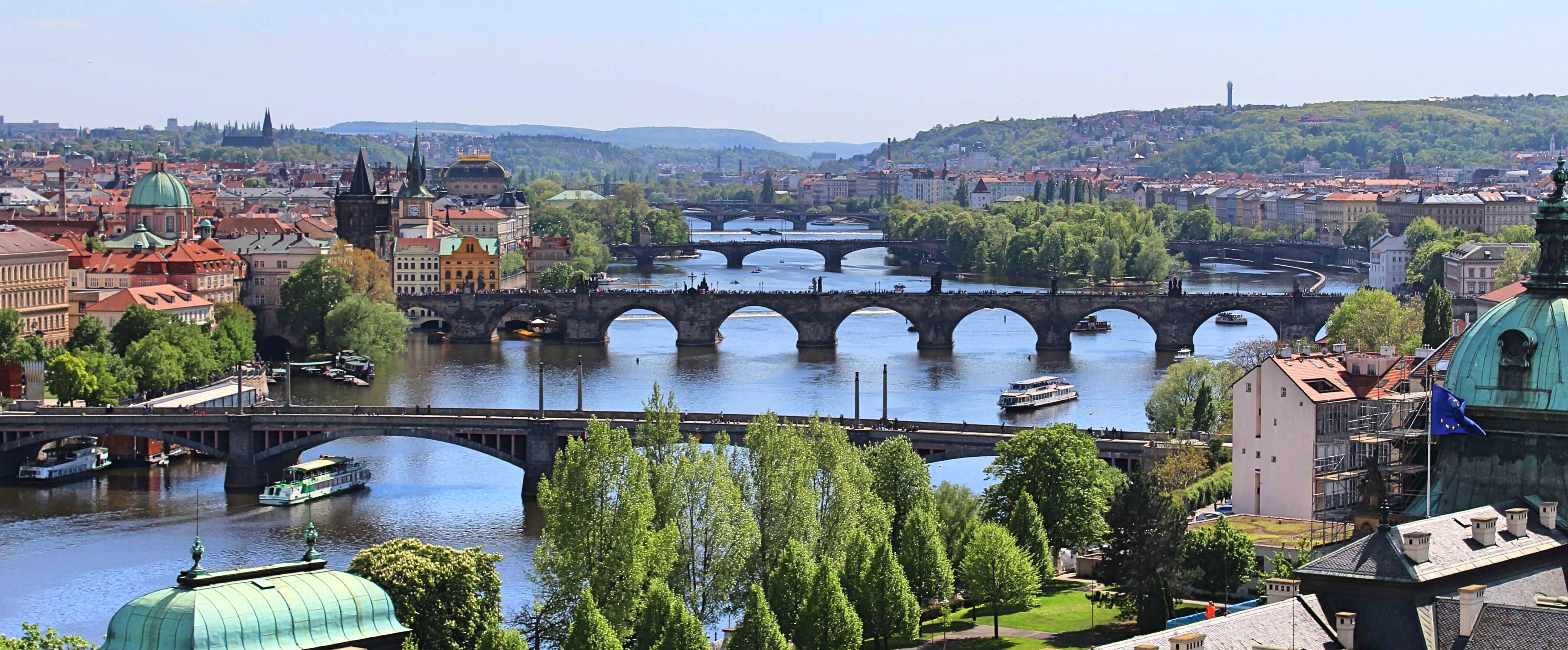
The sun was setting. Without anything to do, I walked to the front of the hillside and looked out at Prague—the shimmering blue river, crossed by iron and stone bridges; the orange rooftops and pink façades of the apartments; and in the distance Prague Castle, with the grey towers of its cathedral silhouetted against a rosy sky. I can see why people like this place.

Admittedly, I am not sure if I can concur with Norman Davies in calling Prague the most beautiful city in Europe—though it is certainly in the running. For my part there is too much tourism for it to be entirely comfortable; and it must be said that the city suffers from the lack of a really top-notch museum. Even so, nobody can deny that Prague is one of the jewels of this continent. There is something for everyone here—for the history buffs, for the art-lovers, and, yes, for the aficionados of knick-knacks and beer.

Prague_riverview

Review: Postwar

Review: Postwar

Postwar: A History of Europe Since 1945Postwar: A History of Europe Since 1945 by Tony Judt

My rating: 4 of 5 stars


History is a discipline peculiarly impervious to high theoretical speculation: the more Theory intrudes, the father History recedes.

When I was in university, studying anthropology, I always resented the requirement that my essays have thesis statements. Can’t I just collect information and serve it up without taking some ultimate stance? Tony Judt seems to have been of the same mind, since this book is one very large serving of information, absent of any overarching thesis. As he says himself, Judt is rather like the proverbial fox than the hegdehog: he knows many things, and has many valuable observations scattered throughout the text, without any one big idea to tie them together.

There are compelling advantages to this approach. This book is one-stop shopping for many aspects of post-war European life. Economic development, intellectual fashions, architecture, film history, political movements, the Cold War, regionalism, the emergence of the European Union—all this and more is covered in impressive detail. And though multifarious, all of these pieces come together to form an astounding story: a continent nearly destroyed by war, divided by dangerous political tension, slowly emerging from American and Soviet dominance to become the most affluent, most peaceful, and most progressive place in the world.

The main disadvantage of this method is, of course, that this story remains fairly messy and haphazard. Without a thesis to guide him, Judt had to rely on a mixture of interest, instinct, and whim—the latter playing an especially significant role in some sections. What is more, though Judt is an opinionated and assertive guide, the lack of a thesis renders it difficult to point to anything distinctly “Judtean” in his analysis. What ties the narrative together is, rather, a certain mood or sensibility—most notably, Judt’s keen sense of historical irony, which he employs to great effect.

This ironic sensibility is most often directed toward Judt’s political foes. Though he is never explicitly partisan, it is easy to tell where Judt’s sympathies lie: in the center-left, socialist-democratic camp. Thus, depending on where the reader falls on the political spectrum, Judt’s comments will be either gratifying or grating. For me they were usually the former. What irked me, instead, was Judt’s relatively brief treatment of Spain—the Franco era is entirely ignored, and the transition to democracy is covered in just a few pages. But this is admittedly my own prejudice speaking.

If Postwar has one takeaway message, it is this: that Postwar Europe is the anxious construction of a generation wearied and horrified by conflict. After going through the belligerent nationalism of the First World War, the economic depression and intense ideological polarization of the interwar period, the even more gruesome Second World War and the unspeakable Holocaust—all this, coupled with the prolonged armed standoff and Soviet repression of the Cold War—Europeans were intent on creating a world where this could never happen again. Extreme ideological stances fell into disgrace; strong government social safety nets helped to prevent economic crisis and, in so doing, made people less susceptible to demagogues; and governments forged institutional ties with one another, a project that culminated in the European Union.

Without constant reminders of this catastrophe—a European civil war that began in 1914 and whose political aftereffects did not disappear until 1991, if then—we risk falling into the same errors that tore the continent apart one hundred years ago. For this, we need good historians—and Judt is certainly among the best.

View all my reviews

Review: Europe, by Norman Davies

Review: Europe, by Norman Davies

EuropeEurope by Norman Davies

My rating: 4 of 5 stars

Can one narrate time—time as such, in and of itself? Most certainly not, what a foolish undertaking that would be. The story would go: “Time passed, ran on, flowed in a mighty stream,” and on and on in the same vein. No one with any common sense could call that a narrative.

—Thomas Mann, The Magic Mountain

Personal Preface

Lately I have been thinking a lot about time. Well, perhaps thinking isn’t the right word; I’ve been worrying. Ever since I moved to Spain, time has been a problem. What’s the proper time to eat? When do people sleep here? How long will my job last? What about my visa? Multiple clocks beset me, counting down and counting up.

Beyond my petty troubles, I have been thinking about time as an experience: how monotony speeds up the clock’s hand, variety slows it down, and nothing can stop it. I have been thinking about the inexorability of time: every passing second is irretrievable, every yesterday is irrecoverable. I have been spending a lot of time remembering, connecting my past with my present, if only artificially, and wondering how much the act of remembering itself distorts my memories. And in a Proustian mood, I have wondered whether a tremendous act of remembrance is the only defense we have against the ceaseless tide of time.

In the midst of our mundane concerns, it is all too easy to forget to remember. But is it crucial to remember; otherwise life can go by without us noticing. This is why we celebrate birthdays. Logically, it is silly to think that you turn from one age to another all at once; of course we get older every day. We celebrate birthdays to force ourselves to reflect on the past year, on how we have spent our time and, more chillingly, on how much time we have left. This reflection can help us assess what to do next.

Birthdays are just one example. In general, I have been finding it increasingly important to focus on these cycles, when a milestone is reached, when a process is completed, moments when the past is forcefully juxtaposed with the present. Finishing Norman Davies’s Europe was one such moment for me, and an important one. I first heard of the book from an old copy of National Geographic; it was in an article discussing the recent introduction of the euro (in 1999), a historic step in European unity. Davies’s book had just been published the year before, and the reporter had interviewed Davies about his thoughts on the future of Europe.

I read this article right as my love of reading began to blossom. Thus I dutifully underlined the name of Davies’s book, hoping to buy and read it some time in the future. But it was years until I finally bought a copy; and still more years before I finally started reading. When I first heard of the book I would never have imagined that I would finally read it, many years later, in Europe. But here I am, and it feels great.

The Review

Norman Davies’s Europe is an attempt to write a survey history of Europe in one volume, from prehistoric times to the dissolution of the Soviet Union, covering both Western and Eastern Europe. It’s an ambitious project. As you can imagine, an enormous amount of selection and compression was necessary in order to fit all this material into one volume. Luckily, Davies is adept at both of these skills; unfortunately, the book is still too big to carry around. It is big, fat, and heavy: thick enough to stop a bullet, hefty enough to knock someone out cold.

In terms of content, the book is both longer and shorter than it appears. Of the nearly 1,400 pages, only about 1,140 are actual history; the rest is given over to his notes, the index, and a lengthy series of appendices, on subjects ranging from the standard canon of opera, to death tolls in the Second World War, to the life course of an Austrian peasant household. Nevertheless, the pages are dense with text, in small font and with narrow margins; and the pages themselves are quite big. Moreover, owing to the huge amount of territory Davies covers, the book is almost nauseatingly packed with information, every page a summary of whole books. It isn’t the sort of thing you can breeze through.

Davies begins with a pugnacious introduction, in which he denounces all of his forbearers. For him, attempts to write European history have all fallen into various traps, by focusing too much on the ‘Great Books’, by their excessive length, or by their neglect of Eastern Europe. Davies snubs his nose at specialization, and wags his finger at academic fads; he bashes both the traditionalists and the radicals. I personally found this introduction to be an interesting read, but it does seem out of place in a book for the general reader.

For all that talk, you’d think Davies’s treatment would be highly heterodox. But that’s not the case. After an obligatory chapter on prehistory, he goes into a chapter on Greece, then Rome, then the Middle Ages, and so on. And even though one of his major bones of contention is the erstwhile disregard for Eastern Europe, he generally spends far more time on Western Europe.

The chapters increase in length as they approach the future, becoming progressively more detailed. For example, Aristotle and Plato must share one measly paragraph between them, but Gorbachev is given a dozen pages. As a result, the book gets more interesting the further you read. The coverage is only so-so for the ancient world; quite good for the Medieval period; and becomes really gripping by the 19th century. Davies attempts to cover all the major developments, but of course his space is limited. He sketches the historical individuals when necessary, but this is certainly not a “Great Man” telling of history. For the most part Davies focuses on economic, political, social, and cultural history, while paying less attention to intellectual and art history. Among the arts, he is strong on music but weak on painting, sculpture, and architecture.

The main narrative is broken up by what Davies calls ‘capsules’. These are mini-essays, ranging from half a page to two pages, on a variety of topics that interested Davies; they are set aside in their own boxes, interrupting the flow of the main text. This was Davies’s attempt to give extra color to his narrative, by focusing on little parts of the story that would otherwise be ignored. But I had mixed feelings about the idea. Half of the capsules were fascinating, but I thought many were uninspiring. And it was annoying to constantly be having to put the main narrative on hold, read a little essay, and then return where I left off. I thought it would have been a much better idea if he had left the capsules out completely, developed them into full-length essays, and then released them in their own book. I’d read it.

Davies is a writer of high caliber. He can adapt his style to any subject. His prose, although largely devoid of flourish, is consistently strong. In short, he has achieved that allusive aim of popular history writers: to inform and entertain in one breath. Seldom does he come across as seriously biased; but he is not afraid to be opinionated at times, which adds a nice touch of spice to the book: “Chamberlain’s three rounds with Hitler must qualify as one of the most degrading capitulations in history. Under pressure from the ruthless, the clueless combined with the spineless to achieve the worthless.”

I did catch two errors worth noting. First, Davies says that Dante called Virgil “The master of those who know,” when that epithet was really applied to Aristotle. Second, in the same sentence Davies calls Picasso, who was born in Andalusia, a “Catalan exile,” but he calls Dalí, who was born in Catalonia, a “Spaniard.” There were probably many more errors that I couldn’t catch, but in general the information seemed reliable.

Although this book is a survey history, Davies does have one central concern: the European identity. What does it mean to be a European? Davies doesn’t give any simple answers to this question, but instead traces how the European identity evolved through time. The reason for his concern is obvious. The Soviet bloc had only recently been dismantled, and now the European Union was faced with the task of dealing with these newly freed states. Davies himself appears to be strongly pro-Union; and in that light, this history of both Western and Eastern Europe can be seen as an attempt to give the people’s of Europe a shared past, in the hopes that they might embrace a shared future.

It was a bit strange to be finishing this book now. I can still remember the hopeful, enthusiastic tone of that National Geographic article about the new euro. People must have felt that they were entering a new age of European unity. Now the United Kingdom is threatening to leave the European Union, and several other countries are grumbling. The future, as always, is in doubt.

 Afterthought

I finished the book on April 23, which is Book Day here in Spain. Yesterday was the 400th anniversary of Cervantes’s death; and today is the same anniversary for Shakespeare. To celebrate, I go to the <i>Circulo de Bellas Artes</i>, where they are having a public reading of <i>Don Quixote</i>. Everyday people, old and young, are lined up in an auditorium to read a page from that great masterpiece; it will go on for 48 hours. After that, I walk to the Cervantes exhibition in the National Library, where they have dozens of old manuscripts of Cervantes and his contemporaries on display. From there, I walk to the Convent of the Barefoot Trinitarians, where Cervantes was buried.

I was celebrating the completion of a cycle, and so was Spain. The past is alive and well in Europe.

View all my reviews

A Trip to Toledo

A Trip to Toledo


“Where’s the damned gate?” I asked my friend, as we stood in the train station, bewildered, worried, looking at every sign, nervously checking the time as the appointed hour of our departure neared.

I thought it must be upstairs, since that’s where the arrow seemed to point; but my friend, more perceptive than myself, noticed that the sign said bajo on it.

“That means it’s on the ground floor,” she said.

She pointed this out while we were already on the escalator up; so after we lamely rode all the way up, and then the adjacent one all the way down, we began again to scour the ground floor for our gate.

“Maybe it’s this way?” my friend offered, pointing in the direction that most people were walking.

We joined the crowd, and found ourselves headed towards the door outside.

“No, no,” I said. “This is to exit the building.”

We returned to where we started, once more examining the sign with the ambiguous arrow. Time was running out. We’d given ourselves a good 45 minutes to get lost, and we’d used nearly all of them. Luckily, we soon noticed the (very obvious) gate entrance, where people were lining up to pass through security.

After walking through the metal detector, we walked frantically down the platform, passing car after car of the train, looking in the windows for open seats. Finally, we got to a car that was mostly empty; we hopped on, found the two nearest seats, and sat down—happy that the stress of the morning was over.

Our peace was disturbed when, just two minutes later, two very nice Spanish women politely informed us that we were sitting in their seats.

Perdone,” I said, as we got up, again confused and embarrassed, and walked away.

“I told you we shouldn’t have sat there,” I said as we recommenced our desperate search for seats. (I’d said no such thing, by the way.) “That must’ve been the reserved section!”

“Whatever.”

We went through one, then two, then three cars—all of them completely full—until finally, in an otherwise full car, there were two empty seats.

We sat down again, hoping that finally we could relax.

As I sat there, letting my breathing slow, still a bit disoriented from the activity and lack of sleep, I noticed that an elderly British couple was sitting in front of us. This would not be worth mentioning if, a moment later, a Spanish man hadn’t came up and told them that they were sitting in his seat.

“What?” said the Englishman.

“Yes, look,” the Spaniard said in English, holding up his ticket. With his finger, he pointed to two numbers on the top of the slip of paper.

“E6 and E7, car 3,” he said.

I looked up and found, to my surprise, that the seats had numbers and letters. We had assigned seats!

“Oh, terribly sorry,” the Englishman said, as he and his wife relocated to their proper seats—which, as it turned out, were right behind us.

“Quick,” I said to my friend, “the tickets!”

She pulled out the tickets from her bag, and we hastily examined them. E8 and E9, car 3. I looked up: we were sitting in our exact seats.

One thing to remember when traveling in foreign lands: even simple things can be a challenge, since here your conventional wisdom is unconventional, and your common sense far from common. This can make you come across as a fool, and feel like one, too. But you know you’re not a fool—you’re an American. And although there’s a large degree of overlap in the two categories, they aren’t exactly equal.

§

I had been urged, repeatedly and sometimes urgently, by friends and family who had been to Madrid that, once there, I shouldn’t miss a chance to visit Toledo.

Toledo is a small city, situated about 75 kilometers south of Madrid. It can be gotten to cheaply and quickly, by train in 30 minutes and by bus in an hour, making it the ideal place for day-trippers. It is a city of long history and rich culture, of fine architecture and splendid sights.

But of course I didn’t know any of this when, after much cursing and petty frustration, I booked two round-trip tickets (ida y vuelta) on the train for a Sunday trip. Really, I didn’t know anything about the place at all, other than that its cathedral was reputed to be one of the finest gothic cathedrals in Europe.

As a result, I had nothing definite in mind when I stepped off the train in Toledo, blinking in the bright sun, looking around in a befuddled daze. My ignorance didn’t bother me, however, as going places without knowing anything about them is something I tend to do. After all, I’d moved to Spain without knowing Spanish—or really anything about Spain at all except that there was bullfighting, flamenco, and an inquisition a long time ago—so why not try the same approach with Toledo?

My friend was less keen on this, though, so she went about procuring a map from the nearby tourist office—even as I insisted that it was unnecessary, since we have phones.

Yet we needed neither a map nor a phone to tell us that we’d arrived somewhere special; even the train station was lovely. In fact, it hardly seemed like a train station at all—more like a renovated relic. I know now, since I’ve looked it up, that the building was constructed in the early 20th century, and so was far from ancient. Nevertheless, the amount of effort exerted on a purely functional edifice—elaborately ornamented on the inside and outside, with finely carved wooden railings and stained-glass windows—was enough to convince me that Toledo was not an ordinary city.

Since we were traveling on the cheap, we decided not to take a cab or a bus into town, but to walk. This was, it turned out, an excellent choice, not only because of the agreeable weather, but because the approach from the station to the town took us across a bridge, spanning across a sparkling blue river, and allowed us to see the whole antique city, nestled up on a hilltop, almost as a traveler would have seen it a few hundred years ago.

I admit I indulged in a bit of romanticizing in the last paragraph; for it is impossible to forget that, however old Toledo might be, it is now the twenty-first century. Indeed, the juxtaposition between old and new was a constant refrain during our trip there. City buses crawled up twisting roads, alongside fortified walls; modern cars squeezed their way through crooked, narrow streets, forcing pedestrians to press themselves up against the sides of buildings, as if in a police line-up, to avoid getting clipped by passing side-mirrors.

To an American, at least, and I suspect to most other people, the past has a strange and eerie power, which lingers in the present like a faint, musty odor. The whole city felt old. We went through a stone gate, passing churches and abbeys, climbing up a road that had possibly been laid down before my country was a country—perhaps before my country was even a colony.

In these moments, when in the presence of something truly antique, there is a certain type of pensiveness that comes upon us, a certain reverie which, we hope, is akin to wisdom. Being in the presence of an object so much older than ourselves puts our own lives into a historic perspective. We feel ourselves, all too briefly, to be but a small and passing phenomenon in the pageant of works and deeds that came before us and will continue after us. Our problems, struggles, and triumphs are made ridiculous in the face of these accomplishments, and we are humbled.

If there is something edifying or character-building about visiting historic sites, I suspect that the above is it. The problem, however, is that these contemplative moments—when the passing years yawn open in your mind like a chasm, swallowing you up until nothing remains but mute astonishment—are cut short by all the other people there, trying to do the exact same thing.

It is one of the paradoxes of travel that, because it’s supposed to be good for you, everyone does it; and because everyone does it, it ceases to be good for you. Nothing quite ruins the romance of gazing at an old statue like two people in front of it, taking a selfie. And not only does this ruin the romance, but it makes it hard to even get a good selfie yourself.

§

The first thing I wanted to do was to visit the cathedral—since that was the only thing I knew about, anyway. I typed “Toledo Cathedral” into my phone, and was helpfully shown the way with a blue path extending from the tips of my toes to one of the finest gothic cathedrals in Europe. Still, we managed to take a few wrong turns (I’m not sure mapping software was built for the crooked, tightly packed, criss-crossing roads of old towns like Toledo), and, as usual, I managed to leave my friend behind a few times as I ruthlessly powerwalked in whatever direction I thought was correct.

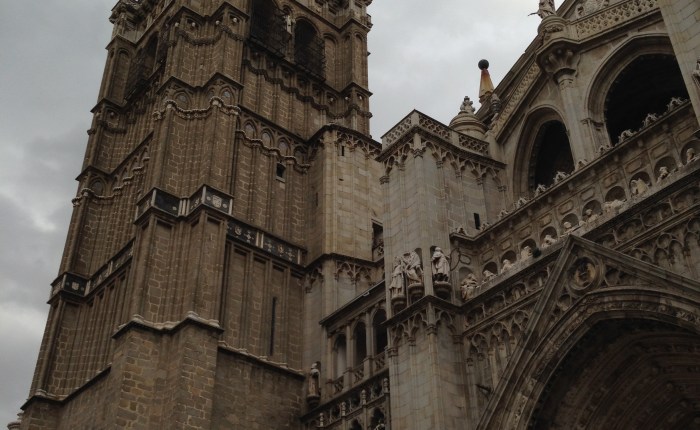
But gothic cathedrals are notoriously hard to miss; so in just twenty-minutes time, we found ourselves gaping upward at the magnificent Catedral Primada María de Toledo. It was even more marvelous than I’d expected. It was, in fact, probably the most beautiful structure that I’d ever seen. Most conspicuous was the tremendous spire, ornamented with spikes, reaching upward like a hand grasping towards heaven.

Hypnotized, we made our way towards it (though we took a short detour to examine the metal swords on sale in a gift shop), trying to find the entrance. Our search took us past the three great doors. In typical gothic style, these were surrounded by concentric archways, which had the effect of making them seem like portals to another world.

Every corner of the façade was stuffed with bas-reliefs of religious figures; the whole building, in fact, was covered in little statues, who prayed and chanted and sang endlessly to the heavens and to the earth. The entire Judeo-Christian tradition was there, the prophets, the apostles, angels and psalmists and kings and priests and even God.

It was a very strange feeling, standing there in front of those doors; it was as if the entire cathedral was looking down at us, judging our little lives. Perhaps because there were so many human figures carved into the walls, or perhaps because the whole building, both in its large-scale design and its fine details, was redolent with symbols and tradition—for whatever reason, the cathedral did not seem in that moment to be a mere hunk of stone, but strangely alive.

But of course, I couldn’t let this feeling linger long, for I had to take pictures. This done, we kept moving, slowly circling the entire edifice, until we ended up at the tourist entrance. Strange: there was no line; only a couple employees standing in front of the open door.

“Ask him if this is for the cathedral,” I told my friend.

“¿Por el catedral?” she asked.

Sí, pero se abre a las dos,” he responded.

“It opens at two,” my friend told me.

“Damn.”

Somewhat despondently, we pulled out the tourist map (the damn thing was useful, after all) and began looking for other things to do until then. The nearest attraction was the El Greco museum, so we decided on that.

§

Like most everything I encountered here, I knew almost nothing about El Greco before coming to Spain. I’d seen a few of his paintings in an art history textbook, and remembered liking them—but that’s about it. So I was understandably not very excited for the museum.

But I perked up a bit when the lady at the front desk told us it was free.

“Sweet!” I said, and in a few minutes we found ourselves standing in an old house, refurnished to give it the appearance it would’ve had during El Greco’s life.

“Imagine, El Greco, the famous painter, lived here!” I said to myself, looking around the quaint old place.

Unfortunately, I soon found out from reading a sign on the wall that he’d never lived here; in fact, his old house no longer exists. This museum was bought and built by some eccentric nobleman (if memory serves) under false pretenses, and the true state of affairs was discovered later.

Somehow, learning this made the experience considerably less cool. I’m not exactly sure why this is, mind you. Really, when you think it over, it’s hard to resist the conclusion that the tourist’s search for the authentic is a bit silly.

The simple truth is that “authenticity” is not a property of objects, but of our perception of objects. Take these two scenarios: First, what if the sign told me that this was the real house, when it really wasn’t? And second, what if the sign told me that this wasn’t the real house, when it really was?

In the first scenario, I’d be thrilled; and in the second scenario, I’d be disappointed—even though the physical house would be, in both cases, identical. The simple fact is that I have no direct way of telling whether this or that particular house was the previous home to a famous Spanish Renaissance painter. My feelings of awe or anticlimax are thus pure exercises of my imagination; they are only tenuously related with the physical object. If told the house was real, I could imagine the painter himself (not that I know what he looked like) walking through these very halls; while if told the house was only a replica, these pleasant images wouldn’t spring so easily to mind. But of course, I can imagine El Greco wherever and whenever I want. And if I was a master of self-deception, maybe I could even convince myself that he’d lived in my own apartment?

To return to the museum, I wasn’t very impressed with it. Seeing old-fashioned furniture and old-fangled kitchens does not play strongly upon my passions. So I walked from room to room, my eyes passing over every surface, my mind somewhere else, until I found myself in a room filled with El Greco’s works.

My interest was piqued. Most of the paintings were individualized portraits of saints. One detail I remember in particular, which I learned from reading a caption, is that it’s a tradition in Catholic art to portray martyred saints holding the instrument with which they were killed. Thus, there were a few portraits of saints with crucifixes leaned upon them, staring straight into the viewer’s eyes, as if challenging us to equal their conviction.

But the most arresting painting of the lot was the portrait of St. Peter, teary-eyed, his hands clasped in prayer in front of his chest, beseeching heaven for forgiveness. He had just denied Christ (as in, denied he knew Christ) three times, just as Jesus prophesied, and was repenting for his cowardice.

It’s difficult to capture the feeling of standing before a great painting—especially for someone such as myself, who knows so little about art. But what I remember most are St. Peter’s eyes, sad and soft, seeming to twinkle as you looked at the portrait.

This was near the end of our walk through the museum; and soon we found ourselves, once again, standing on the streets, wondering what to do. Thankfully, it was almost two o’clock; so after eating a brief lunch—and a very early lunch, for Spaniards—we were on our way, once again, to visit one of the finest gothic cathedrals in Europe.

§

The line was short, the wait was brief, the price of admission came with an audioguide; and in just a few minutes, we found ourselves standing under the vaulted ceiling of Toledo Cathedral.

The first thing I noticed upon entering was the smell. It was a scent I had experienced at least once before, at a concert in a church in New York. Perhaps this is a scent associated with all catholic places of worship—I don’t know. What I do know is that, whatever the smell is, I love it. I find it intoxicating and irresistible. I know this sounds funny, but I wish my whole life smelled like this, for there is something unearthly and calming about it, as if this faint fragrance is above all of the petty concerns and vain ambitions, all of the weaknesses and frailties that beset human life. It is a smell that puts the whole cosmos in perspective. I’d buy it if I knew where to find it.

The next feeling is a vertiginous sense of height. The ceiling, made entirely of heavy stone, hovers high up above you, suspended in mid-air. Light pours in through stained-glass windows, dozens of feet up, making the top of the cathedral brighter than the bottom; it is as if heaven itself is illuminating the space. At ground level, meanwhile, the place is dusky and dim—a twilight of religious mystery. The building is just as impressive on the ears as on the eyes. Footsteps, snatches of conversation, coughs, sneezes, and whispers are all quickly picked up by the towering room, carried up to the top of the building, bounced off the walls, and returned to you as indistinct murmuring. Even your own breath seems far away.

I put on the audioguide and began the virtual tour. I’ve quickly developed a strong liking for audioguides. They are private—preserving the individual experience, and giving you the freedom to go where you please—but they also connect you intimately with your surroundings. Left to my own devices, a particular religious work of art, for example, might be wholly unintelligible; but with an expert in my ear, guiding my eye, feeding me information, a meaningless image becomes an icon, laden with symbolism. This way, I was led by my ears all through the cathedral, then into its museum, then outside into the cloister, and then back in again, learning about kings, cardinals, saints, and artists.

Perhaps this is only a modern prejudice, but I am normally tempted to say that art is a form of self-expression. Yet this definition is wholly inadequate when faced with something like the Toledo Cathedral. So many hands contributed to this building, across so many years, in so many different styles, that it’s obvious that the building is not the expression of any individual. Rather, the building seems to be the expression of an age, of a religion, of a whole people. It is a blend of sensibilities across centuries.

I can’t hope to recount all the different tombs and temples contained in that church; and besides, such a straightforward list would be dull. I will try, however, to articulate why I found my time in the cathedral so profoundly moving, even though I am not at all religious.

But what does it mean to be religious? Does it mean to believe certain dogmas and to endorse a particular mythology? A single glance at the cathedral would give you this impression. Every spare surface has been ornamented with an image from the Judeo-Christian saga. During the Middle Ages, I can imagine these pictures and sculptures being a visual Bible for the unlettered farmers who prayed here, inculcating the faith through the sight rather than words.

“Faith” and “belief” are words we often hear associated with religion. Although some church fathers, such as St. Thomas Aquinas, attempted to persuade others with reason, in the church’s history tremendous clashes of power and violence were waged over doctrinal differences. Arianism, the belief that Jesus was distinct and subordinate to God the Father, came very close to being made the orthodox belief, until it was slowly beaten back by its opponents; and a war had to be waged during the Middle Ages, the Albigensian Crusade, to wipe out a puritanical sect of Christians who had adopted a dualist view of the cosmos (i.e. holding that there was both an evil and a good force in the universe). I give these two examples only to show that, in the history of religion, or at least of Catholicism, a lot of ink and blood has been spilled to establish one belief over another.

Insofar as religion consists in holding beliefs in the supernatural, I can’t abide by it. It seems to me a violence to human reason to enforce beliefs based neither on evidence nor logic. But once the pretentions to reality of Catholic dogma are pared away, once we discredit and ignore the occult elements, what are we left with?

What remains is a complex medley of stories and rituals, myths and legends, customs and ceremonies. Without the core of belief, this remnant can perhaps be called the “shell” of the religion. For Catholicism, this shell is partly physical, partly immaterial. The intangible portion of the remainder consists of the wonderful stories—Adam and Eve, David and Samuel, Jesus and the apostles—full of drama and wit and wisdom. The material remainder consists of things like the Book of Kells, the Hagia Sophia, and of course the Toledo Cathedral.

Taken together, I’d argue that the remaining shell of the religion can be seen, not simply as an anthropological curiosity, but a tremendous work of art. The Catholic religion is like a beautiful, multi-colored tapestry, spread over the whole of human life. Or perhaps it can be better described as an aesthetic system, through which the mundane events of daily life are dramatized. The beauty often hidden in our humdrum affairs is accentuated and given meaning within this tradition. Like a painter, the myths and rituals of religion begin with something ordinary—a shopkeeper, a sunny evening in the park, a few objects sitting on a table—and transforms them into something beautiful and significant.

Of course, I can’t claim any originality for this thought; many have said this before. The Spanish American philosopher, George Santayana, is my most direct influence in seeing religion this way. Here is a quote from his book, The Life of Reason: “Mythical thinking has its roots in reality, but, like a plant, touches the ground only at one end. It stands unmoved and flowers wantonly into the air, transmuting into unexpected and richer forms the substances it sucks from the soil.”

This is an image which has stuck with me: a flower taking nutrients from the unremarkable and ugly dirt, and turning them into a blossom of color. And is not something similar happening when, as in Catholicism, every day of the calendar year commemorates the life of a saint, whose heroic deeds are recounted in dramatic stories? Is not something similar happening when every stage of life and death is marked by a sacrament and a ritual?

These meditations filled my head as I wandered through Toledo Cathedral, gasping up at the ceiling, staring in continuous awe at the many paintings and statues and frescoes contained therein. It was an experience which, I predict, I’ll remember all my life.

§

The rest of my time in Toledo was, of course, something of an anticlimax compared to this. We visited a synagogue, used by the Sephardic Jews before they were expelled in 1492 by the Catholic monarchs. But the main impression left on me by that museum was that I would do well to read The Ornament of the World, by María Rosa Menocal, which tells the story of the brief period of mutual tolerance between Muslims, Jews, and Christians in medieval Spain.

We also visited a temporary exhibition on torture devices, which consisted of replicas of torture devices, alongside gory descriptions of how they were used on their poor victims. The information was framed in the context of the Spanish Inquisition, when torture was used to extract confessions from accused heretics. However, I now suspect that the information presented was untrustworthy, or at least greatly exaggerated. For example, the exhibition had an iron maiden, but according to the Wikipedia article—which I trust!—there is no reliable evidence of the existence of iron maidens before 1793; and although several iron maidens are on display around the world, its unlikely that any of them were ever used. It seems to be an invention of our morbid modern imagination, rather than a condemnation of medieval times.

After this, we tried to visit the Hospital de Tavera, a medical center constructed during the Renaissance. But, unfortunately for us, the place was closed by the time we got there. Oh well.

We were out of time. The train was leaving in 25 minutes, and the station was 20 minutes away. So we powerwalked and jogged the kilometer between the town and the train station, quickly passing through the beautiful station building, presented our tickets, and boarded the train—this time, making sure to sit down in our proper seats. My friend fell asleep shortly after sitting down, and I almost did the same; in thirty minutes, we were exiting the gate which had so eluded us that morning.

“Whew, that was fun,” said my friend. “What’s next?”