Review: Winesburg, Ohio

Review: Winesburg, Ohio

Winesburg, Ohio by Sherwood Anderson

My rating: 3 of 5 stars


This book did not conform to my expectations, and this is often a cause of bitterness with me. I opened Winesburg, Ohio thinking that it would be a series of carefully-plotted, intersecting short stories illustrating the reality of small-town life in America. And I was excited for this hypothetical book, since it seemed like a wonderful concept. But Anderson had quite different ideas, and his were far less to my taste.

For one, the stories in Winesburg, Ohio have very little in the way of plot, and so they can hardly weave an intricate tapestry. The effect is not that of a carefully worked-out machine, but if a simple accumulation. What is more, this is hardly a work of realism in any meaningful sense. Anderson is not one for sensory details, nor for social analysis; his world is composed of individual souls residing in a shadowy world. The stories could have taken place just as easily in Winesburg as in Warsaw, since Anderson’s fundamental concern is something much more universal.

The insistent message of these stories is that people are bound up within themselves, their inner passions shut off from the world, and they have little idea how to rectify their situation. Thus, the stories follow a characteristic pattern: The protagonist’s frustrated dreams and desires are narrated, and then a crisis follows in which the character tries, unsuccessfully, to disburden herself of this frustration. This usually takes the form of a frantic encounter with George Willard, the young town reporter. The story ends as soon as the crisis is shown to be unsuccessful.

I have many criticisms of these stories. Anderson is as guilty as any author can be of telling and not showing. His stories consist almost entirely of narration. What is worse, I often found the narration unsuccessful, as Anderson seems allergic to the use of vivid, concrete details. We are never in the moment with a character, never able to watch a scene unfold in our mind’s eye. Someone extremely sympathetic to Anderson’s style may argue that this creatures a distance between the reader and the story which mirrors the emotional distance between Anderson’s characters. In my case, however, the result was often apathy or bemusement.

As an example of his style, consider this passage:

There was something biting and forbidding in the character of Kate Swift. Everyone felt it. In the schoolroom she was silent, cold, and stern, and yet in an odd way very close to her pupils. Once in a long while something seemed to have come over her and she was happy. All of the children in the schoolroom felt the effect of her happiness. For a time they did not work but sat back in their chairs and looked at her.

This passage is characteristic in its almost total lack of sensory information. Indeed it seems intentionally vague: “in an odd way,” “something came over her,” “felt the effect”—these phrases suggest that Anderson himself was not interested in really picturing to himself how this strange scene could actually play out. It also shows a kind of curious anti-realism when it comes to describing human behavior. As somebody who has worked as a teacher, I can scarcely imagine the reaction of young pupils to a mysteriously happy teacher being to simply look at her. Has Anderson ever been around a child?

Of course, an author is under no obligation to describe people as behaving realistically. Nevertheless, I think that this oddity is symptomatic of one of the paradoxes in these short stories: though they are about the innermost struggles of different individuals, Anderson seems rather uninterested in his characters as individuals. The persons in this book can hardly be called individuals, in fact, but are mere points of tension. They have problems but no personalities, and once their crisis is over they have no further interest. The way that Anderson writes dialogue is particularly infelicitous—unnatural to the point that it must have been intentional, but which nevertheless struck me as jarring. Luckily, there is not much of it.

What perhaps struck me most about these stories is how strongly they reminded me of a lot of contemporary writing. The idea that we are all silently suffering, or that, in Anderson’s own words, “everyone in the world is Christ and they are all crucified”—and, most importantly, that emotional expression will fix this problem—this strikes me as a profoundly limited worldview. For my part, I do not think that emotional connection alone is enough to solve any problem, unless it is supplemented by a thoughtful empathy—the ability to see humans in the round and not as simply balls of frustrated passions.

Indeed, as Lionel Trilling argues in his excellent essay on Anderson, the paradox of this philosophy is that it can lead to a world just as cold and brutal as one of repressed desires. And yet, this is an idea that I encounter again and again: that all we need is emotional expression. Expression is easy, however, while understanding is infinitely more difficult.

View all my reviews

Review: The Works of Archimedes

Review: The Works of Archimedes

The Works of Archimedes by Archimedes

My rating: 5 of 5 stars

In fact, how many theorems in geometry which have seemed at first impracticable are in time successfully worked out!

Many of the most influential and ingenious books ever written possess the strange quality of being simultaneously exhilarating and quite boring. Unless you are among that rare class of people who enjoy a mathematical demonstration more than a symphony, this book will likely possess this odd duality. I admit this is the case for me. Reading this book was a constant exercise in fighting the tendency for my eyes to glaze over. But I am happy to report that it is worth the trouble.

Archimedes lived in the 3rd century BCE, somewhat after Euclid, in Syracuse on the island of Sicily. Apart from this, not much else can be said with certainty about the man. But he is the subject of many memorable stories. Everybody knows, for example, the story of his taking a bath and then running through the streets naked, shouting “Eureka!” We also hear of Archimedes using levers to move massive boats, and claiming that he could move the whole earth if he just had a place to stand on. Even his death is the subject of legend. After keeping the invading Romans at bay using ingenious weapons—catapults, cranes, and even mirrors to set ships afire—Archimedes was killed by a Roman soldier, too preoccupied with a mathematical problem to care for his own well-being.

True or not, good stories tend to accumulate around figures who are worthy of our attention. And Archimedes is certainly worthy. Archimedes did not leave us any extended works, but instead a collection of treatises on several topics. The central concern in these different works—the keystone to Archimedes’s method—is measurement. Archimedes set his brilliant mind to measuring things that many have concerned impossible to reckon. His work, then, is an almost literal demonstration of the human mind’s ability to scan, delimit, and calculate things far outside the scope of our experience.

As a simple example of this, Archimedes established the ratios between the surface areas and volumes of spheres and cylinders—an accomplishment the mathematician was so proud of that he apparently asked for it to be inscribed on his tombstone. Cicero describes coming across this tombstone in a dilapidated state, so perhaps this story is true. Archimedes also set to work on giving an accurate estimation of the value of pi, which he accomplished by inscribing and circumscribing 96-sided polygons around a circle, and calculating their perimeters. If this sounds relatively simple to you, keep in mind that Archimedes was operating without variables or equations, in the wholly-geometrical style of the Greeks.

Archimedes’s works on conoids, spheroids, and spirals show a similar preoccupation with measurement. What all of these figures have in common is, of course, that they are composed of curved lines. How to calculate the areas contained by such figures is not at all obvious. To do so, Archimedes had to invent a procedure that was essentially equivalent to the modern integral calculus. That is, Archimedes used a method of exhaustion, inscribing and circumscribing ever-more figures composed of straight lines, until an arbitrarily small gap remained between his approximations and what he was attempting to measure. To employ such a method in an age before analytic geometry had even been invented is, I think, an accomplishment difficult to fully appreciate. When the calculus was finally invented, about two thousand years later, it was by men who were “standing on the shoulders of giants.” In his time, Archimedes had few shoulders to stand on.

The most literal example of Archimedes’s concern with measurement is his short work, The Sand Reckoner. In this, he attempts to calculate the number of grains of sand that would be needed to fill up the whole universe. We owe to this bizarre little exercise our knowledge of Aristarchus of Samos, the ancient astronomer who argued that the sun is positioned at the center of the universe. Archimedes mentions Aristarchus because a heliocentric universe would have to be considerably bigger than a geocentric one (since there is no parallax observed of the stars); and Archimedes wanted to calculate the biggest universe possible. He arrives at a number is quite literally astronomical. The point of the exercise, however, is not in the specific number arrived at, but in formulating a way of writing very large numbers. (This was not easy in the ancient Greek numeral system.) Thus, we partly owe to Archimedes our concept of orders of magnitude.

Archimedes’s contributions to natural science are just as significant as his work in pure mathematics. Indeed, one can make the case that Archimedes is the originator of our entire approach to the natural sciences; since it was he who most convincingly demonstrated that physical relationships could be described in purely mathematical form. In his work on levers, for example, Archimedes shows how the center of gravity can be found, and how simple principles can explain the mechanical operation of counterbalancing weights. Contrast this with the approach taken by Aristotle in his Physics, who uses wholly qualitative descriptions and categories to give a causal explanation of physical motion. Archimedes, by contrast, pays no attention to cause whatever, but describes the physical relationship in quantitative terms. This is the exact approach taken by Galileo and Newton.

Arguably, the greatest masterpiece in this collection is On Floating Bodies. Here, Archimedes describes a physical relationship that still bears his name: the relationship of density and shape to buoyancy. While everyone knows thpe story of Archimedes and the crown, it is possible that Archimedes’s attention was turned to this problem while working on the design for an enormous ship, the Syracusia, built to be given as a present to Ptolemy III of Egypt. This would explain Book II, which is devoted to finding the resting position of several different parabolas (more or less the shape of a ship’s hull) in a fluid. The mathematical analysis is truly stunning—so very far beyond what any of his contemporaries were capable of that it can seem even eerie in its sophistication. Even today, it would take a skilled physicist to calculate how a given parabola would rest when placed in a fluid. To do so in ancient times was simply extraordinary.

Typical of ancient Greek mathematics, the results in Archimedes’s works are given in such a way that it is difficult to tell how he originally arrived at these conclusions. Surely, he did not follow the steps of the final proof as it is presented. But then how did he do it? This question was answered quite unexpectedly, with the discovery of the Archimedes Palimpsest in the early 1900s. This was a medieval prayer book that contained the remains of two previously unknown works of Archimedes. (Parchment was so expensive that scribes often scraped old books off to write new ones; but the faded impression of the original work is still visible on the manuscript.) One of these works was the Ostomachion, a collection of different shapes that can be recombined to form a square in thousands of different ways (and it was the task of the mathematician to determine how many).

The other was the Method, which is Archimedes’s account of how he made his geometrical discoveries. Apparently, he did so by clever use of weights and balances, imagining how different shapes could be made to balance one another. His method of exhaustion was also a crucial component, since it allowed Archimedes to calculate the areas of irregular shapes. A proper Greek, Archimedes considered mechanical means to be intellectually unsatisfactory, and so re-cast the results obtained using this method into pure geometrical form for his other treatises. If it were not for the serendipitous discovery of this manuscript, and the dedicated work of many scholars, this insight into his method would have been forever lost to history.

As I hope you can see, Archimedes was a genius among geniuses, a thinker of the rarest caliber. His works are exhilarating demonstrations of the power of the human mind. And yet, they are also—let us admit it—not the most exciting things to read, at least for most of us mere mortals. Speaking for myself, I would need a patient expert as a guide if I wanted to understand any of these works in detail. Even then, it would be hard work. Indeed, I have to admit that, on the whole, I find mathematicians to be a strange group. For the life of me I cannot get excited about the ratio of a sphere to a cylinder—something that Archimedes saw as the culmination of his entire life.

Archimedes is the very embodiment of the man absorbed in impractical pursuits—so obsessed with the world of spirals and curves that he could not even avoid a real sword thrust his way. And yet, if subsequent history has shown anything, it is that these apparently impractical, frigid, and abstract pursuits can reveal deep truths about the universe we live in—much deeper than the high-flown speculations of our philosophers. I think this lesson is worth suffering through a little boredom.


View all my reviews

Review: The Ambassadors

Review: The Ambassadors

The Ambassadors by Henry James

My rating: 4 of 5 stars

He had spoken in the tone of talk for talks sake, and yet with an obscure truth lurking in the loose folds…

One would think that, of all the people living on this good green earth, I would be especially prone to loving this particular work of literature. After all, it is about a young American who moved to Europe, fell in love, and then resisted his family’s entreaties to come back and make more money. If you know anything about me, you will know that this has a special resonance. I am also, as it happens, a lover of fancy prose and classic novels. Clearly, in my case, the book’s prospects were extremely favorable.

It is with mild surprise, then, that I report that my feelings are mixed. This is not a novel that one can easily love. It is, rather, a product of James’s infamous late style, which divided critics at the time and has continued to do so ever since. There are many ways to characterize this style—dense, laborious, obscure—but I think that the keynote here is vague. Both in his descriptive passages and his dialogue, James maintains a kind of studious vagueness that can be either delightful or infuriating, depending on your mood and taste. In everything from his sentence structure, to his dialogue, to his descriptions, to his plotting—vagueness reigns.

To indulge in highfalutin terminology, I would say that this is an aesthetic triumph at the expense of humanistic value.

First, the triumph. James, at his best, achieves something like that achieved by the impressionist painters. The strokes of his pen are suggestive rather than illustrative. He asks much of the reader; and this means that the reader becomes an active part of the story. Virtually nothing—not the book’s resolution, nor the personality of the major characters, nor even the meaning of some knotty sentences—is unambiguous, which means that each reader can make the book her own. In other words, James’s late style is quite like the Ostomachion of Archimedes: a set of puzzle pieces that can be assembled in a myriad of ways.

I say that this is an aesthetic triumph because James achieves an effect that is unique, distinctive, novel, and demanding. He creates, in other words, his own aesthetic realm. The cageyness, the uncertainty, the self-referential quirks of this book—we can clearly see, in retrospect, that James was paving the way for literary modernism. And like much of modernism, I think that this aesthetic triumph comes at a great cost to humanistic value.

To simplify matter somewhat, you can describe this loss at the emphasis of form over content. The novels of Dickens, Dostoyevsky, Elliot, Tolstoy—say what you will about them, but they have an awful lot of content. Putting aside whatever explicit messages these novels may carry, they introduce us to concrete places, to remarkable individuals, to unforgettable stories. They capture, in other words, a human reality; and in so doing they help us to come to grips with life itself. Now, do not get me wrong: all of these authors also have aesthetic merits. If they did not, they would not be artists at all—merely columnists. My point is that their artistic style was entirely compatible with a definite view of the world, a view that is communicated in their works. This I call their humanistic value.

My main criticism of this book, then, is that James’s remarkable aesthetic sense overpowered whatever message he wished to transmit. Based on a straightforward reading, the intended message is this: American culture is narrow and materialistic, and it leads people to give up enjoyment for superficial, conventional reasons. We are, thus, presented with a cast of characters who embody this difference. Strether and Chad are exquisitely sensitive to the charms of Europe, and improve under its influence; while other Americans, such as Waymarsh, insistently stay within their narrow horizons.

The problem is, again, the vagueness. James is insistently vague on every detail. How exactly is life in Europe more liberating than life in America? And how exactly have Strether or Chad improved? These may seem like superficial questions, but the entire weight of the plot hinges on them. We cannot come to any moral conclusion without knowing the details. Indeed, James is so impressionistic in his portrayal of the main characters that we can hardly come to any conclusions at all. Do we even like these people? Even the ending is veiled in vagueness. Will Chad return to America? And why does Strether decide to return? And is his return a failure, or a success, or what? It is simply impossible to answer these questions.

Perhaps I would have been able to stomach all of these irresolutions if I had absolutely adored James’s style. But I do not. Indeed, I confess to finding James’s prose quite ugly—laborious, convoluted, and dry. There is hardly a passage in this book that one can read aloud without sounding like an alien. The following is entirely typical:

Nothing could have been odder than Strether’s sense of himself as at that moment launched in something of which the sense would be quite disconnected from the sense of his past and which was literally beginning there and then. It has begun in fact already upstairs and before the dressing-glass that struck him as blocking further, so strangely, the dimness of the window of his dull bedroom; begun with a sharper survey of the elements of Appearance than he had for a long time been moved to make.

A few sentences of this may be fine; but pages of it are painful. Granted, James is capable of quite lovely writing. I was enchanted, for example, by his description near the end, of Strether’s venture into the French countryside. Yet, all too often, the book is like this passage: opaque. His dialogue is only slightly better—readable, and yet still plagued by the strained and unnatural cadences of James’s prose. Besides this, James’s characters have the same tendency to vagueness as James himself, and never spell out what they mean.

Obviously this will come down to taste. I like things to be clear and unambiguous. That is my taste. James clearly did not agree. That I liked this book in spite of this divergence is a testament to James’s aesthetic power. He was an artist in the highest sense of the word.

View all my reviews

Review: Don Juan

Review: Don Juan

Don Juan by Lord Byron

My rating: 4 of 5 stars

Let us have wine and woman, mirth and laughter,
Sermons and soda water the day after.

The legend of Don Juan appears to be one of the most productive stories in all of literature. After its first setting by Tirso de Molina—still a classic of the Spanish stage—it has been adapted innumerable times. Molière’s powerful version may be the most famous for the theater, and Mozart’s opera is considered to be among the greatest works of music even sounded. After speaking in French verse and singing in mellifluous Italian, the infamous seducer of Seville lived on—though much altered—to speak iambic pentameter in Lord Byron’s comedic epic.

Nonetheless, Lord Byron’s use of the legend is free to the point that it may as well have been discarded entirely. The protagonist is, indeed, an attractive young man from Seville with a formidable sexual appetite. Byron’s Juan, however, is usually the seducee rather than the seducer. He does not lie to get his way, he does not have a wisecracking servant, he does not kill the fathers of his victims, and he does not meet his end at the hands of a living statue. There is none of that here. Instead, Don Juan is an attractive young boy with a good heart who runs into a lot of trouble, mainly because every woman who sees him wants him. It is a pleasant twist on an old tale.

Though a member of the Romantic age, Byron does not strike me as a Romantic poet. His poetry is witty, snappy, sharp, irreverent, and lean. There is nothing sentimental, meditative, or wistful in this long poem. Indeed, the verse is so prose-like that it is hardly even poetical. His most obvious literary forebear is not Milton or Donne, but Pope—another witty versifier. It seems strange, then, that of all the great English Romantic poets, it was Byron who was arguably the most famous and influential. Perhaps tastes did not change as much as we are prone to believe.

This epic poem has a loose and baggy structure. That is to say that it is full of holes and an awful lot of wind blows through it. Byron appears to have begun with a fairly concrete idea in mind, and the first three or four cantos are brilliant fun. Soon thereafter the poem falls apart, however—dissolving into an endlessly long aside, in which the main action is lost. The poem ceases to be the comic epic of Don Juan and instead becomes a vehicle for Byron’s own endless editorializing. This is still mostly worth reading, for Byron’s wit if not for his logic, but it is not exactly a work of high art.

Poor Don Juan is left in the lurch, and never does get to meet his final end—whatever that may have been. Byron met his own end before he could give one to Don Juan. If not for that, this poem may have gone on for twenty cantos more. But at the rate the story was progressing in the final cantos, twenty more may not even have been enough to bring this sprawling story to a satisfying conclusion. So let us be thankful for what we have. The parts that are weak are readable, and the parts that are strong are delightful.


View all my reviews

Review: the Martian Chronicles

Review: the Martian Chronicles

Crónicas marcianas by Ray Bradbury

My rating: 4 of 5 stars


I am not sure that I am in the best position to judge this short story collection, since the circumstances of my reading it were far from optimal. I downloaded the audio version to pass the time on a long drive, and I decided on the Spanish translation since my co-pilot would have fallen asleep otherwise. I soon discovered that listening to a foreign-language book while navigating mountain roads is not conducive to careful appreciation (or careful driving).

This is much closer to a short-story collection than to a conventional novel, but Bradbury blurred the lines a bit by adding some connecting passages to his stories (originally published separately). It is really only the setting and a vague sense of chronology that connects the separate chapters. And despite his post-facto additions, Bradbury did not achieve full consistency in his Martian world. This is not a problem, however, since I think the inconsistency adds to the stories rather than detracts. The final effect is much like an episodic TV show, which can invent itself anew with each iteration.

Bradbury has become known as a science-fiction writer; and yet these stories may be more accurately described as “anti-science fiction.” He has little interest in the details of technology, cosmology, or space travel, and even less interest in making his stories plausible or realistic. Indeed, Bradbury is not merely uninterested, but positively worried about what the future may bring. For Bradbury, Mars is not the fourth planet from the sun—with its own moons, its unique geology, its practical challenges—but a kind of parallel world where his fears can play out. Much like The Twilight Zone, these stories have one consistent message: “Be careful what you wish for.” Where other people saw the dawning of the space age, Bradbury saw only an extension of human idiocy beyond the clouds.

Arguably, this is quite a conservative message—anti-science, anti-technology, anti-change—but it also resonated with me. I remember being a little kid and contemplating the wonders that the future would bring: flying cars, tourism to the moon, miracle cures. Nowadays, this mood of optimism seems very distant. New technologies, rather than filling us with wonder, are prompting second-thoughts: automation that reduces job opportunities, face-recognition technology that only extends the surveillance state, or the unknown threat of artificial intelligence. And when I think of space travel, rather than imagining the next glorious phase of humanity’s ascent, two buffoons come to mind: Elon Musk (with his SpaceX) and Donald Trump (with his Space Force).

Well, I do not want to get too gloomy in a book review. My point is that Bradbury’s stories may indeed contain a valuable lesson: be careful what you wish for.


View all my reviews

Review: Bullshit Jobs

Review: Bullshit Jobs

Bullshit Jobs: A Theory by David Graeber

My rating: 5 of 5 stars

Economies around the world have, increasingly, become vast engines for producing nonsense.


Reading this was cathartic. Like so many people, I, too, have experienced the suffering that is a useless job—a job that not only lacks any real benefit to society, but which also does not even benefit the company. (Lucky for me, I am now a teacher, which, for all its unpleasant aspects, almost never feels useless.) Even though I got a lot of reading and writing done on the job, the feeling of total futility eventually drove me half-crazy. So it felt liberating to read an entire book about this phenomenon.

But let me take a step back and explain the book. In 2013 Graeber published an article in STRIKE! magazine (a fairly obscure publication) about bullshit jobs, and it immediately went viral. This book is basically an articulation, elaboration, and defense of the points in that short article. Graeber notes that Keynes predicted the rise of automation to cause a startling reduction in the work-week. Yet this has not occurred. Many economists explain this by pointing to the rise of the so-called “service” industry. But this would seem to imply that we have switched from factory-work to making lattes for one another, or giving each other massages. As Graeber shows, this is hardly the case: the number of people in such jobs has remained fairly constant. What has grown, rather, is a vast edifice of managerial and administrative work.

Anyone familiar with the academic world will instantly recognize this. Universities have come to be dominated by a top-heavy administrative structure, and faculty have been forced to spend ever-increasing amounts of time on bureaucratic nonsense. The same is true in the medical field, or so I hear. Really, the story is the same everywhere: an increasingly arcane hierarchy of administrators, leading to byzantine networks of paperwork—all of it ostensibly for improving quality, and yet manifestly distracting from the real work. This kind of ritualistic box-ticking is only one of the types of bullshit jobs that Graeber investigates. Also included are flunkies (subordinates whose only role is to make superiors feel important), goons (jobs which arise from a kind of arms race, such as marketing agents or corporate lawyers), and duct tapers (who are hired to patch over an easily-fixed problem).

Obviously, one could argue all day about the typology of useless jobs. One could also argue about which jobs, if any, are useless. It must be said that Graeber’s reliance on subjective experience of his informants does introduce a worrisome element of capricious judgment. Besides this, some might say that the free market can never give rise to useless jobs, since such things would be obviously detrimental to a company’s profits. But one need only read through the many testimonies collected by Graeber to be convinced that, yes, some jobs really ought not to exist. According to surveys, around 40% of workers report that they believe their own jobs to be useless—so useless that they could vanish tomorrow without anyone minding. To pick just one of Graeber’s examples: a man works for a subcontractor of a subcontractor of a contractor for the German military, whose job is to fill out the paperwork necessary to allow somebody to move their desk from one room to another room. I do not think this is necessary.

But this raises the obvious question: If so many jobs are really useless, why do they exist? One might understand this happening in the government, but this is precisely the sort of thing that the private sector should be immune from. Well, Graeber is an anthropologist, not an economist, and so his explanations are social and cultural. He cites several factors. There is a huge amount of political pressure, from the left and the right, to create more jobs. This is natural, since being out of work means being poor, or worse. More than that, we have culturally internalized the institution of “work” to the extent that our jobs are the primary source of meaning in many people’s lives, even if they ultimately are disagreeable. Indeed, Graeber believes it is just the unpleasantness of work that makes it a source of value in our culture, as it becomes a type of ennobling suffering.

Graeber also notes the usefulness of useless jobs to the upper classes. For one, they keep people endlessly busy; and, what is more, well-paying, white-collar jobs—even useless ones—make their holders identify with the interests of the upper class. The economy then becomes a kind of engine for distributing favors and resources down an elaborate chain of command. Graeber coins the term “managerial feudalism” for this arrangement: the return of the medieval obsession with ranks mirrored by the modern penchant for inflated job titles. Now, my brief summary does not do justice to Graeber’s writing. Nevertheless, it is here where one wishes most for an economist to contribute to the argument. For even if there are forces countervailing the pressures of profit, the economy is still running on manifestly capitalist lines. So how could a sort of inefficient feudalism exist in this context?

Another point that Graeber examines is the relative pay of people with useful and useless employment. The obvious trend is that jobs which have undeniable social value—like nurses and teachers—are paid less, while jobs that have questionable or even negative social value—such as “creative vice presidents” and corporate lobbyists—are richly rewarded. Now, I do not think you need to be an idealist to see this situation as undesirable. Graeber explains this tendency by analyzing the culture of work (specifically, that useful employment is supposed to be its own reward, while useless employment requires incentives), but again one craves an economic explanation. (This, by the way, is one of the frustrations of social science: that the different disciplines operate with incompatibly different premises and methodologies.)

For my part, my own experience, combined with the many testimonies and statistics in this book, is enough to convince me that some jobs are really bullshit—even from the limited standpoint of a company’s profit. And I think that Graeber may be correct in searching for a cultural and political, rather than a strictly “economic,” explanation. After all, we humans are not exactly renowned for our rational economies. But for my part, I think he may have underestimated the role that corporate mergers have played in vastly reducing competition—and, thus, the pressure to eliminate useless jobs.

While all of this deserves analysis and debate, I think that this book is valuable if only for raising serious questions about the institution of work itself. The more that I read about history, the more I have come to see our modern ritual of work as strange and aberrant. The idea that we would all go to work five days a week, eight hours a day, year after year—regardless of whether we are making cars or filling out forms, and regardless of how much work there is on any given day—would have struck people in nearly any other place and time as bizarre.

To me, it just seems backwards to use a cookie-cutter schedule for every task (from lawyer to salesman), and then expect every member of society to adopt this basic template or risk abject poverty. Considering that the economy requires a certain level of employment to function, and that the current social safety net could not support a large number of unemployed people anyway, perhaps it should come as no surprise that we are plagued by dummy jobs. And if you think about it, it would be an amazing coincidence if the economy—through all the structural and technological changes of the previous century—always needed between 90 to 95 percent of the working population at any given time.

Graeber’s proposed solution to this problem is Universal Basic Income—providing every person with a regular paycheck, sufficient to cover the necessities of life. Personally I think that this is a wonderful idea, and one which could greatly alleviate many of our social ills. Unfortunately, in the United States, at least, UBI seems just as likely as paid maternity leave. But whatever the means, I think it is high time to change our attitude towards work. We spend enormous amounts of time doing things we do not want to do, and, what is worse, things which often do not need to be done. What fuels this is a kind of masochistic work ethic, defining our worth by our ability to do things that we do not want to do. This ethic has so pervaded our culture that, in America at least, we take it for granted that everything from health care to our self-respect should depend on our jobs.

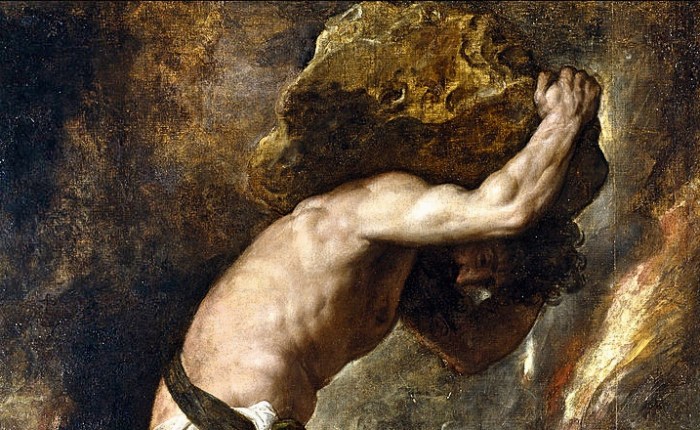
One of Graeber’s most interesting points is that the phenomenon of useless jobs may reveal that we are using a flawed conception of human nature. One would think that being paid to do little or nothing would be the height of happiness. But most people in useless jobs report profound feelings of unease and distress. Again, my own experience testifies to this. Though I had little work, and was paid decently, I often found myself miserable, even beside myself with a strange mixture of boredom and anxiety. Graeber has a long section on this, but basically it comes down to the way that useless work undermines our sense of agency in the world. There is a reason the gods punished Sisyphus that way. As Dostoyevsky said, having humans perform an unpleasant, uninteresting, and totally worthless task might be the most profound form of torture. In my own case, it gave me a very unsettling feeling of dissociation, as if I really could not control my own actions.

So if we build our economy on the assumption that humans, left to themselves, will choose to get the maximum reward for the least benefit, we may be building on false premises. I think that Graeber is right, and that people generally prefer feeling like they are doing something useful. This is why I think we ought not to fear that Universal Basic Income, or a drastic reduction in working hours, would lead to a society of lazy idlers. In any case, people bored at home may do something more worthwhile than people bored at work, who mostly seem to go on social media. (Graeber notes that the rise in social media use coincides with the rise of useless employment. Certainly it was true in my case, that useless employment led naturally to spending huge amounts of time on Facebook.)

This summary does not do justice to the full contents of the book. Graeber is a sharp writer and an agile thinker. Not only is he the first to really hone in on this strange aspect of the modern world, but he does so within a wide perspective. To give just a few more examples, he connects the rise of bullshit jobs with the slowdown in scientific progress and the decline in quality of Hollywood movies. Perhaps Graeber’s political identity as an anarchist helps him to avoid the basic narratives of both the left and the right, and to develop strikingly original opinions about social problems. While I am not anarchist myself, I think the institution of work deserves far more questioning and criticism. We have accepted work as the bedrock of society and the foundations of our lives’ meanings, and yet most of us do not particularly like it. If I could wax utopian for a moment, I would imagine a movement devoted to the creation of a society of leisure. I would even work for it.


View all my reviews

Review: The Myth of Sisyphus

Review: The Myth of Sisyphus
The Myth of Sisyphus and Other Essays

The Myth of Sisyphus and Other Essays by Albert Camus

My rating: 4 of 5 stars

I still vividly remember my writing class in my first semester of college. Our professor was a lover of paradoxes. She had us read Kafka and Borges, whom none of us could understand. And she had a habit of asking impossible questions—such as “What does it mean to be infinitely finite?”—and savoring the uncomfortable silences that followed. Once, she even scared us half to death by asking one of these questions, and than yelping like a banshee half a minute later. Quite a good professor.

The final section of this iconic essay was among the readings she had us read. Of course I did not understand a word of it. I was no where near mature enough to wrap my mind around the idea of absurdism. The “meaning of life” was not a problem for me at that time. Surrounded as I was by thousands of potential friends and girlfriends—free for the first time in my life to do as I pleased—such a confrontation with nihilism was beyond the horizons of my mental life.

This was not the case four years later, when I graduated college with thousands of dollars in debt, confronted with the possibility of deciding “Who I Wanted to Be.” Probably I should have read this book at that time, when I could so keenly feel the weight of life’s pointlessness. Or maybe I should have read it a year later, when I was working in an office job. Humankind has seldom plunged deeper into the void than in entry-level positions.

I mention this biographical background because I think this book should likely not be read during a time of relative stability and contentedness, such as I am in now. We seldom pause to ponder the “meaning of life” when we are enjoying ourselves. The problem of “philosophical suicide” is not a problem at all on beautiful summer days. It is only a problem on cold, rainy Tuesday nights, in the few minutes of mental calm between work, chores, sleep, and work the next day. Unfortunately, such Tuesdays come all too often in this world of ours.

My point is simply that I would have enjoyed this essay far more under more propitious circumstances. Albert Camus’s style is well-calculated to please: a winsome mixture of anecdote, philosophy, literary criticism, and poetry. Certainly it is a relief after dragging my way through Sartre’s tortured syntax and cumbersome verbiage. Camus, by contrast, is concise and stylish. My only reservation is that, for all his accessibility, Camus is not perfectly clear. I say this from the perspective of somebody trying to read his essay as a philosophical work. All philosophy consists in argument; and in order to accept or reject an argument, one must use clearly defined terms. With Camus, however, I was never quite sure what his criteria were for considering something absurd or meaningful—his two central categories.

This is perhaps the wrong way to read Camus. What he was trying to create was arguably more in the tradition of wisdom literature than formal philosophy. From this perspective, the essay is somewhat more satisfying. However, here too I found Camus somewhat lacking. One extracts more piquant lessons in the art of life from Montaigne or La Rochefoucauld than from Camus. Where Camus excels these authors is not in wisdom per se, but in capturing a certain mood, a mood peculiar to modern times: being intellectually and spiritually adrift. After all of the traditional systems belief which underpinned life have crumbled, it is the crushing realization that one is unable to justify anything, even life itself. In this peculiar vein, Camus is difficult to beat.

Even so, I wonder if this iconic essay adds anything essential to that famous remark of Pascal: “Man is only a reed, the weakest in nature, but he is a thinking reed.” Camus’s Sisyphus is the twin brother of Pascal’s thinking reed—the plaything of an indifferent universe, and yet dignified by his consciousness. In his more despairing moments, Pascal may have been quite as horrified by the vast spectacle of an indifferent cosmos as Camus: “The eternal silence of these infinite spaces frightens me.” The essential difference between these two men is not their realization of humanity’s insignificance, but their reactions. Pascal seeks to escape this conclusion any way he can, bolstering his faith with every fallacious argument under the sun. Camus was innovative in his insistence that we must calmly accept this situation, taking it as a starting point and not as a depressing conclusion.

My main criticism with this essay is that, if life has no inherent meaning, and the universe is nothing but a cold expanse, this throws the question of the “meaning of life” back upon each individual. Answering that question definitively, for every person, becomes de facto impossible. But, again, perhaps Camus is not trying to prove anything universal. Rather, his essay is a sort of invitation to abandon the traditional justifications of life, and to focus, as Camus himself did, on the smaller joys—sunlight, the sea, travel. The rest of the essays in this collection may be seen in that light, as enlarging upon Camus’s omnivorous curiosity for his surroundings.

What bothers me is that I do not agree with Camus’s opening assertion: I do not think the most pressing question is whether we should all just commit suicide. To the contrary, once this question is decided in the negative, it opens up a world of far more interesting issues.


View all my reviews

Review: Coriolanus

Review: Coriolanus

Coriolanus by William Shakespeare

My rating: 3 of 5 stars

In my review of Plutarch’s Lives, I noted the stark difference between that ancient author’s conception of personality, and our own. For Plutarch, character was static and definable—an essence that is manifested in every decision and remark of a given person. Compare this with Montaigne’s or Shakespeare’s portrayal of personality: fluctuating, contradictory, infinitely deep, and ever fugitive. To borrow a metaphor from Oswald Spengler, the Plutarchian self is statuesque, while the Shakespearian self is more like a work of music. The first is a self-contained whole, while the second is abstract, fleeting, and morphs through time.

It is fascinating, therefore, to see Shakespeare handle a story right out of Plutarch. Shakespeare adapts his art to the subject-matter, and creates a character in Caius Marcius Coriolanus that is remarkably opaque. I say “remarkably” because Shakespeare had just finished with his five greatest tragedies, each of which has a character notable for its depth. Caius Marcius, by contrast, is a man almost in the Plutarchian mode: with a enumerable list of vices and virtues, who acts and speaks predictably, with little self-reflection. Next to Hamlet, Iago, or Macbeth, the Roman general seems almost childlike in his restriction.

Like Julius Caesar, this play is interesting for a certain amount of moral ambiguity. It is difficult to side with any of the major players. The plebeians of Rome are certainly not a mindless rabble, but they are somewhat vain and narrow-minded, not to mention easily influenced by empty words. Coriolanus himself is a superb soldier but ill-suited to anything else, whose capital vice is not exactly pride, but a certain smallness of mind. His mother, Volumnia, is scarcely less warlike than her son. Even if her counsels are good, it is difficult to see the mother-son relationship as perfectly healthy. She comes across, rather, as a kind of Roman helicopter mom, bringing up her son to be a killing machine for the glory of the state.

For me, the tragedy was not quite successful, simply because Coriolanus was such an unsympathetic protagonist—belligerent, scornful, reactionary, and often a great fool. It is a testament to Shakespeare’s art that he is not altogether hateful. As Harold Bloom says, this play is technically brilliant: in its pacing, language, and plotting. Shakespeare was certainly a professional. But if you come to Shakespeare seeking grand personalities, the work is a barren field.


View all my reviews

Review: Fortunata y Jacinta

Review: Fortunata y Jacinta
Fortunata y Jacinta

Fortunata y Jacinta by Benito Pérez Galdós

My rating: 5 of 5 stars

Evil breeds, and the good are annihilated in sterility.

Here is a real masterpiece of Spanish literature, one of the seemingly endless landmark novels of the nineteenth century. Benito Pérez Galdós, an intensely prolific author by any standard, cranked out this enormous work in two year’s time. This was a long time for Galdós. The vast bulk of Galdós’s dozens of other novels are not even half as long as this work, and many are not even a quarter in length. He went to such lengths because his creative ambition had been spurred on by the publication of Leopoldo Alas’s La Regenta, another enormous novel, in 1885. By 1887, Galdós was ready with his reply: this book.

As the title indicates, the story is basically a love triangle, consisting of the respectable Jacinta, the poor Fortunata, and the privileged cad, Juanito Santa Cruz (called “el Delfín”). The main outline of the story is familiar: Santa Cruz marries the wealthy Jacinta, but has a dalliance with the lowly but beautiful Fortunata. Scandal ensues. This could easily be a trite and uninteresting story. Yet Galdós turns this basic plot into a lens, focused on the middle-class life in Madrid. Galdós documents this life with extraordinary finesse. We meet so many different sorts of people—pharmacists, priests, saintly nuns, military men, café intellectuals, chatty maids, arrogant housewives—each of them with their own quirks of speech and their own peculiar forms of mild insanity. It is a thorough and relentless dissection.

Galdós’s portrait of this world is not flattering. Like so many novels of this time, the plot focuses on the impossible plight of women. But Galdós is quite different from any of his English, French, or even Russian counterparts in his remarkable frankness. He is merciless in portraying the moral hypocrisy of this world, which basically leaves no option open for happiness to the lowly Fortunata. Here there are no dramatic heroes who fight duels, no heroines who throw themselves in front of trains or swallow poison. Instead Galdós gives us the crushing weight of custom, slowly grinding down the characters trying to navigate the morally bankrupt social conventions. In this way, the novel is rather more frightening than the operatic stories of Dickens, Tolstoy, or Flaubert—since it requires no suspension of belief to be believed.

Casting about for a comparison, the writer closest in style may be the great realist, Balzac. Galdós is also a realist of a high order. His endlessly animated prose is heavy with quotidian detail, making every scene photographically vivid. This also makes his novel feel rather modern and easy to read. There are no philosophical asides or extended descriptions of scenery: just action. In fact, if there is one main shortcoming of this book, it is that there is simply too much of it. Galdós is brilliant in the small scale; but at times one feels that he has been carried away with his loving portrayals of various Spanish types, his fascination with certain mannerisms, or his obsession with extreme realism. There are times that one wishes the book to swell into a crescendo, but Galdós stays at a steady volume.

The real star of this book is, undoubtedly, Fortunata. The title notwithstanding, Jacinta disappears for much of the story, only really the protagonist during the first quarter. The shameless lover, Santa Cruz, is also surprisingly absent from these pages. Jacinta and her unfaithful husband serve as the background for the tragedy of Fortunata, an unfortunate woman of high spirit and deep passion—a woman who, in other circumstances, could have become a saint, but whose actual circumstances forced her to become a scandal. Sharing in her tragedy is Maximiliano Rubín, a well-meaning, idealistic, and extremely naïve young medical student who falls in love with Fortunata. He, too, may have become a saint, if not for the ridiculous ideas of female honor holding sway at that time.

As the openning quote shows, a major theme of this work is fertility and sterility. Jacinta, the faultlessly faithful wife, is unable to have children; Rubín, the idealist obsessed with honor, is also sterile. Only Fortunata, the disgraced woman, and Santa Cruz, the philanderer, are capable of bringing life into the world. I cannot help but be reminded of The Departed, wherein only the good men can father children. The situation in Galdós’s novel is ostensibly the reverse. His point, however, is not that evil is somehow more fecund, but that the societal conventions of marriage virtually guarantee that people end up in disfunctional marriages (with divorce illegal, of course). It is society itself, then, that is sterile, and this respectable society would implode if not for the constant breaking of its social code—moral lapses that are ignored or excused in the men and ruthlessly punished in the women.

It is a brilliant metaphor, in a brilliant book briming over with vitality. Certainly the novel is too long and, at times, messy and rambling. But as a portrait of life at this time, it can hardly be surpassed; and as a portrayal of societal hypocrisy, it is definitive.


View all my reviews

Review: The History of Ancient Egypt

Review: The History of Ancient Egypt
The History of Ancient Egypt

The History of Ancient Egypt by Bob Brier

My rating: 5 of 5 stars

Ancient Egypt, like dinosaur bones and outer space, is one of those things which seem to attract universal curiosity. It certainly did in my case. I remember visiting the Egyptian section in the Met, as a young boy, and marveling over the mummies and the massive sarcophagi, the mysterious hieroglyphs and monumental statues.

There is something curiously foreign, even inhuman, about Egyptian artifacts. For one, they are old beyond anything we are accustomed to think about. To cite one oft-repeated fact, there is more time between construction the Great Pyramid and the life of Julius Caesar, than between Julius Caesar and our own time. Even ancient history seems like yesterday by comparison. Aside from mere time, Egypt’s culture is strikingly unlike our own. God-kings who marry their sisters to keep the blood-line pure, mummified bodies interred in graves full of gold, jackal-headed gods and hieroglyphic script—it is alien indeed.

Yet it is beautiful. Egyptian art is undoubtedly one of the great art traditions in the world—as anyone knows who has examined the bust of Nefertiti in Berlin, the seated scribe in Paris, or the statue of Hatshepsut in New York. It is a unified and coherent aesthetic, permeating everything from the smallest objects to the greatest temples, and lasting for thousands of years with only minor change. Even if it is enchanting, however, the art of Egypt also evokes this sensation of distance. Every image is so stylized, every human form is so rigid and unrealistic, every aesthetic choice pre-determined by tradition, that it is difficult to get a sense of real people behind these objects.

This sense of distance, of foreignness, of mystery, is what makes Egypt so exciting to study. (It is also why people talk about ancient aliens.) And Bob Brier is an ideal guide. I have never loved anything or anyone as much as Brier loves Egypt. This enthusiasm is infectious, and makes his series of lectures a real pleasure. He describes how he climbed into the Bent Pyramid—an early, failed attempt to create a pyramid—and how he traveled to the turquoise mines used by Egyptians themselves. He narrates Napoleon’s conquest of Egypt and explains how the Rosetta Stone was translated. He even describes in detail how to make a mummy—and he should know, since he made one himself.

Apart from these entertaining asides, Brier takes the listener through the whole history of Ancient Egypt, from prehistory to the death of Cleopatra. It is a fascinating story, and Brier is a wonderful storyteller. A lifelong resident of the Bronx, his verbal mannerisms may remind one—pleasantly or unpleasantly—of the man in the White House; yet he knows how to dramatize the relevant details enough to make them effortlessly stick in the memory. His love of a good story does lead him astray, at times. For my part, his two lectures on the Biblical stories, Joseph and Exodus, were somewhat too credulous of their veracity. He is similarly generous when it comes to Herodotus. And his theory of Tutankhamun’s murder has now been disproven.

Aside from these mild criticisms, I should note that the series does show its age. Recorded in 1999, a lot has happened in the world of Egyptology since then, notably the advances in DNA and medical technology which allow us to know more about the lives of Egyptians. For example, we now know far more about Tutankhamun’s many physical ailments, and we also know that he was not the son of Nefertiti.

Nevertheless, these lectures remain a wonderful introduction to the times. I cannot emphasize enough how enjoyable they are. They convert you into an Egypt fanatic. Now I want teach myself hieroglyphics and to go to Egypt myself. It must be incredible to see all of this in person. For now, however, I will have to be content with Brier’s virtual tour and whatever museums I can visit.


View all my reviews