Review: The Worst Hard Time

Review: The Worst Hard Time

The Worst Hard Time: The Untold Story of Those Who Survived the Great American Dust Bowl by Timothy Egan

My rating: 4 of 5 stars


The Dust Bowl has always been a somewhat vague disaster in my mind. It occurred during the Great Depression, and the images it generated helped to define the misery of the period. But the question has always lingered in my mind: was it simply chance that the two coincided? Or did one cause the other? Like many people, my primary touchstone for the event is The Grapes of Wrath; but that novel is mainly about people escaping the Dust Bowl, not what it was like to be in it. In short, for such an important event, I had only a vague notion of the Dust Bowl.

This book remedied the problem; and for that, Timothy Egan deserves a great deal of credit. The Worst Hard Time traces the disaster from its historical origins to its conclusion, and provides harrowing descriptions of what it was like to live through the dusters—or die trying.

I have never experienced a dust storm. The closest I’ve come was a few years back, when strong winds deposited sand from the Saharan Desert in Madrid, a climatic event called la calima in Spanish. It was unsettling. The air had a rust-colored hue, with visibility at a minimum. Rain drops fell and left dirty stains on your clothes. I was teaching physical education at the time, and we instructed the kids to use the face masks (which they still had, thanks to the pandemic) when we exercised outside. The only other relevant experience I’ve had was a few summers back, when the huge forest fires in Canada sent haze down to my town in New York. I tried to go on a run in the gray air and ended up with a persistent cough.

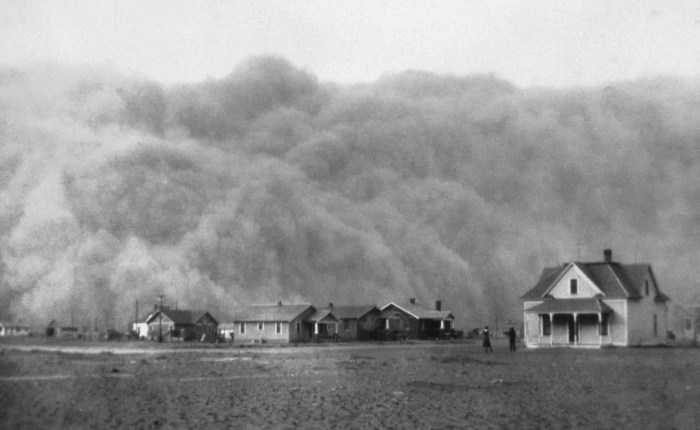
These experiences are mild to the point of triviality compared with the dusters of the 1930s. Visibility would drop to zero, pitch blackness. Dust would block roads and bury equipment. Any vegetation would be drowned or stripped bare. Anyone exposed to the dust would develop a cough that could become a fatal case of “dust pneumonia.” Most surprising of all, the dusters would generate enormous amounts of static electricity which would discharge painfully if an unwary victim touched anything conductive.

As to the question of why this happened, the answer seems to be quite complicated. Regardless of human activity, the Great Plains undergo long periods of rainfall followed by drought; and it just so happened that they were populated when the climate was more benevolent. But the 1930s were a time of extreme drought on the plains. Yet human activity had prepared the way for crisis. First, the peoples of the plain—the Apache and Comanche—were pushed off their land, and the buffalo, upon which they depended, were hunted to oblivion. The federal government encouraged farmers to take up residence by simply giving away land. The combination of the increased demand of the First World War and the Russian Revolution—which took the biggest grain supplier out of commission—prompted farmers to increase yield, plowing up as much topsoil as they could.

Like the Great Depression, then, the Dust Bowl seems to have not been the cause of one simple error, but a kind of perfect storm created by many contributing factors. And like the Great Depression—which was partly provoked by a massive trade imbalance, caused by WWI—the Dust Bowl as a kind of delayed hangover of the Great War.

Once again, Egan deserves a great deal of credit for writing such an informative book about a topic simultaneously so well-known and so poorly understood. That being said, I don’t have warm feelings about The Worst Hard Time. Though it is not an especially long book, it feels bloated and repetitious; and I think this is due to the prose, which was heavy-handed and inflated with a kind of false melodrama. This was frustrating, since the story of Dust Bowl contains more than enough drama to stand on its own.

The first lines give some idea of the tone:

On those days when the wind stops blowing across the face of the southern planes, the land falls into a silence that scares people in the way that a big house can haunt after the lights go out and no one else is there. It scares them because the land is too much, too empty, claustrophobic in its intensity. It scares them because they feel lost, with nothing to cling to, disoriented. Not a tree, anywhere. Not a slice of shade. Not a river dancing away, life in its blood.

I don’t know about you, but I find this ponderous and dull. And it irritates me especially because I don’t think this is Egan’s true voice. It is like he is putting on a persona (a quality of much irritating prose, I find). Mostly, it is extremely redundant—we get it, it’s scary—which is why the book feels so long.

This is just one of the faults of style I thought the book suffered from. However, I don’t want to harp on stylistic shortcomings too much. After all, I didn’t pick up this book to be blown over by the prose, but to learn about the Dust Bowl; and that, I certainly did. Even if it is irritating to read, then, The Worst Hard Time comes close to being the definitive work on the subject.

View all my reviews

Review: The Way

Review: The Way

The Way by Dermot C. Miller

My rating: 4 of 5 stars


The story of how I came to read this book is, I think, necessary to relate before I launch into the review. It began with an invitation to a birthday party. There, amid strangers, I met a thoroughly charming Irishman named Enda, another expat (he hates the word, but it seems to fit) with a literary bent. Last year, Enda—along with his writing and business partner, María—commenced on the bold experiment of opening their own publishing company, Ybernia. This book is among the first published by this new enterprise, and I was given a free copy.

For this reason, this review can hardly be unbiased. However, there are other reasons to be suspicious of my opinion. Despite never having met Miller, I could tell quite soon that we have many experiences, tastes, and opinions in common. I am not talking about anything so lofty as a spiritual connection. Simply put, we are both guiris (another word that seems to fit) who enjoy sunny Spanish landscapes and greasy Spanish jamón. And we are both writers.

Beyond this, as another expat author, I have considered the same sorts of writerly challenges that Miller confronts in this book—namely, how to weave together stories of one’s native country with experiences abroad. I remember a review by Orwell of Henry Miller’s Tropic of Cancer (about Miller’s—that is, Henry Miller’s—depraved time in Paris), where Orwell remarked that life abroad can convey a certain superficiality to one’s experiences—and thus one’s writings—since one is normally single and unattached, both in terms of family and of culture. Orwell himself was quite familiar with this issue, as he wrote about his time in Paris (as a plongeur in a hotel) and in Spain (fighting in the Civil War).

Now, this may seem like a trivial issue to you; but in my experience, even after years abroad, one’s imagination—the images which resonate most deeply—remains tied to where one grew up. Aside from that, in a foreign land, one is inclined to focus on the most salient cultural differences—the cuisine, the weather, the history, the great monuments—which, depending on one’s taste, can be attractive or repellent, but little more. In one’s native land, however, these features move far into the background, allowing one to write about potentially “deeper” subjects.

This, at least, is how I think of the problem confronting an expat author. And unless I am mistaken, Miller (that is, Dermot C. Miller) has confronted this same challenge here in this book. And his solution is interesting.

He settles on a bipartite design. The frame story is a trek on the Camino de Santiago, undertaken by an Irishman haunted by his past. This tragic backstory is then recounted in a series of flashbacks, which take the reader from his childhood to the events that traumatize our hero (who shares Miller’s first name and middle name). Most of this backstory takes place in Miller’s Northern Ireland, and serves to explain how he ended up here on the Iberian Peninsula. He thus hits upon a natural way of uniting his native land and his adopted home.

Both stories, taken separately, are quite well done. The backstory ultimately becomes a kind of thriller, as the protagonist eventually gets mixed up in the IRA. Meanwhile, the frame story is a travelog, in which the protagonist revels in the landscapes, folklore, and history of the Camino de Santiago. The contrast in emotional registers between these two parts gives the book its impetus—as either one, without relief, might have grown wearisome. Nevertheless, the juxtaposition is sometimes jarring, as the reader is thrown from tragedy to tourist brochure rather abruptly. I should say, however, that I did find it believable that a bookish type would use travel as a kind of nerdy therapy. It’s certainly been done before.

In terms of prose style, I actually found myself identifying with Miller—both with his strengths and his shortcomings. To his credit, he achieves the most important quality of prose—namely, readability. I made my way through these pages quite quickly, never put off by any thorny or offensively ugly sentences. If he is guilty of any writerly sins, it is (for lack of a better word) prettifying. That is to say, for my taste, Miller gives a literary polish to some parts which would have been better left simple and raw. Yet, as I am absolutely guilty of doing this myself, it would be hypocritical of me to knock him about for it. I can only say, in his (and my) defense, that if you are a relatively unknown author, it is difficult to resist the temptation to prove that you have serious literary chops.

This overlong and self-important review has been written merely to say that Miller has authored a greatly enjoyable novel. It can be read with profit by readers with an interest in the Troubles or the Way of Saint James (how much overlap is there in the two groups?), or by any reader interested in Irish or Spanish history more generally. Indeed, I would recommend this book to any expats (sorry, Enda) and guiris who want to think of ways their past and present homelands can be woven together.


View all my reviews

Review: The Grand Alliance

Review: The Grand Alliance

The Grand Alliance by Winston S. Churchill

My rating: 4 of 5 stars


Churchill’s account of the Second World War continues. I am finding that these volumes have a kind of cumulative power, which far exceeds that of any single volume. As I slowly make my way through the war, month by month, campaign by campaign, theater by theater, the mind-boggling scale of the conflict is beginning to sink in. What would be major operations in other wars are here mere side-shows or diversions. To pick just one example, if the Anglo-Iraq War were to happen today, it would be considered a momentous event that dominated the news. But in the context of World War II, it hardly even registers.

Merely keeping track of all this—the troop strengths, the ships available to the Navy, the number of serviceable aircraft, all distributed literally around the globe—would strain any military organization today. Two silly but revealing examples illustrate just how many different places Churchill had to keep in mind. He insisted that Iceland be written with a (C) after it, so that it could never be confused with Ireland (R). And he also preferred that Iran be called “Persia,” since otherwise somebody might confuse it with Iraq. The very idea that people might mix up what countries to attack or defend I think says more about the scale of the War than any superlative could.

But the military organization is only half of the equation. For Churchill is always acutely aware of the political situation, in ways that strictly military commanders are not.

To pick a simple example, Churchill has occasion to criticize a general for putting a British regiment in a relatively safe zone, while sending colonial forces into battle—for the apparently superficial, but politically real, reason that it reflects poorly on the British government. Indeed, Churchill’s frustrations with General Auchinleck’s hesitations to attack Rommel in North Africa reminded me very much of Lincoln’s own admonishments to George B. McClellan to be more aggressive. In both cases, the political leader realized the value of at least appearing to have the initiative. Appearances are important when you are courting potential allies and public opinion.

Like Manny, I was also impressed by Churchill’s willingness to put politics aside in order to win the war. Few politicians in Britain, I imagine, were less sympathetic to Soviet Communism than Churchill. But as soon as Hitler made his great error and commenced Operation Barbarossa, Churchill did not hesitate to send vital supplies and equipment to his former foe, even though it weakened his own position—correctly predicting that a strong Russian defense would debilitate the German army. The tense and sometimes downright rude correspondence between Stalin and Churchill was especially interesting to read. Even then, at the beginning of their alliance, the Cold War was looming ahead.


View all my reviews

Review: Our Lord Don Quixote

Review: Our Lord Don Quixote

Vida De Don Quijote Y Sancho/ the Life of Don Quijote and Sancho (Letras Hispanicas / Hispanic Writings)Vida De Don Quijote Y Sancho/ the Life of Don Quijote and Sancho by Miguel de Unamuno

My rating: 4 of 5 stars

‘For me alone was Don Quixote born, and myself for his sake; he knew how to act and I to write,’ Cervantes has written with his pen. And I say that for Cervantes to recount their lives, and for me to explain and elucidate them, were born Don Quijote and Sancho. Cervantes was born to narrate, and to write commentary was I made.

Miguel de Unamuno defies classification. At once a philosopher, a literary critic, a novelist, a poet, and an essayist—and yet none of them completely—he resembled Nietzsche in his mercurial identity. In this way, too, did he resemble Nietzsche: though he had many themes and central ideas, he had no system. He wrote in short feverish bursts, each one as fiery and explosive as a sermon, going off into the branches (as the Spanish say) and returning again and again to his ostensible subject—only to depart once more. He was a wandering knight errant of a writer.

Unamuno was a member of the so-called Generation of ‘98. The date—1898—alludes to the Spanish-American war, a conflict in which Spain suffered a humiliating defeat and lost nearly all of her colonies. After this, it became impossible to see Spain as a world power; her decline and decadence were incontrovertible. This generation of intellectuals and artists was, therefore, concerned with rejuvenating Spanish culture. In Unamuno’s case, this took the form of finding Spain’s ‘essence’: which he did in the person of Don Quixote. He sees in the knight errant everything profound and important in Spanish culture, as a kind of Messiah of Spanish Catholicism, often comparing Quixote to Iñigo de Loyola and Teresa de Ávila.

This book has, therefore, a quasi-nationalistic aim, which may weary the non-Spanish reader. But it survives as one of the greatest works of criticism written on Spain’s greatest book.

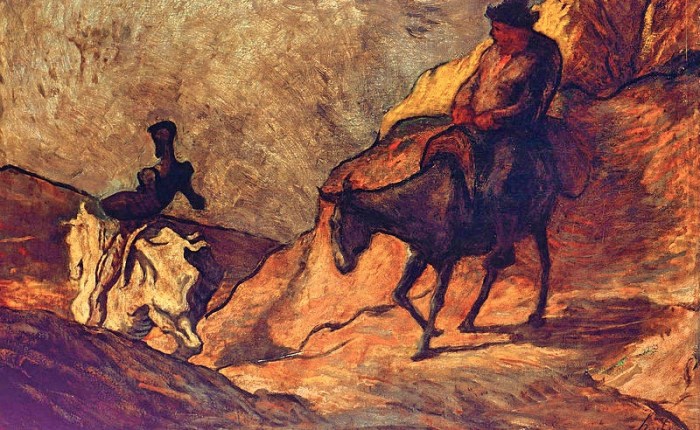
The title of Vida de Don Quijote y Sancho is usually rendered in English as Our Lord Don Quijote; and this title, though not literal, does ample justice to Unamuno’s project. In this work Unamuno undertakes to write a full, chapter-by-chapter commentary on Cervantes’ novel; but his commentary is no conventional literary criticism. Unamuno declares his belief that Don Quixote and his squire were real, and that Cervantes did a grave injustice to their lives by writing it as a farce. In reality, the Don was a hero of the highest order, a saint and a savior, and Unamuno aims to reveal the holiness of the Knight of the Sorrowful Countenance for his readers.

Unamuno is, thus, the most quixotic of interpreters. He claims to see naught but pure nobility and heroism in the great knight from La Mancha. And yet the grandiose and ludicrous claims of Unamuno, and the farcical nature of Don Quixote himself, put the reader on guard: this commentary, like the great novel itself, is laden with delicate irony—an irony that does not undermine Unamuno’s literal meaning, but complements and complicates it.

You might call this Cervantine irony, and it is difficult to adequately describe, since it relies on a contradiction. It is the contradiction of Don Quixote himself: perhaps the most heroic character in all of literature, braver than Achilles and nobler than Odysseus, and yet laughably ridiculous—at times even pitiable and pathetic. We are thus faced with a dilemma: applaud the knight, or ridicule him? Neither seems satisfactory. At times Quixote is undeniably funny, a poor fool who tilts at windmills; but by the end of the novel—an ending more tragic than the darkest of Shakespeare’s tragedies—when he renounces his life as a knight and condemns all his adventures as insanity, we cannot help but feel profoundly sad, and we plead along with Sancho that he continue to live in his fantasy world, if not for his sake than for ours.

This is the paradox of idealism. To change the world you must be able to re-imagine it: to see it for what it might be rather than for what it is. Further, you must act “as if”—to pretend, as it were, that you were living in a better world. How can you hope to transform a dishonest world if you are not honest yourself, if you do not insist on taking others at their word? Quixoticism is thus the recipe for improving the world. Dorothea, from Middlemarch, is a quietly quixotic figure, only seeing pure intentions in those around her. But paradoxically, by presupposing only the best, and seeing goodness where it is not, she creates the goodness that she imagines. Confronted with a person who sees only the most generous motives, those she meets actually become kind and generous in her presence.

We then must ask: Is Dorothea a fool? And if so, does it even matter? And what does it even mean to be a fool? For as Lionel Trilling pointed out, Cervantes posed one of the central questions of literature: What is the relationship between fiction and reality?

Human reality is peculiar: We acknowledge an entire class of facts that are only facts because of social agreement. The value of a dollar, for example, or the rules of football are real enough—we see their effects every day—and yet, if everyone were to change their opinion at once, these “facts” would evaporate. These “social facts” dominate our lives: that Donald Trump is president and that the United States is a country are two more examples. You might say that these are facts only because everyone acts “as if” they are: and our actions constitute their being true.

The reality that Don Quixote inhabits is not, in this sense, less real than this “normal” social reality. He simply acts “as if” he were residing in another social world, one purer and nobler. And in doing so, he engenders his own reality—a reality inspired by his pure and noble heart. What is a queen, after all, but a woman who we agree to treat as special? And if Don Quixote treats his Dulcinea the same way, what prevents her from being a queen? What is a helmet but a piece of metal we choose to put on our heads? And if Don Quixote treats his barber’s bowl as a helmet, isn’t it one? We see this happen again and again: the great knight transforms those around him, making them lords and ladies, monsters and villains, only by seeing them differently.

In this way, Don Quixote opens a gulf for us: by acknowledging the conventional nature of much of our reality, and the power of the imagination to change it, we are left groping. What does it mean for something to be real? What does it mean to be mistaken, or to be a fool? To improve the world, must we see it falsely? Is this false seeing even “false,” or is it profoundly true? In short, what is the relationship between fiction and fact?

To me, this is the central question of Cervantes’ novel. But it remains a dead issue if we choose to see Quixote merely as a fool, as he is so commonly understood. Indeed I think we laugh at the knight partly out of self-defense, to avoid these troublesome issues. Unamuno’s worshipful commentary pushes against this tendency, and allows us to see the knight in all his heroism.

View all my reviews