Roaming in Rome: Basilicas

Roaming in Rome: Basilicas

This is Part Three of a six-part series on Rome, following this plan:


Rome’s basilicas comprise one of the city’s most popular attractions, and rightly so: they are among the most beautiful examples of religious architecture in the world.

The four so-called major basilicas, so designated by the Pope, are all within the diocese of Rome. These are San Giovani in Laterano, Santa Maria Maggiore, San Paulo Fuori Le Mura, and St. Peter’s in the Vatican (which I discuss in my Vatican post). Besides these four major basilicas there are a multitude of minor basilicas to visit, which are minor in name only.


Santa Maria Maggiore

Santa Maria Maggiore is one of the few churches in Rome for which you need to pass through security to enter. In addition to the security guards manning the metal detector there are burly Italian soldiers carrying assault riffles standing outside. All these defenses should tell you that this is a precious building.
Santa_MariaMaggiore1

Santa_Mariamaggiore2

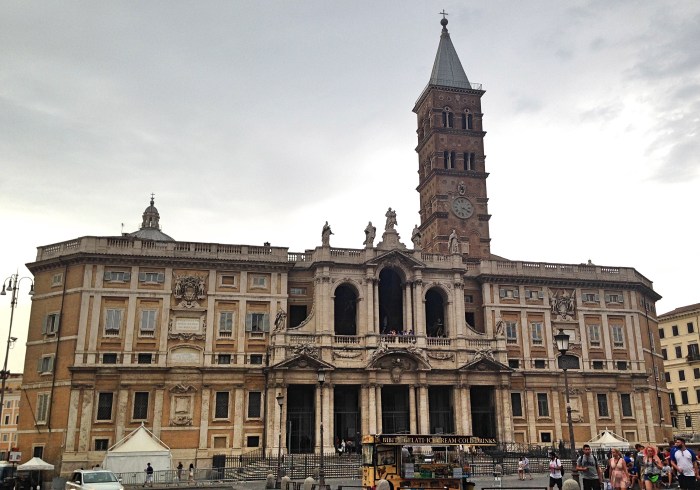
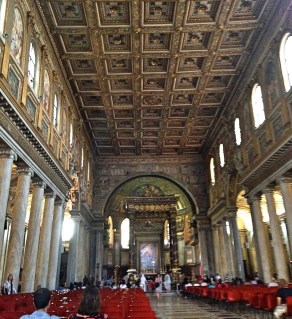
From the outside, the Basilica is hard to miss. Aside from its massive size, the basilica is notable for having the highest bell tower in Rome, a lovely 14th century construction. The inside is even more impressive. When you stand in the center, looking down the central nave, everything seems to be made of solid gold. The coffered ceiling is covered in gilded wooden flowers. Light pours in through the top row of windows, which sit above a row of marble columns. Straight ahead is the main chapel; on the apse above is a mosaic of the Virgin Mary’s coronation amid a golden background. The decoration is absolutely sumptuous.

Santamaria_dome

The feature that most stuck in my memory was a sculpture of Pope Pius IX in prayer, which sits in a sunken area before the main altar. But much more important, historically and artistically, are the mosaics. Mosaics run along the nave in a row under the window, and also surround the semidome above the main altar. Unfortunately, the mosaics on the nave are difficult to see from the ground, but those around the arch are lovely works of art.


Santa Giovanni in Laterano

Bad luck again. I followed my phone to the Basilica di Santa Giovanni in Laterano, and it was not open. The gates were shut, the doors were closed.

In the plaza nearby was another Egyptian obelisk. (This is the Lateran Obelisk—the largest ancient obelisk in the world, apparently. I am embarrassed to say that I hardly took the time to look at it.)

I sat down sullenly on the surrounding barrier, determined to wait until the basilica opened. The thin metal railing was uncomfortably skinny, so I switched to one of the concrete supports. That was slightly better, but still too spherical to make a good seat. If I leaned forward or back, I would slip off; and my tail bone kept rubbing painfully against the concrete. On top of that, it looked like it was going to rain.

I sat and waited. A family of tourists walked up to the gate and then turned back, disappointed. A young couple did the same. Meanwhile, two Italian soldiers, standing beside an armored vehicle and carrying intimidating assault riffles, talked amongst themselves. Their job was not to interact with tourists; their job was to shoot anyone who did anything fishy.

An hour went by. Now it was drizzling. I began to seriously doubt whether this basilica was worth it. The outside was not terribly impressive. Maybe I could just bag it? But I’d come all this way to see it! And there’s no reason it should be closed. Idly, I checked the map on my phone. I could see that the building was quite big, occupying a whole block all by itself. Maybe there was another entrance?

With nothing to lose, I got off my perch, my bottom a bit tender, and walked around the corner. Once there, I smacked myself in the head. This was obviously the entrance. I had been waiting in the wrong place for a whole hour. But I am too used to messing up to get very frustrated when it happens.
SanGiovanni_Laterano

As I lingered near the entrance, I was amused to see a young American couple being forced to tie bits of colorful cloth around their waists. They had to do this because they were both wearing shorts, and the churches in Rome have a dress code. In my brief experience, this dress code applies more stringently to women than to men; several times I observed men walking around basilicas in shorts, while women were always made to cover up their shoulders and legs. Keep this in mind on your visit.

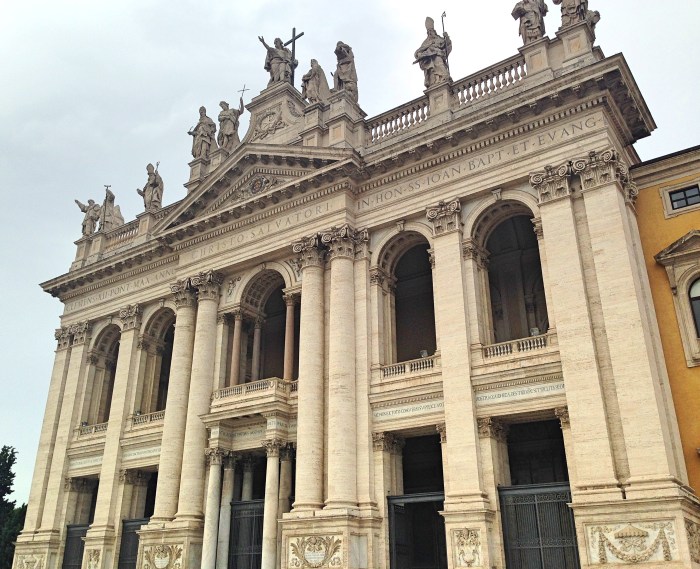
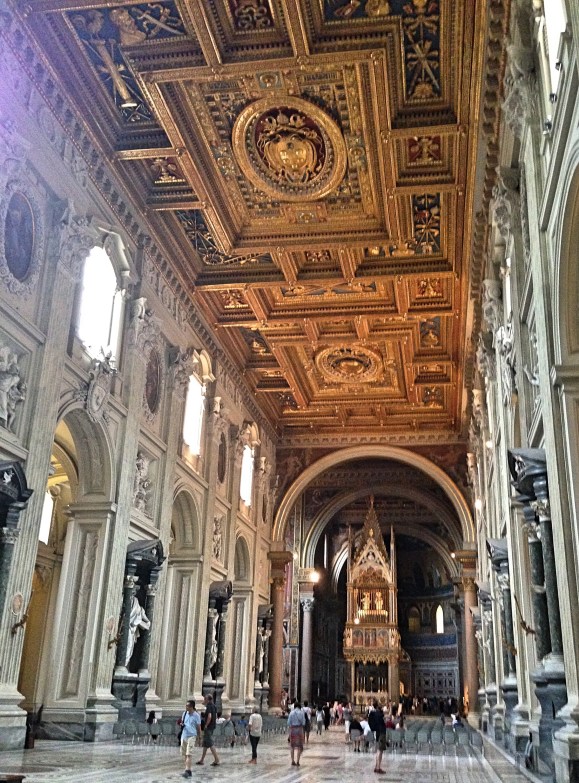
The façade of the basilica is austere and neoclassical, full of straight lines and right angles, rising up to an impressive height. The interior is still more impressive. The main nave is cavernous and enormous. Far above hangs the gilded wooden ceiling, sectioned off into quadrilaterals and covered in armorial and floral motifs. The main altar is covered with a gothic baldachin; this is like a guard tower, with two figures (presumably saints) keeping watch inside.
sangiovanni_laterano1

The most outstanding feature of the basilica, however, is the series of statues of the twelve apostles. These are situated in niches in the columns of the main nave. Under the direction of Pope Clement XI, in the early years of the eighteenth century, seven sculptors were commissioned to make these statues. Each one larger than life-size, and each one is elegant and glorious.

Walking from one end of the basilica to the other, from the entrance to the main altar, dwarfed beneath the gilded roof, passing between these dramatic apostles with their flowing robes and outstretched hands, you can feel the gripping power of the Catholic faith—even if, like me, you do not belong to it.


San Clemente al Laterano

The Basilica of San Clement is one of the more historical and well-known minor basilicas in Rome. Unfortunately for me, my experience with this basilica is largely of frustration.

The first time I went—and I walked everywhere in Rome, so this was a major investment of time—it was closed. I do not know why it was closed, since it was the middle of the day, but it was.

The second time I went was quite late. I arrived at 5:30, just half an hour before the basilica shut its doors for the day. This normally wouldn’t have been a problem; the place is not very large, so half an hour was more than enough time to see everything.

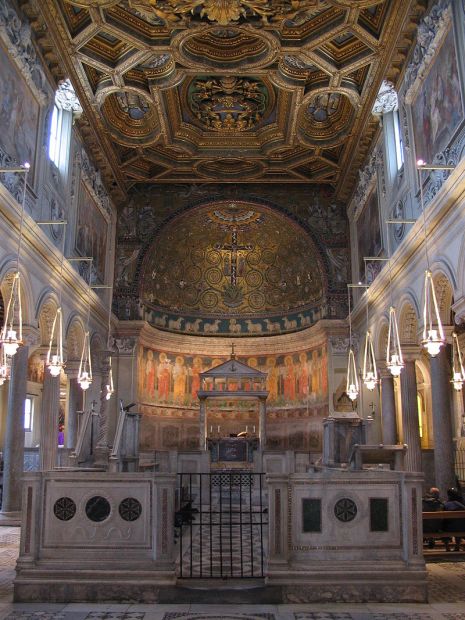
But the Basilica of San Clement is not famous for its main floor; it is famous for what lies buried underneath. The present basilica—which I shall describe in a moment—was built around the year 1,100, over the remains of an older, smaller basilica, which had been converted from the remains of a Roman house. This house had served, at various times, as an early Christian church and as a small temple to the god Mithras. Before that, there had been a house built during the Roman Republic, destroyed in 64 AD by the Great Fire. These ruins are preserved in the lower levels of the basilica.
800px-Interior_of_San_Clemente,_Rome
The “second basilica” of San Clemente in Laterano. Photo by Sixtus; licensed under CC BY-SA 3.0; taken from Wikimedia Commons

The basilica itself, like all basilicas in Rome, is free to enter; but you need to pay to go down to the basement levels to see the archaeological remains. I was more than willing to pay, since it sounded fascinating, but by the time I arrived they had stopped taking new visitors. I missed my opportunity. But I record this so you do not make the same mistake.

In any case, the current basilica was worth a visit. It is more on the scale of a church than a basilica; the roof does not tower above you, and there is no overwhelming sense of space. The semi-dome over the main altar, and the wooden roof above the central nave, are richly ornamented and glimmering with gold. The paintings and designs decorating the semi-dome have that lovely, medieval simplicity that always strikes me as noble and fresh.


San Paulo Fuori Le Mura

The only subway ride I took in Rome was to see the Basilica of Saint Paul Outside the Walls. As you might have guessed, its name derives from the fact that it was situated outside of the (now nonexistent) walls of Rome. As a consequence, the basilica is quite far from the city center, which is why I had to take a subway.

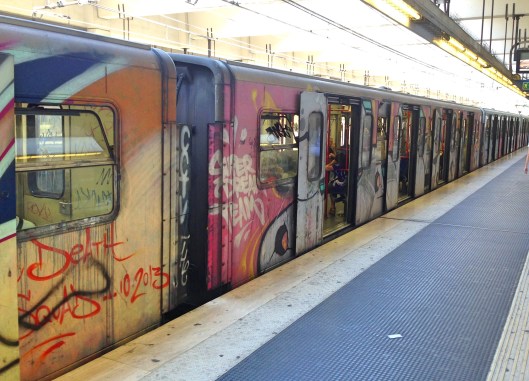
The train was absolutely covered in graffiti. It reminded me of photos I had seen of the New York City subway in the seventies. There must be very lax security if people are able to so completely cover the outside of the train cars. I always wonder: where and how graffiti artists do it? Is there a place where the trains are stored for the night, that the artists can sneak into? Maybe a railway yard in some corner of the city? For my part, I thought that the paint job was a little messy, but I appreciated the bright colors.
Rome_metro

The walk from the metro to the basilica was instantaneous. In a second I was there, sweating like a pig in the Roman sun, facing the grand edifice. To enter, I needed to pass through military-controlled security, perhaps because the basilica, although in Italy, is technically owned by the Vatican. I was going through customs.

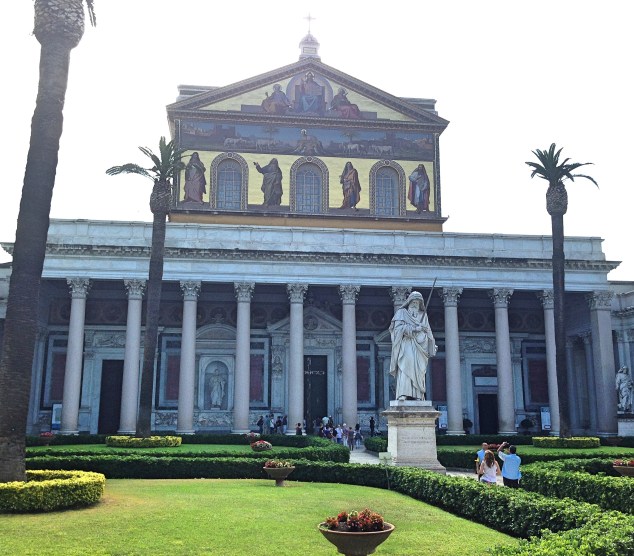
Before entering the basilica proper, you must pass through a courtyard. In the center is a statue of Saint Paul, sword in one hand, book in another, his bearded face staring down ominously. The courtyard is surrounded on all sides by rows of elegant columns, which makes it feel more like a Roman ruin than a Catholic church.
san_pablofuori

And indeed, this feeling is justified by the history of San Clement Outside the Walls. The basilica was founded all the way back in the reign of Constantine, and was later expanded by Theodosius in 386. Although damaged at various times in its history due to wars and earthquakes, it retained its original, ancient form until 1823. That year, a workman repairing the roof inadvertently caused a terrible fire that consumed nearly the whole structure. As it stands now, the building is almost entirely a reconstruction. It is ancient in design, but modern in appearance and execution.
san_pablofuori2

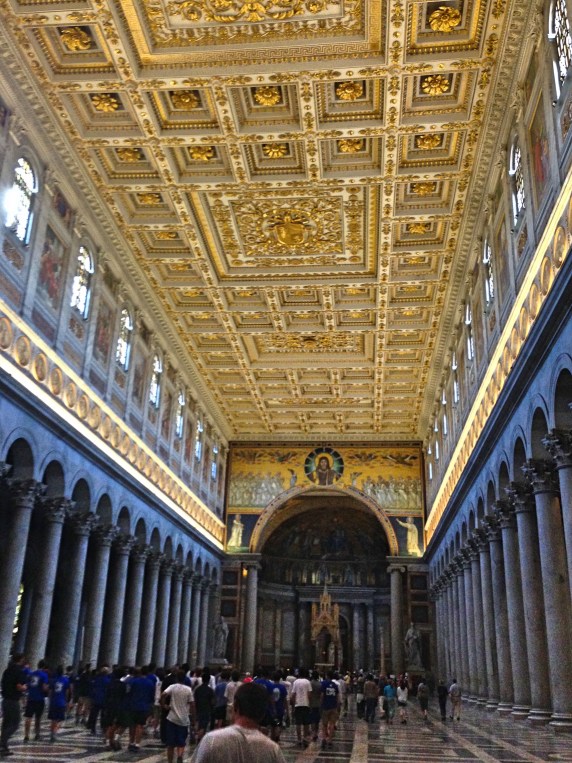
When I went inside, the most lasting impression was of space. Even more than other basilicas, Saint Paul’s is vast and spacious. The paneled ceiling, covered in golden designs and decorations, glows from the light pouring in through the top row of windows. Between each of these windows is a painting of an episode from Saint Paul’s life. The ceiling is so long and wide, and the area underneath so empty, that it seems impossible it could stay suspended above you without more support. Why doesn’t the middle crack under so much weight?

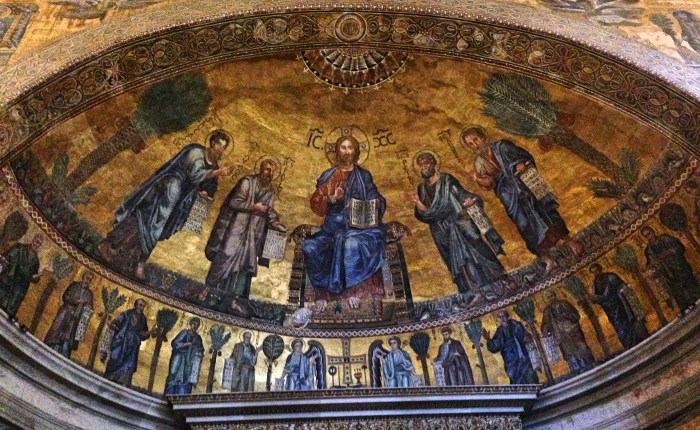
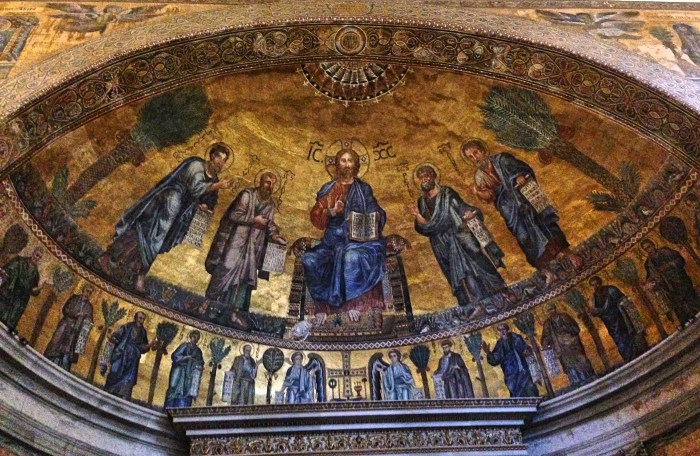
The most beautiful part of the basilica, for me, was the apse mosaic. It captures wonderfully the medieval mood of simple piety that I find so appealing in religious art. Sitting underneath it, with Jesus benignly looking down upon me, I thought I could feel a trace of the comfort that believers must feel in these sacred places.
San_Pablofuori3

But I have not yet mentioned the basilica’s most holy treasure: the grave of St. Paul himself. In truth, there is not much to see. In a lowered section of the floor, there is a clear, plastic panel through which can be glimpsed white stone. In a wall adjacent there is another transparent screen with more white stone. I would not have had any idea what I was looking at if there hadn’t been a sign.

By chance, just when I walked down the stairs to see this tomb, an entire American football team came marching into the cathedral. They seemed to be of college age, and there must have been at least fifty. A nun with an Irish accent guided them to the tomb (I made a hasty retreat to get out of their way) and they all gathered to hear her give a brief explanation. Then, they all bowed their heads in prayer.

Perhaps I am just a cynic, but I could not help wondering how much time these burly, hormonal males spend on spiritual things compared with the time they devote to girls and sports. None of them looked particularly excited to be there.


Santa Maria in Trastevere

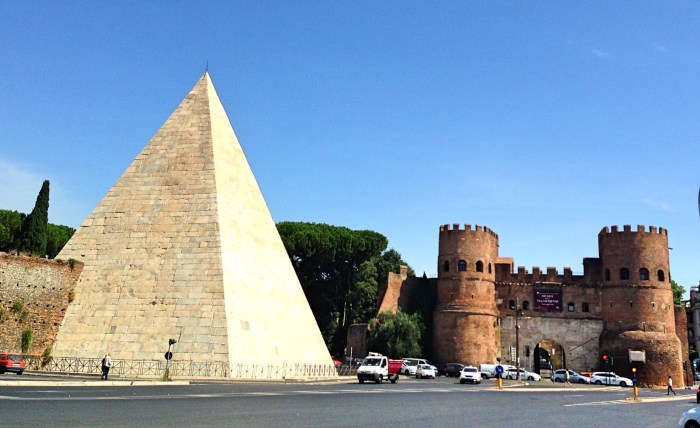
From Saint Paul Outside the Walls I took a long walk to Trastevere. For the most part, this walk was unexciting and unpleasant—just sweating and slogging my way past apartment buildings and parking lots in the heat and humidity. The most notable exception to this pattern of boredom was when I turned a corner and saw a pyramid.
Rome_pyramid

This is the Pyramid of Cestius, and is actually one of the best-preserved ancient buildings in Rome. To me it looked as though it could have been built yesterday. Instead, it was built in around 12 BCE as a tomb for Gauis Cestius, a magistrate, when Rome was conquering Egypt and there was consequently a fad for Egyptian paraphernalia in the city. I thought it was strange that Cestius would put up a tomb in the middle of the city; but of course, back when it was built, the tomb was well outside the city walls, and the city later expanded around it.

It has since been incorporated into the Aurelian Walls. This was done to save money and materials, but it looks a little funny to see a pyramid with walls sticking out on both sides. The fortified gate near the pyramid is also well-preserved.

I did not know this at the time, but near the pyramid is the famous Protestant Cemetery, where John Keats and Percy Bysshe Shelley are buried. It is funny how fame works. Keats and Shelley have modest tombstones, no bigger than average; and yet they will be remembered at least as long as English is spoken. The name of Gaius Cestius, by contrast, is not associated with any notable words or deeds; the only reason we remember him is for his peculiar and grandiose taste in funerary architecture.

The novelist Thomas Hardy visited this area in 1887 to pay his respects to Keats and Shelley. The sight inspired him to write a poem, Rome: At the Pyramid of Cestius near the Graves of Shelley and Keats. He begins by asking: “Who, then, was Cestius / And what is he to me?” He continues:

I can recall no word
Of anything he did;
For me he was a man who died and was interred
To leave a pyramid

And so he was.

Soon I passed the pyramid, walked through the gate, and found myself in Trastevere. This is one of the most historical and most hip neighborhoods in Rome. It is attractive for tourists because of its narrow, stone-paved streets and its plentiful bars and restaurants.

The basilica of Santa Maria in Trastevere is one of the oldest churches in the city. The basic floor plan comes from the 4th century; and the building as it stands now was largely built during the Romanesque period.

Santa_Maria_Trastevere

The basilica is lovely from the outside. Unlike many basilicas, it is not imposing or grandiose, but humble and pleasant. Its graceful brick campanile stands above a simple, triangular roof. At the top of the bell tower, above the clock, there is a small mosaic of the Virgin and Child, easy to miss if you are not looking; and beneath the roof is another, larger mosaic of the Virgin, surrounded by women holding lamps.

Santa_mariatastevere3

The inside of the basilica is even more charming. Its paneled roof is particularly nice; it is divided into stars, crosses, and other shapely forms, and has a painting of the assumption of the Virgin in the center. The glory of the basilca, however, is its apse, covered in medieval mosaics by Pietro Cavallini. (This is the same artist who did the mosaics in Saint Peter Outside the Walls, which were destroyed in the fire.) As is fitting in a church dedicated to the Virgin Mary, these mosaics depict her life, and center on her coronation in heaven.

santa_mariatrastevere2.jpg

Before moving to Spain, I had already thought the art of medieval Europe was simpleminded and cartoonish. But the more I look at this profoundly religious style, the more I fall under its spell. There is no pretence at realism. Two-dimensional figures, hardly individualized, stand in a neutral space with a gold background. And yet it is this lack of realism that allows the artwork to be so emotionally expressive. The figures are frankly symbols of higher things, too subtle and spiritual to be realistically expressed; the sign can thus not be confused with its signifier.

I sat under the apse and thought about time. How many years had it taken to build that basilica? How long has it stood? How many have worshipped here? How many have visited? I tried to think of all the people who were somehow connected with the basilica’s existence: the men who mined the rock, who baked the bricks, who carried the materials from the quarry to the building site. The Early Christians who founded the religion amid persecution, and the later Christians who built up the Catholic Church into the most impressive institution of the medieval world. The Popes who commissioned works, the priests who gave services, the artists who painted and sculpted. The poor mother who left a donation every Sunday. The specialists who helped preserve the aging artwork. The tourist who visits and takes a picture with his phone.

I thought of all the years that went into the place, and all the people who contributed, directly and indirectly, in big ways and small, and I thought about how many more people would visit this basilica after I was dead and gone, and I grasped, just slightly, how small I am in the grand scheme of things. Now, that is some good religious architecture.


Roaming in Rome: Churches

Roaming in Rome: Churches

This is Part Two of a six-part series on Rome, following this plan:


It is an absurd understatement to say that Rome has many beautiful churches. You can hardly go two blocks without passing a church which would, in any other city, be a major tourist destination, but which in Rome is just another church.

Rome has so much world-class religious architecture that I need to divide up my posts by building type. This post is for the churches; the basilicas will come next. (The difference between a church and a basilica is largely a matter of size.) I only visited five churches, although they were quite famous ones. Thus this post, like everything written about Rome, will be woefully incomplete.


Santa Maria della Victoria

The first thing I did when I put down my bags was rush to Santa Maria della Victoria, which was luckily right near my Airbnb.

The main reason I wanted to go was because of Bernini’s famous statue: The Ecstasy of Saint Teresa. That was all I knew about the church. So I was astounded, upon entering, to find that every inch of the place was breathtaking. I found myself gasping, transfixed, at everything I saw. The church deservers Bernini’s masterpiece.

The first word that springs to mind, as I attempt to describe the place, is lush. Like a forest in springtime, the church overflowed with sensory pleasure. The floor, the walls, the ceiling, the statues, the altars—every surface, corner, and crevice provided fascination and delight to the eye.

After gaping at everything for a few moments, I went immediately to find Bernini’s statue. And there it was. In my experience, the first time you lay eyes on a famous work of art, one that you have seen many times in photos, there is a second of disappointment. “So, that’s it?” you say to yourself. At first glance, the statue looks like any other.

When you look closer and more deeply, the disappointment soon turns into a feeling of unreality. It’s like you just walked into a television program: you are suddenly inside something which you had been experiencing from without. “Am I really here?” you think.

This feeling, too, goes away soon enough, leaving only you and the artwork. Now that you can look at it, what do you see? To the modern eye, The Ecstasy of Saint Teresa looks inescapably sexual. A smiling angel stands over the supine saint, an arrow raised in his hands. Teresa is crumpled over, obviously overwhelmed, her mouth hanging open (in pain, pleasure, or both?).

Bernini_Ecstasy

To us in the post-Freudian age, the spear, the postures, and the Saint’s expression all seem like an obvious depiction of coitus. This impression is confirmed when you know a bit about St. Teresa’s life, whose greatest religious struggle was her attraction to handsome men. Yet I wonder if this was intended by Bernini. He was certainly not unacquainted with the sexual side of life. But it is also hard for me to think that a sincerely pious man would have intentionally depicted something sexual for a church, and that the church would have accepted something it considered suggestive.

As usual with Bernini, the statue is a work of technical virtuosity. The most outstanding feature is Saint Teresa’s robe. In the Renaissance, as in Rome and Greece, cloaks and robes were depicted as falling naturally over the body, closely fitting the body underneath. But here the robe seems to be alive. Far from succumbing to gravity, it is animated as if by an electric current, rippling and folding and crashing like stormy ocean waves. Instead of revealing the saint’s body underneath, the robe totally obscures her form, absorbing her into a torrent of energy that represents, all too clearly, the ecstasy she is feeling. This also serves to highlight the saint’s face, since the rest of her is absorbed by her garment. And here too we find Bernini to be a master. The saint is angelic, beautiful, and otherworldly.

Across from this masterpiece is a much lesser work, The Dream of Joseph by Domenico Guido, which is nonetheless impressive. The ceiling is covered with a heavenly fresco, and is held up by white, stucco angels. Besides Bernini’s statue, what most stuck in my memory was the marble in the walls and the floor. Several different colored stones were used, all of extraordinary quality. I cannot fathom how much money went into this single church. I find marble to be nearly hypnotic to look at. Light and dark patches of color swirl around each other like puffs of petrified smoke.

SantaMariaVictoria


Santa Maria del Popolo

I had the bright idea of trying to visit this church on Sunday morning. I walked in to find that, of course, they were celebrating mass, so I did an abrupt about-face and sat down on the steps outside.

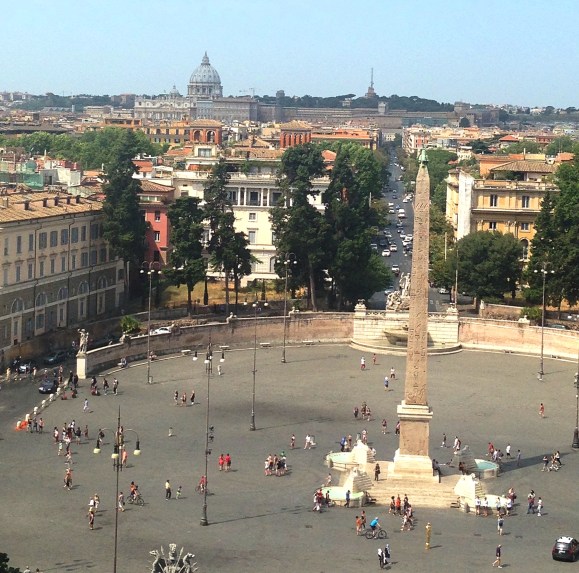
Santa Maria del Popolo is situated in the Piazza del Popolo, one of the pleasantest plazas in the city. In the center is a large Egyptian obelisk, the second oldest obelisk in Rome; and bounding the plaza are two semicircular walls, with a fountain in the middle of each. Although the name literally means “Plaza of the People” in Italian, its name historically comes from the poplar trees that grew there. It was also the site of many public executions.

Piazzadelpoppolo

It was in this plaza that I waited, hungry and frustrated, for the mass to end. The only thing that provided amusement were the many other tourists who made the same mistake. Person after person walked into the door and immediately walked out again, as a beggar by the door futilely said “La messa, la messa!” (“The mass, the mass!”). Obviously nobody could understand the poor guy, or else people habitually ignore the homeless. In any case, the steps were soon full of frustrated tourists who were, like myself, waiting for the mass to end.

It is, by the way, a sardonic comment on religion in the modern world that hundreds of people were annoyed that a church was being used for worship. There are still millions of Catholics in the world, of course; but it seems obvious to me that, in Europe at least, the religion is dying. I don’t know how I feel about this. On the one hand it seems like progress; but on the other it is hard for me to be happy about a religion disappearing when it inspired and helped fund so much beautiful art. But with this new Pope, maybe the future of Catholicism is looking up.

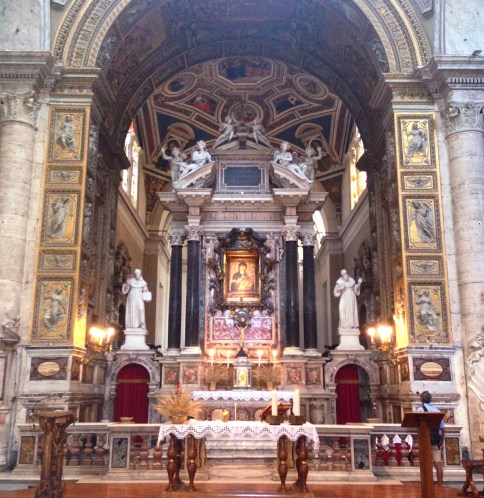
Finally the mass was over, and we all poured inside. Compared with other churches in Rome, the interior of Santa Maria del Popolo is relatively austere. This isn’t saying very much, of course. There were statues, friezes, paintings, and shining golden surfaces in abundance. The church’s dome is lovely, with a pinkish-yellow swirl of clouds painted on the inside, and light pouring in the windows from all directions.

Santamaria_delpopolo

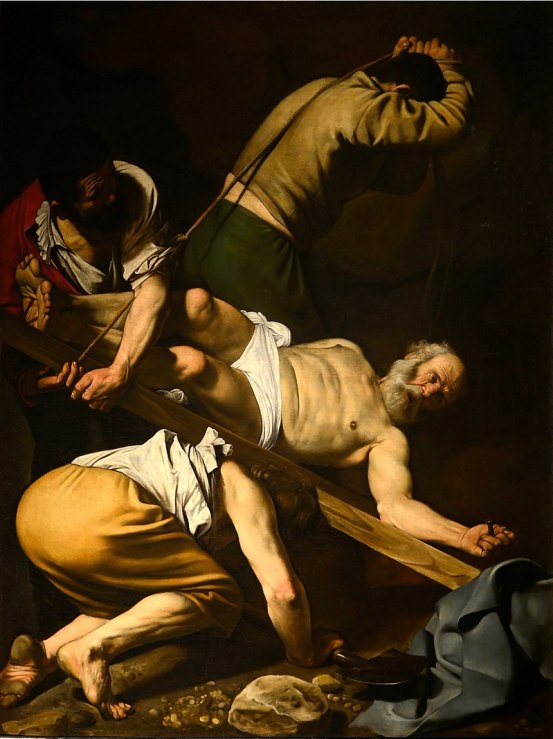
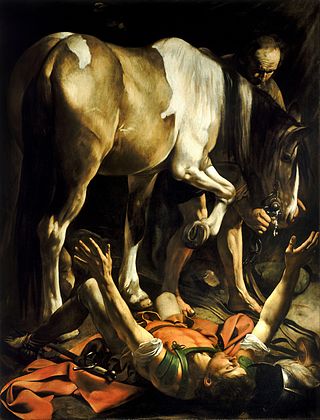
Although Santa Maria del Popolo is home to many important and lovely monuments, it is most known for two paintings by Caravaggio. As soon as we got inside, all of us immediately flocked to the altar where the paintings hang. These two works are the Crucifixion of St. Peter and the Conversion on the Way to Damascus. Unfortunately, the paintings are hung in such a way that they face each other, rather than the viewer, so you have to see them at an odd angle. And if you want to see the paintings properly lighted, you have to put a euro into a little machine nearby (or wait till another visitor does it, like I did).

As usual with Caravaggio, the style is darkly realistic. Accurate anatomy, shadowy backgrounds, grubby details, and an intense focus on dramatic moments are what set Caravaggio apart from his contemporaries.

In Crucifixion of Saint Peter, Caravaggio pictures the saint—old, bearded, and grey—in the moment when he is being hoisted up on the cross (he was crucified upside down). Peter looks with helpless alarm at his hand, nailed to the cross. The workmen are, by contrast, anonymous forms: two of them have their backs turned to the viewer, and the last has his face cloaked in shadow. Caravaggio chose to portray the workers dressed in Renaissance Italian garb, giving the painting an extra feeling of realism.

800px-Martirio_di_San_Pietro_September_2015-1a

Conversion on the Way to Damascus depicts the moment when Saul of Tarsus (later, St. Paul) was struck blind by God and converted to Christianity. The saint is laying flat on his back, his eyes closed, his hands reaching up to heaven. A horse and a servant look down at the supine man, confused at what transpired. The bright red and green of Saul’s clothes contrasts with the dull colors of the upper half. To me, there is something particularly touching about this painting. St. Paul is totally helpless, overwhelmed, as fragile as a newborn; and yet the look of rapture on his face tells us that he will soon be reborn.

320px-Conversion_on_the_Way_to_Damascus-Caravaggio_(c.1600-1)


Sant’Ignazio di Loyola

This church, which stands right in the center of the city, was built in the Baroque period to commemorate St. Ignatius of Loyola, the founder of the Jesuits.

The decoration of this church is lighthearted and joyful. This is exemplified in the fresco painted on the main vault (see above), which abounds in pinks, yellows, and blues, and whose numerous characters, flying through the heavenly skies, are almost cartoonish.

This playfulness is most apparent in the “dome.” Lacking funds to build a proper dome, the Jesuits commissioned a painter to create the illusion of one. It is excellently done: I am sure many visitors do not even notice it is false. When I did notice, I did a double take. “No, that can’t be right,” I thought, and tried to see it from a different angle. But soon the conclusion is inescapable: the dome is a fake.

SantIgnazio1

Also notable are two friezes, one depicting the Annunciation and another St. Aloysius Gonzaga being welcomed into heaven. The swirling spiral columns of dark marble, which flank these friezes, particularly tickle my fancy.

Even more impressive is the monument to Pope Gregory XV. Four angels hold open a curtain, revealing the Pope sitting on a throne. What is most amazing is that the sculptor, Monnot, was able to make marble into a near-perfect semblance of fabric. Technically, at least, it is a masterful.

Sant'Ignazio2


St. Louis of the French

This is the French national church in Rome. This means that the church originated as a charitable organization that helped French pilgrims in Rome. As a result, all the signs in the church are in French.

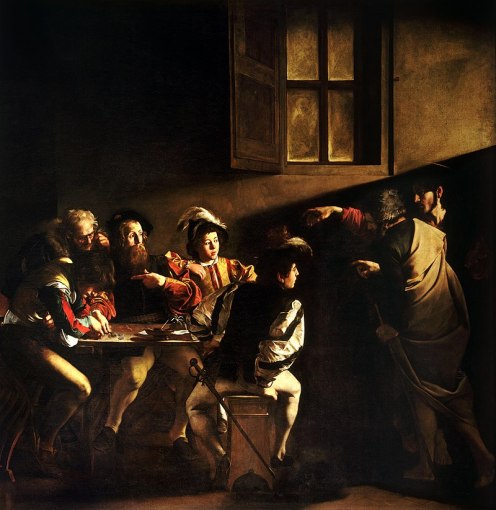
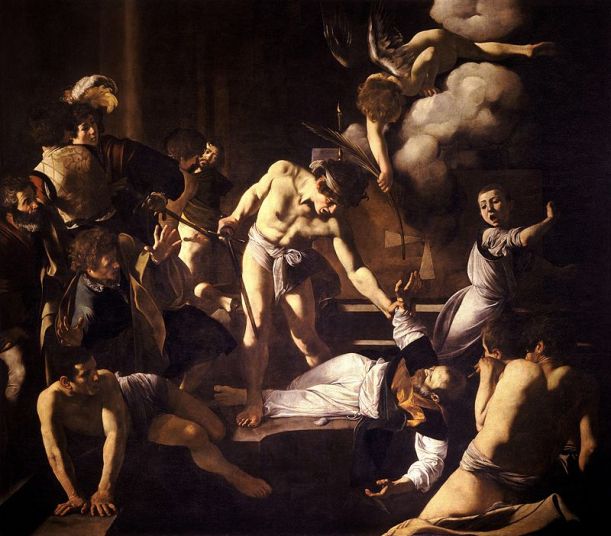
The church of St. Louis of the French is not far from the Piazza Navona. Although a lovely church by itself, it nowadays attracts visitors for its three famous Caravaggio paintings about the life of St. Matthew: The Calling of Saint Matthew, The Inspiration of Saint Matthew, and The Martyrdom of Saint Matthew. All three hang together in the Contarelli Chapel, and all three are masterpieces.

(Unfortunately, as in Santa Maria del Popolo, two of the three paintings are difficult to see, not only because they are a bit far away, because they are positioned at a right angle from the viewer. I can’t help thinking it’s a shame that such great works of art are not more easily visible.)

StLouis_French

On the left wall is The Calling of Saint Matthew. Here is a perfect illustration of Caravaggio’s genius and originality. Instead of a heavenly scene, with the divine Jesus calling Matthew to serve God, we are shown a confused rabble in a bar. Jesus is almost invisible, hidden in shadow; most noticeable is his pointing finger. We follow this finger to a shabby, bearded man sitting behind a wooden table. This is Matthew. He thinks Jesus must be confused, looking for someone else; he points helpfully to his companion, who is bent over, counting money on the table. As usual, the costumes and the scenery are all taken from Caravaggio’s contemporary world (note the boy dressed in bright livery). The grimy realism, the dramatic gesture, the innocent surprise on Matthew’s face—all this combine to make the painting one of the most convincing portrayals of this Gospel scene.

800px-The_Calling_of_Saint_Matthew-Caravaggo_(1599-1600)

In the center, facing the viewer, is The Inspiration of Saint Matthew. This was apparently a difficult commission for Caravaggio, since several earlier versions were rejected by his patron. Unfortunately for us, the most famous of these early versions, Saint Matthew and the Angel, was destroyed during World War II. (As the historian Will Durant notes, art and war are engaged in an eternal struggle.) This earlier painting is almost scandalous in its realism. St. Matthew is portrayed as a illiterate peasant. He is seated uncomfortably on a chair, his eyes squinting, his hand gripped awkwardly around the pen. An angel stands next to him, his hand guiding Matthew’s, acting the role as writing teacher. I love the painting, but I can see why the cardinal did not.

Matthew_collage
The older version (a colorized photograph) is on the left; the current version is on the right.

The later work is somewhat more conventional, but nonetheless wonderful. Instead of guiding St. Matthew’s hand, the angel hovers above the saint, talking to him (the angel seems to be counting something on his fingers). Matthew looks only slightly more comfortable. He is kneeling on a stool, hunched over his table, bending backward apprehensively to listen to the advising angel. Although less startlingly realistic, this painting makes up for that with its iconic design. The angel, robed in white, comes down from the upper right; while Matthew, robed in red, is positioned in a diagonal from the bottom right. The antithesis of the figures’ colors and postures make this painting instantly memorable.

Last we have The Martyrdom of Saint Matthew. This painting is by far the most dramatic. A nearly naked, intensely muscular soldier stands over St. Matthew, whose has collapsed on the ground. The soldier’s face is pure anger and violence. He is the wrathful embodiment of human strength. Surrounding the two central actors are about a dozen figures, reacting to the scene in different ways, from horror to mild curiosity. The saint seems, at first glance, to be frightened. His arm is raised, as if pleading. But then we notice that he is not looking at or reaching towards the soldier, but is entranced by the angel floating above. The angel is holding down the branch of a tree, which St. Matthew reaches for, as if he is about to be pulled right into heaven.

The_Martyrdom_of_Saint_Matthew-Caravaggio_(c._1599-1600)


San Pietro in Vincoli

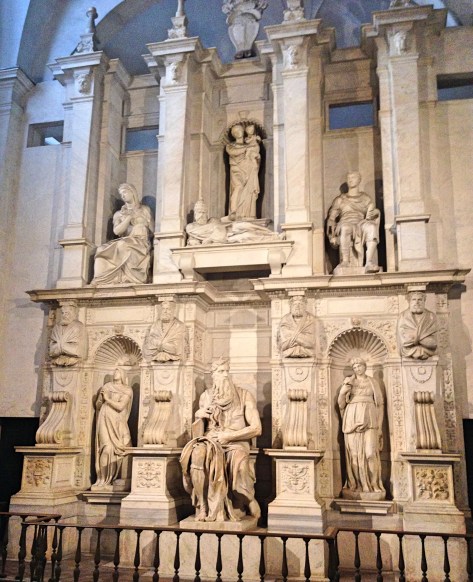
San Pietro in Vincoli is a tremendously old church, first consecrated in the year 439 (although rebuilt after that). Nowadays, it is famous for being the home of Michelangelo’s statue of Moses. The statue is part of a larger funeral monument to Pope Julius II (who was, incidentally, the subject of one of Raphael’s greatest portraits).

The relationship between fame and quality is interesting. To be honest, if I had not known that the statue was done by Michelangelo, I’m not sure I would have paid any special attention to it. This is most likely due to my own ignorance of art, rather than any defect on Michelangelo’s part. Nevertheless, I think the same is true of nearly every person who visits, not only this church, but many other famous works of art: we are impressed as much by the name as by the art itself (if not more).

San_PietroVincoli1

You might notice that Moses is depicted with horns on his head. This isn’t because Michelangelo thought he was a cuckold, but because of the way St. Jerome, in his Latin Vulgate Bible, translated a Hebrew word. The original Hebrew word, used to describe Moses as he descended from Mt. Sinai, often meant “horned,” but also could mean “shining.” St. Jerome chose the first option; and thus there are many portrayals of Moses with little horns on his head.

Moses is seated. His long, flowing beard hangs down in tangled glory. In body and face he is so splendid that he could be mistaken for Zeus. Under his right arm are the two tablets with God’s commandments. On his face, he wears a dark and judgmental expression. What is he looking at? Perhaps he is casting a disappointed glance at his people, who are lost in idolatry. Freud made this statue the subject of some psychoanalysis, and later scholars have done likewise.

Roaming in Rome: Introduction

Roaming in Rome: Introduction

This is Part One of a six-part series on Rome, following this plan:


Arrival

I walked off the plane and into the sweltering heat. Then I paused to look around and breathe in the hot, humid air. I was in Rome.

Well, not quite. I was in the Ciampino airport, about 12 kilometers from the city center. Now I had to find my bus.

Back in Madrid, while I was on the queue to board the plane, a representative from Ryanair went by selling bus tickets. Impulsively I bought one—they were only four euros—and now I had to figure out where to go.

This would not have presented any difficulty to a sane person. But I was stressed and anxious, partly because I am always like that when I travel, but also because this was the first international trip that I had taken by myself. I felt totally exposed and vulnerable. I had no support system if I messed up, nobody to bail me out if I did something stupid. More pragmatically, I did not have a working phone. Anything could happen.

Panic attacks notwithstanding, the bus was easy to find. Exhausted, sweaty, and shaking with nerves, I dropped my bag into the luggage compartment and climbed aboard. The sunlight shone harshly through the window, causing my skin to burn and my face to flush with the heat. The bus seemed to sit there for a long while, as passengers lazily threw their bags into the bottom compartments, and shuffled on.

I felt terribly self-conscious already. What kind of loser travels alone? What did these people think of me? Were they staring at me? Was I staring back? And why wasn’t there air conditioning? Finally the bus began to move, saving me from myself. We were off towards the eternal city.

I could hardly believe it: I was going to Rome. I had been hearing about this city all my life. Roman poets, generals, statesmen, emperors, philosophers, historians, slaves—the names of so many Romans were familiar to me. I was visiting the city where Cicero delivered his speeches, where Virgil penned his verses, and where Caesar bestrode the narrow world like a colossus. All these people were like characters in a long-cherished novel, creatures endowed with the aura of my imagination. Now I would be standing where they stood, under the same sun, sky, and stars, walking on the same soil. (And this is not to mention the Renaissance Italians!)

My eyes were glued to the window. Everything that even hinted at antiquity—crumbled buildings, little run-down shacks, piles of rubble—sent my imagination flying. Were they ruins? Was that a castle? Was this a temple?

Soon reality intervened. Pharmacies, car dealerships, tobacco stores, and rows and rows of ugly buildings surrounded the bus. Pudgy pedestrians walked on the streets, cars honked their horns, and exhaust fumes wafted up into the sky. This was the eternal city?

In fairness, we did pass through a lovely stone gate on the way to the main bus terminal: Termini. (This is an enormous transportation hub, the Roman equivalent of Grand Central.) There, we were dropped off, and soon I was panicking again, wondering how to get to my Airbnb.

Once more, there was nothing inherently difficult or perilous about this. But I was a ragged bundle of nerves, filled with terrible anxiety. Plus, it was hot.

Because I am a millennial, the prospect of navigating a city without Google Maps is alarming. I only ask strangers for directions in emergencies, and I cannot be trusted with a physical map. Luckily, there is Maps.Me, a navigation app that allows you to use your phone even when you don’t have service. (I was confused by this at first, but apparently your phone’s GPS still works even when it’s on airplane mode.) The application is pretty neat, and I certainly recommend it; although it can be pretty laggy and sometimes crashes.

After struggling to find the address in my notebook, walking in the wrong direction, enduring three panic attacks and some hyperventilation; and after getting lost and looking hopelessly at the sky while fighting back tears, I found the apartment. It took about twenty minutes.

I was greeted by a friendly older Italian man, who spoke good English. Seeing him, hearing him, having some of the fresh fruit he offered me—all this calmed me down instantly. I have been talking to Italian people and eating Italian food all my life. I wasn’t in a foreign country; I was somewhere very familiar—where I knew the history, the cuisine, and the culture (though unfortunately not the language). I was in Rome.

I had five days to explore the city, five days to drink up as much of the history, art, and architecture as I could. I got started immediately.


First Impressions of Eternity

What they say about Roman drivers is true: the roads are bedlam. Every time I crossed a street I felt like I was taking my life into my hands. The drivers would not stop to spare a whole kindergarten class. At best, the drivers swerved around me; most did not seem to notice me at all. I would like to see the mortality statistics.

I had been advised not to visit Rome in July; but that was the only time I had available, so I went anyway. Nevertheless, it is good advice. In a word, the weather is inhospitable—hot and humid. Just a few minutes in the afternoon sun were enough to soak my clothes through with sweat. The air hung heavily around me, seeming to physically pull me down.

The only compensation were the drinking fountains. Rome is full of them. Do yourself a favor and bring a refillable bottle. Just watch out of the fountain says “non potable.” Otherwise, drink up—you will need it. Several times I was so thirsty that the water tasted like divine ambrosia.

Because I was trying to save money—and I’m not a connoisseur, in any case—I ate as cheaply as I could. This usually meant eating pizza. I ate a lot of it. Maybe I am a snob when it comes to pizza, but I was not terribly impressed by the quality. The one exception to this was the pizza from a place called Pinsere, which was both excellent and reasonably priced.

Rome is full of tourists in any season, but this is doubly true during the summer—another reason to choose a different time to visit. Everywhere was packed. I could hardly walk three blocks without overhearing Americans chit-chattering away. Rome can be a religious experience, even if you are not religious. But it is hard to appreciate the beauty, history, and sanctity of the place when tour groups go stampeding by, their guide yelling into a microphone; or when you have to keep dodging out of people’s photos; or when the people next to you are whining about the weather while taking several selfies. Complaining about tourists is as old as tourism itself, of course. It is an activity especially popular among tourists. Nevertheless, I suggest that you visit Rome in fall or winter, if you can.

If you knocked down all the churches, destroyed the Roman forum, blew up the Colosseum, dynamited all the monuments, burned the museums, and smashed the statues, then Rome would not be much to look at. The streets are a bit dirty, the buildings are plain, modern, and unremarkable, and the traffic crawls through the streets like a column of army ants.

But of course Rome has churches, ruins, monuments, museums, and statues in abundance.

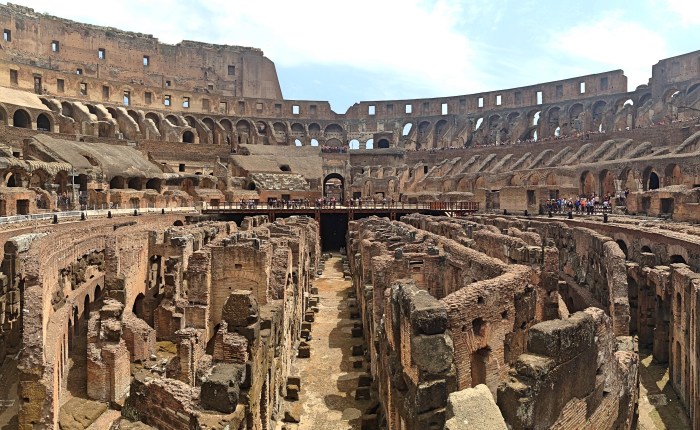
The night of my arrival, I decided to walk to the Colosseum. I got there just as the sun was setting. There it was in the twilight, its familiar iconic form towering above me, shushing me with awe.

How many others had stood in wonder at that same sight? How many others had come to Rome to pay tribute to the civilization that had flourished, conquered, ruled, declined, and then passed away? It boggles the mind that a civilization could build such a thing and then pass away. But Rome was more than an empire; Rome was more than a culture or a people. Rome was an eternal achievement, an achievement for all of humanity, setting a standard of civilization that futures peoples would forever emulate.