Review: A Study of History

Review: A Study of History

A Study of History, Abridgement of Vols 1-6A Study of History, Abridgement of Vols 1-6 by Arnold Joseph Toynbee

My rating: 3 of 5 stars

One of the perennial infirmities of human beings is to ascribe their own failure to forces that are entirely beyond their control.

One day, a couple years ago, as I was walking to Grand Central Station from my office in Manhattan—hurrying, as usual, to get to the 6:25 train in time to get a good seat by the window, which meant arriving by 6:18 at the latest—while crossing an intersection, I looked down and found a Toynbee tile lying in the middle of the street.

Toynbee tiles are mysterious plaques, pressed into the asphalt in city streets, that have appeared in several cities in the United States. Small (about the size of a tablet) and flat (they’re made of linoleum), nearly all of them bear the same puzzling message: “TOYNBEE IDEA MOVIE ‘2001 RESURRECT DEAD ON PLANET JUPITER.” Sometimes other little panicky or threatening messages about the Feds, Gays, Jews, and instructions to “lay tile alone” are scribbled in the margins. Nobody knows the identity of the tile-maker; but they are clearly the work of a dedicated conspiracy theorist with a tenuous grasp on conventional reality; and considering that they’ve been appearing since the 1980s, all around the US and even in South America, you’ve got to give the tile-maker credit for perseverance. (Click here for more on the tiles.)

I was stunned. I had heard of the tiles before, but I never thought I’d see one. I walked across that intersection twice daily; clearly the tile had been recently installed, perhaps just hours ago. I wanted to bend down and examine it closely, but the traffic light soon changed and I had to get out of the way. Reluctantly I moved on towards Grand Central; but I felt gripped by curiosity. Who is this mysterious tile maker? What is he hoping to accomplish? Suddenly I felt an overpowering desire to unlock his message. So instead of jumping on my usual train—I wasn’t going to get a window seat, anyway—I stopped by a bookstore and picked up Toynbee’s Study of History.

Toynbee, for his part, was apparently no lover of mystery, since he tried to explain nothing less than all of human history. The original study is massive: 12 volumes, each one around 500 pages. This abridgement squeezes 3,000 pages into 550; and that only covers the first five books. (Curiously, although the cover of this volume says that it is an abridgement of volumes one through six, it is clear from the table of contents that it only includes one through five. Similarly, though the next volume of the abridgement says it begins with book seven and ends with book ten, it actually begins with book six and ends with book twelve. This seems like a silly mistake.)

The abridgement was done by an English school teacher, D.C. Somervell, apparently just for fun. He did an excellent job, since it was this abridged version that became enormously popular and which is still in print. All this only proves what Toynbee says in the preface, that “the author himself is unlikely to be the best judge of what is and is not an indispensable part of his work.”

As a scholar, Toynbee achieved a level of fame and influence nearly incomprehensible today. His name was dominant in both academe and foreign affairs. In 1947, just after this abridgement of his major work became a best-seller, he was even featured on the cover of Time magazine. This, I might add, is a perverse index of how much our culture has changed since then. It is nearly impossible to imagine this book—a book with no narrative, written in a dry style about an abstract thesis—becoming a best-seller nowadays, and equally impossible to imagine any bookish intellectual on the cover of Time.

But enough about tiles and Toynbee; what about the book?

In A Study of History, Toynbee set out to do what Oswald Spengler attempted in his influential theory of history, The Decline of the West—that is, to explain the rise and fall of human communities. In method and content, the two books are remarkably similar; but this similarity is obscured by a powerful contrast in style. Where Spengler is oracular and prophetic, biting and polemical, literary and witty, Toynbee is mild, modest, careful, and deliberate. Spengler can hardly go a sentence without flying off into metaphor; Toynbee is literal-minded and sober. Toynbee’s main criticism of his German counterpart seems to have been that Spengler was too excitable and fanciful. The English historian seeks to tread the same ground, but with rigor and caution.

Nevertheless, the picture that Toynbee paints, if less colorful, is quite similar in outline to Spengler’s. The two of them seek to divide up humans into self-contained communities (‘cultures’ for Spengler, ‘societies’ for Toynbee); these communities are born, grow, break down, collapse, and pass away according to a certain pattern. Both thinkers see these groups as having a fertile early period and a sterile late period; and they both equate cultural vigor with artistic and intellectual innovation rather than political, economic, or military might.

Naturally, there are significant divergences, too. For one, Toynbee attempts to describe the origin and geographic distribution of societies, something that Spengler glosses over. Toynbee’s famous thesis is that civilizations arise in response to geographic challenge. Some terrains are too comfortable and invite indolence; other terrains are too difficult and exhaust the creative powers of their colonizers. Between these two extremes there is an ideal challenge, one that spurs communities to creative vigor and masterful dominance.

While I applaud Toynbee for the attempt, I must admit that I find this explanation absurd, both logically and empirically. The theory itself is vague because Toynbee does not analyze what he means by a ‘challenging’ environment. How can an environment be rated for ‘difficulty’ in the abstract, irrespective of any given community? A challenge is only challenging for somebody; and what may be difficult for some is easy for others. Further, thinking only about the ‘difficulty’ collapses many different sorts of things—average rainfall and temperature, available flora and fauna, presence of rival communities, and a host of other factors—into one hazy metric.

This metric is then applied retrospectively, in supremely unconvincing fashion. Toynbee explains the dominance of the English colony in North America, for example, as due to the ‘challenging’ climate of New England. He even speculates that the ‘easier’ climate south of the Mason-Dixon line is why the North won the American Civil War. Judgments like these rest on such vague principles that they can hardly be confirmed or refuted; you can never be sure how much Toynbee or ignoring or conflating. In any case, as an explanation it is clearly inadequate, since it ignores several obvious advantages possessed by the English colonists—that England was ascendant while Spain was on the wane, for example.

Now that we know more about the origins of agriculture, we have come to exact opposite conclusion as Toynbee. The communities that developed agriculture did not arise in the most ‘challenging’ environments, but in the areas which had the most advantages—namely, plants and animals that could be easily domesticated. But Toynbee cannot be faulted for the state of archaeology in his day.

The next step in Toynbee’s theory is also vague. The growing society must transfer its field of action from outside to inside itself; that is, the society must begin to challenge itself rather than be challenged by its environments. This internal challenge gives rise to a ‘creative minority’—a group of gifted individuals who innovate in art, science, and religion. These creative individuals always operate by a process of ‘withdraw-and-return’: they leave society for a time, just as Plato’s philosopher left the cave, and then return with their new ideas. The large majority of any given society is an uncreative, inert mass and merely imitates the innovations of the creative minority. The difference between a growing society and either a ‘primitive’ or a degenerating society is that the mass imitate contemporary innovators rather than hallowed ancestors.

Incredibly, Toynbee sees no relation between either technological progress or military prowess with a civilization’s vigor. Like Spengler, he measures a culture’s strength by its creative vitality—its art, music, literature, philosophy, and religion. This allows him to see the establishment of the Roman Empire, as Spengler did, not as a demonstration of vitality but as a last desperate attempt to hold on to Hellenic civilization. Toynbee actually places the ‘breakdown’ of Hellenic society (when they lost their cultural vitality) at the onset of the Peloponnesian War, in 431 BCE, and considers all the subsequent history of Hellene and Rome as degeneration.

But why does the creative minority cease to be genuinely creative and petrify into a merely ‘dominant’ minority? This is because, after one creative triumph, they grow too attached to their triumph and cannot adapt to new circumstances; in other words, they rest on their laurels. What’s more, even the genuine innovations of the creative minority may not have their proper effect, since they must operate through old, inadequate, and at times incompatible institutions. Their ideas thus become either perverted in practice or simply not practiced at all, impeding the proper ‘mimesis’ (imitation) by the masses. After the breakdown, the society takes refuge in a universal state (such as the Roman Empire), and then in a universal church (such as the Catholic church). (As with Spengler, Toynbee seems to have the decline and fall of the Roman Empire as his theory’s ur-type.)

To me—and I suspect to many readers—Toynbee’s theories seem to be straightforward consequences of his background. Born into a family of scholars and intellectuals, Toynbee is, like Spengler, naturally inclined to equate civilization with ‘high’ culture, which leads naturally to elitism. Having lived through and been involved in two horrific World Wars, Toynbee was deeply antipathetic to technology and warfare. Nearly everyone hates war, and rightly; but in Toynbee’s theory, war is inevitably a cause or an effect of societal decay—something which is true by definition in his moral worldview, but which doesn’t hold up if we define decay in more neutral terms. The combination of his family background and his hatred of violence turned Toynbee into a kind of atheistic Christian, who believed that love and non-violence conquered all. I cannot fault him ethically; but this is a moral principle and not an accurate depiction of history.

Although the association is not flattering, I cannot help comparing both Toynbee and Spengler to the maker of the Toynbee tiles. Like that lonely crank, wherever he is, these two scholars saw connections where nobody else had before, and propounded their original worldviews in captivating fashion. Unfortunately, it seems that coming up with a theory that could explain the rise and fall of every civilization in every epoch seems to be just about as possible as resurrecting the dead on planet Jupiter. But sometimes great things are accomplished when we try to do the impossible; and thanks to this unconquerable challenge, we have two monuments of human intelligence and ambition, works which will last far, far longer than linoleum on asphalt.
View all my reviews

Review: The Trial

Review: The Trial

The TrialThe Trial by Franz Kafka
My rating: 5 of 5 stars

Back in university, I had a part-time job at a research center. It was nothing glamorous: I conducted surveys over the phone. Some studies were nation-wide, others were only in Long Island. A few were directed towards small businesses. There I would sit in my little half-cubicle, with a headset on, navigating through the survey on a multiple-choice click screen.

During the small business studies, a definite pattern would emerge. I would call, spend a few minutes navigating the badly recorded voice menu, and then reach a secretary. Then the survey instructed me to ask for the president, vice-president, or manager. “Oh, sure,” the receptionist would say, “regarding?” I would explain that I was conducting a study. “Oh…” their voice would trail off, “let me check if he’s here.” Then would follow three to five minutes of being on hold, with the usual soul-sucking on-hold music. Finally, she would pick up: “Sorry, he’s out of the office.” “When will he be back?” would be my next question. “I’m not sure…” “Okay, I’ll call back tomorrow,” I would say, and the call would end.

Now imagine this process repeating again and again. As the study went on, I would be returning calls to dozens of small businesses where the owners were always mysteriously away. I had no choice what to say—it was all in the survey—and no choice who to call—the computer did that. By the end, I felt like I was getting to know some of these secretaries. They would recognize my voice, and their announcement of the boss’s absence would be given with a strain of annoyance, or exhaustion, or pity. I would grow adept at navigating particular voice menus, and remembered the particular sounds of being on hold at certain businesses. It was strait out of this novel.

When I picked up The Trial, I was expecting it to be great. I had read Kafka’s short stories—many times, actually—and he has long been one of my favorite writers. But by no means did I expect to be so disturbed. Maybe it was because I was groggy, because I hadn’t eaten yet, or because I was on a train surrounded by strangers. But by the time I reached my destination, I was completely unnerved. For a few moments, I even managed to convince myself that this actually was a nightmare. No book could do this.

What will follow in this already-too-long review will be some interpretation and analysis. But it should be remarked that, whatever conclusions you or I may draw, interpretation is a second-level activity. In Kafka’s own words: “You shouldn’t pay too much attention to people’s opinions. The text cannot be altered, and the various opinions are often no more than an expression of despair over it.” Attempts to understand Kafka should not entail a rationalizing away of his power. This is a constant danger in literary criticism, where the words sit mutely on the page, and passages can be pasted together at the analyst’s behest. This is mere illusion. If someone were to tell you that Picasso’s Guernica is about the Spanish Civil War, you may appreciate the information; but by no means should this information come between you and the visceral experience of standing in front of the painting. Just so with literature.

To repeat something that I once remarked of Dostoyevsky, Kafka is a great writer, but a bad novelist. His books do not have even remotely believable characters, character development, or a plot in any traditional sense. Placing The Trial alongside Jane Eyre or Lolita will make this abundantly clear. Rather, Kafka’s stories are somewhere in-between dream and allegory. Symbolism is heavy, and Kafka seems to be more intent on establishing a particular feeling than in telling a story. The characters are tools, not people

So the question naturally arises: what does the story represent? Like any good work of art, any strict, one-sided reading is insufficient. Great art is multivalent—it means different things to different people. The Trial may have meant only one thing to Kafka (I doubt it), but once a book (or symphony, or painting) is out in the world, all bets are off.

The broadest possible interpretation of The Trial is as an allegory of life. And isn’t this exactly what happens? You wake up one day, someone announces that you’re alive. But no one seems to be able to tell you why or how or what for. You don’t know when it will end or what you should do about it. You try to ignore the question, but the more you evade it, the more it comes back to haunt you. You ask your friends for advice. They tell you that they don’t really know, but you’d better hire a lawyer. Then you die like a dog.

Another interpretation is based on Freud. Extraordinary feelings of guilt is characteristic of Kafka’s work, and several of his short stories (“The Judgment,” “The Metamorphosis”) portray Kafka’s own unhealthy relationship with his father. Moreover, the nightmarish, nonsensical quality of his books, and his fascination with symbols and allegories, cannot help but remind one of Freud’s work on dreams. If I was a proper Freudian, I would say that The Trial is an expression of Kafka’s extraordinary guilt at his patricidal fantasies.

A different take would group this book along with Joseph Heller’s Catch-22 as a satire of bureaucracy. And, in the right light, parts of this book are hilarious. Kafka’s humor is right on. He perfectly captures the inefficiency of organizations in helping you, but their horrifying efficiency when screwing you over. And as my experience in phone surveys goes to show, this is more relevant than ever.

If we dip into Kafka’s biography, we can read this book as a depiction of the anguish caused by his relationship with Felice Bauer. (For those who don’t know, Kafka was engaged with her twice, and twice broke it off. Imagine dating Kafka. Poor woman.) This would explain the odd current of sexuality that undergirds this novel.

Here is one idea that I’ve been playing with. I can’t help but see The Trial as a response to Dostoyevsky’s Crime and Punishment. As their names suggest, they deal with similar themes: guilt, depression, alienation, the legal system, etc. But they couldn’t end more differently. Mulling this over, I was considering whether this had anything to do with the respective faiths of their authors. Dostoyevsky found Jesus during his imprisonment, and never turned back. His novels, however dark, always offer a glimmer of the hope of salvation. Kafka’s universe, on the other hand, is proverbially devoid of hope. Kafka was from a Jewish family, and was interested in Judaism throughout his life. Is this book Crime and Punishment without a Messiah?

I can go on and on, but I’ll leave it at that. There can be no one answer, and the book will mean something different to all who read it. And what does that say about Kafka?

View all my reviews

Review: The Righteous Mind

Review: The Righteous Mind

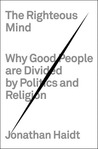
The Righteous Mind: Why Good People are Divided by Politics and ReligionThe Righteous Mind: Why Good People are Divided by Politics and Religion by Jonathan Haidt

My rating: 4 of 5 stars

I expected this book to be good, but I did not expect it to be so rich in ideas and dense with information. Haidt covers far more territory than the subtitle of the book implies. Not only is he attempting to explain why people are morally tribal, but also the way morality works in the human brain, the evolutionary origins of moral feelings, the role of moral psychology in the history of civilization, the origin and function of religion, and how we can apply all this information to the modern political situation—among much else along the way.

Haidt begins with the roles of intuition and reasoning in making moral judgments. He contends that our moral reasoning—the reasons we aver for our moral judgments—consists of mere post hoc rationalizations for our moral intuitions. We intuitively condemn or praise an action, and then search for reasons to justify our intuitive reaction.

He bases his argument on the results of experiments in which the subjects were told a story—usually involving a taboo violation of some kind, such as incest—and then asked whether the story involved any moral breach or not. These stories were carefully crafted so as not to involve harm to anyone (such as a brother and sister having sex in a lonely cabin and never telling anyone, and using contraception to prevent the risk of pregnancy).

Almost inevitably he found the same result: people would condemn the action, but then struggle to find coherent reasons to do so. To use Haidt’s metaphor, our intuition is like a client in a court case, and our reasoning is the lawyer: its job is to win the case for intuition, not to find the truth.

This is hardly a new idea. Haidt’s position was summed up several hundred years before he was born, by Benjamin Franklin: “So convenient a thing it is to be a reasonable creature, since it enables one to find or make a reason for everything one has a mind to do.” An intuitionist view of morality was also put forward by David Hume and Adam Smith. But Haidt’s account is novel for the evolutionary logic behind his argument and the empirical research used to back his claims. This is exemplified in his work on moral axes.

Our moral intuition is not one unified axis from right to wrong. There are, rather, six independent axes: harm, proportionality, equality, loyalty, authority, and purity. In other words, actions can be condemned for a variety of reasons: for harming others, for cheating others, for oppressing others, for betraying one’s group, for disrespecting authority, and for desecrating sacred objects, beings, or places.

These axes of morality arose because of evolutionary pressure. Humans who cared for their offspring and their families survived better, as did humans who had a greater sensitivity to being cheated by freeloaders (proportionality) and who resisted abusive alpha males trying to exploit them (equality). Similarly, humans who were loyal to their group and who respected a power hierarchy outperformed less loyal and less compliant humans, because they created more coherent groups (this explanation relies on group selection theory; see below). And lastly, our sense of purity and desecration—usually linked to religious and superstitious notions—arose out of our drive to avoid physical contamination (for example, pork was morally prohibited because it was unsafe to eat).

Most people in the world use all six of these axes in their moral systems. It is only in the West—particularly in the leftist West—where we focus mainly on the first three: harm, proportionality, and equality. Indeed, one of Haidt’s most interesting points is that the right tends to be more successful in elections because it appeals to a broader moral palate: it appeals to more “moral receptors” in the brain than left-wing morality (which primarily appeals to the axis of help and harm), and is thus more persuasive.

This brings us to Part III of the book, by far the most speculative.

Haidt begins with a defense of group selection: the theory that evolution can operate on the level of groups competing against one another, rather than on individuals. This may sound innocuous, but it is actually a highly controversial topic in biology, as Haidt himself acknowledges. Haidt thinks that group selection is needed to explain the “groupishness” displayed by humans—our ability to put aside personal interest in favor of our groups—and makes a case for the possibility of group selection occurring during the last 10,000 or so years of our history. He makes the theory seem plausible (to a layperson like me), but I think the topic is too complex to be covered in one short chapter.

True or not, Haidt uses the theory of group theory to account for what he calls “hiveish” behavior that humans sometimes display. Why are soldiers willing to sacrifice themselves for their brethren? Why do people like to take ecstasy and rave? Why do we waste so much money and energy going to football games and cheering for our teams? All these behaviors are bizarre when you see humans as fundamentally self-seeking; they only make sense, Haidt argues, if humans possess the ability to transcend their usual self-seeking perspective and identify themselves fully with a group. Activating this self-transcendence requires special circumstances, and it cannot be activated indefinitely; but it produces powerful effects that can permanently alter a person’s perspective.

Haidt then uses group selection and this idea of a “hive-switch” to explain religion. Religions are not ultimately about beliefs, he says, even though religions necessarily involve supernatural beliefs of some kind. Rather, the social functions of religions are primarily to bind groups together. This conclusion is straight out of Durkheim. Haidt’s innovation (well, the credit should probably go to David Sloan Wilson, who wrote Darwin’s Cathedral) is to combine Durkheim’s social explanation of religion with a group-selection theory and a plausible evolutionary story (too long to relate here).

As for empirical support, Haidt cites a historical study of communes, which found that religious communes survived much longer than their secular counterparts, thus suggesting that religions substantially contribute to social cohesion and stability. He also cites several studies showing that religious people tend to be more altruistic and generous than their atheistic peers; and this is apparently unaffected by creed or dogma, depending only on attendance rates of religious services. Indeed, for someone who describes himself as an atheist, Haidt is remarkably positive on the subject of religion; he sees religions as valuable institutions that promote the moral level and stability of a society.

The book ends with a proposed explanation of the political spectrum—people genetically predisposed to derive pleasure from novelty and to be less sensitive to threats become left-wing, and vice versa (the existence of libertarians isn’t explained, and perhaps can’t be)—and finally with an application of the book’s theses to the political arena.

Since we are predisposed to be “groupish” (to display strong loyalty towards our own group) and to be terrible at questioning our own beliefs (since our intuitions direct our reasoning), we should expect to be blind to the arguments of our political adversaries and to regard them as evil. But the reality, Haidt argues, is that each side possesses a valuable perspective, and we need to have civil debate in order to reach reasonable compromises. Pretty thrilling stuff.

Well, there is my summary of the book. As you can see, for such a short book, written for a popular audience, The Righteous Mind is impressively vast in scope. Haidt must come to grips with philosophy, politics, sociology, anthropology, psychology, biology, history—from Hume, to Darwin, to Durkheim—incorporating mountains of empirical evidence and several distinct intellectual traditions into one coherent, readable whole. I was constantly impressed by the performance. But for all that, I had the constant, nagging feeling that Haidt was intentionally playing the devil’s advocate.

Haidt argues that our moral intuition guides our moral reasoning, in a book that rationally explores our moral judgments and aims to convince its readers through reason. The very existence of his book undermines his uni-directional model of intuitions to reasoning. Being reasonable is not easy; but we can take steps to approach arguments more rationally. One of these steps is to summarize another person’s argument before critiquing it, which is what I’ve done in this review.

He argues that religions are not primarily about beliefs but about group fitness; but his evolutionary explanation of religion would be rejected by those who deny evolution on religious grounds; and even if specific beliefs don’t influence altruistic behavior, they certainly do influence which groups (homosexuals, biologists) are shunned. Haidt also argues that religions are valuable because of their ability to promote group cohesion; but if religions necessarily involve irrational beliefs, as Haidt admits, is it really wise to base a moral order on religious notions? If religions contribute to the social order by encouraging people to sacrifice their best interest for illogical reasons—such as in the commune example—should they really be praised?

The internal tension continues. Haidt argues that conservatives have an advantage in elections because they appeal to a broader moral palate, not just care and harm; and he argues that conservatives are valuable because their broad morality makes them more sensitive to disturbances of the social order. Religious conservative groups which enforce loyalty and obedience are more cohesive and durable than secular groups that value tolerance. But Haidt himself endorses utilitarianism (based solely on the harm axis) and ends the book with a plea for moral tolerance. Again, the existence of Haidt’s book presupposes secular tolerance, which makes his stance confusing.

Haidt’s arguments with regard to broad morality come dangerously close to the so-called ‘naturalistic fallacy’: equating what is natural with what is good. He compares moral axes to taste receptors; a morality that appeals to only one axis will be unsuccessful, just like a cuisine that appeals to only one taste receptor will fail to satisfy. But this analogy leads directly to a counter-point: we know that we have evolved to love sugar and salt, but this preference is no longer adaptive, indeed it is unhealthy; and it is equally possible that our moral environment has changed so much that our moral senses are no longer adaptive.

In any case, I think that Haidt’s conclusions about leftist morality are incorrect. Haidt asserts that progressive morality rests primarily on the axis of care and harm, and that loyalty, authority, and purity are actively rejected by liberals (“liberals” in the American sense, as leftist). But this is implausible. Liberals can be extremely preoccupied with loyalty—just ask any Bernie Sanders supporter. The difference is not that liberals don’t care about loyalty, but that they tend to be loyal to different types of groups—parties and ideologies rather than countries. And the psychology of purity and desecration is undoubtedly involved in the left’s concern with racism, sexism, homophobia, or privilege (accusing someone of speaking from privilege creates a moral taint as severe as advocating sodomy does in other circles).

I think Haidt’s conclusion is rather an artifact of the types of questions that he asks in his surveys to measure loyalty and purity. Saying the pledge of allegiance and going to church are not the only manifestations of these impulses.

For my part, I think the main difference between left-wing and right-wing morality is the attitude towards authority: leftists are skeptical of authority, while conservatives are skeptical of equality. This is hardly a new conclusion; but it does contradict Haidt’s argument that conservatives think of morality more broadly. And considering that a more secular and tolerant morality has steadily increased in popularity over the last 300 years, it seems prima facie implausible to argue that this way of thinking is intrinsically unappealing to the human brain. If we want to explain why Republicans win so many elections, I think we cannot do it using psychology alone.

The internal tensions of this book can make it frustrating to read, even if it is consistently fascinating. It seems that Haidt had a definite political purpose in writing the book, aiming to make liberals more open to conservative arguments; but in de-emphasizing so completely the value of reason and truth—in moral judgments, in politics, and in religion—he gets twisted into contradictions and risks undermining his entire project.

Be that as it may, I think his research is extremely valuable. Like him, I think it is vital that we understand how morality works socially and psychologically. What is natural is not necessarily what is right; but in order to achieve what is right, it helps to know what we’re working with.

View all my reviews

Review: Middlemarch

Review: Middlemarch

MiddlemarchMiddlemarch by George Eliot

My rating: 5 of 5 stars

Some gentlemen have made an amazing figure in literature by general discontent with the universe as a trap of dullness into which their great souls have fallen by mistake; but the sense of a stupendous self and an insignificant world may have its consolations.

I did not think a book like this was possible. A work of fiction with a thesis statement, a narrator who analyzes more often than describes, a morality play and an existential drama, and all this in the context of a realistic, historical novel—such a combination seems unwieldy and pretentious, to say the least. Yet Middlemarch never struck me as over-reaching or overly ambitious. Eliot not only manages to make this piece of universal art seem plausible, but her mastery is so perfect that the result is as natural and inevitable as a lullaby.

Eliot begins her story with a question: What would happen if a woman with the spiritual ardor of St. Theresa were born in 19th century rural England? This woman is Dorothea; and this book, although it includes dozens of characters, is her story. But Dorothea, and the rest of the people who populate her Middlemarch, is not only a character; she is a test-subject in a massive thought experiment, an examination intended to answer several questions:

To what extent is an individual responsible for her success or failure? How exactly does the social environment act upon the individual—in daily words and deeds—to aid or impede her potential? And how, in turn, does the potent individual act to alter her environment? What does it mean to be a failure, and what does it mean to be successful? And in the absence of a coherent social faith, as Christianity receded, what does it mean to be good?

As in any social experiment, we must have an experimental group, in the form of Dorothea, as well as a control group, in the form of Lydgate. The two are alike in their ambition. Lydgate’s ambition is for knowledge. He is a country doctor, but he longs to do important medical research, to pioneer new methods of treatment, and to solve the mysteries of sickness, death, and the human frame. Dorothea’s ambitions are more vague and spiritual. She is full of passionate longing, a hunger for something which would give coherence and meaning to her life, an object to which she could dedicate herself body and soul.

Lydgate begins with many advantages. For one, his mission is not a vague hope, but a concrete goal, the path to which he can chart and see clearly. Even more important, he is a man from a respectable family. Yes, there is some prejudice against him in Middlemarch, for being an outsider, educated abroad and with strange notions; but this barrier can hardly be compared with the those which faced even the most privileged woman in Middlemarch. For her part, Dorothea is born into a respectable family with adequate means. But her sex closes so many paths to action that the only important decision she can make is whom she will marry.

Dorothea’s choice of a husband sets the tone for the rest of her story. Faced with two options—the young, handsome, and rich Sir James Chettam, and the dry, old scholar, Mr. Casaubon—she surprises and disappoints nearly everyone by choosing the latter. Dorothea does this because she knows herself and she trusts herself; she is not afraid of being judged, and she does not care about status or wealth.

The first important decision Lydgate makes is who to recommend as chaplain for the new hospital, and this, too, sets the tone for the rest of his story. His choice is between Mr. Tyke, a disagreeable, doctrinaire puritan, and Mr. Farebrother, his friend and an honest, humane, and intelligent man. Lydgate’s inclination is towards the latter, but under pressure from Bulstrode, the rich financier of the new hospital, Lydgate chooses Mr. Tyke. In other words, he distinctly does not trust himself, and he allows his intuition of right and wrong to be swayed by public opinion and self-interest.

Dorothea’s choice soon turns out to be disastrous, while Lydgate’s works in his favor, as Bulstrode puts him in charge of the new hospital. Yet Eliot shows us that Dorothea’s choice was ultimately right and Lydgate’s ultimately wrong. For we cannot know beforehand how our choices will turn out; the future is hidden, and we must dedicate ourselves to both people and projects in ignorance. The determining factor is not whether it turned out well for you, but whether the choices was motivated by brave resolve or cowardly capitulation. You might say that this is the existentialist theme of Eliot’s novel: the necessity to act boldly in the absence of knowledge.

Dorothea’s act was bold and courageous; and even though Mr. Casaubon is soon revealed to be a wearisome, passionless, and selfish academic, her choice was nonetheless right, because she did her best to act authentically, fully in accordance with her moral intuition. Lydgate’s choice, even though it benefited him, established a pattern that ends in his bitter disappointment. He allowed himself to yield to circumstances; he allowed his self-interest to overrule his moral intuition: and this dooms him.

(Eliot, I should mention, seems to prefer what philosophers call an intuitionist view of moral action: that is, we must obey our conscience. Time and again Eliot shows how immoral acts are made to appear justified through conscious reasoning, and how hypocrites use religious or social ideologies to quiet their uneasy inner voice: “when gratitude becomes a matter of reasoning there are many ways of escaping from its bonds.”)

Eliot’s view of success or failure stems from this exploration of choice: success means being true to one’s moral intuition, and failure means betraying it. Dorothea continues to trust herself and to choose boldly, without regard for her worldly well-being or for conventional opinion. Lydgate, meanwhile, keeps buckling under pressure. He marries almost by accident, breaking a strong resolution he made beforehand, and then goes on to betray, one after the other, every other strong resolution of his, until his life’s plan has been lost entirely, chipped away by a thousand small circumstances.

Dorothea ends up on a lower social level than she started, married to an eccentric man of questionable blood, gossiped about in town and widely seen as a social failure. Lydgate, meanwhile, becomes “successful”; his beautiful wife is universally admired, and his practice is profitable and popular. But this conventional judgment means nothing; for Dorothea can live in good conscience, while Lydgate cannot.

But is success, for Eliot, so entirely dependent on intention, and so entirely divorced from results? Not exactly. For the person who is true to her moral intuition—even if she fails in her plans, even if she falls far short of her potential, and even if she is disgraced in the eyes of society—still exerts a beneficent effect on her surroundings.

Anyone who selflessly and boldly follows her moral intuition encourages everyone she meets, however subtly, to follow this example: as Eliot says of Dorothea, “the effect of her being on those around her was incalculably diffusive.” Eliot shows this most touchingly in the meeting between Dorothea and Rosamond. Although Rosamond is vain, selfish, and superficial, the presence of Dorothea prompts her to one of the only unselfish acts of her life.

From reading this review, you might get the idea that this book is merely a philosophical exercise. But Eliot’s most miraculous accomplishment is to combine this analysis with an immaculate novel. The portrait she gives of Middlemarch is so fully realized, without any hint of strain or artifice, that the reader feels that he has bought a cottage there himself.

Normally at this point in a review, I add some criticisms; but I cannot think of a single bad thing to say about this book. Eliot’s command of dialogue and characterization, of pacing and plot-development, cannot be faulted. She moves effortlessly from scene to scene, from storyline to storyline, showing how the private is interwoven with the public, the social with the psychological, the economical with the amorous—how our vices are implicated in our virtues, how our good intentions shot through with ulterior motives, how our hopes and fears are mixed up with our routine reality—never simplifying the ambiguities of perspective or collapsing the many layers of meaning—and yet she is always in perfect command of her mountains of material.

A host of minor characters marches through these pages, each one individualized, many of them charming, some hilarious, a few irritating, and all of them vividly real. I could see parts of myself in every one of them, from the petulant Fred Vincey, to the blunt Mary Garth, to the frigid Mr. Casaubon, to the muddle-headed Mr. Brooke—almost Dickensian in his comic exaggeration—to every gossip, loony, miser, dissolute, profilage, and tender heart—the list cannot be finished.

Perhaps Eliot’s most astounding feat is to combine the aesthetic, with the ethical, with the analytic, in such a way that you can no longer view them separately. Eliot’s masterpiece charms as it preaches; it is both beautiful and wise; it pulls on the heart while engaging the head; and it is, in the words of Virgina Woolf, “one of the few English novels written for grown-up people.”

View all my reviews

Review: Romeo and Juliet

Review: Romeo and Juliet

Romeo and JulietRomeo and Juliet by William Shakespeare

My rating: 4 of 5 stars

ROMEO: Peace, peace, Mercutio, peace!
Thou talk’st of nothing.

MERCUTIO: True, I talk of dreams,
Which are the children of an idle brain,
Begot of nothing but vain fantasy,
Which is as thin of substance as the air
And more inconstant than the wind.

My memories from my high school literature classes are largely a blank. Books held no interest for me. I spent one year skipping my classes completely. And when I did drag myself to class, I almost never did the reading. A quick look through the Cliffnotes the night before was usually enough to pass the exam—which inevitably consisted of a bunch of multiple-choice questions about plot details, and short-answer questions of ‘analysis’ that could easily be fudged by some clever-sounding nonsense.

We occasionally ‘acted-out’ plays in class. This was normally a cue to space-out while my classmates labored through Shakespeare’s language, and hope the teacher didn’t call on me. I liked to day-dream about videogames and action movies. Shakespeare, I thought, was stuffy boring nonsense, hopelessly cliché and old-fashioned. But despite my apathy, one moment of Romeo and Juliet did manage to worm its way into my memory. This was Mercutio’s enormous, phantasmagoric monologue about Queen Mab:

She is the fairies midwife, and she comes / In shape no bigger than an agate stone / On the forefinger of an alderman, / Drawn with a team of little atomi / Over men’s noses as they lie asleep. / Her chariot is an empty hazelnut made by the joiner squirrel or old grub, / Time out o’ mind the faries’ coachmakers; / Her wagon-spokes made of long spinners’ legs; / The cover of the wings of grasshoppers, / Her traces of the smallest spider web, / Her collars of the moonshine’s watery beams, / Her whip of cricket’s bone, her lash of film, / Her waggoner, a small grey-coated gnat, / Not half so big as a round little worm / Prick’d from the lazy finger of a maid; / And in this state she gallops night by night / Through lovers’ brains, and then they dream of love…

The speech goes on much further, describing how the Queen “gallops ov’e a courtiers’ noses” and “driveth o’er a soldier’s neck,” filling their dreams with vain fantasies. I am sure that I didn’t understand even half of it; what is an agate stone, an alderman, or an atomi? But the speech is so exuberant, and interrupted the play’s action so pointlessly (or so it seemed), that I couldn’t help being interested. Yes, I was actually interested in Shakespeare for a moment, and found myself wondering what this fairy queen, so decorously bedecked, had to do with this ridiculous story of love.

I admit that, even now, I find it hard to love this play. It has has become such a ubiquitous cultural reference-point that reading it is rather like seeing the Mona Lisa in person—seeing an icon that is already so relentlessly seen that it is almost impossible to unsee and see afresh. But this is hardly the play’s fault, or Shakespeare’s. Indeed, it is a mark of supreme merit that we can hardly speak of the passions of romantic love without these two lovers coming to mind; and, though we laugh at these outbursts of adolescent passion in our more cynical moments, there is hardly anything more simple and sublime in love poetry than Juliet’s declaration:

My bounty is as boundless as the sea,
My love as deep: The more I give to thee
The more I have, for both are infinite.

A few months ago, I was given a bilingual copy of this book, in English and Italian, from a thoughtful friend who traveled to Verona. I myself was lucky enough to have gone to Verona when I was back in high school, the very same year that I was skipping all my English classes.

I remember getting off the bus, still jetlagged and dazed, but feeling elated and happy in sunny winter’s day. I looked at the stony ruin of the Verona Arena and thought of gladiators wielding tridents and swords. Back then I even knew some Italian—long since forgotten, from lack of both interest and practice—which I was learning in school. So it seems a fitting testament to my misspent youth to quote from this most romantic of plays in that most romantic of languages:

Oh, Romeo, Romeo, perché sei tu Romeo?
Rinnega tuo padre e rifiuta il tuo nome,
o, se non vuoi, giurami solo amore,
e non saró piú una Capuleti.

View all my reviews

Review: Institutes of the Christian Religion

Review: Institutes of the Christian Religion

The Institutes of Christian ReligionThe Institutes of Christian Religion by John Calvin

My rating: 3 of 5 stars

Many wicked lies get mixed up with the tiny particles of truth in the writings of these philosophers.

I am here writing a review of John Calvin’s most famous book, but I can’t say I’ve actually read it. I have read an abridged version, one that preserves about 15% of the original. This is still a fair amount, considering that the unabridged version runs to well over 1,000 pages; but there is so much I missed that I feel a bit self-conscious writing a review.

John Calvin is arguably the most important Protestant theologian in history. Karl Barth once called Hegel the ‘Protestant Aquinas’, but the title seems more apt for Calvin, whose Institutes put into systematic form the new theology and dogma of the budding faith. Calvin begins with knowledge of God, then moves on to knowledge of Christ, the Christian life, justification by faith, prayer, election and predestination, the church and the sacraments, and much more along the way.

Calvin was a lawyer by training, and it shows in his style. Unlike Aquinas, who made careful arguments and addressed objections using logic, Calvin’s primary mode of argument is to quote and interpret scripture, in much the same way as a lawyer might argue from legal precedent. You can also see his legal background in Calvin’s combative tone; he attacks and defends with all the cunning of a professional debater, and will use any rhetorical device available to win his case.

The two biggest theological influence on Calvin, it seems, were St. Paul and St. Augustine, both of whom were rather preoccupied with evil and sin. The gentleness of the Gospels seems totally absent from Calvin’s worldview. Perhaps this is due as much to his personality; he struck me as rather saturnine and bitter, a man disappointed with the world. His mode of argument and cutting tone—treating all his interpretations of the Bible as self-evident and obvious, and his enemies as wicked deceivers—also made him, for me, a rather authoritarian guide through theology. And his zeal was manifested in deed as well as word. It was Calvin, after all, who oversaw the auto-da-fé of Michael Servetus, a Unitarian who believed in adult baptism.

Besides being a powerful thinker, Calvin was a powerful stylist. This book, in the French translation, remains one of the most influential works of French prose. He can swell into ecstasies as he describes the goodness of God, the mercy of Christ, and the bliss that awaits the elect in the next life. At other times, he can rain down fire and brimstone on sinners and reprobates, accusing humanity of universal sin and condemning human nature itself. One of his most characteristic moods is a powerful disgust with sin, which he sees as an inescapable part of earthly life, a pervasive filth that clings to everything. This quote gives a taste of his style:

Even babies bring their condemnation with them from their mother’s womb; they suffer for their own imperfection and no one else’s. Although they have not yet produced the fruits of sin, they have the seed within. Their whole nature is like a seedbed of sin and so must be hateful and repugnant to God.

The most controversial part of this book is the section on predestination. Before even the creation of the world, God knew who would be saved and who would be damned. Our salvation is not ultimately due to any choices we make; we are entirely helpless, completely dependent on God’s grace. By ourselves, we earn and deserve nothing. Human nature can take no credit for goodness. The reason why some are saved and others damned is entirely mysterious. You can never know for sure if you are among God’s elect, but there are certain signs that give hope.

One thing I do admire about Calvin’s argument for predestination is that he achieves a brutal kind of consistency. God is all-powerful, and thus responsible for everything that happens; he is all-knowing, and so was aware of what would happen when he created the world; and he is infinitely good, so all goodness resides in him and not in us.

The only problem with this doctrine is that, when combined with the doctrine of heaven and hell, it makes God seem monstrously unjust. A God who creates a world in which the majority of its inhabitants will be inescapably condemned to everlasting torment is even worse than a man who breeds puppies just to throw them in the fire. Calvin makes much of the “inscrutability of God’s judgment”; but this is as much to say that you should believe him even though what he’s saying doesn’t make sense.

Calvin perhaps can’t be faulted too much for reaching this bleak conclusion. Theologians have been trying for a long time to square the attributes of God—omnipotence, omniscience, omnibenificence—with the qualities we observe in the world and the doctrine of heaven and hell. Everlasting punishment can only appear fair if the sinner brought it upon himself with his own free action (and even then, it seems like a stretch to call everlasting torment “justice”).

But how can free will exist in a universe created by an all-powerful and all-knowing God? For if God knew exactly what was going to happen when the universe was created, and is ultimately responsible for everything that happens (since he created the universe with full knowledge of the consequences), then that would make God responsible for the existence of sinners, and thus we get this same absurdity of people being punished for things they were destined to do.

For my part, I find this question of predestination and punishment extremely interesting, since I think we will have to face similar paradoxes as we learn to explain human behavior. As our belief in free will is eroded through increasing knowledge of psychology and sociology, how will it affect our justice system?

In any case, I’m glad I read the abridged version, since I can’t imagine pushing myself through more than 1,000 pages of this book.
View all my reviews

Review: Phenomenology of Spirit

Review: Phenomenology of Spirit

The Phenomenology of MindThe Phenomenology of Mind by Georg Wilhelm Friedrich Hegel
My rating: 4 of 5 stars

Georg Wilhelm Friedrich Hegel is easily the most controversial of the canonical philosophers. Alternately revered and reviled, worshiped or scorned, he is a thinker whose conclusions are almost universally rejected and yet whose influence is impossible to escape. Like Herodotus, he is either considered to be the Father of History or the Father of Lies. Depending on who you ask, Hegel is the capstone of the grand Western attempt to explain the world through reason, or the commencement of a misguided stream of metaphysical nonsense which has only grown since.

A great deal of this controversy is caused by Hegel’s famous obscurity, which is proverbial. His writing is a great inky cloud of abstractions, a bewildering mixture of the pedantic and the mystic, a mass of vague mysteries uttered in technical jargon. This obscurity has made Hegel an academic field unto himself. There is hardly anything you can say about Hegel’s ideas that cannot be contested, which leads to the odd situation we see demonstrated in most reviews of his works, wherein people opine positively and negatively without venturing to summarize what Hegel is actually saying. Some people seem to read Hegel with the attitude of a pious Christian hearing a sermon in another language, and believe and revere without understanding; while others conclude that Hegel’s language plays the part of a screen in a magician’s act, concealing cheap tricks under a mysterious veil.

For my part, either dismissing or admiring Hegel without making a serious attempt to understand him is unsatisfactory. The proper attitude toward any canonical thinker is respect tinged with skepticism: respect for influence and originality, skepticism towards conclusions. That being said, most people, when confronted with Hegel’s style, will either incline towards the deifying or the despising stance. My inclination is certainly towards the latter. He is immensely frustrating to read, not to mention aggravating to review, since I can hardly venture to say anything about Hegel without risking the accusation of having fundamentally misunderstood him. Well, so be it.

The Phenomenology of Spirit was Hegel’s first published book, and it is widely considered his masterpiece. It is a history of consciousness. Hegel attempts to trace all of the steps that consciousness must go through—Consciousness, Self-Consciousness, Reason, Spirit, and Religion—before it can arrive at the point of fully adequate knowledge (Absolute Knowledge). Nobody had ever attempted anything similar, and even today this project seems ludicrously ambitious. Not only is the subject original, but Hegel also puts forward a new method of philosophy, the dialectical method. In other words, he is trying to do something no one had ever thought of doing before, using a way of thinking no one had thought of using before.

The Phenomenology begins with its justly famous Preface, which was written after the rest of the book was completed. This Preface alone is an important work, and is sometimes printed separately. Since it is easily the most lucid and eloquent section of the book, I would recommend it to those with even a passing interest in philosophy. This is where Hegel outlines his dialectical method.

The dialectical method is a new type of logic, meant to replace deductive reasoning. Ever since Aristotle, philosophers have mainly relied on deductive arguments. The most famous example is the syllogism (All men are mortal, Socrates is a man, etc.). Deduction received renewed emphasis with Descartes, who thought that mathematics (which is deductive) is the most certain form of knowledge, and that philosophy should emulate this certainty.

The problem with syllogisms and proofs, Hegel thought, is that they divorce content from form. Deductive frameworks are formulaic; different propositions (all pigs are animals, all apples are fruit) can be slotted into the framework indifferently, and still produce an internally consistent argument. Even empirically false propositions can be used (all apples are pineapples), and the argument may still be logically correct, even if it fails to align with reality. In other words, the organization of argument is something independent of the order of the world. In the generation before Hegel, Kant took this even further, arguing that our perception and our logic fundamentally shape the world as it appears to us, meaning that pure reason can never tell us anything about reality in itself.

Hegel found this unsatisfactory. In the words of Frederick Copleston, he was a firm believer in the equivalence of content and form. Every notion takes a form in experience; and every formula for knowledge—whether syllogistic, mathematical, or Kantian—alters the content by imposing upon it a foreign form. All attempts to separate content from form, or vice versa, therefore do an injustice to the material; the two are inseparable.

Traditional logic has one further weakness. It conceives of the truth as a static proposition, an unchanging conclusion derived from unchanging premises. But this fails to do justice to the nature of knowledge. Our search to know the truth evolves through a historical process, adopting and discarding different modes of thought in its restless search to grasp reality. Unlike in a deductive process, where incorrect premises will lead to incorrect conclusions, we often begin with an incorrect idea and then, through trial and error, eventually adopt the correct one.

Deductive reasoning not only mischaracterizes the historical growth of knowledge, but it also is unable to deal with the changing nature of reality itself. The world we know is constantly evolving, shifting, coming to being and passing away. No static formula or analysis—Newton’s equations or Kant’s metaphysics, for example—could possibly describe reality adequately. To put this another way, traditional logic is mechanistic; it conceives reality as a giant machine with moving, interlocking parts, and knowledge as being a sort of blue-print or diagram of the machine. Hegel prefers the organic metaphor.

To use Hegel’s own example, imagine that we are trying to describe an oak tree. Traditional logic might take the mature tree, divide it into anatomical sections that correspond with those of other trees, and end with a description in general terms of a static tree. Hegel’s method, by contrast, would begin with the acorn, and observe the different stages it passes through in its growth to maturity; and the terms of the description, instead of being taken from general anatomic descriptions of trees, would emerge of necessity from the observation of the growing tree itself. The final description would include every stage of the tree, and would be written in terms specific to the tree.

This is only an example. Hegel does not intend for his method to be used by biologists. What the philosopher observes is, rather, Mind or Spirit. Here we run into a famous ambiguity, because the German word Geist cannot be comfortably translated as either “mind” or “spirit.” The edition I used translates the title as the Phenomenology of Mind, whereas later translations have called it The Phenomenology of Spirit. This ambiguity is not trivial. The nature of mind—how it comes to know itself and the world, how it is related to the material world—is a traditional inquiry in philosophy, whereas spirit is something quasi-religious or mystical in flavor. For my part, I agree with Peter Singer in thinking that we ought to try to use “mind,” since it leaves Hegel’s meaning more open, while using “spirit” pre-judges Hegel’s intent.

Hegel is an absolute idealist. All reality is mental (or spiritual), and the history of mind consists in its gradual realization of this momentous fact: that mind is reality. As the famous formula goes, the rational is the real and the real is the rational. Hegel’s project in the Phenomenology is to trace the process, using his dialectic method, in which mind passes from ignorance of its true nature to the realization that it comprises the fabric of everything it knows.

How does this history unfold? Many have described the dialectic process as consisting of thesis, antithesis, and synthesis. The problem with this characterization is that Hegel never used those terms; and as we’ve seen he disliked logical formulas. Nevertheless, the description does manage to give a taste of Hegel’s procedure. Mind, he thought, evolved through stages, which he calls “moments.” At each of these moments, mind takes a specific form, in which it attempts to grapple with its reality. However, when mind has an erroneous conception of itself or its reality (which is just mind itself in another guise), it reaches an impasse, where it seems to encounter a contradiction. This contradiction is overcome via a synthesis, where the old conception and its contradiction are accommodated in a wider conception, which will in turn reach its own impasse, and so on until the final stage is reached.

This sounds momentous and mysterious (and it is), but let me try to illustrate it with a metaphor.

Imagine a cell awoke one day in the human body. At first, the cell is only aware of itself as a living thing, and therefore considers itself to be the extent of the world. But then the cell notices that it is limited by its environment. It is surrounded by other cells, which restrict its movement and even compete for resources. The cell then learns to define itself negatively, as against its environment. Not only that, but the cell engages in a conflict with its neighbors, fighting for resources and trying to assert its independence and superiority. But this fight is futile. Every time the cell attempts to restrict resources to its neighbors, it simultaneously impedes the flow of blood to itself. Eventually, after much pointless struggle, the cell realizes that it is a part of a larger structure—say, a nerve—and that it is one particular example of a universal type. In other words, the cell recognizes its neighbors as itself and itself as its neighbors. This process then repeats, from nerves to muscles to organs, until the final unity of the human body is understood to consists as one complete whole, an organism which lives and grows, but which nevertheless consists of distinct, co-dependent elements. Once again, Hegel’s model is organic rather than mechanic.

Just so, the mind awakes in the world and slowly learns to recognize the world as itself, and itself as one cell in the world. The complete unity, the world’s “body,” so to speak, is the Absolute Mind.

Hegel begins his odyssey of knowledge in the traditional Cartesian starting point, with sense-certainty. We are first aware of sensations—hot, light, rough, sour—and these are immediately present to us, seemingly truth in its naked form. However, when mind tries to articulate this truth, something curious happens. Mind finds that it can only speak in universals, which fail to capture the particularity and the immediacy of its sensations. Mind tries to overcome this by using terms like “This!” or “Here!” or “Now!” But even these will not do, since what is “here” one moment is “there” the next, and what is “this” one moment is “that” the next. In other words, the truth of sense-certainty continually slips away when you try to articulate it.

The mind then begins to analyze its sensations into perceptions—instead of raw data, we get definite objects in time and space. However, we reach other curious philosophical puzzles here. Why do all the qualities of salt—its size, weight, flavor, color—cohere in one location, persist through time, and reappear regularly? What unites these same qualities in this consistent way? Is it some metaphysical substance that the qualities inhere in? Or is the unity of these qualities just a product of the perceiving mind?

At this point, it is perhaps understandable why Hegel thought that mind comprises all reality. From a Cartesian perspective—as an ego analyzing its own subjective experience—this is true: everything analyzed is mental. And, as Kant argued, the world’s organization in experience may well be due to the mind’s action upon the world as perceived. Thus true knowledge would indeed require an understanding of how our mind shapes the experience.

But Hegel’s premiss—that the real is rational and the rational is real—becomes much more difficult to accept once we move into the world of intersubjective reality, when individual minds acknowledge other minds as real and existing in the same universe. For my part, I find it convenient to put the question of the natural world to one side. Hegel had no notion of change in nature; his picture of the world had no Big Bang, and no biological evolution, and in any case he did not like Newtonian physics (he thinks, quite dumbly, that the Law of Attraction is the general form of all laws, and that it doesn’t explain anything about nature) and he was not terribly interested in natural science. Hegel was far more preoccupied with the social world; and it is in this sphere that his ideas seem more sensible.

In human society, the real is the rational and the rational is the real, in the sense that our beliefs shape our actions, and our actions shape our environments, and our environments in turn shape our beliefs, in a constantly evolving dialogue—the dialectic. The structure of society is thus intimately related to the structure of belief at any given time and place. Let me explain that more fully.

Hegel makes quite an interesting observation about beliefs. (Well, he doesn’t actually say this, but it’s implied in his approach.) Certain mentalities, even if they can be internally consistent for an individual, reveal contradictions when the individual tries to act out these beliefs. In other words, mentalities reveal their contradictions in action and not in argument. The world created by a mentality may not correspond with the world it “wants” to create; and this in turn leads to a change in mentality, which in turn creates a different social structure, which again might not correspond with the world it is aiming for, and so on until full correspondence is achieved. Some examples will clarify this.

The classic Hegelian example is the master and the slave. The master tries to reduce the slave to the level of an object, to negate the slave’s perspective entirely. And yet, the master’s identity as master is tied to the slave having a perspective to negate; thus the slave must not be entirely objectified, but must retain some semblance of perspective in order for the situation to exist at all. Meanwhile, the slave is supposed to be a nullity with no perspective, a being entirely directed by the master. But the slave transforms the world with his work, and by this transformation asserts his own perspective. (This notion of the slave having his work “alienated” from him was highly influential, especially on Marx.)

Hegel then analyzes Stoicism. The Stoic believes that the good resides entirely in his own mental world, while the exterior world is entirely devoid of value. And yet the Stoic recognizes that he has duties in this exterior world, and thus this world has some moral claim on him. Mind reacts to this contradiction by moving to total Skepticism, believing that the world is unreal and entirely devoid of value, recognizing no duties at all. And yet this is a purely negative attitude, a constant denial of something that is persistently there, and this constant mode of denial collapses when the Skeptic goes about acting within this supposedly unreal world. Mind then decides that the world is unreal and devoid of value, including they themselves as parts of the world, but that value exists in a transcendent sphere. This leads us to medieval Christianity and the self-alienated soul, and so on.

I hope you see by now what I mean by a conception not being able to be acted out without a contradiction. Hegel thought that mind progressed from one stage to another until finally the world was adequate to the concept and vice versa; indeed, at this point the world and the concept would be one, and the real would be rational and the rational real. Thought, action, and world would be woven into one harmonious whole, a seamless fabric of reason.

I am here analyzing Hegel in a distinctly sociological light, which is easily possible in many sections of the text. However, I think this interpretation would be difficult to justify in other sections, where Hegel seems to be making the metaphysical claim that all reality (not just the social world) is mental and structured by reason. Perhaps one could make the argument on Kantian grounds that our mental apparatus, as it evolves through time, shapes the world we experience in progressively different ways. But this would seem to require a lot more traditional epistemology than I see here in the text.

In a nutshell, this is what I understand Hegel to be saying. And I have been taking pains to present his ideas (as far as I understand them) in as positive and coherent a light as I can. So what are we to make of all this?

A swarm of criticisms begin to buzz. The text itself is disorganized and uneven. Hegel spends a great deal of time on seemingly minor subjects, and rushes through major developments. He famously includes a long, tedious section on phrenology (the idea that the shape of the skull reveals a person’s personality), while devoting only a few, very obscure pages to the final section, Absolute Knowledge, which is the entire goal of the development. This latter fact is partially explained by the book’s history. Hegel made a bad deal with his publisher, and had to rush the final sections.

As for prose, the style of this book is so opaque that it could not have been an accident. Hegel leaves many important terms hazily defined, and never justifies his assumptions nor clarifies his conclusions. Obscurity is beneficial to thinkers in that they can deflect criticism by accusing critics of misunderstanding; and the ambiguity of the text means that it can be variously interpreted depending on the needs of the occasion. I think Hegel did something selfish and intellectually irresponsible by writing this way, and even now we still hear the booming thunder of his unintelligible voice echoed in many modern intellectuals.

Insofar as I understand Hegel’s argument, I cannot accept it. Although Hegel presents dialectic as a method of reasoning, I failed to be convinced of the necessary progression from one moment to the next. Far from a series of progressive developments, the pattern of the text seemed, rather, to be due entirely to Hegel’s whim.

Where Hegel is most valuable, I think, is in his emphasis on history, especially on intellectual history. This is something entirely lacking in his predecessors. He is also valuable for his way of seeing mind, action, and society as interconnected; and for his observation that beliefs and mentalities are embodied in social relations.

In sum, I am left with the somewhat lame conclusion that Hegel’s canonical status is well-deserved, but so is his controversial reputation. He is infuriating, exasperating, and has left a dubious legacy. But his originality is undeniable, his influence is pervasive, and his legacy, good or bad, will always be with us.

View all my reviews

Review: Cutting Through Spiritual Materialism

Review: Cutting Through Spiritual Materialism

Cutting Through Spiritual MaterialismCutting Through Spiritual Materialism by Chögyam Trungpa
My rating: 4 of 5 stars

We do not consider how we are going to vomit; we just vomit.

Chögyam Trungpa was a charismatic and controversial figure in the Western popularization of Buddhism. As a teenager in Tibet, Trungpa fled the Chinese in an escape that involved swimming across a river under gunfire, climbing the Himalayas, and running so short of food that he had to eat his leather belt and bag. Eventually he emigrated to the United States, where he founded several schools, and pioneered a secular interpretation of Buddhism, Shambhala Training. You may be surprised to learn that Trungpa, far from being an ascetic monk, also had notorious penchants for bedding his female students and for going on drunken debauches.

My interest in Trungpa was sparked by reading a book on meditation by his disciple, Pema Chödrön, which I thought was excellent. Spiritual Materialism, Trungpa’s most famous book, contains two series of lectures Trungpa gave, in 1970-71, about the pitfalls of the spiritual path and how to overcome them. As such, this series of lectures is largely theoretical rather than practical—how to think about the spiritual path rather than what to do once you’re on it—even if there are practical ramifications.

‘Spiritual materialism’ is Trungpa’s term for the ways that the ego co-opts spirituality for its own benefit. ‘Ego’ is our sense of self. In Buddhist thought, this sense of self is illusory; the self is a process, not a thing. Ego is the mind’s attempt to create an illusion of solidity where none exists. Put another way, ‘ego’ is the mind’s attempt to reject impermanence.

This attempt takes many forms. We modify our environment, manipulating the material world and bringing it under our control, in order to create a perfectly comfortable world that never challenges or disappoints us. We create intellectual systems—positivism, nationalism, Buddhism—that rationalize and explain the world, that define our place in the world and dictate to us rules of action. We also attempt to analyze ourselves: we use literature, psychology, drugs, prayer, and meditation to achieve a sense of self-consciousness, an awareness of who we are. All of these are the ego’s attempts to solidify both itself and its world, to see the universe as a series of defined shapes rather than an endless flux.

This project of solidification can even use spiritual techniques in its own benefit. The goal of meditation is the dissolution of the ego and the absence of struggle. And yet many who embark on the spiritual path see meditation as a battle with the ego, an attempt to break certain habits, to overcome certain mentalities, to free themselves from illusions. If spirituality is seen in such a way—as ‘you’ against ‘something else’—then you will hit a wall; and this wall will only get stronger the harder you push against it. Only when you give up trying to destroy this wall, when you stop struggling, does the wall disappear; for the wall was the product of your own ‘dualistic’ thinking—once again, ‘you’ against ‘something else’—and ceases to exist when you stop trying to destroy it:

“There is no need to struggle to be free; the absence of struggle is in itself freedom. This egoless state is the attainment of buddhahood.”

It is no use, therefore, to practice acts of extreme asceticism, forceful acts of self-denial. It is no use to try to overcome your own negative qualities—to strive to be good, kind, caring, loving. It is no use to accumulate vast amounts of religious knowledge; nor is it beneficial to accumulate religious titles or honorifics. True spirituality is not a battle, not a quality, not an ultimate analysis, and it is not an accomplishment. All of those things belong to a person, whereas enlightenment contains no sense of me and not-me.

This is my best attempt to summarize the core message of this book. (And please excuse the ponderous style; I’ve been reading Hegel.) Yet I’m not exactly sure how to go about analyzing or evaluating it. Indeed, such criticism seems totally antithetical to the ethos of this book. But I’ll try, nevertheless.

There is an obvious contradiction between Trungpa’s stance on intellectual analysis—as the ego’s vain attempt to solidify its world through intellectual work—and the analysis that he himself undertakes in this book. If all analysis is vain, what makes his any different? To this, I think he would respond that analysis is fine if we take the right attitude towards it—namely, as long as we keep in mind that our analysis is not identical with the reality it attempts to describe, that we can never describe reality perfectly, and that there’s always a chance we are wrong. More succinctly, I think he’d say analysis is fine as long as we don’t take it too seriously. By his own admission, there is no ‘final analysis’ of the human condition; and enlightenment is characterized by the absence of any need to analyze.

Still, there does seem to be the idea in Trungpa’s system that, in attaining this ego-less state, we are experiencing the ‘truth’ of reality, whereas before we were mired in the ‘illusions’ of the ego. In this, you might say that the system is esoteric: true knowledge is the purview of only the truly enlightened. True knowledge, in other words, is not transmissible through speech, but is the result of privileged state which only a few achieve. Bodhisattvas become authorities through their enlightened states, beings who must be listened to because of their special, higher perspectives. Again, I think Trungpa would respond that even the ideas of ‘knowledge’ and ‘truth’ are dualistic (they involves the sense of ‘me’ knowing ‘something else’), and thus this idea is not applicable to the enlightened.

Putting all this aside, it’s worth asking whether this ego-less state is even desirable. Could we have science, technology, literature, or love without a sense of self? An ego-less world might involve less suffering; but isn’t there something to be said for suffering? Trungpa describes the ego as a monkey creating various worlds—creating for itself its own heaven and hell, a world of animal desire and human intellect—and moving through these self-created worlds in a vain search for perfect happiness, only to have each of its own worlds collapse in turn. And yet, even if I accepted Trungpa’s premise that this struggle is vain, I still think it’s an open question whether perfect tranquility is preferable to vain struggle.

All reservations notwithstanding, I still thought that this book was an enlightening read. While I may be skeptical about the prospect of enlightenment and ego-death, I do think that meditation, as a method of slowing down, of savoring one’s own mental life, and of learning to accept the world around you, is an extremely useful technique. And as a technique, its end is an experience—or perhaps, better yet, an attitude—and the theory that goes along with meditation does not constitute its substance; rather, theory is just a pedagogical tool to help guide less experienced practitioners. It is in this light, I think, that these lectures should be read.

View all my reviews

Review: The Decline of the West

Review: The Decline of the West

The Decline of the WestThe Decline of the West by Oswald Spengler

My rating: 4 of 5 stars

All genuine historical work is philosophy, unless it is mere ant-industry.

Gibbon’s Decline and Fall of the Roman Empire is one of my favorite books, not only because it is written so beautifully, but because of the spectacle of decline—of a great empire slowly and inevitably crumbling. The scene is irresistibly tragic. Like a Macbeth or an Oedipus, the Empire succumbs to itself, brought down by its own efforts at self-expansion. Or perhaps the scene can be better compared to the Fall of Man in Milton’s poem, a grand cosmic undoing, followed by the heroic struggle against the inevitable.

Besides the sublime tragedy of Rome’s decline, it fascinates because it gives us a foreboding of what might happen to us. Indeed, maybe it is already? This would explain all the banality we see on television every day, all the terrible music on the radio. More than decline—a loss of political and economic power—this is decadence: a decay of taste, morals, artistic skill. Decadence seems observable in many historical instances: the Egyptians, the Babylonians, the Greeks, the Romans, the Byzantines: they all petered out, losing cultural vitality until they disappeared completely. Couldn’t the same thing be happening to us?

Oswald Spengler thought so, and he turned this thought into the basis for an entire philosophy of history. He was not a professional historian, nor an academic of any kind. He worked as a school teacher until his mother’s inheritance allowed him quit his job and to devote all of his time to scholarship. This scholarship was mustered to write an enormous book, whose publication was delayed by World War I. Probably this was very lucky for Spengler, since the pessimism and anguish caused by that war set the mood for his grand theory of cultural decline.

The Decline of the West puts forward a radically unconventional view of history. Spengler divides up world history, not into countries or epochs, but into “Cultures.” There have been only eight: the Egyptian, the Babylonian, the Meso-American, the Chinese, the Indian, the Classical (Greco-Roman), the Arabian (includes the Byzantine), and the Western (European Culture, beginning around the year 1000). Each of these Cultures he conceives as a super-organism, with its own birth, middle-age, and dotage. These Cultures all age at a similar rate, and go through analogical stages in the process (Napoleon is the Western equivalent to Alexander the Great, for example). Spengler believed that he had delineated these Cultures and traced their basic growth and aging process, thus providing a valid scheme for all future history as well, if any new Culture should arise.

Spengler is a cultural determinist and a cultural relativist. This means that he does not see these Cultures as dependent on the talent of individuals to grow; the individual is a product of the Culture and not the reverse. He also thinks that each of these Cultures creates its own self-contained world of significance, based on its own fundamental ideas. There is no such thing as inter-cultural influence, he thinks, at least not on any deep level. Each of these Cultures conceives the world so differently that they can hardly understand one another, let alone determine one another, even if one Culture can overpower another one in a contest of arms. Their art, their mathematics, their architecture, their experience of nature, their whole mental world is grounded in one specific cultural worldview.

Because Spengler is a determinist, he does not present us with a Gibbonian spectacle of a civilization succumbing to its own faults, struggling against its own decline. For Spengler, everything that happens in history is destiny. People don’t make history; history makes people. Thus, while often classed as a political conservative, it is hard to put any political label on Spengler, or to co-opt his views for any political purpose, since he didn’t think we directed our own history. To be a true Spenglerian is to believe that decline is inevitable: decadence wasn’t anyone’s “fault,” and it can’t be averted.

Much of this book consists of a contrast between what he calls the Apollonian (Greco-Roman) worldview, and the Faustian (Western) worldview. The Apollonian world-picture is based on the idea of definite form and definable shape; the nude statue is its most characteristic art, the delineated human body; its mathematics is all based on geometry, concrete shapes and visible lines. The Faustian picture, by contrast, is possessed by the idea of infinity; we make fugues, roving explorations of musical space; our mathematics is based on the idea of a function, an operation that can create an endless series of numbers. Spengler dwells on this contrast in chapter after chapter, trying to prove his point that Western Culture, far from being a development of Classical Culture, is entirely incompatible with it.

His own Culture, the Western, he traces to around the year 1000, at the commencement of the Romanesque. How or why new a Culture begins, Spengler doesn’t venture to say; but once they do begin, they follow the same definite steps. It was inevitable, he thinks, that the Romanesque transformed into the Gothic, and then eventually flourished into the Baroque, the high point of our Culture, wherein we expressed our deep longing for the infinite in Bach’s fugues and Descartes’s mathematics.

Sometime around the year 1800, the Western Culture entered its late, senescent phase, which Spengler terms ‘Civilization.’ This is the phase that follows cultural growth and flourishing; its onset begins when a Culture has exhausted its fundamental idea and explored its inherent forms. A Civilization is what remains of Culture when it has spent its creative forces: “The aim once attained—the idea, the entire content of inner possibilities, fulfilled and made externally actual—the Culture suddenly hardens, it mortifies, its blood congeals, its force breaks down, and it becomes Civilization.”

The ‘decline’ that forms the title of this book is just this transition from Culture to Civilization, wherein major creative work is at an end. Civilization is, rather, the age of Caesarism, the consolidation of political power. It is the age of world cities, major metropolises filled with cosmopolitan urban intellectuals. It is the age of academics rather than geniuses, the Alexandrine Greeks instead of the Golden-Age of Athens. It is, in other words, the period that corresponds with the onset of the Roman Empire, a period of no substantial innovation, but of magnificent stability. The Western Culture, Spengler thought, was entering just this period.

Whereas those who are actuated by a Culture during its creative period feel themselves driven by inevitable impulses, which allow even mediocre artists to create great works, people within a Civilization are creatures of the intellect, not the instinct; and instead of being given creative power and direction by their Culture, they are left to substitute their own subjective tastes and whims for cultural destiny. Instead of, for example, having one overriding epoch in our artistic productions—such as the Gothic, the Baroque, or what have you—we have artistic ‘movements’ or trends—Futurism, Dadaism, Cubism—which, far from being necessary phases in a Culture’s self-expression, are merely intellectual fads with no force behind them.

Spengler’s theory does have the considerable merit of being testable, because he made very specific predictions about what the immediate future held. We had gone through the period of ‘Warring States,’ he thought, in which country fought country and money ruled everything, and were about to enter a period of Caesarism, wherein people would lose faith in the power of self-interested capitalism and follow a charismatic leader. This would also be a period of ‘Second Religiousness,’ a period of faith rather than reason—a period of patriotism, zeal, and peaceful capitulation to the status quo.

Nowadays, one-hundred years later, it seems these predictions were certainly false. For one, he did not foresee the Second World War, but thought the period of internecine warfare was coming to a close. What is more, economic power has grown even more important—far more important than political power, in many ways—and no Caesar has arisen, despite many contenders (including Hitler, during Spengler’s lifetime, of whom Spengler didn’t think highly).

Aside from its breadth, one thing that sets this book apart is its style. Spengler is a remarkable writer. He can be poetic, describing the “flowers at eventide as, one after the other, they close in the setting sun. Strange is the feeling that then presses in upon you—a feeling of enigmatic fear in the presence of this blind dreamlike earth-bound existence.” He can be bitter, biting, and caustic, castigating the blind scholars who couldn’t see the obvious, satirizing the pseudo-sauve intellectuals who populated the cities of his time. He can be lyrical or epigrammatic, and can write ably about art, music, and mathematics.

His most characteristic mode, however, is the oracular: Spengler proclaims, predicts, pronounces. His voice, resonating through the written word, booms as if from a mountaintop. He sweeps the reader up in his swelling prose, an inundation of erudition, a flood that covers the world and brings us, like Noah in his ark, even higher than mountaintops. Perhaps a flood is the most apt metaphor, since Spengler is not only overwhelming in his rhetorical force, but all-encompassing in his world-view. He seems to have thought of everything, considered every subject, drawn his own conclusions about every fact; no detail escapes him, no conventionality remains to be overturned by his roving mind. The experience can be intoxicating as he draws you into his own perspective, with everything you thought you knew now blurry and swirling.

Spengler is so knowledgeable that, at times, he can sound like some higher power declaiming from above. But he was a man, after all, and his erudition was limited. He was most certainly an expert on music, mathematics, and the arts, and writes with keen insight in each of these subjects. But in politics, economics, religion, and especially science, he is less impressive. He completely fails to understand Darwin’s theory, for example, and he thought that physics was already complete and there would be no more great geniuses (and this, in one of the greatest epochs of physics!). He doesn’t even mention Einstein. Spengler also thought that our scientific theories were culturally determined and culturally bound; the Western conception of nature, for example, would have no validity for the Chinese (which doesn’t seem to stop the Chinese from learning Newton’s theories).

His grand theory, though undeniably fascinating, is also impossible to accept. What is the nature of a Culture? Why do they arise, why are they self-contained, why do they follow the same life-course? Why would one single idea determine every single cultural production—from mathematics to music, from architecture to physics—in a Culture from birth to death? All these seem like fundamental questions, and yet they are not satisfactorily addressed—nor do I see how they could be.

By insisting on the Culture as the unit of history, Spengler seems to be at once too narrow and too broad. Too narrow, because he does not allow for the possibility that these Cultures can influence one another; while it seems obvious to me that, yes, there was influence from the Classical to the Western, as well as from the Classical to the so-called ‘Magian’ (his term for the Arabian Culture), and from the Magian to the Western, and so on. And too broad, because within any given Culture there are not only different ages but different areas. Is the cultural difference between Spain and England ultimately superficial, but between the Renaissance and Classical Greece unbridgeable? Really, the more you think about Spengler’s claims, the less credible they seem. After all, if Spengler were right, how could he, a Western intellectual living in the Civilization phase of Western Culture, delineate the fundamental ideas of other Cultures and produce what he regarded as a major intellectual achievement?

I am certainly not saying that this book is intellectually valueless. By comparison, Walter Pater had this to say about aesthetic theories: “Many attempts have been made by writers on art and poetry to define beauty in the abstract, and express it in the most general terms, to find a universal formula for it. The value of these attempts has most often been in the suggestive and penetrating things said by the way.”

This seems equally true with regard to Spengler’s universal formula for history. Although I think his theory is untenable, this book is nevertheless filled to the brim with suggestive and penetrating observations, especially about art, architecture, music, and mathematics. Spengler may be a failed prophet, but he was an excellent critic, capable of making the most astonishing comparisons between arts of different eras and epochs.

Even if we reject Spengler’s proposed theory, we may still savor the grand vision required to see all of human history as a whole, to scan one’s eye over the past and present of humankind, in all its forms and phases, and to form conjectures as to its destiny. And Spengler was undeniably original in his inclusion of Babylonian, Egyptian, Indian, Chinese, and Meso-American Cultures as of equal importance as Western history; indeed, it is at least in part to Spengler that we owe our notion of world-history. Rich in ideas, set forth in ringing prose, invigorating in its novelty, breathtaking in its scope—here we have a true classic, yet another example of a book whose enormous originality outweighs every conventional defect we can detect in it.

View all my reviews

Little Miss Sunshine & Donald Trump

Little Miss Sunshine & Donald Trump

“You know what? Fuck beauty pageants. Life is one beauty pageant after another. School, then college, then work… Fuck that.”

(Cover image taken from the trailer.)

I was 15 when Little Miss Sunshine was released in 2006. My family and I went to see it in theaters, and we liked it enough to buy the DVD. It was one of the few “artsy” movies that I liked at that age. For the most part, I was happy to watch silly comedies and dumb action movies; Little Miss Sunshine is neither, and yet I watched it consistently and enjoyed it, although I could hardly say why. I’ve had the pleasure to encounter the film again (we played it in English class the week before spring break), and realized, upon re-watching it, that Little Miss Sunshine is a far deeper movie that I could have guessed.

The premise is simple: An adorable girl, Olive (Abigail Breslin), wins a local beauty contest (she was runner-up, but the first-place winner was disqualified for taking diet pills), which qualifies her to compete in the Little Miss Sunshine beauty pangent—her dream come true.

Meanwhile, Olive’s family is in disarray. Her grandfather (Alan Arkin), who coaches her, is a heroine addict who’s been kicked out of his nursing home. Her father, Richard (Greg Kinnear), is trying to market his nine-step program for turning “losers” into “winners”. Her mother, Sheryl (Toni Collette), is the only person who has a job, and she works desperately to support the family while she gradually loses patience with her husband’s scheme. Olive’s older brother, Dwayne (Paul Dano), is a moody adolescent who has taken a vow of silence until he goes to the Air Force Academy. And Olive’s uncle, Frank (Steve Carrell), was a leading Proust scholar until he was fired for inappropriate behavior; the film opens with him sitting in a hospital room, after he tried to kill himself.

The task is simple: get Olive to California to compete in the pageant. But circumstances come together—Richard isn’t working so they’re short of money, Grandpa is Olive’s coach so he has to go, Sheryl can’t drive a stick shift, Frank can’t be left by himself since he is suicidal, Dwayne is only fifteen so he can’t stay home alone either—which force the family to pile in an old Volkswagen bus, all together, mostly against their will, to drive all the way there. Thus the adventure begins, a classic road trip movie.

On the surface, there is much to commend the movie. The acting is generally excellent, especially Toni Collette’s performance as the harried and impatient mother. The long shots of the Volkswagen bus driving through the country’s innards are pure Americana. There are some great comedic moments (Alan Arkin is responsible for most of them, even when he’s dead). I especially love DeVotchka’s soundtrack to the movie—at times kitch, at times bubbly, and tender when it needs to me, with a hypnotic preponderance of the root chord to the mediant, an extremely weak harmonic contrast that sounds like a bittersweet sigh.

What I realize now is how thematically tight this movie is, despite the superficially meandering narrative. Little Miss Sunshine is, at bottom, an exploration of what it means to be a winner and a loser. Those two words come up again and again in the movie, in large part thanks to Richard’s nine-step program; and each character interacts with these two poles of success in different ways.

Specifically, each character is defined by what they value in life, what it means to be a “winner” (and, consequently, a “loser”). For Olive, it means winning the beauty pageant; for Dwayne, flight school; for Richard, getting a publishing deal; for grandpa, hedonistic pleasure; for Sheryl, having a normal, happy family; and for Frank, academic prestige. And during the course of the movie, each one of them has to confront the implosion of their dream. Olive is no beauty queen, Dwayne is color-blind, Richard doesn’t get his deal, Sheryl faces the prospect of divorce, grandpa’s hedonism gets himself killed, and Frank witnesses his rival lauded and himself forgotten.

All of them, in other words, face becoming that most dreaded of words, a “loser.” They all have to confront life stripped of their definition of success. This is terrifying, because it means giving up their definition of themselves. Who is Dwayne without flight school? Who is Frank without his professorship? A nobody? A loser?

All of the characters face this moment, a moment of despair, when their dreams are stripped from them. They face this moment of having their own sense of themselves collapse, and their first reaction is to categorize themselves as a failure. Frank is the most extreme case of this, having attempted suicide, but to a greater or lesser extent this happens to everyone, even Olive, who cries in the hotel the night before the pageant because she’s afraid that if she loses her father won’t love her.

This question—”What does it mean to be a loser?”—is brought up explicitly several times. Grandpa says that a loser is “someone who’s so afraid of losing he doesn’t even try.” Richard says that the difference between winners and losers is that “losers don’t give up.” Frank says that Proust was a “total loser,” and yet points out that Proust’s suffering helped him write. Yet all of these are, at best, partial answers. The film’s final message is this: A loser is somebody who cares whether people think he’s a loser.

This is why the film’s climax, when the family gets up and dances to Rick James’s “Superfreak,” is so joyfully cathartic. For it is at that moment when each character finally stops caring about seeming successful, normal, smart, beautiful, cool, or anything else; they stop caring about what the audience thinks. They can be seen as losers and still be happy, which is exactly what it means to be a winner.

Perhaps the most nefarious part of the fear of being seen as a “loser” is that is separates us from one another. All notions of winner and loser require some sort of evaluative framework—how we’re determining success. Each one of these frameworks creates a pecking order, people who are higher up or lower down the hierarchy, and it naturally creates a lot of anxiety around losing status. What’s more, as we can see from just this family, the world is full of many different conflicting value frameworks: academia, business, family, the military, hedonistic pleasure. Even if we’re a winner in one world we’re inevitably a loser in many other worlds. And since we’re inevitably a loser, we will be avoided and shunned by people anxious to lose status in their world.

Giving up your fear of being seen as a loser allows people to engage one another as equals, without status anxiety, without either deference or scorn. In other words, you need to give up this idea of being a loser to have simple, healthy relationships with others.

This notion is symbolized in the movie’s Volkswagen bus. Not long into their voyage, the transmission breaks. From then on, to get it started, everyone is needed: the van doesn’t move unless the whole family is pushing together. Later on, the horn breaks too, constantly producing a squawking wail, drawing every passerby’s attention to the van.

In the same way, the family begins as a fractured group of people concerned with winning and losing. Eventually, each of them realize that their little value systems are silly, and they can connect with each other simply as people. (Frank ironically notes that he’s the “pre-eminent Proust scholar in the US” every time they push the van, underscoring how totally irrelevant his old value-system is.) Soon enough, they discard their old notions of winning and losing so completely that they can be publically goofy, as symbolized by the car’s persistent horn. (I’m not normally a fan of symbolic analysis like this, but it seems very obvious in this case.)

All this brings me, inevitably, to Donald Trump. “Winner” and “loser” are two of the president’s favorite words. Calling someone a loser is, for him, the ultimate insult. In Donald’s world, to win is to have value, to lose to be worthless. This mentality is perfectly demonstrated by Trump’s previous ownership of the Miss USA and Miss Universe beauty pageants. These pageants are such painfully obvious demonstrations of the way we gleefully use superficial standards to rank one another that they didn’t need someone like Trump to discredit them. The beauty pageant becomes one of the dominant symbols of this film, the archetype of every evaluative framework. And the point of the film is that it is far better to get yourself banned from beauty contests than to win them.

So it strikes me, now, that Little Miss Sunshine has only grown more relevant since its release. It both anticipates, analyzes, and rejects the entire worldview of the current president, showing how the beauty pageant, winner/loser view of life just leads to isolation and despair. And to help fight this sort of thinking, it seems we all need to get over our fear of being losers, limber up, let loose, and dance like a bunch of wild fools in public.