Review: The Analysis of Mind

Review: The Analysis of Mind

The Analysis of MindThe Analysis of Mind by Bertrand Russell

My rating: 3 of 5 stars

When you drop a weight on your toe, and you say what you do say, the habit has been caused by imitation of your undesirable associates, whereas it is brought into play by the dropping of the weight.

It is a puzzle of our modern scientific worldview that we have been extremely successful in explaining things remote from our experience, and yet have made comparatively little headway in explaining our experience itself.

We begin with physics, the king of the sciences. Here we are dealing with things like force, time, mass, charge—abstract qualities which we can define precisely and measure accurately. Using these variables we can, and have, constructed theoretical edifices which continue to astound me and the rest of the world with their surpassing precision and elegance. Yet it is in physics that we have found that our everyday notions are most flawed. Seemingly solid objects like tables and people are, it turns out, mostly empty space. Under certain circumstances, time slows down, objects become foreshortened. Space itself is not wholly distinct from time, but forms a four-dimensional fabric that bends in response to matter. And even our basic logical notions, like that of identity, fail miserably when confronted with the probabilistic world of quantum mechanics.

Things get a bit more orderly when we move up the scale of complexity from physics to chemistry. No longer are we dealing with matter in the abstract, but specific types of matter, with their own specific, recognizable qualities—smell, hardness, color. Here we can at least picture specks of matter, arranged into three-dimensional structures, changing and rearranging like grains of sand on a storm-tossed shore. Our ability to predict and explain the universe on this scale is less precise, and perhaps less elegant, than in physics, but it is nonetheless impressive. Yet as we climb the rungs of complexity from hydrogen to organic chemistry, up through biochemistry, we somewhere reach the frontier that separates life from inanimate matter.

Where we draw the line is, in part, merely a question of semantics; but it is also a scientific question, since we are interested in explaining the origins of life—and we can’t decide when life arose without deciding what life is. Viruses seem to sit right on this troubling boundary; but let’s put them to the side. We arrive, then, at bacteria, organisms too small to sense, but which still form the majority of life on earth, both in mass and variety. These little bitty dots of life float to and fro, performing their limited array of behaviors; and yet, simple as they are, do we have equations that could tell us exactly when a specific bacteria will divide, or exactly what direction it will turn next? And is not our knowledge of what life is even now so limited that we are still surprised, year after year, at the strange and inhospitable places we find bacteria happily residing?

Once we arrive at things like trees, mushrooms, bison, and baboons, all bets are off as far as predictive precision is concerned. It is true, we do have Darwinian evolution, which admirably and elegantly unites all of these phenomena into an orderly framework. Nonetheless, our knowledge here is qualitative, not quantitative; and when dealing with something like, say, animal behavior, biology sometimes approaches what can be called “natural history”—the mere collection of facts. Unlike in physics and in chemistry, where nearly every new particle or element is predicted beforehand—not only its mere existence, but its precise qualities, too—in biology, every new species discovered is a surprise. And even when we have good evolutionary grounds for predicting an ancestral species, the exact qualities of said species cannot be simply deduced from a theory; they must be inferred from remains and analogs.

Finally, we get to our own behavior—and here things get really messy. Because we humans exhibit such behavioral flexibility, we can’t quite decide where genetic influence ends and environmental influence begins. Nor can we even make definitive statements about the limits of our behavioral flexibility, as shown by the Westerners who were continually flabbergasted at the discoveries of cultural anthropologists. Moreover, our dominant theories of human behavior in the social sciences contradict one another. The premises of economics run counter to those of anthropologists; evolutionary psychologists and sociologists make different assumptions and operate within incompatible paradigms. Thus we are left with the ironic result that we can predict the behavior of an electron, which nobody has ever seen, with enormous precision, and yet cannot predict the behavior of our spouses, who we see every day, despite our most valiant efforts.

This isn’t a pretty picture; but the next step in our journey is even uglier. When we arrive at the threshold between body and mind, we are stumped completely. How does consciousness arise from a blob of neural tissue? How do chemical signals and electric jolts, when arranged in a sufficiently complicated network, give rise to awareness? How on earth do we explain choice, will, fear, hope? We reach for science, but here our typical scientific approach encounters an obstacle. Science, which is a method for achieving objective results, is being asked to explain subjectivity; a technique for paring away our biases and partialities, leaving only the truth, is being applied to the very center of our biases and partialities. In short, the only indubitable evidence we have of our awareness is purely personal, and yet such evidence—namely, eyewitness testimony—is inadmissible in the scientific enterprise.

In these paradoxical territories, where we cannot yet achieve satisfactory results using empirical research, philosophy makes its home. And here is where Bertrand Russell enters. Published in 1921, The Analysis of Mind is Russell’s attempts to muster the greatest science and philosophy of his day to explain the human mind. Relying not only on his own techniques of logical analysis, Russell draws on David Hume’s empiricism, William James’s psychology, Freud’s psychoanalysis, and the recently-developed behaviorism, quoting scientific papers more often than other philosophers. It is a valiant effort, and I’m not sure how much better Russell could have done given the knowledge available at the time.

Nevertheless, from the perspective of our own day, this book is quite clearly outdated. The most general flaw is that Russell doesn’t posit nearly enough complexity in the mind to account for the richness of mental activity. Again, this is as much the fault of Russell’s influences as Russell himself. Hume thought the mind was merely a succession of sensations and images; William James mainly relied on habit to explain human behavior; Freud divided the mind into the conscious, the unconscious, and the censor, reducing all motivation to the sex drive; and behaviorism, of course, attempts to circumvent the mind completely, explaining everything through observable actions.

Russell more or less attempts to put these theories together, fiddling with one here, another there, trying to find the right combination to account for the human mind. The result is, I’m sorry to say, supremely unconvincing. For example, a ubiquitous feature of human behavior is language, which certainly cannot be accounted for by mere stimulus-and-response, as Russell attempts to do here. Language is not a mere habit, the way that biting your nails is. This has been evinced by the extraordinary difficulty in constructing translating programs—something which, of course, was far in the future when Russell wrote this. Also flat-footed was Russell’s attempt to built up all the contents of the mind with mere sensations and images (imagined sensations). For example, how could you build up something like happiness from sights, sounds, and tactile sensations? Could you construct despair out of moonlight, a minor chord, and the smell of mould?

Most troubling, though, was Russell’s attempt at monism. Now, to backtrack a little, in philosophy two approaches have been offered to supplant the mind-body problem. The first is materialism, which considers everything supposedly mental to be, at most, the mere byproduct of something physical; and the second is idealism, which takes the opposite approach—namely, considering everything in the universe to be really mental. Spinoza famously tried to steer a middle course, and proposed that matter and mind were two forms of the same thing, a doctrine which has been called “neutral monism.” This idea was much later taken up by William James, and is put forward here by Russell, under James’s influence. The problem, however, is that in positing something intermediary and more fundamental than matter and mind, Russell does violence to both.

Russell’s solutions is essentially to reduce everything to sensations. Physics deals with the behavior of sensations from every possible perspective, whereas psychology deals with the behavior of sensations from only one perspective. Thus, a table in physics is just a table seen from every possible angle, under every possible light, and so on; and a single person’s experience is a successions of sensations—a table, a chair, a pizza—seen from one vantage point. Note the advantage: if mind and matter are just two aspects of the same thing, the mind-body problem is solved. In keeping with this view, Russell suggests that matter is, in his words, a “logical fiction,” which physicists merely posit as the glue to hold the data of sensations together. In his words:

Instead of supposing that there is some unknown cause, the “real” table, behind the different sensations of those who are said to be looking at the table, we may take the whole set of these sensations (together possibly with certain other particulars) as actually being the table. That is to say, the table which is neutral as between different observers (actual and possible) is the set of all those particulars which would naturally be called “aspects” of the table from different point of view.

I have very little sympathy for this view, as perhaps do most other people nowadays. Making sensations fundamental puts humans at the very center of reality. The world was around a long time before life arose, and thus cannot be explained as a collection of sensations. Moreover, our current understanding of physics requires that certain things, far outside of our experience, be treated as fundamental; and even though these entities are merely deduced, never directly observed through our senses, by using them we can formulate predictions of extreme precision and accuracy, which is the goal of science.

Russell might respond that, in the interest of applying Occam’s razor, we should ideally have a science that rests on directly observable data (i.e. sensations), since every microscopic particle we posit is an extra, hypothetical entity. Nevertheless, such a thing doesn’t seem possible—which isn’t surprising, considering that, so far as we know, the way we perceive the universe is accidental, limited, and imprecise, the result of the needs of an ape species living on a small planet orbiting an ordinary star. But Francis Bacon, writing 400 years ago, might have said it best:

But by far the greatest hindrance and aberration of the human understanding proceeds from the dullness, incompetency, and deceptions of the senses; in that things which strike the sense outweigh things which do not immediately strike it, though they be more important. Hence it is that speculation commonly ceases where sight ceases; insomuch that of things invisible there is little or no observation.

In fact, the relationship of what we actually sense to modern physics is fairly tenuous. When we are, for example, running an experiment and using a detecting device, what matters is the information the device displays, not the sensations we experience. For example, the detector might display its readings in neon green lettering, in roman numerals, in Chaucerian English, in Egyptian hieroglyphics—in whatever language you want. These would all be quite different sensations, but would all signify the same thing. In short, it is what we deduce from our experience, rather than our experience itself, which is significant.

This, of course, brings us back to our initial paradox—namely, that we can deduce the origins of the universe from our experience, but we cannot explain how our experience arises from our brains. Well, at least Russell cannot; and if he can’t, what hope do I have?

View all my reviews

Review: Titus Andronicus

Review: Titus Andronicus

Titus AndronicusTitus Andronicus by William Shakespeare

My rating: 3 of 5 stars

This play is famous for being Shakespeare’s dud, not only bad by his lofty standards but by any standard. Even Harold Bloom, who worships Shakespeare this side of idolatry, calls Titus Andronicus “ghastly bad.” The plot is mechanical and clumsy—but admittedly that’s true of many Shakespeare plays. More important, the characters are bland and flat, with the notable exception of Aaron the Moor, who nevertheless is still leagues behind the serviceable villains Iago and Edmund. But the main problem, for audiences and critics, has been the violence. This play is a bloodbath; character are not just killed, they are hacked to bits.

True idolaters of Shakespeare have attempted to defend him from this play. The most obvious defense is that he didn’t write it, or that he collaborated with someone else and only wrote the good bits. Unfortunately the available evidence seems to support the Bard’s authorship. Given the time period, it would hardly be surprising that Shakespeare could write something so violent. Elizabethan audiences were quite fond of bloodshed; and this play was wildly successful in Shakespeare’s lifetime. Harold Bloom takes a subtler approach in Shakespeare’s defense, and asserts that Shakespeare wrote this to free himself from the influence of Christopher Marlowe, by parodying Marlowe’s style to excess. This reading does have its merits. Many passages are nearly impossible to read straight:

Come, brother, take a head,
And in this hand the other will I bear
And, Lavinia, thou shalt be employ’d
Bear thou my hand, sweet wench, between thy teeth.

I agree with Bloom that these lines, the last in particular, cannot be read without a shocked chortle. And Aaron the Moor, devious plotter, is as ridiculous as Dr. Evil in his famous monologue:

Even now I curse the day—and yet, I think, / Few come within the compass of my curse— / Wherein I did not some notorious ill; / As kill a man, or devise his death; / Ravish a maid, or plot a way to do it; / Accuse some innocent, and forswear myself; / Set deadly enmity between two friends; / Make poor men’s cattle break their necks; / Set fire on barns and hay-stacks in the night, / And bid the owners quench them with their tears. / Oft I have digg’d up dead men from their graves, / And set them upright at their friends’ door / Even when their sorrow as almost forgot, / And on their skins, as on the bark of trees, / Have with my knife carved in Roman letters / “Let not your sorrows die, though I am dead.” / Tut, I have done a thousand dreadful things / As willingly as one would kill a fly; / And nothing grieves me more heartily indeed / But that I cannot do ten thousand more.

And yet the play is rarely funny, not even unintentionally funny. Indeed, some lines have a certain gravity and grandeur, though they are often marred by melodrama. Titus’s impassioned sorrow, too, does contain a faint hint of Lear’s magnificently mad grief:

If there were reason for these miseries
Then into limits could I bind my woes
When heaven doth weep, doth not the earth o’erflow?
If the winds rage, doth not the sea wax mad,
Threatening the welkin with his big-swoln face?
And wilt thou have a reason for this coil?

But even the most charitable appraisal must rate Titus Andonicus far behind the other tragedies. Of all Shakespeare’s plays that I know, it is the most marked by its Elizabethan origins, the least able to transcend its epoch. The only indication that this playwright will go on to do bigger and greater things is Aaron the Moor, by far the most “Shakespearean” character in the play, whose tenderness for his newborn son adds an extra dimension to his villainy.

All this being said, I still must say I quite enjoyed Titus Andronicus. This is probably because we are nowadays swinging back around to Elizabethan sensibilities. In a world where Game of Thrones—far more bloody and gruesome than this play—is the most popular show in the world, Titus Andronicus is neither intolerably gory nor overly melodramatic. Indeed, I think if HBO did a production of it, they could make a lot of money.

View all my reviews

Review: Working

Review: Working

WorkingWorking by Studs Terkel

My rating: 4 of 5 stars

They ask me if it’s true that when we bury somebody we dig ‘em out in four, five years and replace ‘em with another one. I tell ‘em no. When these people is buried, he’s buried here for life.

—Elmer Ruiz, Gravedigger

It is not really accurate to call Terkel the “author” of this book. The real authors are the 133 subjects of Terkel’s interviews. Terkel serves as a stenographer and redactor, recording interviews and editing them into readable format. This is no mean feat, of course. The ability to get everyday people to open up and share their private thoughts is an uncommon skill. And considering how messy, faltering, and scatterbrained most ordinary speech is, rare talent is required to edit it into readable form while preserving the subject’s voice. Terkel is the ideal person for this task, able to ask probing but open-ended questions, creating interviews that follow the train of the subject’s thoughts without straying off topic. The result is a panoramic view of people and professions, encompassing nearly every imaginable attitude towards work, representing a wide swath of the public without reducing variation to a single narrative.

Books like this are especially valuable, considering how prone we are to taking work for granted. Work, as an institution, is a fairly recent phenomenon, the child of the Industrial Revolution. Back when the vast majority of the populace were farmers, “work” did not exist. Farmers work very hard, of course, but the rhythm of their work is dictated by the seasons; there are no set hours and no salary. The way we make our living is radically different from how our ancestors did; and yet work, nowadays, seems like the most natural thing in the world, more eternal and more important than marriage. This lack of scrutiny is especially striking, considering that our jobs dictate our social status, consume most of our time, and are usually the number one thing we complain about.

So what are the common themes of these interviews? One is boredom. Adam Smith famously proclaimed the economic benefits of the division of labor, which allows workers to be orders of magnitude more productive by dividing up tasks. But Smith was also wary of the dangers of this division:

The man whose whole life is spent in performing a few simple operations, of which the effects are perhaps always the same, or very nearly the same, has no occasion to exert his understanding or to exercise his invention in finding out expedients for removing difficulties which never occur. He naturally loses, therefore, the habit of such exertion, and generally becomes as stupid and ignorant as it is possible for a human creature to become.

Well, as Terkel shows, this is not quite accurate. Even the workers who have worked their whole lives doing very repetitive work show themselves thoughtful and humane in their interviews. Mike Lefevre, an astonishingly articulate steelworker, says “It isn’t that the average working guy is dumb. He’s tired, that’s all.” The real danger is not stupidity, but profound boredom, which is arguably worse. I know this from experience: though apparently harmless, boredom can be hellish, and can wreak serious harm on your psyche. And it is a ubiquitous malady, either from repetition or simple inactivity. Nora Watson, an editor in an advertising agency, says:

Jobs are not big enough for people. It’s not just the assembly line worker whose job is too small for his spirit, you know? A job like mine, if you really put your spirit into it, you would sabotage immediately. You don’t dare. So you absent your spirit from it. My mind has been so divorced from my job, except as a source of income, it’s really absurd.

Connected to this boredom is a kind of brutish narrowness. Every person, even the most ordinary, is radically unique, with their own perspective, talents, and propensities. Jobs, on the other hand, often require only a very limited set of skills, forcing the worker to neglect a large part of their potential and to put aside their own priorities and preferences. Thus workers in this book often report feeling like “machines” or being “dehumanized,” such as Eric Nesterenko, a hockey player:

I know a lot of pro athletes have a capacity for a wider experience. But they wanted to become champions. They had to focus themselves on their one thing completely. His primary force when he becomes champion is his ego trip, his desire to excel, to be somebody special. To some degree, he must dehumanize himself.

Some workers feel dissatisfied because of the disconnect between their jobs and the rest of their lives. Kay Stepkin, director of bakery cooperative, says: “I see us living in a completely schizophrenic society. We live in one place, work in another place, and play in a third. You have to talk differently depending on who you’re talking to.” Other workers lament the separation of their work and the final product, such as Mike Lefevre: “It’s hard to take pride in a bridge you’re never gonna cross, in a door you’re never gonna open. You’re mass-producing things and you never see the end result of it.” The common theme is social compartmentalization and the feeling of isolation that results, something that the philosopher John Lachs thinks is responsible for modern alienation.

It goes without saying that inequality—economic, social, political—is a major source of concern. Roberto Acuna, a farm worker, has this to say:

I began to see how everything was so wrong. When growers have an intricate watering system to irrigate their crops but they can’t have running water inside the houses of workers. Veterinarians tend to the needs of domestic animals but they can’t have medical care for the workers. They can have land subsidies for the growers but they can’t have adequate unemployment compensation for the workers. They treat him like a farm implement. In fact, they treat their implements better and their domestic animals better. They have heat and insulated barns for the animals but the workers live in beat-up shacks with no heat at all.

Curiously, the bosses and elites on the other end of the differential, though more satisfied with their work, sometimes displayed alarmingly unhealthy or superficial mindsets:

My interest in motorcycles was for the money originally. I saw this was going to be a big field. Later, business becomes a game. Money is the kind of way you keep score. How else you gonna see yourself go up? If you’re successful in business, it means you’re making money. It gets to the point where you’ve done all the things you want to do. There’s nothing else you want to buy any more. You get a thrill out of seeing the business grow. Just building it bigger and bigger…

In America, where our jobs are one of the main determinants of our social standing, it is no surprise that status anxiety plays a big role in worker dissatisfactions. Dave Stribling, who works in an automobile service station, doesn’t like telling people what he does:

What really gets you down is, you’re at some place and you’ll meet a person and strike up a conversation with ’em. Naturally, sometimes during that conversation he’s going to ask about your occupation, what you do for a living. So this guy, he manages this, he manages that, see? When I tell him—and I’ve seen it happen lots of times—there’s a kind of question mark in his head.

And then there is that universal blight of modernity, the lack of meaning. The feeling of being useless, of wasting your talents, of working solely for profit or a paycheck, plagued many of the subjects in this book. This was most heartrending when expressed by the older subjects. Steve Dubi, a steelworkers, says: “What have I done in my forty years of work? I led a useless life. Here I am almost sixty years old and I don’t have anything to show for it.” And here is Eddie Jaffe, a press agent: “I can’t relax. ‘Cause when you ask a guy who’s fifty-eight years old, ‘What does a press agent do?’ you force me to look back and see what a wasted life I’ve had. My hopes, my aspirations—what I did with them. What being a press agent does to you. What have I wound up with? Rooms full of clippings.”

The modern remedy for this feeling of meaninglessnes, to “follow your passion,” also left many feeling lost and confused. Here is Sharon Atkins, a receptionist: “I don’t know what else I’d like to do. That’s what hurts the most. That’s why I can’t quit this job. I really don’t know what talents I have. I’ve been fostered so long by school and didn’t have time to think about it.” And some, like the unforgettable Cathleen Moran, a hospital aide, are just annoyed by the idea: “I don’t know any nurse’s aid who likes it. You say, ‘Boy, isn’t that rewarding that you’re doing something for humanity?’ I say, ‘Don’t give me that, it’s a bunch of baloney. I feel nothin’.’ I like it because I can watch the ball games in the afternoon.”

By the end of this list, it is easy to see what Studs Terkel means with his opening lines: “This book, being about work, is, by its very nature, about violence—to the spirit as well as to the body.” But Working is not totally bleak. There are many workers, often in very ordinary jobs, who report great satisfaction. This seemed to be associated with jobs that require a lot of social interaction. I experienced this myself, when I switched from a desk job to teaching. It is hard to feel isolated and useless when you’re constantly dealing with people. Dolores Dante, a waitress, enjoys the constant waves of new customers: “I have to be a waitress. How else can I learn about people? How else does the world come to me?”

Another obvious source of satisfaction is expertise. One of the most satisfied subjects in this book is Babe Secoli, a supermarket checker. She is satisfied with her work because she does it well. In the days before barcodes and digital cash registers, Babe memorized all the prices in the store: “I’m not ashamed that I wear a uniform and nurse’s shoes and that I got varicose veins. I’m makin’ an honest living. Whoever looks down on me, they’re lower than I am.”

But perhaps the biggest source of satisfaction is the feeling of helping others. This is what Jean Stanley, a cosmetics saleswoman, takes pleasure in, despite not considering her job very important: “You would have liked to do something more exciting and vital, something you felt was making a contribution. On the other hand, when you wait on these lonely old women and they leave with a smile and you feel you’ve lifted their day, even a little, well, it has its compensations.”

This book certainly shows its age. There are many professions which no longer exist, mostly due to automation. But as a portrait of work, as a modern institution, Terkel has given us something timeless.

View all my reviews

Review: In Search of Lost Time

Review: In Search of Lost Time

In Search of Lost Time  (À la recherche du temps perdu #1-7)In Search of Lost Time by Marcel Proust

My rating: 5 of 5 stars

In reality, every reader is, while he is reading, the reader of his own self. The writer’s work is merely a kind of optical instrument which he offers the reader to enable him to discern what, without this book, he would perhaps never have perceived in himself.

I struggled with Proust, on and off, for three years. I read these books sitting, standing, lying down, in cars and on trains, waiting in airports, on commutes to work, relaxing on vacation. Some of it I read in New York, some in Madrid, Lisbon, Vienna. By now this book functions as my own madeleine, with different passages triggering memories from widely scattered places and periods in my life.

I am surprised I reached the end. Every time I put down a volume, I was sure I would never pick up another; each installment only promised more of the same and I had already had more than enough; but then the nagging sense of the incomplete overcame my aversion and, with mixed feeling, I would pick up the next one and repeat the experience.

Throughout this long voyage, my response to Proust has been consistent—I should say consistently inconsistent—alternately admiration and frustration. There are times when I fall completely under Proust’s spell, and times when I find his writing intolerable. Probably this mixture has much to do with what Harold Bloom called the “anxiety of influence,” since almost as soon as I finished the first volume, I started working on a novel, a novel which very clearly bears the traces of Proust’s influence. It may be that, with Proust, I have something of an Oedipal complex, and I need to lodge criticism at his work in order to clear the air for my own—though I don’t know. What I do know is that my reactions to this book have proven tempestuous and I have yet to spur myself to write a fair review.

When approaching a novel of this size and complexity, it is difficult to know where to start. Can In Search of Lost Time even be called a novel? In a writing class my instructor told us that any story needs to have a protagonist, an objective, a series of obstacles, a strategy for overcoming these obstacles, a sequence of failures and successes, all of it culminating in a grand climax that leads directly to a resolution. If you look carefully, you can, indeed, make out the bare outline of this dramatic pattern in Proust’s work. But, like the slender skeleton of a peacock buried under a mountain of feathers, this outline serves as a vague scaffold over which are draped colorful ornament; and it is the ornament that attracts our attention.

In most novels, any given passage will serve some dramatic purpose: characterization, description, plot. However, there are times when the author will pull back from the story to make a more general comment, on society, humanity, or the world. These comments are, very often, pungent and aphoristic—the most quotable section of the whole book, since they do not depend on their context. Some authors, like Dickens, very infrequently make these sorts of remarks; others, like George Elliot, are full of them: “Will not a tiny speck very close to our vision blot out the glory of the world, and leave only a margin by which we see the blot? I know of no speck so troublesome as self.”

Elliot’s masterpiece, Middlemarch, is distinguished for being simultaneously didactic and dramatic, equal parts analysis and art. Proust goes even further in the direction of analysis, totally overwhelming every other aspect of the book with his ceaseless commentary. No event, however insignificant, happens without being dissected; the Narrator lets no observation go unobserved, even at the cost of being redundant. This endless exegesis, circling the same themes with relentless exactitude, is what swells this book to its famously vast proportions. Tolstoy, no laconic writer, used less than half the length to tell a story that spanned years and encompassed whole nations. The story Proust tells could have been told by, say, Jane Austen in 400 pages—although this would leave out everything that makes it worth reading.

Different as the two authors are, the social milieu Proust represents is oddly reminiscent of Jane Austen’s world, being populated by snobby aristocrats who jostle for status and who never have to work, a world of elegant gatherings, witty conversation, and artistic dilettantism. Austen and Proust also share an affinity for satirizing their worlds, although they use different means for very different ends. In any case, both Austen’s England and Proust’s France are long gone, and it can be very difficult for the modern reader to sympathize with these characters, whose priorities, manners, and lifestyle are so distant from our own. Why should we care about soirées and salons, dukes and duchesses, who do nothing but gossip, pursue petty love affairs, and pontificate ignorantly in their pinched world?

Yet this narrow social milieu, though always in focus, only forms the backdrop for Proust’s real purpose; and this purpose is suitably universal: to create a religion of art. A new religion was needed. Proust was writing at a turbulent time in European history: in the aftermath of the Death of God, as the fin de siècle high society of his youth was shattered by World War I, as new notions of psychology overturned old verities of human behavior, as every convention in art, music, and literature was being broken. Even the physical world was becoming unrecognizable—populated by quantum fields and bending space-time. It was the world of Freud’s unconscious, Einstein’s relativity, and Picasso’s cubism, when new theories about everything were embraced. Granted, Proust may have been only peripherally aware of these historical currents, but he was no doubt responsive to them, as this novel amply proves.

In this book, Proust sets out to show that our salvation lays in art. This means showing us that our salvation does not lay in anything else. Specifically, Proust must demonstrate that social status and romantic love, two universal human aspirations, are will-o’-the-wisps. He does this subtly and slowly. First, as a young man, the Protagonist is awed by high society. The names of famous actresses, writers, composers, and most of all socialites—the aristocratic Guermantes—hold a mysterious allure that he finds irresistible. He slowly learns how to behave in salons and to hold his own in conversation, eventually meeting all the people he idolized from afar. But when he finally does make the acquaintance of these elite socialites, he finds that their wit is exaggerated, their knowledge superficial, their opinions conventional, their artistic taste deficient. In short, the allure of status was empty.

And not only that, temporary. In the final volume, Proust demonstrates that status waxes and wanes with changes of fashion, often in unforeseen ways. By the end of the book, Rachel, who began as a prostitute, is a celebrated actress; while Berma, who began as a celebrated actress, ends as a broken down old women, still respected but no longer fashionable. The Protagonist’s friend, Bloch, who is a flatfooted, stupid, and awkward man, ends the book as a celebrated author, despite a total lack of originality or wit. The Baron de Charlus, an intensely proud man, ends up doffing his hat to nearly anyone he runs into in the street, while the rest of society ostracizes him. Status, in other words, being based on nothing but mass whim, is liable to change whimsically.

Proust’s views of love are even more cynical. The Protagonist does have a genuine affection for his mother and grandmother; but these are almost the only genuine bonds in the entire long novel. When Proust looks at romantic love, he sees only delusion and jealousy: an inability to see another person accurately combined with a narcissistic urge to possess and a paranoia of losing them. The archetypical Proustian relationship is that between Swann and Odette, wherein Swann, a figure in high-society, has a casual dalliance with Odette, a courtesan, and despite not thinking much of Odette, Swann nearly loses his mind when he begins to suspect she is cheating on him. He marries Odette, not out of romantic passion, but in order to gain some measure of peace from his paranoid jealousy.

Summarized in this way, Proust’s views seem, if somewhat disenchanted, hardly radical. But the real thrust of Proust’s thinking depends on a truly radical subjectivism. This book, as Harold Bloom points out, is wisdom literature, firmly rooted in the introspective tradition of Montaigne. But Proust is more than introspective. A true Cartesian, Proust is solipsistic. And much of his rejection of worldly sources of happiness, and his concomitant embrace of art, depends on this intensely first-person view of the world.

In his emphasis on the subjective basis of reality, Proust’s thought is often oddly reminiscent of Buddhism. Our personalities, far from being stable, are nothing but an endless flux that changes from moment to moment; each second we die and are born again. What’s more, we perceive other people through the lens of our own desires, knowledge, opinions, and biases, and therefore never perceive accurately. There are as many versions of you as there are people to perceive you. Thus we never really know another person. Our relationships with friends and lovers are really relationships with mental constructions that have only a tenuous connection with the real person:

The bonds between ourselves and another person exist only in our minds. Memory as it grows fainter loosens them, and notwithstanding the illusion by which we want to be duped and with which, out of love, friendship, politeness, deference, duty, we dupe other people, we exist alone. Man is the creature who cannot escape from himself, who knows other people only in himself, and when he asserts the contrary, he is lying.

You might think that this is a shockingly cynical view, and it is; but Proust adheres to it consistently. Here he is on friendship:

… our friends being friends only in the light of an agreeable folly which travels with us through life and to which we readily accommodate ourselves, but which at the bottom of our hearts we know to be no more reasonable than the delusions of the man who talks to furniture because he believes that it is alive…

And love, of course, comes off much even worse than friendship:

Almost everyone was surprised at the marriage, and that in itself is surprising. No doubt very few people understand the purely subjective nature of the phenomenon we call love, or how it creates, so to speak, a supplementary person, distinct from the person whom the world knows by the same name, a person most of whose constituent elements are derived from ourselves.

In the dissolving acid of Proust’s solipsism, one can see why he considers both social status and romantic love as vain pursuits, since they are not, and can never be, based on anything but a delusion.

Of course, status and love do bring people happiness, at least temporarily. But Proust is careful to show that all happiness and sadness caused by these things have nothing to do with their reality, but only with our subjective understanding of that reality. Depending on how we interpret a word or analyze an intention; depending on whether we hold someone in esteem or in contempt—depending, in short, on how we subjectively understand what we experience—we will be happy or sad. The source of all suffering and bliss is in the mind, not the world, but we are normally blind to this fact and thus so on mistakenly trying to alter the world: “I had realized before now that it is only a clumsy and erroneous perception which places everything in the object, when really everything is in the mind…”

As you can see, we are moving in a strikingly mystical direction, where love and success are just egotistic delusions, hypostatized mental artifacts that we mistake for solid reality. Proust’s answer to this predicament is also mystical in flavor. Normally we are trapped by our perspective, thinking that we are viewing reality when we are actually just experiencing our own warped mental apparatus. To break us out of this trap we must first experience unhappiness: “As for happiness, that is really useful only in one way only, by making unhappiness possible.” And unhappiness results when something we mistook to be solid—reputation, love, even life itself—is shown to be fleeting and unreal, that our everyday reality is based on nothing but lies, mistakes, and misunderstandings. You might say this is Proust’s version of Christian consolation. For in the despair that opens up during these crises, we can give up our fantasies and partake in Proustian mysticism.

This mysticism consists in reconnecting with our basic sensations. To do this, Proust does not, like the Buddhists, turn to meditation on the present moment. Instead, he relies on art and memory. Normal language is totally inadequate to this task. Our words, being universally used, only convey that aspect of experience that is common to everyone; all the individual savor of a perception, its most essential quality, is lost. But great artists—like the fictitious Vinteuil, Bergotte, or Elstir—can use their medium to overcome the usual limits of discourse, transmitting the full power of their perspectives. Even so, this artistic communication can only act as a spur for our own introspective quest. Shorn of illusory happiness, inspired by example, we can probe our own memory and experience the bliss of pure experience.

Memory is essential in this, for Proust thinks that it is only by juxtaposing one experience with another that we can see the perception in its pure form, without any reference to our conventional reality. This is why moments of involuntary memory, like the madeleine episode, are so important for Proust: it is in these moments, when a present experience triggers a long-buried memory, that we can re-visit the experiences of our past, free from delusion, as a pure impartial spectator. The final Proustian wisdom is essentially contemplative, passive, aesthetic, able to see the ironies of human life and to appreciate the recurring patterns of human existence.

Proust’s goal, then, is to do for the reader what Bergotte, Elstir, and Vinteuil did for his Narrator: to create art that acts as a window to the self. And his style is exactly suited to this purpose. In my review of a book on meditation, I noted what I called the “novelistic imagination,” which is our tendency to see the world as a setting and ourselves as the Protagonist, beset by trials and tribulations. Meditation aims to break out of this rather unrealistic mindset by focusing on the present moment. Proust’s aim is similar but his method is different. He takes the narrative tendency of the novelistic imagination, and stretches and stretches, pulling each sentence apart, twisting it around itself, extending the form and padding the structure until the narration is hardly narration at all, until you are simply swimming in a sea of sounds.

By doing so, Proust allows you to feel the passage of time, to make time palpable and real, and to feel our memory processing and being activated over and over again in response to passing sensations. This way, Proust hopes to bring us in contact with reality: “An hour is not merely an hour, it is a vase full of scents and sounds and projects and climates, and what we call reality is a certain connection between these immediate sensations and the memories which envelop us simultaneously with them…”

This is my attempt to elucidate Proust’s aesthetic religion. Of course, like any religion of art, it is objectionable for manifold reasons: it lacks any moral compass, it is elitist, it is purely passive. Not only that, but Proust connects with his religion a solipsism that is questionable on philosophic grounds, not to mention cynical in the extreme. It is a cold, antisocial, unsympathetic doctrine, with appeal only to disenchanted aesthetes. But of course, this is ultimately a work of art and not of philosophy; and so In Search of Lost Time must be judged on literary grounds.

When it comes to the criteria by which we judge a usual novelist—characterization, dialogue, plot—I think Proust is somewhat weak. There is, of course, little plot to speak of. And although Harold Bloom thought that Proust was a rival of Shakespeare when it came to characterization—a judgment that baffles me—I felt very little for any of the people in this novel. They all speak in Proust’s longwinded voice, and so never came alive for me. It always seems as if I am overhearing Proust describe someone rather than meeting them myself.

But of course one cannot appraise Proust using these standards. This novel is, above all, audacious. It is a modernist tour de force, which turns nearly every novelistic convention on its head. More than that, it is a novel of ideas, which puts forward a radical view of the human predicament and its own answers to the perennial questions of life. It is wisdom literature rooted deeply in tradition, while being absolutely original and uncompromising in its newness. It is both intensely beautiful and intensely ugly—hideously sublime. For anyone who can pull themselves through all its pages, it will leave them deeply marked. I know I have been.

View all my reviews

Review: A People’s History of the United States

Review: A People’s History of the United States

A People's History of the United StatesA People’s History of the United States by Howard Zinn

My rating: 4 of 5 stars

In a country famous for its historical ignorance, Howard Zinn sold two million copies of a 700-page history book. In a country famous for its allergy to the left, Howard Zinn wrote a best-seller from a staunchly left-wing perspective. Every evaluation of his book must begin and end with this achievement. Whatever you like or dislike about Zinn, clearly he did something right.

As you set out to judge this book, you must first decide whether it is a work of inquiry or of advocacy. This distinction has worn thin in our postmodern age, as we have become hyper-aware of the inescapability of bias. Nevertheless I think the distinction holds good in theory, however blurred it may be in practice.

An inquirer searches for the truth, even if the truth contradicts her original opinion; an advocate attempts to motivate people, to bring about some action, even if the action is somewhat vague or far-removed. An inquirer will risk dense and dry writing to get her point across; an advocate will risk simplification and generalization to get her point across. An inquirer will highlight information that her thesis doesn’t account for, and will include counterarguments and consider their merits; an advocate will minimize inconvenient information and will knock down strawmen of counterarguments.

This book is clearly a work of advocacy. And it is important to remember this, since as a work of inquiry A People’s History of the United States has almost no merit whatsoever. Zinn mostly relies on secondary sources, and makes no attempt at addressing counterarguments or at accommodating different viewpoints. His aim is not to explain American history, but to use American history to spark outrage.

Granted that this book is advocacy, we must then ask two more questions: whether it is responsible or irresponsible, and whether it is altruistic or selfish. Responsible advocacy uses careful research, seeks out unbiased sources, and acknowledges those sources; irresponsible advocacy uses lies or severe distortion of facts, or simply lies by omission. Altruistic advocacy acts on behalf of a wide swath of people, not just a narrow interest; selfish advocacy does the opposite. As an example of responsible, altruistic advocacy, Rachel Carson’s Silent Spring addresses an issue of broad concern using careful research. On the other hand, the cigarette industry’s fight against the researchers who uncovered the negative health effects of smoking was an example of irresponsible, selfish advocacy, fighting on behalf of a small group using outright lies.

It is worth noting, by the way, that these two values can come into conflict. In these situations the advocate is faced with a choice: What is better, to distort the truth for a worthy cause, or to tell the truth at the expense of that cause? You might say that, if dishonesty is required, the cause can’t be worthy; but the fact remains that careful scholarship is often at odds with popular success—and popular success is what advocates aim for.

I think Zinn faced just this dilemma in this book, forced to choose between a work that would satisfy academics and would sell well, and he chose popularity. Granted, given the constraints of a popular book, I think he is decently honest with his sources. And it is worth noting that Zinn is frank about his political biases and goals. Nevertheless, I think it is obvious that he relies on books—again, mostly secondary sources—that are broadly sympathetic with his views; that he selectively quotes those who aren’t; and that he questions the motivations of any who disagree with him. What we must ask, then, is this: Does Zinn’s moral aim excuse this approach?

I think, on the whole, it does. At the time Zinn first wrote this book, history books used in public schools were unabashedly nationalistic, omitting labor movements, women’s movements, civil rights movements, and pushing aside the atrocities committed against the Native Americans. In other words, the history commonly taught and known was a history of presidents and elections, wars and victories, a history that ignored large swaths of underprivileged people. Of course Zinn didn’t change this single-handedly; he was the beneficiary of an entire academic movement. But his book, by its popularity, played an important role in changing the status quo. By the time I went to school, we had units on women’s movements, labor movements, and the barbarous mistreatment of blacks and Native Americans. It is also largely thanks to Zinn, I believe, that there is a growing movement against the celebration of Columbus Day (a person who I don’t think we ought to celebrate).

It is eminently right that the injustices and oppressions and inequities of American history be laid before the public. For history is never a neutral series of facts. Every political ideology relies on some historical narrative. Thus, systematically omitting episodes of history is equivalent to squelching certain political views. And even though I am not always in agreement with its ideology, I think that the United States suffers from its lack of a strong leftist movement.

Just recently, the political power of history has been dramatically demonstrated through the conflict over Civil War statues. More and more people are coming to the conclusion, I think rightly, that having statues of Confederate generals is not politically neutral. Of course we must learn and commemorate history. But it is impossible to remember and commemorate everything. We are always faced with a choice; and this choice is shot through with ideological questions. What we choose to remember, and how we choose to remember it, is a moral issue; and I think Zinn is right to remind us of the struggles of the unprivileged and powerless against the privileged and powerful—not for their sake, but for ours.

This, in brief, is why I generally approve of this book. But I do have many criticisms.

Most superficially, I think this book suffers from a lack of organization. Many chapters feel like hasty cut-and-paste jobs, jumping from topic to topic, summarizing and quoting from different sources, without anything more than a sense of outrage to tie it together. In this way, the book is bizarrely reminiscent of a a Bill Bryson work: a hodgepodge of stories, thrown together in a loose jumble. I also think that Zinn should have highlighted more individual stories and condensed some tedious lists of movements, if only for dramatic effect.

More seriously, I think that Zinn commits the moral error of many on the left: by holding people to a stringent standard, the important moral differences between groups are minimized. This was most noticeable on his chapters on the Civil War and World War II, in which Zinn goes to lengths to undermine the moral superiority of the North and of the United States. I absolutely agree with Zinn that the North was hardly a utopia of freedom and equality (racism was almost universal), and that the United States was hardly a shinning beacon on a hill (think of the Japanese internment camps, the Dresden bombing, or the nuclear bombings). Nevertheless, I think that, with all their inequities and injustice, the Union and the United States were clearly preferable to the slave-owning Confederate or Nazi Germany. Minimizing this difference is dangerous.

I also object to the way that Zinn makes it seem as though the United States is controlled by a vast conspiracy, or that all the elements of power work together in one seamless ‘system’ (one of Zinn’s favorite words). He does, at one point, acknowledge that this system arose unconsciously, through necessity and in stages, and is not, for the most part, used intentionally by the powerful. But this, then, leads to the question: What is the difference between an unconsciously developed and unintentionally used system of control, and no ‘system’ at all?

Or consider this paragraph:

The American system is the most ingenious system of control in world history. With a country so rich in natural resources, talent, and labor power the system can afford to distribute just enough wealth to just enough people to limit discontent to a troublesome minority. It is a country so powerful, so big, so pleasing to so many of its citizens that it can afford to give freedom of dissent to a small number who are not pleased.

Zinn’s message is clear: that this is an unjust situation created by powerful people. But think about what he is saying: The United States is a country where most people are content and where the discontented are allowed to express themselves. Phrased like this, the observation looses its outraged and semi-conspiratorial edge; indeed it doesn’t seem so bad at all. I cite this only as an example of Zinn’s use of rhetoric and insinuation to make political points, a dishonest habit. Another bad habit is his tendency to question the motivation of the people he intends to criticize. Every reform or government action aimed at equality is, for Zinn, just a concession aimed at promoting the long-term stability of ‘the system.’ Again, this leads to the question: What, in practice, is the difference between a self-interested concession and an honest attempt at reform?

I also want to note that Zinn’s effort to write a “people’s” history became, at times, a thin pretense. This was obvious whenever the general opinion didn’t match his own. Zinn was not simply chronically “the people”; he consistently chooses to focus on those who shared his ideals, whether they represented the majority or a small minority. This was most obvious in the chapter on the Second World War, which focuses on the small group of people who disapproved of it. But it was a tendency throughout. Here is a typical passage:

After the bombing of Iraq began with the bombardment of public opinion, the polls showed overwhelming support for Bush’s action [Bush Sr.], and this continued through six weeks of the war. But was it an accurate reflection of the citizen’s long-term feelings about war? The split vote in the polls just before the war reflected a public still thinking its opinion might have an effect. Once the war was on, and clearly irreversible, in an atmosphere charged with patriotic fervor … it was not surprising that a great majority of the country would declare its support.

This is special pleading at its worst. The people’s opinion, when it disagrees with Zinn’s opinion, is of course not really their opinion; it is just manipulation. But when the people do agree with Zinn, it is of course their “true” opinion.

This, by the way, is another nasty habit of the left: a pretense to knowing the true interests of the unprivileged, even if the unprivileged themselves disagree with the left and among each other. Thus all the differences that divide the unprivileged—racism, sexism, xenophobia, and homophobia among the poor—are both excused and then dismissed as being superficial differences that mask a true unity, perhaps even instilled by the powerful to divide the poor. In a way this is a disrespectful view of “the people,” since Zinn apparently thinks that most people are far more easily manipulated than he is himself, and thus should be judged by a more lenient standard than the crafty powerful.

I am heaping a lot of criticism on Zinn; but I do think that, despite all this, Zinn is almost always on the morally right side: for equality, for pacifism, for democracy. And even though, largely thanks to Zinn, many of the episodes he covered in this book have made their way into school curriculums and the national awareness, I still learned a great deal from reading this. Both the Mexican-American War (which, to protest, Thoreau spent a night in jail) and the Spanish-American War (which resulted in prolonged, brutal fighting in the Philippines), two American power-grabs, still receive scant coverage in classrooms. And the long, ignominious history of U.S. intervention throughout the world, propping up dictators and plotting to topple governments, is still not widely known—and it should be.

I think Zinn has already been quite successful in changing people’s perception of history. But is this book inspiring or motivational? On the one hand, Zinn is a powerful writer whose every line carries a sense of justified outrage; and outrage, as Zinn shows, is what motivates many to fight for change. On the other, Zinn portrays movement after movement trying and failing—only about one in ten even partially succeeds, it seems—which can easily create a fatalistic cynicism. I was often reminded of the Onion article: “Humanity Surprised It Still Hasn’t Figured Out Better Alternative to Letting Power-Hungry Assholes Decide Everything.

It’s a joke, I know, but I do wonder about this. In a way this is the issue raised by—heaven help us—Game of Thrones: Is it really better, morally speaking, to be an idealist like Ned Stark, if that leads to your defeat at the hands of less scrupulous parties? This is one of the oldest questions in politics; and the way you answer it determines, to some extent, where you fall on the political spectrum. Zinn represents one answer, and I think it is one we too often forget in our cynical age.

View all my reviews

Review: Silent Spring

Review: Silent Spring

Silent SpringSilent Spring by Rachel Carson

My rating: 4 of 5 stars

Advocacy is tricky. When you’re trying to motivate people to take action, you need to decide whether to appeal to the head, to the heart, to some combination of the two, or perhaps to some more delicate faculty. Upton Sinclair miscalculated when he wrote The Jungle, aiming for the heart but instead hitting the stomach; and as a result, the book was interpreted as an exposé of the meat industry rather than a plea for the working poor. Aldo Leopold, in A Sand County Almanac, eschews appeals to expediency, and instead focuses on the spiritual joys of wild nature; but his book didn’t result in any legislation. Rachel Carson seems to have found the right formula: an urgent and multifaceted appeal to self-interest.

Silent Spring is often grouped along with Jane Jacobs’s The Death and Life of Great American Cities, which came out just the year before, in 1961. The comparison is apt, for both books were written by academic outsiders, by women working independently in male-dominated fields, and both books created a sensation. In subject matter, too, the books are surprisingly close. Jacobs describes how top-down city planning, which doesn’t take into account the needs of city-dwellers or the complex economies of cities, only causes ruination. Carson describes how indiscriminate use of pesticides destroys ecosystems and fails even to permanently kill the pests. Both books, in other words, criticize a practice taken for granted, a practice that attempted to mold the world using brute force while remaining ignorant of the systems it attempted to shape.

Even today, Carson’s book retains its moral urgency and its morbid fascination. Not only is Carson a knowledgeable scientist, but she is quite a gifted author. She knows how to drive home her point using vivid—and often frightening—examples, detailing case after case of poisonings, in animals and humans. And she supplements her examples with scientific explanations, showing us how poisons spread through the environment, are absorbed into the body, and disrupt natural processes. She knew that the chemical industry was going to fight her tooth and nail, so she did not leave any stones unturned in her research. She systematically goes through the effects of pesticides on soil, water, birds, and plants, offering case after case in support of her thesis. Now that we take it for granted that pesticides shouldn’t be applied with such wholesale zeal, this can actually be a little tedious. When advocacy is effective, it renders itself obsolete.

But Carson does not make the mistake of focusing only on the environment. She emphasizes again and again how pesticides can enter foods, can combine in the body, can kill livestock and desolate fish, can enter the skin through commercial lawn products—in other words, she emphasizes that this problem is not abstract and distant, but is one that closely affects the reader. It is this focus that makes the book so effective: she appeals to the stomach, the heart, the head, and also to Aldo Leopold’s spiritual values—but most of all, she appeals to self-interest, the strongest motivator of all.

View all my reviews

Review: 722 Miles, a History of the NYC Subway System

Review: 722 Miles, a History of the NYC Subway System

722 Miles: The Building of the Subways and How They Transformed New York722 Miles: The Building of the Subways and How They Transformed New York by Clifton Hood

My rating: 4 of 5 stars

The seven train slowed to a stop in the Mets-Willets Point station and a distorted voice crackled onto the PA system: “Last stop, last stop everybody, this is the last stop, please exit the train.” Normally the seven goes to Flushing; but today it terminated one stop earlier because of track work. With a chorus of sighs and groans the passengers shuffled out and pushed down the stairs to the buses waiting on the street, a stopgap solution used when the subway is shut down.

The buses were much smaller than the train, of course, so we had to pack ourselves in tight. When the final passenger squeezed in, the doors shut and we started moving, throwing nearly everyone off balance. Most people were silent, but behind me a man began talking: “Honestly, this is unbelievable—unbelievable! Every week, track work, signal problems, delays. Every week another problem. And they keep raising the fare! We pay more money, more money, and the service gets worse and worse. These damn MTA people, they don’t even use the subway. You know who’s on the MTA board? Yoko Ono. Yoko Ono hasn’t taken the subway once in her life!”

Except for the Yoko Ono part (I don’t know where he got that from), the man was right: service on the subways is getting worse, even though the fares keep going up. The quality has gotten so bad lately as to approach a crisis. This summer we have had two derailments, and a track fire that sent several people to the hospital. Less dramatic, but no less important, are the delays: signal problems and overcrowding cause constant tardiness. On some lines, the trains are late more often than on time. Since nearly 6 million people use the subway per day, this is a serious political liability. True to form, the politicians have done what they do best: point fingers at each other. The mayor blames the governor, and vice versa, until finally governor Cuomo declared a state of emergency regarding the subways.

Living in Madrid has given me a new perspective on the NYC subway. Before I moved I had just assumed that, by their very nature, subways were dirty, uncomfortable places. The trains screech and wail on the tracks, and jerk back and forth when they pull into the station. The stations themselves are sweaty, claustrophobic, and full of garbage and rats; and the subway cars are always packed to the breaking point. But in Madrid I discovered that a metro can be clean, sleek, and comfortable—and, most surprisingly, cheap. For comparison, a monthly ticket on the Metro North, the railroad from my town in Westchester to Manhattan, costs almost $300; and a monthly subway pass costs an additional $120. An equivalent ticket in Madrid, including both commuter rail and the metro, costs about 100€—one-fourth the price for a cleaner, safer, and better service.

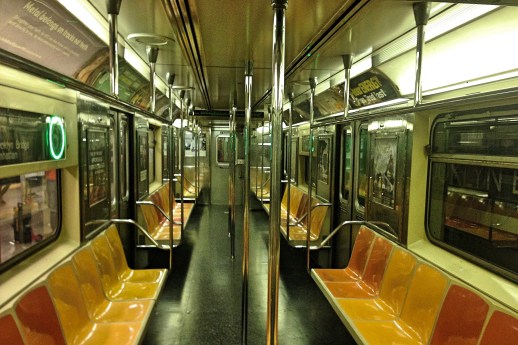
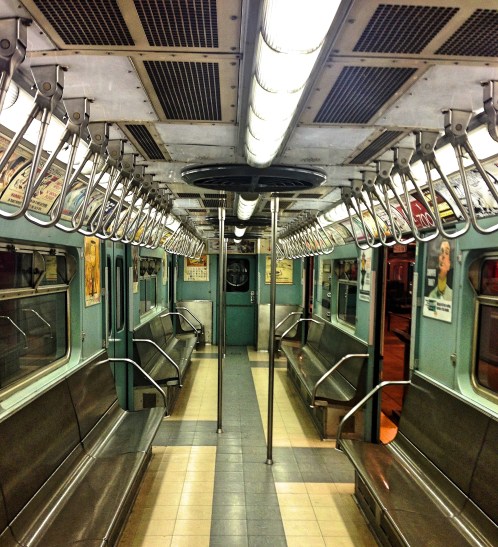
Subway Interior
Modern subway interior

I may sound like I’m disparaging the NYC subway, but really I have a great affection for it. The subway has a gritty, industrial aesthetic that I find strongly appealing. And despite the frustrations, the subway represents what is best about New York: a place where people of every background, doing every activity imaginable, are thrown together in a tight space and manage—just barely—to avoid killing each other. Just the other day, for example, I witnessed a woman violently push herself onto the subway, shoving everyone out of her way to get to a seat. As soon as she reached her prize a man rightly began castigating her, and a loud argument ensued. Luckily, another man began preaching in a loud voice, drowning out the argument and restoring a tense truce as we were given a sermon about the perils of hellfire. I simply don’t witness things like this in Madrid.

For this combination of reasons—a mixture of admiration and despair—I set out to investigate the NYC subway. First I visited the New York Transit Museum, and then I read this book.

The New York Transit Museum has two locations, a small shop in Grand Central Station, and their museum in Brooklyn. The shop in Grand Central has rotating exhibits in half the store. The latest one is about the history of the seven train, which runs from Manhattan to Queens. This line was recently extended to the far West Side, with the opening of the first new station in twenty-five years: Hudson Yards. The museum in Brooklyn, near Borough Hall, is in an old subway station. In addition to the historical photos and the information on display, the museum has examples of all the turnstiles ever used in the subway; and on the old platform there are antique subway cars, going back even to when they were made of wood. (Wooden cars got a bad reputation after the Malbone Street Wreck in 1918, a terrible accident that killed 93 people. The wooden cars splintered apart upon impact.)

Wooden Subway
Wooden subway cars

If you go visit this museum, I recommend a little stop along the way. The New York City subway was officially opened in 1904. The showpiece of the new system was the City Hall station, located right under the seat of the city government. This station was lavish: decorated with ornate tile-work designed by the Spanish architect Rafael Guastavino, using arches based on medieval Spanish churches. Beautiful as it is, the station had to be abandoned when the subway switched to longer cars. The short length of the platform, and the sharp angle of the turn, rendered the famous station useless. Now it sits, unused and empty, below City Hall. You can still catch a glimpse of this station, however, if you take the six train down to the Brooklyn Bridge station, and then stay on the train when it curves around to go uptown. The subway screeches horribly as it turns, but it is an eerie and fascinating experience to see the old abandoned station.

(I couldn’t get any good pictures myself, but you can find some in the gallery here. The Transit Museum does occasional tours of the City Hall Station, which you can find here.)

This book was the perfect accompaniment to the museum. Written by a professional historian, 722 Miles is, I believe, the most informative book on the market about the subway’s history.* As do many books by academics, this one began its life as a doctoral dissertation. It must have been substantially revised, however, since it is mostly free from academic stuffiness and scholarly squabbles. Hood casts a wide net, focusing on three interrelated aspects of the subway’s history: the political wrangling involved in getting it built, the role it played in the development of NYC, and the engineering methods and challenges of the subway. No engineer himself, the latter aspect is fairly basic; but the politics and the urban history are quite well done.

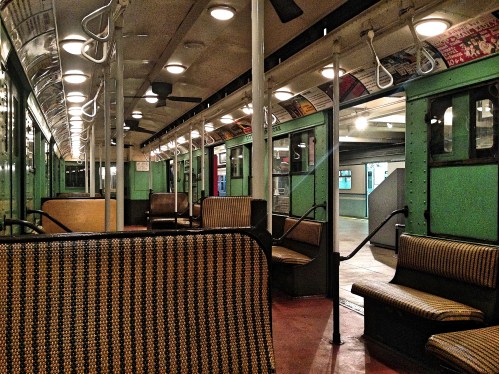
Old Interior
Antique interior design

The reader may be surprised (or maybe not) to learn that the subway has always been plagued with political wrangling and controversy. It was born in an era that saw major government spending and ownership as antithetical to sound business practices. But since private capital has always proven insufficient to infrastructure on this scale, the subway has been a public-private hybrid since its inception, with the state gradually taking on more and more responsibility. One reason the state had to step in was because the five-cent fare became a political stumbling block, something the public regarded as a sacred right; and so the fare remained a nickel even when the cost of a ride to the business was twice that amount.

Old Interior 2
Another old interior design

Originally the subway system was owned and operated by three separate entities: Interborough Rapid Transit (INT), Brooklyn Rapid Transit (BRT), and the Independent Subway System (IND). A relic of this origin is preserved in the subway’s odd numbering and lettering system: the numbered lines were the INT lines, and the lettered lines BRT and IND. These three were consolidated under city ownership by LaGuardia in 1940. From that year onward, there was very little development or even proper maintenance of the subways, in part thanks to the nickel fare. Another contributing factor was Robert Moses—the villain in every New York City story—who commanded most of the federal money available during the New Deal to build highways and bridges, diverting it from subways. Later, in 1968, the subway system was transferred to the newly created Metropolitan Transit Authority (MTA), by governor Nelson Rockefeller. This did little to help its finances, apparently, since by the early 80s the subway was a frightful, rundown, dangerous place. (Photos from that era have a haunting, apocalyptic beauty.)

The original purpose of the subway wasn’t just to serve already built-up areas in the city. Rather, several lines were run into undeveloped areas in the hopes of relieving population density. When the seven line was built in Queens, for example, it was running into almost pristine farmland and wild fields, where many still went to hunt fowl. It didn’t take long for this land to be urbanized. The muckraker Jacob Riis played a role in this development strategy, since it was he who documented the horrors of overcrowded tenements in lower Manhattan, prompting progressives to see the subway as a tool to make the city more livable and clean. This was done under the influence of Ebenezer Howard, the urban planner who originated the idea of the ‘garden city’ (which Jane Jacobs later opposed).

Turnstiles
Chronological turnstiles

Aside from the drier history, there are some fun facts in this book. The first underground train in New York was, I learned, not a proper subway at all, but a pneumatic train built in secret. This was the idea of Alfred E. Beach, who tunneled under Manhattan under the pretense of building a pneumatic parcel delivery system, to avoid the opposition of the corrupt legislature. In 1870 he unveiled his new train, which caused quite a sensation, despite being totally impractical for longer trips (Beach’s train only went a few blocks). I also learned that the tunnel that takes the seven train under the East River, on its journey from Manhattan to Queens, is called the Steinway Tunnel, because it was originally funded and promoted by that scion of the famous piano company. He was interested because he had a factory on the other side of the river.

This book was originally published in 1993, and it shows its age. This was a particularly bad time for the subway, when it was slowly recovering from its low point in the 1980s, and the book ends on a bleak note. Until fairly recently, the subway has been making quite a comeback since then. Just as many people are using the subway nowadays as they did in its so-called “Golden Age,” the 1920s and 30s, which amounts to almost 2 billion per year. The subways are no longer covered in graffiti and plagued by crime. Instead of posters warning passengers about mugging, they discourage ‘manspreading’ and promote basic etiquette. Viral videos also encourage passengers not to eat, clip their toenails, put their bags on seats, or to try to get on the train before other passengers have gotten off—a big improvement. We still have rats, though.

Even more impressive, the subway is building once again. Delayed for nearly 100 years, the Second Avenue line has just begun opening stations, which will relieve the overused Lexington Avenue line. We also have wifi in all the subway stations now.

Nevertheless, there are some serious problems to fix. The most daunting is to replace the subway’s signal system. This system is badly out of date. On some lines, they are still using equipment that dates from the 1930s. Having obsolete analog signals means that there are frequent malfunctions; and even when working properly, trains cannot safely run close to each other, since the old signals are not precise, which leads to overcrowding and more delays. This may seem like an easy fix, but it is estimating that it will take at least until 2045, and probably even later, to refurbish the whole system.

Despite these problems, and despite the expensive fares and the shrieking cars, I am still optimistic about the NYC subway. To me, the subway is a symbol of the entire city: dirty, grimy, overpriced, overcrowded, part worn out and part sleekly modern, where people of all sorts come to strive and struggle and suffer in a narrow space. New York simply wouldn’t be New York if it didn’t include frustration—and garbage—and rats—and loud energy; and the subway has all that in abundance.


*I’m not sure where the number 722 comes from. According to the Transit Museum, there are 656 miles of mainline track and 842 miles total. This number will be rising some more with the completion of the Second Avenue line.

View all my reviews

Review: How the Other Half Lives

Review: How the Other Half Lives

How the Other Half LivesHow the Other Half Lives by Jacob A. Riis

My rating: 3 of 5 stars

Millions of immigrants came to the United States during Jacob Riis’s lifetime, and a great many of them landed on an island: Manhattan. Sadly, thousands of these hopeful souls ended up on another island: Hart Island, New York City’s potter’s field, where the indigent dead are buried.

This island is still in use, by the way. Twice a week, a ferry comes bearing corpses in simple pine coffins, which are buried in mass graves dug out by bulldozers, with prisoners paid fifty cents an hour acting as pall-bearers. It was only in 2015, almost 150 years after the island began being used as a cemetery, that relatives were given permission to visit the island. Before that, the bodies disappeared completely—off limits to the public, isolated by the sea, out of the sight and out of mind. (Click here to see the New York Times’s excellent story about the island.)

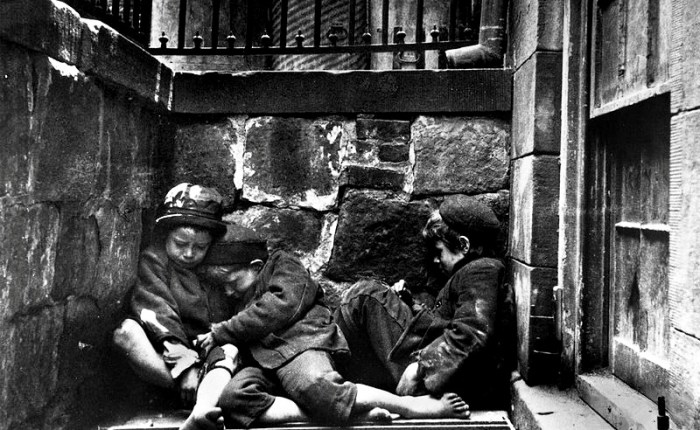
I mention Hart Island, not only because it was already in use back in Jacob Riis’s day (he took a seminal photo of a burial there), but because it is a perfect example of how the city’s poor can be made invisible. In writing this book, Jacob Riis explicitly tried to combat this invisibility. He wanted to bring home to middle-class readers just how bad life in the tenements could be.

Riis was a precursor to the muckraking journalism made famous by Upton Sinclair and his ilk, who came a generation later. In Riis’s case, the term “muckraker” is almost literally accurate, since it was grime he was trying to document. Immigrants from all over the world were pouring into New York City, many of them desperately poor, and housing simply did not keep up with the need. And because there were few building regulations on the books, this resulted in squalid and unsanitary tenements—shabby and dark (many rooms had no windows), and totally packed as families took on lodgers to afford the rent. The overcrowding not only made the buildings fire hazards, but also centers of disease.

Jacob Riis first experienced the plight of the poor when he arrived in New York City fresh from Denmark, aged twenty-one, trying to find work as a carpenter. He struggled for years to get by, occasionally sleeping in police lodging houses alongside beggars and street urchins. When he eventually found his vocation as a journalist, he wound up accompanying the police in nightly patrols of the poorest neighborhoods in the city. He wrote articles about what he saw; and one of them was so successful that he eventually expanded it into How the Other Half Lives.

I must say that this book is not a very compelling read. The prose is fine, but Riis is not a natural story-teller. The writing drifts on in an aimless, impressionistic way, never quite cohering into a cogent overview of the situation. The book itself is somewhat jumbled, with each chapter focusing on one aspect of the poor neighborhoods—stale-beer dives, lodging houses, “street Arabs,” paupers, and so on. You quickly learn that, however indignant Riis may be on behalf of the poor, he is not above racial bigotry. He has an unkind word for nearly every group—Italians, Irish, Jews, Chinese. To his credit, however, he is relatively progressive on the subject of the color line between blacks and whites.

I don’t know if this is true, but I quickly got the impression that Riis never actually spoke with the poor people he took upon himself to document. He mentions a few casual conversations, but no distinct individual emerges. To Riis, the poor seem to be nameless masses, with an ethnicity but not an identity. You occasionally wonder whether Riis is outraged by the injustice of the situation or is simply disgusted by the filth. This complete lack of individual stories contributes to the book’s underwhelming impact. Probably I am judging this book a little harshly, though, since I read this book concurrently with Sinclair’s The Jungle, and the comparison is not flattering for Riis.

There was one area, however, in which Riis excelled: photography. This edition has over one hundred of his photographs, and they are stunning. Riis was able to capture things nobody had before, since he was one of the first field journalists to use flash photography. The early generation of flash cameras used a pistol-like device that was extremely loud and fairly hazardous; twice Riis set fire to the room he was in. Later, he switched to a method that required him to heat the flash powder in a frying pan. The world before smart phones was harsh indeed. Considering these technical limitations, Riis’s photographs are all the more remarkable: candid, dramatic, and sensitive.

It is all too easy to criticize this book from the perspective of the present. Really, Riis is impressive by any measure. He learned English late in life and writes better prose than most of us. He was a brilliant pioneer of photography, and of muckraking journalism. He even had a small hand in the construction of the New Croton Aqueduct, since he documented unsanitary water supplies, as well as the New York Subway, since he was among the reformers who advocated for improved transportation to lessen population density in the slums. Most importantly, despite his flaws, he believed that society had an obligation to its least privileged members, and could not avert its eyes with a clear conscience.

View all my reviews

Review: A Sand County Almanac

Review: A Sand County Almanac

A Sand County Almanac: With Essays on Conservation from Round RiverA Sand County Almanac: With Essays on Conservation from Round River by Aldo Leopold

My rating: 4 of 5 stars

What a dull world if we knew all about geese!

Nature is refreshing. Even a short walk in a park can powerfully clear one’s head. For whatever reason—perhaps because our ancestors lived in trees—surrounding oneself with birches and maples produces in nearly everyone feelings of warmth, comfort, and peace. And for many people, nature is more than refreshing: it is awe-inspiring, even divine. Natural environments are, for some, more uplifting than cathedrals. Emerson might have captured this strain of mystical naturalism best:

In the woods, we return to reason and faith. … Standing on the bare ground,—my head bathed by the blithe air, and uplifted into infinite spaces,—all mean egotism vanishes. I become a transparent eye-ball; I am nothing; I see all; the currents of the Universal Being flow through me; I am part or particle of God.

I myself have had comparable experiences in the woods. Yet both Emerson and I are pure amateurs next to Aldo Leopold.

Leopold was a pioneering conservationist and forester. He was also a superlative writer, and in this brief book he covers a lot of ground. He begins with a month-by-month account of Sand County, a poor farming region in Wisconsin. This was my favorite section, since Leopold’s sensitivity to his environment is nearly superhuman. He has a keen sense of both the history of environments—how they change with the seasons, how they have evolved through time, how they have been warped by human activity—and the close-knit interdependence of ecosystems, how each organism shapes and is shaped by every other organism, forming a perfect whole.

As a stylist, he manages to be lyrical and poetic while sticking scrupulously to what he sees and hears. His sentences are short, his diction simple, and yet he manages to evoke a densely complex ecosystem. This is because, unlike Emerson or I—and more so than Thoreau—Leopold really understood his environment. He can name every species of plant, and tell what soils they prefer and what plants they like as neighbors. He can identify every bird by its call, and knows where it roosts, what it eats, when it migrates, and how it mates. Scratches on a tree tell him a deer is nearby, his antlers fully grown; the footprints in snow tell him a skunk has passed, and how recently.

All this is described with exquisite sensitivity, but no romantic embellishment. To borrow a phrase from E.B. White, Leopold had discovered “the eloquence of facts.” And, like White, Thoreau, and Emerson, his writing has a pleasing, folksy, rambling, ambling quality, wherein each sentence is nailed to the next one at an oblique angle.

In the rest of the book, Leopold puts forward a new philosophy of conservation. This train of thought reminded my very much of another book I read recently, The Death and Life of Great American Cities. In that book, Jane Jacobs explains how top-down approaches to city planning killed neighborhood vitality. Just so, when Leopold was a young man in the forestry service, he participated in the policy of removing predators—bears, wolves, and mountain lions—to protect livestock and to increase the supply of hunting animals, like deer. When hunting became necessary to control population, parks began building more and more roads to make access easier; and meanwhile the exploding deer population prevented new trees from growing. Thus the park was encroached upon by cars, and the ecosystem thrown off balance—in the same way that blindly building highways and public housing can destroy neighborhoods.

Leopold was, I believe, one of the first to popularize the idea that ecosystems act like one giant organism, with a delicate balance of cooperating and competing components. Every healthy ecosystem is a harmony that cannot be disturbed without unpredictable results. To again borrow from Jacobs, an ecosystem—like a city economy or a human brain—is an example of “organized complexity.” Thus ecosystems baffle attempts to understand them by thinking of their components separately, as a collection of individual species, or even statistically, as the average behavior of interchangeable parts. Complexity like this tends to be a product of historical growth, with each distinct component making minute adjustments to each other in a dense network of influence. Leopold doesn’t say this in so many words; but he does something even more impressive: he illustrates this quality using short anecdotes and schoolboy vocabulary.

His most philosophic contribution to the environmental movement is what he called a “land ethic.” Previous arguments for conservation were couched in terms of expediency: how national parks and nature reserves could benefit us economically. Leopold believed that this approach was too narrow; since hunting lodges and mechanized farms are always more profitable in the short term, this would eventually result in the destruction of wild ecosystems and the disappearance of species. We needed to move beyond arguments of expediency and see the land—and everything on it—as valuable for its own sake. Leopold believed that we had an ethical duty to preserve ecosystems and all their species, and that the aesthetic reward of wild nature was more valuable than dollars and cents could measure.

I want to go along with this, but I thought that Leopold was unsatisfyingly vague in this direction. It is simply not enough to say that we have an ethical duty to preserve nature; this is quite a claim, and requires quite a bit of argument. Further, aesthetic value seems like a slender reed to rest on. For every Emerson and Thoreau, there is a Babbitt whose tastes are not so refined. To his credit, Leopold does argue that a great part of conservation must consist in elevating the public taste in nature. Otherwise, conservation will consist of little more than the government using tax dollars to purchase large swaths of land. Individuals must see the value in wilderness and actively participate in preserving it. But molding tastes is no easy thing; and, more importantly, if we are to do so, there must be compelling reasons to do it.

The most compelling reasons for conservation are, I believe, expediency—but expediency in the widest sense. The difference between folly and wisdom is not that the former is preoccupied with expediency and the latter higher things; it is that wisdom considers what is expedient on a grander scale. Leopold comes close to making this same argument. He was, for example, ahead of his time in being deeply concerned about extinction. Every time a species disappears it is an irreplaceable loss; and considering that our medicine partly depends on new discoveries, extinctions may have terrible consequences for us down the line. (I saw a PBS special the other day about scientists trying to discover new antibiotics by shifting through raw soil.) Since Leopold’s day—long before Silent Spring or An Incovenient Truth—we have learned plenty more ways that environmental destruction can be equivalent to self-destruction.

Carping aside, this is a deeply satisfying book: lyrical, descriptive, educational, and innovative. Leopold realized what Orwell also realized: that winning converts requires both argument and propaganda. He does not only argue for the value of nature, but he really captures the beauty of unspoiled environments and serves it up for his readers’ consideration. We are not only convinced, but seduced. This is propaganda in its noblest form—propaganda on behalf of nature.

View all my reviews

Review: The Death and Life of Great American Cities

Review: The Death and Life of Great American Cities

The Death and Life of Great American CitiesThe Death and Life of Great American Cities by Jane Jacobs

My rating: 4 of 5 stars

This is a common assumption: that human beings are charming in small numbers and noxious in large numbers.

I picked up this book immediately after finishing The Power Broker, and I highly recommend this sequence to anyone who has the time. The conflict between Robert Moses, czar-like planner of New York City for almost half a century, and Jane Jacobs, ordinary citizen and activist, has become the source of legend. There is a book about it, Wrestling with Moses, a well-made documentary, Citizen Jane, and an opera, A Marvelous Order, with a libretto written by a Pulitzer Prize winner (I haven’t seen it). The two make an excellent hero and villain. Moses, the autocratic, power-hungry city-planner who eviscerates neighborhoods and bulldozes homes. Jacobs, the underdog autodidact, community organizer, defender of Greenwich Village and Washington Square Park.

The two did not only clash in life—with Jacobs leading protests to stop Moses’s highways—but, more importantly, in thought. More diametrically opposed conceptions of the city could hardly be imagined.

Moses was, at bottom, a follower of Le Corbusier, a modernist who put forward the idea of the Radiant City. The idea was to create a city with all the different functions in separate zones—sections for retail, business, manufacturing, residences—and to create as much green space as possible by putting everything in high-rise buildings, freeing up land for parks. These buildings would be connected, not by ordinary roads, but by giant superhighways. In a way, it is a conception of the city that is anti-city: there would be no streets, no corner shops, no neighborhoods. The impulse was, I believe, originally progressive: to erase differences in class by creating uniform conditions for everyone. But in Moses’s hands this philosophy became deeply reactionary: isolate the poor people of color in projects and build highways for the car-owning middle class.

Jacobs was absolutely opposed to this model. There are innumerable theoretical differences between Jacobs and Moses, but I think the most essential difference is this: Jacobs loved cities. She loved walking around cities, chatting with neighbors, gazing at street-life, making small-talk at local shops, sitting on stoops and leaning out windows. And so her idea of urban planning is not to pack everyone into high-rise buildings to get them off the street, but the reverse: to get as many people on the street as possible. She loves the messiness of cities. A healthy city is not, for her, a work of art, consciously designed. It is more like a biological organism, shaped by natural selection into a well-functioning, complex, interrelated, constantly-changing whole. Healthy cities are not made by planners but by ordinary people.

Since the publication of this book, Jacobs’s ideas have become enormously influential—so influential, in fact, that it is difficult to see anything radical about what she says. One of her basic principles, for example, is that a well-used street is a safe street, because the presence of many bystanders discourages crime. I suspect that this seems obvious to most people. But when you look at the projects that Moses and his ilk built—high-rise buildings surrounded by lawns, with no shops, restaurants, or anything else to attract people to street level—you realize how totally out of touch they were. Indeed, the whole idea of housing projects sounds like a recipe for disaster: pack all the poor into one area, set income limits so anyone successful has to move out, discourage all street activity to eliminate a sense of community. And in practice the projects were disasters—centers of delinquency and despair.

Jacobs’s recipe for creating a healthy neighborhood has four ingredients: (1) mixed uses, so that different kinds of people are drawn to the area at different times of day for different reasons; (2) a mixture of old and new buildings, so that there is low-rent space available for small businesses and low-income residents; (3) small blocks, so that streets are not isolated from one another; (4) and sufficient density of residents, to create the necessary amount of economic and social activity. The goal is to produce a neighborhood like her own Greenwich Village: with lots of street life, with successful residents who choose to stay long-term, with local stores and restaurants and cafes, and with a steady influx of immigrants.

To use a metaphor, Jacobs thinks we should try to create an ecosystem with a lot of biodiversity; and to do this we need a lot of biomass and a lot of separate niches. The essential fact about ecosystems—which also applies to cities—is that they are a delicate balance of different elements, deeply complex, shaped by the action of countless individual players over countless eons. This level of complexity is baffling to the human mind, which is why we so often disrupt ecosystems by trying to “improve” them. Urban planning does the same thing with cities.

The Moses approach (to continue the metaphor) is agricultural rather than natural: sweep away the natural environment and create an artificial monoculture. Monocultures never spring up in healthy ecosystems. Lacking biodiversity, they are inherently vulnerable and difficult to maintain. We expend enormous amounts of money and energy defending our wheat fields from vermin and disease. The same principle applies to the housing projects, which need constant police surveillance to remain remotely viable.

This gives a taste of Jacobs’s guiding idea, perhaps, but I can hardly do justice to the wealth of thought in this book. Jacobs has convincing sociological insights into what makes streets safe or unsafe, what makes city economies thrive or stagnate, why housing projects fail and slums form, why parks are used and unused, why city governments are so often inefficient and ineffective, and even includes her ideas on the history and progress of science. In a way, this book is a constant rebuke to academe. At the time, academic urban planning was entirely stagnant, relying on ideas and principles that hadn’t been modified in thirty years and which were never very good to begin with. It took someone like Jacobs, an autodidact without a college degree, to break up the orthodoxy—and she had to endure a lot of sexism and condescension in the process.

What made her so successful, and what has made this book so enduring, was a rare combination of talents: keen observation, a highly original mind, the ability to think on multiple scales at once, hard-nosed practicality, and a healthy sense of social responsibility. In this book she relies on her wide and somewhat eclectic reading, but even more on her own eyes and ears. She has visited successful and unsuccessful neighborhoods and had talked to their residents. She has led protests and was a frequent visitor of City Hall. When you read this book, it is easy to see why she has become something of a hero for many citizens and academics: she is absolutely unafraid of authority, either intellectual or political, and she had the mental and personal resources to win.

It is, of course, ironic that her ideas, so heterodox, eventually became the new orthodoxy of urban planning. When Jacobs passed away in 2006, there were many who called for an end to her intellectual reign.

The most common criticism, I believe, is that Jacobs did not anticipate gentrification—the gradual takeover of neighborhoods by the affluent. This is the most talked-about problem in New York City today. There’s a popular blog, Vanishing New York, which documents all the small business and local establishments being pushed out by big money. Jacobs’s own former neighborhood, Greenwich Village, is a prime example: now it is nothing like the bustling, bohemian, working-class place it was in her day. I’m not sure if Jacobs can be fairly blamed for this, however. For one, she anticipates how successful neighborhood can become “too successful” and lose their vitality as more money pours in. What’s more, she was very concerned with maintaining housing for low-income tenants within successful neighborhoods, and includes a novel plan to do so in this book.

In any case, this book is not just a recipe for creating neighborhoods. In an oblique way, it presents an entire ideology. Jacobs is a proponent of what you might call progressive decentralism. Normally, decentralism is associated with the right, at least here in the US, but Jacobs make a strong case for leftist decentralism. Large, vertically-oriented government structures simply cannot understand or respond to individual citizens’ needs. The answer is to empower local government so that citizens can shape their own neighborhoods. Government must help the disadvantaged, but must do so by cooperating with local forces and private individuals—exploiting economic and social elements that naturally arise, instead of imposing its own cumbrous structure.

This book can be read even more broadly, as an attack on suburbia and modern isolation. Cities are the future, as Jacobs reminds us—hotbeds of ideas and centers of population growth; and cities are natural products, created by the free choice of individuals, places that organically foster their own sense of identity and community. Suburbia is a rejection of cities: artificial products created through the deliberate policies of planners. Not shaped by free choice, they are not organic communities; and even if they escape being unsafe, like the projects, they foster that constant specter of modern life: isolation. When you hear Jacobs describe her own neighborhood in Greenwich Village, you get a sense of what so many places nowadays lack: neighborliness, friendliness, a group of semi-strangers and sidewalk acquaintances who will go out of their way to help each other, a sense of communal ownership and belonging.

In sum, this book is a true classic: ensconced in an intellectual climate that no longer exists, responding to contemporary problems with eloquence and insight, and championing a perspective that is still vital.

View all my reviews