Review: Organon (Aristotle)

Review: Organon (Aristotle)

OrganonOrganon by Aristotle

My rating: 3 of 5 stars

Aristotle continues to provoke conflicting reactions in me. I am always torn between realizing his tremendous originality and historical importance, and suffering from his extraordinary dullness. This book exemplifies both sides of the coin. Seeing a man single-handedly create the field of logic, ex nihilo, is tremendous; yet reading through these treatises could put a coffee-addict in a coma.

I am not insensitive to the appeals of philosophy. Far from it; I think reading philosophy is thrilling. Some of my most acute aesthetic experiences have been had contemplating some philosopher’s idea. Yet I have never had this reaction to Aristotle’s writings. Part of this is due to his formidable difficulty; another part, to the nature of the works (which, I must constantly remind myself, are lecture-notes).

Nevertheless, Aristotle had a prosaic mind; even when faced with the most abstract phenomena in the universe, his first reaction is to start parceling everything into neat categories, and to go on making lists and explanations of these categories. He does make logical arguments, but they are often brief, and almost as often unsatisfactory. Much of the time the student is faced with the dreary task of working his way through Aristotle’s system, simply because it is his system, and not because it is empirically or logically compelling.

(Every time I write a review for Aristotle, it comes out so disappointed. Let me try to be more positive.)

My favorite piece in this was the Posterior Analytics, which is a brilliant treatise on epistemology, logic, and metaphysics. Aristotle succinctly presents an entire theory of knowledge, and it’s incomparably more rigorous and detailed than anything Plato could have produced. I also particularly liked the Topics, as there we see Aristotle as a seasoned debater, in addition to a bumbling professor. Of course, there is much of strictly philosophic interest in this work as well; a particularly memorable problem is that of the future naval-battle.

For me, Aristotle is at his best when he is discussing the acquisition of knowledge. For Aristotle, whatever his faults, more perfectly embodied the love of knowledge than any other thinker in history. He wanted to know all; and, considering his historical limitations, he came damn near close. Us poor moderns have to content ourselves with either a mastery of one tiny slice of reality, or a dilettante acquaintance with all of it; Aristotle had the whole world at his fingertips.

View all my reviews

Review: Autobiography (Darwin)

Review: Autobiography (Darwin)
The Autobiography of Charles Darwin, 1809–82

The Autobiography of Charles Darwin, 1809–82 by Charles Darwin

My rating: 4 of 5 stars

I have attempted to write the following account of myself, as if I were a dead man in another world looking back at my own life. Nor have I found this difficult, for life is nearly over with me. I have taken no pains about my style of writing.

This is the quintessential scientific autobiography, a brief and charming book that Darwin wrote “for nearly an hour on most afternoons” for a little over two months. Originally published in 1887—five years after the naturalist’s death—it was somewhat censored, the more controversial religious opinions being taken out. It was only in 1958, to celebrate the centennial of The Origin of Species, that the full version was restored, edited by one of Darwin’s granddaughters, Nora Barlow.

The religious opinions that Darwin expresses are, nowadays, not enough to raise eyebrows. In short, his travels and his research slowly eroded his faith until all that remained was an untroubled agnosticism. What is interesting is that Darwin attributes to his loss of faith his further loss of sensitivity to music and to grand natural scenes. Apparently, in later life he found himself unable to experience the sublime. His scientific work also caused him to lose his appreciation for music, pictures, and poetry, which he heartily regrets: “My mind seems to have become a kind of machine for grinding general laws out of large collections of facts,” he says, and attributes to this the fact that “for many years I cannot endure to read a line of poetry.”

The most striking and lovable of Darwin’s qualities is his humility. He notes his lack of facility with foreign languages (which partially caused him to refuse Marx’s offer to dedicate Kapital to him), his terrible ear for music, his difficulty with writing, his incompetence in mathematics, and repeatedly laments his lack of higher aesthetic sensitivities. His explanation for his great scientific breakthrough is merely a talent for observation and dogged persistence. He even ends the book by saying: “With such moderate abilities as I possess, it is truly surprising that thus I should have influenced to a considerable extent the beliefs of scientific men on some important point.” It is remarkable that such a modest and retiring man should have stirred up one of the greatest revolutions in Western thought. Few thinkers have been more averse to controversy.

This little book also offers some reflection on the development of his theory—with the oft-quoted paragraph about reading Malthus—as well as several good portraits of contemporary thinkers. But the autobiography is not nearly as full as one might expect, since Darwin skips over his voyage on the Beagle (he had already written an excellent book about it) and since the second half of his life was extremely uneventful. For Darwin developed a mysterious ailment that kept his mostly house-bound, so much so that he did not even go to his father’s funeral. The explanation eluded doctors in his time and has resisted firm diagnosis ever since. But the consensus seems to be that it was at least in part psychological. It did give Darwin a convenient excuse to avoid society and focus on his work.

The final portrait which emerges is that of a scrupulous, methodical, honest, plainspoken, diffident, and level-headed fellow. It is easy to imagine him as a retiring uncle or a reserved high school teacher. That such a man, through a combination of genius and circumstance—and do not forget that he almost did not go on that famous voyage—could scandalize the public and make a fundamental contribution to our picture of the universe, is perhaps the greatest argument that ever was against the eccentric genius trope.

View all my reviews

Review: The Structure of Scientific Revolutions

Review: The Structure of Scientific Revolutions

The Structure of Scientific RevolutionsThe Structure of Scientific Revolutions by Thomas S. Kuhn

My rating: 5 of 5 stars

Observation and experience can and must drastically restrict the range of admissible scientific belief, else there would be no science. But they cannot alone determine a particular body of such belief. An apparently arbitrary element, compounded of personal and historical accident, is always a formative ingredient of the beliefs espoused by a given scientific community at a given time.

This is one of those wonderfully rich classics, touching on many disparate fields and putting forward ideas that have become permanent fixtures of our mental furniture. Kuhn synthesizes insights from history, sociology, psychology, and philosophy into a novel conception of science—one which, despite seemingly nobody agreeing with it, has become remarkably influential. Indeed, this book made such an impact that the contemporary reader may have difficulty seeing why it was so controversial in the first place.

Kuhn’s fundamental conception is of the paradigm. A paradigm is a research program that defines a discipline, perhaps briefly, perhaps for centuries. This is a not only a dominant theory, but a set of experimental methodologies, ontological commitments, and shared assumptions about standards of evidence and explanation. These paradigms usually trace their existence to a breakthrough work, such as Newton’s Principia or Lavoisier’s Elements; and they persist until the research program is thrown into crisis through stubborn anomalies (phenomena that cannot be accounted for within the theory). At this point a new paradigm may arise and replace the old one, such as the switch from Newton’s to Einstein’s system.

Though Kuhn is often spoken of as responding to Popper, I believe his book is really aimed at undermining the old positivistic conception of science: where science consists of a body of verified statements, and discoveries and innovations cause this body of statements to gradually grow. What this view leaves out is the interconnection and interdependence between these beliefs, and the reciprocal relationship between theory and observation. Our background orients our vision, telling us where to look and what to look for; and we naturally do our best to integrate a new phenomenon into our preexisting web of beliefs. Thus we may extend, refine, and elaborate our vision of the world without undermining any of our fundamental theories. This is what Kuhn describes as “normal science.”

During a period of “normal science” it may be true that scientific knowledge gradually accumulates. But when the dominant paradigm reaches a crisis, and the community finds itself unable to accommodate certain persistent observations, a new paradigm may take over. This cannot be described as a mere quantitative increase in knowledge, but is a qualitative shift in vision. New terms are introduced, older ones redefined; previous discoveries are reinterpreted and given a new meaning; and in general the web of connections between facts and theories is expanded and rearranged. This is Kuhn’s famous “paradigm shift.” And since the new paradigm so reorients our vision, it will be impossible to directly compare it with the older one; it will be as if practitioners from the two paradigms speak different languages or inhabit different worlds.

This scandalized some, and delighted others, and for the same reason: that Kuhn seemed to be arguing that scientific knowledge is socially solipsistic. That is to say that scientific “truth” was only true because it was given credence by the scientific community. Thus no paradigm can be said to be objectively “better” than another, and science cannot be said to really “advance.” Science was reduced to a series of fashionable ideas.

Scientists were understandably peeved by the notion, and social scientists concomitantly delighted, since it meant their discipline was at the crux of scientific knowledge. But Kuhn repeatedly denied being a relativist, and I think the text bears him out. It must be said, however, that Kuhn does not guard against this relativistic interpretation of his work as much as, in retrospect, he should have. I believe this was because Kuhn’s primary aim was to undermine the positivistic, gradualist account of science—which was fairly universally held in the past—and not to replace it with a fully worked-out theory of scientific progress himself. (And this is ironic since Kuhn himself argues that an old paradigm is never abandoned until a new paradigm takes its place.)

Though Kuhn does say a good deal about this, I think he could have emphasized more strongly the ways that paradigms contribute positively to reliable scientific knowledge. For we simply cannot look on the world as neutral observers; and even if we could, we would not be any the wiser for it. The very process of learning involves limiting possibilities. This is literally what happens to our brains as we grow up: the confused mass of neural connections is pruned, leaving only the ones which have proven useful in our environment. If our brains did not quickly and efficiently analyze environmental stimuli into familiar categories, we could hardly survive a day. The world would be a swirling, jumbled chaos.

Reducing ambiguities is so important to our survival that I think one of the primary functions of human culture is to further eliminate possibilities. For humans, being born with considerable behavioral flexibility, must learn to become inflexible, so to speak, in order to live effectively in a group. All communication presupposes a large degree of agreement within members of a community; and since we are born lacking this, we must be taught fairly rigid sets of assumptions in order to create the necessary accord. In science this process is performed in a much more formalized way, but nevertheless its end is the same: to allow communication and cooperation via a shared language and a shared view of the world.

Yet this is no argument for epistemological relativism, any more than the existence of incompatible moral systems is an argument for moral relativism. While people commonly call themselves cultural relativists when it comes to morals, few people are really willing to argue that, say, unprovoked violence is morally praiseworthy in certain situations. What people mean by calling themselves relativists is that they are pluralists: they acknowledge that incompatible social arrangements can nevertheless be equally ethical. Whether a society has private property or holds everything in common, whether it is monogamous or polygamous, whether burping is considered polite or rude—these may vary, and yet create coherent, mutually incompatible, ethical systems. Furthermore, acknowledging the possibility of equally valid ethical systems also does not rule out the possibility of moral progress, as any given ethical system may contain flaws (such as refusing to respect certain categories of people) that can be corrected over time.

I believe that Kuhn would argue that scientific cultures may be thought of in the same pluralistic way: paradigms can be improved, and incompatible paradigms can nevertheless both have some validity. Acknowledging this does not force one to abandon the concept of “knowledge,” any more than acknowledging cultural differences in etiquette forces one to abandon the concept of “politeness.”

Thus accepting Kuhn’s position does not force one to embrace epistemological relativism—or, at least not the strong variety, which reduces knowledge merely to widespread belief. I would go further, and argue that Kuhn’s account of science—or at least elements of his account—can be made to articulate even with the system of his reputed nemesis, Karl Popper. For both conceptions have the scientist beginning, not with observations and facts, but with certain arbitrary assumptions and expectations. This may sound unpromising; but these assumptions and expectations, by orienting our vision, allow us to realize when we are mistaken, and to revise our theories. The Baconian inductivist or the logical positivist, by beginning with an raw mass of data, has little idea how to make sense of it and thus no basis upon which to judge whether an observation is anomalous or not.

This is not where the resemblance ends. According to both Kuhn and Popper (though the former is describing while the second is prescribing), when we are revising our theories we should if possible modify or discard the least fundamental part, while leaving the underlying paradigm unchanged. This is Kuhn’s “normal science.” So when irregularities were observed in Uranus’ orbit, the scientists could have either discarded Newton’s theories (fundamental to the discipline) or the theory that Uranus was the furthest planet in the solar system (a superficial fact); obviously the latter was preferable, and this led to the discovery of Neptune. Science could not survive if scientists too willingly overturned the discoveries and theories of their discipline. A certain amount of stubbornness is a virtue in learning.

Obviously, the two thinkers also disagree about much. One issue is whether two paradigms can be directly compared or definitively tested. Popper envisions conclusive experiments whose outcome can unambiguously decide whether one paradigm or another is to be preferred. There are some difficulties to this view, however, which Kuhn points out. One is that different paradigms may attach very different importance to certain phenomena. Thus for Galileo (to use Kuhn’s example) a pendulum is a prime exemplar of motion, while to an Aristotelian a pendulum is a highly complex secondary phenomenon, unfit to demonstrate the fundamental properties of motion. Another difficulty in comparing theories is that terms may be defined differently. Einstein said that massive objects bend space, but Newtonian space is not a thing at all and so cannot be bent.

Granting the difficulties of comparing different paradigms, I nevertheless think that Kuhn is mistaken in his insistence that they are as separate as two languages. I believe his argument rests, in part, on his conceiving of a paradigm as beginning with definitions of fundamental terms (such as “space” or “time”) which are circular (such as “time is that measured by clocks,” etc.); so that comparing two paradigms would be like comparing Euclidian and non-Euclidian geometry to see which is more “true,” though both are equally true to their own axioms (while mutually incompatible). Yet such terms in science do not merely define, but denote phenomena in our experience. Thus (to continue the example) while Euclidian and non-Euclidian geometries may both be equally valid according to their premises, they may not be equally valid according to how they describe our experience.

Kuhn’s response to this would be, I believe, that we cannot have neutral experiences, but all our observations are already theory-laden. While this is true, it is also true that theory does not totally determine our vision; and clever experimenters can often, I believe, devise tests that can differentiate between paradigms to most practitioners’ satisfaction. Nevertheless, as both Kuhn and Popper would admit, the decision to abandon one theory for another can never be a wholly rational affair, since there is no way of telling whether the old paradigm could, with sufficient ingenuity, be made to accommodate the anomalous data; and in any case a strange phenomena can always be tabled as a perplexing but unimportant deviation for future researchers to tackle. This is how an Aristotelian would view Galileo’s pendulum, I believe.

Yet this fact—that there can be no objective, fool-proof criteria for switching paradigms—is no reason to despair. We are not prophets; every decision we take involves risk that it will not pan out; and in this respect science is no different. What makes science special is not that it is purely rational or wholly objective, but that our guesses are systematically checked against our experience and debated within a community of dedicated inquirers. All knowledge contains an imaginative and thus an arbitrary element; but this does not mean that anything goes. To use a comparison, a painter working on a portrait will have to make innumerable little decisions during her work; and yet—provided the painter is working within a tradition that values literal realism—her work will be judged, not for the taste displayed, but for the perceived accuracy. Just so, science is not different from other cultural realms in lacking arbitrary elements, but in the shared values that determine how the final result is judged.

I think that Kuhn would assent to this; and I think it was only the widespread belief that science was as objective, asocial, and unimaginative as a camera taking a photograph that led him to emphasize the social and arbitrary aspects of science so strongly. This is why, contrary to his expectations, so many people read his work as advocating total relativism.

It should be said, however, that Kuhn’s position does alter how we normally think of “truth.” In this I also find him strikingly close to his reputed nemesis, Popper. For here is the Austrian philosopher on the quest for truth:

Science never pursues the illusory aim of making its answers final, or even probable. Its advance is, rather, towards the infinite yet attainable aim of ever discovering new, deeper, and more general problems, and of subjecting its ever tentative answers to ever renewed and ever more rigorous tests.

And here is what his American counterpart has to say:

Later scientific theories are better than earlier ones for solving puzzles in the often quite different environments to which they are applied. That is not a relativist’s position, and it displays the sense in which I am a convinced believer in scientific progress.

Here is another juxtaposition. Popper says:

Science is not a system of certain, or well-established, statements; nor is it a system which steadily advances towards a state of finality. Our science is not knowledge (episteme): it can never claim to have attained truth, or even a substitute for it, such as probability. … We do not know: we can only guess. And our guesses are guided by the unscientific, the metaphysical (though biologically explicable) faith in laws, in regularities which we can uncover—discover.

And Kuhn:

One often hears that successive theories grow ever closer to, or approximate more and more closely to, the truth… Perhaps there is some other way of salvaging the notion of ‘truth’ for application to whole theories, but this one will not do. There is, I think, no theory-independent way to reconstruct phrases like ‘really there’; the notion of a match between the ontology of a theory and its ‘real’ counterpart in nature now seems to me illusive in principle.

Though there are important differences, to me it is striking how similar their accounts of scientific progress are: the ever-increasing expansion of problems, or puzzles, that the scientist may investigate. And both thinkers are careful to point out that this expansion cannot be understood as an approach towards an ultimate “true” explanation of everything, and I think their reasons for saying so are related. For since Popper begins with theories, and Kuhn with paradigms—both of which stem from the imagination of scientists—their accounts of knowledge can never be wholly “objective,” but must contain an aforementioned arbitrary element. This necessarily leaves open the possibility that an incompatible theory may yet do an equal or better job in making sense of an observation, or that a heretofore undiscovered phenomenon may violate the theory. And this being so, we can never say that we have reached an “ultimate” explanation, where our theory can be taken as a perfect mirror of reality.

I do not think this notion jeopardizes the scientific enterprise. To the contrary, I think that science is distinguished from older, metaphysical sorts of enquiry in that it is always open-ended, and makes no claim to possessing absolute “truth.” It is this very corrigibility of science that is its strength.

This review has already gone on for far too long, and much of it has been spent riding my own hobby-horse without evaluating the book. Yet I think it is a testament to Kuhn’s work that it is still so rich and suggestive, even after many of its insights have been absorbed into the culture. Though I have tried to defend Kuhn from accusations of relativism or undermining science, anyone must admit that this book has many flaws. One is Kuhn’s firm line between “normal” science and paradigm shifts. In his model, the first consists of mere puzzle-solving while the second involves a radical break with the past. But I think experience does not bear out this hard dichotomy; discoveries and innovations may be revolutionary to different degrees, which I think undermines Kuhn’s picture of science evolving as a punctuated equilibrium.

Another weakness of Kuhn’s work is that it does not do justice to the way that empirical discoveries may cause unanticipated theoretical revolutions. In his model, major theoretical innovations are the products of brilliant practitioners who see the field in a new way. But this does not accurately describe what happened when, say, DNA was discovered. Watson and Crick worked within the known chemical paradigm, and operated like proper Popperians in brainstorming and eliminating possibilities based on the evidence. And yet the discovery of DNA’s double helix, while not overturning any major theoretical paradigms, nevertheless had such far-reaching implications that it caused a revolution in the field. Kuhn has little to say about events like this, which shows that his model is overly simplistic.

I must end here, after thrashing about ineffectually in multiple disciples in which I am not even the rankest amateur. What I hoped to re-capture in this review was the intellectual excitement I felt while reading this little volume. In somewhat dry (though not technical) academic prose, Kuhn caused a revolution still forceful enough to make me dizzy.

View all my reviews

Review: Vanity Fair

Review: Vanity Fair

Vanity FairVanity Fair by William Makepeace Thackeray

My rating: 4 of 5 stars

The world is a looking glass, and gives back to every man the reflection of his own face. Frown at it, and it will in turn look sourly upon you; laugh at it and with it, and it is a jolly kind companion; and so let all young persons take their choice.

There seems to be little to say about Vanity Fair that is worth the time in saying it. This is an open book; its appeal is direct, its themes obvious, its interpretation unambiguous. It is an extended satire of Victorian England—what more is there to add?

I was prepared for the nineteenth-century prose; indeed, Thackeray’s unadorned style has aged uncommonly well. I had readied myself for its protracted length and copious cast of characters. I was even prepared for the strong authorial voice and frequent asides; in this, Thackeray follows Henry Fielding quite closely. But I was not quite ready for such a depressing novel. For the secret of Vanity Fair’s lasting success is not, I think, due merely to Thackeray’s execution—brilliant as it is—but owes itself far more to the novel’s triumphant immoralism.

Like many great novelist, Thackeray opens the book by introducing to us a pair of characters, Becky Sharp and Amelia Sedley, who are to be foils for each other. Amelia is simple and good, while Becky is calculating and wicked. Following the standard conventions, we should expect Amelia to emerge triumphant and Becky to be foiled. And yet Thackeray consistently and persistently flaunts this expectation. Instead, he throws his characters into a world full of cowards, egoists, hypocrites, dullards, drunkards, gluttons, dandies, and every other species of vice—in short, Vanity Fair—and shows us that, in such a world, virtue is a luxury few can afford.

Indeed, the frightening thing about this novel is that Thackeray gradually pulls us into sympathy with Becky Sharp. The daughter of a painter and a dancing master, she hoists herself up from the lowest to the highest ranks of society using only her wit. In the process, it becomes clear that she is a sociopath in the proper sense of the word—seeing others as mere instruments, unable to care for anyone but herself. And yet we feel—we are made to feel—that she is not morally lower than those around her (who also only care for money and status), only cleverer and more determined.

In a word, Thackeray’s thesis is that, in our depraved world—where people care only for vanities, and where unjust accidents such as birth determine the distribution of these goods—the only logical course of action is to be ruthless. Thackeray completes this impression by showing how commonly virtue leads to misery. Amelia’s virtue, though genuine, is consistently made to look foolish. Her dedication to her husband is rendered ridiculous by her husband’s unfaithfulness, her dedication to her son rendered absurd by her son’s unconcern with leaving the house, and so on. For my part I found it very difficult to like her, and more often found myself rooting for Becky.

William Dobbin is the only character who is allowed to appear really admirable. Yet his virtue, too, is for most of the story ignored and unrewarded. And when he finally obtains his goal—by which time he has grown bitter with waiting—this is arguably caused, not by his action, but by Becky Sharp, the only effectively active character in the book.

The final result of this has been to leave me with a feeling of emptiness. Thackeray’s portrayal of Vanity Fair is convincing enough to leave the reader with a numbing sense of cynicism, scarcely pierced by the novel’s few tender moments. Despite this, I must recommend the book highly. Thackeray has, in many ways, aged better than his chief rival, Dickens. His prose is leaner and sharper, his characters more realistic, and his ethos free of Dickens’ dripping sentimentality. This is satire raised to a sweeping view of human life—which does not make it any funnier.

View all my reviews

Review: The Merchant of Venice

Review: The Merchant of Venice

The Merchant of VeniceThe Merchant of Venice by William Shakespeare

My rating: 3 of 5 stars

I can easier teach twenty what were good to be done, than be one of the twenty to follow mine own teaching.

In my first review of this play I agonized over whether it was truly anti-Semitic or not. Now I am not unsure: this play is undoubtedly anti-Semitic. The plot is simply incoherent if Shylock is to be regarded as anything but a villain. Sympathetic as we may be to a man so mistreated, we cannot sympathize with someone so single-mindedly bent on material gain and bloody vengeance. No playgoer can conscientiously hope, in the trial scene, that Shylock is successful in fulfilling his bond. And Shakespeare does not allow us to suspect that Shylock is bluffing: he is prepared to cut out a man’s flesh and weigh it on a scale (a traditional anti-Semitic image) simply because “it is my humour.” If Shakespeare was trying to be slyly subversive, he did a very poor job.

What provokes audiences into sympathy with Shylock is the end of the trial, in which, aside from being denied his money, he is forcibly converted to Christianity, on pain of death. To us this seems such an obvious mockery of justice, such an undeniable outrage, that we assume Shakespeare must have felt the same way, and to have written the scene to undermine all the Christian talk of mercy. Yet I do not think Shylock’s fate would have provoked anything like this reaction in Shakespeare’s England, where anti-Semitism was taken for granted. To the contrary, that such a greedy and bloodthirsty Jew should be spared some of his fortune and accepted into Christianity might have been seen as wholly just, even merciful.

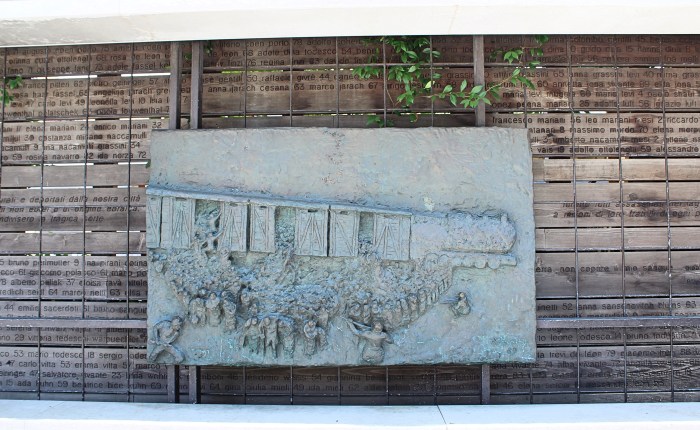
The final result of this—Shylock’s villainy and the play’s anti-Semitism—made the trial scene literally sickening for me. One man, mistreated and spiteful, is trying to legally kill another man for defaulting on a debt, and he is in turn stripped of his property, his identity, and his honor—humiliated, kicked, and spat upon. And all this is delivered as the denouement of a romantic farce, complete with cross-dressing ladies and a playful love story. I admit that I was in no mood to overlook or excuse the anti-Semitism, having recently stood in the Ghetto Vecchio in Venice, and seen the monuments to the deported Jews there. Even so, I think anyone must admit that the play’s dramatic coherence is seriously compromised, even destroyed, by the decline of anti-Semitism.

It speaks to the power of Shakespeare’s art that, even in such an obviously anti-Semitic play, which uses so shamelessly anti-Jewish stereotypes, and which so joyfully persecutes the play’s Jewish villain—even despite all this, we still read and stage this play. As often happens in life, charisma can deaden our moral senses; and Shylock is nothing if not charismatic. He is one of dozens of Shakespeare’s characters whose dialogue reveals a complete personality, a shifting mind whose depths we can only guess at, whose roving interior life extends into parts unknown. Somehow Shakespeare has conjured a character that embodies all of the negative Jewish stereotypes, yet who nevertheless is a believable and fully individual human. This is dramatically admirable and, in retrospect, morally reprehensible. For, as Harold Bloom said, Shylock’s very plausibility is why the play has been such a potent inspiration for anti-Semites.

I am not sure what conclusion to draw from all this. The play is without doubt one of Shakespeare’s stronger efforts. And yet, by the end, I felt little more then distress.

View all my reviews

Review: Stones of Venice

Review: Stones of Venice

The Stones of VeniceThe Stones of Venice by John Ruskin

My rating: 4 of 5 stars

Many people, capable of quickly sympathizing with any excellence, when once pointed out to them, easily deceive themselves into the supposition that they are judges of art.

I recently went on a short trip to Venice, for which I chose an abridged version of this work to accompany me. Ruskin is an eccentric guide, to say the least. To call him ‘opinionated’ is to risk absurd understatement. For Ruskin uses his survey of Venetian architecture, not merely to instruct, but as evidence for his grand theses of art and society. Few writers could turn descriptions of vaults, capitals, and statues into impassioned social criticism; but Ruskin was no ordinary man.

Ruskin’s primary contention is that gothic art was in every way superior to that of the Renaissance, and this was so because gothic art embodied positive social virtues. The workmen had considerable creative freedom, and did not simply execute the instructions of the master architect; not just nobles and popes, but ordinary citizens and guilds contributed to building projects; and the religious architecture was not done in a special style, but was an elaboration of the normal civic architecture of the town. In short, gothic art was communal, while the art and architecture of the Renaissance and later was individualistic, and suffered accordingly.

It is difficult to even critically engage with this thesis, since it rests on Ruskin’s unconvincing conviction that aesthetic and ethical virtues spring from the same root. Like Tolstoy and Orwell, Ruskin was a man possessed of both keen artistic sensitivity and a burning moral conscience; and like those two Ruskin struggled to reconcile these proclivities. To an extent this issue is troubling for us all. We are disturbed to find that our favorite singer beat his wife, or that our favorite writer is a white supremacist. Can we enjoy the art of such disreputable people? Many opt to boycott the works of artists they deem unacceptable. But Ruskin went further, and asserted that truly immoral people cannot make fine art. In this, Ruskin becomes a proper Platonist, equating beauty and goodness—and throwing truth into the bargain as well—thus cutting the uncomfortable gordian knot.

This position has the intellectual convenience of uniting all the goods on one side. This is very appealing for the social reformer. But this comes with the inconvenience of having to argue palpable absurdities. Ruskin is forced, for example, to make statements such as: “It is very possible that the reader may at first like fig. 14 best. I shall endeavor, in the next chapter, to show why he should not”—vainly trying to argue somebody out of an aesthetic preference. Contrariwise, when great art is made by figures whom history has shown to be immoral, Ruskin must commit the opposite absurdity—opposing his own aesthetic sense to documented fact:

I do not believe, of the majority of the leading Venetians of this period whose portraits have come down to us, that they were deliberately and everlastingly hypocrites. I see no hypocrisy in their countenances. Much capacity of it, much subtlety, much natural and acquired reserve; but no meanness. On the contrary, infinite grandeur, repose, courage, and the peculiar unity and tranquility of expression which come of sinciety or wholeness of heart, and which it would take much demonstration to believe could be any possibility be seen on the countenance of an insincere man.

Few people will be converted to this way of thinking, which submits reality to the whims of Ruskin’s moral and artistic senses. It is, however, refreshing to see a man so passionately convinced of the social importance of art. Ruskin scours to the city of Venice—sketchbook and notepad in one hand, step ladder under the other arm—making detailed studies of statues, capitals, friezes, cornices, and whatever other stone monuments he could find. The original edition of this book includes descriptions of eighty churches. Even in my heavily abridged edition, Ruskin goes through every capital of the Ducal Palace, comparing the representations of the virtues to Giotto’s and to Spenser’s—a tedious yet extraordinary feat. Idle fancy could hardly spur such devotion. He operated with the zeal of a reformer and the conviction of a crusader—ready to show all the world that these stones held the key to social welfare.

Personally I wish there were more people like Ruskin in the world, even if they can be insufferable at times. He wanted to live in a beautiful world, and he wanted that beauty to both reflect and encourage the health of its society. We may be inclined to laugh at Ruskin’s arguments; yet we are willing to pay thousands of dollars to go to these beautiful places and see them for ourselves—which, like Venice, consequently become hollowed out shells of their former selves from the influx of tourism—without stopping to wonder why we don’t spare ourselves the trouble and make our own cities beautiful. While I suspect the rise of urban ugliness is far more complex than Ruskin is apt to think, I agree with him in seeing a moral and social dimension to this aesthetic problem.

In any case, it is a pleasure to read Ruskin if only for his rococo prose, whose sentences twist, curl, and spiral into little infinities. One can see why Proust was a fan (and, indeed, his Narrator’s visit to Venice owes much to the Victorian critic). Ruskin was true to his principles, and strove to unite literary elegance, moral fervor, and insightful argument into every one of his paragraphs—and most of the time he achieves at least two out of three, which is not bad at all. Even if you disagree with Ruskin from first to last, it is scarcely possible to dive in his book and come out the other side without a few of his cobwebs sticking to your coat.

View all my reviews

Review: Lives of the Artists

Review: Lives of the Artists

Lives of the ArtistsLives of the Artists by Giorgio Vasari

My rating: 4 of 5 stars

An artist lives and acquires fame through his works; but with the passing of time, which consumes everything, these works—the first, then the second, and the third—fade away.

After Plutarch’s Lives, Vasari’s Lives of the Artists is likely the most iconic collection of biographies of famous men. He published two editions of the book, the first in 1550, the second in 1568; and both found success in Vasari’s lifetime and have continued to sell well ever since. In life Vasari was a typical Renaissance man, achieving fame for his paintings (he decorated the Palazzo Vecchio) and his architecture (he was responsible for the loggia of the Uffizi), in addition to his work as a biographer. Granted, his paintings are not highly regarded nowadays (though many are pleasing enough to my eyes); but this posthumous verdict did not prevent him from making a fine living. And when you write the first book of art history in the history of art, the rest hardly matters.

The edition I own is highly abridged, as are nearly all popular versions, since the original contains dozens upon dozens of painters, sculptors, and architects—most of whom the casual reader does not know of or care for. This explains why most of the Lives are so short. Indeed, fans of any particular Renaissance artist are liable to be disappointed by Vasari’s treatment. He runs through Sandro Botticelli in all of ten pages, for example, barely pausing to mention the Birth of Venus. Indeed, many of these biographies are hardly biographies at all, just extended catalogues of works. This is certainly useful for the art historian (though Vasari made many mistakes) but it does not make for electrifying reading.

The modern psychoanalyzing mode of artistic biographies was, of course, entirely alien to Vasari, and he seems to regard the artist’s personality as a source of gossip but not of insight. This does not prevent him from including many good stories. Like Plutarch himself, Vasari is rich in anecdote—and, as in Plutarch, half of them are probably false. Fact or fiction, a good story is preferable to a dry fact, and this is when Vasari’s Lives really come alive. We hear of Cimabue agreeing to take on Giotto as a pupil, after seeing the young boy scratching on a stone; or of Paolo Uccello staying up long nights to work on problems of perspective. Whether these stories help us to understand the paintings is doubtful; but they do help to bring alive this amazing time in history.

Vasari begins the book with a sketch of the history of art as he understood it. His opinion is not a masterpiece of subtlety. In essence, the Greeks and Romans understood that art begins by copying nature, and so produced excellent works; then art fell into barbarism (Vasari coined the term “gothic” to describe medieval art) in which the ancient knowledge was lost and artists had no knowledge of proper technique; finally the painter Giotto came and revived the arts, inaugurating a process that culminated in the works of Michelangelo. I must say that this view, though little more than naked prejudice, is at least refreshing in Vasari’s conviction that art was ascending and culminating in his own epoch. (Most of us are disposed to think it is declining.) It is striking that Michelangelo’s historic importance was understood even during his own lifetime. This was not an age of poor Van Goghs working in lonely shacks. The great artists were recognized and rewarded when they lived; and younger artists were seen to have surpassed their masters—novel concepts in our romantic age.

The Life of Michelangelo, whom Vasari knew and worshipped, is by far the longest and forms the core of this collection. Indeed, all the other lives can be seen as mere leadup to the great Florentine, who fulfils all the promise of former ages. Vasari here turns from chronicler to hagiographer, praising Michelangelo with every breath. You might even say that Vasari turns into quite the Boswell, including various bits of Michelangelo’s conversation, and also several letters written to him by the great artist, as if to prove that Michelangelo really was his friend. All this makes for good reading, even if the worshipful tone is grating. The second longest Life in my collection is that of another Florentine (Vasari was a fierce patriot of his home city), Filippo Brunelleschi. This life is perhaps even better than that of Michelangelo, as Vasari charts the squabbles and drama behind the scenes of Brunelleschi’s dome.

Vasari’s style is easygoing and almost conversational, and the pages go by quickly. He strikes me as a man full of shallow opinions but of a generous mind and a steady judgment. This book—full of errors, lacking any historical context, and greatly out of step with modern opinion—could hardly be read as a standalone volume on Renaissance painting. But every book on the subject borrows, knowingly or unknowingly, from Vasari, who has given bread to scholars and delight to readers for generations with this charming book.

I have endeavored not only to record what the artists have done but to distinguish between the good, the better, and the best, and to note with some care the methods, manners, styles, behavior, and ideas of the painters and sculptors; I have tried as well as I know how to help people who cannot find out for themselves to understand the sources and origins of various styles, and the reasons for the improvement or decline of the arts at various times and among different people.

View all my reviews

Review: Plutarch’s Lives

Review: Plutarch’s Lives

Parallel LivesParallel Lives by Plutarch

My rating: 3 of 5 stars

Ease, and speed of execution, seldom produces work of any permanent value or delicacy. It is the time which is spent in laborious production for which we are repaid by the durable character of the result.

In the course of his grand theory of history, Oswald Spengler distinguishes what he sees as the fundamental difference between the ancient Greco-Roman and the contemporary Western cultures: the Greek’s ideal concept was of bounded, perfect forms, while the Western soul craves the boundless, the formless, and the infinite. It is a somewhat vague statement, I know, but I kept coming back to Spengler’s idea as I read Plutarch’s Lives.

Specifically, I kept thinking of Spengler’s idea as I mentally compared Plutarch’s conception of personality with Montaigne’s. I could not help making this comparison, you see, since it was Montaigne who led me to Plutarch. The Frenchman idolized the Greek; and the Essays are full of quotes of and references to Plutarch. Indeed, Montaigne specifically praises Plutarch for his insight into human nature:

The historians are my right ball, for they are pleasant and easy, and where man, in general, the knowledge of whom I hunt after, appears more vividly and entire than anywhere else… the variety and truth of his internal qualities, in gross and piecemeal, the diversity of means by which he is united and knit, and the accidents that threaten him. Now those that write lives, by reason they insist more upon counsels than events, more upon what sallies from within, than upon what happens from without, are the most proper for my reading; and, therefore, above all others, Plutarch is the man for me.

For my part this quote better describes Montaigne than Plutarch. Since it is exactly in this—the representation of personality—that I think Spengler’s idea most aptly applies in these two writers.

Compare the representation of a person in a classical Greek statue and in a portrait by Rembrandt, and I think you will catch my meaning. The first is all surface—shapely limbs, a well-proportioned body, a harmonious face, whose eyes nevertheless stare out serenely into vacancy, suggesting nothing internal. In Rembrandt it is exactly the reverse: the face may be ugly, the body largely hidden in shadows, yet all the energy is focused on the expression—an expression of endless suggestion, which brings to us a definite human personality.

I feel the same contrast between Plutarch and Montaigne. Plutarch’s method of characterization is statuesque. He enumerates his heroes’ virtues and qualities as if they were set in stone; and he derives all of their actions from these static characteristics. Montaigne is completely the reverse: he contradicts himself a thousand times in his book, and in the process reveals the qualities of his mind far more exquisitely than any straightforward description could accomplish. Plutarch’s heroes never change: their character is their destiny; whereas Montaigne is nothing but change. Indeed, for me it is hard to say that Plutarch’s heroes have “personality,” in the sense that I can imagine meeting them. They are no more relatable than a Greek statue.

They were certainly relatable to Plutarch himself, however, as he writes in a famous passage:

It was for the sake of others that I first undertook to write biographies, but I soon began to dwell upon and delight in them for myself, endeavoring to the best of my ability to regulate my own life, and to make it like that of those who were reflected in their history as it were in a mirror before me. By the study of their biographies, we receive each man as a guest into our minds, and we seem to understand their character as the result of personal acquaintance, because we have obtained from their acts the best and most important means of forming an opinion about them.

This quote also illustrates Plutarch’s moral purpose. For a book written by a Greek living under Roman domination, comparing the lives of Greeks and Romans, he seems to have been quite bereft of political purpose. He is, rather, a moralist. Through his biographies he hopes to determine which actions are noble, which nobler, and which noblest, an analysis he performs through his comparisons at the end of the paired lives. He writes biographies in the conviction that we naturally imitate which we see and admire; we are drawn in by the attraction we feel for noble characters, and become ennobled ourselves in the process. This is why Plutarch eschews writing strict history:

I am writing biography, not history; and often a man’s most brilliant actions prove nothing as to his true character, while some trifling incident, some casual remark or jest, will throw more light upon what manner of man he was than the bloodiest battle, the greatest array of armies, or the most important siege. Therefore, just as portrait painters pay most attention to those peculiarities of the face and eyes, in which the likeness consists, and care but little for the rest of the figure, so it is my duty to dwell especially upon those actions which reveal the workings of my heroes’ minds, and from these to construct the portraits of their respective lives, leaving their battles and their great deeds to be recorded by others.

This sounds promising enough: teaching moral lessons through depicting great personalities. My problem—aside from not being able to relate to the heroes—was that I questioned the very greatness of their actions. Of course there are many virtuous actions recorded here, worthy of praise and emulation. However, nearly all of Plutarch’s heroes are military commanders; and these pages are spattered with blood. The cutthroat world of ancient political squabbles, territorial conquests, internal strife, did not strike me as promising ground to teach virtue. Voltaire was perhaps thinking of Plutarch when he made this remark:

Not long since the trite and frivolous question was was debated in a very polite and learned company, viz., Who was the greatest man, Caesar, Alexander, Tamerlane, Cromwell, etc.? Somebody answered that Sir Isaac Newton excelled them all. The gentleman’s assertion was very just; … those politicians and conquerors (and all ages produce some) were generally so many illustrious wicked men. That man claims respect who commands over the minds of the rest of the world by force of truth, not those who enslave their fellow-creatures: he who is acquainted with the universe, not they who deface it.

Plutarch, to his credit, does give a remarkable portrait of the Newton of his time: Archimedes. But this is tucked away in his life of the Roman general, Marcellus.

For these reasons I had a great deal of difficulty in finishing this book. After every couple Lives I had to take a break; so it took me three years of on-again, off-again reading to finally get to the end. My ignorance did not help, either. Plutarch, being an ancient author, sometimes presumed a great deal more knowledge that I possessed about the relevant political history; and so I found myself frequently lost. And his style, though eloquent, is also monotonous (at least in translation), which was another challenge to my attention.

But I am glad I read Plutarch. This book is an extraordinary historical document, an invaluable (but not infallible) source of information about these ancient figures. Plutarch loved a good story and these pages are rich in anecdote—some of them so famous that it is likely you know one even if you have not read Plutarch. And though I struggled through many of the less famous figures, I was entranced by Plutarch’s biographies of the heroes I was acquainted with: Pompey, Alexander, Cicero, Brutus, and Antony. (Shakespeare followed the latter two Lives very closely in his Roman plays.) If Plutarch was good enough for Montaigne then, by Jove, he is good enough for me.

View all my reviews

Review: The Logic of Scientific Discovery

Review: The Logic of Scientific Discovery
The Logic of Scientific Discovery

The Logic of Scientific Discovery by Karl R. Popper

My rating: 4 of 5 stars

We do not know: we can only guess.

Karl Popper originally wrote Logik der Forchung (The Logic of Research) in 1934. This original version—published in haste to secure an academic position and escape the threat of Nazism (Popper was of Jewish descent)—was heavily condensed at the publisher’s request; and because of this, and because it remained untranslated from the German, the book did not receive the attention it deserved. This had to wait until 1959, when Popper finally released a revised and expanded English translation. Yet this condensation and subsequent expansion have left their mark on the book. Popper makes his most famous point within the first few dozen pages; and much of the rest of the book is given over to dead controversies, criticisms and rejoinders, technical appendices, and extended footnotes. It does not make for the most graceful reading experience.

This hardly matters, however, since it is here that Popper put forward what has arguably become the most famous concept in the philosophy of science: falsification.

This term is widely used; but its original justification is not, I believe, widely understood. Popper’s doctrine must be understood as a response to inductivism. Now, in 1620 Francis Bacon released his brilliant Novum Organum. Its title alludes to Aristotle’s Organon, a collection of logical treatises, mainly focusing on how to make accurate deductions. This Aristotelian method—characterized by syllogisms: deriving conclusions from given premises—dominated the study of nature for millennia, with precious little to show for it. Francis Bacon hoped to change all that with his new doctrine of induction. Instead of beginning with premises (‘All men are mortal’), and reasoning to conclusions (‘Socrates is mortal’), the investigator must begin with experiences (‘Socrates died,’ ‘Plato died,’ etc.) and then generalize a conclusion (‘All men are mortal’). This was how science was to proceed: from the specific to the general.

This seemed all fine and dandy until, in 1738, David Hume published his Treatise of Human Nature, in which he explained his infamous ‘problem of induction.’ Here is the idea. If you see one, two, three… a dozen… a thousand… a million white swans, and not a single black one, it is still illogical to conclude “All swans are white.” Even if you investigated every swan in the world but one, and they all proved white, you still could not conclude with certainty that the last one would be white. Aside from modus tollens (concluding from a negative specific to a negative general), there is no logically justifiable way to proceed from the specific to the general. To this argument, many are tempted to respond: “But we know from experience that induction works. We generalize all the time.” Yet this is to use induction to prove that induction works, which is paradoxical. Hume’s problem of induction has proven to be a stumbling block for philosophers ever since.

In the early parts of the 20th century, the doctrine of logical positivism arose in the philosophical world, particularly in the ‘Vienna Circle’. This had many proponents and many forms, but the basic idea, as explained by A.J. Ayer, is the following. The meaning of a sentence is equivalent to its verification; and verification is performed through experience. Thus the sentence “The cat is on the mat” can be verified by looking at the mat; it is a meaningful utterance. But the sentence “The world is composed of mind” cannot be verified by any experience; it is meaningless. Using this doctrine the positivists hoped to eliminate all metaphysics. Unfortunately, however, the doctrine also eliminates human knowledge, since, as Hume showed, generalizations can never be verified. No experience corresponds, for example, to the statement: “Gravitation is proportional to the product of mass and the inverse square of distance,” since this is an unlimitedly general statement, and experiences are always particular.

Karl Popper’s falsificationism is meant to solve this problem. First, it is important to note that Popper is not, like the positivists, proposing a criterion of ‘meaning’. That is to say that, for Popper, unfalsifiable statements can still be meaningful; they just do not tell us anything about the world. Indeed, he continually notes how metaphysical ideas (such as Kepler’s idea that circles are more ‘perfect’ than other shapes) have inspired and guided scientists. This is itself an important distinction because it prevents him from falling into the same paradox as the positivists. For if only the statements with empirical content have meaning, then the statement “only the statements with empirical content have meaning” is itself meaningless. Popper, for his part, regarded himself as the enemy of linguistic philosophy and considered the problem of epistemology quite distinct from language analysis.

To return to falsification, Popper’s fundamental insight is that verification and falsification are not symmetrical. While no general statement can be proved using a specific instance, a general statement can indeed be disproved with a specific instance. A thousand white swans does not prove all swans are white; but one black swan disproves it. (This is the aforementioned modus tollens.) All this may seem trivial; but as Popper realized, this changes the nature of scientific knowledge as we know it. For science, then, is far from what Bacon imagined it to be—a carefully sifted catalogue of experiences, a collection of well-founded generalizations—and is rather a collection of theories which spring up, as it were, from the imagination of the scientist in the hopes of uniting several observed phenomena under one hypothesis. Or to put it more bluntly: a good scientific theory is a guess that does not prove wrong.

With his central doctrine established, Popper goes on to the technicalities. He discusses what composes the ‘range’ or ‘scope’ of a theory, and how some theories can be said to encompass others. He provides an admirable justification for Occam’s Razor—the preference for simpler over more complex explanations—since theories with fewer parameters are more easily falsified and thus, in his view, more informative. The biggest section is given over to probability. I admit that I had some difficulty following his argument at times, but the gist of his point is that probability must be interpreted ‘objectively,’ as frequency distributions, rather than ‘subjectively,’ as degrees of certainty, in order to be falsifiable; and also that the statistical results of experiments must be reproducible in order to avoid the possibility of statistical flukes.

All this leads up to a strangely combative section on quantum mechanics. Popper apparently was in the same camp as Einstein, and was put off by Heisenberg’s uncertainty principle. Like Einstein, Popper was a realist and did not like the idea that a particle’s properties could be actually undetermined; he wanted to see the uncertainty of quantum mechanics as a byproduct of measurement or of ‘hidden variables’—not as representing something real about the universe. And like Einstein (though less famously) Popper proposed an experiment to decide the issue. The original experiment, as described in this book, was soon shown to be flawed; but a revised experiment was finally conducted in 1999, after Popper’s death. Though the experiment agreed with Popper’s prediction (showing that measuring an entangled photon does not affect its pair), it had no bearing on Heisenberg’s uncertainty principle, which restricts arbitrarily precise measurements on a single particle, not a pair of particles.

Incidentally, it is difficult to see why Popper is so uncomfortable with the uncertainty principle. Given his own dogma of falsifiability, the belief that nature is inherently deterministic (and that probabilistic theories are simply the result of a lack of our own knowledge) should be discarded as metaphysical. This is just one example of how Popper’s personality was out of harmony with his own doctrines. An advocate of the open society, he was famously authoritarian in his private life, which led to his own alienation. This is neither here nor there, but it is an interesting comment on the human animal.

Popper’s doctrine, like all great ideas, has proven both influential and controversial. For my part I think falsification a huge advance over Bacon’s induction or the positivists’ verification. And despite the complications, I think that falsifiability is a crucial test to distinguish, not only science from pseudo-science, but all dependable knowledge from myth. For both pseudo-science and myth generally distinguish themselves by admirably fitting the data set, but resisting falsification. Freud’s theories, for example, can accommodate themselves to any set of facts we throw at them; likewise for intelligent design, belief in supernatural beings, or conspiracy theories. All of these seem to explain everything—and in a way they do, since they fit the observable data—but really explain nothing, since they can accommodate any new observation.

There are some difficulties with falsification, of course. The first is observation. For what we observe, or even what we count as an ‘observation’, is colored by our background beliefs. Whether to regard a dot in the sky as a plane, a UFO, or an angel is shaped by the beliefs we already hold; thus it is possible to disregard observations that run counter to our theories, rather than falsifying the theories. What is more, theories never exist in isolation, but in an entire context of beliefs; so if one prediction is definitively falsified, it can still be unclear what we must change in our interconnected edifice of theories. Further, it is rare for experimental predictions to agree exactly with results; usually they are approximately correct. But where do we draw the line between falsification and approximate correctness? And last, if we formulate a theory which withstands test after test, predicting their results with extreme accuracy time and again, must we still regard the theory as a provisional guess?

To give Popper credit, he responds to all of these points in this work, though perhaps not with enough discussion. But all these criticisms belie the fact that so much of the philosophy of science written after Popper has taken his work as a starting point, either attempting to amplify, modify, or (dare I say it?) falsify his claims. For my part, though I was often bored by the dry style and baffled by the technical explanations, I found myself admiring Popper’s careful methodology: responding to criticisms, making fine distinctions, building up his system piece by piece. Here is a philosopher deeply committed to the ideal of rational argument and deeply engaged with understanding the world. I am excited to read more.

View all my reviews

Review: Protagoras & Meno

Review: Protagoras & Meno

ProtagorasProtagoras by Plato

My rating: 4 of 5 stars

But you cannot buy the wares of knowledge and carry them away in another vessel; when you have paid for them you must receive them into the soul and go your way, either greatly harmed or greatly benefited

In style the Protagoras is intermediate between the questioning Socrates of the early dialogues and the doctrinizing Socrates of the Gorgias. Here, Socrates is not only concerned in revealing the confusion of common notions, but also in advancing his own theories; yet the dialogue ends on an inconclusive note and, what is more, the ideas that Socrates advances are not the ones we recognize as Plato’s own mature philosophy.

As in the Gorgias, Socrates enters a gathering of sophists and their admirers, with the intent of questioning the practice of Sophism. Unlike Gorgias the rhetorician, however, Protagoras the sophist proves himself to be a formidable opponent. Indeed, in the beginning of the dialogue Protagoras has the upper hand, effectively resolving Socrates’ doubts regarding the teachability of virtue.

Socrates questions whether virtue can be taught, because, if virtue is teachable, then why do good men have bad sons? And why are their no specialists in virtue, as there are specialists in medicine and carpentry? Protagoras counters, first, with a myth about the origin of virtue, explaining that it was a gift of Zeus to all humans. Thus everyone is capable of virtue, and everyone is a teacher of virtue according to her ability; indeed you might say that virtue is taught all the time every day, just like Greek is. To illustrate the point, Protagoras uses a thought experiment involving a society where everyone played the flute. In such a society, some good men would likely have sons who were subpar flute players; but even the worst player in that society would likely be adept relative to a non flute-based society.

To drive home the point, Protagoras observes that punishment would be unreasonable if virtue were not teachable. For to punish as pure retribution is irrational and beastly—naked vengeance, which may satisfy anger but which will not undo any past wrongs. Punishment can only be rational if it is directed towards the future: to correct the wrongdoer and to discourage any others from following her example. The fact that the Athenians punish therefore proves that they believe that virtue can be taught.

Socrates uncharacteristically declares himself wholly satisfied and convinced by this answer. But one doubt remains: Are the parts of virtue, such as wisdom, courage, or piety, all independent, or are they all different names for the same basic thing? Protagoras at first asserts them to be different; a person may be courageous but impious, for example. However, Socrates trips him up with a question about opposites. Does everything have only one opposite? Yes, says Protagoras. So everything that is not wise is foolish? Of course. Then it is possible for piety to be foolish? At this Protagoras hesitates, and attempts to stop the conversation. Meanwhile, Socrates puts forth his doctrine that virtue is knowledge, specifically knowledge of pleasure and pain; and that this knowledge allows us to accurately estimate the pleasant and painful consequences of actions, and to make the best choice. (Plato would not persist with this position.)

In the course of this argument, Socrates and Protagoras have a dispute about the length of their responses. After Protagoras gives a little speech in answer to a question, Socrates professes himself too forgetful to follow long utterances, and requests that Protagoras stick with short answers. (This request is made to Gorgias, too.) Protagoras bristles at this and wants to quit; it takes the surrounding party to convince him to carry on. This seems to have been one of Socrates’ (and Plato’s) main complaints against the sophists, namely that they conceal poor reasoning in extended eloquent speeches. Plato also takes the opportunity to poke fun at those who argue by quoting and interpreting poems, putting a long and wholly implausible interpretation of a poem in Socrates’ mouth, thus illustrating that with sufficient ingenuity any meaning can be extracted from any poem.

The combatants disperse as friends and Socrates lives to argue another day.


MenoMeno by Plato

My rating: 3 of 5 stars

And how will you enquire, Socrates, into that which you do not know? What will you put forth as the subject of enquiry? And if you find what you want, how will you ever know that this is the thing which you did not know?

Reading this dialogue immediately after reading the Protagoras confronts the reader with the mystery of Plato. For here are two dialogues, both about the same questions—What is virtue? Can it be taught?—and coming to opposite conclusions. And this leads to still more questions: Was Plato’s own opinion changing? Or was he representing Socrates’ opinions in one dialogue and his own opinions in another? Or did Socrates’ own opinion change? Or is it some other mixture of reported and original thought? It is impossible to know the answer—but that has never stopped philosophers.

The Meno is a fine example of Plato’s economy. Not a word is wasted in this dialogue. We begin with the inquiry and jump straight into difficulties. Can virtue be taught? Well, what is virtue? Meno says that each type of person has their own virtue—women, men, slaves, citizens, children, adults, and so on. To which Socrates responds that these virtues, qua being virtues, must all have at least one quality in common. (Here Wittgenstein would interject.) Then Meno throws up his hands, declares himself stunned, and offers his famous paradox (quoted above).

Socrates weasels his way out of this with the Platonic doctrine of remembrance. What if we are born (rather, reborn) already filled with true knowledge, and must merely remember what our souls learned during their sojourns in heaven. He demonstrates by leading one of Meno’s young slaves through a mathematical demonstration of square roots. By making the correct deductions, the boy is able to find the right conclusions, from which Socrates concludes that the boy “knew” the information all along. (Though this conclusion will likely strike most of us as absurd, one must keep in mind that, for Plato, all empirical knowledge—knowledge gained through the senses—was not truly knowledge at all, since the observed world changes, but the Truth remains forever eternal.)

The slave boy retreats, enlightened but not emancipated (depressingly, not even great thinkers had scruples about slavery back then), and Socrates and Meno return to the original question. Anytus the politician then appears, whom Socrates uses to prove that the sons of great men are often rather ordinary as far as virtue is concerned, which prompts Anytus to warn Socrates not to slander citizens (he would later be an accuser of Socrates during his trial). There are two possible explanations for this: Either virtue cannot be taught, in which case it is not knowledge; or these great men did not themselves possess the knowledge of virtue.

This second option is pursued by Socrates, who makes a delicate division between “knowledge” and “true opinion.” These may sound identical, but for Socrates the latter is distinguished by not being properly justified. If, for example, I guess that a book of poetry is under the table, and it is under the table, I have true opinion, since I was correct, but not knowledge, since my being correct was fortuitous. Socrates concludes that these great men acted virtuously from true opinion—vouchsafed by the gods—and not real knowledge, since they could not transmit their virtue.

As a teacher myself, I cannot help being interested in the questions of this dialogue. For me, the fundamental paradox was aptly summed up by Gibbon: “the power of instruction is seldom of much efficacy, except in those dispositions where it is almost superfluous.” That is, teaching will most benefit those who least need teachers, since they are motivated to learn on their own, and vice versa. This seems to apply as much to mathematics as it does to virtue. Can a virtuous Hadrian whip a vicious Commodus into shape? I am skeptical. And yet, it is this quixotic task I have set before me.

View all my reviews