Review: The Great Bridge

Review: The Great Bridge

The Great Bridge: The Epic Story of the Building of the Brooklyn BridgeThe Great Bridge: The Epic Story of the Building of the Brooklyn Bridge by David McCullough

My rating: 4 of 5 stars

… on a day when two young men were walking on the moon, a very old woman on Long Island would tell reporters that the public excitement over the feat was not so much compared to what she had seen “on the day they opened the Brooklyn Bridge.”

On the inside cover of my copy of this book its previous owner has inserted a little love note. The brief message is written in a very neat script, in red ink, apparently on the eve of a long separation. Now, you may think that a book about the Brooklyn Bridge is a rather odd gift for a lover—and, considering that the book ended up in a used book shop, this may be what the recipient thought, too—but, now that I have read McCullough’s chronicle of the Brooklyn Bridge, I can see why it might inspire such sentimental attachment. For it is a thoroughly lovable book.

This is my first McCullough work, and I am pleased. He is a fine writer. His prose is stylish yet unobtrusive, striking that delicate balance between being intelligible but not simplified. He has a keen eye for the exciting details of a seemingly dry story; and effectively brings together many different threads—the personalities, the politics, the technology—in such a way that the past looms up effortlessly in the imagination. The only parts which I think could have been improved were his explanations of the engineering, since he used too many unfamiliar terms without explaining them, perhaps thinking that such explanations might swell the book to unseemly proportions. In any case, he is a writer, not an engineer, and he shines most when discussing the human experience of the Bridge.

The bridge’s designer was John A. Roebling, who deserves a book unto himself. An eccentric polymath, who among other things studied philosophy under Hegel, he came to America to found a Utopian village and ended up the foremost expert on suspension bridges. The Brooklyn Bridge was his project; but tragically he died during the first year of the project, after his foot was crushed, his toes amputated, and he contracted tetanus. His son, Washington, immediately took over—in many ways just as remarkable a man. A Civil War hero with a tenacious memory, the bridge ruined his health, too, through a combination of stress and the bends.

In those days the bends were known as “caisson sickness,” named for the compartment sunk underwater in order to excavate for the bridge’s foundations. These were filled with pressurized air in order to prevent water from seeping in. Unfortunately, in those days the dangers of rapidly depressurizing were not understood, so many people fell ill during the construction—including Roebling himself, who spent the final years of the bridge’s construction as an invalid, observing the work through a telescope from his apartment. Luckily for him, his wife, Emily, was a remarkable woman—diplomatic and brilliant—and helped to carry the project to completion.

These personalities come alive in McCullough’s narration, turning what could have been a dry chronicle into an enthralling book. And this is not to mention the political corruption, the manufacturing fraud, the deadly accidents, and the glorious celebrations that took place during the fourteen years of the bridge’s construction.

Yesterday I revisited the Brooklyn Bridge, which is beautiful even if you know nothing about it. As a friend and I strolled across in the intense summer heat, elbowing our way through crowds of tourists, I blathered on about all the fun facts I had learned from this book—which I am sure my friend very much appreciated. Sensing his discomfort, I made sure to emphasize that a fraudulent wire manufacturer had tricked the engineers into using sub-par cables, and that a panic broke out a week after the bridge’s opening, which resulted in twelve people being trampled. You see this book has already helped my social life. Maybe next I can write my own love note inside.

View all my reviews

Review: Don Quixote

Review: Don Quixote

Don Quijote de la Mancha: puesto en castellano actual íntegra y fielmente por Andrés TrapielloDon Quijote de la Mancha: puesto en castellano actual íntegra y fielmente por Andrés Trapiello by Miguel de Cervantes Saavedra

My rating: 5 of 5 stars

“I know who I am,” replied don Quijote, “and I know who I can be…”

I bought this book under the sway of a caprice which, if it were not too hackneyed to say so, I would call quixotic. This was two years ago. I was in the royal palace in La Granja de San Ildefonso, near Segovia. I had just toured the palace—one of the finest in Spain—and was about to explore the French gardens, modeled after those in Versailles, when I encountered the gift shop. Normally I do not buy anything in gift shops, since half of it is rubbish and all of it is overpriced. But this book, this particular volume, called out to me and I obeyed.

It was a foolish purchase—not only because I paid gift-shop prices, but because my Spanish was not anywhere near the level I needed to read it. And at the time, I had no idea I would be staying in Spain for so long. There was a very good chance, in other words, that I would never be able to tackle this overpriced brick with Bible-thin pages. At least I left myself some hope. For this is not the original El ingenioso caballero don Quijote de la Mancha—written in Spanish contemporaneous with Shakespeare’s English—but a bastardization: its style diligently modernized by the writer Andrés Trapiello. Even with this crutch, and even with an additional two years of living in Spain, this book was a serious challenge.

Before charging headlong into the thickets of criticism, I want to say a word in praise of Trapiello’s edition. Cervantes’s Spanish is not as difficult as Shakespeare’s English, but it still foreign enough to prove an obstacle even to native speakers. I know many Spaniards, even well-read ones, who have never successfully made it through El Quijote for this very reason (or so they allege). Trapiello has done the Spanish-speaking world a great service, then, since he has successfully made El Quijote as accessible as it would have been to its first readers, while preserving the instantly recognizable Cervantine style. And while I can see why purists would object to this defacement of hallowed beauty, I would counter that, if ever there were a book to painlessly enjoy, it is El Quijote.

To get a taste of the change, here is Trapiello’s opening lines:

En un lugar de la Mancha, de cuyo nombre no quiero acordarme, vivía no hace mucho un hidalgo de los de lanza ya olvidada, escudo antiguo, rocín flaco y galgo corredor. Consumían tres partes de su hacienda una olla con algo más de vaca que carnero, ropa vieja casi todas las noches, huevos con torreznos los sábados, lentejas los viernes y algún palomino de añadidura los domingos.

And here is the original:

En un lugar de la Mancha, du cuyo nombre no quiero acordarme, no ha mucho tiempo que vivía un hidalgo de los de lanza en astillero, adarga antigua, rocín flaco y galgo corredor. Una olla de algo más vaca que carnero, salpicón las más noches, duelos y quebrantos los sábados, lentejas los viernes, algún palomino de añadidura los domingos, consumían tres partes de su hacienda.

Now, undeniably something is lost in the transition. Cervantes’s “duelos y quebrantos” (lit. “aches and pains”), for example, is undeniably more evocative than Trapiello’s “huevos con torreznos” (eggs with bacon); but without Trapiello I would have no idea what Cervantes meant. It is also worth noting how similar the two are; Trapiello has taken care to change only what he must.

Onward to the book itself. But I hesitate. The more I contemplate this book, the more I think that a critic must be as daft as the don and as simple as his squire to think he can get to the bottom of it. Cervantes was either extremely muddle-headed or fantastically subtle, since this book resists any definite conclusions you may try to wring from its pages. Perhaps, like many great books, it simply got out of the author’s control. Just as Tolstoy set out to write the parable of a fallen woman and gave us Anna Karenina, and as Mark Twain set out to write a boys’ book and invented American literature, it seems Cervantes set out to write a satire of chivalric romances and produced one of the great works of universal art. It is as if a New Yorker cartoonist accidentally doodled Guernica.

The key to the book’s enduring beauty, I think, is Cervantes’s special brand of irony. He is the only author I know who can produce scorn and admiration in the same sentence. He is able to ruthlessly make fun of everything under the sun, while in the same moment praising them to the heavens. The book itself embodies this paradox: for it is at once the greatest rejection of chivalric romance and its greatest embodiment—an adventure tale that laughs at adventure tales. There is no question that Cervantes finds the old don ridiculous, and he makes us agree with him; yet by the end, Quijote is more heroic than Sir Galahad himself.

The central question the books asks is whether idealism is noble or silly. There is no question that the Knight of the Sorrowful Countenance is a hilarious figure. But do we laugh at his expense, or at our own? Is his idealism pathetic, or is it our realism? The book resists both horns of this dilemma, until finally we must conclude that we are all—dreamers and realists alike—equally ridiculous. For we all reside in a social world whose rules only exist in our beliefs and in our actions, a world which we create but do not design. It is only Quijote who seems to realize (however unconsciously) that, by changing the script, we can recreate the world. And he does. By the time we get to Part Two, everyone is playing along with Quijote.

Even so, I am not able to go so far as Miguel de Unamuno, and consider Quijote a sort of messiah. I do not think Cervantes’s irony permits this. For Quijote truly is out of touch, and frequently gets pummeled for it. And even when his fantasy inspires others to play along, and to help him create his new world, they never do so for disinterested reasons. Some, including Sancho, play along for gain; others do so to control or to help Quijote; and most do it just to have some fun at his expense. This is the dilemma faced by all revolutionaries: they have the vision to see a better world, the courage to usher it in with their actions, and the charisma to inspire others to follow them; but most worldlings chose to play along for ulterior motives, not for ideals; and so the new world becomes as corrupt as the old one. To put this another way, Quijote’s problem is not that he is out of touch with the social order, but that he is out of touch with the human heart.

Much of the greatness of this book lays in the relationship between the don and his squire. Few friendships in literature are so heartwarming. Sancho, in his simplicity, is the only one who can even partially meet Quijote in his new world—as a genuine participant in Quijote’s make-believe. Of course, Sancho is not free from ulterior motives, either. There is the island he is to rule over. But the longer the story goes on, the more Sancho believes in his master, and the less he pursues material gain. We are relieved to see that, when finally offered his island, the squire comes running back to the don in a matter of days. As the only two inhabitants of their new world, as the only two actors in their play, they are homeless without one another.

It is useful to compare Shakespeare’s and Cervantes’s method of characterization. As Harold Bloom points out, Shakespeare’s characters are most truly themselves when they are alone, soliloquizing. When together, on the other hand, even close friends and lovers never seem to communicate perfectly, but talk past each other, or talk for their own benefit, or simply show off. But don Quijote and Sancho Panza are most truly themselves when they are with each other; they draw one another out and spur one another on; they ceaselessly bicker while remaining absolutely loyal; they quibble and squabble while understanding one another perfectly. When they are separated during Sancho’s sojourn on the island, the reader feels that each has lost more than half of himself. For my part, though I am not sure it is more “realistic,” I find Cervantes’s friendship more heartening than the bard’s. Though they begin as polar opposites, the squire and the knight influence one another as the story progresses, eventually coming to resemble one another. This beats Romeo and Juliet by a league.

What strikes most contemporary readers of this ur-novel is its modernity. Formally, Cervantes is far more daring than his Victorian successors. This is admittedly more apparent in Part Two, when Cervantes has his characters travel around a world where Part One has already been published and read widely, and where the spurious Part Two by Alonso Fernández de Avellaneda (a pseudonym) has just been released. This leads to self-referential tricks worthy of the coolest postmodernist: the duo encountering readers of the prequels and commenting on their own portrayal. Another daring touch was Cervantes’s use of the Arabic historian Cide Hamete Berengeli—whose Arabic book, found on the streets of Toledo, he is merely transcribing into Castilian—which allows him to comment on the text he is writing: praising the historian’s scrupulous attention to detail and skipping over boring sections in the “original.”

All this is done, not merely to be clever, but to reinforce the sense of infinite irony that pervades the text. The gap opened up by these tricks is what gives Cervantes room to be so delightfully ambiguous. As the authorship is called into question, and as the characters—who are imaginative actors to begin with—become aware of themselves as characters, the sense of a guiding intelligence crafting the story becomes ever more tenuous. The final irony, then, is that this self-referential irony does not undermine the reality of the story, but only reinforces it. In Part Two, especially, the characters leap from the book into reality, becoming both readers and writers of themselves—so real, indeed, that we risk repeating the don’s error of mistaking the book with reality.

Having said all this in praise of El Quijote, I should mention some of the book’s flaws. These are mostly confined to Part One, wherein Cervantes inserts several short novelas that have, for the most part, aged poorly. At the time there was, apparently, a craze for pastoral love stories involving shepherds and shepherdesses, which nowadays is soppy sentimental trash. One must also admit that Cervantes’s was a very mediocre poet, so the verse scattered throughout these pages can safely be skipped. On the whole, though the book’s most iconic moments are in Part One, Part Two is much superior and more innovative.

Part Two is also far sadder. And this is the last ambiguity: the reader can never fully decide whether to laugh or cry. Tragedy and comedy are blended so deeply together that no emotional response seems adequate. I still have not decided with any certainty how I feel or what I think about this book. All I know is that I wish it could go on forever—that I could read another chapter of don Quijote’s and Sancho Panza’s adventures for the rest of my life. To reach the end is unbearable. Don Quijote should live eternal life. And he will.

View all my reviews

Review: On the Revolutions of Heavenly Spheres

Review: On the Revolutions of Heavenly Spheres

On the Revolutions of Heavenly SpheresOn the Revolutions of Heavenly Spheres by Nicholas Copernicus

My rating: 4 of 5 stars

And though all these things are difficult, almost inconceivable, and quite contrary to the opinion of the multitude, nevertheless in what follows we will with God’s help make them clearer than day—at least for those who are not ignorant of the art of mathematics.

The Copernican Revolution has become the prime exemplar of all the great transformations in our knowledge of the world—a symbol of scientific advance, the paradigmatic clash of reason and religion, a shining illustration of how cold logic can beat out old prejudices. Yet reading this groundbreaking book immediately after attempting Ptolemy’s Almagest—the Bible of geocentric astronomy—reveals far more similarities than differences. Otto Neugebauer was correct in calling Copernicus’s system an ingenious modification of Hellenistic astronomy, for it must be read against the background of Ptolemy in order to grasp its significance.

The most famous section of De revolutionibus was, ironically, not even written by Copernicus, but by the presumptuous Andreas Osiander, a Lutheran theologian who was overseeing the publication of the book, and who included a short preface without consulting or informing Copernicus. Knowing that Copernicus’s hypothesis could prove controversial (Luther considered it heretical), Osiander attempted to minimize its danger by asserting that it was merely a way of calculating celestial positions and did not represent physical reality: “for it is not necessary that the hypotheses should be true, or even probable; but it is enough if they provide a calculation which fits the observations.”

Though this assertion obviously contradicts the body of the work (in which Copernicus argues at length for the reality of the earth’s movement), and though Copernicus and his friends were outraged by the insertion, it did help to shield the book from censure. And arguably Osiander was being a good and true Popperian—believing that science is concerned with making accurate predictions, not in giving us “the truth.” In any case, Osiander was no doubt correct in this assertion: “For it is sufficiently clear that this art is absolutely and profoundly ignorant of the causes of the apparent irregular movements.” Neither Ptolemy nor Copernicus had any coherent explanation of what caused the orbits of the planets, which would not come until Einstein.

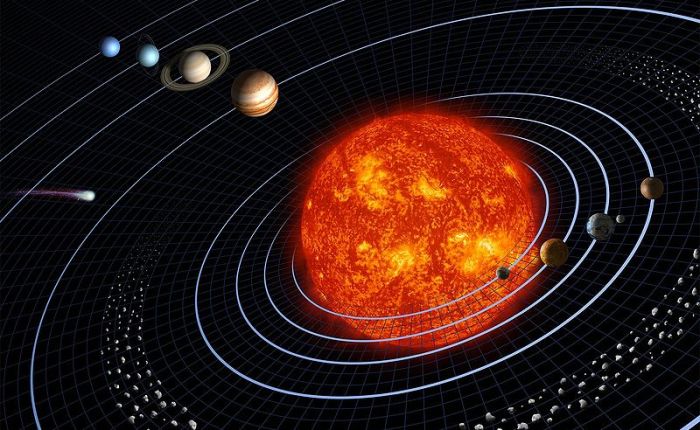
After this little interpolation, Copernicus himself wastes no time in proclaiming the mobility of the earth. In retrospect, it is remarkable that it took such a long stretch of history for the heliocentric idea to emerge. For it instantly explains many phenomena which, in the Ptolemaic system, are completely baffling. Why do the inner planets (Venus and Mercury) move within a fixed distance of the sun? Why does the perigee (the closest point in the orbit) of the outer planets (Mars, Jupiter, Saturn) occur when they are at opposition (i.e., when they are opposite in the sky from the sun), and why does their apogee (the farthest point) occur when they are in conjunction (when they are hidden behind the sun)? And why do the planets sometimes appear to move backwards relative to the fixed stars?

But putting the earth in orbit between Venus and Mars neatly and instantly explains all of these mysteries. Mercury and Venus always appear a fixed distance from the sun because they are orbiting within the earth’s orbital circle, and thus from our position appear to go back and forth around the sun. Mars, Jupiter, and Saturn, by contrast, can appear at any longitudinal distance from the sun because their orbits are outsider ours; but if Mars’ orbit were tracked from Jupiter, for example, it would, like Venus and Mercury, appear to go back and forth around the sun. Also note that Mars will appear to go “backwards” from earth when earth overtakes the red planet, due to our planet’s shorter orbital period. And since Mars will be closest to us when it is on the same side of the sun as earth (opposition from the sun), and furthest from us when it is on far side of the sun (conjunction with the sun), this also explains the apogee and perigee positions of the outer planets.

This allows Copernicus to collapse five circles—one for each of the planets, which were needed in the Ptolemaic system to account for these anomalies—into one circle: namely, the earth’s orbit. The advantages are palpable.

Nevertheless, while I think the benefits of putting the planets in orbit around the sun are obvious, perhaps even to a traditionalist, it is not obvious why Copernicus should put the earth in motion around the sun rather than the reverse. Indeed, this is exactly what the eminent astronomer Tycho Brahe did, several generations later. For it makes no observational difference whether the sun or the earth is in motion. And in the Aristotelian physics of the time, the former solution makes a great deal more sense, since the heavens were supposed to be constituted of the lightest elements and the earth of the heaviest elements. So how could the heavy earth move so quickly? What is more, there is no concept of inertia or gravity in Aristotelian physics, and so no explanation for why people would not fly off the earth if it were in rapid motion.

Copernicus takes a brief stab at answering these obvious counterarguments, even offering a primitive notion of inertia: “As a matter of fact, when a ship floats on over a tranquil sea, all the things outside seem to the voyagers to be moving in a movement which is the image of their own, and they think on the contrary that they themselves and all the things with them are at rest.” Even so, it is obvious that such a brief example does not suffice to refute the entire Aristotelian system. Clearly, a whole new concept of physics was needed if the earth was to be in motion, one which did not arrive until Isaac Newton, born nearly two hundred years after Copernicus. It took a certain amount of boldness, or obtuseness, for Copernicus to proclaim the earth’s motion without at all being able to explain how the heaviest object in the universe—or so they believed—could hurtle through space.

In structure and content, De revolutionibus follows the Algamest pretty closely: beginning with mathematical preliminaries, onward to the orbits of the sun (or, in this case the earth), the moon, and the planets—with plenty of tables to aid calculation—as well as a description of his astronomical instruments and a chart of star locations, and finally ending with deviations in celestial latitude (how far the planets deviate north and south from the ecliptic in their orbits). Copernicus was even more wedded than Ptolemy to the belief that celestial objects travel in perfect circles, which leads him to repudiate Ptolemy’s use of the equant (the point around which a planet moves at a constant speed). The use of the equant upset Copernicus’s sense of elegance, you see, since its center is different from the planet’s actual center of orbit, thus requiring two overlapping circles.

Copernicus’s own solution was an epicyclet, which revolves twice westward (clockwise, from the celestial north pole) for each rotation eastward on the deferent. And so, ironically, though Ptolemy is sometimes mocked for using epicycles, Copernicus followed the same path. I also find it amusing that the combined effect of these circular motions, in both Ptolemy and Copernicus, added up to a non-circular orbit; clearly nature had different notions of elegance than these astronomers. In any case, it would have to wait until Kepler that it was realized that the planets actually follow an ellipse.

Perhaps the greatest irony is that Copernicus’s book is not any easier to use than Ptolemy’s as a recipe book for planetary positions. Now, it is far beyond my powers to even attempt such a calculation. But in his Very Short Introduction to Copernicus (which I recommend), Owen Gingerich takes the reader through the steps to calculation the position of Mars on Copernicus’s birthday: February 19, 1473. To do this you needed the radix, which is a root position of the planet recorded at a specified time; and you also need the planet’s orbital speed (the time needed for one complete orbit, in this case 687 days). The year must be converted into sexigesimal (base 60) system, and then converted in elapsed Egyptian years (which lack a leap year), in order to calculate the time elapsed since the date of the radix’s position (in this case is January 1st, 1 AD). Then this sexigesimal number can be looked up in Copernicus’s tables; but this only gives us the location of Mars with respect to the sun. To find out where it will appear in the sky, we also need the location of earth, which is another tedious process. You get the idea.

I read the bulk of this book while I was on vacation in rural Canada. Faced with the choice between relaxation or self-torture, I naturally chose the latter. While most of my time was spent scratching my head and helplessly scratching the page with a pencil, the experience was enough to show me—as if I needed more demonstration after Ptolemy—that astronomy is not for the faint of heart, but requires intelligence, patience, and care.

There was one advantage to reading the book on vacation. For it is the only time of year when I am in a place without light pollution. The stars, normally hiding behind street lights and apartment buildings, shone in the hundreds. I would have seen even more were it not for the waxing moon. But this did give me the opportunity to get out an old telescope—bought as a birthday present for a cousin, over a decade ago—and examine the moon’s pitted surface. It is humbling to think that even such basic technology was years ahead of Copernicus’s time.

Looking at the brilliant grey circle, surrounded by a halo of white light, I felt connected to the generations of curious souls who looked at the same moon and the same stars, searching for answers. So Copernicus did not, in other words, entirely spoil my vacation.

View all my reviews

Review: Travels with Charley

Review: Travels with Charley

Travels with Charley: In Search of AmericaTravels with Charley: In Search of America by John Steinbeck

My rating: 4 of 5 stars

In literary criticism the critic has no choice but to make over the victim of his attention into something the size and shape of himself.

This little volume must rank as one of the great American travel books—though I am not quite sure what that means. Travel literature, by its nature, finds itself in a paradoxical position: to search for truth by becoming briefly acquainted with a wide and disconnected series of experiences. Steinbeck addresses this in his opening salvo: “So it was I decided to look again, to try to rediscover this monster land. Otherwise, in writing, I could not tell the small diagnostic truths which are the foundations of the large truth.” But the riddle is to figure out which truths are diagnostic and which distractions. Steinbeck seems later to have thrown up his hands in despair at the prospect, as he retreats into subjectivism: “I feel that there are too many realities. What I set down here is true until someone else passes that way and rearranges the world in his own style.”

Yet if the cliché is true, and the journey is more important than the destination, then Steinbeck’s search for America is more important than what he finds. That sounds reassuring, at least. In any case, the search is a pleasure to read. Steinbeck presents himself as an aging everyman, puttering about with his poodle and his camper, making small-talk with locals, sampling diner breakfasts, and getting lost on country roads. Very little of consequence happens; nothing much is discovered that the fifty-eight year old author did not already know; and it is lovely to read about. True, Steinbeck could, and did, narrate a fly buzzing around a dirty kitchen and turn it into poetry; but his writerly skill is not the only virtue this book possesses.

The book’s most consistent note is that of resigned obsolescence. Steinbeck looks upon the country—one which he once knew so deeply that he created its most representative novels—and finds it unfamiliar. He is past his prime, and knows it; and, more impressively, accepts it. He was writing in the wake of On the Road, another iconic travel book; and though Steinbeck’s work is far more mature and, I think, much better written, it nevertheless fails to capture the ethos of the time in the way Kerouac or, indeed, the younger Steinbeck was able to do. I am not saying this in criticism, but in admiration, since Steinbeck still managed to create a classic book. Like any great artist, he found the great universal in his tiny particular; and he transformed his sense of being out of touch into a great sighing comment on his changing country.

Now, of course much of this book isn’t true. All novelists are born and bred liars. But it sounds true enough, and that is all I want from a travel book.

View all my reviews

Review: The Mountains of California

Review: The Mountains of California

The Mountains of CaliforniaThe Mountains of California by John Muir

My rating: 3 of 5 stars

Few places in this world are more dangerous than home.

It is difficult to spend any time in northern California without coming across the name of John Muir. He is the patron saint of the state’s wild beauty. The John Muir Trail, passing through Yosemite Valley and the Sequoia & Kings Canyon National Parks, and Muir Woods, home of the majestic redwoods, are just two of the most prominent monuments to his life’s work.

I picked up a copy of this book on a recent trip to North Cali, while visiting the Donner Museum—near Donner Lake, up in the Sierra Nevada—which commemorates not only the unfortunate party of lost pilgrims, but some of the other epochal events of the region, such as the goldrush, the building of the North Pacific Railroad, and construction of the major highways. Not many years after the Donner Party lost themselves in the Snowy Range, this infrastructure tied the previously isolated region to the rest of the country.

Perhaps it would have seemed grimly ironic to the Donner survivors that, a generation later, people would be fighting to keep this dangerous place pristine, resisting the encroachment of civilization. Yet in hindsight we can only regard this effort as prescient. That there is any nature left at all is largely thanks to Muir and his ilk, who not only directly intervened to preserve wilderness, but through his writings helped to evoke a groundswell of appreciation for natural beauty.

This book is a piece of propaganda on behalf of wilderness. Though Muir was highly knowledgeable in botany, geology, and in the study of glaciers, the information he presents is strictly secondary to his fundamental purpose: to evoke the beauty of the place. Few people in history, if any, had such a sensitivity to nature. Squirrels sent him into ecstasies, bird calls lifted him into mystic regions of delight, and mountain scenery brought him close to death with pleasure. Indeed, one quickly gets the impression that he could be equally happy in the rainforests of South America, the deserts of Arabia, or the bogs of Scotland. This, ironically, makes the book rather monotonous. Since the bees and birds, the flowers and ferns, the pine trees, fir trees, cedars, sequoias, and all the rest are equally majestic, noble, exquisite, etc.—in every season and all times of day—the descriptions become difficult to attend to. The emotional tone is endlessly euphoric.

Muir’s writing comes most alive when he switches from descriptions of nature to first-person accounts of his explorations. For he was not a note-taking Darwin or a rhapsodizing Wordsworth with a walking stick, but a serious adrenaline junkie. He describes, for example, climbing to the top of a 100-foot tall tree during a heavy storm, and clinging to the end while it got whipped about in the wind, and assures us that “never before did I enjoy so noble an exhileration of motion.” He goes on to describe the experience:

The slender tops fairly flapped and swished in the passionate torrent, bending and swirling backward and forward, round and round, tracing indescribable combinations of vertical and horizontal curves, while I clung with muscles firm braced, like a bobolink on a reed… I kept my lofty perch for hours, frequently closing my eyes to enjoy the music by itself, or to feast quietly on the delicious fragrance that was streaming past. … from the chafing of resiny branches against each other, and the incessant attrition myriads of needles, the gale was spiced to a very tonic degree.

Passages like this are entirely typical. Never is there even a hint of discomfort or fear. Everything he does is unselfconsciously joyful. Muir gives us a (perhaps unwitting) self-portrait in his description of the Water Ouzel: “he never calls forth a single touch of pity; not because he is strong to endure, but rather because he seems to live a charmed life beyond the reach of every influence that makes endurance necessary.” The rest of the descriptions applies equally well: “For both in winter and in summer he sings, sweetly, cheerily, independent alike of sunshine and of love, requiring no other inspiration than the stream on which he dwells. While water sings, so must he, in heat or cold, calm or storm, ever attuning his voice in sure accord; low in the drought of summer and the drought of winter, but never silent.”

So must Muir sing his cheerful tune, whether hanging from cliffs, being buffeted in snowstorms, or crawling through thick brush on all fours. It is hard not to envy a man so seemingly impervious to all negative feeling, sensation, or thought. One suspects that Muir is not giving us the whole picture; but he could not have lived such a life if it did not fulfill him. And, as Bill McKibben states in the introduction, in many ways Muir falls comfortably within an American cultural tradition, running from the exhuberance to Whitman, the nature-worship of Thoreau, and the transcendental enthusiasm of Emerson, on through Muir to the drug-fueled ravings of the Beats and beyond. Muir is a shining exemplar of the outdoorsy woodsman, actuated by individual grit and positive thinking, that is so dear to the national myth. And, in truth, he did a lot of good.

All this being said in his praise, I still must give this book a middling rating. Muir is a prime example of a writer who excels on the level of sentences—writing lyrical, poetic descriptions of all he sees—but who falls short on the level of the whole book. The enthusiastic tone and passionate descriptions drift off into homogenous yelps of beauty. And, while evocative and impressionistic, Muir fails to give a fleshed-out, coherent picture of the mountain wilderness. Still, in his best moments Muir is unforgettable; and I confess that he did inspire in me some faint longings to go out hiking myself—though I would prefer a well-marked trail.

View all my reviews

Review: TITAN: the Life of John D. Rockefeller

Review: TITAN: the Life of John D. Rockefeller

Titan: The Life of John D. Rockefeller, Sr.Titan: The Life of John D. Rockefeller, Sr. by Ron Chernow

My rating: 4 of 5 stars

He played golf assiduously, always alone, matching his record on one day against his record on another; just what the saints do when they daily examine their conscience… Such was probably also the interest dominating Rockefeller’s chase after millions. He was beyond comparing himself with his competitors; he compared himself with himself.

—George Santayana

As a child of Sleepy Hollow, I have almost literally grown up in Rockefeller’s shadow. The best walking paths in the area are in the Rockefeller State Park Preserve, an expansive and beautiful slice of forest made from a part of Rockefeller’s former estate. I can also walk to Rockwood, a park with a gorgeous view of the Hudson River, where John’s brother William had his mansion (since demolished). John D. Rockefeller’s own mansion, Kykuit, sits atop the nearby Pocantico Hills, and is a popular tourist destination. And yet, aside from his reputation as an ultra-rich monopolist, I knew almost nothing about the man.

Thus I turned to Ron Chernow, and I am glad I did. For Rockefeller presents a challenging subject for would-be biographers. A private, reserved, and even a secretive man, John D. Rockefeller was a beguiling mixture of avarice and piety; and throughout his life he has provoked both passionate praise and vicious criticism. Since Rockefeller himself was so guarded during his lifetime, never spontaneous or candid, while achieving such historical importance, it is hard to resist the urge to simplify his character—merely to fill up the lacunae he left. Luckily, Chernow’s patience and sensitivity allow him to paint a convincing and unforgettable portrait of this evasive figure.

As Chernow himself says, Rockefeller was the walking embodiment of Max Weber’s Protestant Ethic. He was actuated by a faith which told him that it was his holy duty to work zealously, and which taught him to see his own success as divine favor and his rivals’ failure as divine retribution. This faith in his mission and his rectitude gave him a purpose and a justification, pushing him to work more devotedly than his colleagues, and to feel no pangs of remorse for those he bruised along the way. His outstanding strengths were his iron will and his extreme deliberation. He kept to a rigid schedule, never acted impulsively, tabulated all of his personal expenses in a little booklet, and even showed up to work on his wedding day. This was a man who made money with the morbid devotion of a saint.

During the sections charting Rockefeller’s rise to success, I was filled with a horrified disgust with the man. Such a joyless, self-righteous hypocrite—filling his pockets with gold and wagging his fingers at the poor. I did not see anything to praise in his religion of money. Simple greed is noxious enough, but sanctimonious greed is revolting.

Yet by the end of the book I found that I both liked and admired the man, or at least the man he later became. For Rockefeller, while full of his own vices, was free of many of the vices we associate with the rich. He was neither ostentatious nor profligate; and if his puritan strictness seems joyless—his hatred of drink, cards, smoking, or anything remotely racy—it at least saved him from hedonistic debauchery. And as he grew older, he became more playful, giving away dimes to strangers, riding around in sporty automobiles, and obsessively playing golf. I was surprised to learn that Rockefeller retired early from his post at the helm of Standard Oil, ceasing all regular duties in his fifties, only retaining a symbolic title. Clearly, he saw more to life than work and money.

But Rockefeller’s greatest virtue was his charity. He gave profusely and generously throughout his life, even more than Andrew Carnegie. Much of this was new to me (for example, I had no idea he founded the University of Chicago); and this is no accident, since Rockefeller did not like putting his name on things. (His name was so vilified anyway it would likely have hampered his charities.) And contrary to what you might expect, Rockefeller’s philanthropic impulse was deep and genuine, something he had from the beginning of his life. According to Chernow, Rockefeller’s contributions to medical research revolutionized the field. So on a purely utilitarian tabulation of pain and pleasure inflicted, Rockefeller probably comes out positive in the end. (Rockefeller himself, of course, thought that his life had been virtuous from beginning to end, and never conceived charity as recompense.)

As I hope I have made clear, Rockefeller was a complex man—or, perhaps it is more accurate to say that he continually resists attempts to stereotype him, which is always uncomfortable. And it is a testament to Chernow’s ability that he captures Rockefeller in all these aspects. Now, this was my first Chernow biography and, I admit, I was somewhat disappointed at first. Naturally, I measured this book against Robert Caro’s The Power Broker, and found Chernow’s book very thin on historical background by comparison. But Chernow partially compensates for this with his fine psychological sensitivity, as sharp as a first-rate novelist. The result is a thoroughly engrossing biography, so good that I am left wishing Chernow had made it longer—specifically during Rockefeller’s early years. And you know a book is good when 700 pages does not satisfy.


(As an afterthought, I would like to note how gratifying it is when different books serendipitously overlap. I knew of Charles Strong as one of George Santayana’s best friends, familiar to me from Santayana’s autobiography and his letters. But I did not remember that Strong married Bessie Rockefeller, John’s eldest child, who went insane and died at the age of forty. Santayana helped to look after Bessie’s daughter, Margaret, and even handed her off during her wedding.)

View all my reviews

Review: Sidereal Messenger

Review: Sidereal Messenger

Sidereus Nuncius, or The Sidereal MessengerSidereus Nuncius, or The Sidereal Messenger by Galileo Galilei

My rating: 4 of 5 stars

A most excellent a kind service has been performed by those who defend from envy the great deeds of excellent men and have taken it upon themselves to preserve from oblivion and ruin names deserving of immortality.

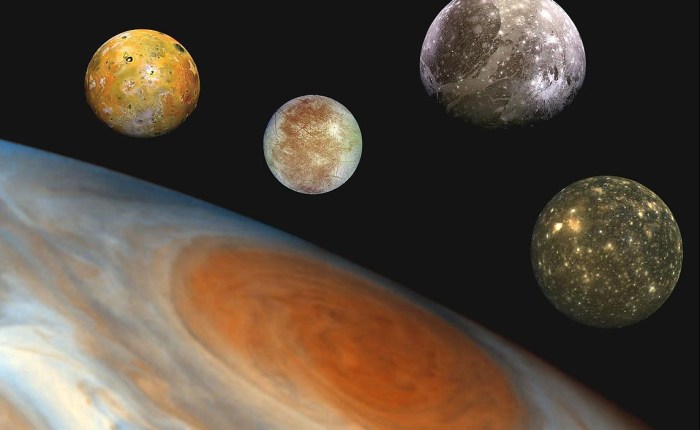
This book (more of a pamphlet, really) is proof that you do not need to write many pages to make a lasting contribution to science. For it was in this little book that Galileo set forth his observations made through his newly improved telescope. In 50-odd pages, with some accompanying diagrams and etchings, Galileo quickly asserts the roughness of the Moon’s surface, avers the existence of many more stars than can be seen with the naked eye, and—the grand climax—announces the existence of the moons of Jupiter. Suddenly the universe seemed far bigger, and stranger, than it had before.

The actual text of Siderius Nuncius does not make for exciting reading. To establish his credibility, Galileo includes a blow-by-blow account of his observations of the moons of Jupiter, charting their nightly appearance. The section on our Moon is admittedly more compelling, as Galileo describes the irregularities he observed as the sun passed over its surface. Even so, this edition is immeasurably improved by the substantial commentary provided by Albert van Helden, who gives us the necessary historical background to understand why it was so controversial, and charts the aftermath of the publication.

Though Galileo is sometimes mistakenly credited with inventing the telescope, spyglasses were widely available at the time; what Galileo did was improve his telescope far beyond the magnification commonly available. The result was that, for a significant span of time, Galileo was the only person on the planet with the technology to closely and accurately observe the heavens. The advantage was not lost on him, and he made sure that he published before he got scooped. In another shrewd move, he named the newly-discovered moons of Jupiter after the Grand Duke Cosimo II and his brothers, for which they were known as the Medician Stars (back then, the term “star” meant any celestial object). This earned him patronage and protection.

Galileo’s findings were controversial because none of them aligned with the predictions of Aristotelian physics and Ptolemaic astronomy. According to the accepted view, the heavens were pure and incorruptible, devoid of change or imperfection. Thus it was jarring to find the moon’s surface bumpy, scarred, and mountainous, just like Earth’s. Even more troublesome were the Galilean moons. In the orthodox view the Earth was the only center of orbit; and one of the strongest objections against Copernicus’s system was that it included two centers, the Sun and the Earth (for the Moon). Galileo’s finding of an additional center of orbit meant that this objection ceased to carry any weight, since in any case we must posit multiple centers. Understandably there was a lot of skepticism at first, with some scholars doubting the efficacy of Galileo’s new instrument. But as other telescopes caught up with Galileo’s, and new anomalies were added to the mix—the phases of Venus and the odd shape of Saturn—his observations achieved widespread acceptance.

Though philosophers and historians of science often emphasize the advance of theory, I find this text a compelling example of the power of pure observation. For Galileo’s breakthrough relied, not on any new theory, but on new technology, extending the reach of his senses. He had no optical theory to guide him as he tinkered with his telescope, relying instead on simple trial-and-error. And though theory plays a role in any observation, some of Galileo’s findings—such as that the Milky Way is made of many small stars clustered together—are as close to simple acts of vision as possible. Even if Copernicus’s theory was not available as an alternative paradigm, it seems likely to me that advances in the power of telescopes would have thrown the old worldview into a crisis. This goes to show that observational technology is integral to scientific progress.

It is also curious to note the moral dimension of Galileo’s discovery. Now, the Ptolemaic system is commonly lambasted as narcissistically anthropocentric, placing humans at the center of it all. Yet it is worth pointing out that, in the Ptolemaic system, the heavens are regarded as pure and perfect, and everything below the moon as corruptible and imperfect (from which we get the term “sublunary”). Indeed, Dante placed the circles of paradise on the moon and the planets. So arguably, by making Earth the equal of the other planets, the new astronomy actually raised the dignity of our humble abode. In any case, I think that it is simplistic to characterize the switch from geocentricity to heliocentricity as a tale of declining hubris. The medieval Christians were hardly swollen with pride by their cosmic importance.

As you can see, this is a fascinating little volume that amply rewards the little time spent reading it. Van Helden has done a terrific job in making this scientific classic accessible.

View all my reviews

Review: Almagest

Review: Almagest
The Almagest: Introduction to the Mathematics of the Heavens

The Almagest: Introduction to the Mathematics of the Heavens by Ptolemy

My rating: 4 of 5 stars

… it is not fitting even to judge what is simple in itself in heavenly things on the basis of things that seem to be simple among us.

In my abysmal ignorance, I had for years assumed that tracking the orbits of the sun and planets would be straightforward. All you needed was a starting location, a direction, and the daily speed—and, with some simple arithmetic and a bit of graph paper, it would be clear as day. Attempting to read Ptolemy has revealed the magnitude of my error. Charting the heavenly bodies is a deviously complicated affair; and Ptolemy’s solution must rank as one of the greatest intellectual accomplishments of antiquity—fully comparable with the great scientific achievements of European Enlightenment. Indeed, Otto Neugebauer, the preeminent scholar of ancient astronomy, went so far as to say:

One can perfectly well understand the ‘Principia’ without much knowledge of earlier astronomy but one cannot read a single chapter in Copernicus or Kepler without a thorough knowledge of Ptolemy’s “Almagest”. Up to Newton all astronomy consists in modifications, however ingenious, of Hellenistic astronomy.

With more hope than sense, I cracked open my copy of The Great Books of the Western World, which has a full translation of the Almagest in the 16th volume. Immediately repulsed by the text, I then acquired a students’ edition of the book published by the Green Lion Press. This proved to be an excellent choice. Through introductions, preliminaries, footnotes, and appendices—not to mention generous omissions—this edition attempts to make Ptolemy accessible to a diligent college student. Even so, for someone with my background to attain a thorough knowledge of this text, he would still require months of dedicated study with a teacher as a guide. For the text is difficult in numerous ways.

Most obviously, this book is full of mathematical proofs and calculations, which are not exactly my strong suit. Ptolemy’s mathematical language—relying on the Greek geometrical method—will be unfamiliar to students who have not read some Euclid; and even if it is familiar, it proves cumbrous for the sorts of calculations demanded by the subject. To make matters worse, Ptolemy employs the sexagesimal system (based on multiples of 60) for fractions; so his numbers all must be converted into our decimals for calculation. What is more, even the names of the months Ptolemy uses are different, bearing their Egyptian names (Thoth, Phaöphi, Athur, etc.), since Ptolemy was an Alexandrian Greek. Yet even if we put all these technical obstacles to the side, we are left with Ptolemy’s oddly infelicitous prose, which the translator describes thus:

In general, there is a sort of opacity, even awkwardness, to Ptolemy’s writing, especially when he is providing a larger frame for a topic or presenting a philosophical discussion.

Thus, even in the non-technical parts of the book, Ptolemy’s writing tends to be headache-inducing. All this combines to form an unremitting slog. So since my interest in this book was amateurish, I skimmed and skipped liberally. Yet this text is so rich that, even proceeding in such a dilettantish fashion, I managed to learn a great deal.

Ptolemy’s Almagest, like Euclid’s Elements, proved so comprehensive and conclusive when it was published that it rendered nearly all previous astronomical work obsolete or superfluous. For this reason, we know little about Ptolemy’s predecessors, since there was little point in preserving their work after Ptolemy summed it up in such magnificent fashion. As a result it is unclear how much of this book is original and how much is simply adapted. As Ptolemy himself admits, he owes a substantial debt to the astronomer Hipparchus, who lived around 200 years earlier. Yet it does seem that Ptolemy originated the novel way of accounting for the planets’ position and speed, which he puts forth in later books.

Ptolemy begins by explaining the method by which he will measure chords; this leads him to construct one of the most precise trigonometric tables from antiquity. Later, Ptolemy goes on to produce several proofs of spherical trigonometry, which allows him to measure distances on the inside of a sphere, making this book an important source for Greek trigonometry as well as astronomy. Ptolemy also employs Menelaus’ Theorem, which uses the fixed proportions of a triangle to establish ratios. (From this I see that triangles are marvelously useful shapes, since they are the only shape which is rigid—that is, the angles cannot be altered without also changing the ratio of the sides, and vice versa. This is also, by the way, what makes triangles such strong structural components.)

Ptolemy gets down to business by analyzing the sun’s motion. This is tricky for several reasons. For one, the sun does not travel parallel to the “fixed stars” (so called because the stars do not position change relative to one another), but rather at an angle, which Ptolemy calculates to be around 23 degrees. We now know this is due to earth’s axial tilt, but for Ptolemy it was called the obliquity of the ecliptic (the angle of the sun’s path). Also, the angle that the sun travels through the sky (straight overhead or nearer the horizon) is determined by one’s latitude; this also determines the seasonal shifts in day-length; and during these shifts, the sun rises on different points on the horizon. To add to these already daunting variables, the sun also shifts in speed during the course of the year. And finally, Ptolemy had to factor in the procession of the equinoxes—the ecliptic’s gradual westward motion from year to year.

The planets turn out to be even more complex. For they all exhibit anomalies in their orbits which entail further complications. Venus, for example, not only speeds up and slows down, but also seems to go forwards and backwards along its orbit. This leads Ptolemy to the adoption of epicylces—little circles which travel along the greater circle, called the “deferent,” of the planet’s orbit. But to preserve the circular motion of the deferent, Ptolemy must place the center (called the “eccentric”) away from earth, in empty space. Then, Ptolemy introduces another imaginary circle, around which the planet travels with constant velocity: and the center of this is called the “equant,” which is also in empty space. Thus the planet’s motion was circular around one point (the eccentric) and constant around another circle (the equant), neither of which coincide with earth (so much for geocentric astronomy). In addition to all this, the orbit of Venus is not exactly parallel with the sun’s orbit, but tilted, and its tilt wobbles throughout the year. For Ptolemy to account for all this using only the most primitive observational instruments and without the use of calculus or analytic geometry is an extraordinary feat of patience, vision, and drudgery.

Even after writing all this, I am not giving a fair picture of the scope of Ptolemy’s achievement. This book also includes an extensive star catalogue, with the location and brightness of over one thousand stars observable with the naked eye. He argues strongly for earth’s sphericity (so much for a flat earth) and even offers a calculation of earth’s diameter (which was 28% too small). Ptolemy also calculates the distance from the earth to the moon, using the lunar parallax (the difference in the moon’s appearance when seen from different positions on earth), which comes out the quite accurate figure of 59 earth radii. And all of this is set forth in dry, sometimes baffling prose, accompanied by pages of proofs and tables. One can see why later generations of astronomers thought there was little to add to Ptolemy’s achievement, and why Arabic translators dubbed it “the greatest” (from which we get the English name).

A direct acquaintance with Ptolemy belies his popular image as a metaphysical pseudo-scientist, foolishly clinging to a geocentric model, using ad-hoc epicycles to account for deviations in his theories. To the contrary, Ptolemy scarcely ever touches on metaphysical or philosophical arguments, preferring to stay in the precise world of figures and proofs. And if science consists in predicting phenomena, then Ptolemy’s system was clearly the best scientific theory around for its range and accuracy. Indeed, a waggish philosopher might dismiss the whole question of whether the sun or the earth was at the “center” as entirely metaphysical (is it falsifiable?). Certainly it was not mere prejudice that kept Ptolemy’s system alive for so long.

Admittedly, Ptolemy does occasionally include airy metaphysical statements:

We propose to demonstrate that, just as for the sun and moon, all the apparent anomalistic motions of the five planets are produced through uniform, circular motions; these are proper to the nature of what is divine, but foreign to disorder and variability.

Yet notions of perfection seem hard to justify, even within Ptolemy’s own theory. The combined motions of the deferent and the epicycle do not make a circle, but a wavy shape called an epitrochoid. And the complex world of interlocking, overlapping, slanted circles—centered on imaginary points, riddled with deviations and anomalies—hardly fits the stereotypical image of an orderly Ptolemaic world.

It must be said that Ptolemy’s system, however comprehensive, does leave some questions tantalizingly unanswered. For example, why do Mercury and Venus stay within a definite distance from the sun, and travel along at the same average speed as the sun? And why are the anomalies of the “outer planets” (Mars, Jupiter, Saturn) sometimes related to the sun’s motion, and sometimes not? All this is very easy to explain in a heliocentric model, but rather baffling in a geocentric one; and Ptolemy does not even attempt an explanation. Even so, I think any reader of this volume must come to the conclusion that this is a massive achievement—and a lasting testament to the heights of brilliance and obscurity that a single mind can reach.

View all my reviews

Review: Life on the Mississippi

Review: Life on the Mississippi

Life on the MississippiLife on the Mississippi by Mark Twain

My rating: 3 of 5 stars

And, mind you, emotions are among the toughest things in the world to manufacture out of whole cloth; it is easier to manufacture seven facts than one emotion.

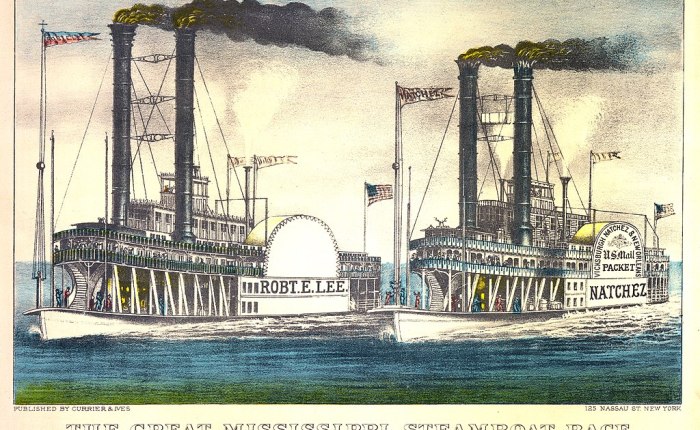
This is an awkward book to review, since it consists of so many, varied sections. Yet it can be neatly divided between the first third and the remaining portion. After a few brief chapters about the mighty river and its history, the beginning section focuses on Twain’s young days as a steersman aboard Mississippi River steamboats. These are easily the best pages. As evinced by the Huckleberry Finn stories, Twain had a marvelous way of writing from a child’s perspective, naively learning to navigate the world. What is more, Twain does an excellent job in illustrating the extensive knowledge necessary to effectively pilot a steamboat—memorizing hundreds of landmarks, learning how to gauge speed and depth, and dealing with difficult coworkers.

The second section is a meandering account of a voyage he took two decades after leaving the steamboat business, when he was an accomplished author. At this point he was already so famous he had to adopt a pseudonym. Here he pauses so often to lose himself in tributary wanderings that the narrative breaks down into a vaguely connected series of anecdotes, most of which seem obviously inflated or simply fictional. Though there is much to amuse in this section, I found myself growing increasingly restless and bored as I continued on, eager for the end. Though I did not dislike this book as much as I did A Connecticut Yankee, I nevertheless felt that the joke had gone stale and that Twain was merely filling up space.

My reactions to Twain tend to shift violently. Again, in the beginning section of this work, when he is writing from the perspective of his younger self, his writing is energetic and witty and wide-eyed. But when he dons the cap of a raconteur, I tend to find his stories mechanical and dull. His account of the Pilots’ Association is an excellent example of this—proceeding in predictable steps to the inevitable conclusion. And when he shifts away from humor, the results can be pretty grim. His flat-footed tall tale of the man who sought revenge for his murdered family—a mix of the ghoulish and the sentimental—is an excellent example of this.

Even with these faults and lapses, this book is an unforgettable portrait of a time and place that are gone for good, written by an indefatigably mordant pen.

View all my reviews

Review: The New Organon

Review: The New Organon

The New OrganonThe New Organon by Francis Bacon

My rating: 4 of 5 stars

Since I’ve lately read Aristotle’s original, I thought I’d go ahead and read Bacon’s New Organon. The title more or less says it all. For this book is an attempt to recast the method of the sciences in a better mold. Whereas Aristotle spends pages and pages enumerating the various types of syllogisms, Bacon dismisses it all with one wave of the hand—away with such scholarly nonsense! Because Aristotle is so single-mindedly deductive, his scientific research came to naught; or, as Bacon puts it, “Aristotle, who made his natural philosophy a mere bond servant to his logic, thereby [rendered] it contentious and well-nigh useless.”

What is needed is not deduction—which draws trivial conclusions form absurd premises—but induction. More specifically, what is needed is a great deal of experiments, the results of which the careful scientist can sort into air-tight conclusions. Down with the syllogism; up with experiment. Down with the schoolmen; up with the scientists.

In my (admittedly snotty) review of Bacon’s Essays, I remarked that he would have done better to have written a work entirely in aphorisms. Little did I know that Bacon did just that, and it is this book. Whatever Bacon’s defects were as a politician or a philosopher, Bacon is the undisputed master of the pithy, punchy maxim. In fact, his writing style can be almost sickening, so dense is it with aphorism, so rich is it with metaphor, so replete is it with compressed thought.

In the first part of his New Organon all of the defects of Bacon’s style are absent, and all of his strengths are present in full force. Indeed, if this work consisted of only the first part, it would have merited five stars, for it is a tour de force. Bacon systematically goes through all of the errors the human mind is prone to when investigating nature, leaving no stone unturned and no vices unexamined, damning them all in epigram after epigram. The reader hardly has time to catch his breath from one astonishing insight, when Bacon is on to another.

Among these insights are, of course, Bacon’s famous four idols. We have the Idol of the Tribe, which consist of the errors humans are wont to make by virtue of their humanity. For our eyes, our ears, and our very minds distort reality in a systematic way—something earlier philosophers had, so far as I know, neglected to account for. We have then the Idols of the Cave, which are the foibles of the individual person, over and above the common limitations of our species. Of these may include certain pet theories, preferences, accidents of background, peculiarities of taste. And then finally we have the Idols of the Market Place, which are caused by the deceptive nature of language and words, as well as the Idols of the Theater, which consists of the various dogmas present in the universities and schools.

Bacon also displays a remarkable insight into psychology. He points out that humans are pattern-seeking animals, which leads us to sometimes see patterns which aren’t there: “The human understanding is of its own nature prone to suppose the existence of more order and regularity in the world than it finds.” Bacon also draws the distinction, made so memorable in Isaiah Berlin’s essay, between foxes and hedgehogs: “… some minds are stronger and apter to mark the differences of things, others to mark their resemblances.” Bacon also notes, in terms no psychologist could fault, a description of confirmation bias:

The human understanding when it has once adopted an opinion (either as being the received opinion or as being agreeable to itself) draws all things else to support and agree with it. And though there be a greater number and weight of instances to be found on the other side, or else by some distinction sets aside and rejects, in order that by this great and pernicious predetermination the authority of its former conclusions may remain inviolate.

Part two, on the other hand, is a tedious, rambling affair, which makes the patient reader almost forget the greatness of the first half. Here, Bacon moves on from condemning the errors of others to setting up his own system. In his opinion, scientific enquiry is a simple matter of tabulation: make a table of every situation in which a given phenomenon is always found, and then make a table of every situation in which a given phenomenon is never found; finally, make a table of every situation in which said phenomenon is sometimes found, shake well, and out comes your answer.

The modern reader will not recognize the scientific method in this process. For we now know that Bacon’s induction is not sufficient. (Though, he does use his method to draw an accurate conclusion about the nature of heat: “Heat is a motion, expansive, restrained, and acting in its strife upon the smaller particles of bodies.”) What Bacon describes is more or less what we’d now call ‘natural history’, a gathering up of facts and a noting of regularities. But the scientific method proper requires the framing of hypotheses. The hypothesis is key, because it determines what facts need to be collected, and what relationship those facts will have with the theory in question. Otherwise, the buzzing world of facts is too lush and fecund to tabulate; there are simply too many facts. Furthermore, Bacon makes the somewhat naïve—though excusable, I think—assumption that a fact is simply a fact, whereas we now know that facts are basically meaningless unless contextualized; and, in science, it is the theory in question which contextualizes said facts.

The importance of hypotheses also makes deduction far more important than Bacon acknowledges. For the aspiring experimentalist must often go through a long chain of deductive reasoning before he can determine what experiment should be performed in order to test a theory. In short, science relies on both deductive and inductive methods, and the relationship of theory to data is far more intertwined than Bacon apparently thinks. (As a side note, I’d also like to point out that Bacon wasn’t much of a scientist himself; he brings up the Copernican view of the heliocentric solar system many times, only to dismiss it as ridiculous, and also seems curiously unaware of the other scientific advances of his day.)

In a review of David Hume’s Enquiry Concerning the Principles of Morals, I somewhat impertinently remarked that the English love examples—or, to use a more English word, instances. I hope not to offend any English readers, but Bacon confirms me in this prejudice—for the vast bulk of this work is a tedious enumeration of twenty-seven (yes, that’s almost thirty) types of ‘instances’ to be found in nature. Needless to say, this long and dry list of the different sorts of instances makes for both dull reading and bad philosophy, for I doubt any scientist in the history of the world ever made progress by sorting his results into one of Bacon’s categories.

So the brilliant, brash, and brazen beginning of this book fizzles out into pedantry that, ironically enough, rivals even Aristotle’s original Organon. So, to repeat myself, the title of this book more or less says it all.

View all my reviews