Review: Aristotle’s Physics

Review: Aristotle’s Physics

PhysicsPhysics by Aristotle

My rating: 4 of 5 stars

Of all the ancient thinkers that medieval Christians could have embraced, it always struck me as pretty remarkable that Aristotle was chosen. Of course, ‘chosen’ isn’t the right word; rather, it was something of a historical coincidence, since Aristotle’s works were available in Latin translation, while those of Plato were not.

Nonetheless, Aristotle strikes me as a particularly difficult thinker to build a monotheistic worldview around. There is simply nothing mystical about him. His feet are planted firmly on the ground, and his eyes are level with the horizon. Whereas mystics see the unity of everything, Aristotle divides up the world into neat parcels, providing lists of definitions and categories wherever he turns. Whereas mystics tend to scorn human knowledge, Aristotle was apparently very optimistic about the potential reach of the human mind—since he so manifestly did his best to know everything.

The only thing that I can find remotely mystical is Aristotle’s love of systems. Aristotle does not like loose ends; he wants his categories to be exhaustive, and his investigations complete. And, like a mystic, Aristotle is very confident about the reach of a priori knowledge, while his investigations of empirical reality—though admittedly impressive—are paltry in comparison with his penchant for logical deduction. At the very least, Aristotle is wont to draw many more conclusions from a limited set of observations than most moderns are comfortable with.

I admit, in the past I have had a hard time appreciating his writing. His style was dry; his arguments, perfunctory. I often wondered: What did so many people see in him? His tremendous influence seemed absurd after one read his works. How could he have seemed so convincing for so long?

I know from experience that when I find a respected author ludicrous, the fault is often my own. Seeking a remedy, I decided that I would read more Aristotle; more specifically, I would read enough Aristotle until I learned to appreciate him. In the words of Stephen Stills, “If you can’t be with the one you love, love the one you’re with.” I decided I would stick with Aristotle until I loved him. I still don’t love Aristotle; but, after reading this book, I have a much deeper respect for the man. For this book really is remarkable.

Hardly a sentence in this book can be accepted as accurate. In fact, from our point of view, Aristotle’s project was doomed from the start. He is investigating physical reality, but is doing so without conducting experiments; in other words, his method is purely deductive, starting from a few assumptions, most of which are wrong. Much of what Aristotle says might even seem silly—such as his dictum that “we always assume the presence in nature of the better.” Another great portion of this work is taken up by thoroughly uninteresting and unconvincing investigations, such as the definitions of ‘together’, ‘apart’, ‘touch’, ‘continuous’, and all of the different types of motions—all of which seem products of a pedantic brain rather than qualities of nature.

But the good in this work far outweighs the bad. For Aristotle commences the first (at least, the first, so far as I know) intellectually rigorous investigations of the basic properties of nature—space, time, cause, motion, and the origins of the universe. I find Aristotle’s inquiry into time particularly fascinating, for I am not aware of any comparatively meticulous investigations of time by later philosophers.

I was particularly impressed with Aristotle’s attempt to overcome Zeno’s paradoxes (a series of thought experiments which ‘prove’ that motion and change is impossible). Aristotle defines and re-defines time—struggling with how it can be divided, and with the exact nature of the present moment—and tries many different angles of attack. What is even more interesting, Aristotle fails in his task, and even falls into Zeno’s intellectual trap by unwittingly accepting Zeno’s assumptions.

Aristotle’s attempts to tackle space were almost equally fascinating. Once again see the magnificent mind of Aristotle struggling to define something of the highest degree of abstractness. In fact, I challenge anyone reading this to come up with a good definition of space. It’s hard. The paradox (at least, the apparent paradox) is that space has some qualities of matter—extension, volume, dimensions—without having any mass. It seems, at first sight at least, like empty space should be simply nothing, yet space itself has certain definite qualities—and anything that has qualities is, by definition, something. However, these qualities only emerge when one imagines a thing in space, for we never, in our day to day lives, encounter space itself, devoid of all content. But how could something with no mass have the quality of extension?

Aristotle does also display an admirable—though perhaps naïve—tendency to trust experience. For his refutation of the thinkers who argue that (a) everything is always in motion, and (b) everything is always at rest, is merely to point out that day-to-day experience refutes this. And Aristotle at least knows—since it is so remarkably obvious to those with eyes—that Zeno must have committed some error. Even if his attacks on the paradoxes do not succeed, therefore, one can at least praise the effort.

To the student of modern physics, this book may present some interesting contrasts. We have learned, through painstaking experience, that the most productive questions to ask of nature begin with “how” rather than “why.” Of course, the two words are often interchangeable; but notice that “why” attributes a motive to something, whereas “how” is motiveless.

Aristotle seeks to understand nature in the same way that one might understand a friend. In a word, he seeks teleological explanations. He assumes both that nature works with a purpose, and that the workings of nature are roughly accessible to common sense, with some logical rigor thrown in. On its face, this is not necessarily a bad assumption. Indeed, it took a lot of time for us humans to realize it was incorrect. In any case, it must be admitted that Aristotle at least seeks to understand far more than us moderns; for Aristotle seeks, so to speak, to get inside the ‘mind’ of nature, understanding the purpose for everything.

Perhaps now I can see what the medieval Christians found in Aristotle. The assumption that nature works with a purpose certainly meshes well with the belief in an omnipotent creator God. And the assumption that knowledge is accessible through common sense and simple logical deductions is reasonable if one believes that the world was created for us. To the modern reader, the Physics might be far less impressive than to the medievals. But it is always worthwhile to witness the inner workings of such a brilliant mind; and, of all the Aristotle I have so far read, none so clearly show Aristotle’s thought process, none so clearly show his mind at work, as this.

View all my reviews

Review: Dialogue Concerning the Two Chief World Systems

Review: Dialogue Concerning the Two Chief World Systems

Dialogue Concerning the Two Chief World SystemsDialogue Concerning the Two Chief World Systems by Galileo Galilei

My rating: 4 of 5 stars

I should think that anyone who considered it more reasonable for the whole universe to move in order to let the earth remain fixed would be more irrational than one who should climb to the top of your cupola just to get a view of the city and its environs, and then demand that the whole countryside should revolve around him so that he would not have to take the trouble to turn his head.

It often seems hard to justify reading old works of science. After all, science continually advances; pioneering works today will be obsolete tomorrow. As a friend of mine said when he saw me reading this, “That shit’s outdated.” And it’s true: this shit is outdated.

Well, for one thing, understanding the history of the development of a theory often aids in the understanding of the theory. Look at any given technical discipline today, and it’s overwhelming; you are presented with such an imposing edifice of knowledge that it seems impossible. Yet even the largest oak was once an acorn, and even the most frightening equation was once an idle speculation. Case in point: Achieving a modern understanding of planetary orbits would require mastery of Einstein’s theories—no mean feat. Flip back the pages in history, however, and you will end up here, at this delightful dialogue by a nettlesome Italian scientist, as accessible a book as ever you could hope for.

This book is rich and rewarding, but for some unexpected reasons. What will strike most moderns readers, I suspect, is how plausible the Ptolemaic worldview appears in this dialogue. To us alive today, who have seen the earth in photographs, the notion that the earth is the center of the universe seems absurd. But back then, it was plain common sense, and for good reason. Galileo’s fictional Aristotelian philosopher, Simplicio, puts forward many arguments for the immobility of the earth, some merely silly, but many very sensible and convincing. Indeed, I often felt like I had to take Simplicio’s side, as Galileo subjects the good Ptolemaic philosopher to much abuse.

I’d like to think that I would have sensed the force of the Copernican system if I were alive back then. But really, I doubt it. If the earth was moving, why wouldn’t things you throw into the air land to the west of you? Wouldn’t we feel ourselves in motion? Wouldn’t canon balls travel much further one way than another? Wouldn’t we be thrown off into space? Galileo’s answer to all of these questions is the principal of inertia: all inertial (non-accelerating) frames of reference are equivalent. That is, an experiment will look the same whether it’s performed on a ship at constant velocity or on dry land.

(In reality, the surface of the earth is non-inertial, since it is undergoing acceleration due to its constant spinning motion. Indeed the only reason we don’t fly off is because of gravity, not because of inertia as Galileo argues. But for practical purposes the earth’s surface can be treated as an inertial reference frame.)

Because this simple principle is the key to so many of Galileo’s arguments, the final section of this book is trebly strange. In the last few pages of this dialogue, Galileo triumphantly puts forward his erroneous theory of the tides as if it were the final nail in Ptolemy’s coffin. Galileo’s theory was that the tides were caused by the movement of the earth, like water sloshing around a bowl on a spinning Lazy Susan. But if this was what really caused the tides, then Galileo’s principle of inertia would fall apart; since if the earth’s movements could move the oceans, couldn’t it also push us humans around? It’s amazing that Galileo didn’t mind this inconsistency. It’s as if Darwin ended On the Origin of Species with an argument that ducks were the direct descendants of daffodils.

Yet for all the many quirks and flaws in this work, for all the many digressions—and there are quite a few—it still shines. Galileo is a strong writer and a superlative thinker; following along the train of his thoughts is an adventure in itself. But of course this work, like all works of science, is not ultimately about the mind of one man; it is about the natural world. And if you are like me, this book will make you think of the sun, the moon, the planets, and the stars in the sky; will remind you that your world is spinning like a top, and that the very ground we stand on is flying through the dark of space, shielded by a wisp of clouds; and that the firmament up above, something we often forget, is a window into the cosmos itself—you will think about all this, and decide that maybe this shit isn’t so outdated after all.

View all my reviews

Review: Voyage of the Beagle

Review: Voyage of the Beagle
Voyage of the Beagle

Voyage of the Beagle by Charles Darwin

My rating: 4 of 5 stars

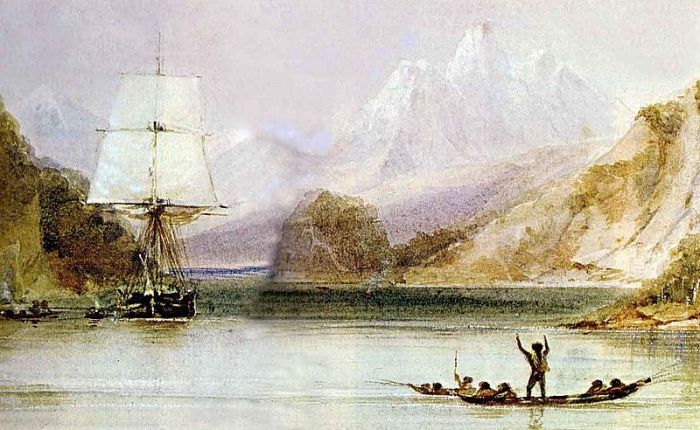
This book is really a rare treasure. Is there anything comparable? Here we have the very man whose ideas have revolutionized completely our understanding of life, writing with charm about the very voyage which sparked and shaped his thinking on the subject. And even if this book was not a window into the mind of one of history’s most influential thinkers, it would still be entertaining on its own merits. Indeed, the public at the time thought so, making Darwin into a bestselling author.

I can hardly imagine how fascinating it would have been for a nineteenth-century Englishman to read about the strange men and beasts in different parts of the world. Today the world is so flat that almost nothing can surprise. But what this book has lost in exotic charm, it makes up for in historical interest; for now it is a fascinating glimpse into the world of 150 years ago. Through Darwin’s narrative, we both look out at the world as it was, and into the mind of a charming man. And Darwin was charming. How strange it is that one of today’s most vicious debates—creationism vs. evolution, religion vs. science—was ignited by somebody as mild-mannered and likable as Mr. Darwin.

His most outstanding characteristic is his curiosity; everything Darwin sees, he wants to learn about: “In England any person fond of natural history enjoys in his walks a great advantage, by always having something to attract his attention; but in these fertile climates, teeming with life, the attractions are so numerous, that he is scarcely able to walk at all.”

As a result, the range of topics touched upon in this volume is extraordinary: botany, entomology, geology, anthropology, paleontology—the list goes on. Darwin collects and dissects every creature he can get his hands on; he examines fish, birds, mammals, insects, spiders. (Admittedly, the descriptions of anatomy and geological strata were often so detailed as to be tedious; Darwin, though brilliant, could be very dry.) In the course of these descriptions, Darwin also indulged in quite a bit of speculation, offering an interesting glimpse into both his thought-process and the state of science at that time. (I wonder if any edition includes follow-ups of these conjectures; it would have been interesting to see how they panned out.)

In retrospect, it is almost unsurprising that Darwin came up with his theory of evolution, since he encounters many things that are perplexing and inexplicable without it. Darwin finds fossils of extinct megafauna, and wonders how animals so large could have perished completely. He famously sees examples of one body-plan being adapted—like a theme and variations—in the finches of the Galapagos Islands. He also notes that the fauna and flora on those islands are related to, though quite different from, that in mainland South America. (If life there was created separately, why wouldn’t it be completely different? And if it was indeed descended from the animals on the mainland, what made it change?)

Darwin also sees abundant examples of convergent evolution—two distinct evolutionary lines producing similar results in similar circumstances—in Australia:

A little time before this I had been lying on a sunny bank, and was reflecting on the strange character of the animals in this country as compared with the rest of the world. An unbeliever in everything but his own reason might exclaim, ‘Two distinct Creators must have been at work; their object, however, has been the same & certainly the end in each case is complete.’

More surprisingly, Darwin finds that animals in isolated, uninhabited islands tend to have no fear of humans. And, strangely enough, an individual animal from these islands cannot even be taught to fear humans. Why, Darwin asks, does an individual bird in Europe fear humans, even though it is never been harmed by one? And why can’t you train an individual bird from an isolated island to fear humans? My favorite anecdote is of Darwin repeatedly throwing a turtle into the water, and having it return to him again and again—because, as Darwin notes, its natural predators are ocean-bound, and it has adapted to see the land as a place of safety. Darwin also manages to walk right up to an unwary fox and kill it with his geological hammer.

You can see how all of these experiences, so odd without a theory of evolution, become clear as day when Darwin’s ideas are embraced. Indeed, many are still textbook examples of the implications of his theories.

This book would have been extraordinary just for the light it sheds on Darwin’s early experiences in biology, but it contains many entertaining anecdotes as well. It is almost a Bildungsroman: we see the young Darwin, a respectable Englishman, astounded and amazed by the wide world. He encounters odd creatures, meets strange men, and travels through bizarre landscapes. And, like all good coming of age stories, he often makes a fool of himself:

The main difficulty in using either a lazo or bolas, is to ride so well, as to be able at full speed, and while suddenly turning about, to whirl them so steadily about the head, as to take aim: on foot any person would soon learn the art. One day, as I was amusing myself by galloping and whirling the balls round my head, by accident the free one struck a bush; and its revolving motion being thus destroyed, it immediately fell to the ground, and like magic caught one hind leg of my horse; the other ball was then jerked out of my hand, and the horse fairly secured. Luckily he was an old practiced animal, and knew what it meant; otherwise he would probably have kicked till he had thrown himself down. The Gauchos roared with laughter; they cried they had seen every sort of animal caught, but had never before seen a man caught by himself.

At this point, I am tempted to get carried away and include all of the many quotes that I liked. Darwin writes movingly about the horrors of slavery, he includes some vivid description of “savages,” and even tells some funny stories. But I will leave these passages to be discovered by the curious reader, who, in his voyage through the pages of this book, will indulge in a voyage far more comfortable than, and perhaps half as fascinating as, Darwin’s own. At the very least, the fortunate reader need not fear exotic diseases (Darwin suffered from ill health the rest of his days) or heed Darwin’s warning to the potential traveler at sea: “If a person suffer much from sea-sickness, let him weigh it heavily in the balance. I speak from experience: it is no trifling evil which may be cured in a week.”

View all my reviews

Review: The Ascent of Man

Review: The Ascent of Man

The Ascent of ManThe Ascent of Man by Jacob Bronowski

My rating: 5 of 5 stars

Fifty years from now, if an understanding of man’s origins, his evolution, his history, his progress is not in the common place of the school books, we shall not exist.

I watched this series right after finishing Kenneth Clark’s Civilisation, as I’d heard The Ascent of Man described as a companion piece. So like my review of Clark’s work, this review is about the documentary and not the book (though since the book is just a transcription of the series, I’m sure it applies to both).

The Ascent of Man is a remarkable program. I had doubts that anyone could produce a series to match Civilisation, but Bronowski made something that might even be better. Bronowski was a polymath: he did work in mathematics, biology, physics, history, and even poetry. In this program, his topic is the history of science. Yet for Bronowski, the word “science” not only refers to the modern scientific method, but rather encompasses all of humanity’s efforts to understand and manipulate the natural world.

We thus begin with Homo erectus, learning how to chip away stone to make tools. As Bronowski notes, this simple ability, to chip away at a stone until a cutting edge is left, is a remarkable indication of human uniqueness. Since the behavior is learned and is not an instinct, it requires a preconception of what the toolmaker wants to create, a certain amount of imagination is required to picture the goal before it is realized. What’s more, creating a stone tool requires a sense of the structural properties of the rock. (I’ve actually tried making stone tools with various types of rock, and let me tell you that it’s not so easy. Even with an archaeologist giving me advice, I was only able to create stone tools of the sophistication of an Australopithecus—randomly beating the stone until a sharp edge was created.) Thus both our creative drive and our knowledge are involved in this quintessentially human activity. “Every animal leaves traces of what he was. Man alone leaves traces of what he created.”

This brings Bronowski to one of his main points, one of the themes of this series: that art and science are not fundamentally different; rather, they are two manifestations of the human spirit. What is this human spirit? It is a composite of many qualities, what Bronowski calls “a jigsaw of human faculties,” which include our wide behavioral flexibility, our capacity to play, our need to create, our curiosity about the natural world, our sense of adventure, our love of variety. Indeed, these can be pithily described by saying that humans retain many childlike characteristics throughout their lives. The name of the last episode is “The Long Childhood.”

One of my favorite sequences in this documentary is when Bronowski takes the viewer from the posts and lintels of the Greek temples, to the arches in the Roman aqueduct in Segovia, to the somewhat prettier arches in the Mezquita in Cordoba, to the cathedral at Reims with its magnificent flying buttresses. Each of these structures, he explains, is a more sophisticated solution to this problem: how do you create a covered space out of stone? The lintel and post system used by the Greeks leads to a forest of columns, and the Mezquita, although less crowded, is still filled with arches. The Medieval Christians achieved a magnificent solution by placing the buttresses on the outside, thus leading to the towering, open interior of Reims.

We’re used to thinking of this development as an architectural triumph, but as Bronowski points out, it was also an intellectual triumph. This progression represents better and better understandings of the structural properties of stone, of the force of gravity, and of the distribution of weight. And when you see it play out in front of your eyes, it’s hard to shake the impression that these marvelous works are also progressively more elegant solutions to a mathematical puzzle. This is just one example of Bronowski’s talent: to see the artistic in the scientific and the scientific in the artistic; and he does this by seeing the human spirit in all of it.

Here’s another example. Bronowski wants to talk about how humanity has come to understand space, and how this understanding of space underpins our knowledge of structure. How does he do it? He goes to the Alhambra, and analyzes the symmetry in the tiles of the Moorish Palace. Then, he bends down and spreads a bunch of crystals on the ground, and begins to talk about the molecular symmetry that gave rise to them. It’s such a stunning juxtaposition. How many people would think to compare Moorish architecture with modern chemistry? But it’s so appropriate and so revealing that I couldn’t help but be awed.

As the title suggests, this series is not simply about science (or art), but about science through history. Bronowski aims to show how humanity, once freed from the constraints of instinct, used a combination of logic and imagination to achieve ever-deeper conceptions of our place in the universe. This is the Ascent of Man: a quest for self knowledge. It’s sometimes hard for us moderns to grasp this, but consider that we are living in one of the brief times in history that we can explain the formation of the earth, the origin of our species, and even the workings of our own brains. Imagine not knowing any of that. It’s hard to envy former ages when you consider that their sense of their place of the universe was based on myth supported by authority, or was simply a mystery. I’m sure (and I earnestly hope) that future generations will believe the same about us.

Bronowski’s final message is a plea to continue this ascent. This means spreading a understanding and an appreciation of science, as his programs tries to do. This strikes me as terribly important. I’ve met so many people who say things like “Science is a form of faith” or “Science can’t solve every problem” or “Science is dehumanizing and arrogant.” It’s sad to hear intelligent people say things like this, for it simply isn’t true. It’s an abuse of language to call science a faith; then what isn’t? And yes, of course science can’t solve every problem and can’t answer every question; but can anything? Science can solve some problems, and can do so very well. And science, as Bronowski points out, is the very opposite of dehumanizing and arrogant. Science is a most human form of knowledge, born of humility of our intellectual powers, based on repeated mistakes and guesses, always pressing forward into the unknown, always revising its opinions based on evidence. Atrocities are committed, not by people who are trained to question their own beliefs, but by ideologues who are convinced they are right.

This is Bronowski’s essential message. But like in any good story, the telling is half of it. As I’ve mentioned above, Bronowski and his team are brilliant at finding unexpected ways to illustrate abstract ideas. This series is full of wonderful and striking visual illustrations of Bronowski’s points. What’s more, the man is a natural storyteller, and effectively brings to life many of this series’ heroes: Newton, Galileo, Alfred Russell Wallace, Mendel. He’s also a poet; one of his books is a study of William Blake’s poetry. This not only gives him a knack for similes, but helps him to explain how science is fundamentally creative. One of my favorite scenes is when Bronowski compares abstract portraits of a man to the ways that various scientific instruments—radar, infrared, cameras, X-rays—detect the man’s face. As he explains, both the portrait and these readings are interpretations of their subjects.

The cinematography is also excellent. There are some sequences in this documentary that are still impressive, saturated as we are with CGI. There are even some quite psychedelic sections. One of my favorite of these was a sequence of microscopic shots of human cells with Pink Floyd (who contributed music) jamming chaotically in the background. Unlike in Clark’s Civilisation, which uses exclusively ‘classical’ music and is devoid of special effects, the style of this documentary is surprisingly modern and even edgy. Another thing Bronowski does that Clark doesn’t, is include some information on non-Western cultures, from Meso-America, Japan, China, and Easter Island.

Yes, there are some parts of this that are outdated. Most obviously, much of the scientific information is no longer accurate—particularly the information on human evolution in the first episode. This is unavoidable, and is in fact a tribute to the ideals Bronowski championed. More jarring is Bronowski’s somewhat negative assessments of the culture of Easter Island and the lifestyle of nomadic peoples. Less controversially, he also has some negative words to say about Hegel. (Did you know Hegel published an absurd thesis when he was young about how the distance of the orbits of the planets had to conform to a number series?) Another mark of this program’s age is that Bronowski several times shows nudity and even a human birth. This would never fly on television today, at least not in the States.

But these flaws are minor in such a tremendous program. The Ascent of Man is a landmark in the history of science education and of documentary making, and a stirring vision of the progress of humanity by an brilliant and sympathetic man. I hope you get a chance to watch it.

View all my reviews