American Colonies: The Settling of North America by Alan Taylor
My rating: 5 of 5 stars
This is an exceptional volume of popular history. Few periods, I reckon, are as mythologized and misunderstood as the European colonization of the United States. In my public school, for example, I learned that the heroic Columbus proved the earth wasn’t flat, and that the Pilgrims lived in joyful harmony with the Wampanoag. To be fair, in high school, this ridiculously rosy picture was brought back to earth somewhat. Still, I think that many Americans (and I may still fall into this category) hold onto many misconceptions about our early history.
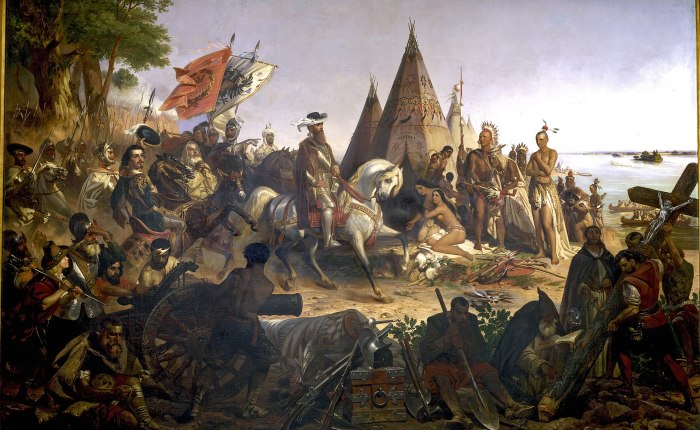
Taylor begins with Columbus and ends with the Russian and Spanish colonization of North America’s west coast. On the way, he discusses the Spanish conquistadores, the French fur traders, the main islands of the Caribbean, the slave trade, and of course the English colonies along the east coast. Even Captain James Cook and his fateful exploration of Hawaii gets a section. Taylor shows what dynamics in Europe motivated expansion—both the large-scale political and economic considerations, and the push and pull factors that made people want to leave. And, of course, Taylor mentions the many Native American groups who cooperated with and resisted, fought for and against, exploited and were exploited by the incoming Europeans.
This history begins with a calamity on a scale difficult for us even to imagine. European diseases ravaged the indigenous population of the United States, causing a population collapse so dramatic that it makes the bubonic plague seem mild by comparison. There is no way to exaggerate the loss this represents, both in terms of people and their lifeways. However, while Taylor does not minimize this tragedy, he also avoids falling into the opposite error of portraying the natives as innocent nature people. To the contrary, he shows how different groups adapted to European presence, often becoming essential allies and trading partners to the new colonists.
Taylor also gives ample space to that other original sin of America: slavery. It is not pleasant reading. His relatively brief coverage of the conditions aboard a slave ship, for example, is deeply disturbing. But even in this case, he does not ignore the agency of his subjects. He describes, for example, how slaves would subtly resist their overseers by feigning misunderstanding or working inefficiently. I also appreciated his explanations of how slavery operated differently in the Caribbean and on the continental United States, according to climate and economic pressures.
In sum, what emerges from these pages is a vivid portrait of a rapidly changing continent—a complicated story to which innumerable groups contributed. While Taylor does demolish the patriotic myth of heroic and benevolent European colonizers, this book is not simply a hit job. Rather, it is a rich, well-written, and dispassionate account of a one of history’s most consequential periods.
View all my reviews
Category: Books
Reposted from my Goodreads page.
Review: The Corner
The Corner: A Year in the Life of an Inner-City Neighborhood by David Simon
My rating: 5 of 5 stars
Some authors have the power to make you feel that you are just understanding the world for the first time. This is, for example, Roberto Caro’s gift. In every one of his books, he seems to expose the world of politics, revealing its inner workings like an ant colony on display in a transparent container. And this is also the consummate gift of this writing team, Simon and Burns. Here, as in Simon’s Homicide, and as in their masterpiece The Wire, these authors show you something you think you already know about: urban poverty. But you really see it for the first time.
In many ways, this book is the ideal companion to William Julius Wilson’s book, When Work Disappears, which was published just one year earlier. Wilson, a sociologist, explains urban poverty using historical trends, statistics, and surveys, whereas Simon and Burns worked like anthropologists: following around their subjects for an entire year and more, trying to understand their world through their eyes.
These different methodologies converge on the same story. When decent working-class jobs disappear from an area, it sets off a chain reaction that erodes the fabric of the society. Those with means move out; those that remain behind are left with few and stark choices. The teenagers in this story, for example, are faced with the options of attending a struggling school system, working for a minimum-wage job, or selling drugs. And while there are significant risks to this last option—risks that, sooner or later, become terrible consequences for all of them—it is undeniable that the reward is immediate and great.
Another theme of both books is how strategies and mindsets that are adaptive on “the corner” are maladaptive anywhere else. The tendency to think in the short-term, to backstab, to lie and cheat, to never show vulnerability—all of these are essential for both the addicts and dealers, though of course they become self-defeating when any of them try to leave this world. And of course many do try to leave it, earnestly and repeatedly. But with so few economic opportunities and so many barriers to government aid (the struggle to just get into a rehab center is Sisyphean), these efforts meet with scant success.
When writing of people in such difficult circumstances, it is tempting to treat them as pure victims. Yet the authors manage to convey the full humanity of their subjects—their many shortcomings and also their strivings—while never minimizing what they are up against. Indeed, this is perhaps the most impressive aspect of this book, and what makes these stories so compelling simply as stories, and not just illustrations of American decadence.
If there is any moral to this book, it is the absolute failure of the war on drugs. Simon and Burns tell of an unending, unceasing drug market—an entire ecosystem of sellers and buyers, operating 24 hours a day, 7 days a week, right in the open. Yes, the police do come and make arrests and confiscate a few vials. But the risk of incarceration is nothing compared to the force of full-fledged addiction or the endless, easy money that dealing provides. At one point, the authors aptly compare the drug war to the debacle of the Vietnam War: all the money, manpower, and machinery in the world is not enough when a war is ill-conceived to begin with.
But what is the solution? What would help? The authors—wisely, I think—refrain from any policy suggestions. Instead, we are left with a kind of mirror-image of the America that Robert Caro describes. Whereas Caro focuses on extraordinary individuals who fundamentally change their worlds, Simon and Burns show how political inertia, economic forces, and human folly conspire to trap everyone—inner-city teachers, beat cops, social workers, rehab nurses, and everyone selling and using—in an endless cycle that chews people up and spits them out, generation after generation. As in Homicide, this is a remarkable work of journalism.
View all my reviews
Review: Homicide
Homicide: A Year on the Killing Streets by David Simon
My rating: 5 of 5 stars
What led me here (as I suspect is true of many readers) was my love of The Wire. Of all of the television I have seen, I found Simon’s masterpiece to be uniquely engrossing and thought-provoking. And despite the obvious creative license taken with the plot, what makes the show so compelling is the bedrock foundation of fact upon which the story is based. Thus, I wanted to get to know some of Simon’s source material directly.
I am glad I did. This book is a triumph in its own right—worth reading even if Simon had never gone on to be a famous television writer. This is just an excellent work of journalism. Simon was given unique access to a squad of murder detectives and their work. He hung around the office on late nights, he listened to interrogations, he read case files, he visited murder scenes, he sat through trials, he went to hospitals and morgues—in short, he did it all. And by simply organizing his observations and writing them down, he has produced a wonderfully insightful look into crime and police work.
Anyone with even a passing acquaintance with detective stories—that is, all of us—has internalized quite a few myths and preconceptions, which are battered to pieces in these pages. For one, most murders do not have a motive beyond rage, greed, or simple recklessness. They are purely impulsive, so detectives rarely bother asking “Who would want this person dead?” Indeed, the Sherlock Holmes image of the cold, rational detective motivated by his love of the common good has virtually no shred of truth to it. The detectives in this book, while decent men (and they are all men), are not on a personal mission against crime. They are motivated by professional pride, by departmental statistics, by overtime pay—and occasionally, yes, by strong feelings of justice.
While we often hear stories of cold cases being solved through innovative scientific techniques, the basic tools of the detective are quite simple: evidence, witnesses, and confessions. And the first two are usually necessary to obtain the third, since most people don’t confess unless they’re backed into a corner. The interrogation techniques Simon describes are somewhat disturbing. Though the detectives do make their suspects aware of their Miranda rights, they do so in such a way that suspects are too intimidated or confused to really stop and consider their next move. The majority don’t use their right to call a lawyer, and instead endure hours of intense interrogation, while detectives browbeat and sometimes scream at them. A surprising number of suspects break and sign confessions.
It is hard not to feel uneasy about this. Indeed, studies have found that some innocent people will even confess to crimes they didn’t commit, just to escape from the intense psychological pressure of the situation. But Simon makes the point that, if detectives were prevented from using manipulative interrogation techniques, they would hardly convict anyone. And when he details the difficulties of actually convicting murderers in court (far fewer than 50% of those arrested for murder end up convicted by a jury of their peers), it is difficult to resist his logic. And when the top brass demand a high clearance rate for the department (that is, the rate of solved to unsolved murders), it is no wonder that detectives will resort to anything to put a case from red to black.
As is usual with Simon’s work, this is the story of ordinary, fallible people who are doing their best (mostly) in a failing, dysfunctional system. The reasons that there are so many murders in Baltimore in the first place go very far beyond the walls of the police department or even the city government. So even though the detectives often do admirable work and lock up obviously dangerous individuals, there is an overwhelming sense of futility in the book. After all, the detectives only arrive after a murder has taken place. They may find the man responsible (and it is usually a man), but even with him behind bars, the next murder is just a block, or a day, or a phone call away.
Yet the book is not wholly bleak. What prevents it from being so are the personalities of the detectives. For the most part, they are smart and, often, surprisingly funny—with a dark gallows humor imposed by the job. And they are surprisingly sympathetic. Indeed, although I share very little life experience with any of these men, somehow I often found myself identifying with them. This is, in essence, the charm of the book: rather than making you fantasize about being an investigative genius, it allows you to see what it would be like if you—the real you, but in another life, perhaps—became an actual, overworked, underpaid homicide detective.
It is a rare book that dramatizes police work while neither elevating the detectives into superheroes nor demonizing them as thugs. Like a good candid photograph, Simon’s portrait is both unflattering and endearing. It is both an uncommonly good work of journalism and a work of art.
View all my reviews
Review: The Emperor of All Maladies
The Emperor of All Maladies: A Biography of Cancer by Siddhartha Mukherjee
My rating: 5 of 5 stars
I do not consider myself a superstitious person—not even remotely—but somehow I felt a deep reluctance to pick up this book. It may have taken us a long time to figure out the germ theory of diseases, yet the psychology of contagion runs deep. I had the irrational fear that even learning about cancer would somehow unleash it into my life.
But turning away from frightful things is not a good way to live. And, anyway, even though there is a lot of sadness in this book, and a lot to stoke your fears (perhaps it is best to avoid if you have a tendency toward hypochondria), but this is basically a story of innovation.
Mukherjee moves through surgery, radiation therapy, chemotherapy, cancer prevention, and modern targeted drugs, showing how each arose and developed in response to different sorts of cancer and out of the science and technology of the moment. It is a vast story, which includes the development of anasthesia and antibiotics, the discovery of genes and chromosomes, the first research into radioactivity, and the campaign against smoking. To use the obvious metaphor, it is a war waged on multiple fronts.
The challenges are manifold. I had naively thought that all cancer was basically the same disease, with its subtypes just minor variations. But it turns out that there is enormous genetic and chemical variety among cancers, so that a treatment effective for one may do little for another. Indeed, even for a single type—breast cancer, say—treatment can be unpredictable. This is what makes the story of doctor’s attempt to treat the disease so riveting, as it feels like a battle between two equally wily antagonists. At several points in this history, doctors attempt extreme cures—radical surgeries, or nearly fatal doses of chemotherapy—only to be defeated. Meanwhile, the victories can be as modest as a remission of just a few months.
It is probably best not to philosophize about a fatal disease, but there does seem to be a lot of irony in our quest to defeat cancer. For one, it has only become so prevalent in the modern period, because we have started living so long. Its appearance as the great killer, then, is a kind of perverse mark of progress. Further, there is the irony of trying to fight what is, in essence, a corrupted version of ourselves—a group of renegade cells which have figured out how to replicate and survive even better than our own body. There is great scope for metaphor here, but if there is a moral to cancer then I don’t think it is a simple one.
Mukherjee does an admirable job weaving a potentially chaotic and depressing story into something coherent and even hopeful. Though the book is composed of history, science, and his own experience as a doctor, these different threads reinforce one another rather than clash. The clinical anecdotes are sparing—just enough to connect the past to the present—and his thumbnail explanations of science are lucid and illuminating. But, most important, despite the many tragic deaths which litter these pages, the final impression is of how much can be accomplished when a researcher’s diligence, a doctor’s pledge to save life, and a patient’s will to live work together, generation after generation.
View all my reviews
Review: The Path to Power
The Path to Power by Robert A. Caro
My rating: 5 of 5 stars
Last winter, I went to the Film Forum in Manhattan with some friends to see the new documentary about Robert Caro and his famous editor, Robert Gottlieb. It was a wonderful experience on many levels. The documentary was fascinating and inspiring—the story of two people who, in quite different ways, have lived fully dedicated to literature—and it was the perfect place to see it, in the heart of Caro’s and Gottlieb’s city, surrounded by other New Yorkers.
Gottlieb comes across as a lovable and brilliant person (he has, sadly, since passed away at the age of 92), but Caro comes across as something superhuman, an embodied intellectual force. The name of the documentary, Turn Every Page, aptly summarizes what makes Caro so special: the meticulous, obsessive, even demented attention to detail—the determination to get to the heart of every aspect of every story, to never be satisfied with half-truths or empty explanations. And then, once he has gathered together his facts, this relentless attention is focused on the writing. For Caro is not satisfied with merely presenting us with his (always impressive) research. He is determined—again, maniacally so—to make us understand on a deep emotional level what each of these facts mean.
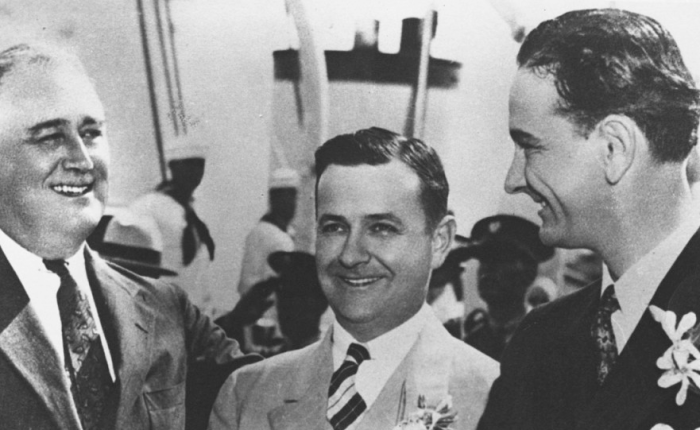
All of these qualities are fully on display in this, the first book of Caro’s monumental biography of the 36th president of the United States. As a political biography—a record of the accumulation and use of power—the book is peerless. Caro traces how Johnson, by sheer force of his personality, went from a rural boy with little education and less money to a member of Congress in just a few years. His chapters on Johnson’s elections alone—his campaign strategies, his fundraising, his advertising—are a goldmine for any political historian, and eye-opening for even the most cynical of readers.
Yet everybody knows that Caro is a master of political biography. What surprised me most was how brilliant this book was in other respects. His descriptions of the Texas Hill Country, for example—its climate, its soil, its weather—often rise to such a level of poetry that I was reminded of John Steinbeck. And his chapter on life in the Hill Country before electrification—the difficulty of even simple chores like washing and ironing—is so empathetic that it brings this experience to life as powerfully as even the most gifted novelist could manage.
Aside from this wonderful scene-setting, and aside from the incisive history, this book is of course the study of a personality. And it is a peculiar one. Indeed, underneath all of the historical detail, I think there is a very basic moral conundrum at the heart of this book. It is, in short, that Johnson is successful and effective—indeed, often a force for good—while being personally unlikeable and morally vacuous.
Caro goes to great lengths to illustrate the uglier sides of Johnson’s character. His urge for power is so great that it trumps every other consideration in his life: love, loyalty, ideals, friendship, ethics. When he is stealing elections, betraying friends and allies, and cheating on his wife, not once does he give evidence that he even possesses a conscience. And yet, in his quest for power, he educates children, helps the unemployed find jobs, secures money for veterans, and electrifies his district, among much else.
This paradox is illustrated in Johnson’s treatment of his secretaries. While he worked as a congressional assistant, Johnson went to great lengths to help the constituents of his district—far more than any ordinary assistant could or would. But this unusual effectiveness was achieved by working his own secretaries to such a degree that they could not have any life outside of work, and one had a nervous breakdown and fell into alcoholism. This is a consistent pattern: the specific people close to Johnson are used as tools for his own advancement, while the abstract people out in the world benefit from his obsessive work ethic.
To put the matter another way, Johnson seems to violate every ethical precept I know regarding the treatment of others, and lives in total contradiction of every piece of advice I know regarding wise and good living. Johnson comes across as a miserable person destined to share his misery with the world. But it becomes clear that Johnson’s personality type is perfectly suited for politics, and he achieves almost instant success when he enters that field. Indeed, one gets the impression that everyone else in Washington D.C. is just a toned-down version of Johnson—equally as power-hungry, but not as effective.
Somehow, we seem to have a system designed to elevate people whom most of us would find repulsive. Maybe this is inevitable, as the people who most desire power are the ones most likely to get hold of it. Perhaps the best thing to do, then, is to hope that the institutions are set up in such a way that, as in the case of Johnson, these driven individuals end up having beneficent effect on society. And yet, this does seem like an awfully risky strategy.
In any case, as I hope you can see, this is a superlative book, excellent on many levels. It is, in fact, among the select class of books that can forever change your outlook.
View all my reviews
Review: Faraday’s Experimental Researches in Electricity
Faraday’s Experimental Researches in Electricity: Guide to a first reading by Michael Faraday
My rating: 4 of 5 stars
In the first volume of Robert Caro’s biography of Lyndon Johnson, there is a fantastic chapter about what life in the Texas Hill Country was like before electricity arrived. Every basic task was substantially more difficult: water had to be carried in buckets, clothes had to be washed by hand, water had to be boiled over an open fire, milk and eggs had to be refrigerated in ice cellars, and on and on. When power finally did arrive to this rural area—thanks in large part to Johnson’s work—it transformed daily life in a matter of years. Johnson was considered a hero, and rightly so.
But if Lyndon Johnson deserves ample praise for having helped bring electricity to his district, what does Michael Faraday deserve? For it was Faraday who first discovered the principles of the electric motor and the electric generator. If not for him, the harsh conditions described by Caro—a life of ceaseless toil, barely eking out a living—might be not just confined to a rural area in Texas, but the general condition of our species. Faraday was, in short, a historical figure of supreme importance, and his work represents a turning point in human history.
Knowing this, it is shocking to see just how humble and, in many ways, how simple his work actually was. The tools at his disposal seem, to the modern reader, almost laughably primitive. Whereas modern physicists are using a city’s worth of power to accelerate particles down a track kilometers long, Faraday was fiddling with wires and bar magnets and compasses. And yet, with such simple tools at his disposal, and with scarcely any formal education—indeed, hardly knowing any math beyond basic algebra—Faraday made contributions to physics comparable to Newton or Einstein.
The format of this book is simple. It is not, like the Principia, a unified work conceived as a final theory. Rather, Faraday reached his conclusions slowly, over years of experimental work; and this book is a reflection of his process. Starting in 1821, Faraday began publishing accounts of his experiments in the Philosophical Transactions of the Royal Society. These papers were eventually collected and published in three separate volumes, in 1839, 1844, and 1855, consisting of 29 “series” of experiments in total.
Before I go any further, I should note that I did not make my way through all three of these volumes. Rather, I bought a condensed and annotated version published by Green Lion Press and edited by Howard Fisher. Frankly, I do not have the patience or interest to fight my way through 1,500 of the original, and I doubt many others do either. I also very much appreciated Fisher’s introductory essays, without which I think I would have been quite lost (and I often was, anyway).
Remarkably, Faraday maintains a numbering system for his paragraphs throughout, so that he can refer to earlier paragraphs of previous series as easily as one might cite the Bible. This is a simple device, but it does help to reveal the unity that underpins the apparently disorganized quality of this work, as it shows how Faraday was continually returning to the same questions and refining his answers.
I have already mentioned that Faraday was unversed in mathematics. And this makes him fairly unique in the field of physics, in which equations are sometimes elevated to a level that equates math with reality. However, the more one reads of his work, the more one comes to see that, even if he eschewed quantitative reasoning, Faraday was an extremely precise thinker. Part of this is his use of diagrams, which for Faraday almost take on the role of equations in summarizing complex relationships. He is also very sensitive to language, and is constantly trying to choose words that do not carry any inappropriate theoretical baggage.
Just because this book is written in good old-fashioned English, however, does not make it easy. Often, Faraday is responding to dead controversies and in general is using both language and theories that seem strange to the modern reader. To pick a simple example, static electricity is referred to as “ordinary” electricity, since this was the most commonly encountered electricity in Faraday’s day. What is more, Faraday very often must describe a detailed experimental apparatus or procedure, and I very often found myself totally unable to picture what was going on.
Here is a fairly typical example:
A ray of light issuing from an Argand lamp, was polarized in a horizontal plane by reflexion from a surface of glass, and the polarized ray passed through a Nichol’s eye-piece revolving on a horizontal axis, so as to be easily examined by the latter. Between the polarizing mirror and the eye-piece two powerful electro-magnetic poles were arranged, being either the poles of a horse-shoe magnet, or the contrary poles of two cylinder magnets; they were separated from each other about 2 inches in the direction of the line of the ray, and so placed, that, if on the same side of the polarized ray, it might pass near them; or if on contrary sides, it might go between them, its direction being always parallel, or nearly so, to the magnetic lines of force.
I don’t know about you, but I find this to be extremely exhausting.
Not all of the book was so dense, however. I particularly enjoyed the fifteenth series, which basically consisted of Faraday and his assistants putting their hands in a tank and getting an electric eel to shock them. Science was indeed simpler back then.
But the final impression is of Faraday’s remarkable theoretical vision. Although he is an extremely concrete thinker—couching even his most speculative remarks in terms of experiments—he nevertheless succeeded in probing some highly abstract questions. Beginning with the relationship between electricity and magnetism, he goes on to consider the relationship of force to matter, to light, and even to empty space.
His work is, in short, a model for science, showing how careful observation and the judicious use of imagination can revolutionize our understanding of the natural world. Compared to the baroque mathematical models of string theorists—whose theories have yet to receive any confirmation from experiment—Faraday’s approach is refreshing indeed.
(Cover image is Faraday’s labs in the Royal Institution; photo taken from Wikimedia Commons; uploaded by AnaConvTrans.)
Review: The Return of the Native
The Return of the Native by Thomas Hardy
My rating: 3 of 5 stars
One of my vices is the reading of advice columns. The problems of the correspondents are often so bizarre as to be beyond the imagination of even the most lurid novelists. My favorite agony aunt (as the British say) is Carolyn Hax, who writes for the Washington Post. And her advice very often boils down to one simple precept: mind your own business.
This book is one long illustration of the wisdom of this maxim, as the entire tragedy of the plot could have been avoided if any of the major characters (and, indeed, even some of the minor ones) had simply minded their own business. From the aunt who cannot trust her niece—or, indeed, even her own son—to marry the right person, to the rejected suitor who spies, eavesdrops, and meddles, to the two principal characters—Eustacia and Wildeve—who express their dissatisfaction with their own marriage by tarnishing another’s, and finally to the titular “native,” whose love for his own country is tainted by his savior complex, thinking that he ought to “improve” his fellows.
Now, you may think that the injunction to attend to your own affairs is not exactly a profound subject for a novel. But considering how difficult it is, and how often we try and fail to do this, I think that it is worth close examination. Indeed, I would go so far to say that minding one’s own business is a bedrock moral principle.
To mind your own business is, in one sense, a way of showing respect, by trusting that others will have the wisdom to manage their own lives. And even if another person evidently cannot act wisely, to refrain from interfering is still very often the best course. The freedom to screw up one’s own life in one’s own chosen manner is an inseparable part of having personal autonomy. In any case, even the kindest intervention can often backfire, as Hardy illustrates with the case of Diggory Venn, who has enough good intentions to pave several superhighways to the fiery pit, and who gets most everyone except himself there in record speed.
However, the injunction to mind your own business is also, potentially, a profoundly conservative one. And as with many Victorian novels—indeed, as with many stories generally—the message boils down to this: do not tamper with the social order. Except for Thomasin and Venn (not coincidentally, the two characters who have a happy ending), all of the major characters consider the Heath to be, in some way, beneath them. Whether their dreams are financial (Mrs. Yeobright), educational (Clym), or romantic (Wildeve and Eustacia), they want to, somehow, get beyond their social reality. And as often happens in stories, the result is a tragic end for them and a return to statis of the society.
I have got caught up in analyzing what I take to be the moral of this book, but I have not said anything about its quality. Unfortunately, I have to admit I found the novel to be quite mediocre. The story is full of cliches (unread letters, mistimed messages, the lover in disguise) and implausible coincidences. I think a good tragedy should show how the end result is an inevitable result of the protagonist’s personality. But with so much seeming bad luck involved in this story, the final impression is that the denouement was just a matter of blind chance.
But it must be admitted that this artificial plot was at least very exciting. Hardy dives right into to the scandalous drama of his story and he never lets up. There is hardly a breath to the ceaseless action, except for the interludes involving the Heath folk, who apparently Hardy conceived of as a kind of Greek chorus to his Sophoclean tragedy. Indeed, as the novel was first serialized in a magazine, I think the experience of reading it must have been remarkably close to that of watching a good soap opera.
Hardy’s characters are only partly successful. His women are more compelling than the men, who are rather stiff, shallow figures. But even the novel’s strongest character, Eustacia, is hampered by Hardy’s penchant for writing dialogue that is pretentious and stuffy, even in moments of great drama. Consider this sample, Eustacia’s reply to her husband during a pivotal scene:
Never! I’ll hold my tongue like the very death that I don’t mind meeting, even though I can clear myself of half you believe by speaking. Yes. I will! Who of any dignity would take the trouble to clear cobwebs from a wild man’s mind after such language as this? No: let him go on, and think his narrow thoughts, and run his head into the mire. I have other cares.
Aside from the strangely epistolary quality of this speech, it is also a good example of a certain psychological implausibility, as Eustacia at key moments withholds explanations which would materially benefit her to provide. That she does this is not a convincing consequence of her character, prideful though she may be, but it is required for the plot to plod onward.
The prose of the novel is not much better. Hardy often seems to be straining for a weighty, literary style that feels both unnecessary and false. He often, for example, includes references to history, literature, and mythology which only prove his own learning, adding nothing to the story. And he gives the impression of choosing words simply to show off. To be fair to Hardy, the writing does improve from the beginning towards the end, which the introduction to this volume attributes to its origin as a serialized novel. Yet even in the final part, we get a sentence like this:
All the known incidents of their love were enlarged, distorted, touched up, and modified, till the original reality bore but a slight resemblance to the counterfeit presentation by surrounding tongues.
Such an ostentatious style may, perhaps, be appropriate in a history of the decline and fall of the Roman Empire, but it is jarring in the context of a novel about rural folks.
In the end, I think this is only a half-successful novel—certainly entertaining, but so uneven as to be ultimately unconvincing as a work of art. But I can say that Hardy would at least have made a first-class agony aunt.
Reflections on Reading the Quran
The Qur’an: Saheeh International Translation by Anonymous
Some years ago, on a trip to Istanbul, I visited the Süleymaniye Mosque with a friend. It was a memorable experience. As we waited outside, a few men washed themselves in the fountains outside the building, purifying themselves before prayer. We went in through another entrance, and found ourselves in an expansive space—light flooding in from the high windows, the geometric designs and arabesques creating an imposing symphony of color. In aesthetic, it was the furthest thing from a gothic cathedral—with its profusion of statues, friezes, sculptures, and gargoyles—but the mosque was, nevertheless, a place of equal spiritual grandeur.
We walked up to the partition that separated the prayer rug from the area reserved for tourists. There, a young Muslim man began to talk to us in good English. He was very polite, asking us where we were from, what we thought of the Mosque, and explaining some of the history and architecture (according to him, the ostrich eggs on the chandeliers were to keep spiders away?). As he spoke to us—so sincere, attentive, and obviously passionate about his faith—I thought of the free copy of the Quran that had been given to me on the previous day, when we visited the equally impressive Blue Mosque, and I quietly resolved to read it.
It took me a while, but I did. This copy is a translation by Saheeh International, first published in 1997 in Saudi Arabia, obviously meant for mass distribution. Now, apparently this organization is a group of three American women who converted to Islam. The translation is widely used but is considered to be both Sunni in flavor and quite conservative. It is certainly possible that it was not the “best” translation for me to read, though I found it to be readable and unpretentious, if not always the most elegant.
This was not my first time attempting to read the Quran. About ten years ago, I tried to read John Medows Rodwell’s translation. But I did something which I rarely do with a book: gave up. The problem was that I did not know how to approach it. Having just finished large chunks of the Old and New Testaments, I thought that the Quran would be at least roughly similar. But it is a very different sort of book. If you skip all the begetting in Genesis, for example, you find that it is, at the very least, an excellent collection of stories. But the Quran is not a collection of stories—indeed, it is not a linear narrative at all. In order to appreciate it, I think that the reader must have some understanding of how somebody born into a Muslim community would first experience the book.
For this, I highly recommend Michael Sells’s excellent book, Approaching the Quran. There, Sells makes the important point that the Quran is heard more often than it is read. Though it may be slightly blasphemous to call Quranic recitation an “artform,” I think that anyone who hears it will recognize that it is a highly developed activity, requiring keen sensitivity to prosody and melody, and following strict rules. Even more striking, this recitation may be heard in rather ordinary situations, almost as one listens to music. Sells, for examples, tells of a driver playing a tape of Quranic recitation on a crowded city bus, while just two weeks ago I ate in a kebab shop with a Quranic recitation playing over the speakers.
This aural quality of the Quran harkens back to its origins. According to Muslim tradition, the Quran was revealed to Muhammed over a period of 23 years by the archangel Gabriel. Muhammed was illiterate and, therefore, did not write down the Quran himself. According to the tradition, it was recited to him and he recited it to his followers, word for word. Indeed, Quran literally means “the recitation.” Unlike in the Christian tradition, then—wherein the works of the Bible are thought to be divinely inspired but not normally considered the direct word of God—the Quran is indeed considered by Muslims to be the actual Divine speech.
Michael Sells points to this difference by referring to how Christian and Muslim missionaries operate in different ways when they come to a new place. The Christians will set about translating their scripture into the local language, while the Muslims will start giving classes in classical Arabic. Martyn Oliver, in his introduction to the Quran, explains the difference in another way. Whereas Christians view the Bible as a human production inspired by God, whereas Jesus is considered to be God incarnate, Muslims consider Muhammad to be divinely inspired but, ultimately, a human, while the Quran is the perfect and miraculous word of God.
I think this background is quite important to know when you attempt to read the Quran. Though of course you can pick up a translation and read it from front to back—which is what I did—this is not how the book was first transmitted, nor how most Muslims first encounter the Quran. Furthermore, the Quran’s organization is baffling unless you understand some of this history.
The book is divided into 114 chapters, called surahs. And these are not organized according to any narrative or obvious internal logic. Rather, they are arranged roughly from longest to shortest. In my edition, Surah 2 (the first is a short opening) is 43 pages long, while Surah 114 consists of six short lines. To confuse matters further, the shorter surahs are normally the ones revealed earlier to Muhammed, before his migration to Medina. Thus the Quran is also in roughly reverse-chronological order—the final revelations coming first. But, again, these features are only puzzling if, like me, you intend to read the Quran from cover to cover.
Despite this seeming disorganization, I think any reader will find that the Quran does have a unified message. The major themes of the book frequently repeat with slight variations from surah to surah, and so the ideas and tenets of the faith are built up in a non-linear fashion from beginning to end.
My first impression was of a powerfully monotheistic faith. True, while Christianity (which is my point of reference, despite not being religious myself) is also monotheistic, I think that if you compare the imagery of the trinity, the angels, the legions of saints, and the Virgin Mary found in any Catholic church with the single emphasis on one omnipotent creator God found in the Quran, you will see a clear difference. Indeed, the Quran repeatedly criticizes both the polytheists and the Christians for thinking that God could have peers or a son.
Another major emphasis of the Quran is the apocalypse. In this, it reminds me of the early Christian church, when the imagery of Christ the judge was far more common than Christ on the cross. Readers are continually warned that God is able to see into their innermost thoughts and that angels record all of their deeds. The terrors of hell and the rewards of heaven are described in far more detail than in the Bible (sometimes even reminding me of Dante) and we are often warned of the final day, when every person will be bodily revived and then judged.
Many Biblical stories are told and retold in the Quran, sometimes in ways that differ considerably from the originals. Rather than the long historical chronicles that one can find in the Bible, however, these stories are told more for their moral point. One obvious theme is that prophets are often rejected by their countrymen, with disastrous results—a clear parallel with Mohammed’s situation.
Yet another common theme of these stories is the importance of faith—of trusting in God’s decrees. Indeed, though there are many sections detailing rules of conduct—such as when to fast, when one can divorce and remarry, or the injunction to go on pilgrimmage (though there is not, I should say, an explicit section on the “Five Pillars” of Islam)—what struck me was how much of the religion is based on the simple act of faith: the belief that God is absolute, all-powerful, all-knowing, and the most merciful. Such a God obviously cannot have any rivals, and no wordly goods can possibly compare with His favor. It is a simple idea, but with deep and far-reaching implications.
I am sure that my impressions will strike both experts and believers as naïve and simplistic. However, I still feel that my understanding of, and appreciation for, this global religion has been deepened by this reading. And that is no small thing.
View all my reviews
Review: What We Owe to Each Other
What We Owe to Each Other by T.M. Scanlon
My rating: 3 of 5 stars
Like many readers of this book, I was led here by the show The Good Place—though my path was indirect. A friend of mine spent months trying to convince me to watch it, arguing that it was “made for me.” But I very rarely watch TV and I never felt compelled to make an exception for the show, however brilliant it may have been.
About a year after my friend moved away, however, I received this book in the mail. Apparently, this relatively obscure philosophy text was referred to multiple times in the show, as the protagonist slowly learned what it means to be a good person. And my friend decided, if she could not get me to watch the show, it would be far easier to get me to read a book. Considering that I am here now, this was a correct surmise.
I really don’t know why the show’s writers chose this, among all of the available philosophy texts, to be featured in the show (an in-joke?). For I really can hardly imagine a work of philosophy less likely to improve a person’s everyday behavior than this one. This is not a criticism of Scanlon, you see, as the book was not written to be exhortatory or uplifting. Rather, this is a work of academic philosophy about the abstract nature of morality. I only point this out to save fans of the show from disappointment.
Scanlon here sets out to give a contractualist account of morality. Well, not quite. He quickly admits that his focus does not include all of what is conventionally thought of as ethics. For some people, saying grace before a meal is morally right, whereas for others preserving a particularly beautiful tree from destruction is something they consider a duty. Indeed, what people consider to be a moral requirement is a large, messy, and varied category. Scanlon here restricts himself to a narrower domain, what he calls “what we owe to each other.” This, in short, has to do with the morality of interpersonal behavior—how we treat one another.
Scanlon begins in a somewhat unusual way, with a delve into the psychology of motivation. He argues that humans, as rational creatures, are better described as being motivated by “reasons” than by “desires.” A desire, in his view, is a kind of short-term motivational urge; and while we do experience such urges, we most often do things because of some larger goal or in accordance with some value. A parent may punish a child, for example, because they think discipline is a necessary part of child-rearing, even if they feel no actual anger—or, indeed, even if they are tired and would rather let it slide.
The fact that humans are motivated by “reasons” and not just “desires” is what makes us, in Scanlon’s views, particularly subject to the laws of morality. This is because we humans, as rational creatures, have a strong motive to care that the reasons for our actions be justifiable to our fellows. Social life would be impossible otherwise. Indeed, for Scanlon, this is the very heart of morality: that we act in a way that no one affected by our action could reasonably reject the principles which guided us.
You might notice that this formula has much in common with Kant’s categorical imperative. Where it differs is in its social (or contractualist) orientation. Morality is not a consequence of a priori rational rules or a special metaphysical category, but rather a consequence of the nature of rationality itself—something we are almost certain to care about, given that we live in communities and act in accordance with broad principles. This account of morality does, however, differ sharply from those along utilitarian lines, and Scanlon argues at length against such views.
I have been trying to present Scanlon’s views fairly, but I have to admit that I did not find this book compelling. For one, his distinction between reasons and desires—an important foundation of his theory—strikes me as particularly fragile. At various points in the book he formulates principles (such as about honesty) which could serve for ethical action. But it is obvious that these principles are so abstract that virtually no ordinary person would think along such lines. Indeed, Scanlon himself admits that most people have rather vague intuitions about their reasons for action, though for him it suffices that the reasons could be formulated.
Worse, while arguing for the primacy of reasons over desires in human motivation, Scanlon does not cite any but “phenomenological” evidence—which is to say, his own experience. To be fair, I have no idea what the state of psychological research into motivation was in 1998, when the book was published. But within a decade, researchers like Jonathan Haidt would make a very strong case that the reasons we profess for acting or thinking in a certain way are not reliable indications of our true motivation.
For example, people often have strong moral feelings (of outrage or disgust, say) without being able to say exactly why they object to something. It seems that our emotional reaction comes first and then our frontal lobe tries to justify the feeling, rather than the opposite. To quote Benjamin Franklin: “So convenient a thing it is to be a reasonable creature, since it enables one to find or make a reason for everything one has a mind to do.”
If Haidt’s model is true, and humans are not primarily motivated by “reasons,” then many of Scanlon’s arguments about morality and why we ought to care about it are considerably weakened. Yet even if we leave this issue to the side, I also found Scanlon’s test of moral validity to be unhelpful. His formula is: Act in such a way that nobody affected by the action could reasonably reject the principles which guided your actions.
To my mind, Scanlon ought to have spent much more time specifying exactly what he meant by “reasonable.” He does not provide any sort of test or easily applicable standards which would show whether a given principle can be reasonably rejected or not, apparently believing that our intuitions about what is reasonable or not would mostly coincide. Perhaps that is true much of the time, but in my experience there is a great deal of disagreement over what is reasonable (and, indeed, what is moral). By the end, I could not help thinking that Scanlon’s formulation was so vague as to be close to useless.
This is related to another fault. Though Scanlon spends a great deal of time explaining the specifics and advantages of his ethical system, he does not show how his way of thinking applies to any tricky areas of morality. He entirely avoids any controversial case—such as abortion, animal rights, the death penalty—and seems content to show that his system forbids murder and most forms of dishonesty. Bertrand Russell once remarked that, in ethics, the philosopher often proceeds by taking the conventional conclusions of morality for granted, and then finding some extra way of justifying them—and this strikes me as precisely the sort of exercise Scanlon is engaged in.
As for the writing style, I notice that many readers found it off-putting. But by the standards of academic philosophy, I would actually say that this book is extremely accessible. That is, of course, not high praise, but at the very least Scanlon avoids formal logic and the impenetrable argot of continental philosophers. Yet it must be admitted that by normal standards the writing is quite dry and lifeless.
But I really do not want to heap so many criticisms upon this book. Scanlon here presents a thoughtful new take on ethics with a minimum of jargon and without being strident or doctrinaire. If I did not find it a rewarding read, it is probably because I am not part of the book’s intended audience (other academic philosophers). Now, after having spent weeks on the book and a lot of time on this review, I wonder if I wouldn’t have been better off just watching the show…
View all my reviews
Review: Les Misérables
Les Misérables by Victor Hugo
My rating: 4 of 5 stars
When I was in the sixth grade I was placed into the “challenge” class. This was a special program for academically “gifted” children, meant (as its name would suggest) to give us more stimulating schoolwork. If memory serves, most of our classes were given over to logic and math problems. But our major project was to read Victor Hugo’s Les Miserables.
We were, of course, assigned a student version of the novel, though even this abridgement seemed immense to me. I am really not sure whether I read the whole thing. If I did, I barely understood even the basic outline. (Maybe I didn’t deserve to be “challenged.”) My only memory of the book is of a description of the streets of Paris, which struck my 11-year-old mind as unbelievably and impenetrably detailed.
The year culminated with a visit to see the musical on Broadway. (Living close to NYC has its perks.) I was stunned that such a long and boring book could be transformed into an exciting performance. Was this what we had been talking about all year? The music was stuck in my mind for days—weeks. And ever since then, I have had the vague intention of making another go at this literary challenge.
The perfect opportunity presented itself when I signed up to run a marathon. If I listened to the audiobook during my training runs, I could tackle two challenges at once. It turned out that Victor Hugo had even more stamina than an endurance runner, since there was still a substantial chunk of the book left by the time I ran my race. But even the longest books submit to persistence!
It is tempting, when finishing a book of this size, to sing its praises. After all, if the book was not brilliant, then spending sixty hours on it hardly seems worthwhile. But I had quite a mixed reaction to Les Miserables. And I think I would be doing my sixth-grade self a disservice if I did not attempt an honest, accurate report.
The book opens with a long and loving portrait of a character who plays a very minor role in the plot: Bishop Myriel. This is Hugo’s version of the thoroughly good man, a living saint, someone who emulates Christ in word and deed. And though this section was (as usual with Hugo) unnecessarily lengthy and (also typical) highly sentimental, I admit that I found this portrait of human goodness thoroughly moving. Bishop Myriel, indeed, is the heart of Les Miserables, the culmination of the sort of humanitarian goodness that Hugo hopes to inculcate.
This high sense of moral obligation is what prevents the novel from devolving into a long exercise in romantic windbaggery. Hugo writes, not just as an entertainer, but as a reformer—even, perhaps, a revolutionary—and he urges his readers to feed the hungry, tend to the sick, clothe the poor, educate the ignorant, to pardon the guilty, and to lift up everyone who has been cast off by society. And Hugo is not merely paying lip service. The most moving parts of the novel are also the places where Hugo illustrates his social vision.
I think this goes a long way to explaining this book’s lasting appeal. The world is still full of Jean Valjeans, born into poverty and then receiving only punishment from the law.
But of course Les Miserable would not have been made into a musical if it were a long sermon. It is also (at times) a cracking good story. At his best, Hugo is able to raise the tension of the novel to a fever pitch, and then hold it there for page after page. I am thinking, in particular, of Jean Valjean’s long ride to attend the trial of the falsely-accused Champmathieu, or when Valjean is taken prisoner by Thénardier in the apartment.
These high points are, however, compensated by many, many slow sections. By modern standards (and probably at the time, too), Hugo is longwinded in the extreme. Partly this is because he does not abide by our strict notions of the novel, simply narrating the deeds of his characters. Rather, he is constantly analyzing, opining, and moralizing, in a rhetorical style which, at its worst, could sound very much like a self-important politician giving a speech to his donors.
Hugo was a romantic in the full sense of the word, and this also made him prone to a kind of sickly sentimentality which the modern reader can scarcely tolerate. There were times when I felt as though I could not roll my eyes hard enough. This is most apparent in Hugo’s characterization of Cosette, who is portrayed as very sweet, very beautiful, very pure, very innocent… very nothing, in other words. She is hardly given any personality at all, which makes both Marius’s infatuation and Jean Valjean’s adoration dramatically dull.
Now, I am probably achieving some sort of apotheosis of stupidity by saying this, but Les Miserable is just too long. This is not just owing to Hugo’s prolixity, but to his roaming digressions. Perhaps a quarter of the novel could be excised without doing any damage to the story. There is, for example, an entire section on monastic life, one on the sewers of Paris, another on slang, and an unbelievably long one which narrates the Battle of Waterloo. Admittedly, some of this material is interesting (I particularly liked the essay on slang). But it struck me as, to say the least, rather clumsy to insert these opinions as essays—and especially at some of the most dramatic turning points in the book.
To put the most generous interpretation on these digressions, however, they can be considered a mark of the book’s great ambition. And this is ultimately a winsome quality. As with many of the great novels of the 19th century, one feels that the author is attempting to reform the whole society, from the sewers to the schools to our very souls. And if the novel can seem a little flabby and bloated, it is also strong enough to confidently take its place among its peers—War and Peace, Bleak House, The Brothers Dostoyevsky, Middlemarch… This is a high bar, to say the least.
One hardly imagine two authors less alike than Leo Tolstoy and Charles Dickens, and yet Victor Hugo somehow manages to combine elements of both writers. He has Tolstoy’s sense of history and his focus on realistic detail, while being just as committed to social reform (and just as prone to sentimentality) as Dickens. If he does not quite reach the artistic heights of either writer, Hugo remains an inspiring figure—intellectually ambitions, socially committed, and dramatically compelling. At the very least, his book presents a worthwhile challenge.
View all my reviews