Review: The Rise and Fall of the Dinosaurs

Review: The Rise and Fall of the Dinosaurs

The Rise and Fall of the Dinosaurs: A New History of a Lost World by Stephen Brusatte

My rating: 4 of 5 stars


Like so many people, I went through a dinosaur phase as a child. It was almost inevitable. Growing up on the Upper West Side, I could visit the Museum of Natural History nearly every week. Natural selection has overcome many engineering problems—flight, sight, growth, digestion—and it has certainly not failed in its ability to awe little boys. I picked up this book to finally learn something about these ancient beasts.

Any fair evaluation of this book must conclude that it does its job: it summarizes new discoveries about dinosaurs in accessible prose. Brusatte goes through the entire chronology of the group, from their beginnings as unremarkable reptiles which emerged after the great Permian-Triassic Extinction, to their gradual rise, growth, spread, and diversification, and finally to their eventual end—wiped out by an asteroid.

There are many interesting tidbits along the way. Dinosaurs had the efficient lungs we find in modern birds, which are able to extract oxygen during the inhale and exhale. They also had primitive feathers, which looked more like hairs. Indeed, modern birds are dinosaurs in the strict sense of the word. I was particularly surprised to learn that Tyrannosaurus Rex lived and hunted in groups; and that they achieved their massive size extremely quickly—growing several pounds a day for years on end.

I also appreciated Brusatte’s descriptions of the methods that paleontologists use—new statistical techniques for analyzing fossils, or piecing together ancient ecosystems, or determining rates of evolutionary change. Nowadays paleontologists to not merely look for old bones, but they study living animals to make hypotheses about the speed, strength, and size of these extinct creatures. One researcher even studied fossils under a microscope to deduce the color of the feathers from the indentations. Brusatte also covers some of the history of dinosaur research, which is surprisingly colorful—especially the tragic life of the Baron Franz Nopcsa von Felső-Szilvás.

So the book undoubtedly accomplishes its goal. My only complaint is the style. When Brusatte sticks to the science, he is clear and engaging. But whenever he chooses to embellish the story—which is rather too often—the prose becomes strained and grating. Here is a description of a seagull that opens his chapter on birds:

When the sun breaks through for a moment, I catch a glint reflected in its beady eyes, which start to dance back and forth. No doubt this is a creature of keen senses and high intelligence, and it’s onto something. Maybe it can tell that I’m watching. Then, without warning, it yawns open its mouth and emits a high-pitched screech—an alarm to its compatriots, perhaps, or a mating call. Or maybe it’s a threat directed my way.

In fairness, I did enjoy his description of what the dinosaurs would have experienced in the first few minutes after the asteroid impact.

More irksome, however, were the thumbnail sketches of his colleagues, which are interspersed throughout the book. I would have understood the necessity of these passages if Brusatte were introducing a researcher who would play an important role in the book. Yet inevitably these researchers were introduced with fanfare only to be immediately dropped. What is more, Brusatte always focuses on the quirkiest aspects of these researchers, in a superficial attempt at coolness; and he also makes sure to tell us that he is one of their best friends.

In one particularly aggravating example, Brusatte describes one researcher’s fashion (“leopard-print Lycra, piercings, and tattoos”), ethnicity (“half-Irish, half-Chinese”), hobbies (“raving and even occasionally DJ-ing in the trendy clubs of China’s suddenly hip capital”), and conversation style (“delivering caustic one-liners one moment, speaking in eloquent paragraphs about politics the next”). Does this add anything of value to the book?

These stylistic irritations mar what is otherwise an excellent popular book about dinosaurs. And since these offending passages do not add anything to the substance of the book, my advice is just to skip on until he gets back on the subject of dinosaurs—a topic which brings out the best in Brusatte.
View all my reviews

Review: The Poetry of John Keats

Review: The Poetry of John Keats

Keats: Poems by John Keats

My rating: 4 of 5 stars

A thing of beauty is a joy for ever

As a dedicated book reviewer, it is my job to say why I like certain books and dislike others. When it comes to nonfiction, this is reasonably straightforward: if the exposition is clear, if the arguments are logical, if the ideas are reasonable—then it is a worthy book. Nonfiction aims for truth, and truth can at least be tested. With literature, however, the task is somewhat more fraught. Beauty is an unfalsifiable hypothesis. We can break down a novel’s strengths and weaknesses by category—good prose, bad pacing, fine dialogue, shallow characterization—but ultimately these evaluations, however much we justify them, rest upon gut reactions.

Why does one sequence of musical notes create a pleasing melody, another a forgettable ditty, and a third a nonsensical jangle? Why do certain combinations of words strike the ear as just right, and others as discordant? Formal analysis can clarify and categorize the sorts of sounds and structures that people tend to enjoy. But it can never explain why we enjoy them in the first place, nor why different people enjoy them to different extents. If literary criticism is to be a worthwhile exercise it requires, then, that the gut reactions of the audience members are at least roughly alike—that we are similarly constituted as regards to beauty.

Shared education contributes towards this similarity; as does, presumably, the basic resemblance of our natures. But does this bedrock of shared taste constitute something durable and permanent enough so that we may say a great artist hits upon the “truth” of art—appealed to something permanent in ourselves—in the same way that a scientist may hit upon a “truth” of nature? Many have thought so. And it strikes me that something like this must be the case if we wish to call any form of art “universal”—namely, that it is a true expression of what we share.

I mention this because the relationship of beauty to truth is one of the great themes of Keats’ poetry. At the end of his “Ode on a Grecian Urn” he tells us that “Beauty is truth, truth beauty”—a line that has been endlessly analyzed. Certainly the widespread and steady popularity of his poems may argue that, indeed, Keats hit upon some basic truth of art. But what could that mean?

The issue of translation may bear on the question. It is often said that poetry is untranslatable; and the bilingual edition I read ironically proved the point. The Spanish consistently failed to evoke the sublimity of the original. Here, for example, are two famous lines from Keats’ “On First Looking into Chapman’s Homer”:

Then felt I like some watcher of the skies
When a new planet swims into his ken

And here is the Spanish translation:

Entonces me sentí como un astrónomo
cuando ve frente a sí un Nuevo planeta

Translated back into English this reads something like: “Then I felt like an astronomer when he sees a new planet in front of him.” Despite preserving the literal meaning, this obviously loses all of the magic of the line. “Watcher of the skies” is infinitely more romantic than “astronomer,” and “sees in front of him” has none of the mystery of “swims into his ken.” In short, the rich beauty of the language does not survive; and the poem becomes a rather bland statement about enjoying a new edition of Homer, rather than an evocation of the grandeur of nature and art.

(I do not think it was the translator’s fault. Spanish is very different to versify than English; and the literal Spanish translation would preserve meaning at the expense of rhythm.)

Yet if Keats’ poetry is truly untranslatable, then how could it contain truth? After all, one could translate Newton’s work into Spanish, French, German, or Japanese, and it would contain just as much truth (or untruth) as in the original. Science is not linguistically bound. Admittedly, the boundary of translation is not equivalent for all forms of poetry. Homer’s works are still riveting in English; and Dante’s vision survives (at least partially) its journey from Medieval Florentine. Lyrical poetry seems to fare the most poorly.

The obvious difference between Homer and Keats is that Homer’s appeal lies in the story, while Keats’ relies on his linguistic brilliance. And, for my part, it is easier to see how a story can contain a semblance of “truth,” rather than a beautiful string of words. Assuming that some experiences in life are universal, that some emotional crises are recurring, that some existential state is inescapable, then a great story may be able to capture something common and durable about the human condition. A beautiful poetic line, on the other hand, has a purely formal appeal—charming not in what it says, but in how it says it—and this perfection of expression, being untranslatable, must fall short of universal art.

Nevertheless, to describe Keats as merely a brilliant wordsmith would be an absurd underestimation. As his letters prove, he was thoroughly educated and keenly intelligent. His poems abound with perplexing classical references. And, in any case, words are never mere sounds; they are laden with meaning; and even the briefest of lyrical poems are pregnant with thought. Contemplation permeates Keats’ work. In his poems we find the focused musings of a highly original man as he meditates on entirely common occurrences: Autumn, Melancholy, Nature, Art—the list goes on.

Here is where Keats’ art may be said to be “universal”—and, in some sense, “true” to the human condition. For many of us have stood, amazed, before a work of art, or felt thrilled upon opening a book, or listened yearningly to a bird singing outside a window—or any number of comparable experiences. Yet only Keats and his ken have taken these fleeting twinges of emotion, reflected deeply upon them, and captured them in words so felicitous that they are impossible to forget once heard. Like the revelers on the Grecian Urn, Keats has frozen time.

It may be that this lyrical form of art, being so bound up in brilliance of expression, is less universal and less durable than works of narrative. But for those who are, by chance, linguistically equipped to enter Keats’ world, then his poems contain just as much artistic “truth” as the oldest tales and the finest melodies.

View all my reviews

Review: Henry V

Review: Henry V
Henry V

Henry V by William Shakespeare

My rating: 4 of 5 stars

Men of few words are the best men.

This is a masterful play, likely one of Shakespeare’s most effortlessly enjoyable. Aided by the chorus, the story moves quickly; and there is none of the artificial machinery of Shakespeare’s comedies and tragedies—mistaken identities, secret plots, and the like—but, instead, a story focused on one man’s glorious ascent. This is Henry; and his character is undoubtedly one of the greatest portrayals of a charismatic leader we have. He is the play. Just as he dominates everyone on the stage, so he dominates us, the audience.

The result is a mesmerizing patriotic spectacle. Even if you have grave reservations about the justice of invading France, and even if you can see through Henry’s rhetoric, it is impossible to resist his call to follow him. But how did Shakespeare himself feel about the hero king? One cannot be sure. Nevertheless, there is enough irony in the play to suggest that the playwright entertained his own doubts. Most telling, for me, was the conversation between the disguised Harry and the soldier Williams. After the soldier expands upon the horrors of war—limbs chopped off, men crying for a surgeon, wives and children left alone—he concludes that the king will be responsible for a great evil if the cause be not just. Harry then responds with a fine bit of extremely specious reasoning:

So, if a son that is by his father sent about merchandise do sinfully miscarry upon the sea, the imputation of his wickedness, by your rule, should be imposed upon the father that sent him. Or if a servant, under his master’s command transporting a sum of money, by assailed by robbers and die in many irreconciled iniquities, you may call the business of the master the author of the servant’s damnation.

Anyone, I suspect, can see the clear difference between a misfortune befalling a servant and a wound suffered by a soldier sent into battle. And this is just one example of Henry’s refusal to consider the ethical ramifications of his decisions. Later on, when Henry discovers that the baggage train has been attacked, the noble king orders his soldiers to cut the throats of every prisoner. He is, in short, remorseless in the pursuit of what he considers his birthright.

The central question that the play asks, then, is whether Henry’s brilliant, charismatic leadership in some measure excuses all of the bloodshed that results from his choices. Now that the idea of monarchy has lost its hold on our imaginations, the argument that any land belongs to a king “by right” sounds barbaric. It thus seems difficult to justify the invasion of France on any reasonable ethical grounds. After all, France is not ruled by a cruel tyrant; and the people of France will likely be no happier under Henry than under Charles VI.

Nevertheless, it is difficult not to root for the young king. And this is true of many historic conquerors, from Alexander the Great to Napoleon. They cloak themselves in glory and promise to inaugurate a new world, if only you follow them through the breach. Indeed, Fluellen explicitly compares Henry to Alexander, noting how the latter killed one of his best friends while drunk, just as Henry rejected his friend and mentor Falstaff. (And Mistress Quickly’s narration of Falstaff’s lonely death is one of the more affecting moments of this play.) It seems strange that these military conquerers have commanded so much praise throughout the ages. Plutarch’s Lives is little more than a compendium of so many Henrys. Yet as Voltaire said:

Not long since the trite and frivolous question was debated in a very polite and learned company, viz., Who was the greatest man, Caesar, Alexander, Tamerlane, Cromwell, etc.? Somebody answered that Sir Isaac Newton excelled them all. The gentleman’s assertion was very just; … those politicians and conquerors (and all ages produce some) were generally so many illustrious wicked men. That man claims respect who commands over the minds of the rest of the world by force of truth, not those who enslave their fellow-creatures: he who is acquainted with the universe, not they who deface it.

All this being said, it must be noted in favor of these conquerors that their less charismatic counterparts are not necessarily better in terms of the common good. In Richard II, the beginning of this tetralogy, Shakespeare gives us a portrait of just such an ineffectual king, a man who has the sensibility of a poet but not the strong will of a commander, and whose poor decisions result in a civil war. Historically, peace at home has often been kept at the cost of war abroad, and vice versa. Conquered land is seldom kept, but the state is strengthened in the meantime; and a country united against an enemy may be preferable to one divided by faction.

Clearly, a country at peace at home and abroad is preferable to either alternative. But historically speaking, this option has not often existed. I do not think this excuses the bloodshed of conquests, but perhaps it goes some way in explaining why these warlike men have so often been treated as heroes, when nowadays we are apt to see them as villains. That, and a play about Isaac Newton would likely not be as entertaining.

View all my reviews

Review: Three Philosophical Tales (Voltaire)

Review: Three Philosophical Tales (Voltaire)
Micromegas

Micromegas by Voltaire

My rating: 5 of 5 stars

This, for me, is a perfect little book—part science-fiction, part philosophy, and all wit.

I confess that I have always been somewhat lukewarm towards the more famous Candide, perhaps because that book pokes fun at an idea that I have never believed nor even taken seriously—namely, that we live in the best of all possible worlds. But this book explores an idea which I have often contemplated: the smallness of our species in the universe.

In a way, the idea is not very sensible, since size is a relative term, and in any case physical size has nothing to do with importance. Nevertheless, when you look out of a plane window or down a skyscraper, and marvel at the almost comical smallness of buildings, cars, and people, it is an irresistible thought—that all of the things we concern ourselves with are ultimately without consequence.

One can perhaps see this book as a farcical precursor to Carl Sagan’s Pale Blue Dot, which uses science rather than wit to emphasis our littleness. Both books come to the same point: we do not know far more than we know, we cover our ignorance with myths and theories, and we fight and kill one another for absolute trivialities. As one of the book’s philosopher says, “Did you know, for example, that as I am speaking with you, there are 100,000 madmen of our species wearing hats, killing 100,00 other animals wearing turbans, or being massacred by them, and that we have used almost the whole surface of the Earth for this purpose since time immemorial?”

The final message of the book is rather bleak and even nihilistic, if lightened by Voltaire’s humor: that humanity is vanishingly unimportant. This is not exactly good philosophy, nor is it even necessarily good moralizing, since if nothing means anything we might as well do what we want. However, this “cosmic” perspective can, I think, be used to moderate ourselves: as a timely reminder of our ultimate ignorance and of our ultimate insignificance. It can at least help us to take ourselves a little less seriously. And, as Betrand Russell observed of Spinoza’s cosmic philosophy:

There are even times when it is comforting to reflect that human life, with all that it contains of evil and suffering, is an infinitesimal part of the life of the universe. Such reflections may not suffice to constitute a religion, but in a painful world they are a help towards sanity and an antidote to the paralysis of utter despair.


Zadig/L'Ingénu

Zadig/L’Ingénu by Voltaire

My rating: 4 of 5 stars

If we must have fables, for heaven’s sake let them at least be emblems of truth.

Here are two more tales of Voltaire, one written before and one after the famous Candide. All three center on a young man in love with a beautiful girl, whose love is thwarted as he is tossed about by fortune. Yet in content and tone the three are fairly divergent.

Zadig, the earliest of the tales, is set in the orient of the Arabian Nights. The titular hero is excellent in every way; he is wise, he is dexterous, he is honorable, and he even practices the art of deduction as well as Sherlock Holmes. Yet no matter what he does, misfortune follows close at his heals.

So far the tale more or less resembles Candide. However, Voltaire ends the story on an unexpected note. Zadig’s misfortunes eventually lead him to marry the woman he loves and become king; and the moral is that, as Pope said, all partial evil leads to universal good. In other words, one must trust fate and not presume to denounce bad luck. This is striking because it is the exact moral that Voltaire so mercilessly parodies in Candide. It appears the younger Voltaire was more optimistic.

The last tale, L’Ingénu (or “The Child of Nature” as the translator renders it) is about an American native who ends up in Breton and tries to integrate. This tale is more pointedly satirical than Zadig, as Voltaire goes out of his way to mock the hypocrisy of French catholics. In tone this tale is not nearly so lighthearted; indeed, in style it is more novelistic than joyfully silly. The final message is that French society is deeply corrupt and that many misfortunes are simply the result of human wickedness. And as the last sentence of the book tells us: “Misfortune is no use at all!”

Optimistic or pessimistic, these two tales are gems of wit from a humane thinker and a sharp writer. Everything I read of the French imp increases my admiration for him.


View all my reviews

Review: The Prussian Officer

Review: The Prussian Officer
The Prussian Officer

The Prussian Officer by D.H. Lawrence

My rating: 4 of 5 stars

This is my first book by Lawrence, and I am greatly impressed. These short stories were published near the beginning of his writing career; yet they show a mature writer with a fully developed voice. Several qualities are immediately apparent. The first is Lawrence’s exquisite sensitivity to nature. The best prose in this volume is to be found in the many passages of natural description:

The air was too scented, it gave no breath. All the lush green-stuff seemed to be issuing its sap, till the air was deathly, sickly with the smell of greenness. There was the perfume of clover, like pure honey and bees. Then there grew a faint acrid tang—they were near the beeches; and then a queer clattering noise, and a suffocating, hideous smell: they were passing a flock of sheep, a shepherd in a black smock, holding his hook.

Lawrence’s primary subject is the rural poor. He is totally convincing in his depiction of the harried mother waiting for her drunkard husband to stumble home, or the sick widow trying to take care of her adult son. Unlike Hemingway, Lawrence has the rare talent of being able to write about people entirely unlike himself. His most memorable characters are consistently women, who normally show themselves to be superior in personality and intelligence to their male counterparts.

Insofar as these stories contain the germ of a philosophy, it is that passionate, sexual relationships allow people to be truly themselves. Thus, in “The Thorn in the Flesh,” the consummation of a relationship gives the couple a strange superiority over their circumstances; and in “Daughters of the Vicar,” the unhappy daughter who settled for a loveless marriage is contrasted with the self-assured daughter who marries for love.

But it would be wrong to call Lawrence a didactic writer, at least in this volume. The stories, for the most part, have no moral. They are concerned with the basic stuff of all prose literature: relationships—with oneself, with others, or with the rest of society. And as Melvyn Bragg says in the introduction, the stories are free of the traditional plot mechanics that are used to propel stories to pre-determined ends; instead Lawrence’s stories develop seamlessly, organically, without any noticeable push from the writer. I am looking forward to reading Lawrence’s novels.

View all my reviews

Review: Henry IV

Review: Henry IV
Henry IV, Part 1

Henry IV, Part 1 by William Shakespeare

My rating: 4 of 5 stars

Food for powder, food for powder. They’ll fill a pit as well as better.

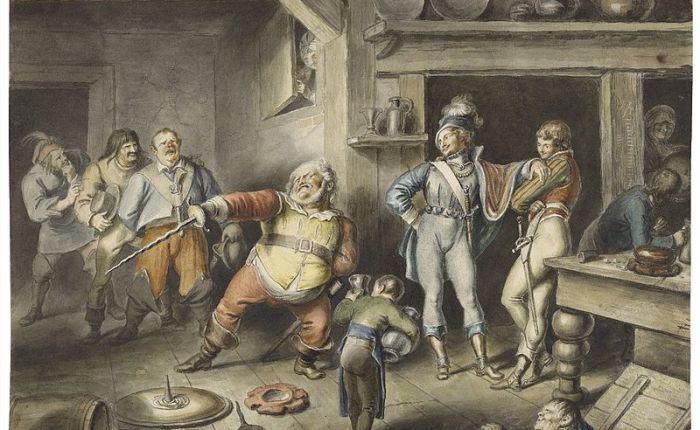
This is undoubtedly one of Shakespeare’s strongest plays. In tone and atmosphere it is far more varied and naturalistic than its predecessor, Richard II. The scenes with Hal amid the low-life of London are fetching, and do much to alleviate the stiff and stuffy courtly atmosphere of some of Shakespeare’s histories. The comedy also helps; and this play contains some of Shakespeare’s highest and lowest comedy, both of which are embodied in the corpulent Falstaff.

Most readers will, I suspect, concur with Harold Bloom in deeming Falstaff one of the bard’s great creations—though we may not go so far as to put him on a level with Hamlet. Bloom is correct, however, in seeing one’s opinion of Falstaff as a defining fact in one’s interpretation of the play. There are those who see in Falstaff the spirit of carnival—the ecstatic embrace of all the pleasures of life and the total rejection of all the hypocrisies of society Others see Falstaff as a corrupter and a lout—a lazy and selfish fool.

For my part I vacillate between these two attitudes. There is no denying Falstaff’s wit; and his soliloquy on the futility of honor is wonderfully refreshing, puncturing through all of the political nonsense that motivates the bloody clashes. Still, I cannot help thinking that, if the Falstaffian attitude were embraced too widely, society itself would be impossible. Some social restraint on our pleasure-loving instincts is necessary if we are not to end up fat drunken thieves. On the other hand, a generous dose of the Falstaffian attitude can be a great antidote to the self-righteous nonsense that leads us into war.

In any case, Falstaff is not the only great character in this play. Hotspur is a mass of furious energy, an electrifying presence every time he is on stage. Prince Hal, though less charismatic, is more complex. From the start, he already has an ambivalent relationship with Falstaff, a kind of icy affection or warm disregard. Indeed, Hal holds everyone at a distance, and one senses a skeptical intelligence that is wary of committing until the circumstances are just right. It is hard to read his character’s evolution as that of a wayward youth who learns to embrace his identity. His actions seem far too deliberate, his timing too perfect. Was he hoping to learn something by keeping company with Falstaff and his lot?

Henry IV, Part 2

Henry IV, Part 2 by William Shakespeare

My rating: 3 of 5 stars

Presume not that I am the thing I was.

Compared with Part 1, this sequel is significantly weaker as a stand-alone play. There is no antagonist to compare with Hotspur. Falstaff wanders about in pointless merrymaking, mostly separated from Hal; and unfortunately his wit is not nearly so sharp outside of his young companion’s company. The same can be said for Hal, whose youthful liveliness fades into a chilling uprightness. And the plot can be frustratingly meandering and abrupt.

The main drama of this play is the progression of Hal from prodigal son to the ideal young king. This transformation is apt to cause some misgivings. On the one hand, I found it genuinely admirable when Hal commends the Justice and bids him to do his work. And even if one loves Falstaff, it is difficult to wish that the King of England would keep such a lawless fellow around, much less lend him influence. On the other hand, the newly-ascended king’s rejection of his former friend and mentor is deeply sad. Perhaps he should have turned Falstaff away, but it need not have been with such cold scorn.

Again, there is a moral conflict here. Falstaff may best be described as amoral: uninhibited, pleasure-loving, devoid of both cruelty and rectitude. He feels no scruples whatsoever at dishonesty and robbery, and acknowledges no ideal as worth pursuing or even respecting. Hal, by contrast, is a moral creature: he wishes to uphold the moral order, but for him this may mean murder or bloody conquest. So one must ask: Which is better, to be a drunken pickpocket or to lead your country on an invasion? Neither the socially subversive nor the socially upstanding can be fully embraced, which is why Hal’s rejection of Falstaff causes such complex reactions.


View all my reviews

Review: Our Magnificent Bastard Tongue

Review: Our Magnificent Bastard Tongue

Our Magnificent Bastard Tongue: The Untold History of English by John McWhorter

My rating: 3 of 5 stars

Like many on Goodreads, I decided to read this book because of Manny’s enthusiastic review. And I am glad I did. As a teacher of English as a foreign language, it seemed high time that I understand something of the language’s history. This book was an excellent choice, since it focused on that aspect of English most pesky to foreign speakers—grammar—while avoiding the too-often-told story of the growth of English vocabulary via French and Latin.

McWhorter begins by focusing on two distinctive features of English grammar: the so-called ‘meaningless’ do (as in, “Do you eat rabbits?”) and the use of the progressive in order to talk about the present (as in, “I am going,” rather than simply “I go”). Not coincidentally, these two aspect of English cause some of the most persistent errors in my students. In Spanish, just like in every other European language I know, there is no auxiliary verb needed for negations or questions; you can simply ask “¿Comes conejos?” Similarly, in Spanish, as in German or French, you can use the simple present to refer to what you are doing now; thus, a Spaniard can say “Voy” to express a current movement, and they reserve “Estoy yendo” for special emphasis.

Curiously, no other Germanic languages have these features. Indeed, they are absent (according to McWhorter) from every other European language, with the notable exception of the Celtic languages (specifically, Welsh and Cornish). This leads him to the quite natural supposition that the indigenous Celtic languages exerted an influence on the Old English spoken by the invading Anglo-Saxons. He musters quite a number of evidences and arguments in support of this thesis, to the extent that I was pretty worn out by the end of the chapter.

To be fair, this idea is considered quite controversial in the academic community, so McWhorter felt the need to champion it in full battle array. Nevertheless I think the maxim “Know your audience” applies here. I presume most readers of this book will be, like me, non-specialists, with little reason to be skeptical of the Celtic influence; to the contrary, it struck me as extremely plausible. So McWhorter’s harping on the point was simply taxing. In any case, if he is looking to influence the academic community, a short popular book is not the medium to do it.

McWhorter’s next chapter deals with the Viking influence, which he holds responsible for the jettisoning of much of Old English’s serpentine Germanic grammar, resulting in the relatively “easy” language we have today. And he rounds out the book by making the considerably more speculative argument that Proto-Germanic diverged in such a distinctive way from Proto-Indo-European because a large number of Semitic speakers (Phoenicians who had made it to Denmark) learned the language. At this point, I admit that I began to have reservations about McWhorter’s method. Despite the reasonableness of the Celtic-English and the Scandinavian-English hypotheses, the cumulative effects of McWhorter’s arguments was to weaken each.

McWhorter’s specialty is researching how languages influenced one another historically; and one begins to suspect that this academic orientation leads him to see evidence for this phenomenon everywhere. To me it is unsatisfying to write a history of English as a series of stories, however plausible, of how it was influenced by other languages. This is because, logically, in order for there to be distinct languages capable of mixing there must first be languages capable of transforming without any linguistic contact. It can all begin to sound like a biologist who insists that the reason elephants have tusks is because proto-elephants mated with proto-walruses epochs ago.

This is an unfair comparison, of course; and to repeat I think his Celtic argument is quite strong. However, the more one reads, the more McWhorter’s method can begin to sound unsettlingly like Just-So stories. Some inconsistencies in the arguments make this clear. For example, he brushes aside the paucity of Celtic vocabulary in English, while citing the many Scandinavian loan-words as evidence for Viking influence (not to mention the possible Semitic loan-words in Proto-Germanic). To me it seems prima facie dubious that Welsh and Cornish speakers were able to fundamentally transform English’s grammar without leaving a considerable stockpile of loanwords. Importing words is the most natural thing in the world when learning a foreign language; I do it all the time, as do my students.

To objections like these McWhorter is always able to point to a case where a similar event occurred as the scenario he is describing. But, again, one surmises that the corpus of available examples is large enough to back up any claim he wishes to impose. McWhorter criticizes other linguists for ignoring the causes of language change. But is invoking the influence of other languages a satisfying explanation? To me this is of the same order as arguing that life on Earth originally came from Mars. Perhaps, but how does life arise in the first place?

Now, it may be unfair of me to nitpick what is, after all, a popular book. But if McWhorter saw fit to include so much argument in favor of his uncommonly-held opinions, I think it behooves readers to be somewhat skeptical, especially since the general reader has no specialized knowledge to ground her acceptance or rejection of McWhorter’s conclusions. For my part, I think a more expository and less polemical book on the history of English would have made for far more pleasing reading. Yet McWhorter is an engaging writer and an original thinker, so it was valuable to learn of his approach to linguistics.


View all my reviews

Review: Letters of the Younger Pliny

Review: Letters of the Younger Pliny

The Letters of the Younger Pliny by Pliny the Younger

My rating: 4 of 5 stars

… the work of getting anybody to cheerfully undertake the monotony and drudgery of education must be effected not by pay merely, but by a skillfully worked-up appeal to the emotions as well.

I read this book in preparation for a recent visit to Pompeii; and it was an excellent choice. The ancient letters and the ruined city make for an ideal pairing, as both offer a remarkable look into daily life in ancient Rome. Pliny had a long and eventful career: an orator, magistrate, lawyer, and writer. His correspondence includes mundane details, tender love letters, poetic reflections, philosophical musings, and much else. Whatever the subject, his personality shines through: intelligent, urbane, loyal, if a bit ostentatious and pompous. He is, above all, eloquent; and his letters are without exception written in superb prose.

Though each epistle is a valuable historical document, some are conspicuously noteworthy. Most interesting for me was his description of the eruption of Vesuvius, which resulted in the death of his illustrious uncle, Pliny the Elder. He recounts his uncle’s and his own experience in two letters to his friend the historian Cornelius Tacitus. Here, with an eye to posterity, perhaps, Pliny reaches the height of his literary skill as he relates his escape from the eruption:

We had scarcely sat down when night came upon us, not such as we have seen when the sky is cloudy, or when there is no moon, but that of a room when it is shut up, and all the lights put out. You might hear the shrieks of women, the screams of children, and the shouts of men; some calling for their children, others for their parents, others for their husbands, and seeking to recognize each other by the voices that replied; one lamenting his own fate, another that of his family; some wishing to die, from the very fear of dying; some lifting their hands to the gods; but the greater part convinced that there were now no gods at all, and that the final endless night of which we have heard had come upon the world.

The collection is also invaluable for the correspondence between Pliny and Trajan. In these letters Pliny’s style is more restrained and formal; he takes the part of a supplicant and an apprentice. For the most part he is asking the Emperor for a favor or for advice. Much of it is concerned with the proper way to interpret the law and to distribute punishments, or else asking for permission to erect aqueducts, temples, and the like. Most extraordinary are two letters concerning the practice, spread, and prosecution of Christianity. Even at this early date, it was clear that the religion could grow rapidly: “In fact, this contagious superstition is not confined to the cities only, but has spread its infection among the neighboring villages and country.”

In sum, I recommend this book to anyone and everyone interested in ancient Rome. The letters are at once a model of style and a window into the past. Few books offer so much insight and pleasure for such little drudgery.

View all my reviews

Review: Gotham

Review: Gotham
Gotham: A History of New York City to 1898

Gotham: A History of New York City to 1898 by Edwin G. Burrows

My rating: 3 of 5 stars

Time is not a carousel on which we might, next time round, snatch the brass ring by being better prepared.

When I began this book, I thought that I would speed through it in a summer month of dedicated reading, while there was little else to distract me. Yet after four weeks of slogging I had not even gotten a third of the way through. Worse still, I never felt fully engaged; every time I returned to the book it required an act of will; the pace never picked up, the writing never become effortlessly pleasurable. So I put it aside, to finish at the end of summer. When that didn’t work, I put it aside, to finish during Christmas break. And when that didn’t work, I bought the audiobook, to finish the remaining chapters on my runs. Now, 261 days later, I can finally tick it off my list.

Edwin G. Burrows and Mike Wallace set an ambitious goal: to write an authoritative, comprehensive, and accessible history of New York City. In their words, they want to include “sex and sewer systems, finance and architecture, immigration and politics, poetry and crime,” and that list is only the beginning. The amount of research required to assemble this vast and teetering edifice of knowledge is almost nauseating. When you consider that this book, heavy enough to serve as a deadly weapon, is the condensed version of thousands of smaller books, dissertations, papers, and studies, you cannot help but feel admiration for the many hours of sweat and toil that went into this pharaonic task. And in the end they have accomplished at least two of their three goals: the book is authoritative and comprehensive. But is it accessible?

This is where my criticism begins. Burrows and Wallace attempt to gather together so many threads of research that the final tapestry is confused and chaotic. In a single chapter they can pivot wildly from one topic to another, going from department stores to race riots to train lines, so that the reader has little to hold on to as they traverse this whirlwind of information. The final product is an assemblage rather than a coherent story, an encyclopedia disguised as a narrative history. Granted, encyclopedias are good and useful things; but they seldom make for compelling reading. What was lacking was a guiding organizational principle. This could have taken the form of a thesis on, say, the way that the city developed; or it could have been a literary device, such as arranging the information around certain historical figures.

Lacking this, what we often get is a list—which, as it happens, is the author’s favorite rhetorical device. To pick an entirely typical sentence, the authors inform us that, in 1828, the Common Council licensed “nearly seven thousand people, including butchers, grocers, tavern keepers, cartmen, hackney coachmen, pawnbrokers, and market clerks, together with platoons of inspectors, weighers, measurers, and gaugers of lumber, lime, coal, and flour.” Now, lists can be wonderful to read if used sparingly and assembled with care—just ask Rabelais. But overused, they become tedious and exhausting.

This is indicative of what is a more general fault of the book, the lack of authorial personality in its prose. Perhaps this is because Burrows and Wallace edited and rewrote each other’s chapters, creating a kind of anonymous hybrid author. Now, this is not to say that the prose is bad; to the contrary, I think that this book is consistently well-written. If the book is dry, it is not because of any lack of writerly skill, but because the prose limits itself to recounting fact rather than expressing opinion or thought. Again, the book is an encyclopedia without the alphabetical order, and encyclopedias are not supposed to contain any speck of subjectivity. Unfortunately, even the most masterly prose is dead on the page if there is no discernable person behind it.

I am being rather critical of a book which, without a doubt, is a triumph of synthesis and scholarship. If I am disappointed, it is because I felt that I could have retained much more of the information in these pages had it been presented with more coherence—a larger perspective, a sense of overall order, an underpinning structure. As it stands, I do not have that satisfying (if, perhaps, untrustworthy) feeling that an excellent history can provide: that of seeing the past from a high perspective, as a grand and logical unfolding. Though not exactly fair, I cannot help comparing Gotham unfavorably with another massive book about the history of the city, The Power Broker, which forever changed how I look at the city and, indeed, at the nature of power itself. Yet after finishing this, I am not sure if my perspective on the city has been appreciably changed.

But I should end on a positive note. This is a well-written, exhaustive, and thoroughly impressive history of the city. And despite all my complaints and headaches, I liked it enough so that I will, someday, drag myself through its sequel.


View all my reviews

Review: The Decameron

Review: The Decameron
The Decameron

The Decameron by Giovanni Boccaccio

My rating: 4 of 5 stars

… nothing is so indecent that it cannot be said to another person if the proper words are used to convey it…

I did not think that a collection of tales from the late Middle Ages would be so raunchy and ribald. While artisans were busy erecting gothic cathedrals—symbols of humanity’s insignificance before an omnipotent deity—Boccaccio was busy writing this most human of books. Indeed, the Decameron can be seen as the humanistic reply to Dante’s Divine Comedy: a celebration of our very worldliness. In Boccaccio’s world, the keystone virtue is not holiness nor piety, but cunning; and those who lack it are sure to be the victims of those who possess it.

Seen from the present day, Boccaccio’s masterpiece seems progressive in many respects. For one, he treats of nobles and peasants indifferently; and in the final (and incredibly sadistic) story he even asserts that these distinctions are of no importance compared with personal merit. More shocking is Boccaccio’s frank portrayal of female sexuality, something that would be taboo for much of European history. At times Boccaccio even seems like a proto-feminist: Women are central to the book, as Boccaccio frames the collection of stories as a diversion for women who have been forced into idleness by their social position. To be sure, there are many regressive and even alarming views about women mixed in with his more “advanced” ideas; even so, he does a better job than, say, Dickens often does.

Another surprising feature of these stories is Boccaccio’s open anticlericalism. The way he speaks of monks and nuns would be scandalous even now. There are many moments in the book in which he seems to be advocating a kind of hippy-ish tolerance for the pleasures of the flesh, condemning all opponents to sensual delight as hypocrites and fools. He even portrays homosexuality as an amusing foible rather than a deadly sin. Considering all this, it is difficult to imagine the reaction if it had been published considerably later. It seems that tolerance does not progress in a neat line.

Boccaccio’s chief virtue as a storyteller is his ability to manipulate plot. In this he is the exact reflection of Shakespeare (one of Boccaccio’s borrowers), who had every gift except plot. Boccaccio’s characters are never round nor indeed memorable; they can for the most part be interchanged at random. But each of these 100 tales, with very few exceptions, is thoroughly charming for having all the elements of a good story: a setup (inevitably involving a man and a woman), a problem (normally somebody trying to sleep with someone else), a clever trick to solve it (and a dunce to suffer as a consequence), a dramatic climax (the heroes are almost foiled), and a satisfying conclusion. All together, these 100 stories are a treasure trove which every responsible storyteller must pilfer mercilessly. If you are going on a camping trip, you could do much worse than to bring a copy of the Decameron along for the evenings.


View all my reviews