Quotes & Commentary #14: Aristotle

Quotes & Commentary #14: Aristotle

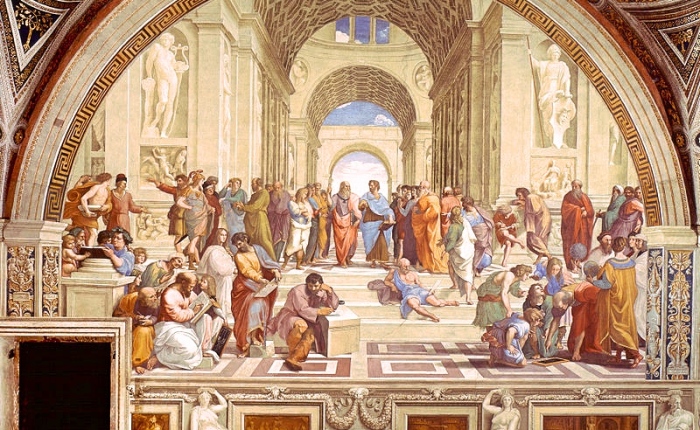
Anger seems to listen to argument to some extent, but to mishear it, as do hasty servants who run out before they have heard the whole of what one says, and then muddle the order, or as dogs bark if there is but a knock at the door, before looking to see if it is a friend; so anger by reason of the warmth and hastiness of its nature, though it hears, does not hear an order, and springs to take revenge.

—Aristotle, Nichomachaen Ethics

Just yesterday I had an interesting question posed to me. Of the seven deadly sins—gluttony, lust, envy, greed, wrath, sloth, pride—which one afflicts me the worst? I thought it about it for a while. Certainly I am afflicted by each deadly sin. I can be lazy, arrogant, selfish, and all the rest. But I think my outstanding challenge has always been my capacity for rage.

I used to be an angry person. Just ask my brother, or any of my old friends. The smallest things could set me off: a joke, a passing remark, a perceived slight. And when I got angry, I lost all control. Once I threw my cell phone at my oldest friend (thankfully, it hit the guitar he was playing instead of striking him) and snapped it in half. Another time, I kicked a good friend in the back, causing him to fall over in the street. And I can’t tell you how many times I beat up my brother when I was a kid.

It is revealing that, almost always, I can’t even recall what made me so angry in these situations. Usually it was something very trivial. Big things don’t provoke rage in me, but little things do. I become enraged when I’m hungry and I can’t find a place to eat. Or when I’m impatient and stuck somewhere. Or when somebody is being silly when I’m in a sour mood. My mood makes the crucial difference. When I’m hungry, tired, stressed, or otherwise irritable, my patience disappears and I have a tendency to snap at people. I lose my ability to empathize and become a selfish, egocentric man-child.

A big part of growing up, for me, has been learning to control my anger. To do this, I’ve had to recognize that anger is almost always illogical and unwise. Rage, indignation, and outrage are dangerous emotions, because they convince us that they are justified. Indeed, anger can feel extremely empowering. We are never so sure that we are right and others wrong than when we’re enraged. And yet, as Aristotle points out, it is when we’re angry, indignant, and outraged that we are most prone to being wrong, precisely because we feel unshakably sure that we’re right.

Anger is just a defense of the ego. When we feel that we are being undermined, or slighted, or treated unjustly, our anger is a way of preventing our ego from being damaged, of preserving our sense of self-worth, of reaffirming our own perspective. Yet by defending your ego, you acknowledge that it’s vulnerable; and even if you retaliate, you can’t undue the injury that’s been done to your pride.

It is one of the hardest things in the world, but also the most rewarding, to actually listen when you’re being criticized rather than to retaliate. I know from painful experience that the urge to fight back can be nearly overwhelming. Instead of understanding what the other person is saying, we immediately start thinking of how to refute them. But how can you refute someone when you haven’t heard what they’re saying? And how can you convince them when you don’t acknowledge the validity of their experience?

When something seems untrue, unjust, or unfair, then your whole body and mind can tense up in protest. But in these moments it is crucial to remember that what seems true to you may not seem true to somebody else, and what seems fair to you might seem unfair to a friend. Most of all it is important to fight the angry tendency to mishear what other people are saying. To do this, extra effort is necessary, the effort to listen and understand. Do not be like Aristotle’s dog and bark before you know who’s at the door.

Quotes & Commentary #13: Edward Gibbon

Quotes & Commentary #13: Edward Gibbon

“History is, indeed, little more than the register of the crimes, follies, and misfortunes of mankind.”

—Edward Gibbon, The Decline and Fall of the Roman Empire

Gibbon does not merely assert this definition of history. In the thousands of pages of his magnificent book, he chronicles every type of vice, wickedness, immorality, imprudence, venality, depravity, villainy, and man-made calamity that has occurred beneath the sun.

For me, reading Gibbon was a thoroughly sobering experience. Nine out of every ten rulers was hopelessly corrupt, incompetent, or malicious. Religious sects spilled each other’s blood over tiny differences of doctrine. Wives poisoned their husbands, fathers executed their sons. Whole cities were destroyed, whole populations slaughtered. Good men were disgraced, bad men elevated to the height of power and respect. Whatever lingering sense of cosmic justice I had before I read that book—the sense that, in the end, most wrongs are righted, most crimes punished—was destroyed. History has no moral compass.

As a writer, Gibbon was at his best when he was portraying decadence. The Roman Empire began as one of the most noble and impressive creations of the human species. Then, slowly but inevitably, the great edifice began to collapse. Sadistic and cowardly emperors took the throne. The love of wealth replaced the love of glory. The desire for gain, comfort, and security destroyed the old Roman ethic of respect, loyalty, and bravery. Institutions slowly crumbled from abuse and neglect. Respect for knowledge was lost, then knowledge itself. Tolerance of differences faded, then the society became pervaded with a sterile uniformity of opinion.

When I first read Gibbon’s book, I thought that his emphasis on moral decline—the decline in values and character—was, at the very least, a superficial explanation for Rome’s decline. Aren’t values and character just adaptations to, and products of, social and economic circumstances?

After witnessing this election, I am inclined to give Gibbon’s view more respect. The degree of incompetence, cowardice, short-sighted ambition—in a word, decadence—displayed by the political class, the media, and the populace, is nothing short of embarrassing.

The debate was rarely, if ever, substantive. We were not seeing two competing philosophies of government, or two rival solutions to the country’s problems. Instead, we saw two outdated candidates who, in different ways, promised nothing but a recapitulation of the past.

Hillary was symbol of the political establishment. She explicitly linked her goals to her husband’s and Obama’s legacies. She would not do anything radically new, but protect (and maybe expand) the work that Obama accomplished against a Republican onslaught. And Trump, with his promise to Make American Great Again, explicitly placed America’s glory days in some idealized past, where white men with little education were able to work good blue-collar jobs and were socially superior to every other demographic group.

(And while I’m at it, it’s worth pointing out that Bernie Sanders was hardly an exception to this. He more or less promised a return to FDR’s New Deal.)

In other words, Clinton promised a return to the 1990s, and Trump to the 1950s.

I can’t help but find both of these campaigns pathetic. Trump’s platform was emptier than a vacuum. His policy suggestions were bad jokes. He is so clearly, so obviously ignorant, and so transparently a con man. But I think it shows that there is something terribly wrong with the political establishment if the best defense they could put forward was Hillary Clinton’s campaign.

As a politician, Clinton has been consistently tone-deaf and uncharismatic. The entire ethos of her campaign was out of step with the country’s mood. The most persuasive reason to vote for her was to prevent Trump from winning. She had no new ideas, but only promised to continue the old ones—and I think it’s obvious by now that lots of people have no love for the old ideas. Many, including myself, were excited to have the first women president. But I think it’s significant that this was the most exciting thing about Clinton.

The media was also consistently pathetic during this campaign. Time after time after time, they predicted Trump would lose. This would be the end of the Republican party, a historic disaster from which they wouldn’t be able to recover. And yet, they gave Trump free air time. They treated his lies like valid opinions. His buffoonery brought them too much revenue, and they focused on profit rather than the truth. The old pundits analyzed, editorialized, and forecasted, and what they said had nothing to do with reality. Over and over, the political, economic, and social elite showed that they had no inkling of what was happening in the country.

In sum, I can’t help but see this election as an unmistakable sign of decadence in the United States. On both sides the campaign was intellectually empty, absent of any new ideas, explicitly focused on preserving or bringing back the past, and fueled by fear rather than hope. And I know from reading Gibbon that when you elevate a narcissistic, demagogic, and incompetent man to the height of power, the results are seldom pretty.

Why are we in the midst of a moral decline? I certainly cannot say. At the very least, we can console ourselves with the knowledge that this era will likely furnish ample material to historians of the future, as they document our crimes, follies, and misfortunes.

Quotes & Commentary #12: James Joyce

Quotes & Commentary #12: James Joyce

History is a nightmare from which I am trying to awake.

—James Joyce, Ulysses

I can’t imagine a more appropriate quote for today, the day I learned that Donald Trump had been elected president.

This morning I fully expected to wake up to news of Clinton’s victory. Even though I wasn’t very happy with Clinton, I was still excited for the first woman president. But I was much more excited to never have to look at, think of, or talk about Donald Trump ever again.

The truth is, I have developed an unhealthy loathing for the man—not just as a politician, but as a person. This hatred is unhealthy because it gives Trump, an egomaniac, exactly what he wants: power over my attention. Unwittingly I got sucked into his reality show world, watching out of spite just to see him lose. Instead, I lost.

This morning I went to work with a pit in my stomach, a feeling of impotent, nebulous anxiety. Seeing the gloomy faces of my coworkers, blanched and speechless, only tightened the knot in my gut.

It wasn’t long before the initial shock wore off, my powers of denial began to fail, and the full enormity of what happened hit me. My reaction was more physical than intellectual. I felt dizzy and lightheaded. I couldn’t think, talk, or do anything remotely productive. I could just sit in sullen silence, trying to hide my feelings from my students.

But James Joyce’s quote reminds me of something. History is nearly always a nightmare. Corruption, bigotry, xenophobia, the lust for power—these have been with us from the beginning, and always will be. The wicked leaders far outweigh the decent ones. Trump is not new, merely a new manifestation of something very old: a demagogue who represents and draws upon the darker impulses of our nature.

If by history we mean the ceaseless tide of human action, propelling us forwards and backwards, raising us to the heights and sinking us into the depths, then it is impossible to awake from history. As long as humans are humans, history will be, in the words of Edward Gibbon, “little more than a register of crimes, follies, and misfortunes of mankind.” History is the constant, heroic, and ultimately doomed attempt to fight against entropy.

But besides the literal meaning, I also like to interpret this quote in another, more psychological, way.

Trump is an archetypical example of a man who places value in external things. For him, this thing is winning. He needs it like a drug, in ever-increasing doses. While it may seem like a strength, this craving to win is really the product of a crippling weakness: the need for constant validation.

When you identify your own value with something external—whether it be money, love, or whatever—you doom yourself to a hamster wheel existence. You spend all your time pursuing it. But when you get it, you immediately want more; and when you don’t get it, you feel worthless.

For me, this is the history from which I am trying to awake. Instead of chasing things, I want to enjoy them. Not that there is anything wrong with pursuing a goal—to the contrary, it is the most admirable thing you can do. But you can pursue goals without wagering your sense of worth and identity in the bargain. You can treat the hustle of life as a necessary, exciting, and vexing game, not the ultimate judgment of your value.

Donald Trump does just the opposite. In his world, if you lose then that makes you worthless, an insect, a nobody, a loser. And if you win, your life has been validated. He identifies totally and completely with the outcome of the game of life. Because of this, no matter how successful he is, he will always feel a gnawing sense of emptiness at the core of his being. No win will ever be enough, and every loss will be devastating.

The reason I am thinking along these lines is that I am now reading Epictetus, the former slave who became a Stoic philosopher. Because Stoicism grew up amid political turmoil and instability, it is a philosophy ideally suited for disastrous times.

Epictetus teaches that external things (like elections) are always ultimately beyond our control. Of course, you do what you can, and you must do so. But you are not obligated to be agitated when it doesn’t go your way—as will frequently happen. Indeed, agitation serves no purpose. Either act, or be tranquil. We cannot always control events, but we can always control how we react to those events.

This Stoic lesson will be increasingly necessary in the coming years, if we are not to wear ourselves out with worrying. It is especially necessary with a man like Trump, who is so addicted to attention. When I talk to friends, watch TV, or look on Facebook,  I am constantly surprised by how completely he has captured the attention of the entire world. And this is exactly what he wanted. It’s the only thing he’s good at. Whether you love or hate him, chances are that you can’t stop thinking about him.

But letting Trump totally dominate our thoughts and moods is giving him the ultimate victory. It is giving him exactly what he craves. And ultimately this stress and anxiety will not make us any more effective in countering his proposals or fighting against his influence. To act appropriately, we must remain calm and focused; and to do that, we cannot, must not, let Trump so totally invade our thoughts and destroy our ability for reflection and thoughtful action.

And we certainly cannot let ourselves, like I have done, become obsessed with our hatred and loathing for the man. To act hatefully is to sink to his level. To become obsessed with beating him is to let him win the ultimate battle over your soul.

All power fades, all tyrants die, and everything, good or bad, is swallowed by time. History can indeed by a nightmare; but like a nightmare upon waking it will one day vanish into nothingness.

Change what you can. Accept what you can’t. Enjoy what you have. This is how we can awake from history.

Quotes & Commentary #11: Alexander Tocqueville

Quotes & Commentary #11: Alexander Tocqueville

I know of no country where there is generally less independence of thought and real freedom of debate than in America.

—Alexander de Tocqueville

This is quite a pessimistic quote to choose on election day, but I feel it’s appropriate after this grueling election season. For me it has been a thoroughly disheartening affair with little to redeem it.

Trump is a problem—a thoroughly disgusting human being—but only a part of the problem. It is too easy, and too satisfying, to rant about how bad Trump is. No superlative is strong enough to capture his vileness. But vile people have always, and will always, exist. The depressing thing is that this man, so obviously unfit for the presidency, has gotten so close and indeed might win.

It’s very easy to point fingers to the media. And there is some truth to this accusation. The amount of free airtime given to Trump, the double standard that has always been applied to him, the fascination with scandals over substance—all this has characterized this year’s election coverage.

The intellectual level of political discussion has been comparable to the interviews on reality shows. We are voting for personalities, not policies; we hear about controversies, not conflicting ideas. After every debate, the “viral” moment is inevitably something that has nothing to do with the politician’s plans or values. We haven’t even approached a rational discussion. We are voting between two public personas, each with their own package of scandals. Waiting to hear the end result of this election is frighteningly similar to waiting for the finale of a reality show.

But is it completely fair to blame the media? After all, newspapers and cable news need to make money to stay in business; and that has been increasingly difficult lately. Because their existence is now so precarious, they simply cannot afford not to seek as much profit as they can. This provides a serious disincentive to report substantive, serious discussion, since by their nature such discussions are difficult and time-consuming. Simple, dramatic, eye-catching, easily-digestible headlines sell more papers and generate more revenue. And why do such things sell better? That’s not the media’s fault: it’s ours.

In any capitalist system, the supply is always shaped and driven by the demand. Our tastes, our preferences, and our values form the demand for our media content. And these tastes, preferences, and values are apparently, on the whole, so shallow that we cannot even approach a thoughtful discussion.

I am not old enough to really know if it was ever otherwise, or whether such shallowness is a persistent feature of democracies. Yet I can’t help suspecting that this is a bad omen. I don’t want to be pessimistic, but Trump is such a sumptuously, startlingly, indecipherably unsuitable candidate that it is hard to resist the conclusion that something has gone badly wrong.

Of course, every society is vulnerable to duplicitous demagogues. Even Athens succumbed to Alcibiades. What most vexes me about Trump’s rise is that he is not even a skilled demagogue. He is a bald-faced liar, one of the most obvious con mans I have ever seen, a man without strategy or subtlety.

Trump may lose tomorrow. But unless we figure out how to elevate our public discussion, and attain Tocqueville’s independence of thought and freedom of debate, we will continue to be vulnerable to people like Trump.

Quotes & Commentary #10: John Milton

Quotes & Commentary #10: John Milton

Who overcomes / By force, hath overcome but half his foe.

—John Milton

Like nearly all good quotes from Paradise Lost, these words are spoken by Satan. He is both commenting on his own expulsion from heaven a well as his plans to disrupt God’s plans through guile and craft rather than force. (He tried using force first, but his army lost.)

This maxim strikes me as true with regard to both physical and intellectual force. If one person is stronger than another, one army better trained and equipped than another, one nation richer and bigger than another, they might be able to have their way through force alone. And doubtless, many have used force successfully. The problem with this strategy, however, is that it is seldom possible to completely defeat an enemy’s strength. Battles are costly, and destruction takes valuable resources. Usually the fallen enemy limps away to fight another day. What’s more, when you use force, you make more enemies than you defeat. There are innumerable examples of this. Through belligerent foreign policy, the United States has often undermined its own security this way, by inspiring hatred in the hearts of many while defeating the arms of a few.

This lesson is equally true in intellectual battles. Let’s say that you and I are having a disagreement. Let’s also say that I am almost certainly wrong, and you almost certainly right. Nevertheless, if you convince me by force, against my will, if you are condescending and contradicting, even if you’re right, you will only inspire resentment and bitterness in me. I will dig in my heels; I will struggle and strain; I will look for every possible argument, however farfetched, to combat you, just because my pride will be on the line. Every intellectual fight is inevitably a fight about something besides the ostensible subject. Every argument becomes a fight of egos, not of minds, and thus a battle in the purest sense. We are never less well disposed to empathize with another person’s point of view if we feel that they are trying to do us harm.

With varying levels of success, I try to apply this lesson whenever I have a disagreement. The trick, I’ve found, is to always try to find some truth in what your partner is saying. (Call them a partner, not an opponent.) Tell them all the ways they’re right before you say any of your own ideas. Then, even if you disagree, don’t frame your comments as contradictions to what they said. Instead, treat your ideas as additions to their ideas, as different bricks in the same structure. This way, you will have an ally instead of an enemy, and they will be much more well disposed towards agreeing with you.

Quotes & Commentary #9: H.G. Wells

Quotes & Commentary #9: H.G. Wells

Men are not born equal, they are not born free; they are born a most various multitude enmeshed in an ancient and complex social net.

The Outline of History, H.G. Wells

This is one of the most powerful quotes in H.G. Wells’s wonderful popular history book. To me it encapsulates an inescapable fact. In any complex society, however egalitarian, resources are not distributed equally. Power, money, influence, and cultural capital are usually distributed hierarchically; and having powerful parents, a rich family, or being the “right” race, sexual orientation, gender, or whatever—these things you are born into.

Karl Marx makes a similar point in this famous passage:

Man makes his own history, but he does not make it out of whole cloth: he does not make it out of conditions chosen by himself, but out of such as he finds close as hand. The tradition of all past generations weighs like an alp upon the brain of the living.

“Equality of opportunity” is a phrase we like very much in the United States. It is an ideal, and like any ideal is something we strive for but can never achieve. Yet what does it mean? People born into wealth are at an obvious advantage to people born into poverty. They have better schools, they can afford to go to elite colleges (and elite colleges often can’t afford to turn them away), and thus they are many times more likely to get high paying jobs (besides being able to inherit money). This is an obvious case of inequality.

But what could we do about it? It’s a difficult problem. Should we prevent people from bequeathing money to their children? Should we make private schools illegal? Should we make laws preventing elite universities from accepting more than a certain percentage of people from wealthy families?

Perhaps it’s better to focus on improving the opportunities of the poor rather than restricting those of the rich? We can improve the schools, legislate affirmative action for disadvantaged groups, and make higher education more affordable (and less dependent on rich donors and students for their survival). These are all good things, for sure, and to a certain extent we are already striving to accomplish them.

A work in progress is all we will ever achieve. Like everything perfect, perfect equality of opportunity is an unrealizable dream. And yet, even if the dream were realized, would we be living in a perfect society? This is a question worth asking.

Even if we managed to equalize the starting point of every child, there would still be the question of how they would be measured. The idea behind having equality of opportunity is that, if some people are more successful than others, we can consider the outcome fair. This is an ideal meritocracy, where everyone gets their just desserts.

In a perfect meritocracy—where opportunity is equal—we advance or fail to advance because we possess certain qualities. But these qualities are arbitrary. In the United States, for example, we tend to value certain types of intelligence, certain personality traits, and certain goals. In other cultures, they have other values.

Every culture arbitrarily chooses some characteristics to value and others to ignore. Yet even when you subtract all the environmental influence, we are still left with our genetic endowment: each of us is born with different abilities, propensities, and weaknesses. Is it really fair that these inborn qualities should determine our success? It seems not—especially when you consider that these native qualities are being measured against an arbitrary standard.

Because of this arbitrariness, I think any fair system needs a kind of social safety net. Even with perfect equality of opportunity—which does not exist—some people will always have more trouble succeeding than others. Providing a basic minimum standard of living is an acknowledgment of this fact.

Quotes & Commentary #8: Shakespeare

Quotes & Commentary #8: Shakespeare

There is nothing either good or bad but thinking makes it so.

—Shakespeare, Hamlet

This is one of Shakespeare’s most popular quotes, especially among philosophers. And no wonder: it is moral relativism in a nutshell.

“Goodness,” as a concept, is famously difficult to analyze. Plato conceived of the Good as something external to the human mind, more real than the material world. Aristotle, always more prosaic, said that the ultimate good was happiness, since we desire other things for the sake of happiness but never desire happiness for the sake of other things. Recently I read Epicurus, more naturalistic even than Aristotle, who thought goodness was pleasure, pure and simple.

The concept of goodness obviously plays an important role in religions as well as philosophy. Zoroastrians conceived of life as a cosmic battle between the forces of good and evil. In Judaism, goodness is similarly seen as something objective. Hamlet is prophetically damned in the Book of Isaiah (5.20): “Woe unto them that call evil good, and good evil; that put darkness for light, and light for darkness; that put bitter for sweet, and sweet for bitter!” In Christianity, good is often conceived of as God’s will (leading to Plato’s famous Euthyphro dilemma: does God will things because they’re good, or are they good because God willed them?)

The Christian concept of an objective, ideal good—influenced by Plato—held sway in Europe for a long while. Morality was conceived of as absolute and objective. What is good for me is good for you; what was good in ancient days is still good today.

In Shakespeare’s day, however, the idea of moral relativism began to take hold in the European mind. About sixty years after Hamlet’s aphorism, Spinoza had this to say:

As for the terms good and bad, they indicate no positive quality in things regarded in themselves, but are merely modes of thinking, or notions which we form from the comparison of things one with another, thus one and the same thing can be at the same time good, bad, and indifferent. For instance, music is good for him that is melancholy, bad for him that mourns; for him that is deaf, it is neither good nor bad.

If you physically or chemically analyze an object, you will never find goodness or badness in it. Those are judgments, and thus exist in our perception of objects, not in the objects themselves. We have learned this lesson very well in the modern world, which is why we frequently dismiss things as “subjective.”

There does seem to be a limit to moral relativism, however, and a danger in pushing it too far. I discussed this in regards to Milton’s quote about making a hell of heaven and a heaven of hell. Some situations are quite simply unfair, dehumanizing, exploitative, or painful. Those judgments, too, only exist in the mind; but every mind is attached to a body, and every body has certain limits and needs. The mind, too, is not infinitely flexible; some things we simply cannot accommodate. This is why long-term solitary confinement, for example, is unambiguously bad: it deprives the mind of something it needs.

For this reason, I cannot fully agree with Hamlet. Because of the constitution of our brains and bodies, some things are almost always bad, and others good. Nevertheless, for most of us in daily life, I suspect that our judgments of reality cause us more pain than the reality itself. Of course this is not always so; the world has many genuine problems.

The wise course, it seems to me, is to strike a balance between striving to improve the world around us, and striving to make peace with what we cannot change.

Quotes & Commentary #7: Bill Bryson

Quotes & Commentary #7: Bill Bryson

We are astoundingly, sumptuously, radiantly ignorant of life beneath the seas.

—Bill Bryson

I originally wrote down this quote because it was an excellent illustration of Bryson’s excellent prose.

Style manuals often tell us to focus on nouns and verbs. Such is the advice of E.B. White in The Elements of Style, where he says that “it is nouns and verbs, not their assistants, that give writings its toughness and color.” Stephen King, in On Writing, even advises writers to avoid adverbs altogether: “I believe the road to hell is paved with adverbs, and I will shout it from the rooftops.”

Bryson shows how effective adjectives and adverbs can be in the hands of a master. First, the chain of three-syllable words with “ly” endings gives the sentence a rolling rhythm, each adverb tumbling off the tongue. He has also chosen his adverbs well. Saying the word “sumptuous” makes me feel sumptuous; and the word “radiant” almost glows. The comedic twist is when he connects his chain of adverbs with the adjective “ignorant.” I understanding being astoundingly ignorant, but what does it mean to be sumptuously and radiantly ignorant?

I also like this sentence because it reminds me of my childhood. One of my first obsessions was with whales. As often as I could, I would go to the Museum of Natural History and stare in awe at the gargantuan blue whale hanging from the ceiling of the Hall of Ocean Life.

My favorite was always the sperm whale. These leviathans, the largest toothed predators on earth, dive thousands of feet down into the dark deep to do battle with giant squids. The display in the Museum of Natural History pictures this battle mid-scene, the whale’s jaw clamped around the squid’s tentacles, both of their massive forms emerging from the shadows.

Something about this scene fascinated me, and still does. I drew the diorama over and over again, until I had hundreds of copies. The sperm whale seemed heroic to me: it descended into the depths and fought a monster, just to have lunch. And if a creature as big and terrifying as the giant squid could be lurking down there, what else might?

This wonder was reignited when, several years later, I heard of “Bloop,” a powerful underwater sound detected in 1997. The sound is now believed to have been caused by an icequake, but originally it drew attention because its sonic profile was similar to a noise made by an animal. This was noteworthy because the sound was much too loud to be made by even a whale, which led to a lot of speculation on the internet about giant monsters. There’s a whole Wikipedia page dedicated to these unexplained, underwater sounds, which I’m sure has provided valuable ammunition to pseudo-scientists and conspiracy theorists.

To me, the ocean’s depths exert a primal fascination. We still know relatively little about the deep, and what we do know has been consistently surprising. With no sunlight, freezing temperatures, and immense pressure, life has still eked out an existence, taking on many bizarre forms in the process. Maybe “radiant” is the best way to describe our ignorance of a place so devoid of light.

Quotes & Commentary #6: Aristotle

Quotes & Commentary #6: Aristotle

History shows that almost all tyrants have been demagogues who gained the favor of the people by their accusation of the notables.

—Aristotle, Politics

This quote has unfortunate contemporary relevance, given this election season. An anti-establishment ethos has characterized both the Democrat and Republic presidential races, an ethos represented by Bernie Sanders and Donald Trump. Both of their campaigns appealed to a broad dissatisfaction with the status quo; and this dissatisfaction was often expressed as a disenchantment with the political class. Both candidates issued sweeping condemnations of the current political system, and promised radical change.

This frustration was, however, apparently more powerfully felt on the right than on the left, particularly among white men, which is why Sanders was defeated and Trump was victorious. Trump has continued his primary strategy into the general election, linking Clinton with Obama, and the two of them with vested interests and the media, and blaming the combination for the country’s current lack of “greatness.”

Now that he’s down in the polls, he is doubling down on this strategy with his accusations of a rigged election. The politicians, the donors, and the media—in short, the rich and powerful, or “the notables”—are conspiring to silence the voice of the people by tampering with election results.

Never mind that he doesn’t provide any evidence to substantiate the claim. It doesn’t matter. Such conspiratorial thinking appeals strongly to the human imagination. Once you suggest there’s a conspiracy, the very lack of evidence becomes a sort of evidence. If there’s a secret, of course we wouldn’t know about it, right? It appeals to a paranoid mindset, seeing significant patterns where none exist, suspecting hidden forces at work behind the scenes.

By questioning the legitimacy of the institution of elections, Trump is positioning himself as a sort of prophet. He can see what others don’t. He is also casting himself as an instrument of the people, a threat that “the notables” must defend themselves from. This is a powerful narrative: a room full of bad guys plotting conspiracies, and a man of the people out to stop them. I know from experience how appealing this story can be; after all, I voted for Sanders in the primary, whose talk of the 1% and Wall Street, and whose criticism of the media coverage (I thought it was bad, too), put him in a similar position.

But of course there are huge differences between Sanders and Trump—so obvious that I feel bad even writing their names in the same sentence. One major difference is that Sanders never questioned the legitimacy of the United States government the way Trump is doing. Sanders accepted defeat and is now campaigning for Clinton. Trump is only intensifying the conspiratorial rhetoric.

This strategy of accusing the notables was ancient by the time Aristotle wrote about it, over two thousand years ago. But it appeals so strongly to our psychology that it is still practiced today. An easy way to gain power is to make people angry at the people who currently wield it. Unfortunately, pointing out problems does not make you qualified to come up with solutions. And someone who is willing to prey on people’s fears shows a cynical contempt for the people, not a desirable quality in a ruler. This is why demagogues so often become tyrants.

Quotes & Commentary #5: Oscar Wilde

Quotes & Commentary #5: Oscar Wilde

“He began to wonder whether we could ever make psychology so absolute a science that each little spring of life would be revealed to us. As it was, we always misunderstood ourselves and rarely understood others. Experience was of no ethical value. It was merely the name men gave to their mistakes.”

—Oscar Wilde, A Picture of Dorian Gray

Oscar Wilde could pack a library into a sentence; and this passage sends my mind off running in multiple directions.

First I am reminded of a book I read long ago: Moonwalking with Einstein, by Joshua Foer. In one section, he talks about the mysterious phenomenon of expertise. How do you become an expert? There is the well-known answer, made famous by Malcolm Gladwell, that becoming an expert requires 10,000 hours of practice. When you pass that threshold, something strange happens.

Foer demonstrates this with a memorable example: chicken sexers. These are the people who examine the rear ends of baby chickens to determine whether they are male or female. (The unfortunate males are dropped down a chute where they are killed. Males are expendable, unluckily for me.)

The task is astoundingly difficult; professionals need to train for years to achieve the required accuracy. But when they do achieve mastery, they are able to see things that others cannot see, and they themselves can hardly articulate. Ask them to explain how they know one chick is female and not male (says Foer), and they will not be able to put their knowledge into words.

This is a universal experience. Teaching and doing are two entirely separate skills. Experts are often not great explainers; and great teachers are sometimes middling performers. Have you ever tried to learn something—playing an instrument, for example—from a real master? Or just somebody far better than you? Have you ever tried to teach a beginner how to do something you’re quite good at?

In these situations, the famous difference between knowing how and knowing that is manifest. I can tie my shoes without looking, but if I tried to explain the steps, I’d probably confuse myself.

Expertise is the product of experience. And experience, as Wilde points out, is just another name for our mistakes. This is easy to forget. A student won’t get better at anything unless she—or an expert teacher—critiques her performance and point out areas that can be improved. Simply strumming a guitar won’t make you Jimi Hendrix, and writing in a diary won’t make you Shakespeare.

Expertise requires that we judge what we do, and then constantly strive to do better. This is what separates training and doing, practicing and performing. In the former, we are self-critical.

Wilde brings in an interesting moral dimension to this notion when he says that experience has no “ethical value.” By that, I think he means that we cannot learn to become a good person simply by doing things. The ethical value comes from us. We need to apply some sort of criterion to our experience; we need to judge right and wrong, better and worse, desirable and undesirable. These judgments are themselves not products of experience; they are applied to experience.

We learn to be good by making mistakes and getting better at judging what is right and wrong, in just the same way that we learn to play piano by making mistakes and learning to recognize what sounds better and worse. Moral expertise is in principle no different from musical expertise: we learn from recognizing our own errors.

Wilde wonders whether we can “make psychology so absolute a science so that each little spring of life would be revealed to us.” I can’t predict the future, but there does seem to me something mysterious about expertise. How can we do something without being able to explain what we’re doing? How can conscious training create unconscious mastery? What is happening in the brain when we get better at something? Can mastery ever be distilled into a book of rules and precepts?

Lastly, there is his comment about “always misunderstanding” ourselves and “rarely understanding” others. It is so true that the motives of others often seem crystal clear, while our own remain deeply mysterious. Some perspective is needed to understand a person, and that is just what we lack when it comes to ourselves. And this lack of perspective on ourselves is one of the things that makes self-study so difficult. If we cannot see ourselves objectively, how can we accurately understand what we need to improve?