Review: On Death Row (Herzog)

Review: On Death Row (Herzog)

Werner Herzog’s series of films about inmates on death row all begin with him making his stance on the death penalty clear: he is against it. And yet, these films are anything but political. Herzog does not, for example, review the arguments against the death penalty—that many of those condemned are likely innocent, that it is racially biased, that it does not act as a deterrent to other violent crime, and so on—nor does he get into its legal justification or its history. 

Indeed, although Herzog repeatedly states that he is against the death penalty, he seems intentionally to portray the punishment in its most “justifiable” form. With some arguable exceptions (to be discussed later), all of the prisoners he interviewed were convicted of horrible crimes on very strong evidence. Most of them, for that matter, are white; and in any case he never explicitly brings up the subject of race. Thus, most of the arguments usually cited against the death penalty do not apply to these cases.

Despite this—or, perhaps, because of it—Herzog’s films become a strong statement against the death penalty’s continued existence. His view is not that the death penalty is wrong because it violates constitutional rights or it’s statistically unfair or so on, but that the death penalty is simply wrong in itself. This is because even the worst criminals are human beings. It is a simple and powerful argument, and I think ultimately the right one to make. For there will always be people who commit terrible crimes, and as a consequence there will always be the temptation to view such people as somehow inhuman or monstrous, and thus not worthy of life.

Herzog combats this tendency by bringing the viewer into direct contact with the reality of the death penalty. Every episode of this documentary series begins in the same way: The camera goes from the holding cell of the death house to the execution chamber. Eerie music plays in the background and Herzog’s equally eerie voice gives us the basic facts about the death penalty in America.

Typical of Herzog, the camerawork has a curiously amateurish quality. It looks as if somebody were simply holding their phone and walking. The angle shifts like a man turning his head: peering down at the Bibles on the table, up at the microphone to capture the prisoner’s final statement, and into the observation room where relatives of the victims and the prisoner are there to watch the final moments.

It is a short and simple sequence, and yet I think it is far more effective than any flashy camerawork or well-produced dramatization could be, as it really makes you feel as if you are a prisoner being led to your own execution. As the camera moves from the white cellblock to the execution chamber with its sickly green brick walls, you can feel some of the numbing terror of institutionalized death.

And this impression is fleshed out with further information at various moments in the different episodes. In the feature-length, standalone documentary that kicks off the series, Into the Abyss, we hear from the priest who administers the last rites and who stays with the inmate as the poison is administered. Behind him we see the rows of stone crosses, where the prisoners are buried whose families don’t make arrangements. They bear only the prisoner’s ID number, no name.*

Later on in that documentary, we hear from Fred Allen, who was the captain of the team that managed the “Death House.” He describes the final hours of a prisoner: They are allowed to shower, for example, and to put on their civilian clothes. They can use a phone to call loved ones. At the fatal hour, a team of five guards takes the prisoner to the gurney, and are able to have the prisoner strapped down within thirty seconds. Allen performed this routine for over 120 executions. His final job was to unstrap the dead prisoner and move them to a stretcher for removal.**

In the documentary on Hank Skinner—whose execution was stayed by order of the Supreme Court just twenty minutes before it was to take place—we get perhaps the most revealing look at the final moments of an inmate scheduled for death. In Texas, though executions are carried out in Huntsville, the male death row inmates are housed in the Polunsky unit, about 40 miles away. In a powerful sequence, Herzog and his crew make the drive from the one prison to the other, showing what a condemned man would see as his last glimpse of the world outside. As Herzog says, it is rather dreary—the standard tableau of gas stations and billboards facing a highway—but when seen through the eyes of somebody who will shortly cease to exist, even this banal landscape can be crushingly beautiful.

(Skinner has since died in prison, months before his new execution date.)

All of this footage and information serves to make something that is normally quite abstract terrifyingly concrete.*** But perhaps even more valuable than this are the interviews with the inmates. Herzog shows himself in these films to be a masterful, if unorthodox, interviewer. Into the Abyss, for example, opens with Herzog evoking tears from the minister by asking him to explain an encounter with a squirrel.

More generally, he is good at getting his subjects to open up, not just about the details of the cases, but about their inner world—what they miss about the outside world, what they dream about, how they are dealing with their approaching end. Yet sometimes the silences are more revealing than the words. Another of Herzog’s characteristic touches is to hold the camera on a person’s face when they have finished speaking. This is uncomfortable at first, but I think it gives the interactions a certain naturalness that recorded interviews otherwise lack. For in reality we often observe others in silence.

I hesitate to make the following comment, as I am a layperson and have no psychological training whatsoever. Nevertheless, I could not help noticing some strong similarities between many of the subjects. With the exception of Blaine Milam, everyone behind bars whom Herzog interviews is surprisingly articulate and intelligent. More than that, I often got the feeling that they would be adept at convincing and manipulating others, for many of them are persuasive on camera.

This apparent intelligence is striking all the more so for the stupidity of their crimes. The crime at the center of Into the Abyss, for example, is so shocking partly because it was done with so little planning and for such a small reward (a car). Both Douglas Feldman and James Barnes—murderers from other episodes—seem highly intelligent, and yet both were caught for pointless and easily-caught acts of violence (the former, basically a case of road rage, and the later, a domestic dispute). Robert Fratta killed his estranged wife rather than just get a divorce, and Linda Carty murdered a woman for her child, somehow believing she could convince others it was her own. The only notable exception to this pattern of stupidity is George Rivas, of the notorious Texas Seven, who was a methodical planner—most famously, orchestrating a complex prison break.

Another thing I found striking was that so many of these convicts strongly protested their innocence, even in the face of overwhelming evidence against them. To be sure, if you are on death row, the only way to potentially avoid execution is to fight for your innocence. Still, even if their circumstances virtually force them to deny the crime, I did notice a lack of regard or concern for the victims of these crimes. Darlie Routier, for example, who was convicted for killing two of her sons, spends all of her time painstakingly going over all of the evidence that could exculpate her, but seems unconcerned that the (supposed) real killer is still on the loose. An even starker example is Douglas Feldman, who gunned down two truck drivers in a random spree of violence. He said in his final statement:

I hereby declare Robert Steven Everett and Nicholas Velasquez guilty of crimes against me, Douglas Alan Feldman. Either by fact or by proxy, I find them both guilty. I hereby sentence both of them to death, which I carried out in 1988.

A starker lack of remorse could hardly be imagined.

Here are a few more similarities that jump out. Two of the convicts in this series, Darlie Routier and Robert Fratta, are notable for being highly superficial, in the sense that they care deeply about how they look and are perceived by others. Another similarity is religion. Many of the convicts, perhaps unsurprisingly, turn to God in their time of need. Fratta, for example, converted to Christianity in prison, and claimed that God had inspired him to invent a new political philosophy (in which all the Christians live together under an elected monarch—oh, and the different races are to live separately), while another murderer, James Barnes, converted to Islam and confessed to additional murders (including some he probably did not commit). Hank Skinner, meanwhile, lost himself in mystical, New Agey numerical coincidences.

If there is one prisoner who stands out as being unlike the others in this series, it is Blaine Milam. In the film, he comes across as somebody who is neither particularly bright nor articulate (indeed, an intellectual disability claim is being reviewed). And he also lacks, for me, the strange remorseless quality I noted in the other convicts. When he talks, he does not sound like he is trying to manipulate you, and he does not plead his case. And yet, he is guilty of perhaps the most disturbing and disgusting crime of all in this series: the brutal torture and murder of a 13-month-old baby girl. Indeed, this murder was so sickening that it dissuaded Herzog from making more of these films.

In fairness to these convicts, I wish to highlight the two who were convicted on the weakest evidence. In my view (and, again, I am the furthest thing from an expert), these are Darlie Routier and Hank Skinner.

For both, the case against them is largely forensic and circumstantial—they were the only people known to be at the scene of a crime, and their blood was found on the murder weapon and the victims. However, in both cases the motive is rather unclear. Furthermore, Routier was herself nearly killed from a knife wound (prosecutors say it was self-inflicted) and Skinner had such a high level of alcohol and codeine in his system that an expert testified he would have been physically unable to commit the brutal triple homicide (though he did walk to a girlfriend’s house shortly after the murder).

For what it’s worth, I personally found the cases against these two to be quite strong, even if it did leave some room for doubt. The theory of their innocence requires, for both, that somebody break into a house and commit a brutal murder—sparing only the person convicted—and then vanish without leaving any trace of their identity. It seems far-fetched to me.

I have gone on about the criminals, but ultimately even they are not at the core of these films. Rather, it is the crimes they committed. These brutal acts are the vital center of these stories, whose effects ripple outward in space and time. Herzog, as usual, does his best to get as close as he can to the moral abyss. He uses archival footage of crime scenes, recordings of interrogations, taped confessions, interviews with police officers and detectives—all this, trying to get a clear look at the worst side of our nature.

This crime sets the convict on a path towards prison and, ultimately, death. And of course it ends the path of the victims. The victims’ stories, instead, reverberate back in time, as they become the centers of investigations and the protagonists of tragedies. And it is perhaps the final tragedy of these victims that they are no longer around even to tell their stories. As one prosecutor explains, when dealing with a murder, there is a kind of asymmetry in our sympathies, since the victim’s suffering is in the past and, therefore, abstract, while the suffering of the criminal is present and palpable.

Herzog cannot, obviously, round out the picture of these crimes by interviewing its victims. But he does his best to give these victims a voice. When he can, he interviews surviving family members. These interviews are (perhaps unsurprisingly) among the most heartbreaking parts of this series—each person faced with a sudden, violent, irrecoverable loss. And though it is uncomfortable, he even asks the murderers to recall their victims—vainly hoping, perhaps, to ignite some spark of conscience. This is a natural extension of his basic attitude: for if Herzog is against the death penalty, he also cannot ignore the evil of murder. As he repeatedly makes clear, he is not opposed to punishment, but to the taking of human life. 

There is a repeated image in this series, of birds slowly flying over what appears to be a landfill. They are just pigeons and seagulls, hundreds of them, on the lookout for trash. And yet, the sky and land are so bleak that these birds take on the appearance of vultures circling carrion. This image has no obvious connection to the subject of the film, and yet it somehow seems to embody it. Herzog has a knack for choosing visual metaphors that are powerful without being obvious. This image, I think, represents a feeling rather than a thought: pure desolation—ugly, gray, bleak. This mood hangs over this whole project, lending every moment a certain weight. I think it is a feeling we ought to reckon with.


*In Texas, starting in 2019, ministers could no longer be with inmates as they are executed. This is because, in 2019, the execution of Patrick Murphy was stayed since the prison would not allow a Buddhist minister to be with him in the execution chamber, while Christian ministers could be present. The Supreme Court decided that this constituted religious discrimination and the execution was postponed. In response, Texas simply decided that no ministers, Christian or Buddhist, would be allowed in the execution chamber. This hardly addressed the fundamental issue, in my opinion, as Christian prisoners were still given access to a minister (before the execution), while Buddhist inmates were not. This policy was apparently reversed when, in 2021, John Ramirez won a Supreme Court case that allowed a Baptist minister to be in the execution chamber with him when the fatal injection was administered. In any case, it is rather bizarre to think that the government’s commitment to religious equality is enough to stop an execution from going forward, but not its commitment to avoiding cruel and unusual punishments.

**It is worth noting that, after having participated in so many executions, Allen had a crisis of conscience and decided that the death penalty was immoral. He immediately quit his job, even though he had to give up his pension. This crisis was provoked by the execution of Kayla Faye Tucker in 1998, which was the first execution of a woman in Texas since 1863. As it happened, Tucker had become something of a celebrity, with even some foreign officials supporting clemency for her crimes.

***I cannot resist adding one final morbid detail about the execution process. One popular fixture of executions is the “Last Meal,” in which the prisoner can request virtually anything to enjoy as their final taste of earthly nourishment. Back in 1959, the blues singer Jimmy Rogers released a song, “My Last Meal,” in which he (as a convict) requests an impossible last meal (including dinosaur eggs, mosquito knees, and rattlesnake hips) so that the warden won’t be able to execute him. The reality is far less romantic. In Florida, the cost of the last meal is limited to $40, and in Oklahoma to $25, neither of which is enough to afford anything luxurious. In Texas, however, the practice of the last meal was abolished in 2011, when the white supremecist Lawrence Russell Brewer requested an enormous last meal—indeed, almost worthy of Jimmy Rogers—and then refused to touch it. Now, Texas inmates simply eat whatever is served to the other prisoners.

The Moselle: Burg Eltz and Koblenz

The Moselle: Burg Eltz and Koblenz

The Middle Rhine is majestic and impressive, but it is not exactly tranquil. There are barges and ferries full of tourists constantly running up and down the river. There are small villages, yes, but they are often crowded with visitors. During my visit, an American fighter jet even flew over the river valley. The Middle Rhine, in other words, for all of its beauty, is not a trip to the countryside for a bit of scenery and fresh air.

But its little brother, the Moselle, is wonderfully sleepy by comparison. Joining the Rhine at Koblenz (of which, more later), the Moselle seems to flow lazily along when compared to the mighty current of the Rhine. Rather than being surrounded by steep cliffs and towering hills, the land gently rises into green knolls, all of them covered in vineyards.

I observed this gentler valley as my train traveled from Koblenz, and was immediately charmed. My destination was the little town of Moselkern. I had arrived early, and the town was so quiet that it almost seemed abandoned. Nothing was open, and nobody was on the street. But I did notice some silly pieces of doggerel printed on the sides of buildings. In front of the Hotel Kebstock, for example, I read this:

Mein lieber Gast,

laß dich

Nieder mache Rast

Bei Bier und Wein,

bring Glück herein.

An der Mosel

und am Rhein,

trinkt man

den guten Wein.

In essence: “Come on in, drink some wine, and have a rest.” It certainly sounded appealing.

But I couldn’t stay for long, for I was not visiting Moselkern to see the town. Rather, as I had been doing so often on this trip, I was there to see a castle: Burg Eltz.

As you may know, most castles everywhere are situated in or near a town, normally on a piece of high ground. This particular castle, however, is not in any town, but right in the middle of a forest. To get there, in other words, I had to take a hike.

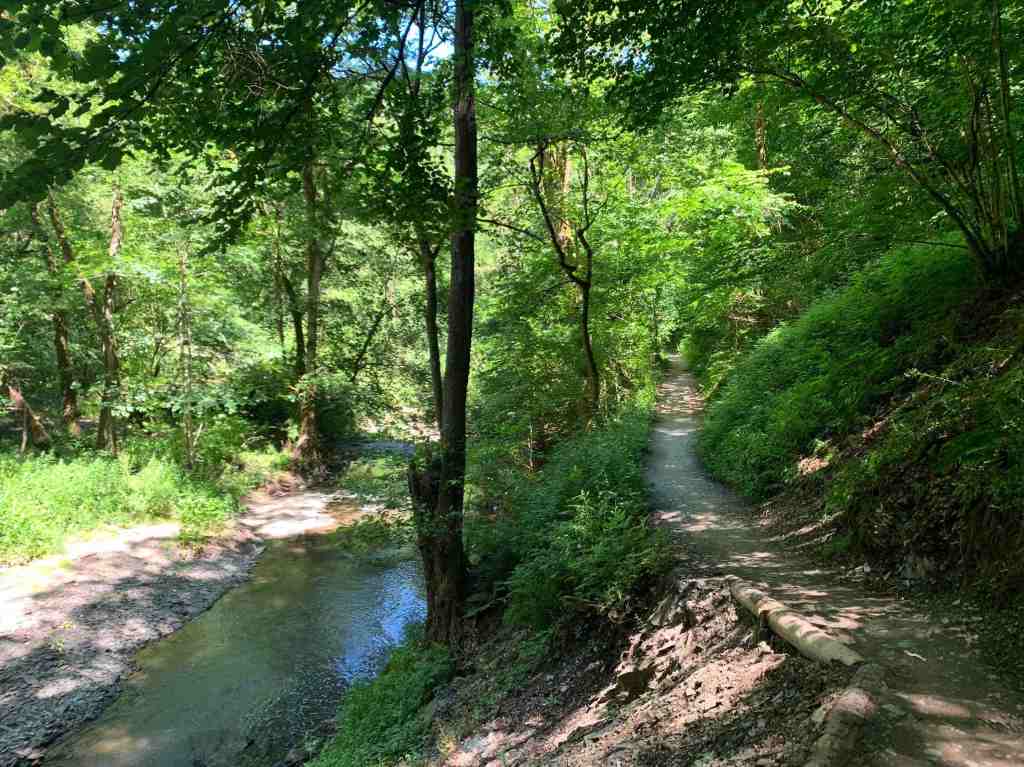
I marched out of Moselkern headed northwest, following the Elzbach, a little stream that empties into the Moselle. Very soon I found myself completely surrounded by woods. It was marvelous. As I have had occasion to say many times on this blog, one thing I miss about New York is the lush greenery of its forests. For all of its beauty, most of Spain is relatively dry and arid, the landscape yellowish and bare. Thus, I intensely savored the sensation of being, once again, in a dense, green wilderness, surrounded by birdsong and close to the sound of running water. Indeed, I found this hike so intoxicatingly enjoyable that I almost forgot about the famous castle. Later on, I found that this forest is actually an official nature reserve.

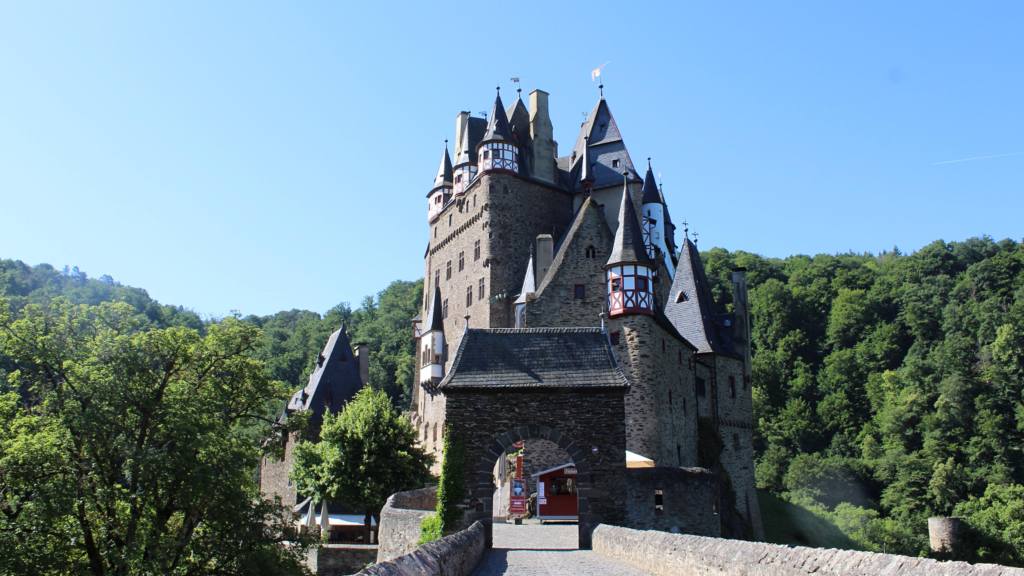
Now, it is possible to reach the castle by shuttle bus. But for anyone contemplating visiting the Eltz Burg, I highly recommend doing so this way. Stepping from under the canopy and into the clearing, and seeing the enormous castle above you, is a tremendous experience—the closest that you can probably get to time travel.

(Another tip for travelers is to bring cash, since the castle does not take credit cards and there are no ATMs in sight. Thankfully, I came prepared. You should also be aware that the castle is only available for visits from April to October.)

At first glance, the castle is both imposing and perplexing. It is difficult to imagine what such a magnificent keep is doing seemingly in the middle of nowhere. This mystery is resolved when we learn that this used to be an important trade route between farmers to the north and the Moselle to the south, where their crops could be shipped downstream. This is such a key point to control that there has been a fortress of some kind here for over a millennium. And for most of that time, the castle was controlled by one family: the Eltz.

This is precisely what makes Burg Eltz so special. It has been in the possession of a single family since the Middle Ages, and it still is today. This has made for truly exceptional preservation. Most of the Rhine castles, for example, were damaged or destroyed in various wars; and what stands today are usually later reconstructions, often with whimsical Romantic fancies added on. Even the best-preserved castle on the Rhine, the Marksburg, does not have its original furnishings. But the Eltz is a kind of enormous time-capsule, an unbroken link to the medieval past.

Burg Eltz has only ever been seriously attacked once. The evidence of this is to be found on a hill overlooking the castle, where the ruins of a small fortress can be seen. This is the Burg Trutzeltz, which was constructed to bombard Burg Eltz with catapults and primitive canons. This was part of a local power struggle of the 14th century, known as the Eltz Feud, in which the knights of Eltz Castle struggled to maintain their independence from the Bishop of Trier. Eventually they capitulated and the family became once again vassals. As it stands now, the castle is remarkable more for its beauty than for its value as a fortification. Indeed, the tall, flat walls of the castle would make it an easy target for canonfire. I would wager that a single piece of artillery could wreck the place.

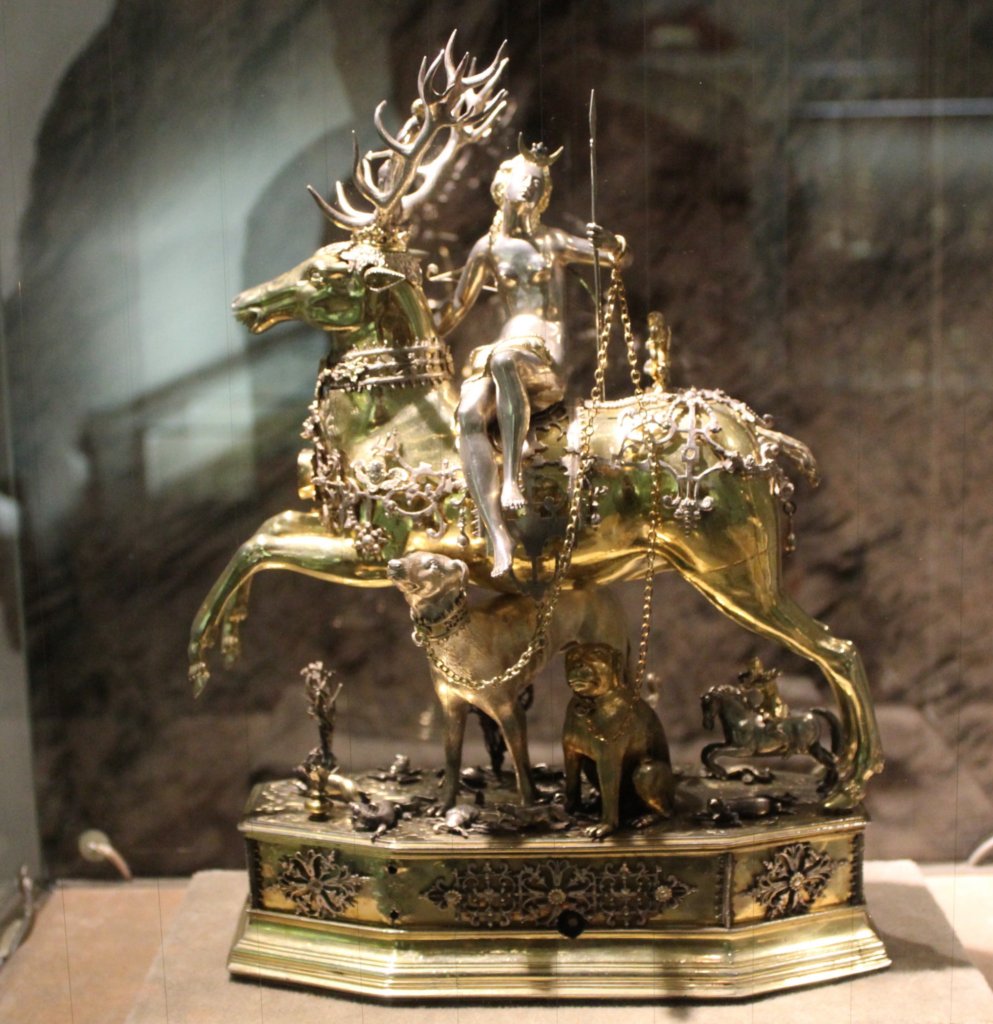
I climbed up the stairs to the main rampart—quite sweaty by now—and bought a ticket for the next guided tour. It would start in about 45 minutes, which gave me some time to visit the castle’s treasury. This is a kind of miniature museum in what appears to be the castle’s dungeon, exhibiting the family’s most valuable possessions. Some of the objects on display are quite fine, exhibiting the prosperity of this aristocratic family. There are, for example, ceremonial crossbows and ornate hunting rifles. And of course, courtly life requires plenty of fine dining. There are ivory drinking vessels, silverware with mother-of-pearl handles, and even a weird mechanical drinking game, a device which participants would wind up and release on the table, dooming one unlucky (or lucky) couple to draining its contents. 

I have to admit that, most of the time, the accoutrements of the upper crust leave me feeling a little cold. As impressive as is the workmanship and artistry required to make such items, to my eyes their aesthetic value is drowned by their proclamation of wealth. This collection, however, was more charming to me for being the accumulated possessions of one single family, displayed in what is still—to an extent, at least—their family home. There certainly is an anthropological value, at least, to seeing authentic examples of luxury in their original context.

Now it was time for the tour. (There are no photos allowed on the tour, but the website has photos of all of the major rooms.)

Once again, I normally find tours of aristocratic or royal dwellings to be kind of depressing. But the interior of Burg Eltz was unlike any other building I have seen. Even though it was obviously the home of a wealthy family, the furnishings of the room often struck me as being charmingly rustic. The roof timbers were visible and the supporting columns were irregularly carved. The Eltz were a family of knights, and their arms and armor form an important part of the decoration.

But by far my favorite aspect of the castle were the wall decorations. These include vegetable motifs vaguely reminiscent of Muslim decorative styles (possibly brought back from the Crusades). Yet compared to, say, the Alhambra’s elegant designs, those in Burg Eltz are sort of clumsy and clodish. I do not mean this as an insult, however, as I found the taste displayed in these decorations to be beguilingly foreign—that is, genuinely medieval, and alien to modern sensibilities of line and color. To repeat myself, a visit to this castle is the closest one can come to a trip back in time, so wonderfully does it preserve the flavor of the Middle Ages.

After an hour, I was back outside. I was both satisfied and exhausted. The only place to eat nearby is in the castle’s café, where I had—what else?—a plate of currywurst and pommes, along with a beer. Fortified, I decided that I ought to explore the lovely forest some more before venturing onward. Thus, I walked on a circular path that goes around the valley below the castle. The best part was the view of the castle from across this valley, its grey spires contrasting against the sea of green around it. By the time I circled back to the castle, I was convinced that this is one of the great destinations of Europe. The castle itself is first-rate. Its dramatic location in the middle of the woods pushes it into another realm entirely.

After another hike, I was back in Moselkern. (In retrospect, I think I could have taken the path instead to the neighboring town of Müden, just for the sake of variety.) Here, I caught a train to the biggest town nearby: Cochem. “Big” is, of course, a relative term here, as Cochem has just about 5,000 residents, making it about half the size of my own little hometown, Sleepy Hollow. Nevertheless, it is a very attractive place, with the local castle—the Reichsburg Cochem—sitting on a hillock overlooking the quiet houses below. This attractive castle, as it happens, is yet another example of Romantic reconstruction, as the original was burned down by French troops in 17th century.

(Cochem has a long history, but perhaps the most interesting thing about the town is that, during the Cold War, it was in this sleepy place that West Germany kept its emergency supply of currency. In a bunker located beneath some nondescript houses, 15 billion German marks were stored away, to be used in case East Germany started counterfeiting their money.)

The cellar of the wine bar.

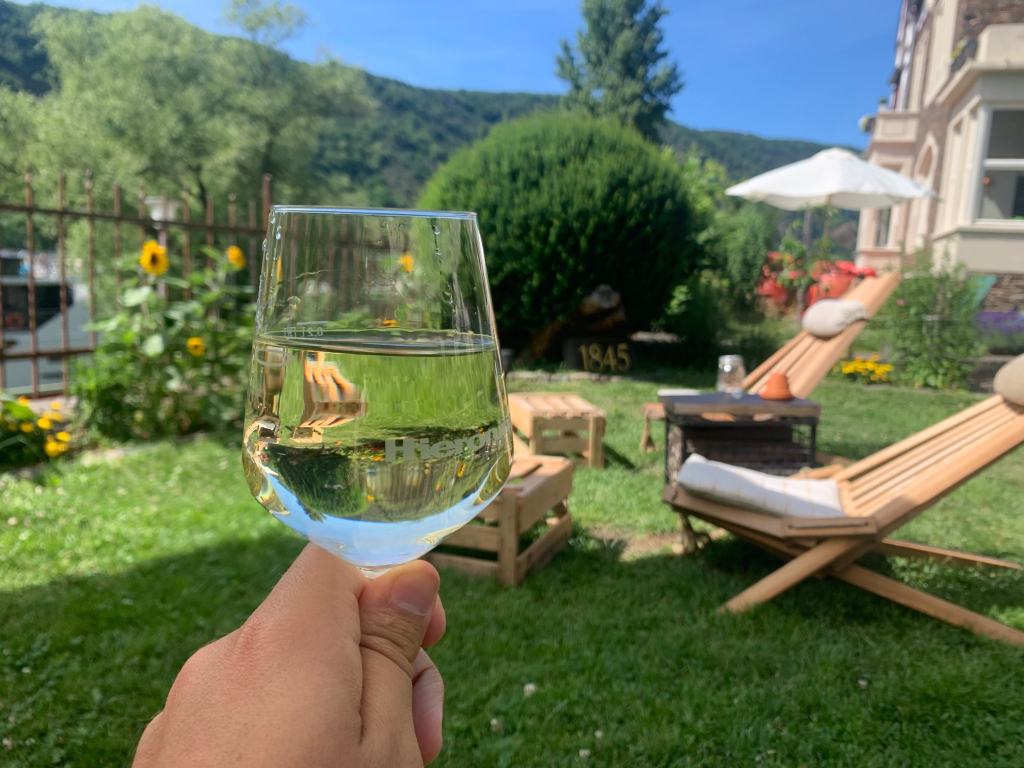
There is, I am sure, a great deal of sightseeing to be done here. But I was quite saturated by this point in the day, and was far more interested in sampling the local wine. The seemingly endless vineyards surrounding the valley in every direction seemed to confirm this desire. Thus, I found my way to a wine bar on the side opposite the town center, sat down on a wooden chair outside, and had a drink. In fact, I have to admit that I had a few. It was just too pleasant to give it up. The weather was perfect, the wine refreshing, and I had nothing else to do. Also, the knowledgeable bartender was quite willing to explain German wines to a clueless foreigner. I listened intently and retained exactly nothing of what he said.

After I decided that I couldn’t have another glass without jeopardizing my return journey, I reluctantly made my way back to the train to return to Koblenz. I had one night left in Germany.


Koblenz is a proper city, with a population of well over 100,000. Like many places in Germany, Koblenz was bombed nearly out of existence during the Second World War, and had to be rebuilt. As a result, it is not exactly the stereotype of a charming European urban center. Nevertheless, I found it to be quite a pleasant place to relax after my journeys on the Rhine and the Mosel. It was quiet, convenient, and not entirely bereft of charm.

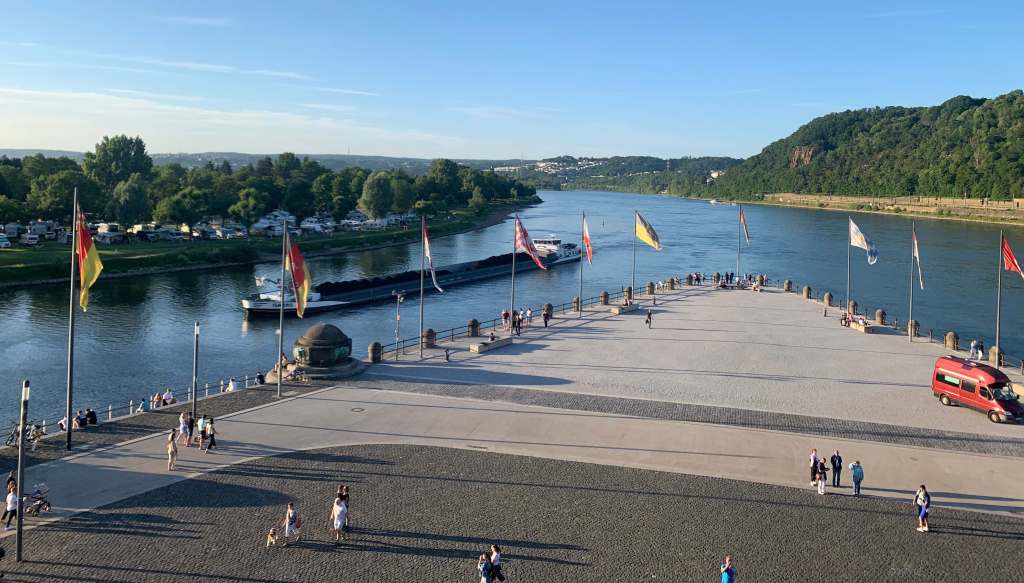
There is only one major tourist attraction in Koblenz, and that is the Deutsches Eck (literally the “German Corner”). This is the point where the mighty Rhine meets the charming Moselle, thus creating a cultural and a literal confluence. It was here that Wilhelm II—last king of Germany—decided to construct one of the many monuments to his grandfather, Wilhelm I. It seems to have been the younger Wilhelm’s object to elevate his grandfather to the status of national hero. He even demanded that Wilhelm I be referred to as “der Große” (“the great”). All over Germany, massive statues of the Kaiser were erected.

To be sure, the first Wilhelm was an important figure in German history, as it was during his reign that, with the help of Bismark, he achieved unification of the separate German states. Much like Italy, you see, for much of European history Germany was split into several dozen states, each with its own laws, currency, and ruler. During the 19th century, both Germany and Italy were unified in a wave of patriotic nationalism, thus allowing them to compete on an equal footing with France and England for domination of Europe. The symbolism of the confluence of these two rivers was surely not lost on those who built this monument.

Where the rivers meet.

The enormous equestrian statue that now rides atop the stone pedestal is, however, a reconstruction. The first statue survived the WWII bombing of Koblenz, but was hit by American artillery fire during the invasion of Germany (sorry about that). The pedestal was bare for several decades until the statue was finally replaced after the fall of the Berlin Wall and the reunification of Germany. Hoisting up the statue of a dead Kaiser may be an odd gesture to celebrate the end of communist rule, but it did help bring tourists to the city.

When I visited, the place was full of locals and tourists alike. The huge pedestal is a pleasant place to sit and enjoy the river, or for kids to climb and play on. Nearby, one can see the Koblenz cable car, which takes riders over the Rhine (sadly, I didn’t make time to go). The journey ends on the other bank of the Rhine, on the hill upon which sits Ehrenbreitstein Fortress. A real modern fortification rather than a romantic faux-medieval castle, this fortress is not exactly beautiful, but it is perhaps worth visiting for the view alone. 

On my first night in Koblenz, I was so tired that I just peeked into a Lidl for a premade sandwich and some chips and ate this paltry dinner in my Airbnb. On my second night, after a day of exploring the Rhine, I made the mistake of choosing a fast food place in the old city center (overpriced and unsatisfying). Finally, on my last night in Koblenz and in Germany, I had the good sense to find a biergarten. There is an excellent one—enormous, with hundreds of outdoor seats—right beside the Deutsches Eck.

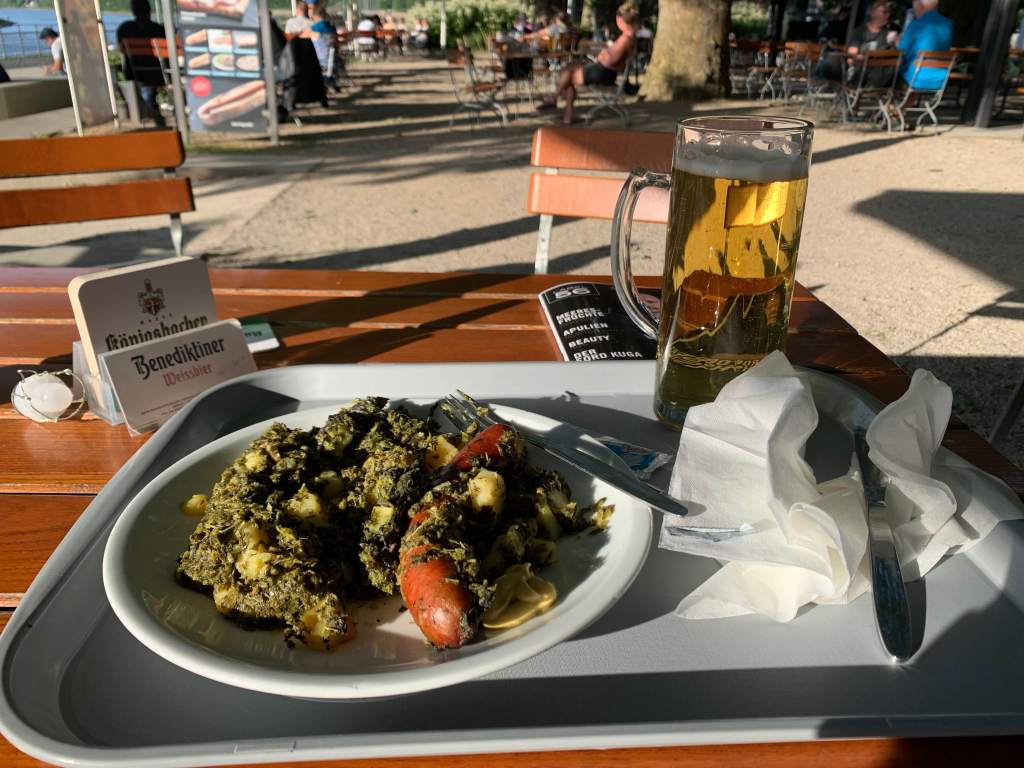
Here, I ordered some sausages and potatoes and a large mug of German beer and sat down on one of the wooden chairs under the shady plain trees. Now, there is something that foreigners ought to know when drinking at a biergarten. The lovely glass mugs (or “steins,” as they are called in English, but not in German!) have proven to be so tempting that many people simply walk off with them as souvenirs. To combat this, one must often pay a deposit, called the “Pfand,” which is normally a euro or so. This amount is then returned to you when you bring the mug back to a special window.

I am clearly not a food photographer

Well, there I was, enjoying the fading light of my last evening on the Rhine, sipping an excellent beer and savoring the full feeling in my stomach, when I heard people talking right behind me. It was a couple, and they were wondering how they could use the bathroom. The door, you see, had a lock on it, and you had to put in a euro to open it. However, I had just found out that, if you asked one of the cashiers, they could give you a key to open it without paying. I turned around and conveyed this information in my best German, for which I was heartily thanked.

The interaction then took a strange turn. The female half of the couple spoke quite decent English and started asking me polite questions about myself. I did the same, and found out that they were young newlywed Germans on a little vacation. She then left (to go to the bathroom, naturally) and I was stuck chatting with the male partner. He was quite drunk and for some reason was convinced that he was able to speak English. What came out of his mouth, however, was a totally incoherent series of sounds with the occasional English word thrown in. I tried telling him that I could understand German, but it was of no avail, and I was subjected to a stream of literal nonsense until his partner returned. Hastily, I made my exit, and walked back to the monument.

I sat on the steps and looked out. The Rhine and the Moselle were beautiful in the sunset, and I felt very sad that I had to go. It had been an absolutely wonderful vacation. One day, I am sure, I will come back.

Riding Down the Rhine

Riding Down the Rhine

There is probably no landscape so evocative of Germany as the Middle Rhine. It is as if everything from the water to the trees were composed by Richard Wagner. With its rolling green hills, the river bustling with barge traffic, the quaint villages and innumerable castles, the whole place is like the fever dream of some 19th century romantic poet. This is what I was here to explore.

I had traveled from Düsseldorf that morning (nearly a two-hour trip) and arrived in Koblenz—the largest city in this section of the Rhine—by noon. There, I dropped my big backpack in a storage locker and then immediately hopped on another train.

In just another 15 minutes, I was in Braubach, a sleepy little town on the eastern bank of the river. But I was not here for the village. Instead, I walked straight to the top of the hill that overlooks the town, rushing so as to catch the first possible tour. I was going to visit the Marksburg. (Some people say “Marksburg Castle,” but “burg” already means “castle.”)

Now, the Rhineland has been an important territory since Roman times. Simultaneously a geographic division (near the border with France), as well as a major artery of trade, the river is a key to political and economic dominance. As a result, it is densely packed with castles and fortifications, from those hoping to defend from invasion or extract tolls. Most of these castles have been destroyed in one war or another. The castles standing today are, most of them, reconstructions dating from the 19th century, when the Rhine became an epicenter of the Romantic movement.

But the Marksburg is one of only two castles which was never burned down or blown up (though it was severely damaged by the Americans in 1945—sorry). For that reason, it is one of the jewels of the river.

You can only visit the Marksburg on a tour, and most of these are in German. Yet anglophones need not fear: non-German speakers are given a little information card to read along as the tour guide explains what’s what. I optimistically thought that my German might be good enough to catch at least some of my guide’s explanation (which sounded very engaging), though I quickly had to admit that I was in over my head. Still, it was a fascinating visit.

We began by entering the main gate. Immediately I was given a sense of how difficult it would have been to actually conquer this castle, for we found ourselves in a kind of narrow stone passageway with a wooden platform above us. For any archers—or even for a boy with a heavy rock to throw—we would have been sitting ducks. On the wall were the coats of arms of all of the noble families who once controlled this castle. At the top there was a battery of cannons pointed out towards the Rhine. Looking out, I could see that any ships on the river below would be in much the same position as a soldier storming through the gate—proverbial fish in barrels.

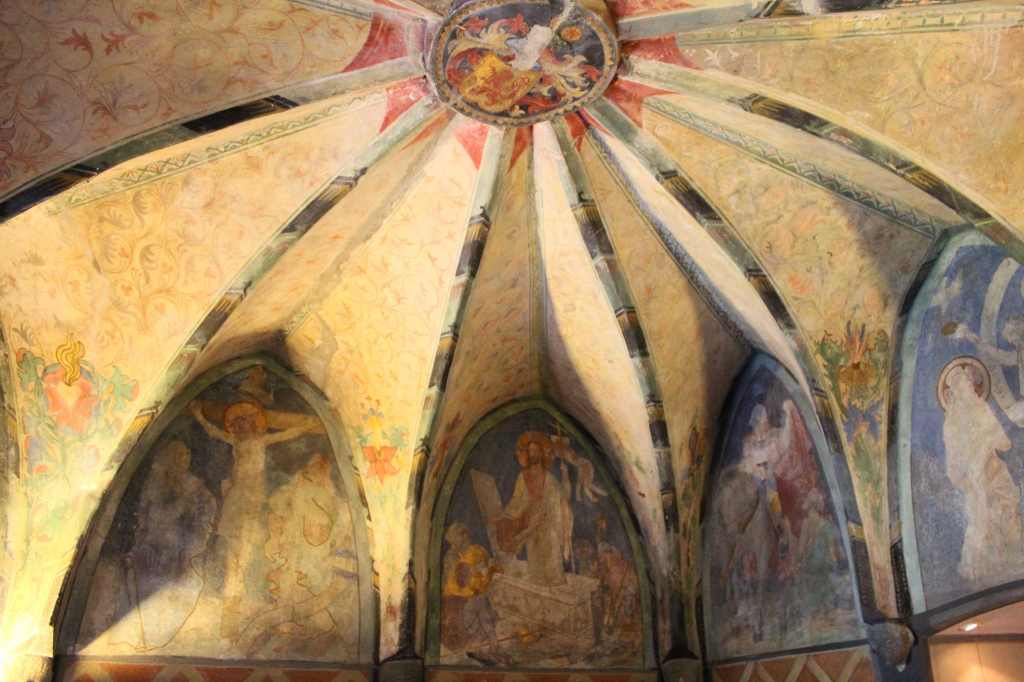
Now, because the castle fell into neglect before its acquisition by the German Castles Association, none of its original furnishings remain. Thus, the interior of the castle is more of a museum than a time-capsule. There is, for example, a room dedicated to the different types of arms and armor used by soldiers throughout history (a bit corny, to be honest), and a garden full of plants important to the medieval herbarium. I particularly liked the kitchen full of period utensils; it put me in the mood for a kingly feast (though I had to settle for currywurst in the castle’s café). But the most beautiful thing to see were the romanesque frescoes on the wall of the chapel.

The medieval kitchen
The chapel with Romanesque frescoes

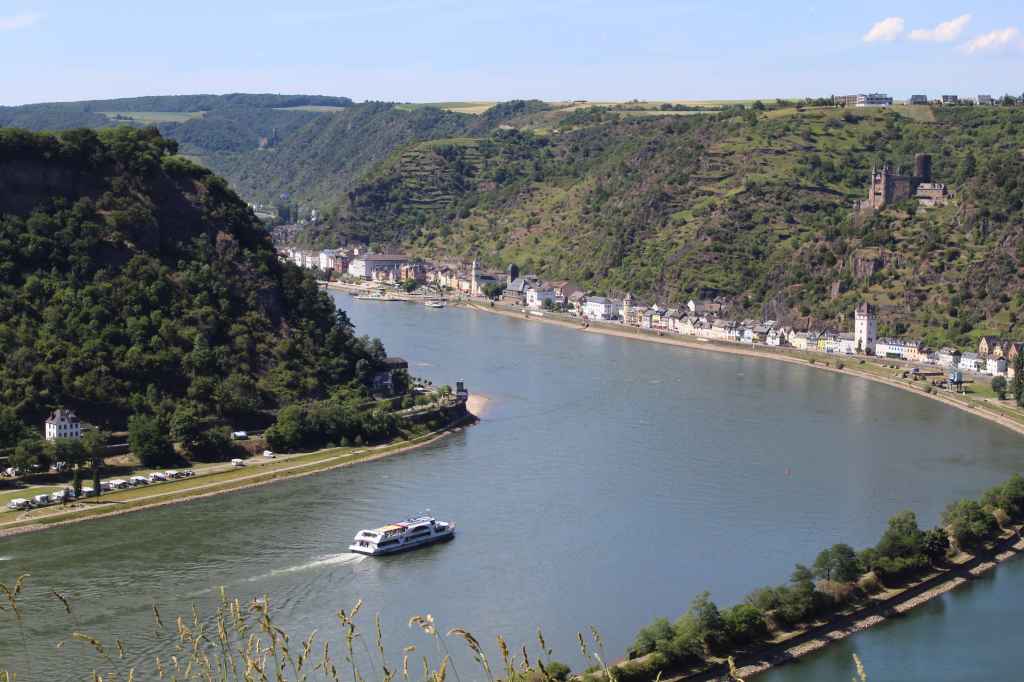
My next stop was a town bearing the attractive name of Sankt Goarshausen. This town is yet another fairly nondescript village on the Rhine. Its main claim to fame is being next to the Lorelei—a huge rocky cliff at a pronounced bend in the river. For centuries, this was a perilous point of navigation for water traffic on the Rhine, and so various legends have grown up to explain the numerous shipwrecks. The most famous of these involves a kind of blond siren who distracts sailors with her beauty. This legend was put into verse by the famed poet Heinrich Heine, whose poem has been set to music by several composers. Here are a few lines:

Die Luft ist kühl, und es dunkelt

Und ruhig fliesst der Rhein

Der Gipfel des Berges funkelt

Im Abendsonnenschein

Die schönste Jungfrau sitzet

Dort oben wunderbar

Ihr Goldenes Geschmied blitzet

Sie kämmt ihr goldenes Haar

In English this goes something like this:

The air is cool, and darkness comes

And quietly flows the Rhine

The mountain peaks are glistening

In the rays of the evening sun

There sits the beautiful maiden

Up there, wondrous

Her golden jewels are shining

She combs her golden hair

You get the idea. Well, beautiful maidens notwithstanding, the Lorelei is indeed a navigational hazard. As recently as 2011, a barge met its demise at this place. And as with seemingly all capsized boats, this one was carrying an environmental hazard—in this case, several thousand tons of sulphuric acid. Sorry, fish.

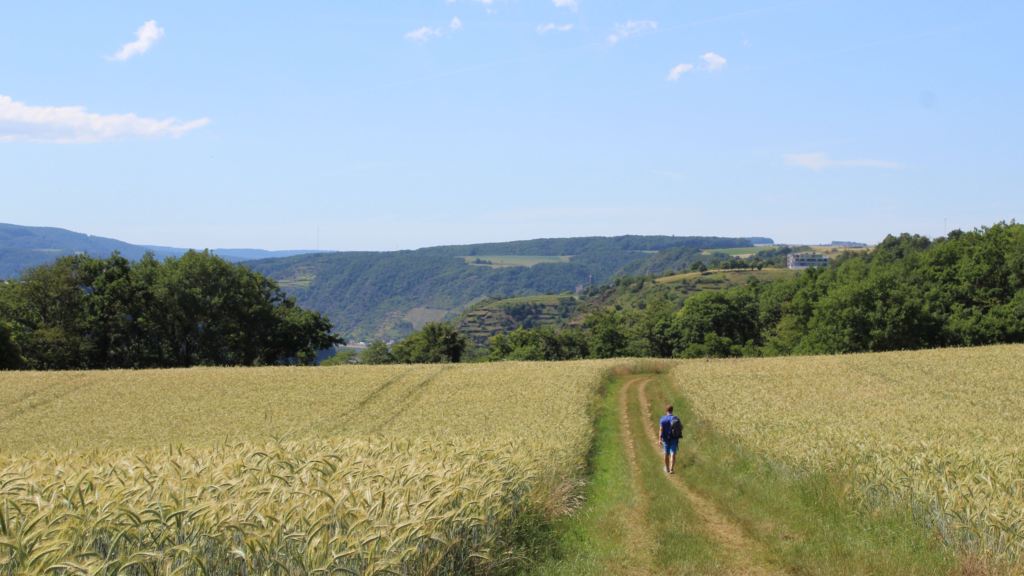
I was here because I wanted to climb up to the top. The path was short but steep, consisting of one staircase after another. On the way, I passed a sign that told me not to “desecrate this holy place,” as it was meant to “honor German heathens.” Duly warned, I arrived panting and sweaty at the top, where there was a small park with an excellent view of the river. When I caught my breath and got my fill of the scenery, I decided that it was time to return to Sankt Goarshausen. Instead of going straight back down the way I came up, I followed another path on my map that seemed less steep. Soon I found myself in the middle of a field of wheat. I kept going, and soon the Burg Katz (“Cat Castle”) came into view. This is more of a mansion attached to a derelict turret than a proper castle, and in any case is now privately owned and not open to visitors. But it does make for a good photo.

(A bit upriver is the humorously named Burg Maus, or “Mouse Castle,” which was built by the rivals of the Counts of Katzenellenbogen.)

At Sankt Goarshausen I had a beer to cool off and then caught the train back to Koblenz. That was it for my first day on the Rhine. I had been moving nonstop since the early morning, and I needed dinner and a shower. But I still had the next full day to explore.


Early the next morning, the train left me in Sankt Goar. This town is directly opposite where I was the day before, visiting the Lorelei. Indeed, Sankt Goar is the sibling town of Sankt Goarshausen, the two being named after Goar of Aquitaine, who served as bishop in Trier, over 100 km to the west. For many years now, a bridge has been proposed to connect these two estranged sisters (which would be the first bridge to cross the middle Rhine), but it has yet to be built. Instead, a ferry runs back and forth a few times a day.

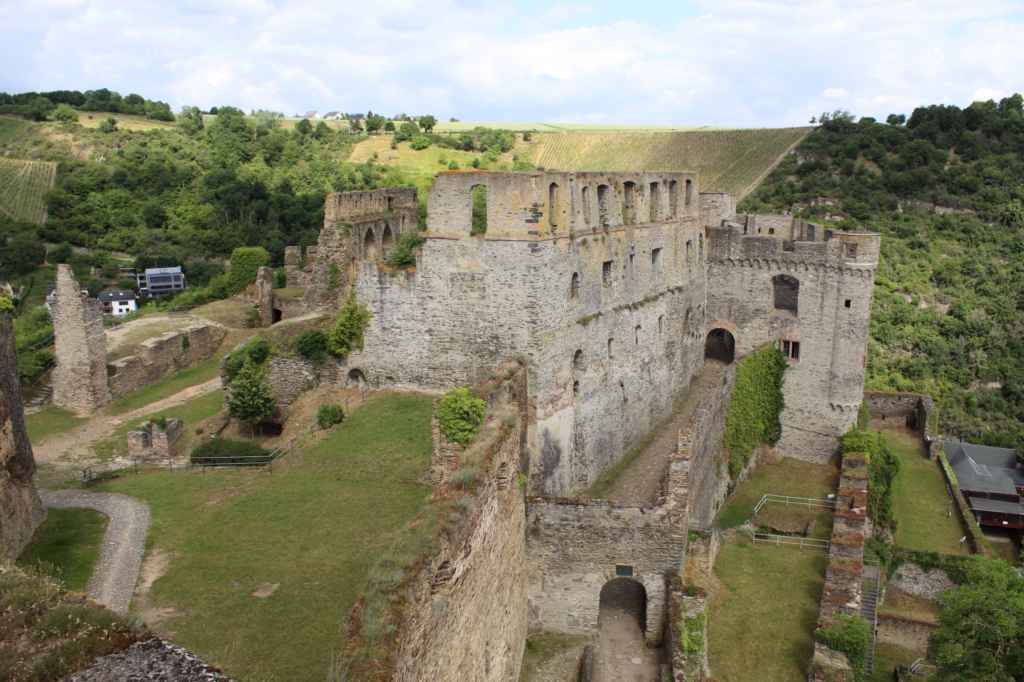
I was here to see yet another castle, one of the biggest on the Rhine: the Rheinfels. In its prime, the fortress must have been enormous and formidable. Much of the structure was built under the auspices of the awesome Count of Katzenelbogen (“Cat’s Elbows”), of Katz Castle, who wanted to use the two castles to extract tolls from river traffic.

Burg Rheinfels before it was destroyed.

Unfortunately for us, during one of the many wars between the Germans and the French (this one during the French Revolution), invading troops decided to make an example of the iconic castle and ruined it (in technical terms, “slighting”). This was something of a scandal. Although the castle had, in previous conflicts, proven its ability to withstand attacks and sieges by far superior forces, the aging commander Philip Valentin von Resius, upon hearing that a huge French army was approaching, abandoned the castle in great haste. The keep was thus taken without a fight, even though it may very well have withstood the attack. As a result, the French walked right into the abandoned castle, and decided to demonstrate French might. Now only a fraction of the original building remains.

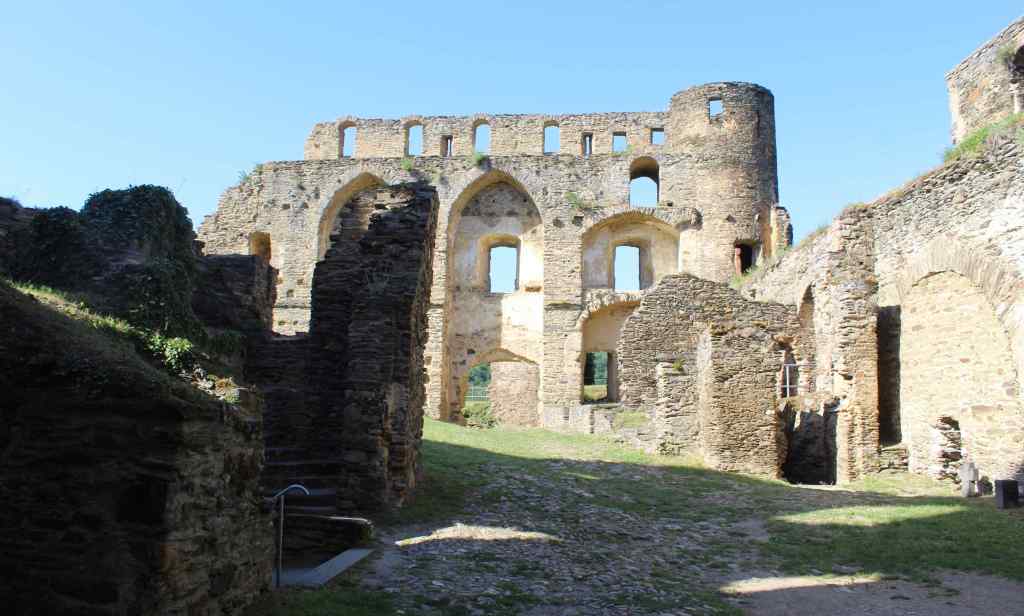
In my enthusiasm to take full advantage of my day on the Rhine, I arrived at the castle gates right as it was opening. I was the first and, for most of my visit, the only visitor in the enormous compound. If memory serves, I was given a little information card that had information about what each section of the castle used to be. But to be honest, I am not particularly interested in castle architecture nor in medieval warfare, and this was of scant interest to me. Instead, I savored the atmosphere of quiet ruin that hung about the place. I walked into one of the intact chambers, in the basement, and whistled—the echo ricocheting like a pinball off the walls. Then, after strolling through the ruins, I sat on a bench overlooking a valley behind the castle. It was a perfect summer day, and I felt that surreal sensation of being absolutely relaxed in a place which you have only ever seen in pictures.

My reverie was broken by a sound. The scream of an airplane engine caught my ear. And although I assumed it would naturally die down, the sound instead quickly increased into an overwhelming roar. For a moment, I panicked. Was a plane about to crash into the castle and incinerate me? 

Then the sound suddenly died away. Curious, I ran towards where it had come from, the river, but there was nothing to see. So I asked the man at the ticket booth, who told me that it was an American fighter jet, from a nearby military base. Sometimes they fly low over the valley in training flights. War is still close at hand in the Rhine Valley. (The town was occupied by the French again in World War I, and then taken by American troops in World War II.)

My castle quota reached for the day, I decided to have a little snack. My original idea was to walk into town and have a quick sandwich. Aside from the Rheinfels, there is very little to do or see in Sankt Goar. But its central street is attractive and charming. Though normally I don’t have a sweet tooth, a display of cakes and pastries caught my eye, and I decided to change my plans. Instead of a sandwich, I had a slice of Black Forest Cake (Schwarzwald Küchen). Very satisfying.

My stomach pleased, I walked over to the riverside, where I bought a ticket for the only operating ferry on this part of the Rhine: Köln-Düsseldorfer. I acquired my ticket and noted down the departure times. It was going to leave in just over an hour. This left me with enough time to visit the wine bar across the river from the Lorelei. It was a long walk and I had to rush; but as I knew from my trip to Vienna that Germanic white wine is delicious, I decided that it was worth it. I arrived sweaty and parched, which made the wine especially good but difficult to savor. I wished I had more time, but the ferry was approaching and I couldn’t risk missing my boat.

The ferry pulled into the harbor and I climbed up to the top floor, where a bunch of other sunburnt tourists were baking under the sun. The ride was slow and scenic, reminding me of the ferry I had taken the previous month in Lago di Como. Every little town seemed to have its own castle, and much of the remaining land was given over to vineyards. The most impressive sight was the ship-shaped Pfalzgrafenstein Castle, which has been built in the middle of the river. It used to work with the nearby Gutenfels castle to extract tolls from passing ships. Unlike so many other fortifications on this martial river, the Pfalzgrafenstein has never been seriously damaged. However, as it was only a military bastion and never the home of a nobleman, its interior is quite spartan. (You can take a tour from nearby Kaub, but I read that it wasn’t worth it.)

Pfalzgraben and Gutenfels

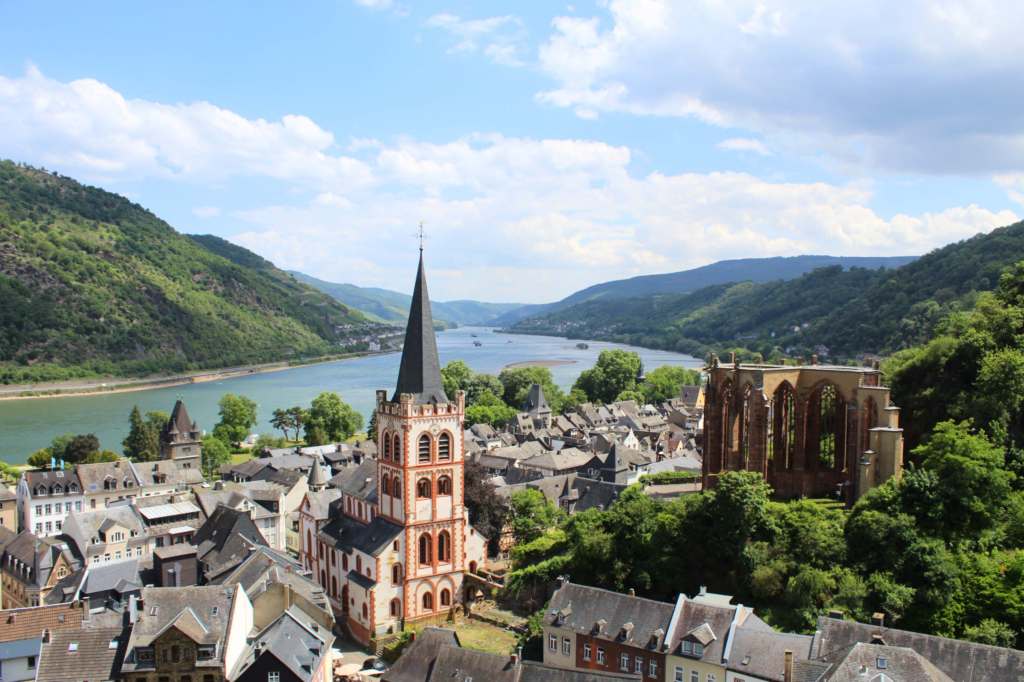
The boat deposited me in Bacharach, one of the most famous villages on the river. The town is full of delightful half-timbered houses—one of them goes all the way back to the 1300s century—giving it a kind of stereotypical German quaintness. Yet as soon as I got off the boat, I decided to walk up into the vineyards on the hill surrounding the river, in order to get a better vantage point. There, I climbed up one of the old watch-towers of the medieval town, the Postenturm, to get a wonderful view of the Rhine valley beyond. After getting my fill of the scenery, I walked up the main road to the Steeger Tor, a gate from the old medieval walls.

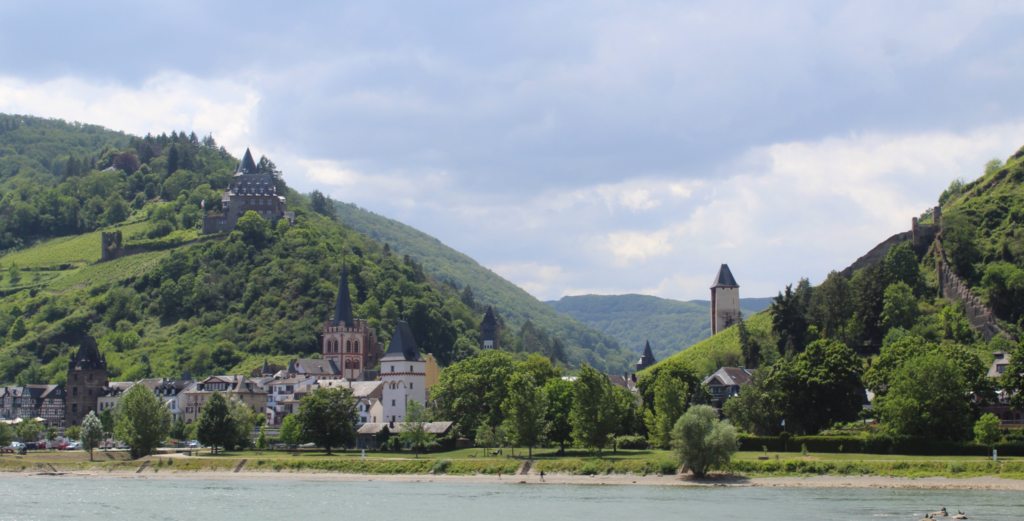
Bacharach from the water. On the left, on the hill, is the Stahleck. On the right is the Postenturm.

The town of Bacharach is crowned with yet another impressive castle, the Stahleck. I decided not to make the trek up to visit, however, as it is now used as a youth hostel. (In any case, like many of the castles on the Rhine, this one is a reconstruction of a previous castle destroyed in war.) But I did walk up to appreciate the Wernerkapelle. This is a beautiful gothic ruin on a hilltop—a perfect romantic combination of medieval mystery and desolation. Unfortunately, the story of this chapel is not so pleasant. It is named after a young boy who was murdered in the 13th century. The townspeople blamed the local Jewish population (with no evidence, of course), which led to a massacre of 40 people. The past can be very inconveniently ugly.

After getting my fill of the sights and views, I decided to kill the time remaining for my return ferry journey by sampling more of the local wine. The typical wines of the region are all white wines, crisp and fresh. Very refreshing. I lapsed into a kind of half-drunk, half-dehydrated reverie.

Finally it was time to return to Koblenz. Luckily for me, the return journey happened to be on the most famous boat on the Rhine, the RMS Goethe. The largest side-paddle steamer in the world, this boat began sailing back in 1913. After being hit by a bomb in the Second World War, it sat for some time on the bottom of the Rhine, until it was finally restored in the 1990s. Nowadays, it is floating nostalgia. I nabbed a seat on one of the side decks and enjoyed a final beer as we crawled up to Sankt Goar. It was the golden hour and the river was especially beautiful. I could see why so many countries and leaders have spent so many centuries fighting over it.

I had loved my time on the Rhine. In many ways, it reminded me of my home in the Hudson Valley—small towns nestled along a picturesque river. Even the verdant landscape was reminiscent of upstate New York. But of course, there are no castles where I’m from (or, at least, no real ones), and our wine is not nearly as good. At least we have better pizza.

Review: Every Man for Himself and God Against All

Review: Every Man for Himself and God Against All

Every Man for Himself and God Against All: A Memoir by Werner Herzog

My rating: 5 of 5 stars

I saw my first Werner Herzog film in my final year at college. I found out at the last minute that, to graduate on time, I needed to take some kind of history class. For some reason that I don’t remember (maybe cultural aspirations), I chose an introduction to Art History. It was taught by an unenthusiastic and disgruntled graduate student (by the end of that semester he would quit his program to become a chiropractor), yet it somehow left a deep impression on me. I had very limited knowledge of ancient and medieval art, and I can still vividly remember first seeing photos of the Book of Kells and the Boudreaux Tapestry.

But probably my most intense experience of art came early in the semester, when we were learning about prehistoric art. In the middle of class, the professor mentioned, offhand, that there was a recent documentary by Werner Herzog about the caves of Lascaux. I had never heard of Herzog, but I decided to look for the film anyway. It was not at all what I expected. Rather than a standard overview of what we know about cave paintings (which is not much, anyway), the film is an attempt to come to terms with the painters as artists. I felt cheated at first—thinking the film unscientific and wishy-washy—but, by the end, I was convinced that Herzog had indeed taken the right approach. For he does the most important thing, which is to try to recreate with his camera the actual experience of being in the caves.

Later on, I saw Aguirre, the Wrath of God and Fitzcarraldo—probably his two most famous films, both with the unstable actor Klaus Kinski—though I have to admit that neither of them left a particularly deep impression on me. It was only this past summer that I fell completely under Herzog’s spell, when my friends invited me to watch Grizzly Man. I was completely transfixed by it, and (as is typical with me, when I find something I really like) I found myself bringing it up in conversation months afterwards. And so I fell down the rabbit hole—or, to put it in more Herzogian terms, I plunged headfirst into the abyss.

One reason that I became so enamored of his films is because Herzog captures images on film that I’ve only dreamed about: What is it like to swim under the ice, or to get lost in the desert, or to walk inside a volcano, or indeed to be in a cave full of prehistoric paintings? The human experiences that Herzog likes to explore also attract my morbid imagination: living on death row, being attacked by a bear, surviving in the jungle after falling from the air (both Dieter Dengler and Julianes Sturz). And I find Herzog’s manner of approaching these images and experiences to be wonderfully human—perhaps, because he is such a pedestrian filmmaker. I mean that literally, in that his films always convey a kind of physical closeness, as if you are there walking beside him. His most characteristic touch as a filmmaker, I’d argue, are his shots in which the footsteps of the cameraman are palpable.

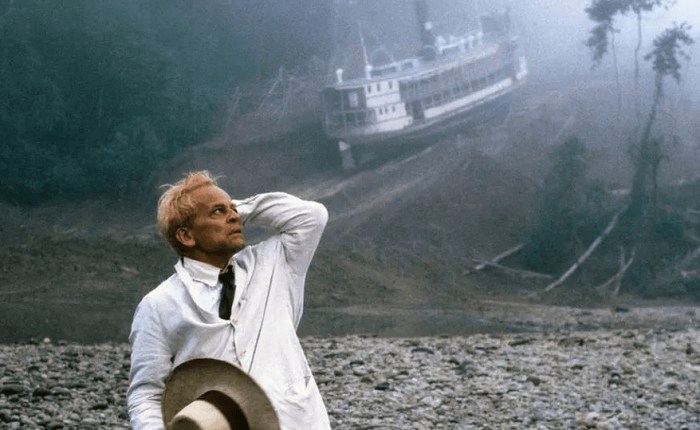
But above all, I appreciate his films and documentaries because they are not about the interpersonal struggles that characterize so much of Hollywood—between children and parents, or between friends, or above all between couples. Granted, this means that his work generally has little value as social commentary, in the way that, say, a classic Victorian novel has. Yet it makes up for it by being about what is, for me, the ultimate theme: the doomed struggle between humanity and the universe. This is summed up in what is arguably the central image in his entire oeuvre, the challenge of Fitzcarraldo: lifting a boat over a mountain in the middle of the jungle. Indeed, the making of the film itself became such an impossible task that it is doubly metaphoric.

Well, I have gone on about Herzog’s work as a filmmaker, but this is a book review, after all. Yet it is apropos, my reaction to this book only makes sense if you know that I am in the midst of a Herzog obsession. And I would only recommend the book to people in a similar predicament. That is, it is difficult for me to imagine someone with only a casual interest in Herzog, or perhaps just wishing to read a good book of memoires, really enjoying the book. Yet if you are a fan, this is wonderful reading.

Or listening. It was an easy decision to experience the book in audio format, narrated in Herzog’s iconic voice. It is certainly good practice for my Herzog impersonation (though it’s still mediocre). Also, it was constantly amusing whenever Herzog pronounced any sort of foreign word—be it German, Spanish, or Nahuatl—as his voice became inundatingly phlegmy.

While Herzog is an extremely thoughtful person—indeed, he seems to be one of the last living examples of the twentieth-century European intellectual, full of strange opinions and oracular pronouncements—while that is true, as I was saying, he is not particularly introspective. To the contrary, he declares himself the enemy of psychoanalysis, and says that there are parts of the human psyche which should remain shrouded in darkness. It is this aversion to delving emotional depths, I think, which makes him spurn human relationships as the focus of his work—and, it seems, as the focus of his life, for he does not seem to be principally motivated by his family or friends.

What motivates him artistically and personally are, rather, what you might call miniature obsessions. The geneses of his films seem to take the following form: He hears a piece of music (such as the madrigals of Carlo Gesualdo) or a story (such as about the simultaneously-speaking twins, Freda and Greta Chaplin) or sees an image (such as man in a protective suit battling an oil fire) and then decides he must make a film about it.

This tendency to get completely lost in a temporary fixation is another quality I share with Herzog. But the big difference between him and sorry devils such as myself is that Herzog is not content to read a book or watch a movie about his latest mania. He actually travels to the ends of the earth to explore it himself.

His absolute determination to see his projects through, regardless of the hardships or the risks, is perhaps his most admirable (and frightening) quality, and the one I identify with the least. I am a soft person who likes comfort, while this book is full of hardship after hardship and injury after injury. It is sometimes difficult to escape the conclusion that the man is a masochist. But I think it is more accurate to say that he has a philosophic attitude to pain. It is woven into his worldview, as something he simply expects to receive from the universe.

Now, I do have to confess at the end of this review that, now and then, I do get a faint whiff of charlatanism. Herzog seems to like telling stories about himself, and he also seems to have a flexible attitude towards the truth (as explained in his theory of “ecstatic truth”). There are precious few flashes of, say, self-deprecating humor to puncture the popular caricature of himself. But even if Herzog the man does not quite live up to Herzog the character, the artistic persona is so compelling that I think we would have to invent him ourselves if he did not really exist.


View all my reviews

The Rhinish Rivalry: Düsseldorf and Köln

The Rhinish Rivalry: Düsseldorf and Köln

Düsseldorf

Düsseldorf is not on many travel agendas. Indeed, it doesn’t even merit a mention in the copy of Rick Steves’s Germany travel guide that I had brought with me. For my part, I knew close to nothing about the place. And yet this was my destination.

As it happened, a friend of mine from Spain, Sai, had moved here (for work), and offered me a place to sleep on his sofa. Another coincidence: my German conversational partner, Karen—whom I had met in Scotland—lived quite closeby, and offered to show me around. So Düsseldorf it was.

Düsseldorf is named after the river Düssel, a tributary of the nearby Rhine, which flows through the city. (“Dorf” means town or village.) While the Rhine Valley is famous for its dramatic hills and castles, at this point the land is extremely flat and highly urbanized. Not for nothing does Steves call it the “unromantic Rhine.” With over 600,000 inhabitants, Düsseldorf is a medium-sized city, somewhat smaller than nearby Cologne (with which it has a fierce rivalry). Despite this, it is Düsseldorf, not Cologne, which is the capital of the region. 

Sai was busy at work, so it was Karen who showed me around the city. First, she took me to Königsalle, the widest boulevard in the country. It is so wide because a large landscaped canal runs through the center of it, with bridges covered in ornamental statues crossing the water. But Kö (as the locals call it) is mainly famous for its upscale shopping, with luxury store after luxury store. Each of these locales, as Karen pointed out, has a kind of bouncer out front, controlling access to the expensive goods within. It was a slightly sickening sight.

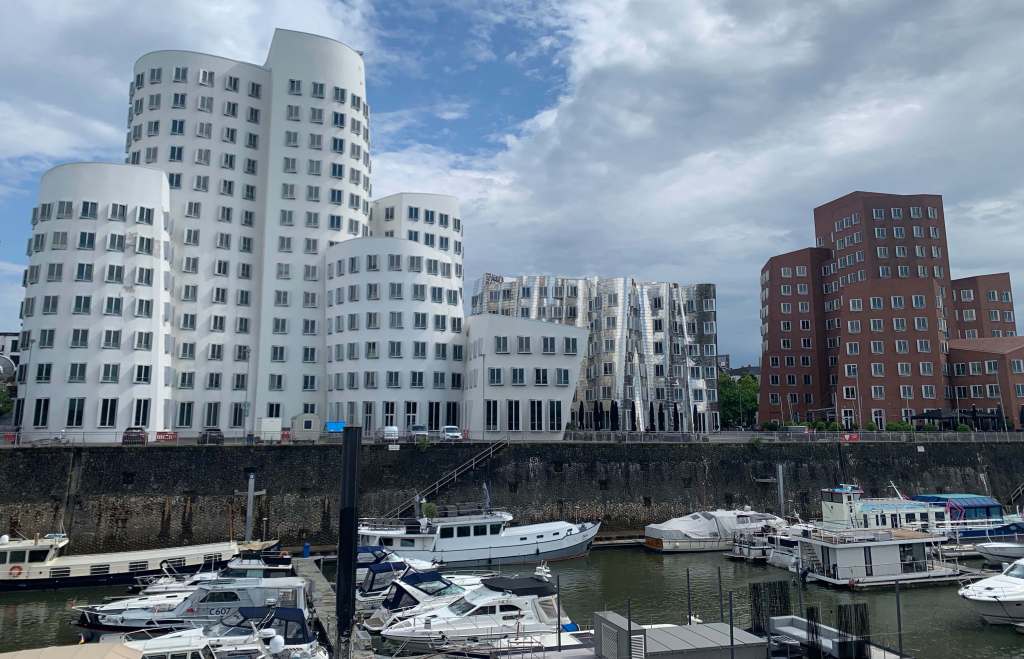
After that, Karen took me to the marina of the city, where a few dozen smaller, private boats are docked. There, we sat on a park bench and admired the Neuer Zollhof. These are a group of three buildings designed by Frank Gehry, which feature the characteristic twisting architecture familiar to anyone who has seen, say, the Dancing House in Prague or the Guggenheim Museum in Bilbao. Each one is made out of a different material—brick, plaster, and reflective stainless steel—but when I visited, the plaster was in poor shape.

This pretty much concluded my first tour of the main sights of Düsseldorf. From there, we walked along the river Rhine. It was a hot day, and I wondered why nobody was swimming in the water. But I quickly gathered that that would be a bad idea. For one, the current is surprisingly fast and strong, easily able to sweep you downstream. I also doubt that the water is particularly clean, considering the constant traffic of barges passing up and downstream. Even now, the Rhine is a major artery of commerce. I enjoyed watching them go by, wondering at their cargo. The captains and crew must live a good chunk of their lives on these ships, which sometimes had the appearance of mobile homes—with their cars parked on the back and, in some cases, their kids playing on a swing set as the boat drifted downstream.

In Germany, drinking in public is perfectly legal (a wonderful state of affairs!). Thus, we bought beers at a stand and sat down on some beach chairs facing the river. This was my first taste of Altbier, the local beer of Düsseldorf. It is sort of rust colored and has a strong, hoppy taste. (It is called “old beer” because it is fermented with yeast that floats on top, which is older than the bottom-fermenting yeast used to make lagers.) Despite being brewed like ales, however, its taste is quite distinct, and significantly lighter. As I discovered later, Altbier—like Kölsch, its rival from Cologne—is typically served in small glasses, which are circulated by the waiter on a tray. When you take a glass, the server puts a mark on your coaster, thus keeping a tally of your drinks.

Altbier

We finished up the day by going to dinner in a Japanese restaurant. It was excellent. Düsseldorf, you see, has one of the largest Japanese populations in Europe. Indeed, Düsseldorf is a highly diverse city in general, with a substantial Chinese population and a great many immigrants from within Europe. Shortly after I arrived, for example, Sai took me to one of the Asian supermarkets near his apartment, and I was astounded at the selection of available foods and ingredients. A few days later, Sai invited me to a picnic in the park with some friends of his, most of whom were of Chinese extraction. We had a veritable feast of non-German foods.

Sai has a demanding job, but he found the time to show me around the city a bit. We took a walk towards the Kö-Bogen, a large and flashy complex of office buildings near the Königsalle. Nearby is the Hofgarten, Düsseldorf’s central park. It was a beautiful day and the park was full of strolling families and youngsters lounging on park benches. Soon, we came upon an impressive neoclassical statue, consisting of a perfectly muscular young man who is dying on his bed, accompanied by a sympathetic lion. This is a war memorial, but not one dedicated to either World War. Instead, this commemorates the dead of the German wars of independence as well as the Franco-Prussian War of 1870. Since that time, war memorials have become less beautiful and more anguished. 

My friend Sai having fun in Düsseldorf

As it happened, the day of the picnic with Sai was also some kind of museum day. This meant that many of the city’s museums were free to visit and open late. Many of these institutions are probably well worth a visit, but I had other plans. I wanted to go out to the city’s Altstadt (Old Town) to enjoy some of the famous nightlife.

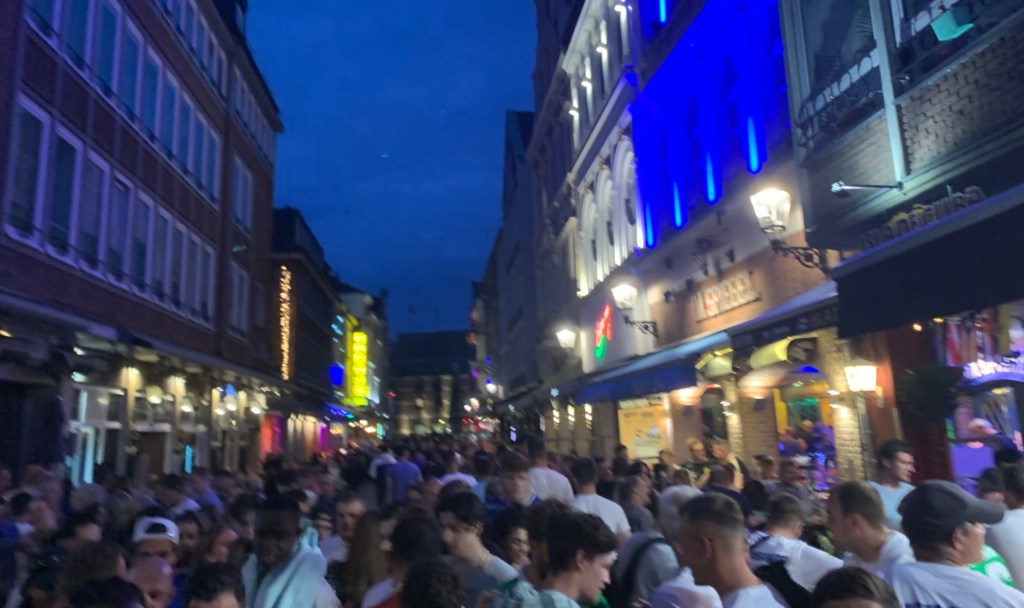
A blury photo of the festivities

This proved to be a mistake. Sai and I arrived shortly after dinner, and the entire neighborhood was completely overrun. There were bachelor and bachelorette parties, and groups of university students on the prowl. Every single one of the seemingly innumerable bars was packed. I was astounded that such a seemingly sleepy town could turn into what struck me as a giant frat party. During the day, Düsseldorf seemed so perfectly bourgeois; but at night, it was overtaken by a kind of adolescent, macho drunkenness. Sai and I had a few of the Altbiers at a bar, but quickly retreated from the noise and chaos. Instead, we got some beers at a corner store and walked along the Rhine. Even here, it was scarcely quieter. For me, being stuck in the middle of so many drunk young people made me distinctly uncomfortable, and it was a relief when we called it a night early.

Such was my experience of Düsseldorf, a city that perhaps deserved more of my time and attention. My brief impression was rather confused. With its high-end shopping, large immigrant community, and raucous night-life, the city seemed to have a split personality. Next, it was time to visit its rival.


Köln

Cologne is in every way a bigger city than Düsseldorf. With over a million inhabitants, it feels properly urban. Whereas the Düsseldorf train station makes very little impression, for example, Köln’s enormous Hauptbahnhof immediately conveys to you its size and importance.

I visited on a tight schedule. This was several days after my visit to Düsseldorf. That morning, I had left my Airbnb in Koblenz (in the Rhine valley, to be related in a future post) in order to return to Düsseldorf for my evening flight back to Madrid. Cologne was one of the major stops on the commuter train from Koblenz, so it was easy to get off and see this famous German city as a final sightseeing stop.

Indeed, Cologne seems custom-made for day trippers. The train station is full of automated luggage storage lockers, which bring your baggage to the basement via an elevator. It was easy to use, cheap, and worked perfectly.

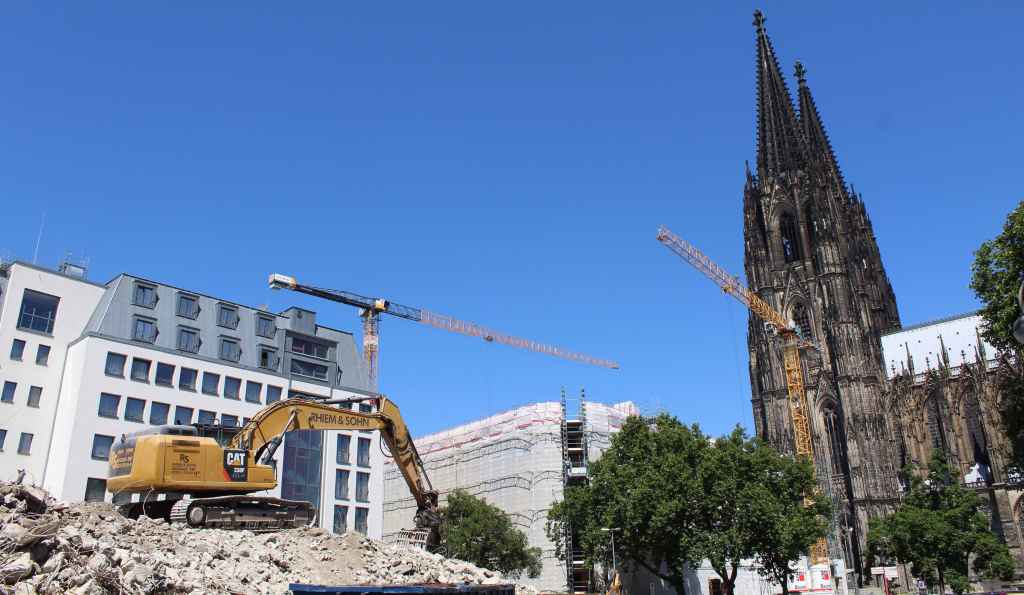
Right next to the station is Cologne’s principal tourist attraction: the Kölner Dom, the city’s magnificent gothic cathedral. Like many European churches, it took several eras to complete. It was begun in the 1200s, in a pure gothic style; but construction was stopped in the 16th century, the Renaissance, with still half of the church unbuilt. For centuries, the half-built cathedral stood in the city, with the medieval wooden crane still mounted atop one of the towers. Finally, in the 1800s, when a romantic passion for the medieval past was sweeping over Europe, it was decided to finish the building according to its original plans. Its completion in 1880—632 years after it was begun—became a national celebration for the relatively new nation of Germany (unified on January 1, 1871).

An unusual vantage point on the cathedral

Since I had recently visited Italy, it was natural to compare the Kölner Dom to that other massive gothic church which took 600 years to finish: the Duomo of Milan. For my part, the German church is the clear winner. Whereas the Duomo is a confused mess of spikes and statues, the Cologne Cathedral has a unified and coherent aesthetic. Its first and last impression is of overwhelming verticality, as if the church is a kind of spiritual rocket about to take off towards heaven. Indeed, even today Cologne Cathedral is among the tallest church buildings in the world, stretching up 157 meters (or over 500 feet). Even its bell is big. The enormous Petersglocke (affectionately called “Fat Peter”) is the second-largest swinging bell in the world, weighing one ton more than the massive Pummerin in Vienna.

Like so many churches and monuments in Europe, the Cologne Cathedral was badly damaged during the Second World War. On a wall near the cathedral, you can see photos of the destruction. The entire city of Cologne was turned into rubble from Allied bombing raids, but the towers of the cathedral remained standing. In the final battle for the city, a German Panzer tank fought a rearguard battle against advancing Allied armor, disabling two Sherman tanks in the process. It was finally destroyed by one of the new American Pershing tanks—an event captured on video by an attached American cameraman.

The still-standing cathedral amid the ruined city and the collapsed bridge.

Right across from the cathedral is (or was, it seems to have been moved) the Roman-Germanic Museum. Cologne, you see, was originally a provincial outpost of the Roman Empire. Indeed, the name of the city comes from the Latin colonia. As a result, the area is abounding in Roman ruins, many of which are collected in this museum. Right nearby is the Ludwig Museum, the city’s premier institution of modern art.

But with my limited time, I decided to go slightly further off and visited the Wallrat-Richartz Museum. Its clunky name notwithstanding, this is a fantastic painting gallery, with a collection that spans from the gothic to the early 20th century. The medieval section is likely the strongest, as the museum has many excellent examples of gothic paintings, some of the best I have ever seen. But with Rembrandt, Monet, and Van Gogh in attendance, there is no lack of quality in the other departments.

Right across the street is the Farina Fragrance Museum. It was here that the Italian Giovanni Maria Farina (whose name is often Germanized to Johann) produced his famous eau de cologne (“water of Cologne”); and they are still in business to this day. (Curiously, although in English cologne is normally marketed for men, in Spanish “colonia” does not have such gendered connotations.)

From there, I went back in the direction of the cathedral. From there, I walked across the Heinrich-Böll Platz, where I noticed a strange sign in French. Apparently, the city’s concert hall was constructed under this square. But it was not well-conceived, for the sounds of people walking could be clearly heard in the Philharmonie. Thus, every time there is a performance, the plaza must be closed to foot traffic. Lucky for me, there was no symphony going on, and I could cross without issue.

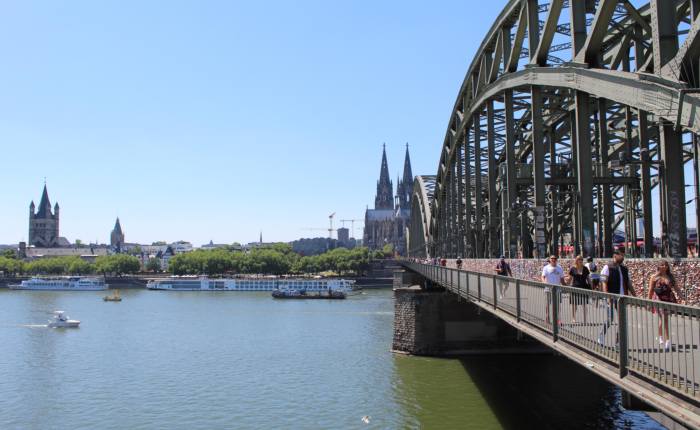
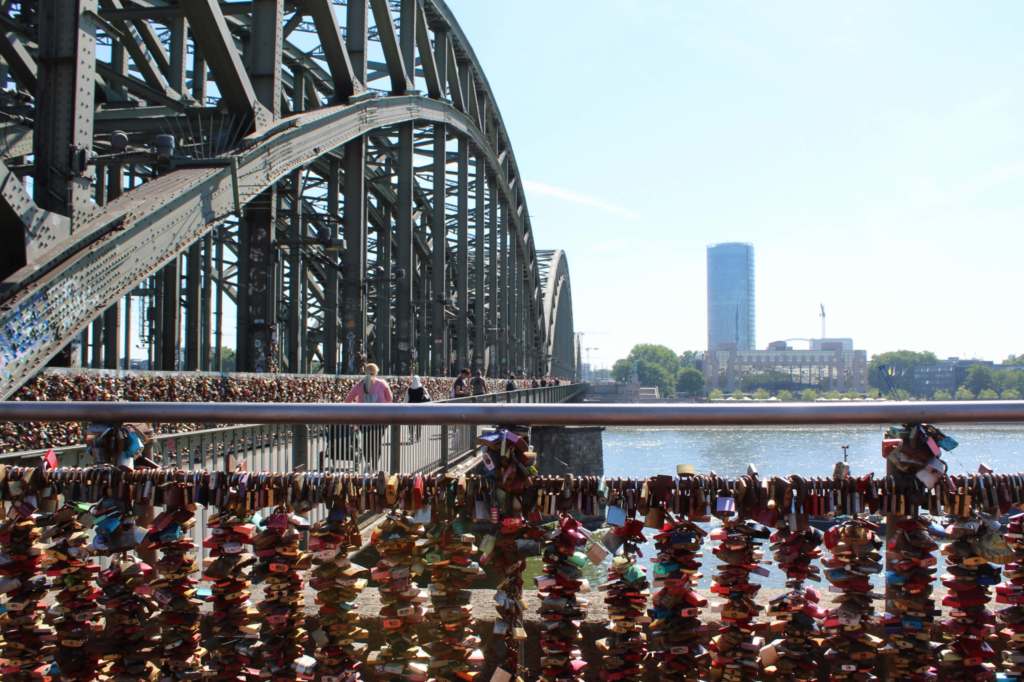
I climbed up some stairs, onto the Hohenzollern Bridge. This is the busiest train bridge in Germany, constantly rumbling with traffic. It is also a landmark for lovebirds, who leave locks on the bridge’s railing. The bridge is named after Germany’s erstwhile royal family, and statues of the old kings guard the four corners of the bridge.

Across the bridge is one of the tallest buildings in the city (though still considerably shorter than the cathedral’s towers), the Kölntriangle. Situated on a little hill, this building is known for its viewing platform on the top floor. I paid and took the elevator to the top, where there is a 360-degree view of the city. Frankly, Cologne is not the most beautiful city to see from the air, but you do get a classic photo of the cathedral next to the bridge.

Finally, it was time to have lunch. My roommate at the time had a German boyfriend who was from Cologne, and he kindly sent me a long list of things to see and do. Unfortunately, I hardly had time to scratch the surface, but I did follow his advice as to where to have a good German meal. Früh am Dom is a traditional beer hall right near the Cathedral. Outside the place was bustling with activity and I was afraid I wouldn’t be seated; but as soon as I walked in, I saw that the beautifully furnished space was half empty.

To eat, I ordered Himmel und Ääd (the Rhinish dialect for “heaven and earth”), a formidable dish consisting of blood sausages over mashed potato and apple sauce. It was delicious—especially, when washed down with the city’s typical beer, Kölsch. Compared to Düsseldorf’s Altbier, Kölsch is much lighter in color and flavor. Though mild, I found it to be delicious and extremely refreshing. As in Altbier, the Kölsch was served in little glasses, and the drinks marked on your coaster. I believe I had three before the end of my meal.

Stuffed, I now had just a bit of time to kill before my train to the airport. To enjoy Germany’s lax laws, I got a Kölsch from a corner store, walked to the park along the Rhine, and drank it slowly in the sunlight. It had been a wonderful trip to Germany.


Epilogue: Travel Troubles

But my voyage was not to have such a tranquil end. For one, the train was absolutely packed. I quickly gave up on finding a seat and resigned myself to standing with my heavy backpack near the doors, as the crowd surged in and out. We passed stop after stop, with the train only growing more and more crowded. After a little more than an hour, the train was full almost to bursting, and I was very eager to get off.

Yet that was not to be. On the tracks between Düsseldorf and its airport, the train came to a halt. Then, a crackling and muffled voice came over the loudspeakers, and made a brief announcement. My German was good enough to get the basic message. My heart sank: the train was not going to stop at the airport, but would bypass the stop and go to the next town over, Duisburg. Full of anxiety now, I got off and looked for the next train back to the airport. It was supposed to arrive in just 10 minutes. But after more than a week in Germany, I knew that this was unlikely. (The trains in Germany are famously unreliable.)

As predicted, the train was delayed. Indeed, it was so late that it had not arrived by the time the next train to the airport was supposed to come. That one was delayed, too. Then this happened again with the next train, so I was waiting on three. I began to grow very panicked, since now I couldn’t tell which train would arrive first or what track it would be on. I was so frantic that I jumped on the first train appearing to head in the right direction, without even being quite sure what train it was.

I had chosen well, and after a delay of about 40 minutes I was at the airport. But my travel stress was not at an end. As I walked into the main lobby, I noticed two enormous lines stretching through the airport. After some reconnaissance, it dawned on me that these were the lines for security. I had given myself a large margin to arrive for my flight, so even with the previous delay I still had almost two hours. But as the line edged forward, I realized that I might be cutting it close.

An hour passed, and we were finally in view of the metal detectors and luggage scanners. Then, behind me, a frazzled woman started making her way through the line, explaining to each person that she was going to miss her flight if they didn’t let her through. Finally, she made it to me, and I let her pass me by (I still had about 45 minutes). But the main in front of me adamantly refused.

“Please, sir, I’m going to miss my flight,” she said, holding her hands in a gesture of supplication.

“That’s not my problem!” he shouted back.

“Please, it doesn’t affect you.”

“You think you’re the only one who’s going to miss their flight?” he snapped. “I’m going to miss my flight, too!”

The argument went on for about ten minutes, with the woman pleading and the man growing more enraged, until finally, exasperated, he let her pass by. (Later, I heard him talking to a colleague on the phone, reporting that he did indeed miss his flight. I don’t know if the woman made it.)

I made it to my gate with just twenty minutes to spare, feeling immensely relieved. I’d had a wonderful time in Germany. But I must say, the country’s reputation for efficiency is rather unmerited.

Review: Columbus (Laurence Bergreen)

Review: Columbus (Laurence Bergreen)

Columbus: The Four Voyages by Laurence Bergreen

My rating: 4 of 5 stars


I remember learning about Columbus when I was in elementary school. The story was simple: he was a daring, visionary man who set out to prove that the earth was round, heroically defeating the nay-sayers who thought that he would sail right over the edge of the earth. To the mind of a child, it is a compelling tale. It is also, of course, complete fantasy (to use a polite word). Since those Edenic days of unproblematic national heroes, Columbus has become a much more divisive figure. So I decided I ought to get the real story, hopefully from somebody without an ideological axe to grind.

As I knew from his books on Marco Polo and Magellan, Bergreen is in the business of writing popular histories of famous explorers. This book is up to his usual standards, though the raw material he had to work with is naturally somewhat messier. Both Polo and Magellan were famous for one iconic voyage, while Columbus travelled to the “New World” on four separate occasions. Instead of one grand adventure, then, we get a series of expeditions, each one drearier than the last. By the fourth voyage, I was quite ready to be done with the Genoese explorer.
But I did learn. For example, Bergreen makes it clear that the competing narratives of Columbus have existed from almost the very beginning. There were rumors and accusations regarding his cruelty and incompetence during his lifetime (which resulted in his imprisonment); and not long after his death the great Spanish anti-colonialist, Bartolomé de las Casas, skewered Columbus for his role in the destruction of the native peoples. In short, he was never a universally beloved hero.

Furthermore, Columbus only became a cornerstone of patriotic ideology centuries later. He started to be celebrated in North America, for example, after the Revolutionary War, as the young nation searched for a founding myth that wasn’t so tied to England. In Spain, October 12th (when Columbus “discovered” the New World) did not become a holiday until 1892, as part of the conservative restoration of the Bourbon monarchy. In the United States, it was not made a holiday until 1937.

So, should Columbus Day be celebrated? Insofar as celebrating Columbus is merely a way of celebrating European colonization of the Americas (which certainly seems to be the case), then I think the answer must be a clear no. I don’t think it is possible to learn about the cataclysm that engulfed the native peoples of the Americas—which resulted in millions dead and the disappearance of so many cultures and languages—and think that worth celebrating. Granted, there is a kind of paradox for European Americans in this, since if there had not been a Columbus we would not exist; and it is difficult to wish oneself out of existence. Even so, celebrating the enslavement and elimination of whole peoples does not seem quite right.

Yet what about celebrating Columbus himself? Well, he does not exactly make a good impression in these pages. Certainly he was a bold and determined man, willing to risk his life for an idea (as well as for gold and glory). And his talent as a navigator is impressive. But these positive qualities seem rather pale when compared with his narrow-mindedness, his incompetence as an administrator, his cruelty to others, and his messiah complex. In the course of these voyages he combats several mutinies (with varying degrees of success), strands his own men (to be used as a bargaining chip), and has untold numbers of people enslaved. And even if you focus exclusively on his role as a “discoverer,” it is difficult to celebrate a man who steadfastly refused to acknowledge the truth of what he, in fact, had stumbled upon.

The truth is that Columbus, contrary to what the legend says, did not have a more accurate notion of the earth than the experts of the time. Precisely the reverse: Columbus’s voyage was based on a profound underestimate of the size of the earth. Indeed, it was pure luck that there was an unsuspected continent in the middle of the ocean. If America did not exist, and there were nothing but open sea between Europe and Asia—as he thought—Columbus would almost certainly have died in the enormous expanse of water. And he never even had the good grace to admit his mistake, insisting to the end that he had found a route to Asia, despite the very clear evidence to the contrary.

Of course, the fact remains that Columbus thought to do something that nobody (to his knowledge) had ever done before, and in the process inaugurated a new period of history. Indeed, given the tremendous importance of his voyage, we ought to do our best to understand both the man and the colonial undertaking he stands for. And I don’t think that is accomplished with myths and unreflecting celebration.


View all my reviews

Aachen: City of Charlemagne

Aachen: City of Charlemagne

It was the summer of 2022 and Europe was in the midst of an energy crisis. As a response to the rise in fuel prices, many governments attempted to make public transportation cheaper. Spain, for example, reduced the price of monthly metro cards by half and offered free train passes for commuters. Germany, meanwhile, offered a nine euro monthly pass that was valid for the bus, metro, and commuter trains for the entire country. It was an incredible deal, and I had arrived in Germany right in time to take advantage of it.

Now, this may come as a surprise if you believe in the German stereotype of efficiency and timeliness, but the trains in Germany are a mess, with constant cancellations and delays. (This is partly because, unlike in Spain or France, the high speed trains in Germany use the same tracks as the local trains.) The new 9-euro pass had only added to the chaos, since the added passengers put additional pressure on the already overburdened system. 
So the train ride was not exactly quick. But I was in a good mood, nevertheless. You see, Aachen had been on my list for years, ever since I watched Kenneth Clark’s magnificent documentary Civilisation. The first episode of that series begins with the so-called Dark Ages, and culminates in the rise of Charlemagne—an event which, for Clark, signifies the rebirth of European civilization from the brink of destruction. Though many historians would, I think, dispute this dramatic conclusion, it cannot be denied that Charlemagne is a figure of paramount importance in the history of Europe. And if you want to learn about Charlemagne, Aachen is the place to be.

But my arrival was something of an anticlimax. As it happened, my train pulled into the Aachen Hauptbahnhof at almost the same moment that several appointments were made available on the Spanish government website. As I was in desperate need of an appointment (in order to get a document that would allow me to travel back to the United States while my visa was being renewed), I spent a panicked 15 minutes navigating the poorly designed and unreliable website in order to secure myself a spot. After so many years in Spain, I still feel acute and almost crippling anxiety when I have to do anything regarding my visa. My hands literally shook as I confirmed the appointment. When I realized I had been successful, relief washed over me.

Now, I could explore the town with no distractions. My route took me to one of the two surviving medieval gates of the city, the Marschiertor. (On the other side of town is the even more impressive Ponttor.) Nowadays, this huge gate stands alone, as Aachen is happily safe from foreign invaders—for the foreseeable future, at least.

Speaking of invasions, Aachen has been under the control of France on at least two occasions. First, it was ceded to France for about 15 years after Napoleon defeated the Holy Roman Empire. Then, after World War I, it was controlled by the allies until 1930. Germany lost control of the city at least once more after that, to American troops, who virtually leveled the place in the process. It was the first German city to fall to the Allies during the Second World War.

German prisoners of war marching through the ruins of Aachen.

As you can see from these snapshots of its long and somewhat turbulent history, Aachen is not the sleepy town that is status as a spa city would have you believe (its hot springs have been appreciated since Roman times). Partially this is due to its history as a capital of the Holy Roman Empire (of that, more below). But this is also because Aachen is near the borders of Belgium and the Netherlands, making it simultaneously the door to Germany (in the Second World War) and, via Belgium, the door to France (in the First). 

All this has resulted in a multitude of names for this place. In German it is, of course, Aachen, while in French it is Aix-la-Chapelle. Meanwhile, in Italian, Portuguese, and Spanish, the city is called some variation of Aquisgrán. This is an awful lot of historical and linguistic weight for one town of a quarter of a million souls to bear. But, on that sunny summer day, none of the residents seemed to notice or mind.

Aachen Town Hall

My first stop was the Aachen Town Hall. This is a venerable old building that, like Aachen itself, has suffered many reversals of fortune—burned down, left to crumble, burned down again, and then finally bombed. As it stands today, it is an imposing neo-gothic structure that looks more like the abode of a nefarious count than a civic-minded mayor. But the flocks of school children on field trips, and the wedding party out front, showed that—appearances to the contrary—this is indeed a beloved part of the town. For a modest price, you can even visit the interior of the Rathaus. If for nothing else, this is worth it to see the extremely well-made replicas of the Imperial Regalia of the Holy Roman Empire. (The originals are now in Vienna.) This includes the famous Imperial Crown, which is so encrusted with jewels that it looks decidedly uncomfortable. 

The Imperial Crown
St. Stephen’s Purse

My next destination was the Aachen Cathedral. This is by far the most famous sight in the city—the church built by Charlemagne himself, where 31 kings and 12 queens were crowned, one of the first places to be listed as a UNESCO World Heritage site. I walked in and was immediately awe-struck. But my amazement turned to confusion when I failed to find the legendary Throne of Charlemagne. I asked one of the tired-looking guards, in the best German I could muster, “Wo ist der Thron des Karl der Grosse?” He responded quickly, repeating the word “Führing” several times, which my dictionary told me meant “guided tour.”

With this new information, I left the cathedral and found the neighboring office, where tickets can be bought for the guided tour. Once there, I noticed an option to buy a combination ticket for the tour and the cathedral treasury—which worked out quite well for me, as it gave me something to do while I waited for the tour to begin.

Now, I have been in many cathedral treasuries by now, and most of the time I find them rather uninspiring—usually consisting of gold and silver reliquaries of various shapes and designs. But the artwork on display here was exquisite and unique. There is, for example, the Proserpina sarcophagus. Made of marble and carved in ancient Rome, it was brought here as a symbol of imperial rule by Charlemagne, who was quite possibly buried in it. Also (potentially) belonging to Charlemagne is a hunting horn and knife. But two works of the goldsmith stood out to me as the jewels of the collection.

A detail of the Proserpina Sarcophagus

One is the Cross of Lothair, made around the year 1000. On one side the gold cross is completely covered in jewels (much like the imperial crown). Strangely, in the very center of the cross is a cameo of Augustus Caesar. Now, it is possible that this pagan emperor was included to symbolize the connection between the ancient empire and the medieval so-called Holy Roman Empire. But it is just as possible that they simply did not know who it represented and thought it was a holy figure. In any case, the reverse side is certainly pious. Delicately engraved into the gold is a portrayal of the crucifixion. To modern eyes, it appears rather standard in design, if well-executed. But in 1000 the image of Christ suffering on the cross still wasn’t paramount in Christian decoration (notice the many depictions of Christ of the Last Judgments in medieval churches). This crucifix, then, is not only beautiful but artistically daring.

The other is the bust of Charlemagne, a reliquary containing a part of the king’s skull. Roughly life-sized, the bust was made hundreds of years after Charlemagne’s death, and so probably bears little resemblance to the actual king. But this portrait, however idealized, is shockingly lifelike nevertheless. The anonymous craftsmen who made it were obviously masters of their arts. The bust works on three levels, as a work of art, a religious object, and a symbol of imperial power. For example, the king’s tunic is covered with the imperial eagle and he wears a crown covered with jewels and, again, ancient Roman cameos (signifying the inheritance of the Roman Empire). It is a marvelous statue—delicate and beautiful, while authentically royal and imposing.

Now it was time to visit the cathedral. The visit began with the traditional entrance to the church, the Wolfstür. This is the subject of a legend, which (if memory serves) goes like this: The townspeople, lacking the time and resources to complete the church, made a deal with Satan. If he completed the church, he would be able to keep the soul of the first creature that entered its doors. But when it came time to honor the bargain, the townspeople craftily sent a wolf to enter the church doors, which is obviously not what Lucifer had in mind. The enraged devil tried to leave the church to punish the townspeople, but got his thumb caught in the closing door.

This story (repeated, in various forms, all over Europe and perhaps the world) has some physical manifestations. In the bronze door knocker, for example, there is a bump inside the lion’s mouth, which legend says is the satanic thumb. Once inside, there is a statue of the unfortunate wolf, and opposite that is (for whatever reason) a pine cone.

Finally we entered the church itself. The core of the structure—the so-called Palatine Chapel—goes back all the way to the year 800, though it has been so finely refurbished that you would hardly guess its age from its polished and immaculate appearance. In structure it is hardly like the typical European church, with its three names culminating in a main altar. Instead, the church is octagonal, with no natural front and back. It takes this design from the Byzantines, as the core of the church is closely modeled after Basilica San Vitale in Ravenna. Indeed, the structure even incorporates ancient marble columns taken from Rome. Clearly, Charlemagne was quite consciously forging a connection between his new kingdom and the splendor of the ancient world.

Hanging in the center of this splendid octagon is the so-called Barbarossa Chandelier, named for the Holy Roman Emperor Frederick I (who had a red beard). Looking like a giant crown, its symmetrical shape complements the octagonal space, creating a sort of tunnel view up to the mosaic on top of the cathedral.

Then, our guide took out a large key and opened the grated metal door leading up to the stairs. This was the moment I had been waiting for, as I knew that Charlemagne’s Throne was on the up there. After pausing to admire the railings, ceiling mosaics, and marble columns, we arrived at the legendary seat.

It is, at first glance, almost comically unimpressive. Far from being the gold and bejeweled seat one might expect, it is made of plain stone slabs, sitting on a platform of what appear to be cinder blocks. Apparently, however, the slabs which make up the throne are relics of some kind (there are different theories, but they all connect the stones to Jerusalem and the life of Jesus). This contrives to make the throne itself into a kind of relic. And, indeed, visiting pilgrims would crawl underneath the throne as an act of devotion.

Considering this religious nature, “throne” may not even be the best word to describe this esteemed seat—at least, as it was originally conceived. Charlemagne, for example, was not crowned here, but in Rome. And, certainly, it is strange to imagine that ruler issuing his decrees from the second floor of a cathedral. But it became a throne, if it was not one to begin with. As I mentioned, dozens of monarchs were crowned on this very spot. Napoleon, in a rare moment of humility, climbed the steps but refrained from sitting down himself. According to our guide, such scruples did not stop Heinrich Himmler.

Now it was time to enter the gothic church. The original Palatine Chapel has, you see, been supplemented with a gothic choir, of a much more conventional—not to say unattractive—design. This part of the church also has its share of famous objects. There is, for example, Henry’s Pulpit (also called an “ambon”), which is yet another example of the golden and encrusted style typical of the Carolingian period. It is covered with exquisite ivory carvings and, as typical of the Holy Roman Empire, it incorporates elements of pagan art pillaged from Italy and the Holy Land. Nearby are the Karlsschrein and the Marienschrein, two enormous gold reliquaries. The first contains the bones of Charlemagne himself (moved from the Roman sarcophagus, apparently), while the second is supposed to contain Jesus’ swaddling clothes and a dress belonging to the Virgin Mary. What is indisputable, however, is that these two are remarkable examples of medieval metalworking. 

This is where the tour ended. Dazzled, I wandered back into the streets of Aachen. It had warmed up by now and my jacket was unnecessary. Extremely hungry, I was gratified to find a German sausage restaurant right around the corner. There, I tried to order the most “German” thing I could, and decided that would be a mug of beer and a plate of blood sausages, accompanied with mashed potatoes and applesauce. A bit over the top, but I enjoyed it.

Stuffed to bursting, I wandered back to the train to return to Düsseldorf, where I was going to stay. But that is a story for another post.

Milan & Lago di Como

Milan & Lago di Como

The bus from the airport dropped us off in front of a monster of a building. We were in Milan, and this was the city’s Centrale train station. Its enormous stone facade looms over the viewer, the pile of stone seemingly poised to crush you. It is, in a word, rather an aggressive structure—with ferocious eagles and lions staring malignantly from its walls. It should come as no surprise, then, that this grandiose design was willed into existence by the Duce himself, who wanted it to represent the power of Fascist Italy.

Rebe and I had come for a little break. It was May—international worker’s day—and the weather was sunny and warm. The first thing we did was to eat some pizza. Within five minutes of walking, we saw a place that looked good and went in. I have no idea if it was special by Italian standards, but the pizza was better than the best you can find in Madrid. Yes, we were in Italy.

This was my second time in Milan. My first had been in high school, on a class trip, when we had seen The Last Supper. Of course, I was too young to appreciate anything about the art (I was far more interested in the airlocks that controlled the atmosphere inside the room than the fresco itself). A decade and a half later, the city looked entirely unfamiliar to me. Not even a shadow of memory remained.

We had a little time to kill before we could check into the Airbnb, so we decided to visit the Castello Sforzesco. This is a lovely Renaissance fortification made of brick, which is free to visit. The castle is named after Francesco Sforza I, an important ruler of the city, who turned the erstwhile medieval castle into the palace we see today. One of his sons, Ludovico, was a great lover of the arts and contributed to the palace’s further beautification—notably, by calling on artists like Bramante and Leonardo da Vinci. Today, this castle is home to several museums, notably the city’s painting gallery.

But we did not have time to visit any museums. Instead, we took a stroll around the lovely Parco Sempione, a large landscaped park. And as it was quite warm, we helped ourselves to some gelato. (Since we had traveled with Ryanair, which charges for carry-on luggage, we only had small backpacks and didn’t need to find a luggage locker.)

After some time relaxing on the grass, it was time to go. Our Airbnb was not in the city of Milan. We only had three days to spend in Italy, and I decided that it would be more fun to explore the nearby Lago di Como rather than stay in the city of Milan. So we walked over to the Cadorna train station and took a commuter train north. Soon, we were all checked in, and exploring the city of Como, at the southern point of the lake.


It was a relief to be outside of a big city. A cool breeze blew off the lake and green hills rose up above us. As if hypnotized, we began to walk along the water.

Perhaps I was just sleep deprived and delirious, but I remember this walk with a strange intensity. Everything seemed colorful, new, and interesting. The ferries in the harbor, the blue hangar full of sea planes, the colorful concession stand selling gelato and panini with Italian flags waving on the top… Soon, we came across a large, classical building. This was the Tempio Voltiano, a temple dedicated to Como’s most famous son, Alessandro Volta. It contains some of the great scientist’s devices, including his voltaic piles—the first ever batteries. (Unfortunately, by the time we arrived it was closed.) Nearby is the War Memorial, a large concrete tower dedicated to those who fought and died in World War I. Built in 1933, the memorial looks remarkably more modern than that, perhaps because it was based on a sketch by the Italian futurist Antonio Sant’Elia, who himself was a casualty of the war.

We continued to wander along the lake. With every step, more of the landscape came into view. It seemed too pretty to be real. The deep blue of the water, the dramatic hills, the unobtrusive architecture of the structures, all of it combined to make a kind of living postcard. It is no wonder that this lake has been a favorite resort since Roman times. But it is a minor miracle, at least, that after so many centuries of human habituation the environment seems so pristine, and the human presence remains tasteful and discreet. Sometimes one really has to hand it to the Italians. They may seem stubborn and stuck in their ways, but they know what they’re doing.

Eventually, we came upon the Villa Olmo, one of a seemingly endless number of lovely mansions that dot the lakeside. Now, I normally have scant interest in the ostentatious residences of the very rich; but this villa and its garden—like everything else—fit so perfectly the aesthetic of the lake that I could not possibly object. It was especially charming because, just as we arrived, a troop of people in period costumes walked by. I have no idea what they were doing.

It was getting late now and we needed to find a place for dinner. We decided that we would take the funicular up to Brunate, a small village on top of the nearby hills, and try our luck there. We had to wait in a queue for about ten minutes for it to arrive—a time that was rendered almost intolerable by the presence of a bunch of Erasmus students talking loudly in front of us. (One student, after professing to know “some Spanish,” proceeded to butcher the conjugation of a basic verb in a way I did not think possible.) Finally, the machine arrived and we boarded (as far away as possible from the students). It was a lovely, if crowded, ride, and soon enough we were in the sleepy town of Brunate.

It seemed like a ghost town after Como. Very few people were in the streets, and the light was fading fast. We hadn’t eaten in hours and were starving by now. We had to find a restaurant. After a quick search online, I guided us to the Trattoria del Cacciatore, crossing my fingers that the place wouldn’t be packed. Indeed, we had the opposite problem: the restaurant was completely empty and they hadn’t even opened up the kitchen yet. I suppose Italians dine as late as the Spanish. We were told we would have to wait half an hour, but were invited into the restaurant’s large backyard to have a drink. The view was shockingly nice—the lake and the mountains stretching out before us, the sky red from the setting sun. I drank an aperol spritz before being called in to enjoy a fine meal. It had been a wonderful day in Italy.

Rebe posing at the restaurant. The view extends into Switzerland.

The next day we woke up early and returned to Como. This was our big day to explore the lake. The Lago di Como is shaped like an inverted Y, with the city of Como at the southern end of the western branch. Our first destination was Bellagio, which sits right at the center, where the three branches connect. To get there, we had to take a ferry. There are several routes on the lake, some local, and others express. To save time, we elected to take one of the express ferries that go there directly—making the trip in about 40 minutes, instead of over twice that much time.

The trip had a few hiccups. For one, even though surgical masks were acceptable for traveling on trains and planes in Italy (oh, the COVID times!), for some odd reason the ferry company demanded that we use the heavy-duty N95 mask. Unprepared for this requirement, we bought some masks from some entrepreneurs selling them on the street (for a significant mark-up, of course).

Because of this scramble to cover our breathing holes, we were among the last to board the ferry, meaning we had to take a seat below deck. This was quite frustrating, since we knew the views of the lake must be gorgeous. Rebe decided to take matters into her own hands and marched up the stairs to take pictures. I attempted to follow, but was immediately told by an attendant to return to my seat. I went back downstairs feeling defeated—frustrated that Rebe was enjoying the scenery while I had a view of a wall. After about ten minutes I made a second attempt, only to be told by the same young Italian man to go back to my seat. I was flabbergasted by this, since I was standing right next to Rebe, who was entirely ignored by the attendant. Was this Italian machismo, or just chivalry? (Maybe it comes to the same thing.)

We arrived in Bellagio in good time. Like everything on this lake, but even more so, it was picture-perfect—a kind of Platonic ideal of a lakeside town. If you try to imagine a place where a world-weary Romantic poet would go to recuperate his spirits, or a disenchanted millionaire would go to discover the charms of the simple life, Bellagio is what comes to mind. It is, in short, a gorgeous town. We walked first to the end of the peninsula, which had a wonderful view of the lake with snow-capped mountains beyond. There, a woman was selling a private boat rental, which we briefly considered before we looked at the price. Then, we walked through the center of town. It was crowded with tourists and full of the expected shops selling gelato and trinkets.

The main site to see in Bellagio is the Villa Melzi d’Eril and its gardens. Melzi, the man, is principally known to history for his brief stint as the Vice President of Italy under Napoleon. But he was also an art collector who was determined to make his villa one of the greatest on the lake. He succeeded. Though we didn’t enter the villa itself, the gardens are as beautifully arranged as any in the world—full of statues, excellent viewpoints, and exotic plants, trees, and flowers. As with everything on the lake, the overall effect was of overwhelming beauty—to the extent that your eyes can hardly take it in. I wonder if the residents of the lake long for brutalist concrete structures and piles of garbage, if only for a contrast.
We went back to the dock to get on the ferry to our next destination: Varenna, which is just across the water. While Bellagio, with a population of about four thousand, feels relatively compact, Varenna is positively tiny: with 800 souls calling it home. And as tiresome as it must be to hear by now, it is another jewel. Indeed, I found myself thinking on the ferry ride that the residents of this place, from Roman times onward, had collectively turned it into a kind of communal work of art—a living landscape painting that they gradually composed.

The view as we left Bellagio
The village of Varenna

There is really nothing to do in Varenna, which is the best thing about it. There is a kind of plaza that drops off into the water, and at any given time is covered with dazed tourists gazing at the scenery. After our own bit of gazing, we wandered inland, eventually ending up at what we would call in New York a “deli,” but which I believe the Italians would refer to us a salumeria. There, we got a couple sandwiches and then wandered into the local church, Chiesa San Giorgio. This modest bit of sightseeing done, we retreated to a nearby bar for campari sodas.

The main square in Varenna
A local Italian deli
The Chiesa San Giorgio

We had had an altogether lovely day on the lake. But the voyage back to Como was perhaps my favorite part. Instead of taking the express ferry, we took the local, which took nearly three hours in its meandering voyage from Varenna back to Como. If I felt deprived of lake scenery on the voyage out, I was absolutely saturated with it by the time we got back. The only thing that would have made it more enjoyable was if the ferry’s bar had been open. A nice glass of wine would have been ideal. But we were still in COVID times, and so I had to get drunk on pure aesthetic pleasure.

Our short vacation was coming to a close. The next day, we had a late flight back to Madrid. This did not leave us much time to explore Milan.

I had a great time on the ferry back.

Milan is the second largest city in Italy. A capital of finance and fashion, it does not exactly fit the stereotype that many hold of Italy—neither quaint and full of art, nor chaotic and rugged. Old women aren’t shouting from their balconies and old ruins aren’t dotted the cityscape. It is, rather, a clean and rather posh place.

Our time was extremely limited, so we went to the symbol of the city: the Duomo. When we visited (and this may still be the case) you had to buy a timed ticket in order to go onto the roof. We selected a time two hours hence, and then set about to see something of Milan.

To start, the Duomo is ringed by important buildings. There is the Palazzo dell’Arengario, for example, which now houses the Museo del Novecento (museum of the 1900s). Right nextdoor is the old Royal Palace, which now serves as a cultural center. And across the piazza is the magnificent Galleria Vittoria Emanuele II. This is a beautiful shopping gallery, consisting of two arcades that intersect at a huge glass dome. The place is full of restaurants and shops that we could hardly afford even to look at, but it was a pleasure just to explore this piece of 19th century splendor. The floor mosaic in the center—representing the regions of Italy—is especially lovely. Rome is, of course, represented by a she-wolf, while Florence is a lily. Turin, meanwhile, is a much-abused bull, whose delicate parts have been worn away by visitors spinning on their heel over them. Supposedly, this brings you good fortune. Perhaps I ought to have tried it!

That poor bull!

Then, we visited San Bernadino alle Osso, a church nearby famous for its ossuary. This is a small side-chapel that has been extensively decorated with human bones (apparently the cemetery got too full). It is free to visit and is certainly worth your time if you have any taste for the morbid.

Finally it was time for the Duomo. My first impression was of its sheer size. It is the third largest church in the world, narrowly beating the gargantuan cathedral in Seville. Stylistically, it struck me as odd. Unlike the other great Italian churches, this one is a medley of styles, owing to the ungodly long time it took to complete—from 1386 to 1965. The proliferation of spikes and spires indicates gothic (unusual in Italy, to say the least, where the Renaissance dominates), but the Milan Cathedral does not have the exuberance, the spiritual riot, of a true gothic creation. It is, rather, quite stiff and almost formalistic, the lines in its facade intersecting at right angles, ascending up in a straight line without giving a great impression of height. This sterility is due, I think, to its facade being actually neo-gothic (after all, it was completed in the 19th century).

Stepping inside, I was once again astonished by its size. I also thought the interior of the church more restrained and tasteful. The same cannot be said, however, for the cathedral’s most famous statue, Marco d’Agrate’s Saint Bartholemew Flayed. Here we can see the unfortunate saint posing like a Roman senator, his skin wrapped around him like a toga, his muscles, veins, and nerves exposed. It is a kind of tour de force of anatomy, and obviously executed with a great deal of skill. But it is hard to call such a gruesome display a masterpiece.

Next, we took an elevator up to the roof. Though it was somewhat expensive (over 30 euros a person, I believe), the visit to the roof proved to be a worthwhile experience. What was nothing but a tangle of statues hanging in the air when viewed from the ground became, from up close, a kind of stone forest. While the decorative statues, judged individually, were rather generic and unremarkable, the sensation of being surrounded by so many floating figures was genuinely uplifting. The visit culminated (pardon the pun) at the top of the roof, where visitors were stretched out on the stone as if it were just another beach.

Old and new skylines in Milan

This was it for us. After a quick lunch (more pizza), we made our way to the Centrale train station and caught a bus to the airport. It had been a wonderful trip, though we had left much undone. I was particularly disappointed that we hadn’t had time to visit the Cimetière Monumentale—the city’s massive and beautiful burying ground—or the Pinacoteca di Brera, Milan’s world class art museum. But after having seen so much beauty, it was impossible to have any regrets. Italy never disappoints.

A special thanks to Rebe, who took some of the photos in this post

Review: Long Day’s Journey into Night

Review: Long Day’s Journey into Night

Long Day’s Journey into Night by Eugene O’Neill

My rating: 5 of 5 stars


My first experience of this play was of an audio recording. It did not make an especially deep impression on me, and I was on the verge of writing a review saying as much, when another reviewer alerted me to the literary importance of the stage instructions. Chastened, I decided I ought to actually read the play before I made a fool of myself, and I’m glad I did. O’Neill, after all, never intended for this work to be produced as a play. It is, rather, like Goethe’s Faust a kind of closet drama, more effective on the page than on the stage.

The play is a masterful depiction of addiction and familial dysfunction. Indeed, I found it to be almost clinical in its psychology. O’Neill was clearly writing from personal experience. He ably captures the mixture of love and resentment that an unhealthy family bond can give rise to—perpetual annoyance, an endless buildup of grievances, non-stop bickering, all built on an unshakable foundation of love. And the characters of this play do love one another, quite dearly, even if they are stuck in a vicious cycle of blame and abuse.

Woven into this dreadful dynamic is addiction. Every member of the family is an addict, and all display the tell-tale signs. They search for excuses—good new or bad news, loneliness or companionship, special occasions or recurrent problems—to justify their habit. And then there is the deferral of responsibility, most exemplified by the mother in this play, who manages to blame everything in her life—her husband, her sons, her doctors, her upbringing—except herself for her morphine addiction. Yet of course the self-deception is never really believed. This awful truth is always there, burning underneath, a gnawing feeling that the substance will never quite deaden.

These contradictions—of great affection and resentment, of excuses and self-knowledge—are so starkly on display in this play that I think even the most brilliant actor would struggle to do it justice. The shifts of tone are too abrupt, the push and pull of conflicting feelings and truths are too violent. But, somehow, it works when read. On the page, a jostled, confused, and depressing mess becomes something orderly, transparent, and deeply tragic. A potentially pathetic group of boozers and dope fiends are transformed into symbols of aching humanity.

Considering that this play is strongly autobiographical, it is frankly amazing to me that O’Neill was able to create such a masterpiece. To confront what must have been a painful and traumatic time in his life and turn it into such a drama—a drama that pulls no punches, and yet condemns no one—is deeply impressive. As this play amply demonstrates, life too often conquers art. Routine deadens us to it, money woos us from it, addiction numbs us to it, so that we lose both our sensitivity to its beauty and the time and energy to create it. But sometimes, art conquers life. And this play is an example of that.


View all my reviews

Review: The Gathering Storm

Review: The Gathering Storm

The Second World War, Volume I: The Gathering Storm by Winston S. Churchill

My rating: 4 of 5 stars


When I first learned, many years ago, that Winston Churchill had written a history of the Second World War, I knew that I would have to read it. After all, I grew up watching documentary after documentary about the conflict (before the History Channel was all about aliens, it was mainly Hitler content). Finally, this summer, I found the complete set, cheap, at the Strand bookstore in New York. Looking at the six fat volumes on my bookshelf, I knew that I was in for a long campaign.

The book is, indeed, long (over 700 pages in this edition), but it is a surprisingly fast read. It was written in haste—if “written” is the right word, for most of the book was either dictated or excerpted from official documents—and reads like a series of dispatches or field reports. This is simultaneously the book’s weakness and its great strength. For Churchill does not attempt to give a universal, impartial overview of the war, but rather recreates what it was like for him to be in the thick of it. And although his perspective does impose serious limitations and distortions on the material, it also makes the narrative far more thrilling. The rush of events is palpable.

Half of this book is devoted to the buildup of the war. Churchill, to his credit, saw the Nazi threat coming from miles away, and tried again and again to rouse his country into action. Unfortunately, his warnings go unheeded, and Germany is allowed time and space to rebuild its military unmolested. It is truly maddening to contemplate all of the lost opportunities. When Germany invaded the Rhineland, for example—clearly violating the Treaty of Versailles—the French and English could have taken decisive action at a time when the German military was miniscule. But nothing can compare with the infamous Munich Agreement, in which a country capable of defending itself was given away to the Germans, which only further strengthened their military for the inevitable war.

One can imagine how such a book could devolve into a series of self-congratulatory told-you-sos. But Churchill, at least in print, is quite generous to his political opponents. In particular, Chamberlain, the architect of appeasement, comes off rather well in Churchill’s telling—portrayed a resolute, peace-loving man who made some very bad decisions. Indeed, I found Churchill’s narrative voice to be rather odd. He has a kind of boyish fascination with war and weapons, and a jingoistic faith in the British people and their empire. Indeed, although he was so very right about Nazi threat, I can easily imagine myself dismissing such a strong believer in king and country as a war-mongering kook.

But he was not a kook, at least not in this regard. Indeed, in his great attention to detail regarding military matters, and his ability to strike a brave, defiant note at a difficult hour, he proved that he was the right man for the moment.


View all my reviews