Whoever takes up and seriously pursues a matter that does not lead to material advantage, ought not to count on the sympathy of his contemporaries.
Arthur Schopenhauer
Despite the greed, grubbiness, and graft associated with capitalism, looked at in a certain light it can appear positively utopian. Certainly many economists and centrist politicians have thought so. In a free market there is no such thing as inherent value. No authority, not even divinely ordained, can determine that something is worth paying for. The only true test of worth is whether people want it, and how much they are willing to spend to get it. That’s it. You can even argue that truly pure capitalism—with perfectly free consumers in a perfectly open market—is a kind of existentialist paradise, where every person determines their values through their own decisions (specifically, by deciding what to buy).
Of course, as any behavioral psychologist, marxist, anthropologist, or clear-eyed person will tell you, this paradise of free choice is very far from the reality we live in. Nevertheless, I think that many of us internalize the idea that value is determined via the market—not only personally (as the existentialists might have it), but objectively. If a song is #1 in the charts, for example, then it must be good by definition. Anything people choose to spend money on simply must be better than what they choose to ignore. By extension, any activity that does not make a profit is, objectively, a waste of time. Money is the ultimate arbiter.
Now, I am not against making money. But I am opposed to the idea that an activity must bring a profit in order to be worth seriously pursuing. A good hobby should, above all, bring pleasure to oneself. Money is a bonus.
In many ways the internet has ushered in a golden age of hobbies, by allowing networks to form among practitioners across vast distances and making available resources that previous generations could scarcely dream of. Birdwatching, for example, used to be done in solitude or, at most, in a local group, with only a guidebook as a resource. Now apps can identify birds by photo or call, or notify users of a certain species in an area, pooling the collected knowledge of the entire community.
But the internet has also made it possible to monetize these hobbies—or try to. Whether taking photos, making paintings, or recording music, now we can all be miniature professionals by selling our work or services on the web. (Birders have mostly kept out of the market, though.) And when these ventures perform poorly—as most inevitably will—a tinge of disappointment and failure hangs over what, in another time, might have been a perfectly carefree pursuit. In other words, we now have the ability to turn virtually any skill we have into another job—which is not exactly a recipe for joy.
Of course, Schopenhauer was not talking about hobbies. With a good deal of self-pity, he was referring to his own largely unrewarded and unrecognized labor to create a new system of philosophy. That bitter man was certainly not the only genius whose work was ignored by his contemporaries. There are too many to name. In retrospect, it is a wonder that people can be so blind. And yet, the idea that posterity is the ultimate judge—which Schopenhauer would likely agree with, I think—is just another version of the idea that markets are the ultimate judge of value. In this case, you can just say that the market is a little bit slow.
But, as I mentioned in my review of Van Gogh’s letters, this introduces a kind of paradox. For if the market is the arbiter of value, and that market can be tardy in coming to a verdict, then we must labor under the uncertainty of our own worthiness. We can spend our lives painting and leave behind a treasure for the ages, or we can spend our lives painting and leave behind junk nobody wants. Since we might die before our work is “discovered,” we might never know. Herman Melville, for example, could probably never have dreamed that Moby Dick—which sold poorly and got mediocre reviews—would become the Great American Novel.
Are there any lessons to be drawn from this? Maybe the very idea that markets—including posthumous markets—determine value ought to be scrapped. After all, there is very little stability or unanimity in mass opinion. For all we know, in 100 years Van Gogh might not even be popular or beloved anymore. Schopenhauer’s reputation has certainly had its highs and lows.
I set to work with this boundless pile of paper to fill it to the last sheet with all manner of odd things, so no doubt there’s much in these pages that make no sense.
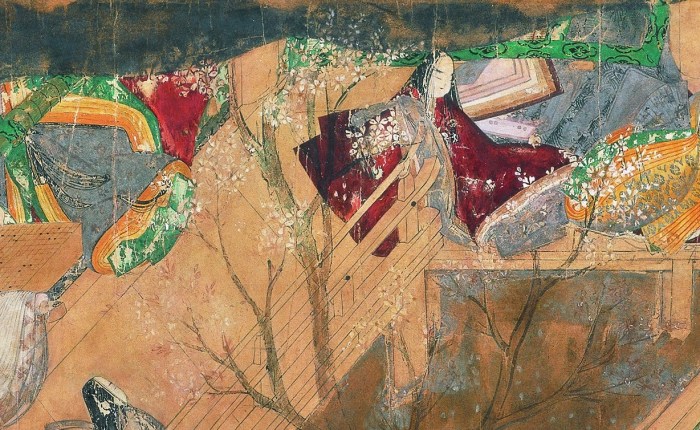
This is an utterly delightful book. Indeed, it is fair to say that this is a book about delight in all its manifold forms.
This is all the more remarkable given what we know about the author’s life. Sei Shōnagon was a kind of lady-in-waiting for the Empress Teishi. However, not long after her marriage, Teishi was supplanted by another Empress, Shōshi (whose own lady-in-waiting, Murasaki, wrote the classic Tale of Genji), and soon thereafter died in childbirth at the age of 23. Thus, Shōnagon’s life in the capital was tense, humiliating, and short-lived. It is not even rightly known what became of Shōnagon after Teishi’s death. Even the date of her death is in doubt.
One might expect the writings of such a person to be tinged by melancholy or motivated by revenge. What we have, instead, is an elegant series of reminiscences and observations about the beauty of her world. Shōnagon appears to have loved court life—the ceremony, the pomp, the artificiality, the formality, the refinement, the elegance—in short, everything. Her taste for her role in court is striking to the modern reader, as her life cannot but appear incredibly confined to us. She spends all her time literally cordoned off, separated from the men by a screen, and is constantly at the Empress’s beck and call. I would have lost my mind.
But Shōnagon wrings as many drops of aesthetic pleasure out of her circumstances as humanly possible. She is, for example, enchanted by the subtleties of dress—what ranks of court officials can wear which articles of clothing, what colors are appropriate for which season. The sounds of words delight her, as do the specific characters used to write them. Seasons, trees, flowers, birds, and insects all attract her attention.
These items are gathered together into lists, which comprise the bulk of this volume. Indeed, Shōnagon must be one of the all-time masters of the list, as she is inexhaustibly brilliant at thinking of categories. True, there are pedestrian ones such as bridges, mountains, ponds, and so forth. Some of these are so short and perfunctory that one wonders why Shōnagon thought it worthwhile to jot them down. But most lists are based, not on the thing itself, but on how it makes Shōnagon feel: dispiriting things, infuriating things, things that look enjoyable (but aren’t), splendid things, regrettable things, things that are distressing to see, things that are hard to say, common things that suddenly sound special, things that look ordinary but become extraordinary when written…
These lists were so quirky and, often, so hilarious that I was incongruously reminded of Wes Anderson’s films, which often feature odd lists. (Come to think of it, if anyone could turn this book into movie, it would have to be a pretentious aesthete like Anderson. He also shares Shōnagon’s love of colors.) But the list, in Shōnagon’s hands, becomes more than just a tool of organization. It reveals a kind of aesthetic philosophy—in part, that of the society she lived in, but to a great degree idiosyncratic—wherein the sensible qualities evoked by things are ultimately more important than the things themselves.
This is exemplified in what is arguably the dominant theme of this book: poetry. To an extent that is very difficult to imagine today, poetry pervaded court life in Heian Japan. Virtually everyone at the court, it seems, had memorized a great deal of poetry, and their conversations are littered with erudite references. (Unfortunately for me, most of this poetry relied on puns that are untranslatable, making it rather baffling in English.) Moreover, it was common to correspond via poetry, and the ability to compose on the fly was highly prized. Stories abound of someone (usually Shōnagon herself) finding the exact perfect reference or quote for an occasion, or completing the opening lines of a poem with brilliant aplomb. It is as if everyone at the White House were expected to freestyle.
It must be said, however, that despite Shōnagon’s attempt to reach a state of pure aesthetic appreciation, her strong and sharp personality very often breaks through. And good thing it does, for without it the book would not be even half as enjoyable as it is.
Admittedly, Shōnagon the person is, in many respects, unpleasant. She is snobby in the extreme and not a little vain. Her attitudes toward common folks is one of utmost condescension, and her need to be refined at all times sometimes verges into the ridiculous (in one section, she pretends not to know the word for “oar,” as it is too vulgar an object for her delicate vocabulary). Shōnagon is even capable of cruelty, which is exemplified in a section when a commoner comes in tears to report that his house burned down, and Shōnagon breaks into laughter and writes a satirical poem about his predicament. (The poor man, being illiterate, mistakes the poem for a promissory note.)
This opinion of Shōnagon was, apparently, shared by at least some of her contemporaries. Lady Murasaki, for example, found her to be “dreadfully conceited” and predicted: “Those who think of themselves as being superior to everyone else in this way will inevitably suffer and some to a bad end.” For my part, however, I think that the tension between Shōnagon’s very human shortcomings and her airy aesthetic focus creates a kind of dynamic tension that makes this book become fully alive as a human document.
I cannot finish a review of this book without mentioning its immense value simply as a window into another time. I was constantly thrown to the endnotes (which I wish had been footnotes) to understand some obscure reference or puzzling custom, and in the process inadvertently learned much about Heian Japan. Somehow, both Shōnagon’s numerous poetic references and her love of gossip combine to make her age come fully alive in these pages, in a way that few other books accomplish. In other words, this book is wholly delightful.
Many that live deserve death. And some die that deserve life. Can you give it to them? Then do not be so eager to deal out death in judgment. For even the very wise cannot see all ends.
J.R.R. Tolkein
I find myself revisiting this long-defunct section of my blog in response to the news of Kenneth Smith’s execution, which took place on January 24th of this year. Smith was condemned for the 1988 murder of Elizabeth Sennett. He had been hired through an intermediary (who received life in prison) at the behest of Sennett’s husband, Charles (who killed himself once he learned that he was suspected). Smith committed the murder—brutally beating and stabbing Sennett to death—along with another man, John Forrest Parker, who was executed in 2010.
Smith was first scheduled to be executed via lethal injection in 2022, but the execution was botched—the third one in a row in the state of Alabama. After over an hour of trying, the execution team quit after they failed to properly place the IVs in Smith’s veins.
This is why, when Smith’s execution was rescheduled, it was decided to carry out the grim task using a novel method: nitrogen asphyxiation. During this procedure, the victim is strapped down to a gurney and fitted with a mask, which forces him to breathe in nitrogen until death occurs. It was the first execution of this kind performed in the United States—perhaps in history. And while the Alabama Attorney General insisted that the execution was “textbook,” and predicted that “many states will follow,” witnesses described Smith writhing and gasping for a number of minutes before finally succumbing.
When I read about this execution, I felt an acute sense of horror and disgust. In my moments of optimism, I like to imagine that, as the years go by, our ethical standards are becoming ever-more elevated. It is thus acutely depressing to hear that, in 2024, we are still fumbling for ways to kill our prisoners—and that asphyxiation is being regarded as, somehow, innovative and humane.
In my view, punishments can only be justified on a limited number of grounds. It is justifiable, for example, to isolate somebody who has proven dangerous to others. And legal consequences are warranted if they serve as deterrents for other potential criminals.
Yet imprisonment isolates a prisoner just as effectively as execution, while study after study has shown that the death penalty does not, in fact, deter potential criminals.
All this seems rather pedantic to say, as it is quite obvious that capital punishment is not a policy born of logic. Rather, it only exists to satisfy a primitive urge for vengeance. It is Old Testament wrath, and not New Testament mercy.
Now, anybody can certainly understand the urge to get back at someone. And perhaps executions can provide closure for the family and friends left behind by a murder. However, vengeance is not, and cannot be, justice. Indeed, our institutions of justice have been created precisely to supplant the basic law of an eye for an eye. And even if—at least in some parts of America—capital punishment is widely popular, and even if it provides some sort of consolation to some, the death penalty is impossible to justify according to any ethical framework I am familiar with.
It may be true, as Tolkein said, that there are some who “deserve death.” However, I find it disturbingly hubristic to think that any human institution, however admirable its ideals, is wise enough to mete it out. Kenneth Smith certainly deserved punishment. But I cannot see how asphyxiating him has made the world a better place.
The Canary Islands are one of the treasures of Spain. Culturally Spanish, they are geographically and climatically quite unlike Europe or even the relatively closer African coast. They are, rather, a world unto themselves, each one quite distinct from the other—products of wind, waves, and volcanism.
Gran Canaria, despite its name, is neither physically the largest island (that is Tenerife) nor the most populated (Tenerife again), but it is home to the largest city in the archipelago: Las Palmas. (Confusingly, there is another island named La Palma; and the capital city of yet another Spanish island, Mallorca, is named Palma.) Home to nearly 400,000 people, it is a proper metropolis, with its suburbs stretching for miles all around.
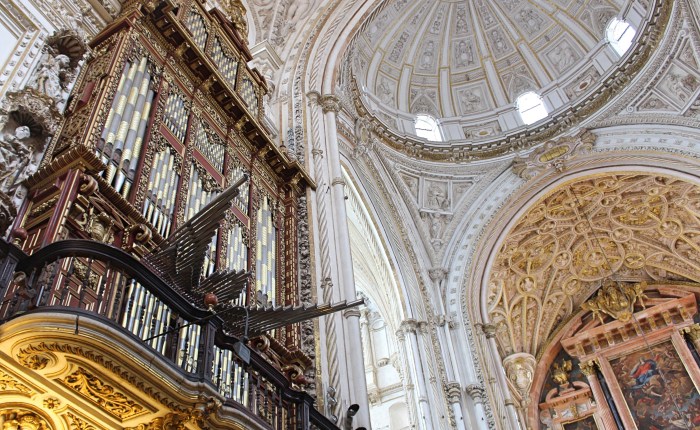
As our Airbnb was in the outskirts of this mighty municipality, we decided that we ought to make Las Palmas our first stop of the trip. We headed first to the city’s cathedral. It fronts an attractive plaza lined with (what else?) palm trees and buildings sporting the colorful façades typical of the city. The cathedral looms overhead without being particularly grand or beautiful from the outside. It is more charming in the nave, where the stone columns imitate palm trees in their leafy spread. But I had to say I did not enjoy the view from the towers, which was of rather ugly urban sprawl.
That being said, although I am sure many parts of the city are, like any city, rather bland and devoid of character, the historic center of La Palma is indeed quite lovely. We strolled around, peaking into a few shops, taking note of restaurants, until we arrived at our next destination: the Pérez Galdós House Museum.
Though comparatively obscure outside of Spain, Benito Pérez Galdós is one of the most iconic writers within the country. For reference, if Cervantes is the Spanish Shakespeare, then Galdós is the Spanish Dickens. He was, in other words, an extraordinarily prolific novelist who stood at the height of the Spanish literary world during his lifetime—both praised by critics and adored by the public. And although many of his most notable stories are set in Madrid—a Madrid as carefully delineated as Dickens’s London—it was from this tropical island that the great writer hailed.
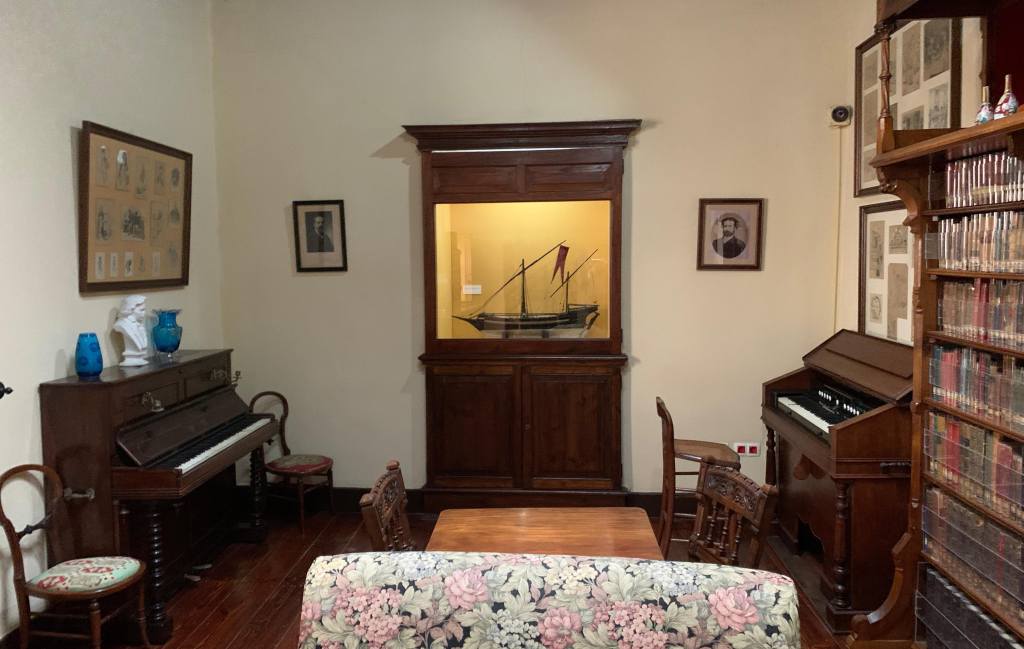
Much of the furniture was handmade by Galdós. He was also an able piano player.
Despite his fame and the strong sale of his books, Galdós never owned a house in the capital city. Instead, he stayed with his nephew as a kind of long-term guest. A lifelong bachelor (though with many lovers), this arrangement seemed to suit his habits just fine. In his later years, Galdós did eventually buy a house, but in Santander (on the northern coast) rather than in Madrid. (Like many madrileños, Galdós escaped the suffocating heat of summer by fleeing north.) And yet it is not that house, but his childhood home in Gran Canaria, which eventually became his museum.
You can only visit the house via a guided tour, but our tour was excellent. The house is of fairly modest dimensions—two floors, with a sizable patio in the middle. No attempt has been made to furnish it as it might have been while Galdós was a boy. Instead, his furniture and decorations were brought here from his home in Santander. This may sound like an odd decision, as it achieves neither an authentic reconstruction of his childhood or adulthood. But it was done so intelligently and tastefully that, somehow, I felt I was getting to know Galdós on an intimate level.
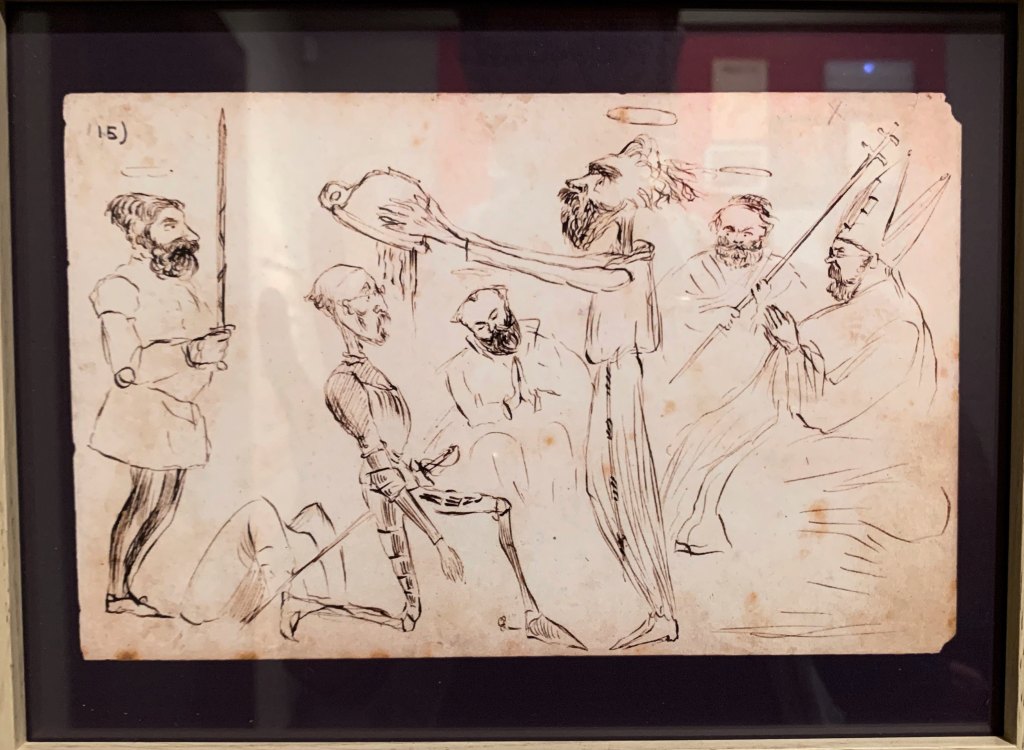
He was a man of many surprising talents. Aside from his obvious literary ability, Galdós was, for example, a skilled pianist. Indeed, he was quite the music enthusiast, and even devoted much of his time to writing criticism of performances. Galdós was also a decent draftsman. In the exhibition room near the entrance to the museum, you can see many examples of his sketches, some of which are of the characters from his books. Most surprising to me, however, was his ability as a woodworker. Much of the furniture in the museum was made with his own hands, and it is very fine work indeed. Surrounded by all of this, you get the impression of a man bursting at the seams with brilliance.
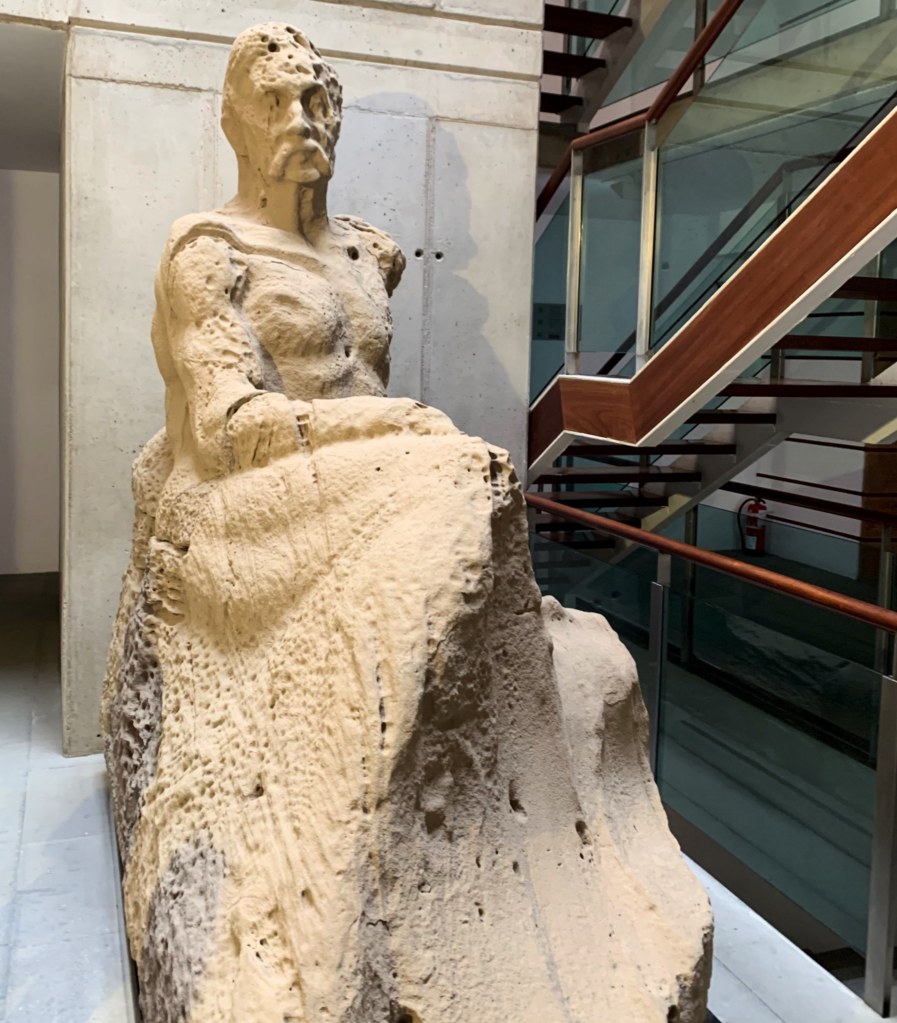
The tour ends with the rough version of the official Galdós monument—the real version of which stands in Retiro Park, in Madrid. (Next to it, there’s a little public library shelf where I donate my books.) I emerged from the museum feeling quite inspired. While he may not be my favorite author, Galdós lived his life fully devoted to art in a way few of us mere mortals can imitate. He is a true literary hero.
After this, we ate a delicious lunch at the Moroccan restaurant across the street to recover our strength. Then, we headed to another excellent museum: El Museo Canario.
Though you may think from its name that this museum would be devoted to all things Canary, its collection is exclusively devoted to exploring the islands’ original inhabitants: the Guanches. (Properly speaking, the “Guanches” was but one group of the islands’ inhabitants, but the name is commonly used to refer to all of the indigenous people collectively.)
The Canary Islands have been inhabited for thousands of years, starting perhaps as far back as the sixth millennium BCE. There is evidence of trade between the islands and several ancient civilizations, including the Phoenicians and the Romans. However, at some point contact with the mainland was lost. What resulted—as seems to be the general rule in isolated peoples—was a kind of technological reversion. By the time the Spanish made contact with the Guanches, they had lost the ability to navigate the open ocean. Indeed, they were literally a stone-age people, making tools out of wood, bone, and rock, and painting caves.
Contact with the Spanish proved disastrous. Much of the original population was wiped out. Not that they didn’t fight back. At the First Battle of Acentejo, for example, the Guanches killed nine out of every ten Spaniards. Yet, in the long run, they had neither the numbers nor the technology to resist European colonization. Those who escaped slaughter gradually integrated into Spanish society, losing their culture. And because none of the colonizers saw fit to write down more than a few sentences in the native language, it has mostly been lost, too. What remains of their language and their bones reveals, as expected, a link with North Africa. But it is tragic to consider how we must now make guesses about a culture which existed until the 1500s, as if they were an ancient people.
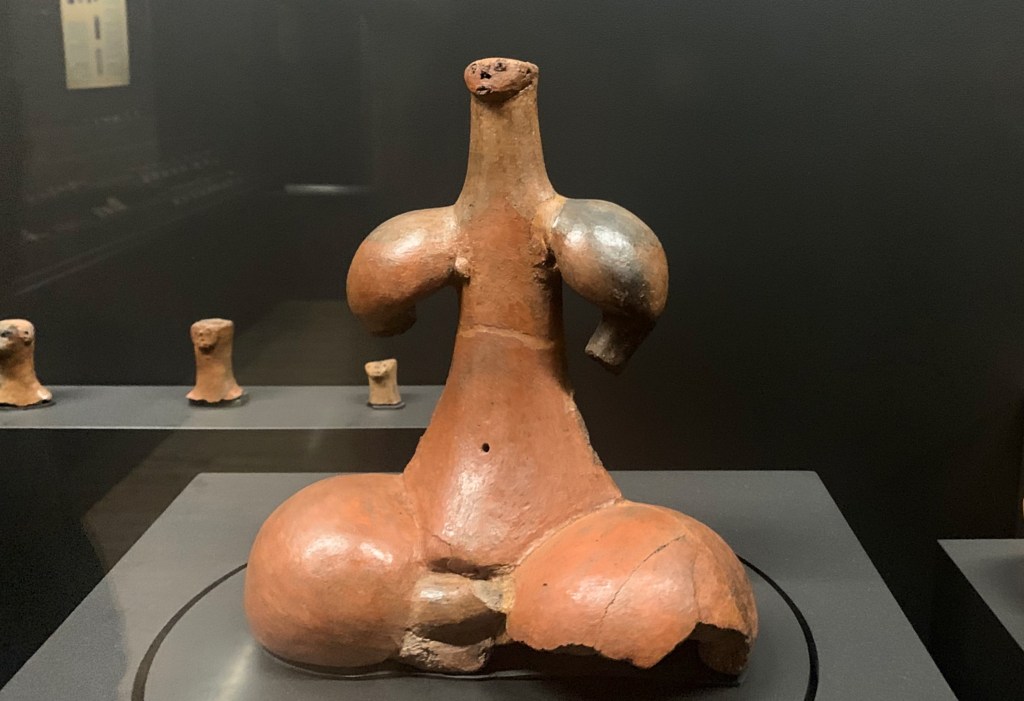
The Museo Canario began in the late 1800s as a kind of private project among a group of intellectuals, under the mistaken belief that the archaeological remains were related with the European paleolithic. Indeed, the museum’s collection is housed in the former home of the leader of this group, Gregorio Chil y Naranjo (who must have been quite a wealthy man). By any standard, the museum’s collection is excellent—with stone tools, ceramics, and even a reproduction of the cave paintings in Galdar (though I wish we had gone to see the originals). Best of all—and strangest—is the so-called “Idol of Tara,” which is a ceramic cult statue depicting a seated woman. Her proportions are, however, rather strange—with enormous thighs and shoulders, but an exceedingly tiny head. Rebe thought it was very funny.
The Idol of Tara
Yet the most memorable part of the visit were the bones. In one room, assembled like a cabinet of curiosities, are the bones of dozens of Guanches on display in glass cupboards. There are even a few mummified bodies. It is quite an impressive sight, I admit, though it did give me some misgivings. I doubt, for example, that we would condone digging up and displaying bones from the European Middle Ages in the same way. Indeed, as it was the Spanish who were responsible for the extinction of their culture, it does strike me as adding insult to injury to treat these erstwhile human beings as decoration. But perhaps I am being overly scrupulous.
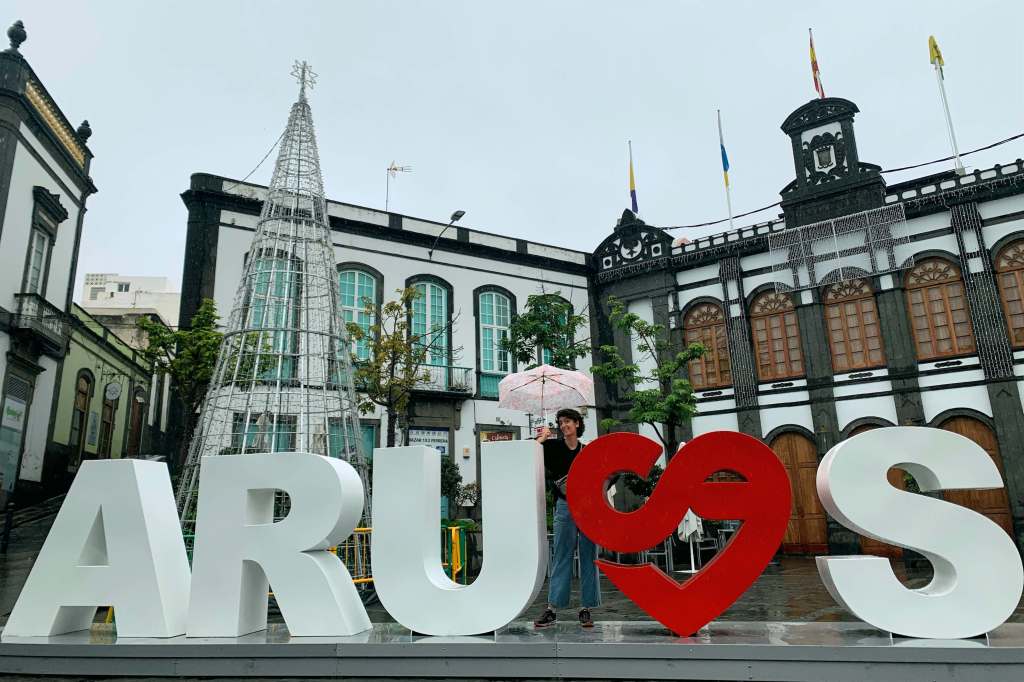
This did it for our sightseeing in the capital. After this, we made a quick stop in the nearby town of Arucas. On the way, we got a taste of capricious Canary weather. In mere minutes, it went from sunny to pouring rain, and the car briefly hydroplaned a couple times as I drove through flooded roads. By the time we arrived, however, the skies had largely cleared, and we were able to walk around without umbrellas. Arucas is famous for two landmarks. First there is the massive neogothic church of San Juan Bautista, which seems out of all proportion to the modest town surrounding it. The other is the famous Arehucas rum plant. Unluckily, it had closed just before we arrived, so we couldn’t take a tour. But I must admit that, when I bought a little bottle to try for myself, I wasn’t especially fond of the liquor. I prefer brandy or whisky.
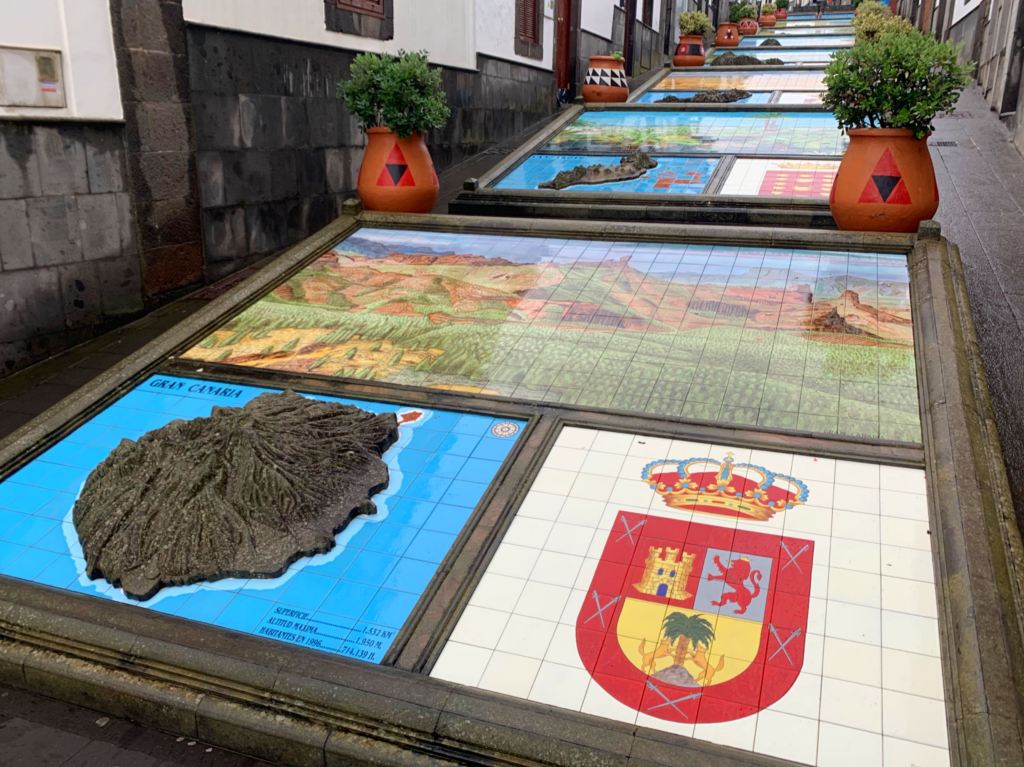
Next we stopped in the nearby town of Firgas. This attractive village is primarily famous for the Paseo de Canarias, which is a long fountain running alongside a walkway. The fountain is decorated with three-dimensional maps of the Canary Islands, along with their flags and coats of arms. Aside from this touristy eye-candy, however, Firgas is just a nice place to stop and have a coffee or a bite to eat.
This model gives you a good idea of how mountainous the island is.
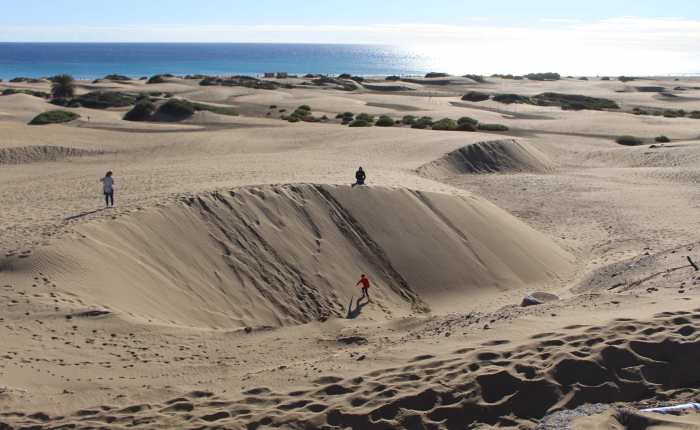
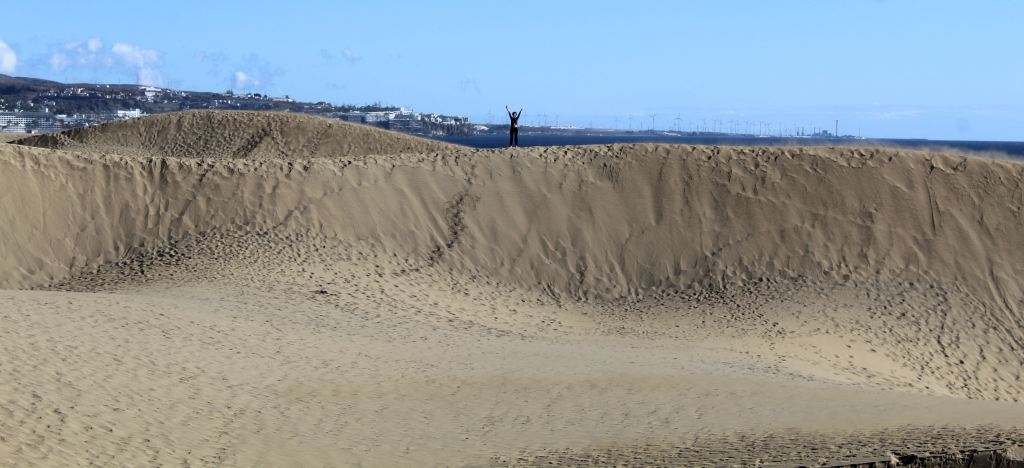
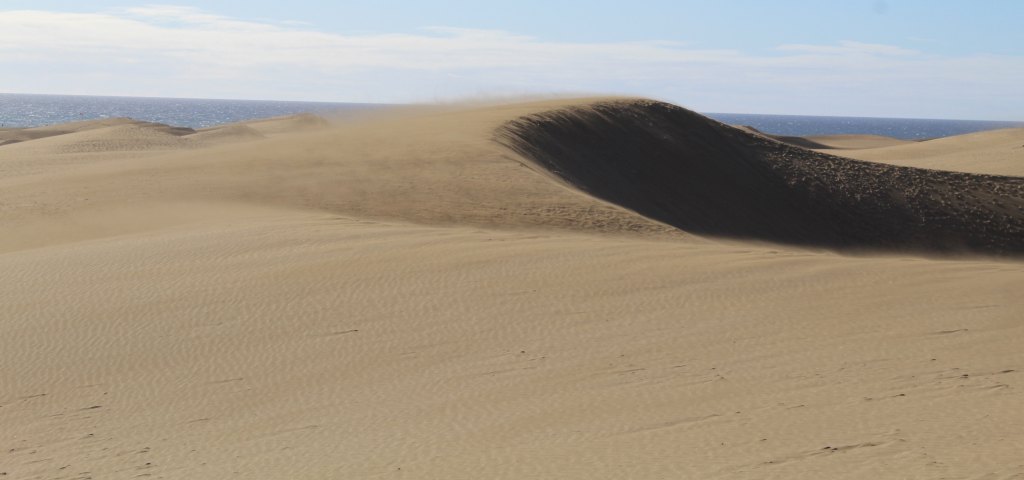
On our next day in Gran Canaria, we headed south. Our first stop was the Maspalomas. We parked the car in a kind of suburban beach community, near an oddly gaudy building that I took for a kind of amusement park (but was actually a shopping center), and started walking towards the ocean. We were there to see the dunes. When they came into view, I was stunned. It is the sort of thing that you expect only to exist in film studios—mountains of sand, rolling into the distance, surrounded by the crystalline blue sea. Apparently, during the last age, when the ocean was considerably lower, sand from the erstwhile ocean floor was washed up. This result of this long geographical process is perfect for Instagram.
We left the wooden walkway to stumble around the dunes. Though it was December, the sun was blindingly intense on the sand. Just moving around on the dunes was strangely exhilarating—either waddling up the steep hills and causing a miniature rockslide in the process, or nearly falling as the sand gave way beneath you on your trip back down. But after about half an hour of that, I’d had my fill of sand and yearned for solid ground.
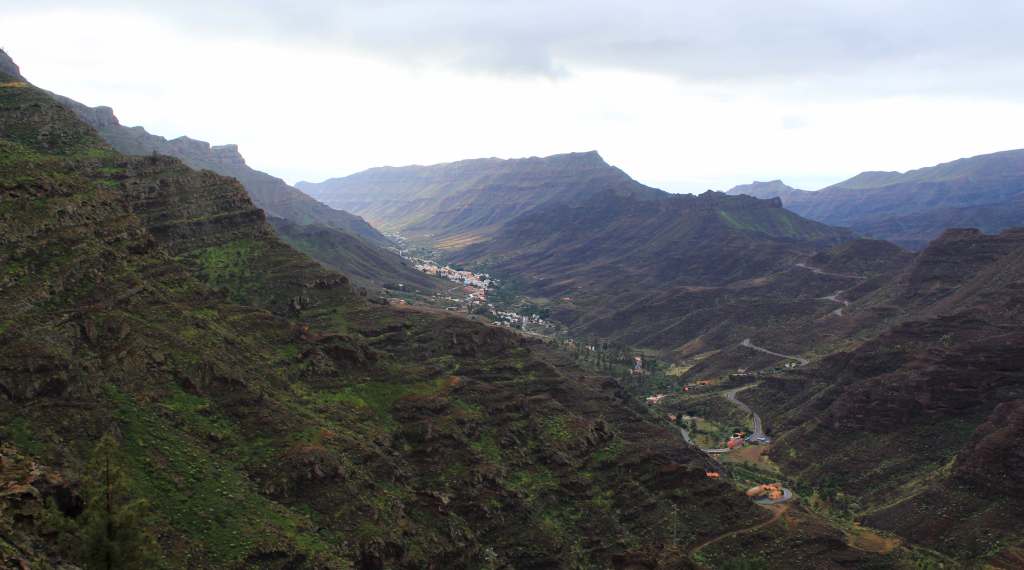
After this, we suffered a bit of confusion. Rebe had read that Mogán was one of the most beautiful beach towns on the island, and so we set our GPS to that location. But when we turned away from the ocean and into the rugged, dry interior, I began to feel that something was off. The drive was interesting—winding through a valley, passing town after town, many of them charming—but the beach did not seem to be forthcoming. Finally, we arrived at Mogán, and parked near a basketball court. The town had a kind of shabby, neglected appearance (no offense) that did not seem to mark it out as a tourist hotspot.
Soon, our error was revealed: the famous town was Puerto de Mogán, not Mogán itself. In fact, we had basically driven right past it before we turned inland. Thus, we got into the car and headed back toward the coast.
Puerto de Mogán is, indeed, a beautiful beach town in a lovely natural setting. The low, white buildings cluster around the bay, while volcanic hills jut up to the left and right. It is also, however, a good example of how tourism can ruin a place. The seaside was full of oversized, overpriced, and badly-reviewed restaurants, while the streets had little more to offer than tourist knicknacks. There was not even an inviting place to have a coffee. Still, the place itself is undeniably attractive, as we found while observing the bright orange grabs darting among the jagged rocks, swept about by the waves.
But we were hungry, and—as mentioned—the town was bereft of decent restaurants. Rebe got on her phone and discovered that there was a promising restaurant in, of all places, Mogán—the town we had just visited. So we got in the car and drove back up the valley to the town, parking in the same parking space, in order to eat in the Restaurante Canario de Oro. There, the owner recommended several local dishes to us which we duly ordered and shared. It was quality local food.
This did it for our time on the south coast. To return to the north, we decided to drive through the center of the island. The road took us high up into the mountains in the interior, until we approached the highest peak, the Pico de las Nieves. Unfortunately for us, during the drive the weather turned from pristine blue skies to downcast to downpour. By the time we got to the mountaintop, ice-cold rain was lashing down, and we decided not to get out of the car. There wouldn’t have been much of a view, anyway.
On the way down the other side of the mountain, we stopped in a village called Tejeda. Under normal circumstances, I am sure it is a beautiful little town. But with the wind and biting rain, we could only think of getting inside somewhere. We ended up in a bakery, where we had a few of the local pastries to recover our strength. But I’m afraid I saw very little of Tejeda.
By the time we reached our next stop, Teror, the weather was clearing up a little. Its name notwithstanding—which goes back to the Guanches—there is nothing terrible about Teror (except for finding a parking spot, perhaps, as that was a little stressful). The town center is well-preserved and extremely charming, indeed probably the loveliest we saw during the trip. True, there isn’t very much to do, but just strolling through and peaking into buildings here and there was quite enough. Though I would hesitate to put the difference into words, Canarian towns in general have a distinct style of architecture and layout that makes them unlike their counterparts on the Spanish mainland. And Teror is an excellent example of this.
By the time we finished our stroll and found the car, the sun was setting. We still had one more full day in Gran Canaria to go.
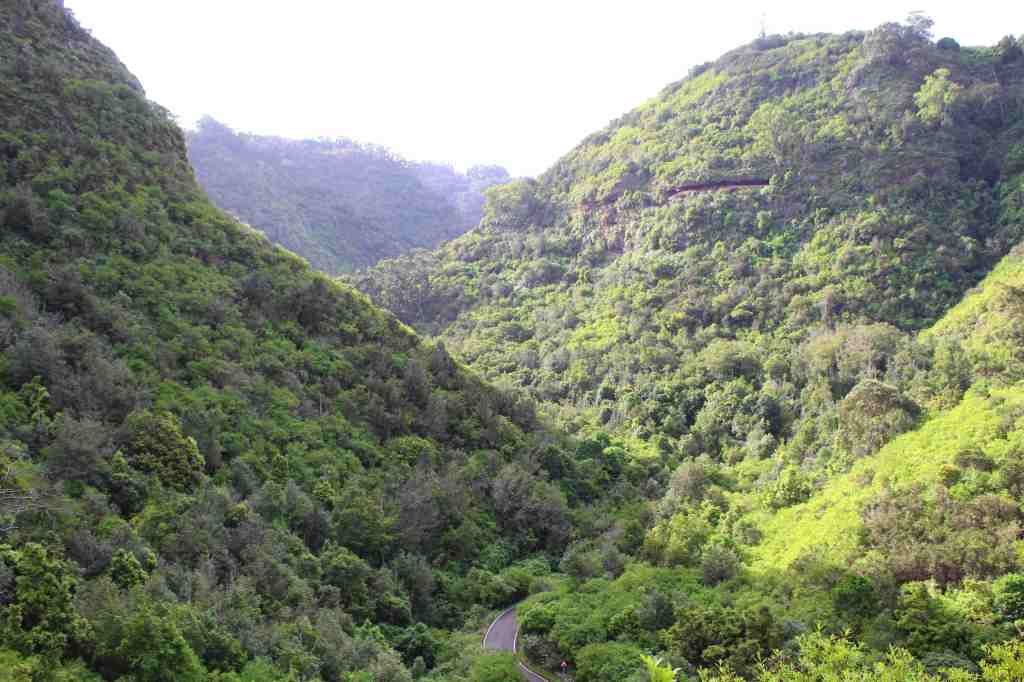
Our first stop the next day was Los Tilos de Moya, one of the great natural parks on the island. Despite its being relatively well-known, I was surprised not to find any kind of official parking lot—or, indeed, any other visitors at all. We left our rental car next to an out-of-business restaurant and embarked on the 2km circular hike, with no other humans in sight.
“Tilo” translates as laurel to English, and this reserve is regarded as a representative of the large laurel forests that once covered the island. The hike was very pleasant—easy and short, while giving us a taste of the lush greenery of the tropical island. But I must admit that I apparently have no idea what a laurel tree looks like, as I could not identify a single tree as belonging to that species. As I discover from a google search, the sort of laurel that grows in the Canaries is not the same species as the one we use to season our food. In any case, it sure does make an attractive forest.
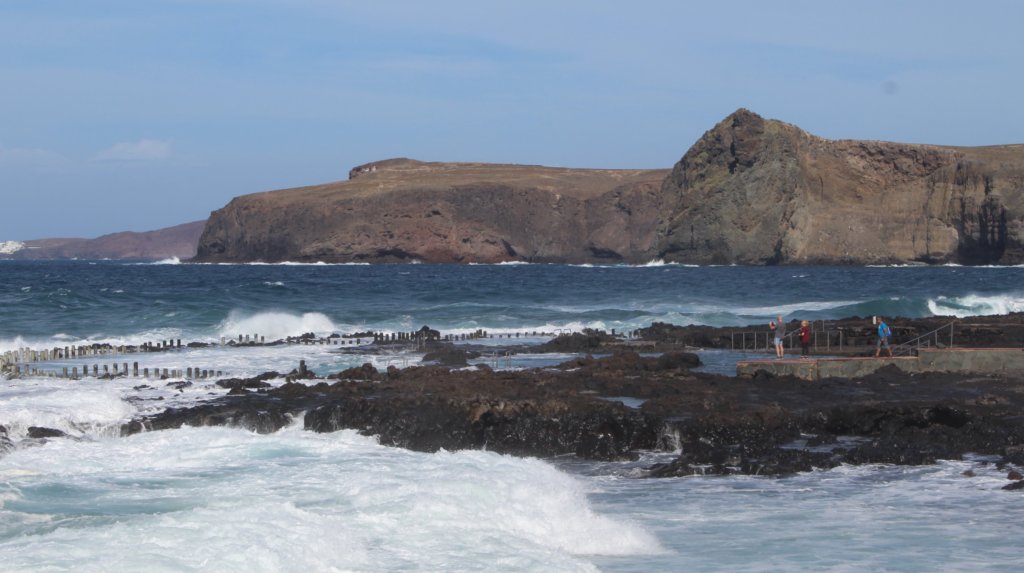
After our little hike, we drove to the northwestern coast, to the town of Agaete. This town was previously famous for being the best place to catch a glimpse of El Dedo de Dios, a precarious rock formation that looked like God’s finger pointing upwards. Unfortunately, however, a storm broke off the index finger in 2005, and God has been making a fist ever since. Nevertheless, Agaete is well worth visiting for the attractive maritime promenade and the natural pools that have formed in the volcanic rock next to the ocean.
Here you can see the damaged Dedo de dios.
Though it was December, there were quite a few people in the water. Rebe and I were not quite so brave. Instead, we walked along the shore taking photos. On the way into town, we passed the Monument to the Poets—a statue commemorating three modernist Canarian poets of the early 20th century. Once we got to the bay, we caught a glimpse of the departing Fred Olsen, a ferry that runs between Gran Canaria and Tenerife—a trip of about an hour and a half. This part of town was full of restaurants, some of which seemed like tourist traps, but several of which looked actually quite nice. We chose one with a view of the beach and had an absolutely terrific lunch. It was Spanish food at its best: cheap, healthy, and dripping with olive oil and garlic.
After this, we headed back into the interior of the island, to Artenara. This town is located far up in the mountains, 1200 meters (or 4000 feet) above sea level. Getting there took some time, as I kept distrusting my GPS. Several times, I was instructed to turn onto something that did not appear to be a real road, and so I disobeyed. Then I was rerouted to yet another unpromising little path. Finally, I decided I had to accept my fate, and I turned into a narrow dirt road.
No sooner had I done so but another car came the other way. The path was too narrow for two cars and had no shoulder, so I was forced to awkwardly back out back onto the road to let the other driver pass. For the rest of my time driving on the road, I was in a panic lest anyone else come the other way, as there was absolutely no space I could squeeze into to let anyone pass. One side of the road was a rock wall, and the other side a steep dropoff. Thankfully, nobody did come, and we made our way to Artenara.
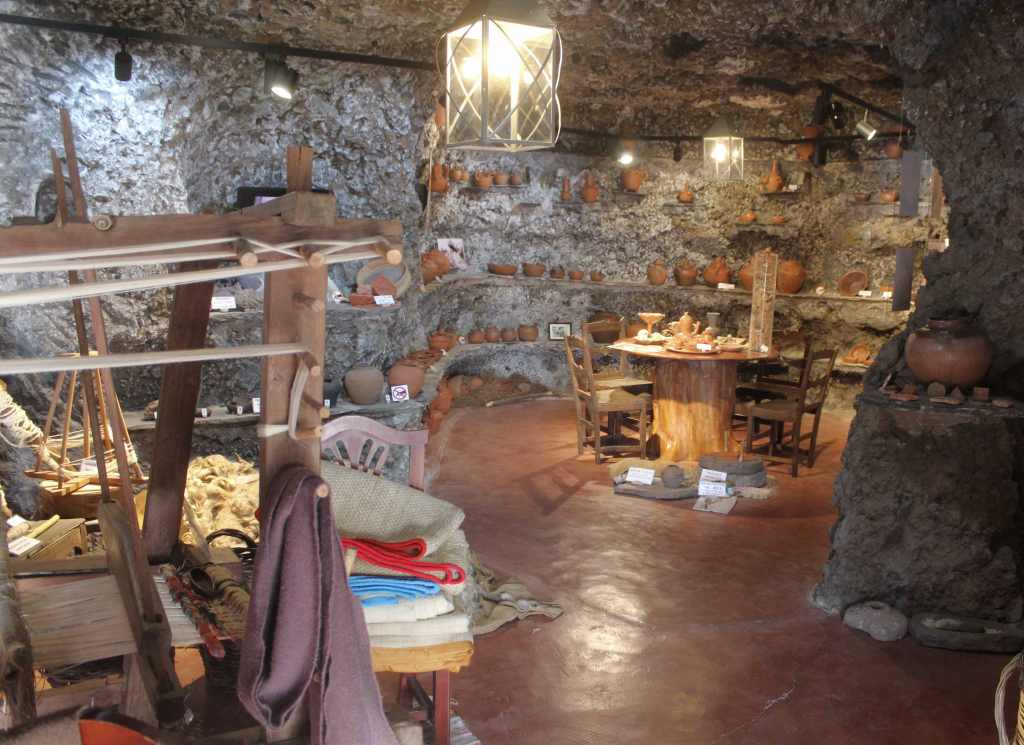
The view alone would have been worth the stress. But Artnenara is also home to a unique museum. After the destruction of the native Guanche population, the incoming Spanish sometimes took over the vacated cave dwellings and turned them into their own habitations. This museum is a kind of recreation of what one of these cave houses might have been like. It was rather bizarre—European sensibilities squeezed into a subterranean context—but oddly fascinating.
This did it for our trip. After Artenara, we went back to the Airbnb, and flew back to Madrid early the next day. Once again, the Canary Islands had surprised us with their richness, variability, and beauty.
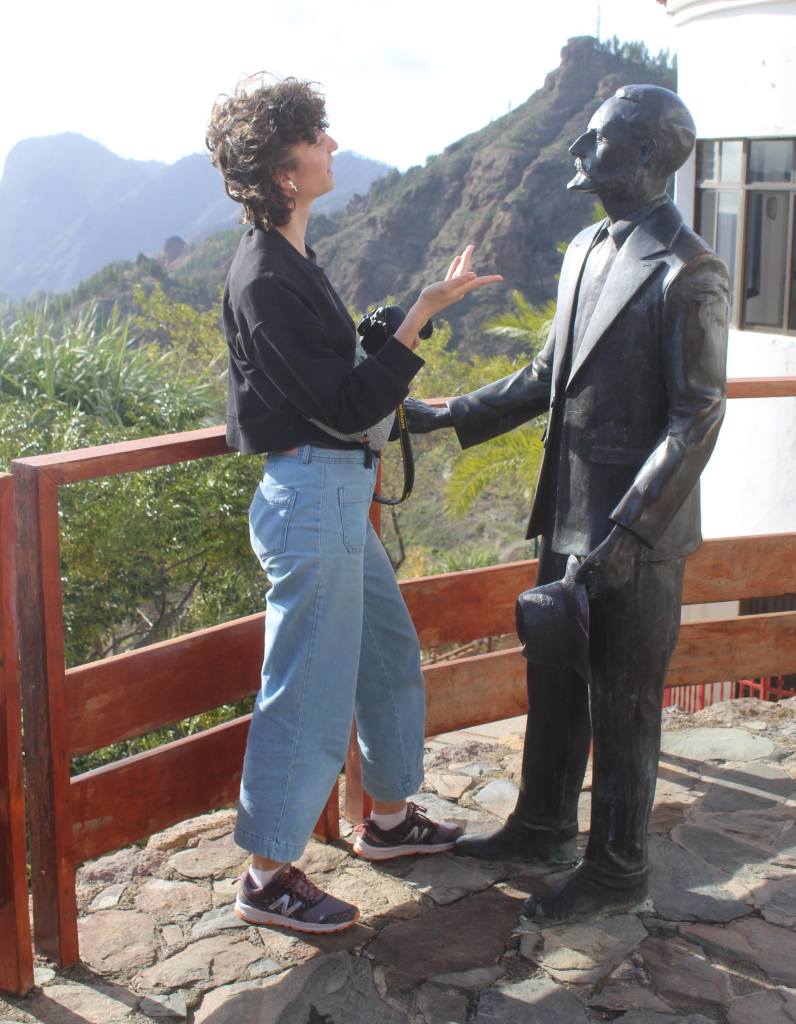
Rebe having a chat with the famous Basque philosopher, Miguel de Unamuno, who visited this town.
Happy belated New Year! This past 2023 was, in retrospect, a surprisingly productive year for me. First, I got back to regularly writing on the blog, and completed most of my backlog of travel writing. I also successfully ran a marathon, finished a draft of my next novel, and—most unlikely of all—got a new job! I’m not sure if I’m going to repeat my marathon experience this time around (it took a lot out of me!), but I do plan on refocusing my attention on improving my German level. After all, learning foreign languages is exercise for the brain.
I still have some trips to write up, such as my trip to Gran Canaria and my big family voyage to Ireland. And I have a great many smaller posts to write about places in Madrid and New York. But my biggest goal is to finish my book and begin trying to get it published.
In my reading, I have all but given up making specific goals, since I am liable to be swayed by any new discovery that seems interesting. However, I do hope to finish both Churchill’s history of the Second World War and Robert Caro’s biography of Lyndon Johnson. Unfortunately, next year is an election year in the United States, and I have a tendency to get sucked into the general excitement—something that is usually reflected in my reading. So we’ll see how that plays out.
The best time of year for reading is, for me, the time between Christmas and New Year’s. The weather is cold, school is out, and I feel relaxed and fully able to focus. I find myself devouring books with great relish, and that is precisely the case with this wonderful collection of Mozart’s letters.
First, a note on the translation. Mozart’s writing is highly idiosyncratic—full of misspellings (at least when he was younger), multiple languages, puns and wordplay. Spaethling’s translation is thus a kind of virtuosic performance in itself, as he brings as much of this exuberance seamlessly into English. As an example, I will quote the first letter in this collection, written when Mozart was just thirteen:
My dearest mama,
My hear is filled with alott of joy because I feel so jolly on this trip, because it’s so cozy in our carriage, and because our coatchmann is such a fine fellow who drives as fast as he can when the road lets him.
Spaething’s careful rendering of Mozart’s peculiar style allows that composer to fully come to life in this book. The result is undoubtedly one of the most fascinating books in the history of music. Though the letters all have the feeling of being dashed off in a great hurry—much like some of his music—they brim with energy and intelligence, and create a remarkably revealing look at the composer. To get an idea for the Mozartian style, it is worth quoting one of his later letters. This one is to his father, merely describing a pleasant outing in a city park:
I just can’t make up my mind to go back to the city so early—the weather is just so beautiful—and it’s so pleasant to be in the Prater today.—We had a little something to eat in the park, and now we’ll stay until 8 or nine o’clock in the evening.—The only company I have is my pregnant little wife—and her only company—consists of her little husband, who isn’t pregnant but is fat and happy…
The man revealed by these letters is full of contradictions. On the one hand, Mozart is capable of being headstrong, defying his father and even the musical establishment, seeking out his own artistic path. And yet, he is also weak-willed—easily swayed by flattery, improvident with money, and short-sighted regarding his career. One gets the impression that his father had inadvertently been overprotective—shielding the child genius from practical concerns so that he could only focus on music—and when Wolfgang had to make his own way outside of the stern, practical, and worldly guidance of his father, he quickly sank into dysfunction.
This is illustrated most painfully in the last section of this volume, which is filled with repeated and increasingly desperate pleas to his friend for money. His letters to his father are also quite revealing of this dynamic, though perhaps inadvertently so. It is amazing to think that one of the greatest composers of history could have been, in many respects, a frustrating disappointment to his father, but this seems to have been the case. In his letters to his father, he seems always to be pleading for Leopold’s approval, even as the imprudent Wolfgang continually flouts his father’s advice.
And yet, revealing as they are, the best letters in this volume are not those to his father, but to his cousin “Bäsle” (Maria Anna). Mozart seems to have found a kind of ideal playmate for his brand of practical jokes and bathroom humor in his cousin, and his letters to her are full of the most extraordinary playfulness—not to mention, a kind of fixation on excrement which sometimes goes beyond the bounds of humor into obsession. Here is an excerpt of perhaps the best of these letters:
Dearest cozz buzz!
I have received your highly esteemed writing biting, and I have noted doted that my uncle garfuncle, my aunt slant, and you too, are all well mell. We, too, thank god, are in good fettle kettle. Today I got the letter setter from my Papa Haha safely into my paws claws. I hope you too have gotten rotten my note quote that I wrote you from Mannheim…
In these letters, perhaps most clearly, you can see the kind of childlike charm of Mozart. And this immaturity is arguably the source of both his particular genius and his constant financial troubles. Both Mozart’s letters and his music brim with a wonderful sense of play—as if his mind were constantly prancing from one idea to another—picking up one form, giving it a twirl, and setting it down into a new pattern.
Yet it would be wrong to accuse Mozart of superficiality. For underneath this childlike playfulness is a deadly serious commitment to his art. This is readily apparent in this volume, as the constant references to music in these letters belie a kind of workaholic productivity as well as a dedication to reaching the highest possible standards at all times. He was anything but an unconscious composer, as he often shows a keen awareness of how his music should affect his listeners.
It is interesting, I think, to compare these letters with those of another wonderful correspondent, Vincent Van Gogh. At first glance, the two artists could not be any more dissimilar: Van Gogh started late and never achieved fame during his lifetime, whereas Mozart was famous since his childhood. The painter was the furthest thing from a technical master, whereas Mozart dominated both instrumental and compositional technique in multiple domains.
And yet, these two men—both of whom died much too young—share one dominating characteristic: an overwhelming, uncompromising commitment to their art. Arguably, this monomaniacal devotion led both of them astray, as they both died isolated and penniless. But who can honestly wish that either man had been even a whit more “practical.” Indeed, I think the world would be a better place if we had more people to dedicate themselves with reckless abandon to the creation of beauty. And such a man is ultimately what these letters reveal.
Though superficially this year has been a disappointing year in reading—I finished considerably fewer books, just over 60 rather than my typical 75 or more—this lack of quantity is largely illusory. A good number of the books I’ve finished this year have been quite long, many over 500 pages and a couple well over 1,000. So in terms of total pages read, I believe I am at par.
For whatever reason, I usually begin the year by getting extremely obsessed with a book. This year, it happened to be Why We Sleep by Matthew Walker, which convinced me that I was chronically under-rested and, thus, in danger of imminent death. For months afterwards, I dutifully tried different strategies for achieving optimal sleep—cutting down or (briefly) giving up caffeine, sleeping with a mask, going to bed earlier, drinking herbal tea, avoiding alcohol—and it did make a difference. However, probably the best thing I did for my sleep was simply to get a new job that didn’t require me to get up so early. Since then, I have mostly resorted to my old bad habits.
A few books I read this year required so much effort that they became little projects. This can certainly be said of my encounter with the Qur’an—a book difficult for a Westerner to appreciate, I think, though I did my best. I read a few other religious classics to complement my exploration of Islam—some Buddhist sutras and the Egyptian Book of the Dead—though none made nearly so deep an impression on me. Another project, offsetting my spiritual investigation, was my attempt to finally tackle two of the great works in the history of science: Faraday’s Experimental Researches in Electricity and Maxwell’s Treatise on Electricity and Magnetism. In both cases, I achieved only the most basic understanding of these great thinkers, though it was rewarding just the same.
I also finally started on two historical series that had long been on my list. The first is Winston Churchill’s account of World War II—deservedly a classic, and quite fun to read, despite its limitations. The other is Robert Caro’s magisterial biography of Lyndon Johnson, which deserves all the superlatives that can be heaped upon it. Both series, though in different ways, make the fine-grained texture of history more palpable, bringing the past alive with copious detail. I will add to this list, though it isn’t exactly a series, the two books by David Simon: Homicide and The Corner. Though Simon’s scope is smaller—the city of Baltimore rather than a president or a major historical event—he is just as good at revealing the inner workings of human life.
There are a few other smaller categories I should include. One is accounts of historical disasters. This describes John Hersey’s Hiroshima, Svetlana Alexievich’s Voices from Chernobyl, and Walter Lord’s A Night to Remember (about the sinking of the Titanic). Perhaps my morbid fascination with these events reveals something unsavory about my character, but I greatly enjoyed these books. Another category is America. Into this bin I would put William Least Heat-Moon’s famous travelog of the United States, Alan Taylor’s excellent history of the early American colonies, and Laurence Bergreen’s informative biography of Christopher Columbus. I am not sure I am feeling any more patriotic, though it is good to reconnect with one’s native land occasionally.
Last, I ought to mention fiction. This year has been, in retrospect, rather light on literature. True, I finally finished Les Miserables, which took months, and finally reread The Canterbury Tales. I also read the trifecta of great American plays: A Streetcar Named Desire, Death of a Salesman, and A Long Day’s Journey into Night—all deserved classics. But the books that stand out in my memory are The Things They Carried (an excellent anti-war book) and Sister Carrie (a devastating deconstruction of the American Dream). I also ought to mention having read my first P.G. Wodehouse and Agatha Christie, both superb in their respective fields.
My goals for 2024 are basically to keep going in the same direction: read a few more spiritual classics, some more influential works of science, continue reading Caro and Churchill, and tackle some rewarding works of literature. As usual, I must express my gratitude to everyone on this site. All of you help make reading a communal activity rather than a lonely endeavor. It is a continual pleasure.
Strange to say, but I seem to be enjoying the holidays more and more with each passing year. This year, to my surprise, I even find myself searching out Christmas music and sentimental holiday movies. I think this is because I have come to appreciate how holidays chart the course of time, preventing one moment from slipping into another in a dreary monotony. And, corny as it sounds, I realize that we do need periodic reminders of what is really important in life, and opportunities to take the time to celebrate it.
So, to all of my readers, I wish to say: Merry Christmas, Happy Hannukah, Happy New Years, and enjoy the holidays!
Robert Caro sets his own standard for political biographies, and if this volume was at all lacking for me it was only in comparison to the masterful first volume in this series. But even this is not exactly a fair comparison, as The Path to Power covered Johnson’s formative years—delving into his family history, his marriage, his schooling, his environment, his first working experience, and finally his rise to the House of Representatives. Its scope, in other words, is quite broad.
Means of Ascent is a very different book, covering only seven years (1941-48). It is significantly shorter (though still hefty enough), and most of these pages are dedicated to Johnson’s 1948 Senate race. This corresponds to what Winston Churchill called his “wilderness years,” in which Johnson was directionless and cut off from the main arteries of power. He spent some of this time in a non-combat role in the military (and spent the rest of his life shamelessly exaggerating his minimal exploits), some of this time using his connections to get rich through a radio station—and finally got back onto the path to power by stealing a Senate election.
As Caro says repeatedly, Johnson is a complex personality with a strange admixture of the despicable and the admirable—and this book contains precious little of the latter. As a result, whereas in the first volume one could sometimes feel sympathetic for the young man from Texas, here he is little more than a power-grasping villain. Caro himself obviously came to feel disgusted with Johnson’s personality, and his feelings seep through in his descriptions of Johnson’s ample transgressions: his blatant mistreatment—indeed, verbal abuse—of anyone he considers inferior (including receptionists, waiters, his own staff, and his poor wife), his absolute amorality regarding even basic ideals (such as democracy itself), and his willingness to stop at nothing to obtain power.
Caro contrasts Johnson’s personality with that of his opponent in the 1948 Senate election, Coke Stevenson—a man Caro portrays as honest and honorable. And here the esteemed biographer got into a little bit of trouble. While Stevenson may indeed have been upstanding in the sense that he was true to his word, did not bow to lobbyists, did not attack political opponents, and did not seek political office in order to satisfy a lust for power—while all this may have been true, Stevenson was also certainly a reactionary and a racist.
These rather unflattering qualities are given only a passing mention in the book, which may leave the reader with a skewed impression of Stevenson. Caro was roundly criticized for this, and in an article in the New York Times, published in 1991, he responded some of these criticisms. Yet his defense—that the subject of race played little role in the election—while valid as far as historical explanation goes, still does not quite excuse the glowing portrait he painted. Upon finishing the book, it is difficult to resist the impression that Caro himself came to admire Stevenson.
Even so, as abhorrent as I find Stevenson’s views to be, I would still prefer such a man to the Johnson of 1948, who seems to have had no political philosophy, no political aspirations beyond his desire to control people, and—worst of all—no respect for the institution of democracy. Throughout all of the legal battles and maneuvers which allowed him to keep his stolen election victory, Johnson never once betrayed the slightest hint that he might have had misgivings about betraying the will of the people. Indeed, as Caro makes clear, he seems to have been proud of it, virtually boasting of the “victory” in later years.
Now, at this point I will do something very brave—or cowardly, perhaps—and venture a slight criticism of Caro. After so many pages, his writing style is beginning to ware on me. This is because, I think, his primary rhetorical technique is that of superlatives. What I mean is that, for Caro, everything is as extreme as possible. Johnson is not just a sleazy politician, but unprecedentedly amoral; Stevenson is not just a popular governor, but a Texan hero; and so on, and so on. Caro relentlessly emphasizes how extreme every event and experience was—so much so that, by the end, you are begging for something totally ordinary and unremarkable to happen (and no, not superlatively ordinary).
That said, the book is eminently readable and highly enjoyable. Here Caro creates such a memorable portrait of an amoral, power-crazed politician that, had this book been written by anyone else, it would by itself be considered an enduring classic of American political writing. It is only when compared to his other books that this one may seem somewhat light.
Most good books lend themselves to be read on many levels. One can read them superficially, merely for momentary pleasure, or study them deeply, working your way slowly through their contents. For the most part, I try to chart a middle path through these two extremes, doing my best to understand what I’m reading—at least on a basic level—without getting bogged down in academic study.
However, some books simply do not lend themselves to that approach, and this is one of them. One can skim over the mathematical proofs in, say, Newton’s Principia and still get a fairly good idea of what the book is about. But in Maxwell’s magnum opus, the math is what does the talking. Indeed, by the midway point I was so desperate—feeling guilty, lazy, and stupid for understanding so little of what I was reading—that I decided to turn to an old ally, Kahn Academy. There, I went through all of the videos on electricity and magnetism, and learned a great deal. (The last time I had any formal instruction on the subject was in my sophomore year of high school, and I doubt I understand much back then.)
But I found, when I picked up the book again, that even this Hail Mary would not save me from the perdition of Maxwell’s writing. Indeed, as I had already bought the heavily annotated student’s edition (with copious notes by Howard J. Fisher), it seemed that I had used up all of my lifelines, and simply had to content myself with only the most superficial reading of this important book.
What follows, then, is probably as valuable as a review of Hamlet by somebody with an elementary level of English. Here I goes.
Now, as I mentioned, the version I picked up is meant for students. Thus, it is heavily abridged and, often, so full of explanatory footnotes that the original text is crowded out.
For what it’s worth, even if you do have the mathematical and scientific chops to handle Maxwell’s tome, I would recommend either this version or something similar. The original is famous for being rather unfocused and overlong. After all, this book was not meant to be Maxwell’s Origin of Species—a text devoted to propounding a radical new theory. Maxwell had already set forth his most revolutionary insights—most notably in the paper “A Dynamical Theory of the Electromagnetic Field,” in 1865—several years before this book was published. Instead, this was meant as a kind of definitive textbook on the subject, to be studied by university students, telegram technicians, and other specialists. Thus, there are long sections in which he rehashed old theories which would be of limited interest to any modern reader.
This edition attempts to pare down the original, leaving only what Fisher considers to be the “central argument”—that is, the material leading directly to Maxwell’s signature breakthroughs. These would be, first, his four famous eponymous equations and, second, the electromagnetic theory of light.
Regarding the former, as you may know, Maxwell did not actually formulate his equations in the form which modern students encounter them. It was one of Maxwell’s followers, Oliver Heaviside, who put the equations into their definitive form. Instead, Maxwell puts forward twelve equations, which use the now-defunct quaternion notation rather than vector calculus. This makes Maxwell’s presentation seem rather foreign, even to those less ignorant than myself. What is more, Maxwell has a liking for using Gothic letters as symbols in his equations, which gives them a doubly strange appearance.
More generally, I think even a mathematically literate reader will have some trouble following significant portions of this book, if only because Maxwell’s mathematical language seems clunky and dated. In my version, for example, Fisher is continually translating Maxwell’s operations into more familiar forms (which, admittedly, I still did not follow).
As I had recently made my way through an (abridged) version of Faraday’s epochal Experimental Researches in Electricity, I was most interested in the sections in which Maxwell reflects on his predecessor’s work. He is extremely laudatory of the English physicist and is quite generous in giving credit for developing this new way of examining electricity.
And, indeed, if I have any way of understanding Maxwell, it is only through the lens of Faraday. At first glance, the devoted experimentalist with no mathematical schooling seems to have little in common with the visionary theorist who prefers numbers to words. And yet, as I’m sure Maxwell would agree, they were bound together by a new vision of the cosmos. In a nutshell, and said very imprecisely, I think their insight was to see energy rather than matter as fundamental.
In the Newtonian view that preceded Maxwell, the world was composed of matter—indeed, even light was supposed to be made up of little corpuscles. This matter traveled in straight lines and attracted other matter in straight lines. This Newtonian view was embodied in, say, Ampère’s earlier theory of electromagnetism.
And yet this view always sat uncomfortably with Faraday, who instead saw the curving lines of the magnetic field as the fundamental reality, rather than one piece of matter attracting another via “action at a distance.” Indeed, Faraday’s brilliant experiment involving the shifting of light via a magnet got him tantalizingly close to the central insight of Maxwell’s life: the unification of light with electromagnetic radiation.
Faraday is one fount of Maxwell’s inspiration. Yet if Maxwell has a mathematical predecessor, it is Joseph-Louis Lagrange, whose work comprises a culminating chapter in this book. Lagrange arguably developed the math that Faraday had been striving toward from another direction. For in Lagrangian mechanics, rather than thinking of forces being exerted by physical objects, one thinks of the energies in the system—the object in question merely following the path of least resistance through the fields of energy around it.
It was Maxwell’s great insight to see how the work of Faraday and Lagrange—among many, many other brilliant scientists—fit together to form one complete account of electricity and magnetism. It is a theory in which fields of energy take precedence over particles, indeed in which the world around us is filled with vibrations in luminiferous ether. And while some parts of Maxwell’s theory (notably the ether) have not survived to the present day, his basic insight was so sound and so significant that, as Richard Feynman said, his discovery constitutes one of the major turning points in human history. You certainly wouldn’t be reading this review without it. Thus, Maxwell’s name stands beside Newton’s and Einstein’s as one of the greatest physicists of all time—even if his book is completely opaque to people like me.










 Lotz in Translation