Quotes & Commentary #7: Bill Bryson

Quotes & Commentary #7: Bill Bryson

We are astoundingly, sumptuously, radiantly ignorant of life beneath the seas.

—Bill Bryson

I originally wrote down this quote because it was an excellent illustration of Bryson’s excellent prose.

Style manuals often tell us to focus on nouns and verbs. Such is the advice of E.B. White in The Elements of Style, where he says that “it is nouns and verbs, not their assistants, that give writings its toughness and color.” Stephen King, in On Writing, even advises writers to avoid adverbs altogether: “I believe the road to hell is paved with adverbs, and I will shout it from the rooftops.”

Bryson shows how effective adjectives and adverbs can be in the hands of a master. First, the chain of three-syllable words with “ly” endings gives the sentence a rolling rhythm, each adverb tumbling off the tongue. He has also chosen his adverbs well. Saying the word “sumptuous” makes me feel sumptuous; and the word “radiant” almost glows. The comedic twist is when he connects his chain of adverbs with the adjective “ignorant.” I understanding being astoundingly ignorant, but what does it mean to be sumptuously and radiantly ignorant?

I also like this sentence because it reminds me of my childhood. One of my first obsessions was with whales. As often as I could, I would go to the Museum of Natural History and stare in awe at the gargantuan blue whale hanging from the ceiling of the Hall of Ocean Life.

My favorite was always the sperm whale. These leviathans, the largest toothed predators on earth, dive thousands of feet down into the dark deep to do battle with giant squids. The display in the Museum of Natural History pictures this battle mid-scene, the whale’s jaw clamped around the squid’s tentacles, both of their massive forms emerging from the shadows.

Something about this scene fascinated me, and still does. I drew the diorama over and over again, until I had hundreds of copies. The sperm whale seemed heroic to me: it descended into the depths and fought a monster, just to have lunch. And if a creature as big and terrifying as the giant squid could be lurking down there, what else might?

This wonder was reignited when, several years later, I heard of “Bloop,” a powerful underwater sound detected in 1997. The sound is now believed to have been caused by an icequake, but originally it drew attention because its sonic profile was similar to a noise made by an animal. This was noteworthy because the sound was much too loud to be made by even a whale, which led to a lot of speculation on the internet about giant monsters. There’s a whole Wikipedia page dedicated to these unexplained, underwater sounds, which I’m sure has provided valuable ammunition to pseudo-scientists and conspiracy theorists.

To me, the ocean’s depths exert a primal fascination. We still know relatively little about the deep, and what we do know has been consistently surprising. With no sunlight, freezing temperatures, and immense pressure, life has still eked out an existence, taking on many bizarre forms in the process. Maybe “radiant” is the best way to describe our ignorance of a place so devoid of light.

Review: The Magic Mountain

Review: The Magic Mountain

The Magic MountainThe Magic Mountain by Thomas Mann

My rating: 5 of 5 stars

Ah yes, irony! Beware of the irony that flourishes here, my good engineer.

In my freshman year of college, I took a literature course to fulfill a core curriculum requirement: Sexuality in Literature. It was a great class; we read Plato’s Symposium, Sappho’s poetry, the Song of Solomon, Sade, and Sacher-Masoch. But of all the great books we made our way through that semester, the one that most stuck with me was Mann’s collection of short fiction, which included Death in Venice.

I was a negligent student of literature in high school. Only rarely did I do my assigned readings, and so I had a remarkably poor vocabulary. (In fact, a friend recently borrowed my copy of Death in Venice, wherein I underlined every word I didn’t know; “Man, your vocabulary sucked,” he said as he returned it.) So you can imagine what it was like for me to try and tackle the enormous erudition and sophistication of Thomas Mann. I was underprepared and overwhelmed. It was work enough to simply understand a sentence; unweaving his sophisticated themes and symbols was beyond my ken. Yet I still managed to enjoy the collection; more, I even savored it. The acute joys of reading fine literature, so alien before, were slowly opening themselves up to me.

The point of this autobiographical digression is that Thomas Mann has earned himself a special place in my reader’s heart. So it was with excitement and trepidation that I recently walked into a book store and bought a copy of his most iconic novel: The Magic Mountain.

Now, seven long weeks later, I have set myself the difficult task of reviewing this book. And, make no mistake, the task is difficult; for The Magic Mountain is perhaps the most ambiguous and elusive work of literature I’ve ever read. Even perhaps more so than Ulysses, the novel is a throwing down of the gauntlet, a tremendous, impudent challenge to any would-be critic. So I hope my reader will excuse me if this review it a bit disorganized, a bit slipshod, as I wrestle with this novel’s hydra heads in no particular order.

The premise is simple: Hans Castorp, a likable, if simpleminded, young man visits his cousin, Joachim Ziemssen, in a sanatorium for a three-week stay, and ends up staying seven years. All of the action takes place on the titular mountain—a reference to a sentence in Nietzsche’s Birth of Tragedy, where Nietzsche is himself referring to Mount Olympus—as the young, impressionable Castorp gets sucked into the environment. He toys around with ideas, he listens to learned discussions, he befriends interesting personalities, he acquaints himself with death, he falls in love, he indulges in food and alcohol—in a word, he dabbles. He almost entirely forgets about his former life as an aspiring engineer “down there” in the “flatlands”—as the residents of the Berghof call the hustling, bustling world of the healthy below.

When characterizing the style of this novel, one falls naturally into paradoxes: the book is both carefully realistic and deeply allegorical, it is both poetic and prosaic, both lyrical and didactic, both ironic and earnest, both knowing and naïve. Mann accomplishes this feat of ambiguity by adopting a narrative voice of the most gentle and subtle irony. Mann’s own opinions of any of the ideas and characters presented in the book are difficult, if not impossible, to guess at. Simply put, Mann takes no sides; he never professes unguarded allegiance or admiration; everything, in short, is coated in an understated mocking humor. And this ambiguity is summed up perfectly well in the person of our protagonist Hans himself, who dabbles in all things and commits to none, and who is constantly vacillating in his dilettante fashion.

Perhaps as a result of this essential abstruseness, the novel seems to make reference to everything at once. Dostoyevsky often comes to mind, as Mann involves his characters in long philosophical debates, à la The Brothers Karamazov. And like Dostoyevsky’s fiction, Mann creates characters which are allegories for certain philosophies of life: we have Settembrini the rational humanist, Naphta the religious radical, Madame Chauchat the symbol of lust, and, my personal favorite, Mynheer Peeperkorn the hedonist. But then suddenly the novel will take a distinctly Proustian turn, as the narrator indulges in long, lyrical discussions of time, music, and the passing seasons. We sometimes get doses of Faust or even Don Quixote, as Hans, our would-be scholar, our wandering knight-errant, trundles about with Joachim in tow, often getting himself into farcical situations. And then suddenly Dante will appear, with Settembrini as Virgil, Madame Chauchat as Beatrice, and the sanatorium itself as the Mountain of Purgatory—where the patients come to be purged of their sickness, rather than their sins.

What is so arresting about all of these literary parallels is that Mann manages to evoke them in the context of story wherein—it must be admitted—almost nothing at all happens; at least, nothing out of the ordinary. There’s no plot to speak of, no major obstacle to overcome, no central struggle, and even no consistent theme. Rather, the story is episodic in nature (here we are reminded of Cervantes again), and is quite realistic to boot. In fact, on the surface, The Magic Mountain is a fairly conventional novel; at least, it isn’t nearly as difficult to read as either Proust or Joyce. Mann’s sentences, though sometimes long, are rarely rococo; and his dialogue and characterizations are, on the surface at least, rather orthodox. Again, here we see Mann as a master of subtlety, evoking the whole Western cannon in the course of a conversation between a patient and his doctor.

Now let me try to unravel some of the themes heard in Mann’s great symphony. One obvious theme is that of sickness and death. Hans encounters a wide variety of attitudes towards illness during his stay. First, we have the medical staff, represented by Dr. Behrens, who sees sickness and death as just matters of business and biology—a matter for science. Contrasted with Behrens, we have Dr. Krokowski, the aspiring psychologist, who sees sickness as unrequited love, as a product of mental tensions. Then, we see Settembrini’s proud disdain of sickness, for it the enemy of vital human life, of social progress. Castorp is inclined to see something poetic in sickness—a kind of ennobling suffering, which parallels the genius’s intellectual struggle. Naphta is wont to praise sickness, for it weakens man’s love of the flesh, and turns his attention to the ascetic Spirit. And we cannot forget the dutiful Joachim, who hates sickness, because it prevents the accomplishment of one’s duty.

Amid the great themes of the novel, we also encounter innumerable smaller motifs. One is that of music. Castorp becomes obsessed with a gramophone; the narrator speculates on the experience of time in music and literature; Settembrini famously calls music “politically suspect.” Another is politics, as the reader gets absorbed in the intellectual clashes between the humanist Settembrini, who champions liberalism and enlightement, and the caustic Naphta, who is a monomaniacal Christian-Marxist-Hegelian. Mann also displays his talents in evoking sexual tension, as Castorp eyes the alluring Chauchat for months and months, just as Aschenbach observed Tadzio.

But perhaps the major theme of this novel is time. In the Berghof, time is experienced differently. Down below, in the flatlands, time is measured in days, hours, minutes, seconds. Up here, in the sanatorium, time is measured in weeks, months, years. Time forms the whole basis of their stay; for their sickness is often likened to a prison sentence, a sentence which is constantly increased. Their day is carefully divided into segments—five meals, “rest cures” (which consist of just laying down for hours on end), and little strolls. They regularly measure their temperature—holding the thermometer in their mouths for seven painful minutes—and chart their fevers through the passing weeks, hoping to see it normalize. One is often even reminded of Einstein’s theory, for time seems to be supernaturally stretched out, dilated and distended, up in the mountain.

Connected with the leitmotif of time is that of acclimatization. When Castorp arrives, he is a stranger in a strange land. Everything is unfamiliar to him. His habits are all out of sync; he finds the patients’ behavior odd and uncanny. But slowly Hans gets used to things (or, as it’s put by Behrens, he gets used to not getting used to things). The reader, too, experiences a sort of acclimatization, as we acquaint ourselves with the Berghof and its many residents. The world of rest-cures and the half-lung club are, to us as well, strange at first, but gradually become intimately familiar. How much the reader himself has gotten used to things is made clear when Hans gets a visit from his uncle. Hans’s uncle goes through the same process as did Hans when he first arrived; but whereas we were outsiders for Hans’s arrival, we are locals for his uncle’s. We are inclined to laugh at the uncle’s incredulity and foreignness; we are now part of the knowing club, and can wink to each other when the flat-footed visiter from the flatlands commits a faux-pas.

Because so much of this novel has to do with getting used to things, it almost demands to be read slowly—a little bit at a time, over many weeks. Indeed, I was almost dismayed at how much time it took me to get through; for not only does the novel take a long time to read, but it feels long. This book simply revels in its own length. One can even go further and say that the experience of reading the novel—to a degree that is almost eerie—mirrors the experience of Castorp as he stays in the Berghof. I picked up the book from the bookstore in almost the same spirit as Castorp when he arrived to visit his cousin—a casual impulsiveness. And gradually, inevitably, I got absorbed in it, entranced by it. I too committed more time than I expected to toy with ideas, to acclimatize myself to a strange place, to put normal life on hold and indulge in an aesthetic experience.

When the reader gets to the 700th page, and reflects that he has been with Hans Castorp for seven whole years, and has gotten to know so many characters so well, he, too, may feel that he has gotten himself a little lost. The atmosphere of the novel, so rich in ambiguity and so full of ideas, may also awake some lingering sickness of soul, or maybe just make us a little dizzy. And now, as I take my leave of the book, I am, like my companion Hans, thrown back into the hustle and bustle of the buzzing flatlands, expelled from the rarefied air of The Magic Mountain—a little wiser, a little more experienced, and, with any luck, a little healthier.

View all my reviews

Review: The Power of Myth

Review: The Power of Myth

The Power of MythThe Power of Myth by Joseph Campbell
My rating: 4 of 5 stars

I have bought this wonderful machine—a computer. Now I am rather an authority on gods, so I identified the machine—it seems to me to be an Old Testament god with a lot of rules and no mercy.

Joseph Campbell’s Hero with a Thousand Faces is a book that, for better or worse, will forever change how you see the world. Once you read his analysis of the monomyth, the basic outline of mythological stories, you find it everywhere. It’s maddening sometimes. Now I can’t watch certain movies without analyzing them in terms of Campbell’s outline.

But that book had another lasting effect on me. Campbell showed that these old myths and stories, even if you don’t believe them literally—indeed, he encourages you not to—still hold value for us. In our sophisticated, secular society, we can still learn from these ancient tales of love, adventure, magic, monsters, heroes, death, rebirth, and transcendence.

This book is a transcription of conversations between Campbell and Bill Moyers, made for a popular TV series. It isn’t exactly identical with the series, but there’s a lot of overlap. Moyers is interested in Campbell for seemingly the same reason I am: to find a value for myths and religion without the need for dogmatism or provinciality.

The book is mainly focused on Campbell’s philosophy of life, but many subjects are touched upon in these conversations. Campbell was, in his own words, a generalist, so you will find passages in here that will annoy nearly anybody. (A good definition of a generalist is somebody who can irritate specialists in many different fields.) Personally, I find Campbell most irritating when he talks about how bad the world is nowadays since people don’t have enough myths to live by. It seems obvious to me that the contemporary world, more secular than ever before, is also better off than ever before (Trump notwithstanding).

Campbell sometimes shows himself to be a sloppy scholar, such as his quoting of a letter by Chief Seattle, now widely believed to be fake. And I certainly don’t agree with his adoption of Jung’s psychology, which is hardly scientific. Indeed, to reduce old myths to Jung’s psychological system is merely to translate one myth into another. Perhaps Jung’s myth is easier to identify with nowadays, but I reject any claim of scientific accuracy. In sum, there is much to criticize in Campbell’s scholarly and academic approach.

Yet his general message—that myths and religions can be made valuable even for contemporary nonbelievers—has a special relevance for me. I grew up in an entirely nonreligious household, and I’m thankful for that. Nevertheless, I sometimes wonder whether I have missed out on something precious. Religious is as near to a human universal as you are likely to find, and I have no experience with it. Often I find myself reading religious books, exploring spiritual practices, and hanging around cathedrals. Although many beliefs and practices repel me, some I find beautiful, and I am fitfully filled with envy at the tranquility and fortitude that some practitioners seem to derive from their faith.

Campbell has been most valuable to me in his ability interpret religions metaphorically, and his insistence that they still have value. Reading Campbell helped me to clarify many of the things I have been thinking and wondering about lately, so I can’t help mixing up my own reflections with Campbell’s. Indeed, there might be more of my opinions in this review than Campbell, but here it goes.

One of the main lessons that art, philosophy, and religion teach us is that society imposes upon us superficial values. Wealth, attractiveness, sex, coolness, success, respectability—these are the values of society. And it’s no wonder. The economy doesn’t function well unless we strive to accumulate wealth; competition for mates creates a need for standards of beauty; cultural, political, and economic power is distributed hierarchically, and there are rules of behavior to differentiate the haves from the have-nots. In short, in a complex society these values are necessary—or at any rate inevitable.

But of course, these are the values of the game: the competition for mates, success, power, and wealth. In other words, they are values that differentiate how well you’re doing from your neighbor. In this way they are superficial—measuring you extrinsically rather than intrinsically. One of the functions of art, philosophy, and religion, as I see it, is to remind us of this, and to direct our attention to intrinsic values. Love, friendship, compassion, beauty, goodness, wisdom—these are valuable in themselves, and give meaning and happiness to an individual life.

How many great stories pit one of these personal values against one of the social values? Love against respectability, friendship against coolness, wisdom against wealth, compassion against success. In comedy—stories with happy endings—the intrinsic value is harmonized with the social value. Consider Jane Austen’s novels. In the end, genuine love is shown to be compatible with social respectability. But this is often not true, as tragedy points out. In tragedy, the social value wins against the personal value. The petty feud between the Capulets and the Montagues prevents Romeo and Juliet from being together. Respectability wins over love. But the victory is hollow, since this respectability brings its adherents nothing but pain and conflict.

Art thus dramatizes this conflict to show us what is really valuable from what is only apparently so. Philosophy does this not through drama, but reason. (I’m not claiming this is all either art or philosophy does.) Religion does it through ritual. This, I think, is the advantage of religion: it is periodical, it is tied to your routine, and it involves the body and not just the mind. Every week and every day you go through a procedure to remind yourself of what is really worthwhile.

But these things can fail, and often do. Art and philosophy can become academic, stereotyped, or commercial. And religion can become just another social value, used to cloak earthly power in superficial sanctity. As Campbell points out during these interviews, religion must change as society changes, or it will lose its efficacy. To use Campbell’s terminology, the social function of myth can entirely replace its pedagogical function. In such cases, the myths and rituals only serve to strengthen the group identity, to better integrate individuals into the society. When this is taken too far—as Campbell believes it has nowadays—then the social virtues are taught at the expensive of the individual virtues, and the religion just becomes another worldly power.

Myths can become ineffective, not only due to society co-opting their power, but also because myths have a cosmological role that can quickly become outdated. This is where religion comes into conflict with science. As Campbell explains, one of the purposes of myths is to help us find our place in the universe and understand our relationship to the world around us. If the religion is based on an outdated picture of the world, it can’t do that effectively, since then it forces people to choose between connecting with contemporary thought or adhering to the faith.

For my part, I think the conflict between science and religion is ultimately sterile, since it is a conflict about beliefs, and beliefs are not fundamental to either.

When I enter a cathedral, for example, I don’t see an educational facility designed to teach people facts. Rather, I see a place carefully constructed to create a certain psychological experience: the shadowy interior, the shining golden altars, the benevolent faces of the saints, the colored light from the stained glass windows, the smell of incense, the howl of the organ, the echo of the priest’s voice in the cavernous interior, the sense of smallness engendered by the towering roof. There are beliefs about reality involved in the experience, but the experience is not reducible to those beliefs; rather, the beliefs form a kind of scaffolding or context to experience the divine presence.

Science, too, is not a system of beliefs, but a procedure for investigating the world. Theories are overturned all the time in science. The most respected scientists have been proven wrong. Scientific orthodoxy today might be outmoded tomorrow. Consequently, when scientists argue with religious people about their beliefs, I think they’re both missing the point.

So far we have covered Campbell’s social, pedagogical, and cosmological functions of myths. This leaves only his spiritual function: connecting us to the mystery of the world. This is strongly connected with mysticism. By mysticism, I mean the belief that there is a higher reality behind the visual world; that there is an invisible, timeless, eternal plain that supports the field of time and action; that all apparent differences are only superficial, and that fundamentally everything is one. Plotinus is one of the most famous mystics in Western history, and his system exemplifies this: the principal of existence, for him, is “The One,” which is only his name for the unknowable mystery that transcends all categories.

Now, from a rational perspective all this is hard to swallow. And yet, I think there is a very simple thought buried underneath all this verbiage. Mysticism is just the experience of the mystery of existence, the mystery there is something instead of nothing. Science can explain how things work, but does not explain why these things are here in the first place. Stephen Hawking expressed this most memorably when he said: “Even if there is only one possible unified theory, it is just a set of rules and equations. What is it that breathes fire into the equations and makes universe for them to describe?”

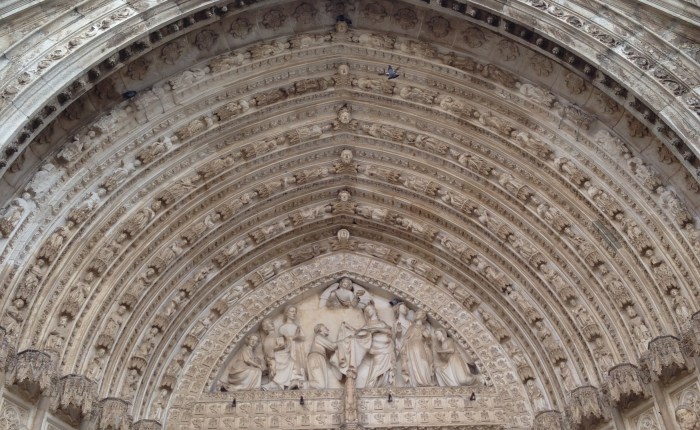
It is arguably not a rational question—maybe not even a real question at all—to ask “Why is there something rather than nothing?” In any case, it is unanswerable. But I still often find myself filled with wonder that I exist, that I can see and hear things, that I have an identity, and that I am a part of this whole universe, so exquisite and vast. Certain things reliably connect me with this feeling: reading Hamlet, looking up at the starry sky, and standing in the Toledo Cathedral. Because it is not rational, I cannot adequately put it into words or analyze it; and yet I think the experience of mystery and awe is one of the most important things in life.

Since it is just a feeling, there is nothing inherently rational or anti-rational in it. I’ve heard scientists, mystics, and philosophers describe it. Yes, they describe it in different terms, using different concepts, and give it different meaning, but all that is incidental. The feeling of wonder is the thing, the perpetual surprise that we exist at all. Campbell helps me to connect with and understand that, and for that reason I am grateful to him.

View all my reviews

Roaming in Rome: Introduction

Roaming in Rome: Introduction

This is Part One of a six-part series on Rome, following this plan:


Arrival

I walked off the plane and into the sweltering heat. Then I paused to look around and breathe in the hot, humid air. I was in Rome.

Well, not quite. I was in the Ciampino airport, about 12 kilometers from the city center. Now I had to find my bus.

Back in Madrid, while I was on the queue to board the plane, a representative from Ryanair went by selling bus tickets. Impulsively I bought one—they were only four euros—and now I had to figure out where to go.

This would not have presented any difficulty to a sane person. But I was stressed and anxious, partly because I am always like that when I travel, but also because this was the first international trip that I had taken by myself. I felt totally exposed and vulnerable. I had no support system if I messed up, nobody to bail me out if I did something stupid. More pragmatically, I did not have a working phone. Anything could happen.

Panic attacks notwithstanding, the bus was easy to find. Exhausted, sweaty, and shaking with nerves, I dropped my bag into the luggage compartment and climbed aboard. The sunlight shone harshly through the window, causing my skin to burn and my face to flush with the heat. The bus seemed to sit there for a long while, as passengers lazily threw their bags into the bottom compartments, and shuffled on.

I felt terribly self-conscious already. What kind of loser travels alone? What did these people think of me? Were they staring at me? Was I staring back? And why wasn’t there air conditioning? Finally the bus began to move, saving me from myself. We were off towards the eternal city.

I could hardly believe it: I was going to Rome. I had been hearing about this city all my life. Roman poets, generals, statesmen, emperors, philosophers, historians, slaves—the names of so many Romans were familiar to me. I was visiting the city where Cicero delivered his speeches, where Virgil penned his verses, and where Caesar bestrode the narrow world like a colossus. All these people were like characters in a long-cherished novel, creatures endowed with the aura of my imagination. Now I would be standing where they stood, under the same sun, sky, and stars, walking on the same soil. (And this is not to mention the Renaissance Italians!)

My eyes were glued to the window. Everything that even hinted at antiquity—crumbled buildings, little run-down shacks, piles of rubble—sent my imagination flying. Were they ruins? Was that a castle? Was this a temple?

Soon reality intervened. Pharmacies, car dealerships, tobacco stores, and rows and rows of ugly buildings surrounded the bus. Pudgy pedestrians walked on the streets, cars honked their horns, and exhaust fumes wafted up into the sky. This was the eternal city?

In fairness, we did pass through a lovely stone gate on the way to the main bus terminal: Termini. (This is an enormous transportation hub, the Roman equivalent of Grand Central.) There, we were dropped off, and soon I was panicking again, wondering how to get to my Airbnb.

Once more, there was nothing inherently difficult or perilous about this. But I was a ragged bundle of nerves, filled with terrible anxiety. Plus, it was hot.

Because I am a millennial, the prospect of navigating a city without Google Maps is alarming. I only ask strangers for directions in emergencies, and I cannot be trusted with a physical map. Luckily, there is Maps.Me, a navigation app that allows you to use your phone even when you don’t have service. (I was confused by this at first, but apparently your phone’s GPS still works even when it’s on airplane mode.) The application is pretty neat, and I certainly recommend it; although it can be pretty laggy and sometimes crashes.

After struggling to find the address in my notebook, walking in the wrong direction, enduring three panic attacks and some hyperventilation; and after getting lost and looking hopelessly at the sky while fighting back tears, I found the apartment. It took about twenty minutes.

I was greeted by a friendly older Italian man, who spoke good English. Seeing him, hearing him, having some of the fresh fruit he offered me—all this calmed me down instantly. I have been talking to Italian people and eating Italian food all my life. I wasn’t in a foreign country; I was somewhere very familiar—where I knew the history, the cuisine, and the culture (though unfortunately not the language). I was in Rome.

I had five days to explore the city, five days to drink up as much of the history, art, and architecture as I could. I got started immediately.


First Impressions of Eternity

What they say about Roman drivers is true: the roads are bedlam. Every time I crossed a street I felt like I was taking my life into my hands. The drivers would not stop to spare a whole kindergarten class. At best, the drivers swerved around me; most did not seem to notice me at all. I would like to see the mortality statistics.

I had been advised not to visit Rome in July; but that was the only time I had available, so I went anyway. Nevertheless, it is good advice. In a word, the weather is inhospitable—hot and humid. Just a few minutes in the afternoon sun were enough to soak my clothes through with sweat. The air hung heavily around me, seeming to physically pull me down.

The only compensation were the drinking fountains. Rome is full of them. Do yourself a favor and bring a refillable bottle. Just watch out of the fountain says “non potable.” Otherwise, drink up—you will need it. Several times I was so thirsty that the water tasted like divine ambrosia.

Because I was trying to save money—and I’m not a connoisseur, in any case—I ate as cheaply as I could. This usually meant eating pizza. I ate a lot of it. Maybe I am a snob when it comes to pizza, but I was not terribly impressed by the quality. The one exception to this was the pizza from a place called Pinsere, which was both excellent and reasonably priced.

Rome is full of tourists in any season, but this is doubly true during the summer—another reason to choose a different time to visit. Everywhere was packed. I could hardly walk three blocks without overhearing Americans chit-chattering away. Rome can be a religious experience, even if you are not religious. But it is hard to appreciate the beauty, history, and sanctity of the place when tour groups go stampeding by, their guide yelling into a microphone; or when you have to keep dodging out of people’s photos; or when the people next to you are whining about the weather while taking several selfies. Complaining about tourists is as old as tourism itself, of course. It is an activity especially popular among tourists. Nevertheless, I suggest that you visit Rome in fall or winter, if you can.

If you knocked down all the churches, destroyed the Roman forum, blew up the Colosseum, dynamited all the monuments, burned the museums, and smashed the statues, then Rome would not be much to look at. The streets are a bit dirty, the buildings are plain, modern, and unremarkable, and the traffic crawls through the streets like a column of army ants.

But of course Rome has churches, ruins, monuments, museums, and statues in abundance.

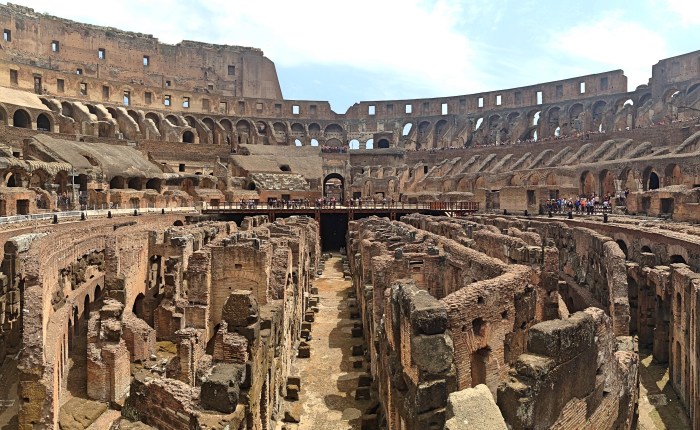
The night of my arrival, I decided to walk to the Colosseum. I got there just as the sun was setting. There it was in the twilight, its familiar iconic form towering above me, shushing me with awe.

How many others had stood in wonder at that same sight? How many others had come to Rome to pay tribute to the civilization that had flourished, conquered, ruled, declined, and then passed away? It boggles the mind that a civilization could build such a thing and then pass away. But Rome was more than an empire; Rome was more than a culture or a people. Rome was an eternal achievement, an achievement for all of humanity, setting a standard of civilization that futures peoples would forever emulate.

Quotes & Commentary #6: Aristotle

Quotes & Commentary #6: Aristotle

History shows that almost all tyrants have been demagogues who gained the favor of the people by their accusation of the notables.

—Aristotle, Politics

This quote has unfortunate contemporary relevance, given this election season. An anti-establishment ethos has characterized both the Democrat and Republic presidential races, an ethos represented by Bernie Sanders and Donald Trump. Both of their campaigns appealed to a broad dissatisfaction with the status quo; and this dissatisfaction was often expressed as a disenchantment with the political class. Both candidates issued sweeping condemnations of the current political system, and promised radical change.

This frustration was, however, apparently more powerfully felt on the right than on the left, particularly among white men, which is why Sanders was defeated and Trump was victorious. Trump has continued his primary strategy into the general election, linking Clinton with Obama, and the two of them with vested interests and the media, and blaming the combination for the country’s current lack of “greatness.”

Now that he’s down in the polls, he is doubling down on this strategy with his accusations of a rigged election. The politicians, the donors, and the media—in short, the rich and powerful, or “the notables”—are conspiring to silence the voice of the people by tampering with election results.

Never mind that he doesn’t provide any evidence to substantiate the claim. It doesn’t matter. Such conspiratorial thinking appeals strongly to the human imagination. Once you suggest there’s a conspiracy, the very lack of evidence becomes a sort of evidence. If there’s a secret, of course we wouldn’t know about it, right? It appeals to a paranoid mindset, seeing significant patterns where none exist, suspecting hidden forces at work behind the scenes.

By questioning the legitimacy of the institution of elections, Trump is positioning himself as a sort of prophet. He can see what others don’t. He is also casting himself as an instrument of the people, a threat that “the notables” must defend themselves from. This is a powerful narrative: a room full of bad guys plotting conspiracies, and a man of the people out to stop them. I know from experience how appealing this story can be; after all, I voted for Sanders in the primary, whose talk of the 1% and Wall Street, and whose criticism of the media coverage (I thought it was bad, too), put him in a similar position.

But of course there are huge differences between Sanders and Trump—so obvious that I feel bad even writing their names in the same sentence. One major difference is that Sanders never questioned the legitimacy of the United States government the way Trump is doing. Sanders accepted defeat and is now campaigning for Clinton. Trump is only intensifying the conspiratorial rhetoric.

This strategy of accusing the notables was ancient by the time Aristotle wrote about it, over two thousand years ago. But it appeals so strongly to our psychology that it is still practiced today. An easy way to gain power is to make people angry at the people who currently wield it. Unfortunately, pointing out problems does not make you qualified to come up with solutions. And someone who is willing to prey on people’s fears shows a cynical contempt for the people, not a desirable quality in a ruler. This is why demagogues so often become tyrants.

Quotes & Commentary #5: Oscar Wilde

Quotes & Commentary #5: Oscar Wilde

“He began to wonder whether we could ever make psychology so absolute a science that each little spring of life would be revealed to us. As it was, we always misunderstood ourselves and rarely understood others. Experience was of no ethical value. It was merely the name men gave to their mistakes.”

—Oscar Wilde, A Picture of Dorian Gray

Oscar Wilde could pack a library into a sentence; and this passage sends my mind off running in multiple directions.

First I am reminded of a book I read long ago: Moonwalking with Einstein, by Joshua Foer. In one section, he talks about the mysterious phenomenon of expertise. How do you become an expert? There is the well-known answer, made famous by Malcolm Gladwell, that becoming an expert requires 10,000 hours of practice. When you pass that threshold, something strange happens.

Foer demonstrates this with a memorable example: chicken sexers. These are the people who examine the rear ends of baby chickens to determine whether they are male or female. (The unfortunate males are dropped down a chute where they are killed. Males are expendable, unluckily for me.)

The task is astoundingly difficult; professionals need to train for years to achieve the required accuracy. But when they do achieve mastery, they are able to see things that others cannot see, and they themselves can hardly articulate. Ask them to explain how they know one chick is female and not male (says Foer), and they will not be able to put their knowledge into words.

This is a universal experience. Teaching and doing are two entirely separate skills. Experts are often not great explainers; and great teachers are sometimes middling performers. Have you ever tried to learn something—playing an instrument, for example—from a real master? Or just somebody far better than you? Have you ever tried to teach a beginner how to do something you’re quite good at?

In these situations, the famous difference between knowing how and knowing that is manifest. I can tie my shoes without looking, but if I tried to explain the steps, I’d probably confuse myself.

Expertise is the product of experience. And experience, as Wilde points out, is just another name for our mistakes. This is easy to forget. A student won’t get better at anything unless she—or an expert teacher—critiques her performance and point out areas that can be improved. Simply strumming a guitar won’t make you Jimi Hendrix, and writing in a diary won’t make you Shakespeare.

Expertise requires that we judge what we do, and then constantly strive to do better. This is what separates training and doing, practicing and performing. In the former, we are self-critical.

Wilde brings in an interesting moral dimension to this notion when he says that experience has no “ethical value.” By that, I think he means that we cannot learn to become a good person simply by doing things. The ethical value comes from us. We need to apply some sort of criterion to our experience; we need to judge right and wrong, better and worse, desirable and undesirable. These judgments are themselves not products of experience; they are applied to experience.

We learn to be good by making mistakes and getting better at judging what is right and wrong, in just the same way that we learn to play piano by making mistakes and learning to recognize what sounds better and worse. Moral expertise is in principle no different from musical expertise: we learn from recognizing our own errors.

Wilde wonders whether we can “make psychology so absolute a science so that each little spring of life would be revealed to us.” I can’t predict the future, but there does seem to me something mysterious about expertise. How can we do something without being able to explain what we’re doing? How can conscious training create unconscious mastery? What is happening in the brain when we get better at something? Can mastery ever be distilled into a book of rules and precepts?

Lastly, there is his comment about “always misunderstanding” ourselves and “rarely understanding” others. It is so true that the motives of others often seem crystal clear, while our own remain deeply mysterious. Some perspective is needed to understand a person, and that is just what we lack when it comes to ourselves. And this lack of perspective on ourselves is one of the things that makes self-study so difficult. If we cannot see ourselves objectively, how can we accurately understand what we need to improve?

On the Quarter-Life Crisis

On the Quarter-Life Crisis

From College to Chaos

In the modern world, there is a certain existential dread that comes with being in your twenties. Certainly this is true in my case.

This dread creeps up on you in the years of struggle, confusion, and setbacks that many encounter after graduating university. There are many reasons for this.

One is that college simply does not prepare you for the so-called “real world.” In college, you know what you have to do, more or less. Every class has a syllabus. Every major has a list of required courses. You know your GPA and how many credits you need to graduate.

College lacks some of that uncertainty and ambiguity that life—particularly life as a young adult—so abundantly possesses. There is a clear direction forward and it’s already been charted out for you. You know where you’re going and what you have to do to get there.

Another big difference is that college life is fairly egalitarian. Somebody might have a cuter boyfriend, a higher GPA, a richer dad, or whatever, but in the end you’re all just students. As a consequence, envy doesn’t have very much scope. Not that college students don’t get envious, but there are far fewer things, and less serious things, to get envious about. You don’t scroll through your newsfeed and see friends bragging about promotions, proposals, babies, and paid vacations.

There’s one more big difference: nothing you do in college is potentially a big commitment. The biggest commitment you have to make is what to major in; and even that is only a commitment for four years or less. Your classes only last a few months, so you don’t have to care much about professors. You are constantly surrounded by people your age, so friendships and relationships are easy to come by.

Then you graduate, and you’re thrown into something else entirely. Big words like Career and Marriage and Adulthood start looming large. You start asking yourself questions. When you take a job, you ask yourself “Can I imagine doing this for the rest of my life?” When you date somebody, you say to yourself “Can I imagine living with this person the rest of my life?” If you move to another city, you wonder “Could I make a home here?”

You don’t see adults as strange, foreign creatures anymore, but as samples of what you might become. You are expected, explicitly and implicitly, to become an adult yourself. But how? And what type of adult? You ask yourself, “What do I really want?” Yet the more you think about what you want, the less certain it becomes. It’s easy to like something for a day, a week, a month. But for the rest of your life? How are you supposed to commit yourself for such an indefinitely long amount of time?

Suddenly your life is not just potential anymore. Very soon, it will become actual. Instead of having a future identity, you will have a present identity. This is really frightening. When your identity is only potential, it can take on many different forms in your imagination. But when your identity is present and actual, you lose the deliciousness of endless possibility. You are narrowed down to one thing. Now you have to choose what that thing will be. But it’s such a hard choice, and the clock keeps ticking. You feel like you’re running out of time. What will you become?

The American Dream

A few weeks ago I was taking a long walk, and my route took me through a wealthy suburban neighborhood. Big, stately houses with spacious driveways, filled with expensive cars, surrounded me on all sides. The gardens were immaculate; the houses had big lawns with plenty of trees, giving them privacy from their neighbors. And they had a wonderful view, too, since the neighborhood was right on the Hudson River.

I was walking along, and I suddenly realized that this is what I’m supposed to want. This is the American Dream, right? A suburban house, a big lawn, a few cars and a few kids.

For years I’d been torturing myself with the idea that I would never achieve success. Now that I was looking at success, what did it make me feel? Not much. In fact, I didn’t envy the people in those houses. It’s not that I pitied them or despised them. I just couldn’t imagine that their houses and cars and their view of the river, wonderful as it all was, made them appreciably happier than people without those things.

So I asked myself, “Do I really want all these things? A house? A wife? Kids?” In that moment, the answer seemed to be “No, I don’t want any of that stuff. I want my freedom.”

Yet nearly everybody wants this stuff—eventually. And I have a natural inclination to give people some credit. I don’t think folks are mindless cultural automatons who simply aspire to things because that’s how they’ve been taught. I don’t think everybody who wants conventional success is a phony or a sell-out.

Overwhelmingly, people genuinely want these things when they reach a certain point in their lives. I’m pretty certain I will want them, too, and maybe soon. The thing that feels uncomfortable is that, in the mean time, since I expect to want these things, I feel an obligation to work towards them, even though they don’t interest me now. Isn’t that funny?

Equations of Happiness

One of the reasons that these questions can fill us with dread is that we absorb messages from society about the definition of happiness.

One of these messages is about our career. Ever since I was young, I’d been told “Follow your passion!” or “Follow your dreams!” The general idea is that, if you make your passion into your career, you will be supremely happy, since you’ll get paid for what you like doing. Indeed, the phrase “Get paid for what you like doing” sometimes seems like a pretty decent definition of happiness.

Careers aren’t the only thing we learn to identify with happiness. How many stories, novels, and movies end with the boy getting the girl, and the couple living happily ever after? In our culture, we have veritable a mythology of love. Finding “the one,” finding your “perfect match,” and in the process finding the solution to life—this is a story told over and over again, until we subconsciously believe that romantic love is the essential ingredient to life.

Work and Love are two of the biggest, but there are so many other things that we learn to identify with happiness. Having a perfect body, being beautiful and fit. Beating others in competitions, winning contests, achieving things. Being cool and popular, getting accepted into a group. Avoiding conflict, pleasing others. Having the right opinions, knowing the truth. This list only scratches the surface.

In so many big and little ways, in person and in our media, we equate these things with happiness and self-worth. And when we even suspect that we don’t have them—that we might not be successful, popular, right, loved, or whatever—then we feel a sickening sense of groundlessness, and we struggle to put that old familiar ground beneath our feet.

Think of all the ways that you measure yourself against certain, self-imposed standards. Think of all the times you chastise yourself for falling short, or judge yourself harshly for failing to fit this self-image you’ve built up, or fallen into a dark hole when something didn’t go right. Think about all the things you equate with happiness.

Now, think about how you judge your good friends. Do you look down on them if they aren’t successful? Do you think they’re worthless if they didn’t find “the one”? Do you spend much time judging them for their attractiveness, popularity, or coolness? Do you like them less if they lose or fail? If someone else rejects them, do you feel more prone to reject them too?

I’d wager the answer to all these questions is “No.” So why do we treat ourselves this way?

Is it the Money?

There’s no question that the quarter-life crisis is partly a product of privilege. It takes a certain amount of affluence to agonize over what will be my “calling” or who will be “the one.” Lots of people have to pay the rent; and their work and romantic options are shaped by that necessity. When you’re struggling to keep your head above water, your anxiety is more practical than existential. This thought makes me feel guilty for complaining.

But affluence is only part of the it. The other is expectation. Many of us graduated full of hope and optimism, and found ourselves in a limping economy, dragging behind us a big weight of college debt. Just when we were supposed to be hitting the ground running, we were struggling to find jobs and worrying how to pay for the degree we just earned. And since many of us had been encouraged—follow your dreams!—to study interesting but financially impractical things, our expensive degrees seemed to hurt us more than help us.

This led to a lot of bitterness. My generation had been told that we could be anything we wanted. Just do the thing you’re passionate about, and everything will follow. That was the advice. But when we graduated, it seemed that we’d been conned into paying thousands of dollars for a worthless piece of paper. This led to a lot of anger and disenchantment among twenty-somethings, which is why, I think, so many of us gravitated towards Bernie Sanders. Our parents had a car, a house, and raised a family, while we were living at home, working at Starbucks, and using our paychecks to pay for our anthropology degree.

For a long while I used my sense of injustice to justify my angst. I had the persistent feeling that it wasn’t fair, and that went back and forth between being angry at myself or the world.

Nevertheless, I think that, for most middle class people, financial factors don’t really explain the widespread phenomenon of the quarter-life crisis.

I realized this when I started my first decent-paying job. I wasn’t making a lot of money, you understand, but I was making more than enough for everything I wanted. The result? I felt even worse. When I took care of the money problem, the full weight of the existential crisis hit me. I kept asking myself, “Can I really imagine doing this forever?” I thought about my job, and felt empty. And this feeling of emptiness really distressed me, because I thought my job was supposed to be exciting and fulfilling.

This was a valuable lesson for me. I expected the money to calm me and make me happy, and yet I only felt worse and worse. Clearly, the problem was with my mindset and not my circumstances. How to fix it?

From Crisis to Contentment

Well, I’m not out of it yet. But I have made some progress.

First, I think it’s important to take it easy on ourselves. We are so prone to hold ourselves up to certain self-imposed standards, or some fixed idea of who we are. We also like to compare ourselves with others, feeling superior when we’re doing “better,” and worthless when we’re doing “worse.” Take it easy with all that. All of these standards are unreal. You tell yourself you’re “supposed” to be doing such and such, making this much money, and engaged at a whatever age. All this is baloney. You aren’t “supposed” to be or to do anything.

Bertrand Russell said: “At twenty men think that life will be over at thirty. I, at the age of fifty-eight, can no longer take that view.” He’s right: There is nothing magical about the age of thirty. There is no age you pass when you don’t have to worry about money, about your boss, about your partner, about your health. There will always be something to worry about. There will always be unexpected curveballs that upset your plans. Don’t struggle to escape the post-college chaos; try to accept it as normal.

Don’t equate your happiness or your self-worth with something external. You are not your job, your hobby, your paycheck, your body, your friend group, or your relationship. You aren’t a collection of accomplishments or a Facebook profile. You’re a person, and you have worth just because you’re a person, pure and simple. Everything else is incidental.

If you want to be rich, famous, loved, successful—that’s fine, but that won’t make you any better than other people. It might not even make you happier. Don’t worry so much about putting ground under your feet. Don’t fret about establishing your identity. You will always be changing. Life will always be throwing problems at you, and sometimes things will go wrong. Try to get comfortable with the impermanence of things.

Don’t look for the “meaning” of life. Don’t look for “the answer.” Look for meaningful experiences of being alive. Appreciate those moments when you feel totally connected with life, and try to seek those moments out. Realize that life is just a collection of moments, and not a novel with a beginning, middle, and end.

These moments are what bring you happiness, not the story you tell about yourself. So you don’t have to feel existential dread about these big Adult Questions of Love and Work. It’s important to find a good partner and a good job. These things are very nice, but they’re not what give your life value or define you or make life worth living. Treat them as practical problems, not existential ones. Like any practical problem, they might not have a perfect solution, and you might fail—which is frustrating. But failure won’t make you worthless, just like success won’t legitimize your life.

One last thing. Stop caring about what other people think. Who cares? What do they know? Be a friend to yourself, be loyal to yourself. Every time to judge yourself, you betray yourself. In a thousand little ways throughout the day, we reject our experiences and our world. Don’t reject. Accept. Stand steadfastly by yourself as you ride down the steady stream of thoughts, feelings, flavors, colors, sounds, mistakes, accidents, failures, successes, and petty frustrations that make up life as we know it.

Quotes & Commentary #4: Dostoyevsky

Quotes & Commentary #4: Dostoyevsky

“Man grows used to everything, the scoundrel!”

—Fyodor Dostoyevsky, Crime and Punishment

This short exclamation is one of my favorite quotes of Dostoyevsky, and I find myself saying it under my breath all the time. The quote is arresting because it condemns as bad something we normally think of as good: human adaptability.

This adaptability—and adaptability is closely tied with intelligence—is what has allowed us conquer nearly every corner of the world. We can fashion clothes for cold climates, accustom ourselves to new technologies, and retain a childlike ability to learn new things throughout our lives.

Like anything, however, adaptability has a darker side. I know this from my own experience. When you live in New York—or Madrid, for that matter—you quickly grow used to passing homeless people on the street. At first, something inside of you rebels against this state of affairs. It is unconscionable that we can live such a heartless society, where the poor are simply left behind.

But then your outrage turns into selfishness when you are accosted for money; and your heart hardens when you pass them day after day. Soon the homeless have been completely dehumanized in your eyes, and the situation is regarded as normal. 

I’m not proud of admitting that this happens to me, but it does. I simply get used to it. I can’t maintain outrage or compassion forever. The feelings dissipate, and numbness comes creeping in.

This is just an illustration. People have gotten used to more horrible things than homelessness. One need only read about some of the darker periods of history to see how far this process can go. Injustice and cruelty, if practiced regularly, become expected, customary, unremarkable. Humans aren’t always scoundrels, but too often are.

Quotes & Commentary #3: John Milton

Quotes & Commentary #3: John Milton

The mind is its own place, and in itself

Can make a heav’n of hell, a hell of heav’n.

—John Milton, Paradise Lost

How often have these words been proven true in my life? I can dislike even the most pleasant things if I set my mind to it (a rather perverse thing to boast about).

Like many people, this truth is most apparent when I am being forced to do something against my will. Even when it’s something I enjoy, if I feel that I’m being cajoled or pressured to do it, I will instantly become stubborn and bitter. I love to sing; but if you pressure me to sing, I will take a vow of silence; and if you somehow make me sing, I’ll hold a grudge against you for as long as I live.

Once we realize how much our happiness is a product of our mentality, it frees us to choose to think differently, and thus to feel differently. This is the principle behind many philosophies and religions—Stoicism, Buddhism, and Cognitive Behavioral Therapy. For me, learning to focus on my mindset rather than my circumstances has been enormously beneficial; sometimes it’s impossible to change the world, but you can always change your mind.

Yet there is a limit to this. Some situations are just more pleasant than others; and some conditions are dehumanizing and dreadful. Milton implies this when he puts this quote into the mouth of Satan, who was just recently banished to hell. Satan is really deluding himself that he can be just as happy in hell as in heaven. The differences between his fallen state and his former blessed life is too apparent.

Even so, I think it’s generally true that the greatest source of our happiness or unhappiness is our expectations, assumptions, interpretations, and our fears. We may not be able to make a heaven of hell or a hell of heaven, but we can make both a heaven and a hell of earth.

Review: Publishing 101

Review: Publishing 101

Publishing 101Publishing 101 by Jane Friedman

My rating: 4 of 5 stars

I teach the rules, even though there aren’t any.

Several years ago I embarked upon a novel (my second; although my first attempt was so slapdash and haphazard that it hardly deserves the name). As it gradually took form, and draft after draft accumulated, the idea that I might actually do something with it appeared less and less absurd. But few things are more mysterious to me than the world of publishing. Every time I tried to investigate, a hornet’s nest of unfamiliar entities—agents, editors, query letters, submissions guidelines, genre, category, digital platform—swarmed and buzzed so menacingly until I gave up, overwhelmed. I needed someone to hold my hand, a Virgil to guide me through the several circles of pre-publication hell. That’s where Friedman came in.

Friedman has been in the publishing industry a long time, notably working as the publisher and editorial director of Writer’s Digest. Now she is perhaps best-known for her blog on writing advice. This book was made from that blog, stitching together the most popular posts since 2008 into a basic guide. In theory, you could get everything in this book for free by rummaging around her site. But the book is cheap on Kindle, so what the heck.

Friedman is a sober and pragmatic guide. This is what I like about her. She is not promising miracles, she knows that no approach will work for everyone (or even most people), she has no illusions about the failure rate. There is no magical thinking in this book, only cold and calculated strategies to incrementally increase your likelihood of success. Absent from this book are those “self-help miracle stories” that one so often finds in the writings of professional advice givers.

She is also a fountain of information. Here you will find advice on traditional publication, self-publishing, as well as ample instruction on digital marketing, online platform, and all the other things that keep me up at night. Indeed, Friedman is most enthusiastic and convincing when it comes to online self-promotion. This is unsurprising, since this was her main avenue of success. Still, I think many would-be writers will be surprised by how much of this book is given over to marketing rather than researching and contacting publishers. I know I was.

There is an awful lot of sales talk in this book. Trying to publish a book is, after all, just marketing a product (although I find it bemusing to consider my poor manuscript a commodity). And I must admit that all this talk of hard-selling, soft-selling, building a network, connecting with fans, and suchlike salesy things sometimes gives me a queasy feeling in my stomach. Many writers, I suspect, write to get away from all that, not to make it a permanent fixture in their lives. Writers are not known for being particularly social, suave, or business-savvy creatures.

Nevertheless I think Friedman’s advice is sane and sensible. Her main nugget of wisdom is that your online presence should not be forced or mercenary. Write a blog about something you care about; connect with people just for fun; do things that interest you and that are connected with your creative work. It takes patience and persistence to establish any kind of reputation, following, or clout, so you’ve got to see your digital activity as something rewarding rather than a chore. Easier said than done, I’m sure.

Like anything under the sun, this book is not without its flaws. The main flaw, as Friedman herself acknowledges, is that it was originally written as a series of blog posts. (At one point she says: “If I read a book and think ‘I could’ve gotten this from a series of blog posts,’ then I consider it a failure.” Luckily for her, I’m more lenient in this regard.) The writing is filled with lists, bullet-points, and a relentless stream of short paragraphs. Such writing works extremely well on a blog, of course, where most people are simply scanning for information; but in a book, it grows tiresome.

Another thing I missed was concrete examples. Friedman’s advice, though sensible, was often abstract; often I wished she would give me the story of an author she helped, or just a short vignette about someone who successfully implemented her strategies. I’m sure she has many such stories, and I wished she had used some of them, since they would have brought warmth and blood to potentially anemic advice.

There were also many times I was inclined to doubt her recommendations. For example, Friedman is very keen on authors having their own websites. Now maybe I am exceptional, but I have never, not once, visited an author’s website. Have you? Also, she suggests that you gather emails and send out blasts (not indiscriminately) when you have a big update. But again, I habitually delete all emails that aren’t work related or personal. Doesn’t everyone?

All these quibbles and queries aside, however, I think that this is an excellent book. Friedman is realistic, thorough, and businesslike, without sacrificing the raison d’être of writing: to create and to enjoy the process of creation. Unfortunately for me, I am now fairly convinced that my own poor manuscript hasn’t much commercial potential (but now that I see how brutal the publishing industry is, I’m not sure I mind). In any case, for those lost souls wandering around inferno, looking for the path to paradise, Friedman will be your guide. But be warned: a long climb up Mt. Purgatory awaits!

View all my reviews