Roaming in Rome: Basilicas

Roaming in Rome: Basilicas

This is Part Three of a six-part series on Rome, following this plan:


Rome’s basilicas comprise one of the city’s most popular attractions, and rightly so: they are among the most beautiful examples of religious architecture in the world.

The four so-called major basilicas, so designated by the Pope, are all within the diocese of Rome. These are San Giovani in Laterano, Santa Maria Maggiore, San Paulo Fuori Le Mura, and St. Peter’s in the Vatican (which I discuss in my Vatican post). Besides these four major basilicas there are a multitude of minor basilicas to visit, which are minor in name only.


Santa Maria Maggiore

Santa Maria Maggiore is one of the few churches in Rome for which you need to pass through security to enter. In addition to the security guards manning the metal detector there are burly Italian soldiers carrying assault riffles standing outside. All these defenses should tell you that this is a precious building.
Santa_MariaMaggiore1

Santa_Mariamaggiore2

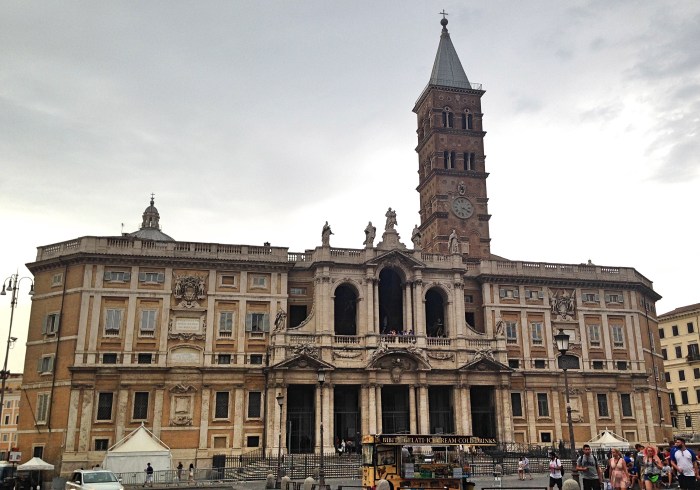
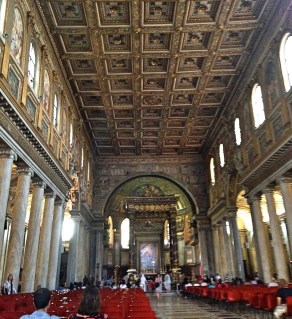
From the outside, the Basilica is hard to miss. Aside from its massive size, the basilica is notable for having the highest bell tower in Rome, a lovely 14th century construction. The inside is even more impressive. When you stand in the center, looking down the central nave, everything seems to be made of solid gold. The coffered ceiling is covered in gilded wooden flowers. Light pours in through the top row of windows, which sit above a row of marble columns. Straight ahead is the main chapel; on the apse above is a mosaic of the Virgin Mary’s coronation amid a golden background. The decoration is absolutely sumptuous.

Santamaria_dome

The feature that most stuck in my memory was a sculpture of Pope Pius IX in prayer, which sits in a sunken area before the main altar. But much more important, historically and artistically, are the mosaics. Mosaics run along the nave in a row under the window, and also surround the semidome above the main altar. Unfortunately, the mosaics on the nave are difficult to see from the ground, but those around the arch are lovely works of art.


Santa Giovanni in Laterano

Bad luck again. I followed my phone to the Basilica di Santa Giovanni in Laterano, and it was not open. The gates were shut, the doors were closed.

In the plaza nearby was another Egyptian obelisk. (This is the Lateran Obelisk—the largest ancient obelisk in the world, apparently. I am embarrassed to say that I hardly took the time to look at it.)

I sat down sullenly on the surrounding barrier, determined to wait until the basilica opened. The thin metal railing was uncomfortably skinny, so I switched to one of the concrete supports. That was slightly better, but still too spherical to make a good seat. If I leaned forward or back, I would slip off; and my tail bone kept rubbing painfully against the concrete. On top of that, it looked like it was going to rain.

I sat and waited. A family of tourists walked up to the gate and then turned back, disappointed. A young couple did the same. Meanwhile, two Italian soldiers, standing beside an armored vehicle and carrying intimidating assault riffles, talked amongst themselves. Their job was not to interact with tourists; their job was to shoot anyone who did anything fishy.

An hour went by. Now it was drizzling. I began to seriously doubt whether this basilica was worth it. The outside was not terribly impressive. Maybe I could just bag it? But I’d come all this way to see it! And there’s no reason it should be closed. Idly, I checked the map on my phone. I could see that the building was quite big, occupying a whole block all by itself. Maybe there was another entrance?

With nothing to lose, I got off my perch, my bottom a bit tender, and walked around the corner. Once there, I smacked myself in the head. This was obviously the entrance. I had been waiting in the wrong place for a whole hour. But I am too used to messing up to get very frustrated when it happens.
SanGiovanni_Laterano

As I lingered near the entrance, I was amused to see a young American couple being forced to tie bits of colorful cloth around their waists. They had to do this because they were both wearing shorts, and the churches in Rome have a dress code. In my brief experience, this dress code applies more stringently to women than to men; several times I observed men walking around basilicas in shorts, while women were always made to cover up their shoulders and legs. Keep this in mind on your visit.

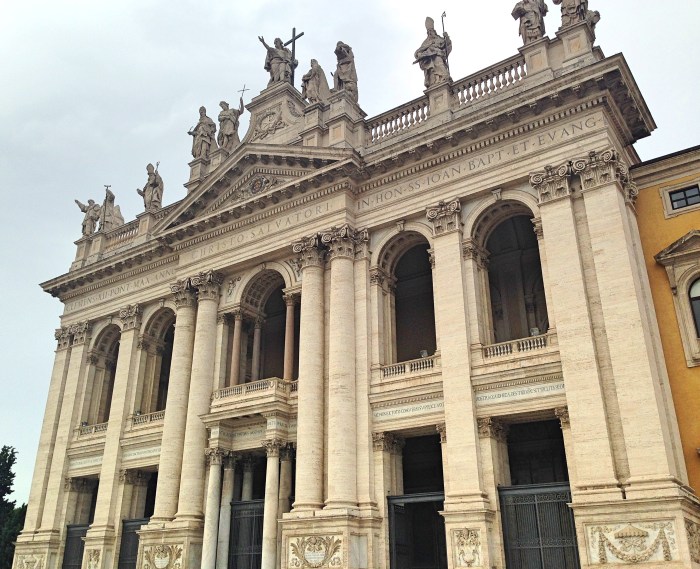
The façade of the basilica is austere and neoclassical, full of straight lines and right angles, rising up to an impressive height. The interior is still more impressive. The main nave is cavernous and enormous. Far above hangs the gilded wooden ceiling, sectioned off into quadrilaterals and covered in armorial and floral motifs. The main altar is covered with a gothic baldachin; this is like a guard tower, with two figures (presumably saints) keeping watch inside.
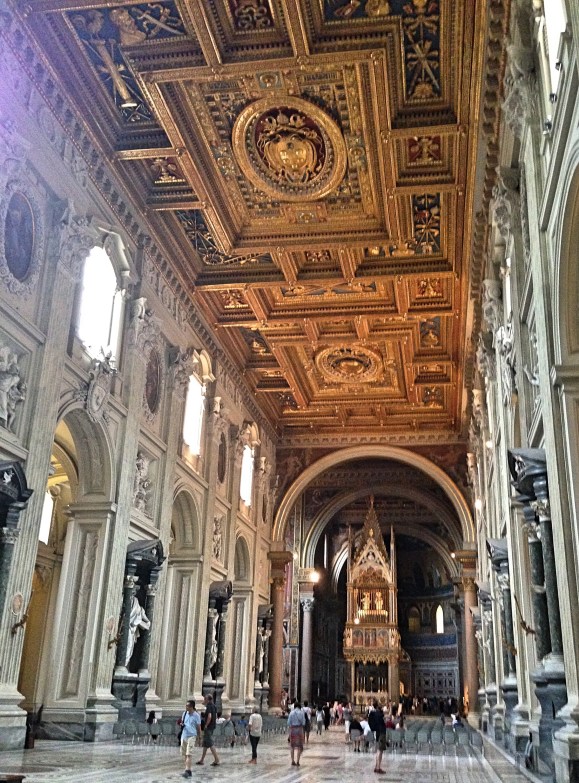
sangiovanni_laterano1

The most outstanding feature of the basilica, however, is the series of statues of the twelve apostles. These are situated in niches in the columns of the main nave. Under the direction of Pope Clement XI, in the early years of the eighteenth century, seven sculptors were commissioned to make these statues. Each one larger than life-size, and each one is elegant and glorious.

Walking from one end of the basilica to the other, from the entrance to the main altar, dwarfed beneath the gilded roof, passing between these dramatic apostles with their flowing robes and outstretched hands, you can feel the gripping power of the Catholic faith—even if, like me, you do not belong to it.


San Clemente al Laterano

The Basilica of San Clement is one of the more historical and well-known minor basilicas in Rome. Unfortunately for me, my experience with this basilica is largely of frustration.

The first time I went—and I walked everywhere in Rome, so this was a major investment of time—it was closed. I do not know why it was closed, since it was the middle of the day, but it was.

The second time I went was quite late. I arrived at 5:30, just half an hour before the basilica shut its doors for the day. This normally wouldn’t have been a problem; the place is not very large, so half an hour was more than enough time to see everything.

But the Basilica of San Clement is not famous for its main floor; it is famous for what lies buried underneath. The present basilica—which I shall describe in a moment—was built around the year 1,100, over the remains of an older, smaller basilica, which had been converted from the remains of a Roman house. This house had served, at various times, as an early Christian church and as a small temple to the god Mithras. Before that, there had been a house built during the Roman Republic, destroyed in 64 AD by the Great Fire. These ruins are preserved in the lower levels of the basilica.
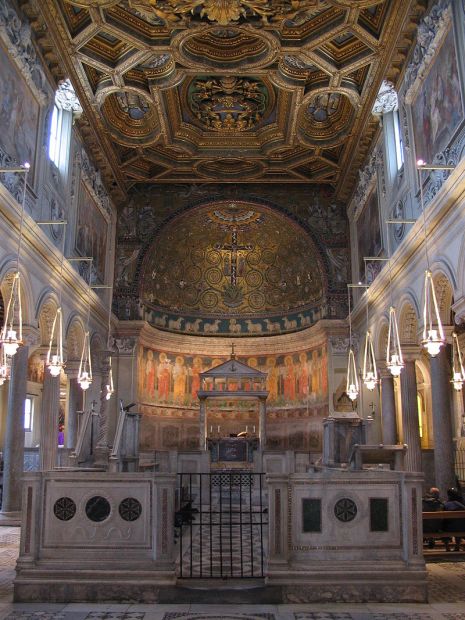
800px-Interior_of_San_Clemente,_Rome
The “second basilica” of San Clemente in Laterano. Photo by Sixtus; licensed under CC BY-SA 3.0; taken from Wikimedia Commons

The basilica itself, like all basilicas in Rome, is free to enter; but you need to pay to go down to the basement levels to see the archaeological remains. I was more than willing to pay, since it sounded fascinating, but by the time I arrived they had stopped taking new visitors. I missed my opportunity. But I record this so you do not make the same mistake.

In any case, the current basilica was worth a visit. It is more on the scale of a church than a basilica; the roof does not tower above you, and there is no overwhelming sense of space. The semi-dome over the main altar, and the wooden roof above the central nave, are richly ornamented and glimmering with gold. The paintings and designs decorating the semi-dome have that lovely, medieval simplicity that always strikes me as noble and fresh.


San Paulo Fuori Le Mura

The only subway ride I took in Rome was to see the Basilica of Saint Paul Outside the Walls. As you might have guessed, its name derives from the fact that it was situated outside of the (now nonexistent) walls of Rome. As a consequence, the basilica is quite far from the city center, which is why I had to take a subway.

The train was absolutely covered in graffiti. It reminded me of photos I had seen of the New York City subway in the seventies. There must be very lax security if people are able to so completely cover the outside of the train cars. I always wonder: where and how graffiti artists do it? Is there a place where the trains are stored for the night, that the artists can sneak into? Maybe a railway yard in some corner of the city? For my part, I thought that the paint job was a little messy, but I appreciated the bright colors.

Rome_metro

The walk from the metro to the basilica was instantaneous. In a second I was there, sweating like a pig in the Roman sun, facing the grand edifice. To enter, I needed to pass through military-controlled security, perhaps because the basilica, although in Italy, is technically owned by the Vatican. I was going through customs.

Before entering the basilica proper, you must pass through a courtyard. In the center is a statue of Saint Paul, sword in one hand, book in another, his bearded face staring down ominously. The courtyard is surrounded on all sides by rows of elegant columns, which makes it feel more like a Roman ruin than a Catholic church.
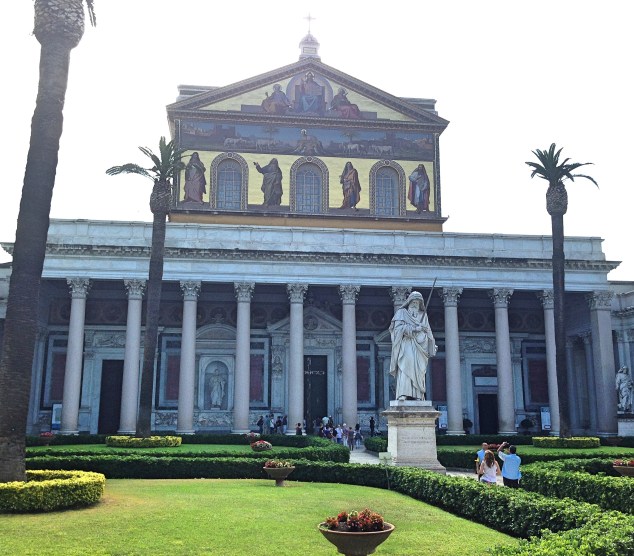
san_pablofuori

And indeed, this feeling is justified by the history of San Clement Outside the Walls. The basilica was founded all the way back in the reign of Constantine, and was later expanded by Theodosius in 386. Although damaged at various times in its history due to wars and earthquakes, it retained its original, ancient form until 1823. That year, a workman repairing the roof inadvertently caused a terrible fire that consumed nearly the whole structure. As it stands now, the building is almost entirely a reconstruction. It is ancient in design, but modern in appearance and execution.
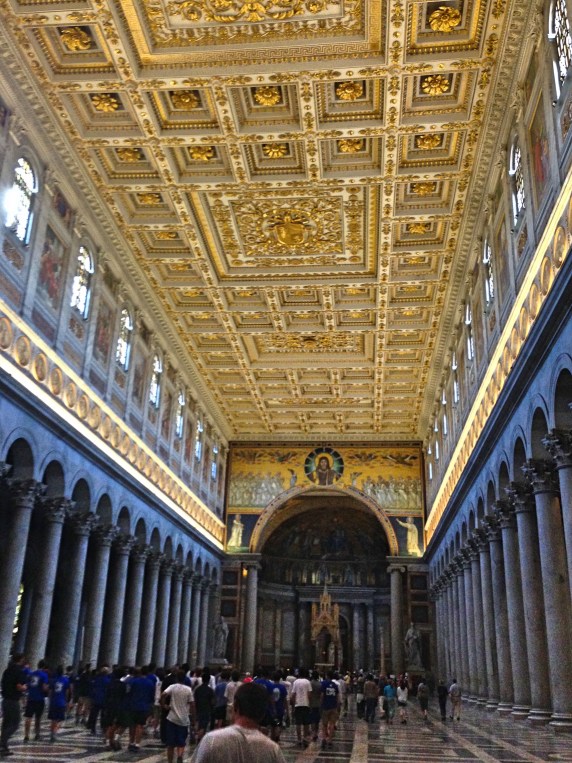
san_pablofuori2

When I went inside, the most lasting impression was of space. Even more than other basilicas, Saint Paul’s is vast and spacious. The paneled ceiling, covered in golden designs and decorations, glows from the light pouring in through the top row of windows. Between each of these windows is a painting of an episode from Saint Paul’s life. The ceiling is so long and wide, and the area underneath so empty, that it seems impossible it could stay suspended above you without more support. Why doesn’t the middle crack under so much weight?

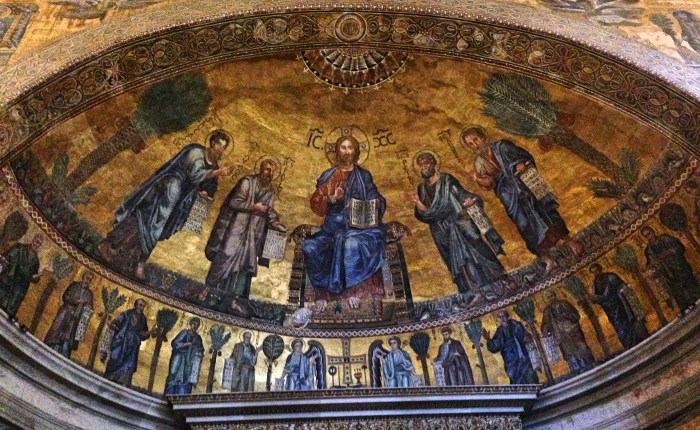
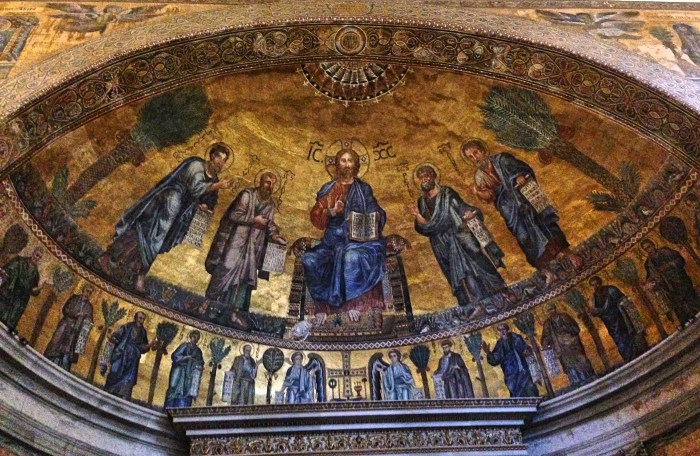
The most beautiful part of the basilica, for me, was the apse mosaic. It captures wonderfully the medieval mood of simple piety that I find so appealing in religious art. Sitting underneath it, with Jesus benignly looking down upon me, I thought I could feel a trace of the comfort that believers must feel in these sacred places.
San_Pablofuori3

But I have not yet mentioned the basilica’s most holy treasure: the grave of St. Paul himself. In truth, there is not much to see. In a lowered section of the floor, there is a clear, plastic panel through which can be glimpsed white stone. In a wall adjacent there is another transparent screen with more white stone. I would not have had any idea what I was looking at if there hadn’t been a sign.

By chance, just when I walked down the stairs to see this tomb, an entire American football team came marching into the cathedral. They seemed to be of college age, and there must have been at least fifty. A nun with an Irish accent guided them to the tomb (I made a hasty retreat to get out of their way) and they all gathered to hear her give a brief explanation. Then, they all bowed their heads in prayer.

Perhaps I am just a cynic, but I could not help wondering how much time these burly, hormonal males spend on spiritual things compared with the time they devote to girls and sports. None of them looked particularly excited to be there.


Santa Maria in Trastevere

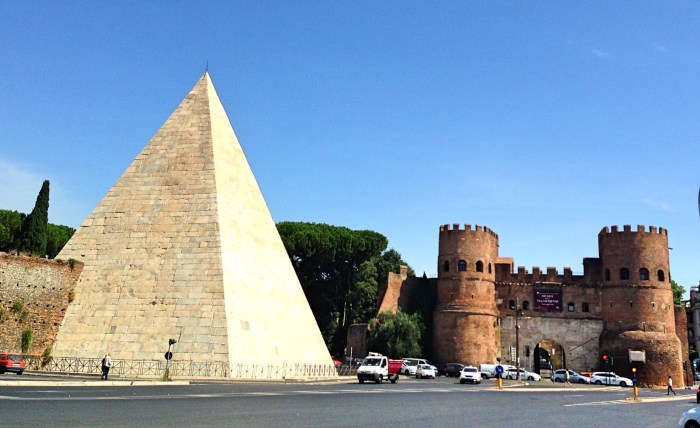
From Saint Paul Outside the Walls I took a long walk to Trastevere. For the most part, this walk was unexciting and unpleasant—just sweating and slogging my way past apartment buildings and parking lots in the heat and humidity. The most notable exception to this pattern of boredom was when I turned a corner and saw a pyramid.
Rome_pyramid

This is the Pyramid of Cestius, and is actually one of the best-preserved ancient buildings in Rome. To me it looked as though it could have been built yesterday. Instead, it was built in around 12 BCE as a tomb for Gauis Cestius, a magistrate, when Rome was conquering Egypt and there was consequently a fad for Egyptian paraphernalia in the city. I thought it was strange that Cestius would put up a tomb in the middle of the city; but of course, back when it was built, the tomb was well outside the city walls, and the city later expanded around it.

It has since been incorporated into the Aurelian Walls. This was done to save money and materials, but it looks a little funny to see a pyramid with walls sticking out on both sides. The fortified gate near the pyramid is also well-preserved.

I did not know this at the time, but near the pyramid is the famous Protestant Cemetery, where John Keats and Percy Bysshe Shelley are buried. It is funny how fame works. Keats and Shelley have modest tombstones, no bigger than average; and yet they will be remembered at least as long as English is spoken. The name of Gaius Cestius, by contrast, is not associated with any notable words or deeds; the only reason we remember him is for his peculiar and grandiose taste in funerary architecture.

The novelist Thomas Hardy visited this area in 1887 to pay his respects to Keats and Shelley. The sight inspired him to write a poem, Rome: At the Pyramid of Cestius near the Graves of Shelley and Keats. He begins by asking: “Who, then, was Cestius / And what is he to me?” He continues:

I can recall no word
Of anything he did;
For me he was a man who died and was interred
To leave a pyramid

And so he was.

Soon I passed the pyramid, walked through the gate, and found myself in Trastevere. This is one of the most historical and most hip neighborhoods in Rome. It is attractive for tourists because of its narrow, stone-paved streets and its plentiful bars and restaurants.

The basilica of Santa Maria in Trastevere is one of the oldest churches in the city. The basic floor plan comes from the 4th century; and the building as it stands now was largely built during the Romanesque period.

Santa_Maria_Trastevere

The basilica is lovely from the outside. Unlike many basilicas, it is not imposing or grandiose, but humble and pleasant. Its graceful brick campanile stands above a simple, triangular roof. At the top of the bell tower, above the clock, there is a small mosaic of the Virgin and Child, easy to miss if you are not looking; and beneath the roof is another, larger mosaic of the Virgin, surrounded by women holding lamps.

Santa_mariatastevere3

The inside of the basilica is even more charming. Its paneled roof is particularly nice; it is divided into stars, crosses, and other shapely forms, and has a painting of the assumption of the Virgin in the center. The glory of the basilca, however, is its apse, covered in medieval mosaics by Pietro Cavallini. (This is the same artist who did the mosaics in Saint Peter Outside the Walls, which were destroyed in the fire.) As is fitting in a church dedicated to the Virgin Mary, these mosaics depict her life, and center on her coronation in heaven.

santa_mariatrastevere2.jpg

Before moving to Spain, I had already thought the art of medieval Europe was simpleminded and cartoonish. But the more I look at this profoundly religious style, the more I fall under its spell. There is no pretence at realism. Two-dimensional figures, hardly individualized, stand in a neutral space with a gold background. And yet it is this lack of realism that allows the artwork to be so emotionally expressive. The figures are frankly symbols of higher things, too subtle and spiritual to be realistically expressed; the sign can thus not be confused with its signifier.

I sat under the apse and thought about time. How many years had it taken to build that basilica? How long has it stood? How many have worshipped here? How many have visited? I tried to think of all the people who were somehow connected with the basilica’s existence: the men who mined the rock, who baked the bricks, who carried the materials from the quarry to the building site. The Early Christians who founded the religion amid persecution, and the later Christians who built up the Catholic Church into the most impressive institution of the medieval world. The Popes who commissioned works, the priests who gave services, the artists who painted and sculpted. The poor mother who left a donation every Sunday. The specialists who helped preserve the aging artwork. The tourist who visits and takes a picture with his phone.

I thought of all the years that went into the place, and all the people who contributed, directly and indirectly, in big ways and small, and I thought about how many more people would visit this basilica after I was dead and gone, and I grasped, just slightly, how small I am in the grand scheme of things. Now, that is some good religious architecture.
 

Quotes & Commentary #29: Evans-Pritchard

Quotes & Commentary #29: Evans-Pritchard

A man is a member of a political group of any kind in virtue of his non-membership of other groups of the same kind.

—E.E. Evans-Pritchard, The Nuer

Evans-Pritchard—or “EP,” as his friends called him—was one of the great pioneers of cultural anthropology. His work among the Nuer, a Nilotic ethnic group living in modern South Suden, is now regarded as among the classics of anthropology.

I read his work when I was just a young anthropology student. After all these years, this quote has stayed vividly in my memory because, though not occupying a central position in EP’s thought, I think it says something profound about the nature of social behavior.

Consider this typical habit. If somebody from Europe asks me where I’m from, I say the United States. If an American asks me the same question, I say I’m from New York. If the person is a New Yorker, I say I’m from Westchester; and if they’re also from Westchester, I say I’m from Sleepy Hollow.

Thus, I locate my identity with increasing precision depending on the proximity of our origin. Differences between people become more important, paradoxically, the more similar you are. Freud called this phenomenon “the narcissism of small difference,” and it is memorably portrayed in EP’s book.

The Nuer, a tall, thin, pastoral, cattle-herding people, are constantly at war with the Dinka. The Dinka also speak a Nilotic language, are also characteristically tall and thin, they also herd cattle. An outsider would likely have trouble telling the two groups apart. And yet the Nuer look down upon the Dinka with disdain and disgust, regarding them are nearly subhuman, and never hesitate to inflict violent raids upon them.

This sounds ridiculous; but consider how often we do the same thing. Indeed, it is of the nature of our social identities that they are defined by the groups they are opposed to.

The phenomenon is especially visible in sports. Here in Spain, your identity is signified by the football team you support. Being a fan of any given team has political and cultural overtones. The ideological tension between Madrid and Barcelona is symbolized by the rivalry between Real Madrid and Barça (known as El Clásico). Likewise in New York the Yankees and the Mets attract different demographics.

Politics, too, is classic example. To be a Democrat means being opposed to everything the Republicans do and believe; and vice versa. To quote a recent Op-Ed article by the comedian Trevor Noah: “Either black people are criminals, or cops are racist—pick one. It’s us versus them. You’re with us, or you’re against us.” Even the minor parties are defined by their contrast to the major ones. A member of the Green Party is somebody too leftist and idealistic to be a Democrat; and a libertarian is somebody who disagrees with the Republicans on social issues and with the Democrats on economic ones. And so on.

Less apparent, though no less real, is the operation of this phenomenon in the sphere of culture. This was demonstrated by the work of Pierre Bourdieu’s classic sociological study, Distinction. There he documents how people use their taste in music and literature in order to define their position in the social scale.

Snobbishness is an attempt to distance oneself from other groups by snubbing your nose at their art and culture; and in so doing, you signal your allegiance to your own group and construct your own social identity. Just consider how much time people have spent publically complaining about Twilight or Fifty Shades of Grey. Why do people so enjoy—in the privacy of friendly conversation and the openness of social media—berating movies, shows, songs, and books? And why do we often consider a person’s taste to be such a critical factor of who they are?

In the words of Oscar Wilde (who was right about everything): “More than half of modern culture depends on what one shouldn’t read.”

I myself, I am ashamed to admit, have viciously judged others by what books they read and didn’t read—even by what books they have or hadn’t heard of. Likewise, in various circumstances I have been judged for my lack of knowledge of Buddhism, rap, postmodern philosophy, contemporary physics, and the history of the United States.

The knowledge deemed “crucial” varies from group to group. And in each case, some other reason is given for their snobbishness. Buddhism can save your life! Physics is the nature of reality! You need to know all the names of the Supreme Court justices in order to be a conscientious citizen! And so on. But the truth is that all this knowledge, while useful and interesting, also serves as a social marker, identifying your place in the complex, ever-shifting, overlapping hierarchies that we use to negotiate the public world.

Take a moment to reflect on this. How much of your own identity is constructed from this process of embracing and scorning, of judging and condemning, of critiquing and collecting, of identifying and opposing? How much of our self-image is composed of the types of movies we watch, the genres of music we listen to, the sophistication of the books we read? How much of your sense of self is a reflection, a negative definition formed by you self-consciously not belonging to a certain political party?

Personally, when I ask myself these questions, I find the answer very disturbing. Yes, to a certain extent it is inevitable if we are to live in a society. But identifying yourself by variously allying yourself with, or distancing yourself from, various pre-existing identities seems like the very definition of superficiality. After all, if we are not to be mere party members or fans or cheerleaders, we cannot put together our identity out of puzzle pieces we find laying around. A true individual is not made of legos.

At the very least, we can keep this insight of Evans-Pritchard in mind the next time we feel inclined to judge somebody for their political party, for the team they support, for the books they read, or any of the other innumerable things we use to reduce the irreducible complexity of a human being down to simple social categories. Next time you have the urge to be a snob about your musical taste, to hate somebody because of their opinion, or to crown yourself with a halo for not being a Democrat or a Republican, consider how this very act of judging is a way of defining yourself. And do you really want your self-image to be the byproduct of snobbery?

Quotes & Commentary #28: Nietzsche

Quotes & Commentary #28: Nietzsche

I would believe only in a god who could dance.

—Friedrich Nietzsche, Thus Spake Zarathustra.

This is one of Nietzsche’s most famous quotes. Like a catchy tune, it sticks effortlessly in the memory after one hearing. Perhaps this is only because it conjures up such a silly image. I imagine the God of Michelangelo’s Sistine Chapel, bearded and robed, skipping and dancing from cloud to cloud, filling heaven with capricious laughter.

But why is this image so silly? Why was Michelangelo, along with so many others, inclined to picture God as solemn, grave, and frowning? Why is a dancing deity such a paradox?

A true god would have no need to be serious and severe; those values are for stern parents, Sunday-school preachers, and ruler-snapping teachers. I know this from my own teaching experience: Putting on a strict, frowning, joyless countenance is a desperate measure. Teachers do it in order to reduce their yapping, fidgeting, giggling, scatterbrained kids into hushed, intimidated, obedient students. But would a god need to resort to such scare-tactics?

This observation is part of Nietzsche’s aim, to resuscitate the Dionysian in European life. By Dionysian, Nietzsche meant the joys of passion, disorder, chaos, and of creative destruction. The Dionysian man identifies with the stormy waves smashing the shore, with the lion tearing into its prey. He is intoxicated by earthly life; every sensation is a joy, every step is a frolic.

This is quite obviously in stark contrast with the Platonic ideal of a philosopher: always calm and composed, scorning the pleasures of the body, worshiping logical order and truth. A true Platonist would never dance. Christianity largely adopted this Platonic idea, which found ultimate expression in the monastic life—a life of routine, celibacy, constant prayer, scant diet, and self-mortification—a life that rejects earthly joys.

I have found myself thinking of this quote because I recently went to a dance club, something I seldom do. Now, at least in theory, I consider myself more of a Nietzschean than a Platonist when it comes to dancing. I don’t see any reason why it should be scorned. And yet every time I get into a situation where I need to dance, I find it distasteful.

The whole thing is a physical ordeal. There must be a better way to find a mate. Behind a booth, a DJ stand there (this one was a middle-aged man, clean-shaven), his head bobbing under the weight of headphones that look more like earmuffs, digitally splicing together song after song, which blare and pound on the strained speakers.

The sound waves bounce off the floors and the walls, creating a super-charged intensity in the atmosphere that makes every molecule in your body vibrate uncomfortably. Conversation is impossible. Men and women shake, jiggle, step rhythmically to the left and the right. None of them are sure what to do with their arms: some arms thrash about haphazardly, some hands are tensed into tight fists. A few are good dancers; the rest are ridiculous.

A few of the men come on rather strongly; they do nothing but prowl around the women, looking for openings. Most of this sort are not the most impressive specimens. Meanwhile, it is hot. Every bouncing body is covered in sweat, and occasionally you’ll get whiffs of the odor.

In short, I find it a bit ridiculous. My usual inclination is to stand in the corner, sipping a drink, wryly observing. But that’s anti-social. So I try to make myself dance. Usually, however, I am far too sober and aware of my surroundings to take any pleasure in it. I would rather have a conversation and learn about somebody else than stand there and bob next to them.

There have been times—not many, but a few—where I have successfully overcome my initial distaste. I need to be in a very specific mood, when I am simply tired of thinking, full of energy, and comfortable with my surroundings. And I admit, I had a good time dancing. I wish I could access this state of mind more consistently. I don’t like being so judgmental, delicate, and self-conscious (seeing everyone around me looking so silly makes me feel silly too). But no matter how hard I try, usually I can’t make myself enjoy it. So I do like I did the other night: I go home.

I don’t think Nietzsche did much dancing himself, anyway. Like him, I’d rather write.

Review: Spiritual Exercises

The Spiritual Exercises of St. Ignatius: Based on Studies in the Language of the AutographThe Spiritual Exercises of St. Ignatius: Based on Studies in the Language of the Autograph by Ignatius of Loyola
My rating: 4 of 5 stars

Just as taking a walk, journeying on foot, and running are bodily exercises, so we call Spiritual Exercises every way of preparing and disposing the soul to rid itself of all inordinate attachments, and, after their removal, of seeking and finding the will of God in the disposition of our life for the salvation of our soul.

Saint Ignatius of Loyola (1491 – 1556), the founder of the Society of Jesus, has a claim to being among the most influential Spaniards in history.

His beginning was quixotic. The son of a Basque nobleman, his imagination was fed, like the Don’s, on tales of knight errantry and romance. This led to a career in the army, cut short by a canon ball that struck and permanently crippled his leg. His shattered bone had to be set, and then re-set twice, in order to heal properly; and by then his injured leg was too short, and he had to endure months of painful stretching. He walked with a limp the rest of his life.

During his convalescence, deprived of his usual adventure stories, he read about the lives of the saints. This, combined with the pain and immobility, worked a religious conversion in him. When he healed, he resolved to devote his life, no longer to earthly glory and the favors of young Doñas, but to God and the Catholic Church. Thus, eventually, the Society of Jesus was formed, which bears the military stamp of its founder in its dedication, organization, and devotion.

The Jesuits soon acquired a reputation for being excellent educators. Voltaire himself, no friend of anyone in a robe or a hood, received his early education from Jesuits, and always had a good word to say about his instructors and his tutelage. The success of the Jesuits in education is somewhat ironic, considering its founder’s lack of interest in formal schooling. In the words of this edition’s translator, St. Ignatius wrote in “limping Spanish,” since he had “only the elements of an education” and used the Spanish language “with little knowledge of its literary form.”

I should pause to note that this translation, by Louis J. Puhl, a Jesuit himself, is excellent. The language is clear, simple, and idiomatic. To achieve this, he had to depart somewhat radically from the original sentence structure, as well as abandon the sixteenth-century Spanish idioms used by St. Ignatius. He justifies this by noting that the book is meant to be a practical manual, not a work of literature, and I think he is right.

The Spiritual Exercises is meant for a month-long retreat. To that end, the exercises are divided into four weeks. We begin with an examination of our conscience. What sins are we committing? We are invited to compare our many sins with the fallen angels, now demons in hell, who committed only one sin. Then we are instructed to contemplate the sin of the rebellious angels and the first sin of Adam and Even in the Garden. What is the nature of those sins? What makes them tempting? What makes them abhorrent in the eyes of God? After that, we shall vividly imagine the tortures of the damned: the smell of burnt bodies, the screams and cries of the hopelessly sinful, the burning flames and the sea of writhing flesh. (The epic of Dante or the paintings of Hieronymus Bosch are helpful.) This is the first week.

The schedule is demanding: “The First Exercise will be made at midnight; the Second, immediately on rising in the morning; the Third, before or after Mass, at all events before dinner; the Fourth, about the time of Vespers; the Fifth, an hour before supper.” I don’t know how many hours that would be in total. Elsewhere, he says: “One who is educated or talented, but engaged in public affairs or necessary business, should take an hour and a half daily for the Spiritual Exercises.” I imagine this total number of hours would increase for somebody on a spiritual retreat.

Before I mention what I liked, I will state my reservations. For me, the fixation of sinfulness and the terrors of hell have always been the most disagreeable aspects of Christianity. I don’t think it is healthy to despise one’s own body, to focus relentlessly on one’s faults, or to act in accordance with a moral code for fear of eternal torment. For somebody, such as myself, who has grown up in the post sexual liberation era, quotes like the following are hard to swallow: “I will consider all the corruption and loathsomeness of my body. I will consider myself as a source of corruption and contagion from which has issued countless sins and evils and the most offensive poison.”

In one section, St. Ignatius even recommends hurting oneself for penance: “The third kind of penance is to chastise the body, that is, to inflict sensible pain on it. This is done by wearing hairshirts, cords, or iron chains on the body, or by scourging or wounding oneself, and by other kinds of austerities.” And in another section, he states that all believers must submit unhesitatingly and completely to the church: “If we wish to proceed securely in all things, we must hold fast to the following principle: What seems to me white, I will believe black if the hierarchical Church so defines.” Neither of these strike me as a good idea.

All these reservations aside—and if a pagan such as myself can judge—I think that this book can be profitably used by contemporary Christians seeking to have a deeper spiritual experience.

I myself tried to do some of the exercises in this book. This was a challenge. I am not a Christian and my knowledge of the Bible is not as intimate as could be desired. What is more, I did not have an hour and a half every day; the most I was willing to spend was half an hour. In any case, even if I was a practicing Catholic, these exercises are not meant to be used by oneself. My attempt to do the exercise was an experiment to see if I could interpret the mythology of Catholicism in a way that had meaning for my own life. And I am happy to report that, despite some struggles, I made considerable progress in experiencing this grand faith, which I have long admired as an outsider.

View all my reviews

Quotes & Commentary #27: Aesop

Quotes & Commentary #27: Aesop

What is worth most is often valued least.

—Aesop

This quote is the moral of the fable, “The Stag at the Pool.” The story, like all of Aesop’s fables, is elegant and simple.

A beautiful stag stops at a pool to take a drink of water. But while bending down, he notices his reflection in the pool. “What beautiful antlers I have!” he says to himself, and begins to turn his head left and right, admiring his antlers. “I would be the paragon of animals if I didn’t have such pitiful, skinny legs!” he says.

Just then, a lion spring out of a nearby bush. The stag turns to run. On his skinny legs he is fleet enough to put distance between himself and the lion. He takes cover in a wooded area. The lion is falling behind, and the stag seems to be losing him. But just then, the stag’s antlers get stuck in a tree branch. No matter how much he twists and turns, he can’t extricate himself.

“What a fool I am!” he says to himself. “I despised my legs, which allowed me to escape, and praised my antlers, which doomed me.” But before the late-blooming philosopher can get any further in his thoughts, he is eaten by the lion.

This moral now reminds me of something Bryan Magee said in his intellectual autobiography, Confessions of a Philosopher. He is attempting to summarize the central insight of most religions (and many philosophies, I’d say):

The world is governed by false values. People in all societies seem anxious to do what they think is the done thing, and are terrified of social disapproval. They set their hearts on getting on in the world, being thought highly of by their fellows, being powerful, acquiring money and possessions, knowing “important” people.

As I have discussed in my review of Joseph Campbell’s The Power of Myth, I think it is, to a certain extent, inevitable that society be governed by these “false values”: wealth, power, attractiveness, coolness, fame, skill, and popularity. Society simply cannot function without them, because society inevitably involves competition: for power, for wealth, for mates, and for fame. Any time there is a competition—with more competitors than prizes—then there arise, ipso facto, standards for determining winners and losers. The competition for wealth causes us to admire the rich; the competition for mates causes us to admire the beautiful; and so on, and so forth.

But these values, which we often put so much stock in, are ultimately superficial and vain. They measure the individual—a constantly evolving, chaotic mixture of virtues, vices, skills, traits, and follies—by external things, like money or power, which are as often as not gotten by luck or villainy. The superficiality of these measures is apparent whenever someone suffers an acute reversal of fortune. A woman in an apparently successful marriage discovers that her husband is having an affair; a young entrepreneur makes a bad choice and goes bankrupt; a one-hit-wonder musician is washed up by thirty. The people themselves did not change; their luck did. And luck is not the measure of a person’s worth.

I do not think society need be condemned for being governed by superficial values. But because this is always so, we must constantly remind ourselves that all these values of the game, these values of the competition for worldly success, and all the relentless, never-ending messages we imbibe every day about the definition of success—all this might as well be a puff of smoke for all its permanence.

The really valuable things are not the prizes of competitions, but are available to anyone. The smell of the air on a chilly autumn day; the chirping of birds and the ringing of church bells echoing through a town; the reds and yellows of a cloudy sunset. Art, love, the pursuit of truth, the laughter of friends—these are what we most enjoy, and it is not a coincidence that enjoying them doesn’t require winning any game.

The story of the stag and his antlers illustrates this point very well. The stag is proud of his antlers, because antlers are what stags use to fight for mates. The stag with the biggest antlers is thus the manliest, the most successful in the eyes of the herd. But the superficiality of this herd value is apparent when the lion attacks. Now what is most valuable? The thing that is given to every stag at birth: his legs.

So remember: never overvalue your antlers at the expense of your legs. When bad luck hits—whether its in the form of a lion or a breakup—then its your legs that will get you through, and your big, impressive antlers will just get in the way.

Quotes & Commentary #26: Durant

Quotes & Commentary #26: Durant

A sense of humor, being born of perspective, bears a near kinship with philosophy; each is the soul of the other.

—Will Durant, The Story of Philosophy

Durant, though not much of a comedian (and hardly more of a philosopher), did have his funny moments. My favorite of his subtle sarcasms is this delicious pun: “Holland boasted of several ladies who courted in Latin, who could probably conjugate better than they could decline.”

I was reminded of this quote while reading Viktor Frankl’s book, Man’s Search for Meaning. In his brief overview of his therapeutic technique, Logotherapy, Frankl mentions that he often uses humor to help his patients deal with neuroses.

The popular cognitive therapist, David D. Burns, also uses humor to help his patients deal with anxiety and depression. One of his techniques for managing fear is to replace a dreadful fantasy with a funny one. This relies on the same principle as the advice commonly given to people with a fear of public speaking: imagine everyone in the crowd in their undergarments. The effect of this is to transform something dreadfully serious and frightening into something absurd, and even fun.

I remember something from a documentary I saw long ago (I wish I could remember which one) that human babies laugh when something apparently dangerous turns out, upon closer inspection, to be harmless. For example: A mom hides her face behind her hands. The baby gets confused and nervous. He can no longer see her face. Is that still his mom? What’s going on? Then, the mom takes her hands away, revealing a silly smile. The baby giggles with delight. It was mommy all along!

The reason why humor is effective in dealing with anxiety relies, I think, on this same mechanism. When we manage to see the humor in our situation, we see it from a new point of view, a new perspective in which our problems, which looked terrible from up close, now look silly and harmless.

In a way, to find something humorous, we must see the situation from a greater distance. Instead of getting absorbed in a problem, letting its shape occupy our whole field of vision, we place the problem in a landscape and thus contextualize it. When we do this, often we find ourselves laughing, because the problem, which before seemed so huge, is really small and insignificant in the grand scheme of things.

Here’s a recent example. A book review I wrote, of which I am fairly proud, was somehow deleted off Goodreads. At first I got very annoyed and upset. I had put so much effort into writing it! And I lost all the likes and comments! Then, with a smile, I realized that it is a bit absurd to get worked up about an internet book review. People are struggling to find jobs, managing chronic diseases—and for Pete’s sake Trump is president! My lost book review was nothing to get frustrated about.

As Durant points out, it is this quality of humor—seeing the part within the context of the whole—that most approaches philosophy. Durant does not, of course, mean “philosophy” in the strict, modern sense of the word (the subject that deals with problems of metaphysics, epistemology, ethics, and so forth). He means, rather, philosophy in its classic sense, as a method of regulating one’s life and thoughts in order to be more virtuous and happy. Nowadays, instead of philosophy, we have therapy and self-help books to aid us in this quest. But whatever we decide to call the art of life, I think most of us can agree that humor plays no small part in it.

Just the other day, I was having a conversation with a teacher in the philosophy department of my school. I asked if there were any Spanish philosophers she would recommend. She mentioned a couple names, but then she added: “You know, the most profound Spanish philosophy cannot be found in any philosophy book. It’s in Don Quixote.”

I was struck by this comment, because Unamuno, who I just finished reading, had the same opinion. And I can’t help agreeing. All profound comedy—and there is no comedy no more profound than Don Quixote—necessarily carries with it a profound philosophy. I do not mean by this that you can extract from Cervantes anything similar to Kant’s ethics; only that great comedy requires an ability to see things as they really are, within the context of the whole, and to transmit this vision with punch and savor.

The comedian alive who, in my opinion, comes closest to this quixotic ideal is Louis C.K. His comedy is distinctive for its emphasis on self-mockery. Most often he uses himself as the butt of his jokes. But his comedy is saved from narcissism because, despite his wealth and fame, he convincingly adopts an everyman persona. Whenever he makes fun of himself he is making fun of you, because inevitably you think the same thoughts and do the same things. But his comedy isn’t threatening because, however denigrating he can be, everyone in the audience is all in it together.

This ability to make fun of yourself is one of the qualities I value most highly. It saves you from being arrogant, condescending, and over-serious. It allows you to be humorous without picking on other people. Self-mockery is also, I think, an excellent antidote to many of life’s petty troubles (like deleted book reviews). If you can take a step back from yourself, and honestly see your faults, your pettiness, and your absurdities—not with bitterness but with forgiving humor—then you will be able to see your successes and your failures with the gentle irony that life, a thoroughly silly thing, so richly deserves.

Review: Story of Philosophy

Review: Story of Philosophy

The Story of PhilosophyThe Story of Philosophy by Will Durant
My rating: 2 of 5 stars

The Story tried to salt itself with a seasoning of humor, not only because wisdom is not wise if it scares away merriment, but because a sense of humor, being born of perspective, bears a near kinship to philosophy; each is the soul of the other.

A long time ago, as I began to set about learning philosophy, I bought a used copy of this book, which sat, unread, on my shelves for a few years, its yellowed pages only growing more yellow, and its already cracked and broken spine castigating me from my bookshelf every time I passed by. Thus, about four or five months ago, I finally decided to read this book; but I quickly lost interest. Every time I put the book down, I waited a long time before picking it up again; and it was only when I downloaded an audiobook, last month that I was able to finish Durant’s popular history of philosophy.

This difficulty in finishing is the clearest indication of how I felt about it: I was unimpressed. Though by no means a bad book, and one with many good qualities, I can’t say I would recommend this book to anyone, for I believe Durant does an injustice to his topic. Simply put, this is both a poor history of and introduction to philosophy; it fails to convey adequately what philosophy is, what philosophers do, and how philosophy developed. There is little of intellectual or academic interest in these pages, and despite its eloquence I often managed to find it quite dull.

The trouble comes early on, when Durant makes this announcement:

The author believes that epistemology has kidnapped modern philosophy, and well nigh ruined it; he hopes for the time when the study of the knowledge-process will be recognized as the business of psychology, and when philosophy will again be understood as the synthetic interpretation of all experience rather than the analytic description of the mode and process of experience itself.

The absurdity of the above paragraph is obvious to anyone who has read a fair share of philosophy. Writing a history of philosophy while omitting epistemology is like writing a history of chemistry while refusing to talk about chemical bonds. Epistemology is a central part of philosophy, and, besides, a central concern of the greatest modern philosophers; so any treatment of the subject lacking epistemology is doomed to miss the mark. Besides this, I would also like to point out that the above paragraph reveals an intellectual weakness as well. How could epistemology be the subject of psychology, a science? Epistemology asks “What is knowledge?” This is clearly not a subject that can be investigated empirically or decided scientifically, for scientific investigation already presupposes that knowledge is empirical in nature. So already Durant is showing himself to be a poor philosopher, as well as a poor historian.

When we get into the thick of Durant’s book, we encounter an even more general problem. Durant’s modus operandi throughout this work is to treat the ideas of philosophers as byproducts of their experiences and their personalities. Not only does this often leads him into cheap psychoanalyzing (such as speculating about how Nietzsche’s father and mother influenced his outlook) as well as broad and often ridiculous generalizations about peoples and places (the Germans do this, the Jews do that), but, more damningly, turns systems of philosophy into mere quirks of personality and whims of fancy. In this book, philosophers are artists, not thinkers. Although Durant would have you believe that this is the wise and cosmopolitan perspective on the matter, this fails completely to do justice to these men.

Philosophy is, among other things, the art of argumentation. Philosophers, at least good philosophers, are extremely focused on the logical reasons for their beliefs. This is embodied in that great creation-myth of Western philosophy, Plato’s tales of Socrates, wherein that old sage wanders from citizen to citizen, perpetually demanding to know the reasons why they believe what they do. Plato’s Socrates is always asking, What do you mean by this word? And why do you mean it that way? The final goal of the philosopher is to harbor no dogmatic opinions—and by dogmatic I mean opinions that are accepted without scrutiny—but rather to probe and investigate every assumption, idea, and goal in life.

Durant’s treatment of philosophers does exactly the opposite. In Durant’s hands, philosophers are mere pundits, who spout theories left and right without taking the time to justify them. Durant’s chapters on their ideas are mere liturgies of opinions; and the final impression is that philosophy is just the art of having pompous and high-sounding views about grandiose subjects. It is absolutely worthless to know that Plato believed in a world of ideal forms without knowing why he did so; and the same goes for every other philosopher’s view. This emphasis on reason and argument is what separates philosophy from philosophizing; but you will find almost exclusively the latter in this book.

I would be being unfair if I didn’t acknowledge that many of this book’s faults are due to its genesis. This book was originally published as a series of pamphlets for the Blue Book series, which were inexpensive paperbacks for worker education. This origin largely explains why this book contains such a huge chronological leap, from Aristotle all the way to Francis Bacon, and also why Durant continually emphasizes the practical over the theoretical, the biographical over the intellectual.

Less excusable, perhaps, was Durant’s choice to write a chapter on Voltaire, who wasn’t even a philosopher, and Herbert Spencer, who was obsolecent even back when this book was written. Much better would have been a chapter on John Locke, who formulated many of the ideas later endorsed by Voltaire, and John Stuart Mill, a contemporary of Herbert Spencer who has had a much more lasting effect on the subsequent history of philosophy. While I’m at it, I think a chapter on Descartes would have been much better than a chapter on Francis Bacon (who is a fairly minor figure in the history of philosophy), for Descartes was also a pioneer of science, as well as a great mathematician, not to mention the father of modern philosophy.

For these reason, I would much more highly recommend Russell’s History of Western Philosophy over this book, as Russell, being himself a philosopher, at least does his best to reconstruct the reasons for other philosophers’ views, even if Russell sometimes falls short in this task. (I also want to note, in passing, that Durant considers Russell’s early work in logic and mathematics to be pure hogwash, whereas most philosophers today consider that to be Russell’s most enduring work.)

The only place that Durant surpasses Russell is in his chapter on Kant, which I think is a truly excellent piece of work, and a good place to start for any students seeking to understand that obscure German metaphysician. Other than this brief flash of sunlight, the rest of this book is nothing but passing storm clouds, rumbling ominously, constantly threatening to rain, and yet passing overhead with nary a drop, leaving us as parched as they found us.

View all my reviews

Quotes & Commentary #25: Homer

Quotes & Commentary #25: Homer

Like the generations of leaves, the lives of mortal men. Now the wind scatters the old leaves across the earth, now the living timber bursts with the new buds and spring comes round again. And so with men; as one generation comes to life, another dies away.

—Homer, The Iliad

Last week I took a walk in the sierra. A dirt path twisted its way through the pines, leading me out of the town and into the forest. It was a cool day. My fingers felt frozen in my pockets. The air had the fresh, crisp smell of autumn. I could scarcely hear a sound. The only noise I recall is the tinkling of the bells worn by the cows and sheep, grazing in the nearby farms.

I passed a small brook running downhill, and sat down on a nearby rock to rest. The sound of running water is one of the most calming in the world; your anxieties seem to get carried off by it. On the stream’s surface I saw the reflections of branches hanging overhead. Their brittle leaves were green, red, and golden yellow, and their surging reflections in the stream reminded me of a painting by Monet.

Further on, I entered a clearing, where the trees had been cut down to make room for a power line. Behind me I saw the mountains of the sierra, their grey jagged peaks scratching the clouds above. In the other direction was the city of Cercedilla nestled into the hillside. The last rays of the setting sun shone mournfully through the clouds, making the buildings glow.

I saw all this, and I felt in my bones how small a part of the world I am. How many people were living in that town? How many people had to walk through this forest to clear the path? How many years of rain and water erosion were responsible for that running brook? How many eons did the tectonic plates need to throw up such massive mountains?

All the organisms around me, including myself, had evolved over millions of lifetimes to fill a specific niche. Those cows and sheep, animals we intimately rely on, were domesticated by men and women not very different from myself, so many generations ago.

The people who put up those monstrous power cables were each as unique and self-absorbed as I am. Each of them had a favorite after-work drink, each had their own problems with their spouses and their own exasperations with work, each had their own private moments, as I was having, when they were struck by some fleeting, incidental beauty, filled with poetic emotions they could not put into words.

When I reflect on how many generations have come before me, and how intimately they have shaped my world, I get a sense of my vanishing insignificance in view of the whole. And when I consider that all these humans were only a small, passing manifestation of the pageantry of life, and that even life itself is just an isolated itch of matter, I feel even tinier.

I took a deep breath and turned to go. The ground was strewn with the discarded leaves of autumn. One day, I would be among them.

Quotes & Commentary #24: Ovid

Quotes & Commentary #24: Ovid

Desire persuades me one way, reason another. I see the better and approve it, but I follow the worse.

—Ovid, The Metamorphoses

I like to this of this passage as the mirror image of the Jane Eyre quote I wrote about a couple days ago. Eyre overcomes her desires in order to do what she thinks is right; but in this story, told by the Roman poet Ovid, the desire wins in the end.

The passage comes from one of the most memorable tales in Ovid’s Metamorphoses, that of Myrrah. Myrrah is the daughter of Cinyras, king of Cyprus. Due to the malicious intervention of the Furies, Myrrah falls madly in love with her father. She spends months fighting this desire, struggling all through the night, until finally she attempts suicide. Her maid discovers the suicide attempt and stops her; then, to prevent any further suicide attempts, the maid agrees to help Myrrah satisfy her taboo desire. In the end, Myrrah succeeds in sleeping with her father; then she is discovered, flees, gets turned into a tree (a common occurrence in Ovid’s universe), and gives birth to Adonis.

This quote stuck in my mind for summing up, with such pith and force, the all too common experience of wanting something you think you shouldn’t want. The case of having lust for your own father is obviously extreme. Most often, I have a craving for unhealthy food and excessive drink; or my desire to laze about and do nothing does battle with my urge to be productive.

I tend to think of these situations, not as my desires fighting against my reason, but as my short-term desires (bacon pizza) fighting against my long-term desires (living to be eighty years old). Reason is simply not a motivation for action. In and of itself, no action is more logical than any other action; the logicalness of an action is a consequence of whether or not it achieves its desired goal; in other words, only in the context of a goal can an action be said to be sensible or not.

In and of itself, no desire is logical or illogical either. Our desires are simply givens. They are facts, and facts cannot be logical or illogical. We are born with our desires, or we develop them; but we certainly don’t choose to have them. Desires become logical or illogical only in the context of other desires; that is, if one desire contradicts another one—such as the desire for bacon pizza and the desire to be an octogenarian—then some logic is needed to negotiate the internal conflict.

Thus, reason has two functions in decision making: negotiating between conflicting desires, and figuring out how to satisfy desires. Take the case of Myrrah. She had two very strong desires: first, she wanted to abide by the laws of society and maintain her position in the world; second, she wanted to have sex with her father. Those desires contradict. She was paralyzed by indecision, not because her reason prevented her, but because both desires were almost equally matched. She was inflamed by love, but also terrified of the consequences. (Fear is a type of negative desire.)

Now, normally we use our reason to envisage and understand the long-term consequences of an action. By envisioning the long-term consequences, we desire things far in the future. “Reasonable” action, as it is commonly called, is usually the desire for something far in the future; and “unreasonable” action, so-called, is desire for immediate gratification. The function of the reason is not to generate desires, but to help discover them, so to speak, by taking the long view. Without some ability to think abstractly, for example, I wouldn’t be able to understand that eating bacon pizza is not good for my heart, or that my heart is needed for long-term living.

We would call Myrrah’s action unreasonable because the short-term desire won out in the end. No matter how vividly she pictured the negative consequences, she still desired her father more than she feared being banished or killed. Yet Myrrah did have to use her reason—and quite cleverly, too—in order to satisfy this “unreasonable” desire, because she had to create a plan that would allow her to deceive her father. In a similar vein, I have been amazed by the care, ingenuity, and dedication that some marijuana users have shown in procuring and consuming their herb.

The case of Myrrah is obviously a special one. But I think it is generally true that everyone ends up doing things that they feel they “shouldn’t” be doing, because their short-term desire was too strong to resist.

One reason for this, I think, is that we have collectively chosen to call actions “wise” that are oriented towards the distant pleasures, while actions oriented towards immediate pleasures are “unwise,” or at the very least less wise.

Thus when we do something hedonistic or impulsive, we feel that we “shouldn’t” be doing so. But it is a basic rule of psychology that we always want what we are told not to want. We’ve known this since we were expelled from the Garden of Eden.

The story of Myrrah is another example of this. The poor girl wants the thing most strongly forbidden by society. And of course any time you draw a line in the sand, all you’re doing is tempting fate.

Besides, it is instinctive that telling someone that they “should” want something only makes them resentful towards it. Nobody likes doing things if they feel obligated to do them; nor is it easy to enjoy doing something if it feels like a responsibility.

The trick, I think, is not to tell yourself that you “should” do something or “shouldn’t” do another thing. It is to remind yourself that you want something, something in the future that you’ll really enjoy, and thus you are really not sacrificing anything in the long-run by acting “wisely.” Indeed, you’re doing the opposite of sacrificing: you are being intelligently hedonistic.

Quotes & Commentary #23: Campbell

Quotes & Commentary #23: Campbell

People say that what we’re all seeking is a meaning for life. I don’t think that’s what we’re really seeking. I think that what we’re seeking is an experience of being alive … so that we actually feel the rapture of being alive.

—Joseph Campbell, The Power of Myth

Right now I’m reading Man’s Search for Meaning, by Victor Frankl. A concentration camp survivor and a psychologist, Frankl created what is now school the “Third Vienesse School of Psychotherapy,” in which Frankl posits a will to meaning in contrast with Adler’s will to power and Freud’s will to pleasure. (The Germans and Austrians have a strange fascination with “will” that I find difficult to empathize with.)

Logotherapy is often called existentialist because of its preoccupation with preventing nihilism, and its conviction that humans make their own meaning. Frankl thought that humans could find meaning in any circumstances, even in the dehumanizing torture of a concentration camp. This meaning is what gives us resolve, courage, and hope. Thus, in his therapy sessions, Frankl encouraged his patients to find a meaning in their situation, whatever it was.

This reminded me of the above quotation by Joseph Campbell. As soon as I heard it (Campbell said this in the course of an interview with Bill Moyers), I was struck by how similar his view was to mine. Life, in itself, is meaningless; meaning only exists in experience.

I know from experience that people are apt to get upset when I say this. “What do you mean that life is meaningless?” they say, aghast. Even Bill Moyers, normally in accord with Campbell’s views, fought him on this point. So I think it’s worth specifying what is being argued.

In the past I used to torture myself about the meaning of life. “What is the point of it all?” I would ask myself. “Sooner or later everything will come to an end. The sun will swallow the earth, and entropy will increase until the universe decays into a pool of heat. And in any case, whatever I do or accomplish in my life won’t change the fact that I’m going to die, and thus lose everything.”

Viewed from this perspective—human life as viewed from the cosmos, that is, from nowhere in particular—everything thing I did and could do seemed totally pointless, absurd, just the twitching of organic matter on a watery rock. Viewed this way, as a small-scale physical phenomenon, life is just as meaningless as an asteroid, a star, or the vacuum of space. Joseph Campbell put it nicely when he said: “I don’t believe life has a purpose. Life is a lot of protoplasm with an urge to reproduce and continue in being.”

Life is not unique in this respect. Simply nothing has meaning in itself. Meaning is not a property of objects, and thus has no objective existence. (By objective I mean existing without any observer.) Life exists in itself, and has certain discoverable properties, such as that it chemically reproduces itself. But that’s just a physical process; it’s just as “meaningful” as the nuclear fusion that goes on inside the sun.

This is a consequence of the nature of meaning. In order for meaning to exist, there must exist some perspective; meaning is necessarily subjective—it exists in the mind of an observer. Thus people are committing a category mistake when they ask “What is the meaning of life?” Life, in itself, cannot have a meaning, in just the same way that sugar, without anybody to taste it, doesn’t have a taste. Like life, sugar has a certain objective reality as a chemical; and like life’s meaning, the sweet flavor of sugar only exists in experience.

Experience, then, is where the meaning of life is to be found. But every second of experience is unique and different. Every moment is transitory and cannot be reproduced. Thus life has no permanent, fixed, unchanging meaning, but rather each moment of experience has a different meaning. Meaningfulness has thus no relationship with duration; something that lasts longer is not more meaningful than something that lasts a mere instant.

Once I began to think of meaning this way, as an interpretation that my mind imposes upon objective reality, then I ceased to be troubled by my bleak thoughts about the end of life and the universe. What does it matter if everything will end one day? My future end has no effect on my ability to enjoy my life now. And what does it matter if, viewed from nowhere, life is meaningless? I don’t view the life from nowhere, but from my own perspective. And because a meaning is an interpretation, and all interpretation is arbitrary, that means it is within my ability to choose how to see and understand the world.

There are some barriers to this, however. The main barrier, in my experience, is habit. We can become so used to doing the same thing, day after day, automatically and unthinkingly, that we forget that each moment is unique. Through routine, we become deadened to the distinctness of each passing second. But sometimes we can awake from this malaise, and re-experience the “rapture of being alive.” This rapture is simply the full awareness of the preciousness and uniqueness of each passing moment, achieved by being so fully and completely engaged in the moment that time seems to slow down.

For me and many others, great art, music, literature, and philosophy can do this. So can falling in love, or having a great conversation with a friend. Even moments of great pain can connect us to the rapture of being alive, if we experience them the right way.

I am reminded of something Louis C.K. said during an interview. He was driving in his car when, suddenly, he began to feel very sad. His impulse was to reach for his phone and text some friends—that is, to retreat into his habitual patterns—but, instead, he pulled over by the side of the road and let the emotions hit him. And although the moment was tremendously sad, it was also sublimely beautiful, because it broke through the apathy of routine and connected him with the reality of his experience.

David D. Burns, the psychologist, reported a similar experience when, as a medical student, he had to tell a family that their loved one was dying. He told them the news, and then broke down and cried; and although he recognized the tragedy of the situation, he also recognized that there was something precious and poetic about his sadness.

The more moments like these we have, the more alive we are. This is where meaning is to be found.