Review: Excellent Sheep

Review: Excellent Sheep

Excellent Sheep: The Miseducation of the American Elite and the Way to a Meaningful LifeExcellent Sheep: The Miseducation of the American Elite and the Way to a Meaningful Life by William Deresiewicz
My rating: 4 of 5 stars

I still remember my first exposure to Deresiewicz. I had recently dropped out of graduate school—full of disgust and indignation—and as a form of self-therapy I was busy reading everything I could find about the flaws of higher education. Naturally, I jumped on Deresiewicz’s essay in The American Scholar: The Disadvantages of an Elite Education. It seemed to put into words so many things I’d been thinking.

A few days later, I was in the car with my mom and my brother (we were dropping my brother off at his elite university), bitterly complaining, and at great length, about the evils of the system. My mom turned on the radio.

This book is an odd jumble. While barely more than 200 pages, it attempts to be a manifesto, an exposé, a path to tranquility, a work of cultural criticism, and a philosophy of education. Needless to say the book fails to be every one of these things, but this doesn’t mean it fails to be any of them.

Deresiewicz’s first section, wherein he talks about the flaws in the system, is the most successful, since it is what he knows about. In a nutshell, the problem with American higher education is that there is an enormous amount of pressure and prestige for precious little substance.

Young people have more hoops than ever to jump through: if they want to go to Harvard, they must be super students. They can’t afford to stop for one moment. They need to get excellent grades, take all the toughest subjects, be leaders in extra-curriculars—at least six!—maybe found a few clubs themselves, outcompete their peers in the SAT, and in general tick off all the rights boxes.

The problem, of course, is that the things that look good to the college admission office often have dubious educational value, and are most often the product of privilege as much as talent. The vignette that most stuck with me was about the “college enrichment programs” that took young people on carefully choreographed trips, so they would have some good stories for their college essays. (This is not to mention the writing assistance, sometimes bordering on ghost-writing, that the wealthy can afford.)

The ironic part is that all of this stress and effort does not lead to social mobility, since the wealthy already start with such a big advantage. Each cohort of students at elite universities is disproportionally upper or upper-middle class. This is no coincidence, since universities need a sizable number of “full-freighters”—students whose parents can afford to pay the enormous tuition costs—in order to stay afloat.

Even more ironic is that it doesn’t even lead to an excellent education. As the university becomes increasingly reliant on wealthy students, the students increasingly get treated like customers. The university cannot afford to fail them; it cannot even afford to make them uncomfortable, which is arguably a prerequisite to genuine learning. Grade-inflation is rampant. Universities focus on hiring a few research professors, because these professors bring more prestige. Though experts, these professors are often not especially good teachers; and besides, there aren’t very many of them. The bulk of the teaching gets done by contingent faculty, chronically underpaid, always underappreciated, who come and go, without the time or resources to teach to their potential.

Instead of education, these universities focus on ranking. The problem is that the ranking is not based on quality of instruction, but on things like admission rates: the more selective, the better. It benefits elite colleges to advertise to students who have a very low chance of getting in, since if they apply and get rejected, the school looks better.

The result is a system obsessed with prestige at the expense of learning. From the moment students arrive to their final graduation speech, students are praised for being the best, the brightest, the most wonderful. And yet they are enmeshed in an educational system that encourages them to put themselves into boxes for admissions, that rarely challenges their fundamental beliefs, and that leaves them with a sense of entitlement, a sense that they deserve all of the nice things their elite education will give them.

So what should an education do? This brings us to part two and three of Deresiewicz’s book, which I thought were much weaker. He has a lot to say about the value of a liberal education, about self-discovery, taking risks, questioning beliefs, developing a philosophy, finding your real passion, and lots of other nice clichés. To be fair, these are clichés for a reason: in some form or another, they are the goal of a true education. Nevertheless, I didn’t find Deresiewicz’s prescriptions particularly insightful or inspiring.

Finally, Deresiewicz aims his sights at society as a whole. What has this educational model done to our country, and how can we fix it? All the recent presidents, as products of “the system,” come in for a good bashing—especially Barack Obama, who Deresiewicz finds to be arrogant, condescending, technocratic, while totally blind to genuine ideological differences. The book ends with a widespread, sweeping, universal condemnation of the entire upper and upper-middle class. Their time has passed, he thinks, and they must be removed from the stage of history, just as the old, aristocratic WASP class had before them.

What are we to make of all this? It’s clear that the book bites off far more than it can chew. Ambition is certainly not a problem; but when ambition so far outpaces execution, it certainly is.

One weakness is that this book is so personal. By his own admission, Deresiewicz—the offspring of upper-middle class, Jewish parents, a former professor at Yale—is bitter about his experience in elite education, and it shows. For many years, it seems, he was dissatisfied and unfulfilled, consumed by feelings of envy and empty accomplishment, which accounts for both the self-help and the invective.

But emotion is a perilous guide. While at his best he is sardonic and witty, at his worst he is alternately whiney and preachy. His torrents of feeling often blow his vessel into strange waters—like the psychology of achievement addiction, or the dysfunction of government—where he thrashes about ineffectually.

This thrashing led to some tiresome writing. He has a tendency to write in epigram after epigram—none very clever—pounding and hammering his opinions into your head, while supplying few particulars and little evidence. He makes sweeping generalizations, all written in antitheses: “Everybody is doing this, and nobody is doing that,” “All of us care about this, and none of us pays attention to that,” and so on. He rarely qualifies his points, he does not address counterarguments, he does not betray even the least doubt of his righteousness and the system’s evilness. (The book’s condescending title is indicative of its fervor.) If I were his writing teacher, I would tell him it needs more work.

This book could really have been a long essay, focusing exclusively on the flaws of elite universities. The rest feels like self-indulgence and padding, an excuse to air his views and sell a book.

But for all his shortcomings, I think that Deresiewicz is making a vital point. All of his complaints boil down to one insight: meritocracy is insidious.

Now, how can this be? Isn’t meritocracy good? Isn’t is the only fair and just system? Well, there are several obvious problems. For one, what is ‘merit’? Any meritocracy must begin with some notion of worth; and this notion will always be shaped by cultural and economic pressures. You simply cannot measure the inherent ‘worth’ of a person, so you end up measuring people against some arbitrary standard—like analytical intelligence or academic pedigree—imposed by the outside.

But even if we could agree on a universal measure of ‘merit’ (which is impossible), there would be no guarantee that we could measure it perfectly. Some people will be lucky, others unlucky. And even if we could agree on a standard and measure it perfectly—two impossible conditions—we are still left with the question of reward. If somebody is in the top fifth percentile, how much wealth do they ‘deserve’? This will also be arbitrary, and whatever decision will likely not satisfy everyone.

So you see, first a meritocracy imposes an arbitrary standard, and then denies the existence of luck, and then distributes rewards along this standard arbitrarily. A meritocratic system is not necessarily fair—since people’s worth cannot be measured—nor is it necessarily effective—since chance will always play a role—nor is it necessarily just—since meritocratic systems can still be highly unequal. The most insidious part is that it makes people believe they deserve their rewards: the rich deserve their wealth, the poor their poverty.

This is essentially what Deresiewicz is complaining about. The American elite educational system tends to reward certain qualities that are not necessarily desirable (and which are usually associated with wealthy families), and then treat this unequal distribution as justified. But when you think about it, is it really fair that educational resources and prestige be concentrated in very few, very expensive institutions, instead of distributed more evenly throughout the system?

I agree with this fundamental critique. However, I am far from sure that I know how to fix it. For his part, Deresiewicz puts his faith in the old tradition of the liberal arts education.

While I am naturally very sympathetic to this idea, I always ask myself: Are the liberal arts compatible with big institutions? Can a tradition predicated on free thought, on questioning authority, and on open enquiry—a tradition that is not oriented towards job skills or economic gain—be made compatible with an organization of power and wealth? Can we really expect students to pay enormous tuitions to induct them into the life of the mind? Or can we expect tax-payers to support universities that do the same?

To me is seems that, in the United States, by asking our universities to be both liberal arts colleges and pre-vocational training, we are asking the impossible. The first tradition teaches us how to live, while the second teaches us how to work. The problem, it seems to me, is that in the United States we have come to identify so fully with our jobs that we can’t see the questions as separate. Deresiewicz definitely falls into this error, which he exemplifies by his endorsement of the “follow your passion” advice for a better life.

As I finish, I am left with more questions than when I started. And, as cliché as that sounds, that is still the sign of a good book.


View all my reviews

Don Bigote: Chapter 1

Don Bigote: Chapter 1

Don and Dan Build a Shelter

In a little town in Alabama—where exactly I won’t tell you, since my dad always says the internet is full of creeps—there’s man who wears a grey smoking jacket on hot summer days, who has a loaded antique revolver on his hip at all times, and who keeps an old greyhound out back. This guy is my neighbor, Don Bigote, who everyone calls “Colonel.”

He may be called that, but I don’t think ever was in the army. I think he got that nickname from his habit of wearing a gun all the time (though God knows he isn’t the only person to do that around here). Or maybe it’s the stiff, sort of military way he walks and moves around, like he’s a windup doll. In any case, it’s clear that the guy was never a soldier, since he’s so skinny and light— basically a skeleton with some skin stretched over it. This skinniness, combined with his height—he’s a lot taller than any of the boys on the basketball team—makes him look like a human streetlamp.

But I forgot to mention Don Bigote’s trademark look: his enormous white mustache. I don’t know how he maintains that thing, since his hair is thin, and the top of his head is totally bald. But his mustache sits proudly over his lips, totally covering his mouth. In the wind, it shivers like a leaf on a tree, and it’s always moist with whatever he just finished eating. But normally, that thing is perfectly brushed, trimmed, and sculpted. It’s a work of art. 

Don Bigote isn’t working now. Nobody’s really sure what he did before he retired. My mom thinks he was a schoolteacher, since “All teachers are useless hippies. And besides how else could he have such a good pension? The good-for-nothing, stealing from the government!” My dad thinks he never worked at all, “How could he? Look at him, he’s a total crank! He couldn’t hold down a job in a million years. Must’ve inherited his money.”

Most people agree that Bigote’s a bit off. He doesn’t seem to have any friends or family. His social life is confined to his greyhound, Rosebud, who he alternately pampers, and then totally forgets. On the one hand Rosebud’s house is nicer than Bigote’s. On the other hand, Bigote sometimes forgets to feed or walk her for days at a time (we can tell because she walks around in his yard, head low, pawing at his door).

The two of them are pretty funny to see when they walk through the neighborhood. Rosebud is one of those old greyhounds who used to race. Who knows if she was any good. But now, the old pooch is almost as stiff, skinny, and boney as Don Bigote himself. Rosebud walks slowly, limping slightly, with her head bent down, not pausing to sniff at anything, while Bigote marches forward to an invisible drumbeat.

You get the picture. Well, Don Bigote has been our neighbor for a long time now. And aside from a few neighborly interactions, and aside from the usual commonplace hellos and all that, and aside from the occasional jokes about his weirdness, we haven’t had much to do with him. Not yet, anyway. 

Lately I’ve had much more important things to worry about. 

I just graduated high school, which is a big deal. That’s something you only do once. You can graduate college multiple times, and you can get married to many different people—in a row or all at once (depending on where you live)—and you can have as many kids are your sperm count permits and your wife’s (or wive’s) egg count allows, and you can exclude as many of those kids from your will as your heart desires, and you can even die over and over again if someone brings you back with a defibrillator—but graduating high school is a one-off thing. So I’m savoring the experience.

To get particular, this savoring involves a lot of drinking and as many girls as I can convince to be a part of the celebrations. I’ve saved up money, planned it all out with friends, and friends of friends, and just whatever random people I could find, and I’ve done all my homework, tracking down good party spots, checking where the cops like to patrol, and buying all the supplies we need—beer and condoms, mostly—to make sure that this savoring goes on for as long as possible. So far so good.

Last night was no exception. I won’t go into details, because I don’t remember any. But this morning I woke up on Jimmy’s couch next to someone (what’s her name?), needing badly to pee and vomit (not in that order), with a bad headache and a kind of little fire in my private parts, which I hope is just from overuse. After taking care of business, I do what I always do: throw on my clothes and sneak out, leaving everything for Jimmy to clean up.

Well, as I’m walking home, eyes hurting, head hurting, body hurting, and almost blind in the sun, stopping once in a while to spit up a little into the bushes, this dude Don Bigote—who, I should say now, before I forget, is the entire subject of this story, and the entire reason I’m writing in the first place, so pay attention!—this dude Don Bigote, as I was saying, with his mustache twinkling in the sunlight (he must’ve drank something recently), walks over from his front porch to his fence and starts talking to me.

“Hello, good sir,” he says.

“Ugh,” I reply.

“Fine day, is it not?”

“Yug.”

“Yes, there is a northerly breeze, and the sun’s rays are dripping full down like a waterfall from heaven.”

“Gargle.”

He opens the gate of his fence and approaches closer. I can hardly keep my eyes open, and judging from the sounds my stomach is making, I don’t have long to get to a bathroom (we ate spicy burritos before the party).

“May I ask, sir,” he says, “if I have the honor of talking to the first-born son of Mr. and Mrs. Chopin?”

“Yurgle,” I answer.

“And is this first-born son bestowed with the appellation, ‘Daniel’?”

“That’s me,” I say. “Dan Chopin.” Stomach clock still ticking.

“Ah, what a pleasure,” he says, and stretches out his hand. I do likewise and he very formally and firmly shakes my limp hand until he’s good and satisfied.

“And am I correct in the knowledge, recently acquired, that this very same son, Dan Chopin, is recently graduated from high school?”

“Mmmm.” Stomach can’t take much more of this.

“And is this same aforementioned son, the honorable Dan Chopin, currently in want of gainful employment?”

“Uuhhhhhuuuhh!” I scream. “Man, I’m in a rush!” And I run into the house and make it to the bathroom just in time (well, close enough).

I shower, nap, get up, shave, apply deodorant under my armpits and my legpit, and then I go again to the bathroom just to make sure my system is totally vacant, and then—cleaned up and emptied out—I go downstairs to eat my mom’s cooking. I’ll give it to her, that lady can cook. And I can smell that she’s already busy in the kitchen. 

“You got a letter,” she says as I walk in. “It’s on the table.”

“Oh yeah? What’s for dinner.”

“Chicken. You got a letter. It’s on the table.”

“Oh yeah? What kind of chicken?”

“Roasted. The letter is there on the table.”

“And what’s on the side?”

“Potatoes and greenbeans. The letter’s right there on the table.”

“Heck yeah,” I say, as I sit down at the table and open the letter, thinking it’s just the usual bullshit about college. But then I pause. It’s written in script, and the writing is all squiggly and fancy-like. I need to squint to read it, since who writes in script? It goes like this:

My dear Daniel,

I hope this letter finds you in good health and fine spirits. I am sorry to have caught you at an inopportune moment earlier today, my sincere apologies.

I am writing you today to introduce a certain proposal into your hands. Recently I have been doing a great deal of work in my house, and it struck me that I badly require assistance, seeing as I am old and increasingly in need of haste due to events beyond my control.

My proposal is this. I wish to contract your services, for a few hours each week, to help me around the home. For your services, I will give you a suitable monetary reward, the exact amount being negotiable but certainly substantial.

If you wish to accept this offer, or if you are merely intrigued and wish to learn more, please come over any time tomorrow and we will discuss it further. If, however, you cannot or do not wish to accept this offer, be assured that I understand and respect your decision, and no further action need be taken on your part.

Yours faithfully,

Don Bigote

What a wackjob. Who writes like this? Well, what should I do? I’ve got so many parties coming up, I don’t think I have any spare time…. tonight at Jimmy’s again, then Thursday I’m with Jessica, then Friday we’re going to the old factory… But then again, if I work during the day, maybe it won’t be a problem. And some extra money could really help with the partying, especially since I got fired from that froyo job.

“Hey mom,” I say.

“Not for another five minutes,” she says, stirring something.

“No, it’s not about dinner.”

“What, then?”

“This letter, it’s from the Colonel. He wants me to work for him.”

“That’s nice, dear.”

“Says he’ll pay.”

“Very nice.”

“What do you think?”

“Well, it sounds terribly nice.”

“Should I do it?”

“I think it would be a nice thing, Danny.”


Next day at noon, I knock on his door.

In three seconds Don Bigote opens it. He’s dressed the usual way: pistol on hip, grey smoking jacket, mustache looking sharp.

“My dear Chopin, come in,” he says, gesturing like a butler in a movie.

“Yo,” I say. “What’s up?”

“I am so pleased you came.” 

We walk to his kitchen. On the way I get a glimpse of his house. It’s a total mess. Magazines, books, and papers are everywhere. It’s a weird assortment of stuff, too—the National Review, ¡Adios America! by Ann Coulter, a book of Latin grammar, a history of the Spanish Reconquista, and several books with the Twin Towers on the cover. Also random are the pictures on the walls—Donald Trump, Ronald Reagan, the Confederate flag, a map of Europe, a glossy photograph of a castle, and an old oil portrait of someone with a big chin who looks historical and important. And the whole place smells like cigars and sawdust. 

When we get to his kitchen—which is filthy, with chipped plates, dirty dishes, and greasy glasses in the sink, and pots and pans and forks and knives everywhere—a radio is playing:

“Nowadays, you can’t say you’re against immigration or the media immediately calls you a racist. Like, am I a racist if I don’t like Mexicans? It’s a conspiracy! The left is trying to open the floodgates, my fellow Americans, and they’re already in control of all the television, all the…”

 Don Bigote turns off the radio. Then he pulls out a chair for me at the kitchen table, and walks over to the cabinet to get something. In front of me is a Bible (in the King James translation), and a book called Vaccines and Autism: Behind the Liberal Conspiracy to Poison our Kids.

“I understand,” he says, as he rummages through his shelves, “that nowadays it is illegal for people of your age to partake of alcoholic drinks. Government tyranny!” He pulls down a bottle of bourbon from the shelves. “Those ungodly communists!” He pours me a drink, and pours himself one.

“To freedom!” he says, and we clink glasses. The bourbon burns.

“Onward to business, then,” he says, crossing his leg over the other, sitting straight up as if someone stuck a stick up his ass. “Chopin, before I begin, I need your most solemn promise of confidentiality. What I am about to tell you is very sensitive information, and if you were to tell anybody, maybe even your parents, then things could get very bad for me.”

“No worries, dude. I’m no snitch.”

“Excellent. Well, to begin, surely you are aware, Chopin, that the world is in crisis. This much is clear to everybody. Immigrants are pouring in and turning the streets into chaos, Muslim terrorist are sneaking into countries and killing untold numbers of innocents, and the media and the government are doing nothing to stop it.”

“You sound like my dad.”

“Yes, all this is generally known and rightly complained of. But after many years of painstaking research on the internet, searching through countless forums, blogs, and chatrooms, as well as a huge effort of radio listening and video watching—it has come to my attention that the trouble goes far, far, far deeper than you think.”

“Oh yeah?” I say, and polish off the bourbon.

“You see, all of these events are connected. The Muslims, the Mexican immigrants, the Media, the Government—they aren’t separate phenomena, but are working in a close alliance. And they have been for a long time, Chopin. Now, I don’t want to scare you, but what if I told you that everything from the Twin Towers attack, to global warming, to vaccinations, to multiculturalism, to abortion, to evolution, to feminism—all of these, Chopin, are part of a carefully planned and perfectly executed conspiracy.”

“Is it alright with you if I have another glass?” I say, as I walk over to the bourbon bottle.

“Yes, yes, of course.”

“So, like, why?”

“Why?”

“Yeah, what’s the point of this conspiracy, then?”

“Chopin, don’t be naïve!” he says. “The purpose is as clear as crystal: to end Western Civilization as we know it.”

“Mmmhmm,” I say, mid gulp, mulling it over. “Are you sure about this, dude? Sounds pretty crazy to me. Like, isn’t the government busy killing the terrorists over there? And, like, why would feminists want to blow up the World Trade Center?”

“I know it may seem hard to believe,” he says. “But that’s just the brilliance of it—that’s why so few have figured out the truth.”

“Well, alright. Then shouldn’t we stop it? Or like tell the police?”

“Chopin, Chopin, I wish we could. But I’m afraid the conspiracy goes far too deep. I mean, look at this.”

He pulls out a twenty dollar bill from his pocket.

“Just watch.”

He starts folding it very carefully, like its origami or something. When he’s finished the bottom is triangular and it’s been folded lengthwise in half.

“See?” he says, handing it to me.

I can see two parts of the White House with trees on the end.

“Can you believe it?”

“Well, I’ve honestly seen better. My friend can make a swan.”

“The Twin Towers!” he says.

I look again. I guess it does sort of look like two buildings on fire, if you squint.

“The twenty dollar bill has had this design since 1928. You know what that means? They have been planning this since before the World Trade Center existed! And at the highest levels of government!”

His eyes were wide with terror, and his mustache seems to be crawling around on his upper lip like a small animal.

“Wow, that’s pretty crazy,” I say. “Some real illuminati shit. So, like, when’s the last time you went to a doctor?”

“You can’t trust doctors either, Chopin. I’m afraid they are some of the most fiendish conspirators of all.”

“I see, I see. Well, man, it seems pretty hopeless. What do you want me to do?”

“At this point, Chopin, I think that there is no hope of preventing their success. Civilization will collapse entirely, in about five years if my calculations are correct. Thus, I have taken it upon myself to begin storing up knowledge for the dark times to come. If I cannot prevent this disaster, at least I can make it easier for future generations to rebuild civilization and regain what was lost. This is what I need you for.”

“Yeah, go on.”

“You see, I am building a shelter beneath this house, a shelter deep underground, where I will store up all of the knowledge, the literature, music, architecture, painting, poetry, all of the science and philosophy, and of course all of our theology and religion, where it will be safe, I hope, when society begins to fall apart. I can’t build it alone, so that’s why I wanted to hire you, as an assistant.”

“So, like, how much are we talking here?”

“Is this a monetary question?”

“Yeah. Cashwise, how much?”

“Well, since I expect money will lose its value in a few years, I am willing to be very generous. How about $50 an hour?”

“I’LL DO IT!” I say. “Let’s start right away!”


“Okay,” he says, “let me see here. How long did you say the basement is?”

“25 feet and 3 inches.”

“And tell me the width once more?”

“20 feet 8 inches and a quarter.”

“Hmmm. This means, according to my calculations, that we need about sixteen hundred cinderblocks, eight bags of cement (I have the mixer machine already out back), at least half a ton of gravel, and several hundred feet of plastic tubing.”

“Why tubes?”

“My dear Chopin,” Bigote says. “The atmosphere on the surface will be unbreathable. We need to install an atmosphere purification system, to remove toxins and radiation, so we can survive long enough for the earth’s ecosystem to re-balance itself. Trust me, I’ve read several blogs about this.”

“Who’s ‘we’?”

“Why, do you think I’d be so heartless as to leave you to fend for yourself during this cataclysm? The thought of it!”

“And my parents?”

“Well, uh, you see Chopin, space is very limited.”

“Ok, I hope you’re a good cook, then, if I won’t have my mom with me.”

“Have no fear about that. I have been practicing the ancient and noble arts of French and Italian cooking, so that I can teach the survivors how to make poulet cordon bleu and spaghetti carbonara—two vital elements of Western culture.”

“Sounds dope.”

“No more time for small talk, Chopin. We must attend to business. Let us away to the pick up truck, to purchase these supplies and start construction.”

“Ok, but I’m driving.”

Bigote’s truck is a true piece of shit and leaves a trail of black fumes behind it as it coughs its way to the department store. The whole interior smells like gasoline and burning brake fluid, which pours in through the ventilators, and the seats aren’t even comfortable.

“I bought it used,” he explains. “No paperwork, paid in cash. For the past seventeen years, you see, I have been doing my best to live off the grid. No bank account, no government records, no paperwork, no signatures, nothing. I live invisibly.”

“But isn’t your name on your mailbox?”

“An alias, my good Chopin, an alias. My true name is not Don Bigote.”

“What is it, then?”

“Here we are!” he says, as the Home Depot pops into view.

We jump out, and I pick up one of those big metal trolleys for serious home improvement shopping. Bigote leads the way, his giant legs crawling like a giant spider over the flat parking lot, his mustache fluttering heroically in the wind. He looks ridiculous and I feel embarrassed, but money is money.

We walk through the sliding automatic doors and into the big warehouse of the store. 

“First, I suppose we should get the concrete,” Bigote says, staring down at his list through wire-framed glasses.

“Welcome to Home Depot,” someone says. “Can I help you?”

“Yes, do you—”

Don Bigote looks up at the assistant and freezes. I look at the assistant, too, and recognize him immediately. He’s my classmate Juan López, from Venezuela, a short, dark-haired boy with a nose piercing. Quite good at lacrosse. 

“No, sorry, I’m not in need of anything, just browsing, thank you very much…”

Don Bigote turns and bolts down the nearest aisle.

“Yo Juan, you coming tonight?” I say.

“Dunno yet dude.”

“Ok, well see ya around.” 

I follow Bigote.

When I find him, he’s leaning against the tires, pale and panting.

“Dude, what’s wrong?”

“Don’t you see!” he sputters. “They’re here! The Mexicans!”

“Who, Juan? He’s not Mexican, dude.”

“That’s what they want you to believe!”

“Who? His parents?”

“Oh, this is bad, Chopin, very bad. If they see what materials I’m buying, they will get suspicious and investigate, and my scheme will be ruined. No, it’s too risky, too risky.”

“I’m pretty sure it’s fine, dude. Juan’s cool, mostly. He did hit a guy in gym class in April. Got suspended.”

“Damn them to hell!” he says, pounding his fist into his palm. “Clever bastards! I will not be defeated so easily!”

And with this, he pulls his revolver out of his holster and starts dashing towards the front door.

“What the fuck?!I yell, and run after him.

He gets to the end of the aisle, stops, and aims straight at Juan.

“See you in Hell, communists!”

“Wait, wait, wait!” I yell, and tackle him from behind just as the shot is fired.

The bullet goes wild and hits the roof. Meanwhile the two of us slam into a shelf full of electric drills, which comes tumbling down. And then, like in all the movies, the domino effect: one shelf hits another shelf hits another, until the entire store is collapsing. Babies are crying, men and women are running for the exits, the alarm is sounding, red lights and a siren, the sprinkler too, everything is going totally nuts.

Finally the last shelf tumbles down, and the place is deathly still, except for the cheesy shopping music. The two of us slowly get to our feet.

What do we do? What do we do? Shit, shit, shit, Bigote will get arrested, and then who will pay me? And what if they arrest me, too? Think, think, think. 

I got it!

“Freeeee stuff!” I yell. “Get it quick, get it now! Before the cops come!”

The store explodes again, as every customer begins frantically looting, ripping open the cash machines, filling up their arms with everything they can carry, running this way and that, in every direction.

“Now’s our chance! We’ve got to go!” I say to Bigote, and yank him towards the exit.

“But the shelter!”

“No time, dumbass! Let’s get our asses in drive, and skedaddle!”

And we run out into the parking lot, jump into the car, and zoom into the sunset.

(Continued in Chapter 2.)

Review: Tools for Teaching

Review: Tools for Teaching

Tools for Teaching: Discipline, Instruction, Motivation.  Primary Prevention of Classroom Discipline ProblemsTools for Teaching: Discipline, Instruction, Motivation. Primary Prevention of Classroom Discipline Problems by Fredric H. Jones
My rating: 5 of 5 stars

Have you ever looked at the work kids turn in these days and wondered, “What will happen to this country in the next 50 years?” When you watch Larry sharpen his pencil, you know that the future is in good hands. It’s inspirational.

Last year I switched from teaching adults to teaching teenagers. Though I’m still teaching English, the job could hardly be more different. With adults, I could focus entirely on content; my students were mature, intelligent, and motivated, so I could think exclusively about what to teach them, and how. With kids, I am dealing with a classroom full of energetic, distracted, unruly, loud, and sometimes obnoxious humans whose main motivation is not to fail the upcoming exam. They’re not there because they want to be, and they would always inevitably rather be doing something else.

This probably makes me sound jaded and disenchanted (and I hasten to add that I actually have a lot more fun teaching kids, and my students are great, I swear!); but the fact is inescapable: when you’re teaching in a school setting, you need to worry about classroom management. Either you will control the kids, or they will control you.

It is the hope of every beginning teacher, myself included, to manage through instruction. We all begin with the same dream: to create lessons so dynamic, so enriching, so brilliant, and to teach with such charisma and compassion, that misbehavior isn’t a problem. But this doesn’t work, for two obvious reasons. For one, we don’t have unlimited control of the curriculum; to the contrary, our room to maneuver is often quite limited. And even with complete autonomy, having interesting lessons would be no guarantee of participation or attention, since it only takes one bored student to disrupt, and only one disruption to derail a lesson.

Even if you’re Socrates, disruptions will happen. When they do, in the absence of any plan, you will end up falling back on your instincts. The problem is that your instincts are probably bad. I know this well, both from experience and observation. Our impulsive reaction is usually to nag, to argue, to preach, to bargain, to threaten, to cajole—in other words, to flap our mouths in futility until we finally get angry, snap, yell, and then repeat the process.

But no amount of nagging creates a motivated classroom; and no amount of speeches—about the value of education, the importance of respect, or the relevance of the lesson to one’s future—will produce interested and engaged students. In short, our instinctual response is inefficient, ineffective, and stressful for both teacher and students. (Again, I know this both from experience and observation.)

Some strategies are therefore needed to keep the kids settled and on task. And since teachers are chronically overworked as it is—the endless grading and planning, not to mention the physical strain of standing in front of classes all day—these strategies must be neither too complex nor too expensive. To the contrary, they must be relatively straightforward to implement, and they must save time in the long run.

This is where Fred Jones comes in. Fred Jones is the Isaac Newton of classroom management. This book is nothing less than a fully worked out strategy for controlling a room full of young people. This system, according to him, is the result of many hundreds of hours of observing effective and ineffective teachers, trying to analyze what the “natural” teachers did right and the “unnatural” teachers wrong, and to put it all together into a system. And it really is systematic: every part fits into every part, interlocking like the gears of a bicycle.

This makes the book somewhat difficult to summarize, since it is not a bag of tricks to add to your repertoire. Indeed, its main limitation—especially for me, since I’m just assistant who goes from class to class—is that his strategies cannot be implemented piecemeal. They work together, or they don’t work. As a pedagogical nomad who merely helps out, I am not really in a position to put this book into practice, so I cannot personally vouch for it.

Despite this, Jones manages to be utterly convincing. The book is so full of anecdotes, insights, and explanations that were immediately familiar that it seemed as if he was spying on my own classrooms. Unlike so many books on education, which offer ringing phrases and high-minded idealism, this book deals with the nitty-gritty reality of being a teacher: the challenges, frustrations, and the stress.

The main challenge of classroom management—the problem that dwarfs all others—is to eliminate talking to neighbors. Kids like to talk, and they will talk: when they’re supposed to be listening, when they should be working, whenever they think they can get away with it. This is only natural. And with the conventional classroom approach—standing in the front and lecturing, snarling whenever the kids in the back are too loud—talking to neighbors is inevitable, since the teacher is physically distant, and the kids have nothing else to do.

Jones begins by suggesting board work: an activity that each student must start at the beginning of class, something handed out or written on the board, to eliminate the usual chaos that attends the beginning of the lesson. He then goes into detail about how the classroom should be arranged: with large avenues to the teacher can quickly move around. Movement is key, because the most important factor that determines goofing off is physical proximity to the teacher. (This seems certainly less true in Spain, where people are more comfortable with limited personal space, but I imagine it’s quite true in the United States.)

This leads to the lesson. Jones advocates a pedagogical approach that only requires the teacher to talk for five minutes or less at a time. Break down the lesson into chunks, using visual aids for easy understanding, and then immediately follow every concept with an activity. When the kids are working, the teacher is to move around the classroom, helping, checking, and managing behavior, while being sure not to spend too much time with the students he calls “helpless handraisers”—the students who inevitably raise their hands and say they don’t understand. (To be clear, he isn’t saying to ignore these students, but to resist the impulse to re-teach the whole lesson with your back turned to the rest of the class.)

This leads to one of the main limitation of Jones’s method: it works better for math and science than for the humanities. I don’t see how literature or history can be broken down into these five-minute chunks without destroying the content altogether. Jones suggests frequent writing exercises, which I certainly approve of, but it is also hard for me to imagine teaching a lesson about the Spanish Reconquest, for example, without a lengthy lecture. Maybe this is just due to lack of imagination on my part.

When it comes to disruptions, Jones’s advice is refreshingly physical. The first challenge is remaining calm. When you’re standing in front of a crowd, and some kids are chuckling in the back, or worse, talking back to you, your adrenaline immediately begins to flow. Your heart races, and you feel a tense anxiety grip your chest, intermediate between panic and rage. Before doing anything, you must calm down. Jones suggests learning how to relax yourself by breathing deeply. You need to be in control of your emotions to respond effectively.

Then, Jones follows this with a long section on body language. The way we hold our bodies signals a lot about our intentions and our resolve. Confidence and timidity are things we all intuitively perceive just from looking at the way someone holds herself. How do you turn around and face the offending students with conviction? How do you signal that you are taking the disruption seriously? And how do you avoid seeming noncommittal or unserious?

One of the most brilliant sections in this book, I thought, was on dealing with backtalk. Backtalk can be anything, but as Jones points out, it usually takes a very limited number of forms. Denial is probably the most common; in Spanish, this translates to “Pero, ¡no he hecho nada!” Then there is blaming; the student points her finger at her neighbor, and says “But, she asked me a question!” And then there is misdirection, when the offending student says, “But, I don’t understand!” as if they were in a busy intellectual debate. I see all these on a daily basis. The classic mistake to make in these situations is to engage the student—to argue, to nag, or to scold, or to take their claim that they “don’t understand” at face value. Be calm, stay quiet, and if they keep talking move towards them. Talking back yourself only puts you on the same level.

The penultimate section of the book deals with what Jones calls Preferred Activity Time, or PAT. This is an academic activity that the students want to do, and will work for. It is not a reward to hold over their heads, or something to punish the students with by taking it away, but something the teacher gives to the class, with the opportunity for them to earn more through good behavior. This acts as an additional incentive system to stay on task and well behaved.

The book ends with a note on what Jones calls “the backup system,” which consists of the official punishments, like suspension and detention, that the school system inflicts on misbehaving kids. As Jones repeatedly says, this backup system has been in place for generations, and yet it has always been ineffective. The same small number of repeat offenders account for the vast majority of these reprimands; obviously it is not an successful deterrent. Sometimes the backup system is unavoidable, however, and he has some wise words on how to use it when needed.

Now, if you’ve been following along so far, you’ll have noticed that this book is behaviorist. Its ideas are based on control, on incentive systems, on input and output. As a model of human behavior, I think behaviorism is far too simplistic to be accurate, and so I’m somewhat uncomfortable thinking of classroom management in this way. Furthermore, there are moments, I admit, when the job of teaching in a public school feels more like working in a prison than the glorious pursuit of knowledge. Your job is to keep the kids in a room, keep them quiet and seated, and to keep them busy—at least, that’s how it feels at times. And Jones’s whole system can perhaps legitimately be accused of perpetuating this incarceration model of education.

But teachers have the choice of working within an imperfect system or not working. The question of the ideal educational model is entirely different from the question this book addresses: how to effectively teach in the current educational paradigm. Jones’s approach is clear-eyed, thorough, intelligent, insightful, and eminently practical, and for that reason I think he has done a great thing. Teaching, after all, is too difficult a job, and too important a job, to do with only idealism and instinct as tools.

View all my reviews

Review: Bleak House

Review: Bleak House

Bleak HouseBleak House by Charles Dickens
My rating: 4 of 5 stars

Call it by any name Your Highness will, attribute it to whom you will, or say it might have been prevented how you will, it is the same death eternally—inborn, inbred, engendered in the corrupted humours of the vicious body itself, and that only—Spontaneous Combustion, and none other of all the deaths that can be died.

For better or for worse, I read this novel through the lens of two critics: Harold Bloom and George Orwell.

In The Western Canon, Bloom calls Bleak House Dickens’s finest achievements; and he considers the novel to be among the central novels in the titular canon. This opinion is based, in part, on Esther Summerson’s narrative (which comprises half of the book; the other half is told from an omniscient narrator).

Bloom agrees with the conventional opinion that Dickens’s modus operandi is to create static and cartoonish characters, far removed from the constantly changing and evolving characters of, say, Tolstoy or Shakespeare. But in Esther, Bloom thought Dickens had transcended his art: he had created a genuinely Shakespearean self, a narrator who could overhear her own narration, and who engaged in a constant dialogue with herself—a mercurial and growing consciousness.

This opinion is far from popular. I’m not sure I agree with it; certainly she doesn’t strike me as “Shakespearean,” and she would not be at home in any of Tolstoy’s works. Unlike a Shakespearean or a Tolstoyan character, it is difficult to see myself in her. This isn’t just me. Esther has irked critics from the beginning. She is too good for her own good. She is passive, forgiving, unconditionally loving, self-negating, dutiful, hardworking, dreadfully kind, painfully virtuous, devoid of malice, thankful to a fault—someone who lives exclusively for others. It’s hard to like her, because it’s so hard to identify with somebody like that, and such a selfless ideal of feminine behavior strikes us nowadays as both sexist and untenable.

And yet, for me, she is ultimately sympathetic, at least from a distance. I think this is due to her resilience. Her childhood as an orphan is harsh and loveless; she is so thirsty for affection that every slight kindness reduces her to tears. As she grows, she is formed by an ethos of feminine subservience and duty, modesty and virtue, an ethos which she embodies as perfectly as possible.

In Esther, however, this is not a sign of passivity and weakness, but of independence and strength. She does not let the world, so often cruel and unfair, make her spiteful; she does not become bitter and resentful from the blows of misfortune. She is determined to be happy; and she realizes that happiness cannot be achieved through selfishness, but requires generosity, forgiveness, and identifying oneself with others. She realizes, in short, that selflessness is the wisest and best form of selfishness, since it leads to the greatest fulfillment.

Nevertheless, I should immediately add that this ethical ideal is so tinged by Dickens’s patriarchal worldview and sickly sweet sentimentality that Esther becomes more of a fairytale heroine than a religious figure. It is hard to admire her, since she is so painfully self-effacing; it is hard to imagine being her friend, since she always puts others above herself, and friendship is based on equality. She is independent and strong, but only in the context of a world where women are expected to be passive to the point of invisibility.

On second thought, perhaps it is wrong to attribute this irksome self-sacrificing nature purely to sexism; for Dickens also gives us a masculine embodiment of this virtue in the form of Mr. Jarndyce. Jarndyce is almost equally self-sacrificing and self-effacing; his one selfish act is his marriage proposal to Esther, which he eventually retracts; everything else he does for the good of his kith and kin. Granted, he is far more active than Esther, being the masculine patriarch; but this activity is oriented exclusively to the good of others.

All this notwithstanding, I found Jarndyce far less sympathetic than Esther, because his personality is nothing but a benign vacuum. A person—at least for me—is partly defined by what he or she wants; and someone who only wants what other people want is not a person, but a kindly automaton. With Esther, selflessness is made to seem, if not desirable, at least viable; but with Jardynce it is neither. He is palpably a figure of the infantile imagination, a kind of idealized father, protective, caring, loving, and in the end such a fantasy that he vanishes altogether into a ray of sunlight.

Esther’s foil is Mrs. Jellyby. She is a picture of selfish selflessness. Mrs. Jellyby abuses her family, neglects her children, and ignores her husband, subordinating everything to her plans for a small tribe in Africa. On the surface, she is an immensely charitable person, living purely for the sake of this tribe. Her “charity,” however, is manifestly an implement of extreme egoism, reducing everyone else in her house to servants and assistants, directing all attention to herself and her own seeming goodness. She talks incessantly about helping others but never actually does.

In his essay on Dickens, Orwell divides up do-gooders into moralists and reformers. Moralists try to improve people’s behavior and values, and see society’s ills as flowing from personal failings. Reformers take the opposite view; they try to improve the structure of society, seeing individual moral failings as products rather than causes of social ills. Dickens is a classic moralist, and Mrs. Jellyby is his portrait of a misguided reformer.

For Dickens, all goodness is personal—flowing from one individual to another—while reformers, like Mrs. Jellyby, mistakenly believe that goodness is impersonal, which is why she concerns herself with the lives of people she has never met. She cannot make society better because she herself is full of vices; while Esther improves society without even trying, by her every virtuous action and her inspiring example.

Again, it must immediately be said that Dickens’s portrayal of Mrs. Jellyby is also tinged with sexism. Aside from a rash reformer, Mrs. Jellyby is a meddling woman—a woman who thinks she can be a man, a woman who doesn’t know her place, a woman who fails to be a wife and a mother. It is impossible to imagine Dickens using the same tone with a male character. This sexism is something to keep in mind, of course; but it does not, for me, negate his wider point about charity and goodness.

Perhaps Orwell’s best insight into Dickens is this: “The outstanding, unmistakable mark of Dickens’s writing is the unnecessary detail.” This novel is long; it is unnecessarily long. For the first four hundred or so pages, it seems to be still trying to get going; the plot clanks and clunks into motion like an old steam engine. A partial explanation for this is that the book was at first a serial, the 19th century equivalent of a sitcom, spinning out plots and subplots to fill episodes and seasons, entertaining its readers piecemeal. But it is also due to Dickens’s perspective. He sees life always in the concrete, never in the abstract, and with a vividness of vision and a relish for daily life that fill his novels with energy and color. The plot serves the detail rather than the reverse; the story is just a conveyance for brilliant particulars.

Many things irked me about this book. Dickens’s sentimentality is often nauseating and sometimes comes across a cheap trick, like the overwrought string music playing in the background of a bad soap opera. The transition from an omniscient narrator to Esther’s narration was a brilliant device, but also made the book a bit difficult for me to follow, and easy to put down. Dickens’s characters are always exciting, but his descriptive language can be soporific. He has a tendency to let himself get carried away into prose poetry, all written in the passive voice. Occasionally, these are masterful, such as the famous beginning paragraphs of this novel; but just as often they make me drowsy.

What is miraculous about Dickens is that his books are so apparently simple and straightforward, and yet they can be endlessly analyzed. Perhaps this is because he effortlessly combines so many contradictory elements: social realism with imaginative fancy, sentimental prettiness with grotesque horror, moral preaching with biting satire, advocacy with art, propaganda with poetry. Dickens’s flaws leap to the eye—his inability to create three-dimensional characters, his lack of intellectual curiosity, his superficial view of the world, his inability to appreciate the sublime, his clumsy plots, his mountains of petty details, his soporific prose style—and yet his appeal is nearly universal. That the same writer could entrance both Harold Bloom, the enemy of political art, and George Orwell, the champion of political art, is a sign of his genius. And in the end, when faced with somebody as universal and powerful as Dickens, all analysis can do is reveal the limitations of its method.

View all my reviews

Roaming in Rome: the Vatican

Roaming in Rome: the Vatican

This is Part Six of a six-part series on Rome, following this plan:


While I do have some scruples about including the Vatican in my series about Rome—since it technically is not a part of Rome—I think excluding it would be paying too much attention to official opinion at the expense of geographic fact.

To state the obvious, the Vatican is unique. The smallest state in the world, both by population and area, the Vatican is also distinguished for being a theocratic monarchy, governed by the bishop of Rome, the Pope. The Vatican’s economy is also unique, supported almost entirely by tourism.

The Vatican is not as old as you might imagine. In former times the Pope was as much a secular ruler as a spiritual guide; the Papacy had its own proper country, known as the Papal States—which lasted from the time of Charlemagne to the nineteenth century—which controlled a sizeable hunk of the Italian boot. This state was swallowed up by Italy during the rise of Italian nationalism after the Napoleonic Wars. The Vatican as we know it today was established in 1929 in the Lateran Treaty. It is thus only a little older than my grandmother.

Aside from the pilgrims, many millions of secular tourists visit the Vatican each year, and all of them to see three things: the Vatican Museums, the Sistine Chapel, and St. Peter’s Basilica. This is what I saw, and this is what I’m here to tell you about.


The Vatican Museums

The first thing you should know about visiting the Vatican is that you must buy your tickets ahead of time. (Here in the link.) If you don’t, you will be one of the hundreds of people waiting—probably in vain—in the enormous line that stretches out the museum’s entrance and curves around the Vatican’s walls. I felt a mixture of pity and, I admit, self-congratulation upon seeing this line, its members sweating in the relentless sun, unremittingly pestered by tour guides.

I scheduled my visit to the Vatican for my first full day in Rome. I did not trust myself to figure out the public transportation, so I walked, which took me about an hour and a half. I was so worried about missing my entrance-time that I didn’t stop to eat or drink. Added to this, it was hot and humid, and I stayed in a room without air conditioning or even a window; so I slept poorly the night before. When I arrived, I was sticky with sweat, dehydrated and dizzy, my stomach filled with foam, disoriented by the heat and sleep deprivation, my legs a bit shaky, my heart pumping like mad, my body full of adrenalin. It was, in other words, a normal vacation day for me.

The Vatican Museum is one of the largest and most visited museums in the world. Begun in the fifteenth century by Pope Julius II, it displays some of the finest pieces in the papal collection, and thus some of the most important works in Western history. There are over 20,000 works on display; I will content myself with some highlights.

augustus-caesar
Monumental Bust of Caesar Augustus, with an updated hairdo

The real shame of the Vatican Museum is that most tourists rush through it to get to the Sistine Chapel. I do not blame the tourists: when you have something like the Sistine Chapel waiting for you, it is hard to take your time. Nevertheless, in the process visitors walk past one of the most impressive museums in the world.

Before visiting, I had hardly an inkling of the size and scope of the museum’s collection. In the Museo Gregorio Egiziano, for example, there is an enormous collection of Ancient Egyptian artifacts, including mummies, sarcophagi, papyruses, statues, and even reproductions of the Book of the Dead; the museum boasts a similarly complete collection of Etruscan art. In another wing, much further along the visit, is a collection of modern religious art. Added to all this is a seemingly endless collection of Greek and Roman statues. In the Museo Chiaramonti, for example, such a huge number of busts and sculptures—of emperors, heroes, and gods, all white marble—are pilled up on top of one another that it seems as though you’ve wandered into a warehouse of a sculpture factory.

Vatican_hallway

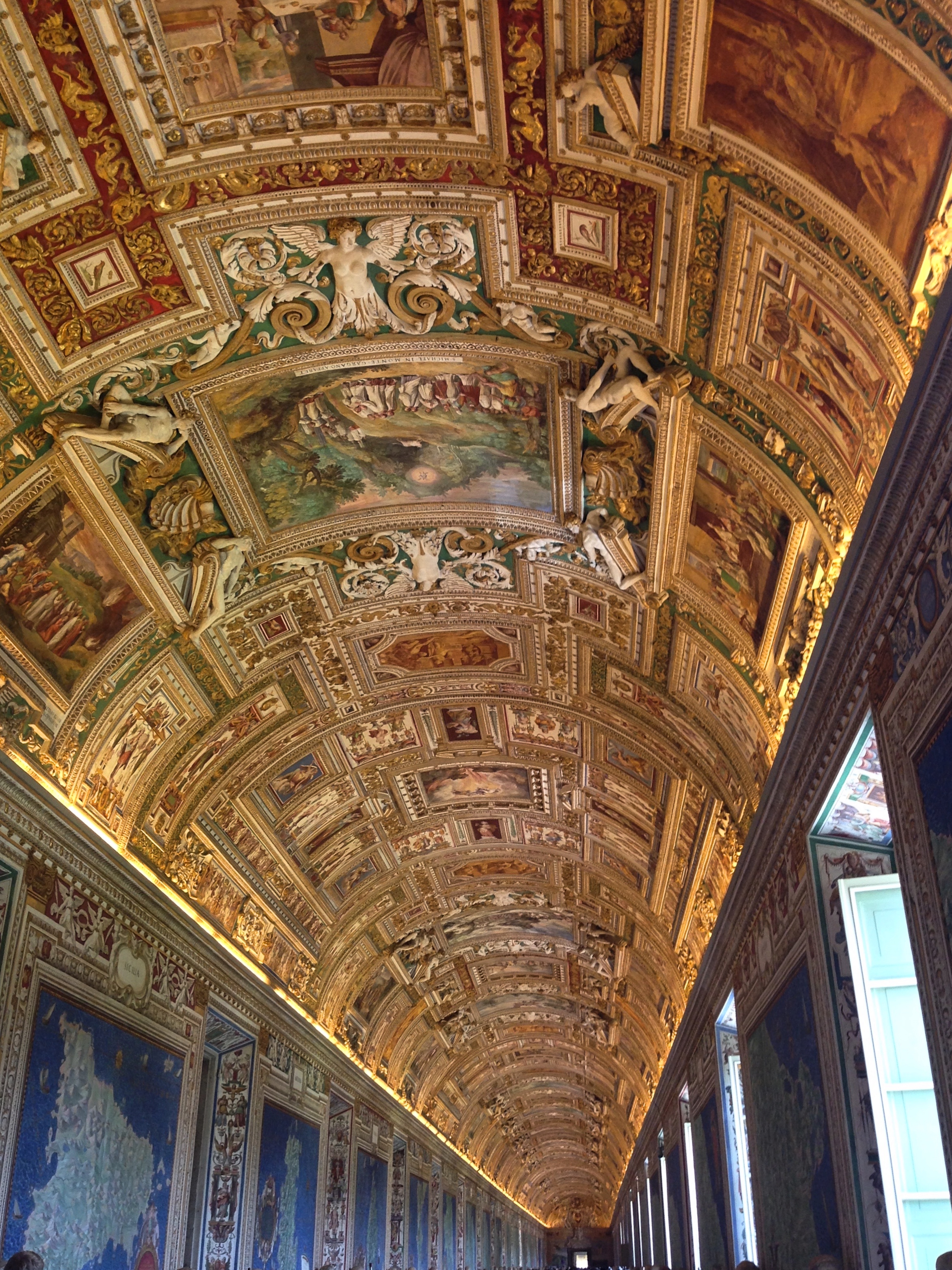
The museum is notable not only for its works, but for its spaces. In the Sala Rotunda (“round room”), larger-than-life statues occupy niches in a circular room, built to imitate the Pantheon; and in the middle of the room is a gorgeous ancient mosaic. The Gallery of Maps is a long hallway; the decoration of the ceiling is unspeakably ornate—totally covered in floral designs, patterns, paintings, and decorative moldings—lit up with a golden glow; and its walls, as befitting its name, are covered in a series of lovely maps of Italy.

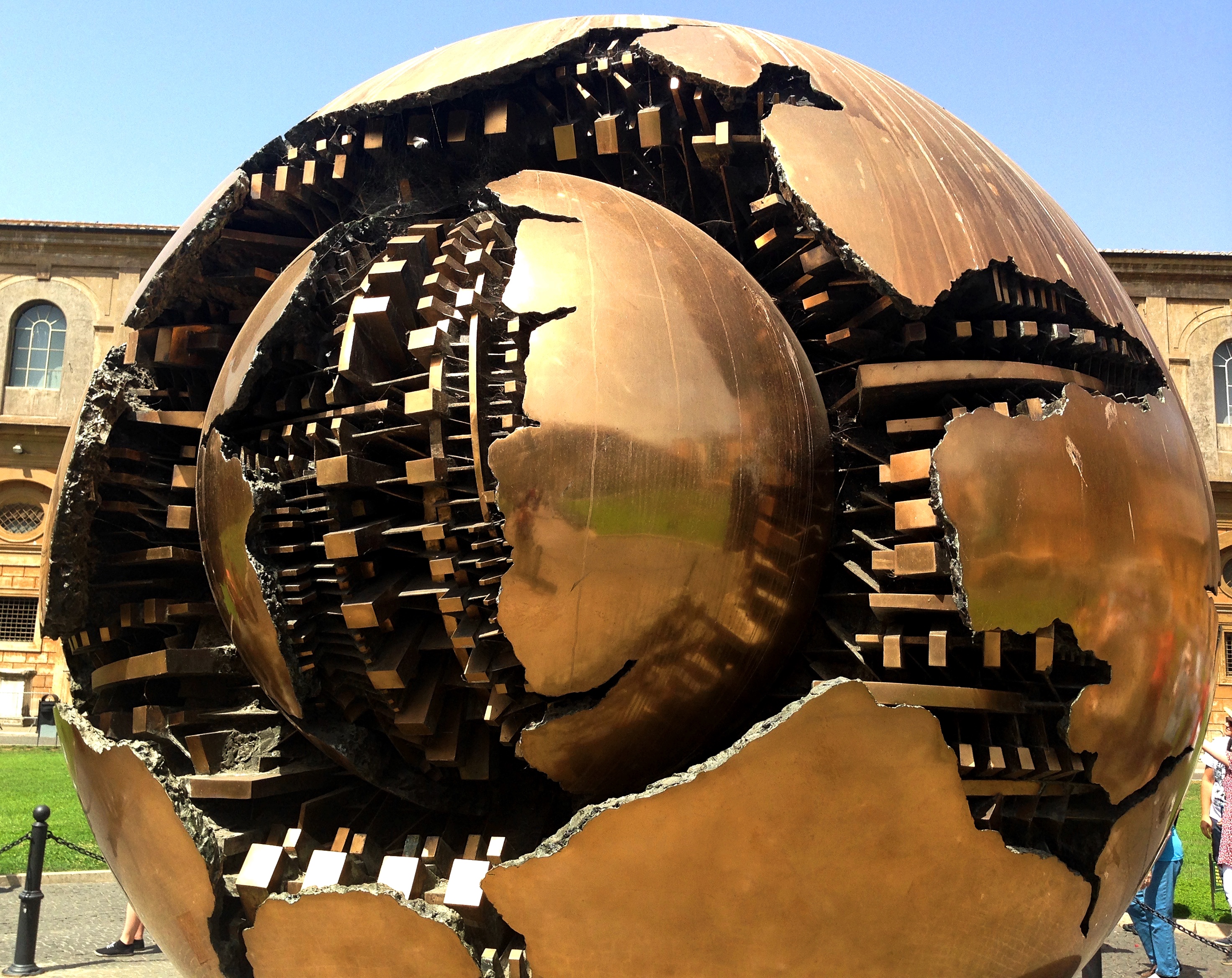
The Cortile della Pigna, or Courtyard of the Pine Cone, takes its name from the Fountain of the Pine Cone. This fountain, of Roman origin, was moved in 1608 from its original location near the Pantheon to decorate a large niche in the courtyard’s wall. (At the time, this courtyard was twice as large, and was known as the Cortile del Belvedere; the Apollo Belvedere used to be displayed here, which is where it gets its name.) In the center of this courtyard is a version of Arnoldo Pomodoro’s famous statue, Sfera con sfera—a large golden sphere, cracked and broken, with another similarly damaged sphere inside. There is also a monumental bust of Augustus, who was given a new hairdo in during the Renaissance.

Vatican_sphere

Among the hundreds of excellent sculptures, my favorite is Laocoön and His Sons—a work that can also be said to be the founding piece of the Vatican Museum. The statue was made sometime around the first century BCE (we think), and later found its way to the palace of the Roman Emperor Titus, where it was praised by the Roman writer Pliny the Elder (first century CE). At some point in antiquity the statue was lost; it was only rediscovered during the Renaissance, in the February of 1506. The antiquarian and art-loving Pope, Julius II, was immediately informed of this discovery; Michelangelo went to investigate and sent an enthusiastic report of the statue; and one month later, Julius had the magnificent sculpture on public display in the Belvedere Courtyard. The statue now stands in the Museo Pio-Clementino.

laocoon-and-his-sons

The statue depicts a moment from Virgil’s Aeneid. The Greeks have given up trying to knock down the walls of Troy; instead they are following Odysseus’s sneaky plan, to gift them the Trojan Horse. The big, wooden horse is wheeled up to the walls, and the Trojans obligingly come out to admire it; soon they decide to bring the horse inside the walls. Laocoön, a priest, is the only person against this plan. “Beware of Greeks bringing gifts!” he says. At that moment, spurred on by the malevolent gods, two enormous snakes appear and strangle both him and his two sons. The Trojans interpret this as an omen, thinking that the gods disapproved of Laocoön’s skepticism. In reality, the gods were on the Greeks’ side.

The statue is extraordinary. Far removed from the Classic Greek ideals of perfect form and sublime grace, it is full of suffering and fear. The bodies are contorted and twisted, the faces scrunched up with pain; the snakes’ slithering bodies are wrapped around arms and legs, tying all the figures together into a writhing mass of limbs. Every detail is exaggerated. Indeed, the statue could have been melodramatic, even silly, if not for its perfect execution. Every detail seems just right: the arrangement of the figures, the anatomy, the posture, the expressions, the technical execution. It is one of those few masterpieces of art that impress themselves upon the memory after a split-second of viewing.

I stood for a long while admiring the work. How could so much movement be conveyed by immobile stone? How could an entire story be told instantaneously? The feeling evoked by the statue is one of gruesome tragedy. Laocoön will die even though he was right, and his sons will die even though they are innocent of any crime. All of them will die publicly, and in immense pain, for nothing, and with nothing to look forward to except oblivion. The image is much too exuberantly violent to be melancholy, much too grisly and ghastly to be beautiful. It is, rather, sublime: instead of conforming to your aesthetic sense, it overawes you, trampling over all your tastes and preconceived notions, soaring above all your attempts to measure or define it, leaving you simply dazed at the power of human art.

I could spend hours and pages in ecstasies over other works in the museum, but I will exercise self-restraint. The only other individual works I will mention are Raphael’s frescoes.

These were commissioned by that same Pope Julius II, in 1508, to decorate the papal apartments. They occupy four rooms, now called the Raphael Rooms: the Sala di Constanto, the Stanza di Eliodoro, the Stanza della Segnatura, and the Stanza dell’Incendio del Borgo. Needless to say, each one is a masterpiece and worthy of study. But by far the most famous of these are in the Stanza della Segnatura. This was the first room that Raphael completed. At the time, this room contained the Pope’s personal library, which is why Raphael set about creating intellectual allegories.

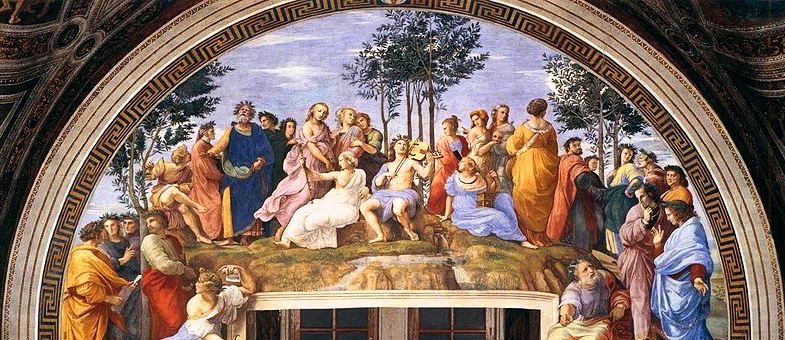
No place in the world more perfectly captures the Renaissance blending of art and science, of classical education and effective government, of pagan philosophy and Christian theology. In the Disputation of the Holy Sacrament, Raphael depicts theology as a collection of saints, popes, and religious poets engaged in a discourse on the nature of God, while Jesus and the Father sit enshrined above. In The Parnassus we find an allegory poetic inspiration, Apollo and the Muses stand with a collection of melodramatic bards and troubadours, all crowned with laurels, crowded on top of a hillside. (Dante is the only figure to be represented twice in the fresco sequence, appearing both among the theologians and the poets.) And in the Cardinal Virtues, both human and divine virtues are depicted in allegorical form, the human virtues—prudence, fortitude, and temperance—as women, and the divine virtues—charity, hope, and faith—as accompanying cupids.

Parnasus 1

The last and incomparably most famous is the School of Athens. Even if you do not know its name, it is an image you have undoubtedly seen countless times. At least three books in my library have this painting as their cover image. It is one of the iconic images of Western art: a symbol of the Renaissance, of humanism, of philosophy, of science, and of the entire intellectual tradition. Like other iconic images—The Mona Lisa, Guernica, The Creation of Adam—it is somehow unforgettable: every detail is classic, perfect, and instantly memorable, and it is carried with you the rest of your life.

School of Athens_Fotor

In his classic documentary, Civilisation, Kenneth Clarke tells us that Raphael’s works must be looked at long and hard to be truly appreciated. Rather like Mozart’s music, Raphael’s art is so perfectly balanced, so immediately appealing to the senses, so intuitively intelligible even to the ignorant, that it seems as if they are devoid of serious substance. Raphael’s painting is just so seeable. The painting unfolds itself to you; it almost sees itself for you. The viewer is not asked to do any work, just to enjoy. Every relevant detail is taken in at a glance. Again, like Mozart’s music, everyone might agree that Raphael’s work is pretty, charming, and pleasant, but many might not guess that it is also profound.

To sense this profundity, you must learn to unsee it before seeing it again: you must fight the immediate familiarity, the apparent ease, and try to see the painting as it might have appeared to its first viewers: as striking, imaginative, triumphant, and so utterly convincing that one man’s individual vision soon became a model for classic grace.

This is, of course, much easier said than done. It is especially difficult if you are standing in the middle of a crowded room, buffeted by tour group after tour group, trying to find a good angle to photograph the painting. By this time, I was thirsty, hungry, and feeling not a little claustrophobic from the swelling crowds. I tried to look at the painting long enough to see what Clarke saw; but the contrast between Clarke calmly meditating on the painting in solitude, and myself sweating and painting in the noisy crowd, was too much to overcome. After fifteen minutes of staring, I turned and left. I was about to enter the Sistine Chapel.


Sistine Chapel

(If you want to take a virtual tour of the chapel, there is an online version that you can find here. I recommend viewing it while listening to Georgio Allegri’s beautiful “Miserer mei, Deus,” composed for performance in the Sistine Chapel.)

Stepping into the Sistine Chapel is an unforgettable mixture of sublime awe and petty annoyance. Security guards are posted all around the room, keeping the gaping tourists out of main channels, preventing the entrance and exit from getting blocked, and repeatedly reminding tourists that no photos are permitted. Hundreds of people were packed into the room, all of them standing elbow to elbow, standing singly or in tight groups, everyone with their eyes turned upwards. It reminded me of those cartoons in which turkeys drowned themselves by looking up, mouths agape, during a rainstorm.

The hushed and hurried sounds of voices, some whispering, some laughing, reverberated in the stone chamber, creating a decidedly unmeditative din. Every five minutes or so, a voice crackled onto a PA system and told everyone, in four or five languages and to respect the sacred space. This created about thirty seconds of respective silence until the talking irrupted again, and the process started over. Even in this place, the most important space in the world for Western art, a holy place for Catholics and humanists alike, we recreate the same silly dynamic as in a middle school classroom.

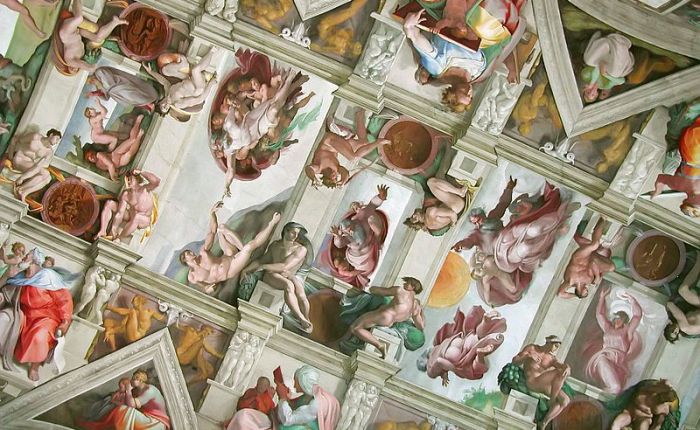
Even without Michelangelo’s frescos, the Sistine Chapel would contain enough artwork to make it a necessary visit for any art-lover. To pick just one example, Botticelli’s Temptations of Christ, an obvious masterpiece, is on one of the lower walls, along with numerous other paintings of similarly high quality. And yet it is nearly impossible to pay any attention to these paintings; indeed, I bet most visitors do not even notice them. Michelangelo’s ceiling frescos are so overpowering that you cannot look at anything else. Every visitor stares helplessly up at the ceiling, painfully craning their neck like Rodin’s statues.

800px-Chapelle_sixtine_plafond

The work is so famous that it seems superfluous to say anything about it. Everybody has seen it. Everybody knows the story of Michelangelo, tortuously arching his back on the scaffold, slowly and scrupulously completing the frescos almost single-handedly. Michelangelo even wrote a sonnet about his own discomfort (this is a translation by Gail Mazur):

I’ve already grown a goiter from this torture
hunched up here like a cat in Lombardy
(or anywhere else where the stagnant water’s poison).
My stomach squashed under my chin, my beard’s
pointing at heaven, my brain crushed in a casket
my breasts twisted like a harpy’s. My brush,
above me all the time, dribbles paint
So my face makes a fine floor for droppings!

(You can read the rest of the poem here.)

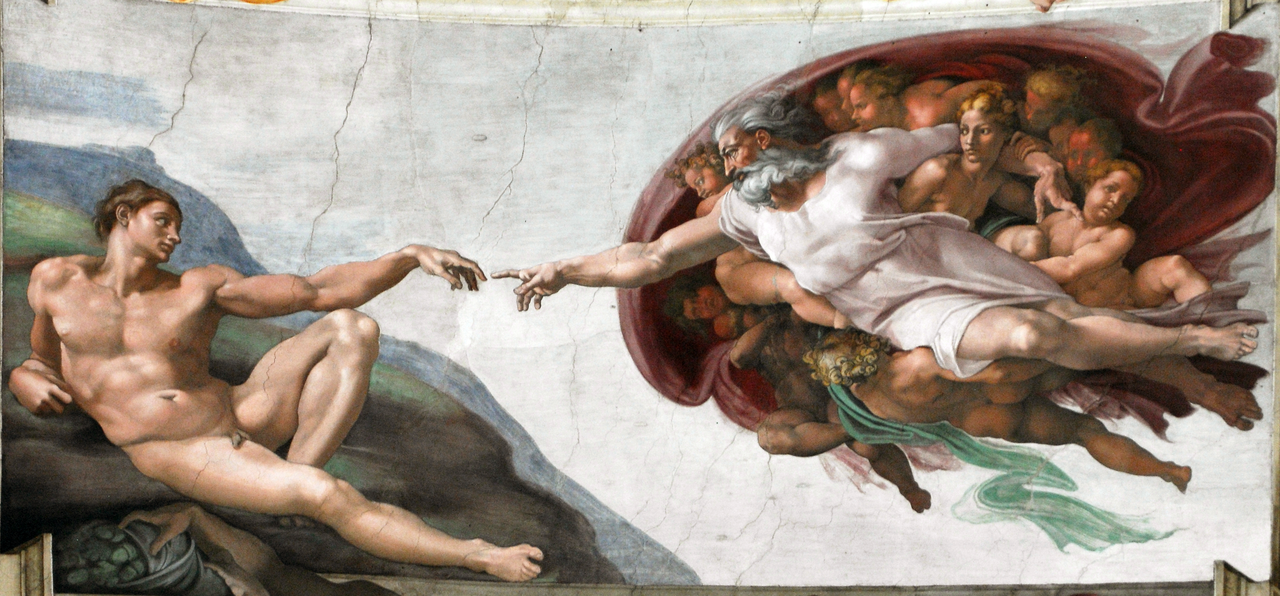
Both artwork and artist have been turned into one of the great creation myths of European history. The work even seems to allegorize its own heroic origin: Just as God, sublime and omnipotent, reaches out with one delicate figure to delineate the reclining figure of Man, so did Michelangelo himself give form to the ideal image of Man. Here is the perfect symbol of creativity.

Creation-of-adam-sistine

The Sistine Chapel was commissioned by the same Julius II—the most important of the Renaissance Popes, perhaps—and interrupted Michelangelo’s work on the Pope’s tomb. This tomb, by the way, was never completed on the scale originally imagined. The half-finished sculptures that were to form a part of it are now considered to be among Michelangelo’s masterpieces, such as the Dying Slave in the Louvre. Although originally planned for St. Peter’s Basilica, the tomb, as eventually realized, is in San Pietro in Vincoli, a church near the Colosseum; this tomb is now most famous for its statue of Moses.

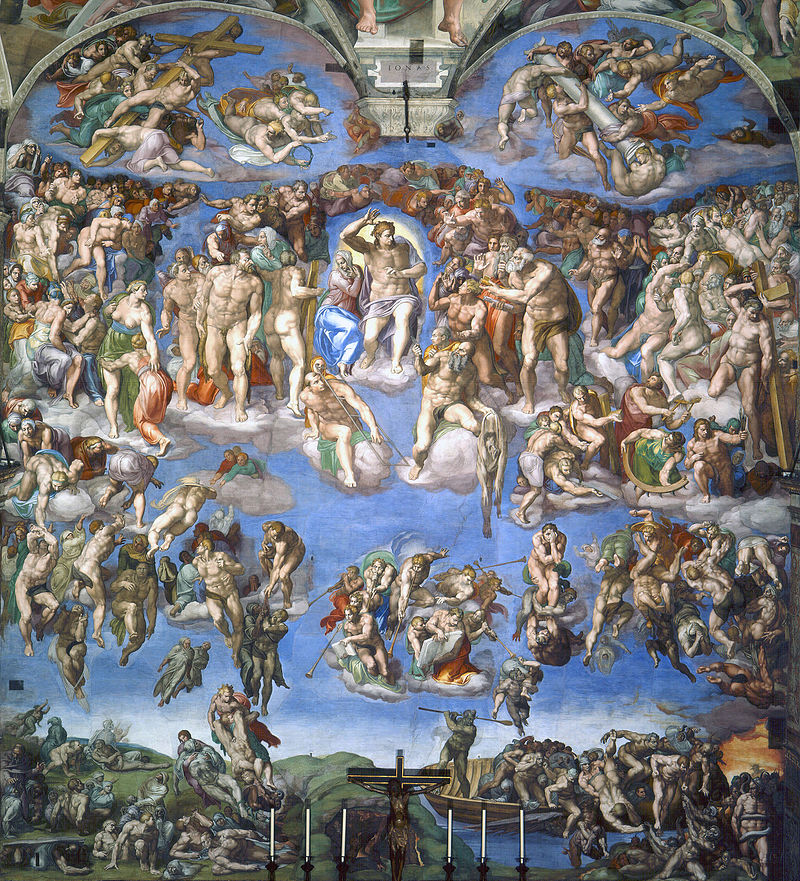
The most striking thing, aside from their awe and splendor, about Michelangelo’s frescos are their focus on man. I use “man” deliberately, because the vast majority of the figures are men, aggressively so. Michelangelo does not portray landscapes, vegetation, or animal life; there are hardly any objects to distract us from the people. Michelangelo was entranced by the body—its musculature, its skeletal structure, its twistings and turnings, its living flesh. This is most striking in his Last Judgment, an obscene explosion of naked bodies.

The Catholic Church has traditionally had a fraught relationship with the human body, to say the least; but Michelangelo seems not to have shared this aversion. If you believe that humanity was made in God’s image, his fascination for the human form is sensible: by studying the human, you might get a glimpse of the divine.

Last_Judgement_(Michelangelo)

I end this section feeling much as I did when I walked out of that room: overwhelmed. What are you supposed to say when face to face with such a work of art? How are you supposed to feel? How can you even understand what you are seeing, much less properly appreciate it? Can you, through any means, do justice to the experience? Michelangelo’s frescos are, for me, like Shakespeare’s Hamlet or Beethoven’s final symphony: a work that reduces me to the same stunned speechlessness as the starry sky.


St. Peter’s Basilica

By the time I left the Vatican museum—winding my way down the double-helix staircase—I was hungry, thirsty, and totally dazed. I bought an overpriced coca-cola from a vending machine, gulped it down, and then bought a bottle of water. Soon I was out on the street again. I had just seen some of the greatest art in the world; but every trace of aesthetic pleasure vanished in the hot sun.

I wanted to go home and sleep, but I didn’t have time to waste. I still had to go see the Vatican’s Basilica.

San Pietro in Vaticano is the church at the very center of the Catholic world. It is the last of the four major basilicas (I’ve written about the other three here), and the most important. The building, as it appears today, is actually the second St. Peter’s Basilica; the first was built during the time of Constantine, and had fallen into such disrepair during the Avignon Papacy that it was clear repairs were needed. The infinitely ambitious Pope Julius II—the ever-present specter of this post—was not content with mere repairs, however, and conceived a project far more daring: to tear down the original St. Peter’s and rebuild it on an even grander scale.

If you bear in mind that the original church was one of the most venerable, most historical, and most important churches in Europe, not to mention one of the biggest, you can get a notion of how bold this plan really was. Julian wanted not only to rival, but to surpass the great ruins of Rome that still towered above everything else in the city.

A contest was held for designs of the new building, and Donato Bramante’s design was the winner; he called for a Greek cross and a massive dome, modeled after the Parthenon’s. One hundred years earlier, the architect Brunelleschi had designed the massive dome the cathedral of Florence, still the biggest brick dome in the world, and Bramante wanted to build something even bigger. But construction was slow in getting off the ground; and it was not long before both Bramante and Pope Julius died. The leadership eventually passed to Raphael, who altered the design to include three main apses; but Raphael died, too, and the project changed hands many times again. When Charles V’s troops sacked Rome, in 1527, this did not help matters. Eventually Michelangelo, then an old man, begrudgingly took on the job; and nowadays his contributions are regarded as the most important.

The Basilica sits at the end of St. Peter’s square. This is a massive plaza, closed to vehicles, that is enclosed by two sprawling colonnades that welcome the visitor in a gigantic embrace. The square was designed by Bernini during the 17th century, and is visibly a product of the Counter-Reformation: grand, impressive, and crushingly huge. The colonnade is four columns deep, and is topped by a row of statues that are difficult to identity from the ground. In the center of the plaza is an obelisk, originally taken from Egypt during the reign of Augustus (a visible marker of the continuity between the Roman Empire and the Roman Church).

st-peters-square

On any given day, the plaza is probably one of the most diverse places on earth. Visitors from hundreds of countries, sporting clothes of every imaginable style, speaking a befuddling mix of languages, crowd the massive square. The one thing they all have in common—at least on a sunny, summer day—is that they are very sweaty, and are busy taking photographs.

I was certainly sweaty when I got on the line to enter the Basilica. To pass from the plaza to the Basilica, you need first to go through security: this means waiting in line for the metal detectors. After you pass through security, however, you can waltz right inside. The Basilica is free to visit, which means that you can still see one of the great works of Renaissance architecture even if you forget to buy tickets for the Vatican Museums.

list-of-popes
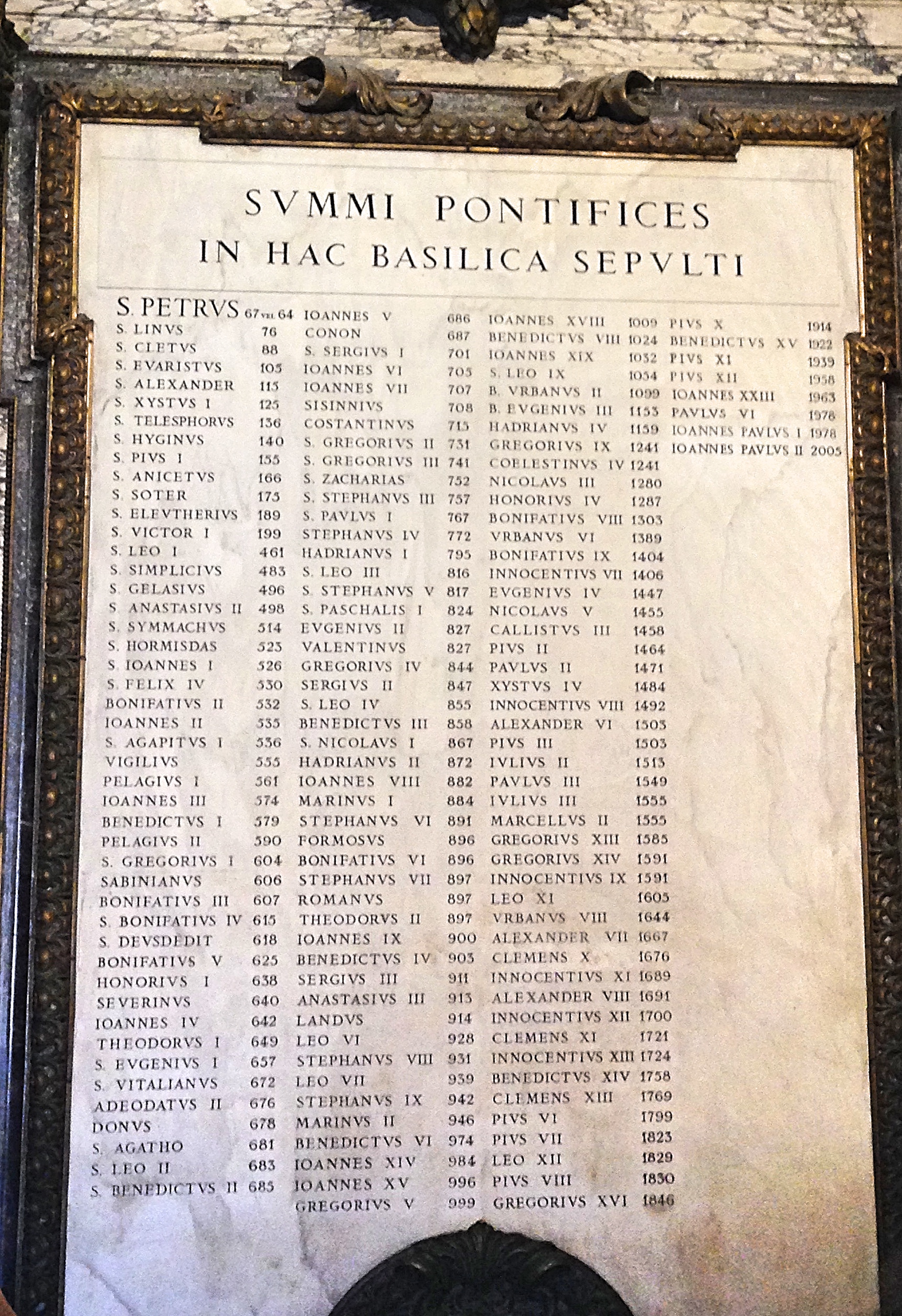
A list of the popes, going all the way back to Peter

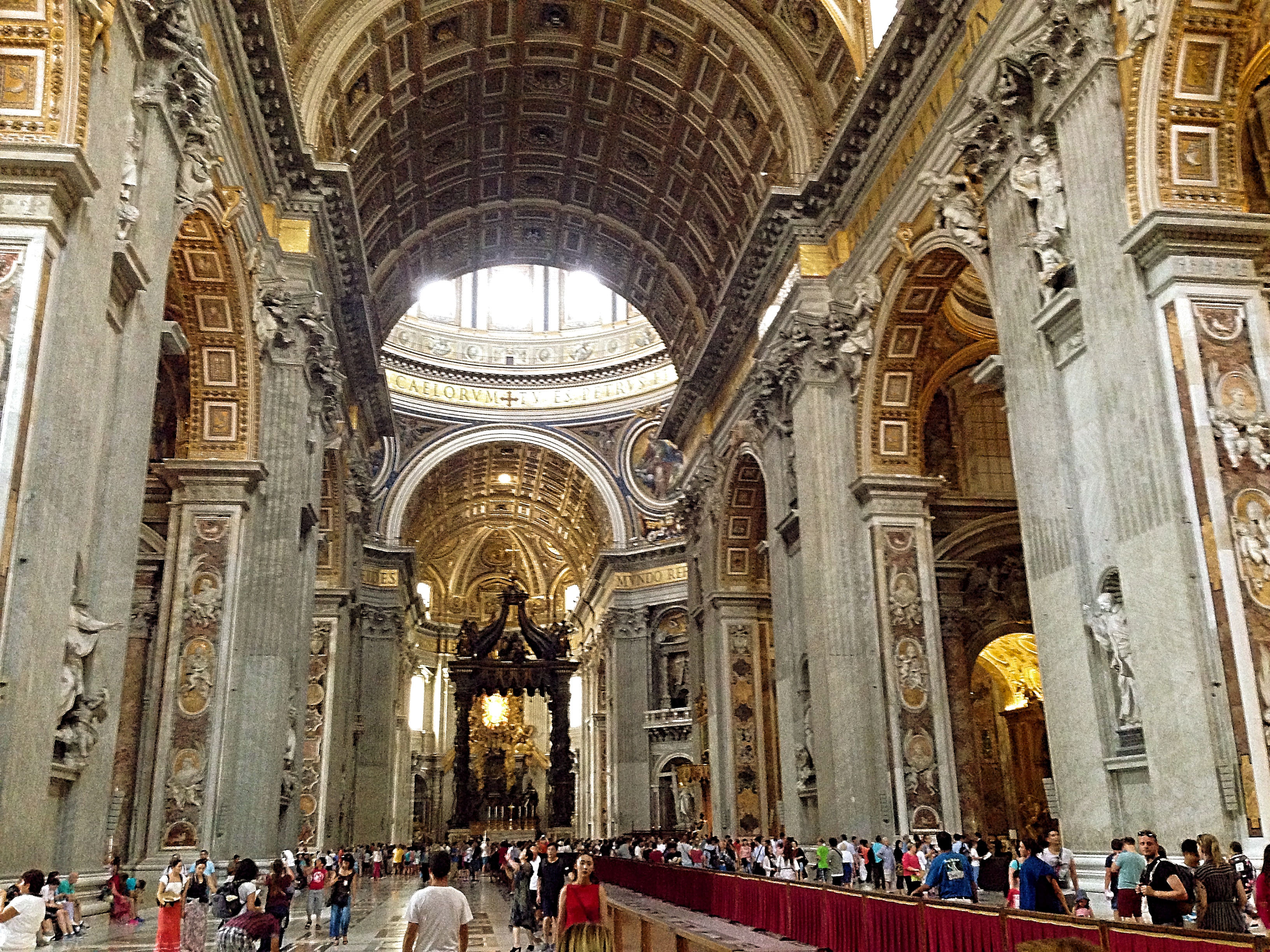
When you walk into St. Peter’s, the first and most persistent impression is the sense of space—open space, empty space, expanding space flooded with light. Everything is on such a huge scale that it is difficult to keep it in perspective; the ceiling is far above you, but sometimes does not appear so high up because everything is proportionally large; and it is only when you compare the little men and women scurrying about on the floor that you realize how big is everything.

st-peters-basilica

The next impression, for me, was an overpowering sense of splendor and fine taste. As in so many Italian churches, but on an even more magnificent scale, the decoration of every surface is lush: shiny, colorful, and finely textured. Statues adorn nooks and crannies—heroic statues of popes and saints—each of them of the highest quality; and yet there are so many, and each is so consistently masterful, that no single thing particularly attracts your attention. Instead, all of the decoration and the statues create an atmosphere of awe.

st-peters-dome

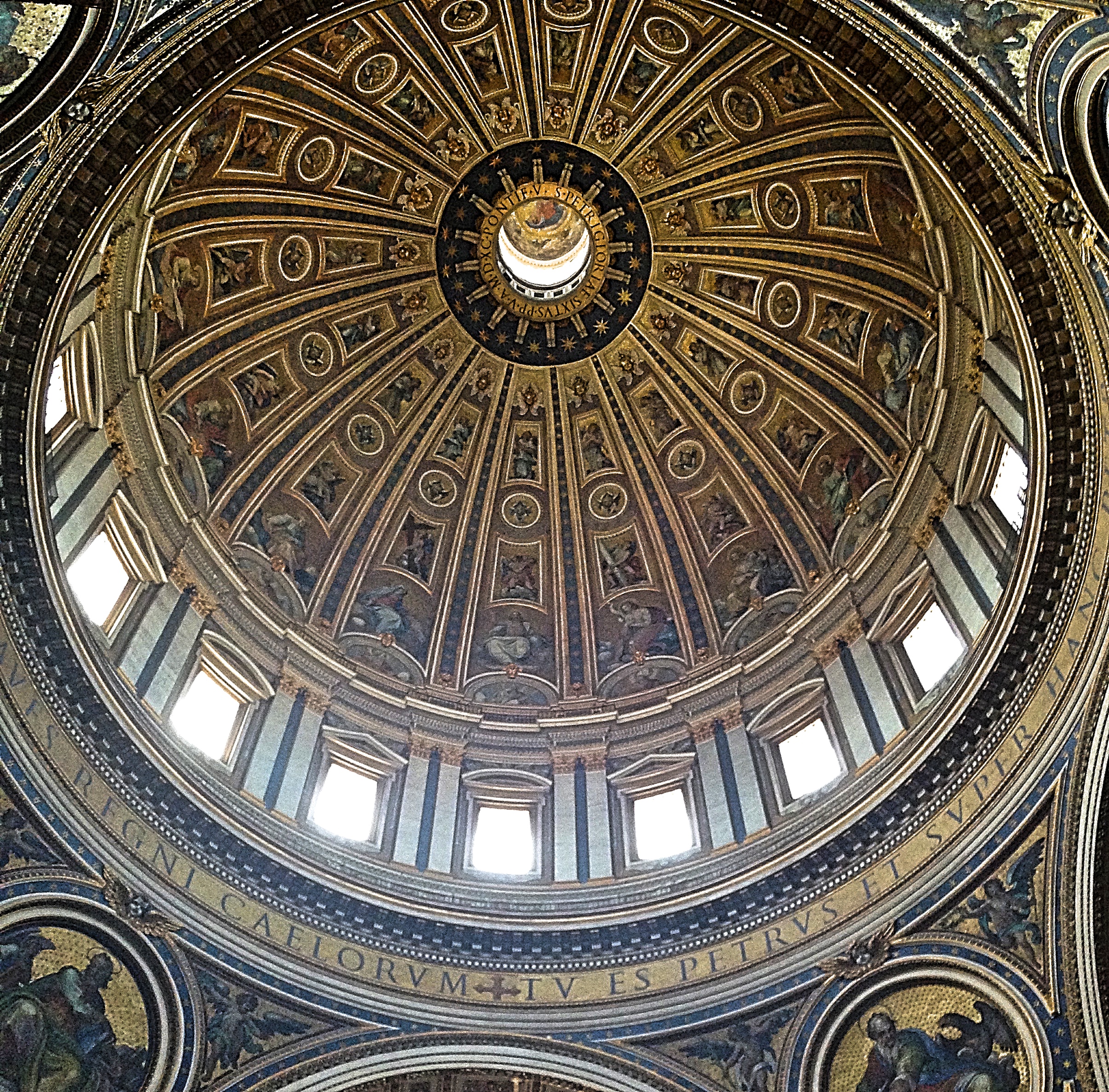
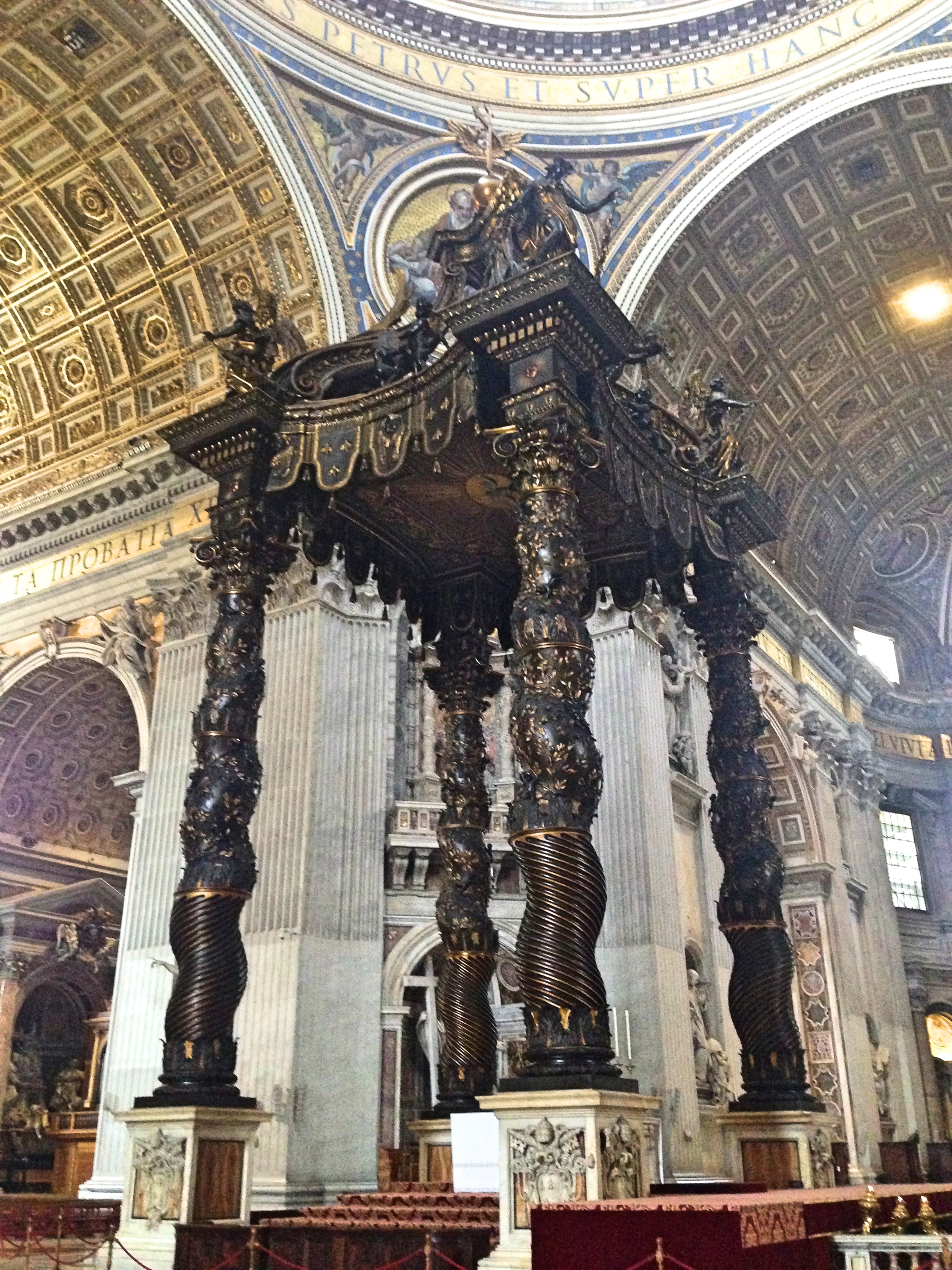
Seeing the dome of St. Peter’s from the inside is somewhat surreal. It is so big, and so far away, that it is difficult to gauge exactly how big and how far away it is, exactly. Underneath the dome is one of the most famous works in the Basilica, Bernini’s Baldachin. This is a canopy, somewhat like a pavilion, that sits above the main altar. And it is gigantic: stretching to 30 meters (98 feet) in height, it is the largest bronze object in the world. (And despite this, it still looks tiny in the massive space of the Basilica.) The most distinctive and, for me, the most attractive feature of the work are the twisting, swirling columns that support it.

Bernini's Thing.jpg

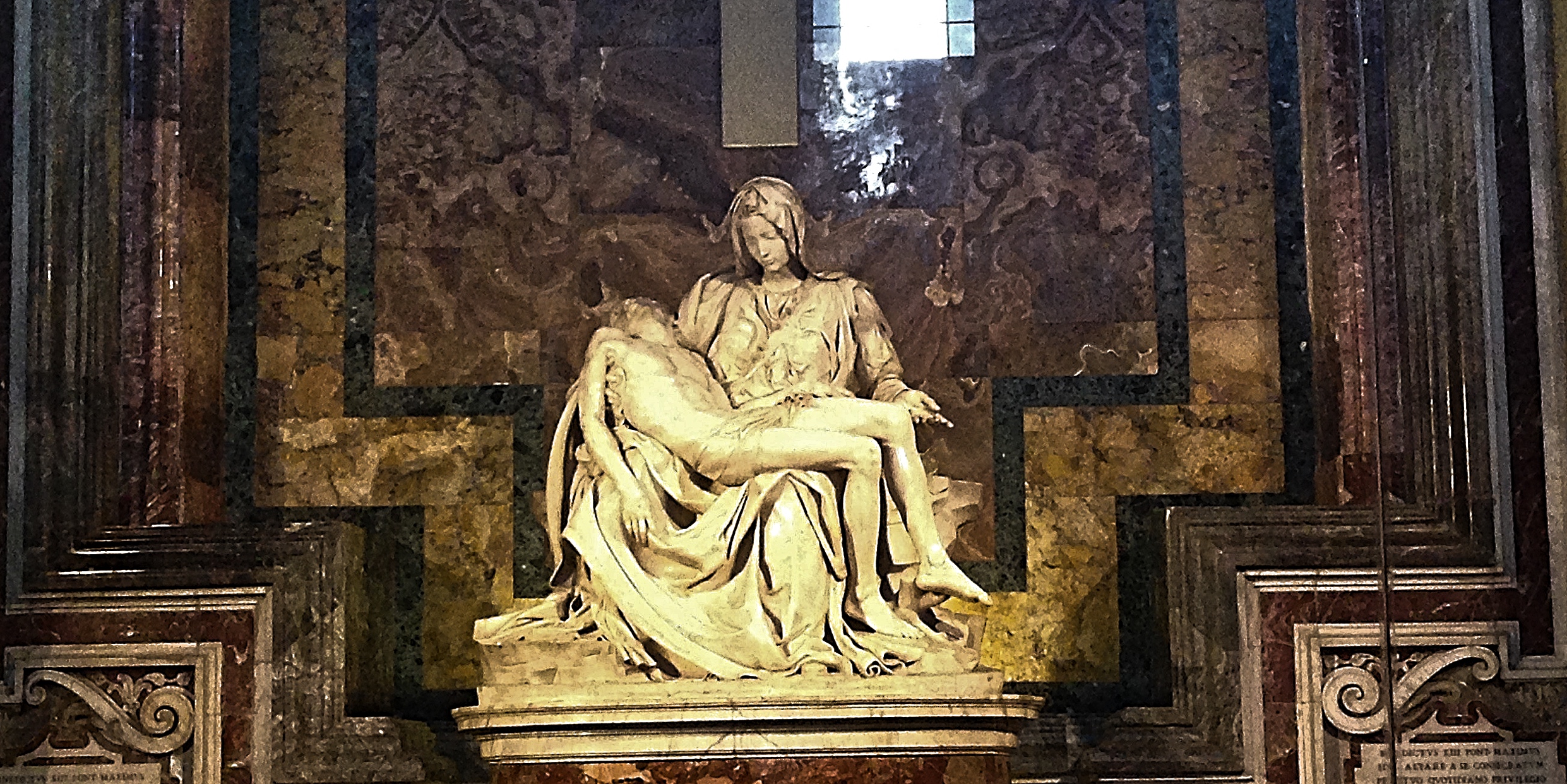
After wandering my way through the Basilica for a while—open-mouthed, exhausted, too dumbstruck and tired to really process any of the experience—I turned to leave. But there, on the way to the exit, was the most famous artwork of all: Michelangelo’s Pietá. The statue now sits in a side-chapel near the front portal, protected by a shield of bulletproof glass. (This glass was not always there. In 1972, a mentally disturbed Australian geologist attacked the statue with a geological hammer, while shouting “I am Jesus Christ!” He managed to destroy Mary’s arm and nose, and it was only through painstaking reconstruction that the statue was restored to its previous appearance. The world is an odd place.)

pieta

The statue is extraordinary. Jesus lays sprawled on Mary’s lap, while she looks down at his lifeless body. Jesus’s face is impossible to see clearly, since it is turned limply toward the sky; but Mary’s face is fully visible. For a woman old enough to have an adult son, she is strikingly youthful and beautiful. Her expression is a masterpiece: so quietly sad, so mournful, and yet not despairing; a tranquil and meditative grief. The viewer cannot help but recall all the images of the Virgin with the Christ Child, rosy-cheeked and smiling, sitting on her lap; now Christ still sits on her lap, a grown man, gaunt, tortured, and put to death. The mother gave life to the son, and now he is gone; but the son will return, and he will give life to mankind. Death and life are united in one image—the tragedy of mortality and the injustice of the world, and the hope of immortality and the justice of the universe.

I stood there for a long while, admiring the statue, and then turned to go. There was only one thing I had left to see: the crypt. St. Peter’s contains the remains of over 100 people, most of them Popes. This crypt is free to visit. To get there, I walked around the side of the building and then down a staircase.

What surprised me, most of all, was its plainness. The walls are white and mostly devoid of decoration; the tombs are relatively simple—at least, compared to everything else I had seen that day. If memory serves, many of the tombs had little plaques near them, explaining who the Pope was and what were his most notable accomplishments. I paused to read some of these, but I find that I normally do not remember much when I do this, so I skipped most. (In retrospect, I was right: I do not remember anything I read.)

At the end of the crypt I came to one far more ornate than the rest. It was not a sarcophagus, but a whole shrine—filled with gold and marble—visible through a glass window. I noticed many people pausing, crossing themselves, and praying before the tomb. Who was he? Then I realized: it was the tomb of St. Peter himself.

According to the story, St. Peter was crucified here on Vatican Hill, during the reign of Nero. He was crucified head downward, at his own request, so as not to die in the same manner as his savior. Peter is traditionally regarded as the first Pope, largely because of this passage from the Gospel of St. Matthew (16.18-19): “I tell you that you are Peter, and on this rock I will build my church, and the gates of Hell will not overcome it. I will give you the keys of the kingdom of heaven.” It was for this reason that Constantine decided to build the original St. Peter’s in this spot.

In the 20th century, archaeologists investigated the area underneath the Basilica’s main altar—right underneath Bernini’s Baldachin. Several burials, tombs, and bones have been discovered under the Basilica. It seems that the area had been used as a gravesite before even the Christian era; coins and even animal bones were discovered. In 1968 it was finally announced that the bones of St. Peter’s had been identified. How any bones could be confidently attributed to St. Peter is another question; what matters, I suppose, is that they were given the official sanction, which makes them officially St. Peter’s bones.

Whenever I visit a cemetery, a tomb, or a graveyard, I think about human finitude. Our bodies are so frail, and will inevitably fail one day. Death comes for us all. And when I see these big stone structures we build for our bodies, it seems as if they are attempts to cope with this finitude. Maybe I will die, but my tomb will survive, and my name will be known, and my memory will live on. But this form of immortality is sterile. What is a tomb but a pile of rock? What is a name but a puff of air? What is a memory but a vague light flitting in darkness?

But when I see Laocoön and His Sons, The School of Athens, the ceiling of the Sistine Chapel, and St. Peter’s Basilica, it gives me pause. So much imagination, effort, will, knowledge, and force is compressed into these things that they seem as if they cannot die. This is fanciful thinking, of course. Everything can die, and everything will. But how could anything so splendid be undone, even by destruction? These works seem to transcend their earthly matter and break into the realm of pure forms, immaterial and everlasting. Why I feel this way, and why I choose to express myself using metaphysics and metaphors, I cannot quite say. What I can say is that these works of art do give me a certain feeling of faith: a faith in the human spirit.


Review: Orwell’s Essays

Review: Orwell’s Essays

A Collection of EssaysA Collection of Essays by George Orwell

My rating: 5 of 5 stars

What I have most wanted to do throughout the past ten years is to make political writing into an art.

George Orwell is one of the inescapable writers of the last century. Far from becoming irrelevant, his works seem to become more significant with each passing year (as most recently evidenced by the present administration’s strained relationship with the truth). Orwell himself said that the “final test of any work of art is survival,” and his works seem on track to pass this final test. His dystopian novel recently became a surprise best-seller, almost seventy years after its initial publication. That is more than mere survival.

And yet it isn’t for his political insights that I opened this collection of essays. It was rather—and I feel somewhat silly saying this—for his writing style. Orwell’s writing is, for me, a model of modern prose. His style can accommodate both the abstract and the concrete, the homely and the refined, the pretentious and the vulgar; his prose can satisfy both the academic and the artist, the intellectual and the layperson, the Panurge and the parish priest. It is unmistakably modern, even sleek, while obviously informed by the tastes and standards of the past. It is fiery, angry, and political, while remaining intimate, human, and honest.

Something that repeatedly struck me while reading this collection was an inner conflict in Orwell’s worldview. There are two sides of the man, sometimes in harmony, and sometimes at odds: the writer and the activist. Orwell the writer is captivated by the rhythms of words, the sounds of sentences; he loves ruminating on a strange personality or a memorable story; he is enchanted by the details of daily life. Orwell the activist is outraged at injustice and uncompromising in his moral sense; he sees people as a collection of allies and enemies, taking part in a grand struggle to bring about a better society.

Orwell himself discusses this tension in his little essay, “Why I Write.” In a more peaceful age, he thinks, he could have been an entirely aesthetic writer, perhaps a poet, not paying much attention to politics. It was his firsthand experience of imperialism, poverty, and fascism that activated his political conscience. Specifically, it was the Spanish Civil War that “tipped the scale” for him: “Every line of serious work that I have written since 1936 has been written, directly or indirectly, against totalitarianism and for democratic socialism.”

Be that as it may, Orwell seems to have repeatedly struggled to reconcile this aim with his more humanistic side. In his brilliant essay on Dickens, for example, he spends page after page trying to analyze Dickens as a kind of social philosopher, examining Dickens’s views on work, on the state, on education, and so on. Since Dickens was anything but a philosopher—as Orwell himself admits—this repeatedly leads to frustrating dead ends, and fails completely to do justice to Dickens’s work. It is only in the last section, where Orwell drops this pretense and treats Dickens as a novelist, that the essay becomes deeply insightful. Indeed, it soon becomes clear—it seems clear to me, at least—that Orwell likes Dickens for his writing, and not his activism, however much he may wish to think otherwise.

Other essays exhibit this same tension. In his essay on vulgar postcard art, for example, he notes how backward is the social worldview expressed in the cards; but he is obviously quite fond of them and even ventures to defend them by likening their humor to Sancho Panza’s. His essay on boy’s magazines follows an identical pattern, exposing their conservative ideology while betraying a keen interest, even a warm fondness, for the stories. In his appreciative essay on Rudyard Kipling’s poems, he even goes so far as to defend Kipling’s political views, at least from accusations of fascism.

It is largely due to Orwell’s influence, I think, that nowadays it is uncontroversial to see the political implications in a movie cast or a Halloween costume. In all of these essays, Orwell worked to undermine the naïve distinction between politics and everyday life, showing how we absorb messages about standards, values, and ideologies from every direction. He did not merely state that “All art is propaganda,” but he tried to show it, both in his analyses and his own works. At least half the time, he is utterly convincing in this. (And indeed, Orwell was such a brilliant man that, even when I think he’s involved in a pointless exercise, he makes so many penetrating observations along the way— incidentally, parenthetically—that his writing fully absorbs me. )

We owe a tremendous debt to Orwell for this insight. Nevertheless, I can’t help thinking that there is something terribly limiting about this perspective. All art may be propaganda, but it is not only propaganda; it is not even primarily so. There needs to be room in criticism, as in life, for the non-political. We need to be able to enjoy a novelist because of his characters and not his views on the state, a poet for his lines rather than his opinions, a dirty joke or a trashy magazine just because we want a laugh and a break. Orwell would agree with me up to a point, I think, but would also say that every decision to be “non-political” implicitly accepts the status quo, and is therefore conservative. This may be true; but it is also true that such “non-political” things are necessary to live a full life.

Where I most disagree with Orwell is his conviction that the media we consume—magazines, post cards, popular novels, television—nefariously and decisively shape our worldview. For my part, I suspect that people absorb their opinions more from their community, face-to-face, and then seek out media that corresponds with their pre-existing views: not the reverse. Media may reinforce these views and give them shape and drive, but I don’t think it generates them.

All this is besides the point. I admire Orwell, for his fierce independence, for his sense of outrage and injustice, for his facility with words, for his attempt to blend art and truth. In sum, I admire both the writer and the activist, and I think his work should be read until judgment day.

View all my reviews

Review: A Guide to the Good Life

Review: A Guide to the Good Life

A Guide to the Good Life: The Ancient Art of Stoic JoyA Guide to the Good Life: The Ancient Art of Stoic Joy by William B. Irvine

My rating: 3 of 5 stars

There will be—or already has been!—a last time in your life that you brush your teeth, cut your hair, drive a car, mow the lawn, or play hopscotch.

In my review of Feeling Good, a self-help book, I noted the lack of practical philosophies in the modern world. Far from an original insight, I now see that this idea is a relatively common criticism of contemporary education and modern philosophy. The other day, for example, I stumbled upon a YouTube channel, the School of Life, an educational project that tries to teach life lessons rather than academic knowledge. This book, an attempt to revive ancient Stoicism, is part of the same loose movement.

William B. Irvine set himself the task of making Stoicism viable and palatable in today’s world. To put it bluntly, this meant rummaging through the Stoic classics to make a self-help book. Whereas the classic Stoic authors—Marcus Aurelius, Seneca, and Epictetus—dispensed practical advice without much order, Irvine tries to create a systematic practice that any reader can follow.

Irvine’s system consists of several mental exercises, or tricks, that the novice Stoic can use to gain tranquility. The most important of these is negative visualization: take a moment to imagine how things could go wrong, how you could lose what you have—your health, job, or spouse—and how everything you take for granted might never have existed at all. This will counteract what Irvine calls “hedonistic adaptation,” which is when we get used to the good things in our lives and lose the ability to enjoy them. Hedonistic adaptation is the real enemy of tranquility, because it forever enchains us to desire—as soon as one desire is satisfied, we have another one, and the process repeats without us getting any happier.

Another Stoic exercise is the internalization of goals. First, determine the extent to which you can control the outcome of any situation; then, make sure you only worry about that part which you can control, and don’t trouble yourself about the rest. If you are going on a first date, for example, don’t make it your goal to impress the person—since you can’t directly control whether someone likes you or not—but make it your goal to try your best. In the language of self-help, that is, focus on the process and not the product, the effort and not the outcome.

The last major technique can be better described as an attitude rather than an exercise. This is to take a fatalistic attitude towards the past. Since what happened in the past is beyond your power to alter, don’t trouble yourself with “if-onlys” or fill up your mind with regrets. Instead, try to cultivate amor fati, love of fate; learn to appreciate the good in what has happened, rather than think of all the ways it could have been better.

The general attitude that a Stoic wishes to cultivate is a mixture of enjoyment and detachment: the ability to enjoy all of the little pleasures of daily life without becoming so attached to anything that you are incapacitated without it. It is rather like the attitude of a spectator at a play: heartily enjoying the show, while keeping in mind that all the action is staged and not worth getting upset over. With this mentality you could, in theory, be satisfied with anything, and maintain your tranquility under any circumstances.

These, in nutshell form, are the book’s major pieces of advice. The rest of the book is divided into a brief historical sketch of Stoicism, a series of short chapters about applying Stoicism to specific challenges, and a broader cultural criticism from a Stoic perspective. The latter of these was the most interesting—Irvine isn’t a fan of political correctness or of grief counseling. He also has a lot of advice about responding to insults, some of which I thought was obvious, some of which I thought was wrong, and most of which made me wonder: Why is he talking so much about insults? Is poor Irvine getting insulted all the time?

My main criticism of this book is its style. Perhaps because Irvine was trying to appeal to a popular market, the prose is painfully simple, and filled with unnecessary clarifications and wearying redundancies. “Repetitive” is a charitable description. Added to that, I often got the feeling that he was purposefully avoiding delving deeply into any topic, for fear of losing any novice readers, which irked me.

The important question is: Do the techniques work? I have been having some fun imagining my life going horribly wrong: my metro being crushed underground in an earthquake, my computer bursting into flames and blinding me—getting struck by lighting on my walk to work, all of my friends leaving me en masse, and so on. Somehow, this exercise does tend to put me in a cheerful mood. I also agree with Irvine about desire—why hedonism doesn’t produce contentment, why connoisseurship is counterproductive, why it’s wise to accustom oneself to some disappointment and discomfort.

At the very least, this book is an interesting experiment: trying to revive a dead philosophy of life for the twenty-first century. Now, to put Stoicism into practice, I’m going to imagine this review not getting any likes.

View all my reviews

Review: History of Western Music

Review: History of Western Music

A History of Western MusicA History of Western Music by Donald Jay Grout

My rating: 4 of 5 stars

The audience for “serious” music—art music of a certain complexity that requires some effort to understand—has never been more than a small fraction of the population.

What seems like a long time ago, I worked in a university music department as a professor’s office assistant. At the time, I was trying to improve my meager understanding of art history by reading E.H. Gombrich’s excellent Story of Art. Seeing art as an integral part of civilized society, in the context of historical change—rather than as decontextualized globs of color on canvass—really helped me to appreciate it in a way I could not before; and I wondered if the same might not be possible with music.

One day I asked my boss if there was a book similar to Gombrich’s about music, and he responded with one word: “Grout.” Finally I’ve gotten around to following up his recommendation.

A History of Western Music is the standard music history textbook in use on college campuses, at least in the United States. Its first edition was written by Donald Jay Grout; later editions were revised, first by Claude V. Palisca, and then by J. Peter Burkholder. I bought the fifth edition, mainly because it was cheap. Between the previous edition and this one, Palisca had entirely rewritten the book, removing the last remaining traces of Grout’s prose. So in this review I’ll being talking about Palisca.

Any author of a general music history textbook deserves some sympathy. First, it is proverbially difficult to write about music. The poor writer is forced to choose between a vague string of adjectives, metaphors, and images, discussing the music’s subjective effects; or he can resort to the technical language of music analysis, which at least allows him to be precise and objective, but at the cost of being inaccessible to music newbies.

Somewhere between these two extremes is the narrow path that Palisca tries to tread, sometimes precariously—veering too much in one direction, and then too much in the other—but for the most part ably. Even so, this middle path carries its own cost: dryness. Since Palisca can neither describe his own tastes and aesthetic responses, nor make any incisive analyses with music theory, he is forced to be a somewhat unexciting guide—the fate of most textbook writers.

The other major challenge is compression. How do you fit 2,000 years of music history into 800 pages? How do you give a decent overview of medieval plainchant, Italian opera, German romanticism, and American minimalism, while also providing the names, biographies, and accomplishments of the major composers, as well as integrating the relevant cultural history—all in enough time to teach it in two semesters? The obvious answer is that you can’t, and Palisca doesn’t. There is simply too much material to do justice to it all. But he does succeed in giving his reader a generous spoonful of all the main dishes.

If I measure this book by my own progress, I must deem it a success. Beforehand, I had only a scattered and incidental knowledge of the major composers. I could rattle off a few names, but I didn’t know who influenced whom, who lived when, who was part of what movement; and I could only name about two composers who lived before J.S. Bach. Now, not only do I feel much more knowledgeable, but the chronological framework will make it easier to learn more.

One of my most pleasant discoveries was the wealth of wonderful music that was written before J.S. Bach even took his first breath, in 1685. There was Leonin and Perotín, Guillaume de Mauchaut, Guillaume Dufay, John Dunstable, Henry Purcell, Claudio Monteverdi, and Arcangelo Corelli, to name just a few of my favorites. Most surprising for me was how much I enjoy sacred music. Like the shadowy interior of a gothic cathedral, the music is tranquil, meditative, and otherwordly—pregnant with tragedy and hope.

So this book does its job. What prevents it from being as great as, say, E.H. Gombrich’s history of art, Kenneth Clarke’s history of civilization, or Bertrand Russell’s history of philosophy, is the lack of authorial personality. In all three of those works, the author is not afraid to opine and speculate. Palisca, by contrast, rarely offers his own judgment, and does not venture to make any theories. His writing is neutral and plain, simply serving up information. There is nothing wrong with this, of course; and many would think that it’s the correct approach. But I think that when you’re dealing with an art form, it is neither possible nor even desirable to be “objective.” Gombrich, Clarke, and Russell are experts, and thus have refined taste. Seeing how they think about their subject, and how they feel about it, is as much an education as the information they present.

As I went through this book, I downloaded and listened to most of the representative pieces discussed in each chapter. I ended up with a long playlist (which you can see here), which I replayed over the course of few weeks before writing this review. I recommend that any curious listener do the same. Several historical trends seem apparent when you do this.

First is the obvious rise of instrumental music, as music shifts from purely vocal, to vocal with instrumental accompaniment, to mainly instrumental. The second is the rise in the prestige associated with secular music, and the attendant fall in the importance of sacred music. The composer becomes increasingly important as time goes on, exerting ever more control over the performance, while the performer becomes merely an executor rather than a collaborator. With many notable exceptions, art music also seems to grow in harmonic and rhythmic complexity, at least in the time since Haydn and Mozart, until the traditional rules of harmony break down entirely.

Something strange happens in the twentieth century, especially in the second half. Music—along with literature and art—seems to split into a dichotomy: erudite and inaccessible, and popular and oversimplified. The first camp, represented most perfectly, perhaps, by Milton Babbitt, write music that does not make sense to the untrained human ear, while popular songwriters make catchy tunes with little depth. This division seems to correspond to sources of income: the university patronizes experimental music; while popular music is obviously commercial. To me it seems that neither of these extremes are desirable, but I don’t know a way out of this dilemma.

Now that I know more about European history than ever before, I can’t help drawing connections between composers’ styles and their cultural moment. The impish, dancing, and perfectly balanced melodies of Mozart now remind me of Voltaire’s prose, suffused with Enlightenment ideals of harmony and wit. I also mentally associate the fall of religious vocal music, and the concomitant rise of secular instrumental music, with widespread changes in attitude towards nature: Nature went from being conceived as animated by intelligence and oriented around humankind, to an impartial force, indifferent to humanity, driven only by mechanical laws.

I also wonder why so many first-rate composers—Bach, Mozart, Haydn, Beethoven, and Brahms, to name only some—are from German-speaking countries? (And I might also ask why relatively few first-rate painters have arisen from these same countries.) Is this something to do with language? With the Protestant Reformation? I’m sure there are a few monographs about this, somewhere.

To bring this review back to its purported subject, I think that this book is a competent, well-researched, and intelligent overview of the history of western music. And with this rather bland statement, and with this song, I will make my final bow.

View all my reviews

Review: How to Live, a Life of Montaigne

Review: How to Live, a Life of Montaigne

How to Live: Or A Life of Montaigne in One Question and Twenty Attempts at an AnswerHow to Live: Or A Life of Montaigne in One Question and Twenty Attempts at an Answer by Sarah Bakewell
My rating: 4 of 5 stars

It had the perfect commercial combination: startling originality and easy classification.

With the state of the world—especially of the United States—growing more unsettling and absurd by the day, I felt a need to return to Montaigne, the sanest man in history. Luckily, I had Bakewell’s book tucked away in the event of any crisis of this kind; and I’m happy to report it did take the edge off.

How to Live is a beguiling mixture. While purportedly a biography of Montaigne, it is also, as many reviewers have noted, a biography of Montaigne’s Essays, tracking how they have been reread and reinterpreted in the centuries since their publication. This double-biography is structured as a series of answers to the question: How to live? In the hands of a less able writer, this organizationing principle could easily have become a cheap, tacky gimmick; but Bakewell’s skill and taste allow the book to transcend biography into philosophy—or, at the very least, into self-help.

Bakewell herself is hardly a Montaignesque writer. Her prose is disciplined and controlled; and though she must weave philosophy, history, literary criticism, and biography into a coherent narrative, she keeps her material on a tight rein. While Montaigne serves as the “massive gravitational core” of his own essays, holding all the disparate topics together by the force of his personality, Bakewell herself is mostly absent from these pages. Instead, she gives us a loving portrait of Montaigne—the man, his times, and his book. And this was especially interesting for me, since Montaigne, despite writing reams about himself, never manages to give his readers a coherent picture of his life or his society. Bakewell’s book is thus most recommended as a compliment to Montaigne’s Essays, providing a background for Montaigne’s rambles.

Montaigne himself was interesting enough. Best-selling author; modern-day sage; dissatisfied lawyer; literary executor for his deceased friend, Étienne de la Boétie; translator of the obscure theologian, Raymond Sebond; and the reluctant mayor of Bordeaux: Montaigne wore many hats, and most of them well. He even played an important role in the negotiations and maneuverings that took place after the death of Henri III over the question of succession. Today, however, Montaigne is remembered more for his painful descriptions of his kidney stones than his political accomplishments.

The career of Montaigne’s reception was, for me, even more interesting than the story of his life. At first, he was interpreted as a later-day Stoic sage, a Seneca for the sixteenth century. In the next generation, both Pascal and Descartes didn’t like him, the former because Montaigne was too cheerful, the latter because he was too comfortable with uncertainty. The philosophes were fond of Montaigne’s secularism, though they had a very different conception of good prose. Rousseau and the romantics liked Montaigne for his praise of naturalness, his fondness for exotic customs, and his exploration of his own personality. Later, more puritanical generations chided Montaigne for his open attitude towards sex and his detached attitude toward society. Nowadays Montaigne is seen as a prophet of the postmodern, with his emphasis on shifting perspectives and the subjectivism of truth.

As far as Montaigne’s pieces of advice go, I’m happy to report that I was already putting most of them into practice. I don’t worry too much about death (no. 1), I like to travel (no. 14), and, to the best of my knowledge, I have been born (no. 3). I am particularly adept at number 4, “Read a lot, forget most of what you read, and be slow-witted,” though I’m still working on number 13, “Do something no one has done before.” Well, as much as I’d like to be original, I’m happy following in Montaigne’s footsteps; indeed, I agree with Bakewell in thinking that Montaigne’s example is more useful now than ever. I will let her have the final word:

The twenty-first century has everything to gain from a Montaignean sense of life, and, in its most troubled moments so far, it has been sorely in need of a Montaignean politics. It could use his sense of moderation, his love of sociability and courtesy, his suspension of judgment, and his subtle understanding of the psychological mechanisms involved in confrontation and conflict. It needs his conviction that no vision of heaven, no imagined Apocalypse, and no perfectionist fantasy can ever outweigh the tiniest of selves in the real world.

View all my reviews

Review: People of the Sierra

Review: People of the Sierra

The People of the SierraThe People of the Sierra by Julian Alfred Pitt-Rivers
My rating: 4 of 5 stars

Writing is an activity which links a person with the world of formality.

Julian A. Pitt-Rivers was, in the words of his mentor E.E. Evans-Pritchard, “in every sense a son of Oxford and an Oxford anthropologist.” Julian was the descendant of an aristocratic family. His grandfather, Augustus, the pioneering archaeologist, was along with Sir Edward Taylor a founder of the anthropology department at Oxford. (The famous anthropology museum in Oxford is named after him.*) Julian’s father, whose absurdly long name I will not write—alright, fine, it is George Henry Lane-Fox Pitt-Rivers—was enormously wealthy. A vigorous anti-Semite and Eugenics proponent, George was jailed during the Second World War. Julian himself, among his other accomplishments, was tutor to the King of Iraq.

With a pedigree like that, it’s easy to see how his book became a classic in the field.

My interest in The People of the Sierra was sparked, naturally, by it being about a village in Spain. But for those with an interest in anthropology, such as myself, the book is significant independent of your specialty. This is because this book was one of the first ethnographies published about a community in Europe. True, it was a small, poor, agricultural community, and it was in a region of Europe commonly regarded as exotic, but it is Europe nonetheless. As such, the book is a landmark in the field.

The book’s classic status is due not only to its groundbreaking subject matter, however, but also to its high quality. Julian Pitt-Rivers was a true disciple of his advisor, E.E. Evans-Pritchard. Everything from the writing style to the analysis bears the traces of EP’s influence. And this is a good thing, for EP was one of the great masters of ethnography.

The central theme of Pitt-Rivers’s analysis is the contrast between the local and the national forces that shape the pueblo. In nearly every sector of life, there are two social structures at play. The first is that of the pueblo; it is self-contained. Moral rules are enforced by the community; there are certain—unwritten but universally known—appropriate ways of acting, and infractions are punished by loss of respect. The second structure is that of the state. Its authority is derived from somewhere far outside of the pueblo. Its laws are explicit, and infractions are punished with fines or jail time.

This theme is explored from a variety of different angles. One chapter, for example, explains the practice of giving members of the town nicknames. These nicknames are never used to a person’s face, and yet everybody in the village knows them. Indeed, you might know a person’s nickname without knowing their surname. Surnames are important, most of all, in dealings with the state. Thus you can see the contrast between local and national, informal and official, even in people’s names.

Tension exists in this state of affairs, because these two systems are often out of alignment. Many things are regarded as immoral which are not illegal, and vice versa. An important concept, for example, is vergüenza, shame, which is the regard that one pays to the social norms of the pueblo. To call someone a sinvergüenza is a serious insult; to be without shame is to be almost inhuman, since it puts you beyond the realm of society; it is to be a pariah. By contrast, it’s obviously not illegal to be without shame, and many of these pariahs are employed by the state as informers.

This is the book’s theme in a nutshell. For me, however, the book’s lasting value has far more to do with its style than its substance. Pitt-Rivers’s writing is remarkable more for what it excludes than for what it includes. There is not a word of jargon in these pages; a polysyllabic word is never used when a shorter one will do; sentences are crisp and short; there is no pretentious name-dropping, no unnecessary citations.

The book itself is brief, and yet Pitt-Rivers’s writing is so economical that he manages to give a full-blooded picture of the community. The first two sentences give an adequate taste of what follows: “This book is about a Spanish town. More precisely, it examines the social structure of a rural community in the mountains of southern Spain.”

Why social scientists no longer write like this, I cannot say. So read this, if only to remember a time when clear, strong English was used in anthropology.

__________________
*Thanks to Wastrel for bringing this to my attention.

View all my reviews