There is something so amiable in the prejudices of a young mind, that one is sorry to see them give way to the reception of more general opinions.
Jane Austen
Part of getting older—in my experience at least—is becoming more “normal.” Of course, “normal” is hard to define, and its definition always depends on social context. But basically, I mean behaving in a way that doesn’t make you stand out, as well as having beliefs that fall within the mainstream (Jane Austen’s “general opinions”).
For better or worse, by this generic definition, I find myself becoming more normal with each passing year. And I am continually reminded of this in my role as an educator. Teenagers like to push limits, and I often hear things which no “normal” person would say or even think—said just to provoke a reaction. These adolescent provocations are certainly not endearing.
But youth also includes a certain naïveté, in which opinions are unbound by considerations of what is practical or possible. Usually these opinions are absurd, but sometimes there is a spark of creativity that, I feel, I and many adults have lost. (Though to be fair, most of their theories of how to improve society involve abolishing school.)
And although I am not so sure about the idea—commonly bandied about—that schools are designed to beat out creativity, it is certainly true that schools are designed to establish a certain level of normalcy among their students. A student studying a standard curriculum, frequently mingling with their neighbors, will almost necessarily be more “normal” than somebody who, say, was homeschooled in a cabin on the prairie.
There is certainly a strength in “weirdness”—the ability to see things differently, to think outside normal paradigms, and perhaps even to push society forward. But there is such a huge social and economic benefit to normalcy that I think it would be remiss in educators not to try to at least guide students in that direction. And, in any case, a certain social baseline is obviously necessary if people are to live and work together.
Whether educated at home or in a public school, however, becoming a working adult requires most of us at least the ability to appear “normal”—dressing and acting in ways that fall within some margin of acceptability. True, the range of what is considered acceptable is growing wider in some respects, particularly in terms of appearance, as dress codes become less formal and, for example, tattoos become more common.
But in other respects, such as what opinions can be expressed without fearing an adverse reaction, I don’t think that we are any more tolerant of weirdness now than we were in the past. And given that reality, it behooves most of us to lose the “prejudices of a young mind,” as Austen says, and adopt the pleasantries of an adult brain to get along in life.
Yet this isn’t the whole story. Another thing I’ve noticed as I’ve gotten older and more “normal” is that, at a certain point, people regress into weirdness. Specifically after retirement, I’ve noticed (not to point fingers at anyone in particular) that people can develop zany opinions and odd behavioral ticks. It is as if it is only the constant pressures of school and then work are what keep people “normal,” and as soon as those pressures ease off, the weirdness comes rushing back. And, to keep to Jane Austen’s theme, this weirdness often manifests itself in prejudices and opinions that are far from “general.”
One might think that a lifetime of experience might insulate one’s mind against nonsense. But the passing years seem to make many people, if anything, more susceptible to unrealistic or outrageous beliefs.
I suppose it is not a novel observation that older folks can fall victim to scams, conspiracy theories, or simple superstition. But I do find it mildly depressing that age, far from conferring wisdom, can involve becoming unpresentable at parties.
To put the language in Jane Austen’s terms, while the prejudices of a younger mind may be “amiable,” those of an older mind are typically quite the reverse. But I suppose both deserve sympathy, if for different reasons.
Churchill’s account of the Second World War continues. I am finding that these volumes have a kind of cumulative power, which far exceeds that of any single volume. As I slowly make my way through the war, month by month, campaign by campaign, theater by theater, the mind-boggling scale of the conflict is beginning to sink in. What would be major operations in other wars are here mere side-shows or diversions. To pick just one example, if the Anglo-Iraq War were to happen today, it would be considered a momentous event that dominated the news. But in the context of World War II, it hardly even registers.
Merely keeping track of all this—the troop strengths, the ships available to the Navy, the number of serviceable aircraft, all distributed literally around the globe—would strain any military organization today. Two silly but revealing examples illustrate just how many different places Churchill had to keep in mind. He insisted that Iceland be written with a (C) after it, so that it could never be confused with Ireland (R). And he also preferred that Iran be called “Persia,” since otherwise somebody might confuse it with Iraq. The very idea that people might mix up what countries to attack or defend I think says more about the scale of the War than any superlative could.
But the military organization is only half of the equation. For Churchill is always acutely aware of the political situation, in ways that strictly military commanders are not.
To pick a simple example, Churchill has occasion to criticize a general for putting a British regiment in a relatively safe zone, while sending colonial forces into battle—for the apparently superficial, but politically real, reason that it reflects poorly on the British government. Indeed, Churchill’s frustrations with General Auchinleck’s hesitations to attack Rommel in North Africa reminded me very much of Lincoln’s own admonishments to George B. McClellan to be more aggressive. In both cases, the political leader realized the value of at least appearing to have the initiative. Appearances are important when you are courting potential allies and public opinion.
Like Manny, I was also impressed by Churchill’s willingness to put politics aside in order to win the war. Few politicians in Britain, I imagine, were less sympathetic to Soviet Communism than Churchill. But as soon as Hitler made his great error and commenced Operation Barbarossa, Churchill did not hesitate to send vital supplies and equipment to his former foe, even though it weakened his own position—correctly predicting that a strong Russian defense would debilitate the German army. The tense and sometimes downright rude correspondence between Stalin and Churchill was especially interesting to read. Even then, at the beginning of their alliance, the Cold War was looming ahead.
Death is unsanitary. Yet it was not until the nineteenth century that urban planners in Europe and the United States connected overstuffed cemeteries with public health. For centuries, the same small church burying grounds of the inner cities had been used for the local dead. Bodies were buried upon bodies, until the ground was piled high above street level, and a good rainstorm would leave rotting limbs exposed. One can only imagine the stench.
It was clear that something had to be done. Carlos III of Spain, for example—a relatively “enlightened” monarch—wanted the cemeteries transferred to the outskirts of Madrid. Yet this policy conflicted with the practice of the Catholic church, in which parishioners were tended to by their local priests and buried in the corresponding consecrated ground. It took the violent arrival of José Bonaparte to the throne of Spain to overcome the resistance of the clergy and establish the first cemeteries on the outskirts of the city, just as Napoleon himself was responsible for the construction of Père Lachaise in the outskirts of Paris.
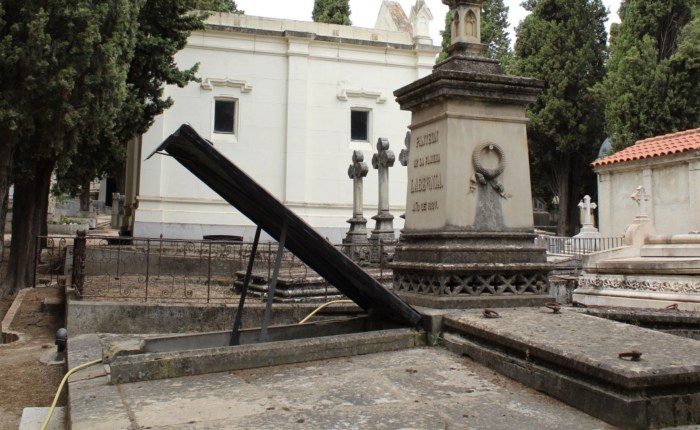
The most beautiful of these far-flung cemeteries is, undoubtedly, that of San Isidro. Well, I ought to give its full, official title: El Cementerio de la Pontificia y Real Archicofradía Sacramental de San Pedro, San Andrés, San Isidro y la Purísima Concepción.
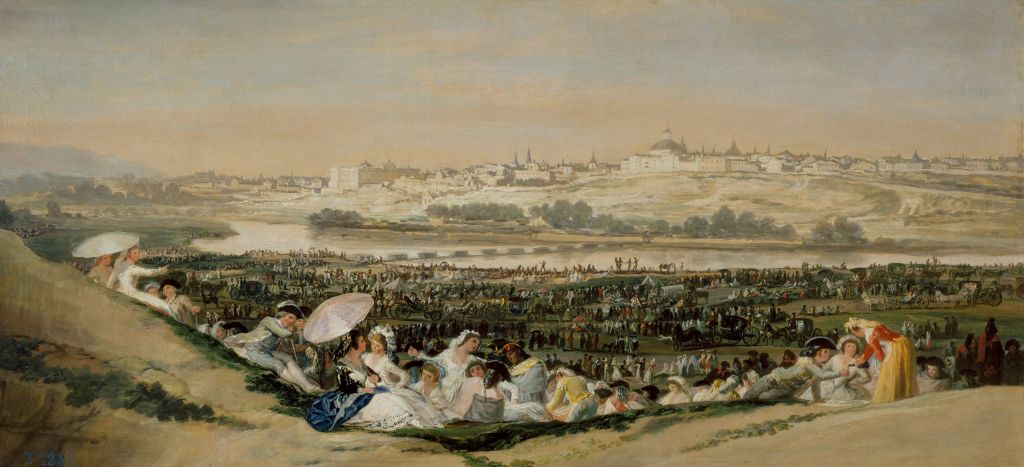
This snappily named cemetery is located on the far side of the Manzanares River, between the Toledo and the Segovia Bridges, in what used to be a remote area. Indeed, there is a famous cartoon (a design for a tapestry) by Goya, La pradera de San Isidro, which shows almost the exact same area where the cemetery stands now. It was painted in 1788, just 23 years before the cemetery was opened, and the area was visibly absent of any human construction. Of course, the ever-growing city of Madrid has since swallowed up the cemetery in its greedy embrace. Even so, the place is not exactly easy to get to, at least on public transportation. It does not help that it is only open until 2 pm.
The cemetery takes its name from the patron saint of Madrid, San Isidro Labrador. (“Labrar” means to till the soil, as he was a poor farmer in life.) Isidro lived in Madrid almost 1,000 years ago, when it was a small town of little importance. Last year, 2022, marked the centenary of this saint’s canonization, and thus it was deemed a year of special celebration. But regardless of the year, every May 15th the adjacent San Isidro park fills up with revelers as a celebration of the saint’s day.
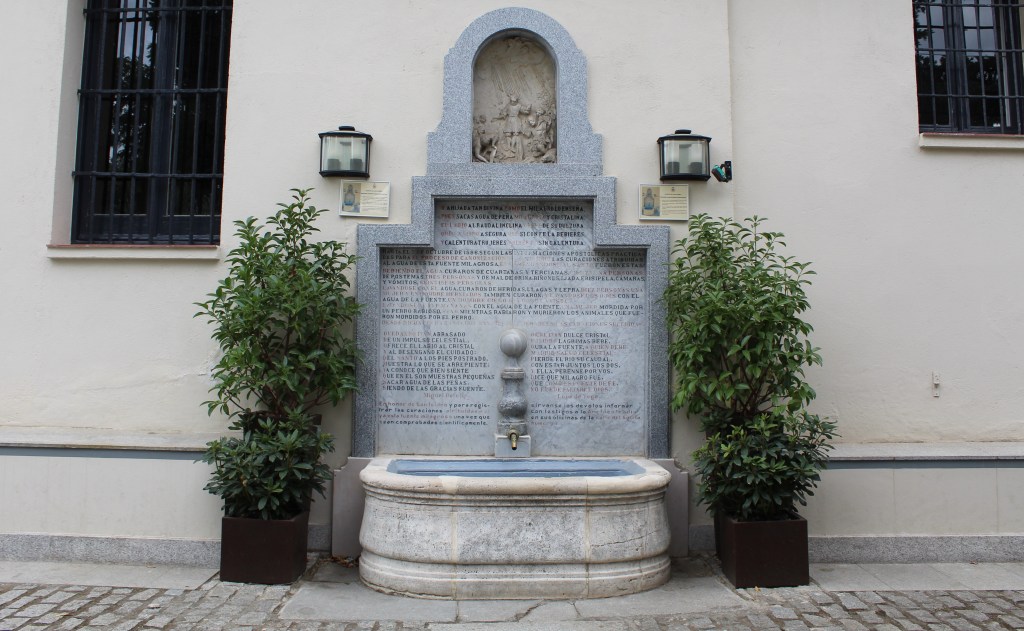
As with many catholic saints, a variety of miracle stories are told about San Isidro, one of which is that of a fountain he created by striking his staff on the ground, in order to slake his master’s thirst. This miraculous spring quickly became known for its curative properties, and it still occupies a place of honor in the cemetery.
Times have changed somewhat. To accommodate the pandemic, a motion-sensor has been added to make the fountain more sanitary. Thus, one can partake of the miraculous healing water without touching any germs. The fountain itself, though not large, is interesting for the long inscription that covers the wall. This text boasts, among much else, of having cured various types of fevers, urinary and kidney problems, erysipelas (a bacterial infection), vomiting, sores, leprosy, wounds, and even of restoring a blind person to sight. An impressive record, indeed—though I think I will stick with my current physician. Yet the fountain’s longevity is palpable, considering that it also bears an inscription of a short poem by Lope de Vega (1562 – 1635) praising the water’s power.
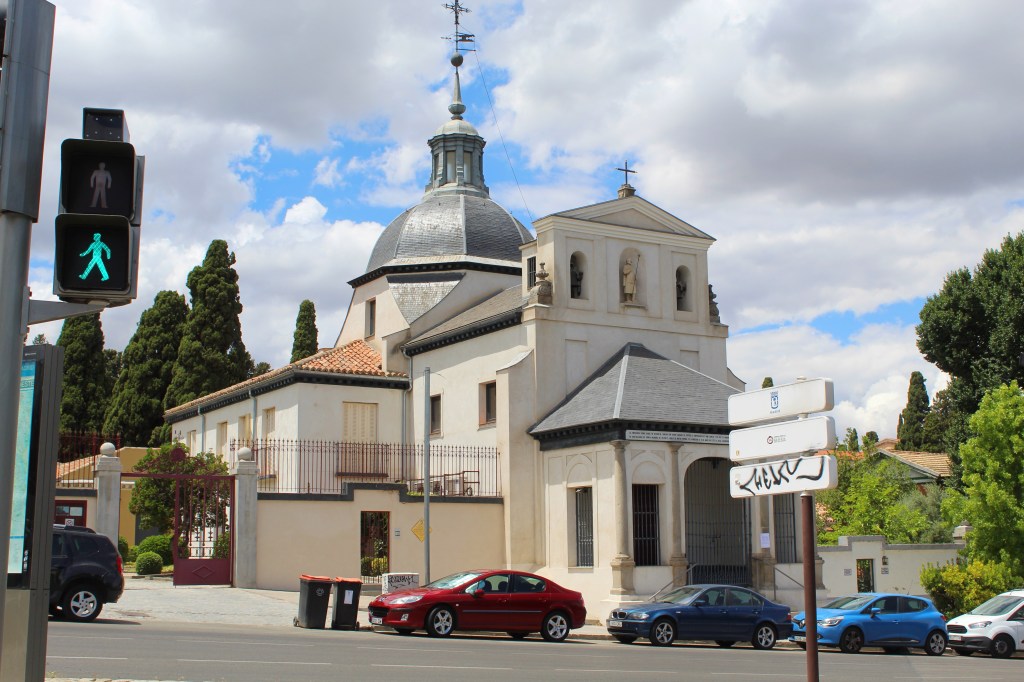
This fountain is right next to the Chapel of San Isidro. This is no coincidence, as the chapel was built on this spot in the 16th century on the orders of the Empress Isabel of Portugal, who believed that the blessed waters had cured her son, the future Felipe II. (This did not prevent poor Felipe from developing severe gout later in life.) Though a chapel has been here on this spot a long while, its current form is from the 18th century, when it was rebuilt. Thus, when Goya painted the chapel in 1788 (in another sketch for a tapestry, on display at the Prado), it looked very much as it does today. Even so, this is something of an illusion, as the chapel was—like much else in Madrid—totally destroyed during the Civil War, and only reconstructed to appear as it did in Goya’s day.
The Hermitage in Goya’s Day
The Hermitage Today
This quiet, peaceful cemetery was in the news last year as the site of a fascist demonstration. About two hundred Falangists (the Spanish fascist party) gathered to protest, hold up signs, and wave the Nazi salute. This was occasioned by the re-interment of the remains of one José Antonio Primo de Rivera (1903 – 1936), the founder of the Falangist party.
Ironically, Primo de Rivera became more important in death than he had ever been during his short political career. The Falangists were never a major electoral force during the Second Republic, and José Antonio did not help plan or execute the military coup which eventually resulted in Franco’s dictatorship. Rather, he became something of a martyr when he was imprisoned and then executed by the Republicans during the first year of the Civil War. After Franco emerged victorious, he found it convenient to treat Primo de Rivera as a kind of John the Baptist to his Messiah, and had Primo de Rivera’s body transported from Alicante to Madrid in a massive funeral parade.
After this, Primo de Rivera was temporarily laid to rest under the altar in El Escorial. But when Franco’s enormous symbol of fascist power—The Valley of the Fallen—was completed in 1959, Franco had the body moved once again, to serve as the symbolic centerpiece to his monument to the Civil War dead. For decades, Primo de Rivera slumbered underneath the mosaic dome of the underground basilica, directly opposite Francisco Franco’s own body.
Yet having such ghastly figures entombed in such a place of honor naturally bothered a lot of people, for the same reason that having statues of Confederate generals disturbs many Americans. The Valley of the Fallen was argued over for years until, in 2019, Franco’s body was dug up and moved to a cemetery in El Pardo. In 2023, the job was finished when Primo de Rivera’s body was also removed (the third time this embattled body has been re-buried, if you’re counting). Indeed, the official name of the site is no longer the Valley of the Fallen, but the Valley of Cuelgamuros.
Such is the hold of fascist propaganda on people’s minds that, decades after the fall of Franco’s dictatorship, and nearly a century after Primo de Rivera’s death, people still showed up to protest for the sake of these old bones.
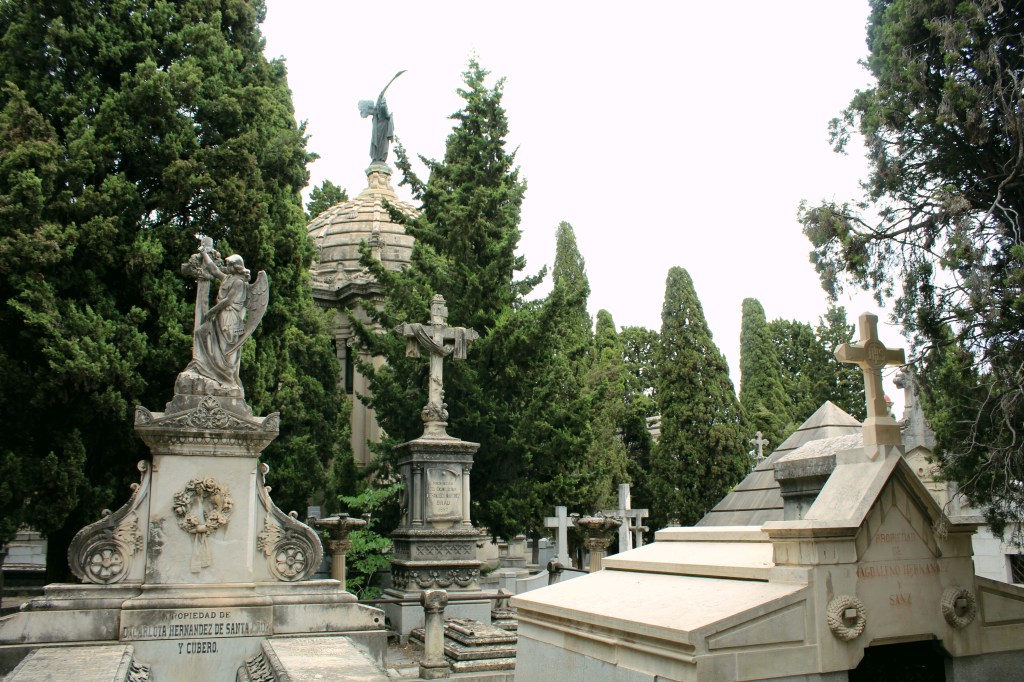
Enough politics! It is finally time to enter the cemetery itself. As the map by the entrance informs us, the cemetery is divided into several “patios.” The first three are located on a level with the chapel and are rather like church cloisters, without much decoration. The most interesting part of the cemetery is, without doubt, the large, semi-circular fourth patio.
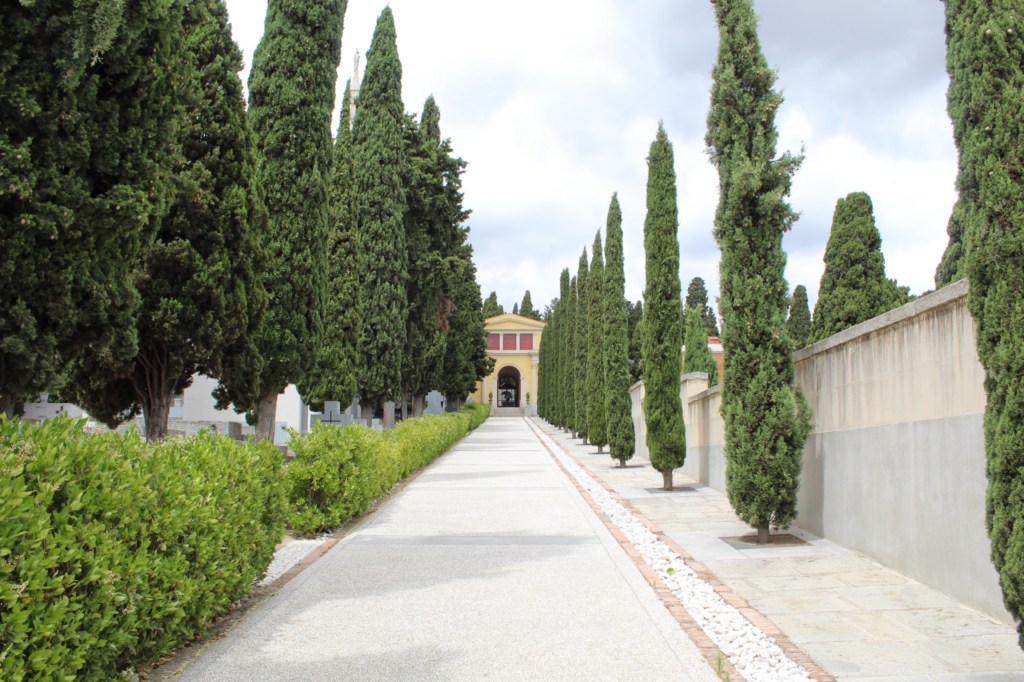
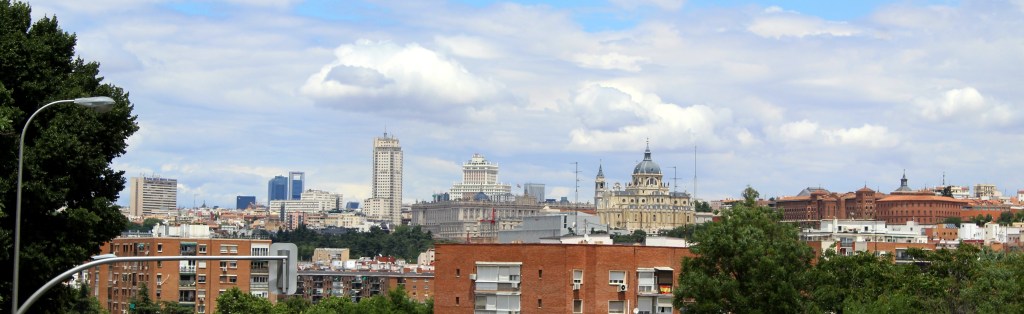
A walkway, lined with cypress trees—the traditional tree of mourning—leads up a hill to the upper level. It is obvious at a glance that this used to be a very fashionable place to decompose. The place is covered in elaborate tombs, mausoleums, and monuments—clearly not a burying ground for the penny-pinched. Look behind you, and you can see part of the reason for its popularity: The views of the city are quite wonderful from here (presumably why it was popular for picnics back in Goya’s day).
There are many eye-catching sculptures on display. But the first I want to discuss is a rather puzzling monument.
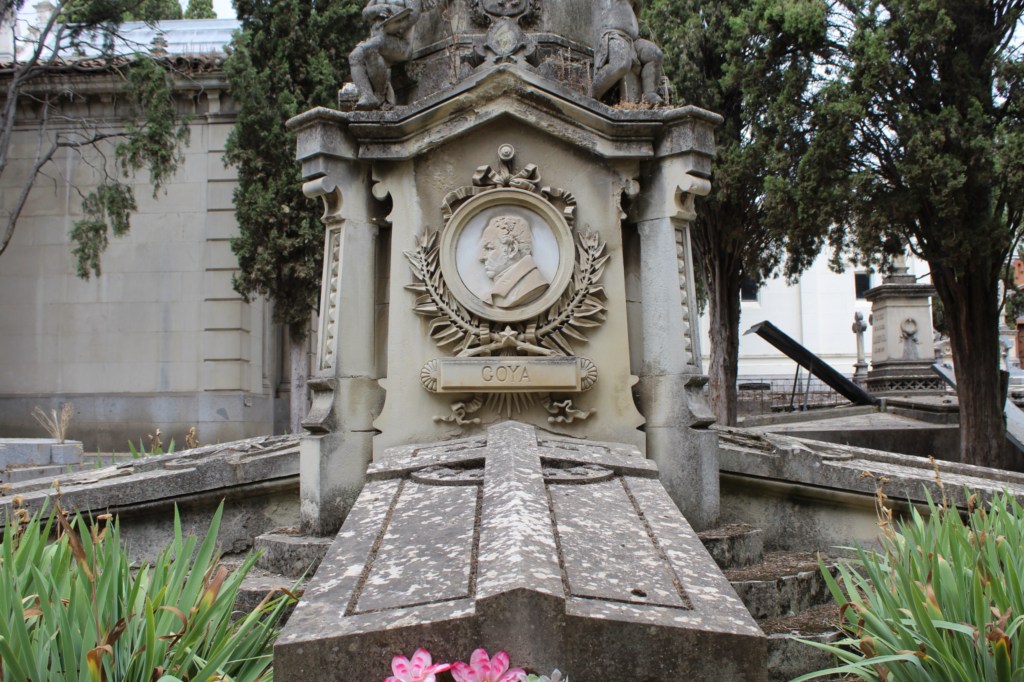
In a previous post, I explored the often-overlooked Pantheon of Illustrious Men, located near Atocha. The Cemetery of San Isidro has what can only be described as an aborted first attempt at that same monument. Also called the Pantheon of Illustrious Men, it consists of a tall stone pillar, upon which an angel stands with his trumpet. At the bottom of this column there is an ornate base with carved reliefs of the extremely distinguished bodies which rest beneath it. Three of these four are people the reader is unlikely to have heard of (illustriousness notwithstanding), but the fourth is none other than Francisco Goya, a person who is famous indeed.
The painter’s posthumous presence here is puzzling for two reasons. For one, this monument was not completed until 1886, while Goya died almost sixty years before that, in 1828. Second, I happen to know that Goya is certainly buried in a different chapel, not far off, called San Antonio de la Florida.
This mystery has a clear—if not exactly a logical—explanation. Goya was first buried in Bordeaux, France, where he died in exile. His body rested there, unharassed, for several decades until it was chanced upon by the Spanish diplomat to France, whose wife was coincidentally buried in the same cemetery. Obviously, the glorious Aragonese painter could not be left to decay on foreign soil, so he was relocated to his native land, and taken to this cemetery. However, because of all the bureaucratic hassle of transporting a body, Goya’s bones did not arrive until 1899, by which time the original idea of the Pantheon had lost its luster. Thus, he was instead buried in the aforementioned chapel of San Antonio de la Florida, which he had decorated with his own hand.
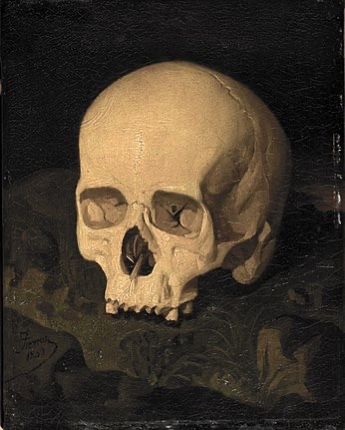
(To make the matter even more confusing, this chapel was eventually deconsecrated and turned into a museum, while an identical chapel was built just across the street—to the delight of many potential visitors, I am sure. And, to top it all off, Goya’s skull was lost at some point during this process, never to be found again. To add to the mystery, there is a painting in the Museum of Zaragoza of what is supposed to be Goya’s skull, made in the year 1849, before any of this tomb switching went on. It is possible it was stolen by curious admirers.)
The supposed skull of Goya
We have spent a lot of time on this odd cenotaph, but there is a great deal more to see in the cemetery. Indeed, I have seen enough cemeteries so that I can confidently proclaim that the Cementerio de San Isidro is among the most beautiful in Spain—perhaps in all of Europe. The finest artists and sculptors of the time were hired to turn a place of mourning into a wonderful open-air gallery. Of course, this was not an act of public service. This was done to preserve and glorify the names of the rich and famous—who wanted their final resting places to reflect the splendor of their lives.
It would be impossible to review every notable tomb and name in the cemetery. The following is only a brief sampling of what you may find there.
By the standards of the cemetery, a relatively modest grave belongs to Cristobal Oudrid, an important composer of zarzuelas (the distinctively Spanish version of light opera). His mustachioed face, carved into the stone, keeps watch over his earthly remains. Not far off is the resting place of Consuelo Vello Cano, better known by her stage name Fornarina. She performed a genre of song called cuplé, considered somewhat risquée, which was normally sung by women (or men in drag) for an all-male audience. Her grave is presided over by the torso and wings of an angel. An extremely modest grave belongs to Ventura de la Vega, an Argentinian playwright who lived and worked in 19th century Spain. He is buried in a niche in the encircling walls of the patio.
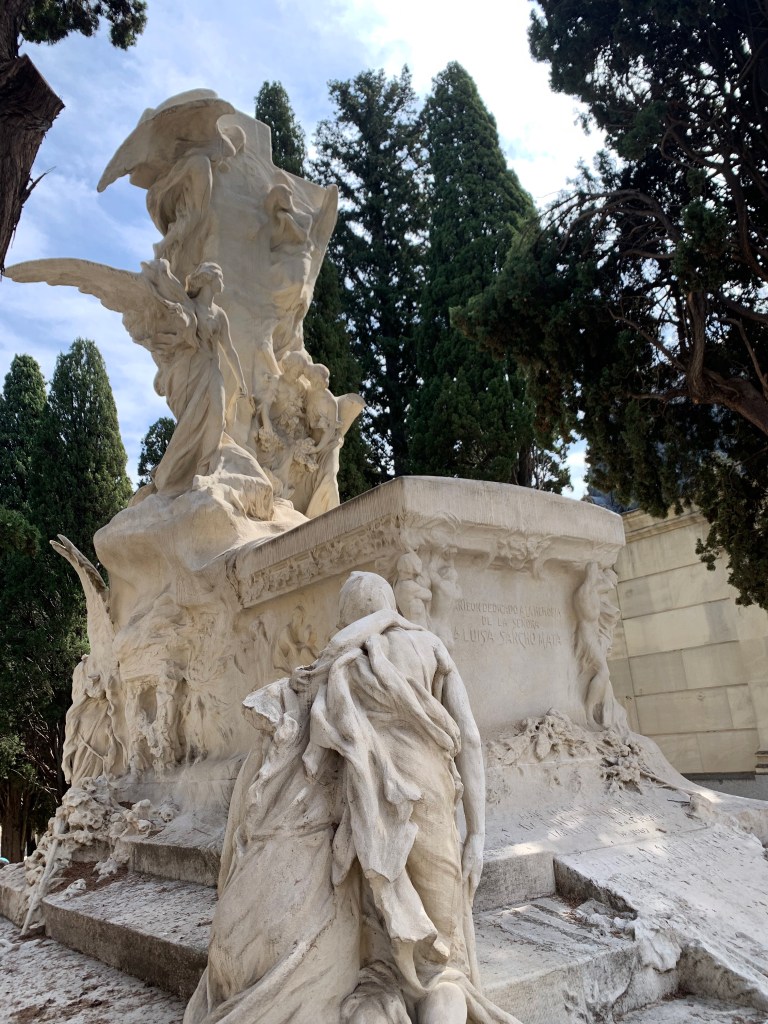
But what naturally attracts the casual visitor are the big tombs. Perhaps the most eye-catching is the Panteón Guirao, a massive sculptural tour de force by Augustín Querol. Querol is also responsible for a monumental tomb in the Panteón de Hombres Ilustres in Atocha, and this work displays his ability to create dramatic, fluid, and even ghostly textures out of hard stone. This tomb—which occupies the center of the patio—was made at the behest of Luis Federico Guirao Girada, who was a lawyer and a politician during his life, but who is now principally remembered for his photography.
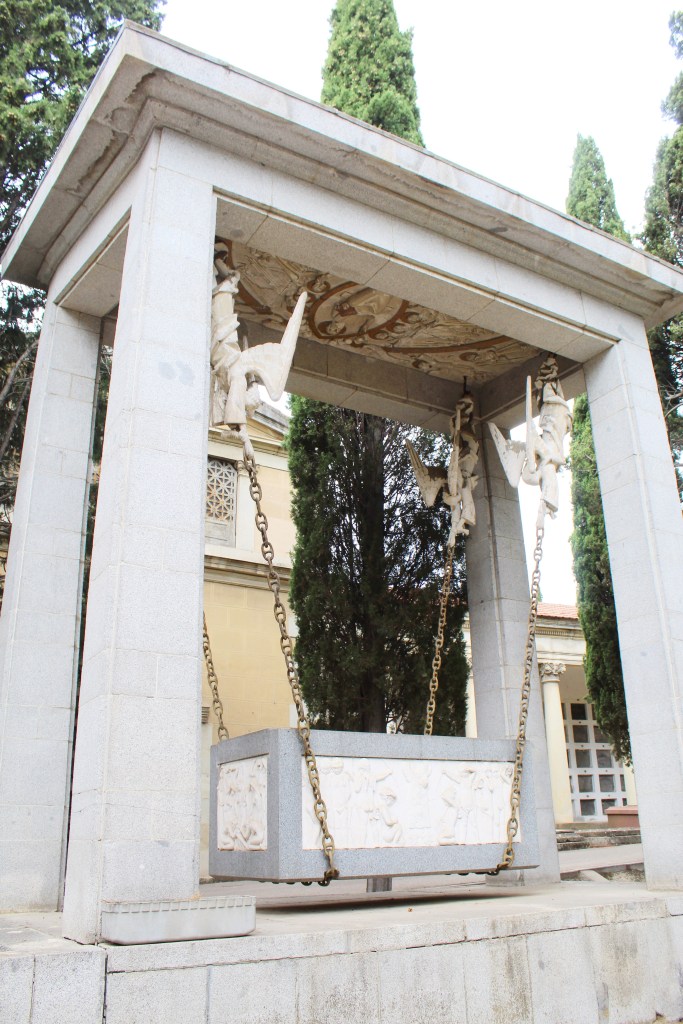
An extraordinary tomb is that which belongs to the Marquis of Amboage, an aristocratic family. This is an enormous neo-gothic chapel, bristling with prongs and complete with a metal spire, much like that of Notre-Dame de Paris. It could be a church if it did not have permanent tenants. But my favorite tomb is that of Francisco Godia Petriz. Petriz had a successful import-export business but was also an avid art collector. His mausoleum is unlike any I have ever seen. A stone sarcophagus hangs suspended by heavy chains from a large rectangular frame. The frames are held by miniature angels, who are ready to literally and figuratively carry the dead businessman up to heaven. Even if it is a bit tacky, I think the design is so original that I am surprised its architect, José Manuel Marañon Richi, is not better known.
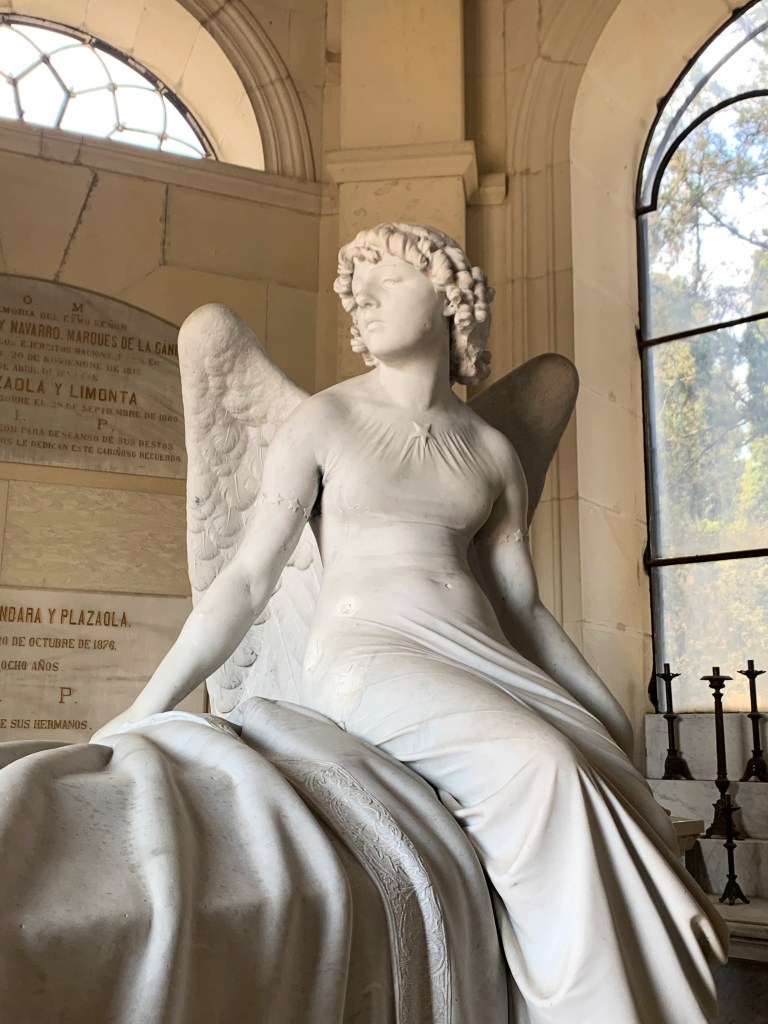
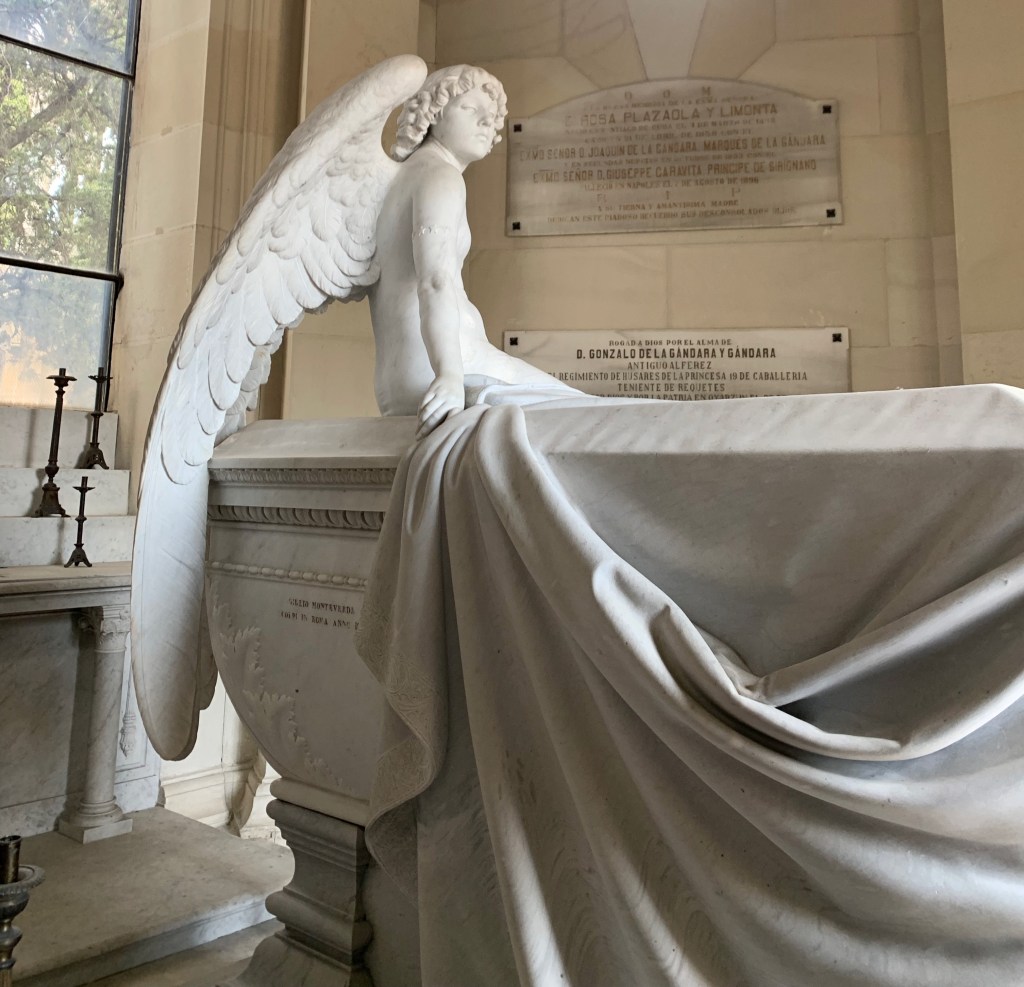
Some of the jewels of the cemetery are only available for those taking the official guided tour. These are offered only every so often and are all in Spanish. If you do manage to get one, however (they are reserved by emailing the cemetery), then you may be taken inside some of these impressive tombs. In the tomb of the Dukes of Denia, for example, there are two statues by the Spanish sculptor Mariano Benlliure, who vividly depicts the Duke and Duchess lying in deathly repose. Even more stunning is what awaits the visitor of the tomb of the Marquis of la Gándara. Inside, sitting atop a sarcophagus, is an angel wistfully looking into the beyond. This is a work of the Italian sculptor Giulio Monteverde, and it is quite wonderful. Standing in front of this heavenly being, it is easy to forget that she is made of inanimate rock, so subtly lifelike is the work in every detail.
If I am dwelling on this cemetery for so long, it is because it was a revelation to me that such a beautiful place was to be found in the city, virtually overlooked as a tourist destination. If Pére Lachaise Cemetery deserves to be on every Parisian tourist’s itinerary, then the Cementerio de San Isidro merits the same—both as an important link to Madrid’s history, and a place beautiful in itself.
Much like Michael Pollan’s Omnivore’s Dilemma, I feel compelled to give this book top marks—not because I agreed with everything Bosker said, and not because I loved every moment of it—simply because I doubt a better book could be written about its subject. Bosker threw herself at the world of contemporary art with the devotion of a fanatic and the patience of a saint. This book represents, in a very real sense, a decent chunk of Bianca Bosker’s life. Years went into it.
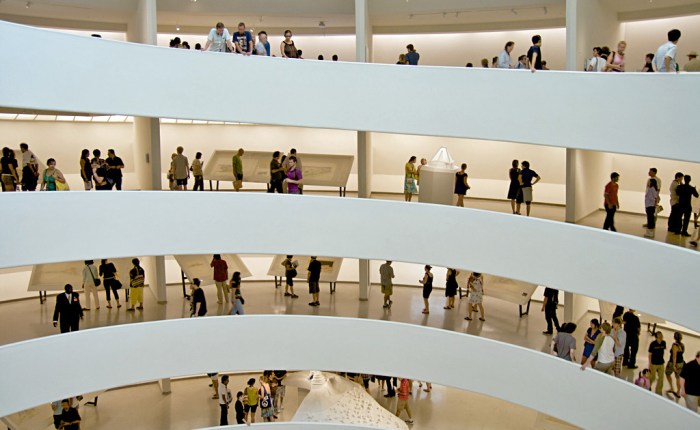
The comparison with Pollan is apt, as—like the food writer—Bosker is a kind of experiential journalist. She is not content to read art theorists and to visit a few galleries. No, she must work for a gallerist, apprentice with a painter, watch over the art in a museum, sell paintings in a show, plan an exhibition—in short, she must do everything that anyone involved in the art world does. And in so doing, she painstakingly assembles a map of this small, strange world.
The (ahem) portrait that she paints of this world is not flattering. This is especially true of the first part of the book, in which she becomes an assistant to a hip Brooklyn gallerist, Jack Barrett. I must say that I found Barrett to be the most unlikable person I had read about in quite some time—and I am including the murderous cannibals in The Road. He epitomizes everything unsavory in the art world: an obsession with reputation, with coolness, with inaccessibility, with fitting in—with everything, in short, except the art itself.
Like many gallerists, apparently, he prefers a property on an upper floor, so that it doesn’t attract street traffic. Visits from ordinary people—so-called ‘schmoes’—are to be avoided at all costs, as their appreciation is worse than worthless: it is detrimental. He even contemplates, at one point, hiring a web designer to make his website as difficult to use as possible, perhaps with white font over a white background. (Judging from his current website, this was wisely decided against.)
This emphasis on inaccessibility is certainly reflected in the language of the art world, whose style will be familiar to anybody who has been in academia. Probably many of you have had the experience of seeing something incomprehensible in an exhibition, turning to the plaque for guidance, and being confronted with a text that only adds to the confusion. As Bosker notes, this style of writing came into vogue in the 20th century, modelled after the French deconstructionists—whose already turgid prose was translated into highly unidiomatic English, and then emulated by anglophone writers. It is, in short, language meant to mystify and intimidate, not enlighten.
Most importantly, in Mr. Barrett’s world, “context” is king—which is really just a pretentious word for “reputation.” He is constantly worried about whether the people he is talking to are the “right” sort of people, in the sense that doing business with them will bolster his own reputation. When deciding whether to represent an artist, his most important question is whether they are the sort of person he would like to hang out with. He even goes so far as to nitpick Bosker’s clothes and to coach her behavior—not too many questions, no complements, no staring at the art—during their visits to galleries, since he doesn’t want her to taint his own manicured reputation.
The final irony is that Barrett, like so many in the art world, does so much of what he does in the name of progressive values, while personally betraying them. Several times, for example, he berates older painters and art critics (like Kenneth Clarke) for their focus on the female body, but he has no problem openly criticizing Bosker’s outfits, and even her exercise habits. He is critical of the white male establishment while being, quite obviously, a part of it—someone who is certainly from a rich family, but who hides his background so as to conceal his own privilege. And he is far from an aberration: as Bosker points out, the majority of galleries are owned by white males.
I am probably spending too much time on Barrett, who really only occupies the first quarter of the book. But I found his entire attitude towards art to be so poisonous that I could hardly even believe that such a person could really exist, much less be (as Bosker insists) one of the ‘nicer’ gallery-owners in New York. Yet perhaps the most damning fact is that, as Bosker points out, Barrett rarely if ever comments on the formal qualities of a work. In the rare moments that he deigns to explain why he likes a particular piece, he resorts to interpretations that rely on his knowledge of the artist—of “context,” in other words. If the book consisted solely of Bosker’s experience with Barrett, one would have to conclude that the art world was entirely and utterly vapid.
But Bosker has an incredible capacity for hope; and even after her tense working relationship with Barrett breaks down completely (he implies that he purposely told her the wrong way to paint a wall, so that he could criticize her for doing it wrong), she persists and actually succeeds in meeting some pretty nice people. The next gallerists she works for tell her, contra Barrett, to “stay in the work”—to appreciate the art you see in front of you, and not fall back on its reputation. And rather than insist on a frigid dress code and an affectless demeanor, they are bouncing off the walls with enthusiasm for the art they sell.
Yet the hero of this book is, undoubtedly, Julie Curtiss. With all of the focus on gallerists, curators, and collectors in the beginning half of the book, it is easy to forget the actual people who make the art. And Curtiss, whatever you think of her work, is every inch an artist—manic about her craft, able to talk your ears off about color, a perfectionist in every detail, and motivated by a kind of ineffable aesthetic vision. In stark contrast to the Barrett camp of art, Curtiss seems motivated purely by the formal qualities of her work—a vision in her head that she is trying to make manifest. What it means—whether it means anything—is of far less significance.
Bosker ends the book by taking her own stab at the question: What is the value of art? She decides that art works by reuniting us with the basic data of our senses. As she notes, our brains are constantly taking the information from our eyes and fitting it to preconceived patterns, which aid us in quickly making sense of what we experience. The advantage of this is greatly increased processing time (we know a lion immediately when we see one), but the disadvantage is that we can become disconnected from the real stuff of experience. Art breaks this pattern by presenting images to our brains that we can’t immediately make sense of.
Now, I think there is a great deal to be said for this view. For one thing, it avoids the over-reliance on “context” that plagues so much modern art—a sculpture of a coffee mug that comes with an essay about modern-day consumerism. However, as an attempt to come to grips with art it strikes me as both too broad and too narrow—too broad, in that many things besides art can reconnect us with our senses (travel, drugs, exercise…), and too narrow, in that art can do more than just attune us to the beauty of color and form. Yet it is difficult to criticize Bosker on this point, given that Plato and Kant also tried and failed to come up with an all-encompassing philosophy of art.
In any case, before writing this review, I made sure to try to put Bosker’s advice into practice. Last Saturday, I went to the Reina Sofia museum and forced myself to stare at art that, otherwise, I would probably have scornfully walked right by. As she advised, I tried to notice at least five things about each work I focused on, and even set a timer on my watch for five minutes, not allowing myself to move on until the time ran out. Perhaps this sounds more like a form of self-hypnosis or meditation than genuine art appreciation, but I did find myself enjoying some rather far-out contemporary works that were not to my usual taste.
And it is a great testament to Bosker’s book that, in spite of the (ahem, ahem) ugly picture she paints of the art world—so full of empty pretensions and hypocrisy, a “progressive” world of starving artists and rich collectors—that despite all this, she still deepened my enjoyment of contemporary art. It is a masterpiece.
Sometimes the simple act of remembering is political. History is, unfortunately, replete with crimes that one government or another would prefer to remain hidden. And, certainly, forgetting is probably easier for everyone involved—less traumatic, more convenient—even, perhaps, for the victims. Thus, whenever some busybody like Ian Gibson begins stirring up old trouble, the accusation of “opening up old wounds” is inevitably trotted out (ironically, by the ones who did the wounding in the first place).
And yet, even if it is not entirely logical—even if what is done is done, and nothing can change that—some sense of moral duty, of obligation to victims who are beyond all human help, seems to compel us nevertheless to reach back into the past and seek justice. This book is imbued with that sense—perhaps a quixotic sense—of ethical duty, as Gibson attempts to nudge the moral balance of the universe back in the right direction.
He first establishes that Lorca was anything but the apolitical flower child that he is sometimes portrayed as. It is true that Lorca was perhaps somewhat naïve and, in general, was averse to party politics (he repeatedly refused to join the communist party). But he was politically active and unambiguously allied with the left, as was evident by several public declarations. Indeed, the idea that Lorca was, in his final days, converting to the fascist cause—an openly homosexual poet who dramatized the evils of conservative Catholicism!—was never anything but laughable.
Gibson then does his best to establish the events that lead to Lorca’s death in Granada, using interviews with witnesses (admittedly many years after the fact) to pin down as many details as he can. In the process, he gives the reader a sense of the climate of terror and repression that engulfed Granada in the opening days of the military uprising—jails packed to bursting, mass graves filled by firing squads, a knock on the door at mightnight to go “take a walk.” In the process, he also lays to rest another myth of Lorca’s murder, that he was somehow killed by uncontrollable elements of the falangist party—a random act of violence, in other words. On the contrary, Lorca’s death was the product of an intentional campaign of “purification,” approved of and organized by the authorities.
This book might not have had such an impact on me had I not visited Granada as I was on the final pages. Though I had read many of Lorca’s works before the visit, he was still just a historical personage for me—one of Spain’s many dead poets. But visiting his former houses (there are several, as his family was very wealthy) transformed him into somebody startlingly real and close. I saw the piano that he liked to noodle on, the writing desk on which he wrote his most famous plays, and even hand-drawn theater backdrops to be used in a puppet show for his baby sister.
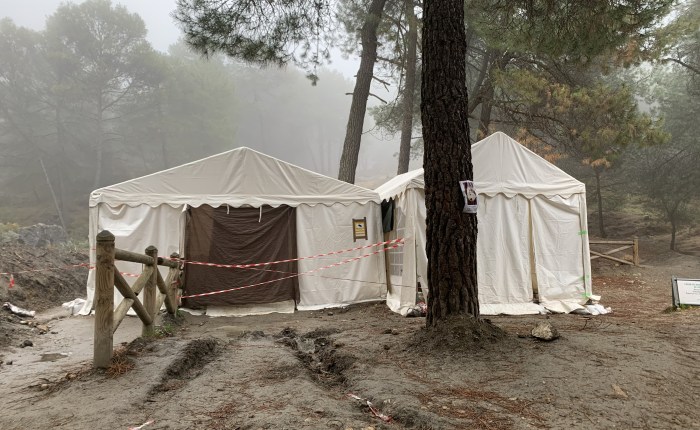
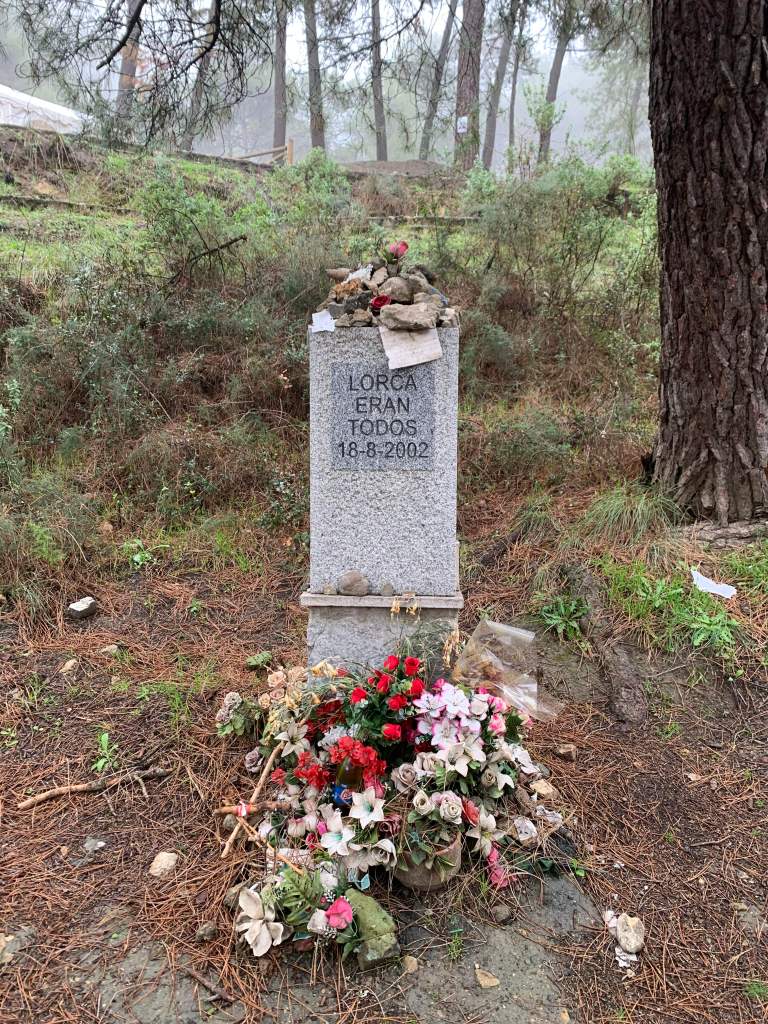
This trip culminated in a visit to the Barranco de Víznar, the place of his execution. We arrived on a foggy Sunday morning and followed the path into the woods. Soon, we came upon several white tents, which covered the excavations sites of mass graves. The trees around the site were covered with laminated posters bearing the names and faces of those executed there—professors, politicians, farmers, pharmacists, music teachers… In the center was a simple memorial covered in flowers, with the inscription “They were all Lorca.”
So far, the remains of dozens of individuals have been recovered there by a team of investigators, though none have yet been identified by DNA tests. That this excavation had to wait nearly 100 years to take place is a measure of the silence—imposed, in an attempt to forget—that followed the Spanish Civil War. But relatives of the victims have kept their memories alive, and now they are perhaps receiving some modicum of justice. Even today, memorializing these victims takes courage. Just last week, a hiker was assaulted at that very place by a man screaming “There aren’t many buried here!” The hiker was hospitalized. But the work continues.
In historical events great men—so called—are but the labels that serve to give a name to an event, and like labels, they have the least possible connection with the event itself.
Leo Tolstoy
Anyone who has made it to the end of War and Peace will remember the strange sensation of finishing one of literature’s most epic stories and immediately being thrown into—of all things—an essay on the philosophy of history. With your heart throbbing with emotion for the characters who made it to the end of the novel, you are hardly in a fit frame of mind for considering the deep mechanisms of historical progress.
Tolstoy himself may not even have been in a fit frame of mind, as his essay—while well-written and interesting—is not exactly persuasive. Indeed, the famous philosopher Isaiah Berlin wrote one of his most famous philosophical essays, “The Hedgehog and the Fox,” analyzing why a man as brilliant as Tolstoy could put forward a work of analysis that does not really hold together. In Berlin’s opinion, Tolstoy is a classic “fox” trying to be a “hedgehog”—meaning, that although Tolstoy’s brilliance was expansive and intuitive, born of his great gift for empathy, he longed to be a systematic thinker who could subject his life to logical conclusions.
Tolstoy’s particular gifts aside, let us turn to the main argument of his essay—namely, that the “Great Man” theory of history is a mistake. Tolstoy argues that, although we conventionally ascribe major historical events to the decisions of certain powerful individuals, it is more accurate to think of history as the product of a countless number of choices and actions by everyone involved. To use Tolstoy’s own example of Napoleon, he argues that, although Napoleon is treated as a kind of mortal god who changed European history—a military genius who defeated so many foes—in reality he was usually unaware of what was happening during his major conflicts, and entirely powerless to influence the outcomes of his battles.
Now, I think nearly everyone would say that Tolstoy pushes his point too far. I doubt many historians would be willing to argue that Napoleon was not a particularly important man, who certainly did exert an influence on the outcome of his battles. Nevertheless, the opposite opinion —say, that Napoleon was wholly in control of his destiny—can also easily be taken too far. Indeed, as far as I can tell, amid historians nowadays there is quite a bit of hostility to the “Great Man” view of history.
I hate to be the sort of person to argue for a middle ground. “It is a little of both” is the oldest intellectual cop out in history. Nevertheless, it does seem logically inescapable that “men” (or, to be a little more inclusive, “people”) are both products of their times and makers of events. The more interesting question is to what extent any given individual is crucial to the shape of history.
The most convincing proponent of the “Great Man” view of history I know is Robert Caro (whose tomes make even War and Peace seem lightweight). In his biography of Bob Moses, for example, Caro makes a convincing case that Moses was a uniquely gifted administrator—an expert in the accumulation and deployment of political power. The very shape of New York City—its many highways, bridges, and tunnels, its parks and housing developments—is, for better or worse, a testament to Moses’s influence.
But a skeptic might say that, as special as Moses might have been, cities all over the United States implemented similar programs—bulldozing neighborhoods for highways, demolishing buildings to create high-rise public housing. If Moses was really so special, then why did he merely accomplish what was basically accomplished all around the country by far less famous individuals?
This rebuttal works in the abstract but not the concrete (pun intended). In Caro’s telling, you can see exactly how Moses subverted rules, bypassed regulations, and bent politicians and contractors to his will, in a way that was completely unprecedented. After witnessing his machinations, it is very difficult not to be convinced that, at the very least, Moses’s specific personality and prejudices carried historic weight.
This is not to take the opposite view, that so-called “Great Men” are the only ones who count in history. It is just to make the claim that, while every individual can exert some influence on the shape of history, some individuals wield considerably more influence than others. And while this may feel like a cop-out, arguably both Tolstoy’s view or the opposite extreme are anti-humanistic—the former, because individual qualities are held to play no role in history, and the latter, because the majority of humankind are reduced to automatons carrying out the will of a few geniuses on top.
I will cease to belabor this point—which I suspect will seem rather obvious to most—as it is just another form of the “chicken and egg” problem. I will only add that, as an amateur student of history, I think it is greatly rewarding to consider the individual experiences of both the major players (the so-called “Great Men”) and the supposedly “ordinary” people on the bottom. It all has much to teach us.
We have artists with no scientific knowledge and scientists with no artistic knowledge and the results aren’t just bad, they’re ghastly.
Robert Pirsig
Among the many woes of American higher education nowadays, one is the precipitous decline of the humanities. Students these days, apparently, are opting for science, business, or engineering degrees, rather than the liberal arts. And as administrators slash budgets in history and literature departments in response to this declining enrollment, some writers and educators have stepped forward to defend this ancient, noble pursuit.
David Brooks attempted a sort of defense recently, in his column “How to Save a Sad, Lonely, Angry and Mean Society.” His argument was essentially that exposure to great works of art develops empathy, as great art trains us to see the world through different perspectives. It is Brooks’s belief and hope that such exposure translates to moral behavior. After all, if we can appreciate the needs, thoughts, and beliefs of others, we will certainly be more kind to them.
I would very much like to agree with this argument. But I have a hard time swallowing it. For example, one of the artists that Brooks mentions is Pablo Picasso, whose great painting Guernica arguably improves its viewers by making the horrors of war viscerally palpable. Picasso himself was, however, a notorious abuser of women, despite being as steeped in art as a person can possibly be. Indeed, history is so replete with cultured criminals—many prominent Nazis were highly educated connoisseurs, to pick just one notorious example—that the notion of betterment through studying the humanities can seem rather silly.
And yet, it is difficult for me to entirely let go of this idea. As a counterpoint, I might mention the American Secretary of Defense, Robert McNamara. After watching Errol Morris’s wonderful documentary about McNamara, one is left with the impression of a man dominated by instrumental thinking. That is, McNamara is always concerned with the how of any question—and he is content to let his superiors worry about what he is doing, why he is doing it, and whether he should be doing it in the first place. Put another way, I think McNamara illustrates the limitations of a purely technical mind—even a brilliant one—as he attempts to make a stupid, immoral war machine as efficient as possible.
Perhaps it is fairer to say, then, that the humanities, while not sufficient for moral behavior, are a necessary condition of it. Or perhaps one must make the even weaker argument that, in general, exposure to philosophy, literature, history, and the arts tends to make us more moral. Or perhaps we might even have to take one further step back, and resign ourselves to saying that these subjects give us an opportunity to at least consider how we could become more moral. If that isn’t convincing, then we ought to just admit that the humanities are valuable simply because they make life more pleasant and interesting—which should be enough, anyway.
What does seem quite clear to me is that all the humanities and arts in the world will not be enough to extricate us from the moral morass that the United States—and, to a worrying extent, much of the rest of the world—seems to have fallen into. Individual enlightenment, even if it is achievable, does not stand much of a chance against collective stupidity. As dirty and disheartening as it is, we must participate in politics as partisans if we want to create a better world.
In any case, I think the decline in student enrollment in the humanities should not be ascribed simply to the deterioration of our culture or the coarse values of the new generation. A huge part of the explanation is simply cost. It is one thing to, say, hold history or philosophy in high esteem, but quite another thing to decide to go into thousands of dollars of debt to acquire such knowledge, with no assurance of a decent job on the other end. Expensive universities only make financial sense if they lead to a good career. (Having studied anthropology, I am in no position to be moralizing on this topic.)
In many ways, the university system here in Spain seems more logical to me. Rather than living on a luxurious campus and indulging in the life of the mind, most university students here commute from home, pay a modest fee, and learn exactly what they need to work in a specific job. In other words, it is job training, pure and simple (at least for most people).
And yet, I am old-fashioned enough to think that there is something good and valuable in the old liberal arts model of education, even if it is difficult to justify on economic grounds. Like Pirsig, I shudder to think of a world where people are only familiar with their own specialty, be it science or art. Education should not be reduced to technical training, or we will be left with a society of people unable to think about problems beyond the narrow domain of their fields. But how can the humanities be kept alive amid the ballooning cost of universities and the dwindling job opportunities of the market? This is a question beyond my ken.
It is amazing how ignorant one can be without knowing it. As a product of the American school system, and a veteran of all 11 and a half hours of Ken Burns’s iconic documentary, I thought that I was in for few surprises when I began this book. But because of deficiencies in either my education or my memory—probably a bit of both—I was constantly surprised throughout this telling of the war, and became absolutely riveted.
Though I am certainly not in a position to judge, I would venture to say that this book simply must be the best one-volume account of the war. It is a remarkable performance on every level. Despite the relatively limited amount of space that McPherson can devote to any one subject, the reader never feels that he is offering a superficial or a cursory account. On the contrary, as in the best overviews of historical events, the whole is greater than the sum of its parts, as each element in the story sheds light on every other.
McPherson shows himself to be a skilled and flexible author. Whether he is analyzing the Confederate economy, or examining the Northern political situation, or explaining the advances in naval technology, or narrating battles and troop movements, McPherson’s prose is steady, clear, and engaging. His grasp of the subject is so strong, and his vision so clear, that the chaos of politics and war plays out on the page with the orderliness of a Victorian novel. The simple act of taking such a huge mass of information and rendering it into something comprehensible—while remaining nuanced and enlightening—is, in my opinion, a great literary accomplishment.
As might be expected, the comforting notion that the war was somehow about states’ rights—and not slavery—does not hold up to even a moment of scrutiny. It is true that the Confederate states, in general, did place a high value on the autonomy of individual states. Yet these states’ support of the Fugitive Slave Act before the war—a huge extension of federal power, allowing the national government to overrule individual state laws to return escaped slaves—shows that slavery trumped this concern. In any case, whenever the states’ rights argument is made, it immediately leads to the question: their right to do what, exactly? (Answer: maintain slavery.)
As a final irony, after vociferously denouncing the use of black troops by the Union Army, and refusing to treat captured blacks as soldiers (either summarily executing them or selling them into slavery), in its final months, the Confederacy considered the use of slave soldiers. This idea was so totally contradictory to their stated values that it produced anger, shame, and confusion among the Confederates. Some preferred simply to give up to the North than to resort to this horrible betrayal of their values. Others admitted that, if blacks could make good soldiers, their entire way of life was based on a lie. Politicians wrangled with the implications of slave soldiers: If they were to fight, shouldn’t they be promised their freedom as a reward? In any case, this handwringing came to nothing, as the Confederacy collapsed before they could put this desperate—and hopelessly contradictory—idea into practice.
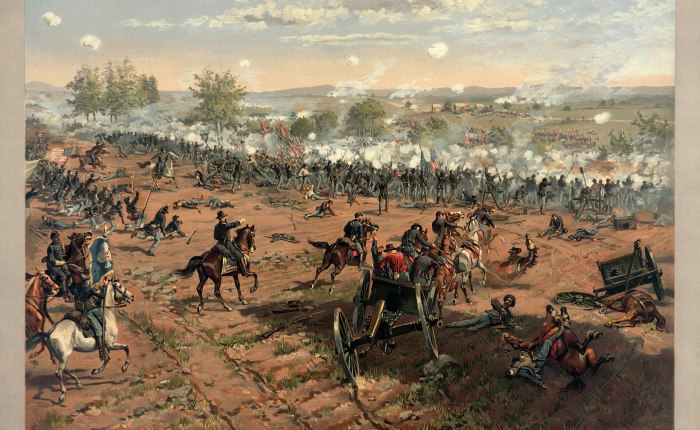
On a purely military level—admittedly, perhaps the most superficial way a war can be judged—the American Civil War is as thrilling and fascinating as any war in history. There were brilliant generals on the Union and Confederate sides whose campaigns are still studied today by would-be commanders. In McPherson’s telling, the main lesson of the war is the wisdom of an aggressive strategy. The first two years of the war, from 1861-63, are marked by defeat after Union defeat under generals (particularly McClellan) who shied away from confrontation, while Southern generals took the initiative. However, when Grant and Sherman—as aggressive as they come—finally took control on the Union side, the carnage of battle went from horrible to simply nauseating, and I began to have some sympathy for McClellan’s reluctance to subject his troops to such slaughter.
In many ways, the American Civil War seems to prefigure the terrible conflicts of the following century. By the end of the war, the basic tactics of the infantry resembled those of the First World War—massed troop attacks against entrenched positions, with predictably horrible casualty rates. The invention of iron-clad ships reminds one of the first tanks, while the Union use of a subterranean mine to break the enemy line in the siege of Petersburg prefigured what became a common strategy in the Great War. On the other hand, the horrible conditions of prisoners of war—particularly in the Confederate camp, Andersonville—are an unsettling forerunner of the German camps in World War II. The photographs of emaciated Union soldiers will look very familiar nowadays. And this is not to mention the millions of enslaved blacks forced to aide in the war effort of their enslavers, another omen of things to come.
And yet, there is a certain horror peculiar to civil wars. I am now, for example, making my way through interviews of civilians and soldiers who lived through the Second World War, and a common thread is how easy it was to hate and fight someone alien—someone who lives far away, speaks a different language, and maybe even looks different. But in a Civil War, neighbors fight neighbors, friends fight friends, and family fight family—not metaphorically, mind you, but literally. It is difficult to understand how a country could devolve to such a point that a boy from Maine is willing to stick a bayonet in the guts of a teenager from North Carolina.
What is even more remarkable, perhaps, is that the country was able to come together after such a vicious conflict. Though the hysterical and uncompromising tone of many of the politicians prior to the war now sound distressingly familiar, I suppose I should derive some hope from the fact that the country survived intact—indeed, became stronger than ever before—after this murderous episode.
Historians are averse to counterfactuals, and perhaps rightfully so. After all, how could you possibly know what might have happened in some imagined parallel timeline? However, I do think it worthwhile to consider these questions, even if precise answers elude us. What would have happened, then, if the South had successfully seceded? In a rapidly industrializing world, in which all of the major powers had abolished slavery or serfdom, how long would the “peculiar institution” have lasted in an independent Confederacy? As valuable as was their cotton, it is difficult for me to resist the idea that they would quickly have ended up an agricultural backwater, increasingly shunned by the rest of the world.
I am getting off track. This is a review of the book, not the war itself. But it is a mark of McPherson’s accomplishment that I cannot stop thinking about this defining conflict. Lately, I have even found myself watching long video tours of the great Civil War battlefields (either a great testament to the book’s value or to my own need to get a life). Of course, in any single-volume work of this kind, there will inevitably be omissions and shortcomings. I would have liked more on the experience of being a common soldier, for example. Yet such criticisms are easy to make, and seem very petty when compared to everything that McPherson has accomplished here. It is a great achievement.
Whoever takes up and seriously pursues a matter that does not lead to material advantage, ought not to count on the sympathy of his contemporaries.
Arthur Schopenhauer
Despite the greed, grubbiness, and graft associated with capitalism, looked at in a certain light it can appear positively utopian. Certainly many economists and centrist politicians have thought so. In a free market there is no such thing as inherent value. No authority, not even divinely ordained, can determine that something is worth paying for. The only true test of worth is whether people want it, and how much they are willing to spend to get it. That’s it. You can even argue that truly pure capitalism—with perfectly free consumers in a perfectly open market—is a kind of existentialist paradise, where every person determines their values through their own decisions (specifically, by deciding what to buy).
Of course, as any behavioral psychologist, marxist, anthropologist, or clear-eyed person will tell you, this paradise of free choice is very far from the reality we live in. Nevertheless, I think that many of us internalize the idea that value is determined via the market—not only personally (as the existentialists might have it), but objectively. If a song is #1 in the charts, for example, then it must be good by definition. Anything people choose to spend money on simply must be better than what they choose to ignore. By extension, any activity that does not make a profit is, objectively, a waste of time. Money is the ultimate arbiter.
Now, I am not against making money. But I am opposed to the idea that an activity must bring a profit in order to be worth seriously pursuing. A good hobby should, above all, bring pleasure to oneself. Money is a bonus.
In many ways the internet has ushered in a golden age of hobbies, by allowing networks to form among practitioners across vast distances and making available resources that previous generations could scarcely dream of. Birdwatching, for example, used to be done in solitude or, at most, in a local group, with only a guidebook as a resource. Now apps can identify birds by photo or call, or notify users of a certain species in an area, pooling the collected knowledge of the entire community.
But the internet has also made it possible to monetize these hobbies—or try to. Whether taking photos, making paintings, or recording music, now we can all be miniature professionals by selling our work or services on the web. (Birders have mostly kept out of the market, though.) And when these ventures perform poorly—as most inevitably will—a tinge of disappointment and failure hangs over what, in another time, might have been a perfectly carefree pursuit. In other words, we now have the ability to turn virtually any skill we have into another job—which is not exactly a recipe for joy.
Of course, Schopenhauer was not talking about hobbies. With a good deal of self-pity, he was referring to his own largely unrewarded and unrecognized labor to create a new system of philosophy. That bitter man was certainly not the only genius whose work was ignored by his contemporaries. There are too many to name. In retrospect, it is a wonder that people can be so blind. And yet, the idea that posterity is the ultimate judge—which Schopenhauer would likely agree with, I think—is just another version of the idea that markets are the ultimate judge of value. In this case, you can just say that the market is a little bit slow.
But, as I mentioned in my review of Van Gogh’s letters, this introduces a kind of paradox. For if the market is the arbiter of value, and that market can be tardy in coming to a verdict, then we must labor under the uncertainty of our own worthiness. We can spend our lives painting and leave behind a treasure for the ages, or we can spend our lives painting and leave behind junk nobody wants. Since we might die before our work is “discovered,” we might never know. Herman Melville, for example, could probably never have dreamed that Moby Dick—which sold poorly and got mediocre reviews—would become the Great American Novel.
Are there any lessons to be drawn from this? Maybe the very idea that markets—including posthumous markets—determine value ought to be scrapped. After all, there is very little stability or unanimity in mass opinion. For all we know, in 100 years Van Gogh might not even be popular or beloved anymore. Schopenhauer’s reputation has certainly had its highs and lows.
I set to work with this boundless pile of paper to fill it to the last sheet with all manner of odd things, so no doubt there’s much in these pages that make no sense.
This is an utterly delightful book. Indeed, it is fair to say that this is a book about delight in all its manifold forms.
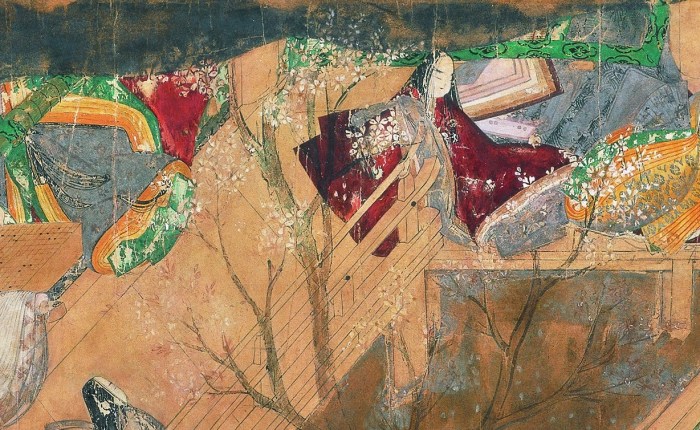
This is all the more remarkable given what we know about the author’s life. Sei Shōnagon was a kind of lady-in-waiting for the Empress Teishi. However, not long after her marriage, Teishi was supplanted by another Empress, Shōshi (whose own lady-in-waiting, Murasaki, wrote the classic Tale of Genji), and soon thereafter died in childbirth at the age of 23. Thus, Shōnagon’s life in the capital was tense, humiliating, and short-lived. It is not even rightly known what became of Shōnagon after Teishi’s death. Even the date of her death is in doubt.
One might expect the writings of such a person to be tinged by melancholy or motivated by revenge. What we have, instead, is an elegant series of reminiscences and observations about the beauty of her world. Shōnagon appears to have loved court life—the ceremony, the pomp, the artificiality, the formality, the refinement, the elegance—in short, everything. Her taste for her role in court is striking to the modern reader, as her life cannot but appear incredibly confined to us. She spends all her time literally cordoned off, separated from the men by a screen, and is constantly at the Empress’s beck and call. I would have lost my mind.
But Shōnagon wrings as many drops of aesthetic pleasure out of her circumstances as humanly possible. She is, for example, enchanted by the subtleties of dress—what ranks of court officials can wear which articles of clothing, what colors are appropriate for which season. The sounds of words delight her, as do the specific characters used to write them. Seasons, trees, flowers, birds, and insects all attract her attention.
These items are gathered together into lists, which comprise the bulk of this volume. Indeed, Shōnagon must be one of the all-time masters of the list, as she is inexhaustibly brilliant at thinking of categories. True, there are pedestrian ones such as bridges, mountains, ponds, and so forth. Some of these are so short and perfunctory that one wonders why Shōnagon thought it worthwhile to jot them down. But most lists are based, not on the thing itself, but on how it makes Shōnagon feel: dispiriting things, infuriating things, things that look enjoyable (but aren’t), splendid things, regrettable things, things that are distressing to see, things that are hard to say, common things that suddenly sound special, things that look ordinary but become extraordinary when written…
These lists were so quirky and, often, so hilarious that I was incongruously reminded of Wes Anderson’s films, which often feature odd lists. (Come to think of it, if anyone could turn this book into movie, it would have to be a pretentious aesthete like Anderson. He also shares Shōnagon’s love of colors.) But the list, in Shōnagon’s hands, becomes more than just a tool of organization. It reveals a kind of aesthetic philosophy—in part, that of the society she lived in, but to a great degree idiosyncratic—wherein the sensible qualities evoked by things are ultimately more important than the things themselves.
This is exemplified in what is arguably the dominant theme of this book: poetry. To an extent that is very difficult to imagine today, poetry pervaded court life in Heian Japan. Virtually everyone at the court, it seems, had memorized a great deal of poetry, and their conversations are littered with erudite references. (Unfortunately for me, most of this poetry relied on puns that are untranslatable, making it rather baffling in English.) Moreover, it was common to correspond via poetry, and the ability to compose on the fly was highly prized. Stories abound of someone (usually Shōnagon herself) finding the exact perfect reference or quote for an occasion, or completing the opening lines of a poem with brilliant aplomb. It is as if everyone at the White House were expected to freestyle.
It must be said, however, that despite Shōnagon’s attempt to reach a state of pure aesthetic appreciation, her strong and sharp personality very often breaks through. And good thing it does, for without it the book would not be even half as enjoyable as it is.
Admittedly, Shōnagon the person is, in many respects, unpleasant. She is snobby in the extreme and not a little vain. Her attitudes toward common folks is one of utmost condescension, and her need to be refined at all times sometimes verges into the ridiculous (in one section, she pretends not to know the word for “oar,” as it is too vulgar an object for her delicate vocabulary). Shōnagon is even capable of cruelty, which is exemplified in a section when a commoner comes in tears to report that his house burned down, and Shōnagon breaks into laughter and writes a satirical poem about his predicament. (The poor man, being illiterate, mistakes the poem for a promissory note.)
This opinion of Shōnagon was, apparently, shared by at least some of her contemporaries. Lady Murasaki, for example, found her to be “dreadfully conceited” and predicted: “Those who think of themselves as being superior to everyone else in this way will inevitably suffer and some to a bad end.” For my part, however, I think that the tension between Shōnagon’s very human shortcomings and her airy aesthetic focus creates a kind of dynamic tension that makes this book become fully alive as a human document.
I cannot finish a review of this book without mentioning its immense value simply as a window into another time. I was constantly thrown to the endnotes (which I wish had been footnotes) to understand some obscure reference or puzzling custom, and in the process inadvertently learned much about Heian Japan. Somehow, both Shōnagon’s numerous poetic references and her love of gossip combine to make her age come fully alive in these pages, in a way that few other books accomplish. In other words, this book is wholly delightful.





 Lotz in Translation