Sorolla: A Tale of Two Cities

Sorolla: A Tale of Two Cities

Madrid has some of the finest museum-going in Europe, holding its own against Vienna, London, and even Paris. And this would be true if the city only had its big three: the Prado, the Thyssen, and the Reina Sofia. In addition to these heavyweight picture galleries, however, the city is also home to a great many excellent small museums. The best of these is, without a doubt, the one dedicated to Joaquín Sorolla.

It is somewhat ironic that Sorolla’s museum should be located in Madrid, as he was a valenciano by birth and disposition. His most famous and distinctive paintings are those featuring beach scenes, bathed in a kind of brilliant lucidity, every surface shimmering under the Mediterranean sun. But he was far more than a provincial painter. During his life, he became the most celebrated artist in the country—and, indeed, one of the most famous in the world. This is why he was able to afford such a fine house in the center of the nation’s capital.

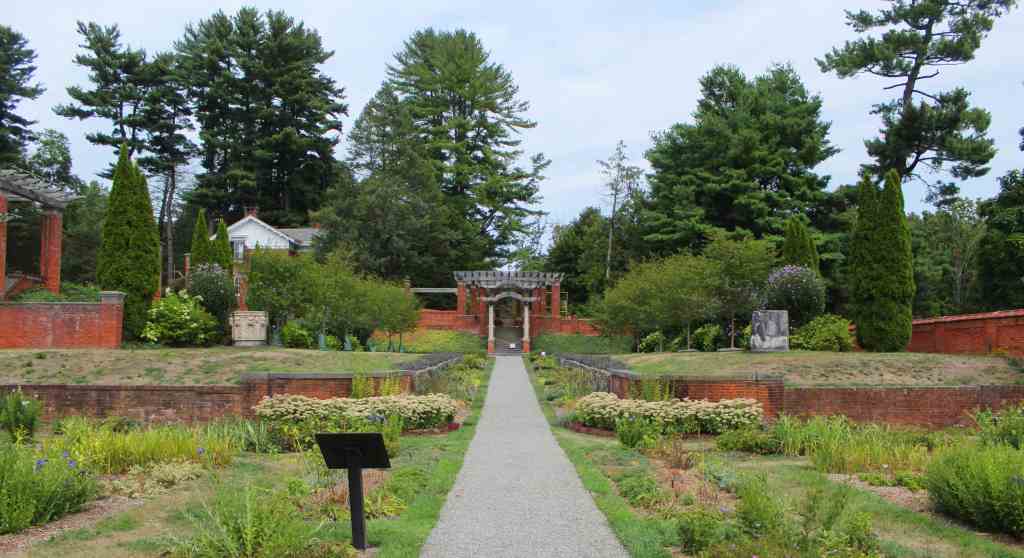
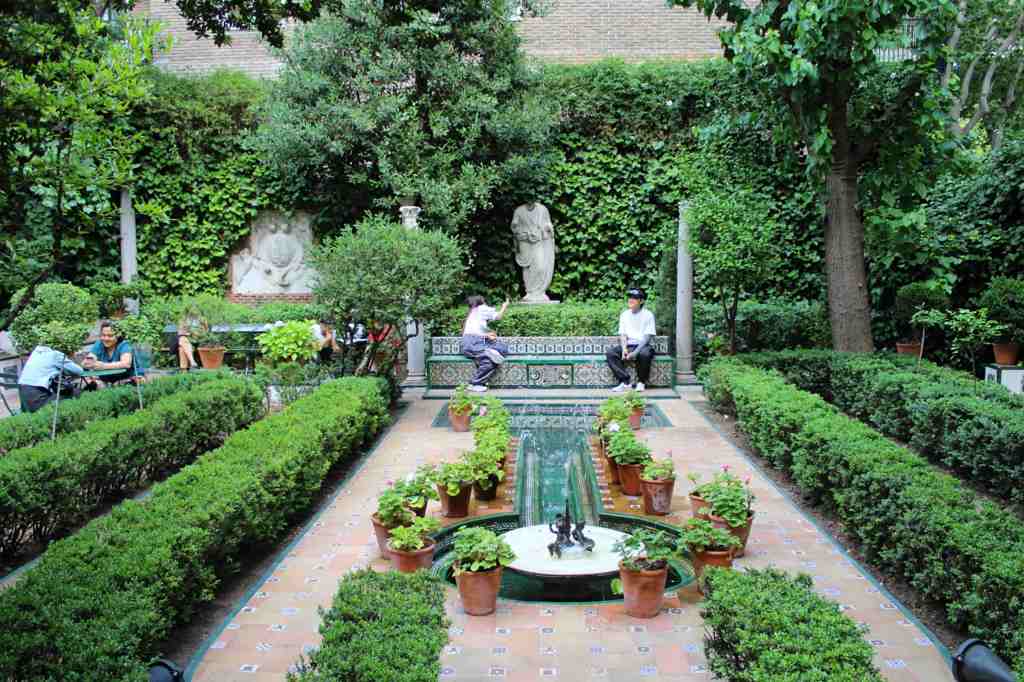
The first thing the visitor will notice upon entering the museum is its lovely garden. This was designed after the Andalusian fashion, featuring colorful tiles, little aqueducts, and gurgling fountains. It is such an attractive space that some locals come here just to hang out, as it is free to enter. Sorolla designed the garden himself, and it is easy to picture him sitting here after a long day in his studio, resting his eyes.

The entrance to the ticket office is distinct from that of the museum itself. As it is a state museum, they charge the standard fee of 3€. It is free on Saturdays, but perhaps it is worth it to go on a different day, as the museum is most pleasant with fewer people. While purchasing your ticket, I recommend pausing to admire the Andalusian patio, as well as the painter’s impressive collection of Spanish ceramics. He seems to have had a keen appreciation for the rural, rustic handcrafts of his countrymen.

The first room of the museum is the picture gallery, featuring several excellent, large-scale paintings of the Spanish master. Here the visitor gets a good impression of his style. In his portraits—such as those of his wife or children—Sorolla’s work resembles other painters of his era, such as John Singer Sargent (whom Sorolla met and admired). He was more than capable of painting in a traditional manner.

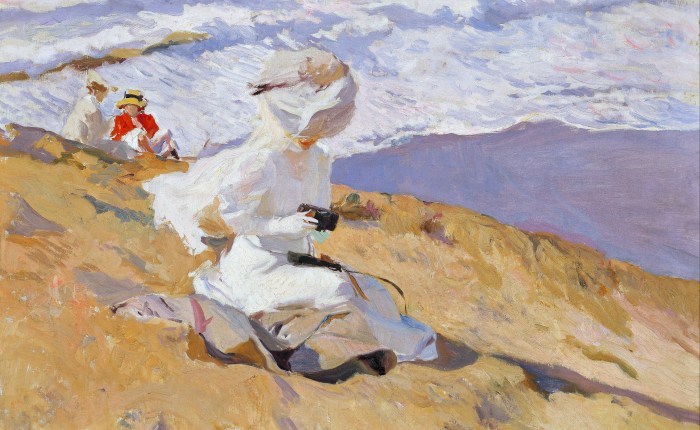
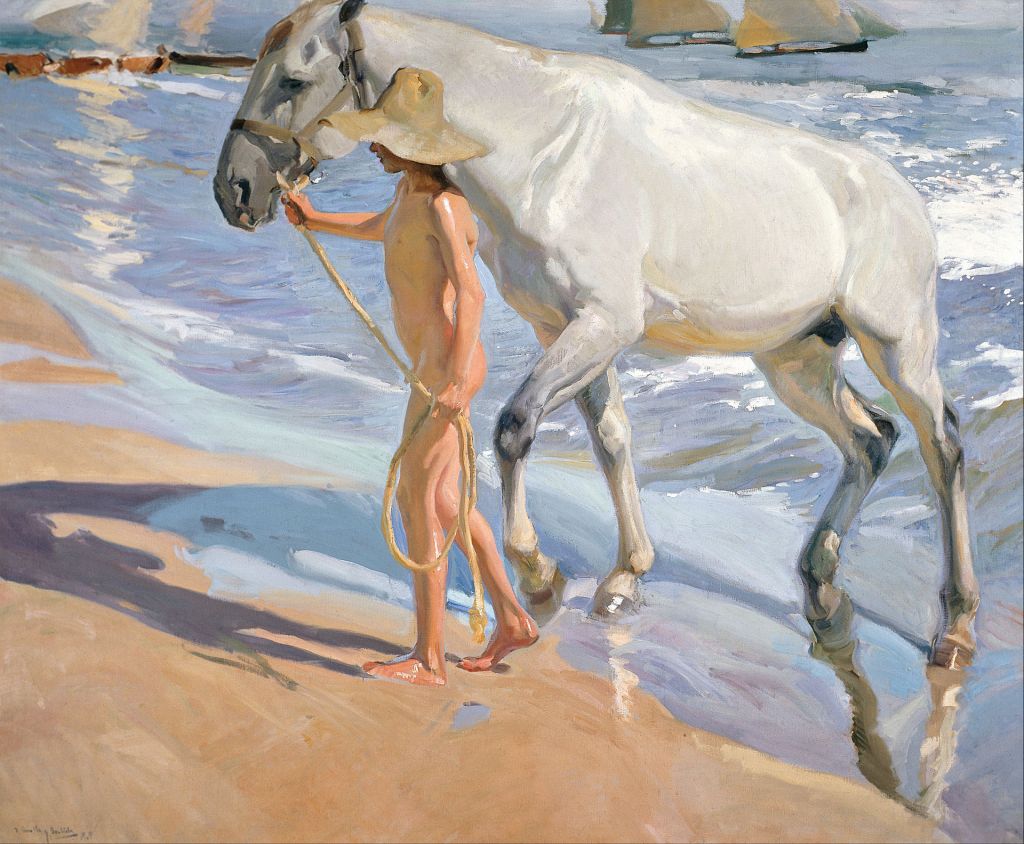
His brush comes alive, however, whenever he depicts bright, shining light. No other painter has captured the sensation of Spanish sun so successfully. His human figures seem to dissolve into gleam and reflection. In his beach scenes, you can smell the saltwater and hear the waves. If you have ever stayed on a Mediterranean beach long enough to go blind from the reflections and dizzy from dehydration, you can see that, in his paintings, Sorolla captured an experiential truth.

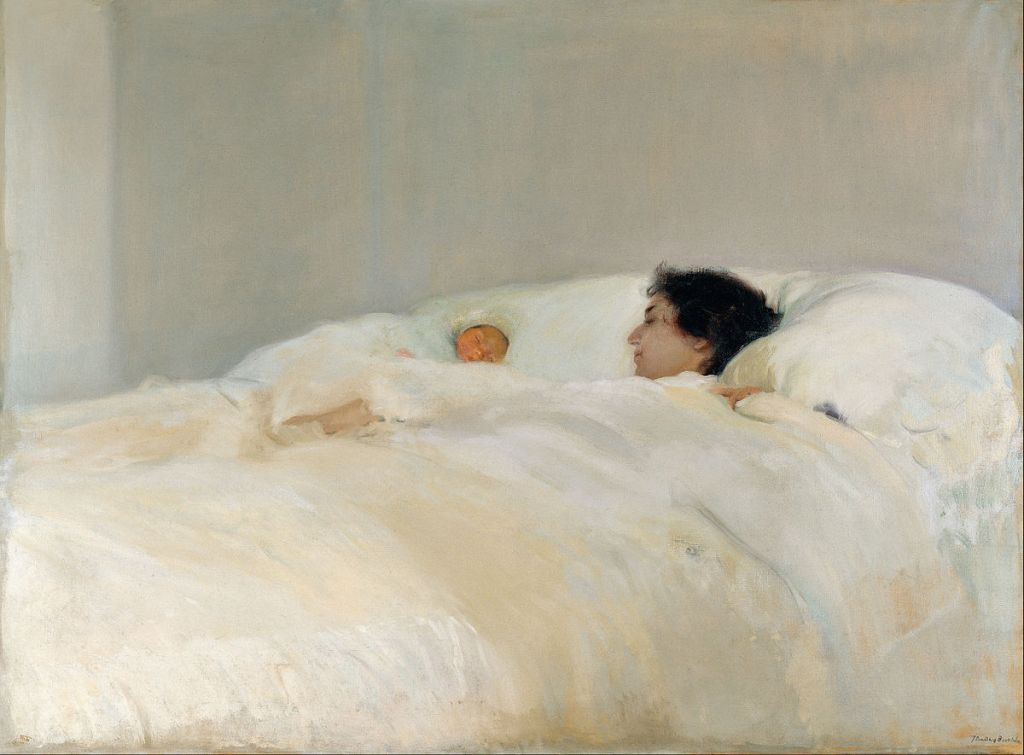
And though Sorolla was the epitome of a bourgeois artist during his lifetime, he was capable of great artistic daring. On my last visit, I was impressed by his work Madre, which depicts a mother in bed with her baby. Their tan faces are the only points of contrast with the white pillows, sheets, and walls, making it seem as if they were floating in a sea of light. There is nothing conventional about it.

The next room features some of Sorolla’s more familial works. Among the portraits we can find Joaquín Sorolla García, his son, who was the museum’s first director. It is largely thanks to him that we have such a fine museum, as he preserved it after his father’s death and left it to a foundation in his will. Unlike so many other house museums, then, nobody else ever lived here before it was turned into a museum. Another notable offspring we may find is Elena Sorolla. She became a talented painter and sculptor in her own right, though she later abandoned art in favor of her family.

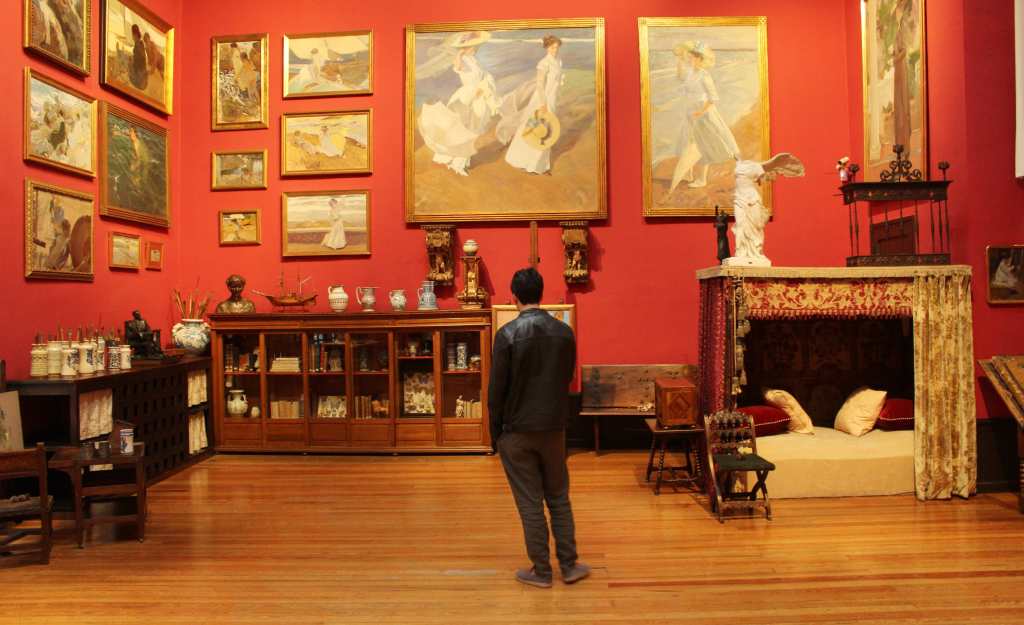
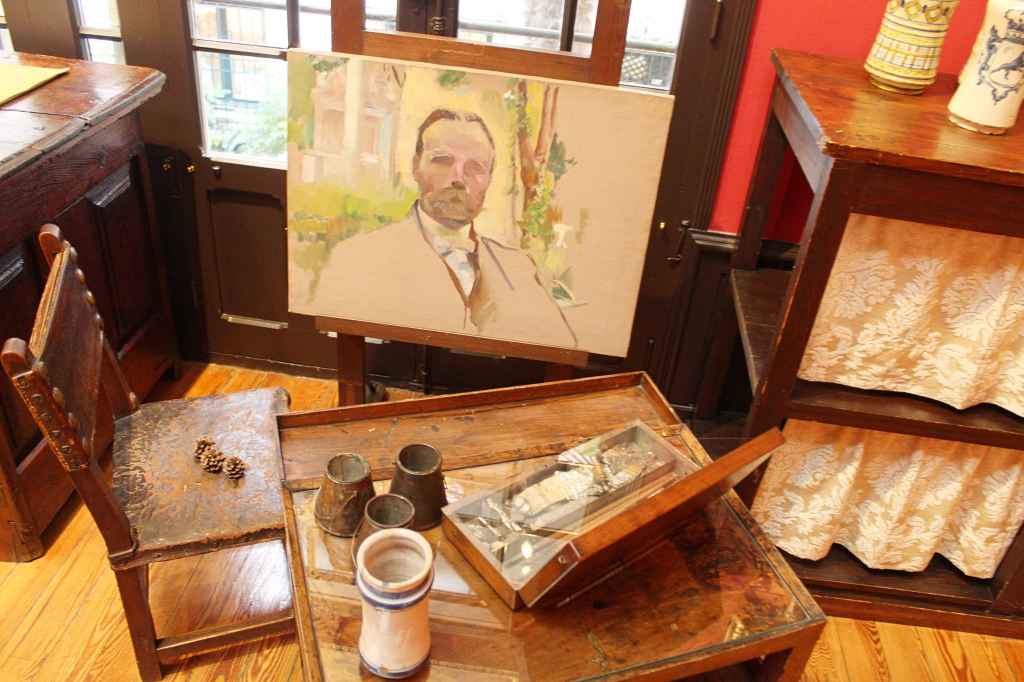
The next room, Sala III, is the showstopper of the museum. It is Sorolla’s former studio. The space is ideal for painting, with large windows, a high ceiling, and skylights. Old, dirty paint brushes stand on a table, and a painting sits on the easel, half-finished, as if Sorolla just stepped out for a cigarette. The walls are covered in his paintings—so many and so high up that it is hard to even appreciate them. In the center of the room hangs a large copy of the Portrait of Pope Innocent X, by Velázquez (one of Sorolla’s heroes). Nearby is an ornate bed in one corner, which looks barely big enough for one person, much less Sorolla and his wife. Was it just for siestas? 

The visitor next climbs the stairs into the temporary exhibition space. I have been to the museum many times by now, and have consistently been impressed with the quality of these exhibits. The museum has far more paintings in its collection than it can display at any one time (Sorolla was prolific), as well as objects and artwork from Sorolla’s own substantial collections. So there is a lot to choose from.

The last time I visited, they had an exhibit commemorating the 100-year anniversary of his death: “Sorolla en 100 objetos.” This is an attempt to tell the story of his life using Sorolla’s possessions. One gets the impression of a man whose career could hardly have gone any better—of an artist who achieved success early, and was highly respected until the end of his life. He is, in other words, at the other end of the scale from Van Gogh: not the lone, eccentric genius but a pillar of his community. And yet, judging from his massive output, one cannot rate his commitment to painting as any less than the Dutchman’s.

The rest of the museum consists of rooms furnished as they were during his time, whose richness only serves to exemplify the degree of success Sorolla enjoyed. The visitor is then, once again, deposited in the lovely gardens—to either bask in aesthetic pleasure or to be consumed by envy at such a fortunate life.

At the end of your visit, you will have a good idea of both the artist and his work. And yet, to see Sorolla’s most ambitious and monumental paintings, you will have to visit another museum—one on the other side of the ocean.

The Hispanic Society of America is perhaps one of the strangest and least-known museums in New York City. The name itself is misleading in two ways: first, because it isn’t and never was a learned society; and second, because—despite being located in Washington Heights, a “Hispanic” (meaning Latino) part of the city—it is really dedicated to Spanish culture. 

In many ways, the museum is a relic from another time. It is the brainchild of Archer Milton Huntington, an eccentric millionaire who had a keen interest in all things Spain. Using his money (inherited) and his many intellectual connections (he was an amateur scholar), he assembled a collection of museums around Audubon Terrace—a monumental complex of ornate Beaux-Arts buildings—and had his wife, Anna Hyatt Huntington, add the sculptures and friezes.

(It is worth noting that Mrs. Huntington was a remarkable artist, who achieved widespread success at a time when it was very rare indeed for women to be sculptors, and who left many attractive monuments all over the Americas and Spain.)

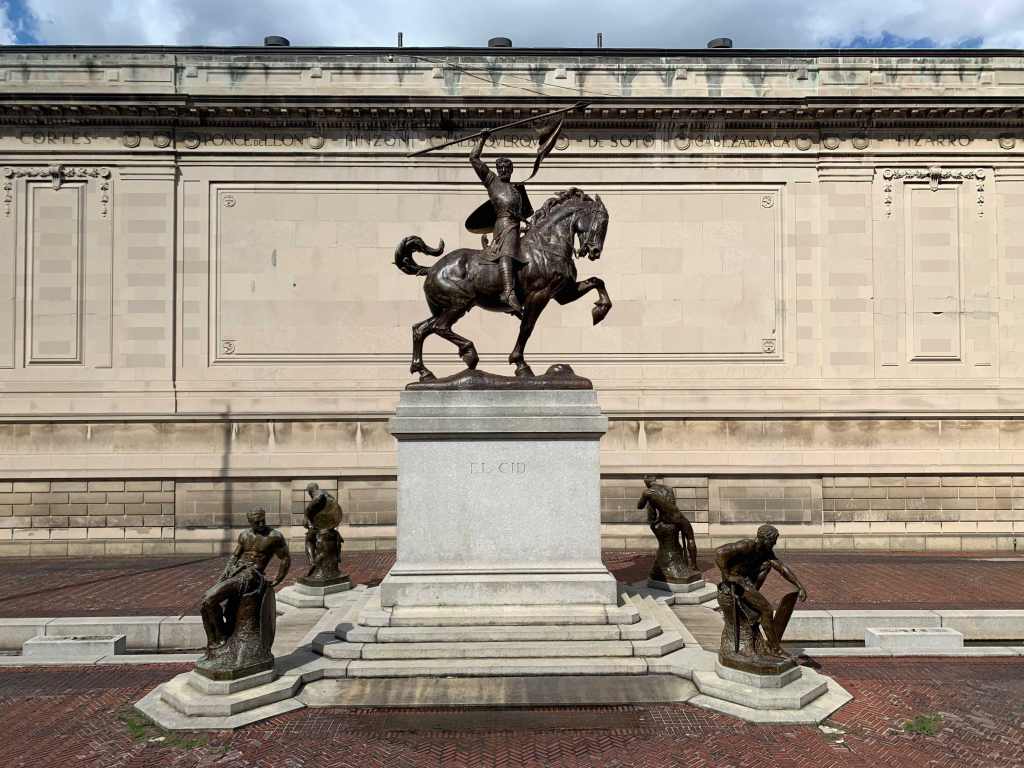
Yet I am afraid that the decoration adorning the outside of the museum will likely rub some people the wrong way nowadays. Above Anna Hyatt Huntington’s wonderful statue of El Cid Campeador—the legendary hero of the Spanish Middle Ages—there are names inscribed on the outside of the building, as if to commemorate heroes. Yet the names include Pizarro, De Soto, Ponce de León, and Cortés—conquistadores, who are now more often reviled as destroyers than celebrated as civilizers. 

The museum has a collection of art and rare books from Spain that is unrivaled outside the country. There are paintings by the big three—Velázquez, El Greco, and Goya—and even a first-edition copy of Don Quixote. For many years, however, this collection hasn’t been available to the public, as the museum had to undergo extensive repairs and renovations. I was fortunate enough to see some of this during my first year in Spain, when the Prado had a temporary exhibition showcasing some of the treasures of the Hispanic Society’s collection. But during my one and only visit to the actual museum, last summer, most of its collection was still unavailable.

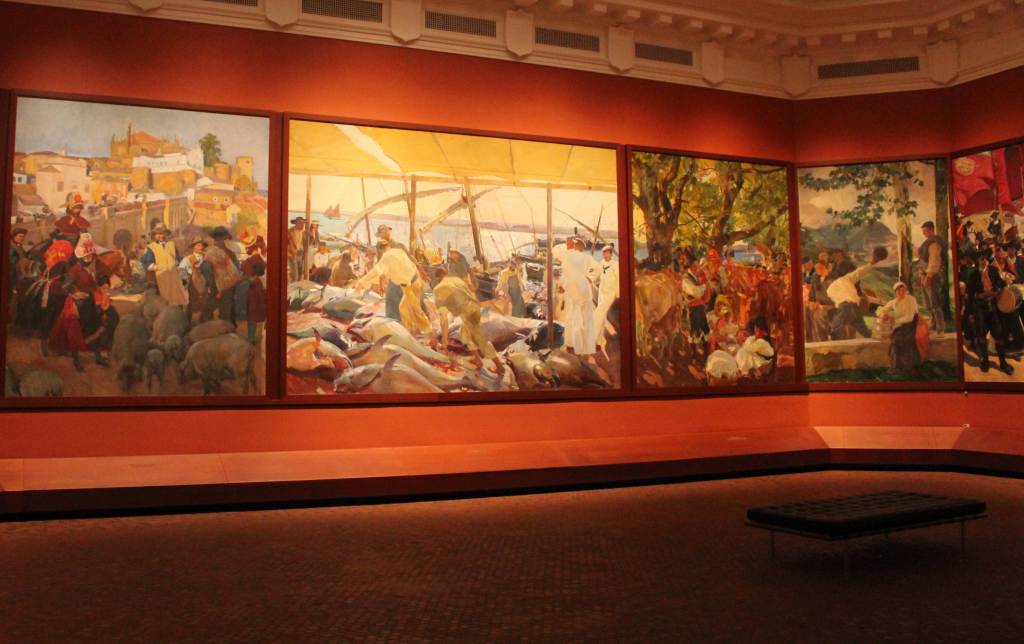
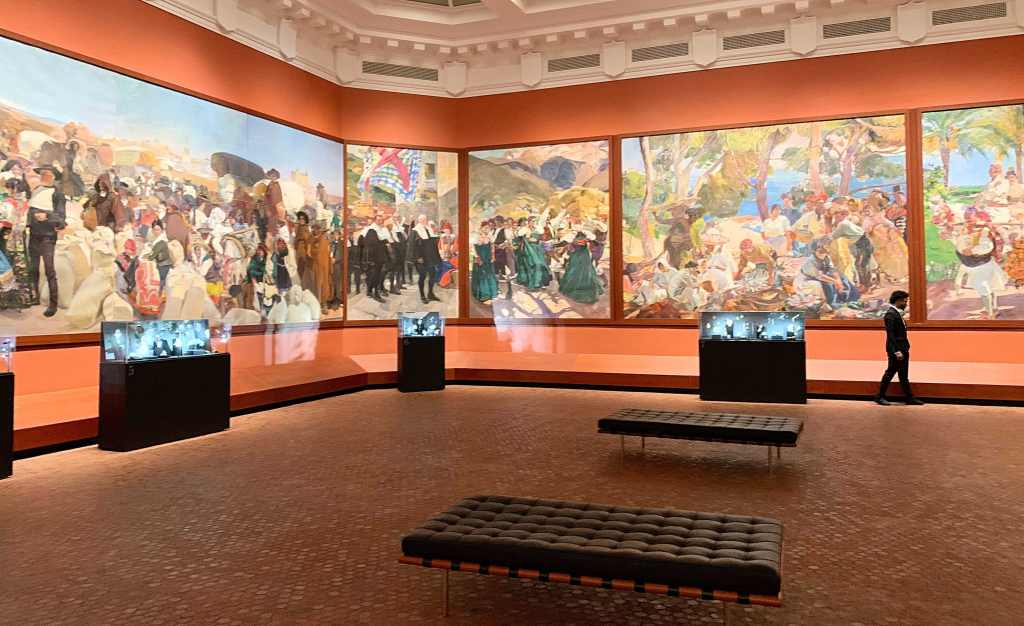
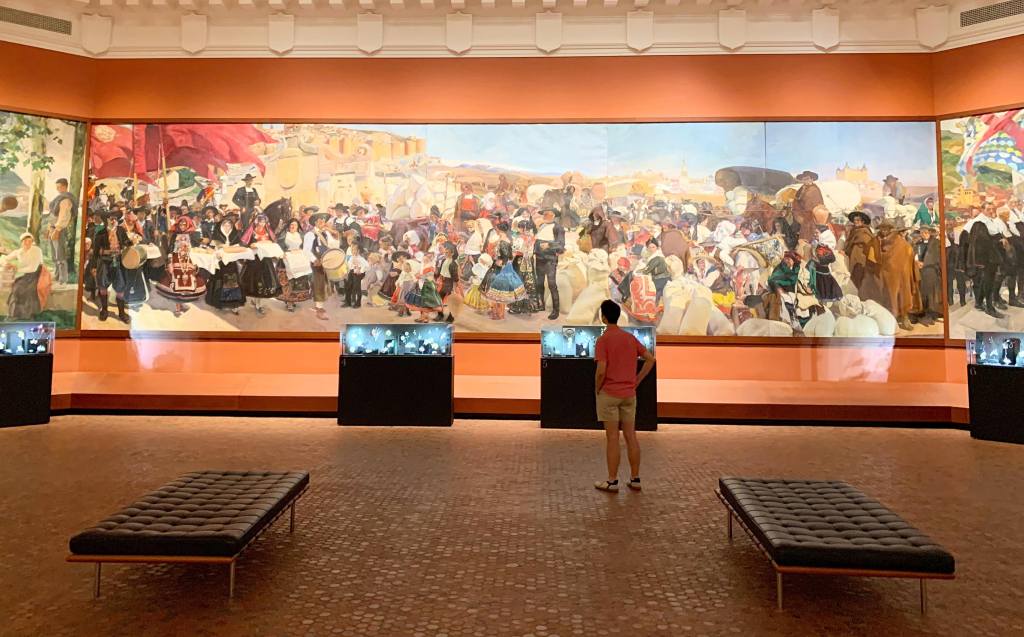
But I was able to see Sorolla’s magnum opus: Visions of Spain. This is a truly massive series of oil paintings, all about 4 meters in height (12ish feet) and wrapping 70 meters (over 200 feet) around the room. Amazingly, despite this huge scale, Sorolla completed nearly all of these paintings outside, working en plein air at various locations around Spain. He must have needed a stepladder and a team of helpers.

The murals depict the many regions of Spain, focusing on their most distinctive qualities. We can see a Semana Santa procession in Seville, as well as some joyful flamenco dancing; in Aragon they dance the jota and in Galicia they listen to a bagpipe; in the Basque Country they play their distinctive ball game, while in Valencia and Catalonia they prepare the day’s catch of fish. By far the biggest painting depicts a bread festival in Old Castile, with both the famous cities of Ávila and Toledo visible in the background (impossibly, since the two cities are quite distant).

Now, judged purely as paintings, the murals in this series are perhaps not as pleasing as Sorolla’s finest individual works, such as El baño del caballo. They are too busy with detail to make for clean compositions, and do not always showcase Sorolla’s exceptional gift for portraying light. Judged by their scale and ambition, however, the paintings are absolutely remarkable. For such a large work, Sorolla paid exceptional attention to details of costume and custom, attempting to make his paintings as anthropologically informative as possible. And the execution is immaculate. It is no wonder that, after completing this series, the painter felt exhausted. He would die just four years later.

If a visit to the Museo Sorolla in Madrid proves that he was a wonderful painter, then a visit to the Hispanic Society in New York proves that he was something else: a patriot. Admittedly, this is not always an admirable quality in an artist (think of Wagner); but in Sorolla it drove him, not to bigotry, but to celebration of the scintillating beauty of his homeland—and not just its famous landscapes and monuments, but its people. For any who love both fine painting and that sunbaked land, his paintings provide a peculiar delight.

Review: The Ethical Slut

Review: The Ethical Slut

The Ethical Slut: A Guide to Infinite Sexual Possibilities by Dossie Easton

My rating: 4 of 5 stars


This is a good example of a book which I almost certainly would never have read had it not been for an excellent review on Goodreads. I refer to the one by Trevor, whose reaction pretty much sums up my thoughts as well as I can hope to. But I would still like to take a crack at it.

Polyamory has been having a kind of cultural moment lately, and I admit that my gut reaction has been consistently negative. The whole idea struck me as naïve and foolish—maybe even a bit sordid—and I resented even being made to think about the topic. But there was a corner of my brain that was unsatisfied with this reaction. After all, I studied anthropology in college, so I knew that lifelong monogamy was hardly a human universal. (Though, in fairness, I’m also unaware of any culture that practices the free love as described in this book.) In short, it seemed merely an irrational bias of mine to react so negatively, and I decided I ought not to bow to my biases.

There does seem to be a lot of confusion regarding sex lately. While tolerance of different sexualities is probably at an all-time high, sex itself seems to be on the decline. It is well known that the birthrate in the developed world has been on the wane for decades, and this isn’t due simply to widespread access to birth control. Young people actually seem to be doing less lovemaking, though nobody quite knows why. Added to this are disturbing trends like the rise of the woman-hating “incel” community, or the disheartening phenomenon of “trad wives.” One gets the impression that traditional modes of relating are breaking down, and nobody really knows what to do.

Consensual polyamory is one proposed solution that appears to be growing in popularity—or, at least, in visibility. It promises to be a sexuality for the future, free of shame, sexism, and possessiveness—a sexuality based on purely utilitarian grounds of harmless pleasure. (As a side note, it is curious that John Stuart Mill, the apostle of utilitarianism, was a devoted monogamist. Was he really promoting “the greatest good for the greatest number” by being loyal to his wife?!) However, the notion of free love is hardly new. This book was first published in 1997, and has a great many forbears—from Alfred Kinsey and Margaret Mead, all the way back to the Adamites.

In that spirit, I wanted to go through an exercise from an early chapter of this book, which advises us to think of examples of non-monogamous people we may know of. For me, the people who spring most readily to mind are Simone de Beauvoir and Jean-Paul Sartre, whose open relationship would certainly qualify as consensual polyamory today. And, if I’m not mistaken, Bertrand Russell was an advocate of free love, though I am not sure to what extent he practiced it (besides sleeping with T.S. Eliot’s wife). Martin Heidegger had an affair with Hannah Arendt, which would make him both a polyamorist and—as Arendt was Jewish and Heidegger a member of the Nazi party—an outrageous hypocrite.

Ironically, however, the book I most often think of in this connection is Will and Ariel Durant’s massive historical series, The Story of Civilization. Will and Ariel, for their part, were models of monogamy, having married when Will was 28 and Ariel just 15, and dying one week apart. Yet one of the main takeaways from their historical writings is that seemingly no one in history (besides them) was a faithful monogamist. Kings had their mistresses, artists their muses (and lovers), and writers their brothels. Even bishops and popes were known to breed discretely (thus cheating on God Himself). And though Durant treats these sexual connections as failings or missteps, the final impression is that one has got to be very tolerant indeed if one isn’t to condemn the entire human race.

The vast majority of this behavior is admittedly non-consensual, and thus ethically dubious to say the least. Yet considering its apparent ubiquity, one is tempted to make the same argument regarding polyamory as has been made with marijuana: If everyone is already doing it, and society isn’t crumbling, then why not just change the rules and allow it? Instead of building barriers to pleasure, why not just let it rip?

The main argument leveled against polyamory (besides religious ones, which don’t concern me) is jealousy: Namely, that it is a powerful, primitive, and uncontrollable emotion, dangerous to tamper with. Judging from the local news, sexual jealousy is among the most common motivations for murder. Besides that, jealousy is the machine that drives any number of classic stories, from Odysseus viciously murdering his wife’s suitors (and the maids they slept with), to Othello choking Desdemona over a handkerchief, to Madame Bovary’s and Anna Karenina’s tragic deaths for attempting to break free from the bonds of holy matrimony. I mean, for Pete’s sake, our entire foundational theory of psychology is, thanks to Freud, based on sexual jealousy.

Perhaps because of to this cultural inheritance, many of us—myself included—are apt to think of jealousy as an implacable force, deeply rooted in our biology, that we must bow to. However, the authors of this work contest this view in their chapter on jealousy, which for me was the heart of this book.

They make many interesting points. For one, considering jealousy as an unyielding fact of our nature is a kind of self-fulfilling prophecy. Lots of unpleasant things are deeply rooted in our collective psyche—envy, phobias, prejudices, violence—which we still try to combat. If we can do our best to overcome, say, fear of public speaking, why not try the same with jealousy?

What is more, despite just having one word for it, “jealousy” comprises several disparate things. It can involve many sorts of emotions—blinding rage, crippling anxiety, or just the sadness of loss—and include all sorts of thoughts, from blame to shame, not to mention all the religious and cultural baggage that comes along for the ride. This may seem like a banal point, but it at least allows you to get a hold of the sensation and examine its roots.

When you do, I suspect that you will find (as I do) that jealousy is a manifestation of anxiety regarding your own inadequacy—the fear of being found wanting in the most intimate sense. Such anxiety would seem obviously to be a “me problem.” The tricky thing about jealousy is that it encourages us to make it a “you problem”—to try to manage it by controlling other people. To use self-help speak, jealousy often involves a failure to “own your feelings,” putting yourself at the emotional mercy of somebody else rather than acknowledging that nobody but you can make you feel a certain way.

(There does seem to be some limits on the philosophy. If somebody stole my bicycle I would say that person was at least partially responsible for my feeling lousy.)

I admit that I found this view to be quite refreshing, since beforehand I was apt to think of jealousy as something unconquerable. It strikes me as far more productive to view it, instead, as just another one of the many emotional hang-ups we are prone to. And considering that jealousy can be an issue in even committed, monogamous relationships, I found the advice to be valuable indeed. I especially appreciated their realism. They don’t promise that we can achieve a Buddha-like detachment, immune from pangs of the heart. According to them, even “experienced sluts” occasionally suffer! All we can do is develop strategies to cope with it.

The rest of the book was surprisingly useful, too, even for prudes such as myself. Perhaps this should come as no surprise, as polyamorists almost by definition have the most experience dealing with relationships. Even when the information did not really apply to my situation, I found it to be of anthropological interest, as a window into another world. And while I’m not convinced that going to a sex-party is a “radical political act” (all the orgies in the world won’t stop the far-right!), I do think the authors’ sex-positive attitude is probably a lot healthier than how we often think about sex—as a commodity, a shameful secret, something to boast about, etc., etc.

So am I a convinced polyamorist? Unfortunately not. If there is one thing in which I vehemently disagree with the authors, it is their liking of complexity.

At various points, the authors describe in rapturous terms the forming of a sexual extended family, built up of present and former lovers into a “constellation.” Maybe this sounds appealing to some; but the thought of my ex-girlfriend going on a date with my current partner, who in turn call on an ex-boyfriend to look after their respective kids, while another ex takes a nap on the couch after making love to my roommate, who is also involved with both me and my partner—frankly, this sounds like a nightmare. The amount of time and energy it would take me to manage a single one of those relationships would utterly drain me. And the scope for drama is stupefying to contemplate.

I also don’t share the authors’ conviction that love is a boundless resource. Maybe some highly extroverted people may feel that they can fit any number of new people into their lives without having to boot out the old ones. But I know from experience that a few close friends, plus a romantic partner, is about as much as I can handle at any given moment. Love may not be limited, but time and energy certainly are; and true intimacy requires both.

But I don’t think this book can be fairly evaluated as an attempt to persuade people to be polyamorous. Rather, it is a how-to manual for those who are already on that path. And judged by that standard, I think the book could hardly be better.


View all my reviews

Review: Master of the Senate

Review: Master of the Senate

Master of the Senate by Robert A. Caro

My rating: 5 of 5 stars


When I finish a doorstopper like this—a book of enormous scope and ambition, a genuine tour de force—I usually feel that I should reflect this weightiness in my review. After all, I spent months on this thing, bringing it up in conversation after conversation, enjoying the feeling of gradual enlightenment as I made my way from the beginning to the end. And yet, I think Caro has made his point so well, so clearly, and so forcefully that there is very little left to be said on this subject.

Apart from Lyndon Johnson, this book must be one of the best books written about the United States Senate. Indeed, one gets a sense that this was precisely Robert Caro’s goal, since he begins with a kind of book within a book, going through the entire history of the institution. In this respect, Master of the Senate can be rather depressing, since the Senate has always been, if not quite a broken, a malfunctioning body. This is largely the fault of the founders, who had the high-minded idea of creating a legislative house composed of older, wiser statesmen who could modify the rash impulses of the electorate. Instead, they created an anti-democratic institution, unresponsive to the will of the people, and historically on the side of the already rich and powerful.

The book’s central theme explores a disturbing irony: it took a bastard of historical proportions to get this legislative body to become, however briefly and modestly, a force for good. For eighty years since Reconstruction, idealistic politicians had tried to get Civil Rights legislation passed through the Senate, and they had all failed. Pure hearts, noble ideals, and moving eloquence had not made a dent in the Senate’s ability to block the legislation. But Lyndon Johnson, who loved power above all, whose personal ambition outweighed every other goal, who stole his election to the Senate, who abused his inferiors, flattered his superiors, and manipulated his equals, who was even cruel to his loving and loyal wife—this man, whom Caro had spent two volumes portraying in the least flattering possible light, had what it took to get a Civil Rights bill through the Senate.

This book thus has a dispiriting message. Put bluntly: maybe we need these Type-A assholes after all. And Johnson is perhaps the perfect representation of this cultural stereotype, all the way down to his heart attack. If you had asked me before starting on this series about this sort of person—selfish, restless, ambitious, domineering—I would have said they all ought to be sent to therapy, for their and our mutual benefit. Indeed, I occasionally fantasized about what would happen if a relatively normal person (me, for example) became president—what would happen if our government were composed of ordinary folks rather than the most power-hungry or ideological among us. The utter foolishness of this thought is demonstrated by this book. If I were suddenly appointed, say, Senate Majority Leader, I would accomplish precisely nothing.

As a final thought, a very clever friend of mine put a question to me some months ago, which at the time I couldn’t answer: Why would a Texas Democrat push so hard for civil rights, when it inevitably meant losing the support of southern whites? This book goes a considerable way in making sense of Johnson’s decision. There were many factors, but the most important in 1957 was that Johnson needed to drop the stigma of being a southern racist if he was ever to have a chance at the presidency—and the presidency was always his ultimate goal. However, this does not explain why Johnson, once president, would continue the fight. The truth seems to be that, when his overwhelming urge for power was satisfied, and other qualities of his personality were allowed to come to the fore, he did genuinely care about helping the disadvantaged. If only every type-A were like that.


View all my reviews

Review: The Way

Review: The Way

The Way by Dermot C. Miller

My rating: 4 of 5 stars


The story of how I came to read this book is, I think, necessary to relate before I launch into the review. It began with an invitation to a birthday party. There, amid strangers, I met a thoroughly charming Irishman named Enda, another expat (he hates the word, but it seems to fit) with a literary bent. Last year, Enda—along with his writing and business partner, María—commenced on the bold experiment of opening their own publishing company, Ybernia. This book is among the first published by this new enterprise, and I was given a free copy.

For this reason, this review can hardly be unbiased. However, there are other reasons to be suspicious of my opinion. Despite never having met Miller, I could tell quite soon that we have many experiences, tastes, and opinions in common. I am not talking about anything so lofty as a spiritual connection. Simply put, we are both guiris (another word that seems to fit) who enjoy sunny Spanish landscapes and greasy Spanish jamón. And we are both writers.

Beyond this, as another expat author, I have considered the same sorts of writerly challenges that Miller confronts in this book—namely, how to weave together stories of one’s native country with experiences abroad. I remember a review by Orwell of Henry Miller’s Tropic of Cancer (about Miller’s—that is, Henry Miller’s—depraved time in Paris), where Orwell remarked that life abroad can convey a certain superficiality to one’s experiences—and thus one’s writings—since one is normally single and unattached, both in terms of family and of culture. Orwell himself was quite familiar with this issue, as he wrote about his time in Paris (as a plongeur in a hotel) and in Spain (fighting in the Civil War).

Now, this may seem like a trivial issue to you; but in my experience, even after years abroad, one’s imagination—the images which resonate most deeply—remains tied to where one grew up. Aside from that, in a foreign land, one is inclined to focus on the most salient cultural differences—the cuisine, the weather, the history, the great monuments—which, depending on one’s taste, can be attractive or repellent, but little more. In one’s native land, however, these features move far into the background, allowing one to write about potentially “deeper” subjects.

This, at least, is how I think of the problem confronting an expat author. And unless I am mistaken, Miller (that is, Dermot C. Miller) has confronted this same challenge here in this book. And his solution is interesting.

He settles on a bipartite design. The frame story is a trek on the Camino de Santiago, undertaken by an Irishman haunted by his past. This tragic backstory is then recounted in a series of flashbacks, which take the reader from his childhood to the events that traumatize our hero (who shares Miller’s first name and middle name). Most of this backstory takes place in Miller’s Northern Ireland, and serves to explain how he ended up here on the Iberian Peninsula. He thus hits upon a natural way of uniting his native land and his adopted home.

Both stories, taken separately, are quite well done. The backstory ultimately becomes a kind of thriller, as the protagonist eventually gets mixed up in the IRA. Meanwhile, the frame story is a travelog, in which the protagonist revels in the landscapes, folklore, and history of the Camino de Santiago. The contrast in emotional registers between these two parts gives the book its impetus—as either one, without relief, might have grown wearisome. Nevertheless, the juxtaposition is sometimes jarring, as the reader is thrown from tragedy to tourist brochure rather abruptly. I should say, however, that I did find it believable that a bookish type would use travel as a kind of nerdy therapy. It’s certainly been done before.

In terms of prose style, I actually found myself identifying with Miller—both with his strengths and his shortcomings. To his credit, he achieves the most important quality of prose—namely, readability. I made my way through these pages quite quickly, never put off by any thorny or offensively ugly sentences. If he is guilty of any writerly sins, it is (for lack of a better word) prettifying. That is to say, for my taste, Miller gives a literary polish to some parts which would have been better left simple and raw. Yet, as I am absolutely guilty of doing this myself, it would be hypocritical of me to knock him about for it. I can only say, in his (and my) defense, that if you are a relatively unknown author, it is difficult to resist the temptation to prove that you have serious literary chops.

This overlong and self-important review has been written merely to say that Miller has authored a greatly enjoyable novel. It can be read with profit by readers with an interest in the Troubles or the Way of Saint James (how much overlap is there in the two groups?), or by any reader interested in Irish or Spanish history more generally. Indeed, I would recommend this book to any expats (sorry, Enda) and guiris who want to think of ways their past and present homelands can be woven together.


View all my reviews

Review: The Hinge of Fate

Review: The Hinge of Fate

The Second World War, Volume IV: The Hinge of Fate by Winston S. Churchill

My rating: 5 of 5 stars


I find that I am liking each one of these volumes more than the last. The pleasure of this history is that, through the eyes of Winston Churchill, the war takes the shape of an enormous board game, played over months and years. Far removed from the gore of the front lines, Churchill sees the conflict as symbols on a map, which he needs to arrange in the most advantageous possible way—a game he plays brilliantly. This is not to say that he is frivolous or superficial. But warfare is far more palatable when experienced from the command chair than from the trenches.

Added to purely military decisions is the messier business of courting allies. Indeed, the best parts of this book describe Churchill’s cultivation of his relationships with Roosevelt and Stalin. Dealing with the Americans was relatively easy, as Roosevelt and Churchill seemed to have gotten along very well. Nevertheless, working so closely together required constant coordination of plans, both short-term and long-term; and Churchill sometimes struggled to get the American command to accept his military vision.

With Stalin, relations were far more tense. The Soviet leader is constantly demanding from Churchill fresh supplies and for a second front in France. Churchill, meanwhile, does his best to placate Stalin while firmly refusing to do what he feels is unwise. This culminates in his 1942 visit to Moscow, narrated in the two best chapters of the book. Churchill, sure that he will not be able to invade France in 1942, decides he must deliver this message personally if he is to maintain his working relationship with the Soviets. Stalin, at first, doesn’t take the news well, but by the end they are up all night, drinking vodka. In virtually any other circumstances, the two men would have been sworn enemies, and it is fascinating to see them try to cooperate.

The title of the book is quite apt, as it contains the battles that marked the beginning of the end for both Germany and Japan: Midway, Stalingrad, and Tunisia. These books, it should be remembered, are public memoirs rather than objective history; and so Stalingrad and Midway, being battles Churchill had nothing to do with, get only a cursory treatment. Northern Africa, on the other hand, occupies much of the book, as British and then American forces beat Rommel, invaded the Vichy territories, and finally won a decisive victory in Tunisia.

As a final thought, I am constantly surprised at how much I am learning from these books. Somehow, after a lifetime of World War II media, I knew close to nothing about operation “Torch,” and had no real idea of the significance of the Northern African campaigns. I was also unfamiliar with the Katyn massacres—Russia’s mass executions of Polish prisoners, an issue which Churchill felt he could not raise with the Soviets, for fear of hurting their relationship. Indeed, having been in Dresden just two weeks ago, I’ve had occasion to reflect that it was not only the axis who committed war crimes.


View all my reviews

Pacífico: My Neighborhood

Pacífico: My Neighborhood

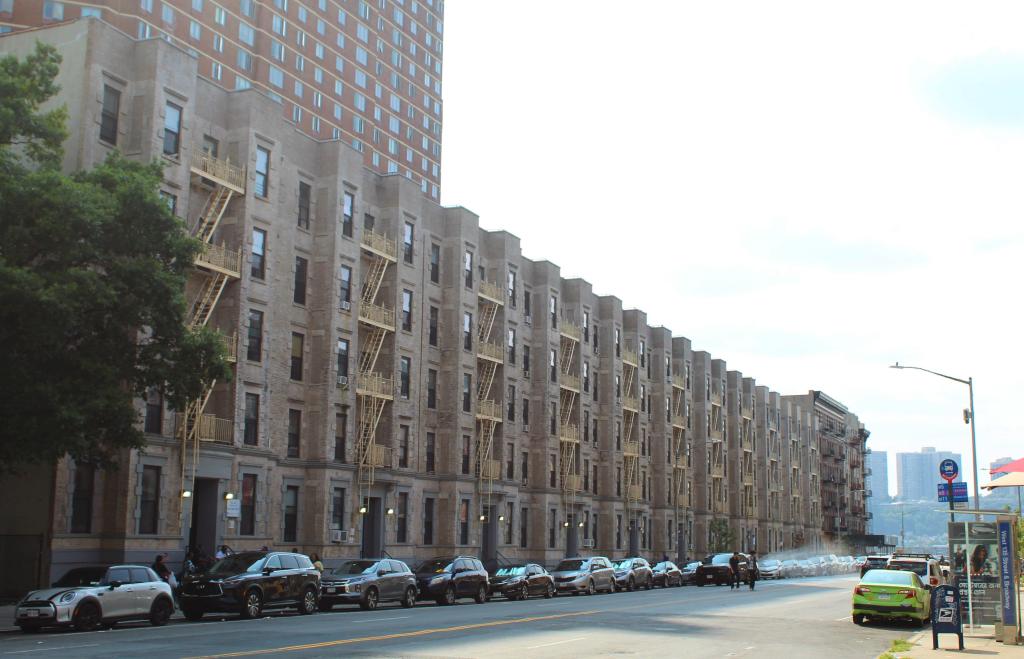
The city of Madrid is divided into 21 “districts,” which are further divided into 131 neighborhoods. Pacífico belongs to the Retiro district, so named for the iconic park which it encompasses. This neighborhood—along with its sister barrio, Adelfas—composes the southernmost part of this district, where some 50,000 reside. And for the last seven years, I have been one of them.

Pacífico is central without being in the center. Extremely well-connected by public transport—the Méndez Álvaro bus station is to the south, Atocha station to the west, the bus hub of Conde de Casal to the north, and two of the most important metro lines running through it—Pacífico is nevertheless quiet and residential, with no tourism to speak of.

I have had occasion to write about my neighborhood before. The beautiful (but obscure) Pantheon of Illustrious Men is located here, along with the Basílica of Atocha, where traditionally the royal family are baptized. Nearby is the Real Fabrica de Tápices, another fascinating place that most visitors overlook. This was built as a “royal factory” in the 18th century to make luxurious tapestries and carpets for the palaces; and it maintains this function to this day, though it is now privately owned. If you reserve in advance, you can visit the factory and see the workers painstakingly assembling enormous and intricate tapestries by hand, thread by thread.

As it is close to Atocha, the neighborhood is also rich in transport history. At the extreme western edge of Pacífico is the Museo La Neomudéjar, a modern art museum with rotating exhibits in a former train workshop. It is still full of decaying industrial ambience and abandoned equipment. Closer to where I live, you can visit the Nave de Motores, where the massive original power generators of the Madrid Metro are stored.

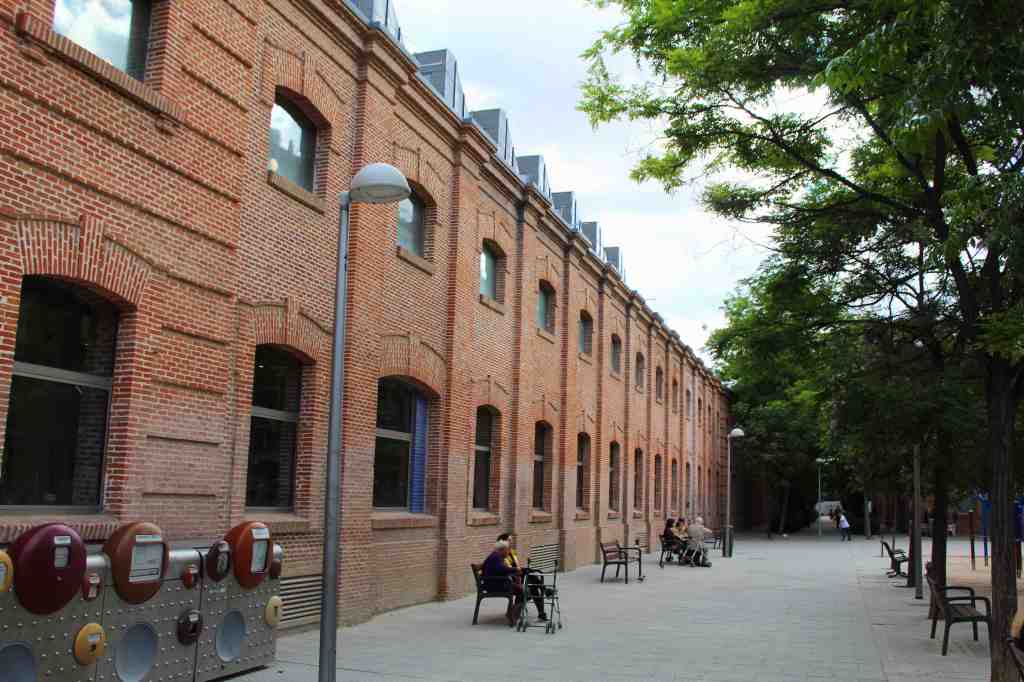
The administrative heart of the neighborhood, where the government offices are located, has a curious history. The building complex was first constructed as warehouses to store goods imported from abroad, for which it was known as “Los Docks” (yes, in English). This business soon failed, and it was turned into a military barracks, a function it maintained until 1981. After its acquisition by the municipal government, however, several historical buildings were demolished to make room for modern offices—a move widely criticized. The surviving original buildings have since been turned into a huge public sports center, with a gym, football and basketball courts, and a gigantic pool.

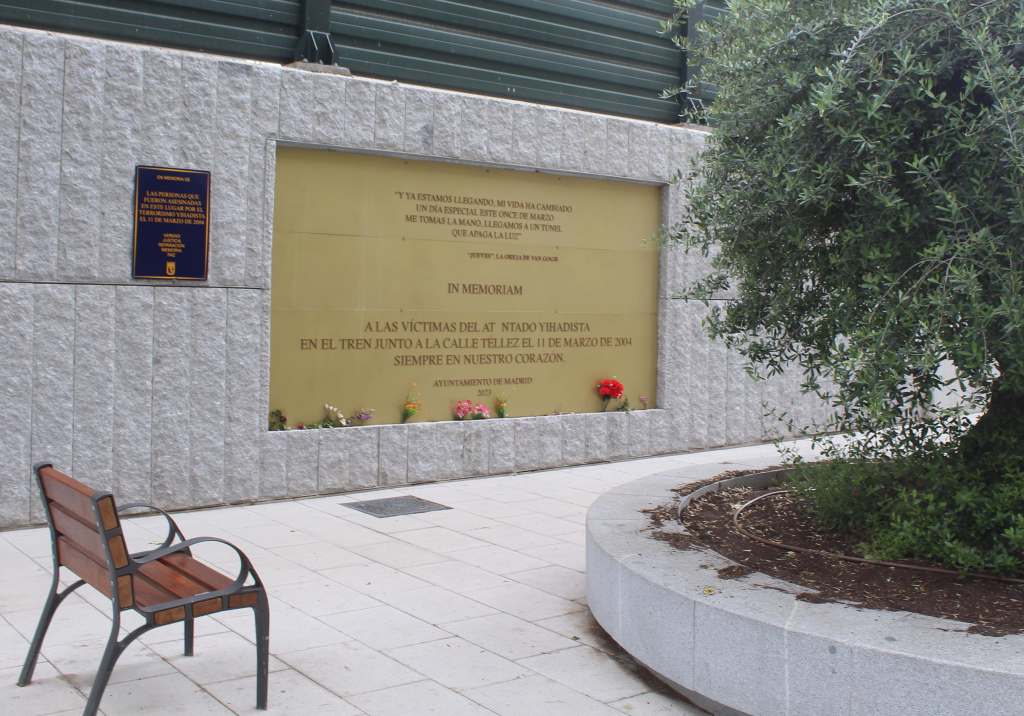
This sounds quite sunny and uplifting. Yet this sports center—named Daoíz y Velarde, after the Spaniards who instigated the uprising against Napoleon’s invading troops—has been touched by tragedy. For it was very near here, in 2004, where one of the bombs went off in the infamous March 11th terrorist attack (the train tracks run right by the buildings), and the sports center had to be used as a field hospital for the victims. 250 victims were treated there, of whom 10 lost their lives. A commemorative plaque marks the event.

More recently, the Daoíz y Velarde Center has acquired an important music venue: the Real Teatro de Retiro. This is an offshoot of Spain’s royal opera house, where shows are tailored for a younger audience, with the aim of involving a new generation in classical music.

As interesting as all this history may be, it is not the reason I like to live here. Apart from being (for the moment) reasonably affordable and quite well connected by public transport, Pacífico is attractive for the wide variety of small businesses. Indeed, as an American, I am constantly surprised at the number of small, family-owned shops in Madrid. If you want to buy groceries, shoes, sports equipment, or whatever else in the United States, chances are you will find yourself at a strip mall, shopping at one of a small number of chains. Not so here.

Some locals, dressed as chulapos, celebrating San Isidro

My impression over all these years—though, I admit, it is little more than a vague one—is that the business landscape in Spanish cities resembles how American cities were ten or twenty years ago, before gentrification and consolidation took a toll on small business. However, I certainly do not know enough about the economy to argue the point.

Regardless, I think that these sorts of small, family-run neighborhood shops are a precious resource in any city, something worth preserving in the face of economic pressure. Thus, I set out to learn more about some of my favorite local businesses.

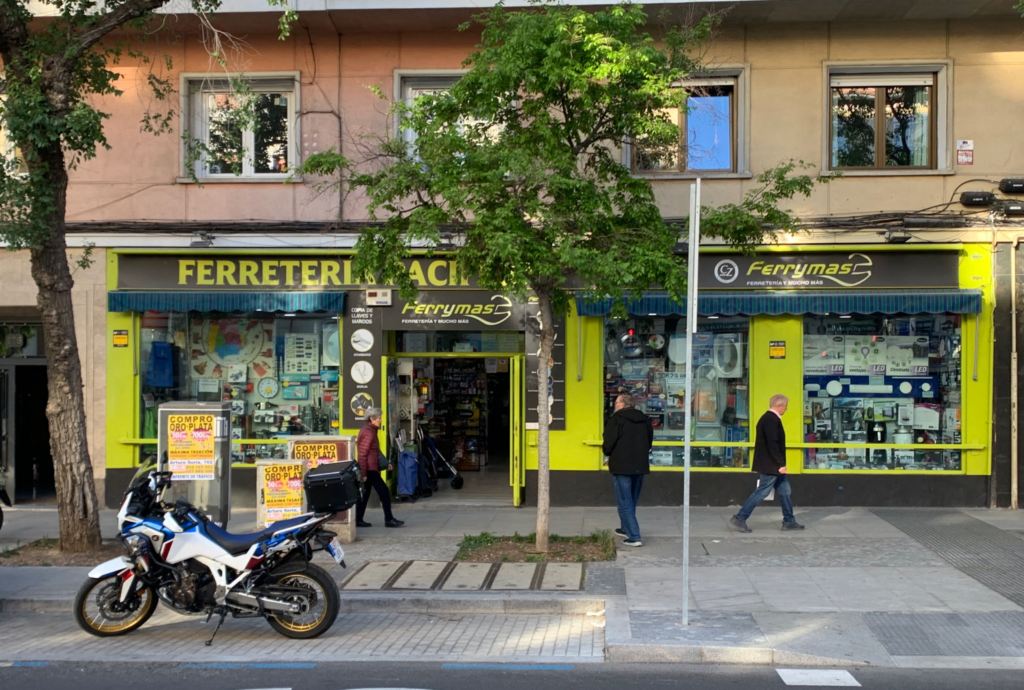
My first stop was my local ferretería (a hardware store and not, what some English speakers might think, a store specializing in ferrets). The Ferretería Pacífico has been around since 1995, and—judging by the constant flow of customers that made it difficult to ask questions—it is still going strong. I am a frequent customer myself, as the store sells everything from frying pans to drying racks to power tools. But my favorite service they offer is to sharpen knives.

The staff at the store are knowledgeable and friendly. And when I asked their secret to staying in business, they offered me an explanation that, though cliché, seems quite true: they offer customers personal attention. I have experience of this. When I was ineptly trying to install a curtain in my apartment, they talked me through the process and sold me everything I needed. When I asked what struggles they have remaining afloat as a business, I was given just one word in reply: “taxes.”

Somewhat further up the hill that leads to Retiro Park is my barber, Almudena. She works in the Pelúqueria Félix, a tiny barber shop on a quiet street. The shop is named after her father, who opened the business in 1966. Almudena learned her craft from him. She gives excellent haircuts, mostly eschewing the buzzer and working with a comb and scissors. When I asked about challenges, she also complained about taxes. The IVA (value-added tax) is 21%, meaning that a fifth of what is paid to her is for the government.

In addition, as somebody who is self-employed, Almudena must pay the “autónomo” tariff. This is a flat-rate fee that people who own their own businesses must pay in order to be legitimate. Strangely, this fee is relatively standard, varying only slightly depending on your income. Certainly I am in no position to judge the Spanish tax code, but as a general rule flat taxes are usually harder on the less fortunate.

The heart of the neighborhood, as far as shopping is concerned, is the traditional market—the Mercado de Pacífico. There are mercados del barrio all over the city, and they all have the same basic design: small stands selling high-quality products, often on a subterranean level. (I believe the reason that markets are often relegated to basements is to minimize the smell; fishmongers and pickled products are often present.)

There, while doing some shopping, I spoke with Francisco. He runs a fruit stand in the market, and has been at it for a long time. That’s an understatement: he is 70 now and started working in the market at the age of 13. I was delighted to notice that his scale was not in euros (adopted in 1999), but pesetas! When I offered to email Francisco this article, he showed me his old flip phone and told me that he didn’t use the internet. What a blissful existence!

Down the street is the oldest shop I was able to find, Zapatos San Román. It was opened in 1959 (as a certificate hung on the wall proudly states) by the father of the current owner, José. He has been working in the shop for 40 years, and still mans the cash register. The store is characterized by its giant “escaparate,” or old-fashioned display window. This is not limited, as in most stores, to a small cabinet out front; rather, the escaparate occupies fully half the store, wrapping around the visitor, creating a miniature landscape of shoes. 

Down the street is another store devoted to footwear: Reparación de Calzado Alfaro. To be honest, I didn’t know that there were still professional cobblers in the world. The word itself, in English, calls to mind Victorian novels. But Rafael has been there for his whole professional life, following in his father’s footsteps, who opened the store in 1985. And he is doing very good business. When I visited him, so many customers came in that I had to retreat and return at a less busy time. But he does not only serve the locals, and not only the city of Madrid. Indeed, his business is not even limited to Spain. While there, he showed me an order that he had gotten from Belgium!

When I asked why he was doing so well, he said that his was a disappearing profession; and so anyone who needs a shoe fixed must search far and wide for a good cobbler. That search will, apparently, only get harder. Though Rafael inherited his business from his father, who himself learned from his own father, there will be no fourth generation of his shoe repair business. “It ends with me.” In response to my (perhaps silly) question of why people bother to get their shoes repaired, he told me a Spanish saying:“Te quiero más que a mis zapatos viejos.” That is, I love you more than my old shoes. And a pair of well-worn shoes are, indeed, something to cherish.

A bit up the block from my former apartment, on Calle de Cavanilles, there is a shop that holds a special place in my heart. It is Deportes Periso, a small sporting goods store. And it is special to me because, shortly before the Coronavirus Lockdown, I bought a pair of gray sweatpants there that got me through the isolation. Considering its size, the store has a lot of merchandise on offer—tennis rackets, sports jerseys, and lots of running shoes.

It was opened in 1978 by the current owner, Ana, and her father. As it happened, while I was there interviewing for this article, her father walked in. He’s in his 90s now and very personable. He told me about how the neighborhood had changed. Physically, he said, it has remained quite the same as it was decades ago.* But the demographics have changed. Since the 1980s, the neighborhood has gone from being mostly young to predominantly old. And of course there are more immigrants.

(*This isn’t exactly true. The big and unsightly Pedro Bosch bridge, which connects Pacífico with Méndez Álvaro, over the train tracks, was recently shortened and pedestrianized. And in general the neighborhood has become more bike friendly, with special bike lanes installed on Calle Doctor Esquerdo. However, there is still much progress to be made in that department, as evidenced by the death, just last month, of a bike delivery rider around the corner from my apartment. He was hit by a taxi in the early morning.)

But there are signs of encroaching gentrification. Across the street from Deportes Periso, for example, is an artisanal olive oil store; and considering how much the price of even store-brand olive oil has risen in the past year (well over 100%), one can imagine that people must have expendable income if they’re buying the fancy stuff. 

Perhaps the most interesting small business I came across was that of Javier Pascual. He owns a merry-go-round that is parked in a small lot on the Avenida del Mediterráneo. He has been at it a long time, having established himself in the neighborhood in 1981. He comes from a family of carnival ride owners. Indeed, in the past, he owned more rides, but now operates just his “tiovivo” (as the Spanish call it, for some reason). 

I have to admit that I was surprised that he could stay in business with a single carousel. Certainly it is hard for me to imagine anyone in my country making a living out of a merry-go-round. But again my expectations were disproven, as so many children came during my visit that I had to call off the interview and return later. (I didn’t have a ride myself, but it looked fun.) Javier works very hard. He’s open seven days a week, even Sundays. In the slow season, when Madrid empties out during the unbearable summer months, he packs up and goes to the fair in Cuenca. Then, he has his contraption repaired in August, ready to get back to work in September.

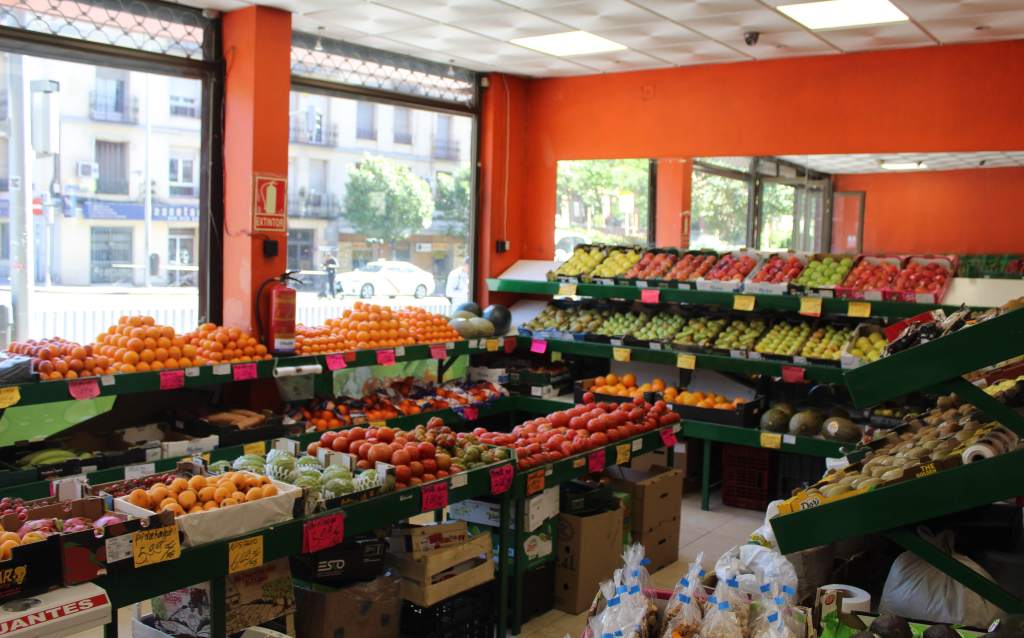
To round out this piece, I thought it right that I interview some of the more recent arrivals to my neighborhood. So I went to Union Frutas, a fruit stand near my house owned by a Chinese immigrant couple. I am a frequent customer, as the shop has very long hours (especially on Sunday, when so many stores close) and has extremely affordable prices. It has been open for 12 years. The husband, Diego (he goes by a Spanish name), moved to Spain in 2003 as a young man, following in the footsteps of his father, who lived in the Canary Islands. His wife, Li Fang, followed a few years later. When I asked Diego about the differences between work in Spain and his homeland, he replied that he had never had a job in China, so he couldn’t compare the experiences.

All of these stores have survived so long, in the face of competition from chains, by forging connections with the locals—something I witnessed in every shop I visited. It is small shops like these that give a neighborhood its flavor and personality, and which make Pacífico a wonderful place to live. And this is not even to mention the bars!

Review: Two Brecht Plays

Review: Two Brecht Plays

Mother Courage and Her Children by Bertolt Brecht

My rating: 4 of 5 stars

The poor need courage. Why? They’re lost. That they even get up in the morning is something.

It is surprising to read, from such a famously doctrinaire thinker, a work of art that is so rich in moral ambiguity. The titular character is enormously compelling, despite being neither hero nor villain. Mother Courage has moments of courage, of course, but also of capitulation, moments wherein she is admirable and when she is despicable. She is, on the one hand, a war profiteer, a kind of jackal gnawing at the scraps of human carnage. But can a person living on the edge of poverty, with hardly any other viable option to make a living, be condemned?

The world that Brecht presents is as hopeless and absurd as in any work from the previous century. It is a world where both morality and immorality are rewarded with cruelty. Two of Mother Courage’s children are killed as a direct consequence of their attempts to do the right thing, whereas her oldest son is killed for his crimes (the same crimes, ironically, that were praised in wartime). Mother Courage herself, who at least survives, is moral within the bounds of practicality. Even when life and death are on the line, she is always a business woman first and foremost, unwilling to make any sacrifice that will jeopardize her ability to make a living.

Considering Brecth’s Marxism, I am tempted to view Mother Courage as a kind of embodiment of the evils of capitalism—or, at least, as a portrait of how capitalism degrades us. And certainly she is far from ennobled by her ceaseless dealings and negotiations. In perhaps the pivotal scene in the play, she convinces a soldier that protests against the powers that be are useless. Her worldview, in other words, is materialistic and cynical.

And yet it is the war, not the economy, that is the defining element of the setting. And it is a war of religion. Is Brecht showing us, then, how capitalists lack the moral ability to oppose war? Certainly Mother Courage’s attempts to profit from the conflict ultimately destroys her family; but there doesn’t seem to be any other option open to her besides starvation.

Rather than a condemnation of capitalism or even of war, then, my final impression was of a cry of despair for the entire human race, written at one of the darkest moments of the previous century. Not cunning, nor cruelty, nor selfishness, nor martyrdom, nor religion, nor anything else can save the characters of this play from ruin. It is a portrait of an entire world gone mad.


Galileo by Bertolt Brecht

My rating: 4 of 5 stars

The evidence of your eyes is a very seductive thing. Sooner or later everybody must succumb to it.

This play succeeds as a drama while failing as history, at least as a history of science. Galileo here is presented as a kind of anti-religious working-class hero—who wants to liberate the toiling masses through knowledge. However, the idea that his philosophy of the heaven’s would naturally lead to atheism and, thus, political disquiet—an argument put against him at various points in the play—would have seemed very foreign to the seventeenth century. To my knowledge, those who censured Galileo were far more afraid of the Protestant Reformation than the Proletariat Revolution.

And as Eric Bentley’s astute introduction points out, the terms of the debate are also not fairly portrayed. True, when Galileo was looking through his telescope and merely reporting what he saw, this was a case of raw observation overturning established doctrine. But in the more important case—Galileo’s advocacy of the Copernican system—it is simply not true that the heliocentric astronomy was manifestly superior to the geocentric.

On the contrary, arguments for its adoption were in the realm of abstract mathematics, far removed from the realm of simple observation. Ironically, then, Galileo was indeed not simply asking the doctrinaire philosophers to accept the evidence of their senses. He was, in a real sense, asking them to disregard it—since, as we all know, what we experience every day is the sun rising and setting, not the earth in motion.

Also, the argument that the Copernican astronomy is a blow to human vanity is also rather anachronistic. Readers of Dante’s Divine Comedy will recall that, although Earth is regarded as the center, it is hardly a privileged place in the cosmos. On the contrary, each of the heavenly spheres is the more divine the further it is from earth, with God himself furthest of all. Thus, for Galileo to place earth among the heavenly spheres was rather flattering to humanity’s stature.

Yet this is a play, not history, and must be judged as such. Written at nearly the same moment as Mother Courage and Her Children, this play—though apparently quite different—shares the central feature of a morally ambiguous hero in compromising circumstances. At various points, particularly at the end, Brecht seems to want to condemn the famous scientist, just as Brecht judges Mother Courage rather harshly. And yet, in both plays, the cowardly behavior of the protagonists is their only real option, the alternatives being a pointless martyrdom.

The ambiguous nature of Galileo—hero and coward, genius and bungler (scientifically astute and yet politically inept)—is what gives him his authentic humanity as a character, as somebody we can readily identify with. That is not to deny his greatness. For Brecht here has portrayed a truly great figure, even an authentically tragic figure, whose flaws form an integral part of his virtues. The play succeeds, then, in spite of its historical inaccuracies, through a compelling portrayal—all too rare in drama—of an intellectual struggling against his surroundings.


View all my reviews

Quotes & Commentary #83: Austen

Quotes & Commentary #83: Austen

There is something so amiable in the prejudices of a young mind, that one is sorry to see them give way to the reception of more general opinions.

Jane Austen

Part of getting older—in my experience at least—is becoming more “normal.” Of course, “normal” is hard to define, and its definition always depends on social context. But basically, I mean behaving in a way that doesn’t make you stand out, as well as having beliefs that fall within the mainstream (Jane Austen’s “general opinions”).

For better or worse, by this generic definition, I find myself becoming more normal with each passing year. And I am continually reminded of this in my role as an educator. Teenagers like to push limits, and I often hear things which no “normal” person would say or even think—said just to provoke a reaction. These adolescent provocations are certainly not endearing.

But youth also includes a certain naïveté, in which opinions are unbound by considerations of what is practical or possible. Usually these opinions are absurd, but sometimes there is a spark of creativity that, I feel, I and many adults have lost. (Though to be fair, most of their theories of how to improve society involve abolishing school.)

And although I am not so sure about the idea—commonly bandied about—that schools are designed to beat out creativity, it is certainly true that schools are designed to establish a certain level of normalcy among their students. A student studying a standard curriculum, frequently mingling with their neighbors, will almost necessarily be more “normal” than somebody who, say, was homeschooled in a cabin on the prairie.

There is certainly a strength in “weirdness”—the ability to see things differently, to think outside normal paradigms, and perhaps even to push society forward. But there is such a huge social and economic benefit to normalcy that I think it would be remiss in educators not to try to at least guide students in that direction. And, in any case, a certain social baseline is obviously necessary if people are to live and work together.

Whether educated at home or in a public school, however, becoming a working adult requires most of us at least the ability to appear “normal”—dressing and acting in ways that fall within some margin of acceptability. True, the range of what is considered acceptable is growing wider in some respects, particularly in terms of appearance, as dress codes become less formal and, for example, tattoos become more common.

But in other respects, such as what opinions can be expressed without fearing an adverse reaction, I don’t think that we are any more tolerant of weirdness now than we were in the past. And given that reality, it behooves most of us to lose the “prejudices of a young mind,” as Austen says, and adopt the pleasantries of an adult brain to get along in life.

Yet this isn’t the whole story. Another thing I’ve noticed as I’ve gotten older and more “normal” is that, at a certain point, people regress into weirdness. Specifically after retirement, I’ve noticed (not to point fingers at anyone in particular) that people can develop zany opinions and odd behavioral ticks. It is as if it is only the constant pressures of school and then work are what keep people “normal,” and as soon as those pressures ease off, the weirdness comes rushing back. And, to keep to Jane Austen’s theme, this weirdness often manifests itself in prejudices and opinions that are far from “general.”

One might think that a lifetime of experience might insulate one’s mind against nonsense. But the passing years seem to make many people, if anything, more susceptible to unrealistic or outrageous beliefs.

I suppose it is not a novel observation that older folks can fall victim to scams, conspiracy theories, or simple superstition. But I do find it mildly depressing that age, far from conferring wisdom, can involve becoming unpresentable at parties. 

To put the language in Jane Austen’s terms, while the prejudices of a younger mind may be “amiable,” those of an older mind are typically quite the reverse. But I suppose both deserve sympathy, if for different reasons.

Review: The Grand Alliance

Review: The Grand Alliance

The Grand Alliance by Winston S. Churchill

My rating: 4 of 5 stars


Churchill’s account of the Second World War continues. I am finding that these volumes have a kind of cumulative power, which far exceeds that of any single volume. As I slowly make my way through the war, month by month, campaign by campaign, theater by theater, the mind-boggling scale of the conflict is beginning to sink in. What would be major operations in other wars are here mere side-shows or diversions. To pick just one example, if the Anglo-Iraq War were to happen today, it would be considered a momentous event that dominated the news. But in the context of World War II, it hardly even registers.

Merely keeping track of all this—the troop strengths, the ships available to the Navy, the number of serviceable aircraft, all distributed literally around the globe—would strain any military organization today. Two silly but revealing examples illustrate just how many different places Churchill had to keep in mind. He insisted that Iceland be written with a (C) after it, so that it could never be confused with Ireland (R). And he also preferred that Iran be called “Persia,” since otherwise somebody might confuse it with Iraq. The very idea that people might mix up what countries to attack or defend I think says more about the scale of the War than any superlative could.

But the military organization is only half of the equation. For Churchill is always acutely aware of the political situation, in ways that strictly military commanders are not.

To pick a simple example, Churchill has occasion to criticize a general for putting a British regiment in a relatively safe zone, while sending colonial forces into battle—for the apparently superficial, but politically real, reason that it reflects poorly on the British government. Indeed, Churchill’s frustrations with General Auchinleck’s hesitations to attack Rommel in North Africa reminded me very much of Lincoln’s own admonishments to George B. McClellan to be more aggressive. In both cases, the political leader realized the value of at least appearing to have the initiative. Appearances are important when you are courting potential allies and public opinion.

Like Manny, I was also impressed by Churchill’s willingness to put politics aside in order to win the war. Few politicians in Britain, I imagine, were less sympathetic to Soviet Communism than Churchill. But as soon as Hitler made his great error and commenced Operation Barbarossa, Churchill did not hesitate to send vital supplies and equipment to his former foe, even though it weakened his own position—correctly predicting that a strong Russian defense would debilitate the German army. The tense and sometimes downright rude correspondence between Stalin and Churchill was especially interesting to read. Even then, at the beginning of their alliance, the Cold War was looming ahead.


View all my reviews

San Isidro: The Spanish Père Lachaise

San Isidro: The Spanish Père Lachaise

Death is unsanitary. Yet it was not until the nineteenth century that urban planners in Europe and the United States connected overstuffed cemeteries with public health. For centuries, the same small church burying grounds of the inner cities had been used for the local dead. Bodies were buried upon bodies, until the ground was piled high above street level, and a good rainstorm would leave rotting limbs exposed. One can only imagine the stench.

It was clear that something had to be done. Carlos III of Spain, for example—a relatively “enlightened” monarch—wanted the cemeteries transferred to the outskirts of Madrid. Yet this policy conflicted with the practice of the Catholic church, in which parishioners were tended to by their local priests and buried in the corresponding consecrated ground. It took the violent arrival of José Bonaparte to the throne of Spain to overcome the resistance of the clergy and establish the first cemeteries on the outskirts of the city, just as Napoleon himself was responsible for the construction of Père Lachaise in the outskirts of Paris.

The most beautiful of these far-flung cemeteries is, undoubtedly, that of San Isidro. Well, I ought to give its full, official title: El Cementerio de la Pontificia y Real Archicofradía Sacramental de San Pedro, San Andrés, San Isidro y la Purísima Concepción.

This snappily named cemetery is located on the far side of the Manzanares River, between the Toledo and the Segovia Bridges, in what used to be a remote area. Indeed, there is a famous cartoon (a design for a tapestry) by Goya, La pradera de San Isidro, which shows almost the exact same area where the cemetery stands now. It was painted in 1788, just 23 years before the cemetery was opened, and the area was visibly absent of any human construction. Of course, the ever-growing city of Madrid has since swallowed up the cemetery in its greedy embrace. Even so, the place is not exactly easy to get to, at least on public transportation. It does not help that it is only open until 2 pm.

The cemetery takes its name from the patron saint of Madrid, San Isidro Labrador. (“Labrar” means to till the soil, as he was a poor farmer in life.) Isidro lived in Madrid almost 1,000 years ago, when it was a small town of little importance. Last year, 2022, marked the centenary of this saint’s canonization, and thus it was deemed a year of special celebration. But regardless of the year, every May 15th the adjacent San Isidro park fills up with revelers as a celebration of the saint’s day. 

As with many catholic saints, a variety of miracle stories are told about San Isidro, one of which is that of a fountain he created by striking his staff on the ground, in order to slake his master’s thirst. This miraculous spring quickly became known for its curative properties, and it still occupies a place of honor in the cemetery.

Times have changed somewhat. To accommodate the pandemic, a motion-sensor has been added to make the fountain more sanitary. Thus, one can partake of the miraculous healing water without touching any germs. The fountain itself, though not large, is interesting for the long inscription that covers the wall. This text boasts, among much else, of having cured various types of fevers, urinary and kidney problems, erysipelas (a bacterial infection), vomiting, sores, leprosy, wounds, and even of restoring a blind person to sight. An impressive record, indeed—though I think I will stick with my current physician. Yet the fountain’s longevity is palpable, considering that it also bears an inscription of a short poem by Lope de Vega (1562 – 1635) praising the water’s power.

This fountain is right next to the Chapel of San Isidro. This is no coincidence, as the chapel was built on this spot in the 16th century on the orders of the Empress Isabel of Portugal, who believed that the blessed waters had cured her son, the future Felipe II. (This did not prevent poor Felipe from developing severe gout later in life.) Though a chapel has been here on this spot a long while, its current form is from the 18th century, when it was rebuilt. Thus, when Goya painted the chapel in 1788 (in another sketch for a tapestry, on display at the Prado), it looked very much as it does today. Even so, this is something of an illusion, as the chapel was—like much else in Madrid—totally destroyed during the Civil War, and only reconstructed to appear as it did in Goya’s day.

The Hermitage in Goya’s Day
The Hermitage Today

This quiet, peaceful cemetery was in the news last year as the site of a fascist demonstration. About two hundred Falangists (the Spanish fascist party) gathered to protest, hold up signs, and wave the Nazi salute. This was occasioned by the re-interment of the remains of one José Antonio Primo de Rivera (1903 – 1936), the founder of the Falangist party.

Ironically, Primo de Rivera became more important in death than he had ever been during his short political career. The Falangists were never a major electoral force during the Second Republic, and José Antonio did not help plan or execute the military coup which eventually resulted in Franco’s dictatorship. Rather, he became something of a martyr when he was imprisoned and then executed by the Republicans during the first year of the Civil War. After Franco emerged victorious, he found it convenient to treat Primo de Rivera as a kind of John the Baptist to his Messiah, and had Primo de Rivera’s body transported from Alicante to Madrid in a massive funeral parade. 

After this, Primo de Rivera was temporarily laid to rest under the altar in El Escorial. But when Franco’s enormous symbol of fascist power—The Valley of the Fallen—was completed in 1959, Franco had the body moved once again, to serve as the symbolic centerpiece to his monument to the Civil War dead. For decades, Primo de Rivera slumbered underneath the mosaic dome of the underground basilica, directly opposite Francisco Franco’s own body.

Yet having such ghastly figures entombed in such a place of honor naturally bothered a lot of people, for the same reason that having statues of Confederate generals disturbs many Americans. The Valley of the Fallen was argued over for years until, in 2019, Franco’s body was dug up and moved to a cemetery in El Pardo. In 2023, the job was finished when Primo de Rivera’s body was also removed (the third time this embattled body has been re-buried, if you’re counting). Indeed, the official name of the site is no longer the Valley of the Fallen, but the Valley of Cuelgamuros.

Such is the hold of fascist propaganda on people’s minds that, decades after the fall of Franco’s dictatorship, and nearly a century after Primo de Rivera’s death, people still showed up to protest for the sake of these old bones. 

Enough politics! It is finally time to enter the cemetery itself. As the map by the entrance informs us, the cemetery is divided into several “patios.” The first three are located on a level with the chapel and are rather like church cloisters, without much decoration. The most interesting part of the cemetery is, without doubt, the large, semi-circular fourth patio.

A walkway, lined with cypress trees—the traditional tree of mourning—leads up a hill to the upper level. It is obvious at a glance that this used to be a very fashionable place to decompose. The place is covered in elaborate tombs, mausoleums, and monuments—clearly not a burying ground for the penny-pinched. Look behind you, and you can see part of the reason for its popularity: The views of the city are quite wonderful from here (presumably why it was popular for picnics back in Goya’s day).

There are many eye-catching sculptures on display. But the first I want to discuss is a rather puzzling monument.

In a previous post, I explored the often-overlooked Pantheon of Illustrious Men, located near Atocha. The Cemetery of San Isidro has what can only be described as an aborted first attempt at that same monument. Also called the Pantheon of Illustrious Men, it consists of a tall stone pillar, upon which an angel stands with his trumpet. At the bottom of this column there is an ornate base with carved reliefs of the extremely distinguished bodies which rest beneath it. Three of these four are people the reader is unlikely to have heard of (illustriousness notwithstanding), but the fourth is none other than Francisco Goya, a person who is famous indeed.

The painter’s posthumous presence here is puzzling for two reasons. For one, this monument was not completed until 1886, while Goya died almost sixty years before that, in 1828. Second, I happen to know that Goya is certainly buried in a different chapel, not far off, called San Antonio de la Florida.

This mystery has a clear—if not exactly a logical—explanation. Goya was first buried in Bordeaux, France, where he died in exile. His body rested there, unharassed, for several decades until it was chanced upon by the Spanish diplomat to France, whose wife was coincidentally buried in the same cemetery. Obviously, the glorious Aragonese painter could not be left to decay on foreign soil, so he was relocated to his native land, and taken to this cemetery. However, because of all the bureaucratic hassle of transporting a body, Goya’s bones did not arrive until 1899, by which time the original idea of the Pantheon had lost its luster. Thus, he was instead buried in the aforementioned chapel of San Antonio de la Florida, which he had decorated with his own hand.

(To make the matter even more confusing, this chapel was eventually deconsecrated and turned into a museum, while an identical chapel was built just across the street—to the delight of many potential visitors, I am sure. And, to top it all off, Goya’s skull was lost at some point during this process, never to be found again. To add to the mystery, there is a painting in the Museum of Zaragoza of what is supposed to be Goya’s skull, made in the year 1849, before any of this tomb switching went on. It is possible it was stolen by curious admirers.) 

The supposed skull of Goya

We have spent a lot of time on this odd cenotaph, but there is a great deal more to see in the cemetery. Indeed, I have seen enough cemeteries so that I can confidently proclaim that the Cementerio de San Isidro is among the most beautiful in Spain—perhaps in all of Europe. The finest artists and sculptors of the time were hired to turn a place of mourning into a wonderful open-air gallery. Of course, this was not an act of public service. This was done to preserve and glorify the names of the rich and famous—who wanted their final resting places to reflect the splendor of their lives.

It would be impossible to review every notable tomb and name in the cemetery. The following is only a brief sampling of what you may find there.

By the standards of the cemetery, a relatively modest grave belongs to Cristobal Oudrid, an important composer of zarzuelas (the distinctively Spanish version of light opera). His mustachioed face, carved into the stone, keeps watch over his earthly remains. Not far off is the resting place of Consuelo Vello Cano, better known by her stage name Fornarina. She performed a genre of song called cuplé, considered somewhat risquée, which was normally sung by women (or men in drag) for an all-male audience. Her grave is presided over by the torso and wings of an angel. An extremely modest grave belongs to Ventura de la Vega, an Argentinian playwright who lived and worked in 19th century Spain. He is buried in a niche in the encircling walls of the patio.

But what naturally attracts the casual visitor are the big tombs. Perhaps the most eye-catching is the Panteón Guirao, a massive sculptural tour de force by Augustín Querol. Querol is also responsible for a monumental tomb in the Panteón de Hombres Ilustres in Atocha, and this work displays his ability to create dramatic, fluid, and even ghostly textures out of hard stone. This tomb—which occupies the center of the patio—was made at the behest of Luis Federico Guirao Girada, who was a lawyer and a politician during his life, but who is now principally remembered for his photography.

An extraordinary tomb is that which belongs to the Marquis of Amboage, an aristocratic family. This is an enormous neo-gothic chapel, bristling with prongs and complete with a metal spire, much like that of Notre-Dame de Paris. It could be a church if it did not have permanent tenants. But my favorite tomb is that of Francisco Godia Petriz. Petriz had a successful import-export business but was also an avid art collector. His mausoleum is unlike any I have ever seen. A stone sarcophagus hangs suspended by heavy chains from a large rectangular frame. The frames are held by miniature angels, who are ready to literally and figuratively carry the dead businessman up to heaven. Even if it is a bit tacky, I think the design is so original that I am surprised its architect, José Manuel Marañon Richi, is not better known.

Some of the jewels of the cemetery are only available for those taking the official guided tour. These are offered only every so often and are all in Spanish. If you do manage to get one, however (they are reserved by emailing the cemetery), then you may be taken inside some of these impressive tombs. In the tomb of the Dukes of Denia, for example, there are two statues by the Spanish sculptor Mariano Benlliure, who vividly depicts the Duke and Duchess lying in deathly repose. Even more stunning is what awaits the visitor of the tomb of the Marquis of la Gándara. Inside, sitting atop a sarcophagus, is an angel wistfully looking into the beyond. This is a work of the Italian sculptor Giulio Monteverde, and it is quite wonderful. Standing in front of this heavenly being, it is easy to forget that she is made of inanimate rock, so subtly lifelike is the work in every detail.

If I am dwelling on this cemetery for so long, it is because it was a revelation to me that such a beautiful place was to be found in the city, virtually overlooked as a tourist destination. If Pére Lachaise Cemetery deserves to be on every Parisian tourist’s itinerary, then the Cementerio de San Isidro merits the same—both as an important link to Madrid’s history, and a place beautiful in itself.