Review: Heidegger’s Basic Writings

Review: Heidegger’s Basic Writings
Basic Writings

Basic Writings by Martin Heidegger

My rating: 4 of 5 stars

Every valuing, even where it values positively, is a subjectivizing. It does not let things: be.

A Gentle Warning

In matters philosophical, it is wise to be skeptical of interpretations. An interpretation can be reasonable or unreasonable, interesting or uninteresting, compelling or uncompelling; but an interpretation, by its very nature, can never be false or true. Thus, we must be very careful when relying on secondary literature; for what is secondary literature but a collection of interpretations? Personally, I don’t like anybody to come between me and a philosopher. When a philosopher’s views are being explained to me, I feel as if I’m on the wrong end of a long game of telephone. Even if an interpreter is excellent—quoting extensively and making qualified assertions—his interpretation is, like all interpretations, an argument from authority; to interpret a text is to assert that one is an authority on the text, and thus should be believed.

Over generations, these interpretations can harden into dogmas; we are taught the “received interpretation” of a philosopher, and not the philosopher himself. This is dangerous; for, what makes a classic book classic, is that it can be read repeatedly—not just in one lifetime, but down the centuries—while continuing to yield new and interesting interpretations. In other words, a philosophical classic is a book that can be validly and compelling interpreted a huge number of ways. So if you subscribe to another person’s interpretation you are depriving the world of something invaluable: your own take on the matter.

In matters philosophical, I say that it is better to be stupid with one’s own stupidity, than smart with another’s smarts. To put the matter another way, to read a great book of philosophy is not, I think, like reading a science textbook; the goal is not simply to assimilate a certain body of knowledge, but to have a genuine encounter with the thinker. In this way, reading a great work of philosophy is much more like travelling someplace new: what matters is the experience of having been there, and not the snapshots you bring back from the trip. Even if you go someplace where you can’t speak the language, where you are continually baffled the whole time by strange customs and incomprehensible speech, it is more valuable than just sitting at home and reading guide books. So go and be baffled, I say!

This is all just a way of warning you not to take what I will say too seriously, for what I will offer is my own interpretation, my own guide-book, so to speak. I will make some assertions, but I’d like you to be very skeptical. After all, I’m just some dude on the internet.


An Attempt at a Way In

The best advice I’ve ever gotten in regard to Heidegger was in my previous job. My boss was a professor from Europe, a very well educated man, who naturally liked to talk about books with me. At around this time, I was reading Being and Time, and floundering. When I complained of the book’s difficulty, this is what he said:

“In the Anglophone tradition, they think of language as a tool for communication. But in the European tradition, they think of language as a tool to explore the world.” He said this last statement as he reached out his arm in front of him, as if grabbing at something far away, to make it clear what he meant.

Open one of Heidegger’s books, and you will be confronted with something strange. First is the language. He invents new words; and, more frustratingly, he uses old words in unfamiliar ways, often relying on obscure etymological connections and German puns. Even more frustrating is the way Heidegger does philosophy: he doesn’t make logical arguments, and he doesn’t give straightforward definitions for his terms. Why does he write like this? And how can a philosopher do philosophy without attempting to persuade the reader with arguments? You’re right to be skeptical; but, in this review, I will try to provide you with a way into Heidegger’s philosophy, so at least his compositional and intellectual decisions make sense, even if you disagree with them. Since Heidegger’s frustrating and exasperating language is extremely conspicuous, let us start there.

Imagine a continuum of attitudes towards language. On the far end, towards the left, is the scientific attitude. There, we find linguists talking of phonemes, morphemes, syntax; we find analytic philosophers talking about theories of meaning and reference. We see sentences being diagrammed; we hear researchers making logical arguments. Now, follow me to the middle of this continuum. Here is where most speech takes place. Here, language is totally transparent. We don’t think about it, we simply use it in our day to day lives. We argue, we order pizzas, we make excuses to our bosses, we tell jokes; and sometimes we write book reviews. Then, we get to the other end of the spectrum. This is the place where lyric poetry resides. Language is not here being used to catalogue knowledge, nor is it transparent; here, in fact, language is somehow mysterious, foreign, strange: we hear familiar words used in unfamiliar ways; rules of syntax and semantics are broken here; nothing is as it seems.

Now, what if I ask you, what attitude gets to the real essence, the real fundamentals of language? If you’re like me, you’d say the first attitude: the scientific attitude. It seems commonsensical to think that you understand language more deeply the more you rigorously study it; and one studies language by setting up abstract categories, such as ‘syntax’ and ‘phoneme’. But this is where Heidegger is in fundamental disagreement; for Heidegger believes that poetry reveals the essence of language. In his words: “Language itself is poetry in the essential sense.”

But isn’t this odd? Isn’t poetry a second or third level phenomenon? Doesn’t poetry presuppose the usual use of language, which itself presupposes the factual underpinning of language investigated by science? In trying to understand why Heidegger might think this, we are led to his conception of truth.

If you are like me, you have a commonsense understanding of what makes a statement true or false. A statement is “true” if it corresponds to something in reality; if I say “the glass is on the table,” it is only true if the glass really is on the table. Heidegger thinks this is entirely wrong; and in place of this conception of truth, Heidegger proposes the Greek word “aletheia,” which he defines as “unconcealment,” or “letting things reveal themselves as themselves.”

It’s hard to describe what this means abstractly, so let me give you an example. Let’s say you are a peasant, and a rich nobleman just invited you to his house. You get lost, and wander into a room. It is filled with strange objects that you’ve never seen before. You pick something up from a table. You hold it in your hands, entranced by the strange shape, the odd colors, the weird noises it omits. You are totally lost in contemplation of the object, when suddenly the nobleman waltzes into the room and says “Oh, I see you’ve found my watch.” According to Heidegger, what the nobleman just did was to cover up the watch in a kind of veneer of obviousness. It is simply a watch, he says, just one among many of its kind, and therefore obvious. The peasant, meanwhile, was experiencing the object as an object, and letting it reveal itself to him.

This kind of patina of familiarity is, for Heidegger, what prevents us from engaging in serious thinking. This is why Heidegger spends so much time talking about the dangers of conformity, and also why he is ambivalent about the scientific project: for what is science but the attempt to make what is not obvious, obvious? To bring the unfamiliar into the realm of familiarity? Heidegger thinks that this feeling of unfamiliarity is, on the contrary, the really valuable thing; and this is why Heidegger talks about moods—such as anxiety, which, he says, discloses the “Nothing.” Now, it is a favorite criticism of some philosophers to dismiss Heidegger as foolish by treating “Nothing” as something; but this misses his point. When Heidegger is talking of anxiety as the mood that discloses the “Nothing” to us, he means that our mood of anxiety is the subrational realization of the bizarreness of existence. That is, our anxiety is the way that the question faces us: “Why is there something rather than nothing?”

This leads us quite naturally to Heidegger’s most emblematic question, the question of Being: what does it mean to be? Heidegger contends that this question has been lost to history. But has it? Philosophers have been discussing metaphysics for millennia. We have idealism, materialism, monism, monadism—aren’t these answers to the question of Being? No, Heidegger says, and for the following reason. When one asserts, for example, that everything is matter, one is asserting that everything is, at base, one type of thing. But the question of Being cannot be answered by pointing to a specific type of being; so we can’t answer the question, “what does it mean to be?” by saying “everything is mind,” or “everything is matter,” since that misses the point. What does it mean to be at all?

So now we have to circle back to Heidegger’s conception of truth. If you are operating with the commonsense idea of truth as correspondence, you will quite naturally say: “The question of ‘Being’ is meaningless; ‘Being’ is the most empty of categories; you can’t give any further analysis to what it ‘means’ to exist.” In terms of correspondence, this is quite true; for how can any statement correspond with the answer to that question? A statement can only correspond to a state of affairs; it cannot correspond to the “stateness” of affairs: that’s meaningless. However, if you are thinking of truth along Heidegger’s lines, the question becomes more sensible; for what Heidegger is really asking is “How can we have an original encounter with Being? How can I experience what it means to exist? How can I let the truth of existence open itself up to me?”

To do this, Heidegger attempts to peel back the layers of familiarity that, he feels, prevents this genuine encounter from happening. He tries to strip away our most basic commonsense notions: true vs. false, subject vs. object, opinion vs. fact, and virtually any other you can name. In so doing, Heidegger tries to come up with ways of speaking that do not presuppose these categories. So in struggling through his works, you are undergoing a kind of therapy to rid yourself of your preconceptions, in order to look at the world anew. In his words: “What is strange in the thinking of Being is its simplicity. Precisely this keeps us from it. For we look for thinking—which has its world-historical prestige under the name “philosophy”—in the form of the unusual, which is accessible only to initiates.”

What on earth are we to make of all this? Is this philosophy or mystical poetry? Is it nonsense? That’s a tough question. If by “philosophy” we mean the examination of certain traditional questions, such as those of metaphysics and epistemology, then it might be fair to say that Heidegger wasn’t a philosopher—at least, not exactly. But if by “philosophy” we mean thinking for the sake of thinking, then Heidegger is a consummate philosopher; for, in a sense, this is the point of his whole project: to get us to question everything we take for granted, and to rethink the world with fresh minds.

So should we accept Heidegger’s philosophy? Should we believe him? And what does it even mean to “believe” somebody who purposely doesn’t make assertions or construct arguments? Is this acceptable in a thinker? Well, I can’t speak for you, but I don’t accept his picture of the world. To sum up my disagreement with Heidegger as pithily as possible, I disagree with him when he says: “Ontology is only possible as phenomenology.” On the contrary, I do not think that ontology necessarily has anything to do with phenomenology; in other words, I don’t think that our experiences of the world necessarily disclose the world in a fundamental way. For example, Heidegger thinks that everyday sounds are more basic than abstract acoustical signals, and he argues this position like so:

We never really first perceive a throng of sensations, e.g., tones and noises, in the appearance of things—as this thing-concept alleges; rather we hear the storm whistling in the chimney, we hear the three-motored plane, we hear the Mercedes in immediate distinction from the Volkswagen. Much closer to us than all sensations are the things themselves. We hear the door shut in the house and never hear acoustical sensations or even mere sounds. In order to hear a bare sound we have to listen away from things, divert our ear from them, i.e., listen abstractly.

To Heidegger, the very fact that we perceive sounds this way implies that this is more fundamental. But I cannot accept this. Hearing “first” the door shut is only a fact of our perception; it does not tell us anything about how our brains process auditory signals, nor what sound is, for that matter. This is why I am a firm believer in science, because it seems that the universe doesn’t give up its secrets lightly, but must be probed and prodded! When we leave nature to reveal itself to us, we aren’t left with much.

And it was clear that I’m not a Heideggerian from my introduction. As the opening quote shows, he was partly remonstrating against our dichotomy of subjective opinion vs. objective fact; whereas this notion is the very one I began my review with. You’ve been hoodwinked from the start, dear reader; for by acknowledging that this is just one opinion among many, you have, willingly or unwillingly, disagreed with Heidegger.

So was reading Heidegger a waste of time for me? If I disagree with him on almost everything, what did I gain from reading him? Well, for one thing, as a phenomenologist pure and simple, Heidegger is excellent; he gets to the bottom of our experience of the world in a way way few thinkers can. What’s more, even if we reject his ontology, many of Heidegger’s points are interesting as pure cultural criticism; by digging down deep into many of our preconceptions, Heidegger manages to reveal some major biases and assumptions we make in our daily lives. But the most valuable part of Heidegger is that he makes you think: agree or disagree, if you decide he is a loony or a genius, he will make you think, and that is invaluable.

So, to bring this review around to this volume, I warmly push it into your hands. Here is an excellent introduction to the work and thought of an original mind—much less imposing than Being and Time. I must confess that I was pummeled by Heidegger’s first book—I was beaten senseless. This book was, by contrast, often pleasant reading. It seems that Heidegger jettisoned a lot of his jargon later in life; he even occasionally comes close to being lucid and graceful. I especially admire “The Origin of the Work of Art.” I think it’s easily one of the greatest reflections on art that I’ve had the good fortune to read.

I think it’s only fair to give Heidegger the last word:

… if man is to find his way once again into the nearness of Being he must first learn to exist in the nameless. In the same way he must recognize the seductions of the public realm as well as the impotence of the private. Before he speaks man must first let himself be claimed again by Being, taking the risk that under this claim he will seldom have much to say.

View all my reviews

Review: Père Goriot

Review: Père Goriot
Père Goriot

Père Goriot by Honoré de Balzac

My rating: 4 of 5 stars

Money is life; money accomplishes everything.

I recently worked as a slush pile reader for a literary magazine, sorting out the best stories from the flurry of submissions. Many of these were quite expertly written—sharp prose, snappy beginnings, intriguing plots, quirky characters, and all of the other boxes ticked. However, the lion’s share lacked something which I came to call “weight.”

The stories never escaped the sense of airy insubstantiality that besets much fiction, that nagging and persistent sense of emptiness—in short, of being entirely fiction. The characters spoke with the voices of puppets and moved in a daydream world. I could not believe, so I did not care. Balzac presents a striking contrast. From the very start, this novel is heavy-laden with realistic details snatched from history and from daily life. Far from being phantasmagoric, the setting is etched into the memory with acid, becoming more real than the characters themselves.

Doubtless this ability to lend the weight of reality to his stories is what made Balzac the father of realism. But Balzac’s realism is most impressive in his depiction of the Paris of the Bourbon restoration; it does not extend so forcefully to his characters. Even the best characters in this book are rather one-dimensional and static; they achieve force through intensity, not complexity. Balzac endows each of his creations with an overwhelming passion, a monomania. In the case of Goriot it is his daughters; with Rastignac, social clout; and with Vautrin, a general diabolical glee.

But if Balzac does not stop at these monomanias, for he is at pains to show that each of these passions is fundamentally rooted in money. Goriot loses the affection of his daughters by giving away his last bit of money; Rastignac realizes that money is the key to social success; and Vautrin wishes to buy a plantation in the American south. For a nineteenth-century novel, this is refreshing. Balzac eschews the usual plot mechanics of romance and marriage in favor of the far more contemporary problem of making one’s way in a morally treacherous world. He is a genius at revealing how mercenary motives worm their way into even the most intimate of relationships.

Given Balzac’s reputation for realism, I was surprised by the amount of melodramatic passion on display in this novel. Often this was a weakness, loading the book down with declamations and hysterics. But, at times, it allowed Balzac to reach a level of emotional intensity that was almost operatic. This was particularly true in the final scene, where the combination of grinding poverty, total desperation, and feverish despair reached Dostoyevskian proportions. Indeed, Pere Goriot was a major influence on Dostoyevsky’s Crime and Punishment, as is clear from the many parallels between the two books.

The final result is a book which, if aesthetically rough and conceptually limited, is both an incisive look at the hypocrisies of society and a gripping work of art.


View all my reviews

Canary Islands: Lanzarote

Canary Islands: Lanzarote

A year had passed since my last trip the Canary Islands. Now it was time to go back—for this trip, to the island of Lanzarote. This time, however, I was traveling on someone else’s dime. Rebe had bought me this weekend trip as my birthday present. Relationships sometimes do pay off. 

The view of the Madrid mountains from the plane window

Lanzarote is the fourth largest Canary Island by area, and the third largest by population. It sits at the northeast extreme of the archipelago, its form like a squiggly oval in the sea. The main thing that I had been told about the island is that it is Martian: bone dry, bereft of vegetation, and covered in red volcanic soil.

As with last time, we would have to rent a car to traverse the island. I was only slightly less nervous about driving than I had been last year. The added time had not added to my experience. I had been behind the wheel remarkably little in the intervening months. At least the car was cheap, and came with insurance. Once again, we rented with PlusCar, and got a Honda Prius with automatic transition (I can’t drive a stick) for about sixty euros, with everything included.

Soon we were on the road. My informants had been right: the island looked like another planet. Misshapen mountains swelled out of the flat red desert, where scarlet soil alternated with fields of black igneous rocks. As in Andalusia, nearly all of the buildings were whitewashed—a recourse against the sun and the total lack of shade. These low-lying dwellings nestled within the wide space, connected by roads that cut through the land at arbitrary angles, there being almost no obstacles in the topography. Though the landscape gave every impression of being inhospitable, the weather was almost perfect: warm but not hot, with a gentle cooling breeze.

Why is Lanzarote’s bone-dry climate so different from the verdant Tenerife’s, which is only a few hundred kilometers away? I suppose the answer must be elevation. The high peak of Teide, Tenerife’s central volcano, captures the mist rolling in from the clouds and channels it downwards to the valleys below; while Lanzarote is quite flat by comparison.

Human habitation on these islands goes back a surprising way. As I mentioned in my previous post, the islands were inhabited by an ethnic group known as the Guanches before the Spanish arrived. But before the Guanches established themselves, the islands were visited by several ancient peoples, most notably the Romans, who left archaeological remains near the pueblo of Teguise. The great geographer Ptolemy even gave the islands’ exact locations. It is a wonder that it did not become a popular vacation spot sooner.

Our plane landed in the afternoon, so our first order of business was, naturally, to have some lunch. We stopped in a place called El Moreno, which specializes in grilled meat (though, again, one wonders where the animals are living). Both of our dishes were delicious. Canarian food has so far never disappointed me in its richness and its simplicity.

From there it was a very short drive to our first stop: the Fundación César Manrique.

Few architects are as emblematic of a place as César Manrique is of Lanzarote. The only comparison I can think of is Gaudí’s relationship with Barcelona. Manrique was a prolific Spanish architect who spent much of his career in New York. Indeed, Nelson Rockefeller—a lover and patron of modern art—paid for Manrique’s apartment. Upon his return, Manrique set about transforming the landscape of his native island. It is largely thanks to him that there are no high-rise buildings or ugly billboards obstructing the natural beauty. He also helped to implement building codes that insured that all buildings have a traditional look. That the island is so well-composed is largely thanks to him.

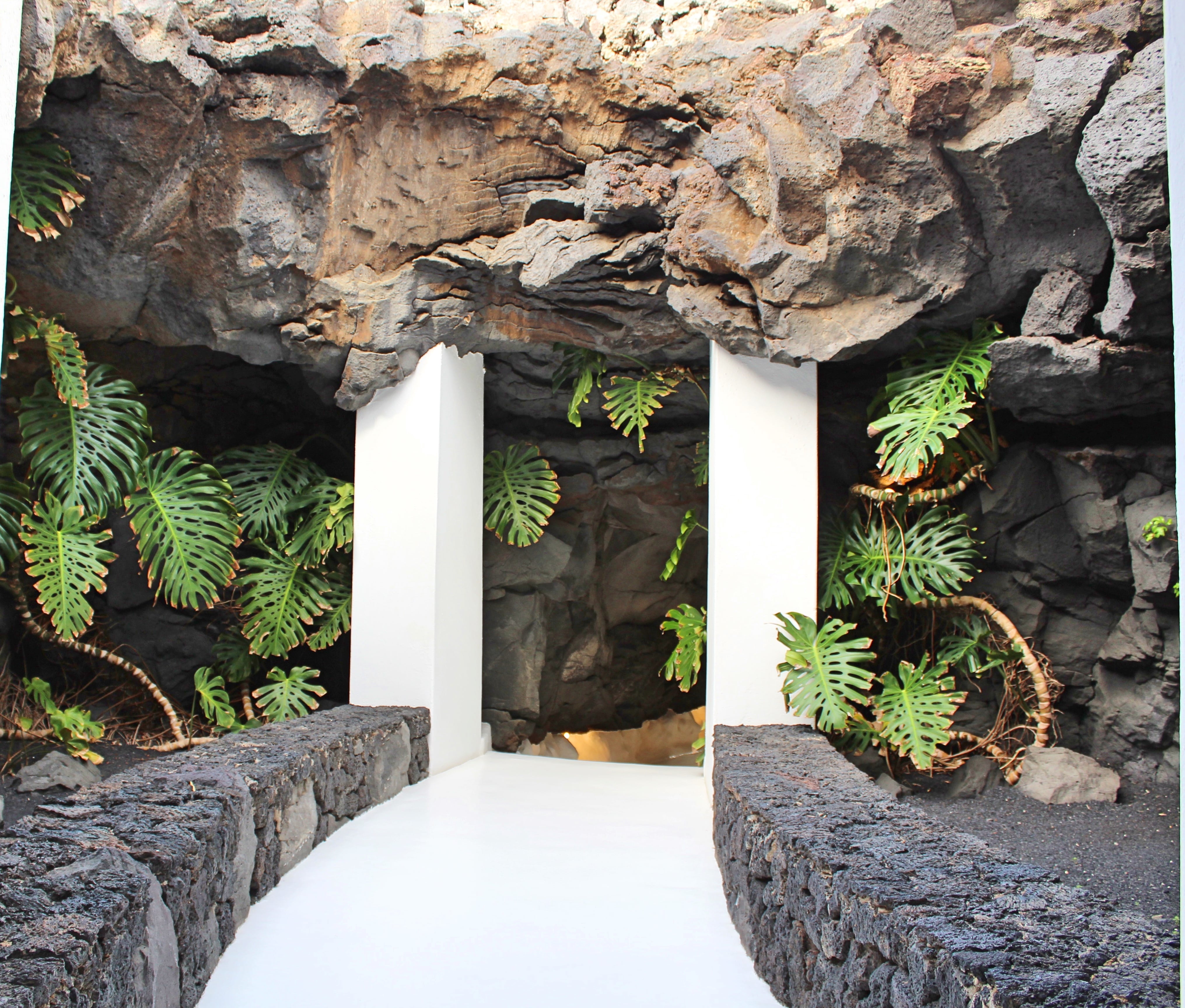
But Manrique also built his own works of art, scattering them on every corner of the island. The building which serves as the headquarters of his foundation, called the “Volcano House,” was his own home for twenty years.

Anyone expecting the architectural exuberance of a Gaudí will be disappointed. Rather, Manrique’s style is made to highlight and complement the island’s natural beauty. Thus, upon entrance the visitor finds herself in a courtyard filled with exotic plants and little ponds. The only explicitly artistic touch is the mural running across the back wall—which, to my eye, bears the obviously traces of Miró’s style. The low walls also afford a glimpse at the landscape beyond, which rises up into red hill in the distance. It is a charming and comfortable space; yet I found myself slightly disappointed at the simplicity. 

But this feeling disappeared when I descended to the lower level. Manrique put his house on land still scarred by volcanic eruptions. Several craters pockmarked the terrain, which Manrique turned into subterranean rooms—a posh living room, a dance floor, a lounge, a spot for grilling, and a small swimming pool: all decorated with sleek furniture. Manrique carved out tunnels to connect these five spaces, and the feeling is that of being in a high-class nature resort. In the main building some of Manrique’s drawings, paintings, and ceramic work were on display.

Even after this performance, however, I admit to being somewhat less than awed by Manrique’s work. It is admirably simple, and it complements the landscape remarkably well. However, I thought that it lacked a forceful personality behind it, and that it well beholden to a vision of tropical paradise which I did not share. But this was only the beginning of my acquaintance with Manrique’s architecture. For, as I soon learned, there is not a single corner of the island that does not bear his fingerprints.

I should also mention that we met one of Rebe’s friends at the Fundación. He’s from another Canary Island, and had met Rebe during a camping trip. Unfortunately for me, I found his Canary accent to be so thick that I could hardly understand a word he said. It is a very different sort of Spanish.

Now it was finally time to check into our Airbnb. Our bags had been sitting in the car the whole time. Rebe had rented a room in a house a little bit outside the town of San Bartolomé. Like so many places on the island, the neighborhood seemed to be in the middle of nowhere. We parked the car and went inside. Already I marvelled at the total lack of parking regulations. “We don’t care about that kind of stuff here,” our host explained. The house was entirely typical: whitewashed, with a tile roof, and surrounded by a fence enclosing a small garden. The interior was of a piece with the outside: mostly empty, with white ceilings, white walls, and full of viny plants.

The beauty of Lanzarote was already beginning to get under my skin. It is the beauty of barrenness, of emptiness, of the desert. It is the beauty of wide open nothingness. What few structures there are—trees, houses, hills—stand out amid the cloudless sky and even terrain, presented as in a minimalist work of art. It is a place that I could get used to.

Since we arrived relatively late, it was already evening when we had settled into our Airbnb and were ready to leave again. Inevitably, we decided to visit another work of Manrique, the Jameos del Agua.

The road there took us across the entire length of the island. When we got into the car the sun was already setting; in half an hour it was quite dark. So far I had been doing decently well in my driving. But piloting in the dark unnerved me. I had hardly any experience with it. On the highways it wasn’t bad, since there were many other cars illuminating the roads, as well as some street lights. And many of the main roads off the highway were lined with reflective plastic.

But our route took us through local roads with no luminescent resources whatsoever. I was driving blind, only able to see the next twenty feet of road in front of me. There were not even any natural contours to the landscape to help orient me; the road was a flat surface surrounded by a flat plain—a line of black asphalt imposed over black volcanic rock. Needless to say I did not find it especially relaxing, and I slowed down to a crawl.

Eventually we reached our destination. It was around eight in the evening and the large parking lot was mostly empty. From the outside the place didn’t look like much—a few nondescript buildings in the middle of nowhere. We paid the entrance fee and went inside, and a winding staircase led us down into a large crater. There we found a restaurant: elegant tables, chatting guests, and a well-stocked bar.

A kind of manufactured “cool” music was pumping through the sound system—a mixture of wavy atmospheric synth and insistent drums, with a woman’s ethereal voice intermittently crying over the ruckus. Such music immediately set the tone of the place: loudly expensive. I did not like it. Though we had not eaten, we did not even consider ordering something from the restaurant, since even a beer was sure to be twice its usual price. Instead, we moved towards the central tunnel.

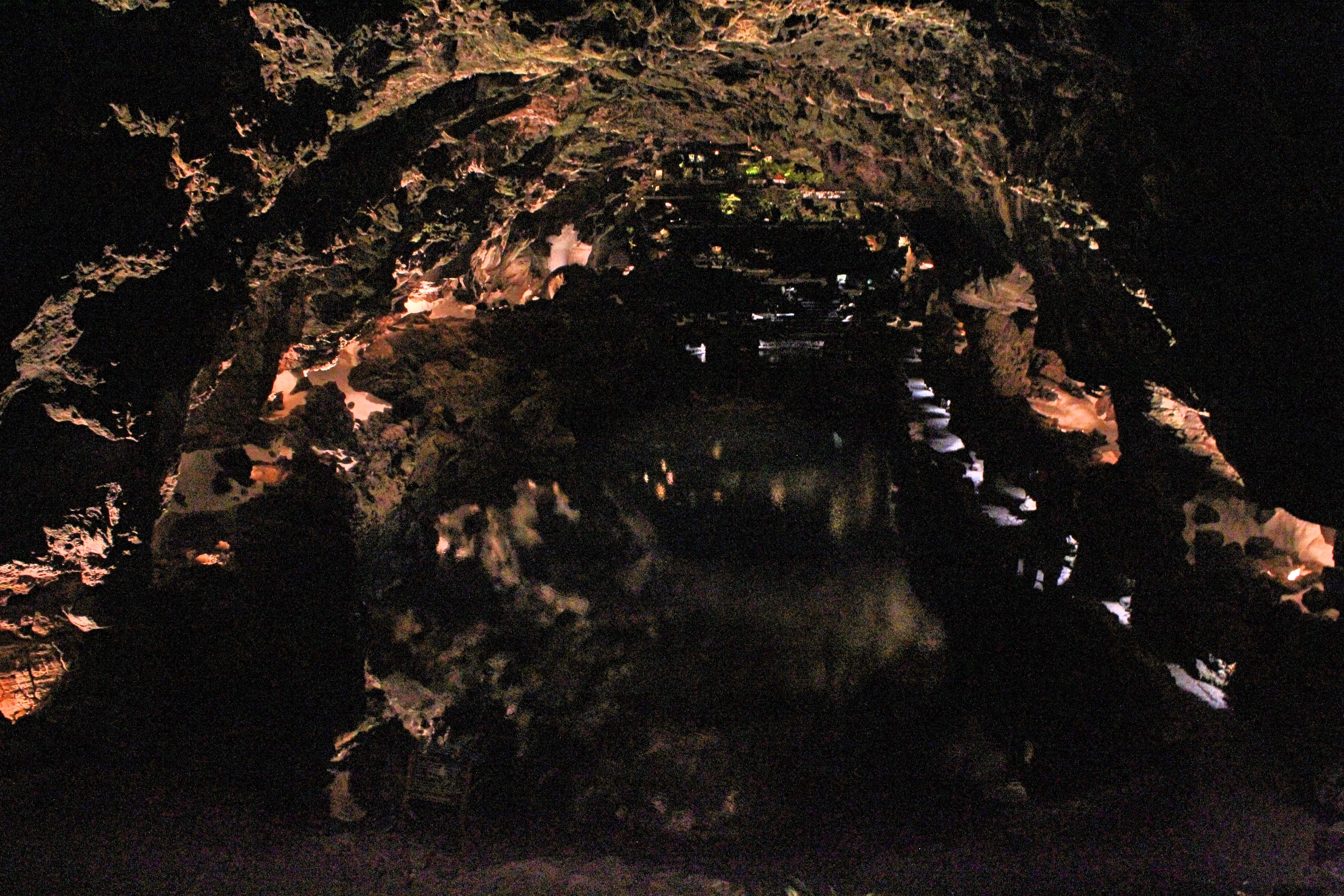
This is easily the highlight of the Jameos del Agua: a volcanic tube connecting a crater on either end. In the tunnel is a salt-water pond, where a strange species of indigenous lobster lives: the Munidopsis polymorpha. In size it is closer to a shrimp than a lobster, indeed even smaller; and its color is albino white. This diminutive create is blind, and is only found in Lanzarote, for which reason it has become the island’s symbol.

Nearby signs advised us not to throw any coins into the water, since this pale lobster depends on a fragile environment. Meanwhile, shifting lights on the ceiling and bottom of the tunnel silhouetted the jagged rocks. I tried to photograph it but the effect proved too delicate for my camera’s light settings. After admiring the cave for a good while—trying to ignore the irritating music—we moved through the tunnel to the other side. Here we climbed a staircase to another crater.

This space resembled a resort: with lawn chairs, a bar, umbrellas, and a pool in the center. The water glowed neon blue in the darkness. Further on I discovered a concert hall. This was by far my favorite part of the Jameos. The hall was beautiful—built into the cliff side, with rows of seats underneath the amorphous igneous rock. Here the bad mood-music could be heard no more; the space was sonically isolated. It must have had motion sensors, too, for when I entered the lights turned on and music began to play on the hall’s speaker system. It was a medieval motet. Ghostly voices reverberated throughout the hall, slowly ascending and descending in Latin syllables. It was gorgeous. And I was there, alone, to appreciate it: the sounds of heaven under the earth.

Despite the place’s commercial and even tacky aspect, I enjoyed the Jameos del Agua. In the stillness and blackness of the night, with very few people around, it had the mystery of an abandoned place.

With another ride through the night, and a quick dinner at a pizza place, we were already finished with our first day at Lanzarote. The next day was our last.


Our first stop the next day was the island’s national park: Timanfaya.

The drive there took us into a landscape that was even more barren than usual. The soil glowed red in the morning sun as the car passed miles of flat terrain. It was hard to believe that we were going anywhere, as the terrain was so rhythmically monotonous. But the voice of the GPS directed us forward, until we were instructed to turn off the road, towards a statue of a little devil that said “Timanfaya.” (This demon, the symbol of the park, was designed by—you guessed it—César Manrique.)

There, a man in a little shack took our money—it was cash only—gave us tickets, and allowed us to go on. The ground here was no longer red and sandy, but dark brown, rough, and arranged in messy piles. The road took us up a slight hill and towards the visitor’s center, where we were waved into a parking spot. Timanfaya has no trails, only roads; and you are not permitted to drive around it yourself, but must take one of the park’s bus tours.

We boarded the bus, along with about twenty other visitors, and set off to see the UNESCO biosphere reserve. I had little idea what to expect as the bus lurched into motion. A recording began to play on the bus’s sound system, giving us information about the park in three languages: English, Spanish, and German (more languages are available on the park’s app). The bus crawled into the volcanic landscape; and I was repeatedly amazed at the driver’s skill, for it must not be easy to maneuver a large tour bus on the narrow, twisting, uneven road.

The devil statue is an appropriate symbol for Timanfaya, for it is a hellish landscape. The audio guide informed us that it was formed during the island’s most recent volcanic eruptions, in the 1700s. Indeed, the guide even included readings of some eyewitness testimony of the cataclysm. (I believe there were no human casualties.) The ground writhed and churned like a storm-tossed sea. The rock itself had grains, like the wood of a tree that had grown around some impediment. Hardly a speck of vegetation was in sight. I found it impossible to capture the impression by taking photographs through the bus’s windows. The tortured mounds of black and red rock created the nearly nauseating sensation that the ground was alive. 

This is the closest that I have ever been to a volcanic eruption, and it was a powerful experience. Since I have lived in seismically inactive areas all my life, the idea of the earth moving—or, more radically, of the earth spitting up more earth—is difficult for me to even imagine. But in Timanfaya, the evidence of volcanism is so perfectly visible that it is impossible to forget the perpetual burning which boils beneath our feet. 

The visit was, however, surprisingly short. In about forty minutes we were back in the parking lot. Near the visitor there are some pits and holes in the ground. There, a park worker was demonstrating the still-active volcanism of the area. He did this by pouring water down one of the holes, only to have it shoot up in a geyser of steam moments later. I almost had a heart attack the first time. He also stuffed some straw into one of the pits, which promptly caught fire due to the escaping heat.

After witnessing these marvels of nature, Rebe bought some knicknacks at the visitor’s center, and we were on our way again. We next wanted to see Lanzarote’s capital: Arrecife.

The city first presented itself as rather ordinary and unremarkable—a collection of whitewashed buildings and crowded streets. But the prospect considerably improved once we walked to the shore. Arrecife is Spanish for “reef,” and it takes its name from the rock reef that lines the coast. The water was blue and shimmering; and even though we were at the port, it was full of swimmers. Further down we saw Arrecife’s beach, the Playa del Reducto—a typically idyllic combination of sand, sunbathers, palm trees, and resorts.

Soon we came upon the city’s most historic landmark: the Castillo de San José, a small fortress built in the 1700s. It is on an island attached to the mainland by a stone walkway, much like the Castillo de San Sebastián in Cádiz, only more diminutive. Crystal water lapped both sides of the walkway, and the wind whipped up once we reached the halfway point. Two old canons stand guard before the weatherbeaten castle, two hollow tubes before a now obsolete edifice. The fortress now houses a small art museum, but I did not know this at the time, so I did not pay the entry fee to go inside. 

Looking back towards the shore, we could see the Church of San Ginés, perhaps the most notable house of worship on the island. The current structure owes its form to the 17th and 18th centuries; but it was built over the first hermitage on the island, which was established in 1574 to house an image of the island’s patron saint. A flood swept away this original building in the 1600s. Nearby is the Charco de San Ginés. Charco is Spanish for “puddle,” but this is a man-made bay where fishermen moor their colorful skiffs. Needless to say that it was designed by César Manrique.

Our next stop was, of course, yet another of that indefatigable artist’s work: the Mirador del Río. This is on the north-eastern side of the island, somewhat close to the Jameos del Agua, so it took a little time to get there. Thankfully we weren’t driving at night. The road took us up above the sea, passing little villages and some scattered wineries. From the outside the Mirador doesn’t look like much. The parking lot is adorned with one of Manrique’s mischievous statues, but the building itself has been disguised by being built into the cliffside.

We walked in and prepared to pay the entrance fee.

“You don’t want to go in,” the ticket man said. “There’s lots of fog. You can’t see anything.”

“Really? Uh… thanks,” I said, and we began to walk back to the car. 

“Now what?” Rebe said to me, rather disappointed that we had come all this way for nothing.

“Don’t listen,” we heard a voice say. It was a Spanish woman walking out of the Mirador. “Even with the fog, it’s nice.”

“Oh… thanks!” we said, and went back inside.

“You sure?” the ticket man said, seeing us again.

Only in Spain does the man selling tickets try to dissuade you from paying.

Like nearly everything Manrique built, the Mirador del Río has a parking lot, a gift shop, and a café. The man may not have been a groundbreaking architect, but he understood tourism. As usual, the interior is sleek and chic, with curving walls and hand-made metal chandeliers. The space opens up through two enormous windows, revealing the famous view.

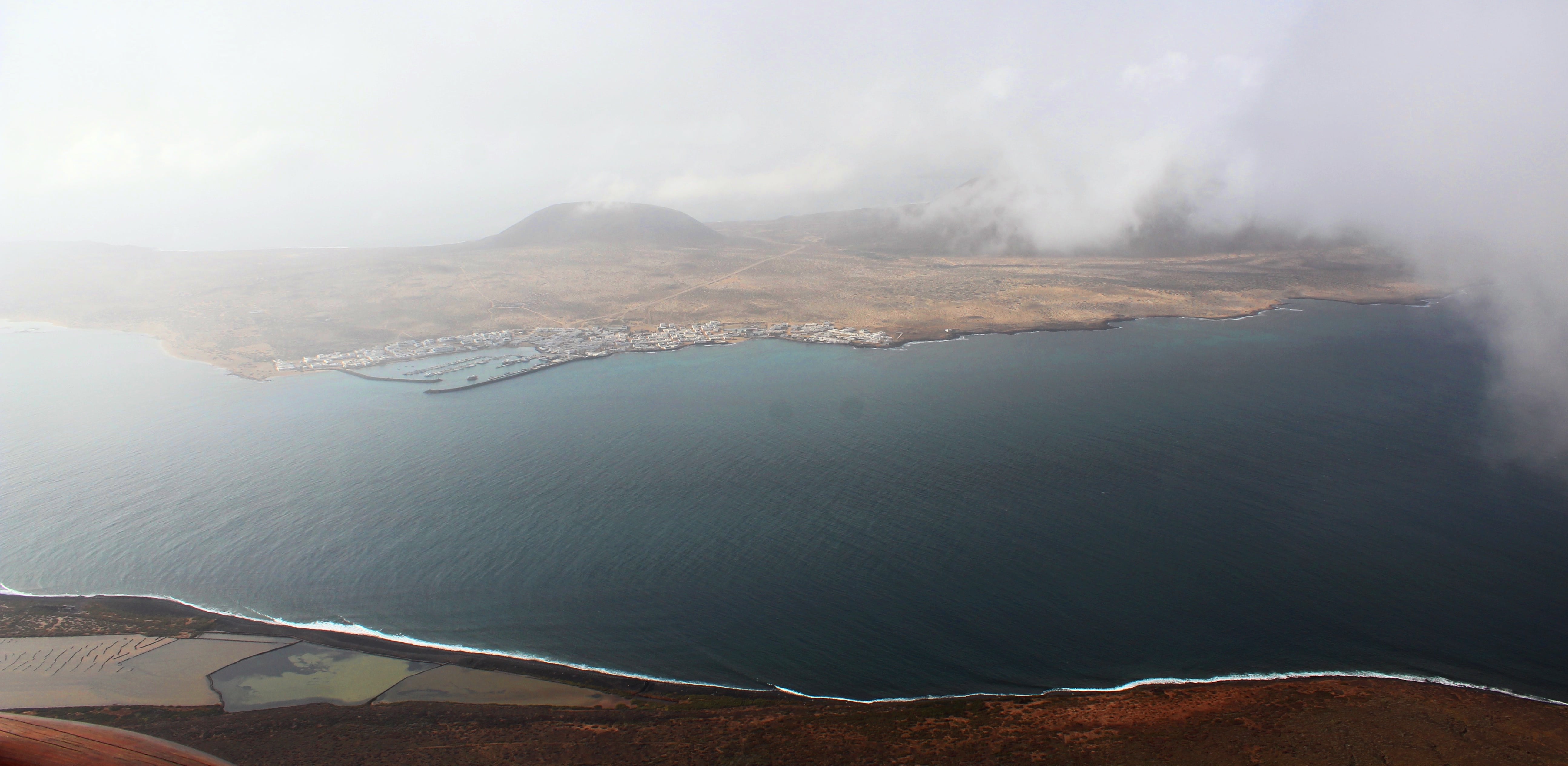
Unfortunately, the ticket vendor was right: it was a foggy day. Normally one should be able to see the neighboring island, La Graciosa, and the narrow channel of water between them (called el río, or “the river”). But this sight could only be snatched at intermittently, when gusts of wind blew the insistent fog away. It was impressive nonetheless. The overlaying mist, which smelt of moisture and ocean, lent a mysterious grandeur to the distant island, only visible in stolen moments. And, true to form, Manrique did a wonderful job in integrating the structure into its surroundings; even the gift shop did not seem out of place.

A glimpse of the famous view

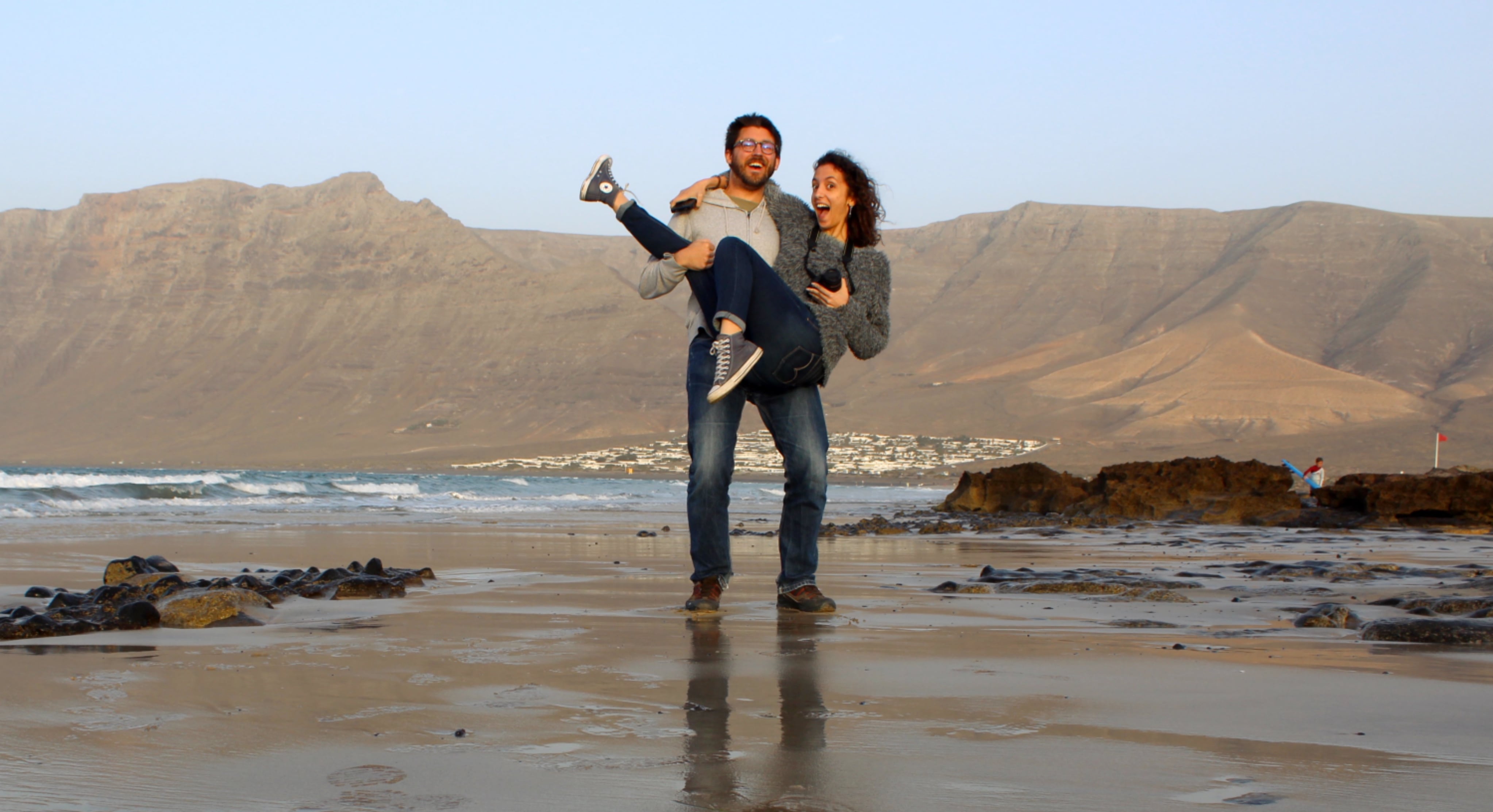
Daylight was waning; our time in Lanzarote was coming to an end. For a last stop we went to the nearby Famara Beach, one of the island’s best-known beaches. The sand stretches for miles, and the cliffs of Famara make a picturesque backdrop to the coastline. However, the current was strong and the wind was cold, so there was not a soul in the water. Volcanic rocks were scattered amidst the sand, trapping pools of water here and there. Very carefully, I placed my camera on one of these rocks and set the timer. We had to have at least one photo together on the trip. 

After our fill of salt and sand, we got back into the car to go home. But we decided to make a quick stop to the nearby pueblo of Teguise on the way back. It is certainly one of the more charming villages on the island, with several historic church buildings, old cobblestone streets, and a view of the beach below. In the pale blue light of the dusk, the white buildings had an almost ghostly glow. Here, again, was that spare beauty of the desert, which I had quickly come to cherish. 

The next morning we dropped off the car, boarded the plane, and returned to Madrid. (I should mention that we used PlusCar once again and it was just as cheap and convenient as before.) Just as in Tenerife, I wished that I could have spent more time on the island—far more. Both of the islands were pleasant in the extreme: friendly people, fresh food, temperate weather, and intoxicating natural beauty. I envy the people who live there.

Review: Maxims

Review: Maxims
Maxims

Maxims by François de La Rochefoucauld

My rating: 4 of 5 stars

We do not like to praise, and we never praise without a motive.

François Duc de La Rochefoucauld was something of a bungler in life. The scion of a great house, the beneficiary of a princely education, the young nobleman got himself mixed up in all sort of plots and intrigues, eventually getting himself locked in the Bastille and later banished to his estate. As a result of this rather undistinguished career in the world, he developed into a man-of-letters, achieving far more success on the page than in the palace.

La Rochefoucauld made a permanent contribution to literature with his Maximes: a collection of cutting aphorisms on the vanity of human nature. His perspective is cynical: seeing bad motives behind even the best actions. Or in his opening words: “Our virtues are most frequently but vices disguised.” And I do not think that one must be a defeated aristocrat in order to see the truth in many of his pronouncements. Here he is his describing me:

One of the reasons that we find so few persons rational and agreeable in conversation is there is hardly a person who does not think more of what he wants to say than of his answer to what is said. The most clever and polite content themselves with only seeming attentive while we perceive in their mind and eyes that at the very time they are wandering from what is said and desire to return to what they want to say.
This also certainly applies to me: “How is it that our memory is good enough to retain the least triviality that happens to us, and yet not good enough to recollect how often we have told it to the same person?” But do not think that I am somehow superior for admitting to these shortcomings; for “We own to small faults to persuade others that we have not great ones.” And do not attempt to compliment me: “The refusal of praise is only the wish to be praised twice.” There is no way out.

I often found myself laughing at these aphorisms. So many of them ring true to my experience. And they represent a perspective too rarely expressed in daily life. Selfless action is a deeply appealing concept; and many people wish fervently to believe in it. Yet it is an incontestable fact that most of what we do, even apparently altruistic actions, benefits ourselves in one way or another.

Politicians fight to pass legislation to benefit their constituents, who then return the politician to power; businessmen give their employees a raise, who thus work harder and take less vacation; a friend picks me up from the airport, but he expects me to do something for him in the future; a man returns a wallet he found on the street, is given a reward, and then is lauded on social media. And of course, altruism towards one’s family is the easiest thing to explain this way, since the family is just an extension of the self—psychologically and genetically.

Some may find this way of thinking gloomy and unproductive. But I do think it is important to keep in mind our tendency to act out of self-interest; for, in my experience, it is those who are most attached to the idea of selfless action who most often treat other people badly. It is a dangerous thing to think that virtue is on your side. And, personally, I find it a great relief to see myself as an ordinary animal rather than a moral machine. Self-knowledge requires knowledge of our less honorable motives; and pretending otherwise can lead to a kind of self-alienation: “We become so accustomed to disguise ourselves to others that at last we are disguised to ourselves.”

But this dark view of human nature must be tempered in two respects. First, not even La Rochefoucauld thought that all actions were driven by vice. He thinks true virtue is rare, but that it does exist. Second, La Rouchefoucauld often points out that our vices prompt us to act more virtuously than virtue ever could: “The praise bestowed upon us is at least useful in rooting us in the practice of virtue.” Or, elsewhere: “Interest which is accused of all our misdeeds often should be praised for our good deeds.” After all, the actions I described above are all virtuous actions.

And this, for me, is the key insight of La Rochefoucauld’s cynicism: seeing our self-interest, not as inherently bad, but as a kind of neutral force which can be channeled for good or for evil. This insight alone could prevent a lot of needless guilt. More importantly, once we accept this premise, we can more easily shape our lives and societies. For we have discovered the secret of living together: finding arrangement in which self-interest overlaps.

View all my reviews

Canary Islands: Tenerife

Canary Islands: Tenerife

I spent the entire plane ride in a panic. The sleep deprivation didn’t help. As usual, I had bought tickets for an early flight in order to save money; and, as often happens, I was too nervous to sleep well the night before. Several seats in front of me, Rebe was contentedly snoozing. I tried putting my hood down over my eyes and drifting off; but every time the plane dipped or turned, I was jolted awake. The art of sleeping on airplanes still escapes me. 

Our destination was Tenerife, the largest of the Canary Islands. This is a group of volcanic islands off the Western coast of Morocco. Including Tenerife, there are seven main islands in the archipelago, along with many minor ones. These islands have been controlled by Spain since the late middle ages. They were conquered as a kind of prelude to the colonization of the New World—during which they were used as a jumping off point to cross the Atlantic.

Before the Europeans came to establish themselves, the islands were populated by indigenous peoples known as Guanches, who had originally came from Northern Africa. Their culture was either totally destroyed or absorbed by the invading Spaniards, so that nowadays only slight traces remain, along with tantalizing archaeological evidence. Today the islands are a kind of offshore European vacation spot.

Considering that I was heading to a tropical island with my girlfriend, it would be logical to assume that I was in a good mood. I was miserable—gripped by anxiety. You see, the Canary Islands are unlike peninsular Spain in at least one crucial respect: the lack of public transportation. You simply must rent a car. Luckily, in my experience car rental prices in the Canary Islands are often very low. Unfortunately, however, I was not very good at driving.

Having grown up with good public transit, I had spent my entire life without serious need of driving. Consequently, I got my license quite late: at the age of 21. And even then, I rarely used it. Moving to Madrid—a place extremely well-connected by trains, buses, and subways—did nothing to remedy the situation. Indeed, I had driven so rarely since getting my license that, before taking this trip to Tenerife, I had probably gone less than 100 miles in total—a few dozen miles a year, here or there.

What is more, I had never driven without the company of a more experienced driver. Rebe certainly did not fall under this category. She did not have her license; she had barely even touched a steering wheel. In short, she would not be any help. I was on my own.

When we arrived at the airport, I insisted on taking a few minutes to have a coffee and relax. But it was no use. As I stared down into the milky brown of the coffee, I felt sure that this was to be the last coffee I would ever taste. My mind flooded with images of gruesome crashes—a head-on collision, careening off a cliff, spinning out of control. This was it: the end. 

Finally it was time to go down to the parking garage and pick up the car. We found the desk and got in line. Behind us a loud bachelorette party also got in line—the women occasionally chanting and singing. I hardly noticed them, however, as I shuffled towards my doom. I was shivering and covered in a cold sweat. Then—suddenly—I felt a sharp pressure in my abdomen.

“I have to go,” I said to Rebe, and ran back upstairs—to the bathroom. Strong anxiety tends to upset my bowels.

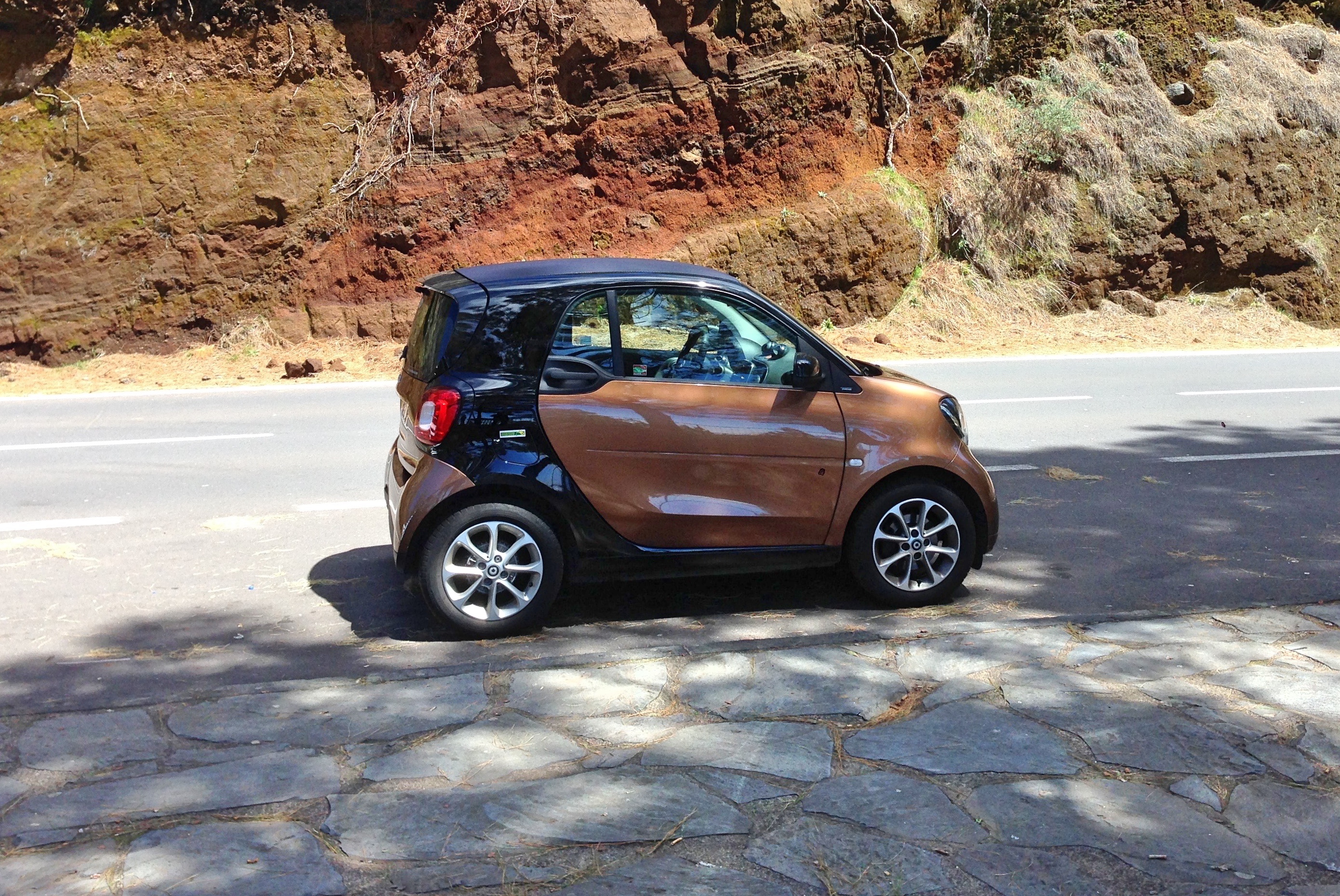
Ten minutes or so later, I re-entered the line. Now it was our turn to do the paperwork. I could hardly pay attention to the man’s explanation. As I signed the paper, I felt as though I were signing the order for my own execution. We walked out to the car—a Smart car, tiny and cute. Do these things have good crash safety ratings?

Failure confronted us immediately.

“How do you open this thing?” I said, trying to get the back door opened.

“Wait,” Rebe said, and tried herself to find the handle—also with no luck. 

In shame, I had to ask the rental car guy to open it for us. Not a good omen.

We got in. I adjusted the seat. I adjusted the mirrors. I checked and rechecked my seatbelt. I turned on the car and braced myself. My head pounded, my vision narrowed, my veins felt like they were flooded with fire. And despite doing my best to not let any of this show, my voice quivered when I said:

“Ok, ready?”

The car was ignited and put into drive. Very gingerly, I pressed the gas. Nothing happened. I pressed a bit harder; still nothing.

“What’s going on?” I said. “The car isn’t moving. Why won’t it move?”

“The emergency brake is on,” Rebe informed me.

“Oh, shit.” Another bad omen.

I switch off the brake, and the car begins to move. All of my senses are focused on the vehicle. I try to remember my training—rules of the road, blind spots, when to signal. After a couple spins around the parking lot it is time to get to our Airbnb.

“Ok, what do I do?”

Rebe turns on the GPS and lets the automated voice do the rest. Soon I am merging onto the highway. Nothing difficult so far. None of the cars are going particularly fast. I just have to follow the road for a dozen kilometers or so until we reach our exit. Meanwhile, every slight adjustment of the car provokes a crisis of indecision in me. What is the proper distance to maintain? Should I pass? What is the safest way to pass? What’s the speed limit anyway? Is that guy too close? Am I going too slow?
Finally our exit appears. After negotiating a roundabout, we are speeding down the center of a Santa Úrsula, a small town on the northern shore of the island.

“The Airbnb is right over there,” Rebe says.

“So should I park?”

“Yes.”

“But where? Where?”

“Anywhere.”

“Jesus.”

We drive about a mile down the street before I manage to pull off the road and into a parking spot. By now, I am totally shaken.

Luckily, the Airbnb calmed me down. I had splurged and gotten us an entire apartment. It was magnificent—a kitchen, a couch, a television, and a balcony with a view of the ocean. Perhaps this vacation in a tropical paradise wouldn’t be so bad after all.


The big division in Tenerife is between the northern and southern shores. From what I hear, the south shore—full of golden beaches and massive resorts—caters mainly to foreigners, while Spaniards tend to prefer the northern shore. No lover of sunbathing or swimming in the ocean, I figured that I would stick to the north.

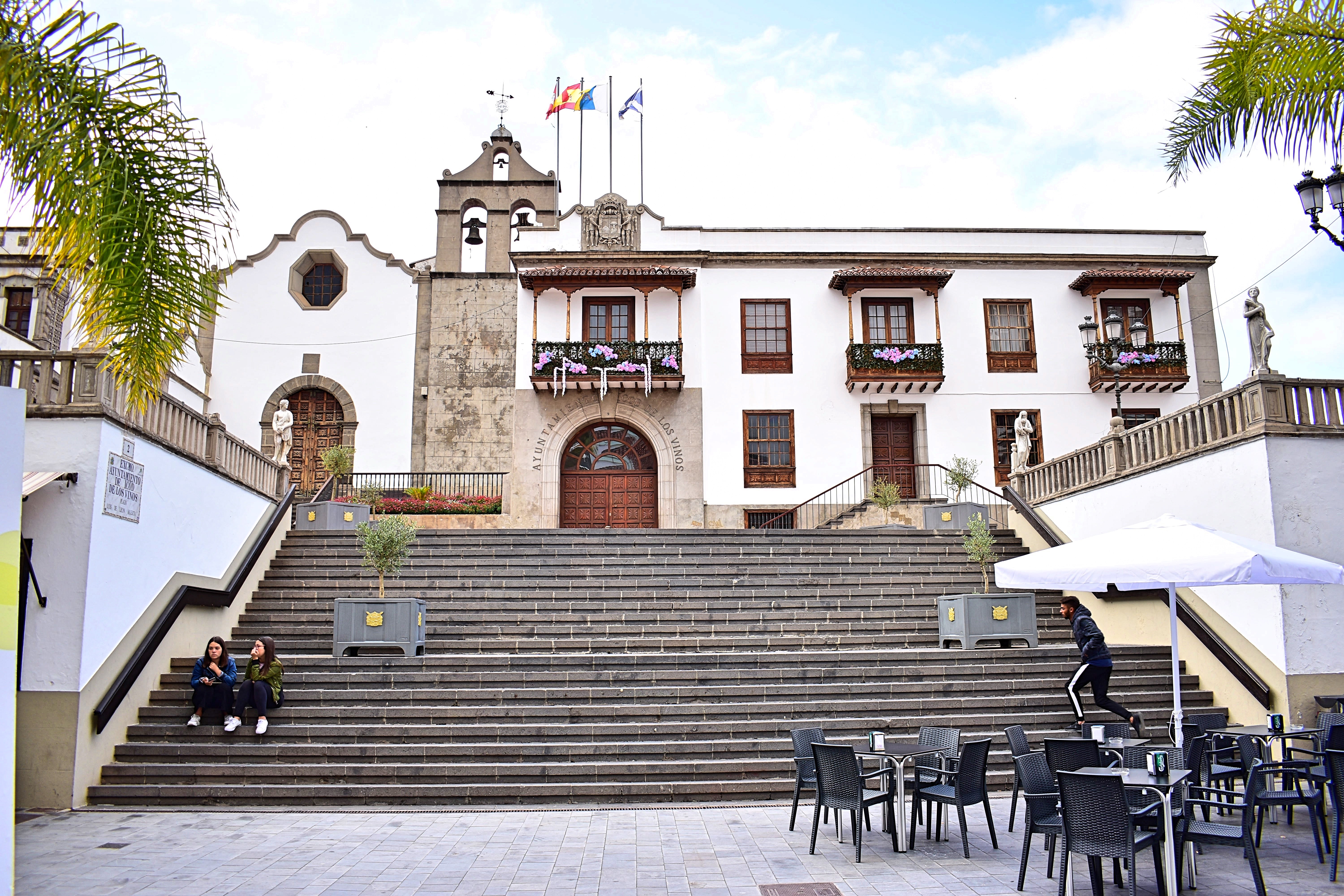
Our first stop was a little town called Icod de los Vinos. We arrived at lunch time. Still very uncertain about my driving, I parked in the first available spot I could find. It just so happened that this spot was very far away from both the restaurant and the city center.

“Are you serious?” Rebe said. “We have to walk half an hour?”

“Listen, I can’t drive anymore right now.”

“Ugh.”

In retrospect, it is absurd that I was so shaken up. The driving could not have been easier. Hardly anybody speeds, and nobody drives aggressively. And if I had not been frantically monitoring the road, I would have noticed that it was a beautiful day. Unsurprisingly, Tenerife looks nothing like Madrid. Far from the arid climate and sandy soil of Spain’s capital, Tenerife looks properly tropical—filled lush greenery, with the ocean rarely out of sight.
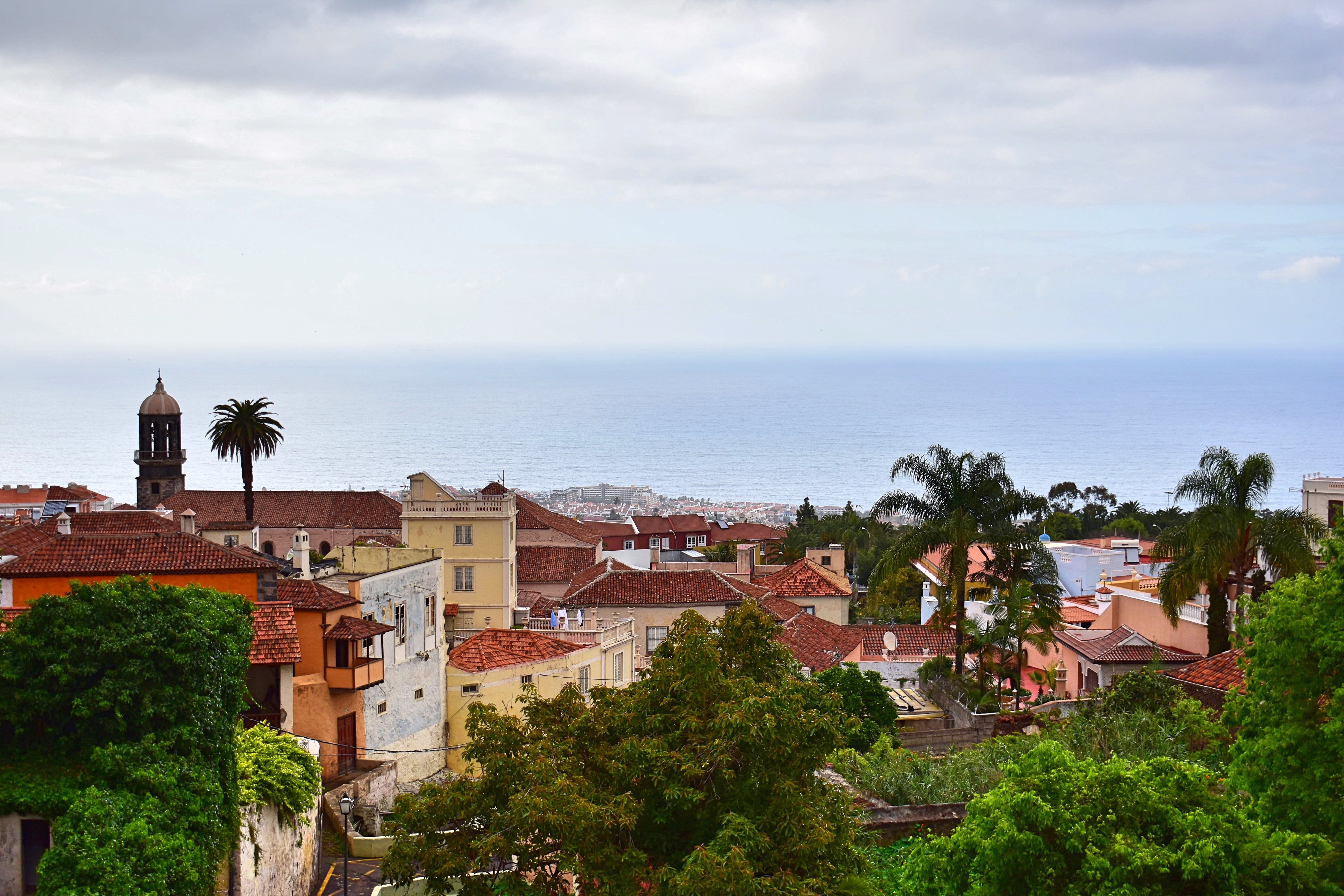
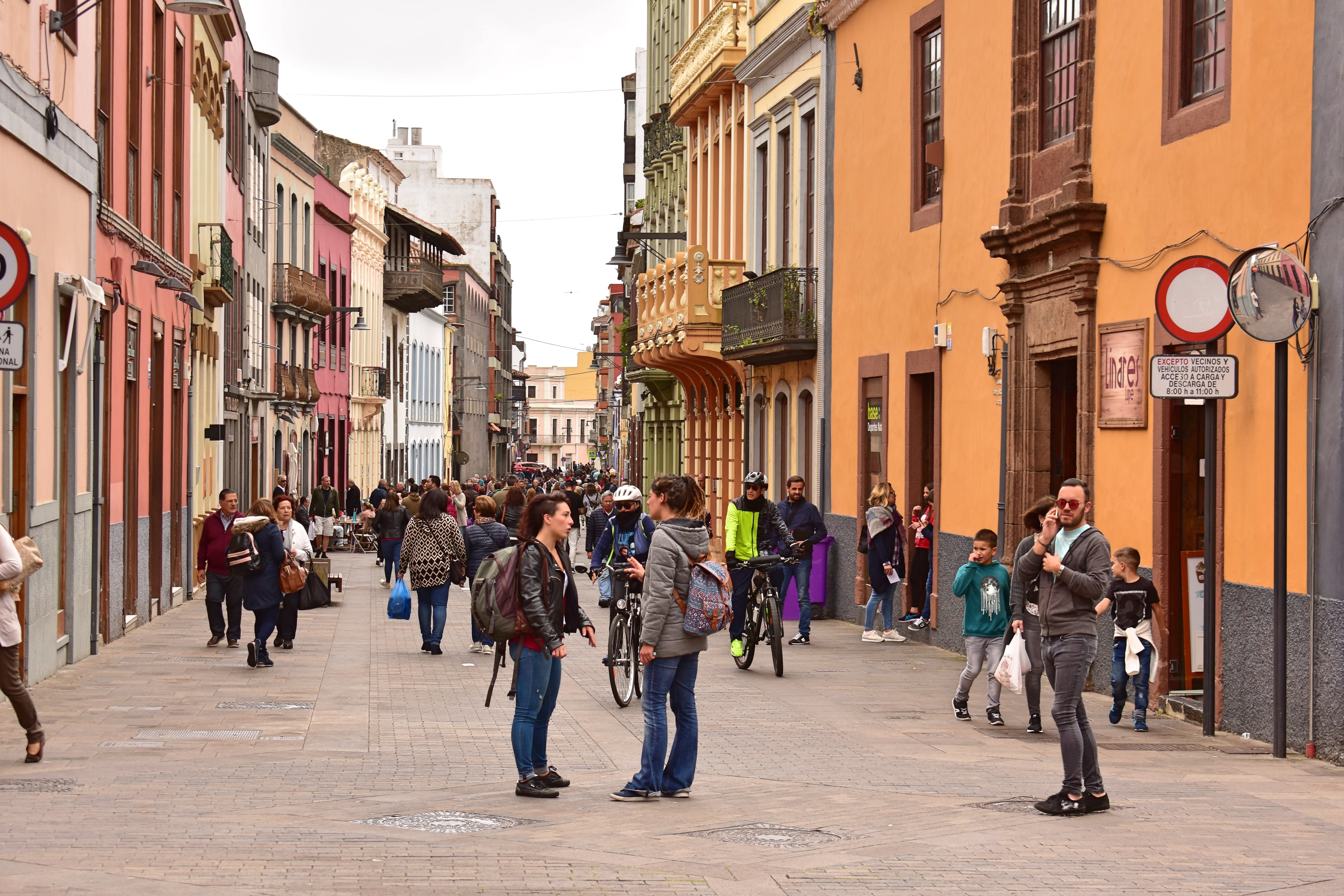
I was happy because I was out of the car. Now it was Rebe’s turn to suffer, since she doesn’t like to walk. The way to the restaurant took us up a sizable hill. At the top we had an excellent view of the town—spread out on the slope, with patches of fields (presumably for wine) interspersed between the houses—not that Rebe was in the mood to appreciate it.

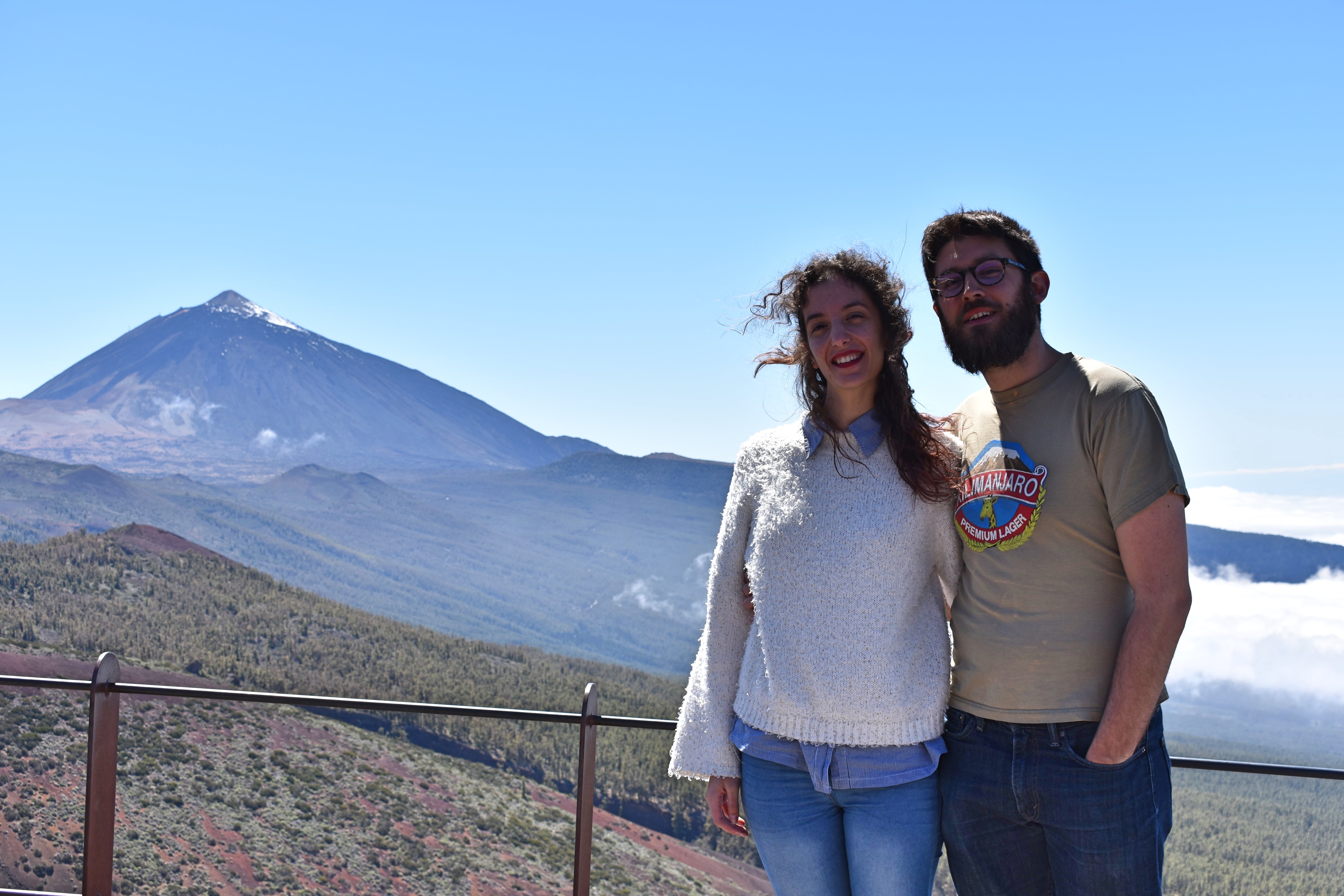
Photo by Rebeca López. She brought her fancy new Nikon D3400. This was, as it happens, the longest my beard has ever grown.

We went to a restaurant called (if memory serves) El Frenazo, which specializes in grilled meat. This is quite common in the Canary Islands, though I don’t know where they keep all the livestock. We ordered a parrillada—which is a huge platter of meat. When it arrived, we were stunned—it was an absurd amount of food, with sausages, chicken, panceta, pork chops, ribs, as well as salad and french fries. We ate as much as we could and then saved the rest for dinner.

Photo by Rebeca López

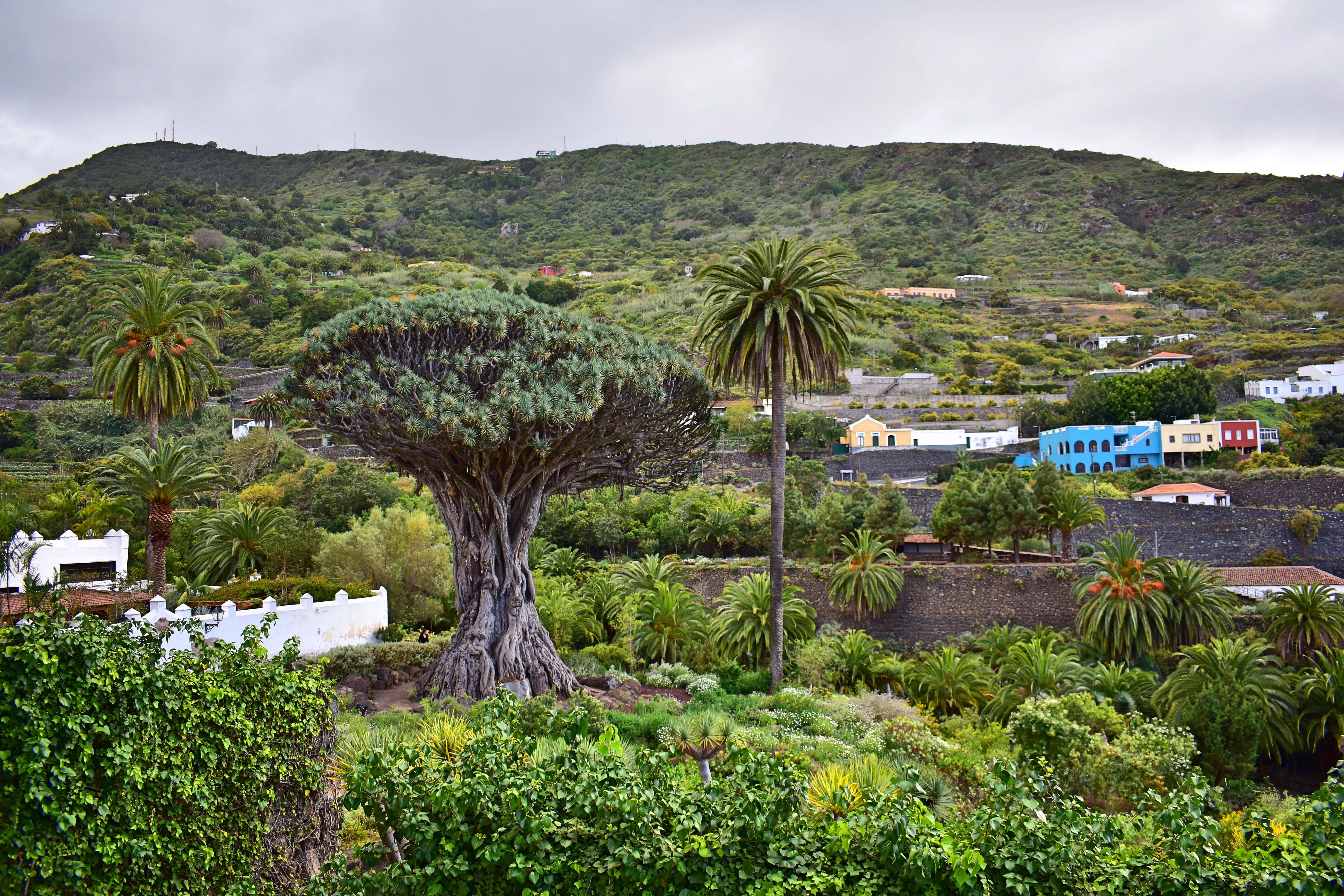
Icod de los Vinos is most famous for the Drago Milenario. This is a massive dragon tree that is supposedly one thousand years old (though nobody knows for sure), which has become one of the most recognizable symbols of Tenerife. Dragon trees, a species native to the Canary Islands, are typically small, even bush-like. This specimen, however, rises to the height of a proper tree. It is a beautiful sight: with the single, massive trunk splitting into a tangle of knotty branches.

The famous Drago Milenario. Photo by Rebeca López
Rebe with a halo of palm tree.

The old center of the town is charming, too. There is a certain architectural style typical of Canary villages: squat buildings of whitewashed granite lining plazas filled with palm trees. It is a strange combination of Latin America and medieval Europe. The local accent furthers this impression. Canarian Spanish is unmistakably different from that of the Peninsula. To me it sounds like the Spanish from Andalusia—clipped, shorn of endings, slurred together—but with a kind of jolly lilt that sounds Caribbean to my ears. I find it very pleasant, even if it is sometimes difficult to understand.

Photo by Rebeca López.

After a very long walk to the car (complicated by me not remembering exactly where it was) we were ready to see more of the island. Though I was still nervous while driving, the island’s beauty began to work on me. Every turn on the highway revealed another impressive view. Unfortunately, I could not properly enjoy these views, since my eyes were frantically fixed on the road. Rebe, meanwhile, sat in the passenger’s seat, blissfully ignorant of my mental state, taking photos through the window with her nice camera.

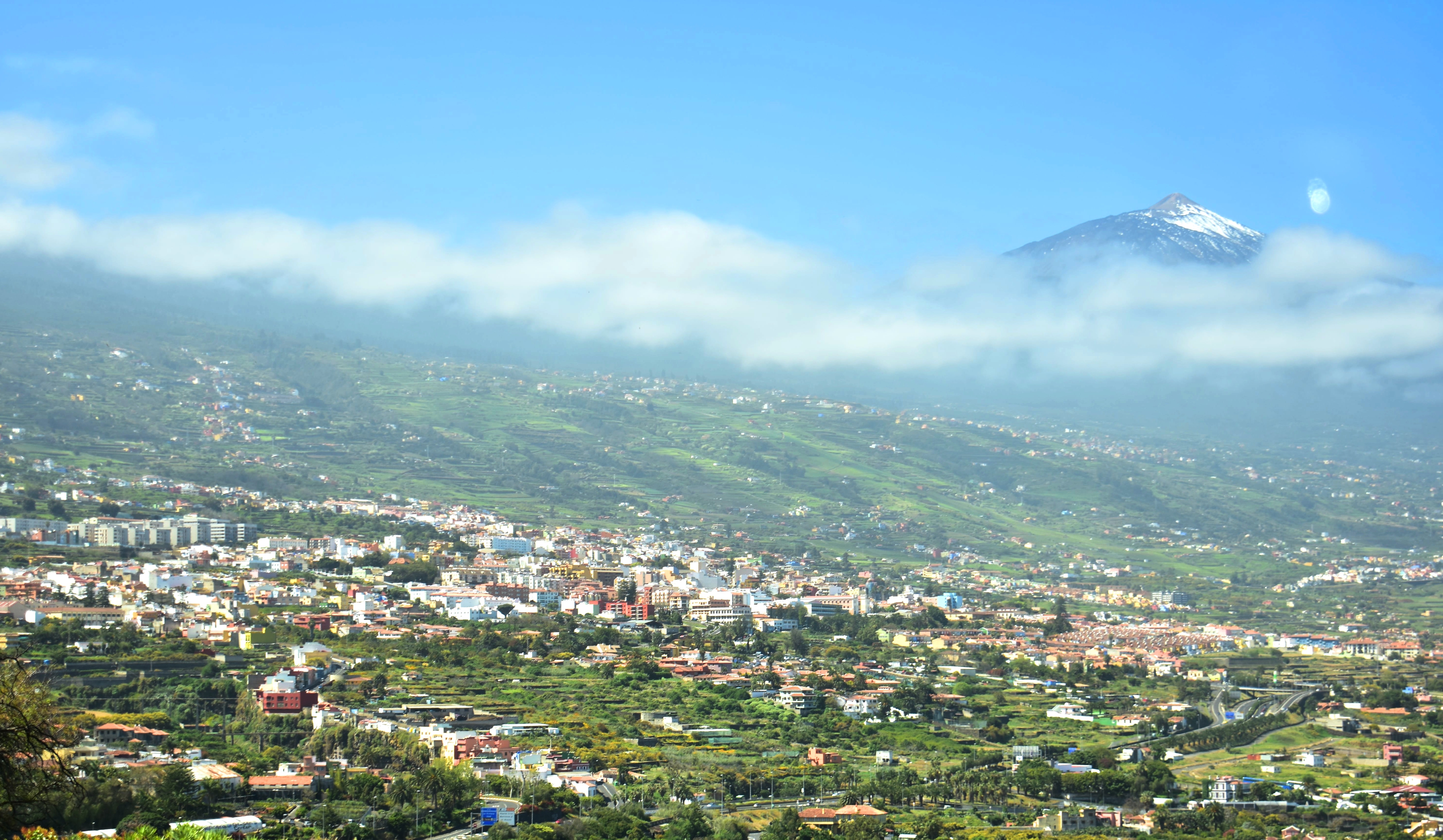
The Orotava Valley, with Teide in the distance. Photo by Rebeca López.

In half an hour we arrived at our next destination: La Orotava. This is a medium-sized town known for its well-preserved historical center. But anyone who has lived in Europe knows that driving in beautiful historical centers is seldom a quaint experience. The twisting, narrow, and steep streets made my already elevated blood pressure spike up to concerning heights.

“Where do I park? Where do I park?”

“I dunno, somewhere around here,” Rebe said.

On impulse, I turned down a nearby street. But a pedestrian immediately started waving at me and, in a moment, I realized that I was going the wrong way down a one-way street. Luckily, a parking space was miraculously available nearby, so I avoided a head-on collision (even though it took me about seven attempts to double park my tiny Smart car).

The center of La Orotava vaguely reminded me of Toledo, both for its antique layout and for its sharp changes in elevation. The town sits splayed out on a steep hillside, making it the most uneven municipality in Spain. As in any historical Spanish town, there are many churches to see. The most noteworthy is the Church of the Holy Conception—a looming structure whose wide façade rises into a series of gentle curves. From the inside the visitor can tell that it is a properly historical edifice, with elaborately carved altars, columns, and pulpits. It is no wonder that the locals affectionately call it a basilica and a cathedral, though it is neither of the two. 

A section of the Church of the Holy Conception. Photo by Rebeca López.

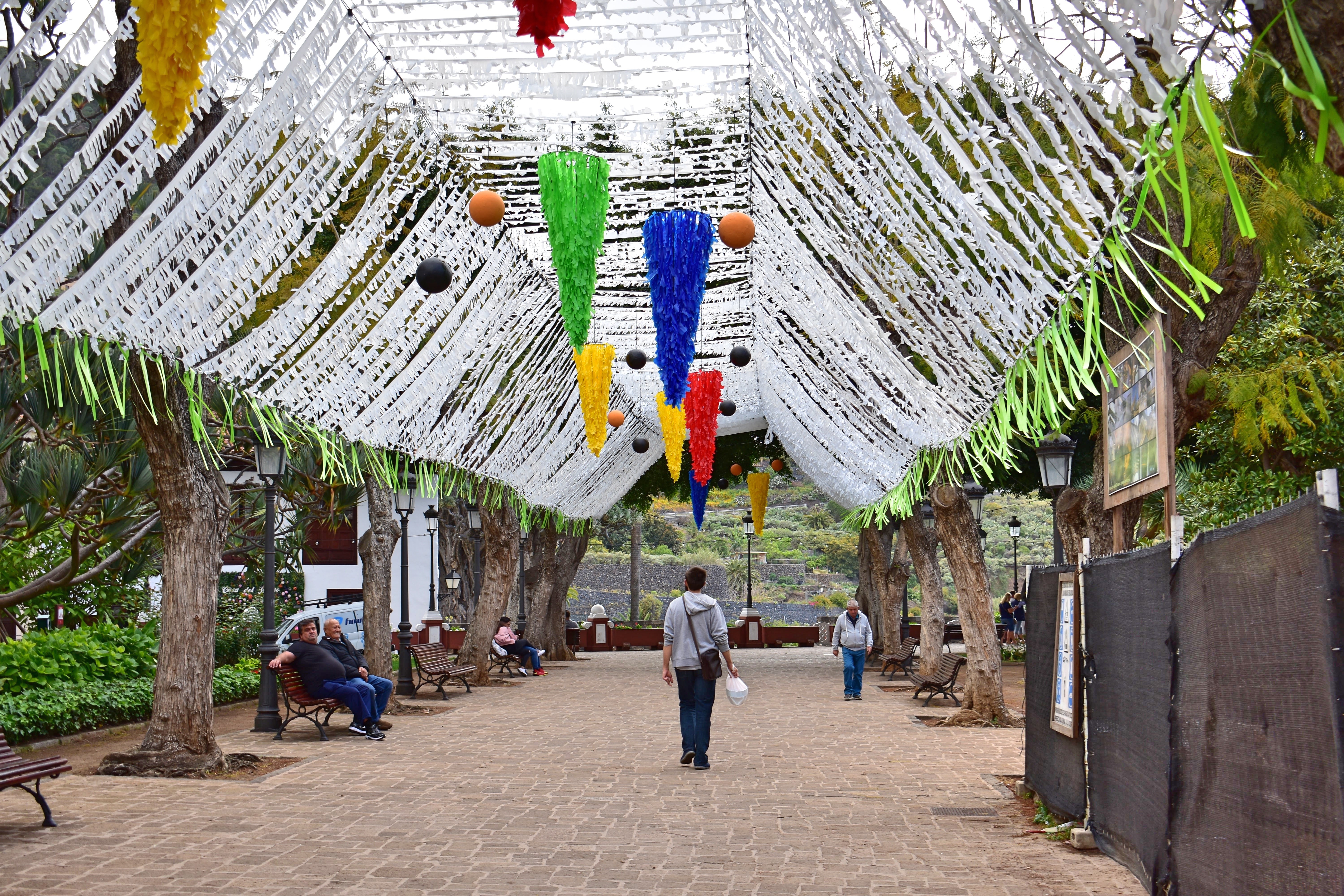
Yet my usual strategy of hunting down historical buildings was inappropriate to visiting Canarian towns. It is far more pleasurable to simply stroll about, admiring the many beautiful angles that opened up into the dramatic ocean beyond—palm trees, church spires, and tiled roofs foregrounding the blue-grey mist of the atlantic.

However, the sun was already on its way towards the horizon; and I was nervous about driving at night. So we went back to the apartment, eating the remainder of our massive meat platter for dinner. The next day was our only full day in Tenerife. We had to make it count.

Photo by Rebeca López

Our first stop after breakfast was Tenerife’s most historically significant city: San Cristóbal de la Laguna (usually just called La Laguna). The city was designated a UNESCO World Heritage site in 1999 for being an excellently preserved example of a Spanish colonial city. Indeed, La Laguna was a model city for many of the major Spanish colonial capitals that followed—such as Havana.

The city is located on relatively flat ground, far from the shore. The wide streets are arranged in a grid-like pattern—not strict, as in New York, but still orderly and logical. This is strikingly different from most other historical Spanish cities. Also striking is the city’s complete lack of defensive structures. A wall has never enclosed the historical city center—probably because, after overwhelming the natives, there were few conceivable enemies to defend the city from. As a result La Laguna has a pleasingly open atmosphere.

Photo by Rebeca López

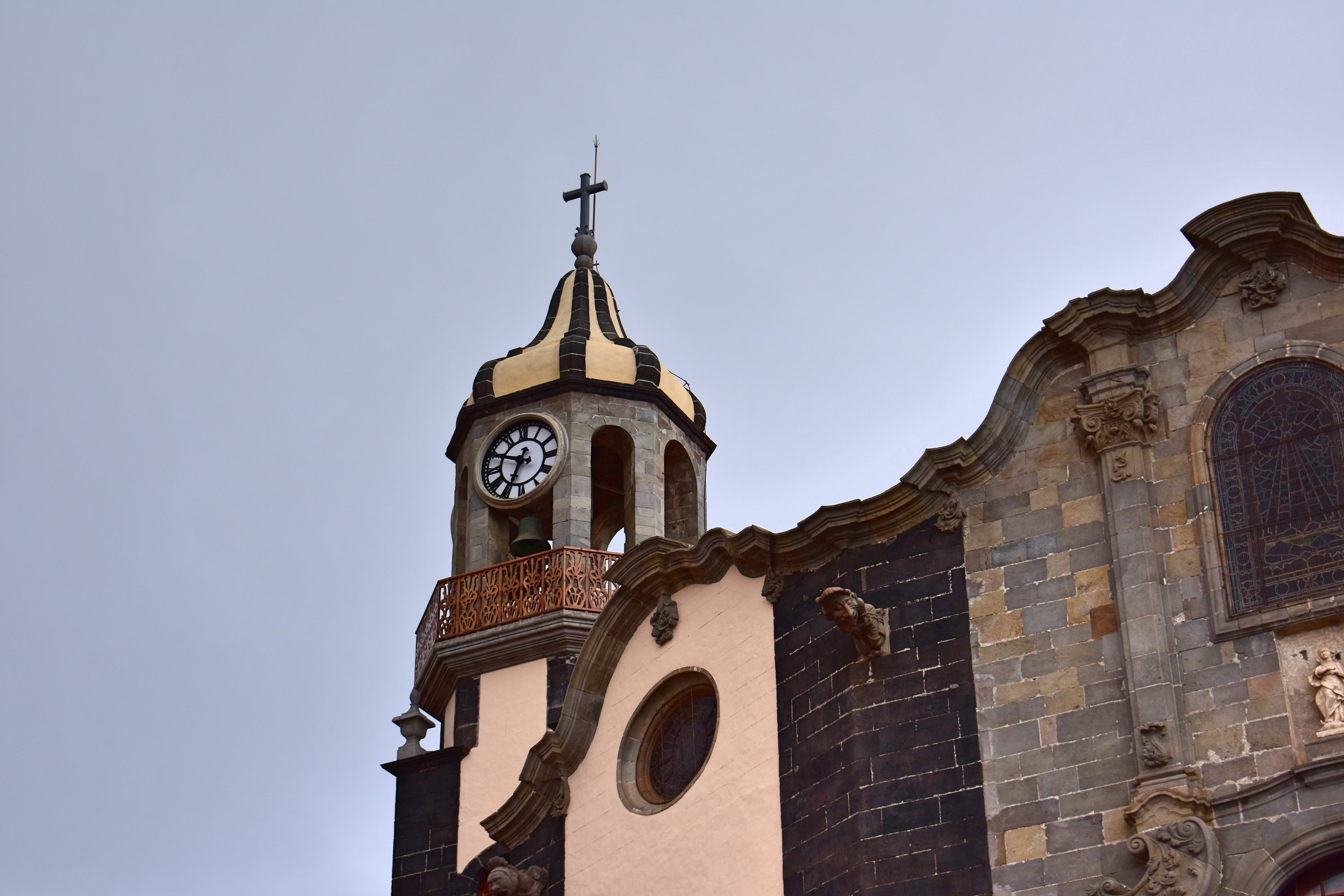
After a stroll through the town—full of locals, tourists, clothing shops, and restaurants—we peeked into the city’s cathedral. It is a rather recent construction, built in the early 1900s. Like Madrid’s cathedral, it is a stylistic mismatch: neoclassic on the outside and neogothic within. Still, it is a pleasing space: open, balanced, well-lit, and filled with altars, statues, and floats used in processionals. The Royal Sanctuary is a far more ancient house of worship, having been built in the 16th century, which houses a famous devotional figure of Christ (thus the name). The most beautiful work of religious architecture in the city is the bell tower of the Church of the Immaculate Conception (the first parish to be established in Tenerife), built in 1511.

Rebe found a wall that she thought was a good background.

Yet the best of the visit was the street life. We ate an early lunch in a kebab place and listened to a couple of street performers do a decent rendition of some blues classics.

But we did not have long to dawdle. Today was the day that we ascended the volcano: Teide. We had to leave ourselves enough time to properly savor the experience. I had a concern, though. Friends had told me that it was very cold at the top of the volcano, and I hadn’t brought anything warmer than a light sweatshirt. When I told Rebe this, she made me even more concerned.

“Do you want to get to the top and be freezing? It’s not even warm down here.”

She was right. It was a surprisingly mild day for a tropical island. I figured that it was better to be safe than sorry, so we walked into a nearby sportswear store, where I bought a thermal t-shirt.

“I hope this is enough,” I said at checkout.

We got back in the car and, after several unsuccessful attempts, we navigated out of the town and towards the mountain. A Canarian friend of mine had suggested the route up the towns of La Esperanza and Las Rosas (basically from east to west), and it was an excellent recommendation. The road took us through bucolic countryside, with tree-shaded roads crossing grassy fields. Rebe put her camera on the dashboard and took photo after photo, while I stole sidelong glances at the scenery.

Photo by Rebeca López

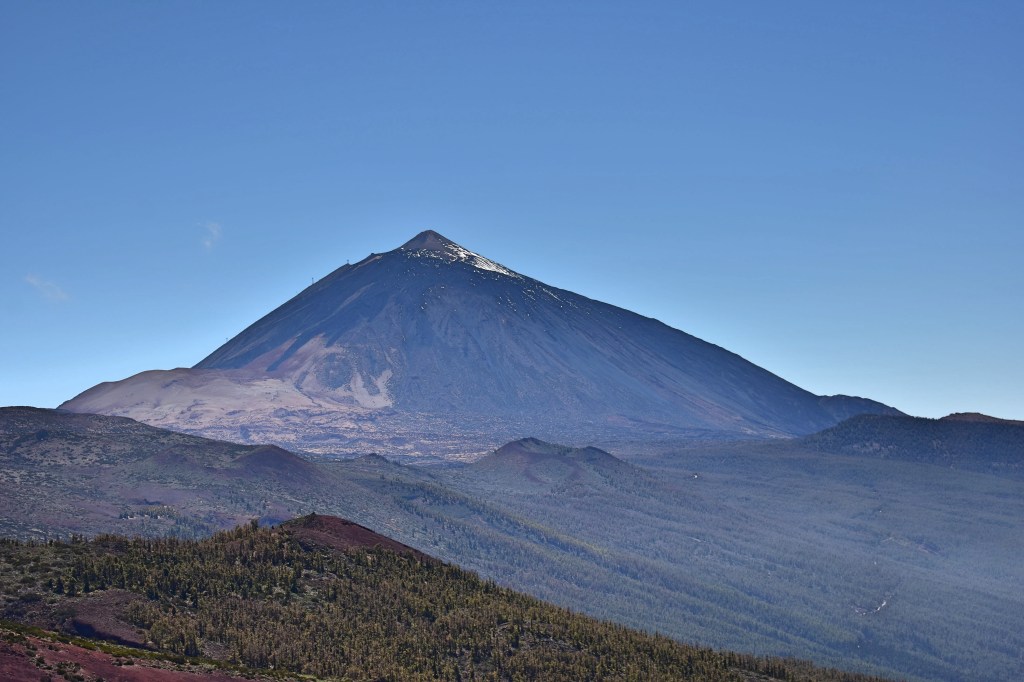
The road up was long. Teide is simply massive: rising over 3,700 m (or over 12,000 ft) above sea level. The volcano is at the historical, cultural, and geological heart of the island. Most obviously, it is evidence of the cataclismic volcanic eruptions that formed the island to begin with. But the volcano has taken on additional significance.

The peak was worshiped by the indigenous Guanches as a god who held up the heavens. And I admit that I, too, am willing to worship the massive hunk of volcanic rock, if my pleas can postpone any further eruptions. One wonders what would happen to the island’s one million inhabitants if the long-dormant volcano should re-awaken. 

The German scientist and explorer, Alexander von Humboldt—a pioneer in the study of how altitude affects the distribution of life—climbed the mountain on his way to South America. And the volcano is featured on Tenerife’s coat of arms. Nowadays Teide is the most-visited natural site in all of Spain—and, indeed, all of Europe.

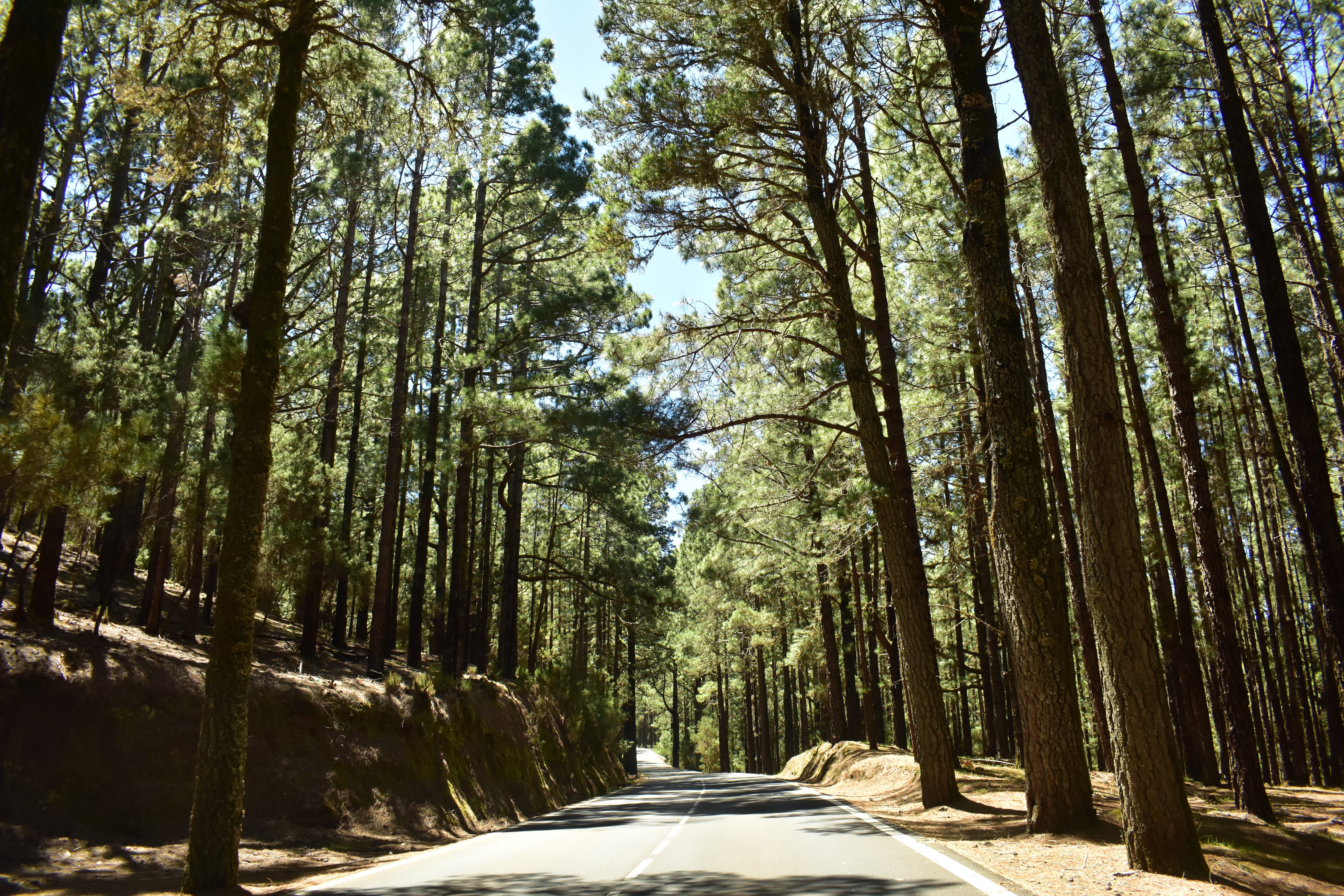
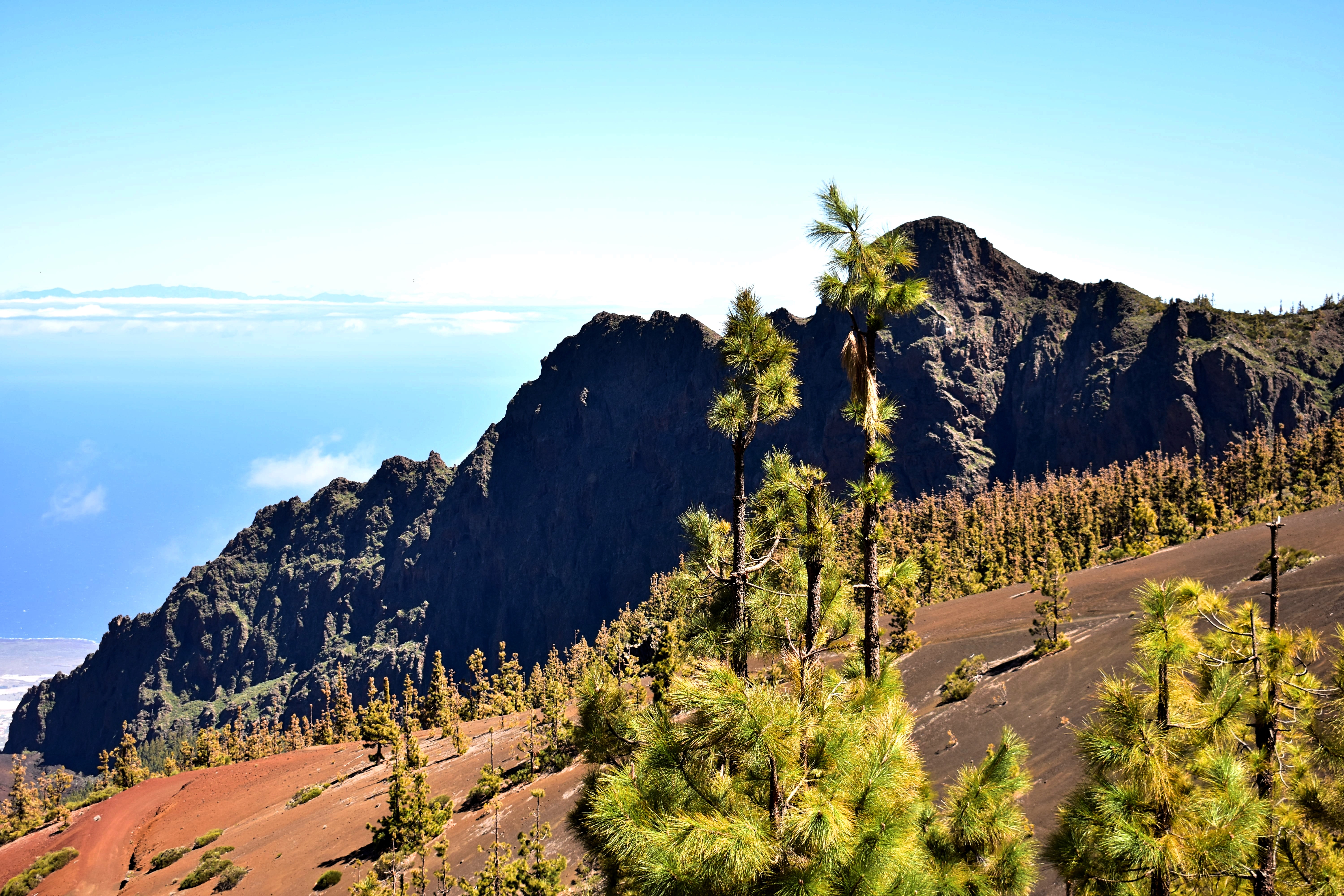
As we approached and then entered the national park, the environment gradually changed. The trees shifted from deciduous to evergreen, and the fields were replaced by dense forest. The road led up and up, on a seemingly endless gradual ascent, gently turning as it went. Soon we were passing little stopping-points by the side of the road, each one offering a progressively better view of the island.

Photo by Rebeca López

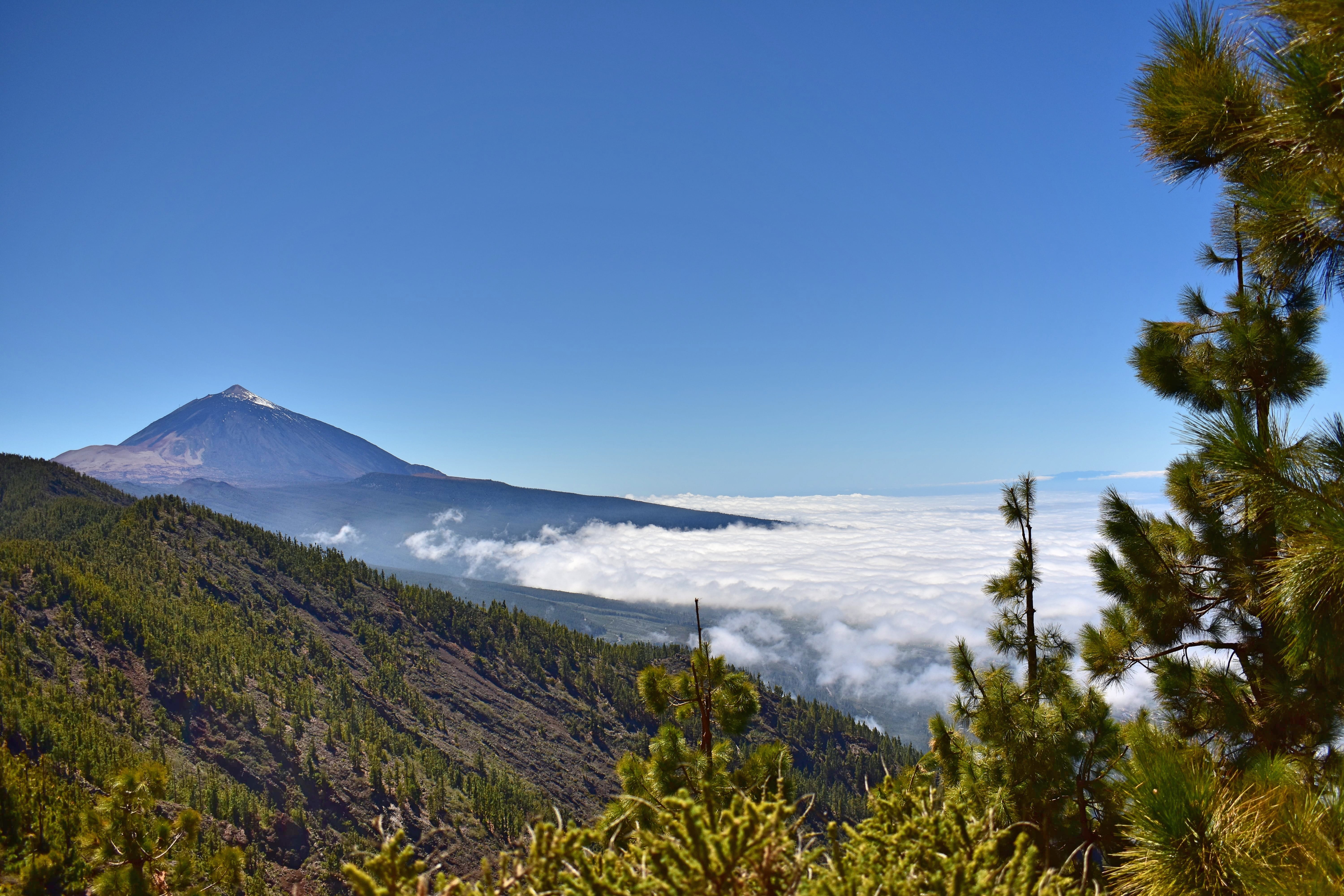
In less than an hour we were above the clouds. It was beautiful. A sea of white drifted in from the ocean, bathing the base of the mountain in mist. I was astonished at how high we were. The road up had not been very steep, but already the coastline below was swallowed into the far distance. And we were not even halfway to the top!

Now, I am very inexperienced with mountains; indeed, the only one that I have climbed is Peñalara, near Madrid. But I would guess that there are few eminences which give such dramatic views of their surroundings. Teide may not be the biggest; but it is surrounded by clear air and open sea; so the full extent of its height can be easily appreciated.

The peak. Photo by Rebeca López

A few signs were set up at the resting points, explaining some of the geological history of the islands. According to them, the valleys below—such as La Orotava and Icod de los Vinos—had been formed in the space of a moment, by massive landslides breaking off from a larger volcanic structure. A sign also had information about the coronal forest, and the conservation efforts to restore it after damage inflicted by severe windstorms. 

Gradually the forest shrank and all but disappeared, leaving a barren landscape, reminiscent of Mars. Now driving became truly nerve-racking. The road kept snaking left and right, with a sharp drop off at least one side at any time. If somehow I lost control, no trees would have broken the fall. We would have tumbled a long, long way. I kept my eyes glued to the road, doing my best to keep the car within the lines as we turned this way and that. Meanwhile, Rebe sat contentedly snapping pictures and oohing and aahing at the natural beauty.

Photo by Rebeca López

Eventually we came to a rest stop. We had been driving for well over an hour already, and we were only halfway up. To actually reach the top, you must take the funicular, which is called the “teleférico.” But the price for non-residents is 27€, and that seemed too steep for us. (After reading a biography of Alexander von Humboldt, who famously ascended to the peak, I slightly regret my stinginess. Maybe next time.) Instead, we decided to have a coffee and then head back towards the north shore.

We sat outside, eating syrupy torrijas (the Spanish version of French toast) and sipping café con leche and hot chocolate. And I noticed something: it was considerably warmer than it was back down in La Laguna. My thermal T-shirt was not necessary after all.

If we had continued our ascent, we could have seen the Teide Observatory. This is an important array of telescopes that have been set up because of the island’s favorable astronomical seeing conditions. (Apparently, across the earth there is a good deal of variation in the degree to which atmosphere blurs stars and planets.) Brian May, the lead guitarist of Queen, did his PhD research on interplanetary dust here. Thus, from Humboldt to the present day, Teide has maintained a scientific significance.

The road down was just as winding and perilous as the road up. But it was shorter. In just half an hour we were in our next destination: Puerto de la Cruz.

This place was one of the first tourist centers on the island. Alexander von Humboldt himself stayed here during his visit to the island. It remains a place of hotels and resorts—tall white buildings huddled around the beach. The city itself is, thus, not especially noteworthy (though there are many good places to eat and drink). What draws attention is the beach of black, volcanic sand right in the center.

Photo by Rebeca López

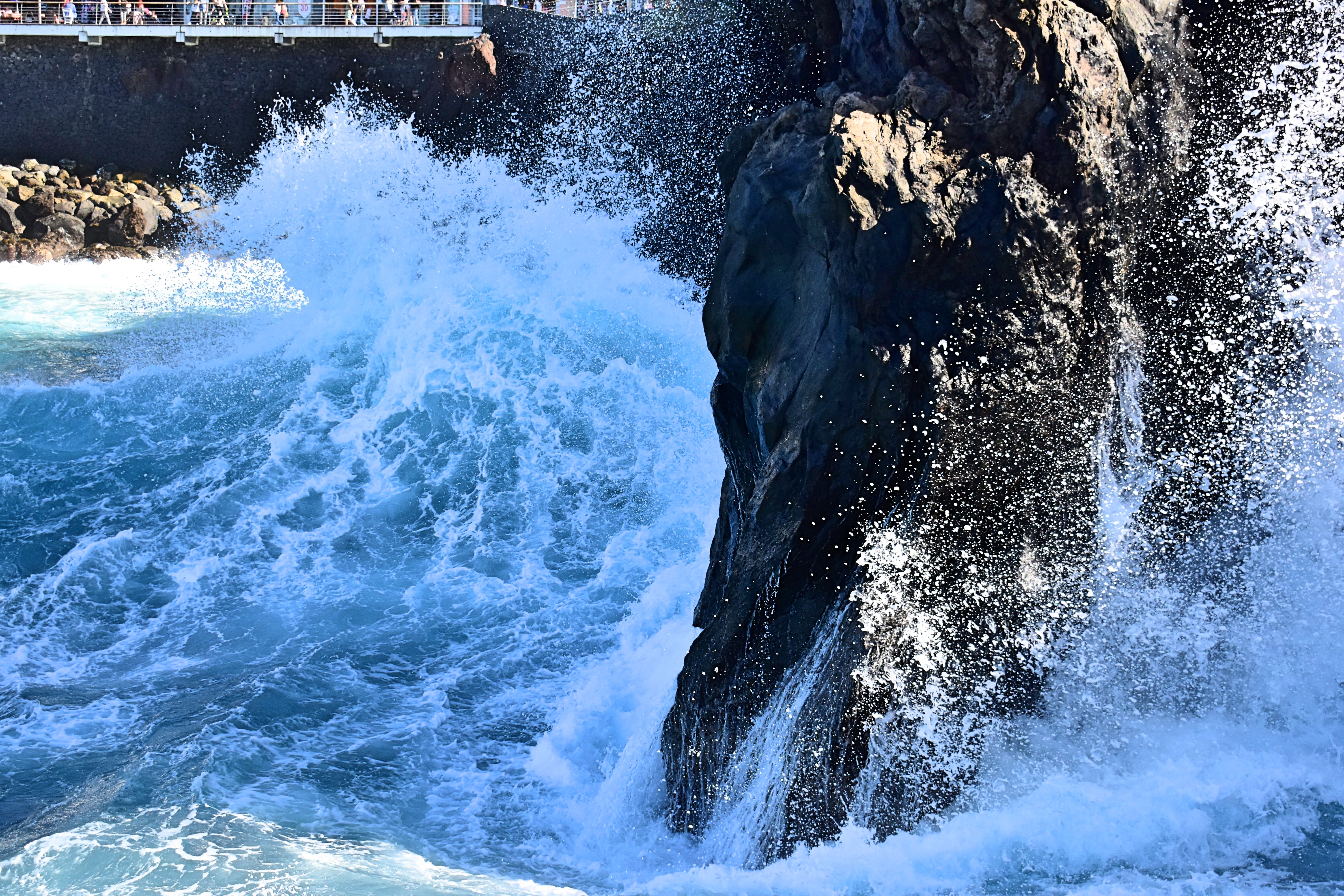
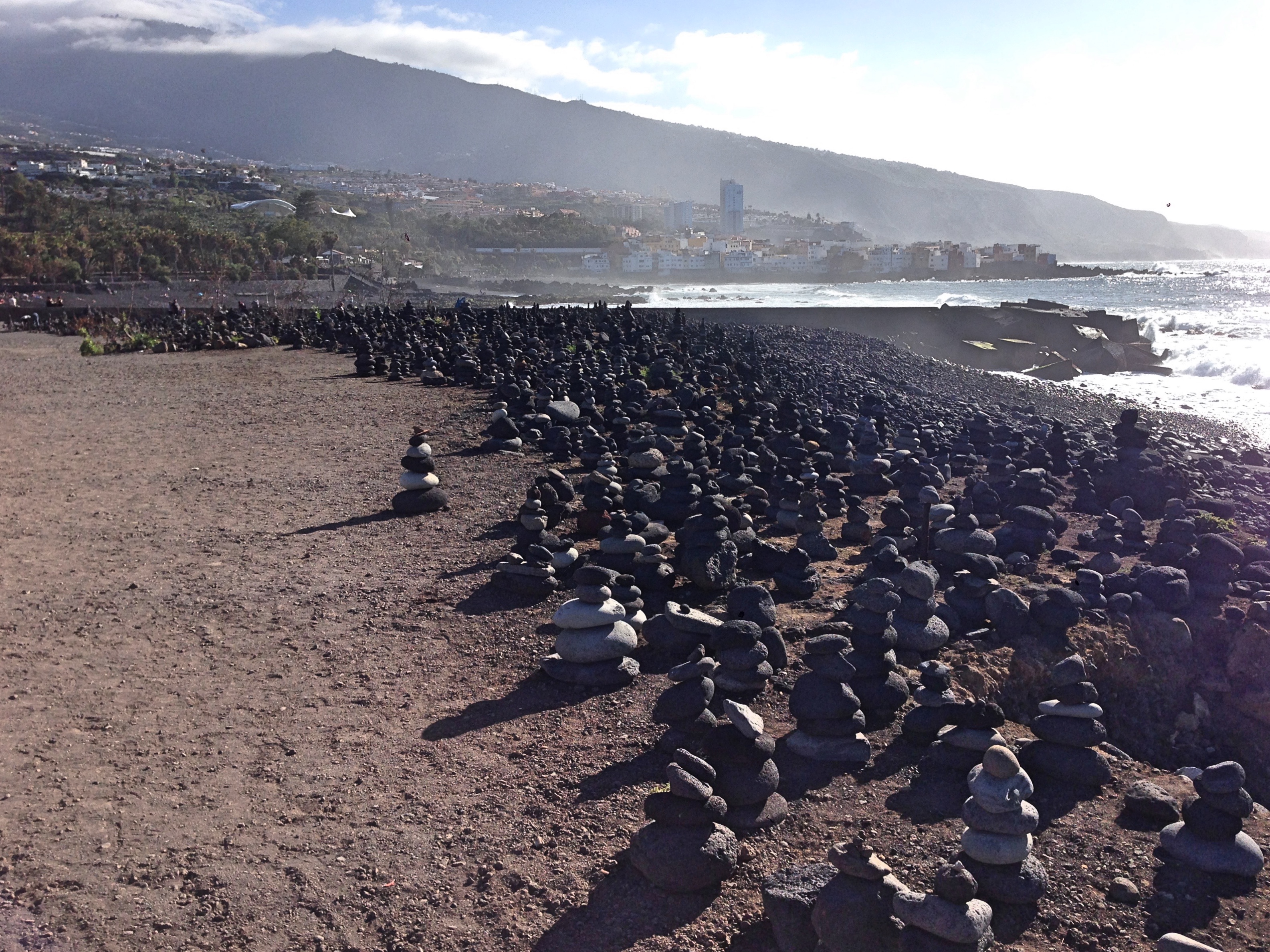
We stood for some time admiring the jagged black rock that forms the surrounding coastline. The rich blue of the waters turned a creamy white as it churned and frothed in the waves, battering against the shore and jettisoning into foamy sprays. Rebe spent about ten minutes trying to photograph it. Then, we headed towards the beach. On the way we encountered a strange sort of monument: thousands of little piles of black stones. A lot of man-hours had been spent in making this natural stone garden. It is a local tradition?

The beach was beyond. For a Saturday evening, it was not too crowded. The weather was not quite hot enough for sunbathing or swimming—at least, I thought so. However, it was beautiful. I had never seen a black sand beach before. The sand was courser than normal sand, with a smoother texture. I imagine it gets very, very hot in the summer months. Exhausted, I sat down on the beach while Rebe walked along the water. Her figure was silhouetted in the intense yellow reflection of sunlight on the waves. If I had had a good camera, it would have made an excellent photograph. 

We hung out on the beach, had a drink (well, Rebe did), and went back to the apartment. Our short time in Tenerife was almost spent. We spent the night drinking a bottle of the local wine, which was surprisingly good. I suppose the mild climate and the volcanic soil are well-suited for viticulture.

The view from our apartment. Photo by Rebeca López.

The next morning we drove to the airport. But there was a problem. The whole time we had been driving, there had been yellow warning light in the dashboard, saying “neumático presión.” I panicked when I first saw it, of course, since I assumed that this had something to do with our suspension. But when I asked the rental car agent, he said it was no problem. It had stayed yellow the entire weekend. But on Sunday morning, as we prepared to return to the airport, it turned a bright red and said “urgente.”

At this point I asked Rebe what “neumático” meant.

“You don’t know?” she said, alarmed.

“I’m not sure…”

“It means tires,” she said.

“Seriously?” I said. “Oh, shit.”

Now, to reiterate, I did not know the first thing about car maintenance. I still don’t. So I was at a loss. I had Rebe call the rental car company, who told us to take it to a gas station and use the free tire pressure gauge. We did. It took us about ten minutes to figure out how to use the machine; we must have looked like two bumbling idiots. When we checked, we found that one tire had considerably less pressure than the rest. With five minutes of pumping, balance was restored, and the warning light turned off. Soon the car was returned to the airport parking lot, and my adventure in automobiling had come to a close. 

I should mention that the car rental experience in Tenerife was excellent. I used PlusCar, and I would recommend them to any who wish to travel to the Canary Islands. The price was cheap and included insurance. The company also had a surprisingly relaxed attitude. There was little paperwork, no deposit, no threats of being held responsible for damages, and no attempt to sell us anything extra. And when we returned the car, we just left the keys under the dashboard and walked away. If only renting a car were always like that.

My last image of Tenerife was magnificent. The plane began to accelerate down the runway, taking off and ascending away from the ground. In five minutes the windows were covered with the white of clouds. Moments later, as we broke through the layer of mist, I looked out to see Teide, with its crown breaking through the sea of fog. I could hardly believe it: the peak was still above us! This was the first time I had looked up at the ground from a plane window.

I wish that I had spent more time in Tenerife. It was one of my best trips in Europe. The landscape is beautiful, the people are charming, the food is delicious—and, best of all, the price is reasonable. I would go back.

Despite my constant terror, I also relished the experience of having a car. The prospect of car ownership has never had much appeal to me. But renting a car made me understand: a car means freedom. True, it also means having to take care of the car, as I also learned. Still, I loved the feeling of being able to go wherever I pleased, whenever I pleased. And it is always a relief to conquer one’s fears. I had driven, and I had survived—something I never thought possible. 

Of course, it was also very nice to be able to travel with Rebe. It was our first vacation together, and we managed not to kill each other. It turns out that spending a weekend on a tropical island with your girlfriend is, indeed, as enjoyable as it sounds.

Review: Pascal’s Pensées

Review: Pascal’s Pensées

Pensées by Blaise Pascal

My rating: 4 of 5 stars

Pascal seems to have been born for greatness. At a young age he displayed an intense talent for mathematics, apparently deducing a few propositions of Euclid by himself; and he matured into one of the great mathematical minds of Europe, making fundamental contributions to the science of probability. While he was at it, he invented an adding machine: the beginning of our adventures in computing.

Later on in his short life, after narrowly escaping a carriage accident, the young man had an intense conversion experience; and he devoted the rest of his energies to religion. A committed Jansenist (a sect of Catholics deeply influenced by Calvinism), he set out to defend his community from the hostile Jesuits. This resulted in his Provincial Letters, a series of polemical epistles now considered a model and a monument of French prose. This was not all. His most ambitious project was a massive apology for the Christian faith. But disease struck him down before he could bring his book to term; and now all we are left with are fragments—scattered bits of thought.

Strangely, it is this unfinished book—not his polished prose, not his contributions to mathematics—which has become Pascal’s most lasting work. It is a piece of extraordinary passion and riveting eloquence. Yet it is also disorganized, tortured, incomplete, uneven, abrupt—at times laconic to the point of inscrutability, at times rambling, diffuse, and obscure. How are we to judge such a book?

Pascal alternates between two fundamental moods in the text: the tortured doubter, and the zealous convert. Inevitably I found the former sections to be far more compelling. Pascal was an avid reader of Montaigne, and seems to have taken that French sage’s skepticism to heart. Yet Pascal could never simulate Montaigne’s easy acceptance of his own ignorance; the mathematician wanted certainty, and was driven to despair by Montaigne’s gnawing doubt. Thus, though Pascal often echoes Montaigne’s thoughts, the tone is completely different: anguish rather than acceptance.

Montaigne’s influence runs very deep in Pascal. Harold Bloom famously called the Pensées “a bad case indigestion in regard to Montaigne,” and notes the many passages of Pascal which directly echo Montaigne’s words. Will Durant goes even further, writing that Pascal was driven nearly to madness by Montaigne’s skepticism. There is, indeed, a shadow of mania and mental imbalance that falls over this work. Pascal gives the impression of one who is profoundly unhappy; and this despair both propels him to his heights and drags him to his depths.

At his best, Pascal strikes one as a kind of depressed charismatic genius, writing in the mood of a Hamlet. Cynicism at times overwhelms him, as he notes how our vanity leads us to choose our professions and our habits just to receive praise from other people. He can also be a pessimist—noting, like Schopenhauer, that all earthly pleasures are unsatisfactory and vain. Pascal had a morbid streak, too.

Imagine a number of men in chains, all under sentence of death, some of whom are each day butchered in the sight of the others; those remaining see their own condition in that of their fellows, and looking at each other with grief and despair await their turn. This is an image of the human condition.

We also have the misanthrope, in which mood he most nearly approached the Danish prince:

What sort of freak then is man! How novel, how monstrous, how chaotic, how paradoxical, how prodigious! Judge of all things, feeble earthworm, repository of truth, sink of doubt and error, glory and refuse of the universe!

But I think even more moving that these moods is Pascal’s metaphysical despair. He wants certainty with every inch of his soul, and yet the universe only inspires doubt and anguish: “The eternal silence of these infinite spaces fills me with dread.” As a scientist during the age of Galileo, Pascal is painfully aware of humanity’s smallness in relation to the vast void of the universe. He struggles to establish our dignity: “Man is only a reed, the weakest in nature, but he is a thinking reed.” Yet his existential desperation continually reasserts itself, no matter how often he defends himself against it:

This is what I see and what troubles me. I look around in every direction and all I see is darkness. Nature has nothing to offer me that does not give rise to doubt and anxiety. If I saw no sign there of a Divinity I should decide on a negative solution: if I saw signs of a Creator everywhere I should peacefully settle down in the faith.

He finds neither negative nor positive confirmation, however, and so must resort to a frenzied effort. Perhaps this is where the famous idea of the wager arose. Pascal’s Wager is simple: if you choose to be religious you have very much to gain and comparatively little to lose, so it is an intelligent bet. Of course there are many problems with this line of thinking. For one, would not an omniscient God know that you are choosing religion for calculated self-interest? Pascal’s solution is that, if you force yourself to undergo the rituals of religion—fasting, confession, mass, and the rest—the belief will gradually become genuine.

Perhaps. Yet there are many other problems with the wager. Most noticeable, nowadays, is Pascal’s treatment of the religious problem as a binary choice—belief or unbelief—whereas now we have hundreds of options to choose from as regards religions. Further, Pascal’s insistence that we have everything to gain and nothing to lose is difficult to accept. For we do have something to lose: our life. Living a strictly religious life is no easy thing, after all. Also, his insistence that the finite existence of our life is nothing compared to the potential infinity of heavenly life leaves out one crucial thing: If there is no afterlife, than our finite existence is infinitely more valuable than the nothingness that awaits. So the wager does not clarify anything.

In any case, it is unclear what use Pascal wished to make of his wager. The rest of this book does not make any mention of this kind of strategic belief. Indeed, at times Pascal seems to directly contradict this idea of an intellectually driven faith, particularly in his emphasis on the role of emotion: “It is the heart which perceives God and not the reason. That is what faith is: God perceived by the heart, not by the reason.” Or, more pithily: “The heart has its reasons of which the reason knows nothing.”

This, for me, summarizes the more enjoyable sections of the book. But there is a great deal to criticize. Many of the arguments that Pascal makes for belief are frankly bad. He notes, for example, that Christianity has been around since the beginning of the world—something that only a convinced young-earther could believe nowadays. There are many passages about the Jews, most of which are difficult to read. One of his most consistent themes is that God hardened the hearts of the Jews against Christ, in order that they be unwilling “witnesses” to future generations. But what kind of divine justice is it to sacrifice a whole people, intentionally blinding them to the truth?

Indeed, virtually every statement Pascal makes about other religions reveals both an ignorance and a hostility greatly unbecoming of the man. And his explanation of the existence of other religions, as a kind of specious temptation, is both absurd and disrespectful: “If God had permitted only one religion, it would have been too easily recognizable. But, if we look closely, it is easy to distinguish the true religion amidst all this confusion.”

I suppose this is one of the great paradoxes of any kind of religious faith: Why did God allow so many to go astray? But conceiving of other religions as snares deliberately placed by God seems extremely cruel on God’s part (as well as wholly dismissive of other faiths). In any case, it is just one example of Pascal’s pitiless piety. He himself warns of the danger of the moral sense armed with certainty: “We never do evil so fully and cheerfully as when we do it out of conscience.” And yet his own religious convictions can seem cruel, at least psychologically: dwelling obsessively on the need to hate oneself, and insisting that “I am culpable if I make anyone love me.”

Pascal also has a habit of dwelling on prophesy, repeatedly noting that the Old Testament prefigured the coming and the life of Jesus—which is clear if we interpret the text in the “right” way. Of course, this is open to the obvious objection that any text can predict anything if it is interpreted in the “right” way. Pascal’s response to this is that God is intentionally mysterious, and it would have been too obvious to have literally predicted Jesus and his works. The ability to see the prophesy differentiates those to whom God sheds light, and those whom God blinds. Once again, therefore, we have this strangely cruel conception of God, as a Being which arbitrarily prevents His creatures from seeing the truth.

As I think is clear from the frantic tone, and the many different and contradictory ways that Pascal tries to justify belief, he himself was not fully convinced by any of them. His final desperate intellectual move is to abandon the principle of logical consistency altogether. As he says: “A hundred contradictions might be true.” Or elsewhere he tells us: “All their principles are true, skeptics, stoics, atheists, etc. … but their conclusions are false, because the contrary principles are also true.” Yet if he had taken this idea seriously, he would have seen that it completely erodes the possibility of justifying any belief. All we have left is to go where the “heart” guides us; but what if my heart guides me towards Chinese ancestor worship?

Another reviewer on this site noted Pascal’s power to convince religious skeptics. But, as you can see, I found the opposite to be true. Pascal’s morbid unhappiness, his frantic doubt, his shoddy reasoning, do not inspire any wish to join him. To the contrary, one regrets that such a fine mind was driven to such a self-destructive fixation. Still, this book deserves its canonical status. Though at times nearly unreadable, in its finest passages the Pensées is as sublime as anything in literature. And, though Pascal falls short of Montaigne in many respects, he is able to capture the one element of experience forbidden to the benign essayist: an all-consuming despair.

View all my reviews

Review: Being and Nothingness

Review: Being and Nothingness
Being and Nothingness

Being and Nothingness by Jean-Paul Sartre

My rating: 3 of 5 stars

Slime is the agony of water.

I first heard of this book from my dad. “I had to read this in college,” he told me. “We looked at every type of being. Being-in-myself, being-for-myself, being-of-myself, being-across-myself, being-by-myself. I went crazy trying to read that thing.” Ever since that memorable description, this book has held a special allure for me. It has everything to attract a self-styled intellectual: a reputation for difficulty, a hefty bulk, a pompous title, and the imprimatur of a famous name. Clearly I had to read it.

Jean-Paul Sartre was the defining intellectual of his time, at least on the European continent. He did everything: writing novels and plays, founding and editing a journal, engaging in political activism, and pioneering a philosophical school: existentialism. This book is the defining monument of that school. An eight-hundred-page treatise on ontology which, somehow, became widely read—or at least widely talked about. Nearly eighty years later, we are still talking about this book. In 2016 Sarah Bakewell released a best-selling book about Sartre’s movement; and a new translation of Being and Nothingness will be released next year. Interest in existentialism has not abated.

Yet what is existentialism? And how has it weathered the passing years? This is what I set out to determine, and this review will show whether my attempt bore fruit.

One should begin by examining the subtitle of this book: “A Phenomenological Essay on Ontology.” Already we have a contradiction. Phenomenology is a philosophical school founded by Edmund Husserl, which attempted to direct philosophers’ attention back “to the things themselves”—that is, to their own experience of the world. One of Husserl’s most insistent commandments was that the philosopher should “bracket,” or set aside, the old Cartesian question of the reality of these experiences (is the world truly as I perceive it?); rather, the philosopher should simply examine the qualities of the experience itself. Thus, Sartre’s promise of a phenomenological ontology (ontology being the investigation of the fundamental nature of reality) is a flagrant violation of Husserl’s principles.

Still, it does have a lot to tell us about Sartre’s method. This book is an attempt to deduce the fundamental categories of being from everyday experience. And this attempt leads Sartre to the two most basic categories of all: being and nothingness. Being is all around us; it is manifest in every object we experience. Sartre defines existing objects as those which are self-identical—that is, objects which simply are what they are—and he dubs this type of being the “in-itself.” Humans, by contrast, cannot be so defined; they are constantly shifting, projecting themselves into an uncertain future. Rather than simply existing, they observe their own existence. Sartre calls this type of human existence the “for-itself.”

Already we see the old Cartesian dualism reappearing in these categories. Are we not confronted, once again, with the paradoxes of matter and mind? Not exactly. For Sartre does not consider the in-itself and the for-itself to be two different types of substances. In fact, the for-itself has no existence at all: it is a nothingness. To use Sartre’s expressions, human consciousness can be compared to “little pools of non-being that we encounter in the heart of being,” or elsewhere he says that the for-itself “is like a hole in being at the heart of Being.” The for-itself (a consciousness) is a particular privation of a specific in-itself (a human body), which functions as a nihilation that makes the world appear: for there would not be a “world” as we know it without perception, and perception is, for Sartre, a type of nihilation.

Putting aside all of the difficulties with this view, we can examine the consequences which Sartre draws from these two sorts of being. If the for-itself is a nothingness, then it is forever removed from the world around it. That is, it cannot be determined, either by its past or by its environment. In short, it is free—inescapably free. Human behavior can thus never be adequately explained or even excused, since all explanations or excuses presuppose that humans are not fundamentally self-determining. But of course we explain and excuse all the time. We point to economic class, occupation, culture, gender, race, sexuality, upbringing, genetic background, mood—to a thousand different factors in order to understand why people act the way they do.

This attempt to treat humans as things rather than free beings Sartre calls “bad faith.” This constitutes the fundamental sin of existentialism. He gives the example of a waiter who so embraces his role as a waiter that his motions become calculated and mechanical; the waiter tries to embody himself in his role to the extent that he gives up his individual freedom and becomes a kind of automaton whose every movement is predictable. But of course life is full of examples of bad faith. I excuse my mistake by saying I hadn’t had my coffee yet; my friend cheats on his girlfriend, but it was because his father cheated on his mother; and so on.

This is the basic situation of the for-itself. Yet there is another type of being which Sartre later introduces us to: the for-others. Sartre introduces this category with a characteristically vivid example: Imagine a peeping Tom is looking through a keyhole into a room. His attention is completely fixed on what he sees. Then, suddenly, he hears footsteps coming down the hall; and he immediately becomes aware of himself as a body, as a thing. Sartre considers experiences like this to prove that we cannot doubt the existence of others, since being perceived by others totally changes how we experience ourselves.

This allows Sartre to launch into an analysis of human interaction, and particularly into love and sexuality. This analysis bears the obvious influence of Hegel’s famous Master-Slave dialectic, and it centers on the same sorts of paradoxes: the contradictory urges to subjugate and be subjugated, to be embodied and desired, to be free and to be freely chosen, and so on. However, Sartre’s best writing in this vein is not to be found here, but in his great play No Exit, where each character exhibits a particular type of bad faith. All three of the characters wish to be looked at in a particular way, yet each of them is stuck with others whose own particular sort of bad faith renders them unable to look in the “right” way.

Sartre concludes from all this that our most fervent desire, and the reason we so often slip into bad faith, is that we wish to be an impossible combination of the in-itself and the for-itself. We want to be the foundation of our own being, a perfect self-identical creature, and yet absolutely free. We want to become gods. But, for Sartre, this is self-contradictory: the in-itself and the for-itself can never coexist. Thus, the idea of God arises as a sort of wish-fulfillment; but God is impossible by definition. As a result, human life “is a useless passion”—a relentless striving to be something which cannot exist.

All this may be clearer if we avoid Sartre’s terminology and, instead, compare his philosophy to that of Buddhism (at least, the type of Western Buddhism I’m acquainted with). The mind is constantly searching for a sense of permanent identity. Though the mind is, by nature, groundless, we are uncomfortable with this; we want put ground under our feet. So we seek to identify ourselves with our jobs, our families, our marriages, our hobbies, our success, our money—with any external good that lets us forget that our consciousness is constantly shifting and flowing, and that our identities can never be absolutely determined. So far, Buddhism and Sartrean existentialism have similar diagnoses of our problems. But Buddhism prescribes detachment, while Sartre prescribes the embrace of absolute freedom and the adoption of complete responsibility of our actions.

No summary of the book would be complete without Sartre’s critique of Freud. Sartre was clearly intrigued by Freud’s theories and wanted to use them in some way. However, Freud’s unconscious motivations and superconscious censorship is clearly incompatible with Sartre’s philosophy of freedom. In particular, Sartre found it self-contradictory to say that there could be a part of the mind which “wants” without us knowing it, or a part that is able to hide information from our awareness. For Sartre, all consciousness is self-consciousness, and it therefore does not make sense to “want” or “know” something unconsciously.

In place of Freud’s psychoanalysis, then, Sartre proposes an existential psychoanalysis. For Sartre, every person is defined by a sort of fundamental choice that determines their stance towards the world (though, strangely, it seems that most people are not aware of having made this choice). It is the task of the existential psychoanalyst is to uncover this fundamental choice by a close examination of everyday actions. Indeed, Sartre believes that everything from one’s preference for onions to one’s aversion to cold water is a consequence of this fundamental choice. Sartre even goes so far as to insist that some things, by virtue of being so clearly suggestive of metaphor, have a universal meaning for the for-itself. As an example of this, he gives “slime”—viscous liquid which Sartre thinks inspires a universal horror of the weight of existence.

This fairly well rounds out a summary of the book. So what are we to make of this?

The comparison with Heidegger is unavoidable. Sartre himself seems to have encouraged the comparison by giving his metaphysical tome a title redolent of the German professor’s magnum opus. The influence is clear: Sartre wrote Being and Nothingness after reading Being and Time during his brief imprisonment in a prisoner-of-war camp; and Heidegger is referenced throughout the book. Nevertheless, I think it would be inaccurate to describe Sartre as a follower of Heidegger, or his philosophy merely as an interpretation of Heidegger’s. Indeed, I think that the superficial similarities between the two thinkers (stylistic obscurity, disregard of religion and ethics, a focus on human experience, a concern with “being”) mask far more important differences.

Heidegger’s project, insofar as I understand it, is radically anti-Cartesian. He sought to replace the thinking and observing ego with the Dasein, a being thrown into the world, a being fundamentally ensconced in a community and surrounded by tools ready-to-hand. For Heidegger, the Cartesian perspective—of withdrawing from the world and deliberately reflecting and reasoning—is derivative of, and inferior to, this far more fundamental relationship to being. Sartre could not be further from this. Sartre’s perspective, to the contrary, is insistently Cartesian and subjectivist; it is the philosophy of a single mind urgently investigating its experience. Further, the concept of “freedom” plays almost no role in Heidegger’s philosophy; indeed, I believe he would criticize the very idea of free choice as enmeshed in the Cartesian framework he hoped to destroy.

In method, then, Sartre is far closer to Husserl—another professed Cartesian—than to Heidegger. However, as we observed above, Sartre breaks Husserl’s most fundamental tenet by using subjective experiences to investigate being; and this was done clearly under the influence of Heidegger. These two, along with Freud, and Hegel, constitute the major intellectual influences on Sartre.

It should be no surprise, then, that Sartre’s style often verges on the obscure. Many passages in this book are comparable in ugliness and density to those German masters of opacity (Freud excluded). Heidegger is the most obvious influence here: for Sartre, like Heidegger, enjoys using clunky hyphenated terms and repurposing quotidian words in order to give them a special meaning. There is an important difference, however. When I did decipher Sartre’s more difficult passages, I usually found that the inky murkiness was rather unnecessary.

Believe me when I say that I am no lover of Heidegger’s writing. Nevertheless, I think Heidegger’s tortured locutions are more justifiable than Sartre’s, for Heidegger was attempting to express something that is truly counter-intuitive, at least in the Western philosophical tradition; whereas Sartre’s philosophy, whatever novelties it possesses, is far more clearly in the mainline of Cartesian thinking. As a result, Sartre’s adventures in jargon come across as mere displays of pomp—a bejewelled robe he dons in order to appear more weighty—and, occasionally, as mere abuses of language, concealing simple points in false paradoxes.

This is a shame, for when Sartre wished he could be quite a powerful writer. And, indeed, the best sections of this book are when Sartre switches from his psuedo-Heideggerian tone to that of the French novelist. The most memorable passages in this book are Sartre’s illustrations of his theories: the aforementioned waiter, or the Peeping Tom, or the passage on skiing. Whatever merit Sartre had as a philosopher, he was undoubtedly a genius in capturing the intricacies of subjective experience—the turns of thought and twinges of emotion that rush through the mind in everyday situations.

But what are we to make of his system? To my mind, the most immediately objectionable aspect is his idea of nothingness. Nothing is just that—nothing: a complete lack of qualities, attributes, or activity of any kind. Indeed, if a nothingness can be defined at all, it must be via elimination: by excluding every existing thing. It seems incoherent, then, to say that the human mind is a nothingness, and is therefore condemned to be free. Consciousness has many definite qualities and, besides that, is constantly active and (in Sartre’s opinion at least) able to choose itself and change the world. How can a nothingness do that? And this is putting to the side the striking question of how the human brain can produce a complete absence of being. Maybe I am taking Sartre’s point too literally; but it is fair to say that he provides no account of how this nothingness came into being.

Once this idea of nothingness is called into question, the rest of Sartre’s conclusions are on extremely shaky ground. Sartre’s idea of freedom is especially suspect. If human consciousness is not separated from the world and from its past by a nothingness, then Sartre’s grand pronouncements of total freedom and total responsibility become dubious. To me it seems unlikely to the highest degree that, of all the known objects in the universe, including all of the animals (some of which are closely related to us), humans are the only things that are exempt from the chain of causality that binds everything together.

Besides finding it implausible, I also cannot help finding Sartre’s idea of total freedom and responsibility to be morally dubious. He himself, so far as I know, never managed to make his system compatible with a system of ethics. In any case, an emphasis on total responsibility can easily lead to a punitive mentality. According to Sartre, everyone deserves their fate.

Admittedly I do think his conception of “bad faith” is useful. Whether or not we are metaphysically “free,” we often have more power over a situation than we admit. Denying our responsibility can lead to inauthenticity and immorality. And Sartre’s embrace of freedom can be a healthy antidote to an apathetic despair. Still, I do not think an elaborate ontological system is necessary in order to make this point.

Reading Sartre nowadays, I admit that it is difficult to take his conclusions seriously. For one, the next generation of French intellectuals set to work demonstrating that our freedom is constrained by society (Bourdeiu), psychology (Lacan), language (Derrida), and history (Foucault), among other factors. (Of course, these intellectual projects were not necessarily any more solid than Sartre’s.) More importantly, Sartre’s system seems to be so completely bound up in both his times and his own psychology—two things which he denied could determine human behavior—that it ironically belies his conclusions. (As an example of the latter influence, Sartre’s revulsion and even horror of sex is apparent throughout the book, especially in the strange section on “slime.”)

In the end I was somewhat disappointed by this work. And I think my disappointment is ultimately a consequence of Sartre’s method: phenomenological ontology. It is simply incorrect to believe that we can closely interrogate our own experiences to determine the fundamental categories of being. Admittedly, Sartre is not entirely averse to making logical argument; but too many of his conclusions rest on the shaky ground of these narrations of subjective experience. Sartre is, indeed, a brilliant observer of this experience, and his descriptions are worth reading for their psychological insight alone. Nevertheless, as a system of ontology, I do not think it can stand on its own two feet.


View all my reviews

Review: The Rise and Fall of the Dinosaurs

Review: The Rise and Fall of the Dinosaurs

The Rise and Fall of the Dinosaurs: A New History of a Lost World by Stephen Brusatte

My rating: 4 of 5 stars


Like so many people, I went through a dinosaur phase as a child. It was almost inevitable. Growing up on the Upper West Side, I could visit the Museum of Natural History nearly every week. Natural selection has overcome many engineering problems—flight, sight, growth, digestion—and it has certainly not failed in its ability to awe little boys. I picked up this book to finally learn something about these ancient beasts.

Any fair evaluation of this book must conclude that it does its job: it summarizes new discoveries about dinosaurs in accessible prose. Brusatte goes through the entire chronology of the group, from their beginnings as unremarkable reptiles which emerged after the great Permian-Triassic Extinction, to their gradual rise, growth, spread, and diversification, and finally to their eventual end—wiped out by an asteroid.

There are many interesting tidbits along the way. Dinosaurs had the efficient lungs we find in modern birds, which are able to extract oxygen during the inhale and exhale. They also had primitive feathers, which looked more like hairs. Indeed, modern birds are dinosaurs in the strict sense of the word. I was particularly surprised to learn that Tyrannosaurus Rex lived and hunted in groups; and that they achieved their massive size extremely quickly—growing several pounds a day for years on end.

I also appreciated Brusatte’s descriptions of the methods that paleontologists use—new statistical techniques for analyzing fossils, or piecing together ancient ecosystems, or determining rates of evolutionary change. Nowadays paleontologists to not merely look for old bones, but they study living animals to make hypotheses about the speed, strength, and size of these extinct creatures. One researcher even studied fossils under a microscope to deduce the color of the feathers from the indentations. Brusatte also covers some of the history of dinosaur research, which is surprisingly colorful—especially the tragic life of the Baron Franz Nopcsa von Felső-Szilvás.

So the book undoubtedly accomplishes its goal. My only complaint is the style. When Brusatte sticks to the science, he is clear and engaging. But whenever he chooses to embellish the story—which is rather too often—the prose becomes strained and grating. Here is a description of a seagull that opens his chapter on birds:

When the sun breaks through for a moment, I catch a glint reflected in its beady eyes, which start to dance back and forth. No doubt this is a creature of keen senses and high intelligence, and it’s onto something. Maybe it can tell that I’m watching. Then, without warning, it yawns open its mouth and emits a high-pitched screech—an alarm to its compatriots, perhaps, or a mating call. Or maybe it’s a threat directed my way.

In fairness, I did enjoy his description of what the dinosaurs would have experienced in the first few minutes after the asteroid impact.

More irksome, however, were the thumbnail sketches of his colleagues, which are interspersed throughout the book. I would have understood the necessity of these passages if Brusatte were introducing a researcher who would play an important role in the book. Yet inevitably these researchers were introduced with fanfare only to be immediately dropped. What is more, Brusatte always focuses on the quirkiest aspects of these researchers, in a superficial attempt at coolness; and he also makes sure to tell us that he is one of their best friends.

In one particularly aggravating example, Brusatte describes one researcher’s fashion (“leopard-print Lycra, piercings, and tattoos”), ethnicity (“half-Irish, half-Chinese”), hobbies (“raving and even occasionally DJ-ing in the trendy clubs of China’s suddenly hip capital”), and conversation style (“delivering caustic one-liners one moment, speaking in eloquent paragraphs about politics the next”). Does this add anything of value to the book?

These stylistic irritations mar what is otherwise an excellent popular book about dinosaurs. And since these offending passages do not add anything to the substance of the book, my advice is just to skip on until he gets back on the subject of dinosaurs—a topic which brings out the best in Brusatte.

View all my reviews