Economics is one subject that causes me perpetual unease. Everybody cares about the economy, of course, and everybody argues about how it should be structured and managed. Imposing terminology is thrown around, graphs and statistics are wheeled out, and yet the situation always seems quite unclear to me. So I was pleased when Timothy Taylor framed his lectures, not as the gospel truth of economics, but as an introduction to the language of economics. Learning this language is essential if you would like to take part in this endless societal argument.
Considering the restraints of time and of format, I think that Taylor deserves praise for these lectures. In 18 hours, he manages to cover all of the major topics of micro- and macro-economics—supply and demand, price curves, government regulation, fiscal policy, etc.—in an accessible but not overly simplistic style. Further, Taylor is an engaging speaker whose enthusiasm for a potentially dreary subject helps to alleviate the dryness. Someone has got to get excited about interest rates, I suppose.
A major shortcoming of these lectures is that they were recorded in 2005, just before the enormous financial crash. Surely, a new edition is called for. Considering how much time has passed, however, I think that these lectures have held up remarkably well. For the most part, the major disagreements and issues in economics do not seem to have changed very much. Everything is here—healthcare costs, financial crashes, trade wars, deficits—which is probably not a reason to celebrate.
If Taylor can be criticized, I think it should be for inserting too many of his own views into these lectures. Some degree of editorializing is inevitable in any academic course, I think. But Taylor is quite an opinionated guide, and never hesitates to advocate for his pet policies. Admittedly this did make the lectures more interesting at times; but it also undermined Taylor’s insistence that economics is merely a way of thinking rather than a specific doctrine. To the contrary, these lectures contain very specific presumptions about and prescriptions for a successful society (hint: it is all about a free market).
Speaking more generally, it is frustrating for me the degree to which the social sciences inhabit parallel worlds. Not only do anthropology, psychology, and economics study different sorts of phenomena, but they make very different assumptions about human behavior—which often contradict one another. I was acutely aware of this while listening to these lectures, since I was concurrently reading psychologist Daniel Kahneman’s Thinking, Fast and Slow, which argues that the rational agent model of economic actors is fundamentally flawed. Meanwhile, my brother is reading anthropologist David Graebner’s book about the many different (non-capitalist) ways that economic activity has been carried out throughout time and across space.
Compared to psychology and anthropology, economics can seem worrisomely abstract to me—too content to rest its conclusions on untested assumptions and a priori principles. In these lectures, for example, I would have appreciated more case studies of historical examples in lieu of theoretical explanations. This would have illustrated the concepts’ usefulness far more effectively, I think.
But I am drifting off topic. As a painless introduction to economics, these lectures do an admirable job. It is a fascinating discipline with much to teach us. I am glad to have a break for now, though. A dismal science indeed.
Here is the next installment of my podcast. This episode is an attempt to compare the deep values of Spain and the United States. You can see the YouTube video here:
Yet another week has passed—this time of year always seems to go by so quickly—and there is nothing special to report from Madrid. According to the news from America, impeachment is a farce, the Iowa caucus is a farce, and we’re all going to die of coronavirus. Oh well. At least the weather in Madrid is unseasonably warm. Of course, that could be a concern, too, if you think too much about hot and sunny February days. But it’s best just to enjoy it while it lasts, I guess.
Today I wanted to try a higher-level cultural comparison between my two countries: Spain and the United States. Now, of course I am constantly comparing these two places on my podcast. That’s pretty much what I’m here to do. But a lot of cultural comparisons focus on details—diet, fashion, rituals, and so on. Culture goes a lot deeper than that, though. And if you want to really get to the heart of a cultural difference, you have to try to focus on these more fundamental values. Geert Hofstede, a social psychologist from the Netherlands, developed perhaps the most famous framework for comparing cultures. Basically he breaks down a culture into six independent factors, and then tries to measure them.
While I don’t know how far I agree with his theory or his methodology, I think this is at least an interesting place to start when thinking about two different cultures. Specifically, I want to focus on what Hofstede calls “power distance.” This is basically the degree to which a society accepts a hierarchy as legitimate. In other words, you can think of it as the difference in respect granted to a boss or an employee, or a parent and a child. Now, according to the Hofstede consultancy website, Spain scores significantly higher than the United States in this regard, meaning that it is a less egalitarian culture. But I have doubts about this. Much of the data was collected in the 1970s and focused exclusively on IBM employees (Hofstede worked for IBM). A lot has changed since then.
Instead, I’m prepared to argue that the “power distance” in Spain nowadays is, on the whole, quite a bit lower than it is in the United States. A lot of little things lead me to this conclusion. One obvious clue is in the Spanish language itself. Spanish, in case you didn’t know, has two forms to say “you,” a casual version (tú) and a formal version (usted). However, in Spain the formal version is rarely used. Even when you meet a total stranger or you’re in a shop, it’s expected to use the casual tú. To be honest, I’ve used the usted form so rarely that I’m not even good at it. Now, this is not the case in many Latin American countries. And a few decades ago, it wasn’t the case in Spain either. The language itself has stopped encoded differences in respect.
Another striking piece of evidence of this is how teachers are addressed. In America teachers are called by their last name. So I would be Mr. Lotz. But in Spain, teachers are universally called by their first name. So here, I’m Roy. I’m not even Mr. Roy or Teacher Roy. Just “Roy” to my students. This isn’t just some curious fact. Believe me: the relationship between teachers and students is very different in Spain than in the United States. Growing up, I remember seeing my teachers are unquestionable authority figures, someone to disobey at your own risk. In Spain, students just don’t have this fear of teachers like I did. There’s a definite casualness in the relationship that can drive you crazy if you’re trying to quiet down a class.
Here’s another example from the classroom. (As a teacher, this is where most of my experience is.) In American high schools, there’s a definite hierarchy among the students. There is a continuum from cool, popular kids to uncool, unpopular kids. Think of any American movie about high school you’ve seen. Besides this, there are quite noticeable cliques or groups of students in any given American class. Certain people hang together. In a Spanish classroom, these factors are refreshingly absent. At least from my perspective, there is no definite hierarchy of popular to unpopular, and the students mix pretty freely. So most of the time you can randomly group students together without fearing any issue.
But there are other signs of this cultural trait, too. One thing that’s striking for an American is how rarely Spanish people talk about their jobs. In America, it’s one of the first things we ask about a person. And we kind of assume that a person’s job defines them, at least partially. But in Spain people often don’t ask, and never seem to want to talk about their work very much. Now, again, I don’t think that this is just a curious fact. In America, your job defines your role in a grand hierarchy. This, I think, is one of the main reasons we want to know it: because our attitude changes if we are talking to a janitor or a lawyer, even if we’re not aware of it changing. If you’re an American listening, try to imagine knowing someone for weeks and weeks without knowing what their job was. Would that make you uncomfortable?
I also think that power distance is encoded into forms of politeness. Specifically, I think about the American tendency to say “please” and “thank you” rather obsessively. Spaniards say please and thank you, of course, but not nearly so often or in so many different situations. To me this is very telling. The words please and thank you are for making requests and receiving benefits. The fact that you have to say it implies that you are not owed anything by the other members of the group, and so every benefit you receive should be treated like a generous gift (even when it obviously isn’t). The funny thing about it is that you normally say please and thank you when you’re in a situation where there isn’t a lot of choice. For example, an American might say “thank you” when a worker in a restaurant fills up their glass with water, but of course if that worker didn’t do so in a timely fashion, they might get fired. Similarly, you say “please” when ordering in a restaurant, but not when asking your friend to pass you a beer.
My point is that these words, far from indicating a situation with equal power, are most often used when there is unequal power—such as a boss telling a worker what to do, or ordering in a restaurant, and so on. Please and thank you serve as a kind of respectful mask for unequal power distributions. This is why, in some cultures, inappropriately thanking someone can be seen as disrespectful. Even in Spain, if you impulsively thank your waiters in a restaurant for everything they do—take your order, give you a beer, serve your food—then they might look at you funny. The attitude is that it’s their job and that’s it. You’re paying for a service and receiving it.
And while I’m on the subject of Spanish restaurants, I think the attitude of waiters also illustrates an important difference. To be a waiter in many American restaurants, you need to be an actor as well as a server. Waiters are expected to smile and be chipper and pleasant. In Spain, there really isn’t nearly as much of a notion that waiters should take on this role so completely. And I think this applies to many jobs: even while they are working, Spanish people tend to treat their jobs as jobs, not as roles in a play. This, to me, signals an unwillingness to identify with their level in the hierarchy of status, maintaining their primary identity as independent of their temporary social role.
This, in short, is why I think Spain’s culture has a lower score on the “power distance” scale.
While I’m on the subject of these big cultural differences, I thought I would also mention another important way that cultures can differ: individualism vs communalism. As is often noted, the United States is highly individualistic. As a Western country, Spain is pretty individualistic, too, though significantly less I think. Here, again, I think that forms of politeness give us a clue. While saying thank you and your welcome are not as important as Spain as in the US, it is significantly more important to say hello and goodbye. Spaniards take greetings seriously. When you’re introduced to a group of people in the United States, you can just wave to everyone and say “hello.” But in Spain, you need to make your way around the circle.
Similarly, you have to say goodbye (technically, “see you later”) when you leave a space, even if you’re talking to perfect strangers. This applies to a lot of situations that strike Americans as strange. You walk into the staff room at school to pick up a pencil, and you have to say “hasta luego” as you leave. Or if you visit someone and leave their building, you say goodbye to the doorman. Or even if you’re in an elevator in a crowded office building, you say “hasta luego.” This strikes an American is really bizarre. But it makes sense in a more communal culture, where being together, in a group, is a strong value in itself.
You can even get a taste of this if you look at the two countries on Google Earth. Americans live alone in big houses, separated by wide spaces. Spaniards live all bunched up together in apartment buildings, even in rural areas they bunch together in a heap rather than spread out. You can drive for miles without seeing a sign of human habitation, and then all the sudden you can see a dense village. As an American, you naturally think: why don’t they spread out? But Spanish people love being together.
As a last cultural aspect to consider, there is what Hofstede calls “masculinity,” which I think is a bad name for a useful concept. This is (and I quote) “the degree to which a society will be driven by competition, achievement, and success.” You can just call this competitiveness rather than masculine, I think. In America, life is conceived of as a struggle of all against all, a universal rat race, a giant zero-sum game. Americans want to have high status, and there is only so much status to go around. Spanish culture is not nearly so competitive.
You can see this very clearly if you teach high school. In America, we separate students into tracks: normal, honors, and AP (advanced placement). Not only that, but students in American high schools must constantly scramble to accomplish as much as they can—get high grades, engage in extra-curriculars, sports, music, dance, theater, etc. Again, in America status depends on success, success depends on money, and money partly depends on education—and, of course, there are only a few coveted spots in elite universities. Spanish high schools are not like this at all. They don’t even have official sports teams that compete against those of other high schools. And in general getting into university has none of this rat race quality that it does in America.
To me it’s obvious that all of these cultural qualities are interrelated: a culture that is more egalitarian will be more communal and less competitive, and vice versa.
Well, this podcast has already gone on long enough. But I hope I at least gave you some food for thought about cultural differences. I wasn’t trying to argue that either one was better, by the way. In some cases it’s nice to have a low score on the power distance scale. But believe me, as a teacher, sometimes you wish there was more of a power distance between yourself and students. On the other hand, I think that the competition to get into good colleges is psychologically and socially unhealthy. So, pick your poison I guess.
Nothing in life is as important as you think it is when you are thinking about it.
I think this book is mistitled. For years, I assumed that it was some kind of self-help book about when to trust your gut and when to trust your head, and thus I put off reading it. But Thinking, Fast and Slow is nothing of the sort. As I finally discovered when the book was gifted to me (the ecstatic blurbs in the front pages were the first clue), this book is the summary of Daniel Kahneman’s study of cognitive errors. The book should probably be called: Thinking, Just Not Very Well.
Granted, my initial impression had a grain of truth. Kahneman’s main focus is on what we sometimes call our gut. This is the “fast thinking” of the title, otherwise known as our intuition. Unlike many books on the market, which describe the wonders of human intuition and judgment, Kahneman’s primary focus was on how our intuition can systematically fail to draw correct conclusions. So you might say that this is a book about all of the reasons you should distrust your gut.
Every researcher of the mind seems to divide it up into different hypothetical entities. For Freud it was the conscious and unconscious, while for Kahneman there are simply System 1 and System 2. The former is responsible for fast thinking—intuition, gut feelings—and the second is responsible for slow thinking—deliberative thought, using your head. System 2, while admirably thorough and logical, is also effortful and sluggish. Trying any unfamiliar mental task (such as mental arithmetic) can convince you of this. Thus, we must rely on our fast-acting System 1 for most of any given day.
System 1 generates answers to questions without any experience of conscious deliberation. Most often these answers are reasonable, such as when answering the question “What you like a hamburger?” (Answer: yes). But, as Kahneman demonstrates, there are many situations in which the answer that springs suddenly to mind is demonstrably false. This would not be a problem if our conscious System 2 detected these falsehoods. Yet our default position is to simply go with our intuition unless we have a strong reason to believe our intuition is misleading. Unfortunately, the brain has no warning system to tell you that your gut feeling is apt to be unreliable. You can call these sorts of situations “cognitive illusions.”
A common theme in these cognitive illusions is a failure of our intuition to deal with statistical information. We are good at thinking in terms of causes and comparisons, but situations involving chance throw us off. As an example, imagine a man who is shy, quiet, and orderly. Is he more likely to be a librarian or a farmer? Now consider the answer that springs to mind (librarian, I assume): how was it generated? Your mind compared the description to the stereotype of a librarian, and made the judgment. But this judgment did not take into account the fact that there are many times more farmers than male librarians.
Another example of this failure of intuition is the mind’s tendency to generate causal stories to explain random statistical noise. A famous example of this is the “hot hand” in basketball: interpreting a streak of successful shots as due to the player being especially focused, rather than simply as a result a luck. (Although subsequent research has shown that there was something to the idea, after all. So maybe we should not lament too much about our intuitions!) Another well-known example is the tendency for traders to attribute their success or failure in the stock market to skill, while Kahneman demonstrated that the rankings of a group of traders from year to year had no correlation at all. The basic point is that we are generally hesitant to attribute something to chance, and instead invent causal stories that “explain” the variation.
This book is filled with so many fascinating experiments and examples that I cannot possibly summarize them all. Suffice to say that the results are convincing, not only because of the weight of evidence, but mainly because Kahneman is usually able to demonstrate the principle at work on the reader. Our intuitive reactions are remarkably similar, apparently, and I found that I normally reacted to his questions in the way that he predicted. If you are apt to believe that you are a rational person (as I am) it can be quite depressing.
After establishing the groundwork, Kahneman sets his sights on the neighboring discipline of economics. Conventional economic theory presupposes rational actors who are able to weigh risks and to act in accordance with their desires. But, as Kahneman found, this does hold with actual people. Not only do real humans act irrationally, but real humans deviate from the expected predictions of the rational agent model systematically. This means that we humans are (to borrow a phrase from another book in this vein) predictably irrational. Our folly is consistent.
One major finding is that people are loss-averse. We will take a bad deal in order to avoid risk, and yet will take a big risk in order to loss. This behavior seems to be motivated by an intense fear of regret, and it is the cause of a certain amount of conservatism, not only in economics, but in life. If an action turns out badly, we tend to regret it more of it was an exceptional rather than a routine act (picking up a hitchhiker rather than driving to work, for example), and so people shy away from abnormal options that carry uncertainty.
Yet, logically speaking, there is no reason to regret a special action more than a customary one, just as there is no reason to weigh losses so much more heavily than gains. Of course, there is good evolutionary logic for these tendencies. In a dangerous environment, losing a gamble could mean losing your life, so it is best to stay to the tried-and-true. But in an economic context, this strategy is not usually optimal.
The last section of the book was the most interesting of all, at least from a philosophical perspective. Kahneman investigates how our memories systematically misrepresent our experiences, which can cause a huge divergence between experienced happiness and remembered joy. Basically, when it comes to memory, intensity matters more than duration, and the peaks and ends of experiences matter more than their averages. The same applies with pain: We may remember one experience as less painful than another just because the pain was mild when it ended. And yet, in terms of measured pain per minute, the first experience may actually have included more experiential suffering.
As a result of this, our evaluations of life satisfaction can often have very little to do with our real, experiential well being. This presents us with something of a paradox, since we often do things, not for how much joy they will bring us in the moment, but for the nice memory they will create. Think about this: How much money would you spend on a vacation if you knew that every trace of the experience would be wiped out as soon as the vacation ended, including photos and even your memories? The answer for most people is not much, if anything at all. This is why so many people (myself included) frantically take photos on their vacations: the vacation is oriented toward a future remembering-self. But perhaps it is just as well that humans were made this way. If I made my decisions based on what was most pleasant to do in the moment, I doubt I would have made my way through Kant.
This is just a short summary of the book, which certainly does not do justice to the richness of Kahneman’s many insights, examples, and arguments. What can I possibly add? Well, I think I should begin with my few criticisms. Now, it is always possible to criticize the details of psychological experiments—they are artificial, they mainly use college students, etc. But considering the logistical restraints of doing research, I thought that Kahneman’s experiments were all quite expertly done, with the relevant variables controlled and additional work performed to check for competing explanations. So I cannot fault this.
What bothered me, rather, was that Kahneman was profuse in diagnosing cognitive errors, but somewhat reticent when it came to the practical ramifications of these conclusions, or to strategies to mitigate these errors. He does offer some consequences and suggestions, but these are few and far between. Of course, doing this is not his job, so perhaps it is unfair to expect anything of the kind from Kahneman. Still, if anyone is equipped to help us deal with our mental quagmires, he is the man.
This is a slight criticism. A more serious shortcoming was that his model of the mind fails to account for a ubiquitous experience: boredom. According to Kahneman’s rough sketch, System 1 is pleased by familiarity, and System 2 is only activated (begrudgingly, and without much relish) for unfamiliar challenges. Yet there are times when familiarity can be crushing and when novel challenges can be wonderfully refreshing. The situation must be more subtle: I would guess that we are most happy with moderately challenging tasks that take place against a familiar background. In any case, I think that Kahneman overstated our intellectual laziness.
Pop psychology—if this book can be put under that category—is a genre I dip into occasionally. Though there is a lot of divergence in emphasis and terminology, the consensus is arguably more striking. Most authors seem to agree that our conscious mind is rather impotent compared to all of the subconscious control exerted by our brains. Kahneman’s work in the realm of judgments closely parallels Johathan Haidt’s work in morals: that our conscious mind mostly just passively accepts verdicts handed up from our mental netherworld. Indeed, arguably this was Freud’s fundamental message, too. Yet it is so contrary to all of our conscious experiences (as, indeed, it must be) that it still manages to be slightly disturbing.
Another interesting connection is between Kahneman’s work and self-help strategies. It struck me that these cognitive errors are quite directly related to Cognitive Behavioral Therapy, which largely consists of getting patients to spot their own mental distortions (most of which are due to our mind’s weakness with statistics) and correct them. And Kahneman’s work on experiential and remembered well being has obvious relevance to the mindfulness movement—strategies for switching our attention from our remembering to our experiencing “self.” As you can see from these connections, Kahneman’s research is awfully rich.
Though perhaps not as amazing as the blurbs would have you believe, I cannot help but conclude that this is a thoroughly excellent book. Kahneman gathers many different strands of research together into a satisfying whole. Who would have thought that a book about all the ways that I am foolish would make me feel so wise?
My first time in Paris was a whirlwind affair. I took a horribly early Ryanair flight and had barely 48 hours to see the major sites. Every waking moment was spent on my feet—and it was easily one of the most impressive travel experiences of my life. Yet such a breakneck tour naturally left me curious. What had I missed as I marched through the city? Thankfully, my second trip to Paris was far more leisurely.
In this post, I want to talk about a particular interest of mine: burial sites. For me, visiting cemeteries is oddly comforting. It is tragic, of course, that we all must die. But it does help to put things in perspective. Recalling that the greatest artists, scientists, and emperors have all succumbed to the same fate can ease our own existential anxiety. And being reminded of our universal destiny can also help us to savor the experiences that make life really worthwhile. This is how I feel, and this is why I went out to explore some of the most famous graves in Paris.
Père-Lachaise
Père-Lachaise is located somewhat outside the city-center, and that is for a reason. As in many major cities in the 19th century, there was less and less room for more and more bodies. Overcrowding in municipal cemeteries was both unattractive and unhygienic. So in 1804, shortly after Napoleon’s ascent to the throne, several “garden cemeteries” were opened on the outskirts of the city. This same process played out in New York City, leading to the creation of beautiful cemeteries like Woodlawn or Green-Wood, among others. In Paris, the biggest cemetery established was Père-Lachaise—built on a hill outside the city, and named for a royal confessor who used to live on the site.
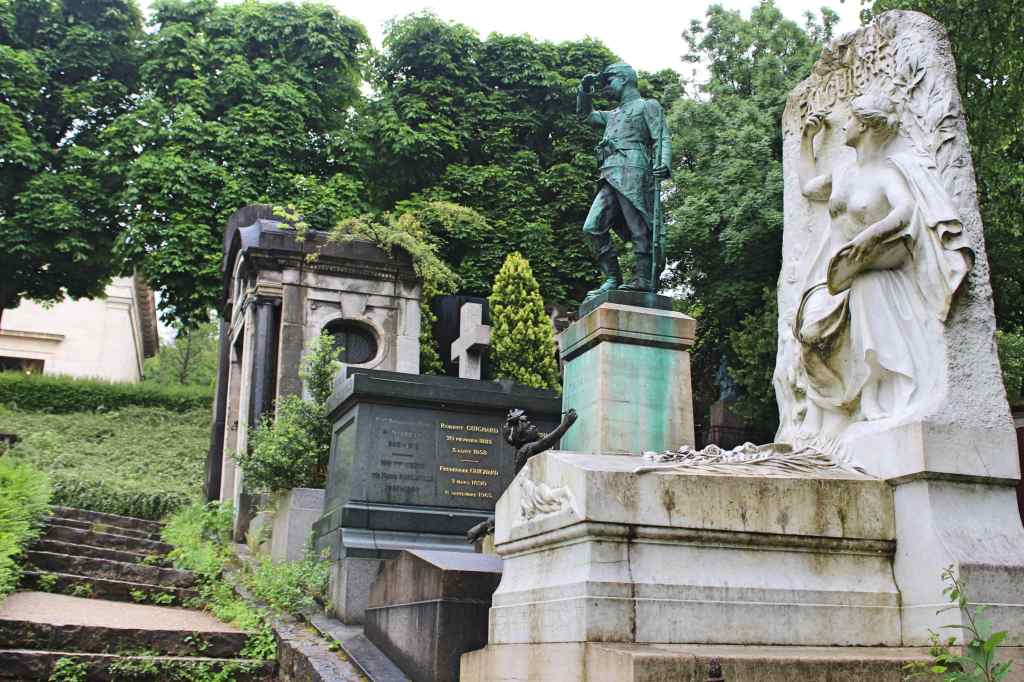
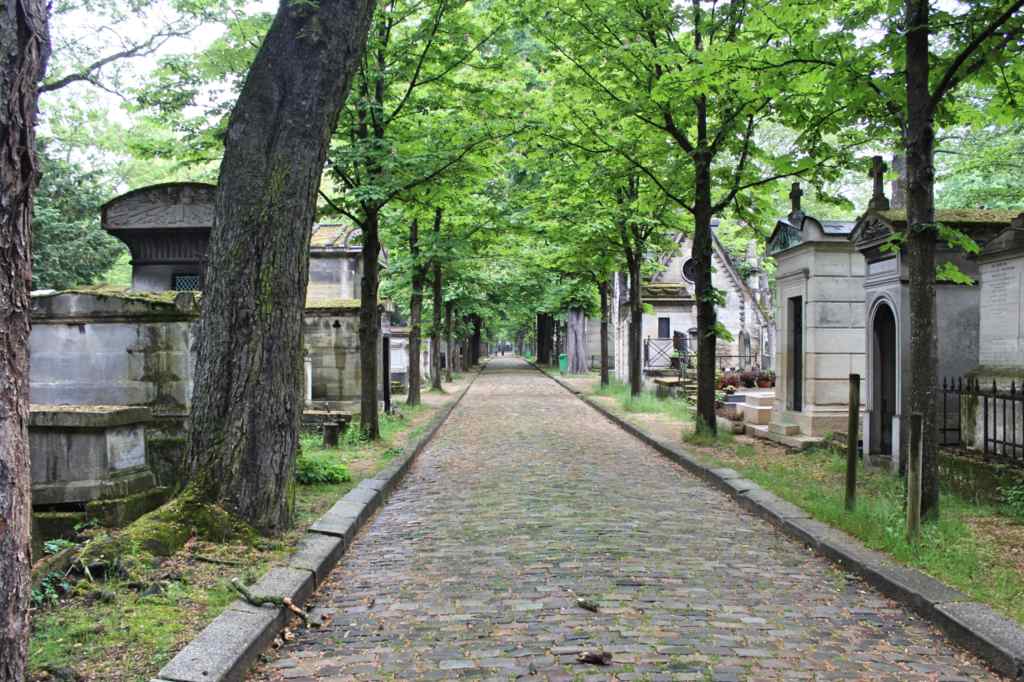
In appearance, Père-Lachaise is somewhere intermediate between the solid stone cemeteries of Spain and the park-like cemeteries of New York. Tree-shaded walkways lead past rows and rows of gravestones, most of them large and ornate. As soon as I walked inside I felt refreshed. After the bustle and noise of Paris, the dead make welcome company. And there are many of them to choose from. Over one million souls lie interred in Père-Lachaise—half the population of modern-day Paris. The cemetery is still active, though burial is expensive and the waiting-list is long. Because of overcrowding, the cemetery actually engages in space-saving measures, such as burying family members together or digging up bodies whose leases have expired. In Paris, even the departed get evicted.
Even though the cemetery is only two-hundred years old—quite young in a European context—it contains bodies that are far older. The most conspicuous example of this is the iconic couple: Abelard and Heloïse. Abelard was one of the finest intellectuals of the Middle Ages, whose philosophical contributions to theology are still fascinating. But among laypeople, he is most famous for his tumultuous love-affair with Hélöise, documented in a series of passionate letters that have become literary classics. Their bodies—supposed bodies, I should say—were moved to Père-Lachaise as part of a marketing ploy to boost the cemetery’s reputation, and now lay interred in an elaborate psuedo-gothic tomb, where the two lovers—whose religious vows made their love rather difficult—can now enjoy eternal rest together.
Two more celebrities were dug up and re-buried here as part of the same marketing push: the dramatist Molière and fabulist Jean de la Fontaine, who both died in the 17th century. I was especially happy to find Molière, who is one of my favorite dramatists of any kind. His comedies are uniformly profound and delightful. The two iconic writers lie interred next to one another, in fairly simple stone sarcophagi raised above the ground. I am not sure about the ethics of relocating bodies for reasons of profit; but I was very glad to see Molière.
Gertrude Stein
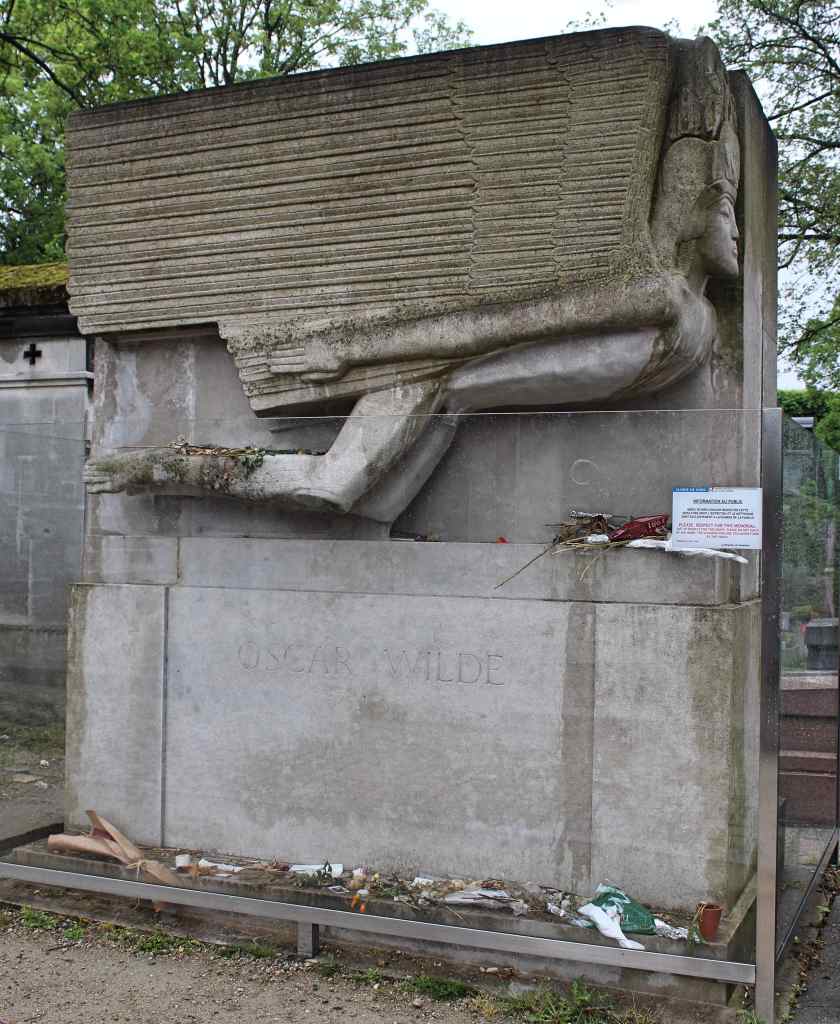
There are many other famous writers to be found, and not all of them French. Gertrude Stein—who wrote innovative, complex books—lies under a simple, traditional grave. The playwright Oscar Wilde’s tomb is significantly more elaborate. It is an enormous statue carved by the sculptor Jacob Epstein, featuring a kind of winged messenger. To my eyes, however, the sculpture appears a bit stiff and awkward, certainly not suggestive of flight. But it at least catches one’s attention. Somehow, the tradition of kissing the statue with bright red lipstick got underway. Nowadays there is a plexiglass barrier to prevent this. A writer I prefer to either Stein or Wilde has a less-visited tomb: Marcel Proust. After having slogged my way through all of his enormous novel, In Search of Lost Time, I was moved to see the great artist’s modest tombstone. For an artist so obsessed with remembrance, he has an inconspicuous grave.
Edith Piaf
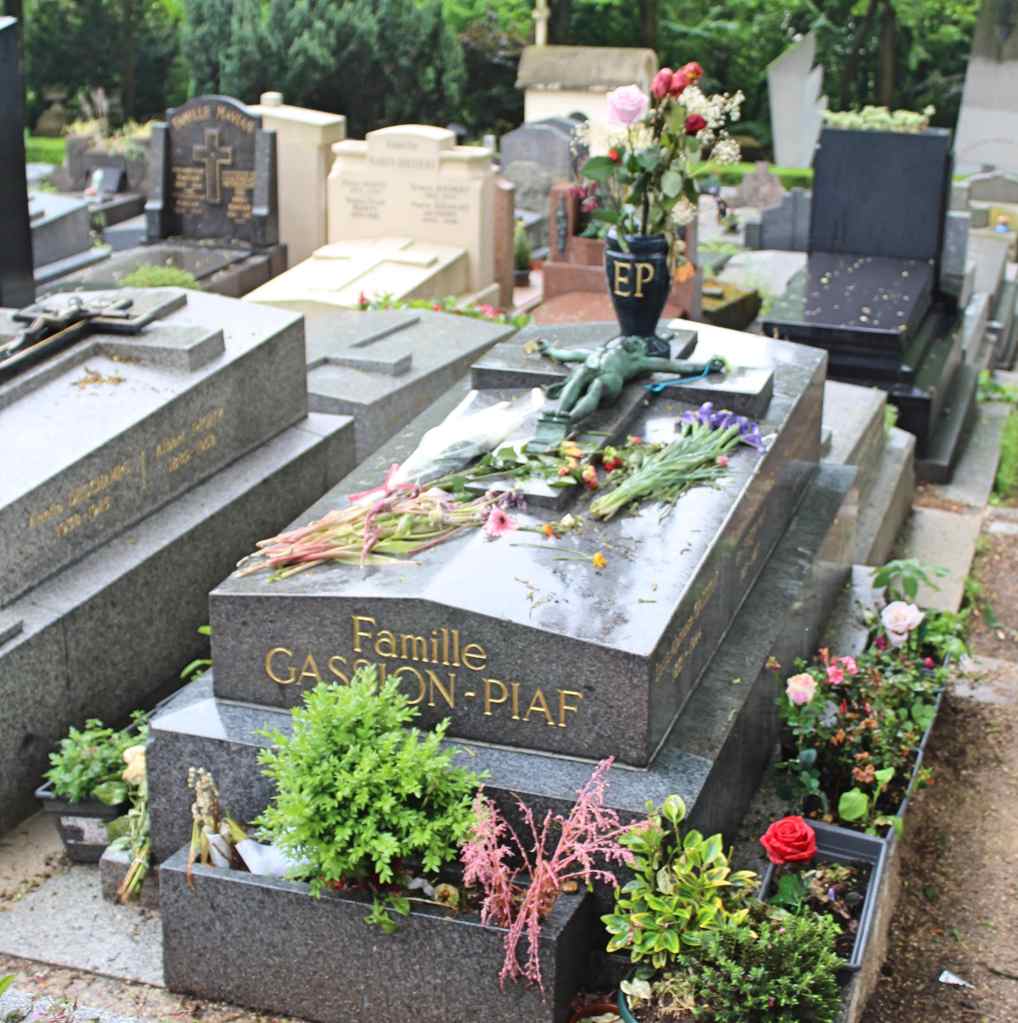
Père-Lachaise also has its share of musicians. The body of Fréderic Chopin, the great piano composer, is close to the entrance. Further on, one comes across Edith Piaf, that star of French singers. It was impossible to look down on her grave without unconsciously hearing her distinctive voice. Yet the most famous musician buried in Père-Lachaise is not a European, but Jim Morrison, the American singer who died at age 27. His may be the most-visited grave in the entire cemetery. So many people visit and vandalize it, in fact, that the cemetery has taken to placing a barrier around the tombstone, so that nobody can get too close.
Oscar Wilde’s tombstone
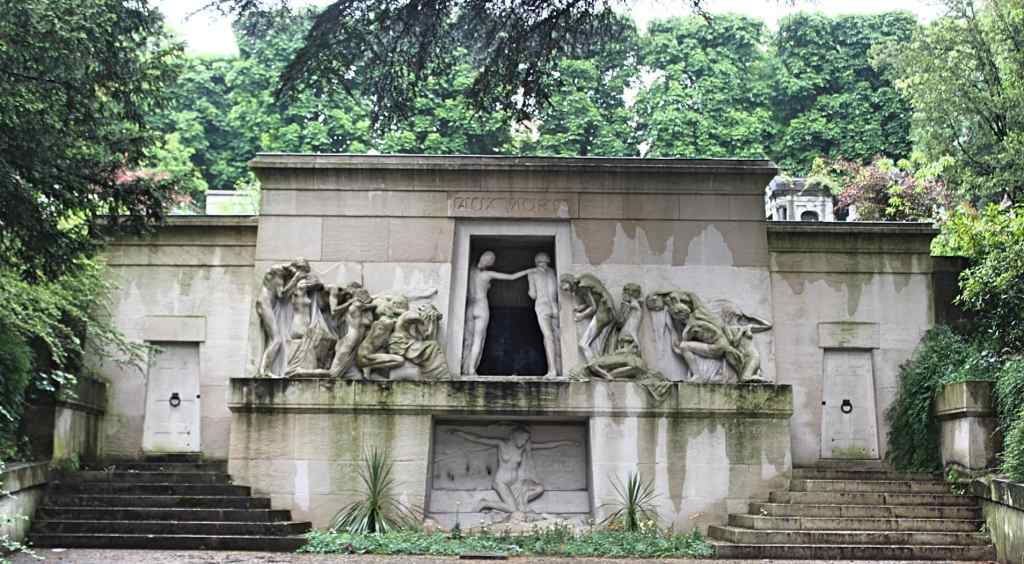
Apart from these personal monuments to the illustrious dead, there are several more general monuments in Père-Lachaise. The most general is the monuments aux morts, a sculptural complex unveiled in 1899 commemorating all of the dead in the cemetery (and presumably beyond). Père-Lachaise has more specific commemorations, too, such as the monument to the victims of the Mauthausen concentration camp. For me this is an extremely moving piece. It shows us a gaunt and haggard figure sprawled across impossibly steep steps. This is meant to evoke the “stairs of death,” 186 steps in which inmates were forced to carry granite up to the top of a quarry. Owing to my own background, I was also pleased to find a monument to the Spaniards who fought in World War II and the French who served in the International Brigades in the Spanish Civil War. Francisco Largo Caballero, one of the leaders of the Republic during this tragic time in Spanish history, is also interred nearby.
The Monument to the Dead
One could go on endlessly listing famous bodies in this cemetery. But since life is short, we must move on to the next one.
Montparnasse
Montparnasse is situated in the south of the city. It was established around the same time as Père-Lachaise, and for the same reasons: overcrowding in municipal cemeteries. It is the second-largest cemetery in Paris, with 300,000 bodies. While not quite as beautiful as its more famous cousin, Montparnasse is home to almost as many icons.
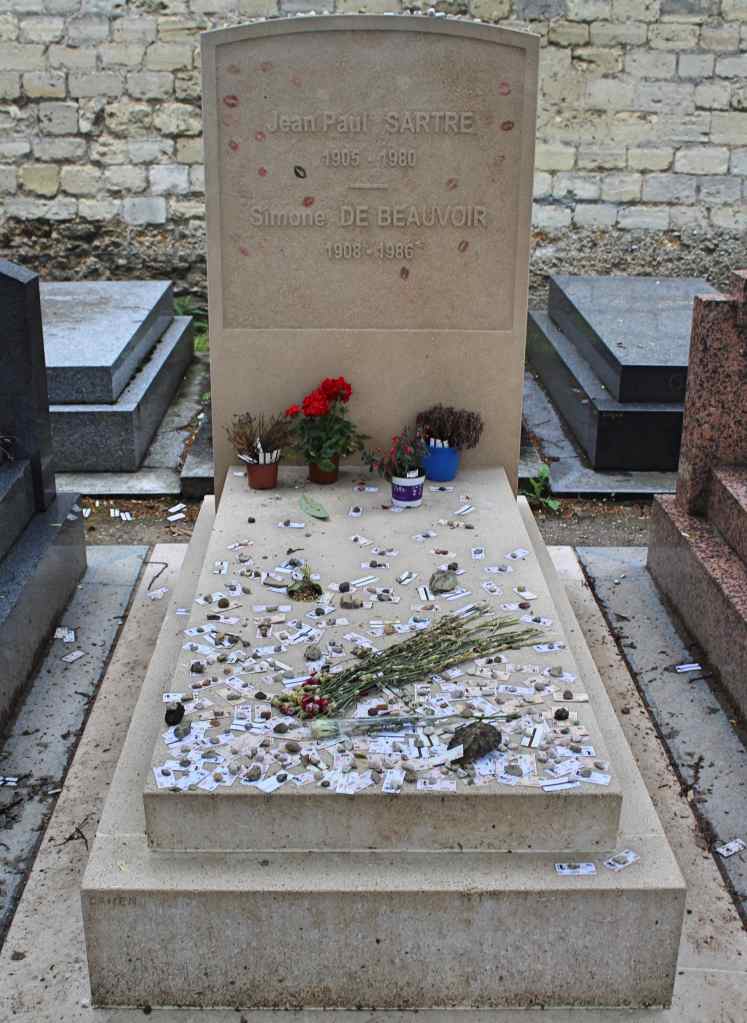
Of special interest for me were the two most famous philosophers of 20th-century France: Simone de Beauvoir and Jean-Paul Sartre. Simone de Beauvoir is usually remembered nowadays as a feminist, and her book The Second Sex is still widely read. She deserves to be remembered for far more, however, as she was an extremely versatile writer and thinker. During her lifetime she published important works of philosophy, best-selling novels, and many memoirs that have become classics. She spent most of her working life in an open relationship with Jean-Paul Sartre, the patron saint of existentialism. Sartre was just as versatile as de Beauvoir, writing plays, novels, pamphlets, treatises, biographies, and much else. Though controversial, Sartre was extremely popular during his lifetime, and his funeral was attended by tens of thousands of mourners. I can think of no writer alive today who could compare with this pair.
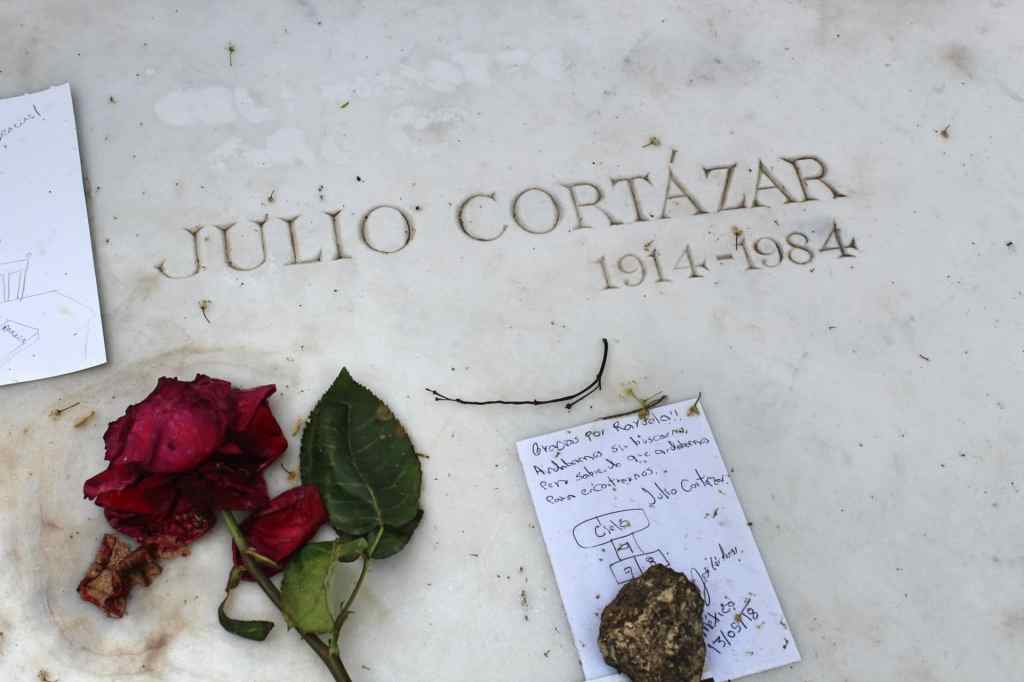
There are still more writers to be found. Charles Baudelaire—one of the most important French poets of the 19th century—lies peacefully under a modest tombstone, after having thrown the world of literature into disarray. And Emile Durkheim, who helped to found sociology as a discipline, lies similarly inconspicuous among the tombs. I was surprised to find Julio Cortázar, as well, who was regarded as one of the outstanding Latin American novelists of any time. Finding Susan Sontag, the influential American essayist, only added to my surprise. Finally I must mention Samuel Beckett, the Irish writer who was one of the pioneers of the absurd. I knew that Paris attracted writers, but I did not know its appeal was so everlasting.
Les Invalides
You will recognize that Les Invalides looks an awful lot like “the invalids,” and that gives you a clue as to its history. Les Invalides originates as a huge hospital and home for military veterans who had been wounded in war, built under Louis XIV. It is a sprawling complex of long halls separated by ample courtyards, covering an enormous area in central Paris.
The majority of the complex is now given over to its use as a military museum. Thus, as you stroll through the seemingly endless halls, you see knights in armor, crossbows, muskets, cannons, machine guns, and tanks. Not being especially fond of military history, I made my way through this area rather quickly; but I am sure it would hold many delights for aficionados.
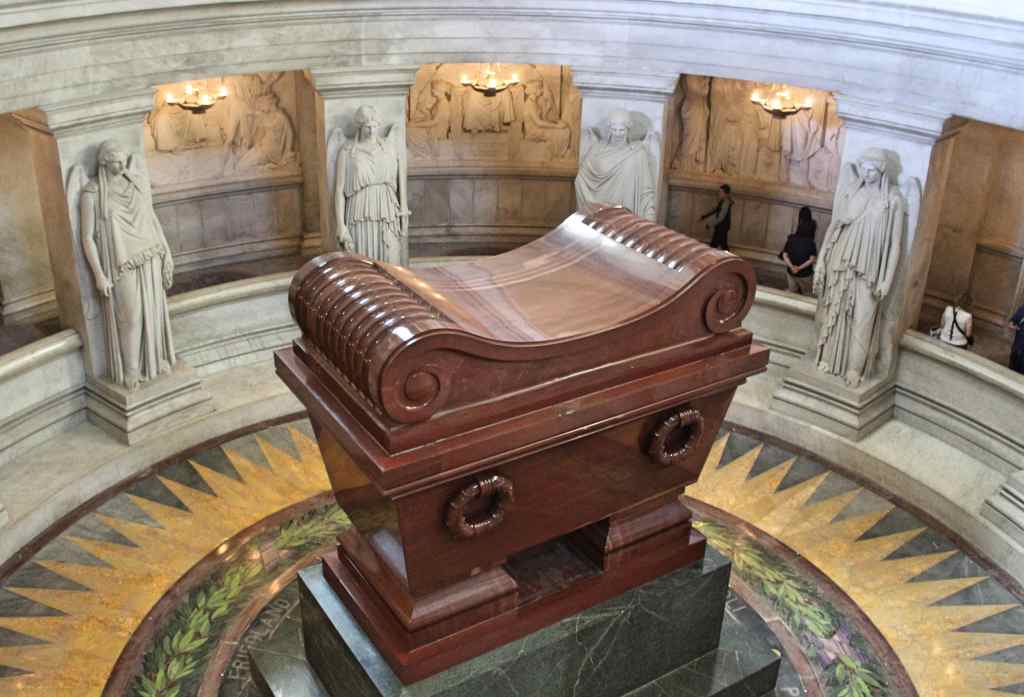
I was mainly there to see the tomb of one of the most important men in history: Napoleon Bonaparte. Napoleon the man was a paradox: power-hungry but idealistic, republical but imperial, egotistical but patriotic, heroic but despotic—the list goes on. This is why he is so fascinating. Indeed, I have heard that Napoleon is the subject of more books than any other historical figure apart from Jesus. It seems only fitting that his tomb be resplendent.
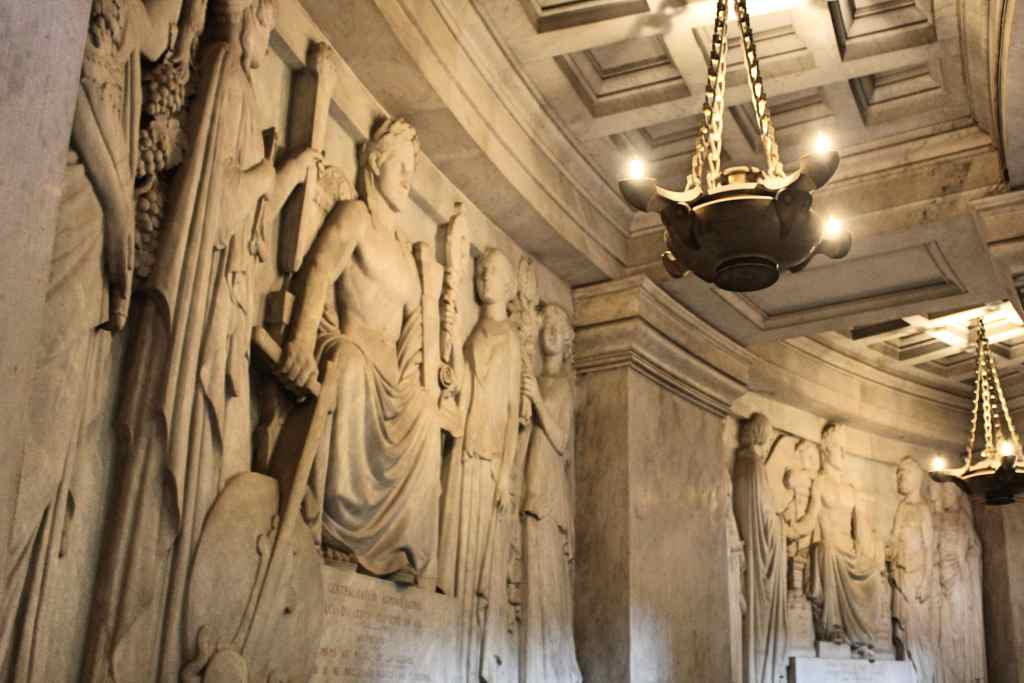
Napoleon lies interred under the central dome of Les Invalides, which originated as a royal chapel for Louis XIV. One wonders whether a church is the most appropriate place for the remains of the dictator—who was not, after all, especially religious—but at least the space is appriopriately grand. A painted dome ceiling hangs far above the space, which opens up to reveal the magnificent sarcophagus of the little emperor. Carved from red quartzite, the sarcophagus emerges from the floor, with its curved lid seeming to break upon the space like a wave. The sarcophagus is surrounded by statues and friezes depicting Napoleon’s glorious reign. Many of them depict the French emperor as the second coming of Alexander the Great—crowned in laurels, sitting as a god among men. It is a bit hard to stomach if you are not an admirer.
As you may know, Napoleon spent his final days on the tiny island of St. Helena, far away from France. It was only during the reign of Louis Philippe (who was trying to curry favor with Napoleon supporters) that the emperor’s bones were brought to France and interred in such grandiose style. As with all funerary displays, the pomp can seem rather empty. Napoleon died a defeated man, after all; and no matter how glorious he was, he is gone for good. But on the other hand, it is humbling to think that somebody born into ordinary circumstances could acquire such a hold over his adopted country (Napoleon was born in Corsica).
The tomb of Joseph Bonaparte
Well, the great Bonaparte is not the only one to be buried here. His son, Napoleon II, is also in attendance, though he died quite too young (21) to have anything but a minor role in French history. I was more interested in finding Joseph Bonaparte, Napoleon’s brother, who held the title as the King of Spain for a few years before being forced to flee. After abdicating, Joseph spent much of his remaining life in the United States, living off the jewels he took from Spain. This is basically my plan, too.
The Panthéon
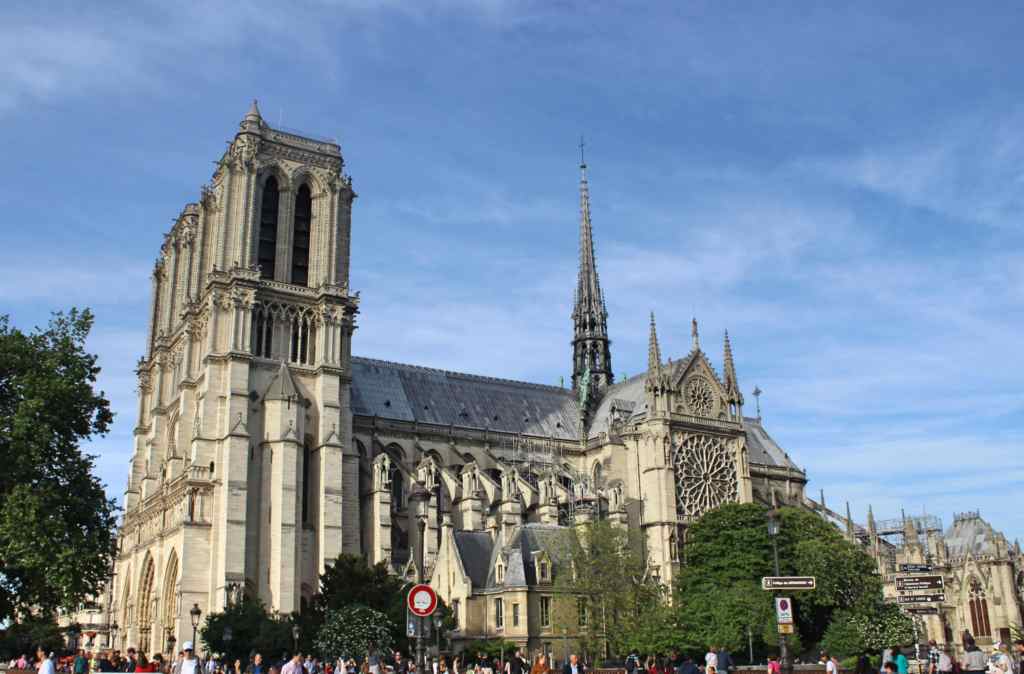
The last time I visited Paris was in May of 2018—about a year before Notre-Dame burned. Nowadays, I suspect, it is impossible to look at the charred building without feeling a bit melancholy. Yet normally the area around Notre-Dame is one of the prettiest parts of Paris. The cathedral is situated on the Île de la Cité, a small island in the Seine. Crossing the bridge southwards, you could see the cathedral’s monumental form standing above calm waters of the river, and marvel at the elaborate iron spire.
Just across the bridge you will come across Shakespeare and Company, the famous book store frequented by Anglophone expatriots like James Joyce and Ernest Hemingway. This is not the original location of the store, however; nor was it ever affiliated with the store’s original owner, Sylvia Beach. This store is more like an homage to Beach’s. Original or not, it has an excellent selection of English-language books, so I decided to walk inside. I emerged with a used copy of Giogio Vasari’s Lives of the Most Excellent Painters, Sculptors, and Architects, a book that I had wanted to read for some time.
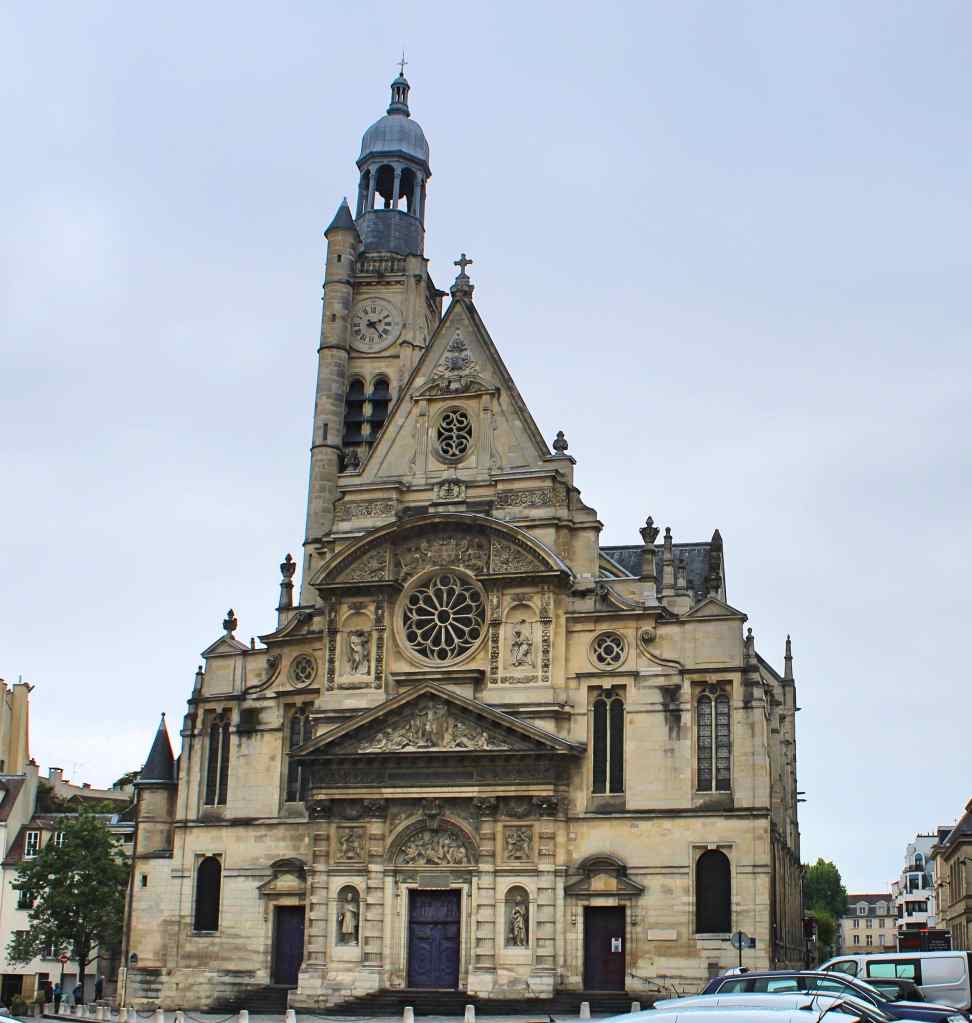
Moving further south, you come to Saint-Étienne-du-Mont, another of Paris’s beautiful churches. Its façade is a rather strange and cluttered jumble of styles, which nevertheless manages to be quite charming. Unfortunately for me, both times I tried to visit, the church was closed; so I have not seen its interior. From what I have read, it is quite a lovely space.
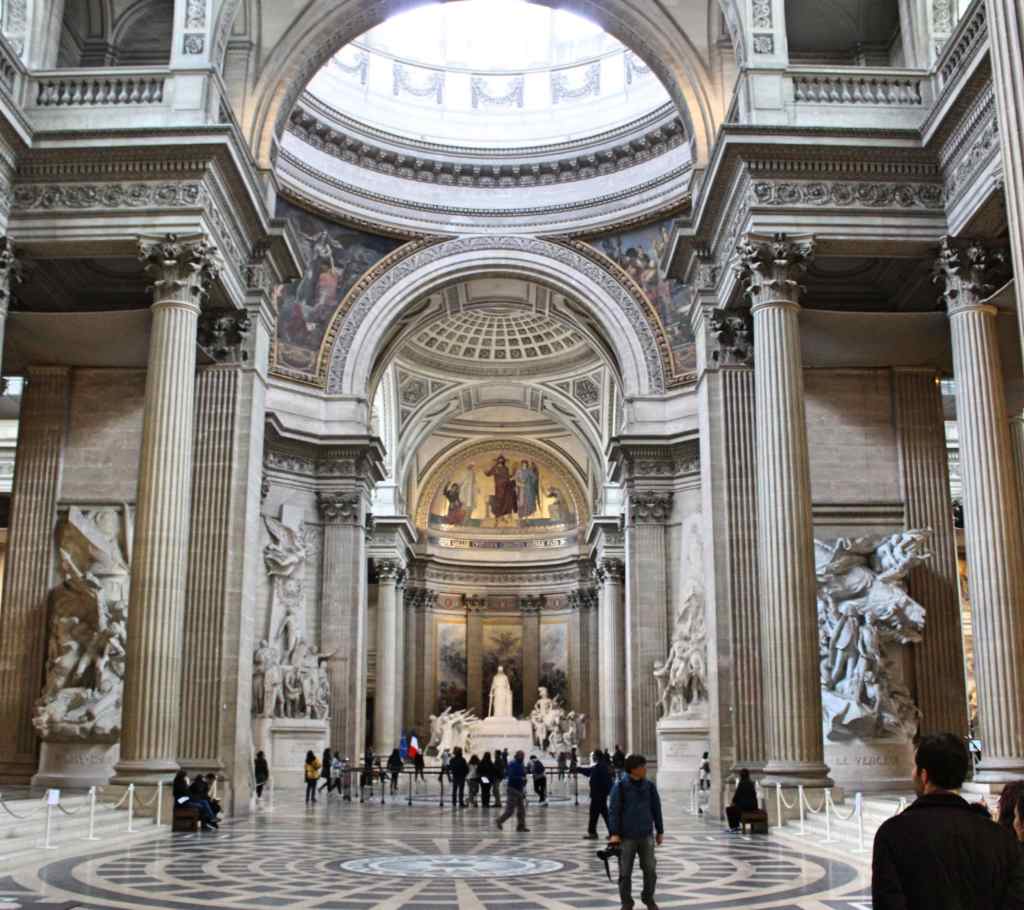
But I was not there to see cathedrals, churches, or bookstores. I was there was the Panthéon, Paris’s great temple to its illustrious dead. It is an enormous neoclassical building, with a towering dome highly reminiscent of America’s Capitol Building (which is not surprising, since the Panthéon was a direct influence). Originally, however, this grandiose building was not built for France’s secular heros, but as a church to Saint Genevive, the patron saint of Paris. But during the atheistic years of the French Revolution, it was decided to deconsecrate the space and use it to honor heroes of the Enlightenment.
Every inch of the structure is richly decorated. The visitor walks under the peristyle, through the flowering Corinthian columns, and past elaborate friezes of religious scenes. The interior of the building is expansive and just as ornate. Any list of the sculptures and paintings would be tedious, but the interplay between Enlightenment and Church decorations is immediately noticeable. The great battle for Europe’s soul is played out on the walls.
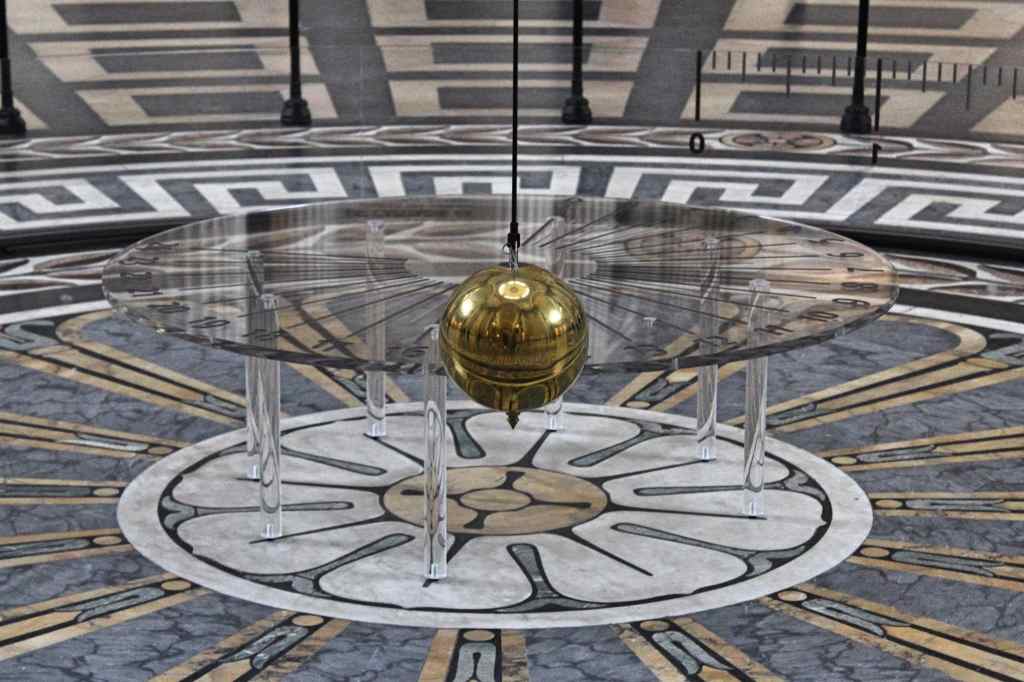
Under the magnificently painted dome, which shows us the apotheosis of Saint Genevieve, there hangs a celebration of human science: Foucault’s pendulum. This is a simple device, consisting of a bob hanging down on a long wire. The back and forth motion of the pendulum undergoes a precession around a circle, directly illustrating earth’s motion. Behind this tribute to the human mind is a celebration of democracy: François-Léon Siccard’s sculptural portrayal of the National Convention. We see a martial female figure (liberty?) surrounded by politicians and soldiers, where underneath it states: “Vivre libre ou mourir” (Live free or die).
Foucault’s pendulumTwo Frances: The monument to the National Convention, with Jesus in the background.
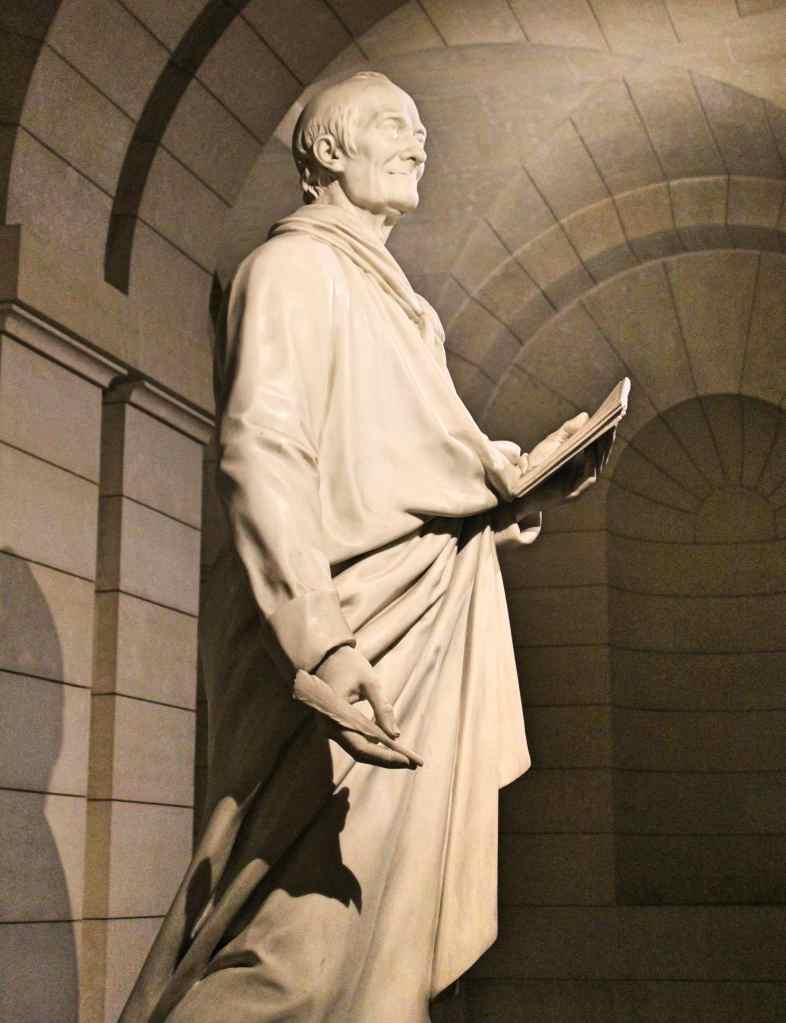
As interesting as is the temple itself, the crypt was why I was there. If you have any love for classic books, it is a holy place. After descending a small staircase, you suddenly find yourself standing between two of the most influential writers of any place and time: Voltaire and Jean-Jacques Rousseau. Voltaire was the first Enlightenment hero to be interred here. At first denied a Christian burial, his remains were first interred in secret in an Abbey in Champagne. But in 1791, during the heady days of the Revolution, it was decided that Voltaire deserved the secular equivalent to canonization, and his remains were moved here. The procession was enormous: reportedly a million people came out to celebrate the late hero, with music, ritual, and fanfare.
The philosopher Jean-Jacques Rousseau was moved here three years later, in 1794, after it was decided that he too was a hero of the Revolution. For my part, it is rather strange to find these two men sharing the same vault. They are opposed in both thought and temperament. Voltaire was an enemy of tyranny but he was no democrat; his writings stressed the importance of civilization and rationality. Rousseau, on the other hand, was a champion of the “general will” in politics; and he emphasized the importance of nature and feeling. The two writers sparred several times in life, each finding the other brilliant but repugnant. Somehow, the ideals of the Revolution were able to accomodate them both.
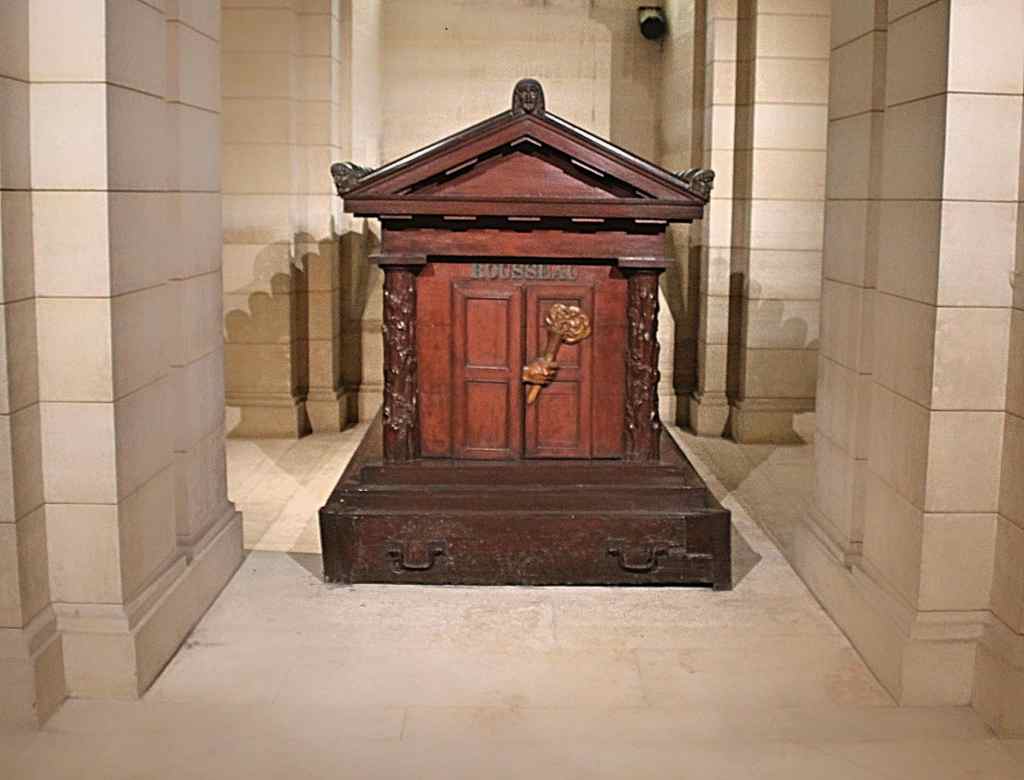
Voltaire’s tomb is the more impressive of the two, if only because of the wonderfully lifelike statue of the wry old philosopher standing before it. Rousseau’s coffin celebrates the man’s accomplishments in inscriptions on both sides, and on one end we see a hand reaching out, bearing a torch. I got goosebumps as I stood there.
Moving further into the crypt, one finds many little chambers branching off the central corridor. Many of these are filled with officers and generals, most of whom served under Napoleon. This had little interest for me. Instead, I made my way straight to the chamber containing the mortal remains of three giants of French literature: Alexander Dumas, Victor Hugo, and Emile Zola.
Victor Hugo was the first to be buried here. Few writers have ever been so beloved by their country. His ceremony was even more elaborate than that for Voltaire, with over two million people in attendance. Emile Zola, another liberal writer, was next to enter the Parthéon, although the ceremony was disturbed by an assassination attempt on the life of Alfred Dreyfus. (Dreyfus was a Jewish officer falsely accused of a crime, whom Zola publicly defended. Proust writes much about the case in his enormous novel. Dreyfus is now buried in Montparnasse.) Finally, as recently as 2002, Alexander Dumas was relocated here, in recognition of his enormous popularity.
As usual with the tombs of icons, standing in their presence is both humbling yet exalting. But what I most like about such visits, perhaps, is that it helps to make a historical figure—a person who can seem impossibly distant—seem real and concrete. These people are no longer just names on a page, but just as real as I am.
So ended my visit to Paris’s tombs. If you can believe it, I managed to visit all of these illustrious graves in the span of a single day. It was a modern, secular pilgrimage.
The Catacombs
Though I have never visited the catacombs myself, I feel that I cannot end this post without at least making mention of this popular spot. As I mentioned in the beginning of this post, by the end of the 18th century Paris was having a problem with making room for its ever-multiplying dead. It is difficult for an American to quite realize the scope of this problem, since our country’s history is so comparatively shallow. Paris has been around a long time: inhabited since at least the Roman times, it has been a major settlement for over 1,000 years. In short, there are an awful lot of bones to bury, and the city’s space is limited.
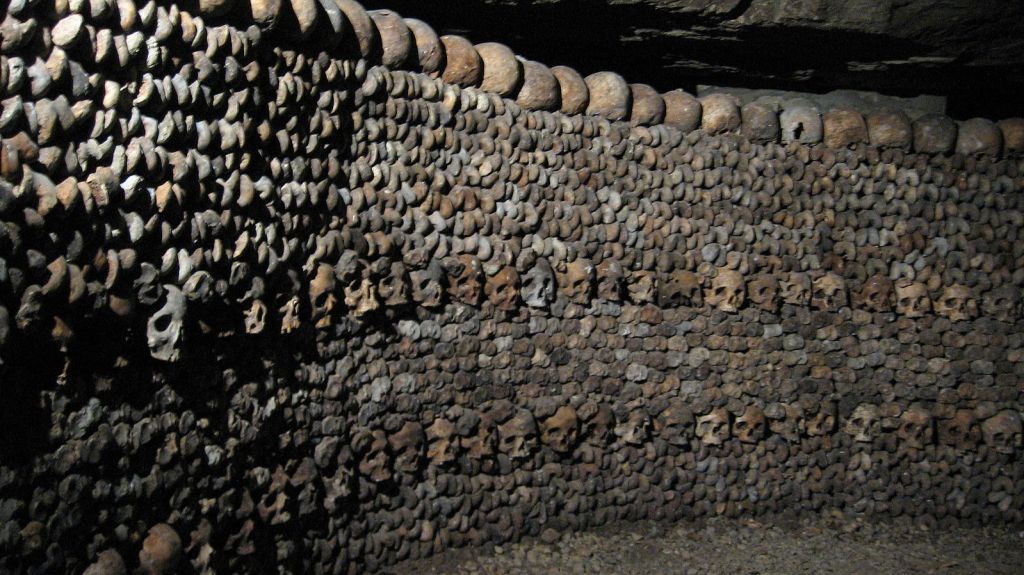
By the late 1700s, the situation was getting serious. In the largest municipal cemetery, Saints-Innocents, so many people were buried on top of one another that the ground was piled up to six feet (or two meters) high. In some areas, this proved to be so heavy that it caused the ground to collapse. Also, as you can imagine, having such a huge pile of bodies is not good for the water supply, not to mention for the air quality. Luckily, however, a solution was at hand. Much of the ground in this area of the city—the Left Bank, close to Montparnasse—was riddled with tunnels and holes, widely used in previous years to mine limestone. Thus, beginning in the 1780s, wagons carried these ancient bones into their new resting-place, under the streets of Paris.
I admit that it does make me feel a bit ethically uneasy to imagine disturbing the eternal rest of so many citizens. Then again, I suppose many of the bones belonged to people who had lived centuries ago, and who were buried in mass graves anyway. Now these skulls and femurs compose one of the most popular tourist attractions in the city. The skeletal remains are arranged into patterns on the walls, creating a kind of grim aesthetic charm. I suppose I should visit; but the thought does make me slightly queasy.
Processing…
Success! You're on the list.
Whoops! There was an error and we couldn't process your subscription. Please reload the page and try again.
I must, unfortunately, begin this podcast with some bad news. Well, it’s bad for me anyway. This past Saturday, as you may know, was Chinese New Year. To celebrate, I decided to go to the big parade in Usera—the Madrid equivalent of Flushing, Queens. The parade was packed. It took us twenty minutes just to walk a couple blocks, and even then our view of the parade was obscured by the crowds. I still managed to take some good pictures, though.
But you will most likely never be able to see these pictures, since shortly after the parade ended my camera was stolen. I’m not sure how it happened. The most likely story seems to be that it was nabbed while I was sitting down at a Chinese restaurant. There were tons of people around and the place was very busy. For half the meal, both me and my brother had our backs to the door, and I carelessly placed my camera on the floor. When we got up, it had vanished. My theory is that someone walked in, spotted it, and nabbed it before anyone took notice. Either that, or I did something even more stupid and left it on a chair or something.
Anyways, this loss, bad as it was, did at least connect me with a universal experience for tourists in Europe: being pickpocketed. There is not a whole lot you can do after the fact. In my case, I looked up my camera’s serial number (which is encoded with every photo you take with it) and then filled out a police report. Though I’ve heard stories of people waiting for hours in the police station, I filled out the report online and then went over to the station to sign all the paperwork. It took me about ten minutes. Every pawn shop in the city is required by law to keep a list of all the serial numbers of its products, and to submit that list to the police. But thieves must have their own workarounds, since business in the pickpocket industry is booming. In fact, judging anecdotally, theft seems to be on the rise. So be careful out there.
Well, to repeat, pickpocketing is a common hazard for travelers everywhere. Though strangely, it seems to be far more common in Europe than in the United States, and particularly bad in Spain. Barcelona is commonly called the pickpocketing capital, with Madrid not far behind. Again, judging anecdotally, the situation is really quite bad in Barcelona. Judging from the stories I see on Facebook, it can seem like half of the tourists who go there lose their phone. Pickpockets are quite good at what they do.
Pickpocketing statistics are naturally very difficult to collect. Many people don’t report the crimes, and even if they are reported it normally cannot be proven that a missing item was stolen and not merely lost. Besides that, pickpockets are only rarely caught by the police. The only figure I’ve been able to get my hands on is 10,000 robberies a year in Madrid, done by about 500 pickpockets who mainly prowl the city’s metro. But I’m not sure how far to trust those figures. In any case, I am constantly hearing about phones and wallets stolen in Madrid.
By contrast, I don’t think I’ve ever heard a pickpocketing story about New York City. This is really strange. There are lots of needy people in NYC, and the dense crowds would make it an ideal place for pickpocketing. So why isn’t there more petty theft? Is it a cultural thing? Better law enforcement? Harsher penalties?
While I’m on the topic of crimes, I thought that I would compare some other crime statistics across my two countries. I quickly found that, while Spain may be worse than the United States when it comes to theft, the US is a lot more violent. Here the relevant statistics are easy to find: In America there are a little more than five murders per 100,000 people. In Spain, the number is 0.63—eight times smaller. Now, call me a liberal snowflake, but I can’t help thinking that this huge difference is largely due to greater access to guns in America.
The American statistics on sexual violence are just as bad. The relevant figure for the United States is 27.3, while in Spain it is a measly 3.4. Of course, rape is also difficult to measure, since it is underreported and under-prosecuted almost everywhere. Here in Spain there have been notorious cases of rapists walking free. So it’s certainly not great anywhere.
Now, Spain may or may not be better than America when it comes to crime rates as a whole. But Spain—and the rest of the world, for that matter—definitely has America beat when it comes to incarceration rates. The United States has the highest percentage of its population behind bars of all the countries in the world: 655 per 100,000. Believe it or not, the United States also has the biggest total number of prisoners in the world—well over two million—significantly more than China, a country with a much bigger population, and which we usually disparage for being totalitarian. The incarceration rate for Spain is 126 per 100,000, about five times lower.
When you consider that Spain experiences significantly less violent crime than America, I don’t know how one can justify such an insanely high incarceration rate. To be honest, I really can’t see any way to explain it other than by drawing the conclusion that we are throwing way too many people into prison in America. (And of course a disproportionately high number of them are black.)
Apart from this, prisoners are generally treated better in Spain than in America. The prisons are less crowded, for one thing, and are therefore more comfortable. Prisoners can pay to have a television or radio in their cells, and can even vote in the elections. Most shocking for me, conjugal visits are allowed, even for non-married partners (they are only permitted in four states in America, and they are not easy to arrange).
But maybe the biggest difference is the death penalty. The United States is the only country in all of the Americas—north, central, and south—to maintain the practice, and also the only so-called Western country to do so. In Europe, only one country (Belarus) continues capital punishment. Spain is a typical European country in this respect: the death penalty has been abolished since the 1970s, and even abolished in the military since the 1990s.
If you ask me, it is way past the time that we do the same in America. There’s little evidence that capital punishment serves as an effective deterrent. And since such a disproportionate percentage of our population is in prison, it stands to reason that we are in general over-prosecuting, and sending many innocent people to jail. Morally speaking, I think it’s worse to kill an innocent person than to insufficiently punish a guilty one.
As a last little piece of data for my informal comparison of crime and punishment, we can look at police killings. In America, there were 119 police killings in 2019, and 390 before that.* And of course the victims are, as usual, disproportionately black. Meanwhile, I can’t even find any statistics about police killings in Spain, and I’ve never heard of it happening. Once again, I suspect that a big culprit is guns. When the population is armed, it naturally makes police officers more prone to panic and overreact with deadly force, since there is a substantially higher risk for them. But if guns are extremely uncommon, then police officers can more easily remain cool. And a calm officer is obviously one less likely to open fire. (But this is just my little hypothesis about this.**)
Well, there you go, a little picture of crime and punishment in Spain and America. All told, Spain looks pretty good by comparison—with significantly less violent crime and far fewer people locked up in prisons. But all this doesn’t change the fact that I’m still missing my camera.
* According to this database, these numbers should be much higher. Apparently there is no government agency that collects statistics of this kind, or any mandate that the data get reported. So it is up to journalists and activists to do so. The database also contains lots of information on the factors that influence police violence.
** According to this article, police killing in America is far worse than in any other Western country. (The Guardian also collects its own statistics on police killings, which don’t quite match the above database, but it’s close.) The portrait that this article paints of American police violence is grim. My gut feeling is that the most likely way to explain this huge disparity is the presence of guns in America, though I’m sure this must be an oversimplification. The database above mentions several policies that are proven to reduce police killings, such as requiring that use of force be reported and that using deadly force be a last possible alternative. Considering America’s abysmal record in this regard, I think it’s clear that we should do something. We shouldn’t accept a situation as inevitable that does not exist elsewhere.
I am not sure that I am in the best position to judge this short story collection, since the circumstances of my reading it were far from optimal. I downloaded the audio version to pass the time on a long drive, and I decided on the Spanish translation since my co-pilot would have fallen asleep otherwise. I soon discovered that listening to a foreign-language book while navigating mountain roads is not conducive to careful appreciation (or careful driving).
This is much closer to a short-story collection than to a conventional novel, but Bradbury blurred the lines a bit by adding some connecting passages to his stories (originally published separately). It is really only the setting and a vague sense of chronology that connects the separate chapters. And despite his post-facto additions, Bradbury did not achieve full consistency in his Martian world. This is not a problem, however, since I think the inconsistency adds to the stories rather than detracts. The final effect is much like an episodic TV show, which can invent itself anew with each iteration.
Bradbury has become known as a science-fiction writer; and yet these stories may be more accurately described as “anti-science fiction.” He has little interest in the details of technology, cosmology, or space travel, and even less interest in making his stories plausible or realistic. Indeed, Bradbury is not merely uninterested, but positively worried about what the future may bring. For Bradbury, Mars is not the fourth planet from the sun—with its own moons, its unique geology, its practical challenges—but a kind of parallel world where his fears can play out. Much like The Twilight Zone, these stories have one consistent message: “Be careful what you wish for.” Where other people saw the dawning of the space age, Bradbury saw only an extension of human idiocy beyond the clouds.
Arguably, this is quite a conservative message—anti-science, anti-technology, anti-change—but it also resonated with me. I remember being a little kid and contemplating the wonders that the future would bring: flying cars, tourism to the moon, miracle cures. Nowadays, this mood of optimism seems very distant. New technologies, rather than filling us with wonder, are prompting second-thoughts: automation that reduces job opportunities, face-recognition technology that only extends the surveillance state, or the unknown threat of artificial intelligence. And when I think of space travel, rather than imagining the next glorious phase of humanity’s ascent, two buffoons come to mind: Elon Musk (with his SpaceX) and Donald Trump (with his Space Force).
Well, I do not want to get too gloomy in a book review. My point is that Bradbury’s stories may indeed contain a valuable lesson: be careful what you wish for.
One of my favorite places in Spain is Mérida. If you have never heard of Mérida, then this illustrates my point: it is one of Spain’s lesser-known gems, which means that it is not overly crowded nor overly expensive. But it is an extraordinary place. Very few cities in the world can compare with Mérida for the breadth and quality of its Roman ruins. The city was one of the capitals of Hispania (Roman Spain) and had all of the comforts of provincial Roman life.
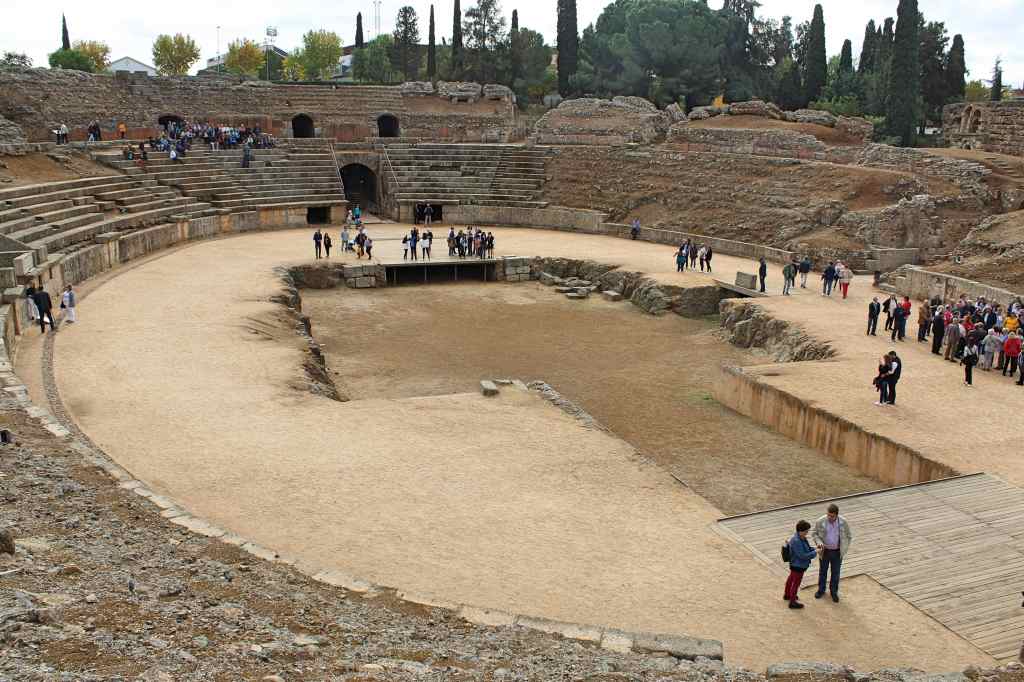
Most of the major sites in Mérida can be visited on a combination ticket, which you can purchase for 15 euros. I recently had a chance to visit Mérida and to experience anew the impressive monuments. The two stars are the amphitheater and theater. They are both enormous and well-preserved—especially the latter—and give you a good sense of what it would have been like to be a Roman having a day of entertainment. Ironically, the architectural monuments may have more lasting value than what the Romans actually consumed inside—gory violence and farcical comedies.
Ancient comedies and tragedies are still performed in this theater, during Mérida’s anual theater festival
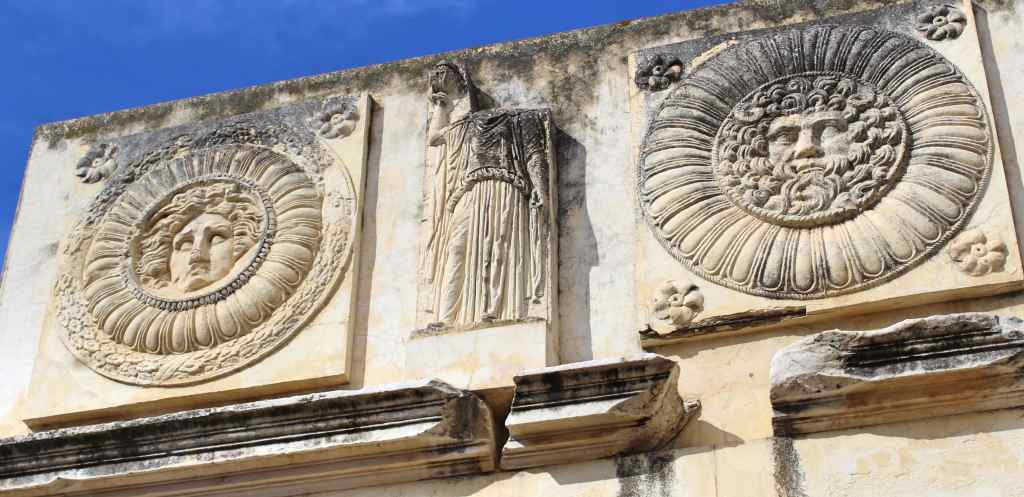
There are several ruins to be seen right in the center of town, free of charge. One of these is the so-called Temple of Diana, which was actually dedicated to the emperor. It is especially interesting because of the Renaissance house that has been incorporated into the remaining pillars (which you can see in the background). Nearby is the old Roman forum, where some fragments and columns still stand.
The temple of DianaA detail from the Roman forum
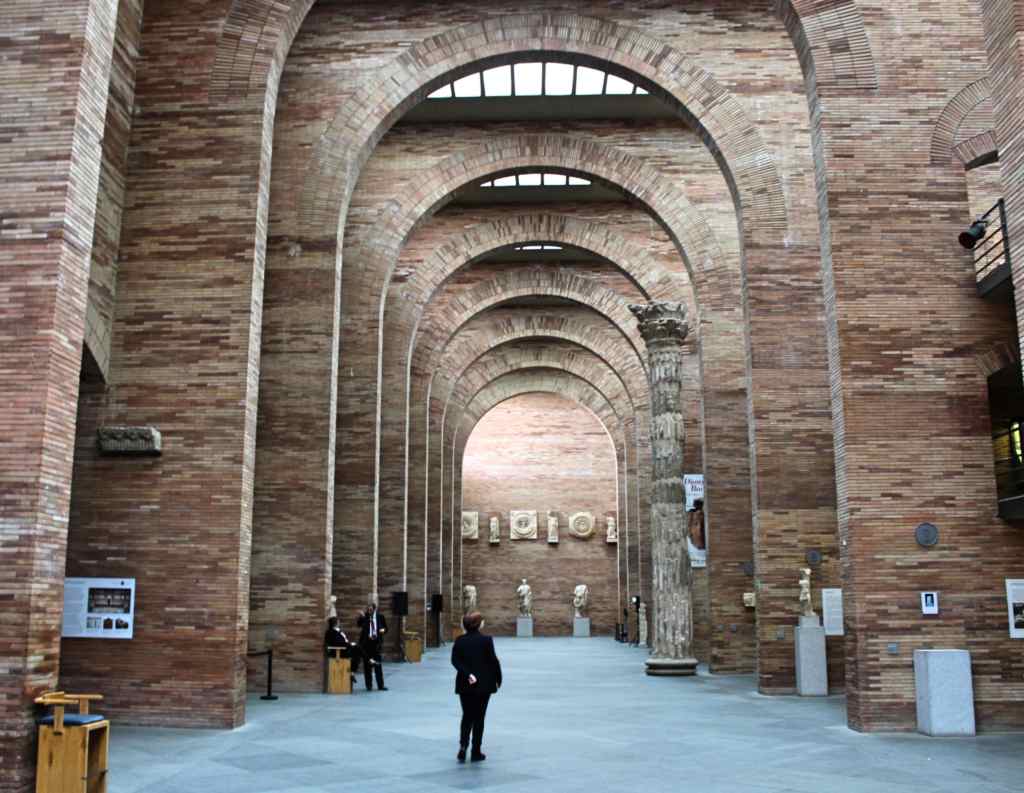
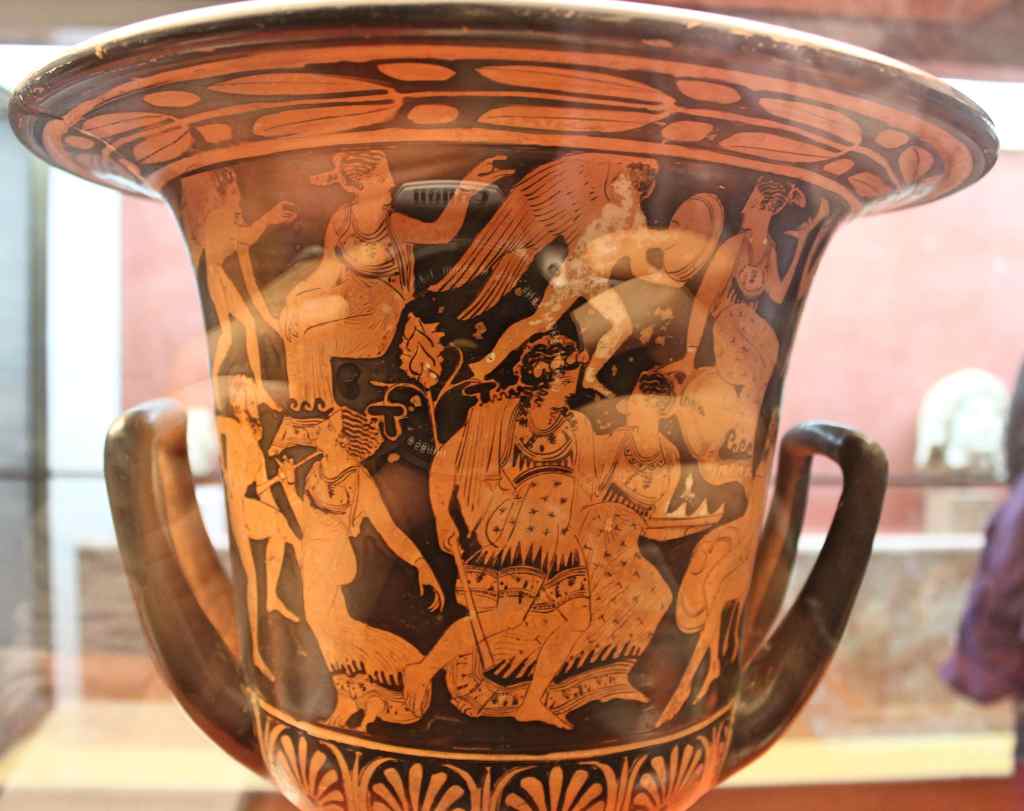
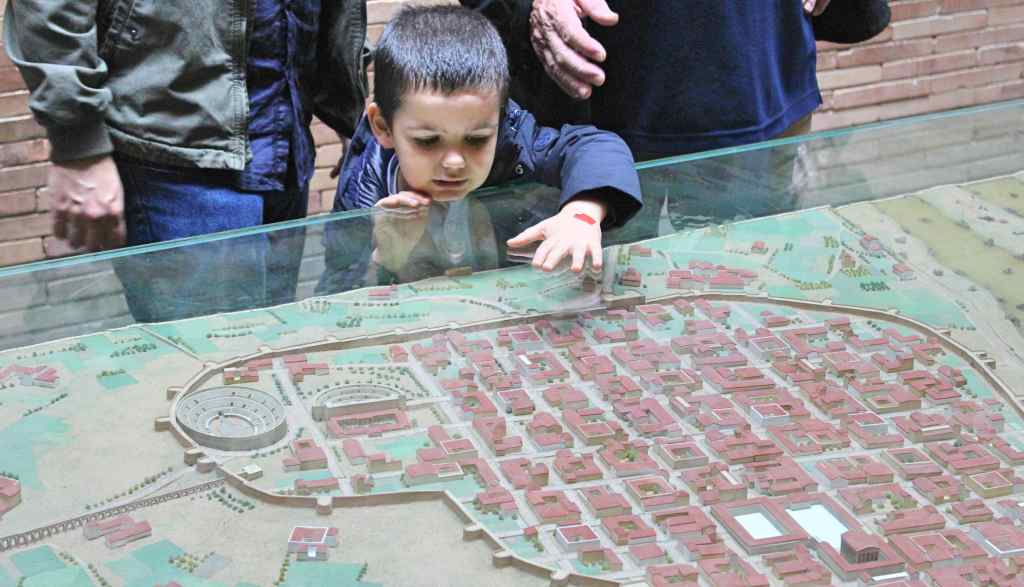
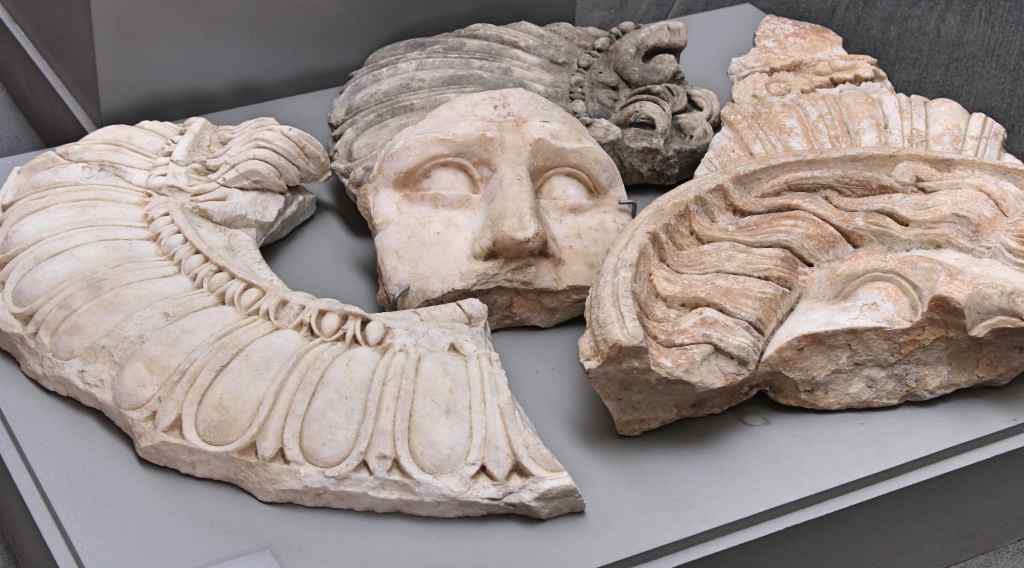
Apart from its many monuments, Mérida has an excellent museum of ancient Rome. The building itself is lovely—made of brick, with a high ceiling help up by Roman-style arches, and skylights that illuminate the space. There are artifacts of all kind inside: statues, pillars, mosaics, gravestones, pottery, jewelry, coins, and more. On the ground floor you can see a preserved section of a Roman road, and marvel at their extraordinary engineering. And in the museum’s basement still more artifacts are displayed, which were uncovered during construction.
The National Museum of Roman ArtA Roman interior, with wall paintings and a floor mosaicA Greek-style vaseA model of how the ancient city may have lookedThe impressive Roman road, a section of the Via de la Plata, an which connected the north and south of Roman Spain
Fairly close-by to the museum is the Casa del Mitreo, the excavation of a Roman villa. Whoever lived here must have been extremely wealthy, since there are three separate patios and many interiors are richly decorated. The Romans had taste. Another interesting site is below the Church of Santa Eulalia, were still more ruins have been uncovered. Probably there are rooms, walls, pillars, and shards of pottery under every inch of the place.
The Casa del MitreoThe crypt of the Church of Santa Eulalia
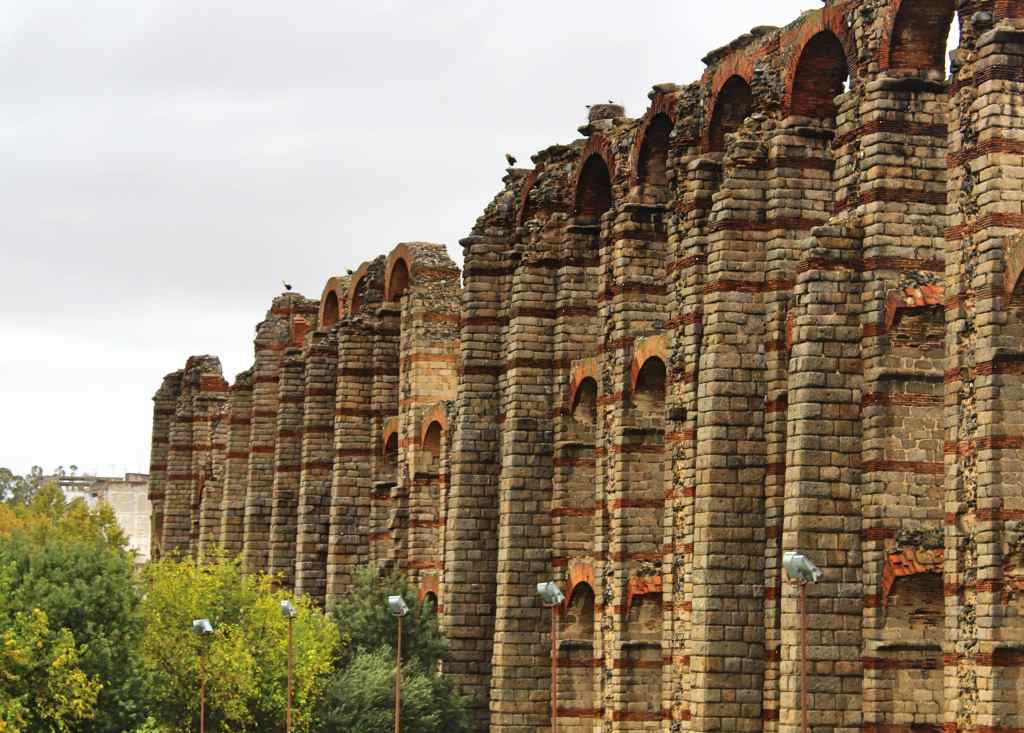
But some of the most beautiful ruins are located well outside of the city center. One is the Acueducto de los Milagros, a towering aqueduct dominating a grassy field. And it really is miraculous that something so seemingly delicate could survive two thousand years, exposed to the elements. Only slightly less impressive is the Acueducto de San Lázaro, which is near the old Circus Romano.
On the other side of town is the Roman bridge, which is connected to the Moorish fortress overlooking the Guadiana River. It is amazingly long—almost a kilometer in length, making it the longest surviving bridge from antiquity. And this is not the only Roman bridge in Mérida: there is another one near the Acueducto de los Milagros.
But perhaps the most impressive feat of Roman technology is the Embalse de Proserpina, a Roman dam. The Romans were extremely skilled hydraulic engineers, you see, and created their own reservoir to feed the town. The dam a lot more complicated than what meets the eye. There are deep chambers underground that the Romans used to divert the water into pipes, which eventually directed the water to the Aqueducto de los Milagros, which in turn brought it right into the center of the city.
The dam’s retaining wallThe exposed structure of the dam
As I hope you can see, Mérida has many sites for such a small and relatively obscure city. But this is how it always is in Spain: in every corner of the country, treasures await.
At long last, here is my first podcast of the new year. Some of my older podcasts are unavailable on iTunes now, but they are all on YouTube, including this one!
Happy New Years to all five of my listeners! It feels good to be back.
For this letter, I want to finally talk about something that has been on my mind a long time, and that is the contrast between the American and the European ways of life. I think this is especially relevant now, during our endlessly long election season back in America, because this contrast between America and Europe has actually exerted a strong influence over progressive American politics. You could arguably boil down the progressive platform—championed by Bernie Sanders and Elizabeth Warren—to the following statement: that America should be more like Europe. So what’s Europe like?
One of the most obvious contrasts is healthcare. Spain, like Germany, France, or Denmark, has a nationalized healthcare system. That means that every citizen is automatically covered at all times, free of charge or nearly so (although some people do supplement their public healthcare with private insurance). This is radically different from the United States, where most people have private healthcare, usually tied to one’s job. The difference is profound. In America, people really worry about the cost of healthcare. Even relatively well-off people.
The cost of an ambulance is one example. If you pass out in the street and somebody calls the ambulance for you, you can wake up in debt. There’s a famous story of a woman who fell between the subway car and the platform, who begged people not to call an ambulance because she couldn’t afford it. People go bankrupt in America because of illnesses and injuries—something almost unheard of in Europe. It’s not uncommon in America to see GoFundMe campaigns for people struggling with medical costs. But this isn’t just a question of insurance. It’s also because anything related to healthcare is absurdly expensive in the United States. A hip replacement, for example, is six times more expensive in the US than in Spain. That means you could take a nice long vacation in Spain, and then get your hip replacement, and it would still cost less money. And medication prices are wild in America. Insulin is so expensive that some people try to ration it, and a few have died in the process.
There are lots of reasons for the high cost of healthcare in the USA. One is the bureaucratic complexity needed to deal with all the different private insurers. Some hospitals need just as many administrators as hospital beds to process all the intricacies of insurance claims. Another reason is that, in most countries, medicine is bought in bulk by the government from the drug companies, while in the United States each person buys directly from the drug companies—and there’s no bargaining power in that situation.
Anyways, I don’t want to set myself up as some expert on healthcare, which I’m clearly not. What I can say is that I’ve never heard a Spanish person worry about whether they’ll be able to afford going to a doctor, while in America the financial costs of getting sick are at times even scarier than the actual sickness. On the other hand, I have had a bad experience with a Spanish dentist here. They often try to rip you off. (Though admittedly most dentists are private in Spain.)
Speaking of health, another big difference between America and Europe is our eating habits. We eat a lot in America—a lot of food, and a lot of junk food—and as a consequence obesity rates in America are over twice as high as they are in Europe. This tends to make us sick, which only exacerbates our healthcare problem. One thing that we Americans do have over Spain, at least, is that fewer people smoke in the United States (15%) than in Spain (about 22%). But America definitely loses when it comes to physical activity. Since so much of our country is designed for driving, the average American walks less than 5,000 steps a day, as compared to more than 9,000 for Spain. This, combined with other factors like Spain’s diet, led Bloomberg to proclaim Spain the healthiest country in the world. (The United States ranked 35. In fact, the average life expectancy in America has been falling for the last three years.)
So much for health. But there are still more striking contrast between Spain and the United States. One big one is maternity leave. Every European Union country guarantees at least 14 weeks of maternity leave, and several also give paternity leave. This means that a new mother can take over three months with her new baby, while receiving full pay, and guaranteeing a job when she returns to work. I have no idea why this isn’t a more outrageous issue in the United States, where the government guarantees no days of paid maternity leave—everybody likes mothers, after all. By the way, America is also unique for offering no minimum paid vacation days, and no guaranteed paid holidays. Spain, by contrast, offers a minimum of 22 working days off, plus a mandated 12 paid holidays, and an optional 2 more holidays that local governments can choose.
The last major contrast I’ll mention is university. The cost of going to college in America is incomparably higher than it is in Europe. Even a public university can cost tens of thousands of dollars per year. Student debt has become a way of life in the US, and virtually everyone graduates with at least a few thousand dollars of loans they need to pay off. This has a huge effect, not only on our economy, but in our educational decisions and philosophy. It influences everything from what we study, to grade inflation, to job choices after college. Meanwhile, in Europe, getting a degree is cheap and in some places even free. With a stipend, you may even be paid to attend a university. As you can imagine, this makes a big difference.
There are many other differences, too—the strength of workers’ unions in Europe is a big one—which combine to make Europe substantially more egalitarian than the United States. Here are some figures. From 1970 to the present, the share of total income going to the top 1% in America rose from 8% to 20%. In Europe, it also rose, but from 7.5% to 10%. That is, in America it increased by 150%, while in Europe by about 33%. That’s a big difference. In this same time period, the share of income going to the bottom 50% of the population fell by 7% in America (to 13%), and by only 2% in Europe (to 18%). To sum up, in America the gap between the rich and the poor has grown far wider than in Europe.
And this brings me to a central contrast. In America we talk about the American “dream.” That is, our model is based on the idea of people “making it”—pulling themselves up by their bootstraps into another economic echelon. And of course there are success stories. But this narrative hides the fact that, if you don’t “make it,” then life in America can be rather harsh. Even more importantly, getting to the top is extremely rare. Besides the fact that having a highly unequal society means that there is less room at the top and more room at the bottom, America does not score particularly well on social mobility. According to the World Economic Forum, the United States ranked 27th globally. The top 13 countries, by the way, were all European. And the top five are the Nordic countries, famed for their socialist policies: Denmark, Norway, Finland, Sweden, and Iceland (in that order).
Admittedly, Spain ranked just below America, at the 28th spot. But the important thing to note is that, in Spain, social mobility is not vitally important to well-being, since a robust social security program guarantees a high minimum standard of life. This is why I refer to the “European Way of Life” rather than the “European Dream.” Because the idea in Europe is that the good life should not be a longshot, rags-to-riches, one-in-a-million dream, but something taken for granted.
My point has not been to convince you with statistics. These issues are extremely complicated, and of course Europe has its own problems. My point is this. When Americans, especially younger Americans, look across the Atlantic and see all of these differences—healthcare, education, maternity leave, vacation—many of them naturally wonder why we cannot do the same thing in our wealthy country. Why is America so exceptional in these rather unfortunate ways? I can’t say I know the answer to this question. But I know that awareness of this discrepancy is growing, and has already had a major effect on our own politics as more and more voters react with outrage. Americans put up with many things that, in Europe, would cause mass protests. But will Americans continue to do so?
Hello everyone. As my podcasts have been expiring (since Buzzsprout only keeps them live for 90 days if you don’t pay for a subscription), I have decided to uploud them to YouTube. Here is a link to the playlist:
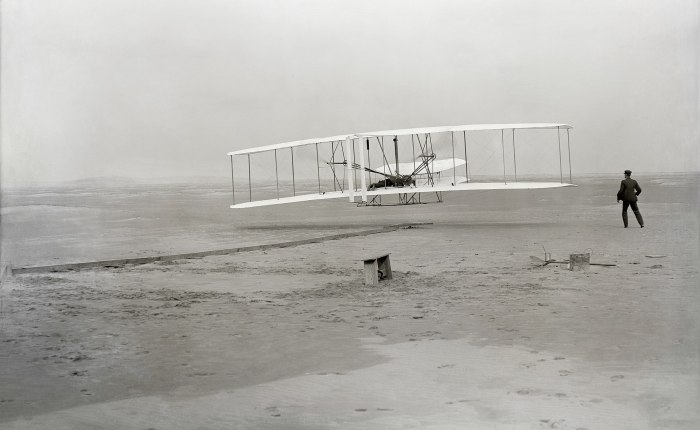
When you open a McCullough book you know what to expect: fine prose, strong storytelling, and inspiring stories of American heroes. That is his domain, and he is the master of it. This book about the Wright brothers exemplifies all of these virtues in just over 300 pages. The audio book in particular, narrated by McCullough himself—whose folksy and yet erudite speaking voice encapsulates his ethos—is perhaps the most concentrated form of McCullough that you can imbibe.
Like many people, I was surprised at how little I knew about the Wrights. My hazy impression of their story was thus: The brothers were eccentric bike mechanics who, through a series of trial and error, managed to make some primitive flying machines, devices that could putter a few hundred feet and lift a few dozen feet off the ground. This is quite wrong. The Wrights approached the problem of flight with remarkable dedication and care. They read all the scientific literature they could find; and they performed careful experiments, documenting each step of the way. Their final product was not just some clumsy motor-powered kite, but a sophisticated machine capable of crossing the English channel and flying over the Eiffel Tower. Their creative vision was matched only by their persistence and perfectionism.
The story of the Wrights is legitimately inspiring. Having no special resources, no roadmap, no background, no support, they were able to succeed where so many other famous and wealthy inventors failed. They endured countless setbacks, both in the research and development of their craft and then in achieving recognition for their accomplishments. But in the end, two modest men from Ohio profoundly changed human life. It is a testament to their tenacity as much as to their intelligence.
It is difficult to criticize McCullough, because he does so perfectly what he sets out to do: show us how people in ordinary circumstances accomplish extraordinary things. But of course, this requires minimizing or even ignoring many aspects of a story that would attract other writers. One prominent example of this is the Wrights’ personalities. McCullough portrays them as dignified and diligent, representatives of an old-fashioned work ethic, unconcerned with fame or fortune. But in the hands of another biographer, the Wrights might not come across as so perfectly admirable. To me, they seemed curiously aloof, distant, and even repressed. The fact that Orville flew into a rage when his sister got married, for example, seems to be worth more investigation than McCullough is willing to give it. He dismisses the long estrangement as one of Orville’s “moods.”
Reading McCullough is a bit strange in today’s political climate. He was never concerned with being cutting-edge; but now more than ever he feels distinctly like a holdover from another era. As is commonly observed, American life has become deeply divided; so McCullough’s mission—to write about universally admirable Americans—seems especially quixotic. Yet McCullough’s reputation appears to have survived the late polarization relatively intact. And I think that is a good thing. True, it is wise to be wary of national mythologizers. But for the life of me I cannot find anything to trouble my conscience or divide the nation in the figures of Wilbur and Orville Wright.





















 Lotz in Translation