In the Footsteps of García Lorca

In the Footsteps of García Lorca

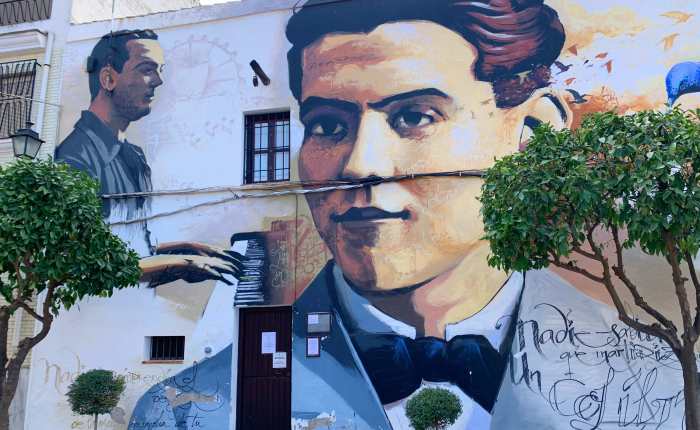
Federico García Lorca is the most famous playwright and poet that Spain produced in the previous century. This is largely owing to undeniable brilliance, as any readers of Bodas de Sangre or Yerma can attest to. Yet his fame is also due, in part, to the tragic story of his death—executed by Nationalist forces during the first few months of the Spanish Civil War. Among the hundreds of thousands dead from that conflict, Lorca remains its most famous victim. And in death, he has become a kind of secular saint to artistic freedom.

The precise details of Lorca’s murder were, for a long while, rather obscure; and it is largely thanks to the Irish writer, Ian Gibson, that it was finally uncovered. Prior to our trip to Granada, Rebe had read Gibson’s book, El asesinato de García Lorca, and so we had a full Lorca itinerary planned.

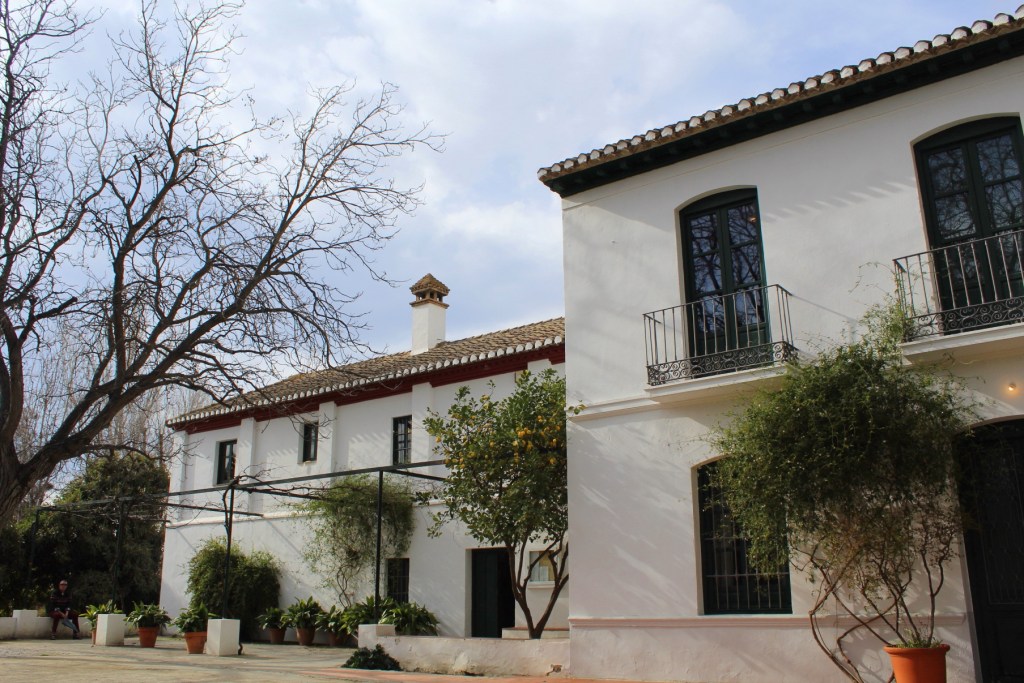
Our first stop was the Huerta de San Vicente. This was the summer house of the García Lorca family for the last ten years of the poet’s life. It is a kind of rustic villa, typical of Andalusia, with large windows and whitewashed walls—ideal for keeping cool. We joined a tour and were shown around the house, which has a piano that Lorca would play on (he was a gifted musician, and friends with Manuel de Falla), as well as a desk at which he wrote.

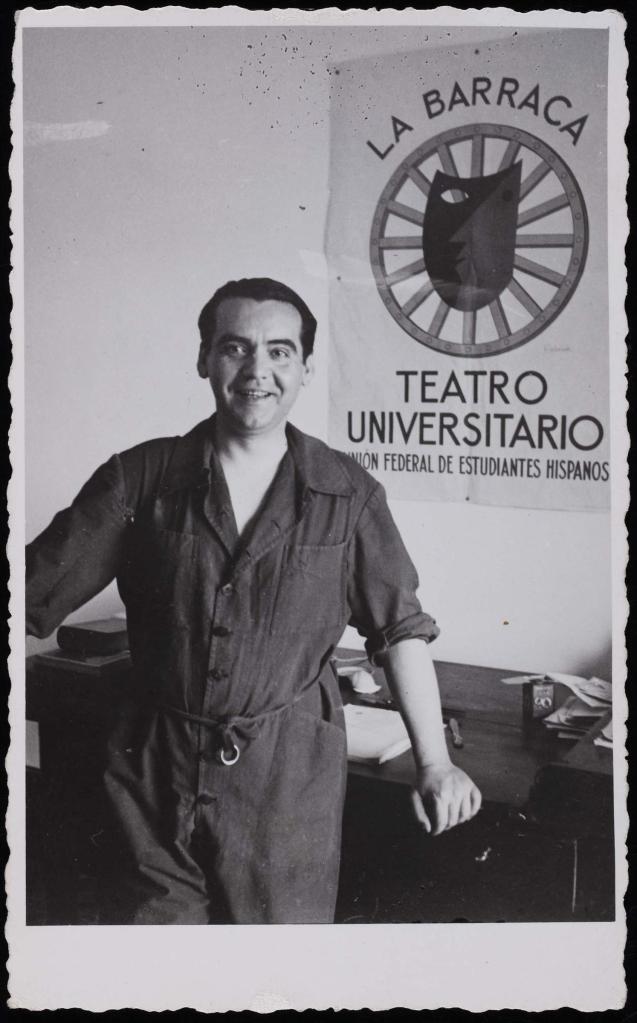
The hour-long visit gave a satisfying overview of the many facets of his short life. Lorca came across as a man wholly devoted to the arts—to music, to poetry, and above all to theater. One of my favorite items on display was a poster for La Barraca, a popular theater group that he helped to direct. They would travel around the countryside and perform for the benefit of the public, putting on avante-garde shows for the masses. It reminds me somewhat of the Federal Theater Project of the American New Deal, and demonstrates that Lorca, while not overtly political, did not shy away from social causes.

Our next stop was the small town of Fuente Vaqueros, which is a short drive from Granada. There, we visited the house where Lorca was born and spent his earliest years. It is a large house with thick walls, ideal for keeping out the heat. We were given a tour—just the two of us—by a local whose grandfather had gone to the same primary school as Lorca himself! He explained that the Lorca family was quite wealthy, having made their fortune in the tobacco business. Indeed, their house was one of the first to receive electricity in the area.

The upstairs of the house was made into a small exhibition space. Among other things, there is the only extant video clip of the poet, as he emerges from a truck used to haul theater supplies. The video has no sound and it lasts for only a few moments. Yet it is a tantalizing glimpse into the past. Also on display are puppets that Lorca made, in order to put on shows for his baby sister.

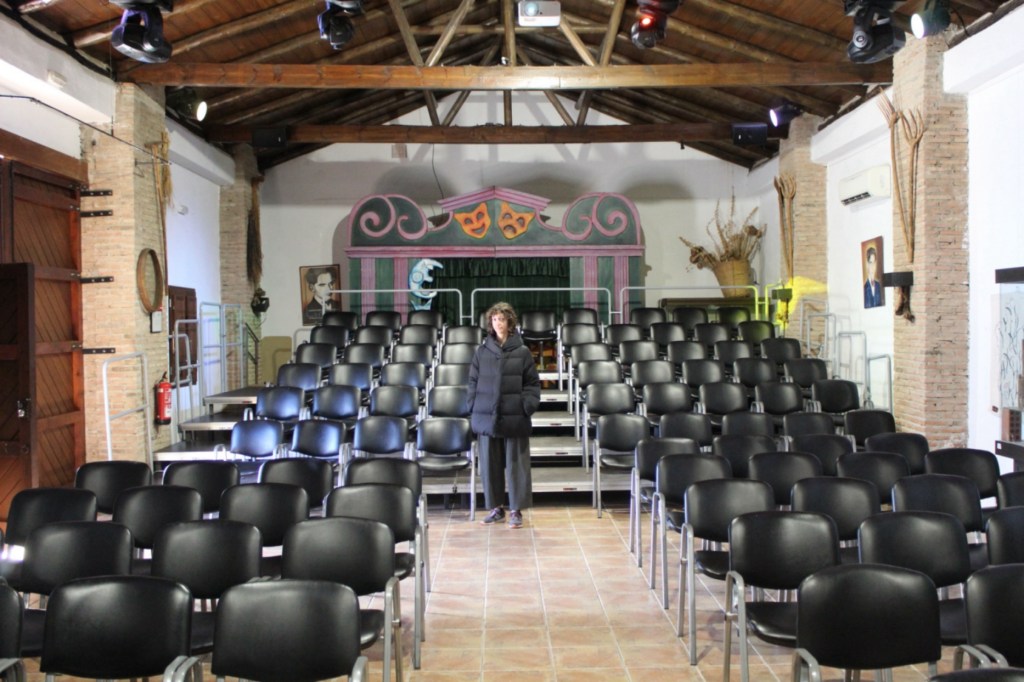
A short drive from Fuente Vaqueros is the town of Valderrubio, previously known as “Asquerosa” (“Disgusting”). Apparently, this name is a linguistic coincidence, having come from the Latin Aqua Rosae (“Pink Water”), but it led to the unfortunate toponym “asquerosos” for the denizens of this perfectly inoffensive town. Here is yet another house museum of the playwright, this one larger and grander than the one in Fuente Vaqueros. Unfortunately, however, we arrived too late for the tour of this house, and had to content ourselves with a quick walk-through.

Rebe in the theater attached to the house museum.

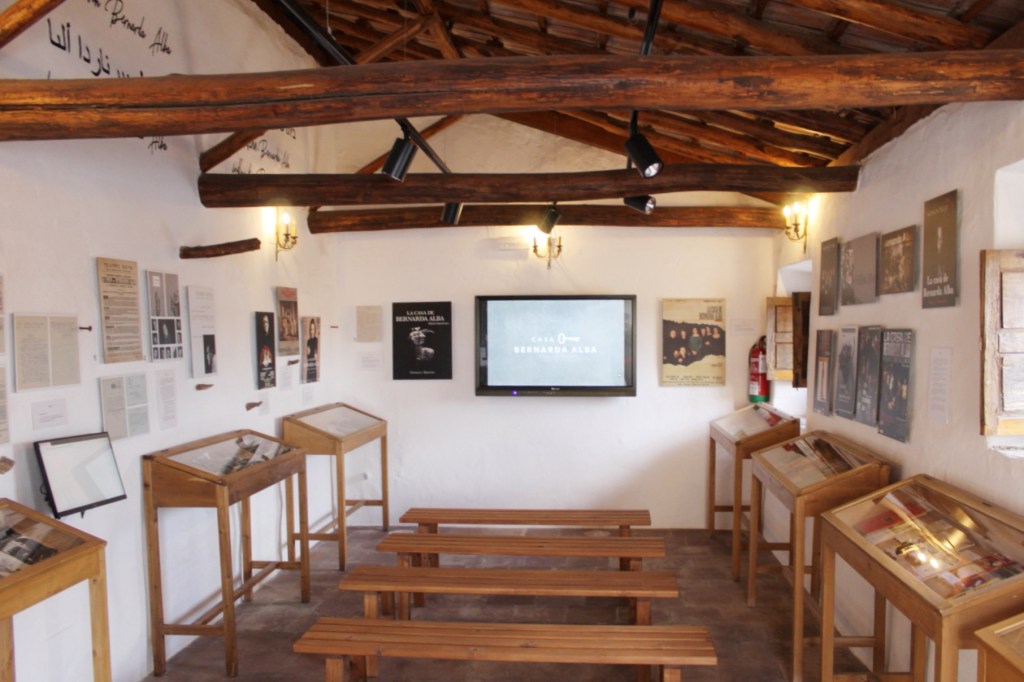
But we were on time for the tour of the House of Bernarda Alba. This is an attractive villa next to the Lorca property, where a widow lived with her daughters. Federico used this family as the basis for one of his best plays, La casa de Bernarda Alba, which is about a tyrannical widow who imposes a decade’s long period of mourning on herself and her daughters after the death of her husband. Apparently, the actual family—who I presume weren’t nearly as monstrous as Lorca portrayed them—were understandably quite offended by this, and cut off contact with the Lorcas. And now, to add insult to injury, their home stands as a museum to the poet’s honor!

Our last stop was rather more somber. On the 19th of August, 1936, Lorca was arrested, taken outside the city, and shot. Against the advice of his friends, on the eve of the Civil War he had traveled to his native city. But as war broke out and violence spread, he realized that he was unsafe and so hid himself in the home of family friends, who were members of the right-wing Falangist party. The political connection didn’t help. Along with three other men, he was taken to a spot on the highway between Vïznar and Alfacar and shot.

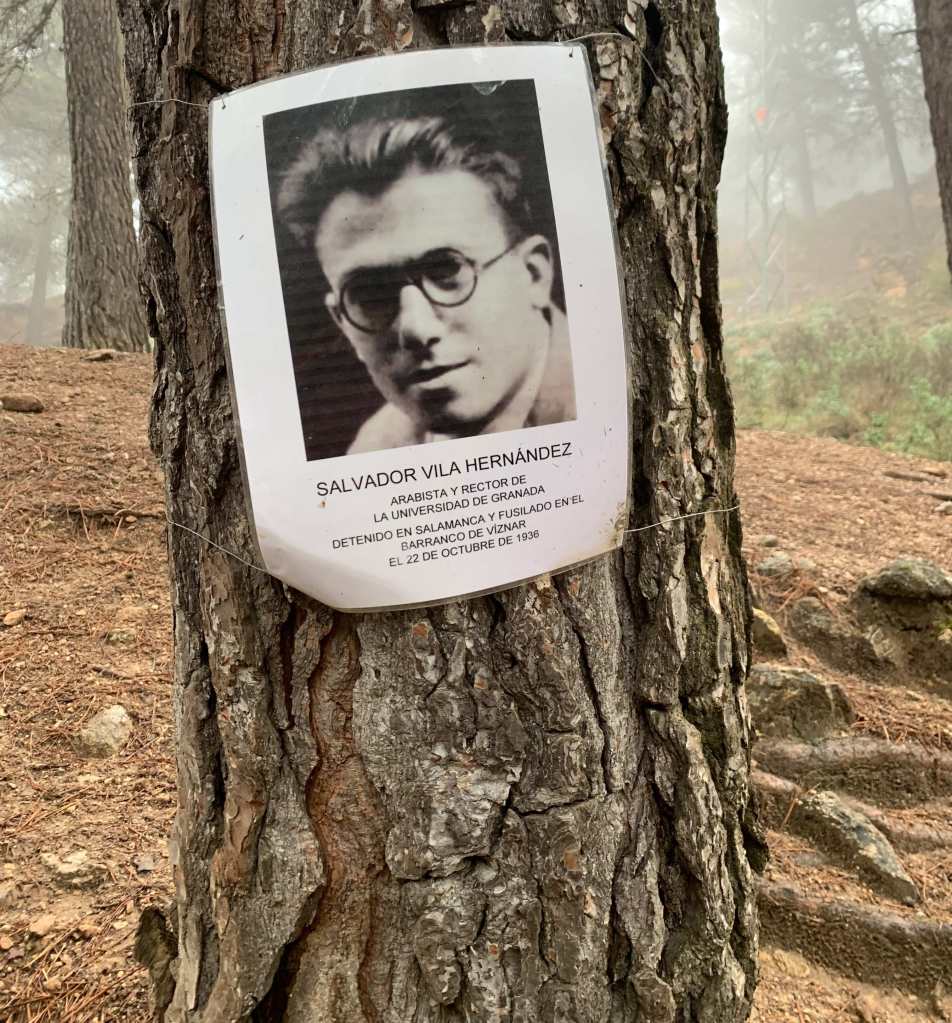
The place where Lorca was executed is hardly recognizable today. At the time it was a barren hillside, completely devoid of vegetation. Today, however, it is a grove of tall pine trees that cover the ground with shade. We parked the car and walked up a hill, not sure what we were looking for. Then we noticed papers tacked onto trees, like ‘Lost Cat’ posters on telephone polls. They were photos of the people believed to be executed here. There were dozens of these photos, each one with a name, profession, and believed date of death.

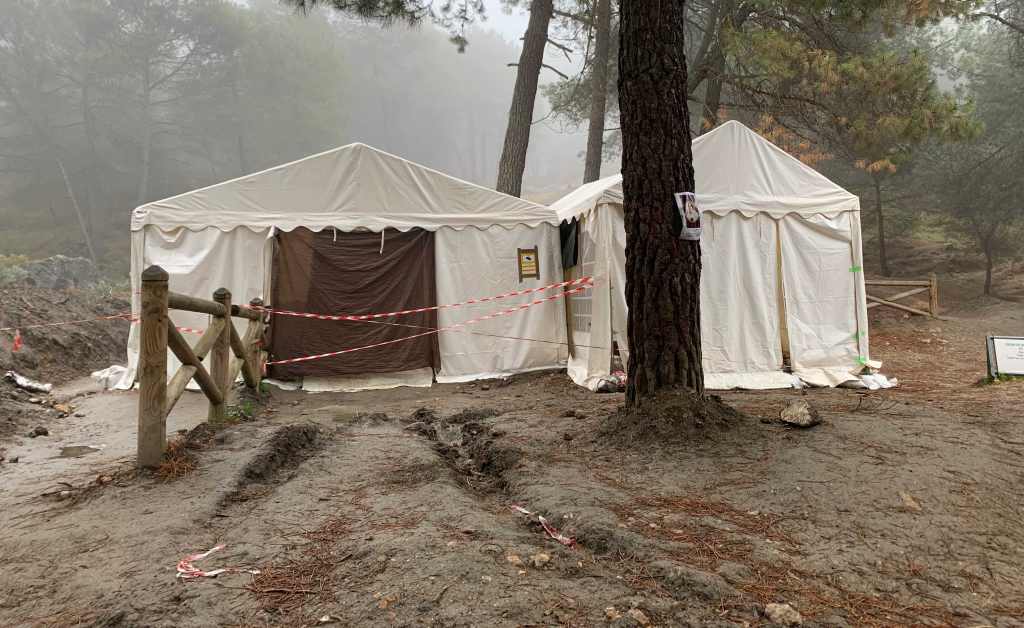
Even more unsettling were the white tents, standing empty and silent. They were covering excavation pits, where investigators are finally unearthing the remains of the hundreds of victims executed here, nearly a century after the Civil War. The investigators are also collecting DNA samples from surviving family members, so as to be able to identify any remains they uncover. Lorca’s body is believed to be here somewhere, though it hasn’t been identified yet. (You can learn more about the effort by following the groups’s Instagram.)

To state the obvious, it is chilling to think that such a harmless man—a gift to the world and an ornament to his country—could be deemed so threatening that he had to be executed this way. His last moments must have been terrifying. His work, however, has outlived Franco and his regime, and perhaps it will outlive the current constitution.

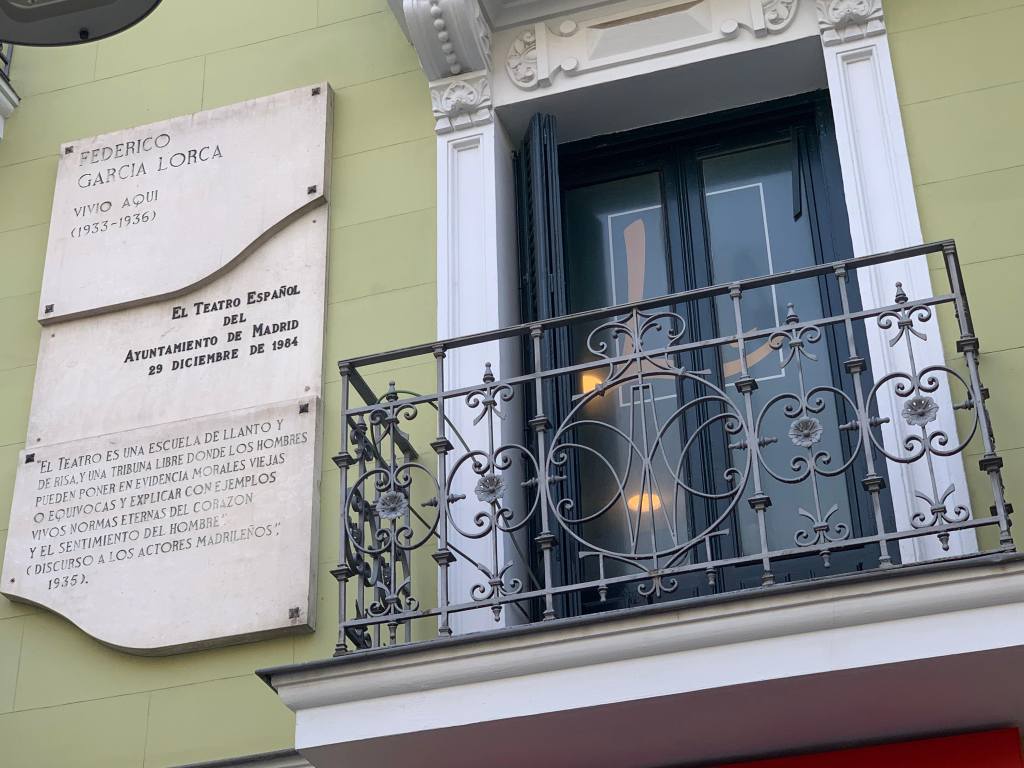
Now, for the very serious Lorca fan, there are also some sites to visit in Madrid. There is a lovely statue of the poet in the plaza de Santa Ana, and on Calle de Alcalá 96 there is a plaque which marks the apartment where Lorca lived for the last three years of his life. Another worthwhile visit is the Residencia de Estudiantes, where Lorca lived as a student along with his Dalí. The two were very close as young men, though many have criticized Dalí’s later reconciliation with the Francoist regime as a betrayal to the memory of his friend. 

But, of course, the most important thing is not to follow in his footsteps, but to keep reading and performing his works. This way, he will remain forever alive. 

Monet: Giverny, L’Orangerie, Mormottan

Monet: Giverny, L’Orangerie, Mormottan

The name of Claude Monet stands over the artworld like a colossus—the man who defined one of the most iconic movements in art: impressionism. For a great many, I suspect, these blurs of color and light are what immediately spring to mind when they imagine the French countryside. The image of the paint-stained artist, brush in hand, standing in a field of grass, flouting both artistic conventions and social norms, is virtually a cliché now. But all of this we owe to Claude Monet.

Stereotype or no, I admit that this vision of the artist has a certain romantic appeal to me. And so I decided, on my last trip to Paris, to pay a visit to the home of this artist to partake of this dreamy, wistful aesthetic.

Normally, getting there from Paris is no challenge. A high-speed train bridges the distance in less than an hour—departing from Gare Saint-Lazare, a station Monet depicted in a series of paintings, and then arriving in the town of Vernon. This town lies just across the river Seine from Giverny. A taxi, a bus, or even a sprightly walk will get you to Monet’s house in no time.

Gare Saint-Lazare

But I was unlucky. During my trip, in May of 2024, there was maintenance scheduled on this particular train line, so this option was out. So I opted for something I habitually avoid: a guided bus tour.

The bus was set to depart early in the morning, from the Avenue de la Bourdonnais, in the shadow of the Eiffel Tower. However, there was a hitch. As the group of tourists—speaking a babble of tongues—gathered on the pavement to board the bus, a police officer approached the tour guides and explained something with authoritative insistence. Apparently, the bus could not park in its usual spot, because of the new rules put in place in preparation of the summer olympics.

The preparation was already apparent. The Champs de Mars was buried in a mass of scaffolds, and a large stage was nearly finished in the Trocadero on the other side of the river. What this meant for us, however, was that we had to walk to a street a few blocks away. As we walked, a young Italian woman, who spoke astoundingly good English, chit chatted with an elderly American couple; but I was too focused on Monet for smalltalk.

The bus swept us out of the city and into rolling fields of green. We were headed north, towards Normandy. On the bright May morning, it was easy to imagine why this gentle, domesticated landscape inspired artists to capture its delicacy.

We arrived in no time, and I followed the crowd into the property. This was a moment I had imagined to myself many times. Monet’s gardens are a kind of mythical place in the world of art, a place I had seen through Monet’s eyes innumerable times, imbued by his vision with mystery and translucent beauty. It was almost a surreal moment, then, when I realized that I was standing in the gardens, and that they were real, physical, concrete.

The gardens are divided into two sections. Directly in front of the simple house, with its pink plaster walls and vine-covered trellises, there are rows of flowers in square plots. They are arranged like globs of paint, splashes of color that look organized from afar but haphazard from up close. It is impressionism made manifest.

The more famous section of the garden is on the other side of the highway that runs through town. Monet purchased this property later, which is why it is not contiguous with the original gardens. Visitors nowadays can pass from one to the other through a small underpass under the road, but Monet himself would have had to cross it.

If the first section embodies the lightness and prettiness that is often associated with impressionism, this one is its highest embodiment. Here, Monet expressed his love for Japan, with the thicket of bamboo, the famous pond of water lilies, and the green wooden bridge. The pond is shallow and murky, and ringed all sorts of trees, bushes, and flowers. As a result, the surface texture is a mixture of reflections—of the blue sky, grey clouds, and the surrounding gardens—and the waterlilies lurking below. Though I was there briefly, it took little imagination to picture how the surface could change with the time of day, the weather, and the seasons. It is a kind of laboratory to study color and light.

I would have loved to have basked in the garden for hours, but my time was limited by the tour bus schedule. So I pulled myself away to queue up for the house. It is much as one might expect of Monet—open, light, airy, and unpretentious. Unfortunately, however, it is difficult to put oneself in the artist’s shoes and imagine oneself at home, if only for the constant crowds pushing the visitor from room to room. But I still had a few moments to appreciate Monet’s fine collection of Japanese prints.

The visit ends, as so many do, in the gift shop. Yet unlike so many gift shops, this one is actually one of the main attractions. Though it looks like a large green-house, this was actually Monet’s studio—and it is easy to see why, as the large windows in the ceiling flood the space with light. Perhaps it is sacrilegious to fill such a space with knick-knacks for tourists; yet, as far as knick-knacks go, the items on display are surprisingly enticing, if only because they are adorned with the master’s paintings.

If I had more time in Giverny, I would have walked the short distance to the Église Sainte-Radegonde, where Monet is buried in a family plot. I would also have liked to visit the small Museum of Impressionism, which has a collection of paintings by Monet and others. But, alas, my tour bus was departing for Paris, and I didn’t have any more time to spend in Giverny.

When I got back into the city, I decided to round out my Monet experience by visiting the Musée Marmottan. This is located near the Bois de Boulogne, a huge park to the west of the city. The museum has one of the finest Monet collections in the world, mostly thanks to a huge donation by Michel Monet, the artist’s only heir. It is housed in what used to be a Duke’s old hunting lodge; and like the Frick Collection in New York, it preserves some of the ambience of obscene wealth.

The museum has a series of rotating special exhibits (when I visited, it was about art and sport) and a collection of impressionists that goes far beyond Monet. But his work is the main attraction. The paintings are held in an underground space, modeled after another museum in Paris, the Musée de l’Orangerie—with large, open, well-lit rooms which situate the viewer in a kind of simulated garden.

And, indeed, standing there after paying a visit to the real garden gives you a wonderful insight into the way an artist’s eye can both capture and transform its subject. Monet’s paintings are both highly “unrealistic”—impossible to mistake for a photograph, say—and yet startlingly accurate. They convey subtleties of light and color that a more “correct” technique would overlook. Or rather, they convey a kind of flavor—a subjective sensation, overlaid with aesthetic appreciation.

The only disappointment of my visit was that the museum’s most famous work, Impression, Sunrise, was away on loan. This work, which Monet completed in 1872, was monumentally influential; it would eventually give the entire artistic movement its name. The painting was both daringly original and a continuation of trends that came before. Its originality is apparent when compared to the oil paintings of the established French artists of Monet’s day, with their impeccable technique and focus on mythological or allegorical subjects. Monet’s work is nothing like that. But a side-by-side comparison with, say, a Victor Turner painting shows how Monet took pre-existing techniques for portraying light and atmosphere, and then expanded on them.

Impression, Sunrise

The last museum I want to discuss is one I visited many years before this trip, before even the 2020 pandemic: the Musée de l’Orangerie. This museum is in what used to be an “orangery,” a building to protect orange trees from the harsh Paris winter. In the past, you see, oranges were something of a royal prerogative—so delicate that only the huge resources of the monarchy could keep them alive in European climes. This particular orangery is located in the Tuileries Garden, and is the home of Monet’s most impressive works.

The visitor enters and almost immediately finds herself in an oval room, flooded with white light. Running along either wall are huge canvases, the Water Lilies—so big that you can easily imagine that you are visiting Monet’s home in Giverny. They are mesmerizing: exuding an almost mystical intensity. In their own way, these paintings are as ambitious and monumental in scope as any in art history; and yet, they are concerned with something completely ordinary. What makes them so powerful is the intensity of vision that Monet brings to the scene, as if he is somehow penetrating the surface layer of reality and looking at its essence.

I remember sitting on the central benches a long time, and willing myself to extract as much from the paintings as I could. I tried to imagine what it would be like for me to have such a vision, to see light and color as pure attributes of nature, rather than mere signs of material things. What I’m trying to say is that these paintings struck me as being wonderfully profound, in a way that very few paintings do. But then again, perhaps I just like pretty pictures.
Well, that rounds out my Parisian Monet experience. While I’m sure his work is not to everybody’s taste—with its focus on pure aesthetic qualities instead of content—I think that Monet has earned his place in the pantheon of artistic greatness. His career was intensely innovative, and he nurtured his creativity into his old age. Unlike so many artists, it is Monet’s final works which have arguably become his most celebrated. Further, I think his art is especially relevant now, as the contemporary art world—with its emphasis on message over form—has moved so radically away from the principles he embodied. This is not to say that either camp is correct, only that Monet’s vision of art is one that is worth getting to know.

Don Bigote’s First Review

Don Bigote’s First Review

This past Friday was the official book release of Don Bigote and it went far better than I expected. Surprisingly, the venue was full, with people even sitting on the floors! And we sold (and I signed) far more books than I had dared to hope for.

One of the visitors to the event was an author whose own book I had previously reviewed: Mario Grande, a great polyglot. A man of prodigious talents, he read my book is less than 24 hours and wrote a review, which I quite enjoyed. I wanted to pass it along for anyone interested.

Three New Articles

Three New Articles

As part of the promotion for my new book (it’s a dirty job, but someone’s got to do it), I’ve written three ariticles for other websites. On the off chance that you want to read even more of my writing, here they are:
One is about my long and rewarding experience on Goodreads, a platform I’ve been contributing to for over a decade now. Another is about my accidental connection to the writer Washington Irving, another son of the Hudson Valley who moved to Spain and wrote about the country. And the last is a modest contribution to literary criticism, using the philosophy of science, that I wrote for The Madrid Review.

My New Book: Don Bigote!

My New Book: Don Bigote!

Don Bigote by Roy Lotz

When I began to write fiction, I hardly dared to dream that I would ever have a book published, much less two! I wish I could believe that this was due to my immense literary talent; but the truth is that, for this book, luck played a huge role in getting it published.

A few years ago, at a house party, I was introduced to a pleasant Irish man named Enda. It just so happened that he was also a writer; and, frustrated with the world of publishing, he was thinking of founding his own publishing company. It was this new enterprise, Ybernia, which agreed to put out my comic novella. As the Spanish say, I am an “enchufado.”

Don Bigote originated as an exercise in pure silliness, written to entertain a few close friends. The genesis of the idea was nothing more profound than the realization that the Spanish word bigote resembles the English bigot, and sounds like Quixote. Thus my hero was born, a mustachioed right-wing conspiracy theorist who wishes to save Western civilization.
The book consists of ten chapters and was written piecemeal over a number of years, from the first to the last years of the Trump presidency. After Trump’s defeat to Biden, I was content to let this hastily written misadventure wallow in obscurity and collect the internet equivalent of dust. It is the world’s ill luck, but my literary good fortune, that this book is now once again relevant.

If you happen to be in Madrid on February 21st, there will be a book release event in the Secret Kingdoms book shop at 8:00 p.m. (with wine, don’t worry), and I would be delighted to sign a copy for you. If not, you can find the book on Amazon or Ybernia’s website!


View all my reviews

Review: Times Square Red, Times Square Blue

Review: Times Square Red, Times Square Blue

Times Square Red, Times Square Blue by Samuel R. Delany

My rating: 5 of 5 stars


When I was an undergraduate, having rashly and unwisely switched my major from chemistry to anthropology, I met with my academic advisor. He asked me: What do I hope to learn as an anthropologist? To this, I gave the answer: I want to walk through Time Square and understand why it is the way it is. Yes, grandiose and pretentious, but it did capture something—the urge to figure out why the world is filled with so much soulless, commercial crap.

I am now suffering the financial consequences of studying anthropology, and not much closer to enlightenment. Thanks to this book, however, I do feel closer to understanding that mecca of American consumerism: Times Square.

This is a highly unusual book. Delany, who usually writes science fiction, set out to write a work of urban studies. And yet it is just as much a memoir as an academic analysis, and it comes to its point in a very roundabout way. Even so, it is easily among the best books about New York City I have ever read.

The book is divided into two essays, originally published independently. The first, “Times Square Blue,” recounts Delany’s experience of the old, seedy Times Square—the Times Square of peep shows, prostitutes, drugs, and sex shops. Specifically, it focuses on the porn theaters, places which became gay cruising grounds, despite showing almost exclusively straight porn. Delany spent decades visiting these theaters and paints a memorable portrait of this now unimaginable Times Square.

Yet this part of the book is not prurient. Delany doesn’t write to titillate the reader, or even to mourn a part of the city that has disappeared. He writes, instead, to illustrate an idea about what makes cities work. It is really an expansion of what Jane Jacobs said in her classic book on the subject: that cities need to foster contact between different sorts of people. Delany merely adds a sexual dimension to this analysis, and he shows how his own search for men threw him into contact with all sorts of people whom he would never have met through work or other socializing.

Part Two, “… Three, Two, One Contact: Times Square Red” expands this observation into a theory. Delany contrasts “contact”—the kind of random meeting of a stranger, such as in line at a grocery store—with “networking,” which is a more formalized way of meeting people, such as at a book convention. An important difference between the two is that, in the former, it is common to meet people of different backgrounds and socio-economic classes, while the latter usually restricted to members of the same class.

Delany asserts that much of the modern world is intentionally created to promote networking and to discourage contact. And the redevelopment of Times Square is a case in point. Whereas it was possible to go to the old Times Square and meet all sorts of people, in the Times Square as it exists today there are simply tourists and people trying to make money off of tourists. And very few people who visit Times Square now, I reckon, meet anyone at all.

There are further aspects of Delany’s analysis—much of it in a Marxist vein—but to me the pleasure of this book was simply in the love of city life that he exudes. On every page, the reader can feel that he simply enjoys meeting people of different sorts, and finds that it enriches his life. It is a wonderful antidote to the sometimes suffocating loneliness that big cities can engender—the feeling of being surrounded by people, and yet completely ignored. While reading this book on the metro, I suddenly became aware of everyone else on the train as individuals and not faceless mannequins. It made the ride far more pleasant.


View all my reviews

2025: New Year’s Resolutions

2025: New Year’s Resolutions

Happy New Year, everyone! This year turned out to be a great year for writing. True, I didn’t finish working on my new novel, but that’s because I decided that it needed to be more thoroughly re-written. But I branched out in my writing, trying to write stories based on original research and interviews, rather than just my own experience. This led to my writing about my neighborhood, craft beer, and hot sauce; and I hope to continue this kind of pseudo-journalism in the future. The world is full of interesting people, after all.

In other news, I have a new book coming out in February! In fact, it’s one that originated on this blog: Don Bigote. I may even get an official book release! I’ll keep you posted.

But I do have a backlog of travel pieces. Here’s a quick list:

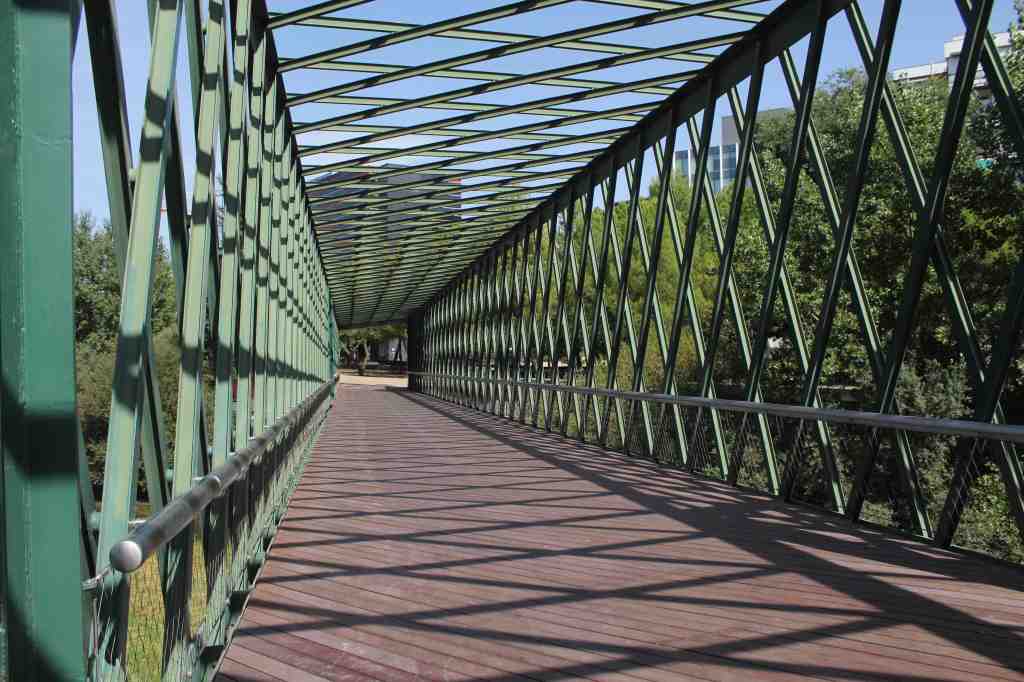
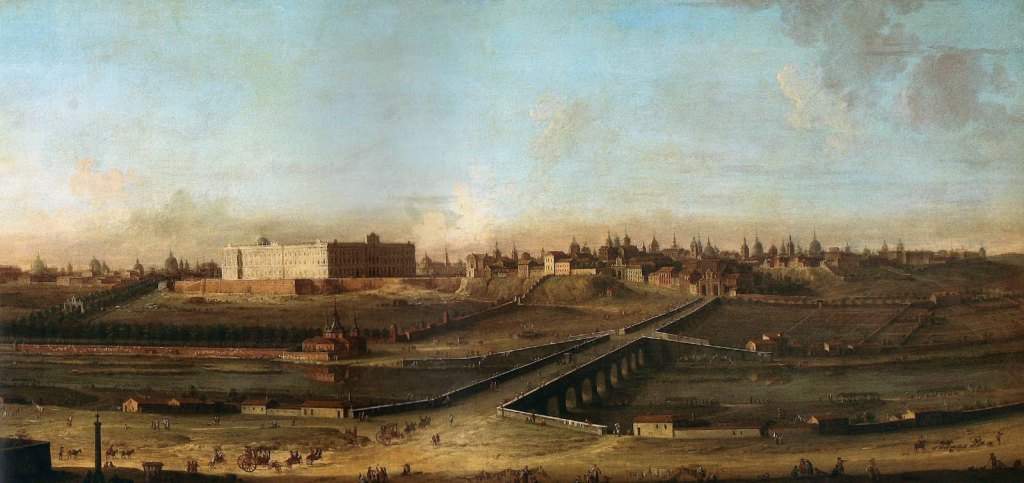
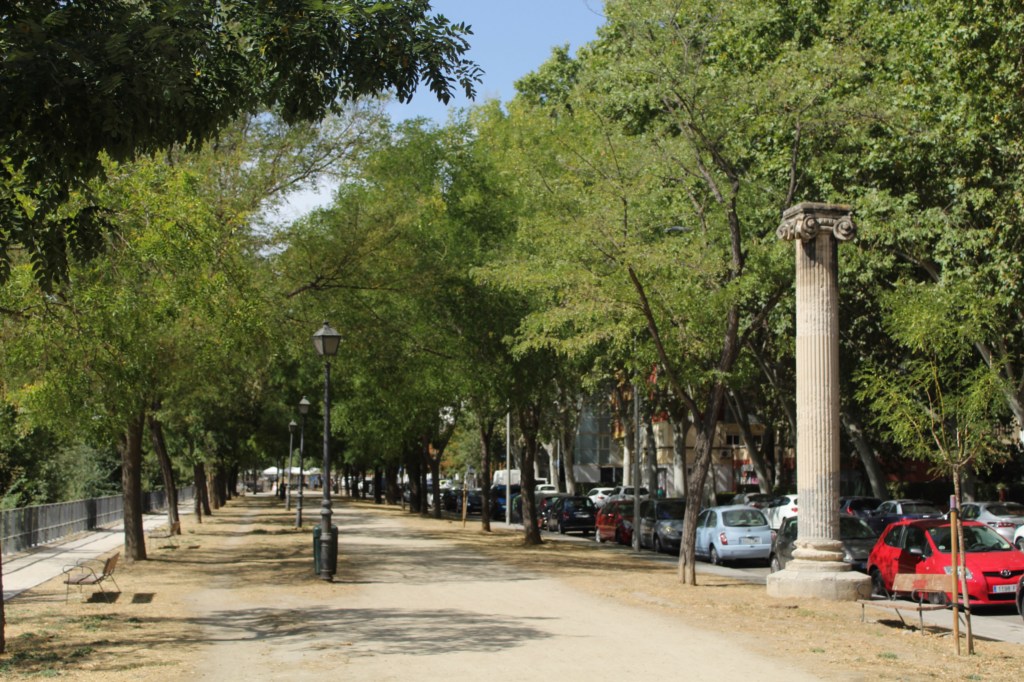
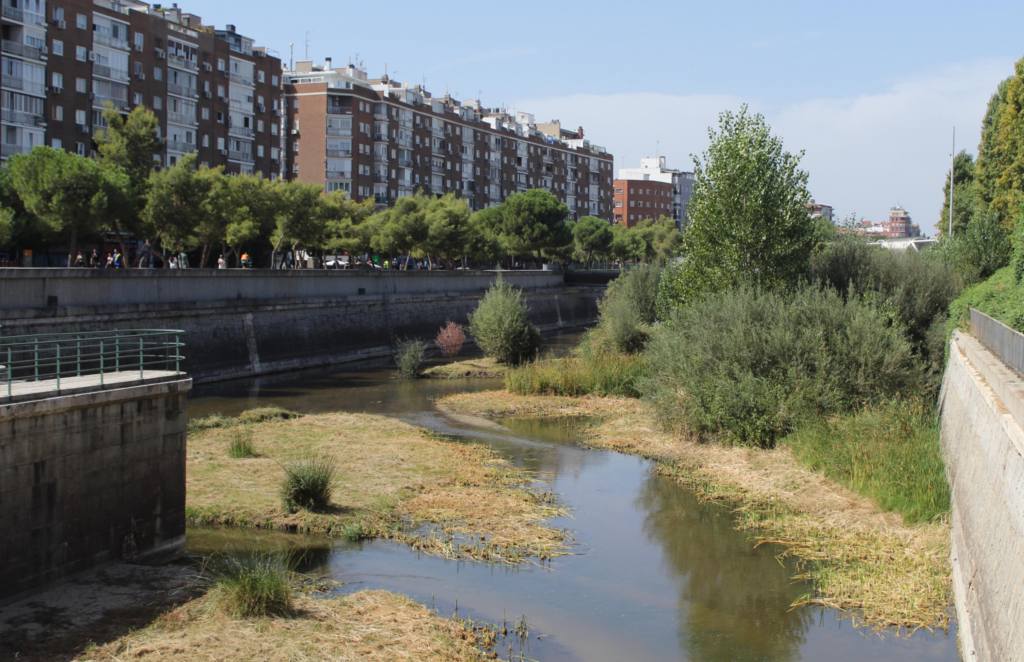
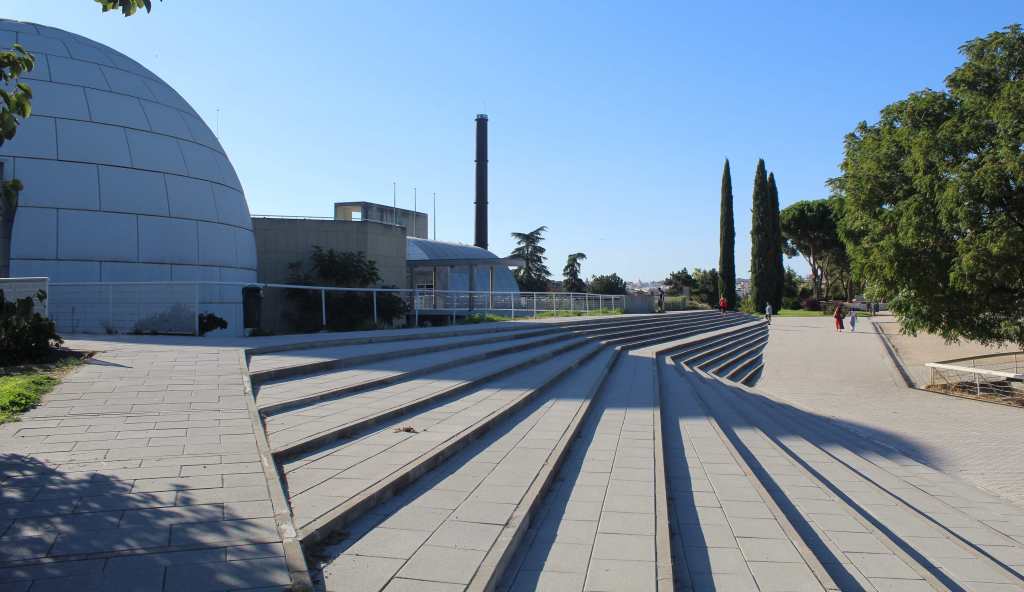
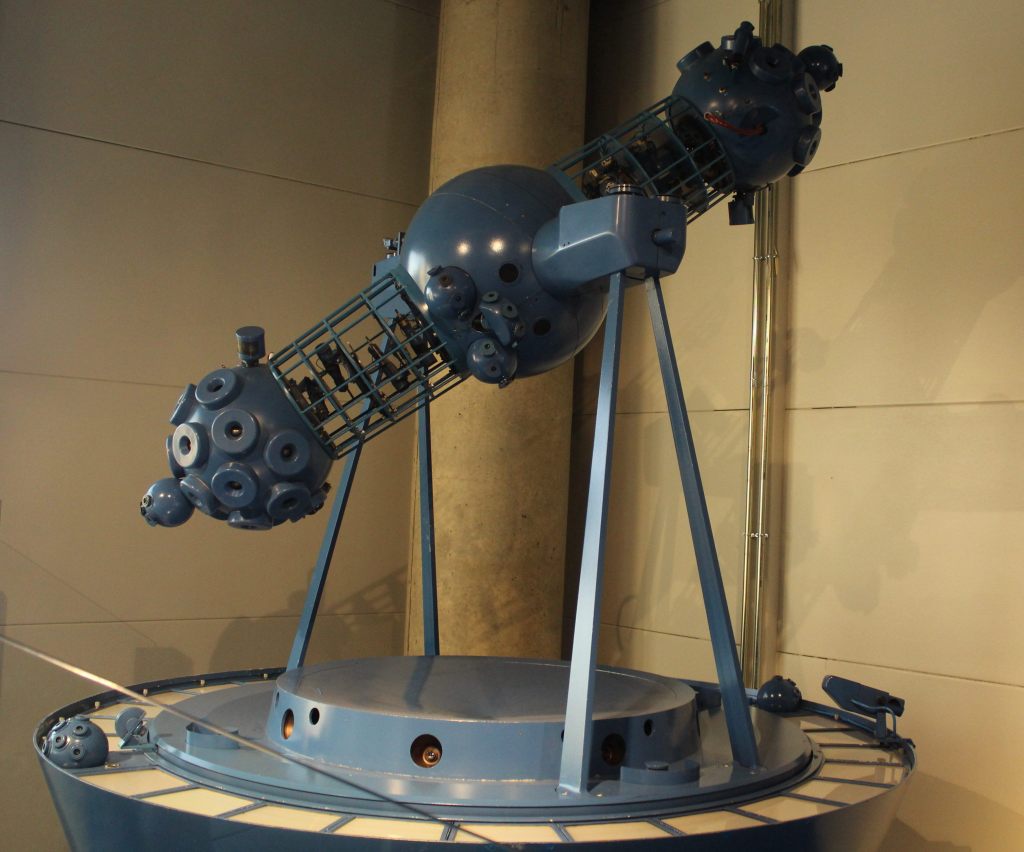
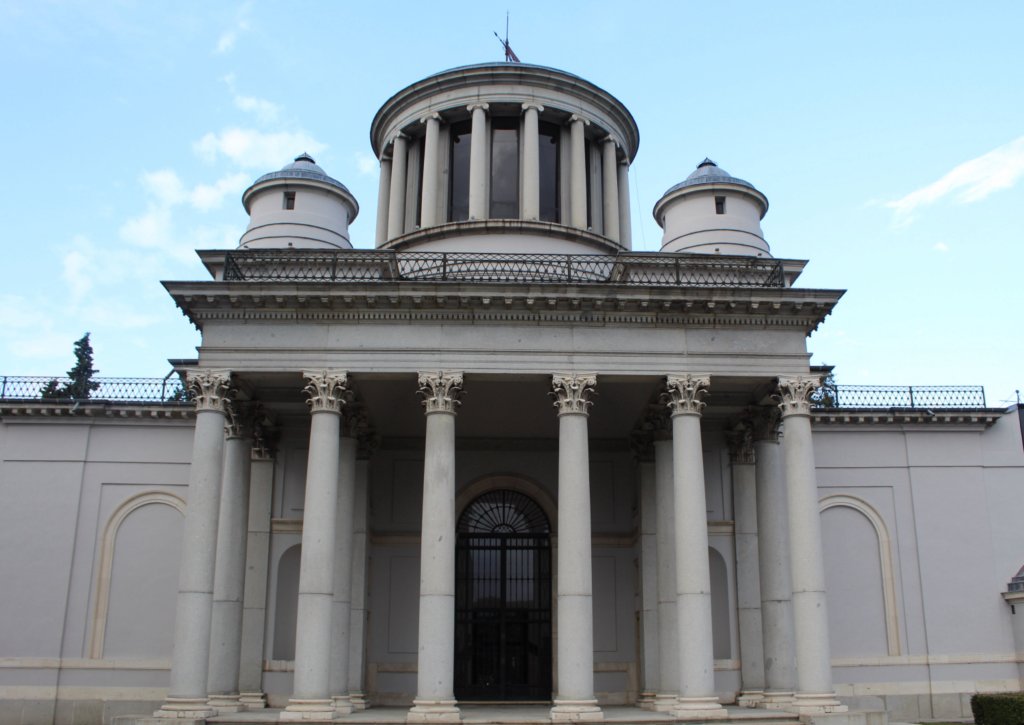
Aside from this, there are many sites around Madrid that I hope to include, such as the Royal Observatory, the Tapestry Factory, and the Madrid Río.

And of course there are an endless number of books to read and review. As it happens, I just came into possession of a trove of books about New York City, so it appears that the great Metropolis will be a major subject of my reading. I also still have the last of Caro’s LBJ books, and the last two of Churchill’s WWII memoirs. Apart from that, I can’t guess what books the year will throw my way.

Outside of the blog, my major goal is to get myself a more lucrative job, whatever that takes. But I suppose that’s always the case. So here is to a happy, healthy, prosperous 2025!

2024 in Books

2024 in Books

2024 on Goodreads by Various

My rating: 4 of 5 stars


I seem to be slowing down in my old age. About a decade ago, I was reading well over 100 books a year. Since then, my total book count has steadily gone downward, a dismal sign of adult responsibilities encroaching on my free time. But I still managed to finish some excellent books.

In election years, I tend to get swept up in the frantic political mood, but this year somehow I managed to maintain calm. My big election read was What It Takes, Richard Ben Cramer’s monumental account of the 1988 election. It was a thorough reminder of how much American politics have decayed during my lifetime. This was complemented by Robert Caro’s Master of the Senate, a monumental exploration of how power operates on a national scale. The attempted Trump assassination also prompted me to read the Warren Commission Report and to finally learn all of the gory and suspicious details of the JFK assassination.

But the major theme of the year was, broadly speaking, the 1920s, 30s, and 40s in America. I’m fascinated by this period because it seems to separate the past from the present—a historical crisis that birthed the modern world. The best general overview of the period I know is David M. Kennedy’s Freedom From Fear, but I supplemented this with Studs Terkel’s books on the Great Depression and World War II, Frederick Lewis Allen’s books on the 1920s and 30s, two volumes of Churchill’s WWII memoirs, and two books on the Dust Bowl. I admit that it was reassuring to be reminded that the United States has already survived crises of extraordinary proportions as we face a second Trump term.

But many other valuable books just came my way. Among these were Mozart’s letters—a thoroughly charming self-portrait—and Bianca Bosker’s wonderful book on the contemporary art scene, which illuminated a world that had previously been a complete conundrum to me. This also included Jon Krakauer’s two most famous books—about Chris McCandless and the 1996 Mount Everest Disaster—which deserve their fame. Sei Shonagan’s classic of Heian Japan, The Pillow Book, made a lasting impression on me; but the most unexpectedly good read was The Ethical Slut, a manual of polyamory which has much to teach prudes such as myself.

Like last year, this one has been rather light on literature. I read some good plays—a couple of Brecht plays, and Tom Stoppard’s postmodern Shakespeare sendup—and two novels by Sinclair Lewis. Yet the most beautiful piece of writing I encountered was James Agee’s sui generis Let Us Now Praise Famous Men, a book worth reading for the quality of the prose alone.

As always, I heartily thank the Goodreads community for allowing me to express my thoughts and to learn from yours. In the new world of AI, this platform seems to be stuck in time, and I’m not complaining.


View all my reviews

Adventures in Public Healthcare

Adventures in Public Healthcare

In the wake of the murder of Brian Thompson, the simmering anger that Americans feel for their healthcare system has boiled over. The internet is full of stories of people denied necessary treatments and medicine by our byzantine and heartless insurance industry. The alleged killer, Luigi Mangione, has even become a kind of folk hero to some, for taking revenge against a system they believe is just as guilty of murder—if not more so.

Fortunately, I don’t have a horror story about the American healthcare system to contribute. Nor am I here to lionize Mangione. Instead, I wanted to write up my experience dealing with a public healthcare system, in case any Americans are curious about what it is like in the rest of the world.

Shortly after running the Marathon, in 2023, I wanted to go to get a checkup to make sure I was alright. At the time I had private insurance through my job, which is fairly common even in a country with a robust public system. However, I should note that even the private insurance here is much better than it is in the United States. I never had a copay and, as far as I know, didn’t have a deductible. When I went to the dentist, podiatrist, or radiologist, the subject of money was not even brought up. Far from the American experience, here people get private insurance for convenience, and don’t seem to spend any time fighting with their insurers.

I went to an English-speaking doctor popular among expats. After a blood test, it turned out that I had extremely low iron reserves and was mildly anemic. My levels of ferritin (an enzyme that stores iron) were particularly low, about a quarter of the minimum level.

My doctor didn’t seem particularly concerned. He prescribed me iron pills to take for 90 days and told me to check back after the summer. By chance, during that time I got a new job, a better one, but which didn’t come with private insurance. Thus, when I went to do the follow-up, I went to the public health center in my neighborhood.

The experience was quite different. While the private doctor’s office was basically comparable to what I was used to in America—with a front desk, a waiting room, and a private room in the back to see patients—the public health center was more like an urgent care. There was a large central waiting room with metal benches and rows of doors leading to dozens of doctor’s offices.

After a brief talk with the doctor, I was told to come back in a few days for the blood test. The results were later delivered to me on the public health portal. After 90 days of iron supplements, my iron and ferritin levels were still abnormally low. Shortly thereafter, I got a call from the doctor. She seemed concerned. She asked me if I was a vegetarian or a vegan; and when I said no, whether I suffered from stomach pain or diarrhea. When I said no again, she told me that I would have to do an additional blood test and, more upsetting, bring in a stool sample.

This is when I began to panic. I had blithely assumed that my low iron levels were due to overtraining for the marathon, but the doctor seemed to think it could indicate something far more serious. I will spare you the details, but the stool sample was brought, and the blood test done, with no progress. There was no blood in my stool nor was I positive for celiac disease.

The doctor called me again, and told me that I would have to go get an ultrasound. This is when I realized that they were looking for lumps in my digestive tract—ulcers, cysts, or even tumors. A letter came in the mail, telling me how to make the appointment. Within a month, my belly was smothered in sticky goo and the nurse was passing her baton over it, as if I were pregnant. I expected her to say something but she didn’t, so I just wiped off the goo and left. The report came a few days later, again through the health portal: no irregularities found.

I thought that this might be the end of it, but I got another call from the public doctor. She said that, to be absolutely sure, I would have to get a colonoscopy (of my intestines) and an endoscopy (of my stomach). This is when panic really started to set in. You see, both stomach and colon cancer can cause iron deficiency, often without noticeable symptoms—until it’s too late, that is. And while colon cancer has a relatively good outlook, stomach cancer decidedly does not.

The appointment for the procedure was set for the beginning of April. This left me about two months to stew in anxiety. My mind was not soothed when a story was published in the New York Times, just a week before the appointment, that colon and rectal cancer rates are growing among young people. It seemed like an ominous sign.

For an endoscopy, a tube is inserted down your throat; and for a colonoscopy, up the other end. You’re spit-roasted, in other words. Thankfully, they sedate you for the procedure. It is the leadup to the colonoscopy that is the really unpleasant part. As the day nears, you must increasingly restrict your diet, cutting out foods with lots of fiber or strong colors, and finally cutting out food altogether. The final step is taking a powerful laxative. It’s not a fun way to pass the day.

Since you’re put under sedation, which takes a while to wear off, you can’t go to a colonoscopy alone. There has to be someone to help get you back home. Thankfully, I had Rebe. She arrived home from work and it was time to go. Strangely, at that moment, I didn’t feel a lot of anxiety about the results. I was so tired from not eating that I just wanted to get it over with.

I waited for just about five minutes before I was ushered in. The next thing I knew, I was on a stretcher with a needle in my arm. “You’re going to sleep,” the doctor said, and I was out. I came to, as many anesthetized patients do, wondering when they were going to start, and was astounded to learn that it was already over. I felt groggy and hungover. After waiting for fifteen minutes, I was handed the report: they hadn’t found anything—no tumors, no cysts, no ulcers, just a mild gastritis. It turns out that, as I originally thought, I had just over-trained for the marathon and used up my iron reserves.

You would think that I would be ecstatic at the news. But in my groggy state, I only felt annoyed that I had gone through so much trouble just to be told I was fine. I had pizza that night and drifted off into sleep.

I wanted to relate this health scare simply because it was shocking to me that, after so many tests, and speaking to so many doctors and nurses, I was never once asked to pay. No bill came in the mail. I walked out of the hospital a free (and healthy) man. What’s more, though I had to wait a couple months for the procedure, I never felt like the wait times were excessive—a common argument against public healthcare in America. As far as the doctors went, though they couldn’t spend a lot of time with me, they were highly professional, and arguably did a better job than their private counterpart, who only prescribed me iron supplements for a potential symptom of cancer.

To be absolutely fair, I should mention that the public system in Spain seems to do a very bad job when it comes to dentistry. I’ve never heard a good word about the public dental system, and the vast majority of the people I know don’t even bother trying to use it. As a result, like many people, I have private health insurance, paying a measly four euros a month. With those four euros, I get a cleaning and a checkup twice a year, with no co-pay—though, if I need anything beyond that, I have to pay out of pocket.

However, I should also mention that dental procedures are incomparably cheaper here than in the US. A single cavity drilling and filling costs between 40 and 50 euros, for example, and a root canal is about 200—prices that would seem almost free to many Americans. Even so, this doesn’t excuse the lack of good public dental care in Spain. For the life of me, I can’t understand why teeth are deemed categorically different from the rest of the body when it comes to insurance.

Even with that lack, however, I think that the healthcare system here in Spain is far superior to what Americans have to suffer through. It is cheaper both individually and collectively, and achieves better outcomes, as evidenced by Spain’s significantly higher lifespan. Going bankrupt due to a health problem is unheard of; people are not afraid of going to the doctor or the hospital or to call an ambulance. Not everyone is satisfied, for sure, but there certainly isn’t the deep hatred on display in my country.

Unfortunately, here the public system is continually in danger of privatization by right-wing parties. But if more Spaniards understood what Americans had to deal with, they would cherish their system, with all of its faults.


Cover photo by Israel Hergón – Flickr: IMG659, CC BY-SA 2.0, https://commons.wikimedia.org/w/index.php?curid=32799310