“Well you’re a writer,” Allan said, “you know how it is. When you want to say something, you don’t make up a new word. You put old words together in a new way. That’s essentially what we’re doing when we take a solo.”
We were sitting around my dad’s dining room table, having a conversation over the battered remains of three large pizza pies. We were there to talk about jazz.
By virtue of my father, Norman, jazz has been an unavoidable part of my life since as far back as I can remember. And though I have never been a jazz fanatic, I have consistently been astounded at the musicianship displayed by so many jazz players. Name virtually any instrument, and inevitably a jazz musician will be among the best who ever touched it.
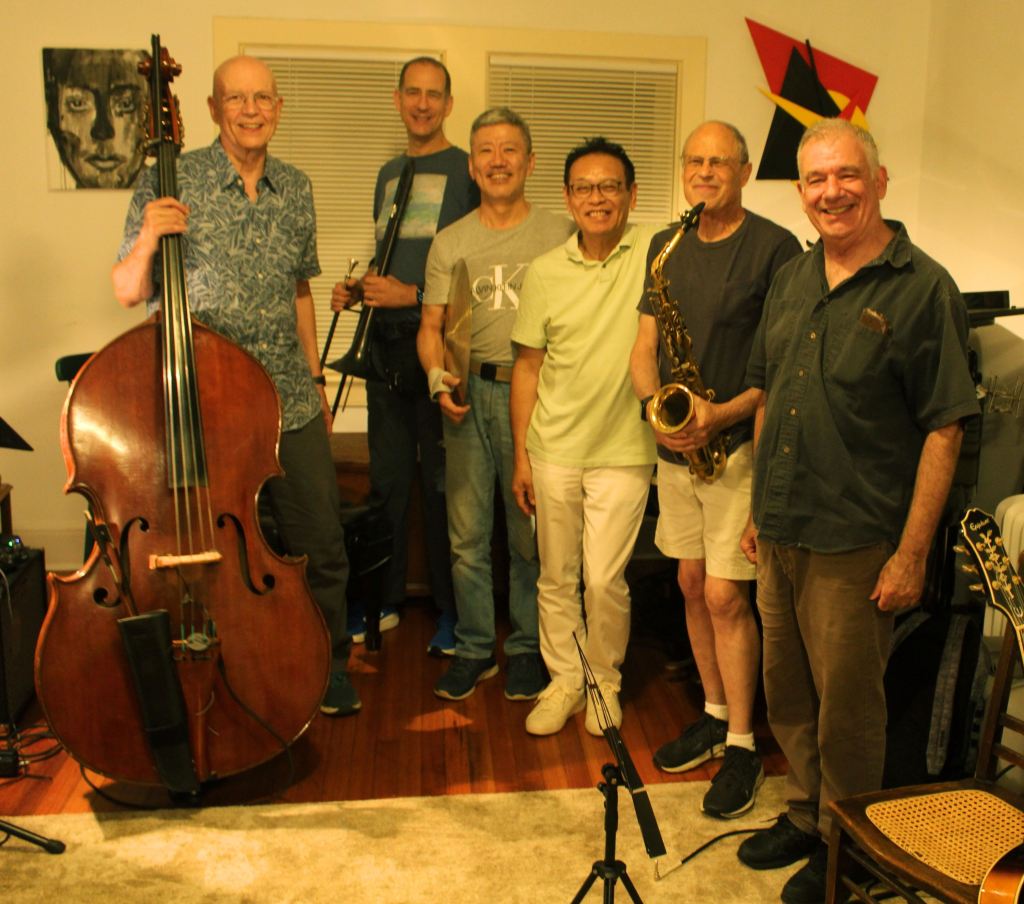
Yet after years of training and trying, I have never been able to play a lick of it. So I had the bright idea to interview the members of the East-West Rivertowns Sextet, which meets biweekly* in my dad’s living room to play, to see what they have that I so conspicuously lack.
Here I should pause to introduce the players. I’ll do so in the order they usually play.
Typically, the melody is played by the horn players—in this case, trombone and saxophone. Meanwhile, the rhythm section—drums, bass, piano, and guitar—provides the harmonic cushion and percussive drive.
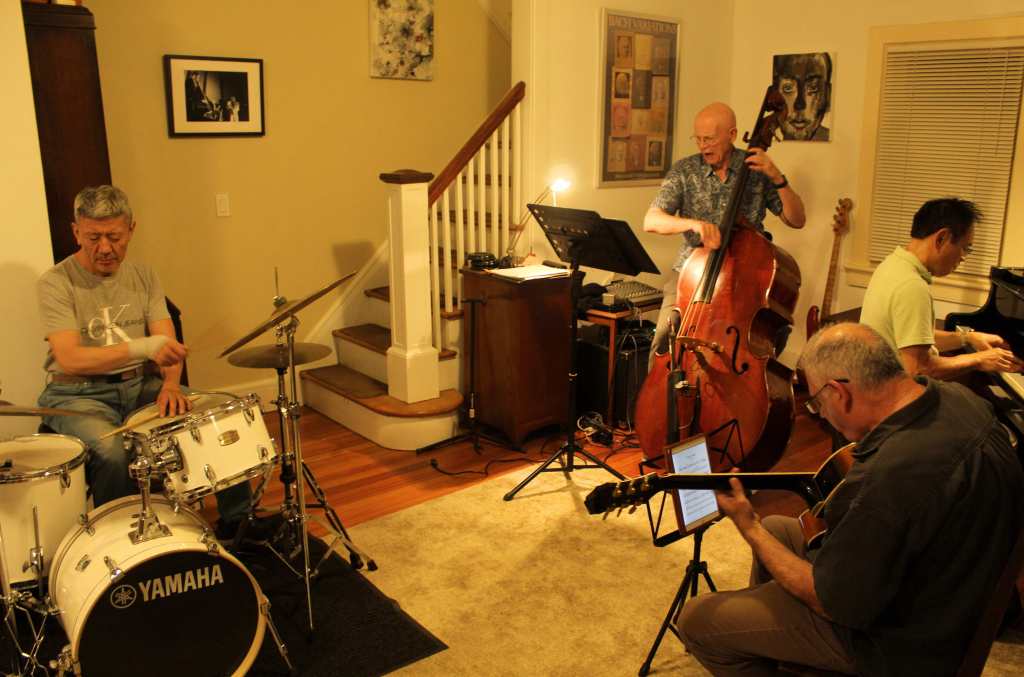
Then, the solos.
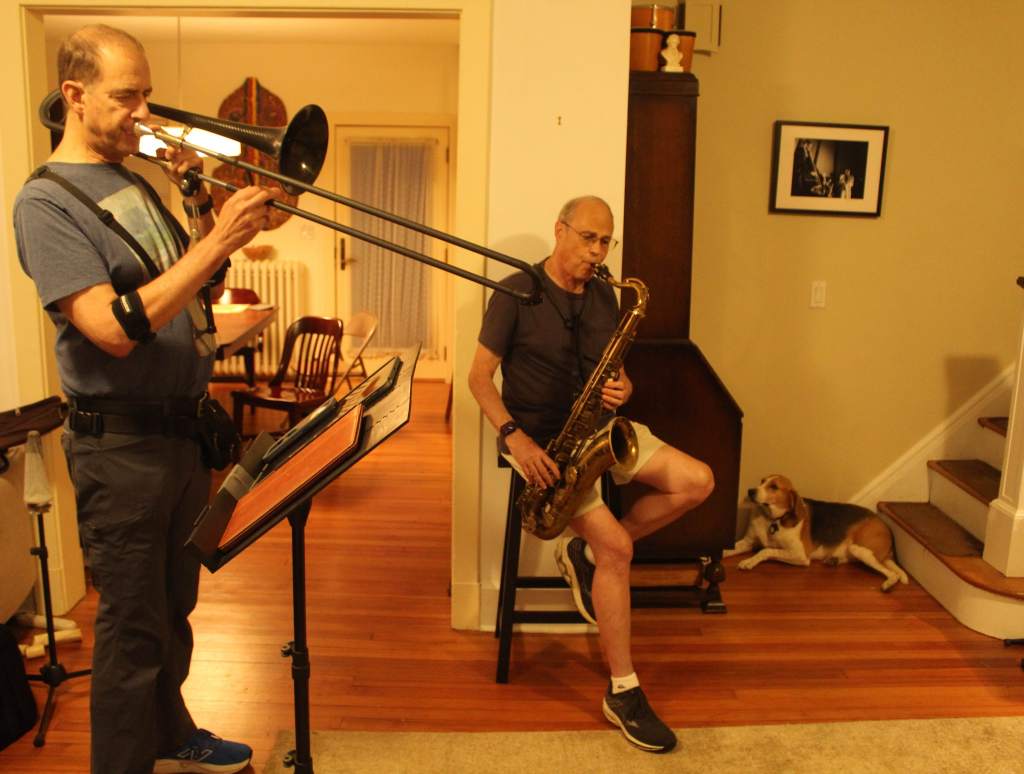
The first to bat is Allan Namery, who plays both alto and tenor sax (not an easy transition, since they’re keyed differently). As a student, Allan started on clarinet; but he early made the switch to sax. From there, jazz was almost inevitable, as all the best saxophonists are jazz players. Allan worked as a music teacher and band director in a public high school in Jersey City, and spent seemingly the rest of his time studying and playing as much jazz as humanly possible. He knows everyone, and he’s played it all.
Next it’s Alan Goidel’s turn, the trombonist. When asked why he settled on that instrument, he indicated his prodigious height. “Long arms.” Curiously, he was playing a trombone made of carbon fiber rather than brass, because it’s much lighter and easier to manage. Also a public school teacher, Alan has been playing trombone—classical, big band, latin, you name it—in New York and beyond for his whole working life.
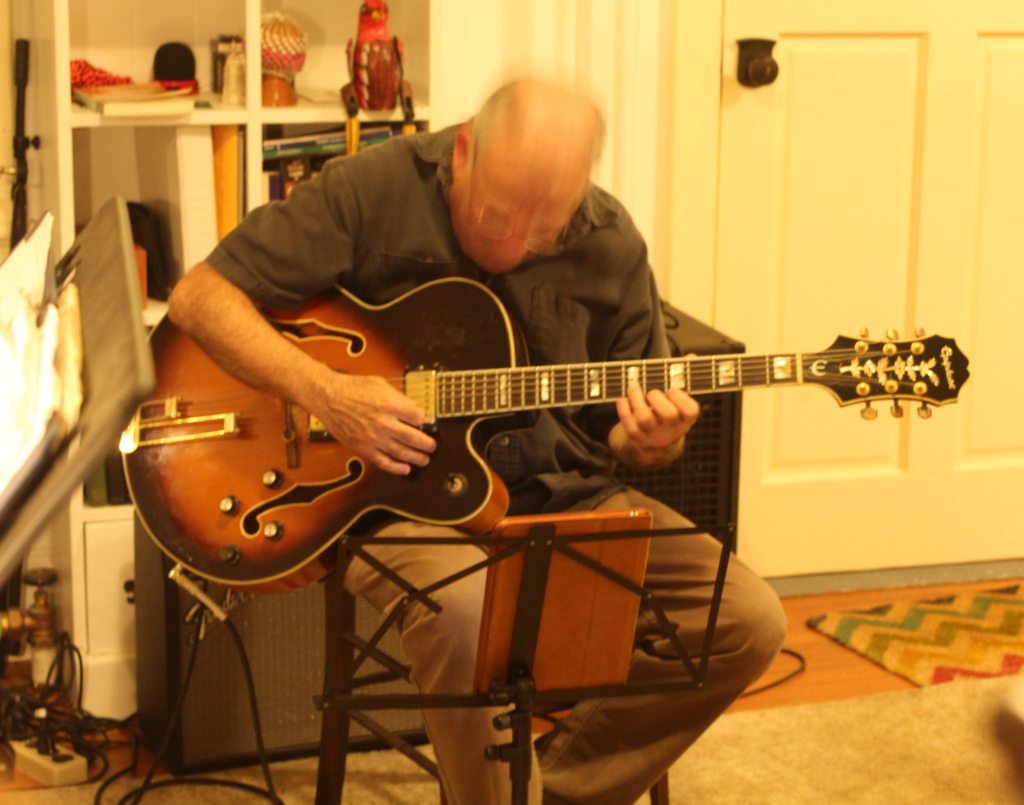
Now it’s time for Ray Machiarolla to take a guitar solo. Unusually, Ray plays with his thumb rather than a pick. When I asked him why, he said that’s just how he learned: he is mostly self-taught, modeling his style on players like Wes Montgomery, Jim Hall, and Kenny Burrell. Supplementing his income, as many musicians do, with another line of work—in his case, IT—he nevertheless has managed to play seemingly with everyone, all over the place.
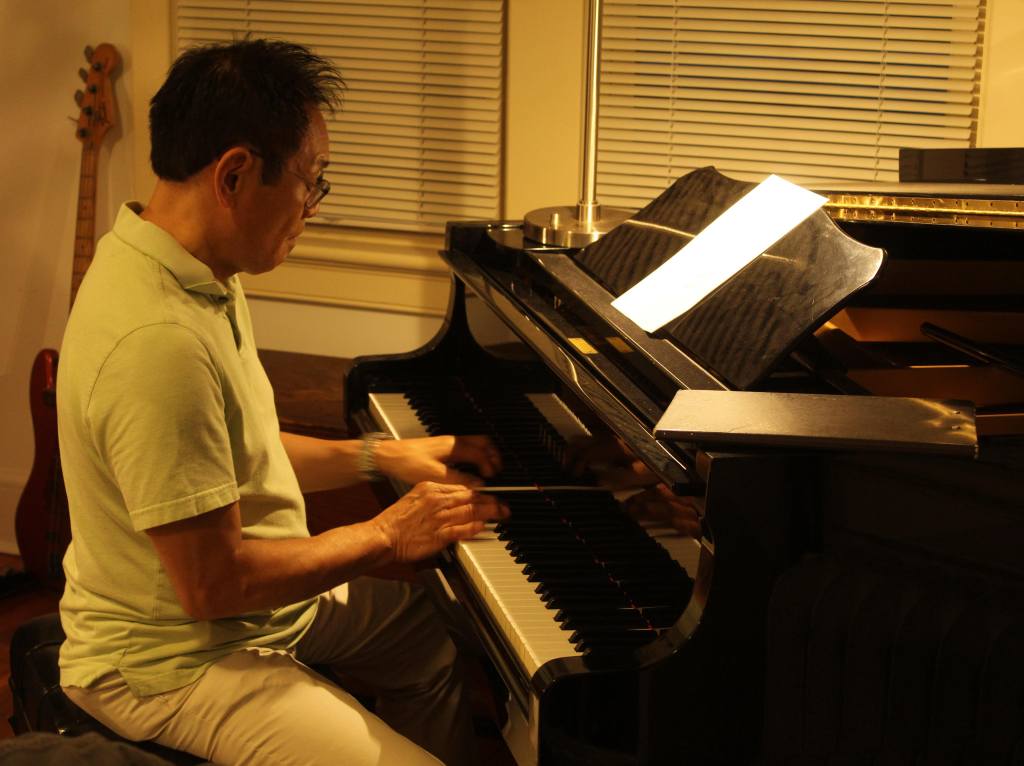
Hiroshi Yamazaki on the piano picks up where Ray left off. Hiroshi has been a musician his whole professional life, having graduated with a degree in music from Osaka College. His early musical experience was devoted to classical music. Indeed, he didn’t even hear jazz until the age of 19. But he quickly became hooked, listening to Art Blakey cassettes so often that he wore them out. He moved to the United States at the age of 30, to the East Village, in order to further his jazz career. Nowadays, when he isn’t playing, he’s teaching at the Conservatory of Westchester.
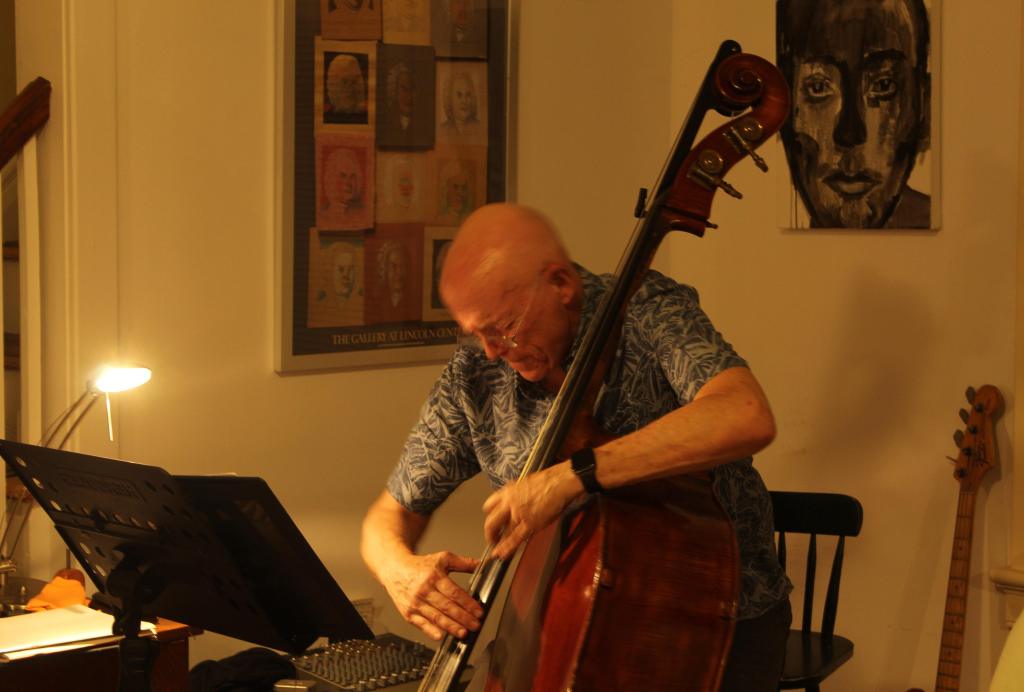
After the piano comes the bass, played by my father. As is typical in jazz, he plays an upright rather than an electric bass—a considerably larger instrument, though next to my tall dad it looks proportionate. Norm got involved in the music scene as early as he could (playing in a rock band that made the cover of Seventeen Magazine), and later on he studied both classical and jazz. But like so many musicians, my dad got himself a stable job, and has only been able to fully devote himself to music since his retirement. When asked why it’s so hard for musicians to make a living through their playing, he reminded me of the pertinent Hunter S. Thompson quote:
The music business is a cruel and shallow money trench, a long plastic hallway where thieves and pimps run free, and good men die like dogs. There’s also a negative side.
Finally we get to the drums, played by Seiji Ochiai. Another Japanese expat—hailing from the Shizuoka prefecture—Seiji began playing at the age of 16, at first in a rock band. Like me, he studied anthropology in college (and, like me, he soon discovered it wasn’t very profitable). But he commuted to Tokyo for drum lessons during his studies, and his teacher introduced him to jazz. At the age of 27, he sold nearly everything he had and came to the United States with a single suitcase. For money, he works in a studio assembling picture frames. But he plays jazz whenever he can—indeed, he makes a trip out to Taiwan every year to do some gigs there.
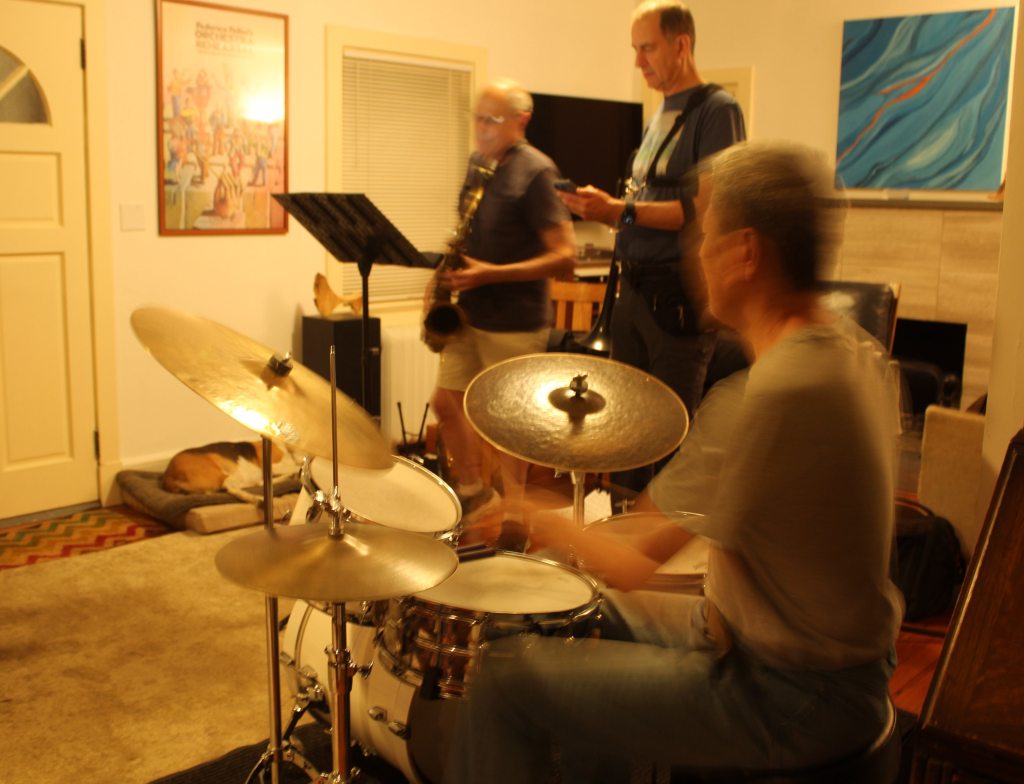
After Seiji is finished trading eights with the other players, the horns play the melody one more time, and the tune is over.
The defining feature of jazz is improvisation. Rock or blues music may have a guitar solo, but that’s about it. In jazz, by contrast, the melody (or “head”) can be a minor feature of the song—merely a structure to organize and bookend long, elaborate solos. You can’t play jazz if you can’t improvise.
At first glance, putting together a solo may not seem too daunting. Just fiddle around on the relevant musical scales, and voilà—there’s your solo. In practice, it’s very difficult to play something that doesn’t make your ears bleed. A good solo has a sense of humor, timing, form, progression, dynamics—in short, musicality. Compare a five-minute sketch of an expert draftsman with the doodle of a preschooler, and you will get an idea of the difference between a competent and incompetent solo.
But how can any mortal musician be expected to put together a compelling melody off the top of their head? The short answer is: they don’t. As Allan suggests in the opening quote, jazz is a musical language, and good soloists take the building blocks of that language—licks, runs, quotes of other tunes, or simply their basic instincts of harmony and melody, shaped from a lifetime of playing—and use them to construct something new, yet familiar enough to be called a jazz solo.
This is perhaps not as mysterious as it sounds. This sort of structured improvisation is arguably akin to what chess masters do—memorizing thousands of situations and patterns—or how freestyle rappers train themselves to spit fire on any subject, by having a stock of rhythmic, rhyming phrases. Indeed, many scholars believe the Homeric poems emerged out of a tradition of “improvised” recitation. You may go as far as to say that this is the basic state of affairs for any artform that doesn’t rely strictly on a written medium.
Yet this is where Allan’s comparison with writing breaks down. As I pointed out, when you’re writing, you can go over and revise a sentence innumerable times, until you’re finally satisfied. The same can be said of a classical composer, or an oil painter (unless you’re Jackson Pollock), or even a pop musician doing multiple takes in the studio. Some artforms, you might say, are based on the product, while others—like jazz—are based on the process.
This was exemplified when Ray expressed his boredom with big band playing. (Big band jazz is perhaps the closest jazz comes to classical music, as much of the music is through-composed.)
“It’s just a lot of reading,” Ray said. “I get tired of reading. Can’t we just play?” Alan, the trombonist, had a revealing comment when he added: “The thing I don’t like about big band playing is that they expect you to start hot. I can’t play like that. I have to warm up into a solo.”
Another clue came when Ray said: “It’s a conversation.” By this he meant that jazz is intrinsically a group activity, and one’s playing should respond to the other members of the group.
Here I am reminded of the Enlightenment-era Parisian salons or the Bloomsbury Group (of which Virginia Woolf and John Maynard Keynes were members), in which witty, learned conversations are prized as an end in themselves. You might fancifully say that jazz musicians are doing the same, making reference to Wes Montgomery or Red Garland rather than Plato or Voltaire: a clever exchange of musical repartee.
This all adds up to a very confusing picture. On the one hand, the players downplayed the level of spontaneity required for a solo; but on the other, it was clearly important to them to be improvising their own way, and not just reading someone else’s musical ideas.
Perhaps the best way to escape this apparent dilemma was provided by the great Chick Corea. His article “The Myth of Improvisation” (which Alan recommended to me) acknowledges that, even if jazz musicians are expected to discover their solo along the way, most have a strong idea of what they are going to play beforehand. Indeed, a truly spontaneous solo would sound, according to Corea, “very erratic,” while it takes “once or twice or a hundred times before what you’re doing comes out as a flow.” What makes a solo good, then, is not its unpredictability; rather, it is the musician’s ownership and mastery of the musical ideas. In Corea’s zenful words:
There’s a myth that spontaneity has something to do with the musical phrase being different from anything that has come before. But newness is just viewing something from now, from the present moment. It doesn’t matter if the tree you’re looking at now is the same tree you looked at yesterday. If you’re looking at the tree now, it’s a new experience. That’s what life is about.
Now it was time to play.
To give an adequate taste of a session, I will contrast it with how my band used to practice. Typically, we had a list of songs we would play at the next gig, and we would rehearse them again and again until they sounded halfway decent. Sometimes we played the same song a dozen times in a row. And if we jammed—as in, attempted improvisation—it was a loud, chaotic mess of feedback and dissonance.
When the Rivertown Sextet plays, it is quite different. They have no set list whatsoever. Somebody calls a tune—any one of the hundreds of jazz standards—and they simply start playing, after perhaps only a few quick words on the key or the tempo. Admittedly, some of the musicians have tablets with digital lead sheets (showing the melody and chords) that can be quickly called up. But often they play from memory. According to my dad, it is common for jazz players to have hundreds—even thousands—of songs memorized, to be called up at a moment’s notice.
Hearing them, the amateur musician is amazed that there are scarcely any false starts, flubbed notes, or other breakdowns that cause them to have to stop or repeat a song. It is just tune after tune, each one played expertly, as if they had rehearsed it a thousand times.
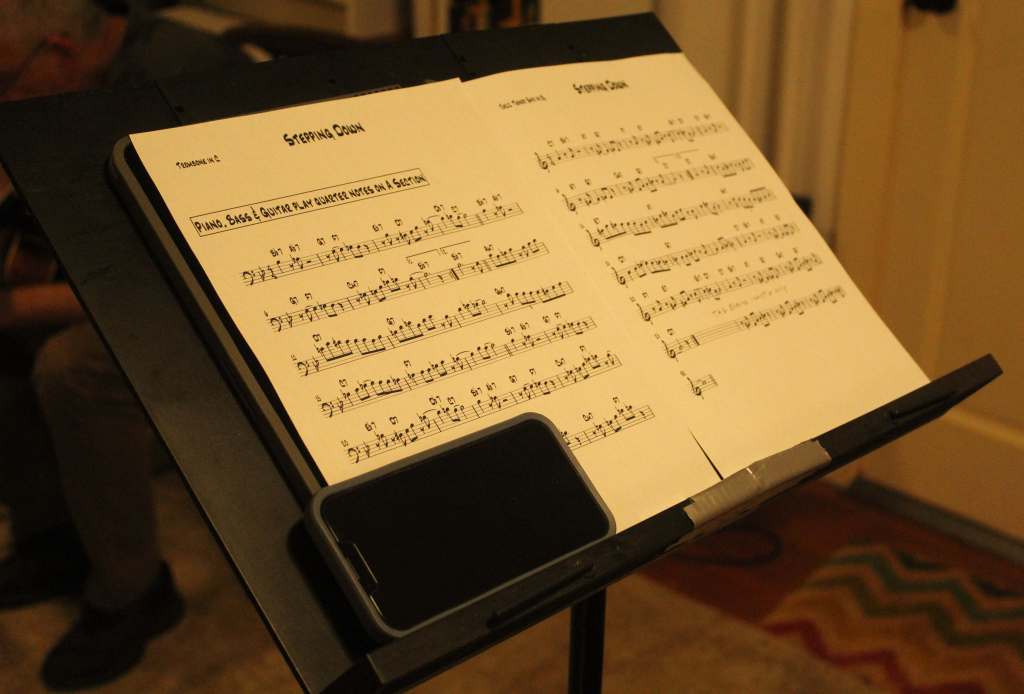
As a case in point, three of the musicians brought in original compositions on the day I observed. Hiroshi brought in “Blues on the Street,” Alan Goidel “Steppin’ Down” (which he said he had written at 9 o’clock the night before), and Allan Namery the ballad “Urban Renewal.” In other words, there was simply no way the other musicians could have practiced the tunes beforehand. Still, it all went off without a hitch.
To further illustrate the point, after playing several songs in common time, Ray requested they do something “in 3” (as in, waltz time) to break up the monotony. Somebody suggested that they just do the song they were about to play, “This I Dig of You,” in the new time signature—a transition many musicians would find awkward—and, once again, the song was played impeccably.
It is as if these musicians had transcended the need to practice and rehearse, so fluent had they become in the idiom of jazz. They could just play. And I ask again: what do they have that I lack?
I suppose the simple, unsexy answer is that these musicians have all spent thousands of hours listening, jamming, shedding, critiquing and getting critiqued, taking classes and giving classes, bombing and smoking and burning, in order to get where they are now.
Arthur C. Clark famously said: “Any sufficiently advanced technology is indistinguishable from magic.” But it turns out that mastery can be indistinguishable from magic, too.
*It is among the unfortunate details of the English language that “biweekly” can mean either twice a week or every two weeks. In this case, I mean the latter.

 Lotz in Translation